
FEDERAL REAL PROPERTY
Successful Public Buildings Service Reorganization Is Critical for Addressing Longstanding Challenges
Statement of Heather Krause, Managing Director, Physical Infrastructure
Before the Subcommittee on Economic Development, Public Buildings, and Emergency Management, Committee on Transportation and Infrastructure, House of Representatives
For Release on Delivery Expected at 10:00 a.m. ET
United States Government Accountability Office
A testimony before the Subcommittee on Economic Development, Public Buildings, and Emergency Management, Committee on Transportation and Infrastructure, House of Representatives
For more information, contact: Heather Krause at KrauseH@gao.gov
What GAO Found
Federal real property management has faced longstanding challenges. The General Services Administration (GSA) and its component office, the Public Buildings Service (Buildings Service), play a central role in addressing the high-risk issues identified by GAO of underused buildings, real property data reliability, and building condition.
· Underused buildings. Federal agencies, many of which are tenants in buildings managed by the Buildings Service, have long struggled to determine how much space they need to fulfill their missions. Retaining this underused space costs millions of dollars. While the issue remains on GAO’s High-Risk List, GSA and others have taken steps to address underused buildings in recent years. For example, in March 2025, GSA launched a program called Space Match to help agencies find available office space in underused federal space. According to GSA, potential benefits of the program include helping agencies find available space as employees return to in-person work; optimizing the use of underused space; and creating a collaborative work environment for agencies.
· Data reliability. Without reliable data, supporting real property management and decision making is difficult. GAO has identified problems with the reliability of federal real property data since GAO first designated management of federal real property as a High-Risk area in 2003. GSA has taken steps to improve the reliability of real property data, including contributing to new quality standards in August 2024.
· Building Condition. In the 2025 High-Risk Update, GAO added building condition as a new concern for federal real property due to large increases in the cost of addressing deferred maintenance in federal buildings. This backlog of maintenance and repair needs has more than doubled in estimated cost from fiscal years 2017 through 2024, going from $170 billion to $370 billion. In addition, GAO found in 2023 that the spaces of federal agencies, many of which are GSA tenants, are not well configured to meet modern office needs. If agencies continue to operate in poorly configured office buildings, they will continue to underuse space, spending unnecessary operating funds. GSA and Buildings Service tenant agencies are taking steps to improve building condition and configuration, but challenges remain.
As instructed by the administration, the Buildings Service began a major reorganization in March 2025, which has included reducing staff levels by about 50 percent. Buildings Service officials told GAO in September 2025 that they planned to finalize this reorganization in October 2025. GAO has not confirmed with GSA how the recent lapse in appropriations affected its implementation timeline. GAO will issue a report in the coming months applying leading practices for agency reforms to the Buildings Service’s reorganization efforts. GAO’s past work has shown that agency reforms are more likely to be successful in refocusing and enhancing agency missions and achieving efficiency and effectiveness if they follow these leading practices.Why GAO Did This Study
Federal real property management has been on GAO’s High-Risk List since 2003. GAO has previously reported that better management is needed to effectively dispose of underused buildings, collect reliable real property data, and improve the condition of federal buildings. The Buildings Service’s primary mission is to manage federal real property. In March 2025, the Buildings Service began taking reorganization actions.
This statement discusses how the issues of underused buildings, data reliability, and the condition of federal buildings on the High-Risk List relate to GSA and the efforts GSA’s Buildings Service has taken to reorganize as of October 2025. This work is a part of a review for Congress on the organization and management of the Buildings Service.
GAO’s description of the relationship of the high-risk issues to GSA is based on GAO’s prior work and reflects GAO’s most recent High-Risk Update, released on February 25, 2025. As of May 2025, GAO has eight open priority recommendations to GSA on real property High-Risk issues, including property disposal, data reliability, and the management of deferred maintenance and repair. See GAO-25-108060.
To identify the steps the Buildings Service has taken to reorganize, GAO reviewed GSA documents and interviewed GSA officials.
December 11, 2025
Chairman Perry, Ranking Member Stanton, and Members of the Subcommittee:
Federal real property management has been on GAO’s High-Risk List since 2003.[1] We have previously reported that better management is needed to effectively dispose of underused buildings, collect reliable real property data, and improve the condition of federal buildings. While the challenges of managing federal real property are governmentwide, the Public Buildings Service (Buildings Service), within the General Services Administration (GSA), is the agency component whose primary mission is to manage federal real property. Specifically, the Buildings Service’s mission is to provide workspace for more than 1 million federal employees at the best value for taxpayers.
As of September 2025, the Buildings Service’s portfolio includes about 8,500 owned and leased properties covering, 359 million square feet and housing 80 tenant agencies. It collects more than $10 billion annually in rent from its tenants and provides tenants with a broad range of real estate services, including maintaining owned buildings, negotiating leases, disposing of unneeded properties, and helping agencies plan their real property portfolios. The administration has expressed a desire for a smaller and more efficient federal workforce, including in its February 26, 2025, memo, Guidance on Agency Reduction in Force and Reorganization Plans (ARRP). Since March 2025, the Buildings Service has been engaged in a large-scale reorganization. Buildings Service officials told us in September 2025 that they planned to finalize this reorganization in October 2025. GAO has not confirmed with GSA how the recent lapse in appropriations affected its implementation timeline. The successful implementation of this reorganization will be critical for the Buildings Service’s ability to address longstanding real property management challenges moving forward.
My statement today discusses: (1) how the recommendations made concerning issues of underused buildings, data reliability, and the condition of federal buildings on GAO’s High-Risk List relate to GSA; and (2) the reorganization efforts of GSA’s Buildings Service as of October 2025. We plan to report more fully on the Buildings Service’s reorganization in the coming months. Our description of GSA’s efforts to address high-risk issues is based on GAO’s prior work and reflects GAO’s latest High-Risk Update, released on February 25, 2025.[2] To identify the efforts the Buildings Service has made to reorganize, we reviewed pertinent documents and interviewed GSA officials.
We conducted the work on which this statement is based in accordance with generally accepted government auditing standards. Those standards require that we plan and perform the audit to obtain sufficient, appropriate evidence to provide a reasonable basis for our findings and conclusions based on our audit objectives. We believe the evidence obtained provides a reasonable basis for our findings and conclusions based on our audit objectives.
GSA Actions Have Resulted in Improvements to the High-Risk Area of Managing Federal Real Property, but More Progress is Needed
Underused Buildings
Federal agencies, many of which are tenants in buildings managed by the Buildings Service, have long struggled to determine how much space they need to fulfill their missions. Retaining underused space costs millions of dollars and is one of the main reasons that federal real property management has remained on GAO’s High-Risk List since 2003. The following are key actions that Congress, GSA, and others have taken to address underused buildings in recent years.
· Enacted in January 2025, the Utilizing Space Efficiently and Improving Technologies (USE IT) Act requires agencies to measure building utilization and plan to dispose of underused space.[3] Specifically, it requires that agencies measure the utilization of public buildings by comparing the usable square footage of each space to the occupancy of the building.[4] If a tenant agency’s building utilization remains below 60 percent capacity for 2 consecutive years, GSA, in consultation with the Office of Management and Budget (OMB), must take steps to reduce the amount of underused space. This Act, combined with effective implementation, would address our 2023 recommendation on the need for governmentwide guidance on measuring space utilization.[5]
· In March 2025, GSA announced it would begin disposing of federally owned office buildings using what it described as an accelerated approach. As of November 2025, GSA had identified 45 federal properties—many of which were previously identified for disposal—for this accelerated approach. GSA estimates that disposing of these properties will reduce the federal government’s real property inventory by 14.6 million square feet and save $106 million in annual operations and $3 billion in deferred maintenance costs.
· In addition, as of August 2025, a temporary real property disposal process established under the Federal Assets Sale and Transfer Act of 2016 (FASTA) had resulted in GSA selling 11 properties for a total of $331 million.[6] In May 2025, the board created under FASTA also recommended 11 additional GSA properties for disposal.
· In February 2025, GSA initiated an effort to reduce unneeded and underused space leased by GSA for federal tenant agencies. GSA targeted its space reduction effort on federal leases in the “soft term,” the part of the lease term subject to termination rights.[7] According to GSA officials, GSA consulted with tenants prior to sending formal intent to terminate lease letters. GSA sent letters to federal tenant agencies asking them whether the agency’s ability to fulfill its mission would be “irreparably compromised” if GSA were to terminate these leases. GSA estimates $112 million in annual costs savings from over 260 completed lease terminations or leases for which GSA has sent an intent to terminate.
· In March 2025, GSA launched a program called Space Match to help federal agencies find available office space in underused space. According to GSA, potential benefits of the program include helping agencies find available space as employees return to in-person work; optimizing the use of underused space; and creating a collaborative work environment for agencies. GAO has not reviewed this program.
We are currently reviewing GSA’s real property disposal and sales processes. We expect to issue reports on those topics in 2026.
Data Reliability
Effective real property management and decision-making is difficult without reliable data. GSA relies on federal agencies to submit accurate data to the Federal Real Property Profile, the governmentwide database of federal real property that GSA uses to manage buildings, structures, and land. We have identified problems with the reliability of federal real property data since we first placed management of federal real property on the High-Risk List.
GSA has worked with federal agencies to improve the reliability of federal real property data. In 2020, we reported that 67 percent of addresses in the Federal Real Property Profile public database were incorrectly formatted or incomplete.[8] GSA took actions to improve its process for validating and verifying addresses in this database. In 2023, we found that over 98 percent of addresses were correctly formatted, but that location data errors continued.
In August 2024, the Federal Real Property Council, an interagency council of which GSA is a member, published guidance to help federal agencies improve the quality of data they submit to the Federal Real Property Profile.[9] The guidance instructs agencies to concentrate their initial data quality improvement efforts on data elements such as property type and property use because these elements are most easily verified with external information. GSA established a strategic initiative to improve real property data accuracy through data standards and management in its strategic plan for fiscal years 2022-2026. GSA also implemented a tool that alerts agencies to potentially incorrect location data in the Federal Real Property Profile database.
Moving forward, GSA should continue to take steps to fully implement our 2020 recommendation to help federal agencies improve their data reliability by implementing the data quality standards identified in the Federal Real Property Council’s August 2024 guidance and ensuring street address information is accurate.[10] As of November 2025, this recommendation was partially addressed.
We are currently completing an assessment of the reliability and utility of the Federal Real Property Profile. We plan to issue that report in early 2026.
Building Condition
In the 2025 High-Risk Update, we added building condition as an area for concern due to large increases in the cost of addressing deferred maintenance in federal buildings. This backlog of maintenance and repair needs more than doubled in estimated cost from fiscal years 2017 through 2024, going from $170 billion to $370 billion. GSA’s estimated backlog of total liabilities, including deferred maintenance, for the next 10 years is $26 billion, as of September 2025. GSA and Buildings Service tenant agencies are taking steps to improve building condition and configuration, but the continuing challenges led us to include the topic in the High-Risk update.
· In 2023, we determined that the spaces of federal agencies, many of which are tenants of GSA, are not well configured to meet modern office needs.[11] If agencies continue to operate in poorly configured office buildings, they will continue to underuse space, spending unnecessary operating funds. Agencies ranked a shortage of funds in their budget to reconfigure space as the top challenge to increasing utilization of their headquarters buildings.
· In 2023, we reviewed GSA and three other agencies and found they did not fully communicate the potential costs of maintenance backlogs to Congress.[12] None of the agencies provided sufficient information in their financial and budget documents to explain how much of their backlog was for projects necessary to fulfilling agency missions. As a result, Congress and the public do not have a clear picture of the anticipated costs to address the deferred maintenance that may impact critical government functions. We recommended that GSA and three other agencies fully communicate repair needs to Congress and the public. As of November 2025, all four of these recommendations remained open; two of the four are partially addressed.
GSA’s Buildings Service Reduced Staff and Took Initial Steps to Implement a Reorganization as of October 2025
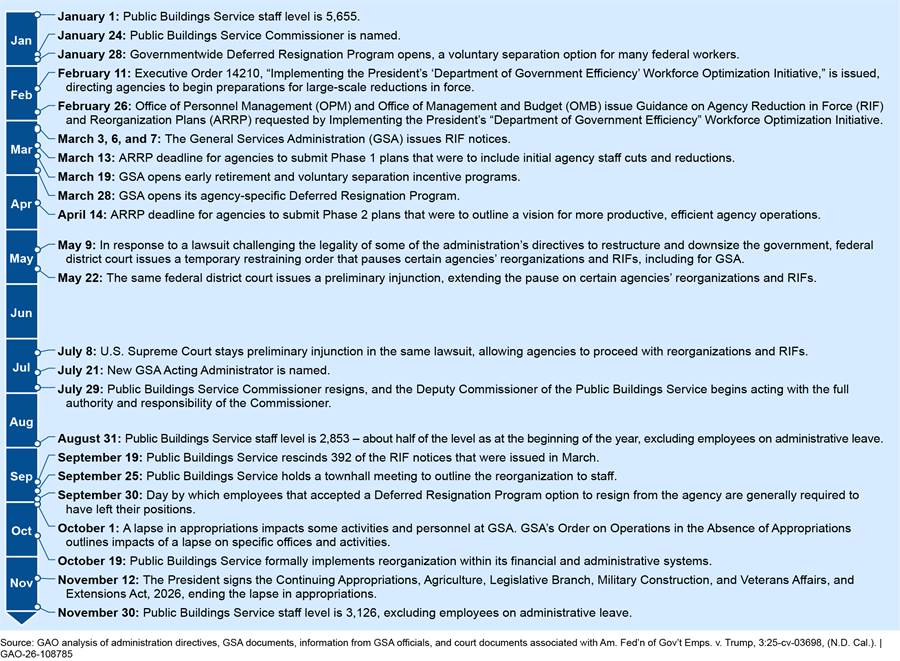
As of October 2025, the Buildings Service had taken several reorganization actions, such as reducing staff and developing its proposed new organizational structure. We have not confirmed with GSA how the recent lapse in appropriations affected its implementation timeline. We spoke to Buildings Service officials as part of an ongoing review on the organization and management of the Buildings Service, which was directed by a provision of the Thomas R. Carper Water Resources Development Act.[13] Buildings Service officials told us that the agency initially planned to complete its reorganization in July 2025 but postponed implementation due to litigation and leadership changes. See Figure 1 for a timeline of events since January 2025 related to the Buildings Service’s reorganization.
Figure 1: Events Related to the Public Buildings Service’s Reorganization, January 2025 through November 2025
Our past work has shown that agency reforms are more likely to be successful in refocusing and enhancing agency missions and achieving efficiency and effectiveness if leading reform practices are followed.[14] Following these leading reform practices could help the Buildings Service ensure that its reorganization is a success.
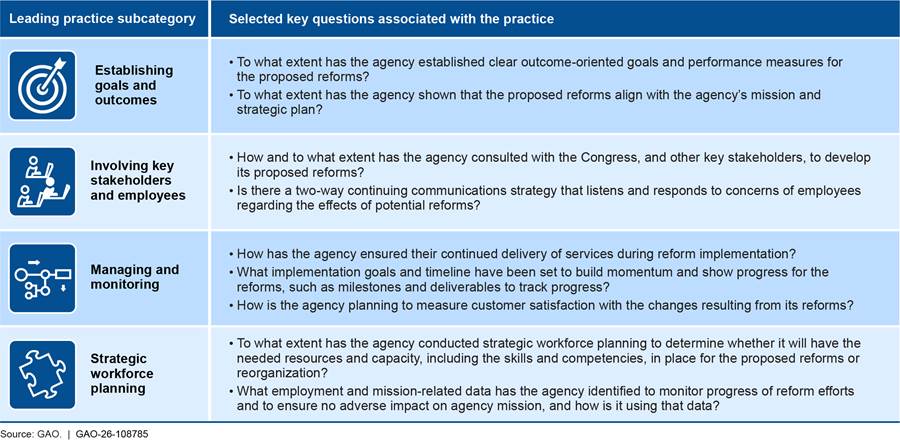
We have work underway for the Congress which applies selected leading practices for agency reforms to the Buildings Service’s reorganization to date. We plan to issue this work in the next few months. We selected these leading practices and associated key questions based on their relevance to Section 2305 of the Water Resources Development Act, which directed our work; the stage of the Buildings Service’s reorganization; and relevance to administration priorities identified for Agency Reduction in Force and Reorganization Plans (ARRP) (see fig. 2).[15] We interpret the administration’s ARRP guidance as indicative of the administration’s priorities in conducting agencies’ reorganizations. We do not plan to assess GSA’s ARRP, but we assessed the Buildings Service’s actions related to its own reorganization.
Figure 2: Selected Leading Practices and Key Questions for Agency Reform
In addition, we plan to report on selected tenant agency views on the strengths and limitations of the organization of the Buildings Service that was in place as of December 31, 2024. We also will describe former Buildings Service Commissioners’ views on both the strengths and limitations of the organization of the Buildings Service as of December 31, 2024, and their perspectives on potential improvements.
Chairman Perry, Ranking Member Stanton, and Members of the Subcommittee, this concludes my prepared statement. I would be pleased to respond to any questions that you may have at this time.
GAO Contact and Staff Acknowledgments
If you or your staff have any questions about this testimony, please contact Heather Krause, Managing Director, Physical Infrastructure at KrauseH@gao.gov. Contact points for our Offices of Congressional Relations and Public Affairs may be found on the last page of this statement. GAO staff who made key contributions to this testimony are Keith Cunningham (Assistant Director), Krishana Perry (Analyst in Charge), Audrey Blumenfeld, and Grace Pettey. Madeline Barch, Melissa Bodeau, Matt Cook, Emily Crofford, Adam Darr, Josh Ormond, Sarah Veale, and Alicia Wilson provided key support.
This is a work of the U.S. government and is not subject to copyright protection in the United States. The published product may be reproduced and distributed in its entirety without further permission from GAO. However, because this work may contain copyrighted images or other material, permission from the copyright holder may be necessary if you wish to reproduce this material separately.
The Government Accountability Office, the audit, evaluation, and investigative arm of Congress, exists to support Congress in meeting its constitutional responsibilities and to help improve the performance and accountability of the federal government for the American people. GAO examines the use of public funds; evaluates federal programs and policies; and provides analyses, recommendations, and other assistance to help Congress make informed oversight, policy, and funding decisions. GAO’s commitment to good government is reflected in its core values of accountability, integrity, and reliability.
Obtaining Copies of GAO Reports and Testimony
The fastest and easiest way to obtain copies of GAO documents at no cost is through our website. Each weekday afternoon, GAO posts on its website newly released reports, testimony, and correspondence. You can also subscribe to GAO’s email updates to receive notification of newly posted products.
Order by Phone
The price of each GAO publication reflects GAO’s actual cost of production and distribution and depends on the number of pages in the publication and whether the publication is printed in color or black and white. Pricing and ordering information is posted on GAO’s website, https://www.gao.gov/ordering.htm.
Place orders by calling (202) 512-6000, toll free (866) 801-7077,
or
TDD (202) 512-2537.
Orders may be paid for using American Express, Discover Card, MasterCard, Visa, check, or money order. Call for additional information.
Connect with GAO
Connect with GAO on X,
LinkedIn, Instagram, and YouTube.
Subscribe to our Email Updates. Listen to our Podcasts.
Visit GAO on the web at https://www.gao.gov.
To Report Fraud, Waste, and Abuse in Federal Programs
Contact FraudNet:
Website: https://www.gao.gov/about/what-gao-does/fraudnet
Automated answering system: (800) 424-5454
Media Relations
Sarah Kaczmarek, Managing Director, Media@gao.gov
Congressional Relations
A. Nicole Clowers, Managing Director, CongRel@gao.gov
General Inquiries
[1]Since the early 1990s, our high-risk program has focused attention on government operations with significant vulnerabilities to fraud, waste, abuse, and mismanagement or that need transformation to address economy, efficiency, or effectiveness challenges. GAO, High-Risk Series: Heightened Attention Could Save Billions More and Improve Government Efficiency and Effectiveness, GAO‑25‑107743 (Washington, D.C.: Feb. 25, 2025).
[3]Thomas R. Carper Water Resources Development Act, Pub. L. No. 118-272, § 2302, 138 Stat. 2992, 3218 (2025).
[4]Occupancy is the average number of employees performing duties in person in a public building or federally leased space at least 40 hours per week over a 2-month period. Covered agencies were directed to begin collecting utilization measurements beginning no later than July 3, 2025, 180 days after the date of enactment. Id. § 2302(b)(2).
[5]GAO, Federal Real Property: Agencies Need New Benchmarks to Measure and Shed Underutilized Space, GAO‑24‑107006 (Washington, D.C.: Oct. 26, 2023).
[6]Pub. L. No. 114-287, 130 Stat. 1463 (codified as amended 40 U.S.C. § 1303 note). FASTA originally included three rounds of recommendations by the Public Buildings Reform Board, but recently enacted legislation directed an additional, fourth round to identify additional properties. Pub. L. No. 118-272, § 2301, 138 Stat. at 3214.
[7]GSA often enters into leases for a “full term,” split into an initial “firm” term and a “soft” or “non-firm” term. The firm term is the part of the leas not subject to termination rights, while the “soft” or “non-firm” term is the portion of the lease following the firm term, which is subject to termination rights. See, for example, U.S. Gen. Services Admin. Leasing Desk Guide, chs. 2, 2.1-13–2.1-14 (2022); U.S. Gen. Services Admin, Global Lease Template – GSA Template L100, 2 (2023).
[8]GAO, Federal Real Property: GSA Should Improve Accuracy, Completeness, and Usefulness of Public Data, GAO‑20‑135 (Washington, D.C.: Feb. 6, 2020).
[9]Federal Real Property Council, Agency-Level Federal Real Property Profile Data Quality Improvement Program Guidance (August 2024).
[12]GAO, Federal Real Property: Agencies Should Provide More Information about Increases in Deferred Maintenance and Repair, GAO‑24‑105485 (Washington, D.C.: Nov. 16, 2023).
[13]Pub. L. No. 118-272, div. B, tit. III, §2305, 138 Stat. 2992, 3225 (2025).
[14]We use the term “reforms” to broadly include any organizational changes—such as major transformations, mergers, consolidations, and other reorganizations—and efforts to streamline and improve the efficiency and effectiveness of government operations. GAO, Government Reorganization Key Questions to Assess Agency Reform Efforts, GAO‑18‑427 (Washington, D.C.: June 13, 2018).
[15]OMB, Guidance on Agency RIF and Reorganization Plans (Washington, D.C.: Feb. 26, 2025).