

Report to Congressional Committees
United States Government Accountability Office
A report to congressional committees
Contact: Heather MacLeod at MacleodH@gao.gov
What GAO Found
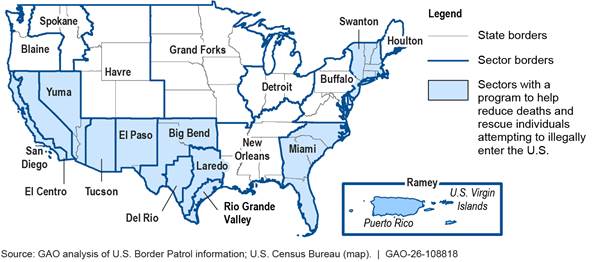
Border Patrol—a component of U.S. Customs and Border Protection (CBP)— established a program in 2017 to help rescue individuals in distress and reduce deaths along the border. The program includes various efforts such as placing rescue beacons and 911 placards in remote areas.
Border Patrol Sectors Operating Programs to Reduce Deaths and Rescue Individuals Attempting to Illegally Enter the U.S., as of April 2026
CBP used data in its fiscal year 2025 report to Congress that Border Patrol recorded using practices and systems that have not changed since our April 2025 report on these activities. However, CBP’s fiscal year 2025 report did not include all required information about rescue beacons. A Border Patrol official told GAO that the agency inadvertently omitted some information and was not aware it was required to report the remainder. Border Patrol’s internal operating procedures state that the program manager is responsible for completing the annual report to Congress, but they do not specify the reporting requirements. Documenting these requirements would help ensure CBP includes all required information in its annual reports and increase transparency about its efforts to reduce deaths and rescue individuals in distress along the border.
Border Patrol has taken several steps to evaluate its program to help reduce deaths and rescue individuals, in response to GAO’s two prior recommendations (GAO-25-107548). For example, it developed an evaluation plan that defined the scope, methodology, and timeline for an evaluation and identified information needed to complete it, consistent with GAO’s first recommendation. For the second recommendation, Border Patrol has conducted site visits, interviews, and a survey of staff, according to officials. Border Patrol has additional evaluation-related activities planned and expects to complete a program assessment by September 2026. Such an evaluation would help the agency determine if the program is meeting its intended purpose.
Why GAO Did This Study
Border Patrol responds to reports of individuals attempting to illegally enter the U.S. between ports of entry who may be missing or in distress. In fiscal year 2024, CBP reported Border Patrol responded to 3,302 rescue events. The Missing Persons and Unidentified Remains Act requires CBP to submit an annual report to Congress including the number and location of unidentified remains. The act also requires CBP to report information on rescue beacons, including their numbers and locations. CBP submitted its most recent report in August 2025.
The act includes a provision for GAO to annually review how CBP collects the data it reports to Congress and measures the effectiveness of its program to help reduce deaths and locate and rescue individuals attempting to illegally enter the U.S. who are in distress. This report focuses on CBP’s activities since GAO’s April 2025 report.
GAO assessed CBP’s (1) data collection for its fiscal year 2025 report to Congress and (2) efforts to measure program effectiveness. GAO reviewed Border Patrol documentation, including internal operating procedures, system guides, and program evaluation plans. GAO compared CBP’s fiscal year 2025 report to the act’s requirements and to prior annual reports. GAO also interviewed Border Patrol officials about their data collection and evaluation processes and practices.
What GAO Recommends
GAO is recommending that CBP ensure Border Patrol updates its internal operating procedures to document the reporting elements required by the act. The Department of Homeland Security concurred with the recommendation.
|
Abbreviations |
|
|
|
|
|
BSITS |
Border Safety Initiative Tracking System |
|
CBP |
U.S. Customs and Border Protection |
This is a work of the U.S. government and is not subject to copyright protection in the United States. The published product may be reproduced and distributed in its entirety without further permission from GAO. However, because this work may contain copyrighted images or other material, permission from the copyright holder may be necessary if you wish to reproduce this material separately.
July 14, 2026
The Honorable Rand Paul, M.D.
Chairman
The Honorable Gary C. Peters
Ranking Member
Committee on Homeland Security and Governmental Affairs
United States Senate
The Honorable Andrew Garbarino
Chairman
The Honorable Bennie G. Thompson
Ranking Member
Committee on Homeland Security
House of Representatives
U.S. Border Patrol—a component of the Department of Homeland Security’s U.S. Customs and Border Protection (CBP)—is responsible for securing U.S. borders between ports of entry.[1] This includes patrolling nearly 6,000 miles of land borders with Canada and Mexico, and about 2,000 miles of coastal waters around Puerto Rico and the Florida Peninsula. People risk injury or death when crossing the border in remote areas where they encounter dangerous terrain or conditions. As part of its mission, Border Patrol responds to reports of individuals attempting to illegally enter the U.S. who may be missing or in distress. In fiscal year 2024, for example, CBP reported that Border Patrol responded to 3,302 rescue events, resulting in 5,679 people rescued.[2]
In 2017, Border Patrol initiated a program to help reduce deaths along the southwest border and locate and rescue individuals attempting to illegally enter the U.S. who are in distress.[3] As of April 2026, Border Patrol operated the program in all southwest border sectors, as well as the Florida Peninsula, Puerto Rico, and the northeast border with Canada.[4]
The Missing Persons and Unidentified Remains Act of 2019 requires CBP to submit an annual report to Congress that includes the number and location of unidentified remains found along the southwest border.[5] The act also requires CBP to report information on rescue beacons, including the number in each sector, the specific locations of the beacons, the frequency with which a person in distress activated each beacon, and a description of the nature of the distress that resulted in each rescue beacon activation, if determinable.[6] In response, CBP submitted reports to Congress in March 2022, August 2023, April 2024, and most recently August 2025.[7] The reports include information on Border Patrol’s efforts to reduce the frequency of deaths, data on deaths and rescues in sectors where the program is operating, and information on its rescue beacons and 911 placards.[8]
The act also includes a provision for us to annually review how CBP collects the data it reports to Congress and measures the effectiveness of its program.[9] Since April 2022, we have issued four reports on the program.[10] In our April 2022 and April 2025 reports we made a total of five recommendations to improve how Border Patrol collects and reports data and how it evaluates the program. Border Patrol agreed with all five of our recommendations and implemented changes to address those from our April 2022 report. For example, we recommended that Border Patrol take steps to ensure the agency collects and records available information on deaths, including those identified by external entities. In response, Border Patrol revised its guidance, met with sector staff, and coordinated with external entities to better ensure data on all relevant deaths are included in its data systems.[11] In our April 2025 report, we recommended that Border Patrol develop an evaluation design and collect information on its activities that is clearly linked to the program’s scope and purpose. Later in this report, we discuss the steps Border Patrol has taken to address these recommendations.
This report focuses on Border Patrol’s data collection and efforts to measure program effectiveness since our April 2025 report and reflects information from CBP’s August 2025 report to Congress. Specifically, this report addresses (1) the extent to which Border Patrol records and reports required data on rescues, deaths, and related events and (2) how Border Patrol has evaluated the effectiveness of the program to help reduce deaths along the border and rescue individuals in distress.
To assess how Border Patrol records and reports data, we reviewed Border Patrol documentation, including the program’s internal operating procedures. These procedures include guidance on entering data, coordinating with external entities, and responding to inquiries about missing individuals.[12] We reviewed procedures for the Border Safety Initiative Tracking System—which Border Patrol used as its system to record information on deaths and rescues until March 2026.[13] We reviewed guidance for the Rescues and Recoveries Application, the new system to which Border Patrol transitioned.
In addition, we analyzed CBP’s fiscal year 2025 annual report to Congress to determine whether it included the information the act specified and the extent to which it differed from the fiscal year 2024 report. We also interviewed Border Patrol headquarters officials about the process for recording and reviewing data, focusing on processes and practices that have changed since our April 2025 report. Using the information from our analyses, document reviews, and interviews, we compared Border Patrol’s processes to Standards for Internal Control in the Federal Government, which describes how to effectively implement processes that help ensure an entity achieves its objectives—in this context, the required reporting to Congress.[14]
To describe how Border Patrol has evaluated the program’s effectiveness, we reviewed the forms sectors use to document program activities. We also reviewed evaluation design documents, including an evaluation plan and meeting agendas documenting key decisions, describing Border Patrol’s ongoing evaluation as of April 2026. We interviewed headquarters officials about the evaluation’s scope and methodology and the status of activities undertaken in response to the recommendations from our April 2025 report.
This report supplements information and draws from our previous reports. The scope and methodology for that work are detailed in the published reports.[15]
We conducted this performance audit from December 2025 to July 2026 in accordance with generally accepted government auditing standards. Those standards require that we plan and perform the audit to obtain sufficient, appropriate evidence to provide a reasonable basis for our findings and conclusions based on our audit objectives. We believe that the evidence obtained provides a reasonable basis for our findings and conclusions based on our audit objectives.
 Background
Border Patrol’s program to help reduce deaths along the border and locate and rescue individuals attempting to illegally enter the U.S. who are in distress includes various activities. These include responding to 911 calls and other reports, as well as placing rescue beacons and 911 placards in remote areas. In fiscal year 2024, for example, rescue beacon activation was linked to 70 rescues, according to Border Patrol.
Beginning in 2017, Border Patrol initially focused on a target zone of 45 counties on or near the border with Mexico.[16] The agency uses target zones to define the geographic area within which a death or rescue should be recorded as part of the program. In fiscal year 2023, Border Patrol expanded the program to include the Swanton sector—the first sector along the northern border to be included—and the Miami sector.[17] In fiscal year 2024, it added the Ramey sector, which encompasses Puerto Rico and the U.S. Virgin Islands. Figure 1 shows Border Patrol sectors and target zones for the program, as of April 2026.
Figure 1: Border Patrol Sectors and Target Zones for Recording Data About Rescues and Deaths of Individuals Attempting to Illegally Enter the U.S., as of April 2026
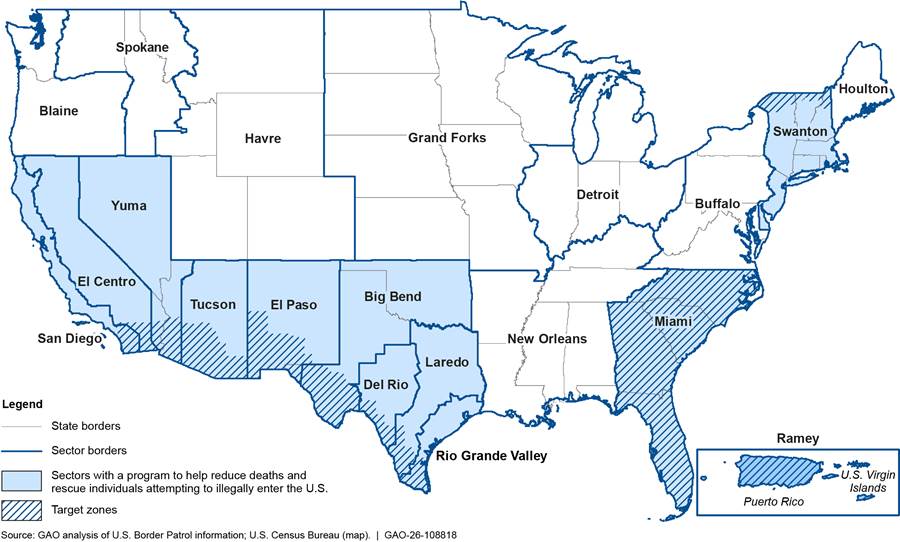
Note: From 2017 through January 2025, Border Patrol referred to the program to reduce deaths and rescue individuals attempting to enter the U.S. as the Missing Migrant Program. Following U.S. Customs and Border Protection’s January 2025 issuance of updated guidance on terminology, Border Patrol began referring to it as the Missing Alien Program.
Border Patrol updated its internal operating procedures in March 2024 to standardize data collection needed to meet congressional reporting requirements in the act.[18] For example, the updated procedures detail roles and responsibilities for program officials in headquarters and each sector and define a rescue for congressional reporting purposes.[19]
Border Patrol also coordinates with external entities such as foreign consulates, nongovernmental organizations, and local police departments as part of the program. We previously reported how Border Patrol’s internal operating procedures standardized how it processes notification of a missing person received from an external entity and which program officials at the sector level are responsible for maintaining regular contact and sharing appropriate information with such entities.[20] In March 2024, we reported that Border Patrol had taken further action to strengthen its coordination with these entities. Border Patrol headquarters staff monitor sector-level coordination with external entities as part of their oversight activities.
Border Patrol Records Data on Deaths and Rescues but CBP’s 2025 Report to Congress Did Not Include Some Required Rescue Beacon Information
Border Patrol Records Data on
Deaths and Rescues and Transitioned to a Different System
CBP used data in its fiscal year 2025 report to Congress that Border Patrol recorded using the same processes and systems used to record data for previous reports. In March 2026, Border Patrol transitioned to a different system for recording death and rescue information.
Border Safety Initiative Tracking System (BSITS). Until March 2026, BSITS was the system of record Border Patrol used to track deaths, rescues, and other information in its annual reports to Congress—including its 2025 report. Border Patrol documented the definitions for reportable events and how to record the information in internal operating procedures and the BSITS user manual.[21] A coordinator in each sector was responsible for ensuring that reportable deaths and rescues that occur in the sector were accurately documented in BSITS, according to the procedures.[22] The sector coordinator was also responsible for submitting weekly reports on relevant activities to a headquarters-based program manager, who consolidated it for reporting to agency leadership. These policies and practices for recording rescues and deaths were consistent with what we described in our 2025 report.
In March 2026, Border Patrol transitioned from BSITS to the Rescues and Recoveries Application to record information about deaths and rescues. This is a new application within an existing tool that agents in the field use to record tracking efforts and sensor activations related to border crossings, among other activities.[23] Border Patrol held voluntary training sessions about how to use the Rescues and Recoveries Application and distributed instructions for walking through the data entry process. As of April 2026, Border Patrol officials said the agency was working to refine the application to ensure complete data entry and accurate recording. Officials said they intend to update the program’s internal operating procedures once the agency finalizes the application and all data fields.
It is too soon to determine whether transitioning data systems might affect CBP’s reporting to Congress on Border Patrol’s program. According to Border Patrol officials, agents already use the tool to which the Rescues and Recoveries Application was added, so they expected a smooth transition. Border Patrol officials said the Rescues and Recoveries Application records the same information that BSITS recorded and they do not have concerns about the completeness and accuracy of the information they are required to report to Congress pursuant to the act.[24]
Migrant Search and Rescue Applications. As we previously reported, some Border Patrol sectors use other applications to track information related to efforts to help reduce deaths along the border and rescue individuals in distress that do not meet the definition for reportable events in BSITS. The Migrant Search and Rescue Applications help sectors more completely document activities associated with locating and identifying remains and locating and assisting missing individuals or those in distress, according to Border Patrol officials. For example, agents in participating sectors can see information on open and closed cases in which Border Patrol assisted in identifying a deceased individual outside of the target zone. In these cases, the location of the death or remains means the case would not be reportable in BSITS. Another part of the applications contains a map of rescue beacon locations and unresolved 911 calls, providing agents a real-time mechanism for tracking 911 calls for missing individuals.
In April 2025, we reported that three sectors were using the Migrant Search and Rescue Applications and Border Patrol was in the process of deploying them to additional sectors. As of April 2026, officials confirmed that these three sectors were continuing to use the applications and a fourth sector was in the process of testing an updated version. The updated version, according to officials, aims to allow users to view information from other sectors. Officials said they are testing the updated applications in the Tucson sector and plan to deploy that version of the applications to the remaining southwest border sectors, as well as the Miami, Ramey, and Swanton sectors. Once deployment to those sectors is complete, it will update the applications in the three sectors where it is currently in use, according to officials.
CBP’s Fiscal Year 2025 Report to
Congress Did Not Include Required Rescue Beacon Information
CBP’s fiscal year 2025 report did not include all information on rescue beacons that the act requires.[25] Specifically, CBP did not report information about the (1) number of rescue beacons it deployed in each sector, (2) frequency that each beacon was activated by someone in distress, and (3) types of distress associated with beacon activation.[26] In its three prior annual reports, CBP reported the total number of rescue beacons deployed—the first element—and included a map showing the location of those beacons. However, CBP did not include the number of beacons in its fiscal year 2025 report. In addition, our analysis indicates that CBP has not reported information about beacon activation frequencies or distress type in any of its prior reports.
In response to the results of our analysis, Border Patrol officials agreed that the act requires CBP to report the omitted information to Congress. The program’s manager said the agency had inadvertently omitted information about the number of beacons Border Patrol deployed in the fiscal year 2025 report. With regard to the other missing information, Border Patrol officials said they were not aware it was required.
Border Patrol’s internal operating procedures state that the program manager is responsible for completing the annual report to Congress as outlined in the act, but do not specify the reporting requirements. Federal internal control standards state that management should establish policies and procedures to achieve objectives—in this context, the required report to Congress.[27] They further state that management should maintain documentation that communicates who is responsible for what. Moreover, the documentation mitigates the risk that knowledge might be limited to a few personnel by providing a means to retain organizational knowledge, for example, when a new manager assumes responsibility for a program.
Border Patrol officials told us the fiscal year 2026 report to Congress will include all the elements related to rescue beacons specified in the act. However, that report had not been finalized at the time of our review and therefore we could not verify its contents. Updating the program’s internal operating procedures to document the reporting elements required by the act would help ensure CBP reports all required information to Congress. This, in turn, would increase transparency to Congress about CBP’s efforts to reduce deaths and rescue individuals in distress along the border.
Border
Patrol Has Taken Steps to Evaluate Its Program to Help Reduce Deaths and Rescue
Individuals in Distress
Border Patrol has taken several steps to evaluate its program to help reduce deaths along the border and locate and rescue individuals in distress. In April 2025, we reported Border Patrol had developed a standardized form for collecting information from sectors to monitor certain program activities and identify challenges.[28] However, we also found that the agency had not determined a design for its evaluation of the program. An evaluation design is an overall approach to gathering and analyzing information or data to answer specific research questions about a program.[29] Because Border Patrol had not determined an evaluation design, we also reported that it may not be collecting relevant information through the standardized forms to support an evaluation of the program.
Therefore, we recommended that Border Patrol develop an evaluation design that includes evaluation questions and methods for collecting and analyzing information. We also recommended that Border Patrol then collect information on program activities that is clearly linked to its scope and purpose. By taking these actions, Border Patrol will be better positioned to examine whether the program is meeting its scope and purpose in each sector. Such information could, in turn, help Border Patrol and lawmakers understand the program’s impact.
Border Patrol agreed with both our recommendations and has fully addressed one. Specifically, as of April 2026, Border Patrol had developed an evaluation plan that defined the scope, methodology, and timeline for the evaluation and identified its information needs to complete the assessment. According to the plan, the evaluation will focus on processes and compare the program’s internal operating procedures to actual program implementation. Border Patrol documentation indicated that Border Patrol also intends to design an outcome-oriented evaluation, which would assess the extent to which the program, as implemented, is meeting its objectives.
Border Patrol has also taken steps to address our second recommendation. As of April 2026, Border Patrol conducted in-person site visits to two sectors, interviewed program coordinators in other sectors, surveyed staff, and reviewed program records, according to officials. The agency had additional evaluation-related activities planned and expected to complete its assessment of the program by September 2026. According to the evaluation plan, Border Patrol plans to analyze the information it collects to identify key findings, trends, and gaps in the program. We will continue monitoring Border Patrol’s actions to address our recommendation.
Conclusion
People risk injury or death when seeking to illegally cross the border in remote areas where they encounter dangerous terrain or conditions. As part of its mission, Border Patrol responds to reports of individuals attempting to enter the U.S. who may be in distress. Rescue beacons alert Border Patrol if someone is in need of aid. Congress included a provision in the Missing Persons and Unidentified Remains Act of 2019 that CBP report information about the location and activation of rescue beacons—including the type of distress the individual was in. Updating the program’s internal operating procedures to document the reporting elements required by the act, including rescue beacon information, could help ensure CBP includes all required information in its annual reports and increase transparency about CBP’s efforts to reduce deaths and rescue individuals in distress along the border.
Recommendation
for Executive Action
The Commissioner of CBP should ensure that Border Patrol updates its internal operating procedures to document the reporting elements required by the Missing Persons and Unidentified Remains Act of 2019.
Agency
Comments and Our Evaluation
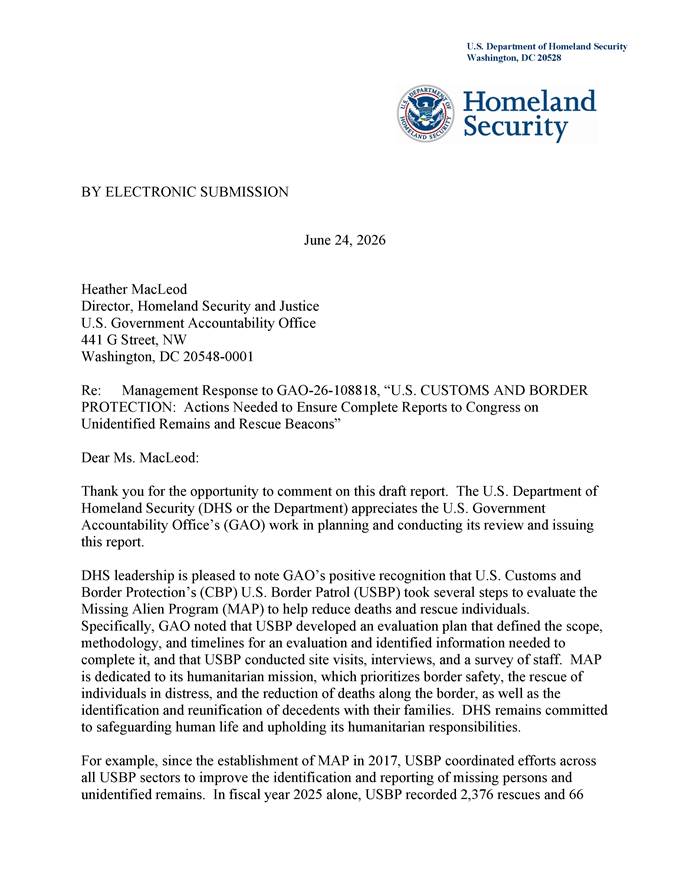
We provided a draft of this report to the Department of Homeland Security for review and comment. In its written comments, reproduced in full in appendix I, the department agreed with the recommendation and described how it intends to address it. Specifically, the department noted that Border Patrol has initiated a review of its internal operating procedures by subject matter experts. As part of this effort, Border Patrol will ensure all reporting elements mandated by the Missing Persons and Unidentified Remains Act of 2019 are documented in internal operating procedures.
We are sending copies of this report to the appropriate congressional committees and the Secretary of Homeland Security. In addition, the report is available at no charge on the GAO website at http://www.gao.gov.
If you or your staff have any questions about this report, please contact me at MacLeodH@gao.gov. Contact points for our Offices of Congressional Relations and Media Relations may be found on the last page of this report. GAO staff who made key contributions to this report are listed in Appendix II.
Heather MacLeod
Director, Homeland Security and Justice
GAO Contact
 Heather MacLeod, at MacLeodH@gao.gov
Staff Acknowledgments
In addition to the contact named above, Kathryn Bernet (Assistant Director), Jessica Wintfeld (Analyst in Charge), Ryan Basen, Michele Fejfar, Jordan Miller, and Heidi Nielson made key contributions to this report.
The Government Accountability Office, the audit, evaluation, and investigative arm of Congress, exists to support Congress in meeting its constitutional responsibilities and to help improve the performance and accountability of the federal government for the American people. GAO examines the use of public funds; evaluates federal programs and policies; and provides analyses, recommendations, and other assistance to help Congress make informed oversight, policy, and funding decisions. GAO’s commitment to good government is reflected in its core values of accountability, integrity, and reliability.
 Obtaining Copies of GAO Reports
and Testimony
Obtaining Copies of GAO Reports
and Testimony
The fastest and easiest way to obtain copies of GAO documents at no cost is through our website. Each weekday afternoon, GAO posts on its website newly released reports, testimony, and correspondence. You can also subscribe to GAO’s email updates to receive notification of newly posted products.
Order by Phone
The price of each GAO publication reflects GAO’s actual cost of production and distribution and depends on the number of pages in the publication and whether the publication is printed in color or black and white. Pricing and ordering information is posted on GAO’s website, https://www.gao.gov/ordering.htm.
Place orders by calling (202) 512-6000, toll free (866) 801-7077,
or
TDD (202) 512-2537.
Orders may be paid for using American Express, Discover Card, MasterCard, Visa, check, or money order. Call for additional information.
Connect with GAO
Connect with GAO on X,
LinkedIn, Instagram, and YouTube.
Subscribe to our Email Updates. Listen to our Podcasts.
Visit GAO on the web at https://www.gao.gov.
To Report Fraud, Waste,
and Abuse in Federal Programs
Contact FraudNet:
Website: https://www.gao.gov/about/what-gao-does/fraudnet
Automated answering system: (800) 424-5454
Media Relations
Sarah Kaczmarek, Managing Director, Media@gao.gov
Congressional Relations
David A. Powner, Acting Managing Director, CongRel@gao.gov
General
Inquiries
[1]Ports of entry are facilities that provide for the controlled entry into or departure from the U.S. Specifically, a port of entry is any officially designated location (seaport, airport, or land border location) where CBP officers are assigned to clear travelers, merchandise, cargo, and other items; collect duties; enforce customs laws; and inspect persons entering or applying for admission into, or departing, the country pursuant to U.S. travel controls and immigration law. See 8 C.F.R. §§ 100.4, 234.4; 19 C.F.R. §§ 101.1, 101.3.
[2]CBP, Rescue Beacons and Unidentified Remains: Fiscal Year 2025 Report to Congress (Washington, D.C.: Aug. 26, 2025).
[3]From 2017 through January 2025, Border Patrol referred to this program as the Missing Migrant Program. Following CBP’s January 2025 issuance of updated guidance on terminology, Border Patrol began referring to it as the Missing Alien Program. Throughout this report, we refer to it as “the program.” Statute defines an “alien” as any person who is not a citizen or national of the U.S. 8 U.S.C. § 1101(a)(3). Documentation we reviewed for this report used the terms “alien” and “migrant.” For readability, we generally use the phrase “individuals attempting to illegally enter the U.S.” in this report except when quoting language in statute, regulation, executive orders, or operating procedures that used other terminology.
[4]Border Patrol divides responsibility for border security operations geographically among 20 sectors, each with its own sector headquarters. There are nine sectors along the southwest border, eight along the northern border, and three in the Gulf Coast and Caribbean regions.
[5]Pub. L. No. 116-277, § 5, 134 Stat. 3368, 3370-71 (2020).
[6]Id. at § 5(b).
[7]CBP, Rescue Beacons and Unidentified Remains: Fiscal Year 2022 Report to Congress (Washington, D.C., Mar. 29, 2022); CBP, Rescue Beacons and Unidentified Remains: Fiscal Year 2023 Report to Congress (Washington, D.C., Aug. 17, 2023); CBP, Rescue Beacons and Unidentified Remains: Fiscal Year 2024 Report to Congress (Washington, D.C.: Apr. 26, 2024); CBP, Rescue Beacons and Unidentified Remains: Fiscal Year 2025 Report to Congress (Washington, D.C.: Aug. 26, 2025). Each report covers relevant data for the previous fiscal year—that is, the fiscal year 2025 report describes fiscal year 2024 information on deaths and rescues.
[8]Rescue beacons are towers with sensors that can alert Border Patrol agents that someone needs help once activated by an individual in distress. Placards placed across the southwest border have instructions to call 911 for help and assist rescue personnel with locating individuals in distress.
[9]Pub. L. No. 116-277, § 5(c), 134 Stat. at 3371.
[10]GAO, Southwest Border: CBP Should Improve Data Collection, Reporting, and Evaluation for the Missing Migrant Program, GAO‑22‑105053 (Washington, D.C.: Apr. 20, 2022); Southwest Border: Border Patrol’s Missing Migrant Program, GAO‑23‑106007 (Washington, D.C.: Nov. 15, 2022); Border Security: Border Patrol’s Missing Migrant Program, GAO‑24‑107051 (Washington, D.C.: Mar. 20, 2024); Border Security: Additional Actions Needed to Evaluate the Missing Migrant Program, GAO‑25‑107548 (Washington, D.C.: Apr. 7, 2025).
[11]In our 2022 report, we also recommended CBP include information about limitations to the data it reports to Congress. In response, CBP began including language in its annual report to Congress explaining why the number of deaths in its reports may be different from those reported by medical examiners offices and nongovernmental organizations. See GAO‑22‑105053.
“External entities” refers to any government or organization that coordinates with Border Patrol on program activities, including federal, tribal, state, or local entities; medical examiner’s offices; consulates of foreign countries located in the U.S.; and nongovernmental organizations.
[12]An internal operating procedure serves as national guidance for Border Patrol.
[13]Border Patrol, Border Safety Initiative Tracking System (BSITS) User Manual, (Washington, D.C.: Nov. 2007).
[14]GAO, Standards for Internal Control in the Federal Government, GAO‑25‑107721 (Washington, D.C.: May 2025).
[16]Border Patrol selected 45 counties from within the nine southwest border sectors as the “target zone” because of their proximity to the border and because they were historically routes of travel for individuals attempting to illegally enter the U.S.
[17]The Swanton sector’s target zone along the northern border includes areas in New Hampshire, Vermont, and New York. The Miami sector’s target zone includes Florida, Georgia, North Carolina, and South Carolina.
[18]See Pub. L. No. 116-277, § 5(a)(1), 134 Stat. at 3370-71.
[19]As of March 2024, the procedures define a rescue as saving an individual from confinement or a dangerous or difficult situation within the designated target zone where lack of intervention by Border Patrol could result in imminent death or bodily injury. Rescues of noncitizens, as well as U.S. citizens and other individuals lawfully in the U.S., are reported as rescues, according to the procedures. Large groups that contact Border Patrol or call 911 at or near the border are not automatically counted as rescues; only the individuals in the group that require medical attention or otherwise require saving from a situation resulting in imminent death or bodily injury would be counted.
[21]The BSITS user manual defines a reportable death as (1) the death of a suspected undocumented migrant who died in furtherance of an illegal entry within a target zone, regardless of whether Border Patrol was directly involved in the incident, or (2) the death of a suspected undocumented migrant who died in furtherance of an illegal entry outside a target zone, if Border Patrol was directly involved in the incident. The BSITS user manual defines a reportable rescue as the saving an individual from a situation within a target zone where the lack of intervention by Border Patrol could result in imminent death or serious bodily injury. A 2024 update to internal operating procedures clarified that mass group give-ups who call 911 are not considered rescues. Only individuals within the group who require medical attention should be considered reportable rescues.
[22]The sector coordinator is a designated assistant chief patrol agent who manages the resources, personnel, and operations associated with the program to reduce deaths and locate and rescue individuals attempting to illegally enter the U.S. who are in distress.
[23]Border Patrol added the Rescues and Recoveries Application to Tracking, Resources, Actions, Integrations – Live, which is part of a technology modernization program intended to improve situational awareness and operational decision-making along the border, according to officials.
[24]See Pub. L. No. 116-277, § 5(a)(1), 134 Stat. at 3370-71.
[25]See Pub. L. No. 116-277, § 5(b), 134 Stat. at 3371.
[26]We also found that CBP did not include other information in its fiscal year 2025 report that it had included in previous reports: (1) the overall number and type of rescue incidents it responded to (e.g., exposure to heat, water-related, etc.), (2) the number of rescue placards deployed, and (3) the number of rescues associated with use of those placards. A Border Patrol official stated that CBP removed this information from the report because it was not specifically required under the Missing Persons and Unidentified Remains Act of 2019.
[29]GAO, Designing Evaluations, GAO‑12‑208G (Washington, D.C.: Jan. 31, 2012).