
COAST GUARD
Actions Needed to Address Law Enforcement Mission Challenges
Statement of Heather MacLeod, Director, Homeland Security and Justice
Before the Subcommittee on Coast Guard and Maritime Transportation, Committee on Transportation and Infrastructure, House of Representatives
For Release on Delivery Expected at 10 a.m. ET
United States Government Accountability Office
A testimony before the Subcommittee on Coast Guard and Maritime Transportation, Committee on Transportation and Infrastructure, House of Representatives
For more information, contact: Heather MacLeod at MacleodH@gao.gov.
What GAO Found
The Coast Guard employs assets—including aircraft and vessels—and personnel to conduct law enforcement operations. In prior work, GAO identified longstanding challenges that have hindered the Coast Guard’s ability to meet its law enforcement mission demands. GAO made recommendations to help address asset availability, acquisitions, and workforce challenges, which the Coast Guard has yet to fully address.
· The Coast Guard’s vessels and aircraft have faced availability challenges and have been in a state of decline for decades. In June 2025 GAO found that the Medium Endurance Cutters availability to conduct missions declined from fiscal year 2020 through fiscal year 2024. GAO recommended that the Coast Guard address maintenance challenges and operational availability issues with these cutters, which it relies on for law enforcement missions.
· The Coast Guard’s declining asset availability is exacerbated by persistent and longstanding challenges managing its planned $40 billion acquisition programs to modernize its vessels and aircraft. In November 2025, GAO found that continued delays and cost overruns with the Offshore Patrol Cutter program—one of its highest priority acquisitions—is likely. GAO made four recommendations to address these issues
· GAO has identified longstanding staffing shortfalls and poor workforce planning, which have challenged the Coast Guard’s ability to meet its mission needs. For example, in June 2025, GAO reported that cutter crew vacancy rates increased from fiscal year 2017 through fiscal year 2024, according to the most recent Coast Guard data at the time. GAO recommended that the Coast Guard develop a clear plan to support its workforce retention initiatives, among other recommendations.
Coast Guard Migrant Interdiction
Why GAO Did This Study
The U.S. government has identified transnational and domestic criminal organizations as a significant threat to the public, law enforcement, and national security.
The Coast Guard is the nation’s lead federal maritime law enforcement agency. It received nearly $25 billion in supplemental funding in fiscal year 2025 for various acquisitions and in support of efforts to modernize operations and capabilities. The Coast Guard is a component of the Department of Homeland Security (DHS). It conducts maritime law enforcement, including: drug interdiction, migrant interdiction, and other missions (which include fisheries law enforcement work to prevent illegal, unreported, and unregulated fishing).
This statement discusses Coast Guard challenges GAO previously identified related to its law enforcement missions. This statement is based primarily on six GAO reports published from June 2023 to January 2026.
What GAO Recommends
GAO previously made 24 recommendations to the Coast Guard in the reports covered by this statement to help address challenges related to vessel and aircraft availability, acquisition delays and cost overruns, and staffing shortfalls.
DHS generally agreed with the recommendations. As of January 2026, two of the recommendations have been implemented. GAO continues to monitor the agency's progress in implementing the remaining recommendations.
Chairman Ezell, Ranking Member Carbajal, and Members of the Subcommittee:
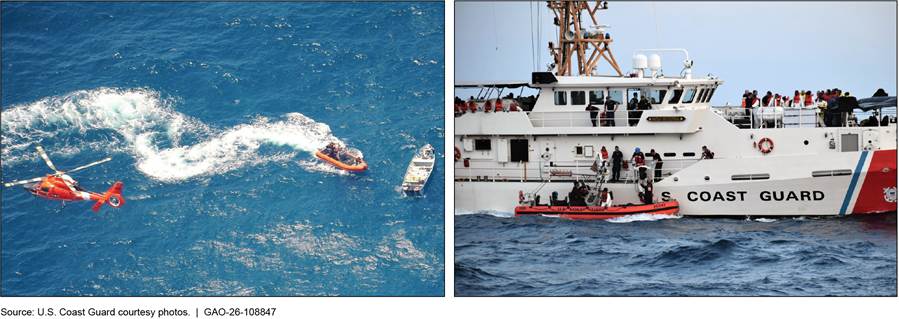
I am pleased to be here today to discuss GAO’s work examining Coast Guard law enforcement activities and challenges. The Coast Guard—a multi-mission, maritime military service within the Department of Homeland Security—is the nation’s lead federal maritime law enforcement agency. The service is responsible for conducting 11 statutory missions, including maritime law enforcement missions such as drug interdiction and migrant interdiction, among other missions (which include fisheries law enforcement work to prevent illegal, unreported, and unregulated (IUU) fishing).[1] According to the Coast Guard, its presence—vessels, aircraft, and specialized forces—serves as an enforcement mechanism and deterrent to illicit activity that contributes to instability throughout the Western Hemisphere.[2] Figure 1 shows the Coast Guard using its assets to conduct law enforcement missions.
Figure 1: Coast Guard Vessels and Aircraft Interdict Smuggling Vessels; Interdicted Migrants on Coast Guard Cutter
The U.S. government has identified illicit drugs, as well as the transnational and domestic criminal organizations that traffic and smuggle them, as significant threats to the public, law enforcement, and the national security of the U.S. Given the challenges the federal government faces in responding to the drug misuse crisis, in March 2021, we added national efforts to prevent, respond to, and recover from drug misuse to our High Risk List.[3]
My statement today discusses challenges the Coast Guard faces related to its law enforcement missions. This statement is based primarily on GAO reports published from June 2023 to January 2026. This includes a report we are issuing today on maritime interdiction.[4]
For the reports we cite in this statement, among other methodologies, we analyzed Coast Guard policies, documentation, and data, and interviewed officials from agency headquarters and selected field units. More detailed information on our scope and methodology, including analyzing data and determining a sufficient level of reliability for our reporting, can be found in the reports we cite in this statement. For this statement, we also reviewed information on the status of agency implementation of selected recommendations through January 2026. (See appendix I for related open recommendations.)
We conducted the work on which this statement is based in accordance with generally accepted government auditing standards. Those standards require that we plan and perform the audit to obtain sufficient, appropriate evidence to provide a reasonable basis for our findings and conclusions based on our audit objectives. We believe that the evidence obtained provides a reasonable basis for our findings and conclusions based on our audit objectives.
Several Challenges Hinder Coast Guard Law Enforcement Efforts to Confront Illicit Maritime Activities, which the Service has Yet to Fully Address
Our prior work has identified several longstanding challenges that have hindered the Coast Guard’s ability to meet its law enforcement mission demands. These include: (1) availability of vessels and aircraft, (2) acquisition of new assets, and (3) staffing shortfalls and workforce planning.[5] We have made recommendations to help address these challenges.
Vessel and Aircraft Availability
The Coast Guard’s vessels and aircraft have faced availability challenges and have been in a state of decline for decades.[6] Overall, the total number of operational hours generally decreased, and the total estimated operating expenses generally increased from fiscal year 2017 through fiscal year 2024, as shown in figure 2.
Figure 2: Coast Guard Vessel and Aircraft Operational Hours and Estimated Operating Expenses, Fiscal Years 2015-2024
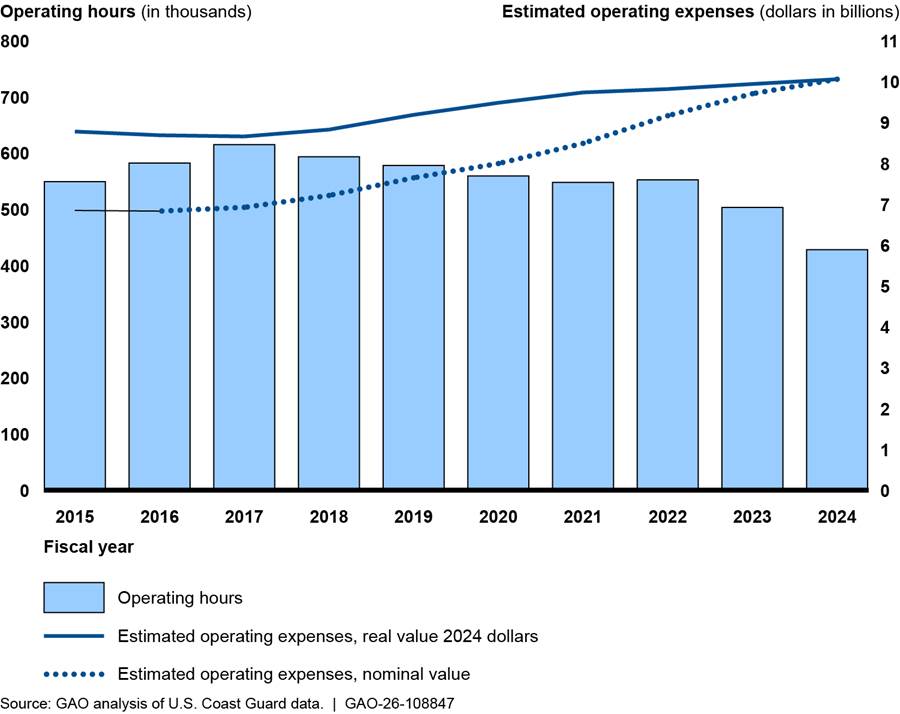
Note: Coast Guard operational hours include the use of aircraft, cutters, and boats for its 11 statutory missions. See 6 U.S.C. § 468(a). They do not include the time personnel may spend on missions without using vessels or aircraft. We do not include hours expended for support activities or for training. According to the Coast Guard, the service estimates its operating expenses for each mission by (1) multiplying operations and maintenance costs for supporting a vessel or aircraft by the operational hours and (2) using survey data to estimate additional personnel costs for nonvessel or aircraft-based operations.
In June 2025, we reported that the operational availability of the Coast Guard’s Medium Endurance Cutters, which the Coast Guard relies on for its law enforcement missions, declined from fiscal year 2020 through fiscal year 2024.[7] We also reported that the Coast Guard was experiencing increasing cutter maintenance challenges, and that those increasing challenges, such as equipment failure and resulting unplanned maintenance, have led to cutters missing patrol obligations. For example, Coast Guard operational reporting documents stated that unplanned maintenance, among other things, had significantly reduced the capacity of Medium Endurance Cutters to conduct missions. Further, due to delays in receiving critical parts needed for repairs, the Coast Guard cannibalized cutters by moving working parts between cutters. According to Coast Guard data, there were 194 cannibalizations completed across the cutter fleet from February 2022 to September 2024; 145 of these involved National Security Cutters—which mostly support the drug interdiction mission.
As a result, in June 2025 we made five recommendations to address cutter maintenance and workforce challenges. For example, we recommended that the Coast Guard should systematically collect and assess data on instances where previously deferred maintenance may have caused cutter equipment failures and develop mitigation strategies as appropriate. In its agency comments, DHS agreed with this recommendation and described steps the Coast Guard plans to take to improve its processes to document, develop, and validate the efficacy of a new cutter maintenance metric, which it plans to use to develop the recommended assessment. DHS estimates completing these efforts by June 2027. We will continue to monitor the status of this and the other recommendations.
The Coast Guard’s asset readiness challenges are not limited to its cutters. In April 2024, we reported that the Coast Guard’s aircraft generally did not meet its 71 percent availability target during fiscal years 2018 through 2022.[8] Coast Guard officials attributed the aircraft fleet generally not meeting availability targets to maintenance and repair challenges. As a result, we made five recommendations, including that the Coast Guard assess the type and number of helicopters, and aviation workforce size, needed to meet its mission demands. In response, in August 2025, the Coast Guard told us an analysis of alternatives and a fleet mix analysis is being ordered. It anticipates completing these steps by December 2027. We will continue monitoring Coast Guard’s efforts to address these recommendations, as well as the other recommendation that remains unaddressed.[9]
Acquisition Programs
We have previously reported that the Coast Guard’s declining asset availability is exacerbated by persistent challenges it faces managing its planned $40 billion acquisition programs to modernize its vessels and aircraft. For example, in September 2024 we reported on the declining availability of the Coast Guard aircraft fleet and found that the Coast Guard’s cutter program faces persistent challenges including capability gaps from schedule delays.[10] Furthermore, officials told us that they would not be able to increase mission activity without acquiring more assets, but acquisition delays have been a longstanding challenge for the service. Furthermore, according to officials, the acquisition process is lengthy, as it can take several years from initial request to final delivery of an asset.[11]
One of the Coast Guard’s highest priority programs—the Offshore Patrol Cutters—has experienced delays that will exacerbate maritime capability gaps.[12] According to the Coast Guard, it urgently needs Offshore Patrol Cutters to replace aging cutters that conduct law enforcement and search and rescue operations.[13] However, in November 2025, we reported that the Coast Guard’s plan to acquire 25 Offshore Patrol Cutters was delayed by more than 5 years.[14] Notwithstanding delays, ship design remains incomplete, and continued delays and cost overruns are likely.[15]
As a result, we made four recommendations in November 2025, including that the program stabilizes design before starting construction of additional ships. Incorporating the knowledge gained from testing—as well as other shipbuilding leading practices—into the procurement process could help the Coast Guard make better investment decisions. It could also improve the timeliness of future ship deliveries. While the agency agreed with two of the four recommendations, we maintain that all four recommendations are warranted and will continue to monitor their implementation.
Staffing Shortfalls and Workforce Planning
Our prior work has also shown that staffing shortfalls and poor workforce planning have affected the Coast Guard’s ability to meet its mission needs, including for drug interdiction and other law enforcement missions. While the service recruited more enlisted service members than it lost in fiscal year 2024, it experienced net enlisted staffing losses from fiscal years 2019 through 2023. In April 2025 we reported that even with the increase in recruiting, the service remained approximately 2,600 service members, or 8.5 percent of its total enlisted workforce, short of its enlisted workforce target at the end of fiscal year 2024.[16] As a result, the Coast Guard was operating below the workforce level it deemed necessary to meet its operational demands. We made three recommendations, including that the Coast Guard develop a clear plan to support its retention initiatives. The Coast Guard agreed with our recommendations, and we continue to monitor their implementation.
Further, in June 2025, we reported that cutter crew and support position vacancy rates increased from fiscal year 2017 through fiscal year 2024, according to Coast Guard data.[17] Multiple Coast Guard officials told us at that time that due to cutter personnel shortages, cutters often deploy without a full crew, leaving the remaining crew to take on the responsibilities of missing staff. We also previously reported on Coast Guard resource shortfalls and incomplete workforce planning for its aviation workforce, which the service relies on to support its drug interdiction mission. For example, as of April 2024 the Coast Guard had not assessed and determined necessary staffing levels and skills for a large portion of its aviation workforce, including all 25 of its air stations and its major aircraft repair facility.[18] As a result, we recommended that the Coast Guard assess and determine the aviation workforce levels it requires to meet its mission needs. DHS concurred with this recommendation. It stated the Coast Guard would conduct workforce analyses for all of its air stations by June 2026. We will continue monitoring Coast Guard’s efforts to address this recommendation.
In summary, the Coast Guard’s law enforcement missions are vital to confronting and mitigating illicit maritime activities. The Coast Guard received nearly $25 billion in supplemental funding in fiscal year 2025 for various acquisitions and in support of efforts to modernize operations and capabilities.[19] We have identified longstanding challenges with the Coast Guard’s management of its programs and tradeoff decisions among its mission priorities and have made recommendations to help address these challenges. Addressing our 20 open recommendations pertaining to the Coast Guard’s assets and workforce would help ensure that the service efficiently uses its resources to carry out its law enforcement missions and interests.[20]
Chairman Ezell, Ranking Member Carbajal, and Members of the Subcommittee, this completes my prepared statement. I would be pleased to respond to any questions that you may have at this time.
GAO Contacts and Staff Acknowledgments
If you or your staff have any questions about this testimony, please contact Heather MacLeod, Director, Homeland Security and Justice, at MacLeodH@gao.gov. Contact points for our Offices of Congressional Relations and Public Affairs may be found on the last page of this statement. GAO staff who made key contributions to this statement are Andrew Curry (Assistant Director), Cristina Norland (Analyst-in-Charge), Paul Hobart, Jay Berman, Mary E. Offutt-Reagin, and Schuyler Janzen. Other staff who made key contributions to the reports cited in the testimony are identified in the source products.
Appendix I: Related Open Recommendations to the Department of Homeland Security as of January 2026
Coast Guard: Actions Needed to Improve Maritime
Interdictions.
GAO‑26‑107440.
Washington, D.C.: January 13, 2026.
· Recommendation: The Secretary of Homeland Security should ensure the Commandant of the Coast Guard implements performance measures for the migrant interdiction mission that effectively measure the service’s efforts.
· Recommendation: The Secretary of Homeland Security should ensure the Operation Vigilant Sentry task force implements a process to identify and address lessons learned following real-world events and exercises with all relevant federal partner agencies, and shares relevant information with those partners.
Offshore Patrol Cutter: Coast Guard Should Gain Key Knowledge Before Buying More Ships. GAO‑26‑107583. Washington, D.C.: November 25, 2025.
· Recommendation: The Commandant of the Coast Guard should ensure that the Offshore Patrol Cutter (OPC) program demonstrates that the stage 2 design is stable prior to authorizing construction of additional stage 2 OPCs by (1) completing basic and functional design, including routing of major distributive systems that affect multiple zones of the ship, in a 3D model with reliable vendor-furnished information and (2) successfully testing an integrated prototype of the davit in a realistic environment, consistent with shipbuilding leading practices.
· Recommendation: The Commandant of the Coast Guard, in collaboration with the Navy, should develop a memorandum of agreement to clarify and document agreement on how the evaluation of deficiencies and ongoing surveillance of Austal’s EVM system will be coordinated between the Coast Guard and SUPSHIP throughout the duration of the OPC program.
· Recommendation: The DHS Secretary should ensure that the DHS Under Secretary for Management directs the Coast Guard to revise the OPC acquisition program baseline to include cost goals for each stage.
· Recommendation: The DHS Secretary should ensure that the DHS Under Secretary for Management directs the Coast Guard to document a plan for acquiring stage 3 OPCs that identifies (1) how results from operational testing of OPC stages 1 and 2 will be incorporated into stage 3 procurement activities, such as developing the request for proposals, and contingency plans if this testing is delayed; and (2) how leading practices for ship design will be incorporated into stage 3.
Coast Guard: Actions Needed to Address Cutter Maintenance and Workforce Challenges. GAO‑25‑107222. Washington, D.C.: June 25, 2025.
· Recommendation: The Commandant of the Coast Guard should systematically collect and assess data on instances where previously deferred maintenance may have caused cutter equipment failures and develop mitigation strategies as appropriate.
· Recommendation: The Commandant of the Coast Guard should complete Ship Structure and Machinery Evaluation Boards for all cutter types at the intervals prescribed by policy.
· Recommendation: The Commandant of the Coast Guard should systematically collect and assess data on which parts and systems across the cutter fleet are or will become obsolete and develop mitigation strategies as appropriate.
· Recommendation: The Commandant of the Coast Guard should systematically collect and assess data on cutter days lost due to unplanned maintenance issues.
· Recommendation: The Commandant of the Coast Guard should regularly collect and analyze data on staff availability for cutter crew and support personnel positions, including which cutter workforce positions are temporarily empty across the cutter fleet, and use this information to inform personnel assignments.
Coast Guard: Enhanced Data and Planning Could Help Address Service Member Retention Issues. GAO‑25‑107869. Washington, D.C.: April 23, 2025.
· Recommendation: The Commandant of the Coast Guard should ensure that the Office of Workforce Requirements, Systems, and Analytics implements additional mechanisms to increase response rates for its Career Intention Survey.
· Recommendation: The Commandant of the Coast Guard should ensure that the Office of Workforce Requirements, Systems, and Analytics analyzes the potential for nonresponse bias in its Career Intention Survey results.
· Recommendation: The Commandant of the Coast Guard should ensure that the Talent Management Transformation Program Integration Office develops a clear plan, including how retention initiatives align with strategic objectives and time frames and milestones for implementation, to track progress and gauge program performance.
Coast Guard: Aircraft Fleet and Aviation Workforce Assessments Needed. GAO‑24‑106374. Washington, D.C.: April 9, 2024.
· Recommendation: The Commandant of the Coast Guard should establish a process to regularly evaluate Coast Guard-wide air station readiness data.
· Recommendation: The Commandant of the Coast Guard should assess the type of helicopters the Coast Guard requires to meet its mission demands, as part of an analysis of alternatives.
· Recommendation: The Commandant of the Coast Guard should assess the number of helicopters the Coast Guard requires to meet its mission demands, as part of a fleet mix analysis.
· Recommendation: The Commandant of the Coast Guard should assess and determine the aviation workforce levels it requires to meet its mission needs.
Coast Guard Acquisitions: Offshore Patrol Cutter Program Needs to Mature Technology and Design. GAO‑23‑105805. Washington, D.C.: June 20, 2023.
· Recommendation: The Commandant of the Coast Guard should ensure that OPC program officials develop a technology maturation plan for the davit prior to builder’s trials. This plan should identify potential courses of action to address davit technical immaturity, including assessing technology alternatives should the current davit continue to face development challenges, and a date by which the Coast Guard will make a go/no-go decision to pursue such a technology alternative.
· Recommendation: The Commandant of the Coast Guard should ensure that OPC program officials test an integrated prototype of the davit in a realistic environment prior to stage 1 builder’s trials.
Related GAO Products
Coast Guard: Actions Needed to Improve Maritime Interdictions. GAO‑26‑107440. Washington, D.C.: January 13, 2026.
Offshore Patrol Cutter: Coast Guard Should Gain Key Knowledge Before Buying More Ships. GAO‑26‑107583. Washington, D.C.: November 25, 2025.
Coast Guard: Actions Needed to Address Cutter Maintenance and Workforce Challenges, GAO‑25‑107222. Washington, D.C.: June 25, 2025.
Coast Guard: Enhanced Data and Planning Could Help Address Service Member Retention Issues. GAO‑25‑107869. Washington, D.C.: April 23, 2025.
Coast Guard: Actions Needed to Address Persistent Challenges Hindering Efforts to Counter Illicit Maritime Drug Smuggling. GAO‑24‑107785. Washington, D.C.: September 19, 2024.
Coast Guard: Aircraft Fleet and Aviation Workforce Assessments Needed. GAO‑24‑106374. Washington, D.C.: April 9, 2024.
Coast Guard Acquisitions: Offshore Patrol Cutter Program Needs to Mature Technology and Design. GAO‑23‑105805. Washington, D.C.: June 20, 2023.
This is a work of the U.S. government and is not subject to copyright protection in the United States. The published product may be reproduced and distributed in its entirety without further permission from GAO. However, because this work may contain copyrighted images or other material, permission from the copyright holder may be necessary if you wish to reproduce this material separately.
The Government Accountability Office, the audit, evaluation, and investigative arm of Congress, exists to support Congress in meeting its constitutional responsibilities and to help improve the performance and accountability of the federal government for the American people. GAO examines the use of public funds; evaluates federal programs and policies; and provides analyses, recommendations, and other assistance to help Congress make informed oversight, policy, and funding decisions. GAO’s commitment to good government is reflected in its core values of accountability, integrity, and reliability.
Obtaining Copies of GAO Reports and Testimony
The fastest and easiest way to obtain copies of GAO documents at no cost is through our website. Each weekday afternoon, GAO posts on its website newly released reports, testimony, and correspondence. You can also subscribe to GAO’s email updates to receive notification of newly posted products.
Order by Phone
The price of each GAO publication reflects GAO’s actual cost of production and distribution and depends on the number of pages in the publication and whether the publication is printed in color or black and white. Pricing and ordering information is posted on GAO’s website, https://www.gao.gov/ordering.htm.
Place orders by calling (202) 512-6000, toll free (866) 801-7077,
or
TDD (202) 512-2537.
Orders may be paid for using American Express, Discover Card, MasterCard, Visa, check, or money order. Call for additional information.
Connect with GAO
Connect with GAO on X,
LinkedIn, Instagram, and YouTube.
Subscribe to our Email Updates. Listen to our Podcasts.
Visit GAO on the web at https://www.gao.gov.
To Report Fraud, Waste, and Abuse in Federal Programs
Contact FraudNet:
Website: https://www.gao.gov/about/what-gao-does/fraudnet
Automated answering system: (800) 424-5454
Media Relations
Sarah Kaczmarek, Managing Director, Media@gao.gov
Congressional Relations
David A. Powner, Acting Managing Director, CongRel@gao.gov
General Inquiries
[1]6 U.S.C. § 468(a).
[2]The Coast Guard maintains Deployable Specialized Forces units with the capabilities needed to deploy with specialized training to handle counterdrug, terrorism, and other threats to the U.S. maritime environment.
[3]See GAO, High-Risk Series: Dedicated Leadership Needed to Address Limited Progress in Most High-Risk Areas GAO‑21‑119SP (Washington, D.C.: Mar. 2, 2021). We issue an update to the High-Risk List every two years at the start of each new session of Congress. The most recent update was issued in February 2025. See GAO, High-Risk Series: Heightened Attention Could Save Billions More and Improve Government Efficiency and Effectiveness, GAO‑25‑107743 (Washington, D.C.: Feb. 25, 2025).
[4]See GAO, Coast Guard: Actions Needed to Improve Maritime Interdictions, GAO‑26‑107440. (Washington, D.C.: Jan. 13, 2026).
[5]GAO, Coast Guard: Actions Needed to Address Persistent Challenges Hindering Efforts to Counter Illicit Maritime Drug Smuggling, GAO‑24‑107785 (Washington, D.C.: Sept. 19, 2024).
[6]Vessel and aircraft availability challenges hinder the Coast Guard’s ability to meet mission demands. For example, in January 2026, we reported that during fiscal years 2015 through 2024, the Coast Guard generally did not meet its drug or migrant interdiction goals. We also found that the service did not fully share information about lessons learned from maritime migrant interdiction with federal partners. We made two recommendations to DHS to address these issues and will monitor Coast Guard actions to fully address them. See, GAO‑26‑107440.
[7]GAO, Coast Guard: Actions Needed to Address Cutter and Maintenance Workforce Challenges, GAO‑25‑107222 (Washington, D.C.: June 25, 2025).
[8]GAO, Coast Guard: Aircraft Fleet and Aviation Workforce Assessments Needed, GAO‑24‑106374 (Washington, D.C.: Apr. 9, 2024). We further reported that the Coast Guard was embarking on a significant operational change from a largely short-range helicopter fleet to a medium-range fleet. However, we reported that its related planning efforts raised serious questions, including how the medium-range helicopters will interact with cutters for its drug interdiction operations.
[9]The Coast Guard has addressed one of the five recommendations. In April 2024, we found that the U.S. Coast Guard's air stations do not have complete data for the Coast Guard to assess service-wide readiness. We recommended that the Coast Guard should establish procedures to uniformly collect and maintain air station readiness data. The Coast Guard concurred with this recommendation and in April 2025 updated its operational reporting manual to, among other things, help standardize the collection of air station readiness data. The manual requires air stations to report periods when they cannot meet readiness requirements and provides examples on how to do so. By issuing updated guidance requiring air stations to uniformly collect and maintain aircraft readiness data, the Coast Guard can help ensure it has complete and accurate information on Coast Guard-wide air station readiness.
[10]GAO, Coast Guard: Actions Needed to Address Persistent Challenges Hindering Efforts to Counter Illicit Maritime Drug Smuggling, GAO‑24‑107785 (Washington, D.C.: Sept. 19, 2024).
[12]In June 2023, we found that the Coast Guard’s management of its Offshore Patrol Cutter acquisitions continued to face challenges we had previously identified. We made five new recommendations to the Coast Guard, including that it develop a technology maturation plan and update its acquisition policy to require programs to complete routing of distributive systems as part of functional design prior to lead ship construction. Two of the recommendations have not yet been fully addressed. See, GAO, Coast Guard Acquisitions: Offshore Patrol Cutter Program Needs to Mature Technology and Design, GAO‑23‑105805 (Washington, D.C.: Jun. 20, 2023).
[13]Admiral Linda L. Fagan, Commandant, U.S. Coast Guard, testimony before the House of Representatives Committee on Homeland Security, 118th Cong., 2nd sess., July 24, 2024.
[14]GAO, Offshore Patrol Cutter: Coast Guard Should Gain Key Knowledge Before Buying More Ships, GAO‑26‑107583 (Washington, D.C.: November 25, 2025).
[15]The Coast Guard plans to acquire the 25 Offshore Patrol Cutters in four phases. In July 2025, the Coast Guard terminated two of four ships from the first phase contract for default.
[16]GAO, Coast Guard: Enhanced Data and Planning Could Help Address Service Member Retention Issues, GAO‑25‑107869 (Washington, D.C.: Apr. 23, 2025).
[17]GAO‑25‑107222. Specifically, our analysis showed that 1,104 cutter crew and support positions were vacant (about 13 percent) in fiscal year 2024. This is an increase from fiscal year 2017, in which 401 cutter crew and support positions were vacant (about 5 percent).
[18]GAO‑24‑106374. The Coast Guard agreed with our recommendation. We also made four other recommendations in the report and the Coast Guard concurred with all four. As of August 2025, four of the five recommendations remain open. We will continue monitoring Coast Guard's efforts to address these recommendations.
[19]Pub. L. No. 119-21, tit. IV, § 40001, 139 Stat. 72, 127 (2025).
[20]We made 24 recommendations in the reports covered by this statement. The Coast Guard implemented two of these recommendations, twenty remain open, and two are no longer valid.