
Report to Congressional Requesters
United States Government Accountability Office
A report to congressional requesters
Contact: Heather MacLeod at MacLeodH@gao.gov
What GAO Found
In August 2025, U.S. Immigration and Customs Enforcement (ICE)’s largest immigration detention facility to date (known as Camp East Montana) opened on U.S. Army Fort Bliss in El Paso, Texas. GAO found that the Army—which awarded and administered the $1.3 billion facility contract—and ICE expedited the award and construction schedule for the facility. This negatively affected their planning and acquisition. Army and ICE officials indicated that the expedited time frames directed by senior leadership dictated several decisions related to their acquisition approach, such as using a contracting vehicle not previously used for detention services. They also selected a contractor that did not have prior experience providing detention services. The Army transferred contract administration responsibilities to ICE in October 2025.
GAO found that the Army did not incorporate flexibilities in the contract to account for occupancy levels below the maximum, resulting in millions of dollars in waste. For example, the Army paid the full cost for meals and services from August 1 to August 15, 2025, when there were no detained noncitizens at the facility. GAO also found that ICE could save tens of millions of dollars through September 2026 by incorporating cost saving measures in the contract, such as tiered pricing for meals. In April 2026, ICE terminated the contract for convenience and chose a new contractor to operate the facility. However, ICE had not yet incorporated these cost saving measures into the new contract and continued to pay for meals that it did not need.
GAO also identified serious performance and oversight challenges at Camp East Montana. The facility opened without meeting key detention standards. For example, the facility initially did not have perimeter security cameras, outdoor recreation space, or space for attorney and family visitation. ICE did not identify these issues because it did not inspect the facility prior to housing detained noncitizens there, as required by ICE policy. After the facility opened, ICE reported additional problems, including gaps in medical services, the loss of a loaded firearm, and unsanitary conditions, among other issues. These issues posed serious risks to the safety and security of both detained noncitizens and staff in the facility.
Why GAO Did This Study
ICE increased its enforcement efforts and expanded its detention capacity in response to a January 2025 Executive Order. ICE’s average daily population of detained noncitizens increased 71 percent from January 20, 2025 to April 1, 2026, according to ICE data.
This report provides observations from our ongoing review of ICE’s expansion of immigration detention operations and focuses on (1) how the Army and ICE planned for and acquired Camp East Montana and (2) oversight of the facility. We are issuing this report given the need for ICE to take immediate corrective actions to save taxpayer dollars and improve detention operations.
To conduct this audit, GAO visited Camp East Montana and observed facility operations in September 2025. GAO reviewed relevant statutes and regulations, agency policies, contract documentation, and Army and ICE reports on Camp East Montana operations. GAO also analyzed facility population data and invoices to calculate waste and potential cost savings. GAO interviewed Army and ICE officials and contractors to discuss operations and oversight.
What GAO Recommends
GAO is making four recommendations, including that ICE incorporate cost saving measures in detention facility contracts, such as tiered pricing for food and other services to account for fluctuations in population; and that ICE develop controls to ensure that new facilities are inspected as required and meet applicable detention standards prior to housing detained noncitizens. DHS and DOD concurred with the recommendations.
Abbreviations
CBP U.S. Customs and Border Protection
DHS Department of Homeland Security
DOD Department of Defense
ICE U.S. Immigration and Customs Enforcement
WEXMAC Worldwide Expeditionary Multiple Award Contract
This is a work of the U.S. government and is not subject to copyright protection in the United States. The published product may be reproduced and distributed in its entirety without further permission from GAO. However, because this work may contain copyrighted images or other material, permission from the copyright holder may be necessary if you wish to reproduce this material separately.
June 9, 2026
Congressional Requesters
Within the Department of Homeland Security (DHS), U.S. Immigration and Customs Enforcement (ICE) is the lead agency responsible for providing safe, secure, and humane confinement for detained noncitizens in the United States.[1] A January 2025 Executive Order directed DHS to detain individuals apprehended for violations of immigration law to the extent permitted by law, and to allocate all available resources for ICE detention purposes.[2] In July 2025, the Public Law 119-21, commonly referred to as the One Big Beautiful Bill Act, provided ICE around $75 billion through fiscal year 2029, including $45 billion for detention capacity.[3]
Since then, ICE has increased its enforcement efforts and expanded its detention capacity. For example, ICE’s average daily population of detained noncitizens increased from 39,314 on January 20, 2025, to 67,204 on April 1, 2026, an increase of 71 percent, according to ICE data. In addition, ICE’s data indicate that the number of authorized ICE detention facilities increased from 134 on January 20, 2025, to 239 on April 1, 2026, an increase of 78 percent.[4] ICE plans to continue these expansion efforts in 2026 through a new $38 billion acquisition approach, in part, to convert warehouses into detention facilities.
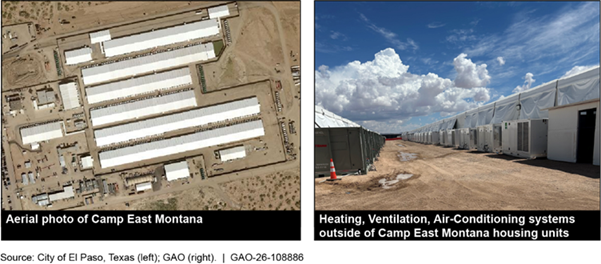
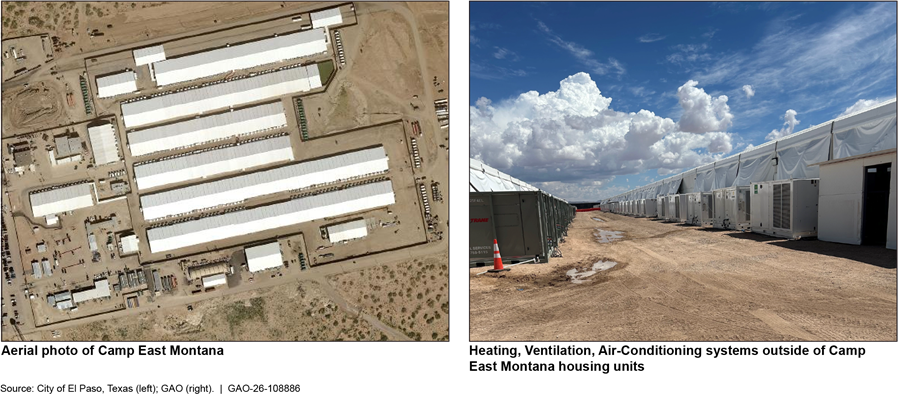
As part of these expansion efforts, in February 2025, DHS sent the Department of Defense (DOD) a request for assistance to support ICE detention efforts. ICE requested access to U.S. Army Fort Bliss in El Paso, Texas, and other DOD military installations for ICE detention operations.[5] In July 2025, the Army awarded and administered a task order on behalf of ICE to provide soft-sided detention facility services—including steel-framed tent-like structures—on Fort Bliss.[6] This facility—known as Camp East Montana—opened in August 2025. The Army then transferred contract administration responsibilities for Camp East Montana to ICE at the beginning of fiscal year 2026.[7] As of April 2026, Camp East Montana was ICE’s largest detention facility, with capacity for about 5,000 detained noncitizens (see fig. 1).
You asked us to review ICE’s expansion of immigration detention and operations, including which facilities ICE is using to detain noncitizens and how ICE is acquiring new detention space. As part of this work, we conducted a site visit to El Paso, Texas, in September 2025. We interviewed ICE and Army officials and contractors to discuss ICE’s detention expansion efforts. We also observed detention facility operations at three facilities, including Camp East Montana. We identified concerns at Camp East Montana regarding the acquisition and operations of the facility. We referred some of those concerns to the DOD Office of Inspector General for further investigation and describe others in this report. This report provides observations from our ongoing review of ICE’s expansion of immigration detention and operations and focuses on (1) how the Army and ICE planned for and acquired Camp East Montana and (2) oversight of the facility. Our review of ICE’s expansion efforts is ongoing, and we will further describe that review in a future report. We are issuing this report given the need for ICE to take immediate corrective actions to save taxpayer dollars and improve detention operations.
To address both topics, we interviewed headquarters officials from ICE’s Enforcement and Removal Operations’ Custody Management Division, the division responsible for oversight and management of ICE’s detention facilities. We also interviewed DOD officials from the Joint Chiefs of Staff Operations Directorate, the division responsible for reviewing ICE requests to use military installations. We also spoke with officials responsible for facility operations and oversight at Camp East Montana, including those from ICE’s El Paso Field Office, the Army, and the prime facility contractor. In addition, we spoke with federal contracting officials responsible for administering the Camp East Montana contract from ICE’s Office of Acquisition Management and U.S. Army North Field Directorate Office Fort Sam Houston.
To address how the Army and ICE planned for and acquired Camp East Montana, we reviewed relevant parts of the Federal Acquisition Regulation, guidance, and contract documentation, including the acquisition plan, statement of objectives, performance work statement, contract, and contract modifications. During our review of the contract and interviews with Army and ICE officials on the acquisition and planning of the facility, we identified instances of waste and potential cost savings. To calculate this waste and estimate potential cost savings at Camp East Montana, we analyzed contractor-generated daily population data on the number of detained noncitizens held at the facility from August 1, 2025 through March 12, 2026, the time period for which data were available during the course of our review.
We assessed the reliability of these data by reviewing the data for missing elements, outliers, and obvious errors, and asking ICE officials about applicable quality control procedures to ensure the accuracy and integrity of the data. We determined the data were sufficiently reliable for the purposes of determining the approximate numbers of detained noncitizens held at Camp East Montana and using the data to calculate waste and estimate potential cost savings.
To calculate waste from August 1, 2025 through August 15, 2025, before detained noncitizens were held at the facility, we identified the costs for operational services—such as guards, medical services, transportation, and meals—listed in the contract for this time period. To calculate waste on meals that were not needed from August 16, 2025—when detained noncitizens first arrived at the facility—through March 12, 2026, we identified the daily population at Camp East Montana and added a 10 percent buffer to account for additional detained noncitizens that could have arrived at the facility.[8] We then calculated the difference between the adjusted daily population and the facility’s capacity for that particular day.[9] We multiplied the difference by the daily cost for meals per detained noncitizen. For all waste calculations, we reviewed invoices to verify either the Army’s or ICE’s payment to the contractor.
To estimate potential cost savings through the end of the contract’s first option period on September 30, 2026, we estimated the amount of money ICE could save if it reduced the operational status of the facility to account for lower occupancy levels. To do so, we first estimated the amount ICE spent per month on each housing unit at Camp East Montana. We projected an average daily population based on the population data we received, then identified the number of housing units ICE would need to accommodate that population. We then estimated potential cost savings using the methodology from our prior work on similar U.S. Customs and Border Protection’s (CBP) soft-sided facility contracts, which identified a range of cost savings when unoccupied housing units at soft-sided facilities are placed in warm or mothball status.[10] Finally, we compared ICE’s contracting approach against project management standards that emphasize tailoring the approach to a project based on its context and objectives.[11]
To address facility oversight, we reviewed ICE and Army documentation, including policies, memos, and reports on Camp East Montana operations. These documents also included the contract’s performance work statement, ICE’s National Detention Standards, contract modifications, and contract discrepancy reports.[12] To assess gaps between performance requirements and contractor performance when Camp East Montana opened, we compared issues that ICE officials identified and those we observed during our visit to the facility in September 2025 to the requirements in the contract’s performance work statement or National Detention Standards.[13] We also compared the Camp East Montana opening process with ICE’s policy on inspecting new facilities prior to housing detained noncitizens, known as a pre-occupancy inspection.[14] Finally, we reviewed our past work and that of the Project Management Institute about the importance of identifying lessons learned and using such lessons to make future changes.[15]
The ongoing work on which this report is based is being conducted in accordance with generally accepted government auditing standards. Those standards require that we plan and perform the audit to obtain sufficient, appropriate evidence to provide a reasonable basis for our findings and conclusions based on our audit objectives. We believe that the evidence obtained provides a reasonable basis for our findings and conclusions based on our audit objectives.
Expedited Award and Construction Schedule Negatively Affected Planning and Acquisition of Camp East Montana
Expedited Award and Construction Schedule Drove Acquisition Decision-Making
Senior leaders’ direction to expand immigration detention capacity drove the government to award the Camp East Montana contract quickly, according to Army and ICE officials. After requesting access to Fort Bliss in February 2025, ICE made two unsuccessful attempts to award a contract for Camp East Montana. First, in April 2025, ICE awarded a contract for the facility but terminated it 3 days later.[16] ICE attempted to award another contract in May 2025 for the Camp East Montana facility and others at various military installations but was unsuccessful. Army and ICE officials stated that, given the expedited time frames and ICE’s unsuccessful contracting efforts, they then jointly determined that the Army was better positioned to issue the solicitation and award the contract, with ICE providing operational support and serving as the lead for contract oversight.
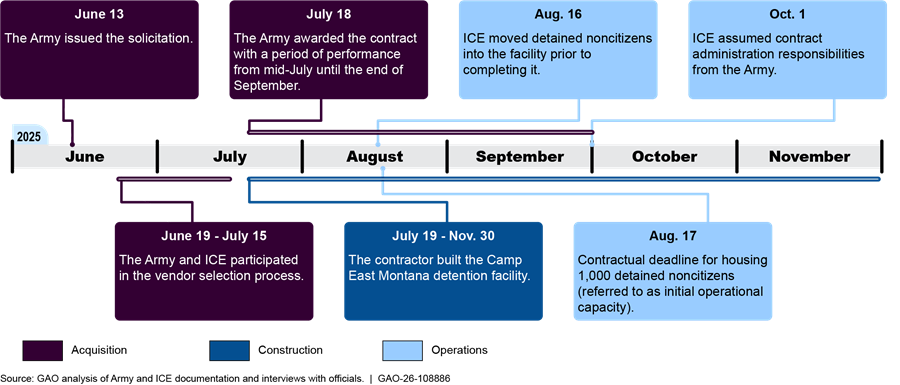
In July 2025, about a month after the Army issued the solicitation, the Army awarded a detention facility service contract valued at up to $1.3 billion with a base period of 2.5 months and two option years.[17] The contract required the facility to reach an initial operational capacity of 1,000 beds within 30 days of award (see fig. 2).
Figure 2: Acquisition Timeline for U.S Immigration and Customs Enforcement’s (ICE) Camp East Montana
We previously reported that a variety of factors, such as contracting approach and total contract value, can affect the amount of time it takes for an agency to progress from solicitation to award. For example, in March 2024 we reported that during fiscal years 2019 through 2022, the Army’s median time frame for progressing from solicitation to award for orders placed on indefinite delivery contracts was 49 days. However, that time frame increased to 168 days for orders valued at over $250 million, like the order for Camp East Montana.[18]
Army and ICE officials indicated that the short time frame to award the contract dictated several decisions related to their planning and acquisition approach for Camp East Montana. These decisions allowed the Army to award the contract quickly but also resulted in challenges and negative outcomes for facility operations. These decisions included:
Use of DOD contract. To meet ICE’s detention needs, the Army and ICE agreed to issue the solicitation for the Camp East Montana facility using the Worldwide Expeditionary Multiple Award Contract (WEXMAC) vehicle for small businesses.[19] WEXMAC is an indefinite delivery/indefinite quantity contracting vehicle with a pool of approved contractors that the Army and other agencies can use to order supplies (such as food and fuel) and services (such as base operations, transportation, and construction) in the United States and throughout the world.[20] According to ICE contracting officials, this was the first time WEXMAC was used for detention facility services. The use of an indefinite delivery/indefinite quantity contracting vehicle—such as WEXMAC—can allow an agency to award a contract more quickly. However, the Army’s and ICE’s decision to use WEXMAC contributed to selecting a contractor that did not have prior experience providing detention services.[21] According to ICE officials, this resulted in a significant learning curve for the contractor that was selected for Camp East Montana.
Requirements development. The Army relied on the pool of WEXMAC contractors to define how they would meet ICE’s Camp East Montana facility requirements rather than leveraging ICE contracting officials’ tools for writing detention facility contracts. According to Army officials, this enabled them to move quickly and allowed potential contractors to propose innovative ideas. However, most of the WEXMAC contractors that submitted offers for the Camp East Montana contract did not have prior experience providing detention services.
Further, although ICE Enforcement and Removal Operations officials approved the contractor’s approach to meeting ICE’s requirements—known as a performance work statement—ICE contracting officials, who typically award ICE’s detention contracts, told us that they did not review the contractor’s approach prior to contract award. The Army subsequently incorporated the performance work statement into the contract without any revisions. ICE contracting officials told us that without the opportunity to review the approach, they encountered challenges when they took over the contract, such as portions of the contractor’s performance work statement that did not align with ICE’s National Detention Standards.[22] ICE contracting officials told us the contractor’s performance work statement did not include the level of specificity regarding applicable detention standards and other requirements ICE detention facility contracts normally include.[23] They said this led to miscommunication between the contractor and ICE during contract performance and resulted in the contractor not meeting National Detention Standards in key areas, which we discuss later in this report.
Source selection. Lastly, the Army used an evaluation approach for the Camp East Montana contract proposals known as lowest price technically acceptable—where cost or price plays a dominant role in the government’s award decision. Specifically, the Army and ICE used a two-phase approach to evaluate prospective contractors, first selecting vendors based on a partial facility design and past performance, and then awarding the contract to the vendor that met additional technical requirements and had the lowest price offer.[24] Army officials stated that given the expedited time frame for award, they chose to use lowest price technically acceptable procedures because it was quicker and resulted in cost savings. The Army did not consult with ICE about this decision, according to ICE contracting officials.
We have previously reported that federal agencies may elect to use the lowest price technically acceptable process where the requirements are clearly defined and the risk of unsuccessful contract performance is minimal, among other criteria.[25] ICE contracting officials said that they do not typically use a lowest price technically acceptable approach for detention facility service contracts because of the complex services involved. Rather, ICE prefers to use the tradeoff process, which allows them to give other factors, such as past performance, greater weight than price. In their view, the Army’s decision to use a lowest price technically acceptable approach was inappropriate because (1) ICE’s requirements were not clearly defined and (2) the risk of unsuccessful contract performance was high because the prospective contractors did not have prior experience providing detention services.
Army and ICE’s Planning Did Not Incorporate Contract Flexibilities to Avoid Waste
We also found that the Army did not incorporate flexibilities into the July 2025 contract to account for occupancy levels below the maximum, resulting in millions of dollars in waste.[26] The Army awarded the Camp East Montana contract as a firm-fixed price contract with set pricing for services. The contract identified pricing for services needed to reach initial operational capacity of 1,000 detained noncitizens, along with pricing to increase the capacity of the facility by 250 detained noncitizens every week until it reached its full operational capacity of 5,000. Based on our review of contract documents and invoices, the Army began paying the full cost for guards, medical services, transportation, meals, and other services on August 1, 2025. However, there were no detained noncitizens at the facility until August 16. Between August 1 and August 15, 2025, the Army wasted up to $11.5 million for these services.[27] Further, because the Army set a fixed price for meals based on the capacity of the facility, it paid about an additional $423,000 for meals it did not need when the facility was operating below its designated capacity from August 16, 2025, through September 30, 2025.
After ICE took over the contract on October 1, 2025, it continued to pay for meals and services that it did not need.[28] According to ICE officials, this is because ICE had to abide by the contract terms set by the Army. For example, at the end of February 2026, the facility held about 1,600 detained noncitizens, but ICE continued to pay the full cost of meals for 5,000 detained noncitizens. As a result, ICE paid about $7.1 million for meals it did not need from October 1, 2025, through March 12, 2026.[29]
ICE officials also said they continued to operate all five of the facility’s housing units—each of which can hold 1,000 detained noncitizens—despite housing about 1,600 detained noncitizens at the end of February 2026. According to ICE officials, they used all five housing units to house detained noncitizens according to gender, risk level, and medical isolation needs. However, we observed that each housing unit contains multiple dormitories that would allow ICE to house separate populations within each housing unit, as needed.
We previously reported on similar issues with CBP’s award and management of contracts for soft-sided facilities. For example, in March 2020, we reported on a facility in Tornillo, Texas, that held an average of 30 individuals per day during its 5 months in operation—about 1 percent of the facility’s capacity. We found that CBP spent $5.3 million on meals it did not need and leveraged significant federal personnel resources that could have been used elsewhere.[30] We recommended that CBP document lessons learned from the acquisition and use of the facility. CBP agreed with our recommendation and addressed it by documenting and sharing lessons learned with other CBP personnel to improve contract flexibility and foster internal communication.
In September 2025, we reported that based on our recommendation, CBP incorporated some lessons learned into planning future soft-sided facility contracts, such as using tiered pricing for meals, staff, and operations. Using tiered pricing provides flexibility when the number of apprehended individuals changes.[31] For example, CBP structured its soft-sided facility contracts to pay for meals on a fixed-unit cost basis depending on the daily number of apprehended individuals in each facility. CBP also established operational status tiers that allowed it to limit operations—known as “warm” status—or stop operations in part or all of the facility—known as “mothball” status.[32]
According to the Project Management Institute, designing and tailoring the approach to a project based on its context, objectives, stakeholders, and environment can help to maximize value, manage constraints, and improve performance.[33] However, our review of the Camp East Montana contract found that Army and ICE officials did not incorporate flexibilities such as tiered pricing for meals or other operations. Specifically, while the contract identified pricing to increase the capacity of the facility by 250 detained noncitizens every week after reaching its 1,000-person initial operational capacity, it did not include provisions to adjust pricing for meals and operational costs if the facility was not operating at full capacity. Further, ICE officials told us they did not seek input from CBP on any lessons learned related to using soft-sided facilities prior to the Army’s award of the Camp East Montana contract, despite lacking prior experience awarding a contract for soft-sided facilities.
On March 12, 2026, ICE awarded a new undefinitized contract to a different vendor to begin operating Camp East Montana from April 18, 2026, through the end of September 2026.[34] In mid-April 2026, ICE terminated its initial contract for convenience. Because ICE is still finalizing the terms and conditions under the new contract, it does not yet include tiered pricing or operational status tiers. If ICE were to incorporate these flexibilities into the new Camp East Montana contract, we estimate ICE could save tens of millions of dollars. Furthermore, taking action to incorporate cost saving measures, such as tiered pricing, in future detention facility contracts to account for fluctuations in the detained noncitizen population, will help ICE ensure that it does not waste tens of millions of dollars more in taxpayer money on services it does not need at other facilities.
ICE Provided Inconsistent Oversight to Address Significant Performance Issues
Camp East Montana Opened Without Meeting Key Detention Standards and ICE Did Not Conduct Required Inspection
There were gaps in contractor performance in several areas when Camp East Montana opened in August 2025 (see table 1). Specifically, the facility did not meet ICE’s National Detention Standards, as required by the performance work statement, in several key areas.[35]
Table 1: Observed Gaps between Requirements and Contractor Performance When U.S Immigration and Customs Enforcement’s (ICE) Camp East Montana Opened, August–September 2025
|
Requirementa |
Gap between requirement and contractor performance |
|
Facility security. Maintain sufficient supervision of detained noncitizens, including through appropriate staffing levels and, where applicable, video monitoring. |
According to an ICE report, there were no security cameras on the perimeter fencing and there were blind spots in the placement of cameras throughout the facility, increasing the risk of a sexual assault or an escape. In addition, during our visit to the facility on September 16, 2025, officials told us that the post responsible for monitoring security camera footage for all areas of the facility was understaffed. |
|
Accommodations for disabilities. Provide detained noncitizens with disabilities special equipment and assign detention officers to push wheelchairs. Place them in housing units and integrate them with other detained noncitizens. Provide accessible toileting and bathing facilities. |
Contractors told ICE they were unable to accommodate detained noncitizens using wheelchairs. According to an ICE report, the facility did not have any Americans with Disabilities Act-compliant showers in the housing units when it opened. During our visit to the facility on September 16, 2025, ICE officials told us this issue still had not been addressed, and as a result, detained noncitizens with disabilities were held in medical care rooms. |
|
Recreation. Ensure the facility has sufficient outdoor recreation space to accommodate all detained noncitizens for at least 1 hour per day. |
According to an ICE report, the outdoor recreation area was not available for several days after the facility opened. The contractor later opened one outdoor recreation yard, but did not have sufficient outdoor space to provide required recreation time. For example, during our visit to the facility on September 16, 2025, ICE officials told us that the one outdoor recreation yard available at the time was inadequate for the approximately 1,500 detained noncitizens at the facility. |
|
Visitation and access to legal resources. Provide detained noncitizens the ability to meet privately with their attorneys and visit with family and friends. Provide access to a law library with access to legal resources. |
According to ICE and Army reports, the building that contained attorney client visitation booths, a family and friends visitation area, and the law library was not available for at least 2 weeks after the facility opened. As a result, detained noncitizens may not have had access to their attorneys, legal resources for their immigration cases, or the ability to see family and friends. |
|
Classification. Have a classification system in place to determine housing assignments for detained noncitizens. These assignments should consider risk level, among other things.b |
According to an ICE report, the contactor had not fully implemented a classification system for detained noncitizens when the facility opened. The report further stated that contract staff did not consistently understand the policies surrounding classification. As a result, in some cases the contractor housed high-risk detained noncitizens in the same housing units as low-risk detained noncitizens. |
Source: GAO analysis of National Detention Standards, contract documents, Army and ICE reports, and GAO observations. | GAO‑26‑108886
Note: We did not systematically assess adherence to all National Detention Standards. Rather, the gaps presented in this table are select gaps that ICE identified and those we observed during our visit to Camp East Montana in September 2025. This table does not address actions that may have been taken to address these gaps after September 2025.
aRequirements are from the contractor’s performance work statement, which was incorporated into the contract, or ICE’s National Detention Standards (Revised 2025), which the contractor is directed to apply and comply with, pursuant to the performance work statement. Under the terms of the July 2025 contract, the facility was required to apply and adhere to the National Detention Standards with respect to detained noncitizens at the facility.
bDetained noncitizens are classified at different risk levels based on their prior criminal records, among other factors.
ICE did not identify these issues prior to opening Camp East Montana because it did not conduct a pre-occupancy inspection. Under ICE policy, ICE’s Enforcement and Removal Operations’ Custody Management Division is required to conduct a pre-occupancy inspection before housing detained noncitizens in new detention facilities.[36] The policy states that a pre-occupancy inspection is intended to establish a baseline measurement of facility compliance with detention standards and to determine if it is appropriate to house detained noncitizens. However, the policy does not include controls to prevent facilities from being used without receiving a pre-occupancy inspection and meeting applicable detention standards. ICE officials stated that they did not conduct such an inspection because of the expedited time frames for opening the facility.[37]
According to ICE’s National Detention Standards, ICE has important obligations under the U.S. Constitution and other federal and state laws to detained noncitizens in its custody. The government has a constitutional responsibility to provide basic needs, such as medical care, safety, shelter, clothes, and food, for those in confinement, including detained noncitizens.[38] ICE’s detention standards are designed to ensure safe, secure, and humane treatment for these individuals. Therefore, ICE is required to ensure that its facilities meet appropriate detention standards, even when it is opening facilities under expedited time frames. Without controls to ensure that new facilities are inspected as required and meet applicable detention standards prior to housing detained noncitizens, ICE risks failing to meet legal and policy-based obligations to maintain the safety, security, and humane treatment of detained noncitizens, ICE employees, and contractors in those facilities.
Significant and Ongoing Performance and Oversight Challenges Warrant Assessment of Lessons Learned
After Camp East Montana opened, ICE continued to face significant performance and oversight challenges at the facility. The facility continued to not meet contractual requirements, including key detention standards, after ICE assumed contract administration responsibilities on October 1, 2025. Since that time, ICE has identified serious problems at the facility, for which it has issued eight discrepancy reports and one oversight report, as shown in table 2.[39]
Table 2: Discrepancy and Oversight Reports Issued by U.S. Immigration and Customs Enforcement (ICE) to the Camp East Montana Contractor, December 3, 2025, through March 3, 2026
|
Requirementa |
Discrepancy or oversight report summaryb |
|
Tuberculosis testing. Conduct tuberculosis skin tests on all detained noncitizens within 12 hours of their arrival at the facility and a chest X-ray for those who test positive. |
On December 3, 2025, ICE issued a discrepancy report on the contractor’s inadequate tuberculosis screening procedures. The contractor had been using tuberculosis symptom questionnaires—rather than administering the required skin tests—for detained noncitizens at intake. As a result, in November 2025, a detained noncitizen with tuberculosis was housed with the general population. |
|
Health assessments. Provide detained noncitizens a comprehensive health assessment—including a physical examination and mental health screening—within 14 days of their arrival at the facility. |
ICE Health Services Corps conducted a site visit to Camp East Montana in December 2025 and issued a report highlighting various medical issues at the facility.c For example, it found that the contractor conducted health screenings at intake, but did not follow up with comprehensive health assessments. As a result, detained noncitizens with chronic conditions did not receive treatment and care in accordance with National Detention Standards. For example, none of the detained noncitizens with diabetes or HIV had treatment plans in place. |
|
Weapons control. Develop and implement site-specific procedures for controlling gun-locker access. Store and handle firearms and weapons appropriately. |
On January 26, 2026, ICE issued a discrepancy report on the contractor’s inadequate weapons control procedures. In January 2026, a contract security guard at Camp East Montana lost their loaded firearm at the facility. According to an ICE official, despite several searches of the facility, as of March 2026 the firearm had not been recovered. The incident exposed the staff, detained noncitizens, and the public to significant risk, including potential unauthorized access to firearms. |
|
Food service. A registered dietician certifies menus before they are served, including religious and medical meal menus. |
On February 20, 2026, ICE issued a discrepancy report on food service issues, such as the contractor’s inability to produce evidence that the dietician had reviewed the menus for detained noncitizens. |
|
Transportation. Provide secure, safe, and timely transportation of detained noncitizens, with proper planning and documentation. |
On February 20, 2026, ICE issued a discrepancy report related to transportation issues with the contractor. On six occasions, the contractor was delayed or did not meet transportation schedules for detained noncitizens, resulting in delayed departure flights or rescheduled immigration hearings. |
|
Use of force and death. Document all use of force incidents and deaths and provide to ICE. Use of force reporting will include memoranda by each staff member witness as well as after-action reviews. |
On February 20, 2026, ICE issued a discrepancy report for a detained noncitizen death by use of force in January 2026. The coroner’s autopsy found the death to be a homicide due to asphyxia. However, the contractor did not provide use of force and death reports to ICE, as required. In addition, evidence associated with the incident was missing or destroyed.d |
|
Cleanliness. Clean and sanitize all areas of the facility, including the dormitories, daily. |
On March 3, 2026, ICE issued a discrepancy report because the contractor had not cleaned some of the dormitories for detained noncitizens daily, as required. Rather, these dormitories were cleaned weekly, resulting in unsanitary conditions. In addition, some contract security guards offered detained noncitizens cookies in exchange for cleaning their own dormitories. |
|
Supervision. Maintain sufficient supervision of detained noncitizens, such as conducting head counts and tracking detained noncitizens’ movement. |
On March 3, 2026, ICE issued a discrepancy report related to a detained noncitizen escaping from Camp East Montana in October 2025. ICE oversight officials attributed the escape to the contractor’s inability to account for detained noncitizens. |
|
Suicide prevention. Staff are to receive comprehensive suicide prevention training, including how to recognize signs and symptoms for suicide risk. A provider is to place at-risk detained noncitizens in a suicide-resistant cell and monitor them every 15 minutes. |
On March 3, 2026, ICE issued a discrepancy report for a detained noncitizen death by suicide in January 2026. Although the detained noncitizen exhibited risk factors for suicide, staff placed them in a medical holding room—not a suicide-resistant cell—and left them unattended for intervals longer than 15 minutes. In addition, ICE officials raised concerns to the contractors in October 2025 regarding the lack of vision panels on the doors in medical holding rooms because there was no line-of-sight to detained noncitizens. However, the contractor had not installed the vision panels at the time of the death. |
Source: GAO analysis of National Detention Standards, contract documents, ICE reports, and interviews with ICE officials. | GAO‑26‑108886
aRequirements are from the contractor’s performance work statement, which was incorporated into the contract, or ICE’s National Detention Standards (Revised 2025), which the contractor is directed to apply and comply with, pursuant to the performance work statement. Under the terms of the July 2025 contract, the facility was required to apply and adhere to the National Detention Standards with respect to detained noncitizens at the facility.
bA discrepancy report is formal documentation of a performance issue committed by a detention facility operator. Operators are able to provide comments on the discrepancy report and are required to create corrective action plans and eventually correct the deficiencies identified. According to ICE officials, some of the eight discrepancy reports issued to the contractor remained in draft or pending status as of March 2026 because ICE was awaiting the contractor’s response before finalizing the report. The original prime contractor for Camp East Montana stated they had ongoing or planned actions to address deficiencies identified in the reports. According to the Fort Bliss Army Garrison Commander, officials at the installation were not immediately notified after these issues occurred.
cICE Health Service Corps, the medical authority within ICE, administers medical care at select ICE facilities. At other facilities, such as Camp East Montana, it has an oversight role and monitors compliance with health-related National Detention Standards.
dICE’s Office of Professional Responsibility is responsible for examining deaths of detained noncitizens in ICE custody. According to ICE officials, as of April 2026, the Office of Professional Responsibility’s investigation is on hold pending an ongoing criminal investigation.
ICE faced challenges in addressing these and other performance issues in part because the Army did not finalize a Quality Assurance Surveillance Plan for inclusion in the Camp East Montana contract. These plans establish how the government will monitor contractor performance against contract requirements, including the methods and frequency of oversight activities and how performance deficiencies will be documented and addressed. ICE and Army officials told us the Army did not include a Quality Assurance Surveillance Plan in the Camp East Montana contract due to the expedited time frames for opening the facility.[40] Without this framework, ICE contracting officials told us they experienced significant challenges conducting oversight and addressing performance issues they identified. For example, while ICE issued discrepancy reports related to contractor performance issues, ICE officials said they were unable to apply any financial penalties without meaningful performance metrics and a Quality Assurance Surveillance Plan.
As previously noted, on March 12, 2026, ICE awarded a new undefinitized contract to a different vendor to begin operating Camp East Montana from April 18, 2026, through the end of September 2026. In mid-April 2026, ICE terminated its initial contract for convenience. At the time of our review, it was too early to assess whether this new contract would resolve performance issues at Camp East Montana or if it would include a Quality Assurance Surveillance Plan. However, we have identified significant, pervasive issues with ICE and Army’s planning, acquisition, and oversight of the facility, including the acquisition approach, pricing for meals and other services, and the absence of a Quality Assurance Surveillance Plan to correct key performance deficiencies.
These issues contributed to waste of government resources and threats to the health and life of detained noncitizens and staff at the facility. According to key practices that we and others have identified for both program and project management, it is important to identify and apply lessons learned from programs, projects, and missions to limit the chance of recurrence of previous failures or difficulties.[41] Moreover, agencies can learn lessons from an event and make decisions about when and how to use that knowledge to change behavior.[42]
Although the Army and ICE officials told us that they do not plan to build detention facilities on military installations moving forward, ICE has not rescinded its February 2025 request for assistance, and the agreement remains active. While both Army and ICE officials acknowledged that they have learned lessons from their experience at Camp East Montana, neither agency identified plans to assess those lessons to inform future efforts. Further, ICE’s current plan to embark on a new $38 billion acquisition approach, in part, to convert warehouses into detention facilities could face similar challenges to those encountered at Camp East Montana. For example, ICE has not previously engaged in largescale efforts to purchase and retrofit warehouses to meet its detention needs, and ICE plans to continue to use the WEXMAC contract vehicle to both renovate and operate the warehouses as detention facilities. Assessing the Camp East Montana acquisition to identify lessons learned could help provide the Army and DHS with insights to inform future acquisitions in support of ICE’s detention efforts.
Conclusions
ICE has increased its enforcement efforts and expanded its detention capacity, including building its largest detention facility—Camp East Montana—on Fort Bliss. While the Army and ICE’s planning and acquisition approach for Camp East Montana enabled them to award the contract quickly, it contributed to negative outcomes during facility operations.
For example, the Army did not incorporate contract flexibilities to account for fluctuations in detained noncitizen population levels, resulting in millions of dollars of waste. By structuring the Camp East Montana contract without mechanisms such as tiered pricing or the ability to place portions of the facility in warm or mothball status, the Army—and later ICE after assuming contract administration—paid for meals and services that were not needed when the facility operated below capacity. Because the number of detained noncitizens at a facility fluctuates, taking action to incorporate cost saving measures, such as tiered pricing, into the Camp East Montana contract and future contracts for detention facilities will help ICE ensure that it does not waste taxpayer money on services it does not need.
In addition, ICE began housing detained noncitizens without meeting key detention standards and without undergoing a required pre-occupancy inspection. Without controls to ensure that new facilities are inspected as required and meet applicable detention standards prior to housing detained noncitizens, ICE risks failing to meet legal and policy-based obligations to maintain a safe and secure environment for detained noncitizens, ICE employees, and contractors, and to treat detained noncitizens humanely in those facilities.
After contract administration transferred from the Army to ICE at Camp East Montana, the agency continued to face performance challenges at the facility, such as serious gaps in medical services and inadequate weapons control procedures. Furthermore, the absence of a Quality Assurance Surveillance Plan limited ICE’s ability to effectively monitor contractor performance. Given the ongoing agreement between Army and ICE to support ICE’s detention contracting efforts and ICE’s current plan to embark on a new $38 billion acquisition approach, in part, to convert warehouses into detention facilities, assessing and applying lessons learned from Camp East Montana could help inform future acquisitions.
Recommendations for Executive Action
We are making a total of four recommendations, including two to ICE, one to the Army, and one to DHS. Specifically:
The Director of ICE should take action to incorporate cost savings measures, such as tiered pricing for meals and other operations and services, into its detention facility contracts, including the contract for Camp East Montana, to account for fluctuations in population. (Recommendation 1)
The Director of ICE should develop controls to ensure that new facilities are inspected as required and meet applicable detention standards prior to housing detained noncitizens. (Recommendation 2)
The Secretary of the Army should assess the acquisition of Camp East Montana and identify any lessons learned to inform future acquisitions in support of ICE’s detention efforts. (Recommendation 3)
The Secretary of Homeland Security should assess the acquisition of Camp East Montana and identify any lessons learned to inform future acquisitions in support of ICE’s detention efforts. (Recommendation 4)
Agency Comments, Third Party Views, and Our Evaluation
We provided a draft of this report to the Department of Homeland Security and the Department of Defense for review and comment. Both departments provided written comments that are reprinted in appendixes I and II, respectively, and summarized below. Both departments also provided technical comments, which we incorporated as appropriate. We also provided the original prime contractor for Camp East Montana the relevant sections of the draft report for review and comment. We incorporated their comments as appropriate.
DHS agreed with our recommendations and discussed actions planned or underway to address them. With respect to recommendation 1, DHS stated that they are shifting the Camp East Montana contract to a tiered pricing model. With respect to recommendation 4, DHS stated that ICE and DHS’s Office of the Chief Readiness Support Officer will collaborate to assess the acquisition of Camp East Montana and capture lessons learned, successes and challenges, and ways to improve future actions. We will monitor these efforts to address our recommendations.
With respect to recommendation 2, DHS agreed but stated that ICE’s existing policies address our recommendation. Specifically, DHS noted that ICE already has a policy requiring pre-occupancy inspections for new facilities. During this inspection, subject matter experts are to inspect the facility for adherence to ICE detention standards, among other things. Our report also discusses ICE’s pre-occupancy inspection policy. However, we found that ICE did not adhere to its policy when it failed to conduct a pre-occupancy inspection prior to the opening of Camp East Montana. As a result, we continue to believe that ICE should develop controls to ensure that new facilities are inspected as required and meet applicable detention standards prior to housing detained noncitizens.
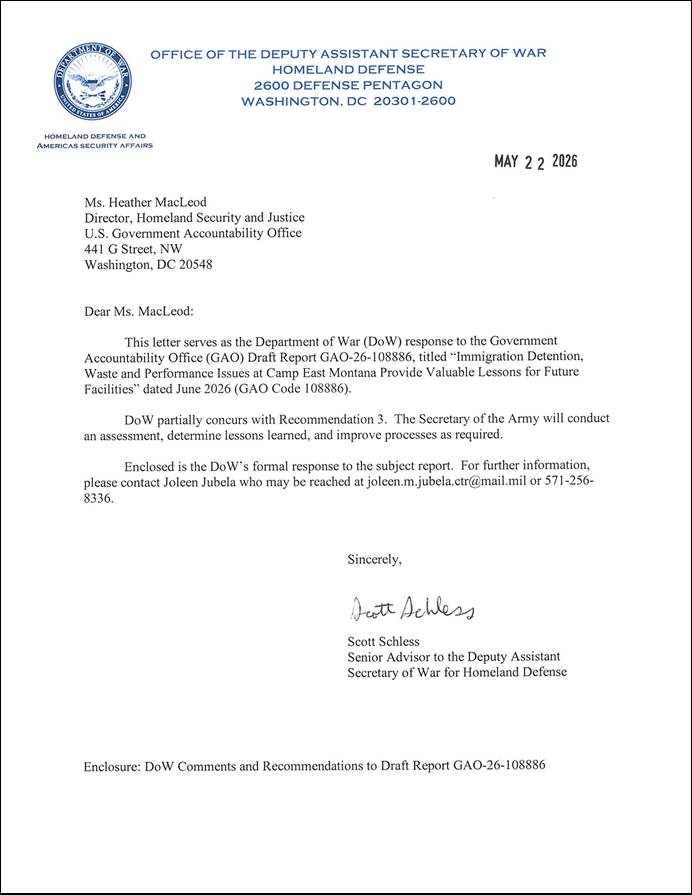
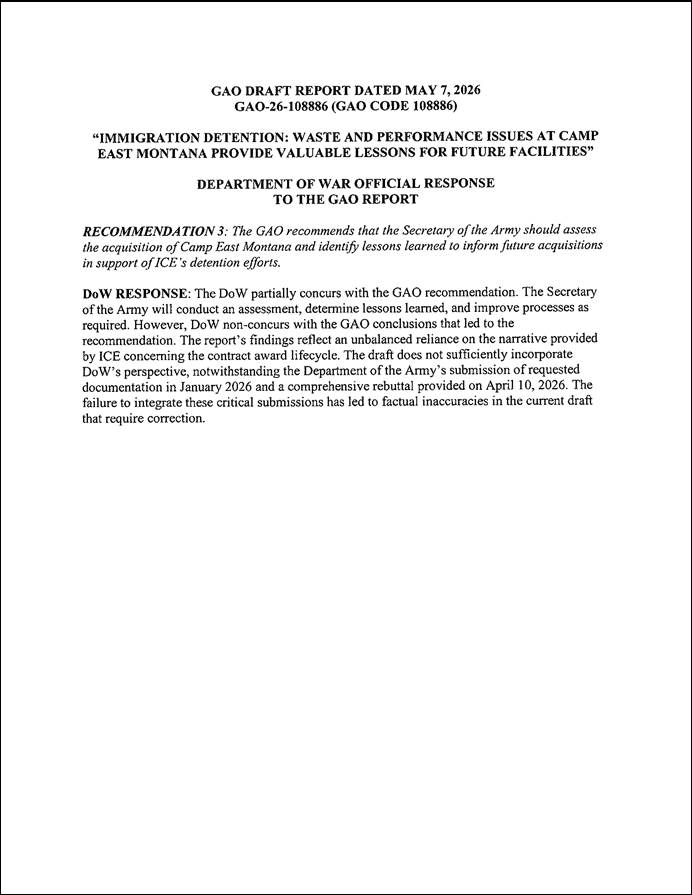
DOD agreed to implement our recommendation. However, DOD stated that they disagree with our conclusions that led to the recommendation. Specifically, DOD stated that the report overly relies on ICE’s perspective concerning the Camp East Montana contract award and does not sufficiently incorporate DOD’s perspective. Our report fairly and accurately outlines the events and decisions that both the Army and ICE made regarding the planning, acquisition, and operations at Camp East Montana. In addition, we believe that the report fairly characterizes the Army’s and DHS’s roles and responsibilities for the Camp East Montana contract. Both the Army and DHS made decisions that contributed to the serious challenges at Camp East Montana. As a result, we continue to believe that both agencies should assess the acquisition and identify lessons learned to inform future acquisitions in support of ICE’s detention efforts.
If you or your staff have any questions about this report, please contact me at MacleodH@gao.gov. Contact points for our Offices of Congressional Relations and Public Affairs may be found on the last page of this report.
Heather MacLeod
Director, Homeland Security and Justice
List of Requesters
The Honorable Jack Reed
Ranking Member
Committee on Armed Services
United States Senate
The Honorable Gary C. Peters
Ranking Member
Committee on Homeland Security and Governmental Affairs
United States Senate
The Honorable Richard J. Durbin
Ranking Member
Committee on the Judiciary
United States Senate
The Honorable Bennie G. Thompson
Ranking Member
Committee on Homeland Security
House of Representatives
The Government Accountability Office, the audit, evaluation, and investigative arm of Congress, exists to support Congress in meeting its constitutional responsibilities and to help improve the performance and accountability of the federal government for the American people. GAO examines the use of public funds; evaluates federal programs and policies; and provides analyses, recommendations, and other assistance to help Congress make informed oversight, policy, and funding decisions. GAO’s commitment to good government is reflected in its core values of accountability, integrity, and reliability.
Obtaining Copies of GAO Reports and Testimony
The fastest and easiest way to obtain copies of GAO documents at no cost is through our website. Each weekday afternoon, GAO posts on its website newly released reports, testimony, and correspondence. You can also subscribe to GAO’s email updates to receive notification of newly posted products.
Order by Phone
The price of each GAO publication reflects GAO’s actual cost of production and distribution and depends on the number of pages in the publication and whether the publication is printed in color or black and white. Pricing and ordering information is posted on GAO’s website, https://www.gao.gov/ordering.htm.
Place orders by calling (202) 512-6000, toll free (866) 801-7077,
or
TDD (202) 512-2537.
Orders may be paid for using American Express, Discover Card, MasterCard, Visa, check, or money order. Call for additional information.
Connect with GAO
Connect with GAO on X,
LinkedIn, Instagram, and YouTube.
Subscribe to our Email Updates. Listen to our Podcasts.
Visit GAO on the web at https://www.gao.gov.
To Report Fraud, Waste, and Abuse in Federal Programs
Contact FraudNet:
Website: https://www.gao.gov/about/what-gao-does/fraudnet
Automated answering system: (800) 424-5454
Media Relations
Sarah Kaczmarek, Managing Director, Media@gao.gov
Congressional Relations
David A. Powner, Acting Managing Director, CongRel@gao.gov
General Inquiries
[1]For readability, we generally use the term “noncitizen,” to refer to an “alien,” (defined under U.S. immigration law as any person who is not a U.S. citizen or national), except when quoting language which includes the term “alien” in statute, regulation, or executive orders. In our audit work, we have found that DHS documentation often uses various terms such as “alien,” “migrant,” and “noncitizen,” among other words or phrases, in reference to those of non-U.S. nationality.
[2]Protecting the American People Against Invasion, Exec. Order No. 14159, 90 Fed. Reg. 8443 (Jan. 29, 2025) (issued Jan. 20).
[3]An Act to provide for reconciliation pursuant to title II of H. Con. Res. 14, Pub. L. No. 119-21, title IX, subtitle A, § 90003, title X, subtitle A, pt. II, § 100052, 139 Stat. 72, 358, 387-89 (2025). Among other things, the act also provided 50 percent of the fees collected for removal orders in absentia and inadmissible alien apprehensions to ICE for retention and expenditure without further appropriation.
[4]Authorized facilities include all facilities for which ICE has an active contract or agreement. Hold rooms—temporary spaces where detained noncitizens are held while awaiting processing, transfer, or removal—are not included.
[5]Department of Homeland Security, Request for Department of Defense Assistance in Support of U.S. Immigration and Customs Enforcement Removal Operations, Feb. 12, 2025. As of April 2026, the Department of Homeland Security had not rescinded this request.
[6]In this report, an order refers to an order of supplies (delivery order) or services (task order) against an established contract or with government sources. See Federal Acquisition Regulation § 2.101 (48 C.F.R. § 2.101). For the purposes of this report, we refer to the Army’s task order as a contract.
[7]The Army contract modification on September 23, 2025, transferred contract administration responsibilities to ICE at the start of fiscal year 2026.
[8]In our prior work on U.S. Customs and Border Protection’s management of its soft-sided facilities, we identified that CBP used a buffer to account for fluctuations in daily population. See GAO, Border Security: DHS Needs to Better Plan for and Oversee Future Facilities for Short-term Custody, GAO‑25‑107346 (Washington, D.C.: Sept. 2, 2025).
[9]The facility opened with an initial operating capacity of 1,000 detained noncitizens and the capacity increased by 250 detained noncitizens every week until it reached its full operational capacity of 5,000.
[10]See GAO‑25‑107346. Warm and mothball are operational statuses for soft-sided facilities, which we discuss later in this report.
[11]Project Management Institute, Inc. A Guide to the Project Management Body of Knowledge (PMBOK® Guide), Eighth Edition (Newtown Square, PA: 2025).
[12]A discrepancy report is formal documentation of a performance issue committed by a detention facility operator. Operators are able to provide comments on the discrepancy report and are required to create corrective action plans and eventually correct the deficiencies identified.
[13]ICE has multiple sets of detention standards that differ with respect to their scope, specificity, and other factors. These standards discuss medical care, legal services, grievance procedures, and other areas. Contracts or agreements between ICE and detention facilities specify which set of standards facilities are to follow. The performance work statement, which was incorporated into the contract for Camp East Montana, required application of and compliance with ICE’s National Detention Standards (Revised 2025). We did not systematically assess adherence to all National Detention Standards. Rather, this report discusses selected gaps documented or identified by ICE officials and gaps we observed during our visit to Camp East Montana in September 2025.
[14]ICE Enforcement and Removal Operations, Detention Management Control Program Policy and Procedure, Feb. 8, 2022.
[15]For example, see GAO, Project Management: DOE and NNSA Should Improve Their Lessons-Learned Process for Capital Asset Projects, GAO‑19‑25 (Washington, D.C.: Dec. 21, 2018). Project Management Institute, Inc., A Guide to the Project Management Body of Knowledge (PMBOK® Guide), Eighth Edition (2025), provides guidelines for managing projects, including collecting requirements and defining the project’s scope. The Project Management Institute is a not-for-profit association that provides global standards for, among other things, project and program management. These standards are utilized worldwide and provide guidance on how to manage various aspects of projects, programs, and portfolios.
[16]ICE terminated the contract for the convenience of the government. Federal contracts typically include terms that give agencies the right to terminate contracts (partially or fully) for convenience when it is in the government’s interest. See Federal Acquisition Regulation §§ 2.101, 12.403, part 49 (48 C.F.R. §§ 2.101, 12.403, part 49); GAO WatchBlog, What Happens When a Government Contract is Terminated? Apr. 17, 2025.
[17]The Army exercised the first option year in September 2025 before transferring contract administration responsibilities to ICE at the beginning of fiscal year 2026. ICE subsequently terminated the contract for convenience. On March 12, 2026, ICE awarded a noncompetitive, undefinitized contract to a different vendor to begin operating the facility on April 18, 2026. An undefinitized contract authorizes a contractor to begin work before reaching a final agreement on contract terms, specifications, or price. See Federal Acquisition Regulation § 217.7401 (48 C.F.R. § 217.7401). We discuss this contract in more detail later in this report.
[18]GAO, Defense Contracts: Better Monitoring Could Improve DOD’s Management of Award Lead Times, GAO‑24‑106528 (Washington, D.C.: Mar. 14, 2024).
[19]The Navy established the WEXMAC contracting vehicle.
[20]Indefinite delivery/indefinite quantity contracts are awarded to one or more contractors when, above a specified minimum, the exact quantities and timing for products or services during the contract period are not known at the time of award. See Federal Acquisition Regulation §§ 16.501-1, .501-2, 16.504, 48 C.F.R. §§ 16.501-1 (definitions), .501-2 (general; three types of indefinite delivery contracts), 16.504 (indefinite quantity contracts).
[21]In its proposal, the prime contractor that won the Camp East Montana contract identified other companies that would serve as subcontractors for medical and guard services, among others. Several of those companies had experience working on detention contracts.
[22]ICE has multiple sets of detention standards that differ with respect to their scope, specificity, and other factors. These standards discuss medical care, legal services, grievance procedures, and other areas. Contracts or agreements between ICE and detention facilities specify which set of standards facilities are to follow. The performance work statement, which was incorporated into the contract for Camp East Montana, required application of and compliance with ICE’s National Detention Standards (Revised 2025).
[23]The contract’s performance work statement, however, does explicitly direct the contractor to apply ICE’s National Detention Standards, among other documents, in order to provide a safe and secure environment for all detained noncitizens, visitors, and staff at the facility.
[24]These additional technical requirements included a final facility design, mobilization and demobilization plans, a staffing plan, and a performance work statement.
[25]GAO, Federal Contracting: Information on Agencies’ Use of the Lowest Price Technically Acceptable Process, GAO‑19‑691 (Washington, D.C.: Sept. 26, 2019).
[26]Waste occurs when individuals or organizations expend government resources carelessly, extravagantly, or without adequate purpose.
[27]While some portion of these costs may have been needed at the facility prior to detained noncitizens arriving, our review of facility reports during this period found that key portions of the facility were still under construction and a majority of contractor staff were still undergoing required security clearance reviews.
[28]In January 2021, we reported that ICE had increasingly incorporated guaranteed minimum payments into its contracts and agreements, whereby ICE agreed to pay detention facility operators for a fixed number of detention beds regardless of whether it used them. We found that ICE had not taken a strategic approach to these decisions and, as a result, paid millions of dollars per month for detention space that was not used. ICE agreed with our recommendation to implement a strategic approach to using guaranteed minimums. However, ICE reported in May 2024 that it phased out the use of guaranteed minimums and planned to include language that allows it to reduce or renegotiate the value of the contract or agreement if ICE uses less detention space at the facility than anticipated. We agreed that such steps would help position ICE to take a strategic approach to using fixed costs in detention facility contracts and agreements, but as of April 2026, ICE has not provided examples of contracts or agreements in which it has used this approach. See GAO, Immigration Detention: Actions Needed to Improve Planning, Documentation, and Oversight of Detention Facility Contracts, GAO‑21‑149 (Washington, D.C.: Jan. 13, 2021).
[29]According to ICE officials, while the contractor was paid for the full cost of meals for 5,000 detained noncitizens, it only prepared meals based on the actual daily population.
[30]GAO, Border Security: U.S. Customs and Border Protection’s Management of a Temporary Facility in Texas Raised Concerns about Resources Used, GAO‑20‑321R (Washington, D.C.: Mar. 11, 2020).
[31]See GAO‑25‑107346.
[32]For example, based on our review of selected CBP soft-sided facility contracts, CBP saved anywhere from 33 to 54 percent of the monthly operational costs if a facility was put into warm status—where most contractor staff remain on site and may be reassigned to other duties, but no one is processed or held. Similarly, CBP saved anywhere from 48 to 63 percent of monthly operational costs when a facility was put into mothball status, where the facility is no longer operational and contracted staff are laid off or transferred to another facility.
[33]Project Management Institute, Inc. A Guide to the Project Management Body of Knowledge (PMBOK® Guide), Eighth Edition (2025).
[34]We have previously reported that using undefinitized contracts can pose risks to the taxpayer, as contractors lack incentives to control costs while contract terms and conditions are negotiated and definitized. See, GAO, Defense Contracting: DOD Has Enhanced Insight into Undefinitized Contract Action Use, but Management at Local Commands Needs Improvement, GAO‑10‑299 (Washington, D.C.: Jan. 28, 2010).
[35]The performance work statement—which was incorporated into the contract—required the contractor to provide a safe and secure environment for all detained noncitizens, visitors, and staff at the facility through the application of the 2025 National Detention Standards. Regarding security and control, the contractor is required to achieve “100% direct detainee supervision and full compliance with national detention standards” with compliance to be monitored daily. The contractor’s quality assurance program also must ensure strict adherence to National Detention Standards.
[36]ICE Enforcement and Removal Operations, Detention Management Control Program Policy and Procedure, Feb. 8, 2022.
[37]Custody Management Division officials told us that they conducted an informal, post-occupancy inspection to assess conditions and address deficiencies after detained noncitizens were placed in the facility. In addition, within ICE, the Office of Professional Responsibility’s Office of Detention Oversight is responsible for conducting regular inspections of ICE detention facilities, but not pre-occupancy inspections. The office conducted an inspection of Camp East Montana in February 2026 and found 49 deficiencies, including three priority issues—noncompliance with tool control requirements, noncompliance with ammunition inventory and inspections, and lack of notification to ICE of a detained noncitizen with tuberculosis symptoms. The Office of Detention Oversight rated the facility as acceptable.
[38]DeShaney v. Winnebago Cnty. Dep’t of Soc. Servs., 489 U.S. 189, 200 (1989) (citing Estelle v. Gamble, 429 U.S. 97, 103–04 (1976); Youngberg v. Romeo, 457 U.S. 307, 315–16 (1982)). The Supreme Court has applied the Due Process Clause of the Fourteenth Amendment to civil detainees, such as detained noncitizens, providing them the same Eighth Amendment protection that prisoners have against cruel and unusual punishment. Charles v. Orange Cty., 925 F.3d 73, 85 (2d Cir. 2019) (citing Estelle v. Gamble, 429 U.S. 97, 104-05 (1976); Youngberg v. Romeo, 457 U.S. 307, 321-22 (1982); Revere v. Mass. Gen. Hosp., 463 U.S. 239, 244 (1983)). Therefore, individuals in civil detention have a right to be free from deliberate indifference to their serious medical needs. Charles, 925 F.3d at 85.
[39]A discrepancy report is formal documentation of a performance issue committed by a detention facility operator. Operators are able to provide comments on the discrepancy report and are required to create corrective action plans and eventually correct the deficiencies identified.
[40]The original prime contractor for the facility also confirmed that a Quality Assurance Surveillance Plan was not included in the Camp East Montana contract.
[41]For example, see GAO‑19‑25. Project Management Institute, Inc., A Guide to the Project Management Body of Knowledge (PMBOK® Guide), Eighth Edition (2025), provides guidelines for managing projects, including collecting requirements and defining the project’s scope. The Project Management Institute is a not-for-profit association that provides global standards for, among other things, project and program management. These standards are utilized worldwide and provide guidance on how to manage various aspects of projects, programs, and portfolios.