
Before the Subcommittee on Readiness and Management Support, Committee on Armed Services, U.S. Senate
For Release on Delivery Expected at 2:30 p.m. ET
United States Government Accountability Office
A testimony before the Subcommittee on Readiness and Management Support, Committee on Armed Services, U.S. Senate
For more information, contact: Diana Maurer at MaurerD@gao.gov
What GAO Found
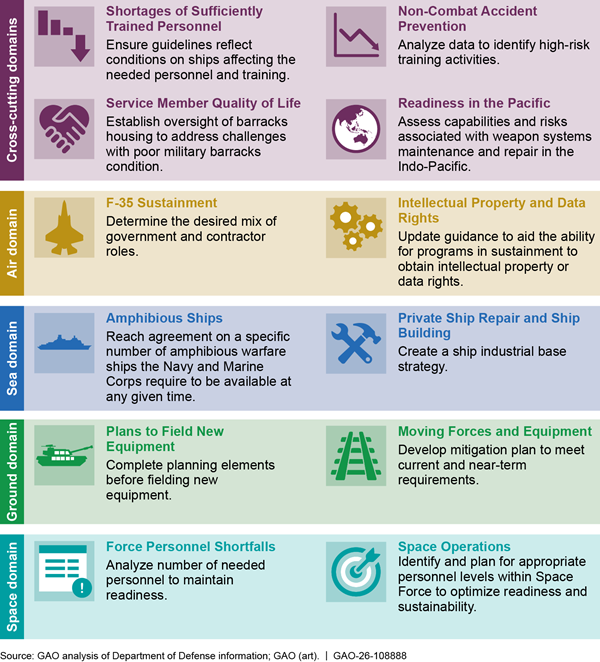
To maintain its reputation as the dominant military force worldwide, the Department of Defense (DOD) must balance efforts to improve the readiness of its forces with meeting ongoing demands, modernizing its capabilities, and addressing priorities identified in the 2026 National Defense Strategy. GAO’s body of work has shown that U.S. military readiness has been degraded over the last 2 decades due to a variety of challenges, including maintaining existing systems while acquiring new capabilities. Implementing GAO’s open recommendations—such as those shown in the figure below—will help DOD address these challenges and enhance readiness.
Why GAO Did This Study
DOD’s efforts to improve military readiness require the department to make difficult decisions on how best to address ongoing operational demands, adapt to shifting priorities, and prepare for future challenges. DOD has taken steps to address persistent readiness challenges, but significant work remains to make a range of needed improvements that GAO has identified.
This statement provides information on readiness challenges across the air, sea, ground, and space warfighting domains.
This statement is primarily based on published GAO reports since 2022 that have examined aspects of military readiness, operations, and sustainment in the air, sea, ground, and space domains. This statement also includes information on related work ongoing during fiscal year 2026. To perform all this work, GAO analyzed Army, Navy, Air Force, Marine Corps, and Space Force readiness, maintenance, personnel, and training information and interviewed cognizant officials.
What GAO Recommends
Across the reports summarized in this statement, GAO has made nearly 200 recommendations, with which DOD generally agreed, to help improve readiness across and in each of the domains. DOD needs to take additional actions to implement more than 150 of these recommendations, as discussed in this statement.
Chairman Sullivan, Ranking Member Hirono, and Members of the Subcommittee:
Thank you for the opportunity to be here today to discuss Department of Defense (DOD) readiness.
For decades, the United States has been considered the dominant military force worldwide, capable of defending its interests and preserving peace through strength in all warfighting domains—ground, sea, air, space, and cyberspace. During the past quarter century, conflicts have taken a toll on U.S. military readiness, while competition and threats posed by China and other adversaries have increased. The 2026 National Defense Strategy outlines a shift in the United States’ strategy, such as a renewed focus on the Western Hemisphere and the restructuring of long-standing relationships with allies and other partners around the world.[1] At the same time, the strategy emphasizes the continued importance of deterrence.
To ensure the U.S. military’s continued advantage across all domains, DOD has taken steps to both modernize and improve the readiness of its forces in line with the 2026 National Defense Strategy’s stated aim to bolster sustainment capabilities within the department and reinvest in the defense industrial base to build out capacity. However, our work has shown that DOD faces challenges that can hamper efforts to maintain current capabilities as well as efforts to acquire new capabilities.
For example, the military services have generally not met availability goals for the department’s current force structure—including for aircraft, ships, vehicles, and the personnel required to operate and maintain them. Issues affecting service member quality of life—such as poor housing conditions and fatigue—can exacerbate these challenges by diminishing military readiness. Additionally, DOD has been unable to sustain its weapon systems to meet its goals across all domains and faces challenges providing logistical support to U.S. forces, especially in contested environments.
We recognize that DOD’s efforts to improve military readiness require the department to make difficult decisions regarding how best to address continuing operational demands while it adapts to new priorities and prepares for future challenges. DOD has taken steps to address persistent and long-standing readiness challenges, but significant work remains. We have made nearly 200 recommendations in the reports summarized in this statement, with which DOD generally agreed. They are all intended to help DOD improve military readiness, but DOD still needs to take actions to address more than 150 of them. Many of these recommendations warrant priority attention from the department because their implementation could improve congressional and executive branch decision-making on major issues and substantially improve defense programs, among other benefits.[2]
This statement provides information on readiness challenges that exist across the air, sea, ground, and space domains, as well as cross-cutting challenges that span the force. It is based primarily on our prior reports, which we cite throughout this statement. Most of these were issued from May 2022 through January 2026 and examined aspects of military readiness, operations, and sustainment in the air, sea, ground, and space domains. We also include prior reports examining readiness issues across these domains, including key issues affecting service member quality of life. To perform our prior work, we analyzed Army, Navy, Air Force, Marine Corps, and Space Force information on readiness as well as maintenance, personnel, and training information; and interviewed cognizant officials.[3]
This statement also includes information on related ongoing work. We generally expect to report on those results during fiscal year 2026. To perform these ongoing reviews, we analyzed relevant documentation and interviewed cognizant officials.
More detailed information on the objectives, scope, and methodology for our prior work can be found in the issued reports listed in Related GAO Products at the conclusion of this statement. We conducted the work on which this statement is based in accordance with generally accepted government auditing standards. Those standards require that we plan and perform the audit to obtain sufficient, appropriate evidence to provide a reasonable basis for our findings and conclusions based on our audit objectives. We believe that the evidence obtained provides a reasonable basis for our findings and conclusions based on our audit objectives.
Implementing GAO’s Recommendations Can Help DOD Address Persistent Readiness Challenges Across the Air, Sea, Ground, and Space Domains
Cross-Domain
Each military service operates across multiple domains. For example, each service uses cyberspace. All conduct or depend on space operations. Army and Marine Corps forces operate from the air; Navy forces can influence land battles; and Air Force operations routinely affect multiple domains. DOD recognizes, and we have previously reported on, the importance of military operations working across multiple domains. In our prior work, we have found a variety of readiness challenges that cut across multiple domains and military services, as described further below.
Shortage of Sufficiently Trained Personnel Hinders Readiness
Insufficient numbers of adequately trained military personnel can negatively affect the military services’ ability to perform their missions. Our prior reports have found that the military services face challenges providing an adequate number of aircraft maintainers and sailors aboard Navy ships that are needed to meet mission requirements.
Aircraft Maintenance Personnel
Shortages in trained maintenance personnel have contributed to challenges the Departments of the Army, Navy, and Air Force face in meeting mission capable rate goals for their aircraft that support combat-related missions.[4] For example:
· The Army CH-47F Chinook—the Army’s only heavy-lift cargo rotary wing aircraft—has experienced depot maintainer shortages that have affected the availability of the aircraft, according to program officials. The CH-47F Chinook did not meet its mission capable rate goal in any year across fiscal years 2015 through 2024.
· The Air Force C-130J Super Hercules—performing airlift support and aeromedical missions—faced maintenance personnel challenges. In particular, difficulty hiring skilled depot personnel and high attrition rates for these personnel have affected the maintenance of the aircraft, according to program officials. The C-130J Super Hercules met mission capable rate goals in 1 out of 10 years across fiscal years 2015 through 2024.
· The Air Force B-2 Spirit—the Air Force’s multirole low observable, or stealth bomber that can deliver both conventional and nuclear munitions by penetrating an enemy’s defenses—experienced shortages of trained maintenance personnel. For example, there are only two technicians available who are trained to perform a specific type of B-2 maintenance, according to B-2 program officials. The B-2 Spirit met mission capable rate goals in 4 of 10 years across fiscal years 2015 through 2024.
· The Navy EA-18G Growler—an aircraft with advanced electronic warfare capabilities—has experienced depot maintenance personnel shortages, according to program officials. The officials stated that the program has experienced a shortage of trained depot maintenance personnel due to less experienced personnel being hired who need additional training, and attrition caused by higher pay in the private sector for trained maintenance personnel.[5]
Navy Ship Maintenance Personnel
The Navy faces several interrelated personnel and training challenges that inhibit sailors’ ability to complete required ship maintenance. In September 2024, we found that the Navy does not fill all required ship positions, and that sailors assigned to a ship are sometimes unavailable for duty (for example, temporarily assigned to another ship) or may have inadequate training or preparation for their positions.[6]
Sailor shortages hinder sailors’ ability to complete required maintenance, according to ship executive officers we surveyed, sailors from our visits to 25 ships, and our review of Navy data. For example, 63 percent of executive officers completing our survey said it was moderately to extremely difficult to complete repairs while underway with the number of sailors assigned to their ships. Our work found that the total sailor-led maintenance backlog declined for aircraft carriers and surface ships but increased for submarines. For a subset of maintenance actions classified as “mission-limiting” based on their priority and impact, the backlog worsened in fiscal year 2023, increasing by about 8 percent, according to our analysis.
Sailors who are assigned to a specific ship are sometimes unavailable to perform sailor-led maintenance, due to illness or temporary duty on another ship, among other reasons. However, we reported the Navy did not track and report data on the number of sailors assigned to a ship, but not available for duty, according to officials.
We made seven recommendations, with which the Navy agreed, including that the Navy improve the quality of information on the number of ship’s crew available for duty and ensure that maintenance guidelines reflect specific conditions affecting the needed amount of time, personnel, and training specific to ships or ship classes. The Navy has taken action to address one recommendation, but needs to take additional actions to fully implement the remaining recommendations.
Additionally, in April 2024, we identified issues concerning the reliability of data the Navy uses to monitor the personnel readiness of the fleet.[7] As a result, the Navy did not have an accurate understanding of the true extent of personnel skill and experience gaps. To address these issues, we made 11 recommendations aimed at improving the reliability and management of Navy ship crewing data. The Navy partially agreed with these recommendations; however, as of February 2026, the Navy still needs to take action to address them.
Actions Could Help Improve Safety and Prevent Accidents
Accidents involving U.S. military personnel during training and other non-combat events have resulted in deaths and hundreds of millions of dollars in damage to ships, vehicles, and aircraft. DOD has stated that it cannot afford to maintain the status quo if it is to reach a goal of zero fatalities from preventable accidents, and emphasized the importance of preserving the health and safety of personnel in addition to military equipment and assets.[8] Through our work in this area, we have identified that inattention, lapses in supervision, and not following procedures were key factors that have contributed to reported non-combat accidents.[9]
Osprey Accidents
In our December 2025 report, we found that reported Marine Corps and Air Force accident rates for the most serious Osprey accidents (i.e., those involving death; permanent disability; extensive hospitalization; property damages of $600,000 or more; or a destroyed aircraft) increased in fiscal years 2023 and 2024 and exceeded the average serious accident rate for the previous 8 fiscal years.[10] Specifically, the rates of Marine Corps and Air Force serious accidents were between 36 percent and 88 percent higher than each service’s average rate for fiscal years 2015 through 2022 (see fig. 1).[11]
Figure 1: Serious Osprey Accident Rates in Fiscal Years 2023 and 2024 Compared with Service Average for Fiscal Years 2015–2022
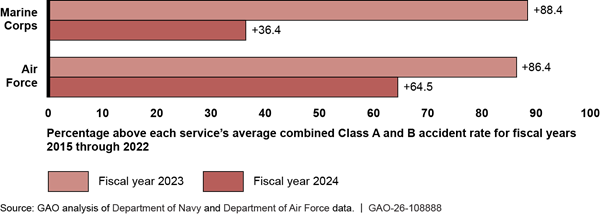
Note: The accident rate equals the number of accidents per year divided by the number of flight hours per year and then multiplied by 100,000. Serious accidents refer to combined Class A and B accidents, which are those accidents that involve death; permanent disability; extensive hospitalization; property damages of $600,000 or more; or a destroyed aircraft. The Navy had not experienced a Class A or Class B accident with its Osprey variant since it began operational use in fiscal year 2021 through fiscal year 2024.
We also identified weaknesses that limited DOD’s ability to fully identify, analyze, and respond to Osprey safety risks, like not having enough personnel for maintenance. We further found that DOD had not established comprehensive mechanisms to oversee efforts to resolve known safety risks. Additionally, we identified opportunities for DOD to improve information-sharing practices to promote the safe operation of the aircraft. For example, we found that Osprey program stakeholders had not proactively shared hazard and accident reporting information with Osprey units and unit safety personnel in the other services that operate the aircraft.
We made five recommendations to DOD, including that it refine the Osprey program’s process for identifying, analyzing, and responding to all safety risks; establish an oversight structure to ensure the timely resolution of known safety risks; and implement processes to routinely share relevant safety data. DOD agreed with all our recommendations and identified actions it would take to incorporate them in relevant policies and procedures.
Special Operations Forces Training Accidents
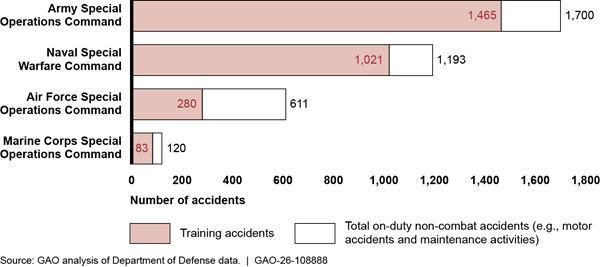
Special Operations Forces individuals have experienced serious accidents during high-risk training, which U.S. Special Operations Command (SOCOM) defines as a set of activities that expose the individual to the potential risk of serious injury, permanent disability, or death. In November 2024, we found about 80 percent of the over 3,600 reported on-duty, non-combat accidents involving Special Operations Forces personnel occurred during training activities in fiscal years 2012 through 2022, according to military service safety center data (see fig. 2).[12] About 40 percent of the total reported training accidents occurred in two high-risk training areas: parachute training and combat dive training.
Figure 2: Reported Number of On-Duty, Non-Combat and Training Accidents Involving Special Operations Forces Personnel, Fiscal Years 2012-2022
We found that SOCOM had not analyzed accident trends in these areas or others that may be high risk to improve safety. We also found that none of the military services’ Special Operations Forces commands addressed all of SOCOM’s oversight requirements in their respective high-risk training and related policies. As a result, SOCOM did not have reasonable assurance that it had an effective approach to safety with standardized oversight across the military services’ Special Operations Forces commands to mitigate training risks.
In our November 2024 report, we made six recommendations to DOD including that SOCOM analyze safety data to identify high-risk training areas and ensure that the military services’ four Special Operations Forces commands complete updates to their policies that include SOCOM’s high-risk training oversight requirements. DOD agreed with the recommendations, but needs to take further actions to fully implement them.
Army and Air National Guard Helicopter Accidents
In March 2023, we found that the Army and Air Force National Guard reported 298 accidents during non-combat flights from fiscal years 2012 through 2021.[13] We found that these accidents were mostly due to human error. Approximately 45 of those were considered serious helicopter accidents in that they involved death, permanent disability, extensive hospitalization, property damages of $500,000 or more, or a destroyed helicopter (see fig. 3).
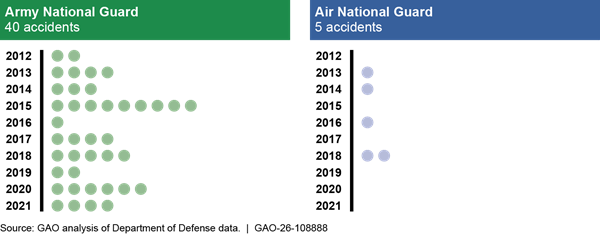
Note: Serious helicopter accidents include those that involved death, permanent disability, extensive hospitalization, property damages over a certain threshold ($500,000 or more during fiscal years 2012 to 2019 and $600,000 or more after October 2019), or a destroyed helicopter.
We made eight recommendations to the Army and Air Force, including that they take steps to ensure that their National Guard helicopter units continuously evaluate and update risk management practices and develop comprehensive strategies to address challenges that have hindered National Guard helicopter pilot training. DOD generally agreed with our recommendations and has taken action to address six of them, but needs to take further actions to fully implement the other two.
The military services continue to experience serious training accidents, including those involving loss of life. These worsening trends in military aviation accidents can be a result of smaller issues that relate to an unsafe culture. We have a related ongoing review evaluating DOD’s efforts to promote a positive operational safety culture in aviation. We expect to report on our work later in 2026.
Quality of Life Challenges Can Negatively Affect Military Readiness
Challenges affecting service member quality of life can also diminish military readiness. We have identified a range of issues affecting the condition of housing for service members and families, including risks to health and safety. In addition, fatigue caused by inadequate sleep also negatively affected service members’ performance and contributed to serious accidents.[14]
Condition and Availability of Service Member Housing
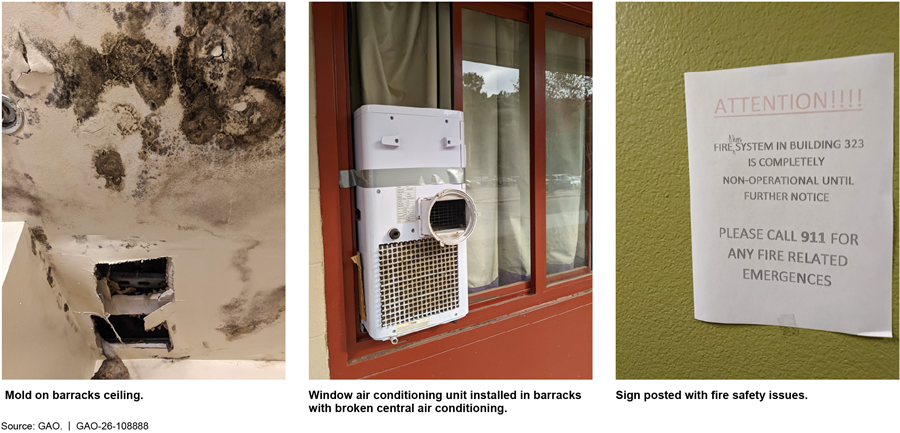
In our prior work, we found that poor living conditions in military housing can degrade service member quality of life and, consequently, affect military readiness.[15] In September 2023, we identified many issues negatively affecting the condition of military barracks. For example, we found that poor living conditions in some military barracks—such as the presence of mold, broken fire alarm systems, and extreme temperature—may pose potentially serious risks to the physical and mental health of service members, as well as their safety (see fig. 4).
We also found that DOD did not sufficiently assess the effects of poor military barracks conditions on quality of life and readiness. To address this and other issues, we made 31 recommendations with which DOD generally agreed, including that DOD establish oversight of barracks housing to address challenges with poor barracks conditions. To date, DOD has fully implemented 19 of these recommendations and still needs to take action to implement the remaining 12.
Similarly, in October 2024, we identified challenges related to supply and affordability of housing for service members receiving housing allowances to live off base. We found these challenges can negatively affect service member quality of life, as well as performance and mission.[16] For example, in some cases, service members may be unable to get to work if they have to commute long distances in dangerous weather due to the availability of nearby housing. We further found that DOD did not routinely assess or respond to these negative effects. As a result, we made six recommendations, with which DOD agreed. However, DOD needs to take further action to implement them.
In our February 2026 report on the management of facilities on joint bases we also identified challenges related to the condition of installation facilities such as barracks, including that insufficient funding and workforce levels have contributed to poor conditions.[17] In addition, we have ongoing work related to the maintenance of facilities on military installations, which we plan to issue a report on in spring 2026.
Service Member Fatigue
When service members do not get enough sleep, it can affect their performance. DOD is aware that impairment from fatigue can be equivalent to the effects of alcohol intoxication and significantly increases the risk of physical injury. The department’s overarching guidance about fatigue emphasizes the importance of service members obtaining at least 7 hours of sleep for optimal performance and readiness.[18] For over a decade, DOD surveys have found that most service members reported sleeping 6 or fewer hours per night.
We found in March 2024 that many service members were not getting the DOD-recommended 7 or more hours of sleep each day.[19] In a nongeneralizable survey that we conducted for our March 2024 report, we found that many respondents were sleeping too little, and roughly half of respondents had poor sleep quality regardless of quantity.[20] Survey respondents provided examples of how sleep deprivation had affected their work—from nearly colliding with another aircraft to falling asleep on the job.
We made nine recommendations in this area in our March 2024 report, including that DOD assess its fatigue-related oversight structure, assign DOD and service-level leadership to oversee fatigue-related efforts, and create and maintain a list of all relevant research projects. DOD generally agreed with our recommendations and has implemented six of them, but needs to take further actions to fully address the remaining three. For example, DOD has not yet created a comprehensive list of fatigue-related research projects or compared such projects to reduce fragmentation among initiatives.
The Navy also cited fatigue as a factor in recent investigations into the loss of an F/A-18 Super Hornet and a collision between aircraft carrier USS Harry S. Truman and a merchant ship in 2025.[21] The Navy’s investigation into the Truman collision, in particular, cited fatigue as a key factor in the collision and cited ship personnel who described a “just get it done” atmosphere aboard the carrier. While no sailors were injured or killed in the recent Truman collision, the carrier experienced considerable damage, and the Navy relieved the Truman’s commanding officer following the incident.
Challenges Affect Readiness in Specific Regions
Readiness in the Indo-Pacific
We have also identified a range of challenges affecting readiness in the Indo-Pacific theater. Key challenges we identified relate to Pacific weapon system repair, the Pacific Deterrence Initiative, fuel and assets in the Indo-Pacific region, and Guam missile defense.[22]
Pacific weapon system repair. In January 2026, we issued a classified report on DOD’s efforts to assess capabilities and identify risks associated with weapon system maintenance and repair in a contested Indo-Pacific environment, develop mitigation strategies for such risks, and incorporate maintenance and repair in a contested Indo-Pacific environment into exercises and wargames.[23]
We reported that each of the military services has some organic capabilities for maintenance and repair of weapon systems, as well as some ability to use allied and partner nation industrial capabilities in the region. We also identified examples of the military services leveraging each other’s maintenance and repair capabilities in the region. In addition, we reported on risks associated with maintenance and repair in a contested Indo-Pacific environment—some inherent to operating in the Indo-Pacific region more generally and others specific to conducting operations in a contested environment.
We found that DOD and the military services have begun to develop strategies to address risks, such as increased coordination with allies and partners and efforts to develop organic capabilities closer to the point of need. However, we found that while selected exercises and wargames included aspects of maintenance and repair, the U.S. Indo-Pacific Command and the military services have not ensured that the objectives for exercises and wargames include maintenance and repair.
We made 20 recommendations for DOD, the Indo-Pacific Command, and the military services to conduct assessments and address risks associated with maintenance and repair, and to include maintenance and repair in Indo-Pacific exercises and wargames. DOD agreed with our recommendations but has not yet taken action to implement them.
Pacific Deterrence Initiative. In November 2025, we reported on DOD’s Pacific Deterrence Initiative, a congressionally directed effort intended to increase visibility into how DOD resources are being used to strengthen deterrence and posture in the Indo-Pacific region.[24] As implemented by DOD, the Pacific Deterrence Initiative requires DOD to provide an annual detailed budget exhibit covering activities to enhance force posture, infrastructure, presence, and readiness in the region.
We found that the Pacific Deterrence Initiative budget exhibits for fiscal years 2023 through 2025 did not consistently reflect department-wide priorities and presented an inconsistent mix of programs and funding, limiting their usefulness for congressional oversight. These inconsistencies stemmed in part from unclear guidance on program selection. We also found that the programs and funding included in the exhibits differed from those in U.S. Indo-Pacific Command’s independent assessment, which is based on strategy and capability needs identified by that command.
We recommended that DOD (1) clarify program selection criteria and establish processes, including roles and responsibilities, for selecting and validating programs included in the annual Pacific Deterrence Initiative budget exhibit; and (2) update its processes to ensure that it reviews and considers U.S. Indo-Pacific Command’s funded priorities for inclusion in the exhibit. DOD agreed with these recommendations and cited actions it would take to address them.
Fuel and assets in the Indo-Pacific. In June 2025, we issued two classified reports focused on fuel supply and pre-positioned assets in the Indo-Pacific, respectively. Specifically, we reported on the risks DOD faces in storing and delivering fuel in a contested environment in the Indo-Pacific and the department’s prioritization of risk mitigation actions.[25] We further reported on DOD’s coordination on joint fuel requirements and live exercises that incorporate fuel storage and delivery. We made 11 recommendations in our classified report. DOD agreed with all of the recommendations but has not yet taken action to implement them.
We also reported that DOD faced challenges in managing its prepositioned assets in the Indo-Pacific region.[26] Our classified report included two recommendations for DOD to ensure sufficient training for oversight of contractors and to develop a comprehensive plan for managing challenges and risks related to prepositioned assets in the region. DOD agreed with our recommendations but has not yet taken action to implement them. In addition, we noted that Congress should consider requiring DOD to report that plan to Congress.
Guam missile defense. In May 2025, we reported that DOD’s plans to defend Guam from missile attack faced a variety of planning challenges.[27] DOD has taken steps to establish an organizational structure for overseeing and sustaining an enhanced missile defense system known as the Guam Defense System. However, we found that DOD has not established when or how the military services or the Missile Defense Agency will take responsibility for operating and sustaining the Guam missile defense system. Further, it has not identified the number of personnel that the services will need to deploy to Guam.[28]
We also reported that, while the Army has deployed a missile defense battery in Guam for over 10 years, it does not have sufficient installation support for its forces currently defending Guam from missile attack. The Army’s forces are not well integrated into the joint base structure in Guam, which includes installations managed by the Navy, Air Force, and Marine Corps. According to Army officials, the Army has had difficulty securing approvals from the joint base for temporary or permanent military construction at the Army’s site in Guam, where it relies on the Navy to provide construction planning services. As a result, the Army missile defense forces are experiencing austere living conditions, have limited space to store equipment and spare parts, and lack dedicated maintenance facilities.
Army officials also noted that, while the Army’s presence in Guam is expected to grow, the Army will rely on installation support from the Navy, Air Force, and Marine Corps bases in Guam rather than establishing its own base. The Army has taken initial steps to improve installation support, such as signing the Joint Region Marianas Joint Memorandum of Agreement and sending Army planners and engineers on temporary assignments to Guam. However, the Army has not determined its organizational structure for establishing a formal presence within Joint Region Marianas, which could continue to limit its ability to coordinate construction priorities and provide needed installation support services.
We made three recommendations in our May 2025 report, including that DOD develop strategies for transferring Guam missile defense system responsibilities to lead organizations and identify personnel requirements.[29] DOD agreed with our recommendations and has taken some actions—such as designating a Senior Army Element Commander for Army personnel supporting the Guam Defense System, according to DOD officials—but needs to take further action to fully implement them. We are continuing to follow these developments as part of our ongoing work on Guam Defense System planning.
Readiness in Europe
In recent years, we have identified challenges affecting the military’s readiness to address threats posed by Russia within the European theater. For example, in an August 2025 classified report, we identified challenges with DOD’s ability to rapidly receive and move materiel and equipment that would be needed in an event of a conflict with Russia.[30] We also identified instances where DOD and the North Atlantic Treaty Organization could improve their efforts to address these challenges. As a result, we made three recommendations to DOD, with which DOD agreed, as well as a matter for consideration by Congress.
In March 2025, we reported on the effect of Ukraine assistance on U.S. military readiness.[31] DOD has ordered over $20 billion in military assistance from DOD stockpiles through presidential drawdowns, from artillery rounds and missiles to tanks and body armor.[32] In our classified report, we identified both benefits and challenges to DOD’s readiness from these drawdowns. DOD has taken actions to address the challenges—for example, investing billions of dollars for replacement equipment and increasing production capacity for munitions, such as for 155mm artillery rounds.
In addition, our work in January 2025 found that training Ukrainian forces increased range usage and had varied effects on U.S. force readiness (see fig. 5).[33] As we reported, as part of the U.S. response to Russia’s invasion of Ukraine, DOD has trained Ukrainian personnel on specific weapons, group operations, and leadership—mainly at U.S. training ranges in Germany.[34]
Figure 5: Percentage of Training Range Days Scheduled at Grafenwoehr Training Area, by Month, January 2021–January 2024
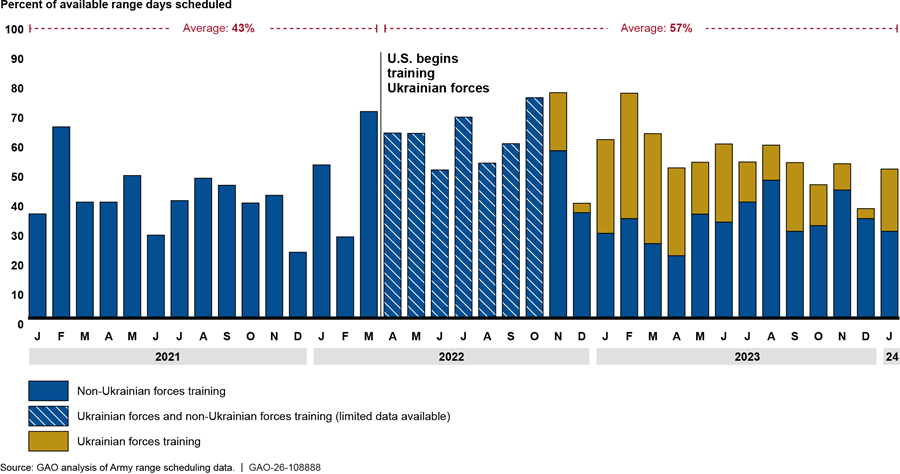
U.S. military personnel experienced some positive and negative readiness effects because of the security assistance training for Ukrainian forces. For example, units that frequently served as trainers described some benefits to general readiness that may not be captured in a unit’s readiness reporting, including morale and retention, repetition of training tasks, and knowledge sharing. In other cases, some U.S. Army units had to cancel, reschedule, or divert training to alternative locations because certain training ranges were being used for training Ukrainian forces at Grafenwoehr, Germany, and because training Ukrainian forces created a less predictable training schedule, according to officials. These alternative locations did not always have some equipment available to gather data and measurements during training.
However, we also found that DOD components, including the U.S. Army, had not consistently recorded observations from training Ukrainian forces in the Joint Lessons Learned Information System as required by DOD policy, which could contribute to a missed opportunity to learn from this experience.[35]
We made three recommendations in our January 2025 report, including that DOD ensure that organizations capture and share relevant training observations through the Joint Lessons Learned Information System. DOD agreed with two of our three recommendations and has taken action to address the recommendation on sharing training observations. The remaining two recommendations remain open as of February 2026.
Air Domain
Few Aircraft Met Mission Capable Goals
The Army and the Air Force did not meet their mission capable rate goals for fiscal year 2024 for 25 of the 27 aircraft that support military-related missions, based on our ongoing work on aircraft sustainment. For the Army and Air Force
· only two aircraft—the Air Force’s MQ-9 and UH-1N—met their annual mission capable rate goal in a majority of years from fiscal years 2015 through 2024;
· 19 aircraft were more than 10 percentage points below the mission capable rate goal for fiscal year 2024; and
· six aircraft were 10 percentage points or less below the mission capable rate goal for fiscal year 2024.
Beginning in fiscal years 2022 and 2023, respectively, the Navy and Marine Corps started to place less emphasis on the mission capable rate and more emphasis on managing by numbers of mission capable aircraft. For fiscal years 2022 through 2024 for the Navy and fiscal years 2023 and 2024 for the Marine Corps, the goal for each aircraft fleet was a monthly average number of mission capable aircraft. Given this change, we were unable to assess the Navy and Marine Corps aircraft against annual mission capable goals after fiscal years 2021 and 2022, respectively.
For fiscal years 2015 through 2022, only one of the Navy and Marine Corps aircraft we reviewed met its annual mission capable goal—the Navy’s E-6B. The E-6B aircraft met its goal for one fiscal year during the period. Figure 6 shows the number of years selected aircraft met their annual mission capable rate goal during fiscal years 2015 through 2024 for the Army and Air Force and fiscal years 2015 through 2021 or 2022 for the Navy and Marine Corps, respectively.
Figure 6: Number of Years Selected Aircraft Met Their Annual Mission Capable Rate Goal, Fiscal Years 2015-2024
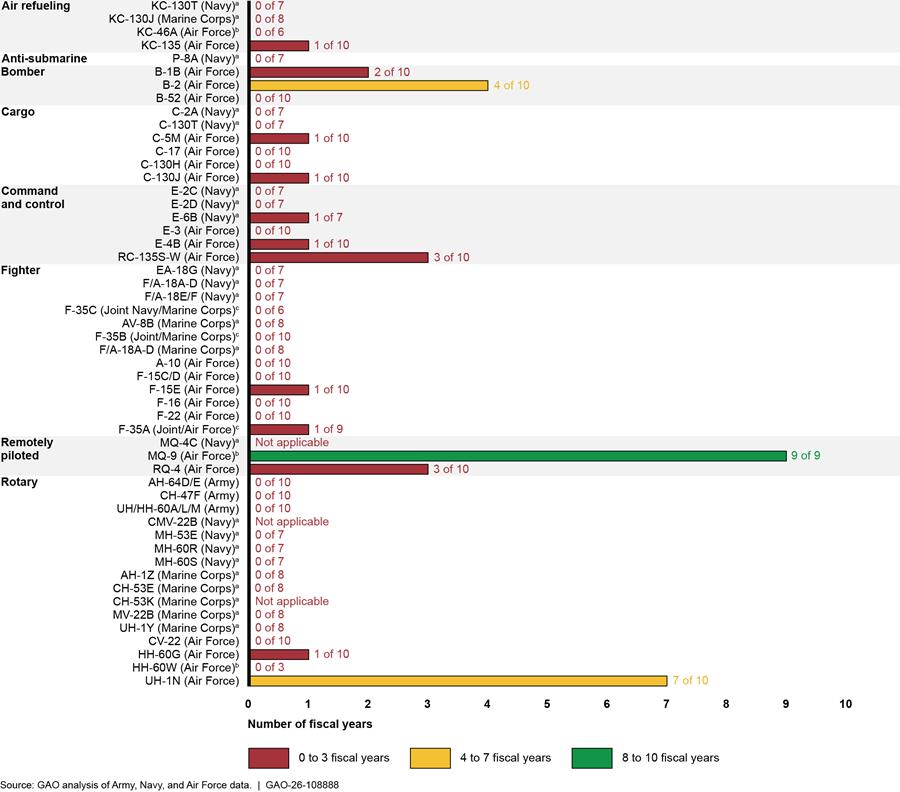
aThe Navy and Marine Corps, in fiscal years 2022 and 2023, respectively, started to place less emphasis on the mission capable rate and more emphasis on managing by numbers of mission capable aircraft. Therefore, we analyzed the mission capable rates for Navy aircraft from fiscal years 2015 through 2021 (7 years) and the Marine Corps aircraft from fiscal years 2015 through 2022 (8 years). We did not compare the mission capable rate to the service goal for any fiscal year before the aircraft reached initial operational capability. As a result, for Navy and Marine Corps aircraft that reached initial operational capability in fiscal year 2015 or later, the total number of years that we compared the mission capable rate to the service goal is less than 7 or 8 years, respectively. The MQ-4C, CMV-22B, and CH-53K reached initial operational capability either in or after the fiscal year that the Navy or Marine Corps stopped using mission capable rates, so—for these aircraft— we did not compare any mission capable rates to service goals for the period.
bFor Air Force aircraft, we did not compare the mission capable rate to the service goal for any fiscal year before the aircraft reached initial operational capability—except for the KC-46A. As a result, for Air Force aircraft that reached initial operational capability in fiscal year 2015 or later, the total number of years that we compared the mission capable rate to the service goal is fewer than 10.
cFor the F-35A, F-35B, and F-35C, we did not compare the mission capable rate to the goal for any fiscal year before the aircraft reached initial operational capability. As a result, for the F-35 aircraft that reached initial operational capability in fiscal year 2015 or later, the total number of years that we compared the mission capable rate to the goal is less than 10 years.
Our preliminary analysis examining aircraft sustainment indicates that many of the aircraft we reviewed faced one or more sustainment challenges related to supply support, maintenance constraints, and the age of the aircraft (see fig. 7). According to officials from the aircraft program offices, these challenges affect mission capable rates. One challenge—parts shortage or delay—has been a long-standing issue negatively affecting the ability of maintainers to conduct maintenance on aircraft. Having the necessary parts available is critical for ensuring weapon systems and equipment remain functional, sustainable, upgradable, and affordable.[36] We plan to report on our work on aircraft sustainment in summer 2026.
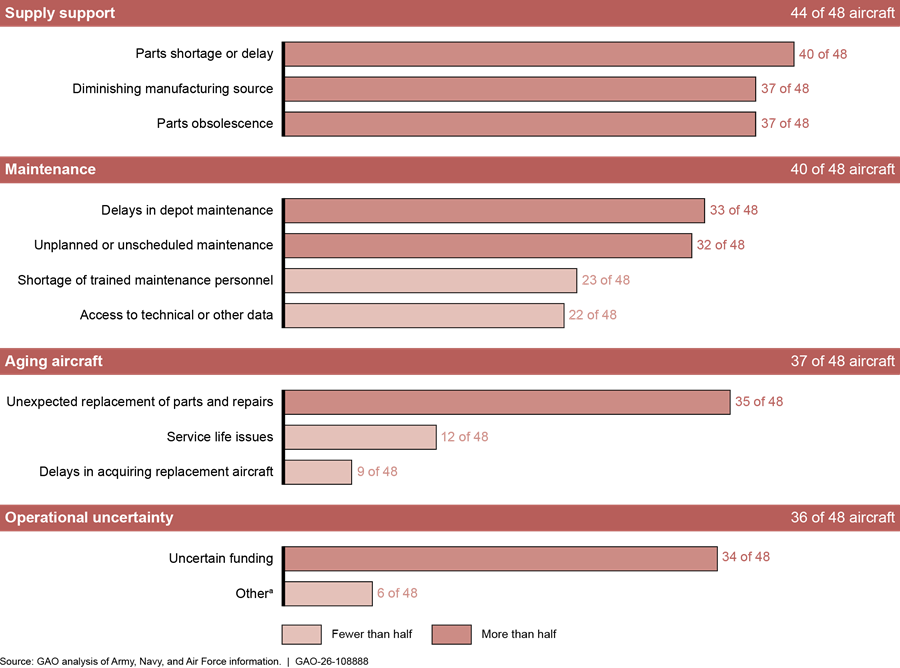
Note: ‘Obsolescence’ refers to a lack of availability of a part due to its lack of usefulness or it no longer being current or available for production. ‘Diminishing manufacturing source’ refers to a loss or impending loss of manufacturers or suppliers of items. ‘Service life issues’ refers to challenges related to extending the service life of an aircraft beyond what was planned.
aExamples of other sustainment challenges that program officials cited included uncertain retirement date, mishaps, multiple modification efforts, increased notices of escapements, and funding restrictions.
In addition, we have ongoing work examining sustainment issues for the Air Force’s aerial refueling tanker fleet, as well as modernization and sustainment of the B-52 fleet. We plan to issue both reports in spring 2026. We have additional related ongoing work reviewing (1) cargo aircraft sustainment, (2) aviation supply chain risks, and (3) bomber operations and sustainment in contested environments. We plan to report on the results of that work later in 2026.
Actions Are Needed to Address F-35 Sustainment and Operational Challenges
The F-35 Lightning II aircraft—a growing portion of DOD’s tactical aviation fleet—faces significant sustainment challenges. With over 800 F-35s now in service with the Air Force, Navy, and Marine Corps, the F-35 is DOD’s most ambitious and costly weapon system. In September 2025, we reported that DOD plans call for procuring 2,470 F-35s at an estimated total acquisition cost of about $485 billion.[37] Additionally, in April 2024, we found that DOD estimates an additional $1.58 trillion in sustainment costs for the aircraft.[38] These sustainment costs have grown about 44 percent from $1.1 trillion in 2018 due to inflationary pressures and an increase in the planned life cycle of the aircraft from the 2070s to the 2080s.
The Air Force, Navy, and Marine Corps have deployed the F-35 to forward locations including (1) Air Force deployments to Europe, the Middle East, and the Pacific; (2) Navy carrier deployments in the Pacific; and (3) Marine Corps stationing in Japan and deployments on amphibious ships and carriers. However, in recent years, the program has not met performance goals for F-35 aircraft readiness. In fiscal year 2025, all F-35 variants were below the full mission capable minimum-performance target by more than 35 percentage points (see fig. 8). Furthermore, each F-35 variant in fiscal year 2025 did not meet its target for mission capable minimum performance by at least 10 percentage points (see fig. 9). When programs overpromise a weapon’s prospective performance and deliver systems that cannot achieve their requirements, such as mission capable goals, the warfighter receives less capability than originally promised.
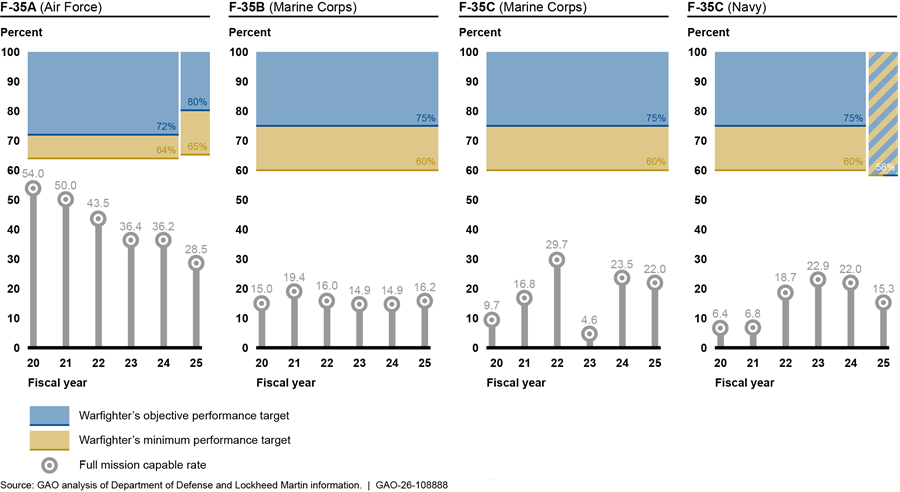
Note: The full mission capable rate assesses only aircraft that are in the possession of F-35 units. It measures the percentage of time during which these aircraft are fully capable of accomplishing all tasked missions. The warfighter’s minimum and objective performance targets are those requirements established for non-deployed F-35 aircraft by the U.S. Air Force for the F-35A, by the U.S. Marine Corps for the F-35B, and by the U.S. Navy for the F-35C, in their respective performance-based arrangements. According to Air Force officials, the fiscal year 2025 decline in full mission capable rates was a result of the program accepting new aircraft that were non-mission capable due to software delays, as well as ongoing challenges with scarce parts and corrosion inspections and remediation. For 2025, the Navy’s objective and minimum performance targets were both 58 percent.
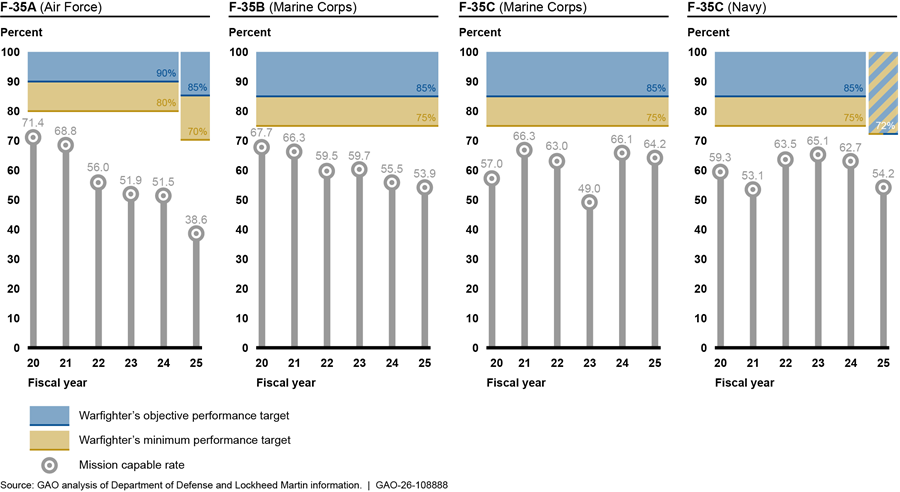
Note: The mission capable rate assesses only aircraft that are in the possession of F-35 units. It measures the percentage of time during which these aircraft are safe to fly and able to perform at least one tasked mission. The warfighter’s minimum and objective performance targets are those requirements established for non-deployed F-35 aircraft by the U.S. Air Force for the F-35A, by the U.S. Marine Corps for the F-35B, and by the U.S. Navy for the F-35C, in their respective performance-based arrangements. According to Air Force officials, the fiscal year 2025 decline in full mission capable rates was a result of the program accepting new aircraft that were non-mission capable due to software delays, as well as ongoing challenges with scarce parts and corrosion inspections and remediation. For 2025, the Navy’s objective and minimum performance targets were both 72 percent.
We have previously reported that a host of challenges negatively affected F-35 readiness and the ability of the aircraft to achieve mission capable goals, as shown in figure 10.[39] In particular, DOD officials have told us that recurring issues with parts reliability and maintainability continue to negatively affect the program. We also found that a lack of technical data, spare parts, and training hinders the ability of maintainers to maintain the aircraft.
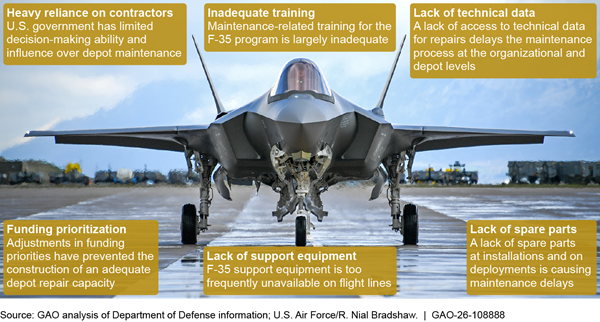
In a deployed environment, including potentially contested environments, it is of critical importance for squadrons to be able to conduct maintenance to support mission goals. In March 2025, we reported that F-35 squadrons have faced maintenance challenges while deployed, including that personnel lack access to certain data needed to independently take certain maintenance actions, which limits aircraft availability.[40] We found that the F-35 Joint Program Office is taking steps to improve maintenance capabilities for the entire F-35 fleet, but that these efforts remain in early stages. We also found that the F-35 Joint Program Office was taking steps to improve access to supply chain information, particularly for deployed and deploying units. Program officials said they recognize that the warfighter wants visibility into the supply chain to determine how to allocate resources. However, we found that these initiatives were still in early stages with unclear implementation timelines.
Since 2014, we have made 46 recommendations designed to improve the department’s operation and sustainment of the F-35 program. DOD agreed with many of these recommendations and has implemented 14 of them but needs to take further actions to implement the other 32. For example:
· In 2023, we found that as DOD seeks expanded government control of F-35 sustainment, it has neither (1) determined the desired mix of government and contractor roles, nor (2) identified and obtained the technical data needed to support its desired mix.[41] We recommended that DOD reassess F-35 sustainment elements to determine government and contractor responsibility, identify any required technical data, and make final decisions on changes to F-35 sustainment to address performance and affordability. In January 2026, DOD officials told us they were working to implement these recommendations as part of their efforts to transfer all functions relating to the management, planning, and execution of sustainment activities for the F-35 from the F-35 Joint Program Office to the Secretary of the Air Force and the Secretary of the Navy.[42]
· In 2025, we recommended that DOD assess whether F-35 maintenance personnel are granted appropriate authorities and access to technical data and information when deployed and make any changes necessary to ensure the success of the F-35 in future uncontested and contested environments.[43] We also recommended that DOD establish implementation timelines and fully implement initiatives to improve the visibility and the quality of data, as appropriate, for operational squadrons. DOD agreed with both recommendations and, according to officials, is drafting corrective action plans detailing steps to address them. We will continue to review DOD’s efforts to implement these plans.
We have an ongoing review examining F-35 performance; DOD’s implementation of an updated F-35 sustainment strategy; and DOD’s management of sustainment contracts, including the use of incentive fees. In 2025, the F-35 Joint Program Office determined that the current sustainment strategy was insufficient to meet the needs of a growing F-35 fleet. The program office developed an updated strategy to remedy several of the issues we previously identified with the goal of achieving a fleet-wide mission capable rate of 80 percent and full mission capable rate of 65 percent by 2030. According to officials, the program office estimates that over the next 5 fiscal years the updated strategy would require additional spending of over $12 billion. Additionally, according to DOD officials, the department is in the process of obtaining data on F-35 parts in its inventory and developing information technology systems that will enable auditability and improve sustainment outcomes. We plan to report on our results in summer 2026.
Data Rights Challenges Can Hamper Weapon System Sustainment
We have reviewed intellectual property and data rights necessary for the sustainment of DOD weapon systems including the F/A-18 and F-35. In September 2025, we reported that DOD program offices prepare acquisition, intellectual property, and sustainment strategies during early planning phases when long-term data rights needs can be difficult to predict.[44] Striking the right balance in this process is a challenge; however, a program failing to obtain the technical data and data rights it needs can result in long-term sustainment problems.
Additionally, we found that some programs experienced vendor lock—or reliance on a single supplier—due to data rights shortfalls. According to officials, this can drive up costs and lengthen repair time frames. Options to address these effects are limited once programs enter sustainment. DOD has unlimited rights in statute to certain data needed for operation, maintenance, installation, and training purposes.[45] However, the statute excludes detailed manufacturing or process data from this allowance.
We made three recommendations to address these issues, including that DOD update or produce guidance to address the courses of action available to programs in sustainment to obtain intellectual property and data rights. DOD agreed with our recommendations but has not yet taken action to address them. In addition, we noted that Congress should consider clarifying how DOD and contractors should treat detailed manufacturing or process data needed for operation, maintenance, installation, and training purposes.
Air Force Actions Are Needed to Improve New Process for Preparing Units to Deploy
Continuous deployments over the past 2 decades have reduced the Air Force’s readiness to deploy units. To rebuild readiness, the Air Force is implementing a new cyclical process to organize and deploy its forces, known as Air Force Force Generation (AFFORGEN). The Air Force’s primary focus of the new process is to standardize deployment schedules and meet demand for its units, while providing enough downtime for rest, training, and the preservation of readiness. It seeks to change how the Air Force generates and presents forces to better mirror how the other military services generate and present forces to meet combatant command requirements. For example, the Navy offers carrier strike groups as a standard force package to the Joint Staff to meet combatant command requirements. In addition to the active-duty Air Force, the Air National Guard and Air Force Reserve are also implementing AFFORGEN.
In November 2024, we found that the Air Force has taken steps to address some challenges in implementing this new process, but it continues to face a variety of ongoing challenges.[46] For example, units assigned to combatant commands, such as bomber units that directly support U.S. Strategic Command missions, did not have enough forces to meet Air Force and combatant command taskings and move through AFFORGEN’s four phases. The Air Force acknowledged and addressed this issue by revising the composition of these forces and tailoring the AFFORGEN process to specific types of units.
However, we identified other implementation challenges. For example, the Air Force has not completed an assessment of minimum U.S. base staffing needs. Under AFFORGEN, the Air Force planned to deploy whole units from U.S. bases, but it has relied on some of these personnel to operate its bases and perform duties to provide security measures for a base’s perimeter, or support the nuclear mission, among other functions. Completing a service-wide assessment of Air Force base minimum staffing needs would identify any personnel gaps and help the Air Force better manage staffing at U.S. bases. Assessing these gaps and potential risks could also help base commanders develop plans and ways to address or mitigate risk to their installations from reduced staffing.
We also found that the Air Force’s ongoing efforts to implement AFFORGEN partially align with some selected leading reform practices and do not align with others. For example, while the Air Force has released visionary statements, it has not set goals to track implementation progress. Incorporating leading reform practices, such as establishing goals and outcomes, into its implementation of AFFORGEN would assist the Air Force in instituting outcome-oriented goals and evaluating its progress.
We made four recommendations in our November 2024 report to address these issues, including that the Air Force complete an assessment of minimum U.S. base staffing needs. DOD agreed with our recommendations and has fully implemented one to date. However, DOD needs to take further action to address the remaining three recommendations.
Delays and Staffing Challenges Affect Maintenance at Air Force Depots
We have ongoing work assessing the extent to which the Air Force has completed aircraft depot maintenance on time and addressed any staffing challenges at its three maintenance depots, also known as Air Logistics Complexes. Our preliminary analysis indicates that depot maintenance delays have increased considerably since fiscal year 2019, which was the last time we reported on Air Force depot timeliness (see fig. 11).[47]
Figure 11: Percentage of Air Force Aircraft Delayed During Depot Maintenance, Fiscal Years 2019–2024
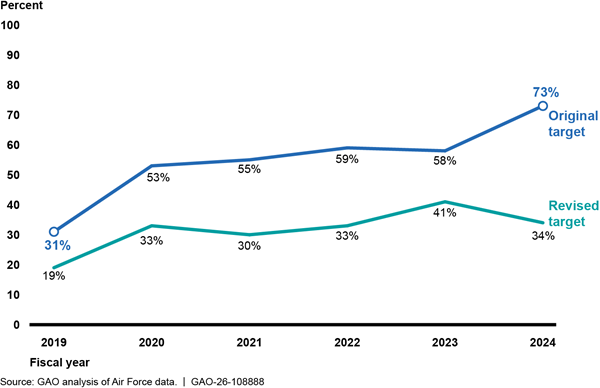
The Air Force tracks depot timeliness based on both the original target completion date set before aircraft arrive at the depot, and the revised target completion date set during depot maintenance. It primarily uses the revised target to report on its depot timeliness performance, which our preliminary analysis indicates can mask the full extent of maintenance delays because it does not reflect additional time for unplanned work. Unplanned work includes previously unknown aircraft issues, such as corrosion or stress cracks, that require additional time to obtain parts, receive engineering approvals, and conduct the labor. Air Force officials cited this as a major issue contributing to overall delays, and said the issue is worsening as aircraft continue to age.
Our preliminary analysis of staffing shows that while all three depots have filled 90 percent or more of workforce positions since 2020, they experienced shortages in specific occupations such as aircraft mechanics and engineers. Depot officials identified pay competition with the private sector as the primary challenge in recruiting and retaining personnel in these occupations, which our prior work also identified.[48] Our ongoing work is examining steps the Air Force depots have taken to address this challenge. We plan to issue a report on our findings in spring 2026.
Sea Domain
Ship Sustainment Challenges Hinder Navy’s Ability to Generate Forces
We have reported extensively on the sustainment challenges facing the Navy’s surface ships, submarines, and aircraft carriers in the last several years.[49] Figure 12 shows key sustainment challenges that we determined were affecting selected ship classes.
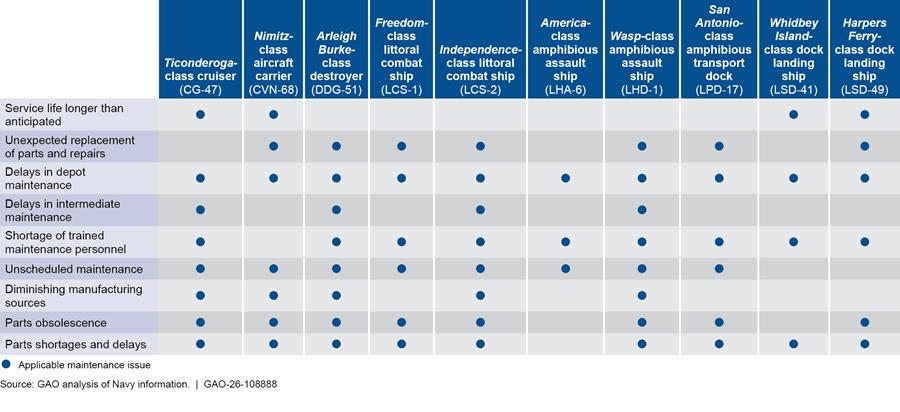
Note: ‘Diminishing manufacturing sources’ refers to the loss, or impending loss, of manufacturers or suppliers of items, raw materials, or software.
Our work also identified several interrelated challenges hindering the ability of sailors to maintain and repair Navy ships. In September 2024, we reported that the Navy provides training for sailor-led maintenance that both officers and sailors described as inadequate to meet their needs.[50] Specifically, sailors who responded to our survey expressed dissatisfaction with both the quality of training––whether it prepares them to perform maintenance aboard ship––and the format in which training is delivered (see fig. 13).

In addition, the Navy’s guidelines for performing ship maintenance are sometimes inaccurate with respect to the time and personnel needed and are not written appropriately for sailors’ maintenance skills and supervisor’s experience levels.
We made seven recommendations in our September 2024 report, including for the Navy to evaluate and adjust the balance between classroom training and on-the-job training on maintenance skills for junior sailors. The Navy agreed with our recommendations and has taken actions to implement one of them, but needs to take further actions to address the remaining recommendations.
Availability of Amphibious Warfare Ships
We have also reported on challenges with the Navy’s ability to provide amphibious ships for Marines due to fleet condition and maintenance issues.[51] The Navy’s amphibious fleet transports Marines and their equipment, such as landing craft, for critical missions like amphibious assault and humanitarian response. We found in December 2024 that half of the fleet of 32 amphibious warfare ships were in poor condition and that these ships were not on track to meet their expected service lives (see fig. 14).
Figure 14: Navy Assessment of the Condition of Ships in the Amphibious Warfare Fleet as of March 2024
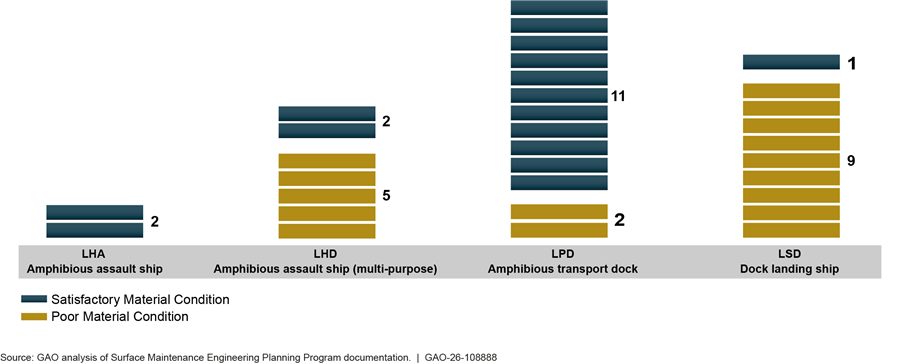
We identified factors that contributed to the fleet’s poor condition and reduced its availability for Marine Corps operations and training. For example, the Navy faces challenges with spare parts, reliability of ship systems, and canceled maintenance. Specifically, the Navy had previously decided to cancel maintenance for nearly a third of its aging amphibious ships that it wanted to divest or retire before the end of the ships’ expected service lives. However, the Navy made this decision before notifying Congress and completing a required waiver process.[52] When Congress prohibited divestment of some of these ships, they fell into further disrepair, which compounded the amount of work the Navy needed to complete in future maintenance periods.
Another key reason the Navy was not meeting its ship availability goals is that it has generally failed to complete amphibious warfare ship maintenance in accordance with its planned maintenance schedules. Maintenance delays can result in cascading delays to training and, ultimately, deployment. For amphibious warfare ships that began depot maintenance periods in fiscal years 2022 through 2024, the Navy completed only one of 10 of those periods on schedule, according to our analysis. The remaining nine maintenance periods that the Navy did not complete on schedule resulted in more than 3,000 days of cumulative delays. Additionally, in total, the maintenance periods cost $400 million more than the original contract value for the efforts.
We also found that the Navy is likely in the future to face difficulties meeting a statutory requirement to have at least 31 amphibious ships given the age of many ships and other factors. The Navy is considering extending the service life for some ships to meet the 31-ship requirement. However, these efforts will require preliminarily up to $1 billion per ship, according to the Navy, with six ships needing service life extensions in the next 3 decades amid rising ship construction costs and maintenance backlogs.
We made four recommendations in our December 2024 report to address these issues, including that the Navy refine definitions related to amphibious warfare ship availability to include specific and measurable terms, and reach agreement on a specific number of amphibious warfare ships the Navy and Marine Corps require to be available at any given time. The Navy agreed with three of the four recommendations. As of December 2025, the Navy provided documentation showing the Navy and Marine Corps approved a joint memorandum of understanding outlining expanded ship availability definitions that include specific and measurable terms, but the Navy needs to take further action to address our remaining recommendations.
Attack Submarine Maintenance Delays
The Navy has long faced challenges performing timely maintenance for its attack submarines.[53] In December 2018, the Navy reported to Congress that it would take actions to eliminate attack submarine maintenance backlogs and associated idle time (when submarines are no longer certified for normal operations as they wait to enter maintenance) by the end of fiscal year 2023.[54] However, our ongoing work examining attack submarine readiness has preliminarily found that while the Navy has made some progress, it continues to face challenges performing attack submarine maintenance. Our preliminary analysis of Navy data over the last 10 years—from fiscal year 2016 through fiscal year 2025—indicates that while the Navy has not eliminated the submarine maintenance backlog, it has made significant progress in reducing active idle time on attack submarines. At the same time, inactive attack submarine idle time has grown.
· Days of depot maintenance delay. The Navy’s attack submarine maintenance backlog has persisted over the last 10 years. The Navy incurred 3,040 days of maintenance delay from fiscal year 2016 through fiscal year 2020 and 3,454 days from fiscal year 2021 through fiscal year 2025. Additionally, from fiscal year 2016 through fiscal year 2020, the average depot-level maintenance period was 744 days, compared with 809 days from fiscal year 2021 through fiscal year 2025.
· Idle time for active attack submarines. According to officials, active idle time describes a period when an attack submarine and its crew must remain pier-side because they are no longer certified to conduct normal operations and cannot be inducted into a maintenance period. The attack submarine is considered active because it is not being decommissioned and will continue operations after completing its maintenance period. These attack submarines and their crew must wait until a shipyard has the capacity to begin their maintenance period. From fiscal year 2016 through fiscal year 2025, the Navy incurred 8,906 days of active idle time. Active idle time hit a peak in fiscal year 2022 with 1,518 days. Since this peak, the Navy has reduced active idle time to 166 days in fiscal year 2025.
· Idle time for inactive attack submarines. According to officials, inactive idle time describes a period when an attack submarine designated for decommissioning cannot be inducted into a dry dock in a public shipyard. As a result, officials stated the submarine and its crew—including those required to maintain and supervise the nuclear reactor—must remain pier-side because they are no longer certified to conduct normal operations and must wait until a shipyard has the capacity in a dry dock to defuel their nuclear reactor. Inactive attack submarines faced significant increases of inactive idle time over the last 10 years, incurring 3,287 days from fiscal year 2016 through fiscal year 2025 and reaching a peak of 1,260 days of inactive idle time in fiscal year 2025. Additionally, the Navy projects significant increases in inactive idle time through fiscal year 2030. As of January 2026, without mitigation, 15 attack submarines will enter inactive idle time through fiscal year 2030—during which time the Navy could realize more than 14,000 days of inactive idle time. This significant increase is due largely to an aging Los Angeles-class reaching the end of their service lives as new Virginia-class submarines enter the fleet and seismic constraints at Puget Sound Naval Shipyard. According to Navy officials, the Navy is pursuing service life extensions for submarines projected to incur inactive idle time and, if approved, these extensions will reduce inactive idle time and provide additional operational availability prior to inactivation.
In addition to lost operational availability for attack submarines, the Navy incurs significant operating and support costs for submarines that are not ready for operations due to maintenance delays and idle time. All delayed attack submarines discussed above—whether delayed during a maintenance period or sitting idle pier-side—are generally fully crewed. We conducted preliminary analyses of the operating and support costs the Navy incurs on average to estimate the costs of crewing, maintaining, and supporting attack submarines that are delayed in entering and leaving the shipyards. Using historical daily cost data, we estimated that from fiscal year 2016 through fiscal year 2025, the Navy has spent $4.2 billion on attack submarines sitting idle while waiting to enter the shipyards and on those delayed in completing their maintenance at the shipyards.[55] We plan to issue a report on attack submarine readiness in summer 2026.
Planning Challenges and Increased Costs Could Jeopardize Navy’s Ability to Improve Public Shipyards
The Navy’s four public shipyards are critical to the maintenance of its fleet of aircraft carriers and submarines, ensuring their readiness to support ongoing military operations around the world. [56] In our prior work we have found that persistently deteriorating and outdated shipyard infrastructure—including dry docks, facilities, and equipment—has resulted in suboptimal conditions for timely and complete ship maintenance. Thus, fewer aircraft carriers and submarines are available for necessary training and strategically important operations.
The Navy has taken action over the past decade to improve the public shipyards, but has faced continued challenges with poor facility conditions, backlogs of needed repair and modernization, and aging equipment that strain ship maintenance operations.[57] We have reported that existing shipyard infrastructure also cannot yet support the full maintenance and capacity requirements for the Navy’s newer classes of nuclear-powered ships.[58] In 2018, the Navy initiated the Shipyard Infrastructure Optimization Program to address these condition and capacity shortfalls, and to modernize the shipyards’ outdated configuration and technology to meet the needs of a 21st-century Navy.
Since 2018, the Navy has begun projects to improve and optimize its infrastructure and equipment, including multibillion-dollar construction projects for new and expanded dry docks at Portsmouth and Pearl Harbor, and digital modeling to redesign shipyard configuration and facilities to improve efficiency of maintenance processes. However, the Navy has underestimated the amount of time and resources needed both to plan and to execute its vision for the shipyards.[59] For example, as we reported in 2023, the Navy has not developed a full cost and schedule estimate for the program and has reported it now expects to do so by the end of fiscal year 2026—years later than originally anticipated. Additionally, combined costs for the two dry-dock projects have grown by more than $2.5 billion since 2020.[60] The Navy plans to complete these projects to conduct upcoming submarine maintenance periods in Portsmouth and Pearl Harbor, and continues to contend with project challenges.
We have made 10 recommendations in three reports to help the Navy improve the condition of the shipyards, and to improve planning and cost estimating of these efforts.[61] The Navy agreed with our recommendations and has taken action to address five of them, but must take further steps to fully implement the other five. We also have ongoing related work examining Navy oversight and implementation of the Shipyard Infrastructure Optimization Program, and we plan to report on the results later in 2026.
Private Sector Ship Repair Industrial Base Is Challenged to Meet Navy Goals
The Navy contracts with private companies to build vessels and repair surface ships to augment the repair work conducted at the Navy’s public shipyards.[62] However, we found that the private sector industrial base for shipbuilding and repair has struggled to meet the Navy’s goals for on-time completion of ship construction and ship repair periods due to key infrastructure and workforce challenges.[63] In fiscal year 2022, private repair companies only completed 36 percent of nonnuclear-powered surface ship repair periods on time, according to the Navy’s maintenance plan. In January 2024, we reported that private repair companies took almost 10,000 extra days to repair destroyers and over 5,000 extra days to repair cruisers between fiscal years 2015 and 2022.[64] We also reported that the Navy struggled to complete all its surface ship maintenance periods in full, meaning the Navy did not complete all required maintenance or outright canceled the maintenance period, which resulted in billions of dollars in backlog work.
Despite these challenges, we found that the average days of maintenance delay trended down from fiscal year 2019 through fiscal year 2022. The private ship repair industrial base has also expanded in recent years, with companies investing in dry docks to complete more repair work. Generally, these companies have enough capacity to support the Navy’s planned surface ship repair work in the near term. However, this industrial base does not always have the capacity to support maintenance plan changes, such as growth work, emergency repairs, or wartime needs due to limited infrastructure and workforce capacity.[65] For example, the Navy estimates that its planned repair workload could exceed ship repair companies’ workforce capacity in three fleet concentration areas—San Diego, California; Mayport, Florida; and Pearl Harbor, Hawaii—at some times through fiscal year 2031 if workforce capacity does not change from current levels.[66] However, the Navy often has some flexibility to shift the timing of work or location to areas with additional capacity. See figure 15.
Figure 15: Navy Estimation of When Workload May Exceed Capacity Based on Private Repair Companies’ Workforce Levels, as of February 2024
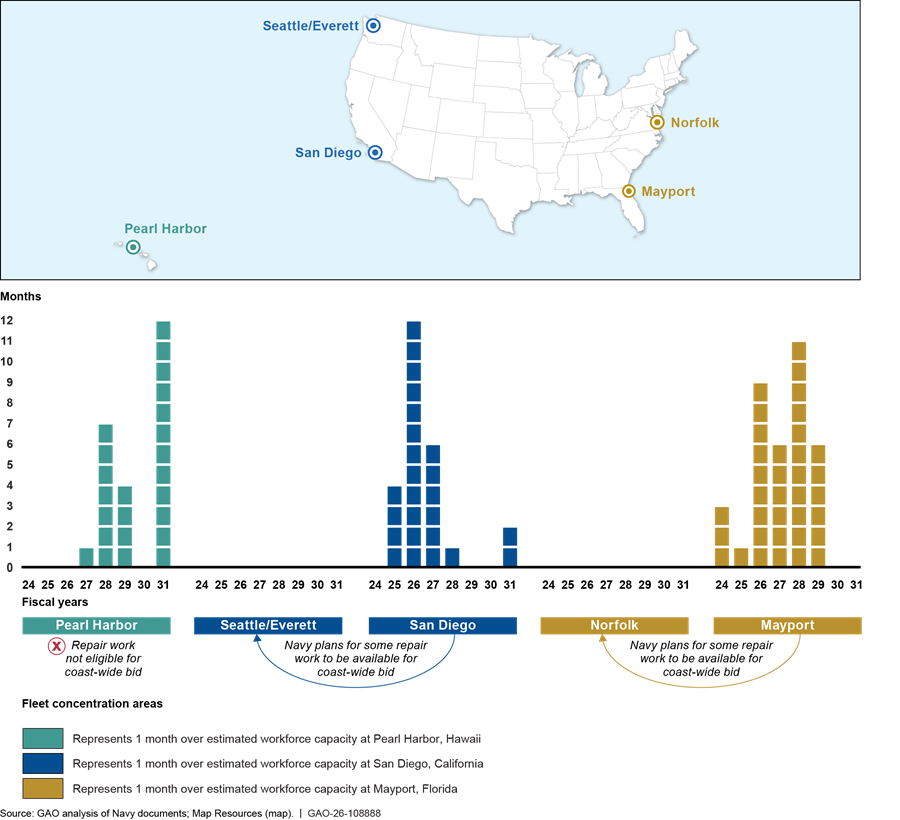
The Navy’s maintenance plan states that demonstrating steady demand for ship repair, such as through projections of ship repair work, is the most consequential action the Navy can take to improve repair outcomes—such as reducing maintenance delays. This is because the Navy expects stable demand to enable private companies to invest in infrastructure, such as dry docks and workforce. However, our analysis of the Navy’s bimonthly workload projections—which provide ship repair companies with an estimated workload for the current and next 3 fiscal years—shows that (1) the amount of work the Navy projected for private repair companies fluctuated significantly, and (2) the Navy consistently reduced the expected volume of workload over time.
We identified several factors that hindered the Navy’s ability to address these challenges. For example, the Navy has not developed a strategy to guide management of the ship industrial base. Our prior work has shown that a consolidated and comprehensive strategy enables decision-makers to better guide program efforts and assess results. Without an overall strategy, the Navy has struggled to provide industry with a stable workload projection, which has hindered industry efforts to invest in needed infrastructure. Developing a ship industrial base would help the Navy align and assess its actions to manage the industrial base for shipbuilding and repair.
We made six recommendations to DOD in our February 2025 report to improve its management of investments in the private sector shipbuilding and repair industrial base, including that the Navy create a ship industrial base strategy. DOD generally agreed with the recommendations. As of February 2026, DOD has implemented one recommendation and partially implemented another. We will continue to monitor DOD’s progress in implementing the remaining recommendations, including the recommendation to create a ship industrial base strategy.
Ground Domain
Mission Capable Rates for Most Army and Marine Corps Ground Vehicles Have Decreased Since Fiscal Year 2015
In our recent review of Army and Marine Corps ground vehicles, none of the Army vehicles we reviewed met the mission capable goal of 90 percent in fiscal year 2024.[67] Five of six selected Army ground combat vehicles did not meet mission capable goals in any fiscal year from 2015 through 2024. Additionally, mission capable rates for all 11 Army vehicles we reviewed have decreased since fiscal year 2015, as shown in figure 16.
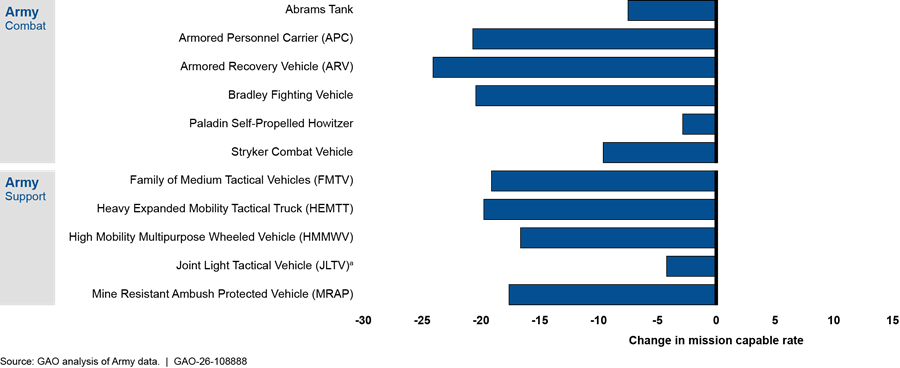
aThe Army initially fielded the JLTV in fiscal year 2019.
Army officials stated that decreases in depot-level overhauls have contributed to the decline in mission capable rates among the selected ground vehicles. Specifically, the Army reduced the number of overhauls from 1,285 in fiscal year 2015 to 12 in fiscal year 2024. However, Army fleet-wide maintenance costs increased by about 50 percent from fiscal year 2015 through fiscal year 2023, led by increased costs for parts and materiel provided by the Defense Logistics Agency and Army depots.
According to Marine Corps officials, the service does not have a general mission capable goal for its ground vehicles.[68] However, the mission capable rates for five of the seven Marine Corps ground vehicles we reviewed declined since fiscal year 2015 (see fig. 17). The Assault Amphibious Vehicle experienced the largest increase among Marine Corps vehicles that we reviewed. However, Marine Corps officials attributed its higher mission capable rates to declining usage by field units as the service phases this vehicle out of service.
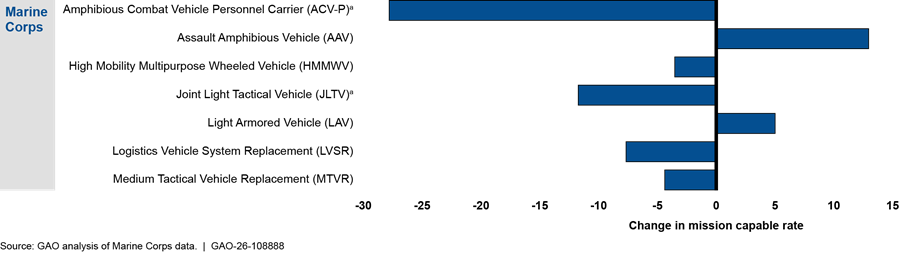
aThe Marine Corps initially fielded the ACV-P in fiscal year 2021 and the JLTV in fiscal year 2019.
The Marine Corps reduced the number of overhauls performed at its depots from 725 in fiscal year 2015 to 163 in fiscal year 2024. The Marine Corps’s fleet-wide maintenance costs have varied among the seven vehicle fleets though overall costs decreased by about 15 percent.
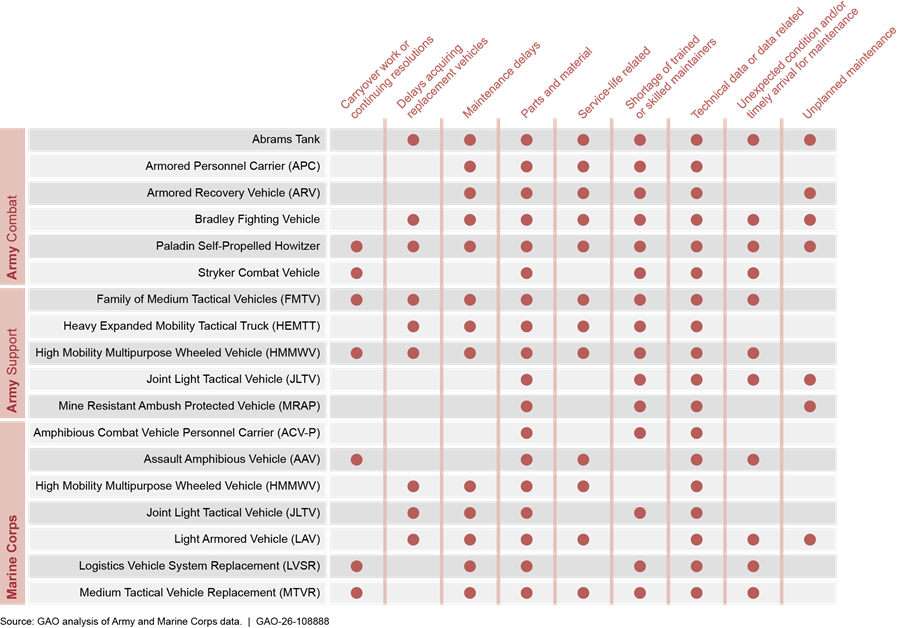
We also reported on nine sustainment challenges that have affected the 18 ground vehicles we reviewed. According to Army and Marine Corps officials, all 18 of these ground vehicles experience challenges related to a lack of parts and materiel and access to technical data. For example, diminished manufacturing sources, single-source suppliers, and long lead times for production can lead to challenges attaining needed parts and materials. Both services cited a lack of parts and materiel as the leading cause for rating vehicles not mission-capable for 14 of 18 ground vehicles during fiscal year 2024.
In addition, officials from both services cited technical data challenges such as access to proprietary and updated technical data packages. For example, Army officials reported that for the Abrams, Bradley, and Stryker, depot maintainers send various maintenance and repair work to manufacturers due to the proprietary nature of some of the technical data instead of performing the work at Army depots. These and other sustainment challenges affecting the 18 ground vehicles we reviewed are shown in figure 18.
Figure 18: Sustainment Challenges Affecting Ground Vehicles as Identified by Army and Marine Corps Officials
The Army Has Not Fully Developed Plans to Support Fielding New Equipment
In July 2024, we found the Army had put new equipment into the field before plans for the facilities, personnel, and training were ready. From 2020 through early 2024, the Army had been taking steps to implement and improve its revised approach to generate ready forces. The approach is called the Regionally Aligned Readiness and Modernization Model (ReARMM).[69] The Army uses ReARMM to prepare forces for combat, including fielding new equipment on a more predictable schedule, to ensure that units train and deploy with the most modern equipment (see fig. 19). We reported that the Army met its initial goals of aligning units with geographic regions and providing forces to combatant commands; developing and meeting unit life-cycle schedules; and fielding upgraded and new equipment to combat units, such as air defense systems.[70]
Figure 19: Regionally Aligned Readiness and Modernization Model (ReARMM) Phases, General Lengths, and Activities
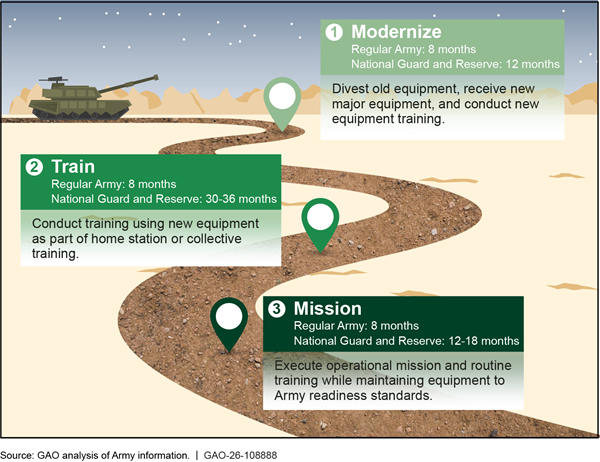
Among the Army’s ReARMM implementing steps are identifying priority units and fielding upgraded, new, and priority modernized equipment to units. However, we found in July 2024 that the first two transfers of major equipment under ReARMM to Army National Guard units included equipment that did not meet required condition standards, according to officials. Without identifying and implementing a means to reasonably assure units transfer equipment that meets condition standards, receiving units will continue to be at risk of incurring unexpected costs and delays in their modernization and training.
According to the Army’s modernization strategy, ReARMM is a key component for fielding modernized equipment more rapidly to units. However, we found that in fielding new equipment through ReARMM, the Army has been unable to fully complete key planning elements for training, facilities, and personnel, and other planning elements needed to operate and sustain the equipment. The Army has taken steps to manage the risk of units not having some of the planning elements completed, such as training strategies or necessary facilities for the new equipment. However, the Army expects to continue to face challenges completing requirements in some of the other planning elements before fielding new equipment.
We made three recommendations to the Army in our July 2024 report to improve the continued implementation of ReARMM. Among other actions, we recommended that the Army identify and implement corrective actions that would reasonably assure that equipment sets meet required condition standards before they are transferred to other units during their ReARMM life cycle. We also recommended that the Army review and determine opportunities to better complete planning elements by the time it fields new equipment. The Army agreed with our recommendations but needs to take further action to fully implement them.
The Army Faces Capability Gaps in Its Watercraft Fleet
The U.S. Army’s watercraft fleet is designed to carry supplies, vehicles, and people in deep ocean and shallow coastal waters, as well as provide access by water to remote, undeveloped areas. For example, in October 2024, Army officials shared with us examples of exercises and transport missions in the Indo-Pacific that use Army watercraft, including bilateral exercises with partners in the Indo-Pacific region, such as Australia and the Philippines; and transport missions involving inter-island movements and the use of watercraft in training areas, such as the Pohakuloa Training Area in Hawaii.[71] In addition, Army watercraft have supported humanitarian aid missions. For example, in March 2024, they supported a mission to Gaza in the Palestinian Territories.
However, we reported in October 2024 that the Army has identified significant capability gaps in its watercraft fleet. Concurrently, the Army has increased its use of watercraft, and plans to increase the use of its fleet, especially in the Indo-Pacific theater. The Army plans to address these capability gaps by acquiring new watercraft and modernizing its current fleet. However, it has not fully considered potential options to mitigate challenges and optimize the use of its existing watercraft fleet to meet current mission requirements. Further, the Army has not addressed the challenges and risks from current gaps in capability.
We found that the Army’s ability to meet its mission requirements with its fleet of 70 watercraft is limited. Army policy identifies a fully mission capable goal of 90 percent for ground equipment, including watercraft.[72] However, the fully mission capable rate for watercraft has steadily declined, from 75 percent in 2020 to less than 40 percent in 2024 (see fig. 20).
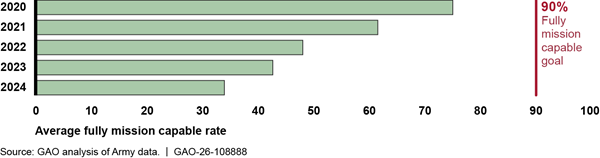
The Army has struggled to address a series of long-standing maintenance challenges with its watercraft fleet. Lengthy delays in completing planned maintenance, use of handwritten systems to manage maintenance, and delays in updating repair manuals for upgraded systems have adversely affected the fleet’s operational readiness. For several years, the Army’s governance body established to address these and other watercraft management functions was unable to integrate Army watercraft maintenance efforts, which remained diffused among various entities across the Army. In February 2024, the Army established the Army Watercraft Enterprise Executive Board, which has since taken positive steps to provide oversight and coordination. However, the Board has not fully adopted leading practices of effective governance bodies into its framework that will enable it to develop comprehensive and cohesive strategies to address long-standing maintenance challenges.
We made four recommendations in our October 2024 report to the Army to address these issues, including that it develop a mitigation plan to meet current and near-term requirements, and ensure the Watercraft Board develops a framework that reflects leading practices for effective governance. The Army agreed with our recommendations but needs to take further actions to fully implement them.
We also have ongoing work assessing (1) ground vehicle maintenance at the Army’s Anniston and Red River Depots and (2) whether the Army is organized, trained, and equipped for performing field maintenance in a contested environment. We plan to report the results of this work later in 2026.
Space Domain
DOD’s ability to conduct space operations is critical to national security. The space domain is no longer a permissive environment, with China and Russia pursuing capabilities to deny the United States’ use of its space capabilities. In the face of these threats, DOD has made maintaining current and future readiness for space operations a top priority.
DOD Conducts Space Operations with Allies and Partners
In July 2025, we issued a report on DOD’s efforts to collaborate with allies and partners to enhance readiness and prepare for potential conflict in the space domain. In its 2020 Defense Space Strategy, DOD stated that allies and partners play a critical role in space operations and emphasized the advantage gained from continued integration, which may improve deterrence and defeat strategic threats. DOD uses various mechanisms and agreements to collaborate with allies and partners on space operations and other activities, as shown in figure 21.[73]
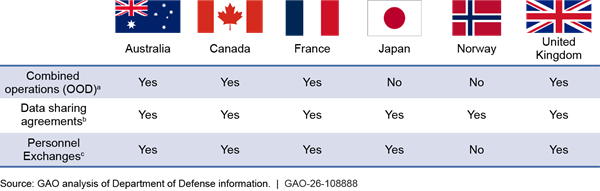
aOperation Olympic Defender (OOD) is a multinational named U.S. Space Command operation to jointly strengthen defenses and deter aggression in space.
bU.S. Space Command has space situational awareness data sharing agreements with 33 partner countries to share data gathered by U.S. and partner countries’ sensors.
cU.S. Space Command and Space Force have personnel exchange agreements for exchange and liaison officers with multiple countries to foster relationships and facilitate information sharing.
In our report, we found that the Space Force had not identified, analyzed, or responded to the risk of not filling positions within its service components, including space-related planning, information sharing, and security cooperation positions. Without doing this, the Space Force risks undermining its goal of increasing collaboration with allies and partners.
We made three recommendations in our July 2025 report, including that the Space Force identify and plan for appropriate personnel levels within the Space Force components to combatant commands to optimize readiness and sustainability, or address the risks of understaffing certain positions. DOD agreed with two recommendations and did not agree with the third. DOD officials said that they plan to fully implement the recommendations they agreed with by the end of 2026.
Space Force Faces Force Generation and Potential Sustainment Challenges
Force Generation Challenges
In May 2024, we issued a report on DOD’s readiness for space operations that described, among other things, the Space Force’s efforts to address current and future readiness challenges for contested space operations through its force generation model and through efforts to fully resource new systems.[74]
The Space Force established a force generation model—referred to as SPAFORGEN—in early fiscal year 2022 that was intended to address its current readiness challenges. Many space units operate in place continuously from their home station, and officials noted these units lack a deployment cycle that includes time for rebuilding readiness. SPAFORGEN establishes a cycle of three phases—Prepare, Ready, and Commit—to ensure that its operational space units have the capacity and time to conduct readiness-building activities that cannot be accomplished while supporting a combatant command’s ongoing operational needs. (see fig. 22).
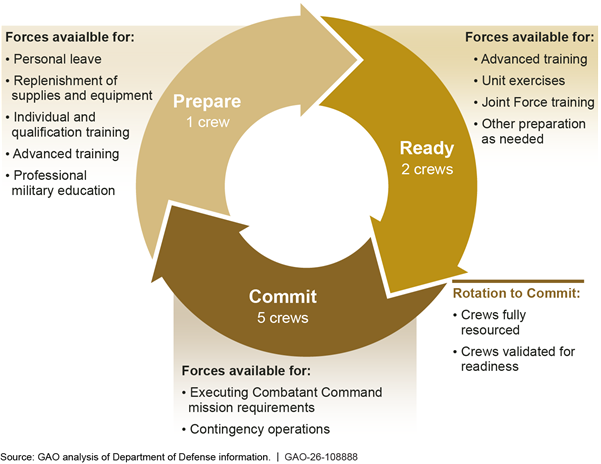
In our May 2024 report, we found that the Space Force had not fully analyzed or reported all the personnel, and the types of personnel, that the service needs to fully implement SPAFORGEN. While a September 2023 Space Force report identified a shortfall of nearly 2,000 military personnel to implement SPAFORGEN, the report did not include estimates of the civilian or contracted personnel that will also be necessary to implement the model.
We also found that training-related limitations affected the Space Force’s implementation of SPAFORGEN. Specifically, the Space Force faces interrelated challenges that include shortfalls in training personnel, limitations in training capability, and variation in the SPAFORGEN phase lengths among operational space units. Without a plan for how to navigate these challenges, the Space Force will continue to face challenges ensuring SPAFORGEN provides opportunities for training and exercises as intended.
As described in our report, the future readiness of DOD to conduct space operations relies not just on new or upgraded systems but on combat-ready units able to effectively operate those systems. In August 2023, the Space Force took a positive step by outlining the actions needed to ensure operational space units are fully resourced with the appropriate personnel and training capabilities required for day-to-day operations prior to operationally accepting a new system. However, translating this strategy into reality will likely require significant resources, which the service has not yet identified.
We made seven recommendations in our May 2024 report, including that the Space Force analyze and report the minimum number of personnel needed to implement SPAFORGEN and develop a plan to ensure its execution of SPAFORGEN meets its stated purpose of generating space readiness. DOD generally agreed with our recommendations. As of January 2026, DOD has fully implemented one recommendation but needs to take additional actions to implement the remaining recommendations.
Space Force Weapon System Sustainment and Personnel Needs
We have ongoing work related to how the Space Force sustains its weapon systems. The 2023 Space Force Mission Sustainment Strategy highlights that space weapon systems are low-density, high-demand assets that are largely ground-based and critically dependent on infrastructure that must be sustained to avoid severe, negative outcomes. Further, the strategy highlights that the Space Force must be prepared to provide uninterrupted sustainment support in a contested environment. The Space Force reports that it has taken steps to improve how sustainment performance is tracked. We are reviewing the extent to which the Space Force faces challenges as it is working to better support weapon systems and their associated infrastructure in a contested environment.
As part of this work, we plan to describe how the Space Force tracks weapon system sustainment performance and challenges to sustainment; and how the Space Force plans for sustainment in contested environments. We plan to report on our work in late spring 2026.
In addition, we have ongoing work examining Space Force personnel needs. Readiness for space operations requires the right number and type of personnel trained to execute those operations. The Space Force was established in 2019 to organize, train, and equip Guardians to preserve U.S. freedom of action in an increasingly contested space domain. Space Force leadership has also emphasized that the service should remain lean and agile as it pursues its missions. The Space Force has grown since its establishment 6 years ago, as have its missions. However, it remains by far the smallest military service.
Our work will describe the changes to the size and composition of the Space Force workforce as the service has evolved to address its missions. We will also assess the extent to which the Space Force has determined its personnel needs to accomplish its missions, among other issues. We plan to report on our work in spring 2026.
In sum, the military services will continue to depend on many of today’s capabilities in the air, sea, land, and space domains for decades to come, but face persistent challenges ensuring these capabilities are available and able to perform their assigned missions. At the same time, as DOD develops and deploys new capabilities, it will also need to address long-standing challenges it has faced sustaining weapon systems and training and organizing the forces that will operate and maintain them. Implementing our recommendations will help DOD meet current mission needs, rebuild the readiness of existing forces, and modernize its capabilities within available resources.
Chairman Sullivan, Ranking Member Hirono, and Members of the Subcommittee, this completes my prepared statement. I would be pleased to respond to any questions that you may have at this time.
GAO Contact and Staff Acknowledgments
If you or your staff have any questions about this testimony, please contact Diana Maurer, Director, Defense Capabilities and Management, at maurerd@gao.gov. Contact points for our Offices of Congressional Relations and Media Relations may be found on the last page of this statement. GAO staff who made key contributions to this testimony are Brent Helt (Assistant Director), Serena Epstein (Analyst in Charge), Natalya Barden, Anna Beischer, Alyssa Bertoni, Emily Biskup, Ji Byun, Julie Clark, Nick Cornelisse, Mike Dworman, Rebecca Guerrero, Matt Jacobs, Susan Langley, Amie Lesser, Claire Liu, Anne McDonough, Marcus Oliver, Kevin O’Neill, Janine Prybyla, Andrew Redd, Michael Silver, Yong Song, Anne Thomas, Matt Thompson, Tristan To, Mollie Todd, Kaitie Trabucco, Matt Ullengren, Cosette Vincent, Chris Watson, Sally Williamson, and Delia Zee.
The following list contains both public reports, which are available on GAO’s website, and reports that are not publicly available. Report numbers with a C or RC suffix are classified. Report numbers with an SU suffix are sensitive but unclassified. Classified and sensitive but unclassified reports are available upon request to personnel with the proper clearances and the need to know.
Weapon Systems Maintenance: DOD Needs Enhanced Assessments and Exercises to Prepare for an Indo-Pacific Conflict. GAO‑26‑107710C. Washington, D.C.: January 30, 2026.
Osprey Aircraft: Additional Oversight and Information Sharing Would Improve Safety Efforts. GAO‑26‑107285. Washington, D.C.: December 8, 2025.
Defense Budget: Clearer Guidance Is Needed to Improve Visibility into Resourcing of Pacific Deterrence Efforts. GAO‑26‑107698. Washington, D.C.: November 25, 2025.
Weapon System Sustainment: DOD Can Improve Planning and Management of Data Rights. GAO‑25‑107468. Washington, D.C.: September 29, 2025.
Weapon Systems Sustainment: Various Challenges Affect Ground Vehicles’ Availability for Missions. GAO‑25‑108679. Washington, D.C.: September 25, 2025.
Space Operations: DOD Is Pursuing Efforts to Collaborate with Allies and Partners but Needs to Address Key Challenges. GAO‑26‑108043. Washington, D.C.: July 8, 2025.
Fuel Supply: DOD Is Not Prepared for a Contested Environment in the Indo-Pacific. GAO‑25‑107216C. Washington, D.C.: June 26, 2025.
Defense Prepositioning: DOD Should Develop a Plan to Address Challenges in the Indo-Pacific Region and Report to Congress. GAO‑25‑106991C. Washington, D.C.: June 6, 2025.
Priority Open Recommendations: Department of Defense. GAO‑25‑108042. Washington, D.C.: June 2, 2025.
U.S. Space Command: Air Force’s Reevaluation of Headquarters Location and Status of Operations. GAO‑25‑107092. Washington, D.C.: May 29, 2025.
Missile Defense: DOD Faces Support and Coordination Challenges for Defense of Guam. GAO‑25‑108187. Washington, D.C.: May 22, 2025.
Ukraine: Readiness Implications of U.S. Military Assistance. GAO‑25‑107190C. Washington, D.C.: March 19, 2025.
F-35 Aircraft: Actions Needed to Address Long-Standing Risks to Operational Effectiveness. GAO‑25‑107101C. Washington, D.C.: March 7, 2025.
Missile Defense: DOD Faces Support and Coordination Challenges for the Defense of Guam. GAO‑25‑107116C. Washington, D.C.: February 28, 2025.
Shipbuilding and Repair: Navy Needs a Strategic Approach for Private Sector Industrial Base Investments. GAO‑25‑106286. Washington, D.C.: February 27, 2025
Ukraine: DOD Can Take Additional Steps to Improve Its Security Assistance Training. GAO‑25‑107923. Washington, D.C.: January 28, 2025.
Amphibious Warfare Fleet: Navy Needs to Complete Key Efforts to Better Ensure Ships Are Available for Marines. GAO‑25‑106728. Washington, D.C.: December 3, 2024.
Air Force Readiness: Actions Needed to Improve New Process for Preparing Units to Deploy. GAO‑25‑107017. Washington, D.C.: November 26, 2024.
Special Operations Forces: Additional Oversight Could Help Mitigate High-Risk Training Accidents. GAO‑25‑106321. Washington, D.C.: November 21, 2024.
Military Housing: DOD Should Address Critical Supply and Affordability Challenges for Service Members. GAO‑25‑106208. Washington, D.C.: October 30, 2024.
Army Watercraft: Actions Needed to Optimize Small but Critical Fleet. GAO‑25‑106387. Washington, D.C: October 16, 2024.
Columbia Class Submarine: Overcoming Persistent Challenges Requires Yet Undemonstrated Performance and Better-Informed Supplier Investments. GAO‑24‑107732. Washington, D.C.: September 30, 2024.
Navy Readiness: Actions Needed to Improve Support for Sailor-Led Maintenance. GAO‑24‑106525. Washington, D.C.: September 9, 2024.
Army Modernization: Actions Needed to Support Fielding New Equipment. GAO‑24‑107566. Washington, D.C.: July 15, 2024.
Navy Frigate: Unstable Design Has Stalled Construction and Compromised Delivery Schedules, GAO‑24‑106546. Washington, D.C.: May 29, 2024
Space Operations: Improved Planning and Better Information Will Help DOD Address Readiness Challenges. GAO‑24‑106457C. Washington, D.C.: May 10, 2024.
Navy Readiness: Actions Needed to Improve the Reliability and Management of Ship Crewing Data. GAO‑24‑105811. Washington, D.C.: April 29, 2024.
F-35 Sustainment: Costs Continue to Rise While Planned Use and Availability Have Decreased. GAO‑24‑106703. Washington, D.C.: April 15, 2024.
Military Readiness: Comprehensive Approach Needed to Address Service Member Fatigue and Manage Related Efforts. GAO‑24‑105917. Washington, D.C.: March 26, 2024.
Navy Readiness: Challenges to Addressing Sailor Fatigue in the Surface Fleet Continue. GAO‑24‑106819. Washington, D.C.: October 11, 2023.
Military Housing: Strengthened Oversight Needed to Make and Sustain Improvements to Living Conditions, GAO‑23‑107038. Washington, D.C.: September 27, 2023.
F-35 Aircraft: DOD and the Military Services Need to Reassess the Future Sustainment Strategy. GAO‑23‑105341. Washington, D.C.: September 21, 2023.
Military Barracks: Poor Living Conditions Undermine Quality of Life and Readiness. GAO‑23‑105797. Washington, D.C.: September 19, 2023.
Navy Readiness: Actions Needed to Address Cost and Schedule Estimates for Shipyard Improvement. GAO‑23‑106067. Washington, D.C.: June 28, 2023.
Military Housing: DOD Can Further Strengthen Oversight of Its Privatized Housing Program. GAO‑23‑105377. Washington, D.C.: April 6, 2023.
National Guard Helicopters: Additional Actions Needed to Prevent Accidents and Improve Safety. GAO‑23‑105219. Washington, D.C.: March 14, 2023.
Weapon System Sustainment: Navy Ship Usage Has Decreased as Challenges and Costs Have Increased, GAO‑23‑106440. Washington, D.C.: January 31, 2023
Weapon System Sustainment: Aircraft Mission Capable Goals Were Generally Not Met and Sustainment Costs Varied by Aircraft. GAO‑23‑106217. Washington, D.C.: November 10, 2022.
U.S. Space Command: Air Force Should Develop Guidance for Strengthening Future Basing Decisions. GAO‑22‑106055. Washington, D.C.: June 2, 2022.
Naval Shipyards: Ongoing Challenges Could Jeopardize Navy’s Ability to Improve Shipyards. GAO‑22‑105993. Washington, D.C.: May 10, 2022.
Military Depots: DOD Strategy for Addressing Deteriorating Facilities and Equipment Is Incomplete. GAO‑22‑105009. Washington, D.C.: May 9, 2022.
Navy Ships: Applying Leading Practices and Transparent Reporting Could Help Reduce Risks Posed by Nearly $1.8 Billion Maintenance Backlog, GAO‑22‑105032. Washington, D.C.: May 9, 2022.
This is a work of the U.S. government and is not subject to copyright protection in the United States. The published product may be reproduced and distributed in its entirety without further permission from GAO. However, because this work may contain copyrighted images or other material, permission from the copyright holder may be necessary if you wish to reproduce this material separately.
The Government Accountability Office, the audit, evaluation, and investigative arm of Congress, exists to support Congress in meeting its constitutional responsibilities and to help improve the performance and accountability of the federal government for the American people. GAO examines the use of public funds; evaluates federal programs and policies; and provides analyses, recommendations, and other assistance to help Congress make informed oversight, policy, and funding decisions. GAO’s commitment to good government is reflected in its core values of accountability, integrity, and reliability.
Obtaining Copies of GAO Reports and Testimony
The fastest and easiest way to obtain copies of GAO documents at no cost is through our website. Each weekday afternoon, GAO posts on its website newly released reports, testimony, and correspondence. You can also subscribe to GAO’s email updates to receive notification of newly posted products.
Order by Phone
The price of each GAO publication reflects GAO’s actual cost of production and distribution and depends on the number of pages in the publication and whether the publication is printed in color or black and white. Pricing and ordering information is posted on GAO’s website, https://www.gao.gov/ordering.htm.
Place orders by calling (202) 512-6000, toll free (866) 801-7077,
or
TDD (202) 512-2537.
Orders may be paid for using American Express, Discover Card, MasterCard, Visa, check, or money order. Call for additional information.
Connect with GAO
Connect with GAO on X,
LinkedIn, Instagram, and YouTube.
Subscribe to our Email Updates. Listen to our Podcasts.
Visit GAO on the web at https://www.gao.gov.
To Report Fraud, Waste, and Abuse in Federal Programs
Contact FraudNet:
Website: https://www.gao.gov/about/what-gao-does/fraudnet
Automated answering system: (800) 424-5454
Media Relations
Sarah Kaczmarek, Managing Director, Media@gao.gov
Congressional Relations
David A. Powner, Acting Managing Director, CongRel@gao.gov
General Inquiries

[1]Department of War, 2026 National Defense Strategy (Jan. 23, 2026).
[2]GAO, Priority Open Recommendations: Department of Defense, GAO‑25‑108042 (Washington, D.C.: June 2, 2025).
[3]We have also issued several classified reports concerning readiness issues since May 2022. We cite these reports where appropriate and discuss information that DOD has deemed publicly releasable.
[4]The mission capable rate—the percentage of total time when the aircraft can fly and perform at least one mission—is used to assess the health and readiness of an aircraft fleet. See GAO, Weapon System Sustainment: Aircraft Mission Capable Goals Were Generally Not Met and Sustainment Costs Varied by Aircraft, GAO‑23‑106217 (Washington, D.C.: Nov. 10, 2022).
[5]Beginning in fiscal years 2022 and 2023, respectively, the Navy and Marine Corps started to place less emphasis on the mission capable rate and more emphasis on managing by numbers of mission capable aircraft. Accordingly, the Navy has not set an annual mission capable rate goal for the EA-18G Growler since fiscal year 2021. The EA-18G Growler did not meet its mission capable rate goal in any year across fiscal years 2015 through 2021.
[6]GAO, Navy Readiness: Actions Needed to Improve Support for Sailor-Led Maintenance, GAO‑24‑106525 (Washington, D.C.: Sept. 9, 2024).
[7]GAO, Navy Readiness: Actions Needed to Improve the Reliability and Management of Ship Crewing Data, GAO‑24‑105811 (Washington, D.C.: Apr. 29, 2024).
[8]Department of Defense, DOD Strategic Management Plan, Fiscal Years 2022-2026 (Mar. 6, 2023).
[9]GAO, Osprey Aircraft: Additional Oversight and Information Sharing Would Improve Safety Efforts, GAO‑26‑107285 (Washington, D.C.: Dec. 8, 2025); GAO, Special Operations Forces: Additional Oversight Could Help Mitigate High-Risk Training Accidents, GAO‑25‑106321 (Washington, D.C.: Nov 21, 2024); and National Guard Helicopters: Additional Actions Needed to Prevent Accidents and Improve Safety, GAO‑23‑105219 (Washington, D.C.: Mar 14, 2023).
[10]GAO‑26‑107285. DOD adjusted the thresholds for accident classes upward in October 2019, including an increase in the threshold for Class B accidents from $500,000 to $600,000. Assistant Secretary of Defense for Readiness Memorandum, Revision to Accident Severity Classification Cost Thresholds and Recording of Injury and Fatality Costs (Oct. 15, 2019).
[11]The Marine Corps’s average rate was about 8.58 accidents per 100,000 flight hours for fiscal years 2015 through 2022 but increased to an average rate of 13.93 for fiscal years 2023 and 2024. The Air Force’s average rate was about 50.58 accidents per 100,000 flight hours for fiscal years 2015 through 2022 but increased to an average rate of 88.74 for fiscal years 2023 and 2024.
[14]We reported on the extent of sailor fatigue and made four recommendations for the Navy to more effectively manage fatigue. See GAO, Navy Readiness: Additional Efforts Are Needed to Manage Fatigue, Reduce Crewing Shortfalls, and Implement Training, GAO‑21‑366 (Washington, D.C.: May 27, 2021). In October 2023, we found that the Navy had not taken actions to fully implement three of the four recommendations. See GAO, Navy Readiness: Challenges to Addressing Sailor Fatigue in the Surface Fleet Continue, GAO‑24‑106819 (Washington, D.C.: Oct. 11, 2023). For more information on the negative impacts of fatigue on service members, see National Commission on Military Aviation Safety, Report to the President and the Congress of the United States (Dec. 1, 2020).
[15]GAO, Military Barracks: Poor Living Conditions Undermine Quality of Life and Readiness, GAO‑23‑105797 (Washington, D.C.: Sept. 19, 2023); and Military Housing: Strengthened Oversight Needed to Make and Sustain Improvements to Living Conditions, GAO‑23‑107038 (Washington, D.C.: Sept. 27, 2023). We have also identified issues related to the condition of privatized military family housing, including reports of mold, pest infestations, and other hazards. In April 2023, we made 19 recommendations to improve DOD’s oversight of its privatized military housing, with which DOD generally agreed. To date, DOD has taken steps to fully implement 12 of the recommendations and needs to take further action to address the remaining seven. GAO, Military Housing: DOD Can Further Strengthen Oversight of Its Privatized Housing Program, GAO‑23‑105377 (Washington, D.C.: Apr. 6, 2023).
[16]GAO, Military Housing: DOD Should Address Critical Supply and Affordability Challenges for Service Members, GAO‑25‑106208 (Washington, D.C.: Oct. 30, 2024).
[17]GAO, DOD Joint Bases: Actions Needed to Improve Sustainment of Facilities, GAO-26-106832 (Washington, D.C.: February 26, 2026). DOD consolidated 26 installations into 12 joint bases from 2009 through 2010 to increase readiness, reduce duplication of efforts, and generate cost savings. This effort designated one military service on the joint base as the lead component responsible for providing installation support, including facility maintenance activities.
[18]DOD Instruction 1010.10, Health Promotion and Disease Prevention (Apr. 28, 2014) (incorporating change 3, effective May 16, 2022).
[19]GAO, Military Readiness: Comprehensive Approach Needed to Address Service Member Fatigue and Manage Related Efforts, GAO‑24‑105917 (Washington, D.C.: Mar. 26, 2024).
[20]Our survey focused on six general military occupations with the potential to be affected by fatigue: fixed-wing pilots, rotary-wing pilots, remote pilots, aviation maintainers, on-alert operations, and motor vehicle operators.
[21]Additionally, the Navy lost two other F/A-18 Super Hornets in December 2024 and April 2025. A Navy investigation of the December 2024 incident identified that a lack of integrated training opportunities, among other issues, contributed to the misidentification and friendly fire on the aircraft and a near miss of another aircraft. A Navy investigation of the April 2025 incident identified that the primary cause was an aircraft brake system failure, which was compounded by insufficient communication among personnel.
[22]The Pacific Deterrence Initiative requires DOD to submit to Congress: (1) an annual detailed budget exhibit for the initiative, and (2) an annual independent assessment by the commander of the U.S. Indo-Pacific Command on the resources required for the joint force in the Indo-Pacific region.
[23]GAO, Weapon Systems Maintenance: DOD Needs Enhanced Assessments and Exercises to Prepare for an Indo-Pacific Conflict, GAO‑26‑107710C (Washington, D.C.: Jan. 30, 2026).
[24]GAO, Defense Budget: Clearer Guidance Is Needed to Improve Visibility into Resourcing of Pacific Deterrence Efforts, GAO‑26‑107698 (Washington, D.C.: Nov. 25, 2025).
[25]GAO, Fuel Supply: DOD is Not Prepared for a Contested Environment in the Indo-Pacific, GAO‑25‑107216C (Washington, D.C.: June 26, 2025).
[26]GAO, Defense Prepositioning: DOD Should Develop a Plan to Address Challenges in the Indo-Pacific Region and Report to Congress, GAO‑25‑106991C (Washington, D.C.: June 6, 2025).
[27]GAO, Missile Defense: DOD Faces Support Challenges for Defense of Guam, GAO‑25‑108187 (Washington, D.C.: May 22, 2025).
[28]The Missile Defense Agency builds and delivers missile defense systems across DOD. Once these systems are delivered, the Missile Defense Agency is responsible for transferring responsibilities for operating and sustaining missile defense systems to another lead organization or it retains those responsibilities itself.
[29]We made a fourth recommendation in our classified version of this report. GAO, Missile Defense: DOD Faces Support and Coordination Challenges for the Defense of Guam, GAO‑25‑107116C (Washington, D.C.: Feb 28, 2025).
[30]These recommendations and matter can be found in our classified report. GAO, European Logistics: DOD Is Pursuing Logistics Efforts with NATO but Actions Needed to Address Significant Gaps, GAO‑25‑106999C (Washington, D.C.: Aug. 25, 2025).
[31]GAO, Ukraine: Readiness Implications of U.S. Military Assistance, GAO‑25‑107190C (Washington, D.C.: Mar. 19, 2025).
[32]Presidential drawdown authority is considered security assistance that authorizes the President to transfer articles, such as ammunition and weapon systems, from DOD stocks to other countries in the event of an unforeseen emergency requiring military assistance, among other purposes.
[33]GAO, Ukraine: DOD Can Take Additional Steps to Improve Its Security Assistance Training, GAO‑25‑107923 (Washington, D.C., Jan. 28, 2025).
[34]As we reported in January 2025, since Russia’s invasion in February 2022, the U.S. European Command and its Army component—U.S. Army Europe and Africa—have provided most of the U.S. training for Ukrainian forces at Grafenwoehr in Germany.
[35]DOD develops lessons learned through a five-phase process that is facilitated by its Joint Lessons Learned Information System, among other tools. The process involves recording and validating observations, developing the lessons for further analysis, and disseminating the lessons across the department. The primary objective of the process is to enhance force readiness and effectiveness by contributing to improvements in shorter-term operations and planning as well as longer term doctrine, organization, training, materiel, leadership and education, personnel, facilities, and policy, according to DOD. Chairman of the Joint Chiefs of Staff Instruction 3150.25H, Joint Lessons Learned Program (Dec. 30, 2021), (incorporating change 1, Apr. 5, 2024).
[36]We have previously reported on parts shortage or delay as an aircraft sustainment challenge. See, for example, GAO‑23‑106217.
[37]GAO, F‑35 Joint Strike Fighter: Actions Needed to Address Late Deliveries and Improve Future Development, GAO‑25‑107632 (Washington, D.C.: Sept. 3, 2025).
[38]GAO, F‑35 Sustainment: Costs Continue to Rise While Planned Use and Availability Has Decreased, GAO‑24‑106703 (Washington, D.C.: Apr. 15, 2024).
[39]GAO‑ F‑35 Aircraft: DOD and the Military Services Need to Reassess the Future Sustainment Strategy, GAO‑23‑105341 (Washington, D.C.: Sept. 21, 2023).
[40]GAO, F‑35 Aircraft: Actions Needed to Address Long-Standing Risks to Operational Effectiveness, GAO‑25‑107101C (Washington, D.C.: Mar. 7, 2025). This report includes additional details and recommendations that were deemed classified by the Department of Defense and are not discussed here.
[42]Section 142 of the National Defense Authorization Act for Fiscal Year 2022 requires this transfer to occur by October 1, 2027. Pub. L. No. 117-81, § 142 (2021).
[43]GAO‑25‑107101C.
[44]GAO, Weapon System Sustainment: DOD Can Improve Planning and Management of Data Rights, GAO‑25‑107468 (Washington, D.C.: Sept. 29, 2025).
[45]10 U.S.C. § 3771; DFARS 252.227-7013(c).
[46]GAO, Air Force Readiness: Actions Needed to Improve New Process for Preparing Units to Deploy, GAO‑25‑107017 (Washington, D.C.: Nov. 26, 2024).
[47]GAO‑20‑390. To determine the proportion of aircraft that were late each fiscal year, we examined individual aircraft records from the Air Force’s Aircraft Maintenance Production/Compression Report (AMREP). For each aircraft, we compared the targeted number of days for maintenance completion (original and revised) with the actual number of days it took to complete maintenance.
[48]GAO, Military Depots: DOD Can Benefit from Further Sharing of Best Practices and Lessons Learned, GAO‑20‑116 (Washington, D.C.: Jan. 30, 2020) and DOD Depot Workforce: Services Need to Assess the Effectiveness of Their Initiatives to Maintain Critical Skills, GAO‑19‑51 (Washington, D.C.: Dec. 14, 2018).
[49]For example: GAO, Weapon System Sustainment: Navy Ship Usage Has Decreased as Challenges and Costs Have Increased, GAO‑23‑106440 (Washington, D.C.: Jan. 31, 2023).
[51]GAO, Amphibious Warfare Fleet: Navy Needs to Complete Key Efforts to Better Ensure Ships Are Available for Marines, GAO‑25‑106728 (Washington, D.C: Dec. 3, 2024).
[52]The Secretary of the Navy may waive the limitation on decommissioning before the end of the expected service life of a ship only after (1) submitting a certification accompanying the President’s budget for the fiscal year in which the waiver is sought to the congressional defense committees and (2) a waiting period after the enactment of the fiscal year National Defense Authorization Act. 10 U.S.C. § 8678a.
[53]In October 2018, we found that the Navy was unable to begin or complete the vast majority of its attack submarine maintenance periods on time, resulting in significant maintenance delays and operating and support cost expenditures. As a result, we recommended that the Navy conduct a business case analysis to inform maintenance workload allocation across public and private shipyards, including an analysis of private shipyard maintenance capacity and an accounting of costs and risks of attack submarines sitting idle, among other things. We additionally made three classified recommendations, and the Navy implemented all four recommendations. GAO, Navy Readiness: Actions Needed to Address Costly Maintenance Delays Facing the Attack Submarine Fleet, GAO‑19‑229 (Washington, D.C.: Nov. 19, 2018).
[54]Navy, Report to Congress on Submarine Depot Maintenance (Dec. 28, 2018).
[55]To determine the daily cost for attack submarines from fiscal years 2008 through 2025, we used the Navy’s operating and support costs weighted daily average for calendar year 2008 through 2023. We will be updating these estimates with more recent cost data in our forthcoming report.
[56]The four shipyards—Norfolk Naval Shipyard in Virginia, Pearl Harbor Naval Shipyard and Intermediate Maintenance Facility in Hawaii, Portsmouth Naval Shipyard in Maine, and Puget Sound Naval Shipyard and Intermediate Maintenance Facility in Washington—provide the Navy the capability to perform depot-level maintenance on ships, emergency repairs, ship modernization, and ship deactivations.
[57]For example, in May 2022 we reported that although the average condition rating of facilities at three of the shipyards had improved in fiscal years 2016 through 2020, the overall rating at all four shipyards remained poor. We also found that the backlog of restoration and modernization projects to repair, renovate, or replace existing buildings and other infrastructure had grown to $7 billion in this time, and that the age of more than half of all shipyard equipment was past its expected service life. See GAO, Military Depots: DOD Strategy for Addressing Deteriorating Facilities and Equipment Is Incomplete, GAO‑22‑105009 (Washington, D.C.: May 9, 2022) and Naval Shipyards: Ongoing Challenges Could Jeopardize Navy’s Ability to Improve Shipyards, GAO‑22‑105993 (Washington, D.C.: May 10, 2022).
[58]See GAO, Navy Readiness: Actions Needed to Address Cost and Schedule Estimates for Shipyard Improvement, GAO‑23‑106067 (Washington, D.C.: June 28, 2023) and Naval Shipyards: Key Actions Remain to Improve Infrastructure to Better Support Navy Operations, GAO‑20‑64 (Washington, D.C.: Nov. 25, 2019).
[59]See GAO‑23‑106067 and GAO‑20‑64.
[60]In 2023, we reported that the Navy cost estimate to construct the new dry dock at Portsmouth Naval Shipyard had grown from $715 million in 2020 to $2.24 billion by 2021. In May 2024, the Navy reported it increased its estimate to complete the project to nearly $2.46 billion, for a total increase of about $1.74 billion from the original request. We reported that while unforeseen pandemic-era commodity-price volatility contributed to this increase, the Navy did not sufficiently incorporate risk and sensitivity analysis into its estimate. We also reported the Navy had received, requested, or intended to request nearly $3.64 billion to construct a new dry dock at Pearl Harbor Naval Shipyard. In February 2024, the Navy reported a needed increase of about $834 million to complete the project at a total cost of nearly $4.47 billion. See GAO‑23‑106067.
[61]See GAO, Naval Shipyards: Actions Needed to Improve Poor Conditions that Affect Operations, GAO‑17‑548 (Washington, D.C.: Sept.12, 2017), GAO‑20‑64, and GAO‑23‑106067.
[62]The Navy’s fleet of nuclear aircraft carriers and submarines mostly undergoes repair periods at the Navy’s four public shipyards—located at Norfolk Naval Shipyard in Virginia, Pearl Harbor Naval Shipyard and Intermediate Maintenance Facility in Hawaii, Portsmouth Naval Shipyard in Maine, and Puget Sound Naval Shipyard and Intermediate Maintenance Facility in Washington. Private industry also conducts a limited amount of this repair work.
[63]GAO, Shipbuilding and Repair: Navy Needs a Strategic Approach for Private Sector Industrial Base Investments, GAO‑25‑106286. Washington, D.C.: February 27, 2025. For examples of our recent work in shipbuilding and ship repair, see GAO, Columbia Class Submarine: Overcoming Persistent Challenges Requires Yet Undemonstrated Performance and Better-Informed Supplier Investments, GAO‑24‑107732 (Washington, D.C.: Sept. 30, 2024); Navy Frigate: Unstable Design Has Stalled Construction and Compromised Delivery Schedules, GAO‑24‑106546 (Washington, D.C.: May 29, 2024); GAO‑23‑106440; and Navy Ships: Applying Leading Practices and Transparent Reporting Could Help Reduce Risks Posed by Nearly $1.8 Billion Maintenance Backlog, GAO‑22‑105032 (Washington, D.C.: May 9, 2022).
[64]GAO, Navy Readiness: U.S. Ability to Sustainably Produce Ready Naval Forces Lags Behind Strategic Competitor, GAO‑24‑106363C (Washington, D.C.: Jan. 11, 2024).
[65]Growth work refers to additional tasks identified during performance that are related to a work item already specified on the original contract, some of which may be identified after a repair period has begun.
[66]The Navy estimates future workforce capacity using a calculation based on data from the last 3 years. Private industry provides the workforce for major surface ship repair, even when their work is performed at Navy facilities.
[67]The Army measures the availability of its ground vehicles using the fully mission capable rate. This rate shows that a vehicle is in a state where it can perform all its potential missions. GAO, Weapon Systems Sustainment: Various Challenges Affect Ground Vehicles’ Availability for Missions, GAO‑25‑108679 (Washington, D.C.: Sept. 25, 2025).
[68]The Marine Corps measures the availability of its ground vehicles using a mission capable rate. This rate shows that a ground vehicle can perform at least one of its potential missions.
[69]According to the Army, it is transitioning from ReARMM to a new force generation model called the Continuous Transformation Readiness Model in March 2026.
[70]GAO, Army Modernization: Actions Needed to Support Fielding New Equipment, GAO‑24‑107566 (Washington, D.C.: July 15, 2024).
[71]GAO, Army Watercraft: Actions Needed to Optimize Small but Critical Fleet, GAO‑25‑106387 (Washington, D.C.: Oct. 16, 2024).
[72]Watercraft are included in the “ground equipment” category, according to officials. Fully mission capable generally means that watercraft are ready and available to perform their missions.
[73]GAO, Space Operations: DOD is Pursuing Efforts to Collaborate with Allies and Partners but Needs to Address Key Challenges, GAO‑25‑108043 (Washington, D.C.: July 8, 2025).
[74]GAO, Space Operations: Improved Planning and Better Information Will Help DOD Address Readiness Challenges, GAO‑24‑106457C (Washington, D.C.: May 10, 2024).