
OSPREY AIRCRAFT
Additional Oversight and Information Sharing Would Improve Safety Efforts
Statement of Diana Moldafsky, Director, Defense Capabilities and Management
Before the Subcommittees on Seapower and Projection Forces and Readiness, Committee on Armed Services, House of Representatives
For Release on Delivery Expected at 2:00 p.m. ET
United States Government Accountability Office
Chairmen Kelly and Bergman, Ranking Members Courtney and Garamendi, and Members of the Subcommittees:
Thank you for the opportunity to be here today to discuss our recent report on V-22 Osprey (Osprey) aircraft accidents.[1] As you know, the Osprey is a tiltrotor aircraft that combines the vertical takeoff, hover, and vertical landing qualities of a helicopter with the long-range, fuel efficiency, and speed characteristics of a turboprop aircraft. The Marine Corps, Air Force, and Navy use variants of the Osprey to conduct missions that would normally require both types of aircraft.[2]
The Osprey’s novel design has contributed to persistent technical, operational, and safety challenges. In November 2023, an Osprey aircraft flown by an Air Force Special Operations Command unit crashed off the coast of Japan, resulting in the deaths of all eight service members on board. This accident came on the heels of fatal accidents involving Ospreys flown by Marine Corps units in August 2023 and June 2022 and resulted in the grounding of the entire Osprey fleet for over 3 months. The reported reasons for Osprey accidents have varied from human error to mechanical and environmental issues. These recent instances of fatal Osprey non-combat accidents have raised concerns about its safety and reliability.
Due to continued safety and readiness issues, the House Armed Services Committee, Readiness Subcommittee asked us to review Osprey aircraft accidents. In addition, the Naval Air Systems Command (NAVAIR) initiated a review of the V-22 in September 2023 that assessed program performance and recommended actions that accountable DOD entities should implement with estimated completion dates. The command publicly released its report in December 2025.[3]
My testimony today discusses the findings from our December 2025 report on Osprey aircraft accidents. This testimony (1) describes the trends in reported Osprey aircraft accidents and reported causes; (2) evaluates the extent to which the Department of Defense (DOD), the Osprey Joint Program Office, and the military services have taken steps to identify and resolve safety issues involving the Osprey; (3) discusses how the military services that operate the Osprey use procedures to share relevant information to promote safe operations; and (4) summarizes the recommendations from our December 2025 report.
To conduct this work, we analyzed DOD data on Osprey accidents from the year of initial operational capability through fiscal year 2024.[4] We also reviewed DOD documentation and conducted site visits to interview officials at a non-generalizable sample of seven Marine Corps, Air Force, and Navy Osprey units that we selected based on factors such as where accidents occurred. Our December 2025 report provides additional details on the methodologies we used. Our work was performed in accordance with generally accepted government auditing standards.
Serious Osprey Accident Rates Increased in Recent Years and Involved Materiel Failure and Human Error
In our December 2025 report, we found that reported Marine Corps and Air Force accident rates for the most serious Osprey accidents (i.e., Class A and B accidents) increased in fiscal years 2023 and 2024 and exceeded the average serious accident rate for the previous 8 fiscal years.[5] These accidents involved death; permanent disability; extensive hospitalization; property damages of $600,000 or more; or a destroyed aircraft. Specifically, the rates of Marine Corps and Air Force serious accidents were between 36 percent and 88 percent higher than each service’s average rate for fiscal years 2015–2022 (see fig. 1). The Navy had not experienced a Class A or Class B accident with its Osprey variant since it began operational use in fiscal year 2021 through fiscal year 2024.
Figure 1: Percent Difference of Serious Osprey Accident Rates in Fiscal Years 2023 and 2024 Compared to Service Average for Fiscal Years 2015–2022
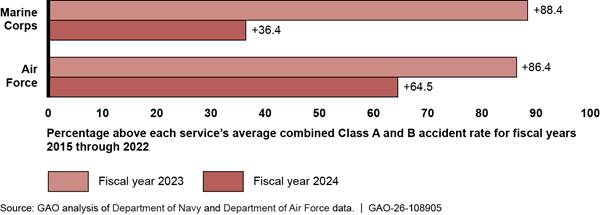
Note: Serious accidents refer to combined Class A and B accidents which are those accidents that involved death; permanent disability; extensive hospitalization; property damages of $600,000 or more; or a destroyed aircraft. The Marine Corps’ average rate was about 8.58 accidents per 100,000 flight hours for fiscal year 2015 through 2022 but increased to an average rate of 13.93 for fiscal years 2023 and 2024. The Air Force’s average rate was about 50.58 accidents per 100,000 flight hours for fiscal year 2015 through 2022 but increased to an average rate of 88.74 for fiscal years 2023 and 2024. The Navy had not experienced a Class A or Class B accident with its Osprey variant since it began operational use in fiscal year 2021 through fiscal year 2024.
We also found that recent increases in the combined Class A and B accident rates for the Marine Corps and Air Force Osprey variants exceeded the annual combined Class A and B accident rates for the Departments of the Navy’s and Air Force’s other fixed wing and rotary wing aircraft fleets. For example, the Air Force Osprey variant exceeded the Department of the Air Force’s annual combined Class A and B fixed wing and rotary wing accident rates for each of the previous 10 years (see fig. 2).
Figure 2: Serious Accident Rate Comparisons for Marine Corps and Air Force Osprey with Departments of the Navy and Air Force Fixed Wing and Rotary Wing Fleets, Fiscal Years 2015–2024
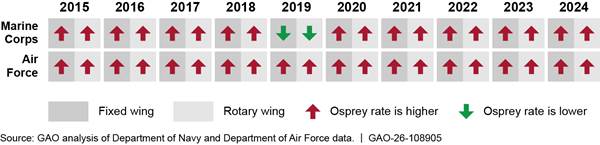
Note: Serious accidents refer to combined Class A and B accidents which are those accidents that involved death; permanent disability; extensive hospitalization; property damages of $600,000 or more; or a destroyed aircraft. The Navy had not experienced a Class A or Class B accident with its Osprey variant since it began operational use in fiscal year 2021 through fiscal year 2024.
Further, the Osprey’s combined Class A and B accident rate generally ranked among the highest year over year, when compared to other individual aircraft types, according to our analysis. For example, the Marine Corps Osprey was among the top 10 highest combined Class A and B accident rates across 21 selected Department of the Navy aircraft in 9 of the 10 years of data we analyzed. Regarding the Air Force Osprey, it had the highest combined Class A and B accident rate across 37 Air Force aircraft types in 5 of the 9 years of data we analyzed.
Osprey accidents have been caused by human error, materiel failure, and environmental factors.[6] Most reported causes for serious accidents related to (1) human error during aircraft operations (138 of 242 reported causes), such as deficiencies in risk management, supervision, or training, among others, and (2) materiel failure of airframe or engine components, or other systems (73 of 242 reported causes), according to our analysis. In addition, more than one causal factor can be cited per accident. Osprey accidents often occur when a combination of materiel failure and human error factors are present, according to DOD officials.
DOD Has Not Fully Implemented Comprehensive Efforts to Resolve Osprey Safety Risks
We identified weaknesses that limited DOD’s ability to fully identify, analyze, and respond to Osprey safety risks, and found that it had not established comprehensive mechanisms to oversee efforts to resolve them in a timely manner.
Identifying, analyzing, and responding to safety risks. The Osprey Joint Program Office (Program Office) and the military services use a variety of efforts to identify, analyze, and determine a response to safety risks associated with the aircraft and its systems (such as developing a mitigation or accepting the risk), using tools such as system safety risk assessments, engineering investigations, and hazard reporting, among others.[7] However, in our December 2025 report, we found that the Program Office and the military services had not fully identified, analyzed, or responded with procedural or materiel mitigations to all safety risks, including those that are not related to the aircraft and its systems.
In our report, we found that the Program Office considered 34 of 79 system safety risk assessments it identified since 2010 in either an “open” or “monitor” status as of June 2025.[8] Specifically, 19 risk assessments remained open, meaning the risk was identified but not yet analyzed or responded to with a procedural or materiel mitigation. Additionally, 15 risk assessments, including six general military aviation risks that are not specific to the Osprey and have been accepted for the life of the program, were in a monitor status. This means that the risk was identified but was being further analyzed for trends before determining a response.
Further, the Program Office and the military services had not identified actions to fully respond to non-system safety risks associated with the maintenance and operations of the Osprey aircraft. We and others have identified non-system risks as factors that contributed to safety concerns. For example, in December 2025, we reported that mismatches in maintenance skill and proficiency levels and heavy maintenance workloads presented safety risks for Osprey squadrons. This is because maintenance personnel are stretched thin, limiting the units’ ability to consistently provide ready aircraft for training, maintenance personnel told us. In addition, aircrew experience levels have presented safety concerns for Osprey squadrons because, among other factors, Osprey pilots were moving through initial training and the qualification process faster than in prior years, aircrew personnel told us. These factors have limited the number of aircraft available for training, hindered training opportunities to build aircrew experience, and contributed to higher safety risks.
We also found that Osprey operating forces had raised maintenance and aircrew challenges as top safety issues. However, the process used by the Program Office to identify and analyze system safety issues deemed these concerns out of scope because they relate to the military services’ authorities to manage personnel and training. As such, these non-system risks did not result in a risk analysis and the identification of steps needed to respond to them.
Without refining the joint program’s process for identifying, analyzing, and responding to Osprey safety risks to incorporate and prioritize system and non-system safety risks, the Program Office and the military services cannot determine which risks must be eliminated or mitigated and which risks can be accepted.
Establishing mechanisms to oversee efforts to resolve safety risk assessments. Our review of Osprey system safety risk assessment data shows the median age for 28 unresolved risk assessments that the Program Office does not consider general military aviation risks was about 9 years, and over half had been unresolved for between 6 and 14 years (see fig. 3).[9] Further, the Osprey had more unresolved “catastrophic” (e.g., death, permanent total disability, aircraft loss or damage beyond economical repair) risks than all but one other Department of the Navy aircraft. These risks have been unresolved on average for longer than any other of these aircraft, based on our review of summary data provided by NAVAIR.
Figure 3: Summary and Median Age of Unresolved Osprey System Safety Risk Assessments, by Assessment Type as of June 2025
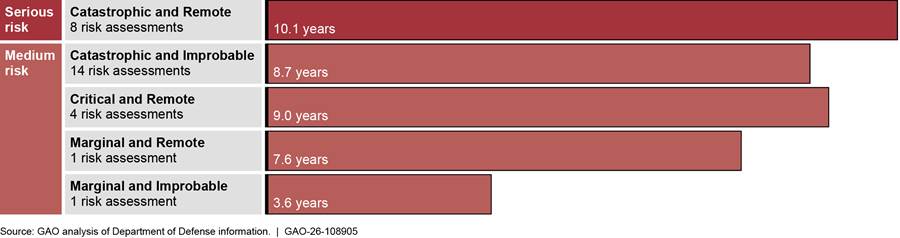
Note: The Department of Defense designates risk assessments as serious and medium based on their assessment of the severity (e.g., catastrophic) and frequency (e.g., remote). The figure does not include six additional risk assessments for general military aviation risks (e.g., bird strikes) that are not specific to the Osprey and have been accepted for the life of the program.
In December 2025, we reported that Program Office and military service officials described factors that affected their ability to fully resolve these longstanding safety risks. These factors include the following:
· Inconsistent development of initiatives to address safety risks with clear priorities and agreement of resource sponsors to fund them
· Lack of communication between the Program Office and units operating the Osprey on identified safety risks and efforts to address them
· Lack of a continuous process to review specific mitigation plans and milestones to respond to safety risks
· Challenging engineering solutions that were subject to shifting funding priorities over time
· Difficulties aligning resources and aircraft availability to implement fleet-wide safety improvements across a joint program with varied fleet sizes
New initiatives established by NAVAIR and the Program Office in 2024 to enhance safety governance are intended to address several of these factors. For example, in December 2025, we reported that the Program Office had taken steps to align Department of Navy initiatives to address safety risks associated with the aircraft and its systems. These steps included action plans that identify action owners, estimated completion dates, and funding sources to better clarify priorities and resourcing needs. Further, the Program Office has implemented additional tools to monitor the status of these initiatives during the year. However, we found the initiatives are not comprehensive in three areas.
· The Program Office lacked mechanisms to identify, analyze, and respond to non-system risks and processes to resolve these risks, including action plans that identify responsibilities, estimated completion dates, and funding determinations.
· NAVAIR’s changes in the Osprey program safety governance have focused on Navy and Marine Corps Osprey variants. These changes did not include information on Air Force efforts to address safety risks for its Osprey variant, based on our review of available documentation.
· The responsibility for conducting periodic reviews of efforts to resolve safety risks and communicating information on the status and progress to the Osprey user community has not been established.
Without determining an oversight structure with clearly defined roles and responsibilities for resolving known safety risks or conducting periodic reviews of efforts to resolve them in a timely manner, DOD cannot have reasonable assurance that it will fully resolve the interrelated system and non-system safety risks affecting the Osprey. Such risks, if left unmitigated, can contribute to death, injury, or loss of mission capability and resources.
Military Services Have Not Routinely Shared Relevant Information to Bolster Osprey Safety
In December 2025, we found that the Program Office and the military services had not routinely shared information in three areas to promote the safe operation of the aircraft.
Hazard and accident reporting. The Program Office and the military services have not proactively shared hazard and accident reporting information with Osprey units and unit safety personnel in the other services that operate the aircraft. For example, the fatal November 2023 Osprey accident investigation report found that the Program Office did not communicate findings of previous proprotor gear box safety risk assessments. This in turn limited opportunities for service-specific changes to guidance and training based on each service’s assessment of risk. Determining a process to proactively share relevant safety information with these personnel would provide greater assurance that Osprey units have the information needed to update their safety procedures.
Aircraft knowledge and emergency procedures. The Program Office and the military services did not convene a multi-service conference or other forum to share Osprey aircraft knowledge and emergency procedures for 5 years (from 2020 to 2025). Service-specific changes to operational practices included safety related information, but these changes were not readily shared among the services, according to unit personnel with whom we spoke. The military services that operate the aircraft held a conference in May 2025, but they had not formalized plans to continue to do so. Without such regular gatherings of key personnel, Osprey units have missed opportunities to share information that would enhance the safe operations of the aircraft.
Maintenance data for common aircraft components and parts. The Program Office and the military services have taken steps to improve the maintenance data for the hundreds of common Osprey aircraft components and parts that are shared across the services, but they have yet to confirm that all implementation steps have been completed. Without conducting a comprehensive review of Osprey maintenance guidance and inspection procedures, DOD does not have assurance that efforts to improve maintenance information sharing have been resolved. The outstanding sharing and data integrity issues include critical life-limited Osprey components. Addressing these components is essential to DOD’s full assurance of the safe operation of the aircraft.
GAO Recommends DOD Address Oversight and Information Sharing to Improve Osprey Safety
In our December 2025 report, we made five recommendations to the DOD:
· refine the Osprey Joint Program’s process for identifying, analyzing, and responding to all safety risks, including incorporating and prioritizing system and non-system safety risks;
· establish an oversight structure to ensure the timely resolution of known Osprey safety risks;
· ensure that a process exists to proactively share relevant safety information from Osprey hazard and accident reporting with Osprey units and unit safety personnel across the military services;
· establish a routine method, such as a recurring multi-service conference, to share information on Osprey aircraft knowledge and emergency procedures; and
· conduct a comprehensive review of maintenance guidance and inspection procedures and update them as needed to ensure that Osprey units are using the system for tracking serialized aircraft components.
DOD agreed with all our recommendations and identified actions it would take to incorporate them in relevant policies and procedures.[10] With sustained engagement and leadership focus, DOD can ensure that these changes will endure over time.
Chairmen Kelly and Bergman, Ranking Members Courtney and Garamendi, and Members
of the Subcommittees, this concludes my prepared statement. I would be pleased
to respond to any questions that you may have at this time.
GAO Contacts and Staff Acknowledgments
For questions about this statement, please contact Diana Moldafsky, Director, Defense Capabilities and Management, at moldafskyd@gao.gov. Contact points for our Offices of Congressional Relations and Public Affairs may be found on the last page of this statement. Individuals making key contributions to this testimony are Matt Ullengren and William Carpluk. Other staff who made contributions to the report cited in this testimony are identified in the source product.
This is a work of the U.S. government and is not subject to copyright protection in the United States. The published product may be reproduced and distributed in its entirety without further permission from GAO. However, because this work may contain copyrighted images or other material, permission from the copyright holder may be necessary if you wish to reproduce this material separately.
The Government Accountability Office, the audit, evaluation, and investigative arm of Congress, exists to support Congress in meeting its constitutional responsibilities and to help improve the performance and accountability of the federal government for the American people. GAO examines the use of public funds; evaluates federal programs and policies; and provides analyses, recommendations, and other assistance to help Congress make informed oversight, policy, and funding decisions. GAO’s commitment to good government is reflected in its core values of accountability, integrity, and reliability.
Obtaining Copies of GAO Reports and Testimony
The fastest and easiest way to obtain copies of GAO documents at no cost is through our website. Each weekday afternoon, GAO posts on its website newly released reports, testimony, and correspondence. You can also subscribe to GAO’s email updates to receive notification of newly posted products.
Order by Phone
The price of each GAO publication reflects GAO’s actual cost of production and distribution and depends on the number of pages in the publication and whether the publication is printed in color or black and white. Pricing and ordering information is posted on GAO’s website, https://www.gao.gov/ordering.htm.
Place orders by calling (202) 512-6000, toll free (866) 801-7077,
or
TDD (202) 512-2537.
Orders may be paid for using American Express, Discover Card, MasterCard, Visa, check, or money order. Call for additional information.
Connect with GAO
Connect with GAO on X,
LinkedIn, Instagram, and YouTube.
Subscribe to our Email Updates. Listen to our Podcasts.
Visit GAO on the web at https://www.gao.gov.
To Report Fraud, Waste, and Abuse in Federal Programs
Contact FraudNet:
Website: https://www.gao.gov/about/what-gao-does/fraudnet
Automated answering system: (800) 424-5454
Media Relations
Sarah Kaczmarek, Managing Director, Media@gao.gov
Congressional Relations
David A. Powner, Acting Managing Director, CongRel@gao.gov
General Inquiries
[1]GAO, Osprey Aircraft: Additional Oversight and Information Sharing Would Improve Safety Efforts, GAO‑26‑107285 (Washington, D.C.: Dec. 8, 2025).
[2]As of June 2025, the Marine Corps Osprey aircraft inventory totaled 348 aircraft; the Air Force aircraft inventory totaled 52 aircraft; and the Navy aircraft inventory totaled 29 aircraft. The Osprey variants have similar airframes, crew sizes, and speed, but different mission sets for each service ranging from transporting personnel, equipment, and supplies from ships and land bases for the Marine Corps to long-range special operations missions for the Air Force to transporting personnel and priority cargo to aircraft carriers at sea for the Navy.
[3]Naval Air Systems Command, V-22 Comprehensive Review (2025).
[4]Initial operational capability generally refers to a system’s readiness for deployment to a limited number of units that can use and maintain it, but not at full capacity. The Marine Corps Osprey variant reached initial operational capability in 2007; the Air Force Osprey variant reached initial operational capability in 2009; and the Navy Osprey variant reached initial operational capability in 2021.
[5]In fiscal years 2023 and 2024, the Marine Corps and Air Force experienced 18 Class A and B non-combat Osprey accidents. DOD categorizes aircraft accidents by severity from A–D, with Class A accidents being the most severe, and Class D accidents being the least severe. Accident severity is determined based on criteria regarding the cost of damages or injuries resulting from the accident. Aviation accident rates are calculated based on the number of accidents per 100,000 flight hours. Changes to the number of accidents or the total flight hours can affect the accident rate. For example, the accident rate will increase if an aircraft flies for fewer hours in a year, but the number of accidents remains constant.
[6]Causal factors are factors which caused the accident, and if the factors had been corrected, eliminated, or avoided, the incident would not have happened.
[7]The Program Office manages the development, delivery, and sustainment of the Osprey program for the Marine Corps, Air Force, and Navy. System risks are related to the potential materiel failure of airframe and engine components. System safety risk assessments define risks by combining two parameters: (1) severity that could result from a specific risk event, and (2) probability of a specific risk event occurring.
[8]The Program Office had closed 45 of the 79 risk assessments—meaning that it completed procedural or materiel mitigations and accepted the residual risk after the mitigations were put in place. The Program Office considers six of the 34 risk assessments as general military aviation risks that are not specific to the Osprey and risks that are accepted for the life of the program, officials told us. These risk assessments include common aviation risks such as bird and wire strikes and specific military aviation risks such as aerial refueling. The Program Office has not closed these risks and will continue to monitor them for trends and to keep leadership and the Osprey user community informed of the risk exposure, officials told us.
[9]Of the 34 unresolved risk assessments, we excluded six risk assessments from our analysis because the Program Office considered these to be general military aviation risks that are not specific to the Osprey and risks that are accepted for the life of the program.
[10]Since we issued our report in December 2025, DOD released the V-22 Comprehensive Review. The final report contains 34 recommendations that point to steps that DOD planned to take that, if implemented, could address a number of our recommendations.