
Report to Congressional Committees
United States Government Accountability Office
A report to congressional committees
Contact: Jill Naamane at naamanej@gao.gov
What GAO Found
Each year, the Department of Housing and Urban Development’s (HUD) Federal Housing Administration (FHA) insures billions of dollars in mortgages for multifamily properties through a variety of programs. HUD’s section 542(c) program provides FHA insurance for loans on affordable multifamily properties that are originated, underwritten, and serviced by housing finance agencies (HFA). The program is also known as the risk-sharing program because HUD and HFAs share the risk of loss on the loans. From fiscal years 2016 through 2025, HFAs underwrote over $12 billion (adjusted for inflation) in FHA-insured multifamily loans under the program. These loans helped finance 776 projects that are expected to produce or preserve about 93,670 rental units (see figure).
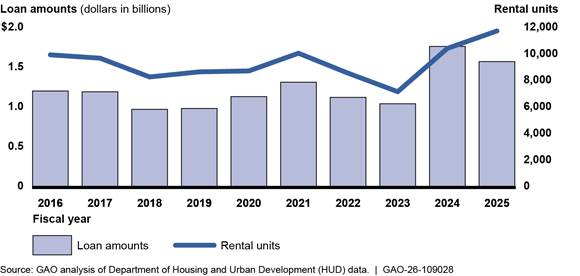
Three traditional HUD mortgage insurance programs GAO selected for comparison—in which HUD-approved lenders process applications—each financed more multifamily housing than the risk-sharing program. These three programs and the risk-sharing program collectively helped finance projects expected to produce or preserve nearly 1.3 million multifamily units from fiscal years 2016 through 2025. The risk-sharing program accounted for 7 percent of the total units. The traditional programs may be used for both affordable and market-rate projects, while the risk-sharing program may be used only for affordable projects. According to HUD officials, around half of the projects under the traditional programs are market rate.
HUD’s traditional and risk-sharing programs are similar in some areas but differ in other areas, partly because their requirements differ. Under the traditional programs, HUD-approved lenders prepare and submit loan applications for FHA insurance in accordance with HUD’s uniform standards and procedures. Under the risk-sharing program, HFAs use their own standards and procedures. GAO found that the traditional and risk-sharing programs have some similarities in loan processing and underwriting, but HUD’s role in those activities and program oversight differs. For example, HUD approves projects under the traditional programs, and HFAs approve projects under the risk-sharing program.
Why GAO Did This Study
Section 542 of the Housing and Community Development Act of 1992 directed FHA to demonstrate the effectiveness of new forms of federal credit enhancement (e.g., mortgage insurance) for multifamily housing loans. The risk-sharing program was initiated as a pilot program in 1994 and made permanent in 2001.
HFAs must be approved by HUD to participate in the risk-sharing program, and HUD had approved 37 HFAs as of July 2026. HUD delegates to state and local HFAs the authority to originate, underwrite, and service loans for the new construction, substantial rehabilitation, purchase, or refinancing of affordable multifamily housing. In general, a unit is considered affordable if rent plus utilities does not exceed 30 percent of household income. HFAs may elect to share from 10 percent to 90 percent of the loss on a loan with HUD.
Senate Report 119-47 includes a provision for GAO to review HUD’s risk-sharing program. This report describes (1) how the program contributed to the production and preservation of affordable multifamily housing during fiscal years 2016–2025 and (2) how it compares with selected traditional HUD mortgage insurance programs for multifamily housing.
GAO analyzed HUD data on FHA multifamily mortgage insurance programs and reviewed HUD regulations and program documents. GAO also collected and reviewed documents on HFA multifamily programs. GAO interviewed HUD officials; representatives and HFA members of relevant HFA associations; and representatives of the Mortgage Bankers Association and two lenders.
|
Abbreviations |
|
|
|
|
|
FFB |
Federal Financing Bank |
|
FHA |
Federal Housing Administration |
|
HFA |
housing finance agency |
|
HUD |
Department of Housing and Urban Development |
|
LIHTC |
Low-Income Housing Tax Credit |
|
MAP |
Multifamily Accelerated Processing |
This is a work of the U.S. government and is not subject to copyright protection in the United States. The published product may be reproduced and distributed in its entirety without further permission from GAO. However, because this work may contain copyrighted images or other material, permission from the copyright holder may be necessary if you wish to reproduce this material separately.
September 15, 2026
The Honorable Cindy Hyde-Smith
Chair
The Honorable Kirsten Gillibrand
Ranking Member
Subcommittee on Transportation, Housing and Urban Development, and Related
Agencies
Committee on Appropriations
U.S. Senate
The Honorable Steve Womack
Chairman
The Honorable James E. Clyburn
Ranking Member
Subcommittee on Transportation, Housing and Urban Development, and Related
Agencies
Committee on Appropriations
House of Representatives
The U.S. faces a widespread shortage of rental units that are affordable to very low- and extremely low-income renter households.[1] According to the Department of Housing and Urban Development (HUD), in 2023, 59 affordable units were available nationwide for every 100 very low-income renter households, and 38 affordable units were available for every 100 extremely low-income renter households.[2]
Each year, HUD’s Federal Housing Administration (FHA) insures billions of dollars in mortgages for multifamily rental properties under a variety of programs. HUD’s section 542(c) program provides FHA insurance for loans on affordable multifamily properties that are originated, underwritten, and serviced by state and local housing finance agencies (HFA).[3] The program is also called the HFA risk-sharing program because HUD and HFAs share the risk of loss on loans. In comparison, under its traditional mortgage insurance programs, HUD generally assumes all the risk of loss and performs loan-processing and asset management functions.
Senate Report 119-47 includes a provision for us to review HUD’s risk-sharing program. This report describes
· how the HFA risk-sharing program contributed to the production and preservation of affordable multifamily housing during fiscal years 2016 through 2025 and
· how the risk-sharing program compares with selected traditional HUD mortgage insurance programs for multifamily housing.
To address the first objective, we used HUD’s FHA multifamily firm commitments and endorsements database to analyze the number and selected characteristics of the multifamily projects financed through HUD’s HFA risk-sharing program from fiscal years 2016 through 2025.[4] To assess the reliability of these data, we reviewed database documentation, including controls designed to ensure the data are complete and accurate; interviewed knowledgeable HUD officials; and manually tested the data to identify missing data, outliers, and obvious errors. We found the data to be sufficiently reliable for providing information on multifamily housing production and preservation through HUD’s risk-sharing program, including insured loan amounts and number of projects and rental units. In addition, we reviewed the Federal Financing Bank’s documents on its role in financing loans under the risk-sharing program.[5] Finally, we identified and reviewed articles and other information issued by stakeholders, including nonprofit associations, about HUD’s risk-sharing program.
To address the second objective, we used the HUD database as described above to analyze the number of rental units financed through selected traditional HUD mortgage insurance programs from fiscal years 2016 through 2025.[6] We reviewed HUD regulations and documents covering its traditional mortgage insurance programs, including the Multifamily Accelerated Processing (MAP) Guide, and for the risk-sharing program, the Housing Finance Agency Risk-Sharing Pilot Program Handbook.[7] We also reviewed underwriting guides, program term sheets, and other documents from websites of HFAs that participate in the risk-sharing program.
For both objectives, we interviewed HUD officials and representatives from the Center for Public Enterprise, two lenders that HUD approved to process loans under its Multifamily Accelerated Processing program, the Mortgage Bankers Association, and the National Association of Affordable Housing Lenders.[8] We also interviewed a representative from the National Association of Local Housing Finance Agencies and two of its HFA members that participate in the risk-sharing program, and a representative from the National Council of State Housing Agencies and six of its HFA members that participate in the risk-sharing program. We also reviewed prior GAO reports on HUD’s traditional and risk-sharing multifamily housing programs.[9]
We conducted this performance audit from February 2026 to September 2026 in accordance with generally accepted government auditing standards. Those standards require that we plan and perform the audit to obtain sufficient, appropriate evidence to provide a reasonable basis for our findings and conclusions based on our audit objectives. We believe that the evidence obtained provides a reasonable basis for our findings and conclusions based on our audit objectives.
Background
HUD’s Traditional Mortgage Insurance Programs
Through FHA, HUD provides insurance on mortgages originated by approved lenders to facilitate the production and preservation of multifamily rental housing properties.[10] It does so through a variety of traditional programs under the National Housing Act, including the following:
· Section 213, 220, 221(d)(4), 231, and 241(a) programs provide mortgage insurance for loans financing market-rate and affordable projects to facilitate new construction or substantial rehabilitation of multifamily rental properties, housing for seniors, cooperative housing, and single-room occupancy projects.
· Section 223(f) and 223(a)(7) programs provide mortgage insurance for the purchase or refinance of existing rental properties and a streamlined refinancing option for mortgages that already have FHA insurance.
Under these traditional programs, HUD generally processes applications for mortgage insurance through its Multifamily Accelerated Processing (MAP) program. Only HUD-approved MAP lenders may submit applications. HUD permits MAP lenders to prepare much of the application documentation, including due diligence and underwriting. To be an approved MAP lender, a lender must demonstrate, among other things, that it is financially sound, has a satisfactory lending record, and has qualified underwriters. According to HUD, MAP is designed to establish uniform national standards for approved lenders to prepare, process, and submit loan applications for FHA multifamily mortgage insurance.
HUD’s Risk-Sharing Program
Section 542 of the Housing and Community Development Act of 1992 directed HUD to carry out programs through FHA to demonstrate the effectiveness of providing new forms of federal credit enhancement (e.g., mortgage insurance) for multifamily loans. Originally initiated as a pilot program in 1994, the HFA risk-sharing program was made permanent in 2000 under HUD’s fiscal year 2001 appropriations act.[11] According to HUD regulations, the use of federal credit enhancements increases access to capital markets and thereby increases the supply of affordable multifamily housing.
HFAs must apply and be approved by HUD to participate in the risk-sharing program, among other things. To be approved, an HFA must, among other things, carry an issuer credit rating of “A” or better from a nationally recognized credit rating agency, receive an overall rating of “A” for its general obligation bonds, or otherwise demonstrate its capacity as a sound and experienced HFA. An HFA without an issuer credit rating of “A” must establish and maintain a specifically identified dedicated account consisting entirely of liquid assets (i.e., cash or cash equivalents or readily marketable securities) in a financial institution acceptable to HUD. Once approved, the HFA can enter into a risk-sharing agreement with HUD.[12] HUD has approved 37 HFAs to participate in the risk-sharing program since the inception of its pilot program.[13]
Under the risk-sharing program, HUD delegates to state and local HFAs the authority to underwrite, process, and service loans and to manage and dispose of properties that fall into default. The program allows HFAs to underwrite loans for the new construction, substantial rehabilitation, purchase, or refinancing of affordable multifamily housing, including for older adults. HFAs may elect to share from 10 percent to 90 percent of the loss on a loan with HUD. In the event of a claim, HFAs reimburse HUD for their portion of the loss pursuant to their risk-sharing agreement.
HFAs that assume 50 to 90 percent of the risk on loans can use their own underwriting standards and loan terms and conditions without further approval from HUD; this is referred to as level I approval. HFAs that assume less than 50 percent of the risk are given level II approval and must have their underwriting standards and loan terms and conditions approved by HUD.[14] The actual percentage of risk that an HFA assumes may vary from one loan to another but must be documented for each loan.
Affordable Housing
Multifamily residential properties, such as apartment buildings, are generally financed with multifamily mortgage loans. Potential future income from rents, a key reason why developers pursue multifamily projects, is an important factor lenders use when evaluating multifamily mortgage applications. Multifamily projects that target lower-income households may not generate sufficient rental income to repay their mortgages and meet profitability targets, making them less attractive to developers and lenders. To lower rents to levels that lower-income households can afford, developers seek various types of capital and operating subsidies as well as rental assistance payments to tenants to make projects financially feasible.
Assistance for affordable multifamily housing projects can come in many forms of subsidy, including public and private sources of funding. The federal government encourages developers and lenders to invest in affordable multifamily properties by offering various incentives, including Low-Income Housing Tax Credits (LIHTC), FHA multifamily mortgage insurance, and HUD programs such as the Housing Trust Fund and the HOME Investment Partnerships Program.[15] State and local governments and private organizations may also offer incentives or programs to fund affordable multifamily housing. For example, HFAs issue tax-exempt bonds to finance mortgages for multifamily housing for low-income renters.
The LIHTC program is the largest source of federal assistance for developing affordable rental housing.[16] The program provides federal income tax credits to encourage private equity investments in the construction of new or rehabilitation of existing low-income housing.[17] Each state receives an annual allocation of these tax credits and evaluates developers’ proposals to use the credits against the state’s allocation plan. These plans identify priority housing needs and contain selection criteria for awarding credits.[18] In addition to meeting criteria outlined in an allocation plan, projects awarded tax credits must remain affordable to qualifying households for at least 30 years.[19]
Risk-Sharing Program
Contributed to Affordable Multifamily Housing in Fiscal Years
2016–2025
HFAs Used the Risk-Sharing Program to Help Finance over 93,000 Affordable Rental Units
From fiscal years 2016 through 2025, HFAs underwrote over $12 billion (adjusted for inflation) in FHA-insured multifamily loans under the risk-sharing program. These loans helped finance 776 affordable multifamily projects that are expected to produce or preserve about 93,670 rental units.[20] As shown in figure 1, the annual loan amounts and total number of units produced or preserved varied over the period.
Figure 1: Loan Amounts and Multifamily Rental Units Produced or Preserved Under HUD’s Risk-Sharing Program, Fiscal Years 2016–2025
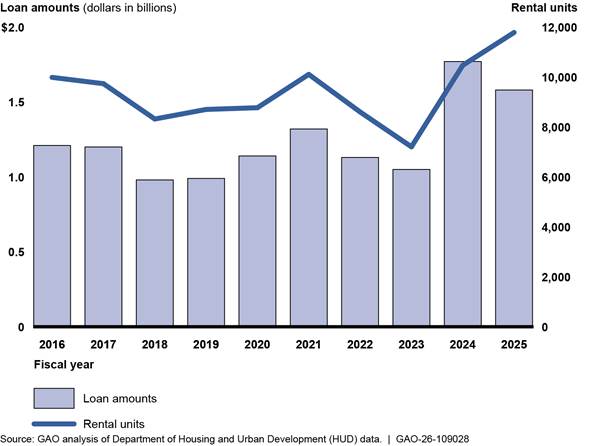
Notes: Total mortgage loan amounts represent the amounts that the Federal Housing Administration promised to insure at initial endorsement. Dollar amounts are adjusted for inflation using the fiscal year gross domestic product price index and presented in fiscal year 2025 dollars.
LIHTC Use in Risk-Sharing Projects
Of the 776 projects accepted under the risk-sharing program from fiscal years 2016 through 2025, 563, or 73 percent, received LIHTC. These projects produced or preserved about 67,320 rental units, or about 72 percent of the total units produced or preserved under the program over the period.
According to HUD’s LIHTC database, approximately 3.9 million housing units were placed in service from 1987 through 2024. In 2018, we reported that one of two types of LIHTC programs had financed an estimated 50,000 housing units annually since 2010.[21]
Potential Financing and Rent Benefits
As we previously reported, credit enhancement, such as FHA mortgage insurance, can affect loan terms when an HFA sells bonds to raise capital to lend to multifamily housing developers.[22] By providing additional support, the credit enhancement can improve the HFA’s bond rating, allowing it to obtain a lower interest rate or longer-term loan. The HFA can pass these benefits along to the developer, which in turn can convey them to tenants in the form of lower monthly rents.
Representatives from two HFAs similarly told us that the risk-sharing program enables their HFAs to improve their credit ratings and lower the interest rates on their tax-exempt bonds. One representative said the HFA can pass on its lower borrowing costs to its borrowers. A representative from another HFA told us that having multifamily loans insured under the risk-sharing program allows the HFA to retain less capital to protect against losses and use that capital to fund other housing programs.
Characteristics of Risk-Sharing Projects
From fiscal years 2016 through 2025, use of the risk-sharing program generally shifted from the purchase and refinancing of existing properties to new construction and substantial rehabilitation (see fig. 2). HUD officials and a representative from an HFA told us the shift was partly caused by changes in interest rates. Representatives from two other HFAs told us their states have prioritized new construction.
Figure 2: Number of Multifamily Housing Projects by Type Under HUD’s Risk-Sharing Program, Fiscal Years 2016–2025
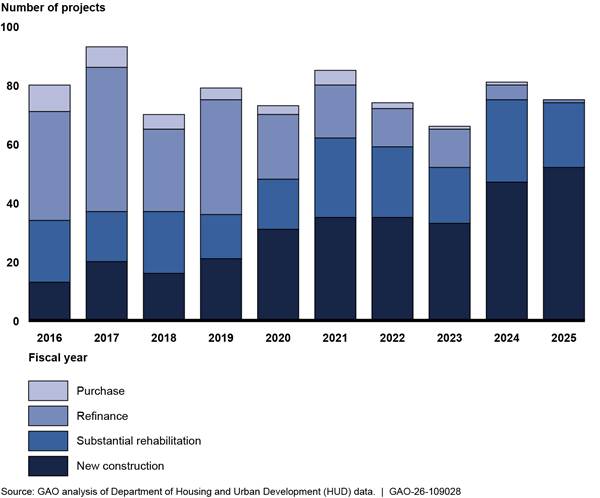
Note: HUD’s section 542(c) program, also referred to as the risk-sharing program, provides Federal Housing Administration insurance for loans on affordable multifamily properties that are underwritten, processed, and serviced by state and local housing finance agencies.
From fiscal years 2016 through 2025, 22 state and local HFAs—located in 18 states and the District of Columbia—underwrote loans for multifamily projects under the risk-sharing program. As shown in table 1, HFAs in New York, Massachusetts, and Maryland accounted for the largest loan amounts during the period, representing around 67 percent of the total.
Table 1: Locations of Multifamily Housing Projects Financed Under HUD’s Risk-Sharing Program, Fiscal Years 2016–2025
|
Location |
Number of projects |
Total mortgage amount |
Percent of total mortgage amount |
|
New York |
70 |
$3,100,619,837 |
29% |
|
Massachusetts |
187 |
$2,803,306,292 |
26% |
|
Maryland |
77 |
$1,277,619,445 |
12% |
|
California |
52 |
$775,846,259 |
7% |
|
Illinois |
64 |
$689,118,726 |
6% |
|
New Hampshire |
77 |
$571,952,601 |
5% |
|
Rhode Island |
54 |
$531,347,000 |
5% |
|
Colorado |
53 |
$479,306,000 |
4% |
|
Minnesota |
92 |
$295,688,762 |
3% |
|
Washington, D.C. |
6 |
$140,190,000 |
1% |
|
Vermont |
14 |
$56,613,000 |
1% |
|
Virginia |
8 |
$37,742,561 |
<1% |
|
New Jersey |
4 |
$33,774,432 |
<1% |
|
Wisconsin |
6 |
$21,927,000 |
<1% |
|
Michigan |
2 |
$6,174,086 |
<1% |
|
New Mexico |
4 |
$3,770,000 |
<1% |
|
Ohio |
2 |
$2,330,000 |
<1% |
|
Utah |
3 |
$2,030,000 |
<1% |
|
Kentucky |
1 |
$690,000 |
<1% |
Source: GAO analysis of Department of Housing and Urban Development (HUD) data. | GAO‑26‑109028
Note: Total mortgage loan amounts represent the amounts the Federal Housing Administration promised to insure at initial endorsement. Dollar amounts are not adjusted for inflation.
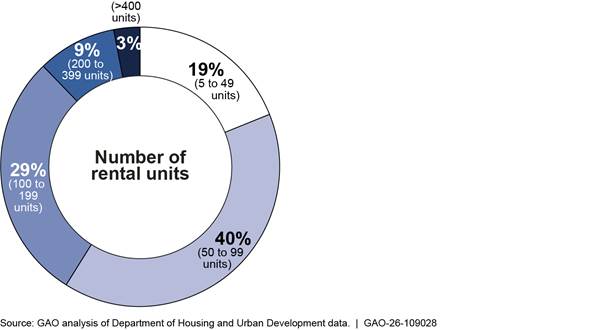
Multifamily projects financed under the risk-sharing program varied in size from fiscal years 2016 through 2025 (see fig. 3). Most projects had either 50 to 99 rental units or 100 to 199 rental units.
Figure 3: Risk-Sharing Program Multifamily Housing Projects by Number of Rental Units, Fiscal Years 2016–2025
Federal Financing Bank Initiative Financed About $4 Billion in Risk-Sharing Program Loans
In 2014, HUD and the Federal Financing Bank (FFB) started an initiative under which FFB provides financing for multifamily loans insured under HUD’s risk-sharing program. At the time, HUD stated the initiative would reduce the interest rate for affordable multifamily housing compared with the cost of tax-exempt bonds under then-current market conditions, increase the supply and preservation of affordable housing, and ensure the availability of competitive financing to underserved segments of the market.[23]
To participate in the HUD-FFB initiative, HUD requires HFAs to assume 50 percent of the risk on all loans originated under the initiative and have a credit rating of “A” or better. According to FFB’s 2025 annual report, 16 HFAs participate in the initiative, and an additional five HFAs were finalizing documents to begin participation in 2026.[24] According to FFB officials, FFB does not play a role in determining which HFA projects receive FFB funding. Rather, HUD provides its firm commitments to HFAs for their risk-sharing projects, which then allows HFAs to sell their FHA-insured loans to FFB. The use of FFB financing can eliminate the need for HFAs to issue their own bonds to finance the projects.
From fiscal years 2016 through 2025, FFB financed nearly $4 billion (adjusted for inflation) in loans for 276 multifamily projects under the risk-sharing program (see fig. 4). These projects produced or preserved about 30,900 rental units during the period, ranging from a high of 5,776 units in fiscal year 2017 to a low of 618 units in fiscal year 2023.[25] HUD stopped accepting new applications under the HUD-FFB initiative in 2019 but honored existing commitments, allowing FFB to finance projects completed during or after 2019. HUD resumed the initiative in 2022. In its fiscal year 2027 congressional budget justification, HUD did not project that any new firm commitments would be issued in 2027 but stated it would honor existing commitments.[26]
Figure 4: Risk-Sharing Program Loan Amounts Financed and Not Financed by the Federal Financing Bank, Fiscal Years 2016–2025
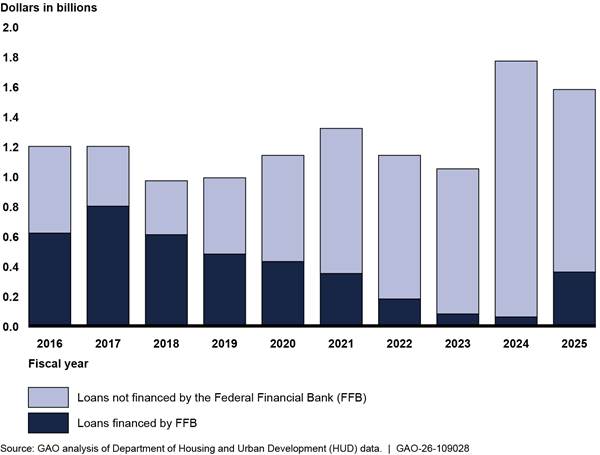
Notes: Total mortgage loan amounts represent the amounts that the Federal Housing Administration promised to insure at initial endorsement. Dollar amounts are adjusted for inflation using the fiscal year gross domestic product price index and presented in fiscal year 2025 dollars. The HUD-FFB initiative stopped accepting new applications after December 31, 2018, but honored existing commitments.
Views on the HUD-FFB financing initiative vary. In a January 2026 letter to the Department of the Treasury and HUD, the National Council of State Housing Finance Agencies expressed concern about the effect of terminating the initiative on affordable housing. The council noted that the initiative has financed affordable housing, including small projects in rural areas that could not attract other financing, and produced revenue for the federal government.
In contrast, in a June 2024 letter to Treasury and HUD, the Mortgage Bankers Association expressed concern about continuing the FFB initiative. According to the association, the initiative creates direct and unfair competition with private sector lenders that participate in HUD’s MAP program and may discourage their future participation in the market.
Risk-Sharing Program Financed Fewer Units Than and Differed from Traditional HUD Programs
Selected Traditional Insurance Programs Generally Provided Financing for More Multifamily Housing Units Than the Risk-Sharing Program
The three traditional HUD mortgage insurance programs we selected—the section 221(d)(4), 223(a)(7), and 223(f) programs—generally have provided more multifamily housing financing than the risk-sharing program (see fig. 5). These traditional and risk-sharing programs collectively financed projects that produced or preserved nearly 1.3 million multifamily rental units from fiscal years 2016 through 2025.[27] The risk-sharing program accounted for 7 percent of the total units over the period, and its annual share ranged from a high of 21 percent in fiscal year 2024 to a low of 4 percent in fiscal year 2021.[28]
Figure 5: Rental Units Produced or Preserved Under Selected HUD Multifamily Mortgage Insurance Programs, Fiscal Years 2016–2025
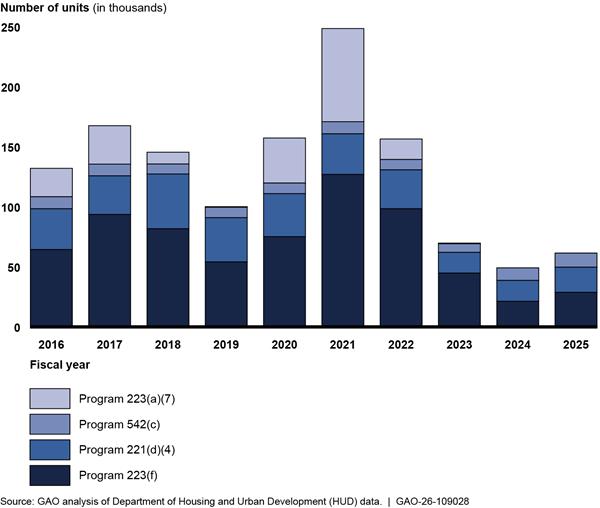
Note: HUD’s section 542(c) program, also referred to as the risk-sharing program, provides Federal Housing Administration (FHA) insurance for loans on affordable multifamily properties that are underwritten, processed, and serviced by state and local housing finance agencies. HUD’s section 223(a)(7) program insures mortgage loans to facilitate the refinancing of certain FHA-insured mortgages. HUD’s section 221(d)(4) program insures mortgage loans to facilitate the new construction or substantial rehabilitation of multifamily housing. HUD’s section 223(f) program insures mortgage loans to facilitate the purchase or refinancing of existing multifamily rental housing.
HUD officials told us that some MAP lenders view the HFA risk-sharing program as a competitor to HUD’s traditional multifamily programs. However, the officials said the traditional programs can be used for both market-rate and affordable housing projects, while the risk-sharing program can be used only for affordable housing. They said this difference can limit competition between traditional and risk-sharing programs and estimated that about 50 percent to 60 percent of multifamily projects under the traditional programs are market rate.
According to two MAP lender representatives, HUD’s risk-sharing and traditional programs can compete against each other for multifamily projects. One representative said HFAs have a competitive advantage because they can combine risk-sharing financing with other incentives or subsidies, such as LIHTC and grants. However, the representatives said competition between their firms and HFAs is limited because of differences in their customer bases and project types.
State and local HFAs have the mission of meeting affordable housing needs. Representatives from five HFAs generally told us the risk-sharing program helps HFAs achieve this mission, in part by providing them with an additional tool to finance multifamily projects. Two representatives said the program enables their HFAs to execute financially complex projects that could not be executed easily under the traditional programs. Two HFAs said they use both HUD’s traditional and risk-sharing programs to help meet the different needs of their customers, with each program offering certain advantages and disadvantages. Finally, an HFA representative told usHFAs review most risk-sharing loans for other reasons, such as the allocation of LIHTC, so there is efficiency in having them underwrite the loans.
HUD’s Traditional and Risk-Sharing Programs Differ in Some Areas
HUD’s traditional and risk-sharing programs generally serve to help finance multifamily housing. They are similar in some program areas but differ in other areas, in part because they are subject to different requirements. Key differences between the programs include the following:
· Under the risk-sharing program, HFAs select which projects receive financing and FHA insurance. Under the traditional programs, HUD approves which projects receive financing and FHA insurance.
· The risk-sharing program may be used to finance only affordable multifamily properties, including mixed-income housing.[29] The traditional programs may be used to finance affordable and market-rate properties.
· Under the risk-sharing program, HFAs use their own standards and procedures to underwrite and process loans.[30] Under the traditional programs, MAP lenders prepare, process, and submit loan applications for FHA multifamily mortgage insurance in accordance with HUD’s uniform national standards.[31]
· Under the risk-sharing program, HFAs contract with HUD to reimburse it for a portion of the loss from loan defaults. Under the traditional programs, HUD generally assumes all losses from loan defaults.
We reviewed four aspects of HUD’s traditional and risk-sharing programs to identify similarities and differences: application processes, underwriting standards, costs, and oversight.
Application Processes Have Similar Stages, but HUD’s Role Differs
As shown in table 2, the application processes for FHA insurance under HUD’s traditional and risk-sharing programs generally comprise similar activities. However, the processes differ in the requirements that apply, who conducts the activities, and the extent of HUD’s involvement.
Table 2: Summary of HUD Insurance Application Stages for a New Construction Project Under Traditional and Risk-Sharing Programs
|
Application stage |
Traditional program |
Risk-sharing program |
|
Prescreening stage |
The Multifamily Accelerated Process (MAP) lender and borrower and HUD hold concept meeting to discuss the proposed project. |
The borrower provides the housing finance agency (HFA) with basic information about the proposed project. HFA provides feedback on the proposal. |
|
Pre-firm commitment/approval stage |
The MAP lender submits a pre-application to HUD. The pre-application for new construction is designed to permit HUD to review the feasibility of a proposed project before the lender, borrower, and HUD spend the time and expense involved in processing a firm commitment application. HUD processes, reviews, and underwrites the pre-application submission and recommends the submission be approved, approved with conditions, returned to lender for modification, or rejected. If appropriate, HUD issues the MAP lender an invitation letter to submit a firm commitment application. |
The borrower submits an application and due diligence (e.g., third-party reports) and other information needed to underwrite the project. HFA analyzes the application and information and, if appropriate, seeks internal approval, such as from its board of directors. |
|
Firm commitment/approval application stage |
The MAP lender submits a firm commitment application, which includes underwriting forms, third-party reports, and other information. If appropriate, HUD issues a firm commitment letter (i.e., promise to insure the mortgage) to the applicant. |
HFA approves the application and submits information to HUD and requests a firm approval letter. Upon positive completion of its retained reviews, HUD issues a firm approval letter. |
|
Closing on construction loan and initial endorsement stagea |
The MAP lender prepares a draft closing package, which is then reviewed by HUD. When the lender and borrower close on the construction loan, HUD provides its initial endorsement of the loan for mortgage insurance. |
HFA prepares and circulates a draft closing package. Subsequently, HFA and the borrower close on the construction loan. HFA submits the closing package to HUD. HUD reviews the closing document and provides its initial endorsement of the loan for mortgage insurance. |
|
Construction stage |
HUD conducts inspections during construction, processes and approves loan advances, administers and enforces routine labor standards, and reviews and approves cost certification. |
HFA conducts inspections during construction, processes and approves loan advances, administers and enforces routine labor standards, and reviews and approves cost certification. |
|
Permanent loan and final endorsement |
The MAP lender prepares the draft closing package, and HUD reviews it. When the lender and borrower close on the construction loan, HUD provides its initial endorsement of the loan for mortgage insurance. |
HFA prepares and circulates the draft closing package. Subsequently, HFA and the borrower close on the permanent loan. HFA submits the closing docket to HUD. HUD reviews the closing document and provides its final endorsement of the loan. |
Source: GAO analysis of Department of Housing and Urban Development (HUD) and HFA information. | GAO‑26‑109028
Note: The application stages for new construction, substantial rehabilitation, purchase, and refinancing projects generally are similar, but new construction and substantial rehabilitation projects include the construction stage and permanent loan and final endorsement stage. For this reason, we selected new construction projects for comparison.
aIn projects where the Federal Housing Administration does not insure the construction loan, only the permanent loan is insured and a single endorsement is required after satisfactory completion of construction, substantial rehabilitation, or repairs.
Production Times and Costs Are Not Easily Compared
Differences in production times (the amount of time from when the borrower initially meets with the lender to final endorsement) and costs between HUD’s traditional and risk-sharing programs are affected by a variety of factors, making them difficult to directly compare. For example, as discussed above, the FHA-insurance application processes differ between the programs, which can affect production times and, in turn, production costs.[32] Production times or costs also can differ between programs or within a program depending on a range of factors, such as project type, size, or location. Finally, data needed to methodically analyze production times and costs are not publicly or readily available.
Production Times
A project’s production time generally spans from when a borrower meets with HUD or the HFA to discuss the project to when HUD provides its final endorsement. Using HUD data, we estimated that the average time from firm commitment to final endorsement for new construction projects under the section 221(d)(4) program in fiscal years 2023 and 2024 was nearly 1,000 days and 860 days, respectively.[33] The average time under the risk-sharing program in fiscal years 2023 and 2024 was nearly 1,080 days and 1,090 days, respectively. Our analysis does not consider factors that could affect production times, such as differences in project size or location. In addition, our estimates do not capture the time spent on the stages before HUD’s firm commitment or approval.
HUD officials told us that comparing production times between the traditional and risk-sharing programs would not be meaningful because the programs’ application processes differ. Under the traditional programs, application stages are regimented and set by the MAP guide. In contrast, under the risk-sharing program, HFAs control their application processes and time frames.
Representatives from two HFAs told us they can process loans faster under the risk-sharing program because of their delegated authority. However, representatives from another HFA told us loan processing under the risk-sharing program can be long because of the need to negotiate and reach agreement on loan terms and conditions across multiple funding sources.
Production Costs
Production costs comprise hard costs—including land, existing structures, and construction—and soft costs—including contractor, architect, engineer, and developer fees and construction-loan financing.
· Hard costs. A potential cost difference between the traditional and risk-sharing programs is the application of the Davis-Bacon Act to a project.[34] Under HUD’s risk-sharing regulations, new construction and substantial rehabilitation projects are not subject to the act’s prevailing wage requirements, if an HFA elects not to obtain FHA insurance for its construction loan and if the project does not receive other federal assistance that triggers the requirements. In contrast, the Davis-Bacon Act’s requirements generally apply to new construction and substantial rehabilitation projects under HUD’s traditional programs.
Representatives from two HFAs told us they consider the applicability of the Davis Bacon Act’s requirements when developing projects under the risk-sharing program. They also said risk-sharing projects, such as for public or older-adult housing, can be subject to the Davis-Bacon Act’s requirements because the projects receive other federal assistance. They said that if a project were subject to the act’s prevailing wage requirements, the project’s cost would increase substantially.
A representative from a MAP lender told us that HFAs have flexibility under the risk-sharing program to avoid higher wages under the Davis-Bacon Act. A representative from another MAP lender told us general contractors and subcontractors for FHA-insured new construction or substantial rehabilitation projects generally must comply with the Davis-Bacon Act’s prevailing wage rates. According to the representative, these rates pose the biggest obstacle to building affordable multifamily housing because of their impact on construction costs.
· Soft costs. Under its MAP program, HUD sets its application and inspection fees and limits lender fees. In comparison, each HFA participating in the risk-sharing program generally sets its own fee schedule, and the types and amounts can differ among the HFAs.[35]
A representative from an HFA told us that transaction costs are similar under both programs because due diligence costs and underwriting reviews are similar. A representative from another HFA told us costs under HUD’s section 221(d)(4) program are higher than under the risk-sharing program because the HFA charges only an application and reservation fee.
According to HUD officials, HFAs may elect not to obtain FHA insurance for their construction loans, given the potential to reduce costs and administrative requirements.
Our prior work on LIHTC provides additional context for differences in production costs.[36] For example, we identified legal, accounting, and other fees associated with using multiple funding sources as one among several possible explanations for why costs may differ between LIHTC and market-rate projects. This work also identified wide variation in development costs among LIHTC projects completed from 2011 through 2015 and drivers of such variation, including construction type, project scale, and geographic factors.
Selected Underwriting Standards Are Similar, and HUD Officials Said Loans Have Performed Well
HUD officials and representatives from two HFAs and a MAP lender told us underwriting standards are similar between the traditional and risk-sharing programs. As discussed earlier, MAP lenders use HUD’s standards to underwrite loans under the traditional mortgage insurance programs, while HFAs use their own standards to underwrite loans under the risk-sharing program.
According to HUD’s 1995 risk-sharing handbook, in processing the FHA-insurance application and underwriting the project, an HFA must
· determine that a market for the project exists, taking into consideration any HUD comments about the potential for the project to adversely impact proposed or existing federally insured and assisted projects in the area,
· establish the maximum insurable mortgage and review plans and specifications for compliance with HFA standards,
· determine the acceptability of the proposed mortgagor and management agent,
· approve the Affirmative Fair Housing Marketing Plan,
· make any other determinations necessary to ensure acceptability of the proposed project,
· ensure that the environmental review is conducted in accordance with regulatory requirements before requesting HUD to conduct its retained review, and
· ensure that any required subsidy layering review is completed by the applicable housing credit agency or HUD before loan approval.[37]
According to HUD officials, loans under HUD’s risk-sharing and traditional programs have both performed well and pose low risk to the FHA insurance fund.[38] They told us there have been no claims on risk-sharing loans since 2014 and no claims on FFB-financed risk-sharing loans since FFB began financing them.[39]
We reviewed three financial ratios that HUD uses to determine the maximum loan amount under its traditional programs.[40]
· Debt service coverage ratio is used in underwriting to evaluate the potential for a property’s income to cover the property’s mortgage debt.[41] In general, the higher the ratio, the less the property is likely to face financial difficulties that could lead to default. As shown in figure 6, one of the 15 selected HFAs adopted a less conservative debt service coverage ratio than HUD. The remaining HFAs adopted ratios that were equal to or more conservative than HUD’s ratios.
Figure 6: HUD and Selected HFA Minimum Debt Service Coverage Ratios for Affordable Multifamily Housing Projects
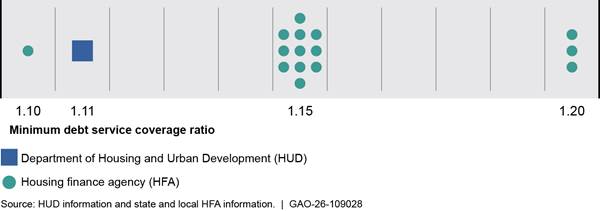
Notes: Affordable housing for the Federal Housing Administration’s multifamily mortgage insurance programs is defined as projects meeting either the minimum affordability requirement for the Low-Income Housing Tax Credit or the requirements for project-based Section 8 (certain project-based rental assistance). These minimum debt service coverage ratios apply to affordable housing projects under HUD’s section 221(d)(4) and 223(f) programs. The section 221(d)(4) program insures mortgage loans to facilitate the new construction or substantial rehabilitation of multifamily housing. The section 223(f) program insures mortgage loans to facilitate the purchase or refinancing of existing multifamily housing. HUD revised its minimum debt service coverage ratio in January 2025 from 1.15 to 1.11.
· Loan-to-value ratio is used to determine whether a property’s cash value will be sufficient to cover the mortgage debt in the event of foreclosure.[42] In general, the lower the ratio, the more likely the property’s value will be sufficient to pay off the outstanding mortgage obligation. The MAP guide uses this ratio for purchases and refinancing of existing rental housing. As shown in figure 7, one of the 15 selected HFAs adopted a less conservative loan-to-value ratio than HUD. The remaining HFAs adopted ratios that were equal to or more conservative than HUD’s ratios.
Figure 7: HUD and Selected HFA Minimum Loan-to-Value Ratios for Affordable Multifamily Housing Projects
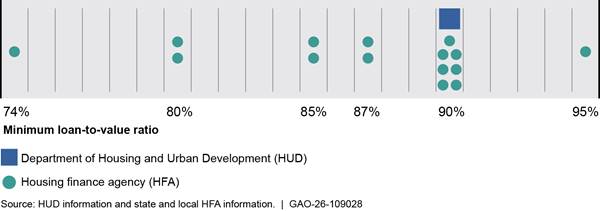
Notes: Affordable housing for the Federal Housing Administration’s multifamily mortgage insurance programs is defined as projects meeting either the minimum affordability requirement for the Low-Income Housing Tax Credit or the requirements for project-based Section 8 (certain project-based rental assistance). These minimum loan-to-value ratios apply to affordable housing projects under HUD’s section 221(d)(4) and 223(f) programs. The section 221(d)(4) program insures mortgage loans to facilitate the new construction or substantial rehabilitation of multifamily housing. The section 223(f) program insures mortgage loans to facilitate the purchase or refinancing of existing multifamily housing. HUD revised the minimum loan-to-value ratio in January 2025 from 87 percent to 90 percent.
· Loan-to-cost ratio is used to compare the amount of a project’s mortgage loan to the project’s total cost.[43] A lower ratio means a lower amount of debt is being used to finance the project. The MAP guide generally uses this ratio for new construction and substantial rehabilitation projects. As shown in figure 8, two of the 15 selected HFAs adopted a less conservative loan-to-cost ratio than HUD. The remaining HFAs adopted ratios that were equal to or more conservative than HUD’s ratios.
Figure 8: HUD and Selected HFA Minimum Loan-to-Cost Ratios for Affordable Multifamily Housing Projects
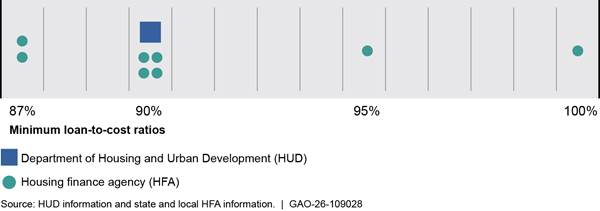
Notes: Affordable housing for the Federal Housing Administration’s multifamily mortgage insurance programs is defined as projects meeting either the minimum affordability requirement for the Low-Income Housing Tax Credit or the requirements for project-based Section 8 (certain project-based rental assistance). These minimum loan-to-cost ratios apply to affordable housing projects under HUD’s section 221(d)(4) and 223(f) programs. The section 221(d)(4) program insures mortgage loans to facilitate the new construction or substantial rehabilitation of multifamily housing. The section 223(f) program insures mortgage loans to facilitate the purchase or refinancing of existing multifamily housing. HUD revised its minimum loan-to-cost ratio in January 2025 from 87 percent to 90 percent. Some HFAs do not use the loan-to-cost ratio. As a result, the total for the loan-to-cost ratio does not equal 15 HFAs.
HUD’s Oversight Requirements for MAP Lenders and HFAs Are Generally Similar
Based on our review of HUD regulations and guidance, we found that HUD’s oversight requirements for MAP lenders and HFAs participating in the risk-sharing program are generally similar.[44] As discussed above, MAP lenders and HFAs must be approved by HUD to participate in the MAP programs and the risk-sharing program, respectively. In general, HUD’s oversight is intended to ensure that MAP lenders and HFAs continue to comply with their program requirements.
Oversight of Traditional Programs
According to HUD officials, HUD oversees MAP lenders to ensure that they are qualified, well capitalized, and conducting sound underwriting to minimize losses to the FHA insurance fund.
Under HUD’s regulations and MAP guide, MAP lenders are subject to the following reporting requirements, quality control plan requirements, and reviews:[45]
· Reporting requirements. HUD requires MAP lenders to submit annual audited financial statements and annual certifications, which include the names of key personnel, any corrective actions taken as a result of their most recent quality control reviews, and a summary of loans underwritten by new MAP underwriters. MAP lenders also must notify HUD of changes in their key personnel, address or contact information, and quality control plans and reapply to be a MAP lender if there is a change in ownership, controlling interest, or the way they materially do business.
· Quality control plan requirements. HUD requires MAP lenders to implement a quality control plan to assure their compliance with MAP program requirements. The plan must describe (1) the requirements for MAP loan origination, underwriting, closing, construction-loan administration, and loan servicing, as applicable, and (2) the actions the lender will take to oversee and manage risks in the MAP lending process. MAP lenders are required to review and update their quality control plans annually.
In addition, MAP lenders must have their MAP operation reviewed annually by an independent and properly licensed professional auditor. According to the MAP guide, the review must be sufficient in scope to enable the lender to evaluate the performance of its MAP operation and compliance with MAP program requirements. The reviews must document all positive and negative findings in writing and be presented to the lender’s senior management committee. MAP lenders are required to report the results of their reviews to HUD, including any corrective action plans.
· Reviews. According to its guide, HUD is to conduct a full MAP lender review and quality control plan audit once every 3 years for all active MAP lenders with 3 or more years of MAP experience, or more frequently for any lender that HUD determines requires enhanced monitoring. HUD may perform limited reviews and updates during intervening years. For MAP lenders with less than 3 years of MAP experience, the guide specifies that HUD conduct full or limited reviews annually.
Oversight of the Risk-Sharing Program
According to HUD officials, the agency primarily oversees HFAs in the risk-sharing program by reviewing the information they periodically submit. The officials told us HUD has not conducted on-site reviews of HFAs because of resource constraints. The officials also said that because HFAs are exposed to loan losses under the program, HFAs have an incentive to be conservative in underwriting loans.
Under HUD’s regulations and 1995 handbook for the risk-sharing program, which HUD officials told us they plan to update, HFAs participating in the risk-sharing program are subject to reporting requirements and monitoring, and the handbook provides for reviews.[46] These requirements and procedures include the following:
· Reporting requirements. HUD requires HFAs to submit, among other information, annual audited financial statements, semiannual reports on the amounts and status of their loans, and an annual certification attesting to their compliance with all eligibility requirements during the past year. HFAs also are required to notify HUD of any changes to their standards and procedures, loan terms, and conditions.[47]
· Monitoring. According to its handbook, HUD remotely monitors HFAs by reviewing project underwriting and management and servicing information to assess compliance with their underwriting standards and procedures. HUD also may remotely monitor HFAs to ensure they continue to meet eligibility requirements.
· Reviews. HUD’s handbook provides for on-site reviews of HFAs based on HUD’s remote monitoring and other information. Such reviews would generally be intended to assess an HFA’s compliance with the HUD handbook’s requirements. However, as noted above, the agency has not conducted on-site reviews due to resource constraints. In addition, according to HUD regulations, HUD will review the underwriting standards, loan terms and conditions, and asset management and servicing procedures for level II HFAs every 5 years.
Agency Comments
We provided a draft of this report to HUD and Treasury for their review and comment. HUD and Treasury did not provide comments on the report.
We are sending copies of this report to the appropriate congressional committees, the Secretary of Housing and Urban Development, the Secretary of the Treasury, and other interested parties. In addition, the report will be available at no charge on the GAO website at https://www.gao.gov.
If you or your staff have any questions about this report, please contact me at naamanej@gao.gov. Contact points for our Offices of Congressional Relations and Media Relations may be found on the last page of this report. GAO staff who made key contributions to this report are listed in appendix I.

Jill Naamane
Director, Financial Markets and Community Investment
GAO Contact
Jill Naamane, naamanej@gao.gov
Staff Acknowledgments
In addition to the contact named above, Rich Tsuhara (Assistant Director), Phil Curtin (Analyst in Charge), Genesis Galo, Jill Lacey, Marc Molino, Jessica Sandler, Jennifer Schwartz, Jack Wang, and Steve Westley made key contributions to this report.
The Government Accountability Office, the audit, evaluation, and investigative arm of Congress, exists to support Congress in meeting its constitutional responsibilities and to help improve the performance and accountability of the federal government for the American people. GAO examines the use of public funds; evaluates federal programs and policies; and provides analyses, recommendations, and other assistance to help Congress make informed oversight, policy, and funding decisions. GAO’s commitment to good government is reflected in its core values of accountability, integrity, and reliability.
Obtaining Copies of GAO Reports and Testimony
The fastest and easiest way to obtain copies of GAO documents at no cost is through our website. Each weekday afternoon, GAO posts on its website newly released reports, testimony, and correspondence. You can also subscribe to GAO’s email updates to receive notification of newly posted products.
Order by Phone
The price of each GAO publication reflects GAO’s actual cost of production and distribution and depends on the number of pages in the publication and whether the publication is printed in color or black and white. Pricing and ordering information is posted on GAO’s website, https://www.gao.gov/ordering.htm.
Place orders by calling (202) 512-6000, toll free (866) 801-7077,
or
TDD (202) 512-2537.
Orders may be paid for using American Express, Discover Card, MasterCard, Visa, check, or money order. Call for additional information.
Connect with GAO
Connect with GAO on X,
LinkedIn, Instagram, and YouTube.
Subscribe to our Email Updates. Listen to our Podcasts.
Visit GAO on the web at https://www.gao.gov.
To Report Fraud, Waste, and Abuse in Federal Programs
Contact FraudNet:
Website: https://www.gao.gov/about/what-gao-does/fraudnet
Automated answering system: (800) 424-5454
Media Relations
Sarah Kaczmarek, Managing Director, Media@gao.gov
Congressional Relations
David A. Powner, Acting Managing Director, CongRel@gao.gov
General Inquiries
[1]In general, very low-income households have incomes that do not exceed 50 percent of the area median family income, and extremely low-income households have incomes that do not exceed 30 percent of the area median family income. 42 U.S.C § 1437a(b)(2). In general, a unit is considered affordable if the gross rent (rent plus utility costs) does not exceed 30 percent of household income.
[2]Department of Housing and Urban Development, Office of Policy Development and Research, Worst Case Housing Needs: 2025 Report to Congress (Washington, D.C.: July 2025).
[3]Section 542 of the Housing and Community Development Act of 1992 (12 U.S.C. § 1715z–22) directs HUD to carry out programs through FHA to demonstrate the effectiveness of providing new forms of federal credit enhancement for multifamily loans. According to the National Council of State Housing Finance Agencies, state HFAs are state-chartered authorities established to help meet the affordable housing needs of state residents. Although HFAs vary widely in such characteristics as their relationship to state government, most are independent entities that operate under the direction of a board of directors appointed by the governor. HFAs administer a wide range of affordable housing and community development programs. Local housing finance agencies operate similarly but at the county, city, or other municipal-entity level.
[4]To determine the fiscal year of a project, we used the fiscal year in which HUD initially endorsed the loan. Data from these fiscal years were the most recent data available at the time of our review.
[5]The Federal Financing Bank is a government corporation under the general supervision and direction of the Secretary of the Treasury. The Federal Financing Bank is the vehicle through which federal agencies finance programs involving the sale or placement of credit market instruments including agency securities, guaranteed obligations, participation agreements, and the sale of assets, consistent with the Federal Financing Bank Act of 1973 (12 U.S.C. §§ 2281-2296.).
[6]HUD’s traditional mortgage insurance programs are authorized by the National Housing Act and use HUD’s multifamily accelerated process. We selected the primary three programs covered by HUD’s multifamily accelerated process: (1) the section 221(d)(4) program (12 U.S.C. § 1715l(d)(4)), which insures mortgage loans to facilitate the new construction or substantial rehabilitation of multifamily housing, (2) the section 223(a)(7) program (12 U.S.C. § 1715n(a)(7)), which insures mortgage loans to facilitate the refinancing of certain FHA-insured mortgages, and (3) the section 223(f) program (12 U.S.C. § 1715n(f)), which insures mortgage loans to facilitate the purchase or refinancing of existing multifamily housing.
[7]HUD issued the handbook in June 1995 but stated when it revised its regulations in December 2020 that it planned to update the handbook.
[8]The Center for Public Enterprise works with local, state, and federal government agencies, as well as advocacy organizations, researchers, and academics, to support the successful design and implementation of public development programs. It has assisted HFAs with the risk-sharing program and has published articles on the program.
[9]GAO, Housing Finance: FHA’s Risk-Sharing Programs Offer Alternatives for Financing Affordable Multifamily Housing, GAO/RCED‑98‑117 (Washington, D.C.: Apr. 23, 1998); and Low-Income Housing Tax Credit: Improved Data and Oversight Would Strengthen Cost Assessment and Fraud Risk Management, GAO‑18‑637 (Washington, D.C.: Sept. 18, 2018).
[10]HUD’s multifamily insurance programs are funded through mortgage insurance premiums paid by borrowers.
[11]In a 1998 report on the HFA risk-sharing demonstration program, we found that it facilitated the production of affordable multifamily housing. See GAO/RCED‑98‑117.
[12]A risk-sharing agreement is a contract between an HFA and HUD that incorporates the terms, obligations, and conditions specified in 24 C.F.R. Part 266.
[13]Of the 37 approved HFAs, 14 are approval level I only, two are approval level II only, and 21 are approval level I and II. Level I participants are HFAs that elect to take 50 percent or more of the risk of loss on mortgages issued under the program. Level II participants generally are HFAs that elect to take 10 or 25 percent of the risk of loss on mortgages issued under the program. In July 2026, a HUD official told us the agency had approved another HFA to participate in the risk-sharing program, but the HFA had not yet signed a risk-sharing agreement.
[14]When the loan-to-replacement-cost ratio for a new or substantially rehabilitated property or the loan-to-value ratio for an existing property is greater than or equal to 75 percent, the HFA assumes 25 percent of the loss. When these ratios are less than 75 percent, the HFA can choose to assume 10 percent or 25 percent of the loss.
[15]According to the National Council of State Housing Agencies, HFAs have crafted hundreds of housing programs using tax-exempt housing bonds, LIHTC, the HOME Investment Partnerships Program, and other federal and state resources.
[16]The LIHTC program is jointly administered by the Internal Revenue Service within the Department of the Treasury and by credit allocating agencies, typically state HFAs established to meet the affordable housing needs of their residents.
[17]For additional information on LIHTC, see GAO, Low-Income Housing Tax Credit: Opportunities to Improve Oversight, GAO‑24‑107064 (Washington, D.C.: Dec. 14, 2023).
[18]Once a project is awarded tax credits, developers often attempt to obtain funding for the project by attracting investors willing to contribute equity financing. Developers typically sell an ownership interest in their LIHTC projects in exchange for equity from investors (a process commonly referred to as selling tax credits). The equity investments reduce debt burden on LIHTC projects, making it possible for project owners to offer lower, more affordable rents. Generally, investors buy an ownership interest in a LIHTC partnership (commonly referred to as buying tax credits) to lower their tax liability.
[19]A project must reserve at least 20 percent of available units for households earning up to 50 percent of the area’s median gross income (adjusted for family size) or at least 40 percent of units for households earning up to 60 percent of the area’s median gross income (adjusted for family size) for the entire 30 years. 26 U.S.C. § 42(g)(1), (h)(6). The Consolidated Appropriations Act, 2018 amended these requirements to allow developers to reserve at least 40 percent of available units for households earning an overall average income no greater than 60 percent of area median gross income, with no individual tenant with an income above 80 percent of the area median gross income. Pub. L. No. 115-141, Div. T, § 103, 132 Stat. 348, 1157 (2018), (amending 26 U.S.C. § 42 (g)(1)).
[20]We used HUD’s initial endorsement database to calculate the number of rental units expected to be produced or preserved under the risk-sharing program. For construction projects with FHA-insured advances, the initial endorsement of the mortgage occurs before the start of construction. A second or "final” endorsement occurs at the conclusion of construction upon completion of the cost certification procedure. Thus, some multifamily projects in our analysis may not be completed. Insured mortgages for acquisition or refinancing of properties have no construction period and have a single endorsement. We generally use “produced or preserved” to refer to rental units expected to be produced or preserved.
[21]This estimate applies to units financed with 9 percent LIHTC, which is designed to provide a 70 percent subsidy for developing or rehabilitating low-income units and is based on industry estimates. While this report focused on the 9 percent LIHTC, a 4 percent LIHTC providing a 30 percent subsidy also is available. 26 U.S.C. § 42(b)(1)(B). See GAO‑18‑637.
[23]Department of Housing and Urban Development, Benjamin T. Metcalf, Assistant Secretary for Multifamily Housing Programs, “Memorandum for All HFA Section 542(c) Multifamily Risk Sharing Lenders” (Washington, D.C.: Nov. 14, 2014). The memorandum noted that HUD was pursuing a legislative change to allow risk-sharing loans to be securitized by the Government National Mortgage Association to achieve the same outcome as the FFB initiative.
[24]According to FFB officials, an HFA executes a master risk-sharing agreement with HUD, a master escrow and custody agreement with FFB and a custodian, and a master purchase and sale agreement with FFB.
[25]Of these total units over the period, about 23 percent were new construction projects and 14 percent were substantial rehabilitation projects. In August 2024, HUD launched the FFB Interest Rate Collar Program for new construction and substantial rehabilitation under the HUD-FFB initiative. HFAs can face interest rate risk between the start of construction and the acquisition of a permanent mortgage. Under the program, FFB hedges the risk for HFAs by locking in an interest rate collar that provides HFAs with the certainty that the eventual rate on the permanent mortgage will be within a specified range, or collar. According to FFB officials, the program had not been used as of July 2026.
[26]According to HUD’s fiscal year 2027 congressional budget justification, the administration is examining the FFB program and considering its necessity within the government’s credit portfolio.
[27]We determined the fiscal year based on the date HUD initially endorsed a mortgage loan for insurance.
[28]In addition to the section 221(d)(4), 223(a)(7), and 223(f) programs, HUD administers other programs that provide FHA mortgage insurance for multifamily rental properties. As a result, the risk-sharing program’s share would be smaller if data for all such HUD programs were included.
[29]According to HUD, a mixed-income housing development can be defined as a development that consists of housing units with differing levels of affordability, typically with some market-rate housing and some housing that is available to low-income occupants below market rate.
[30]Under the risk-sharing program, HFAs that assume less than 50 percent of the risk must have their underwriting standards and loan terms and conditions approved by HUD.
[31]The MAP program generally covers the section 220, 221(d)(4), 231, 241(a), 223(a)(7), and 223(f) programs.
[32]For example, shorter production times could reduce costs. See, for example, Jason M. Ward and Luke Schlake, The High Cost of Producing Multifamily Housing in California: Evidence and Policy Recommendations (Santa Monica, CA: RAND Corporation, Apr. 2, 2025).
[33]We did not include fiscal year 2025 because the section 221(d)(4) program only had one project with a final endorsement date within our review’s time frame.
[34]The Davis-Bacon Act generally requires the payment of prevailing wage rates (determined by the Department of Labor) to all laborers and mechanics on federal and District of Columbia construction projects in excess of $2,000.
[35]According to HUD’s risk-sharing program handbook, for the financing of existing properties without substantial rehabilitation, the maximum HFA financing fee is 3.5 percent of the mortgage amount, except for bond-financed projects (taxable or tax-exempt), where the maximum is 5.5 percent.
[36]GAO‑18‑637. We recommended that Congress consider designating a federal agency to maintain and analyze LIHTC cost data. As of July 2026, this matter for congressional consideration remained unaddressed. We also made three recommendations to the Internal Revenue Service to enhance collection and verification of cost data. The Internal Revenue Service disagreed with the recommendations and as of July 2026 had not taken action to implement them.
[37]Under HUD’s risk-sharing regulations, an HFA must submit any information or certification required by HUD to enable HUD to determine compliance with requirements concerning (1) previous participation of principals, (2) intergovernmental review, (3) subsidy layering, and (4) the Davis-Bacon Act.
[38]Compared with HUD’s traditional multifamily insurance programs, the risk-sharing program exposes the federal government to less risk of loss in the event of default because HFAs share in any losses.
[39]Although HUD provides public information on default rates of FHA-insured multifamily loans, such information does not provide default rates by specific program. See, for example, Department of Housing and Urban Development, Federal Housing Administration Commercial Mortgage Portfolio: April 2026 Credit Risk Report (Washington, D.C.: April 2026).
[40]Under the MAP guide, maximum loan amounts are the lesser of (1) the requested mortgage amount, (2) the amount allowed by statutory limits, (3) the amount supportable by applicable debt service coverage ratios, or (4) the amount supportable by applicable loan ratios. In January 2025, HUD revised FHA’s multifamily housing programs' underwriting standards to help boost the housing supply. For its section 221(d)(4) and 223(f) programs, HUD made the minimum debt service, loan-to-value, and loan-to-cost ratios less conservative for affordable housing and market-rate projects. Department of Housing and Urban Development, Mortgagee Letter 2025-03 (Jan. 8, 2025).
[41]The debt service coverage ratio generally is a property’s net operating income divided by required mortgage payments.
[42]The loan-to-value ratio generally is the outstanding mortgage amount on a property divided by the property’s market value.
[43]The loan-to-cost ratio generally is the project loan amount divided by the project’s total cost.
[44]We did not audit HUD’s oversight of the traditional and risk-sharing programs.
[45]Applicable HUD regulations are in 24 C.F.R. Part 200, including Subpart Y, and 24 C.F.R. Part 202. The applicable handbook is the Office of the Assistant Secretary for Housing–FHA Commissioner’s Multifamily Accelerated Processing (MAP) Guide (Mar. 19, 2021).
[46]Applicable HUD regulations are in 24 C.F.R. Part 266, including § 266.115 program monitoring and evaluation. The applicable HUD handbook is the Housing Finance Agency Risk-Sharing Pilot Program Handbook (4590.1).
[47]For level II HFAs, HUD must review proposed changes and provide written approval before the HFA may implement the changes.