
Testimony Before the Subcommittees on Seapower and Projection Forces, Committee on Armed Services, and Coast Guard and Maritime Transportation, Committee on Transportation and Infrastructure, House of Representatives
For Release on Delivery Expected at 3:30 p.m. ET
United States Government Accountability Office
A testimony before the Subcommittee on Seapower and Projection Forces, Committee on Armed Services and the Subcommittee on Coast Guard and Maritime Transportation, Committee on Transportation and Infrastructure, House of Representatives
Contact: Shelby Oakley at oakleys@gao.gov
What GAO Found
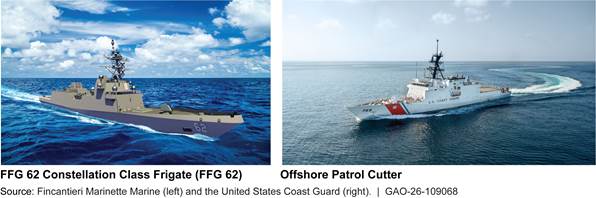
Navy and Coast Guard shipbuilding programs have consistently fallen short of expectations over the last 2 decades. Collectively, they are billions of dollars over cost and years behind schedule. For example, the Navy’s Constellation class frigate program was overcome by issues. As a result, the Navy announced a strategic shift away from the program in 2025—having previously exercised contract options valued at over $3 billion dollars. Similarly, the Coast Guard paused work on two ships and terminated two other ships in its Offshore Patrol Cutter program after a more than 5-year delay in delivering the lead ship.
Proposed solutions by federal officials have included reorganizing how shipbuilding programs are managed, increasing shipbuilder workforce wages, and finalizing ship designs before beginning construction, among others. While there is no singular solution, implementing leading practices and GAO’s prior recommendations could help ensure smoother sailing.
For example, ensuring that new ship design efforts, such as the Navy’s planned new attack submarine program, fully leverage ship design practices used by leading companies will be critical to long-term success. This would include practices like iterative design based on user feedback, completing ship design before beginning construction, and using digital tools. (See GAO-24-105503.)
Additionally, the shipbuilding industrial base—the private companies that build or supply the parts for ships—has not met the government’s submarine construction goals in recent years. GAO’s analysis of the Department of Defense’s (DOD) efforts to invest in the submarine industrial base to improve its capacity found shortcomings. For example, DOD does not know how much funding it expects to need—beyond the more than $10 billion DOD already invested—to solve submarine industrial base challenges such as ensuring needed parts get delivered on time. Without this understanding, decision-makers may not have the information needed to balance funding for the submarine industrial base with other shipbuilding priorities. Further, DOD has not taken key steps to ensure oversight for some of its costliest submarine industrial base investments. Without improvements, such as documented project monitoring, DOD cannot ensure those taxpayer dollars are helping achieve its goals as cost effectively as possible. These findings can provide lessons learned for the Navy, Coast Guard, and other federal agencies in their efforts to build up the maritime industrial base.
Why GAO Did This Study
The U.S. is in a period of heightened emphasis on improving shipbuilding to tackle pressing national security demands. The Navy and Coast Guard spend billions to procure ships each year and have ambitious plans to build new ships. GAO has reported for decades on the persistent issues that plague these shipbuilding programs and has made more than 100 recommendations to address them.
This statement addresses (1) the state of Navy and Coast Guard shipbuilding; (2) key challenges the Navy and Coast Guard need to address to achieve their ambitious shipbuilding goals; and (3) DOD’s efforts to support the submarine industrial base and the lessons that can be derived for future maritime industrial base investments.
This statement is based on prior and ongoing GAO work. In addition, GAO is issuing the results of its analysis of DOD’s management of submarine industrial base investments in this testimony statement. To perform this work, GAO analyzed relevant Navy and Coast Guard documentation and interviewed knowledgeable officials
What GAO Recommends
GAO is making two new recommendations to DOD to assess the full scope of investments needed to expand the submarine industrial base in support of the Navy’s construction goals and to improve oversight of these investments. DOD agreed with our recommendations.
Additionally, since 2016, GAO has made 92 recommendations to the Navy and 45 to the Coast guard to help improve their shipbuilding programs. Of these, many have yet to be addressed. GAO will continue to monitor each agency's progress in addressing the recommendations.
April 22, 2026
Chairmen Kelly and Ezell, Ranking Members Courtney and Carbajal, and Members of the Subcommittees:
Thank you for the opportunity to discuss the shipbuilding challenges facing the U.S. Navy and Coast Guard. We are in an unprecedented era of focus on the maritime industrial base and American shipbuilding, as illustrated by the release of America’s Maritime Action Plan by the White House in February 2026. This plan sets out the common challenges faced by the maritime industrial base across government and commercial shipbuilding and outlines policy options to address them.[1] The recognition of these challenges by Congress and federal agencies has been accompanied by a significant increase in funding and plans for building new ships to address pressing national security demands.
In the near term, the Navy and Coast Guard plan to spend tens of billions of dollars on shipbuilding. For example, the President’s Budget for fiscal year 2027—released in April 2026—requested over $65 billion in shipbuilding funding, in part to support recently announced plans for the Golden Fleet. Similarly, the Coast Guard plans to invest over $40 billion to replace and expand its current fleet of ships.[2] The Navy and the Coast Guard collectively received over $30 billion to help procure ships under Public Law 119-21, commonly known as the One Big Beautiful Bill Act.[3] Further, the Navy continues to request significant amounts of funding to build up the capacity of the shipbuilding industrial base—the private companies that build ships or supply parts for the ships.
However, for these investments to produce results in the time frames demanded by the threat environment the U.S. currently faces, the Navy and the Coast Guard will have to overcome the shipbuilding issues that have plagued them for nearly 2 decades.[4] These issues include cost and schedule challenges, outdated design practices, and not having a strategic approach to improve the capacity of the shipbuilding industrial base, among other things.
While these issues are long-standing, we believe that by adopting and consistently following leading commercial principles that our work has identified and addressing the numerous other recommendations we have made in our body of work, the Navy and Coast Guard could deliver ships and much-needed capabilities in a time frame demanded by today’s dynamic threat environment. As I have testified before your committees in the past, Navy and Coast Guard action to implement our recommendations has been mixed.[5]
My statement today addresses: (1) the current state of Navy and Coast Guard shipbuilding; (2) key challenges the Navy and Coast Guard need to address to help achieve their shipbuilding goals; and (3) lessons learned from Department of Defense’s (DOD) efforts and investments to support the submarine industrial base that the government can apply to future efforts and investments related to the broader maritime industrial base.
This statement is based, in part, on our body of issued reports on Navy and Coast Guard shipbuilding programs. In those reports, we reviewed Navy and Coast Guard documentation, conducted site visits to shipbuilders, and interviewed officials from both agencies. More detailed information on the objectives, scope, and methodology for that work can be found in the issued reports. This statement also includes information on other related ongoing work on the Navy and Coast Guard’s shipbuilding trades workforces; Navy shipbuilding cost and schedule outcomes; and our annual assessments of DOD and Department of Homeland Security (DHS) acquisition programs, among others.[6] We generally expect to report on those results during 2026. To perform these ongoing reviews, we analyzed relevant documentation, conducted site visits, and interviewed cognizant officials.
This statement also includes the results of our recent work assessing DOD’s efforts to manage its investments in the submarine industrial base, which we conducted from September 2024 to April 2026. To perform this work, we reviewed DOD studies that identified related funding needs and compared them against elements of an effective economic analysis that we identified in prior work.[7] We also reviewed DOD and contractor policy and procedure documentation related to the oversight of submarine industrial base investments; and analyzed documents for a nongeneralizable sample of 15 submarine industrial base investments. Additionally, we reviewed contracts supporting efforts related to DOD’s submarine industrial base investments; conducted site visits to the two shipyards that build submarines, among other locations; and interviewed DOD officials and contractor representatives.
We conducted the work on which this statement is based in accordance with generally accepted government auditing standards. Those standards require that we plan and perform the audit to obtain sufficient, appropriate evidence to provide a reasonable basis for our findings and conclusions based on our audit objectives. We believe that the evidence obtained provides a reasonable basis for our findings and conclusions based on our audit objectives.
Navy and Coast Guard Shipbuilding Programs Fall Short of Cost and Schedule Expectations, Delivering Less Capability Than Planned
During the past 2 decades, we have consistently found that Navy and Coast Guard shipbuilding programs have fallen short of cost and schedule expectations. These challenges continue to beset Navy and Coast Guard programs, as reflected in the recent partial termination of work on the Navy’s Constellation class frigate program and the Coast Guard’s Offshore Patrol Cutter program, after spending billions of dollars across these programs and providing no capability to the fleet.
Persistent Cost and Schedule Challenges in Navy Shipbuilding Programs Result in Delays and Fewer Deliveries Than Planned
Over the last 2 decades, we have consistently found that the Navy’s shipbuilding acquisition practices result in cost growth and delivery delays. For example, in 2017, we identified cost and schedule risks for the Columbia class submarine program that have since been realized.[8] The Navy now projects that SSBN 826, the lead Columbia class submarine and the Navy’s top acquisition priority, is at least 18 months behind its contract delivery date. Virginia class submarine construction progress also continues at a slower than expected pace. For example, according to the latest data provided by the Navy, the shipbuilders were working at a one-per-year-pace as of June 2025—half the rate of the Navy’s two per year goal. While the Navy reported accepting delivery of two Virginia class submarines in 2025, both were over 3 years late. Both programs have also experienced significant cost increases, as compared to original estimates.
Unfortunately, these are not isolated examples, and delays have persisted or even worsened across ship classes since I testified last year on Navy shipbuilding. For example, while last year we reported that DDG-51 Flight III destroyer delays ranged from 8 to 33 months, those delays have increased and now range between 22 and 58 months. See figure 1.
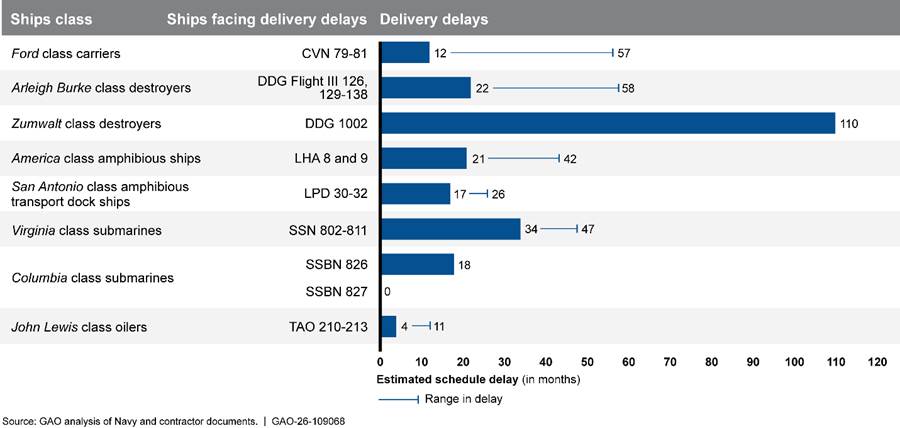
Notes: SSBN 827, the second Columbia class submarine, is 8 percent behind its schedule, as of November 2025. This analysis reflects 35 battle force ships currently under construction. GAO excluded Littoral Combat Ships, DDG-51 Flight IIA ships, Constellation class frigate ships, and Virginia class Block IV submarines because the Navy is not planning to procure additional quantities of those types of ships. GAO also excluded command and support ships from this analysis.
The Navy has also experienced consistent challenges with building both lead and follow-on ships at planned costs. In total, the last 11 of the most recent Navy lead ships have cost at least $8 billion more than planned.
The Constellation class frigate program is the latest example of lead ships overcome with issues. Following several years of slower than expected progress and uncertain costs, the Navy announced the termination of work on four of the six ships that were under contract in November 2025.[9]
As we previously reported, the Navy had exercised contract options valued at over $3.4 billion to construct six ships before completing the frigate’s basic and functional design—an approach counter to shipbuilding leading practices. As of September 2025, more than 3 years since construction began, the program office reported the functional design remained incomplete (87 percent complete). According to senior Navy officials, the other two ships remain under construction but are also under review. These officials told us that, as of April 2026, they are currently assessing what capability, if any, will result from the ships. Also, in February 2018, the Navy reported its decision to curtail the Littoral Combat Ship class early, reducing procurements by more than 20 ships. The Navy later decided to retire seven of the Littoral Combat Ships significantly earlier than planned. As such, the Navy has now spent over $20 billion on small surface combatant programs that have not provided needed capabilities to the fleet.
Despite these long-standing challenges, we previously reported that the Navy’s shipbuilding plans are not based on realistic assumptions about cost and schedule performance.[10] For example, in February 2025, we reported that the Navy’s fiscal year 2025 shipbuilding plan states that the Navy developed the plan based on the assumption that private industry will eliminate excess construction backlog and produce future ships on time and within budget—an assumption not grounded in historical trends.[11] The Navy did not produce a plan to accompany the budget request for fiscal year 2026, so this 2025 plan (released in calendar year 2024) remained the Navy’s most recently issued plan, as of the end of March 2026. This means that decision-makers have been without a long-range shipbuilding forecast for the Navy, based on realistic assumptions about the cost and schedule performance for shipbuilding programs, for a significant amount of time.
Coast Guard Shipbuilding Programs Face Significant Cost and Schedule Challenges, Resulting in Recent Termination
Since 2010, we have repeatedly found that the Coast Guard faces persistent challenges keeping to the planned costs and schedules of its major acquisition programs.[12] This has been due, in part, to the Coast Guard’s reliance on incomplete designs as well as challenges with contractor performance.[13]
Most recently, in November 2025, we found the Coast Guard made limited construction progress on the Offshore Patrol Cutter’s first four ships because of challenges with the inexperienced shipbuilder and an unstable design. These factors contributed to significant rework during construction, a delay of more than 5 years for lead ship delivery, and an increase in costs that the Coast Guard is still determining.[14] The Coast Guard ultimately terminated two of the first four ships for default after the shipbuilder said it could no longer meet its contractual requirements, and the shipbuilder suspended all work on two other ships. The Coast Guard also authorized the second shipbuilder, responsible for ships 5 through 15, to start construction of the fifth ship before completing the ship’s design, contrary to our prior recommendation.[15] In November 2025, we again recommended that the Coast Guard ensure that the Offshore Patrol Cutter’s design is stabilized before authorizing construction on additional ships, as we have done on previous stages of the program.[16]
Unfortunately, these design and shipbuilder challenges are not unique to the Offshore Patrol Cutter program. For example:
· Polar Security Cutter. DHS approved the program to start construction of the lead ship without completing its design, which contributed to a 9-year delay to the delivery of the lead ship.[17] As of April 2026, the second and third ships are also delayed until 2032 and 2034, respectively.
· National Security Cutter. In fiscal year 2021, the shipbuilder began construction of the 11th and final ship. However, in May 2025, the Coast Guard and shipbuilder agreed to stop construction after the Coast Guard discovered pervasive corrosion of steel plates. The program attributed the corrosion to the shipbuilder not properly preserving the steel after buying it and before starting construction. The shipbuilder estimated that, had it continued with the 11th ship, remediation would have cost up to $117 million and delayed ship delivery to February 2029—more than 4 years later than planned.
Figure 2 shows that the Coast Guard’s schedule challenges are persistent across its fleet.
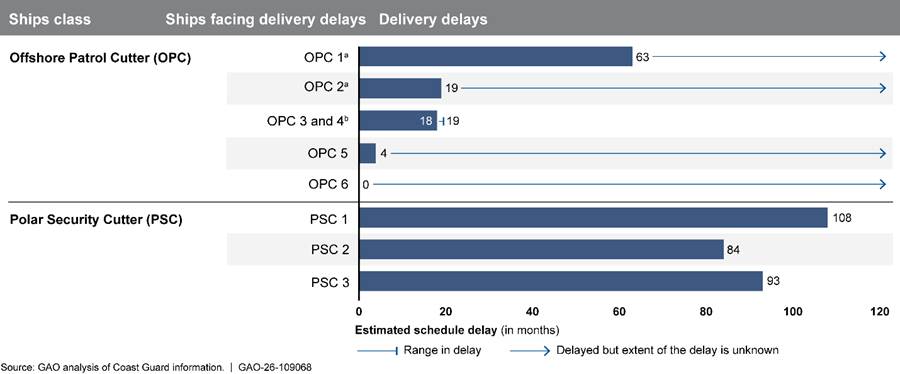
aIn November 2025, the shipbuilder provided
notice that it was suspending all work on OPCs 1 and 2 due to financial and
operational strain.
bIn July 2025, the Coast Guard terminated for default the OPC 3 and
4 portions of the stage 1 design and construction contract.
Additionally, some of the Coast Guard’s key large ship programs are significantly overrunning their initial cost estimates. For example, the Polar Security Cutter program’s revised baseline includes a cost goal of $3.4 billion for the lead ship—nearly the expected cost for the three Polar Security Cutter ships under the initial baseline. The Coast Guard will not know the cost of the two remaining ships until it completes contract negotiations in late 2026, according to officials. However, even without a cost estimate beyond the first ship, Coast Guard officials said the $4.3 billion in appropriations from the One Big Beautiful Bill Act will cover the cost of constructing ship 2 and the purchase of long lead time materials for ship 3. As a result, congressional decision-makers do not know how much more funding beyond this $4.3 billion appropriation the Coast Guard will need to complete the Polar Security Cutter program.
There is also limited insight into how much it will cost the Coast Guard to build the cutter fleet, including costs for the Offshore Patrol Cutter program and two of its newest icebreaker programs. For example:
· Offshore Patrol Cutter. The program’s 2024 cost baseline is based on 2-year-old data and is reported as an aggregated lump sum rather than discrete segments. This limits the ability of decision-makers to track progress or identify potential cost overruns.
· Arctic Security Cutter. In 2025 and 2026, the Coast Guard reported awarding contracts worth up to $6.8 billion to build 11 icebreakers. At the time of award, the contracts were undefinitized. According to officials, the shipyards were authorized to begin limited design work, which means they could incur costs before reaching final agreement on contract terms and conditions or price.[18] As of April 2026, the Coast Guard plans to definitize the contracts in the coming weeks, prior to the start of construction. We previously reported that, while this type of contract action may be necessary under certain circumstances, it is considered risky, in part, because the government may incur unnecessary costs if requirements change before the contract is definitized.[19]
The Coast Guard and congressional decision-makers, therefore, have limited insight into how much it will cost to build the cutter fleet. Specifically, the Coast Guard does not have a long-term capital investment plan that includes its modernization plans for its shipbuilding programs, similar to the Navy’s 30-Year Shipbuilding Plan.[20] The Coast Guard’s January 2026 Capital Investment Plan, which is supposed to represent the Coast Guard’s funded major acquisitions from fiscal years 2026 through 2030, is not a meaningful planning or oversight document. The Coast Guard noted that its plan does not reflect its priorities, its plans for future years, or effects of asset and infrastructure investments it received from the One Big Beautiful Bill Act.
However, not having a meaningful plan is not new. As early as 2014, we found that the Coast Guard’s 5-year Capital Investment Plan did not consistently reflect current cost and schedule estimates, or the effects of the trade-offs that are made as part of the annual budget cycle.[21] We recommended that the Coast Guard develop a 20-year fleet modernization plan that identifies all acquisitions needed to maintain the current level of service and the fiscal resources necessary to build the identified assets. We also recommended that the Coast Guard consider trade-offs if the fiscal resources needed to execute the plan are not consistent with annual budgets. After 7 years of inaction by the Coast Guard, we closed the recommendation as not implemented.
Since 2016, the Coast Guard has been statutorily required to report to Congress a 20-year long-term major acquisitions plan that details the numbers and types of cutters to be decommissioned and acquired.[22] This plan must include the estimated level of funding in each fiscal year needed to acquire, operate, sustain, and otherwise support the cutters.[23] As of April 2026, the Coast Guard has yet to submit a 20-year plan to Congress. If the Coast Guard does not provide Congress with long-term insight into how it plans to acquire its ships and how much funding it needs to do so, then it risks underfunding shipbuilding priorities that need to be balanced with the Navy’s.
Improving Practices in Several Areas Is Critical to Achieving Navy and Coast Guard’s Ambitious Shipbuilding Goals
While there is no singular solution to the Navy and Coast Guard’s ship construction challenges, I would like to highlight three areas that our work has found could significantly improve results: (1) portfolio management practices, (2) design discipline and practices, and (3) strategic management of the industrial base.
Leading Practices for Portfolio Management Could Help Agencies Effectively Implement Recent Reorganizations
In recent months, DOD, the Navy, and the Coast Guard announced reorganizations of key acquisition functions, including shipbuilding programs and portfolios. These reorganizations were intended, in part, to increase the speed of acquisitions. More specifically:
· In August 2025, the Secretary of Defense established a Submarine Direct Reporting Portfolio Manager. In the memorandum establishing this position, the Secretary of Defense described the role as a step to correct the structural, programmatic, and management shortcomings that have resulted in repeated delays in submarine construction and sustainment activities, as well as cost increases. In January 2026, the Senate confirmed the first Submarine Direct Reporting Portfolio Manager.
· In March 2026, the Navy announced it was reorganizing its acquisition leadership by creating portfolio acquisition executives, who would be expected to make disciplined, data-driven trade-off decisions across cost, schedule, and performance; and hold programs accountable for delivering capabilities to the warfighter faster.
· According to the Coast Guard’s Force Design 2028 executive report, the Coast Guard also reorganized and created Program Executive Offices with the intent of fully integrating capabilities, reducing stovepipes across disconnected capability programs, and implementing a life-cycle management approach. For example, as of February 2026, the Coast Guard’s Program Executive Office for Surface is responsible for cutter and boat acquisition and sustainment, including the offices for programs (like the Offshore Patrol Cutter), contracting for ships, naval engineering, and logistics, as well as the Coast Guard Yard.
As the agencies implement these reorganizations, our recent work on how leading companies organize portfolios of products to help facilitate speed to market can provide guidance. Portfolio management is a tool that leading companies have used for decades to provide data visibility across multiple development efforts. The tool also allows leading companies to collectively assess the progress of investments intended to provide a needed capability.
In September 2025, we found that leading companies have departed from following the traditional linear, stepwise process to portfolio management in favor of more agile approaches.[24] The traditional process centered on first defining the specific components of a portfolio and performance metrics and then executing programs to deliver on those metrics. Agile business processes for portfolio management, on the other hand, are fully aligned with and enable the rapid, iterative technical processes that leading companies employ to develop new products.[25] These companies regularly reassess market conditions, user needs, and technology advances and adjust their product portfolios accordingly. Agile portfolio management helps leading companies ensure that they continue to deliver relevant and innovative products to the market.
Our work further found that leading companies use information from business cases for product development efforts to ensure they make informed portfolio-level decisions and maintain responsive product portfolios. Such information includes user feedback on product capabilities, how a development effort is contributing to portfolio and financial goals, and planned delivery dates. These data are critical for portfolio management, as they help leading companies determine whether they are effectively implementing their strategic and portfolio goals.
Importantly, leading companies apply an iterative process to developing their business cases for individual products. This is a departure from the traditional business case process that locks in a new product’s cost, schedule, and performance baseline from the start. As they gain knowledge, leading companies continually improve the business case for a new product and update key elements. This allows them to capture changes in user needs, technology readiness, and markets.
Our ongoing work continues to evaluate the Navy’s progress in implementing policies consistent with Agile portfolio management and the use of iterative business cases. Additionally, we have similar ongoing work related to the other military departments. We also will continue to monitor DOD, Navy, and Coast Guard efforts to implement their reorganization efforts.
Navy and Coast Guard Design Practices Must Evolve to Achieve Timely and Predictable Shipbuilding Outcomes
Navy and Coast Guard design practices must evolve to enable shorter, predictable cycles and timelines for designing and delivering high-quality ships that meet operational needs. In May 2024, we reported that commercial ship buyers and builders achieve timely, predictable outcomes for their shipbuilding programs by using leading ship design practices that had evolved since our initial reporting on such practices in 2009.[26] As part of our more recent reporting, we found that ship buyers and builders typically design and deliver a range of large, complex commercial ships within roughly 4 years of contract award. This contrasts with our findings that Navy shipbuilding programs commonly take more than a decade to deliver a new ship to the fleet. Though the Coast Guard was not part of our May 2024 work, programs like the Offshore Patrol Cutter and Polar Security Cutter demonstrate similar challenges in achieving timely design and delivery of new vessels to fulfill the agency’s critical missions.[27]
Our May 2024 work highlights four leading practices found in commercial ship design, supported by 13 key elements. See figure 3.
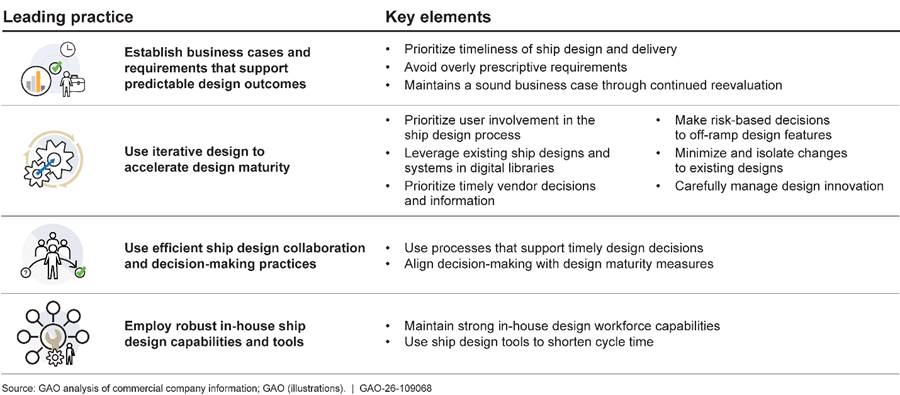
We have demonstrated since 2009 that leading practices from commercial industry can be applied thoughtfully to improve the outcomes for Navy and Coast Guard shipbuilding programs. This is true regardless of potential differences between commercial and government shipbuilding that yield different incentives and priorities. Actions taken by Congress in recent years, including updates to statutory requirements for Navy certification of design maturity before approving the start of lead ship construction, reflect these leading practices.[28]
Federal agencies are also increasingly recognizing the importance of these practices. For example, America’s Maritime Action Plan acknowledges what we have tried to impress upon the Navy and Coast Guard through our reporting for nearly 2 decades: acquisition programs accept significant cost and schedule risk when ship construction begins before designs are sufficiently matured and stable. Further, the action plan urges—consistent with our ship design findings from May 2024—the use of a design-bid-build approach to reduce cost and schedule risks by ensuring ship designs are fully validated before construction awards are made.[29] Service leadership in the Navy has also begun to emphasize these principles. For example, in a December 2025 speech, a senior Navy official emphasized the importance of separating the design from the construction of a lead ship to better ensure that the shipbuilder and the Navy understand what is required.
Some of the tenets of our leading ship design practices are reflected in the Navy’s and Coast Guard’s recent plans for the new FF(X) frigate and Arctic Security Cutter icebreaker programs, respectively. Both programs intend to use existing designs with minimal changes to accelerate the timeline from contract award to lead ship delivery. Such a design approach, used in combination with other leading ship design practices, may enable those programs to realize the benefits of having a stable design supporting contract awards for new ship construction. For example, the Navy and Coast Guard will need to combine plans for use of an existing design with the use of efficient ship design collaboration and decision-making practices to ensure that agency leadership can make timely, well-informed decisions on these programs.
Further, the Navy and Coast Guard need to demonstrate that the approach to these programs is not a short-term deviation followed by returning to the long-standing business as usual approach. This is especially true for shipbuilding programs that require new designs, like the future BBG(X) battleship and SSN(X) next generation attack submarine. For these and other future programs, fully leveraging the range of leading ship design practices—like iterative design based on user feedback and robust, in-house ship design capabilities and digital tools—will be critical to long-term success.[30] And the challenge of breaking away from business as usual is real, as illustrated by the 23 recommendations related to ship design that we made to the Navy or Coast Guard over the last decade that were not or have yet to be implemented. This represents 70 percent of the total design-related recommendations that we collectively made to the Navy and Coast Guard during this period.[31]
Navy and Coast Guard Need a More Strategic Approach to Revitalize the Industrial Base
The Navy and the Coast Guard have yet to take a strategic approach to revitalizing the shipbuilding industrial base. As emphasized in America’s Maritime Action Plan, such revitalization to meet government and commercial shipbuilding needs is a critical national security priority that requires strategic investments on multiple fronts. However, this revitalization will not be an easy feat to accomplish because the Navy and Coast Guard shipbuilding industrial base continues to experience significant infrastructure and workforce challenges that contribute to persistent schedule and cost shortfalls for shipbuilding programs. These challenges are likely to be exacerbated as the Navy and Coast Guard look to ramp up their shipbuilding while other federal agencies simultaneously look to revitalize commercial shipbuilding, as these efforts are likely to rely on overlapping groups of suppliers and potential employees. Additionally, both the Navy and Coast Guard face challenges in their management of the shipbuilding industrial base.
Infrastructure and Workforce Limitations
We reported in February 2025 that due, in part, to infrastructure and workforce limitations, none of the seven shipbuilders that constructed Navy battle force ships at that time were currently positioned to meet the Navy’s ship delivery goals.[32] This was despite the nearly $6 billion that DOD had already invested in the shipbuilding industrial base as of the end of fiscal year 2023. As shown in figure 4, several factors contribute to these limitations at the shipyards that construct Navy ships.
Figure 4: Key Infrastructure and Workforce Challenges GAO Identified in February 2025 as Facing the Navy’s Shipbuilding Industrial Base
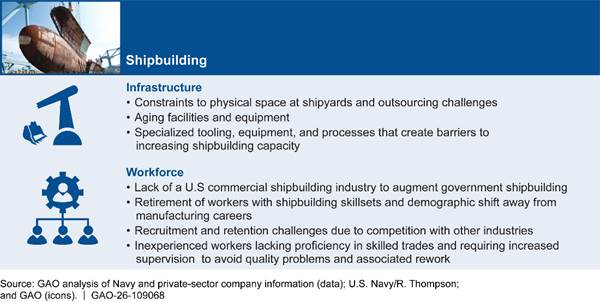
Our ongoing work indicates that workforce challenges at Navy shipbuilders persist, and that Coast Guard shipbuilders face similar challenges as well. Specifically, our ongoing work shows that both Navy and Coast Guard shipbuilders face challenges training, recruiting, and retaining trades workers, such as welders, pipefitters, and machinists. Several shipbuilding programs have cited workforce issues as a cause of delays and significant risk. This includes the Navy’s Virginia class submarine and John Lewis class fleet replenishment oiler, and the Coast Guard’s Offshore Patrol Cutter and Waterways Commerce Cutter.
Several factors cause workforce challenges, and our preliminary observations indicate that these vary by region. Wages are a key factor, and shipyard representatives told us that low wages at shipyards make it difficult to hire and retain skilled workers. Navy officials told us that low wages can cause newer workers to leave shipyards for other jobs with similar wages in a less physically demanding environment. High cost of living where shipyards are located, particularly in San Diego and the Northeast U.S., is also a factor. Other factors include difficult work conditions at the shipyards and demographic shifts in which the skilled workforce in the U.S. is aging and retiring while fewer new workers are being trained in the trades.
Our ongoing work shows that the Navy has made significant investments in addressing workforce challenges, primarily for the submarine industrial base. For example, the Navy reported that an April 2025 modification to the Virginia class submarine Block V contract included funding for wage enhancements for preexisting nuclear shipbuilding contracts to improve worker retention. Representatives from one of the shipbuilders told us they had already seen a positive effect on recruiting and retention as a result of the increases. According to the Navy’s Maritime Industrial Base Program Year in Review Report, other Navy initiatives include training programs, recruiting efforts, and K-12 outreach programs. The Navy has also used contract incentives to encourage shipyards to address workforce challenges, some authorized by statute.[33]
The Coast Guard, on the other hand, is not investing in the shipbuilding trades workforce. The one exception is the inclusion of a workforce-related contract incentive for one program, which shipyard officials told us they have yet to use. Coast Guard acquisition officials told us, in 2025, that the Coast Guard did not have the funding to pursue these types of investments. We are exploring these issues in depth in our current ongoing work on Navy and Coast Guard shipbuilding trades workforce challenges, which we expect to issue later this year.
Management of Industrial Base Challenges
Both the Navy and Coast Guard face challenges in their management of the shipbuilding industrial base. For example, we made recommendations in February 2025 to help the Navy improve its management of the shipbuilding industrial base, but the Navy has made limited progress in implementing them. The Coast Guard also faces unique challenges due to not having funding for the shipbuilding industrial base. Further, questions remain about how efforts to simultaneously build up the Navy, Coast Guard, and commercial shipbuilding industrial bases will affect the ability of each entity to meet its goals.
In February 2025, we made four recommendations to the Navy related to managing the shipbuilding industrial base.[34] These included one we identified as a priority recommendation, to develop a ship industrial base strategy that would enable decision-makers to effectively assess and align their actions to manage the industrial base and adheres to the desirable characteristics of a national strategy. This strategy could also close the gap between the Navy’s shipbuilding goals and shipbuilding performance. In February 2026, Navy officials stated that the Maritime Action Plan serves as the Navy’s management strategy. However, this plan, as currently written, does not address the Navy’s private sector ship industrial base at the level of specificity needed to meet the intent of the recommendation. Further, the plan does not have characteristics important to a national strategy that we recommended the Navy include, such as determining what the strategy will cost and delineating roles and responsibilities for implementing the strategy.
Because the Navy has not addressed this recommendation, it is reorganizing its offices that manage the shipbuilding industrial base without a strategy to guide those efforts. Specifically, in 2024, recognizing the need to have a coordinated approach to managing investments in the submarine and surface ship industrial base, the Navy stood up a new Maritime Industrial Base program office. This office was accountable for managing the maritime industrial base, including the industrial base that supports naval submarine and surface shipbuilding and repair. However, when the Navy created portfolio acquisition executive offices in March 2026, the Navy reorganized the functions of this office. As part of this reorganization, the Navy again split responsibility for the revitalization of the submarine and surface ship industrial base. Questions remain as to how the Navy will manage the concerns that we and it previously raised about the potential for overlap and duplication of efforts as the reorganization is implemented.
The Coast Guard also faces unique industrial base challenges. For example, it competes with the Navy for the same type of shipbuilding expertise, work, and resources. However, while the Navy annually requests and receives significant additional funding to invest in the industrial base, the Coast Guard has not regularly requested or received this type of funding.[35] Furthermore, our current preliminary work indicates that actions taken by the Navy to bolster its shipbuilding capacity with this additional funding may have unintended effects on the Coast Guard’s shipbuilding efforts. For example, shipbuilder representatives for a Coast Guard yard told us that after recent wage increases at one nearby shipyard that Navy officials told us they helped to fund, the shipbuilder faced increased attrition. The shipyard representative stated that, for example, in a 2-week period they lost several workers to the shipyard that increased wages.
These unique challenges raise questions on the extent to which the Coast Guard will be able to secure experienced shipbuilders for their programs moving forward. The Coast Guard’s major shipbuilding programs have encountered challenges due, in part, to the inexperience of its shipbuilders. For example, Eastern Shipbuilding Group—one of two Offshore Patrol Cutter shipbuilders—did not previously have experience working with the federal government. Nor did it have experience building a ship as complex as the Offshore Patrol Cutter.
Lastly, these challenges highlight open questions about how the efforts to build up government and commercial shipbuilding at the same time, as called for in America’s Maritime Action Plan, will affect Navy and Coast Guard shipbuilding. For example:
· Our prior work found barriers to increasing capacity in the national security shipbuilding space, such as specialized production capabilities that constrain the types of ships that existing shipbuilders can build, and an atrophied commercial shipbuilding industry that results in limited additional capacity for building government ships.[36]
· Shipbuilders can alleviate physical constraints at shipyards by outsourcing the building of parts of ships—called modules—to suppliers, but many suppliers also have workforce and infrastructure problems that could result in challenges to their ability to produce quality materials on time.
It remains to be seen whether simultaneous efforts to rebuild the commercial maritime industrial base will help or hinder the Navy and Coast Guard’s efforts to address shipbuilding challenges. We will continue to monitor federal efforts to revitalize the broader maritime industrial base as well at the Navy and Coast Guard’s individual efforts related to their shipbuilding programs.
Shortcomings in DOD’s Initial Efforts to Support the Submarine Industrial Base Highlight Lessons for Effectively Managing Future Investments
Shortcomings in DOD’s initial efforts to strengthen the submarine industrial base can offer key lessons to agencies across the government—such as the Navy, Coast Guard, and Department of Transportation—as they seek to revitalize the broader shipbuilding industrial base to support government shipbuilding goals and make investments to grow the commercial shipbuilding industry. Specifically, our work shows that DOD has not identified the full scope of investments needed to revitalize the submarine industrial base, has not taken key steps to ensure effective oversight of investments, and has not fully aligned disparate efforts to support the submarine industrial base.
DOD Has Yet to Identify the Full Scope of Investments Needed to Revitalize the Submarine Industrial Base
DOD has invested more than $10 billion since fiscal year 2018 to support the submarine industrial base, but its progress toward achieving its submarine construction goals is difficult to measure.[37] Specifically, DOD has yet to identify the full scope of investments, including cost and time frames, that it expects to need to support these goals.
DOD’s approach to managing submarine industrial base funding has evolved over time. Initially, the submarine shipbuilders managed these DOD-funded investments on an ad hoc basis, according to Navy officials. These officials told us that the shipbuilders generally focused on areas of immediate need in identifying priorities. In 2022, DOD officials stated DOD—including multiple offices within the Navy and the Office of the Secretary of Defense (OSD)—took a more active role in identifying investment needs and managing its submarine industrial base investments.[38] At that time, the Navy, with the assistance of OSD’s Cost Assessment and Program Evaluation office, identified five critical submarine industrial base priorities that needed attention to meet the Navy’s strategic goal of delivering one new Columbia and two new Virginia class submarines per year (see fig. 5 for these priorities).[39]
Figure 5: Description of Critical Submarine Industrial Base Priorities Identified by the Department of Defense
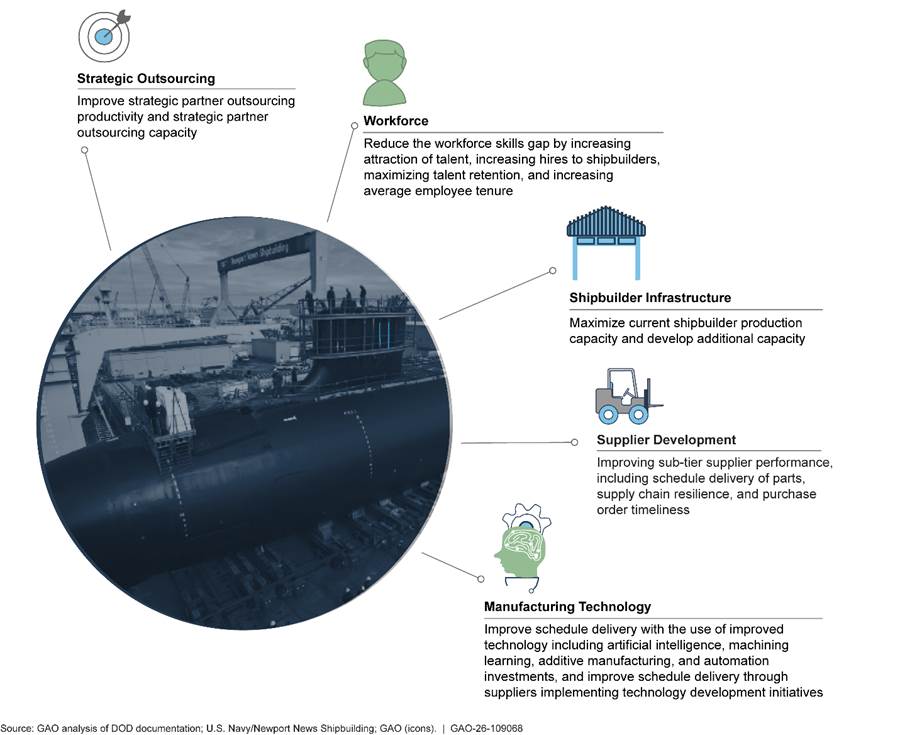
DOD continues to request billions of dollars under these five priorities without a comprehensive understanding of how much money and time it will take to expand the submarine industrial base to a state where it can support the Navy’s submarine construction goals. Specifically, we found that DOD relied on two studies to support recent submarine industrial base funding requests: the Submarine Industrial Base Study for Fiscal Year 2023 and the Submarine Industrial Base Study for Fiscal Year 2025. However, these studies do not contain key information about the total future costs and time frames necessary to improve the submarine industrial base.
Our prior work has shown that agencies should analyze a program’s total costs and risks by using a comprehensive assessment of key elements.[40] This approach enables decision-makers to guide program efforts and later determine if these efforts are achieving desired results. However, DOD’s submarine industrial base studies do not have any of these key elements (see table 1).
Table 1: Extent to Which Two DOD Studies Met Key Elements Identified in GAO’s Assessment Methodology for Economic Analysis
|
Key element of a comprehensive analysis |
Submarine Industrial Base Study for Fiscal Year 2023 |
Submarine Industrial Base Study for Fiscal Year 2025 |
|
Objective and Scope – documentation states why the analysis is justified and why the time horizon is long enough to encompass the important economic effects of the action. |
Not met |
Not met |
|
Methodology – compares alternatives, including that of no action as a baseline, and justifies analysis taken to determine how the best assessment was conducted for each alternative. |
Not met |
Not met |
|
Analysis of Effects – economic considerations of each alternative are separately detailed and quantified where feasible. |
Not met |
Not met |
|
Transparency of sensitivity analysis – describes the use of data and assumptions used, and the plausibility of each alternate result. |
Not met |
Not met |
|
Documentation – results are clearly written with transparent tables that describe the data used, the results, and a conclusion consistent with results. |
Not met |
Not met |
Source: GAO analysis of Department of Defense (DOD) documentation; GAO‑18‑151SP. | GAO‑26‑109068
According to Navy officials, the total funding necessary to expand the submarine industrial base to the point where it can support the Navy’s submarine construction rate goal will be significantly more than the funding requested to date. But they told us they could not quantify this amount. They stated that, to date, they have generally focused their submarine industrial base investment strategy on DOD’s 5-year budget cycles rather than taking a comprehensive long-term approach. Additionally, they stated that they focused on budget cycle needs because they were concerned that the type of analysis necessary for a long-term approach would take time away from current priorities. Navy officials recognized the importance of a comprehensive analysis to model future industrial base funding and schedule needs, and told us they plan to conduct this analysis in the future.
We previously reported that not comprehensively analyzing the costs for submarine industrial base expenses can significantly underestimate the actual costs. For example, in 2018, the Navy issued a rough cost estimate of $4.5 billion for 14 dry dock projects at its submarine repair shipyards, including improvements to the dry docks, facilities, and equipment.[41] By early 2022, the Navy estimated the first two of these projects would cost more than $5 billion—exceeding the original estimate for all 14 dry dock projects. Until the Navy develops a comprehensive estimate for the costs and time frames needed to expand the private sector submarine industrial base, Congress and other decision-makers will not know how long to prioritize submarine industrial base funding at the expense of other competing priorities.
DOD Does Not Consistently Take Key Steps for Effective Oversight of Submarine Industrial Base Investments
We found that DOD has not consistently ensured effective oversight of its submarine industrial base investments. The Navy’s limited progress to date in improving the submarine construction rate increases the importance of oversight to ensure that DOD is getting what it needs from current and future investments. However, we found that DOD has not consistently established performance metrics or monitored investment performance.
Establishing Consistent Performance Metrics
DOD is unable to fully assess how its individual submarine industrial base investments are contributing to submarine construction outcomes because it has yet to consistently establish performance metrics. At the project level, DOD—including the Navy and OSD—has not consistently documented outcome metrics for individual investments made in the submarine industrial base.
DOD officials reported that they established processes to develop and assess outcome metrics for individual submarine industrial base investments at the project level. For example, in April 2025, senior Navy officials testified before a congressional subcommittee that the Navy implements discrete and measurable return on investment outcome metrics for each investment with a process to measure progress.
However, we found that was not the case for most of the project files we reviewed. Specifically, we analyzed DOD’s documentation of three types of metrics related to investment outcomes for 15 individual submarine industrial base investments with the highest dollar value.[42] We asked DOD to provide documentation of these metrics for the 15 individual submarine industrial base investments project files that we reviewed. These metrics included (1) documentation of baseline metrics (i.e., the initial measurement of performance prior to the submarine industrial base investment); (2) documentation of outcome metrics (i.e., the expected result of the submarine industrial base investment); and (3) documentation of tracking the established outcome metric over time. Of these 15 investments, we found that DOD documented all three types of metrics for only a few. Figure 6 shows our analysis of the metrics that DOD documented for the 15 individual submarine industrial base project files that we reviewed.
Figure 6: Extent to Which the Department of Defense Documented Metrics for Selected Submarine Industrial Base Investments
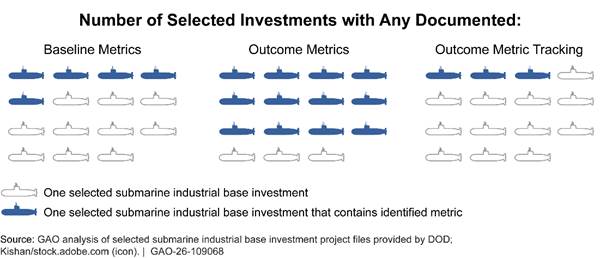
While we focused our review of performance metrics on the 15 high-dollar-value investments we selected, other documentation we received also raised questions about the extent to which the Navy has established metrics for the remainder of its submarine industrial base investments.[43] Specifically, DOD provided us with a list of all submarine industrial base investments made between fiscal years 2018 and 2024, and the majority of fiscal year 2025. In that list, DOD included a column that listed the scope and impact of the investments, which officials stated illustrated that they had developed metrics for these investments. However, the level of detail provided varied widely between investments and a small number of investments did not include any information about scope and impact. For example:
· One fiscal year 2023 investment totaling $3.5 million includes metrics that detail projected increases to capacity, efficiency, and process control because of the investment.
· One fiscal year 2024 investment totaling $1.6 million only states that the investment will support the immediate needs of a critical supplier.
· A different fiscal year 2024 submarine industrial base investment totaling $700,000 states that the scope and impact of the investment is to be determined.
Navy officials told us they have challenges compiling outcome metrics for individual submarine industrial base investments. Previously, this data was compiled manually but never into a single database. The Navy reported in its 2025 Maritime Industrial Base annual report that it is working to define metrics and milestones to show progress for its submarine industrial base investments.
DOD also continues to not have processes to fully assess submarine industrial base investments at the aggregate level to ensure progress toward its submarine construction goals. Specifically, we found deficiencies with how DOD tracks the linkage of individual submarine industrial base investments to its high-level goals. Navy and OSD do not have consistent processes to ensure that individual submarine industrial base investments are reflected in higher level outcome metrics linked to submarine construction goals. For example, the Navy uses a tool to track the effect of groups of projects to its submarine construction goals, such as tracking the number of sequence critical material parts that have been and need to be delivered on time and in full. However, Navy officials told us that the tool is not intended to link individual project-level metrics to these effects. Our prior work found that organizations should assess progress toward goals and understand why progress was achieved or not.[44] For DOD, this would include gaining an understanding of how project-level outcomes contribute toward broader submarine construction goals.
In February 2025, we recommended that the Navy develop performance metrics to assess the programmatic and aggregate effect of the Navy’s ship industrial base investments.[45] While DOD did not provide comments on the report, the Navy noted in draft comments that it generally concurred with the recommendations. As of April 2026, the Navy is continuing to work to address this recommendation. Until DOD consistently documents outcome metrics for individual submarine industrial base investments and determines how to link the outcomes of these individual investments to aggregate level outcome metrics, it will not be well positioned to assess these investments. Furthermore, DOD will not understand the linkage between individual investments and the programmatic and aggregate performance metrics we recommended that it develop. This will inhibit DOD from using the metrics to inform future investment decisions.
Monitoring investment performance
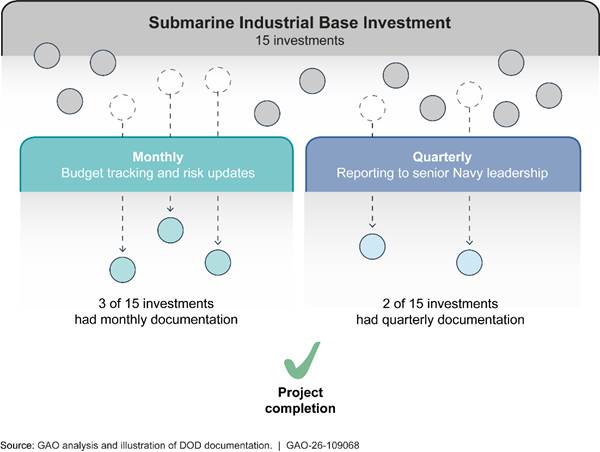
Navy and OSD officials told us that they monitor and oversee submarine industrial base investments through a variety of processes. These include monthly and quarterly updates and reviews for DOD’s submarine industrial base investments.[46] The same officials told us that this monitoring is conducted by DOD employees or by support contractors, and investment status updates developed as part of this monitoring are provided to DOD stakeholders and shipbuilders.
However, our analysis of the project files from the 15 highest dollar value submarine industrial base investments found that DOD could not provide evidence that it consistently followed its stated monitoring processes. Specifically, of the 15 submarine industrial base investments that we reviewed, we found that:
· only three contained any documentation of monthly updates, and
· only two contained any documentation of quarterly reporting.
In one example, the Navy invested $254 million to improve facilities at a submarine shipbuilder, but the files provided by the government for this investment did not include any documentation related to monthly or quarterly updates or monitoring. Figure 7 depicts the investment monitoring process that DOD officials described and compares it to what we found.
Figure 7: Submarine Industrial Base Investment Oversight Process Described by Department of Defense Officials as Compared to Documentation of 15 Selected Investments
Standards for Internal Control in the Federal Government state that an agency should document and implement policies for how it plans to monitor and oversee its activities.[47] OSD and Navy officials told us they had established processes for monitoring submarine industrial base investments. However, when we requested documentation of these processes, officials referred to the program management plan developed by the Navy’s support contractor, which describes how the contractor monitors and reports on submarine supplier development efforts to the Navy. In addition, DOD officials told us they monitor groups of projects at higher levels through regular DOD-organized meetings, and, as such, it may not be possible to locate performance information for individual investments. However, without a consistent process for conducting and documenting the monitoring of individual investments, DOD is not well positioned to ensure that it is overseeing its investments in an effective manner. Without effective oversight, DOD cannot ensure that its investments are helping achieve the strategic goal of delivering one new Columbia and two new Virginia class submarines per year.
DOD Has Not Fully Aligned Disparate Efforts to Support the Submarine Industrial Base
Prior to a recent reorganization of the Navy offices that support submarine industrial base investment efforts, we found that DOD had not fully aligned the roles and responsibilities of the organizations that manage submarine industrial base investments. Specifically, we found that (1) DOD’s documented assignment of roles and responsibilities for revitalizing the submarine industrial base did not align with the actual execution of investments, (2) relevant offices faced challenges sharing investment data, and (3) relevant offices faced challenges coordinating related support contracts.
· Inconsistent roles and responsibilities. The Navy established the Maritime Industrial Base office in 2024 to manage its industrial base priorities, but we found that certain significant industrial base investments and priorities continued to be managed at the program office-level. More specifically, the Navy established the office to centrally manage its shipbuilding industrial base efforts, including the increased funding it received, following DOD’s submarine industrial base studies. However, according to Navy officials, the Navy’s submarine program offices were responsible for the investments associated with some shipyard infrastructure priorities. Program offices were also responsible for investments in other priority areas, such as for wage increases for shipyard workers in support of the workforce priority. In February 2026, before the Direct Reporting Portfolio Manager for Submarines had assumed responsibilities for submarine industrial base investments, Navy officials acknowledged that the roles for and responsibilities of the Maritime Industrial Base office likely needed to be revised to clarify which priorities it was accountable for managing.
Additionally, OSD leads separate submarine industrial base investments that Navy officials were not fully aware of. For example, Navy officials told us that OSD’s submarine industrial base investments between fiscal years 2018 and 2025 were specific to the workforce priority. However, according to OSD officials, OSD invested more than $200 million into submarine industrial base priorities other than workforce in fiscal years 2024 and 2025. For example, OSD officials reported that they invested over $150 million in fiscal year 2025 under the submarine industrial base technology priority.
We previously reported that integrating management of the shipbuilding industrial base is important to ensure that decision-makers have the visibility to identify and prevent potential risks, such as unnecessary duplication and overlap when leading billions-of-dollars of investments.[48]
· Inaccessible data. Within the Navy and OSD, submarine industrial base investments are managed in disparate information systems, which makes it difficult to provide DOD leadership with up-to-date information regarding the status of projects. For example, it took the Navy several months to provide us with a list of all its submarine industrial base investments. According to Navy officials, its use of different systems to track data related to its investments contributed to how long it took to provide that list. Further, the Navy did not have ready access to basic details about at least one of its investments. For one $200 million investment, Navy officials told us they were unable to provide us with documentation of performance metrics or oversight for the project because it was managed by a shipbuilder. Officials from the Navy’s Maritime Industrial Base office told us in February 2026—prior to the office moving under the new Direct Reporting Portfolio Manager for Submarines—that they planned to develop a centralized dashboard with information from over 1,300 submarine industrial base investment projects.
· Insufficient coordination on submarine industrial base contracts. The Navy and OSD used separate contracts valued at a combined $3.5 billion to facilitate and oversee submarine industrial base investments but did not fully coordinate on department-wide requirements or opportunities to share work products between relevant Navy and OSD offices. For example, Navy officials told us that they were unaware that OSD was using its contract to support submarine industrial base priorities other than the workforce priority, such as the manufacturing technology priority. According to OSD and Navy officials, the entities frequently coordinate efforts under the submarine industrial base workforce priority, but, in practice, more coordination is likely needed. This level of coordination across department-wide investment priorities may limit visibility into opportunities to improve broader management of submarine industrial base investments.
In February 2025, we recommended that the Secretary of Defense ensure that the Office of the Under Secretary of Defense for Acquisition and Sustainment and the Secretary of the Navy regularly coordinate industrial base support investments, to include collecting and sharing relevant data.[49] While DOD did not provide comments on the report, the Navy noted in draft comments that it generally concurred with the recommendations. The Navy partially addressed this recommendation by providing lists of its submarine industrial base investments to date across key lines of effort, such as supplier development and workforce. Navy officials told us that this type of information is shared with some stakeholders today and could provide a mechanism in the future for sharing data across a broader range of offices. We continue to believe that fully implementing this recommendation is an important step toward ensuring that DOD can effectively manage its ship industrial base investments. This is particularly relevant as the Navy has returned to having multiple offices responsible for managing these investments, which could lead to duplicative efforts if investments are not coordinated.[50]
Conclusions
Achieving the Navy and Coast Guard’s ambitious shipbuilding goals will require significant changes to the way these agencies have done business to date. Current practices have yet to yield improvements sufficient to meet lesser levels of demand and will not be sufficient to meet the increasing levels of demand driven by current national security priorities. Navy and Coast Guard officials are beginning to acknowledge the deficiencies in past practices, such as the Navy acknowledging the problems inherent in beginning construction without a complete design. But, bold and sustained actions will be required to bring about the type of long-lasting change that will carry through the shipbuilding cycle.
Further, no single solution will be enough to bring about the magnitude of change required for success. Increased attention to portfolio management, improved ship design, and more strategic management of the shipbuilding industrial base are all important to moving the needle on speeding up ship construction. Our past recommendations in these areas provide a guide to the Navy and the Coast Guard for near-term actions. For example, the Navy moving expeditiously to develop the strategy we recommended would help improve its management of its ship industrial base. It would also help the Navy coordinate effectively with the Coast Guard and other federal agencies working to revitalize the maritime industrial base, as called for in America’s Maritime Action Plan.
Additionally, addressing shortcomings in DOD’s efforts to revitalize the submarine industrial base can help DOD avoid future pitfalls as it reorganizes its efforts in this area, and illustrate a path forward for the Coast Guard and other federal agencies in managing industrial base investments. For example, conducting the analysis necessary to understand the total estimated cost and time frames for industrial base investments will help ensure that agency and congressional decision-makers have the information to understand the appropriate amount of investment to meet national security needs. It will also help ensure that they have needed information about the length of time the government needs to invest in private companies outside of acquisition programs. Additionally, developing and consistently implementing an appropriate oversight process will help ensure that taxpayer dollars are being used most efficiently on investments that directly contribute to achieving government shipbuilding goals.
Recommendations for Executive Action
We are making the following two recommendations to DOD:
The Secretary of Defense should ensure that the Submarine Direct Reporting Portfolio Manager assesses the full cost and schedule of investments expected to be needed to expand the submarine industrial base to a state that it can support the Navy’s submarine construction goal of producing one Columbia and two Virginia class submarines annually. (Recommendation 1)
The Secretary of Defense should ensure that the Submarine Direct Reporting Portfolio Manager and the Under Secretary of Defense for Acquisition and Sustainment consistently document and implement oversight processes for all submarine industrial base investments. (Recommendation 2)
Agency Comments
We provided a draft of this statement to DOD and the Coast Guard for review and comment. A senior official responsible for industrial base issues from the office of the Submarine Direct Reporting Portfolio Manager provided oral comments, stating that the office agreed with our recommendations. DOD and Coast Guard also provided technical comments, which we incorporated as appropriate.
Chairmen Kelly and Ezell, Ranking Members Courtney and Carbajal, and Members of the Subcommittees, this concludes my prepared statement. I would be pleased to respond to any questions you may have at this time.
GAO Contact and Staff Acknowledgments
If you or your staff have any questions about this testimony, please contact Shelby S. Oakley, Director, Contracting and National Security Acquisitions at oakleys@gao.gov. Contact points for our Offices of Congressional Relations and Public Affairs may be found on the last page of this statement. GAO staff who made key contributions to this testimony include Laurier Fish, Claire Li, Anne McDonough (Assistant Directors), Jeffrey Carr (Analyst in Charge), Joshua Bolanos-Cruz, Cassidy Cramton, John Crawford, Lindsey Cross, Christopher Durbin, Lori Fields, Stephanie Gustafson, Edward Harmon, Robin Harris, Min-Hei (Michelle) Kim, Sean Merrill, Brendan Orino, Ashley Rawson, Abby Volk, Miranda Wickham, and Jacob Wu.
This is a work of the U.S. government and is not subject to copyright protection in the United States. The published product may be reproduced and distributed in its entirety without further permission from GAO. However, because this work may contain copyrighted images or other material, permission from the copyright holder may be necessary if you wish to reproduce this material separately.
The Government Accountability Office, the audit, evaluation, and investigative arm of Congress, exists to support Congress in meeting its constitutional responsibilities and to help improve the performance and accountability of the federal government for the American people. GAO examines the use of public funds; evaluates federal programs and policies; and provides analyses, recommendations, and other assistance to help Congress make informed oversight, policy, and funding decisions. GAO’s commitment to good government is reflected in its core values of accountability, integrity, and reliability.
Obtaining Copies of GAO Reports and Testimony
The fastest and easiest way to obtain copies of GAO documents at no cost is through our website. Each weekday afternoon, GAO posts on its website newly released reports, testimony, and correspondence. You can also subscribe to GAO’s email updates to receive notification of newly posted products.
Order by Phone
The price of each GAO publication reflects GAO’s actual cost of production and distribution and depends on the number of pages in the publication and whether the publication is printed in color or black and white. Pricing and ordering information is posted on GAO’s website, https://www.gao.gov/ordering.htm.
Place orders by calling (202) 512-6000, toll free (866) 801-7077,
or
TDD (202) 512-2537.
Orders may be paid for using American Express, Discover Card, MasterCard, Visa, check, or money order. Call for additional information.
Connect with GAO
Connect with GAO on X,
LinkedIn, Instagram, and YouTube.
Subscribe to our Email Updates. Listen to our Podcasts.
Visit GAO on the web at https://www.gao.gov.
To Report Fraud, Waste, and Abuse in Federal Programs
Contact FraudNet:
Website: https://www.gao.gov/about/what-gao-does/fraudnet
Automated answering system: (800) 424-5454
Media Relations
Sarah Kaczmarek, Managing Director, Media@gao.gov
Congressional Relations
David A. Powner, Acting Managing Director, CongRel@gao.gov
General Inquiries

[1]White House, America’s Maritime Action Plan (February 2026).
[2]The $40 billion is based on acquisition costs in fiscal year 2024 dollars in acquisition program baselines for the Offshore Patrol Cutter, Polar Security Cutter, National Security Cutter, Fast Response Cutter, and Waterways Commerce Cutter programs. This does not include acquisition costs for the Commercially Available Polar Icebreaker, Homeland Security Cutter, and Arctic Security Cutter programs since these programs do not yet have approved baselines.
[3]Pub. L. No. 119-21, § 20002(16)-(26) and § 40001(a) (codified at 14 U.S.C. § 1181(4)-(9)) (2025).
[4]GAO, Navy Shipbuilding: Increased Use of Leading Design Practices Could Improve Timeliness of Deliveries, GAO-24-105503 (Washington, D.C.: May 2, 2024); Coast Guard Acquisitions: Offshore Patrol Cutter Program Needs to Mature Technology and Design, GAO-23-105805 (Washington, D.C.: June 20, 2023); Coast Guard Acquisitions: Polar Icebreaker Program Needs to Address Risks before Committing Resources, GAO-18-600 (Washington, D.C.: Sept. 4, 2018); Littoral Combat Ship and Frigate: Delaying Planned Frigate Acquisition Would Enable Better-Informed Decisions, GAO-17-323 (Washington, D.C.: Apr. 18, 2017); Defense Acquisitions: Realistic Business Cases Needed to Execute Navy Shipbuilding Programs, GAO-07-943T (Washington, D.C.: July 24, 2007); and Coast Guard: Status of Deepwater Fast Response Cutter Design Efforts, GAO-06-764 (Washington, D.C.: June 23, 2006.
[5]Over the past 10 years, we have made at least 92 recommendations to the Navy and 45 recommendations to the Coast Guard focused on improving the practices and results of shipbuilding programs. The agencies largely agreed with our recommendations. The Navy and Coast Guard have fully addressed 32 and 27 of the recommendations to them, respectively. Further, the Navy has partially addressed seven others and the Coast Guard has partially addressed three. However, we currently have 46 open recommendations that the Navy has yet to address, and eight that the Coast Guard has yet to address. We also closed seven without the Navy taking action and seven without the Coast Guard taking action, for example, because they were overcome by events.
[6]The Coast Guard is a component within DHS.
[7]GAO, Assessment Methodology for Economic Analysis, GAO‑18‑151SP (Washington, D.C.: Apr. 10, 2018).
[8]GAO, Columbia Class Submarine: Immature Technologies Present Risks to Achieving Cost, Schedule, and Performance Goals, GAO‑18‑158 (Washington, D.C.: Dec. 21, 2017).
[9]This work was terminated by the Navy for convenience. When exercised, a termination for convenience clause allows the government to completely or partially terminate the performance of work under a contract when it is in the government’s interest. See Federal Acquisition Regulation (FAR) 2.101. The FAR is currently undergoing a complete overhaul. Executive Order 14275 directs the Office of Federal Procurement Policy to reduce the FAR to what is required by statute and is necessary for streamlined and efficient federal procurement. Exec. Order No. 14275, 90 Fed. Reg. 16,447 (Apr. 15, 2025).
[10]The Navy outlines its shipbuilding plans in an annual long-range shipbuilding plan, which is often referred to as the 30-Year Shipbuilding Plan (hereafter referred to as the shipbuilding plan). Statute requires the Navy to produce the shipbuilding plan, which must include details on the construction of Navy ships over the next 30 fiscal years and information about the force structure needed to align with the most recent national security or defense strategy. Section 231 of title 10 of U.S. Code outlines the elements to be contained in the annual long-range shipbuilding plan.
[11]GAO, Shipbuilding and Repair: Navy Needs a Strategic Approach for Private Sector Industrial Base Investments, GAO‑25‑106286 (Washington, D.C.: Feb. 27, 2025).
[12]GAO, Offshore Patrol Cutter: Coast Guard Should Gain Key Knowledge Before Buying More Ships, GAO-26-107583 (Washington, D.C.: Nov. 25, 2025); Coast Guard Acquisitions: Opportunities Exist to Improve Shipbuilding Outcomes, GAO-24-107488 (Washington, D.C.: May 7, 2024); Coast Guard Acquisitions: Opportunities Exist to Reduce Risk for the Offshore Patrol Cutter Program, GAO-21-9 (Washington, D.C.: Oct. 28, 2020); Coast Guard Acquisitions: Polar Icebreaker Program Needs to Address Risks before Committing Resources, GAO-18-600 (Washington, D.C.: Sep. 04, 2018); Coast Guard: Deepwater Requirements, Quantities, and Cost Require Revalidation to Reflect Knowledge Gained, GAO-10-790 (Washington, D.C.: July 27, 2010); and GAO-23-105805.
[16]GAO‑26‑107583; GAO‑23‑105805; and GAO‑21‑9. The Coast Guard did not agree with recommendations on design stability that we made in our prior work (GAO‑26‑107583, GAO‑23‑105805). However, as we stated in those reports, we stand by those recommendations.
[17]According to program officials, four primary factors contributed to the shipbuilder’s delays in maturing the PSC’s design: (1) shipbuilder inexperience designing and building heavy polar icebreakers, (2) the complexity of PSC’s design, (3) significant changes from the original design, and (4) impacts from the COVID-19 pandemic.
[18]A definitized contract action is one in which all terms and conditions, including price, are agreed to by the parties to the contract at the time of contract award. “Undefinitized contract actions” are permitted by statute, subject to certain limitations. 14 U.S.C. § 1109 . For example, Coast Guard undefinitized contract actions are required to be definitized by 180 days after the contractor submits a qualifying proposal or when the amount of funds obligated is more than 50 percent of the negotiated overall ceiling price for the contract action, whichever is earlier.
[19]GAO, Missile Defense: The Warfighter and Decision Makers Would Benefit from Better Communication about the System’s Capabilities and Limitations, GAO‑18‑324 (Washington, D.C.: May 30, 2018); and, Defense Contracting: Use of Undefinitized Contract Actions Understated and Definitization Time Frames Often Not Met, GAO‑07‑559 (Washington, D.C.: June 19, 2007).
[20]While we have previously noted challenges associated with the Navy’s plan, we also observed that such a plan is beneficial in that it lays out a strategic approach for decision-making. A long-term plan can enable trade-offs to be seen and addressed in advance, leading to better informed choices and making debate possible before irreversible commitments are made to individual programs. Without this type of plan, decision-makers do not have the information they need to better understand the Coast Guard’s long-term outlook. See GAO‑25‑106286.
[21]GAO, Coast Guard Acquisitions: Better Information on Performance and Funding Needed to Address Shortfalls, GAO‑14‑450 (Washington, D.C.: June 5, 2014).
[22]Coast Guard Authorization Act of 2015, Pub. L. No. 114-120, § 204(e) (2016) (codified as amended at 14 U.S.C. § 5103(e).
[23]14 U.S.C. § 5103(e)(3).
[24]GAO, Leading Practices: Agile Portfolio Management and Iterative Business Cases Drive Innovative Product Development, GAO‑25‑107130 (Washington, D.C.: Sept. 17, 2025).
[25]GAO, Leading Practices: Iterative Cycles Enable Rapid Delivery of Complex, Innovative Products, GAO‑23‑106222 (Washington, D.C.: July 27, 2023).
[26]GAO, Best Practices: High Levels of Knowledge at Key Points Differentiate Commercial Shipbuilding from Navy Shipbuilding, GAO‑09‑322 (Washington, D.C.: May 13, 2009); and GAO‑24‑105503.
[27]We intend to discuss these and other issues in greater detail as part of a planned report focused on the Coast Guard’s ship design practices.
[28]Section 8669c(a) of title 10, United States Code, requires the Secretary of the Navy to submit a report to the congressional defense committees on the results of any production readiness review before approving the start of construction for the first ship for any major shipbuilding program. Consistent with elements of leading ship design practices we found in GAO‑24‑105503, Congress amended 10 U.S.C. § 8669c to require that the Navy’s certification of basic and functional design for crewed surface and undersea combatant vessels is based on 3D modeling and the positioning and routing of all major distributive systems. Servicemember Quality of Life Improvement and National Defense Authorization Act for Fiscal Year 2025, Pub. L. No. 118-159, § 1024 (2024).
[29]GAO‑24‑105503. See also White House, America’s Maritime Action Plan, (February 2026).
[30]In our prior work, we outlined ways for the Navy to move ship design and construction away from a traditional, linear development pathway. Specifically, we identified opportunities for the Navy to structure a program’s acquisition strategy around iterative cycles of design, validation, and production to help it deliver ships to the fleet at a faster pace. This strategy would also provide the Navy with increased assurance that a ship’s capabilities are matched to evolving mission needs. Such a schedule-driven structure would include continuous engagement with stakeholders and users to inform the business case for each ship and subsequent design development. It would also use modern tools like digital engineering and digital twins as key enablers to iterative development, and off-ramp capabilities when needed. As we previously reported, these leading practices can help redefine the shipbuilding acquisition process in ways that position the government to rapidly deliver new ships with needed capabilities while supporting the stability of the U.S. shipbuilding industrial base. See GAO, Navy Shipbuilding: Enduring Challenges Call for Systemic Change, GAO‑25‑108225 (Washington, D.C.: Mar. 25, 2025).
[31]In total, we made 33 recommendations related to ship design over the past decade—17 to the Navy and 16 to the Coast Guard. The Navy has not implemented 13 of the 17 recommendations, and the Coast Guard has not implemented 10 of 16 recommendations.
[32]GAO‑25‑106286. While the Coast Guard was not part of our February 2025 work, our recent and ongoing work indicates that similar types of challenges also exist at the shipyards that build Coast Guard’s ships.
[33]See 10 U.S.C. § 8696, which authorizes the use of a special incentive for Navy shipbuilding workforce development, subject to certain conditions.
[35]For over 10 years, we have repeatedly found two main challenges in how decision-makers, including the Office of Management and Budget (OMB), the Department of Homeland Security (DHS), and the Coast Guard, budget for the Coast Guard’s portfolio of acquisitions (1) the expected cost of the Coast Guard’s portfolio does not align with its plans and funding levels; and (2) OMB, DHS, and the Coast Guard have made short-term budget decisions that obscure the trade-offs needed to balance the long-term affordability of the portfolio. The Coast Guard has also noted that they have budget caps imposed by OMB and DHS. See GAO‑24‑107584.
[37]The submarine industrial base includes the two shipbuilders that design and build nuclear submarines and the thousands of suppliers that are integral to the construction of submarines.
[38]Within OSD, the Industrial Base Analysis and Sustainment office primarily manages the organization’s submarine industrial base efforts.
[39]The Navy identified a sixth line of effort, Government Oversight, but it is only used to determine what funds should be applied to the Navy’s Supervisor of Shipbuilding, Conversion and Repair. Because this funding is only used specifically for government and does not support the private sector industrial base, we excluded it from our work.
[41]GAO, Navy Readiness: Actions Needed to Address Cost and Schedule Estimates for Shipyard Improvement, GAO‑23‑106067 (Washington, D.C.: June 28, 2023). The Navy’s industrial base includes four public shipyards that are government owned and operated to repair nuclear submarines and aircraft carriers.
[42]Our methodology to select individual submarine industrial base investments for this analysis included (1) selecting three investments from each of the five critical priorities; (2) within those three investments, selecting one from fiscal year 2023, one from fiscal year 2024, and one from fiscal year 2025; and (3) ensuring that the selected submarine industrial base investments were the highest dollar value investments within each critical priority and fiscal year.
[43]The list of investments that the Navy provided contained over 1,000 submarine industrial base investments. For the purposes of our review, we did not independently validate the number of submarine industrial base investments.
[44]GAO, Evidence-Based Policymaking: Practices to Help Manage and Assess the Results of Federal Efforts, GAO‑23‑105460 (Washington, D.C.: July 12, 2023).
[46]According to Navy officials, the frequency of updates varies based on the type of investment project. For example, supplier development projects are tracked through monthly reporting. However, other types of investments are tracked quarterly, and projects may not require both monthly and quarterly reporting.
[47]GAO, Standards for Internal Control in the Federal Government, GAO‑14‑704G (Washington, D.C.: September 2014). Control activities are the policies, procedures, techniques, and mechanisms that enforce management’s directives to achieve the entity’s objectives and address related risks. As part of the control environment component, management defines responsibilities, assigns them to key roles, and delegates authority to achieve the entity’s objectives.
[48]GAO‑25‑106286. Additionally, GAO reports annually on duplication, overlap, and fragmentation in federal programs. See Duplication & Cost Savings | U.S. GAO.
[50]In January 2026, the Senate confirmed an official to serve as the Submarine Direct Reporting Portfolio Manager. This official is to direct all activities needed to deliver submarines, including associated submarine industrial base activities and investments. We will continue to monitor how this newly formed office will affect DOD’s management of the submarine industrial base. Additionally, GAO reports annually on duplication, overlap, and fragmentation in federal programs. See Duplication & Cost Savings | U.S. GAO.