
Report to the Secretary of the Treasury
United States Government Accountability Office
A report to the Secretary of the Treasury
Contact: Dawn B. Simpson at simpsondb@gao.gov
What GAO Found
GAO’s audit of the fiscal year 2025 consolidated financial statements of the U.S. government (CFS) identified control deficiencies in the processes the Department of the Treasury used to prepare the CFS. These control deficiencies contributed to material weaknesses in internal control that involve the federal government’s inability to
· adequately account for intragovernmental activity and balances between federal entities;
·
reasonably assure that the consolidated financial statements are
(1) consistent with the underlying audited entities’ financial statements,
(2) properly balanced, and (3) in accordance with U.S. generally accepted
accounting principles (U.S. GAAP); and
· reasonably assure that the information in the (1) Reconciliations of Net Operating Cost and Budget Deficit and (2) Statements of Changes in Cash Balance from Budget and Other Activities is complete, properly supported, and consistent with the underlying information in the audited entities’ financial statements and other financial data.
GAO identified three new control deficiencies in the processes Treasury used to prepare the fiscal year 2025 CFS.
1. Treasury did not properly report legal contingencies in the draft CFS note disclosure.
2. Treasury did not consistently prepare accurate and complete note disclosures in the draft CFS.
3. The reports used to annually recertify access to Planning Analytics, a system used to prepare the CFS, were not adequate to determine whether the access granted was appropriate.
As of the completion of GAO’s fiscal year 2024 audit, nine recommendations were open from prior reports related to control deficiencies in the processes used to prepare the CFS. During the fiscal year 2025 CFS audit, GAO found that Treasury implemented corrective actions that resolved three recommendations from prior reports, and GAO closed these recommendations.
These new and continuing deficiencies increase the risk that material amounts and disclosures may not be presented in the CFS in accordance with U.S. GAAP. GAO will continue to monitor the status of Treasury’s corrective actions to address the nine open recommendations—six remaining from prior reports and three new recommendations GAO is making in this report—as part of the fiscal year 2026 CFS audit.
Why GAO Did This Study
The Secretary of the Treasury, in coordination with the Director of the Office of Management and Budget, prepares the Financial Report of the United States Government, which includes the CFS. Since GAO’s first audit of the CFS, for fiscal year 1997, certain material weaknesses in internal control over financial reporting and other limitations on the scope of its work have prevented GAO from expressing an opinion on the federal government’s accrual-based consolidated financial statements. As part of the fiscal year 2025 CFS audit, GAO identified continuing material weaknesses and other control deficiencies in the processes used to prepare the CFS.
The objective of this report is to provide (1) detailed information on new control deficiencies GAO identified related to the processes Treasury used to prepare the CFS, along with related recommendations, and (2) the status of Treasury’s corrective actions to address recommendations from GAO’s prior reports related to the processes used to prepare the CFS that remained open as of the completion of GAO’s audit of the fiscal year 2024 CFS.
What GAO Recommends
GAO is making three new recommendations to Treasury to address the control deficiencies identified during the fiscal year 2025 CFS audit. In commenting on GAO’s draft report, Treasury concurred with the three new recommendations and stated its ongoing commitment to improving federal financial reporting.
|
Abbreviations |
|
|
|
|
|
|
|
BAR |
budget and accrual reconciliation |
|
|
CFS |
consolidated financial statements of the U.S. government |
|
|
General Fund |
General Fund of the U.S. Government |
|
|
GTAS |
Governmentwide Treasury Account Symbol Adjusted Trial Balance System |
|
|
NIST |
National Institute of Standards and Technology |
|
|
OMB |
Office of Management and Budget |
|
|
SFFAS |
Statement of Federal Financial Accounting Standards |
|
|
SOP |
standard operating procedure |
|
|
TIA |
treaties and other international agreements |
|
|
U.S. GAAP |
U.S. generally accepted accounting principles |
|
This is a work of the U.S. government and is not subject to copyright protection in the United States. The published product may be reproduced and distributed in its entirety without further permission from GAO. However, because this work may contain copyrighted images or other material, permission from the copyright holder may be necessary if you wish to reproduce this material separately.
September 15, 2026
The Honorable Scott Bessent
Secretary of the Treasury
Dear Mr. Secretary:
In our March 2026 report on the results of our audits of the fiscal years 2025 and 2024 consolidated financial statements of the U.S. government (CFS), we disclaimed an opinion on the federal government’s accrual-based consolidated financial statements and on its sustainability financial statements.[1] Since our first audit of the CFS, for fiscal year 1997, certain material weaknesses[2] in internal control over financial reporting and other limitations on the scope of our work have resulted in conditions that prevented us from expressing an opinion on the federal government’s accrual-based consolidated financial statements.[3] We described these material weaknesses in our report on the audit of the fiscal year 2025 CFS.[4] Other auditors also reported, in their audit reports on individual federal entities’ financial statements, internal control deficiencies related to several of these material weaknesses, along with related recommendations.
Several of these material weaknesses that we described in our audit report relate to the federal government’s processes used to prepare the CFS.[5] These material weaknesses involve the federal government’s inability to
· adequately account for intragovernmental activity and balances between federal entities;
· reasonably assure that the consolidated financial statements are (1) consistent with the underlying audited entities’ financial statements, (2) properly balanced, and (3) in accordance with U.S. generally accepted accounting principles (U.S. GAAP); and
· reasonably assure that the information in the (1) Reconciliations of Net Operating Cost and Budget Deficit and (2) Statements of Changes in Cash Balance from Budget and Other Activities is complete, properly supported, and consistent with the underlying information in the audited entities’ financial statements and other financial data.
The Secretary of the Treasury, in coordination with the Director of the Office of Management and Budget (OMB), prepares, on behalf of the federal government, the Financial Report of the United States Government, which includes the CFS.[6]
The objective of this report is to provide (1) detailed information on new control deficiencies identified during our fiscal year 2025 audit that relate to the processes used to prepare the CFS, along with related recommendations, and (2) the status of the Department of the Treasury’s corrective actions to address the nine recommendations related to the processes used to prepare the CFS that we detailed in our prior reports and that remained open as of the completion of our audit of the fiscal year 2024 CFS.
Scope and Methodology
As part of our fiscal year 2025 CFS audit, we considered the federal government’s financial reporting procedures and related internal controls over the processes used to prepare the CFS. We determined the status of Treasury’s corrective actions to address recommendations, in our prior reports, that remained open as of the completion of our fiscal year 2024 audit (see app. I). A full discussion of our scope and methodology is included in our March 2026 audit report on the fiscal year 2025 CFS.[7] We have communicated the status of each of the recommendations discussed in this report with your staff. We performed our audit in accordance with U.S. generally accepted government auditing standards. We believe that our audit provides a reasonable basis for our findings and recommendations in this report.
Control Deficiencies Identified During Our Fiscal Year 2025 Audit
During our audit of the fiscal year 2025 CFS, we identified three new control deficiencies in Treasury’s processes used to prepare the CFS:
1. Treasury did not properly report legal contingencies in the draft CFS note disclosure.
2. Treasury did not consistently prepare accurate and complete note disclosures in the draft CFS.
3. The reports used to annually recertify access to Planning Analytics, a system used to prepare the CFS, were not adequate to determine whether the access granted was appropriate.
Inadequate Procedures for Reporting Legal Contingencies
Treasury accountants are responsible for reviewing and analyzing the reporting of litigation, claims, and assessments by federal entities significant to the CFS, to ensure the accuracy and completeness of the CFS. Treasury accountants compare information related to legal cases from multiple sources—significant entities’ financial statements, note disclosures, and inquiries of entity legal counsel and Treasury inquiries of government-wide legal counsel—to identify and resolve any inconsistencies in material contingencies.[8] Treasury uses the analysis to determine the appropriate disclosures in the CFS contingencies note related to litigation, claims, and assessments.
Condition. During our fiscal year 2025 CFS audit, we found that Treasury did not properly report legal contingencies in the draft CFS note disclosure. Specifically, while Treasury disclosed an estimate of the possible loss contingencies, including that the upper end of the reasonably possible estimated range of loss was $1.5 trillion as of September 30, 2025, it did not disclose the nature of the contingencies. Of this amount, $1.4 trillion related to two Environmental Protection Agency legal contingency cases of $700 billion each. Treasury corrected the note disclosure to include the nature of the contingencies in the final fiscal year 2025 CFS.
Cause. Treasury does not have adequate procedures to properly report legal contingencies. Treasury’s Legal Letter Analysis standard operating procedure (SOP) includes detailed procedures for determining the probable and reasonably possible estimated ranges of potential loss, including ensuring the consistency of the information among multiple sources. However, as it relates to the disclosure of the nature of the contingencies, the procedure is for the legal letter accountant to confer with the contingencies note accountant to determine what legal cases should be disclosed. The SOP does not include specific steps for determining the information to disclose regarding the nature of the contingencies in order for the note to be presented in accordance with U.S. GAAP.
Criteria. Federal Accounting Standards Advisory Board’s Statement of Federal Financial Accounting Standards (SFFAS) 5, Accounting for Liabilities of the Federal Government, as amended by SFFAS 12, Recognition of Contingent Liabilities Arising from Litigation, provides guidance on accounting and reporting for loss contingencies, including those arising from litigation, claims, and assessments. SFFAS 5 calls for an entity to disclose a contingency in the notes to the financial statements if any of the conditions for liability recognition are not met and there is at least a reasonable possibility that a loss may be incurred. The disclosure should include the nature of the contingency and an estimate of the possible liability, an estimate of the range of the possible liability, or a statement that such an estimate cannot be made.
Effect. Without adequate procedures to properly report legal contingencies, Treasury cannot reasonably assure that it prepares the CFS in accordance with U.S. GAAP.
Recommendation for Executive Action. The Fiscal Assistant Secretary of the Treasury should improve and implement procedures to properly report legal contingencies in the CFS in accordance with U.S. GAAP. (Recommendation 1)
Inadequate Procedures for Preparing Note Disclosures
Treasury accountants are responsible for reviewing and analyzing the financial statement information that entities significant to the CFS submit for consolidation. Treasury accountants use this information and other sources to prepare note disclosures that provide additional information needed to make the CFS informative and not misleading.
Condition. During our fiscal year 2025 CFS audit, we found that Treasury did not consistently prepare accurate and complete note disclosures in the draft fiscal year 2025 CFS. We identified several errors in the note disclosures, such as incorrect amounts, information incorrectly carried forward from the previous year’s report, and incomplete information. For example, Note 4, Loans Receivable and Loan Guarantees, did not explain the $52.7 billion increase in the loans receivable balance of “all other programs” from fiscal year 2024. In addition, Note 8, Investments, did not disclose that (1) the Department of Commerce received a 5-year warrant to purchase up to 240.5 million shares of Intel common stock exercisable under certain conditions at $20.00 per share and (2) due to the uncertainty of the conditions being met, the warrant was not recorded as of September 30, 2025. Further, Note 20, Commitments, erroneously included $14.9 billion as the increase in obligations. However, according to supporting documentation, the amount was $47.8 billion. In its final fiscal year 2025 CFS, Treasury corrected the errors we identified.
Cause. Treasury has more than 40 SOPs for preparing the CFS, which include steps related to tracing note disclosure narratives to support and guidance for explaining changes in amounts from the prior year. However, these procedures were not adequate to provide the necessary steps for accurately and completely preparing the CFS note disclosures.
Criteria. Standards for Internal Control in the Federal Government provides that management should (1) design control activities to achieve objectives and respond to risks, such as procedures to reasonably assure that financial information in the financial statements and note disclosures is completely and accurately reported, in all material respects, and (2) implement control activities through policies and procedures. In addition, Treasury’s Subject Matter Analysis SOP requires note disclosures to include explanations of changes in amounts from the prior year that are (1) greater than $20 billion and 10 percent or (2) greater than $50 billion. The SOP also requires that amounts in the note disclosures are consistent with applicable source documents.
Effect. Without adequate procedures, Treasury cannot reasonably assure that CFS note disclosures are accurate and complete.
Recommendation for Executive Action. The Fiscal Assistant Secretary of the Treasury should improve and implement procedures to reasonably assure that CFS note disclosures are accurate and complete. (Recommendation 2)
Inadequate Procedures for Recertifying Planning Analytics Users
To prepare the CFS, Treasury uses the Governmentwide Treasury Account Symbol Adjusted Trial Balance System (GTAS) and the Financial Accounting and Reporting System, which is composed of Planning Analytics and Certent Disclosure Manager. Federal entities submit adjusted trial balance data in GTAS, which Treasury then extracts and loads into Planning Analytics for consolidation. In addition, Fiscal Service accountants use Planning Analytics to record journal vouchers and enter data not submitted through GTAS.
Condition. During our fiscal year 2025 CFS audit, we found that the reports that Fiscal Service managers used to annually recertify access to Planning Analytics were not adequate to determine whether the access granted to users was appropriate. Specifically, the reports only identified whether each user had a USER role or an ADMIN role, but they did not include the specific roles granted to each user. Fiscal Service has created 62 specific roles that it can grant to users in Planning Analytics based on job responsibilities.
Cause. Fiscal Service’s procedures for annually recertifying Planning Analytics users did not include steps to provide the manager with the specific roles granted to a user so that the manager could determine the appropriateness of the access granted.
Criteria. The Federal Information Security Modernization Act of 2014 (FISMA) requires federal agencies to maintain security policies and procedures aligned with information security standards developed by the National Institute of Standards and Technology (NIST). NIST Special Publication 800-53 calls for agencies to employ the principle of least privilege, allowing only authorized access for users that are necessary to accomplish assigned tasks. NIST Special Publication 800-53 also states that agencies should enforce access authorizations to support the separation of duties.
Effect. Without adequate procedures to determine whether access to Planning Analytics is appropriate, Treasury increases the risk that material amounts and disclosures may not be presented in the CFS in accordance with U.S. GAAP.
Recommendation for Executive Action. The Fiscal Assistant Secretary of the Treasury should improve and implement procedures to provide managers with the specific roles granted to users for use in annually recertifying access to Planning Analytics. (Recommendation 3)
Status of Recommendations from Prior Reports
As of the completion of our fiscal year 2024 audit, nine recommendations were open from our prior reports related to control deficiencies in the processes used to prepare the CFS. During our fiscal year 2025 CFS audit, we found that Treasury implemented corrective actions that resolved three recommendations from these prior reports, and we closed these recommendations. As described in appendix I of this report, these corrective actions included
· enhancing procedures to identify all known uncorrected misstatements by line item and on all of the affected current year and prior year financial statements;
· enhancing procedures to consider the effect of uncorrected misstatements by line item and on all of the affected current year and prior year financial statements; and
· developing and implementing procedures to annually determine the reliability of information used from sources other than significant component entities’ audited financial statements to prepare the social insurance sections of the CFS.
We also found that Treasury continued to make progress in resolving the remaining control deficiencies and associated recommendations from our prior reports. However, additional work is needed, and six recommendations remained open as of March 11, 2026, the date of our report on the audit of the fiscal year 2025 CFS.
Appendix I summarizes the status of the nine recommendations from our prior reports according to Treasury, as well as our own assessment and additional comments, where appropriate. Treasury has efforts under way to address these recommendations. As part of our fiscal year 2026 CFS audit, we will continue to monitor Treasury’s progress in addressing our open recommendations.
Conclusions
The annual preparation and audit of federal financial statements are critical to ensuring federal entity accountability and facilitating effective financial management. The new and continuing deficiencies increase the risk that material amounts and disclosures may not be presented in the CFS in accordance with U.S. GAAP. Taking actions to address these deficiencies would enhance federal government officials’ and others’ access to accurate and reliable financial data and, in turn, their ability to make more informed financial decisions. As part of our audit of the fiscal year 2026 CFS, we plan to follow up with Treasury on its corrective actions to address our new recommendations and those recommendations from prior reports that remain open (see app. I).
Agency Comments
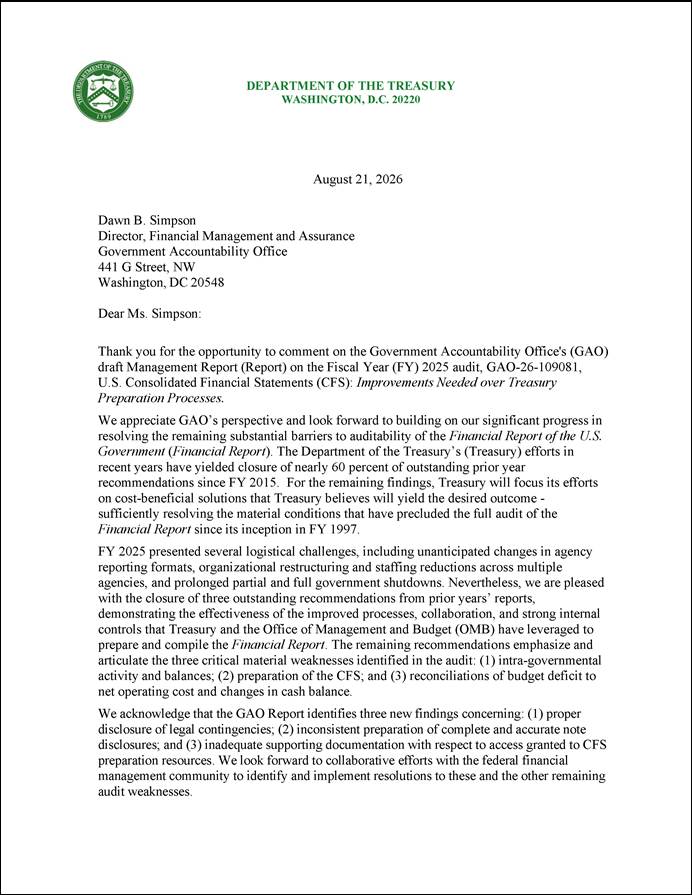
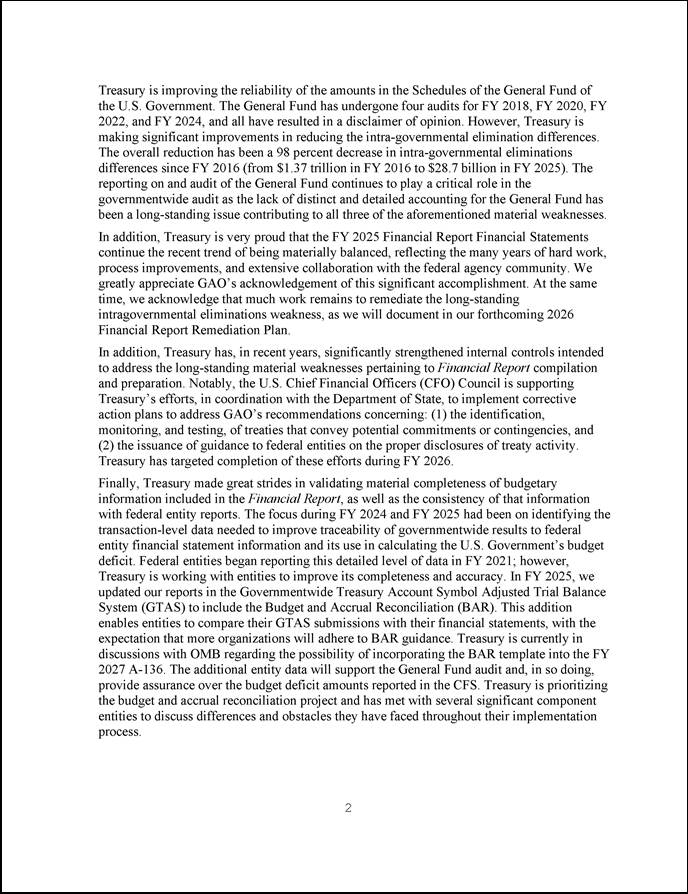
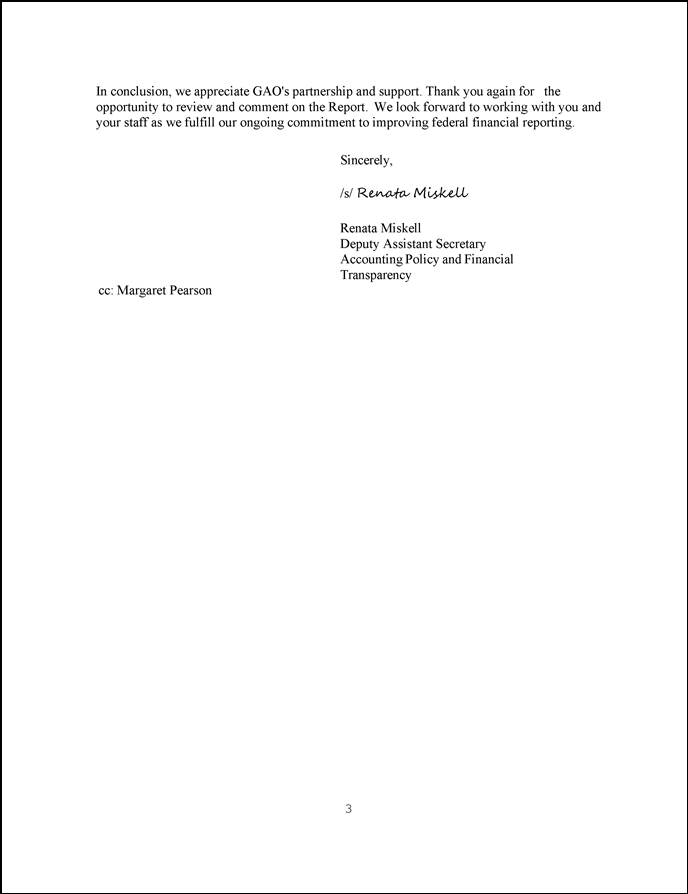
We provided a draft of this report to Treasury for comment. In written comments reproduced in appendix II, Treasury stated that it appreciates our perspective and will focus its efforts on cost-beneficial solutions to resolve the material conditions precluding us from expressing an opinion on the CFS. Treasury concurred with our three new recommendations and looks forward to collaborative efforts with the federal financial management community to resolve these and the other remaining audit weaknesses. In its response, Treasury described actions it has taken and will take to address certain open recommendations from our prior reports that we summarize in appendix I of this report. Treasury stated its ongoing commitment to improving federal financial reporting.
We are sending copies of this report to appropriate congressional committees, the Fiscal Assistant Secretary of the Treasury, and other interested parties. In addition, the report is available at no charge on the GAO website at https://www.gao.gov.
We acknowledge and appreciate the cooperation and assistance that Treasury staff members provided during our audit. If you or your staff have any questions about this report, please contact me at simpsondb@gao.gov. Contact points for our Offices of Congressional Relations and Media Relations may be found on the last page of this report. GAO staff members who made key contributions to this report are listed in appendix III.
Sincerely,
Dawn B. Simpson
Director
Financial Management and Assurance
Appendix I: Status of GAO’s Prior Recommendations Related to the Processes Used to Prepare the Consolidated Financial Statements
_________________________________________________________________________________________________________________________
Table 1 shows the status of recommendations from GAO’s prior reports related to the processes used to prepare the consolidated financial statements of the U.S. government (CFS) that remained open as of the completion of GAO’s audit of the fiscal year 2024 CFS.
Table 1: Status of GAO’s Prior Recommendations Related to the Processes Used to Prepare the Consolidated Financial Statements
|
|
|
Status of recommendationb |
|
|||||||||||||
|
Count |
No. |
Recommendationa |
Per Treasury |
Per GAO |
|
|||||||||||
|
GAO‑13‑540 (results from the fiscal year 2012 audit) |
|
|||||||||||||||
|
1 |
12-04 |
The Secretary of the Treasury should direct the Fiscal Assistant Secretary, working in coordination with the Controller of OMB’s Office of Federal Financial Management, to establish and implement effective procedures for reporting amounts in the CFS budget statements that are fully consistent with the underlying information in significant federal entities’ audited financial statements and other financial data. (Reconciliation Statements material weakness) |
Treasury implemented the BAR crosswalk into GTAS, allowing Treasury and all agencies the ability to produce a BAR statement or note using GTAS data. This report will streamline and standardize how agencies prepare the BAR in their audited financial statements. Treasury plans to use this report to ensure consistency with one of the Reconciliation Statements and the underlying information in federal entities audited financial statements. Treasury continues to meet with the financial reporting community to support inquiries and enhance the BAR in its working group meetings. |
Open. Treasury continued to develop and improve its procedures for preparing the Reconciliation Statements, such as focusing on the BAR. Treasury also continued to improve its process for accounting and reporting of transactions and balances for the General Fund, which provides information supporting one of the Reconciliation Statements. This included Treasury implementing a new reporting process that would provide better traceability for certain types of transactions and automated edit checks to ensure that federal entities report loan activity properly. However, additional work is needed to (1) report amounts in the Reconciliation Statements that are fully consistent with the underlying information in significant entities’ audited financial statements and other financial data and (2) determine the appropriate presentation for the reconciling items, which could affect the line items included on the statements. |
|
|||||||||||
|
2 |
12-05 |
The Secretary of the Treasury should direct the Fiscal Assistant Secretary, working in coordination with the Controller of OMB’s Office of Federal Financial Management, to establish and implement effective procedures for identifying and reporting all items needed to prepare the CFS budget statements. (Reconciliation Statements material weakness) |
See the status of recommendation no. 12-04. |
Open. See the status of recommendation no.12-04. |
|
|||||||||||
|
|
|
|
|
|
|
|||||||||||
|
GAO‑14‑543 (results from the fiscal year 2013 audit) |
|
|||||||||||||||
|
3 |
13-06 |
The Secretary of the Treasury should direct the Fiscal Assistant Secretary, working in coordination with the Controller of OMB, to establish and implement policies and procedures for accounting for and reporting all significant General Fund activity and balances, obtaining assurance on the reliability of the amounts, and reconciling the activity and balances between the General Fund and federal entities. (Intragovernmental material weakness) |
Treasury has worked previously to develop the infrastructure to support the Schedules of the General Fund. In addition, Treasury developed an accounting model as well as a reporting format for the General Fund. Treasury also created a method for federal entities to identify and report their activity with the General Fund that has shown great results in reconciling intragovernmental activity with the General Fund. Treasury continues to work with federal entities to improve the traceability of amounts within the Schedules of the General Fund and obtain audit assurance on the activity and balances. |
Open. Treasury continued to implement corrective actions, including a new reporting process that would provide better traceability for certain types of transactions and automated edit checks that ensure federal entities report loan activity properly. However, intragovernmental differences remain, and further improvements are needed to account for and report all significant General Fund activity and balances, including obtaining audit assurance and reconciling with federal entity trading partners. |
|
|||||||||||
|
4 |
13-07 |
The Secretary of the Treasury should direct the Fiscal Assistant Secretary, working in coordination with the Controller of OMB, to establish a formalized process to require the performance of additional audit procedures specifically focused on intragovernmental activity and balances between federal entities to provide increased audit assurance over the reliability of such information. (Intragovernmental material weakness) |
As a result of multiple ongoing initiatives established over the past few years, Treasury and OMB have seen a significant decrease in intragovernmental elimination differences that federal entities submit. Treasury and OMB will continue to monitor the raw intragovernmental data from the entities. Treasury is drafting position papers for every intragovernmental subcategory that will document the controls and procedures that each transaction goes through in its respective intragovernmental subcategory. These papers will follow process flows from pre-GTAS submission uploads, associated GTAS edits and validations, and post-GTAS analysis. |
Open. While Treasury has made progress, auditors for several significant component entities continued to report that the entities did not have effective processes for reconciling intragovernmental activity and balances with their trading partners. Treasury continues to implement corrective actions to provide increased audit assurance over the reliability of intragovernmental activity and balances between federal entities. |
|
|||||||||||
|
GAO‑22‑105851 (results from the fiscal year 2021 audit) |
|
|||||||||||||||
|
5 |
21-02 |
The Fiscal Assistant Secretary of the Treasury should enhance Treasury’s procedures for analyzing uncorrected misstatements to identify all known uncorrected misstatements, by line item and on all of the affected current year and prior year financial statements, during the CFS preparation process. (Preparation material weakness) |
Treasury improved existing procedures to identify and analyze all prior year and current year uncorrected misstatements. For fiscal year 2025, Treasury made additional updates to improve its analysis of uncorrected misstatements. |
Closed. During our fiscal year 2025 audit, we determined that Treasury enhanced procedures for analyzing uncorrected misstatements and thus sufficiently addressed recommendations 21-02 and 21-03. |
||||||||||||
|
6 |
21-03 |
The Fiscal Assistant Secretary of the Treasury should enhance Treasury’s procedures for analyzing uncorrected misstatements to consider the effect of uncorrected misstatements by line item and on all of the affected current year and prior year financial statements. (Preparation material weakness) |
See the status of recommendation no. 21-02. |
Closed. See the status of recommendation no. 21-02. |
|
|||||||||||
|
GAO‑23‑106707 (results from the fiscal year 2022 audit) |
|
|||||||||||||||
|
7 |
22-01 |
The Fiscal Assistant Secretary of the Treasury, in coordination with the working group, should develop and implement policies and procedures for identifying, at the time of entry into force, the TIAs that have contingencies, and for monitoring the TIAs that have contingencies for events that may give rise to the recognition of a contingent liability or disclosure of a contingency. (Preparation material weakness) |
Treasury worked with the Department of State to update its process to include new elements to identify, monitor, and determine responsible entities for TIAs that may give rise to the recognition of a contingent liability or disclosure of a contingency. State communicated to us that due to a reallocation of funds and budget cuts, it pulled the staff resources that were working on these process improvements through fiscal year 2025. Treasury will reengage with State in fiscal year 2026. |
Open. |
|
|||||||||||
|
8 |
22-02 |
The Fiscal Assistant Secretary of the Treasury, in coordination with the working group, should develop and implement policies and procedures for determining, in coordination with applicable federal entities, in which reporting entity’s financial statements to report any identified contingencies. (Preparation material weakness) |
See the status of recommendation no. 22-01. |
Open. |
|
|||||||||||
|
9 |
22-05 |
The Fiscal Assistant Secretary of the Treasury should develop and implement procedures to annually determine the reliability of information used from sources other than significant component entities’ audited financial statements to prepare the social insurance sections of the CFS. (Preparation material weakness) |
Treasury updated standard operating procedures and strengthened documentation in a position paper that documents the use of sources other than the audited financial statements to prepare the social insurance sections of the CFS. |
Closed. During our fiscal year 2025 audit, we determined that Treasury developed procedures and implemented corrective actions that sufficiently addressed this recommendation. |
|
|||||||||||
Legend:
BAR = budget and accrual reconciliation
CFS = consolidated financial statements of the U.S. government
General Fund = General Fund of the U.S. Government
GTAS = Governmentwide Treasury Account Symbol Adjusted Trial Balance System
OMB = Office of Management and Budget
TIA = treaties and other international agreements
Source: GAO and Treasury. | GAO‑26‑109081
aThe recommendations in our prior reports related to material weaknesses in the following areas:
Intragovernmental: The material weakness relates to the federal government’s inability to adequately account for intragovernmental activity and balances between federal entities.
Preparation: The material weakness relates to the federal government’s inability to reasonably assure that the consolidated financial statements are (1) consistent with the underlying audited entities’ financial statements, (2) properly balanced, and (3) in accordance with U.S. generally accepted accounting principles.
Reconciliation Statements: The material weakness relates to the federal government’s inability to reasonably assure that the information in the (1) Reconciliations of Net Operating Cost and Budget Deficit and (2) Statements of Changes in Cash Balance from Budget and Other Activities is complete, properly supported, and consistent with the underlying information in the audited entities’ financial statements and other financial data.
bThe status of the recommendations listed in the table is as of March 11, 2026, the date of our report on the audit of the fiscal year 2025 CFS.
GAO Contact
Dawn B. Simpson, simpsondb@gao.gov
Staff Acknowledgments
In addition to the contact name above, Carolyn M. Voltz (Assistant Director), Adrienne N. Walker (Auditor in Charge), William E. Brown, and Shaun Williams made key contributions to this report.
The Government Accountability Office, the audit, evaluation, and investigative arm of Congress, exists to support Congress in meeting its constitutional responsibilities and to help improve the performance and accountability of the federal government for the American people. GAO examines the use of public funds; evaluates federal programs and policies; and provides analyses, recommendations, and other assistance to help Congress make informed oversight, policy, and funding decisions. GAO’s commitment to good government is reflected in its core values of accountability, integrity, and reliability.
Obtaining Copies of GAO Reports and Testimony
The fastest and easiest way to obtain copies of GAO documents at no cost is through our website. Each weekday afternoon, GAO posts on its website newly released reports, testimony, and correspondence. You can also subscribe to GAO’s email updates to receive notification of newly posted products.
Order by Phone
The price of each GAO publication reflects GAO’s actual cost of production and distribution and depends on the number of pages in the publication and whether the publication is printed in color or black and white. Pricing and ordering information is posted on GAO’s website, https://www.gao.gov/ordering.htm.
Place orders by calling (202) 512-6000, toll free (866) 801-7077,
or
TDD (202) 512-2537.
Orders may be paid for using American Express, Discover Card, MasterCard, Visa, check, or money order. Call for additional information.
Connect with GAO
Connect with GAO on X,
LinkedIn, Instagram, and YouTube.
Subscribe to our Email Updates. Listen to our Podcasts.
Visit GAO on the web at https://www.gao.gov.
To Report Fraud, Waste, and Abuse in Federal Programs
Contact FraudNet:
Website: https://www.gao.gov/about/what-gao-does/fraudnet
Automated answering system: (800) 424-5454
Media Relations
Sarah Kaczmarek, Managing Director, Media@gao.gov
Congressional Relations
David A. Powner, Acting Managing Director, CongRel@gao.gov
General Inquiries
[1]The CFS as of and for the fiscal years ended September 30, 2025, and 2024, consist of the accrual-based consolidated financial statements (Statements of Net Cost; Statements of Operations and Changes in Net Position; Reconciliations of Net Operating Cost and Budget Deficit; Statements of Changes in Cash Balance from Budget and Other Activities; and Balance Sheets, including the related notes to these financial statements) and the sustainability financial statements (2025 and 2024 Statements of Long-Term Fiscal Projections; 2025, 2024, 2023, 2022, and 2021 Statements of Social Insurance; and 2025 and 2024 Statements of Changes in Social Insurance Amounts, including the related notes to these financial statements). See GAO, Financial Audit: FY 2025 and FY 2024 Consolidated Financial Statements of the U.S. Government, GAO‑26‑108073 (Washington, D.C.: Mar. 19, 2026).
[2]A material weakness is a deficiency, or combination of deficiencies, in internal control over financial reporting, such that there is a reasonable possibility that a material misstatement of the entity’s financial statements will not be prevented, or detected and corrected, on a timely basis. A deficiency in internal control exists when the design or operation of a control does not allow management or employees, in the normal course of performing their assigned functions, to prevent, or detect and correct, misstatements on a timely basis.
[3]We have reported that significant uncertainties prevented us from expressing an opinion on the sustainability financial statements (Statements of Social Insurance for fiscal years 2010 through 2025 and Statements of Long-Term Fiscal Projections for fiscal years 2015 through 2025). The Statements of Social Insurance were first presented for fiscal year 2006, and the Statements of Long-Term Fiscal Projections were first presented for fiscal year 2015.
[4]See GAO‑26‑108073, app. II.
[5]Our March 2026 report also discussed material weaknesses and scope limitations that did not relate to the processes used to prepare the CFS but prevented us from expressing an opinion on the federal government’s accrual-based consolidated financial statements (see GAO‑26‑108073, app. II).
[6]The Government Management Reform Act of 1994 has required the preparation of the government-wide financial statements, covering the executive branch of the government, beginning with financial statements prepared for fiscal year 1997. See 31 U.S.C. § 331(e). The consolidated financial statements also include the legislative and judicial branches.
[8]Paragraph 35 of Statement of Federal Financial Accounting Standards 5, Accounting for Liabilities of the Federal Government, defines a contingency as an existing condition, situation, or set of circumstances involving uncertainty as to possible gain or loss to an entity. The uncertainty will ultimately be resolved when one or more future events occur or fail to occur.