
Report to Congressional Requesters
United States Government Accountability Office
A report to congressional requesters
Contact: Anne Sit-Williams at sitwilliamsa@gao.gov
What GAO Found
The Infrastructure Investment and Jobs Act (IIJA) and Inflation Reduction Act (IRA) provided federal funding to agencies, including the Department of Agriculture (USDA) and Department of Energy (DOE), for a wide range of efforts. These efforts included projects to reduce wildfire risk, improve rural power production, and develop clean energy technologies. Of the $37 billion provided to USDA that was not later rescinded by Public Law 119-21, commonly known as the One Big Beautiful Bill Act, USDA obligated $32.2 billion for fiscal years 2022 through 2025. Of the $78 billion provided to DOE that was not later rescinded, DOE obligated $51 billion for fiscal years 2022 through 2025 (see figure).
Infrastructure Investment and Jobs Act (IIJA) and Inflation Reduction Act (IRA) Funding for USDA and DOE as of September 30, 2025
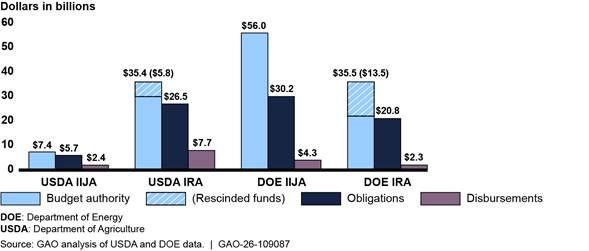
Note: This figure does not include budget authority for which the entire period of availability occurs after September 30, 2025, or obligations, disbursements, or rescissions of that budget authority.
USDA. In response to the President’s directive in 2025 to review IIJA and IRA funding for alignment with executive orders, USDA reported that it reviewed awards for the use of racial, ethnic, and gender preferences and for promoting climate change or environmental justice initiatives. Senior leadership ultimately made final decisions on whether to approve to continue, modify, or cancel awards, according to USDA officials and documentation. According to agency officials, USDA completed its review of IIJA- and IRA-funded awards by June 30, 2025. The agency terminated 34 contracts, totaling $67 million, according to its data. However, GAO concluded that USDA data were not sufficiently reliable to determine the status of all awards reviewed. Specifically, USDA officials could not specify which awards the agency approved to continue or modified as a result of its review or if the agency canceled additional awards.
DOE. In May 2025, DOE created the advisory portfolio review process (PRP) committee to evaluate awards for consistency with executive orders. According to DOE officials, the relevant program office head made the final decision for each award under review, with the PRP committee serving in an advisory role. According to agency officials, DOE completed its review of IIJA and IRA awards in April 2026. According to agency data, DOE reported approving to continue 381 awards ($19.6 billion) and canceling 155 awards ($9.1 billion).
Why GAO Did This Study
The IIJA and IRA provided billions in federal funding to agencies to distribute through mechanisms like grants and loans. Beginning in January 2025, executive orders directed agencies to pause this funding to review it for consistency with administration priorities. Grant recipients have raised concerns that delays in distributing these funds affect their ability to implement their projects.
GAO was asked to review the status of IIJA and IRA funding. This report describes USDA’s and DOE’s (1) IIJA and IRA budget authority, rescissions, obligations, and disbursements for fiscal years 2022 to 2025; (2) processes for reviewing IIJA and IRA funding in response to executive orders; and (3) IIJA and IRA funding review status.
GAO analyzed the IIJA and IRA and financial data from USDA’s and DOE’s accounting systems and the agencies’ policies and guidance for reviewing IIJA and IRA funding. GAO also analyzed and summarized agency review data. GAO also interviewed selected agency officials. GAO found USDA’s and DOE’s data to be sufficiently reliable for reporting aspects of the agencies’ funding review status, with some limitations, as discussed in the report.
|
Abbreviations |
|
|
|
|
|
DOE |
Department of Energy |
|
FAR |
Federal Acquisition Regulation |
|
IIJA |
Infrastructure Investment and Jobs Act |
|
IRA |
Inflation Reduction Act |
|
OMB |
Office of Management and Budget |
|
PRP |
portfolio review process |
|
USDA |
Department of Agriculture |
This is a work of the U.S. government and is not subject to copyright protection in the United States. The published product may be reproduced and distributed in its entirety without further permission from GAO. However, because this work may contain copyrighted images or other material, permission from the copyright holder may be necessary if you wish to reproduce this material separately.
September 17, 2026
Congressional Requesters
The Infrastructure Investment and Jobs Act (IIJA) and Inflation Reduction Act (IRA) provided billions in federal funding to agencies to support a wide range of efforts. These efforts included projects to reduce wildfire risk, improve rural power production, and develop clean energy technologies.[1] Starting on January 20, 2025, the President issued executive orders that directed federal agencies to review, revise, or cancel some or all of their IIJA or IRA funding.[2]
In response to these executive orders, federal agencies took varying approaches to review their IIJA and IRA funding for consistency with the priorities identified in the executive orders. Some agencies paused disbursement of IIJA or IRA funds during the reviews. States, nonprofits, and other award recipients have publicly reported concerns that delays in the distribution of these funds affected their ability to implement projects and risked agencies’ ability to achieve objectives identified in the IIJA and IRA.
You asked us to review the status of IIJA and IRA funding. This report describes
1. the Department of Agriculture’s (USDA) IIJA and IRA budget authority and related rescissions, obligations, and disbursements as of September 30, 2025; its processes for reviewing IIJA and IRA funding in response to executive orders and administration priorities; and the status of its funding review and
2. the Department of Energy’s (DOE) IIJA and IRA budget authority and related rescissions, obligations, and disbursements as of September 30, 2025; its processes for reviewing IIJA and IRA funding in response to executive orders and administration priorities; and the status of its funding review.
To review the status of IIJA and IRA funding, we initially selected six agencies with the highest amount of combined funding. In July 2026, we reported on the status of IIJA and IRA funding for four of these agencies—the Department of Commerce’s National Telecommunications and Information Administration, the Department of the Interior, the Department of Transportation, and the Environmental Protection Agency.[3] In this report, we focus on the remaining two of the six agencies—USDA and DOE. USDA and DOE received $134.3 billion in combined IIJA and IRA budget authority available for all or part of the fiscal year 2022 through fiscal year 2025 period.[4]
To describe USDA and DOE’s IIJA and IRA budget authority, rescissions, obligations, and disbursements as of September 30, 2025, we analyzed agency-provided financial data from their accounting systems. To assess the reliability of these data, we interviewed agency officials, reviewed financial audit reports, and tested the data to verify that budget authority, obligations, and outlays were all reasonable in relation to each other. We also compared the financial information to other available sources, including the Department of the Treasury’s Centralized Accounting Reporting System and applicable statutes, such as the IIJA, IRA, and Public Law 119-21, commonly known as the One Big Beautiful Bill Act. Based on our analysis, we found the data USDA and DOE reported to us to be sufficiently reliable for the purposes of describing reported IIJA and IRA budget authority, rescissions, obligations, and disbursements as of September 30, 2025.
To describe USDA’s and DOE’s processes for reviewing IIJA and IRA funding in response to executive orders and administration priorities, we obtained and analyzed their policies and guidance for reviewing IIJA and IRA funds, and we reviewed publicly available legal affidavits provided in response to relevant litigation. We also conducted interviews or obtained written responses from agency officials responsible for overseeing or implementing the reviews. We asked USDA and DOE officials to describe their agencies’ funding review processes, including roles and responsibilities, documentation from reviews, guidance, and timelines. The information we obtained from these interviews is not generalizable to any reviews that other federal agencies may have conducted.
To describe the status of USDA’s funding reviews, we requested data from USDA on IIJA and IRA-funded awards, noting which were (1) subject to review, (2) approved to continue, (3) modified, and (4) terminated or canceled as a result of the review.[5] USDA provided data on awards approved to continue from USAspending.gov and on terminated contracts from its systems.[6] We assessed the reliability of these data by manually reviewing them for anomalies and interviewing USDA officials. We noted the following limitations and conclusions.
· Subject to review. USDA did not provide complete data on awards subject to USDA’s funding reviews. We reviewed publicly available declarations that a USDA official gave in response to legal claims in a civil case and compared them to the number of USDA awards in USAspending.gov as of June 30, 2025.[7] We determined that information in the civil case declarations was sufficiently reliable to describe the number of awards subject to USDA’s funding reviews.
· Approved to continue. USDA provided data on awards approved to continue. However, our review showed that certain terminated contracts were included in these data.[8] We also noted, because USDA did not provide data to allow us to isolate only IRA obligations, that the dollar amount of approved IRA awards included obligations that may have been funded by other appropriations in addition to the IRA.
Further, USDA officials did not confirm the completeness and accuracy of the data on awards approved to continue. They specifically noted that the data may include canceled financial assistance, such as grants or loans. Therefore, we determined that the data USDA provided on awards approved to continue were not sufficiently reliable for the purposes of this report, and we could not describe the dollar value or number of awards that were approved to continue, as of September 30, 2025.
· Modified. Because USDA did not provide awards it modified as a result of its review, we could not describe the number and dollar value of modified awards, as of September 30, 2025.
· Terminated or canceled. USDA provided data on terminated contracts from its systems. We compared the data from USDA’s systems to contracts reported in USASpending.gov. We determined the data on terminated contracts were sufficiently reliable regarding the number and dollar value of terminated contracts USDA reported, with some limitations. Specifically, while we were able to corroborate that the contracts were terminated, we could not determine whether the data included all contracts terminated as a result of the review. Also, USDA did not provide data on canceled financial assistance, such as grants or loans. As a result, the information USDA reported to us may not reflect all awards canceled as a result of USDA’s review.
To describe the status of DOE’s funding reviews, we reviewed agency-provided documentation on the status of its reviews of IIJA- and IRA-funded awards. DOE provided data on approved-to-continue awards and canceled awards and documents confirming its reviews. We assessed the reliability of these data by manually reviewing the data for anomalies (such as duplicate entries), interviewing agency officials, and reviewing publicly available information, among other steps. We determined DOE’s data to be sufficiently reliable for describing the reported status of the agency’s IIJA and IRA funding review and noted the following limitations and conclusions.
DOE documentation showed that two program offices—the Nuclear Energy and State and Community Energy Programs—did not cancel awards. However, DOE officials were unable to provide review documentation to corroborate the results.
DOE officials stated that the data on awards approved to continue also included awards modified as a result of its review. However, DOE officials did not specify which awards were modified. As a result, we could not describe the number and dollar value of modified awards as of September 30, 2025.
We could not corroborate the dollar value of awards included in DOE’s data on approved-to-continue and canceled awards with data in USASpending.gov. Specifically, USASpending.gov does not identify the amount of IRA funding that an award used. Further, while USASpending.gov identifies the amount of IIJA funding an award used, we found differences between some dollar values of awards reported in DOE’s data on approved-to-continue and canceled awards with amounts reported in USASpending.gov. As a result of these limitations, our report reflects the dollar amounts of awards that DOE reported to us.
We conducted this performance audit from April 2025 to September 2026 in accordance with generally accepted government auditing standards. Those standards require that we plan and perform the audit to obtain sufficient, appropriate evidence to provide a reasonable basis for our findings and conclusions based on our audit objectives. We believe that the evidence obtained provides a reasonable basis for our findings and conclusions based on our audit objectives.
Background
Federal Funding Process Overview
Federal law provides funds to agencies through appropriations, among other ways. Agencies either spend funds directly, such as on employee salaries, or award these funds to other entities through a variety of different mechanisms. For IIJA and IRA funding that agencies reviewed in response to executive orders and administration priorities, these mechanisms include the following:
· Formula grants. Agencies distribute grant funds to eligible recipients in accordance with a distribution formula prescribed by law or administrative regulation.[9]
· Discretionary grants. Under a discretionary grant program, agencies generally award funds to eligible recipients through a process in which agency officials review and select applications for alignment with criteria, in keeping with specific statutory authority.[10]
· Cooperative agreements. Using cooperative agreements, federal agencies award funds similarly to grants. The key difference is that under a cooperative agreement, the federal agency providing the assistance is expected to have substantial involvement with the recipient in carrying out the funded activity, whereas substantial involvement is not expected under a grant agreement.[11]
· Direct loans. A direct loan is a disbursement of funds by the government to a nonfederal borrower under an agreement that requires the repayment of such funds either with or without interest.[12]
· Contracts. In the context of federal acquisition, contracts are mutually binding legal relationships obligating a seller to furnish supplies or services and the buyer, a federal agency, to pay for them. In this context, contracts do not include grants and cooperative agreements.[13]
Award funding follows a life cycle from statutory authorization or appropriation through award closeout. Two key agency actions in this life cycle are obligation and disbursement.
· Obligation. An obligation is a definite commitment that creates a legal liability on the part of the government for the payment of goods and services ordered or received.[14] An obligation may also be a legal duty on the part of the United States that could mature into a legal liability by virtue of actions on the part of the other party beyond the control of the United States.[15] Creating an obligation does not necessarily lead immediately to expending obligated funds.
· Disbursement. A disbursement is a payment a federal agency makes, by cash or cash equivalent, to liquidate a federal obligation.[16] For example, a disbursement can occur when an agency reimburses a grant recipient for the federal share of the costs of the project for which the agency obligated funds.
An agency may only obligate funds during the period in which they are available. Specifically, statutes may provide funds with a fixed period of availability, which is a definite amount of time that funds are available to agencies for obligation.[17] Statutes may also provide “no-year” funds, which are funds that remain available for agency obligation for an indefinite period of time or until expended or rescinded.
After an agency obligates its funding, the time it takes to disburse such funding to a recipient varies by agency and award and is often based on actions the recipient takes. For example, agencies may reimburse recipients for expenses in increments driven by the progress of a recipient’s project. Disbursements may be for payment of obligations made in prior years.
Agencies may also cancel or modify awards at different points in their life cycle, which may be subject to certain requirements, depending on the type of award and reason for cancellation.[18]
· Cancellation. For this report, “cancellation” refers to an award discontinued for a variety of reasons. For example, this may include termination of an obligated award, awards for which funding was rescinded by law, retraction of an unobligated award previously announced, and discontinuation initiated by a recipient.
· Modification. For this report, “modification” refers to when an agency or recipient changes the terms or amount of the award, but the project continues with federal support. Modification may affect both unobligated and obligated awards.
Infrastructure Investment and Jobs Act and Inflation Reduction Act
The IIJA and IRA provided funding to federal agencies for a range of projects and programs.
· IIJA. In November 2021, Congress passed the IIJA, which provided funding to federal agencies to support transportation; clean energy; broadband; and other infrastructure projects, such as roads and bridges. The IIJA provided agencies with funding to award through a variety of mechanisms, including formula grants, discretionary grants, loans, and other types of funding.
The period in which the IIJA required agencies to obligate funding varied. For USDA and DOE, some funds are available to obligate for an indefinite period of time and some funds’ periods of availability ended as early as fiscal year 2025.
· IRA. In August 2022, Congress passed the IRA, which provided funding for new and existing federal financial assistance programs that support emissions reductions, renewable energy, climate resilience, and energy-efficient infrastructure, among other purposes.[19] The IRA provided funding to agencies, in some cases specifying that agencies could award funds through grants, contracts, and other mechanisms.
As under the IIJA, the time period in which the IRA required agencies to obligate their IRA funding varied. For USDA and DOE, some funds’ periods of availability to obligate end as late as 2031; other funds are available for an indefinite period of time.
Subsequent statutes rescinded or transferred some budget authority provided in the IIJA and IRA. In July 2025, Public Law 119-21, commonly known as the One Big Beautiful Bill Act, rescinded the unobligated balances for many IRA-funded programs.[20]
Executive Orders
Beginning on January 20, 2025, the President issued multiple executive orders that identified administration priorities and directed federal agencies to review, revise, or cancel some or all of their IIJA and IRA funding for consistency with these priorities. For example, Executive Order 14154, Unleashing American Energy, directed agencies to, among other things, (1) immediately pause the disbursement of IIJA and IRA funds and (2) review their processes, policies, and programs for issuing grants, loans, contracts or any other financial disbursements of such funds for consistency with the law and administration energy-related policies, as described in the executive order.[21] According to that executive order, agencies were to submit the results of their review to the Director of Office of Management and Budget (OMB) and Assistant to the President for Economic Policy and were not to disburse these funds until the Director of OMB and Assistant to the President for Economic Policy determined that such disbursements were consistent with review recommendations.
USDA IIJA and IRA Funding Status
IIJA and IRA provided a combined $42.8 billion for fiscal years 2022 through 2025 to USDA to support various programs, including rural energy, conservation, and wildfire management. As of September 30, 2025, USDA obligated $32.2 billion and disbursed $10 billion of the IIJA and IRA funds.
In response to the President’s executive orders directing agencies to review, revise, or cancel some or all IIJA or IRA funding, issued beginning on January 20, 2025, USDA paused obligations and disbursements of IIJA and IRA funds to conduct this review. USDA completed its review in June 2025, according to USDA officials. USDA reviewed more than 42,000 awards, according to a civil case declaration.[22] According to data USDA provided to us, the agency terminated about $67 million in contracts as a result of its review. However, USDA did not confirm that the data included all awards reviewed and the review outcomes.
USDA Obligated About Three-Quarters of Its IIJA Funds and Disbursed Just Under Half of the Obligated Amount
The IIJA provided about $7.4 billion to USDA for fiscal years 2022 through 2025. As of September 30, 2025, USDA obligated about 77 percent ($5.7 billion) of its available budget authority and disbursed about 42 percent ($2.4 billion) of the obligated funding. As of September 30, 2025, USDA disbursed about 32 percent of its IIJA budget authority for fiscal years 2022 through 2025.
The extent to which USDA obligated its IIJA funding varied across its agencies. The Forest Service and the Rural Utilities Service received the largest amounts of IIJA funds at USDA. The Forest Service accounted for about 60 percent ($4.5 billion) of USDA’s IIJA budget authority—with about 68 percent ($3.1 billion) of that funding obligated and 66 percent ($2.0 billion) of the obligated funding disbursed. The Rural Utilities Service accounted for about 27 percent ($2.0 billion) of USDA’s IIJA budget authority—with about 92 percent ($1.9 billion) of that funding obligated and 5 percent (less than $0.1 billion) of the obligated funding disbursed. Figure 1 presents the status of IIJA budget authority, obligations, and disbursements among USDA’s various agencies and offices.
Figure 1: Department of Agriculture (USDA) Infrastructure Investment and Jobs Act (IIJA) Budget Authority, Obligations, and Disbursements as of September 30, 2025
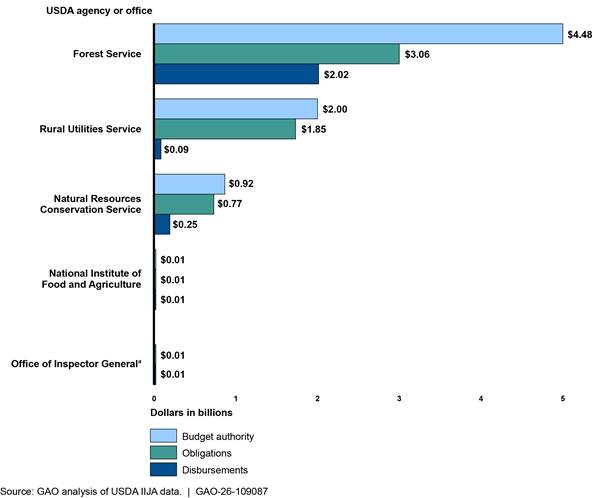
Note: Our analysis does not include budget authority for which the entire period of availability occurs after September 30, 2025, as these funds were not available for obligation during the time frame of our review.
aThe IIJA requires the Forest Service to transfer 0.5 percent of the available funds for each year from fiscal year 2022 through 2026 to the USDA Office of Inspector General to provide oversight for the Forest Service’s IIJA funding. Infrastructure Investment and Jobs Act, Pub. L. No. 117-58, 135 Stat. 429, 1407 (2021). According to USDA data, as of September 30, 2025, the Forest Service transferred $22.5 million.
USDA Obligated About Three-Quarters of Its IRA Funds and Disbursed Just Under One-Third of the Obligated Amount
The IRA provided about $35.4 billion to USDA for fiscal years 2022 through 2025. As of September 30, 2025, according to agency data, USDA obligated about 75 percent ($26.5 billion) of its IRA budget authority and disbursed about 29 percent ($7.7 billion) of the obligated funding. As of September 30, 2025, USDA disbursed 22 percent of its IRA budget authority for fiscal years 2022 through 2025.[23]
As with its IIJA funding, the extent to which USDA obligated its IRA funding varied across its agencies. The Natural Resources Conservation Service and the Rural Utilities Service received the largest amount of IRA funds. The Natural Resources Conservation Service accounted for about 32 percent ($11.4 billion) of USDA’s IRA budget authority—with about 36 percent ($4.1 billion) of that funding obligated and 18 percent ($0.8 billion) of the obligated funding disbursed. The Rural Utilities Service accounted for about 30 percent ($10.7 billion) of USDA’s IRA budget authority—with about 94 percent ($10.1 billion) of that funding obligated and less than 1 percent (less than $0.1 billion) of the obligated funding disbursed.
In July 2025, Public Law 119-21, commonly known as the One Big Beautiful Bill Act, rescinded about $5.8 billion in unobligated balances of IRA-provided budget authority available as of September 30, 2025.[24] Table 1 presents the status of IRA budget authority, rescissions, obligations, and disbursements among USDA’s various agencies and offices.
Table 1: Department of Agriculture (USDA) Inflation Reduction Act (IRA) Budget Authority, Rescissions, Obligations, and Disbursements as of September 30, 2025
Dollars in billions
|
USDA agency or office |
Budget authority |
Rescissions |
Obligations |
Disbursements |
|
Natural Resources Conservation Service |
$11.40 |
$5.58 |
$4.13 |
$0.76 |
|
Rural Utilities Service |
10.70 |
— |
10.06 |
0.01 |
|
Forest Service |
4.90 |
0.18 |
4.24 |
0.91 |
|
Farm Service Agency |
3.35 |
— |
3.22 |
2.95 |
|
Office of the Secretary |
2.66 |
0.01 |
2.62 |
2.42 |
|
Rural Business Cooperative Service |
2.10 |
— |
1.94 |
0.56 |
|
National Institute of Food and Agriculture |
0.25 |
— |
0.25 |
0.05 |
|
Total |
$35.36 |
$5.77 |
$26.46 |
$7.65 |
Legend: — = no amounts associated with the indicated program office.
Source: GAO analysis of USDA IRA data. | GAO‑26‑109087
Note: Amounts may not sum to totals due to rounding. Our analysis does not include budget authority for which the entire period of availability occurs after September 30, 2025, as these funds were not available for obligation during the time frame of our review.
USDA Senior Leaders Made Decisions on Awards in Consultation with OMB
USDA paused obligations and disbursements of IIJA and IRA funds during its review in response to several executive orders.[25] According to USDA documentation, on January 21, 2025, USDA’s Acting Secretary directed all USDA agency and office heads to temporarily pause all new requests for proposals; notices of funding availability; and grant, cooperative agreement, and contract obligations to allow for a review. This pause included halting all disbursements of IIJA and IRA funds. The documentation noted that the goal of the review was to determine whether obligations or other funding actions aligned with the policies as set forth in the executive orders.
In response to the directive to review funding for alignment with policies, USDA agencies and staff offices initiated an award-level review of grants, cooperative agreements, and other transactions to determine whether to continue, modify, or terminate awards, according to USDA documentation.
USDA guidance directed agencies and staff offices to evaluate awards to ensure that they did not have racial, ethnic, and gender preferences or promote or take part in climate change or environmental justice initiatives. The guidance also directed agencies and staff offices to ensure that all awards were free from fraud, abuse, and duplication.
According to a USDA official’s civil case declaration, agencies and staff offices were provided a series of terms or concepts to look for in their reviews.[26] The official noted that because of the overlap between some of the terms and common scientific phrases in USDA awards (e.g., “diversity” and “biodiversity” and “DEI” and “deionization”), staff reviewed awards on an individual basis to ensure that recommendations to continue, modify, or terminate reflected the actual contents of the award.[27]
USDA officials stated that the agencies and staff offices conducted the initial review and provided recommendations for contracts to the Assistant Secretary for Administration and for other awards to the Office of the Chief Financial Officer. The Assistant Secretary for Administration and the Office of the Chief Financial Officer reviewed these recommendations in collaboration with Department of Government Efficiency representatives within USDA, whose approval was required to continue with awards, according to USDA officials. Subsequently, agencies and staff offices met with officials in the Office of the Secretary who reviewed and approved agency and staff office recommendations. According to USDA guidance, OMB also needed to concur with the decision to continue awards and resume obligations and disbursements of IIJA and IRA funds.
USDA Completed Its Review and Provided the Status of Some of the Awards Reviewed
USDA completed its review of IIJA- and IRA-funded awards by June 30, 2025, according to USDA officials. According to a civil case declaration, USDA staff reviewed 42,627 unique grants, cooperative agreements, direct loans, and other financial assistance transactions funded by either the IRA or IIJA.[28] As of May 2, 2025, USDA noted that 34 IIJA- and IRA-funded awards remained frozen because they funded programs related to diversity, equity, and inclusion. We requested an update on the status of the 34 frozen awards; however, as of May 2026, USDA had not provided an updated status.
In addition, according to data USDA provided, the agency terminated 34 contracts, totaling $67 million. However, as we discussed earlier in the report, we concluded that USDA data were not sufficiently reliable to determine the status of all awards reviewed.
USDA officials could not specify which awards the agency approved to continue or modified as a result of its review or if the agency canceled additional awards. However, as part of discovery in a civil legal action,[29] USDA produced copies of award termination letters that indicate it canceled certain IIJA- and IRA-funded awards.
USDA officials noted that staff offices and agencies recommended that the Office of the Secretary cancel certain federal financial assistance, which included grants and loans. Also, USDA guidance directed agencies to terminate or modify awards they deemed to be inconsistent with USDA’s priorities. According to a civil case declaration, the Office of the Secretary actively reviewed agency and staff office recommendations for modification or partial termination of those awards.[30] In addition, on March 25, 2025, USDA publicly announced that recipients of the Rural Energy for America Program, Empowering Rural America and Powering Affordable Clean Energy programs would have 30 days to review and voluntarily revise their project plans to align with Executive Order 14154, Unleashing American Energy. However, USDA did not report any modifications to awards from those offices in the data it provided.
DOE IIJA and IRA Funding Status
In total, the IIJA and IRA provided a combined $91.5 billion to DOE for fiscal years 2022 through 2025 for awards supporting clean energy demonstrations, energy efficiency, renewable energy, and other programs. As of September 30, 2025, DOE obligated $51 billion and disbursed $6.6 billion of the IIJA and IRA funds.
In response to the President’s executive orders directing agencies to review, revise, or cancel some or all IIJA or IRA funding, in May 2025, DOE initiated reviews of awards that these statutes funded through its newly established portfolio review process (PRP). DOE officials provided some information about the review process and the status of the review. Based on the information provided, we found that DOE canceled 155 IIJA and IRA awards totaling almost $9.1 billion.
DOE Obligated over One-Half of Its IIJA Funds and Disbursed Under One-Quarter of the Obligated Amount
The IIJA provided about $56 billion to DOE for fiscal years 2022 through 2025. As of September 30, 2025, DOE obligated about 54 percent ($30.2 billion) of its available budget authority and disbursed about 14 percent ($4.3 billion) of the obligated funding. As of September 30, 2025, DOE disbursed about 8 percent of its IIJA budget authority for fiscal years 2022 through 2025.
The extent to which DOE obligated its IIJA funding varied across its program offices. The Office of Clean Energy Demonstrations received about 39 percent ($21.8 billion) of DOE’s IIJA budget authority—with about 38 percent ($8.3 billion) of that funding obligated and about 13 percent ($1 billion) of the obligated funding disbursed. The Grid Deployment Office received about 20 percent ($11.1 billion) of DOE’s IIJA budget authority—with about 79 percent ($8.7 billion) of that funding obligated and about 4 percent ($0.3 billion) of the obligated funding disbursed. Figure 2 presents the status of IIJA budget authority, obligations, and disbursements among DOE’s various program offices.
Figure 2: Department of Energy (DOE) Infrastructure Investment and Jobs Act (IIJA) Budget Authority, Obligations, and Disbursements as of September 30, 2025
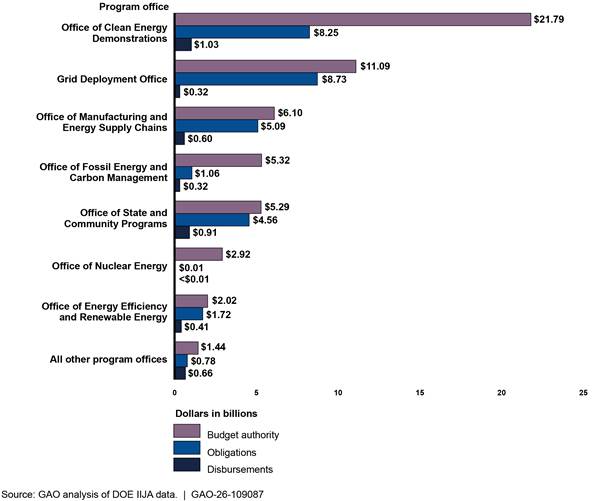
Note: Our analysis does not include budget authority for which the entire period of availability occurs after September 30, 2025, as these funds were not available for obligation during the time frame of our review.
DOE Obligated over One-Half of Its IRA Funds and Disbursed About One-Tenth of the Obligated Amount
The IRA provided approximately $35.5 billion to DOE for fiscal years 2022 through 2025. As of September 30, 2025, according to agency data, DOE obligated about 59 percent ($20.8 billion) of its IRA budget authority and disbursed about 11 percent ($2.3 billion) of the obligated funding. As of September 30, 2025, DOE disbursed about 7 percent of its IRA budget authority for fiscal years 2022 through 2025.[31]
As with its IIJA funding, the extent to which DOE obligated its IRA funding varied across DOE’s program offices. The Office of Energy Dominance Financing, which is committed to financing energy and manufacturing projects that contribute to energy security and grid reliability, received about 33 percent ($11.6 billion) of DOE’s IRA budget authority—with about 16 percent of that funding obligated and 17 percent of the obligated funding disbursed.[32] The Office of State and Community Energy Programs, which invests in developing innovative energy technologies to bolster communities, received about 28 percent ($10 billion) of DOE’s IRA budget authority—with about 95 percent of that funding obligated and 3 percent of the obligated funding disbursed.
In July 2025, Public Law 119-21, commonly known as the One Big Beautiful Bill Act, rescinded about $13.5 billion in unobligated balances of IRA-provided budget authority available as of September 30, 2025.[33] Table 2 presents IRA budget authority, rescissions, obligations, and disbursements among DOE’s various program offices.
Table 2: Department of Energy (DOE) Inflation Reduction Act (IRA) Budget Authority, Rescissions, Obligations, and Disbursements as of September 30, 2025
Dollars in billions
|
Program office |
Budget authority |
Rescissions |
Obligations |
Disbursements |
|
Office of Energy Dominance Financing |
$11.60 |
$9.71 |
$1.89 |
$0.32 |
|
Office of State and Community Energy Programs |
9.96 |
0.05 |
9.46 |
0.26 |
|
Office of Clean Energy Demonstrations |
5.76 |
1.18 |
4.58 |
0.11 |
|
Grid Deployment Office |
2.96 |
2.43 |
0.45 |
0.04 |
|
Office of Manufacturing and Energy Supply Chains |
2.24 |
— |
2.19 |
0.03 |
|
Office of Science |
1.55 |
— |
1.55 |
1.31 |
|
All other program offices |
1.46 |
0.09 |
0.69 |
0.26 |
|
Total |
$35.53 |
$13.47 |
$20.80 |
$2.33 |
Legend: — = no amounts associated with the indicated program office.
Source: GAO analysis of DOE-provided data. | GAO‑26‑109087
Note: Amounts may not sum to totals due to rounding. Our analysis does not include budget authority for which the entire period of availability occurs after September 30, 2025, as these funds were not available for obligation during the time frame of our review.
DOE Established a New Process to Advise Program Offices on Review Decisions
DOE initially paused IIJA and IRA funding to evaluate the effect of executive orders, but the pause was temporary, according to DOE officials. On May 15, 2025, DOE announced that the PRP committee would evaluate awards on a case‑by‑case basis.[34] According to DOE officials, this review process was newly established and intended to respond to executive orders and ensure that awards were financially sound; economically viable; and consistent with the administration’s policies, priorities, and program goals.
According to its charter, the PRP committee comprised members that the Secretary selected or approved, including a nonvoting member of the Office of General Counsel who served as committee secretary. According to a DOE official, program offices initiated discussion of awards with the PRP committee and provided a recommended outcome for each award the program office selected for discussion. According to the PRP committee’s charter, to inform its recommendation on whether to cancel, continue, or modify an award, the program office could consider statutory compliance and national and economic security, in addition to other factors.
According to DOE officials, following a discussion, the PRP committee agreed or disagreed with each program office’s recommendation on the outcome for specific awards. Additionally, the PRP committee could ask the program office to return with additional information for further discussion with the committee. According to DOE officials, the relevant program office head made the final decision for each award under review, with the PRP committee serving in an advisory role.[35]
We found instances where the program office ultimately approved to continue awards following PRP committee documentation of a recommendation to cancel and instances where the program office canceled awards without documentation of a PRP concurrence to do so. In addition, DOE officials stated that there were instances in which the program office did not agree with PRP committee documentation of a recommendation to cancel an award, but DOE leadership ultimately decided to move forward with the award cancellation.
DOE Reported That It Approved Most Awards and Canceled 155 Awards Totaling $9.1 Billion
According to DOE officials, the agency completed its review of IIJA and IRA awards in April 2026. According to DOE data, as of April 2026, the agency approved to continue 68 percent of the funding it reviewed (totaling about $19.6 billion). In total, DOE canceled 18 IRA awards (totaling $2.8 billion) and 137 IIJA awards (totaling $6.3 billion) according to data DOE provided (see fig. 3). As of April 2026, DOE data indicated that recipients were appealing 93 canceled awards (totaling $6.9 billion) while DOE reinstated an additional 12 canceled awards (totaling $0.9 billion) following successful appeals.[36]
Figure 3: Disposition of Reviewed Infrastructure Investment and Jobs Act (IIJA) and Inflation Reduction Act (IRA) Awards, as Reported by the Department of Energy, as of April 2026
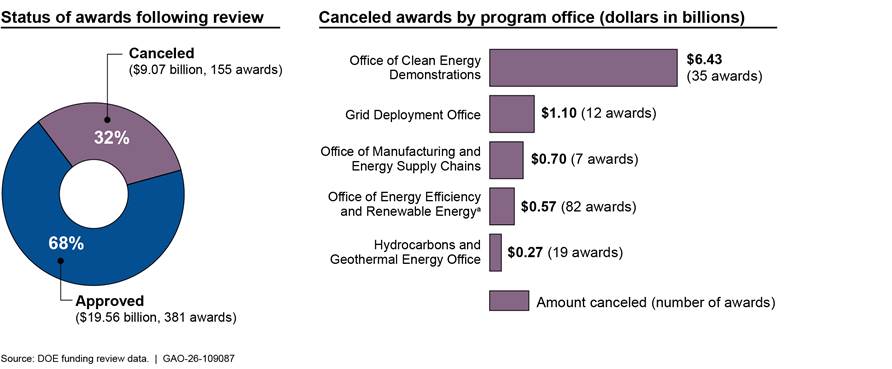
Note: Approved awards include 12 canceled awards totaling $861 million that DOE ultimately reinstated as of April 2026. Canceled awards include 11 awards totaling $2.78 billion that DOE chose to discontinue following the completion of the award’s current phase (i.e., not funded for future budget periods).
aAs a result of a DOE reorganization in January 2026, the Office of Energy Efficiency and Renewable Energy is now the Office of Critical Minerals and Energy Innovation, which includes the Vehicle Technologies Office.
Agency Comments
We provided a draft of this report to USDA and DOE for review and comment. USDA provided technical comments, which we incorporated as appropriate. DOE did not have any comments on the report.
As agreed with your offices, unless you publicly announce the contents of this report earlier, we plan no further distribution until 7 days from the report date. At that time, we will send copies of this report to the Secretary of Agriculture, the Secretary of Energy, and other interested parties. In addition, the report is available at no charge on the GAO website at https://www.gao.gov.
If you or your staffs have any questions about this report, please contact me at sitwilliamsa@gao.gov. Contact points for our Offices of Congressional Relations and Media Relations may be found on the last page of this report. GAO staff who made key contributions to this report are listed in appendix I.
Anne Sit-Williams
Director
Financial Management and Assurance
List of Requesters
The Honorable Amy Klobuchar
Ranking Member
Committee on Agriculture, Nutrition, and Forestry
United States Senate
The Honorable Jared Huffman
Ranking Member
Committee on Natural Resources
House of Representatives
The Honorable Yassamin Ansari, House of Representatives
The Honorable Becca Balint, House of Representatives
The Honorable Nanette Diaz Barragán, House of Representatives
The Honorable Joyce Beatty, House of Representatives
The Honorable Donald S. Beyer, Jr., House of Representatives
The Honorable Sanford D. Bishop, Jr., House of Representatives
The Honorable Brendan F. Boyle, House of Representatives
The Honorable Shontel M. Brown, House of Representatives
The Honorable Julia Brownley, House of Representatives
The Honorable Nikki Budzinski, House of Representatives
The Honorable Salud Carbajal, House of Representatives
The Honorable Ed Case, House of Representatives
The Honorable Sean Casten, House of Representatives
The Honorable Gilbert Ray Cisneros, Jr., House of Representatives
The Honorable Yvette D. Clarke, House of Representatives
The Honorable Emanuel Cleaver, II, House of Representatives
The Honorable Steve Cohen, House of Representatives
The Honorable J. Luis Correa, House of Representatives
The Honorable Jim Costa, House of Representatives
The Honorable Jasmine Crockett, House of Representatives
The Honorable Danny K. Davis, House of Representatives
The Honorable Diana DeGette, House of Representatives
The Honorable Chris Deluzio, House of Representatives
The Honorable Mark DeSaulnier, House of Representatives
The Honorable Adriano Espaillat, House of Representatives
The Honorable Dwight Evans, House of Representatives
The Honorable Cleo Fields, House of Representatives
The Honorable Shomari Figures, House of Representatives
The Honorable Bill Foster, House of Representatives
The Honorable Laura Friedman, House of Representatives
The Honorable Maxwell Alejandro Frost, House of Representatives
The Honorable John Garamendi, House of Representatives
The Honorable Jesús G. “Chuy” García, House of Representatives
The Honorable Robert Garcia, House of Representatives
The Honorable Sylvia R. Garcia, House of Representatives
The Honorable Dan Goldman, House of Representatives
The Honorable Maggie Goodlander, House of Representatives
The Honorable Jim Himes, House of Representatives
The Honorable Chrissy Houlahan, House of Representatives
The Honorable Val Hoyle, House of Representatives
The Honorable Glenn Ivey, House of Representatives
The Honorable Jonathan L. Jackson, House of Representatives
The Honorable Sara Jacobs, House of Representatives
The Honorable Pramila Jayapal, House of Representatives
The Honorable Julie Johnson, House of Representatives
The Honorable Marcy Kaptur, House of Representatives
The Honorable Robin L. Kelly, House of Representatives
The Honorable Timothy M. Kennedy, House of Representatives
The Honorable Ro Khanna, House of Representatives
The Honorable Raja Krishnamoorthi, House of Representatives
The Honorable Greg Landsman, House of Representatives
The Honorable Rick Larsen, House of Representatives
The Honorable George Latimer, House of Representatives
The Honorable Susie Lee, House of Representatives
The Honorable Teresa Leger Fernandez, House of Representatives
The Honorable Mike Levin, House of Representatives
The Honorable Ted W. Lieu, House of Representatives
The Honorable Zoe Lofgren, House of Representatives
The Honorable Doris Matsui, House of Representatives
The Honorable Lucy McBath, House of Representatives
The Honorable April McClain Delaney, House of Representatives
The Honorable Betty McCollum, House of Representatives
The Honorable James P. McGovern, House of Representatives
The Honorable LaMonica McIver, House of Representatives
The Honorable Gregory W. Meeks, House of Representatives
The Honorable Gwen S. Moore, House of Representatives
The Honorable Jared Moskowitz, House of Representatives
The Honorable Seth Moulton, House of Representatives
The Honorable Kevin Mullin, House of Representatives
The Honorable Jerrold Nadler, House of Representatives
The Honorable Joe Neguse, House of Representatives
The Honorable Eleanor Holmes Norton, House of Representatives
The Honorable Johnny “Johnny O” Olszewski, Jr., House of Representatives
The Honorable Jimmy Panetta, House of Representatives
The Honorable Scott H. Peters, House of Representatives
The Honorable Brittany Pettersen, House of Representatives
The Honorable Mark Pocan, House of Representatives
The Honorable Mike Quigley, House of Representatives
The Honorable Delia C. Ramirez, House of Representatives
The Honorable Emily Randall, House of Representatives
The Honorable Jamie Raskin, House of Representatives
The Honorable Deborah K. Ross, House of Representatives
The Honorable Andrea Salinas, House of Representatives
The Honorable Mary Gay Scanlon, House of Representatives
The Honorable Robert C. “Bobby” Scott, House of Representatives
The Honorable Adam Smith, House of Representatives
The Honorable Eric Sorensen, House of Representatives
The Honorable Darren Soto, House of Representatives
The Honorable Melanie Stansbury, House of Representatives
The Honorable Greg Stanton, House of Representatives
The Honorable Haley M. Stevens, House of Representatives
The Honorable Marilyn Strickland, House of Representatives
The Honorable Suhas Subramanyam, House of Representatives
The Honorable Mark Takano, House of Representatives
The Honorable Shri Thanedar, House of Representatives
The Honorable Bennie G. Thompson, House of Representatives
The Honorable Mike Thompson, House of Representatives
The Honorable Dina Titus, House of Representatives
The Honorable Jill Tokuda, House of Representatives
The Honorable Ritchie J. Torres, House of Representatives
The Honorable Lori Trahan, House of Representatives
The Honorable Lauren Underwood, House of Representatives
The Honorable Juan Vargas, House of Representatives
The Honorable Nydia M. Velázquez, House of Representatives
The Honorable Debbie Wasserman Schultz, House of Representatives
The Honorable Maxine Waters, House of Representatives
The Honorable Nikema Williams, House of Representatives
GAO Contact
Anne Sit-Williams, sitwilliamsa@gao.gov
Staff Acknowledgments
In addition to the contact named above, Joshua Marcus (Assistant Director), Rebecca Riklin (Analyst in Charge), Princess Adrineda, Melissa Bentley, Giovanna Cruz, Kristen Foster, Sophie Geyer, Joanne Howard, and Kristine Papa made key contributions to this report.
The Government Accountability Office, the audit, evaluation, and investigative arm of Congress, exists to support Congress in meeting its constitutional responsibilities and to help improve the performance and accountability of the federal government for the American people. GAO examines the use of public funds; evaluates federal programs and policies; and provides analyses, recommendations, and other assistance to help Congress make informed oversight, policy, and funding decisions. GAO’s commitment to good government is reflected in its core values of accountability, integrity, and reliability.
Obtaining Copies of GAO Reports and Testimony
The fastest and easiest way to obtain copies of GAO documents at no cost is through our website. Each weekday afternoon, GAO posts on its website newly released reports, testimony, and correspondence. You can also subscribe to GAO’s email updates to receive notification of newly posted products.
Order by Phone
The price of each GAO publication reflects GAO’s actual cost of production and distribution and depends on the number of pages in the publication and whether the publication is printed in color or black and white. Pricing and ordering information is posted on GAO’s website, https://www.gao.gov/ordering.htm.
Place orders by calling (202) 512-6000, toll free (866) 801-7077,
or
TDD (202) 512-2537.
Orders may be paid for using American Express, Discover Card, MasterCard, Visa, check, or money order. Call for additional information.
Connect with GAO
Connect with GAO on X,
LinkedIn, Instagram, and YouTube.
Subscribe to our Email Updates. Listen to our Podcasts.
Visit GAO on the web at https://www.gao.gov.
To Report Fraud, Waste, and Abuse in Federal Programs
Contact FraudNet:
Website: https://www.gao.gov/about/what-gao-does/fraudnet
Automated answering system: (800) 424-5454
Media Relations
Sarah Kaczmarek, Managing Director, Media@gao.gov
Congressional Relations
David A. Powner, Acting Managing Director, CongRel@gao.gov
General Inquiries
[1]Infrastructure Investment and Jobs Act, Pub. L. No. 117-58, 135 Stat. 429 (2021); An Act to provide for reconciliation pursuant to title II of S. Con. Res. 14, Pub. L. No. 117-169, 136 Stat. 1818 (2022) (commonly known as the Inflation Reduction Act).
[2]These include executive orders such as Exec. Order No. 14154, Unleashing American Energy, 90 Fed. Reg. 8353 (Jan. 20, 2025), and Exec. Order No. 14151, Ending Radical and Wasteful Government DEI Programs and Preferencing, 90 Fed. Reg. 8339 (Jan. 20, 2025).
[3]GAO, Funding Status: Infrastructure Investment and Jobs Act and Inflation Reduction Act, GAO‑26‑108434 (Washington, D.C.: July 22, 2026).
[4]Budget authority is authority provided by federal law to enter into financial obligations that will result in immediate or future outlays involving federal government funds. The basic forms of budget authority include (1) appropriations, (2) borrowing authority, (3) contract authority, and (4) authority to obligate and expend offsetting receipts and collections. Borrowing authority is a form of budget authority enacted to permit an agency to borrow money and then to obligate against amounts borrowed. GAO, A Glossary of Terms Used in the Federal Budget Process, GAO‑05‑734SP (Washington, D.C.: Sept. 2005). For DOE programs, while the IRA provided only appropriations, the IIJA provided both appropriations and borrowing authority. While the IIJA and IRA provided only appropriations for USDA programs, for the purposes of this report, we will use the comprehensive term “budget authority.” Our review does not include budget authority for which the entire period of availability occurs after September 30, 2025, as these funds were not available for obligation during the time frame of our review.
[5]For this report, “federal award” generally refers to federal financial assistance and cost‑reimbursement contracts that nonfederal entities receive directly from federal agencies or indirectly from a pass‑through entity. 2 C.F.R. § 200.1. Here, we use “award” to include opportunities for such funding that an agency has announced, regardless of obligation status.
[6]Executive agencies must report certain information on their obligation and disbursement of funds to Congress and the public. Agencies must report obligations and disbursements to USAspending.gov—the official source of federal spending information for the public. The Office of Management and Budget (OMB) and the Department of the Treasury provide guidance and policies related to USAspending.gov. The Federal Funding Accountability and Transparency Act of 2006, as amended, requires OMB to ensure the existence and operation of a single searchable website, accessible to the public at no cost, containing information on federal awards and on the status of agencies’ appropriations accounts. See Pub. L. No. 109-282, 120 Stat. 1186 (2006), codified as amended at 31 U.S.C. § 6101 note. USAspending.gov was established in response to this requirement.
[7]Woonasquatucket River Watershed Council v. U.S. Dep’t of Agric., 778 F. Supp. 3d 440 (D.R.I. 2025), aff’d in part, rev’d in part, No. 25-1428 (1st Cir. Aug. 7, 2026).
[8]For this report, “termination” refers to obligated awards including contracts that USDA or DOE discontinued. “Cancellation” refers to an award discontinued for a variety of reasons. For example, this may include termination of an obligated award, but it can also include awards for which funding was rescinded by law, retraction of an unobligated award previously announced, and discontinuation initiated by a recipient.
[10]See 2 C.F.R. § 200.1.
[11]31 U.S.C. § 6305.
[12]2 C.F.R. § 200.1; see also GAO‑05‑734SP.
[13]See Federal Acquisition Regulation (FAR) 2.101.
[14]GAO‑05‑734SP. Payment may be made immediately or in the future.
[16]GAO‑05‑734SP. Payments made to liquidate federal obligations include the issuance of checks, disbursement of cash, or electronic transfer of funds. These are also referred to as “outlays.”
[17]While agencies may incur obligations only during the funding’s period of availability, agencies have additional time after that period in which they may record, adjust, or liquidate properly incurred obligations. See 31 U.S.C. § 1553; see also GAO‑05‑734SP.
[18]Grants and loans may be terminated pursuant to 2 C.F.R. § 200.340 or under program-specific statutes or regulations. Contracts may be terminated pursuant to the terms of FAR Part 49 or otherwise pursuant to the terms of the individual contract. Cancellation provisions may vary for interagency agreements, which may be entered into pursuant to the Economy Act, 31 U.S.C. § 1535, as implemented by FAR Part 17.5, or more specific statutory authority.
[19]See An Act to provide for reconciliation pursuant to title II of S. Con. Res. 14, Pub. L. No. 117-169, 136 Stat. 1818 (2022) (commonly known as the Inflation Reduction Act). We previously reported on provisions of the IRA related to tax administration, prescription drug pricing, federal buildings, and environmental review and data collection efforts.
[20]See An Act to provide for reconciliation pursuant to title II of H. Con. Res. 14, Pub. L. 119-21, 139 Stat. 72 (2025).
[21]Exec. Order No. 14154, Unleashing American Energy, 90 Fed. Reg. 8353 (Jan. 20, 2025). See also Exec. Order No. 14151, Ending Radical and Wasteful Government DEI Programs and Preferencing, 90 Fed. Reg. 8339 (Jan. 20, 2025), and Exec. Order No. 14222, Implementing the President’s “Department of Government Efficiency” Cost Efficiency Initiative, 90 Fed. Reg. 11095 (Feb. 26, 2025).
[22]Declaration of Director of Transparency and Accountability Reporting Division, Office of the Chief Financial Officer, USDA, 3, Apr. 25, 2025, ECF No. 56-2, Woonasquatucket, 778 F. Supp. 3d 440 (2025).
[23]These percentages reflect budget authority prior to rescissions.
[24]See An Act to provide for reconciliation pursuant to title II of H. Con. Res. 14, Pub. L. No. 119-21, 139 Stat. 72 (2025).
[25]USDA officials and documentation noted that USDA’s review of IIJA and IRA funding was in response to the following executive orders: Exec. Order No. 14151; Exec. Order No. 14154; Exec. Order No. 14222; Exec. Order No. 14153, Unleashing Alaska’s Extraordinary Resource Potential, 90 Fed. Reg. 8347 (Jan. 20, 2025); Exec. Order No. 14156, Declaring a National Energy Emergency, 90 Fed. Reg. 8433 (Jan. 20, 2025); Exec. Order No. 14168, Defending Women From Gender Ideology Extremism and Restoring Biological Truth to the Federal Government, 90 Fed. Reg. 8615 (Jan. 20, 2025); Exec. Order No. 14170, Reforming the Federal Hiring Process and Restoring Merit to Government Service, 90 Fed. Reg. 8621 (Jan. 20, 2025); Exec. Order No. 14173, Ending Illegal Discrimination and Restoring Merit-Based Opportunity, 90 Fed. Reg. 8633 (Jan. 21, 2025); Exec. Order No. 14202, Eradicating Anti-Christian Bias, 90 Fed. Reg. 9365 (Feb. 6, 2025); and Exec. Order No. 14262, Strengthening the Reliability and Security of the United States Electric Grid, 90 Fed. Reg. 15521 (Apr. 8, 2025).
[26]Declaration of Director of Transparency and Accountability Reporting Division, Office of the Chief Financial Officer, USDA, 4, May 2, 2025, ECF No. 64-2, Woonasquatucket, 778 F. Supp. 3d 440 (2025).
[27]“DEI” is an acronym for diversity, equity, and inclusion.
[28]Decl. of Director of Transparency and Accountability Reporting Division, 3.
[29]Urban Sustainability Directors Network v. U.S. Dep’t of Agric., No 1:25-cv-01775 (D.D.C. June 5, 2025).
[30]Decl. of Director of Transparency and Accountability Reporting Division, 2.
[31]These percentages reflect budget authority prior to rescissions.
[32]The Office of Energy Dominance Financing was previously named the Loans Program Office prior to October 2025.
[33]See An Act to provide for reconciliation pursuant to title II of H. Con. Res. 14, Pub. L. No. 119-21, 139 Stat. 72 (2025).
[34]According to a DOE official, the Office of Science opted out of this review of awards.
[35]DOE officials did not respond to questions about how the program offices and PRP committee applied criteria to their decision-making. DOE stipulated in a civil legal action that DOE provided the program office decisions to OMB, “consistent with its Executive Branch obligation to clear its funding decisions with OMB.” Parties’ Stipulation and Agreement to Obviate Discovery as to DoE and DoE’s Stipulations of Fact and Agreement to Produce Grants Spreadsheet, ECF No. 211-6, Exhibit F, p. 6, Thakur v. Trump, et al., No. 3:25-cv-043737-RL (N.D. Cal. June 4, 2025).
[36]In our analysis, we included 12 reinstated awards in the total awards approved to continue.