
Report to Congressional Committees
United States Government Accountability Office
A report to congressional committees
Contact: Candice N. Wright at WrightC@gao.gov
What GAO Found
The Department of Commerce has continued to implement the semiconductor facilities and equipment incentives program, and awardees have made progress on milestones. Since July 2025, Commerce has awarded nine new projects, for a total of 49 projects across 24 companies. When setting award amounts, Commerce considered new factors as compared to prior awards, such as whether the company would provide equity in exchange for funding. Commerce also amended existing awards for 14 companies. As of April 2026, awardees had completed all required milestones by their due dates, but some milestones had fallen behind anticipated schedules. Commerce has disbursed $13.1 billion to awardees—approximately 42 percent of the total $31.5 billion in direct funding.
Commerce initially established key advanced microelectronics R&D activities but later canceled awards representing $7.8 billion of the $11 billion appropriated. The agency significantly revised its approach to align with current administration priorities but did not have a plan or timeline for fully meeting statutory requirements—specifically those related to the National Semiconductor Technology Center, National Advanced Packaging Manufacturing Program (NAPMP), and Industrial Advisory Committee. For example, Commerce canceled the center’s award in 2025, but its plan to reestablish the center is not sufficiently detailed to show how it will meet relevant statutory requirements. Commerce also canceled or paused NAPMP awards and has not renewed the advisory committee charter. Without a detailed plan for reestablishing these entities in line with statute, Commerce may miss opportunities to advance U.S. semiconductor technologies, leaving the U.S. reliant on other countries.
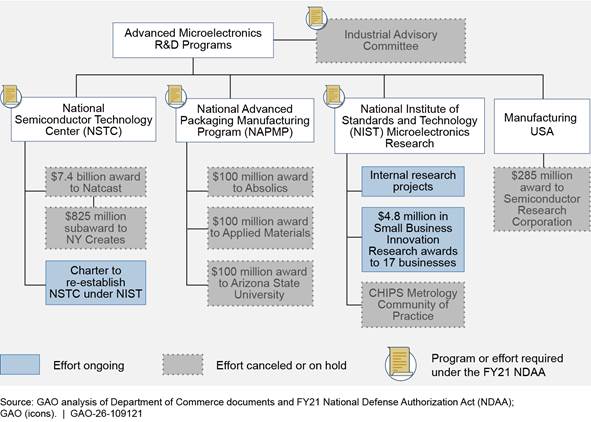
Commerce’s Changes to Advanced Microelectronics R&D Activities
Why GAO Did This Study
Semiconductors, also called chips, are small electronic devices that are critical to nearly all industries. A recent global semiconductor shortage exposed long-term risks in the supply chain.
The William M. (Mac) Thornberry National Defense Authorization Act for Fiscal Year 2021 (as amended, the FY21 NDAA) authorized Commerce to incentivize semiconductor facilities and equipment projects and support advanced microelectronics R&D.
The FY21 NDAA also includes a provision for GAO to issue a series of reports. This second report updates GAO’s December 2025 report on the status of financial assistance awards and projects funded under the semiconductor incentives program as of June 5, 2026, and assesses the status of Commerce’s efforts on the advanced microelectronics R&D programs, among other objectives.
GAO analyzed Commerce documents, including project milestone and disbursement documentation. In addition, GAO reviewed requirements in the FY21 NDAA and compared Commerce’s efforts to those requirements. GAO also interviewed Commerce officials.
What GAO Recommends
GAO is making three recommendations that Commerce develop plans and timelines for how it will move forward to ensure alignment with FY21 NDAA requirements related to (1) the National Semiconductor Technology Center, (2) NAPMP, and (3) Industrial Advisory Committee. The agency should implement these recommendations within 1 year of the date of this report. Commerce agreed with the recommendations.
|
Abbreviations |
|
|
|
|
|
ATP |
assembly, testing, and packaging |
|
BAA |
broad agency announcement |
|
DOD |
Department of Defense |
|
DOE |
Department of Energy |
|
EUV |
extreme ultraviolet |
|
FY21 NDAA |
William M. (Mac) Thornberry National Defense Authorization Act for Fiscal Year 2021, as amended |
|
GCCA |
Government Corporation Control Act |
|
NAPMP |
National Advanced Packaging Manufacturing Program |
|
NIST |
National Institute of Standards and Technology |
|
NSF |
National Science Foundation |
|
NSTC |
National Semiconductor Technology Center |
|
OLC |
Office of Legal Counsel |
|
R&D |
research and development |
|
SRC |
Semiconductor Research Corporation |
This is a work of the U.S. government and is not subject to copyright protection in the United States. The published product may be reproduced and distributed in its entirety without further permission from GAO. However, because this work may contain copyrighted images or other material, permission from the copyright holder may be necessary if you wish to reproduce this material separately.
August 6, 2026
Congressional Committees
The Department of Commerce oversees $50 billion in programs related to semiconductors—small electronic devices that are critical to nearly all industries. Amid a global semiconductor shortage that exposed long-term risks in the supply chain, the William M. (Mac) Thornberry National Defense Authorization Act for Fiscal Year 2021 (as amended, the FY21 NDAA) authorized these programs.[1] The CHIPS Act of 2022 added additional authorities and appropriated funds, including $39 billion for U.S. semiconductor facilities and equipment incentives and $11 billion for advanced microelectronics research and development (R&D).[2] The FY21 NDAA includes specific requirements for both programs.
The FY21 NDAA also includes a provision for GAO to issue a series of reports on the semiconductor incentives program, including an evaluation of how award recipients are selected and how other federal programs are drawn upon to complement the awards, among other things.[3] In December 2025, we issued our first report on incentives awards made by Commerce for manufacturing and other activities under the FY21 NDAA from September 2024 through July 2025.[4] This second report examines (1) the status of the financial assistance awards and projects funded under the semiconductor incentives program; (2) how Commerce has drawn on other federal programs to complement incentives awards; and (3) the status of the advanced microelectronics R&D program and the extent to which efforts align with FY21 NDAA requirements.
To address our first objective, we analyzed Commerce documents, including notices of funding opportunity, evaluation and selection documents, awards, award amendments, and funding disbursement documents. We used data collection instruments to summarize key information in the documents including project descriptions and locations, disbursement amounts, selection criteria, and project milestone due dates and completion dates. Our scope for this objective includes incentives awards made by Commerce for manufacturing and other activities under the FY21 NDAA from August 2025 to July 15, 2026, and amendments made through April 30, 2026, to all incentives awards. We were not able to include seven new projects recently awarded by Commerce into our milestone analysis due to the timing of our data collection cutoff date.
For the second objective, we collected and reviewed Commerce documents, including award agreements and guidance documents provided to awardees, to catalog federal agency programs that Commerce drew on to support the incentives awards.
To address the third objective, we reviewed R&D program awards and documentation on award cancellation, and we interviewed representatives from four of the nine awardees that received R&D program awards of $100 million or more.[5] In addition, we reviewed relevant requirements in the FY21 NDAA and compared Commerce efforts to those requirements. For all three objectives, we interviewed Commerce officials.
We conducted this performance audit from April 2026 to August 2026 in accordance with generally accepted government auditing standards. Those standards require that we plan and perform the audit to obtain sufficient, appropriate evidence to provide a reasonable basis for our findings and conclusions based on our audit objectives. We believe that the evidence obtained provides a reasonable basis for our findings and conclusions based on our audit objectives.
Background
Semiconductors
Nearly all industries rely on semiconductors, also called chips, because they are critical components of digital technologies. Chips are generally smaller than postage stamps yet contain billions of components that control the flow of electric current to store, process, or move data.
Semiconductor production involves three broad stages: (1) design; (2) wafer and chip manufacturing; and (3) assembly, testing, and packaging (ATP). In the design stage, chips are designed with sophisticated software. In the manufacturing stage, semiconductors are created on wafers. And in the ATP stage, chips are cut out of wafers, tested for performance, and packaged to protect and prepare them for end products. Manufacturing and ATP both require specialized equipment and many different raw materials. In addition, all three stages continue to evolve through advancements in R&D.
Semiconductor Incentives Program
The FY21 NDAA authorizes Commerce to provide financial assistance to entities undertaking projects to construct, expand, or modernize semiconductor-related facilities and equipment.[6] Awardees may also use funding to support workforce development activities for eligible facilities.[7] The Secretary of Commerce is to select projects that bolster U.S. economic and national security interests. Under the act, Commerce may provide direct funding, loans, or loan guarantees.[8]
The act contains several eligibility requirements for the program. Applicants may be headquartered outside the U.S., but they must use funds for facilities inside the U.S.[9] They must also make certain commitments to worker and community investment.[10]
Commerce has released two notices of funding opportunity for the program. The first notice was released in February 2023 to solicit manufacturing and ATP projects. Commerce amended the first notice in June 2023 to add projects producing semiconductor materials or equipment with total capital expenditures greater than or equal to $300 million. The second notice was released in September 2023 to solicit semiconductor materials or equipment projects with capital expenditures less than $300 million. Commerce amended and reopened the second notice in October 2025 to allow for all materials or equipment projects, regardless of capital expenditures.
In December 2025, we reported that as of July 2025, Commerce had provided incentives awards to 19 companies for 40 projects. These included manufacturing, ATP, materials, and equipment projects. Thirteen of the 19 companies also received funding for workforce development activities associated with the projects.
The CHIPS Program Office within the Department of Commerce’s National Institute of Standards and Technology (NIST) is responsible for overseeing the awards and projects. One key responsibility is to monitor milestones. Each project includes unique milestones, which relate to construction of facilities, installation of equipment, and fulfillment of minimum production levels, among other things. Commerce disburses funding to awardees under direct funding agreements after proof of milestone completion or for workforce activities.
Advanced Microelectronics R&D Programs
The FY21 NDAA requires Commerce to establish a National Semiconductor Technology Center (NSTC), establish a National Advanced Packaging Manufacturing Program (NAPMP), and carry out a NIST microelectronics research program. It also authorized Commerce to establish up to three new Manufacturing USA Institutes.[11] We refer to these four programs collectively as the advanced microelectronics R&D programs.
The act also includes specific requirements for the programs. For example, the NSTC is to be operated as a public-private consortium, align its efforts with the National Strategy on Microelectronics Research, establish and capitalize an investment fund, and work to expand participation in microelectronics-related academic programs.[12]
To inform the four programs, the FY21 NDAA requires Commerce to establish an Industrial Advisory Committee to assess and provide guidance on issues including the needs of the U.S. microelectronic industry and opportunities for new public-private partnerships to advance microelectronics R&D and manufacturing.[13] The committee is to comprise 12 or more members, including representatives of industry, federal laboratories, and academic institutions. Members must be qualified to provide advice to the U.S. government on matters relating to microelectronics R&D, manufacturing, and policy.
The CHIPS R&D Office within NIST is responsible for overseeing the four advanced microelectronics R&D programs, as well as the Industrial Advisory Committee.
Commerce and Awardees Have Continued to Make Progress on Incentives Awards and Projects
Commerce has continued to implement the semiconductor incentives program, and awardees have made progress toward completing project milestones. Commerce awarded nine additional projects since July 2025. Commerce also reached agreement with over half of awardees to amend existing awards. As of April 2026, Commerce had disbursed $13.1 billion of $31.2 billion in direct funding awards.
Commerce Awarded Nine Additional Projects Since July 2025
Commerce awarded five additional companies with funding for nine projects from August 2025 to July 15, 2026 (see table 1). This includes the first seven awarded projects under the second notice of funding opportunity, as well as two additional projects under the first notice of funding opportunity.[14] The seven projects under the second notice of funding opportunity aim to support production of materials used in the semiconductor supply chain, and the remaining two projects aim to support a combination of chip manufacturing as well as packaging.
|
Awardee |
Number of projects |
Direct funding |
Loans |
Description |
|
USA Rare Earth |
5 |
$277 million |
$1.3 billion |
New mining and processing facility in Texas and expanded and modernized metal and magnet production facilities in Oklahoma and South Carolina |
|
Bosch |
1 |
$225 million |
N/A |
Expanded and modernized facility in California for silicon-carbide power semiconductor production |
|
Crucible Metals |
1 |
$210 million |
N/A |
New metal refinery in Tennessee, expected to process multiple types of critical minerals |
|
Vulcan Elements |
1 |
$50 million |
N/A |
Modernized magnet production facility in North Carolina |
|
Powerex |
1 |
$3 million |
N/A |
Expanded and modernized facility in Pennsylvania for power semiconductor packaging |
Source: GAO analysis of Department of Commerce documents. | GAO‑26‑109121
Note: Awards are authorized under Section 9902 of the William M. (Mac) Thornberry National Defense Authorization Act for Fiscal Year 2021, as amended (FY21 NDAA), 15 U.S.C. § 4652. GAO last reported on projects as of July 2025. See: GAO, Semiconductors: Information on Projects Funded to Strengthen U.S. Supply Chain, GAO‑26‑107882 (Washington, D.C.: Dec. 11, 2025).
With these new awards, Commerce has awarded a total of 24 companies approximately $31.7 billion in direct funding for 49 projects (see fig. 1), as well as workforce activities associated with the projects.[15] This represents approximately 89 percent of the $35.5 billion available for the incentives program.[16] Including these nine new projects, 33 of the 49 total projects are for chip manufacturing; 11 of 49 are for materials production; and nine of 49 are for the assembly, testing, and packaging stage. We previously reported that prior materials awards were for glass, filters, purifiers, and polysilicon; prior chip-manufacturing awards were for a variety of different chip types across leading-edge, current-generation, and mature nodes.[17]
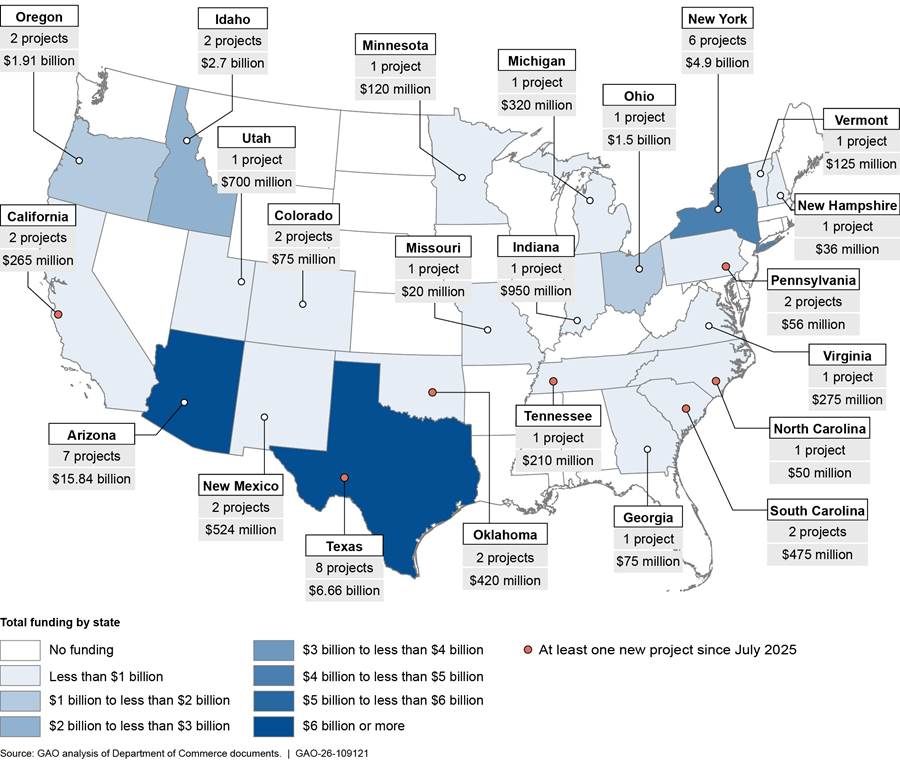
Note: Awards are authorized under Section 9902 of the William M. (Mac) Thornberry National Defense Authorization Act for Fiscal Year 2021, as amended, 15 U.S.C. § 4652. Funding includes both direct funding and loans to construct, expand, or modernize facilities; it does not include funding for workforce activities, which in some cases is not tied to specific states. Amounts are rounded to the nearest $1 million. There were no projects in Alaska or Hawaii. We last reported on projects as of July 2025. See: GAO, Semiconductors: Information on Projects Funded to Strengthen U.S. Supply Chain, GAO‑26‑107882 (Washington, D.C.: Dec. 11, 2025).
According to our analysis of the new awards, Commerce selected projects according to criteria in the notices of funding opportunity (see table 2). We found that the agency gave greatest consideration to the projects’ potential impact on economic and national security objectives, in alignment with FY21 NDAA requirements.[18]
|
First notice of funding opportunity |
Second notice of funding opportunity |
|
1. Potential impact on economic and national security objectives, such as potential to advance supply chain resilience, domestic capacity, national security needs, and supply chain security 2. Commercial viability, such as customer base and product demand 3. Financial strength, such as market share and profit performance 4. Technical feasibility and readiness, such as construction plans, supplier network, and regulatory (e.g., permitting) progress 5. Workforce development, such as recruitment and hiring plans, employee training and education, and employee services 6. Broader impacts, such as community investments and plans to engage small or disadvantaged suppliers and contractors |
1. Potential impact on economic and national security objectives, such as potential to advance supply chain resilience, U.S. technology leadership, cybersecurity, and operational security 2. Commercial viability, such as market environment and demand 3. Financial strength, such as projected capital expenditures, profit potential, and private investment 4. Technical feasibility and readiness, such as construction plans and regulatory progress 5. Workforce and community investment, such as facility and construction workforce strategies 6. Degree to which incentives are necessary to make the project viable in the U.S. |
Source: GAO analysis of Department of Commerce documents. | GAO‑26‑109121
Note: Awards are authorized under Section 9902 of the William M. (Mac) Thornberry National Defense Authorization Act for Fiscal Year 2021, as amended (FY21 NDAA), 15 U.S.C. § 4652.
When determining amounts for these new awards, Commerce considered several factors. For example, Commerce considered the award amount as a percentage of the project’s total capital expenditures. Commerce officials said that they also conducted analyses of estimated profits, capital costs, other incentives, and risks to company profits.
In addition, Commerce considered the amount that the companies agreed to provide in equity, which it did not consider for prior awards. USA Rare Earth provided Commerce with equity valued at $277 million in exchange for the $277 million in direct funding, as well as warrants valued at approximately $302.2 million for the $1.3 billion loan. Additionally, Crucible Metals affiliates and Vulcan Elements provided Commerce with equity in exchange for their awards.[19]
Commerce Amended Awards for Most Recipients
From January 2025 through April 2026, Commerce negotiated amendments to award agreements with 14 awardees. These amendments cover a range of issues including project and workforce activities, project milestones, and equity or profit-sharing arrangements.
Project and Workforce Activity Changes
Some amendments changed planned projects and workforce activities. One amendment allowed an awardee to relocate a project to a different parcel of land within the same state. Additionally, nine awardees reached agreement with Commerce on amendments related to their funded workforce activities. These amendments added detail to the description of when awardees should submit progress reports, removed requirements related to providing childcare for employees, and provided additional flexibility in how awardees may allocate funds across different activities.
Milestone Changes
Two awardees amended some of the dates in their milestone schedules for three total projects. Project milestone schedules have different key dates associated with them (see text box).
|
Project Milestone Dates for the Semiconductor Incentives Program Anticipated completion date. The anticipated completion date is the date that the milestone is expected to be complete. However, awardees are not denied associated funding disbursements for failing to meet this date. Anticipated completion dates can apply to interim project milestones and the final milestone for a project. Due date. The due date, also called the milestone completion longstop date, is the date by which the awardee must complete the milestone in order to receive an associated funding disbursement. Milestone due dates can apply to interim project milestones and the final milestone for a project. Clawback date. The clawback date, also called the project completion clawback date, is the date by which the awardee must complete the entire project. The agency may demand recovery of funds previously disbursed if this date is not met. |
Source: GAO analysis of Department of Commerce documents. | GAO‑26‑109121
One awardee amended at least one key date for all milestones across two projects, while also adding a new project. These amendments changed all three types of key dates: anticipated completion dates, due dates, and clawback dates. Both of the awardee’s projects are now expected to be completed 2 years later than originally agreed upon. The awardee told us that the dates for these projects were pushed back so that it could add a new project in a different location that it could bring online more quickly.
In contrast, the other awardee with an amended milestone schedule did not amend its due dates or clawback date. This awardee’s amendment added a new milestone and then amended anticipated completion dates for subsequent milestones. Because the awardee only amended interim milestone dates, the project is still expected to be completed at the originally agreed upon date. Figure 2 summarizes overall anticipated completion dates for all projects following these amendments.
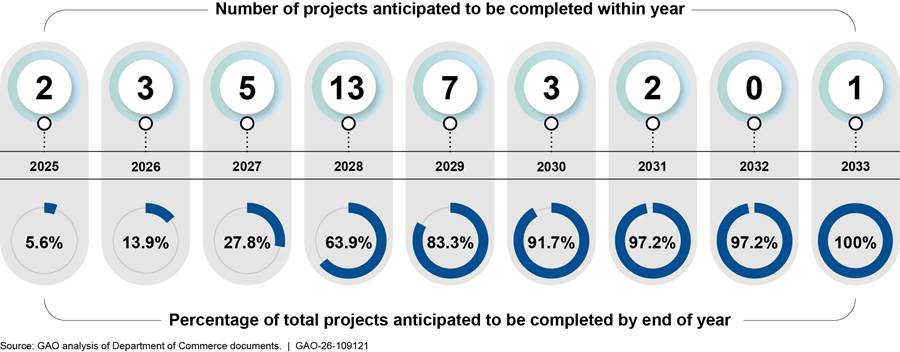
Note: Awards are authorized under Section 9902 of the William M. (Mac) Thornberry National Defense Authorization Act for Fiscal Year 2021, as amended, 15 U.S.C. § 4652. The figure does not include the six Intel projects, because Intel’s awards were amended to remove anticipated completion dates. Since April 2026, seven additional projects were awarded that are not reflected in this analysis. GAO was not able to include the seven new projects recently awarded by Commerce into this analysis due to the timing of the data collection cutoff date for this review.
In addition, in August 2025, Commerce amended Intel’s award for six projects. As part of the amendments and in exchange for the equity stake that will be discussed below, existing required project milestones not yet achieved were removed. Language was added stating that each of Intel’s projects would be considered complete once Intel incurred eligible costs in the full amount of the award. In other words, Intel’s projects would be considered complete once Intel spent $7.865 billion on eligible costs, which is equal to the total amount of Intel’s awards for all projects. Commerce considered all Intel projects complete at the time the award was amended, because Commerce found that Intel had already incurred eligible costs. Commerce no longer requires Intel to report progress on the original project milestones that were removed. We will continue to examine other aspects of the Intel projects in planned future reporting on the semiconductor incentives program.
Equity and Profit-Sharing Changes
Two amendments involved equity agreements. Intel’s agreement was amended to provide Commerce with 9.9 percent of outstanding shares, which was valued at $8.9 billion at the time.[20] A second company’s agreement was amended to provide Commerce with a warrant to purchase equity.[21]
In addition, upside-sharing agreements were removed for two projects and revised for a third project.[22] Under these agreements, companies share profits with the federal government if their profits exceed a specific threshold. [23] We previously reported that Commerce had negotiated upside-sharing agreements for 27 of 40 projects, as of July 2025.[24]
Commerce Disbursed $13 Billion as of April 2026
As of April 2026, Commerce disbursed $13.1 billion to awardees. This was approximately 42 percent of the total $31.2 billion in direct funding awards Commerce had made as of April 2026. Awardees have received disbursements for completing project milestones, carrying out workforce activities, and conducting design activities. Additionally, Intel received disbursements per the terms of its amended agreement.
Eleven awardees received disbursements for completing 24 project milestones. About half of these milestones were completed on or before their anticipated completion dates, and all were completed by their contractually required due dates (see fig. 3).[25] The remaining 125 milestones are still in progress. Most of these have not yet reached their anticipated completion or contractually required due date. However, as of April 2026, we found nine milestones to be past their anticipated completion date.[26] We excluded Intel’s milestones from this analysis due to the unique terms of Intel’s award agreement following its August 2025 amendment. We discuss Intel’s disbursements later in this section.
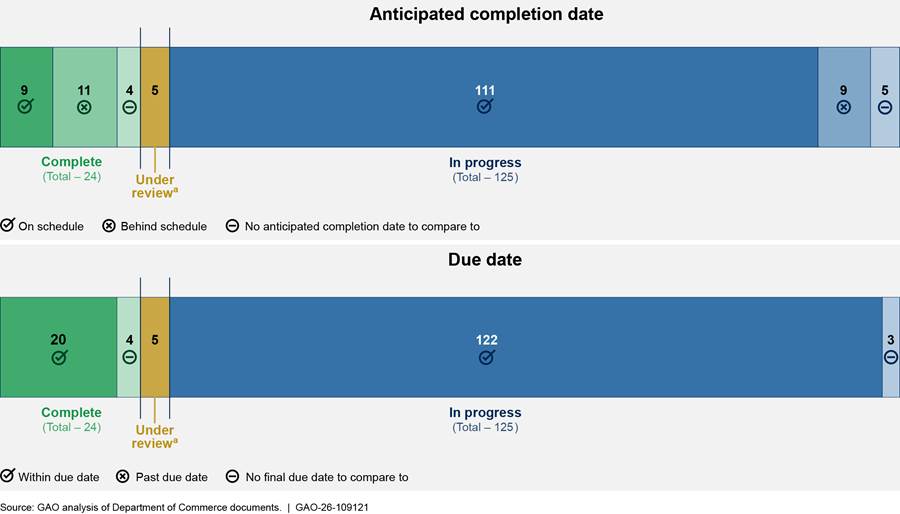
Note: Awards are authorized under Section 9902 of the William M. (Mac) Thornberry National Defense Authorization Act for Fiscal Year 2021, as amended, 15 U.S.C. § 4652. Since April 2026, seven additional projects were awarded that are not reflected in this analysis. GAO was not able to include the seven new projects recently awarded by Commerce into this analysis due to the timing of the data collection cutoff date.
aA milestone is considered “under review” if the awardee has submitted its disbursement request but has not yet received its disbursement for the milestone because the request was still being reviewed by the CHIPS Program Office within the Department of Commerce’s National Institute of Standards and Technology as of April 2026.
In general, milestone disbursements aligned with the amounts described in the award agreements; however, there are several valid reasons why a disbursement may not match exactly what was listed in the agreement. For example, Commerce adjusted some of these disbursement amounts in accordance with award agreements, because capital expenditures or costs differed from those previously anticipated. We found one milestone disbursement that was $9 million more than what was described in the agreement and five milestone disbursements that were on average $15.4 million less than what was described in the agreements. [27] The remaining 18 milestone completion disbursements aligned with the amounts described in agreements.
In addition to the milestone disbursements, awardees also received disbursements for other actions as of April 2026:
· Intel received disbursements totaling $7.865 billion, largely as a result of the company incurring eligible costs under the terms of its amended funding agreement.
· One awardee received a disbursement of $32.1 million to support design porting activities. Design porting is the process of adapting a semiconductor design so that its function can be carried out on a different generation of chip or in a different foundry or fabrication environment. This is generally done to improve the semiconductor (e.g., shrinking layout or improving electrical performance) or adjusting to new fabrication environments.
· Four awardees received disbursements totaling $11.2 million for carrying out workforce development activities. Examples of funded workforce activities include upskilling and apprenticeship programs.
Commerce Drew on a Wide Range of Federal Programs to Complement Awards
Commerce drew on a wide range of federal programs from at least 18 department-level agencies to complement incentives awards.[28] In some cases, Commerce directly consulted with other programs to help design and implement the semiconductor incentives program. In other cases, Commerce referred awardees to programs that can assist with manufacturing, research, and training.
Commerce Drew on Other Programs to Design and Implement Efforts
Commerce considered other federal programs when designing the semiconductor incentives program. In establishing goals for making large-scale investments in advanced chip manufacturing and expanding capacity for current generation and mature chip manufacturing, Commerce officials considered the needs that other federal programs had for semiconductors. For example, officials considered Department of Energy programs’ needs for particular advanced chips and Department of Defense (DOD) programs’ needs for secure chips of various generations.[29]
As we previously reported in December 2025, Commerce also considered how companies had worked with or planned to work with other federal programs when selecting projects for awards and setting award amounts.[30] In selecting projects for awards, Commerce considered whether applicants had participated in other federal programs, including Commerce Tech Hubs, DOD Microelectronics Commons Hubs, and the DOD Trusted Foundry program.[31] For example, Commerce viewed participation in the Trusted Foundry program as demonstrating company experience mitigating national security risks. In setting award amounts, Commerce accounted for applicants’ anticipated receipt of the Department of Treasury’s Advanced Manufacturing Incentive Credit.[32] According to selection documents, Commerce officials took into consideration the anticipated amount of the incentive credit that applicants would receive when determining the total amount of taxpayer dollars awarded to projects.
Further, Commerce utilized other federal programs to inform risk management and financial processes. Commerce officials told us that they coordinated with Department of Justice programs to monitor awardees and projects for national security threats. Some award agreements encourage awardees to develop relationships with the Federal Bureau of Investigation and participate in its programs that facilitate intelligence information sharing between the federal government and the private sector, which aids the federal government in managing national security threats.[33] Commerce officials also stated that they gathered information on programs across various agencies to inform their own financial management processes. For example, Commerce modeled its transaction review processes after those of the Export-Import Bank of the United States.
Commerce Drew on Other Programs to Provide Guidance to Companies
Commerce identified other programs to provide guidance to companies applying for and receiving awards under the first notice of funding opportunity for chip manufacturing projects.[34] Guidance was intended to assist companies in meeting requirements under the first notice of funding opportunity related to workforce development and inclusive business opportunities, which are priorities set forth in the FY21 NDAA, as well as obtaining environmental regulatory approvals for projects.[35]
· Workforce development. In March 2023, Commerce identified and provided guidance on workforce development programs from eight department-level agencies.[36] The programs assist companies on a range of workforce issues, including hiring, labor relations, benefits, and training. In some cases, award agreements require awardees to participate in certain programs, such as the Department of Labor Registered Apprenticeship Program. Under the FY21 NDAA, to be eligible for an award, entities must make commitments to worker investment, including paid training and educational benefits.[37]
· Inclusive business opportunities. In August 2023, Commerce identified and provided guidance on programs related to inclusive business opportunities from four department-level agencies.[38] The programs assist companies with contracting and procuring supplies from diverse businesses. These include small businesses, businesses owned by people of disadvantaged groups (e.g., women, racial and ethnic minorities, and veterans), and businesses located in rural communities. Under the FY21 NDAA, entities must make commitments to worker and community investments, including through programs to expand employment opportunities for economically disadvantaged individuals.[39]
· Environmental regulatory approvals. Commerce relied on programs from the Environmental Protection Agency for information on review processes under the National Environmental Policy Act of 1969. Commerce provided this guidance on the CHIPS.gov website.[40]
Commerce Significantly Revised Its R&D Approach but Has Not Determined How It Will Meet Statutory Requirements
Commerce has significantly revised its approach for the advanced microelectronics R&D programs but has not demonstrated how current efforts will fully align with requirements in the FY21 NDAA. Commerce initially established key aspects of the programs but later canceled awards representing approximately $7.8 billion of the $11 billion appropriated (see fig. 4). Factoring in the cancellations, Commerce has expended $506.8 million, approximately 5 percent of the $11 billion in appropriated funds for the advanced microelectronics R&D programs. These expenditures include approximately $347.3 million on ongoing internal agency research, $79.2 million on administrative costs, $64.1 million on a canceled award, and $16.1 million on disbursements to awardees.[41]
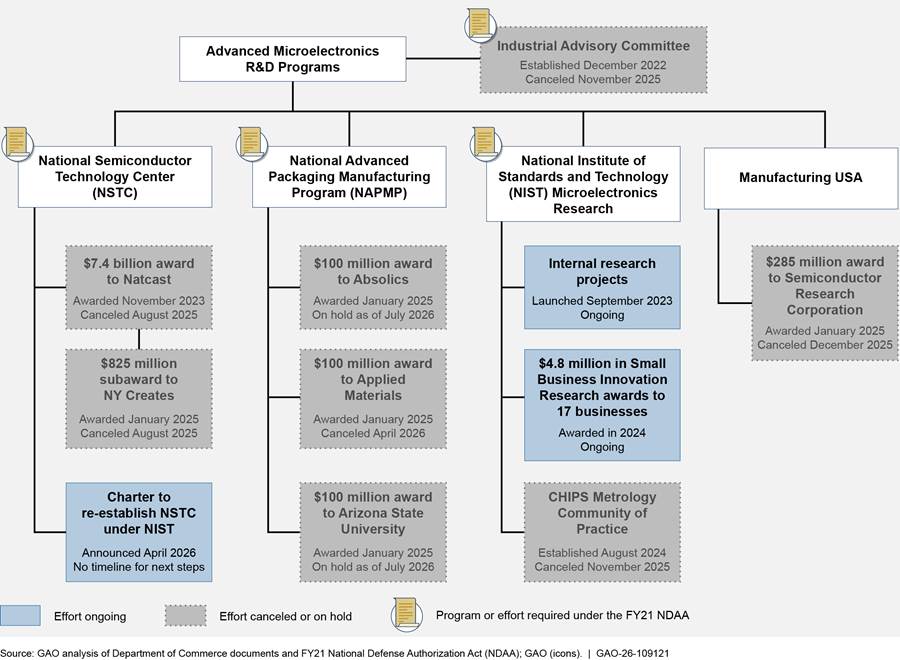
Note: Awards are authorized under Section 9906 of the William M. (Mac) Thornberry National Defense Authorization Act for Fiscal Year 2021, as amended (FY21 NDAA), 15 U.S.C. § 4656. Award amounts are rounded to the nearest $100,000. The figure does not include three awards made from May 2026 to June 2026. Commerce has not described how, if at all, they align with the four advanced microelectronics R&D programs set forth in the FY21 NDAA.
In September 2025, Commerce released a broad agency announcement (BAA) to serve as the new primary mechanism to make awards for the NSTC, the NAPMP, and a CHIPS Manufacturing USA institute.[42] However, the BAA itself does not state that it solicits projects related to those three programs. Instead, the BAA notes particular interest in projects related to artificial intelligence, quantum technology, biotechnology, biomanufacturing, commercialization of innovations, and standards development. It also states that, as a condition of receiving an award, companies may be required to provide a return on investment to the government. This could include equity, warrants, licenses to intellectual property, royalties, or other revenue sharing.
Since September 2025, Commerce has made three new awards totaling $900 million and nine preliminary awards, in each case using or intending to use funds appropriated for advanced microelectronics R&D under Section 9906 of the FY21 NDAA.[43] First, Commerce awarded $150 million in direct funding to xLight to support development of an alternative light source for extreme ultraviolet (EUV) lithography. Commerce made this award pursuant to a request for application solicited to support the domestic construction, outfitting with equipment, and initial operation of one or more facilities that enable the use of particle accelerator technology as an alternative light source for photolithography and other semiconductor-related applications. Second, Commerce awarded $500 million in direct funding to SandboxAQ to use artificial intelligence in the development of new and alternative materials for semiconductor manufacturing. Third, Commerce awarded $250 million in direct funding to I-Pulse to develop novel silicon-carbide semiconductors to operate in harsh environments. As part of the award agreements, the three companies will provide Commerce with equity.[44] The nine preliminary awards total approximately $2 billion for quantum computing, and Commerce has stated that they will also include equity agreements. Information publicly reported by Commerce on these final and preliminary awards does not describe how, if at all, they will align with the four advanced microelectronics R&D programs set forth in the FY21 NDAA.
Below we discuss how Commerce has revised its initial approach to each of the R&D programs and Industrial Advisory Committee and the extent to which that approach aligns with relevant requirements in the FY21 NDAA.
National Semiconductor Technology Center
Commerce awarded a nonprofit entity named Natcast with $7.4 billion to operate the NSTC, including building a membership base, establishing facilities, and conducting workforce activities.[45] Award agreements were signed between November 2023 and January 2025.
Natcast took several steps to stand up the NSTC. For example, it developed a strategic plan in October 2024 and revised it in February 2025. Natcast also registered 200 NSTC member companies and academic institutions. Under its membership model, paid members would be able to access NSTC facilities and equipment, apply for funding, participate in collaborative research, and participate in workforce development programs, among other benefits.
Natcast also took steps to establish three facilities and a Workforce Center of Excellence:
· EUV Accelerator. Natcast made an $825 million subaward to nonprofit NY Creates to operate the EUV Accelerator facility for advanced R&D on extreme ultraviolet lithography. The modernized facility was intended to provide NSTC members across the semiconductor supply chain access to technologies, capabilities, and other resources. NY Creates began implementing the EUV Accelerator, including conducting strategic planning, selecting leaders and hiring employees, obtaining office space, and acquiring equipment and materials.
· Prototyping facility. Natcast announced a preliminary subaward to the Arizona Commerce Authority, in partnership with Arizona State University, to operate a prototyping facility. The facility was to bridge the gap between laboratory research and full-scale semiconductor production. The newly built facility was intended to provide NSTC members with access to capabilities to develop and test new materials and devices. Further, the facility was to be colocated with Arizona State University’s NAPMP project, which we discuss later in the report.
· Design and Collaboration Facility. Natcast announced a location for the Design and Collaboration Facility. The new facility was intended to bring together NSTC members to address challenges facing the microelectronics industry, including the need for a skilled workforce and access to secure, cloud-based services for NSTC members.
· Workforce Center of Excellence. Natcast established a Workforce Center of Excellence that aimed to bring together stakeholders from across the private sector, government, nonprofits, training providers, community and technical colleges, universities, and labor organizations. The center announced $11.5 million in preliminary Workforce Partner Alliance subawards to seven nonprofit institutions to provide semiconductor workforce education and training to high school students, college and university students, and workers.
In August 2025, Commerce took its first step in changing its approach to the NSTC by sending a letter to Natcast canceling its award. The letter stated that Commerce had consulted with the Department of Justice and determined that Natcast was established in violation of federal law—and that the agreement was thus void and Commerce would no longer abide by its terms.[46] As a result of the cancellation, Natcast laid off all employees and ceased operations in September 2025. The EUV Accelerator subaward and all preliminary subawards were also canceled. While Commerce reclaimed most of the funding that had been disbursed, $64.1 million in administrative closeout costs had already been paid to third parties for expenses such as leases for projects.
In April 2026, Commerce released a new charter for the NSTC. According to the charter, Commerce plans to operate the NSTC itself rather than making an award for another entity to operate the NSTC. Also in April 2026, Commerce amended the BAA to provide for awards that invest in companies, as part of an NSTC investment fund. Companies receiving this type of award would not be required to use funds for specific R&D projects.
While the charter outlines FY21 NDAA requirements for the NSTC, it does not describe how Commerce will fully meet those requirements (see table 3).
Table 3: Commerce Efforts to Meet Statutory Requirements for the National Semiconductor Technology Center (NSTC)
|
Requirement in the fiscal year 2021 NDAA |
Related Commerce efforts |
|
Collaborate with the Secretary of Defense to establish the NSTC |
The NSTC charter states that the Department of Defense (DOD) will be an NSTC member, but Commerce officials said they had not yet engaged with DOD officials as of May 2026. |
|
Operate the NSTC as a public-private consortium with participation from the private sector, the Department of Energy (DOE), and the National Science Foundation (NSF) |
The NSTC charter states that members will include the private sector, DOE, and NSF, but Commerce officials said in May 2026 that they had not yet engaged with DOE or NSF officials. |
|
Conduct advanced semiconductor research and prototyping that align with the National Strategy on Microelectronics Research |
The NSTC charter does not mention the strategy or contain sufficient detail to demonstrate plans for the NSTC to align with the strategy. |
|
Conduct advanced semiconductor research and prototyping with emphasis in four specific technical areasa |
Commerce’s broad agency announcement states that eligible projects may include advanced semiconductor research and prototyping in the four areas. |
|
Establish and capitalize an investment fund, in partnership with the private sector, to support start-ups and collaborations between start-ups, academia, established companies, and new ventures |
Commerce amended its broad agency announcement to include awards that are investments in companies, rather than specific research and development projects. Commerce did not establish the fund in consultation or collaboration with the private sector. Commerce officials said in May 2026 that they plan to engage the private sector but did not have a timeline for doing so. |
|
Work with the Secretary of Labor, the Director of the National Science Foundation, the Secretary of Energy, the private sector, institutions of higher education, and workforce training entities to incentivize and expand participation in microelectronics-related academic programs |
The NSTC charter states that Commerce will engage in these efforts, but in May 2026 Commerce officials said they did not have further details and have not yet worked with other entities. |
Source: 15 U.S.C. § 4656(c); GAO analysis of Department of Commerce documents. | GAO‑26‑109121
Note: Awards are authorized under Section 9906(c) of the William M. (Mac) Thornberry National Defense Authorization Act for Fiscal Year 2021, as amended, 15 U.S.C. § 4656(c). The National Strategy on Microelectronics Research was released by the National Science and Technology Council, Committee on Homeland and National Security, Subcommittee on Microelectronics Leadership pursuant to 15 U.S.C. § 4656(a)(3)(A) in March 2024 and amended in April 2025.
aThe four technical areas are (1) semiconductor advanced assembly, test, and packaging capability in the domestic ecosystem; (2) materials characterization, instrumentation, and testing for next-generation microelectronics; (3) virtualization and automation of maintenance of semiconductor machinery; and (4) metrology for security and supply chain verification.
Commerce officials told us that the agency changed its approach to the NSTC in order to align with the current administration’s priorities, but Commerce’s actions to realign the NSTC through the BAA were done without a detailed plan in place for how the BAA would fully support FY21 NDAA requirements. For example, the NSTC charter states that NSTC activities may include developing curricula and workforce training programs, as required in the FY21 NDAA. But it does not contain additional details beyond what is stated in the law, such as whether Commerce will conduct these activities itself or provide financial assistance for other entities to do so. Commerce’s change in approach on how the NSTC would be organized and operated resulted in the loss of at least 2 years of planning time and $64.1 million in administrative costs. This delayed implementation of activities that could help ensure the U.S. develops and benefits from semiconductor technology advances. In turn, this presents risks to U.S. semiconductor competitiveness such as extending the time that the U.S. remains dependent on foreign suppliers or ceding U.S. leadership of technological advances to competitor nations.
A detailed plan to align Commerce’s efforts with NSTC requirements would help ensure that Commerce is positioned to fully address congressional priorities and tackle widespread R&D challenges. The FY21 NDAA states that the NSTC is intended to conduct advanced research and prototyping and to grow the domestic semiconductor workforce with the goal of strengthening the economic competitiveness and security of the domestic supply chain.[47] Additionally, according to a 2022 Commerce report summarizing stakeholder input, stakeholders say that:
· Industry needs more collaborative R&D spaces.
· Start-ups face challenges accessing capital for R&D.
· Workforce development efforts, such as curricula, are fragmented across the industry.[48]
National Advanced Packaging Manufacturing Program
In January 2025, Commerce awarded three entities $100 million each to conduct NAPMP projects. NAPMP projects are intended to strengthen domestic advanced packaging. Advanced packaging comprises various innovative techniques to connect and improve communication between chips. It has become an increasingly important method of increasing chip performance as the rate of chip miniaturization slows.[49]
· The first award was to Absolics and was intended to support Absolics’s Substrate and Materials Advanced Research and Technology Packaging Program and help build a glass-core packaging ecosystem.
· The second award was to Applied Materials and was intended to develop and scale a silicon-core substrate technology for next-generation advanced packaging and 3D heterogeneous integration.
· The third award was to Arizona State University and was intended to support the development of the next generation of microelectronics packaging through fan-out-wafer-level-processing. This project was initially intended to be colocated with the NSTC prototyping facility.
Award funding could also be used for workforce activities. Awardees planned to conduct activities such as postgraduate training programs and continuing education programs for veterans.
In May 2025, Commerce began considering making changes to how the NAPMP awards are carried out to align them with the current administration’s priorities, according to agency officials. For one awardee, Commerce made approximately $11.3 million in disbursements for completed milestones through April 2025 and then did not make disbursements for milestones the awardee completed from May 2025 to February 2026, at which time the awardee stopped work. The second award was terminated in April 2026 before the company received any disbursements. The third NAPMP awardee has also not received any disbursements.
As of July 15, 2026, Commerce officials said they were still considering how to move forward with the two remaining awards, including whether to amend the award terms or cancel the awards. If the awards are canceled, awardees would be able to reapply for funding under the BAA but would not be guaranteed an award. Similar to the changes made to the NSTC discussed above, Commerce began taking steps to change the implementation of the NAPMP awards before it developed a plan or a timeline for an alternative approach to meeting FY21 NDAA requirements.
Having a plan and timeline in place for how to meet statutory requirements would help Commerce avoid delays and ensure that it does not miss opportunities to address congressional priorities and keep pace with global innovation. The FY21 NDAA requires Commerce to establish the NAPMP to strengthen semiconductor advanced ATP capability in the domestic ecosystem. In addition, the NAPMP is required to coordinate with the NSTC.[50] Further, according to the 2022 Commerce report on stakeholder input, the NAPMP could help spur domestic advanced packaging. Specifically, stakeholders cited benefits for collaborative innovation, supply chain resilience, workforce development, and national security.
NIST Microelectronics Research Program
The largest effort under the NIST microelectronics research program was to initiate 65 internal research projects from September 2023 through July 2025. As of December 2025, Commerce had expended approximately $347.3 million on the projects.
The projects are working toward fulfilling statutory requirements. Specifically, the FY21 NDAA requires that the NIST director carry out a microelectronics research program to enable advances and breakthroughs in six areas: measurement science, standards, material characterization, instrumentation, testing, and manufacturing capabilities.[51] The 65 projects address the six areas and align with seven metrology areas that NIST identified as necessary to strengthen the U.S. semiconductor industry.[52] Metrology, the science of measurement and its applications, plays a key role in semiconductor manufacturing to ensure quality, yield, and performance. In addition, as devices become more complex, highly integrated, and smaller, the ability to measure and ensure performance becomes much more difficult. For example, one project is developing standard reference materials for high-purity solids required for reliable chip production, and another project is developing 3D imaging to characterize subsurface features useful for manufacturing and security.
One project is complete, and the remaining 64 are ongoing but have produced preliminary results, as of May 2026. The projects are either working on or have resulted in 294 presentations or conference proceedings, 91 publications, 25 new proposed or published standards, and four proposed or accepted patents. To make the digital products of this work available, NIST established the Metrology Exchange to Innovate in Semiconductors. The exchange is a data-sharing platform where stakeholders can access CHIPS research and data. Commerce officials told us that they plan to continue with the 64 ongoing projects.
In addition to internal research, NIST also began two externally facing efforts. However, one of these was later canceled.
· Small Business Innovation Research awards. Through the Small Business Innovation Research program, NIST made 17 CHIPS-related awards totaling approximately $4.8 million. These awards were under NIST’s 2024 solicitation topics. Commerce disbursed funding at the time of award; disbursements are not connected to specific project milestones. Projects funded under the awards are ongoing as of May 2026, according to Commerce officials. Officials said that they have not yet decided whether to offer follow-on awards (known as Phase II awards) to the awardees.
· CHIPS Metrology Community. In August 2024, NIST established this community and developed a charter. The community of practice was intended to (1) facilitate data and knowledge sharing related to the seven metrology research challenges NIST identified and (2) help stakeholders inform industry standards. NIST canceled the community of practice in November 2025. Commerce officials said that the decision was part of a broader effort to ensure that available resources were aligned with advancing the current administration’s priorities.
Manufacturing USA
In January 2025, Commerce made a $285 million award to nonprofit Semiconductor Research Corporation (SRC) to operate a new Manufacturing USA institute focused on digital-twin technologies. Digital twins in the semiconductor manufacturing context are data-driven virtual representations of real-world production processes, tools, and systems. When synchronized with their physical system counterparts, digital twins analyze real-time data from them and continuously inform those systems to optimize performance.[53] According to SRC, using digital-twin technology can cut development and manufacturing costs by more than 35 percent, cut cycle times by 30 percent, and improve yields by 40 percent.
SRC took steps to stand up the institute, including conducting strategic planning, selecting a board, hiring employees, and registering more than 100 member companies and academic institutions. The institute was to consist of seven regional innovation hubs, as well as a national digital platform for knowledge sharing. Further, SRC released three solicitations to fund a range of projects, such as projects to improve access to digital-twin technology education at community colleges.
In December 2025, Commerce sent a letter to SRC terminating the award for convenience. Commerce officials told us that the award was not in line with the current administration’s priorities. As a result, the institute ceased operations in February 2026, and SRC laid off over two-thirds of its employees. As of May 2026, Commerce is still in the process of accounting for any administrative closeout costs from the canceled award, for which Commerce disbursed $17.3 million from January 1, 2025 to December 10, 2025.
Commerce officials said that they are considering whether to make awards under the BAA for new Manufacturing USA institutes. The FY21 NDAA authorizes but does not require the NIST director to establish up to three new Manufacturing USA institutes focused on semiconductor manufacturing.[54]
Industrial Advisory Committee
In November 2021, Commerce established an Industrial Advisory Committee to guide and assess the four advanced manufacturing R&D programs previously discussed. The committee was established in consultation with the Secretaries of Defense, Energy, and Homeland Security, as required under the FY21 NDAA.[55] It also comprised members from industry, federal laboratories, and academic institutions, as required.
The committee had begun work toward fulfilling its mandate. The act requires the committee to assess and provide guidance to the U.S. government on:
· science and technology needs of the domestic microelectronics industry,
· the extent to which the National Strategy on Microelectronics Research is helping maintain U.S. leadership in microelectronics manufacturing,
· assessment of the advanced microelectronics R&D programs, and
· opportunities for new public-private partnerships to advance microelectronics R&D and domestic manufacturing.
Five meetings were held between December 2022 and August 2024. During the meetings, committee members discussed progress on working groups focused on identifying R&D gaps and workforce needs, learning from other examples of public-private partnerships, and developing investment strategies. These working groups made several recommendations to Commerce, such as that Commerce should make use of existing federal programs for workforce development.
The committee was scheduled to be renewed in November 2025; however, Commerce did not appoint new members or establish a new charter. As of May 2026, Commerce officials told us that they are still considering options for the committee. Commerce allowed the existing Industrial Advisory Committee to lapse without having a plan or a timeline in place to reestablish the committee in alignment with FY21 NDAA requirements.
A plan and timeline to reestablish the committee in alignment with the FY21 NDAA could help Commerce take advantage of opportunities to leverage external expertise in direct support of the four advanced microelectronics R&D programs.[56] For example, given its mandate, the committee could help guide Commerce to reestablish the NSTC as a public-private consortium and align its efforts with the National Strategy on Microelectronics Research.
Conclusions
The advanced microelectronics R&D programs and Industrial Advisory Committee established by the FY21 NDAA are a key part of the federal government’s plans to advance the development of semiconductor technologies and enhance the competitiveness of the U.S. semiconductor industry. After the CHIPS Act of 2022 was enacted, Commerce began to implement the R&D programs and stand up the Industrial Advisory Committee. However, in revising its approach to R&D activities to align with the current administration’s priorities, Commerce curtailed extensive efforts it had already begun toward the FY21 NDAA requirements and lengthened the time frame for implementation, delaying activities that could help reduce U.S. dependence on foreign suppliers. Commerce lacks specific plans and timelines for how its new approach will meet FY21 NDAA requirements. Planning for full, timely implementation of the R&D programs and Industrial Advisory Committee would help ensure that Commerce does not miss opportunities to advance U.S. interests in this important advanced technology and manufacturing sector.
Recommendations for Executive Action
We are making the following three recommendations to Commerce:
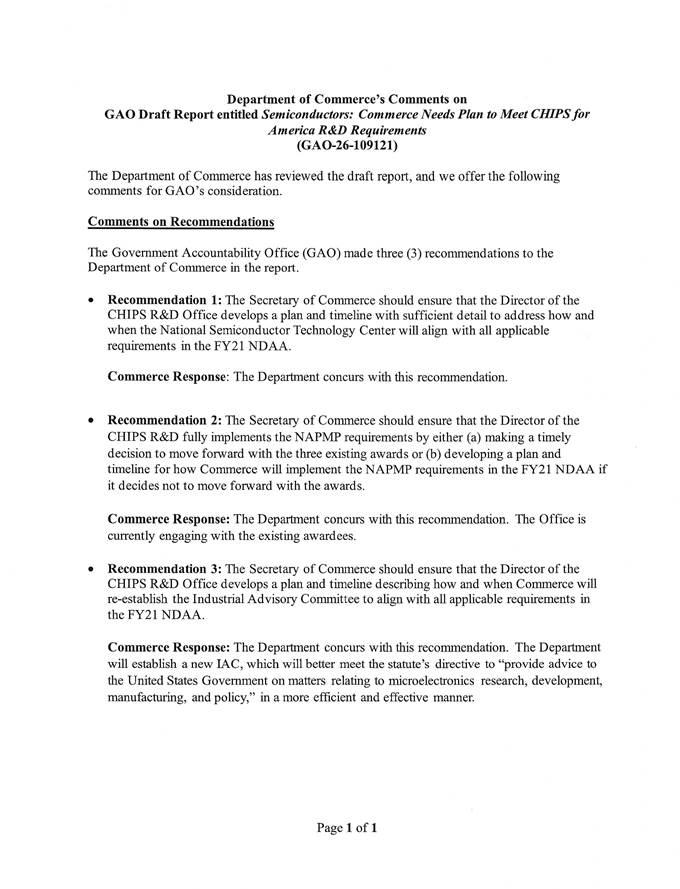
The Secretary of Commerce should ensure that the Director of the CHIPS R&D Office develops a plan and timeline with sufficient detail to address how and when the National Semiconductor Technology Center will align with all applicable requirements in the FY21 NDAA. (Recommendation 1)
The Secretary of Commerce should ensure that the Director of the CHIPS R&D Office fully implements the NAPMP requirements by either (a) making a timely decision to move forward with the two existing awards or (b) developing a plan and timeline for how Commerce will implement the NAPMP requirements in the FY21 NDAA if it decides not to move forward with the awards. (Recommendation 2)
The Secretary of Commerce should ensure that the Director of the CHIPS R&D Office develops a plan and timeline describing how and when Commerce will reestablish the Industrial Advisory Committee to align with all applicable requirements in the FY21 NDAA. (Recommendation 3)
Commerce should implement these recommendations within 1 year of the date of this report.
Agency Comments
We provided a draft of this report to Commerce for review and comment. Commerce provided written comments that are reproduced in appendix I. Commerce agreed with our three recommendations and stated that it is currently engaging with the existing NAPMP awardees and that it will establish a new Industrial Advisory Committee that will better meet the FY21 NDAA directives. Commerce also provided technical comments, which we incorporated as appropriate.
We are sending copies of this report to the appropriate congressional committees, the Secretary of Commerce, and other interested parties. In addition, the report is available at no charge on the GAO website at https://www.gao.gov. If you or your staff have any questions about this report, please contact me at WrightC@gao.gov. Contact points for our Offices of Congressional Relations and Media Relations may be found on the last page of this report. GAO staff who made key contributions to this report are listed in appendix II.

Candice N. Wright
Director, Science, Technology Assessment, and Analytics
List of Committees
The Honorable Susan Collins
Chair
The Honorable Patty Murray
Vice Chair
Committee on Appropriations
United States Senate
The Honorable Roger Wicker
Chairman
The Honorable Jack Reed
Ranking Member
Committee on Armed Services
United States Senate
The Honorable Tim Scott
Chairman
The Honorable Elizabeth Warren
Ranking Member
Committee on Banking, Housing, and Urban Affairs
United States Senate
The Honorable Ted Cruz
Chairman
The Honorable Maria Cantwell
Ranking Member
Committee on Commerce, Science, and Transportation
United States Senate
The Honorable Mike Lee
Chairman
The Honorable Martin Heinrich
Ranking Member
Committee on Energy and Natural Resources
United States Senate
The Honorable Mike Crapo
Chairman
The Honorable Ron Wyden
Ranking Member
Committee on Finance
United States Senate
The Honorable James E. Risch
Chairman
The Honorable Jeanne Shaheen
Ranking Member
Committee on Foreign Relations
United States Senate
The Honorable Rand Paul, M.D.
Chairman
The Honorable Gary C. Peters
Ranking Member
Committee on Homeland Security and Governmental Affairs
United States Senate
The Honorable Tom Cotton
Chairman
The Honorable Mark Warner
Vice Chairman
Select Committee on Intelligence
United States Senate
The Honorable Tom Cole
Chairman
The Honorable Rosa DeLauro
Ranking Member
Committee on Appropriations
House of Representatives
The Honorable Mike Rogers
Chairman
The Honorable Adam Smith
Ranking Member
Committee on Armed Services
House of Representatives
The Honorable Brett Guthrie
Chairman
The Honorable Frank Pallone, Jr.
Ranking Member
Committee on Energy and Commerce
House of Representatives
The Honorable French Hill
Chairman
The Honorable Maxine Waters
Ranking Member
Committee on Financial Services
House of Representatives
The Honorable Brian Mast
Chairman
The Honorable Gregory Meeks
Ranking Member
Committee on Foreign Affairs
House of Representatives
The Honorable Andrew Garbarino
Chairman
The Honorable Bennie G. Thompson
Ranking Member
Committee on Homeland Security
House of Representatives
The Honorable Brian Babin
Chairman
The Honorable Zoe Lofgren
Ranking Member
Committee on Science, Space, and Technology
House of Representatives
The Honorable Jason Smith
Chairman
The Honorable Richard Neal
Ranking Member
Committee on Ways and Means
House of Representatives
The Honorable Rick Crawford
Chairman
The Honorable Jim Himes
Ranking Member
Permanent Select Committee on Intelligence
House of Representatives
GAO Contact
Candice N. Wright, WrightC@gao.gov
Staff Acknowledgments
In addition to the contact named above, Darnita Akers (Assistant Director), Kelsey Kennedy (Analyst in Charge), Ethan Brown, Darren Grant, Timothy Kinoshita, Anika McMillon, Jenique Meekins, Christopher Murray, and Jacob Selgestad made key contributions to this report.
The Government Accountability Office, the audit, evaluation, and investigative arm of Congress, exists to support Congress in meeting its constitutional responsibilities and to help improve the performance and accountability of the federal government for the American people. GAO examines the use of public funds; evaluates federal programs and policies; and provides analyses, recommendations, and other assistance to help Congress make informed oversight, policy, and funding decisions. GAO’s commitment to good government is reflected in its core values of accountability, integrity, and reliability.
Obtaining Copies of GAO Reports and Testimony
The fastest and easiest way to obtain copies of GAO documents at no cost is through our website. Each weekday afternoon, GAO posts on its website newly released reports, testimony, and correspondence. You can also subscribe to GAO’s email updates to receive notification of newly posted products.
Order by Phone
The price of each GAO publication reflects GAO’s actual cost of production and distribution and depends on the number of pages in the publication and whether the publication is printed in color or black and white. Pricing and ordering information is posted on GAO’s website, https://www.gao.gov/ordering.htm.
Place orders by calling (202) 512-6000, toll free (866) 801-7077,
or
TDD (202) 512-2537.
Orders may be paid for using American Express, Discover Card, MasterCard, Visa, check, or money order. Call for additional information.
Connect with GAO
Connect with GAO on X,
LinkedIn, Instagram, and YouTube.
Subscribe to our Email Updates. Listen to our Podcasts.
Visit GAO on the web at https://www.gao.gov.
To Report Fraud, Waste, and Abuse in Federal Programs
Contact FraudNet:
Website: https://www.gao.gov/about/what-gao-does/fraudnet
Automated answering system: (800) 424-5454
Media Relations
Sarah Kaczmarek, Managing Director, Media@gao.gov
Congressional Relations
David A. Powner, Acting Managing Director, CongRel@gao.gov
General Inquiries
[1]Pub. L. No. 116-283, §§ 9902, 9906, 134 Stat. 3388, 4846–49, 4856–60 (codified as amended at 15 U.S.C. §§ 4652, 4656).
[2]CHIPS Act of 2022, division A of the CHIPS and Science Act of 2022, Pub. L. No. 117-167, §§ 102(a)(2) (appropriations), 103(d) (additional authorities), 136 Stat. 1366, 1372, 1389–90. Microelectronics is the field of study focused on the design and manufacture of extremely small electronic components, including semiconductors.
[3]15 U.S.C. § 4652(c).
[4]GAO, Semiconductors: Information on Projects Funded to Strengthen U.S. Supply Chain, GAO‑26‑107882 (Washington, D.C.: Dec. 11, 2025).
[5]We were not able to schedule a meeting with five R&D awardees in time for this review.
[6]15 U.S.C. § 4652(a).
[7]15 U.S.C. § 4652(a)(4)(B).
[8]15 U.S.C. § 4652(a), (g). The CHIPS Act of 2022 appropriated $6 billion of the $39 billion to support up to $75 billion in loans and loan guarantees. A loan guarantee is an agreement that a third party, in this case the federal government, will repay a loan if the borrower defaults, which can help entities gain access to private lending. Unlike direct funding awards, awardees must repay loans and payments made on their behalf under loan guarantees. Pub. L. No. 117-167, § 102(a)(2)(B)(i), 136 Stat. 1366, 1373 (2022); Congressional Budget Act of 1974 § 502(3), 2 U.S.C. § 661a(3).
[9]15 U.S.C. § 4652(a)(4)(A), (j); see also 15 U.S.C. § 4652(a)(2)(C)(v).
[10]15 U.S.C. § 4652(a)(2)(B)(ii)(II).
[11]15 U.S.C. § 4656(c)–(f). The Manufacturing USA program aims to stimulate U.S. leadership in advanced manufacturing, mainly through a national network of public-private partnership institutes. Institute members, such as companies and universities, conduct advanced manufacturing R&D and workforce training. 15 U.S.C. § 278s(b)–(d).
[12]15 U.S.C. § 4656(c); see 15 U.S.C. § 4656(a)(3)(A); Executive Office of the President, National Science and Technology Council, Committee on Homeland and National Security, Subcommittee on Microelectronics Leadership, National Strategy on Microelectronics Research (March 2024, as amended April 2025).
[13]15 U.S.C. § 4656(b).
[14]We previously reported on awards made through July 2025 under the first notice of funding opportunity. See GAO‑26‑107882.
[15]In addition, Commerce has now awarded a total of three companies $6.8 billion in loans.
[16]The $35.5 billion in available funds does not include $3.5 billion appropriated for the Secure Enclave program. The Commerce, Justice, Science, and Related Agencies Appropriations Act, 2024 directs Commerce to allocate $3.5 billion of the $39 billion to a new Secure Enclave program—an initiative to create a secure supply of leading-edge semiconductors for the Department of Defense and the intelligence community. Pub. L. No. 118-42, §§ 4, 546, 138 Stat. 25, 26, 178–80. We did not include the Secure Enclave program in the scope of this review.
[18]The FY21 NDAA states that the Secretary of Commerce shall give priority to ensuring that awardees (1) manufacture semiconductors necessary to address gaps and vulnerabilities in the domestic supply chain across a diverse range of technology and process nodes; and (2) provide a secure supply of semiconductors necessary for the national security, manufacturing, critical infrastructure, and technology leadership of the United States and other essential elements of the economy of the United States. 15 U.S.C. § 4652(a)(2)(D)(i). See also 15 U.S.C. § 4652(a)(2)(C)(i)(II). Commerce reiterated these priorities in its notices of funding opportunity.
[19]We are not providing additional details on these equity agreements because information is proprietary.
[20]As of market close on July 15, 2026, Commerce’s equity in Intel was valued at approximately $44.6 billion ($102.99 per share).
[21]We are not naming the company or the amount because information in the warrant agreement is proprietary.
[22]The third project was amended to reflect updated conditions of the award and changed calculations determining the amount of upside sharing.
[23]We previously reported that Commerce did not aim for upside-sharing agreements to result in profit sharing in GAO‑26‑107882. According to Commerce documents, the purpose of upside sharing was to incentivize companies to provide reasonable profit projections that will help inform appropriate award amounts. Without such agreements, companies may be incentivized to underestimate projected profits in their proposals in order to seek larger awards. Under the agreements, if companies underestimate profits too much, they may have to pay out a portion of profits later. Thus, upside-sharing agreements may result in more accurate up-front profit projections.
[25]Milestones without a value for either of these project milestone dates were excluded from the relevant analysis. Two completed milestones did not have an anticipated completion date, two completed milestones did not have a due date, and two had neither.
[26]None of the in-progress milestones have reached their contractually required due date.
[27]The exact discrepancies varied greatly, with the smallest discrepancy being approximately $164,000 and the largest being $69.8 million.
[28]We independently confirmed that Commerce drew on programs from 14 of these agencies. The remaining four are based on comments from Commerce officials.
[29]For more information, see: White House, Building Resilient Supply Chains, Revitalizing American Manufacturing, and Fostering Broad-Based Growth: 100-Day Review under Executive Order 14017 (Washington, D.C.: June 2021).
[31]The Commerce Economic Development Administration designates Tech Hubs, which are regional entities engaged in advancing critical technology ecosystems. DOD designates Microelectronics Commons Hubs, which are regional entities engaged in advancing microelectronics technology. The DOD Defense Microelectronics Activity’s Trusted Foundry program accredits companies that agree to provide an assured chain of custody, mitigate supply chain disruptions, prevent modification or tampering, and prevent unauthorized attempts at reverse engineering of microelectronics products. Companies also agree to provide the U.S. government with guaranteed access to certain advanced microelectronics services and intellectual property.
[32]The Advanced Manufacturing Investment Credit provides a federal tax credit of 35 percent for qualified investments in advanced semiconductor manufacturing facilities beginning construction on or before December 31, 2026, to eligible taxpayers (25 percent for property placed in service on or before December 31, 2025). I.R.C. § 48D; One Big Beautiful Bill Act, Pub. L. No. 119-21, § 70308, 139 Stat. 72, 201 (2025). See also 26 C.F.R. § 1.48D-1.
[33]Programs include the Domestic Security Alliance Council, Private Sector Coordinators Program, and InfraGard.
[34]Commerce officials stated that under the amended second notice of funding opportunity, some of the guidance previously provided to companies was no longer applicable because it was issued under the prior administration and referenced priorities and programs that are no longer in effect or relevant for new applicants.
[35]15 U.S.C. § 4652(d).
[36]Department of Commerce, National Institute of Standards and Technology, CHIPS Program Office, Workforce Development Planning Guide: Guidance for CHIPS Incentives Applicants (Mar. 27, 2023).
[37]15 U.S.C. § 4652(a)(2)(B)(ii)(II).
[38]Department of Commerce, National Institute of Standards and Technology, CHIPS Program Office, Creating Inclusive Opportunities for Businesses Guide (Aug. 21, 2023).
[39]15 U.S.C. § 4652(a)(2)(B)(ii)(II).
[40]“The National Environmental Policy Act (NEPA) and the CHIPS Act,” National Institute of Standards and Technology, last modified December 23, 2025, https://www.nist.gov/chips/implementation-strategies/national-environmental-policy-act-nepa-and-chips-act. See 42 U.S.C. §§ 4321–4347; see also 15 U.S.C. § 4659.
[41]Internal agency research and administrative costs are as of December 2025; canceled awards are as of July 15, 2026; and disbursements are as of April 2026. The CHIPS Act of 2022 makes available 2 percent of program funds for salaries and expenses, administration, and oversight purposes to carry out the advanced microelectronics R&D program, as well as the separate semiconductor incentives program. Pub. L. No. 117-167, § 102(a)(2)(B)(ii), 136 Stat. 1366, 1373.
[42]See the webinar accompanying the BAA: “CHIPS R&D Office (CRDO) Broad Agency Announcement (BAA) Webinar,” National Institute of Standards and Technology, uploaded November 19, 2025, https://www.nist.gov/video/chips‑rd‑office‑crdo‑broad‑agency‑announcement‑baa‑webinar.
[43]On July 29, 2026, Commerce also announced seven preliminary awards totaling $874 million to support the compute supply chain. Commerce stated that they will include equity agreements.
[44]We are not providing additional details on these equity agreements because information is proprietary.
[45]NIST published an April 2023 Federal Register notice seeking selection committee members who would identify and select board members to form Natcast. The committee then selected a board, which included members from the semiconductor industry and academic institutions.
[46]Specifically, Commerce stated that after consulting with the Department of Justice’s Office of Legal Counsel (OLC), it determined that the creation of Natcast violated the Government Corporation Control Act (GCCA), 31 U.S.C. § 9102, which prohibits an agency from establishing or acquiring a corporation to act as an agency except when specifically authorized by law. In September 2025, OLC issued a memorandum opinion memorializing its August 2025 oral advice to Commerce and explaining the basis for its conclusion. Whether the Creation of Natcast Violates the Gov’t Corp. Control Act, 49 Op. O.L.C. __ (Sept. 2, 2025). OLC found that (a) the CHIPS Act did not specifically authorize the creation of a private corporation to oversee the NSTC, (b) Commerce “established” Natcast within the meaning of the GCCA, and (c) Natcast “act[ed] as an agency” within the meaning of the GCCA. 49 Op. O.L.C. at 9, 16, 19. OLC stated that it had previously communicated to Commerce that Natcast’s creation satisfied the GCCA but found it was appropriate to reconsider its prior views when it identified errors in the supporting legal reasoning. 49 Op. O.L.C. at 16–19.
[47]15 U.S.C. § 4656(c)(1).
[48]Department of Commerce, National Institute of Standards and Technology, Incentives, Infrastructure, and Research and Development Needs to Support a Strong Domestic Semiconductor Industry: Summary of Responses to Request for Information, NIST Special Publication 1282 (August 2022).
[49]Advanced packaging technologies can improve chip performance by increasing the density of connections between individual chips and reducing energy usage. As transistor density improvements reach physical limits, advanced packaging will become a growing subset of technologies for increasing processing power for certain chips.
[50]15 U.S.C. § 4656(d).
[51]15 U.S.C. § 4656(e).
[52]For more information on the seven areas, see: Department of Commerce, National Institute of Standards and Technology, CHIPS Research and Development Office, Metrology Gaps in the Semiconductor Ecosystem: First Steps Toward Establishing the CHIPS R&D Metrology Program (June 5, 2023).
[53]For more information on digital twins, see GAO, Science & Tech Spotlight: Digital Twins—Virtual Models of People and Objects, GAO‑23‑106453 (Washington, D.C.: Feb. 14, 2023).
[54]15 U.S.C. § 4656(f).
[55]15 U.S.C. § 4656(b).
[56]We have previously identified leading practices for how agencies can coordinate with other entities to address crosscutting issues. GAO, Government Performance Management: Leading Practices to Enhance Interagency Collaboration and Address Crosscutting Challenges, GAO‑23‑105520 (Washington, D.C.: May 24, 2023).