
Report to the Subcommittee on Delivering on Government Efficiency, Committee on Oversight and Government Reform, House of Representatives
United States Government Accountability Office
A report to the Subcommittee on Delivering on Government Efficiency, Committee on Oversight and Government Reform, House of Representatives
Contact: Shelby S. Oakley at oakleys@gao.gov
What GAO Found
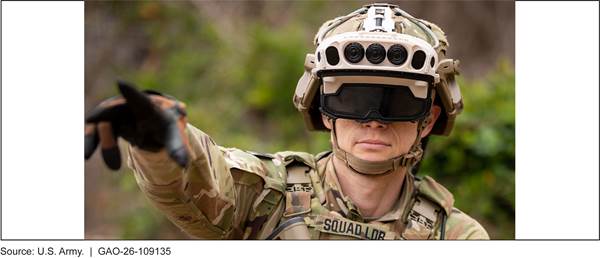
In weapon systems acquisition, waste is not merely about individual overpriced parts; it is the systemic loss of billions of dollars and decades of time. Since 1990, the Department of Defense’s (DOD) costliest weapon programs have wasted billions while often failing to deliver a usable capability to the field. For example, the Army’s Integrated Visual Augmentation program—intended to provide augmented-reality headgear for soldiers for close combat—has yet to deliver operational capability after three different acquisition efforts over the last 8 years. Though the program produced nearly 10,000 units of the first two versions, they do not meet soldiers’ needs and will go into storage, with some potentially used for testing, rather than into the field.
GAO's decades-long body of work on DOD acquisition consistently shows that waste
in these programs occurs when they are structured to “fail slow” as DOD pours time
and money into efforts that stagnate while global technology accelerates. DOD
is incentivized to award massive development contracts and obligate funds
quickly to ensure the budget is not “lost” to another program. Success is often
measured by money spent, not capability delivered. As a result, the expected
time frame for major programs to deliver an initial capability now exceeds 12
years. Every month of delay in a weapon system acquisition program causes a
warfighter to rely on aging, less-capable equipment for longer.
In contrast, leading commercial companies iteratively develop business cases to respond to users’ needs and finish fast, helping them stay on budget. They reassess business cases regularly to avert problems sooner. They also ramp up investments as products demonstrate progress. (See GAO-25-107130.)
However, DOD has yet to fully adopt these leading practices because acquisition policies do not treat iterative development as a founding principle for all weapon system acquisitions programs. As noted in its November 2025 policy memorandum aimed at revamping the defense acquisition system, DOD now plans to maximize acquisition flexibility, among other changes. GAO will continue to assess DOD’s efforts.
Why GAO Did This Study
DOD plans to invest over $2.4 trillion to develop and acquire its costliest weapon systems. The need for smart spending and increased urgency and innovation for these acquisitions are national imperatives to help DOD maintain a competitive edge over adversaries. But DOD continues to struggle with delivering timely, cost-effective solutions to the warfighter, and slow, linear development approaches persist.
GAO has reported for decades on the persistent issues that plague these weapon programs and on leading practices that commercial companies use to avoid these issues.
GAO was asked to discuss issues related to waste in DOD weapon systems acquisition. This report, which GAO prepared for a subcommittee roundtable, addresses (1) the wasteful DOD practices that lead to undesirable weapon system acquisition program outcomes and (2) leading commercial practices that, if thoughtfully applied, could reduce waste and improve outcomes.
GAO based this report predominantly on prior work, including recent reports on leading practices for product development and prior GAO reports on weapon systems acquisitions.
What GAO Recommends
Over the years, GAO has made hundreds of recommendations to DOD to help improve outcomes in its weapon system programs. DOD has yet to implement many of these recommendations. GAO will continue to monitor DOD’s progress in addressing the recommendations.
|
Abbreviations |
|
DOD Department of Defense |
|
FAR Federal Acquisition Regulation |
|
GPS Global Positioning System |
|
IVAS Integrated Visual Augmentation System |
|
MVP minimum viable product |
|
OCX Next Generation Operational Control System |
|
SBMC Soldier Borne Mission Command |
This is a work of the U.S. government and is not subject to copyright protection in the United States. The published product may be reproduced and distributed in its entirety without further permission from GAO. However, because this work may contain copyrighted images or other material, permission from the copyright holder may be necessary if you wish to reproduce this material separately.
June 9, 2026
The Honorable Tim Burchett
Chairman
The Honorable Melanie Stansbury
Ranking Member
Subcommittee on Delivering on Government Efficiency
Committee on Oversight and Government Reform
House of Representatives
Since 1990, we have included Department of Defense (DOD) weapon systems acquisition as an area on our High-Risk List, updated at the start of each new Congress, of programs and operations with serious vulnerabilities to waste, fraud, abuse, or mismanagement, or in need of transformation.[1] We have also issued numerous reports over the years and made hundreds of recommendations—many that went or remain unimplemented—to reduce waste and improve DOD’s performance in this area.
DOD now plans to invest over $2.4 trillion in its costliest weapon programs. However, because the department remains alarmingly slow in delivering capabilities, these investments are at high risk of becoming obsolete before they even reach the field. The expected time frame for major programs to deliver an initial capability now totals over 12 years. In a global landscape where commercial technology cycles are measured in months, this “fail slow” pace is a recipe for delivering yesterday’s solutions to tomorrow’s threats.
In weapon systems acquisition, waste is not merely about individual overpriced parts; it is the systemic loss of billions of dollars and decades of time. It occurs when programs are structured to “fail slow” rather than succeed quickly, pouring capital into efforts that remain on the drawing board while technology moves past them. The waste that DOD regularly accepts would be intolerable in the commercial marketplace. Imagine a company attempting to build a “Smartphone of the Future.” They hire thousands of engineers and spend $10 billion over a decade, never releasing a prototype or testing it with actual users. By the time they “finish” and ship the phone, the screen technology is two generations behind, the battery is inefficient compared with current standards, and the software is incompatible with modern apps. The “waste” is not just the $10 billion—it is the 10 years of lost relevance and revenue while competitors moved through five generations of better products.
Taxpayers deserve a better return on their investment than DOD weapon systems acquisition currently delivers. Any rationale that “because this is the government, it has to be inefficient” should be unacceptable—particularly when it comes to providing capabilities for our national defense. You asked us to discuss issues related to DOD weapon systems acquisition waste. This report, which we prepared for a subcommittee roundtable, addresses (1) the wasteful DOD practices that lead to undesirable weapon system acquisition program outcomes and (2) leading commercial practices that, if thoughtfully applied, could reduce waste and improve outcomes.
This report is based predominantly on our body of issued reports since 2022 on (1) DOD weapon system acquisition policies, plans, programs, and outcomes and (2) leading practices in product development. For those reports, we analyzed relevant documentation, conducted site visits, and interviewed cognizant officials or representatives; more detailed information can be found in the issued reports. For statements related to the Army’s Integrated Visual Augmentation System (IVAS), Space Force’s Next Generation Operational Control System (OCX), and the Air Force’s LGM-35A Sentinel (Sentinel), we summarized DOD-reviewed information that we plan to include in our upcoming weapon systems annual assessment report later this summer.
We conducted our work from April 2026 to June 2026 in accordance with all sections of GAO’s Quality Assurance Framework that are relevant to our objectives. The framework requires that we plan and perform the engagement to obtain sufficient and appropriate evidence to meet our stated objectives and to discuss any limitations in our work. We believe that the information and data obtained, and the analysis conducted, provide a reasonable basis for any findings and conclusions in this product.
Weak Business Cases Underpin “Fail Slow” Approach and Result in Billions Wasted
Continued Underperformance Carries Significant Opportunity Costs
Our prior work has consistently found that DOD weapon system acquisition programs often are not underpinned by a sound business case—the balance of technologies, design knowledge, funding, and time needed to transform warfighter needs into a product.[2] The reasons why DOD accepts flawed business cases are both structural and cultural in nature. Poor acquisition decisions are compounded by a budget planning process that requires DOD to secure long-range funding commitments before a program’s business case is fully understood. The current process incentivizes “starting fast”—awarding massive development contracts quickly, often in the name of preserving the industrial base, and obligating funds rapidly to ensure the budget is not “lost” to another program. Success is all too often measured by activity (money spent), not by outcomes (capability delivered).
Further, most program business cases are based on a slow, linear path that seeks to “manage” risk over a decade. Relying on paperwork and promises rather than actual product performance, they progress through early milestone reviews with incomplete knowledge and overly optimistic assumptions while keeping the appearance of being “on track.” As development progresses and these initial business cases predictably begin to erode, weapon system acquisition programs come under pressure to control growing costs and schedules. This has generally entailed reducing planned quantities, scaling back promised capabilities, and accepting delivery of deficient systems years late. In other words, DOD can pay the same or more to get less than planned, sometimes years later than expected.
Beyond the financial costs, the opportunity costs associated with this underperformance are also substantial. Every month of delay in a weapon system acquisition program causes a warfighter to rely on aging, less capable equipment for longer. Navy shipbuilding programs exemplify these wasteful delays. Our analysis of Navy shipbuilding documentation shows that, as of February 2026, eight of the Navy’s major shipbuilding programs now estimate delays that will cause ship deliveries to occur later than their contracted delivery dates. Five of these programs each have at least one ship no fewer than 42 months delayed.[3] This waste of time is a waste of our competitive advantage.
Delays in new programs, such as the Air Force’s KC-46 tanker, also force DOD to spend billions on service life extension efforts to keep 40- or 50-year-old legacy systems, such as the Air Force’s KC-135 tankers, functioning.[4] This, in turn, means the defense industrial base has to divide its attention between patching up the old rather than developing the new. For Navy ships, delays in new programs cause the fleet to have to drive current ships, such as Wasp-class amphibious assault ships (LHD 1), longer and harder, often deferring planned maintenance and potentially spending billions later to extend ship service lives.[5] This all creates a vicious cycle: DOD spends money on the old and (often) obsolete because the new is late, which leaves less money to fix the problems that make the new programs late.
Wasteful Programs Come in All Shapes and Sizes
Weapon systems acquisition waste can be found across every military department and in programs intended to deliver small capabilities worn by warfighters all the way up to programs that seek to deliver some of DOD’s largest capital assets, such as nuclear ballistic missiles and warships. Below are several recent examples of weapon system acquisition programs characterized by their wasteful investments.

· Integrated Visual Augmentation System (IVAS): The Army’s estimated $1.8 billion IVAS program—intended to provide augmented-reality headgear for soldiers for close combat—has yet to deliver operational capability after three different acquisition efforts and system versions developed since 2018. Though the program produced nearly 10,000 units of the first two versions, they have fallen short of soldiers’ needs and will go into storage, with some potentially used for testing, rather than to the field, according to program officials. Meanwhile, the Army plans to begin a new rapid prototyping program—Soldier Borne Mission Command (SBMC)—to develop a new capability.
· Next Generation Operational Control System (OCX): The Space Force’s OCX program was a software-centric system intended to replace the existing Global Positioning System (GPS) ground control system. In April 2026, after spending over 13 years in development and more than $7 billion, the Space Force terminated OCX based on low confidence that the program could deliver sufficient capability in time to meet operational needs. Instead, the Space Force plans to rely on enhancements to the existing ground system to continue operating the GPS satellite constellation. Further, the cancelation means that GPS satellites already in orbit cannot be fully utilized for some of their most advanced capabilities.

· LGM-35A Sentinel (Sentinel): The Air Force’s Sentinel program is intended to replace the Minuteman III intercontinental ballistic missile system. Though the program started development in 2020, the Air Force is now restructuring Sentinel following a critical program acquisition unit cost breach reported to Congress in January 2024. In June 2025, we reported Sentinel’s total estimated acquisition costs at the time were more than $129 billion, an increase of nearly $35 billion from the program’s initial estimate.
· FFG 62 Constellation Class Frigate (FFG 62): The Navy’s FFG 62 program planned to develop and deliver 20 small-surface combatants. Following several years of slower-than-expected progress and uncertain costs, the Navy announced the termination of work on four of the six ships that were under contract in November 2025.[6] As we previously reported, the Navy had exercised contract options valued at over $3.4 billion to construct six ships before completing the frigate’s basic and functional design—an approach counter to shipbuilding leading practices. According to senior Navy officials, the other two ships remain under construction but are also under review, including assessments of what capability, if any, will result from the ships. The Navy now plans to acquire a new frigate, FF(X), marking its third attempt at a viable, small-surface combatant program.
· F-35 Joint Strike Fighter (F-35): The DOD’s F-35 program includes a family of fifth-generation strike fighter aircraft that integrates low-observable (stealth) technology with advanced sensors and computer networking capabilities. DOD completed the final phase of the original F-35 development program in March 2024—over a decade later and at a cost of $250 billion more than originally planned. DOD is now upgrading F-35 capabilities to meet evolving warfighter needs and implement technology innovations under modernization efforts. In recent years, the program paid contractors hundreds of millions of dollars in incentive fees that were intended to improve on-time delivery. However, the structure of on-time delivery incentives allowed the contractor to deliver aircraft up to 60 days late and still earn some of the fee.[7]
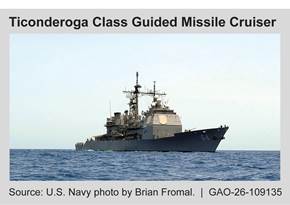
· Ticonderoga class cruisers: Since 2015, the Navy has spent about $3.7 billion modernizing seven of the Ticonderoga class guided-missile cruisers—large-surface combatants that provide key air defense capabilities. However, only three of the seven ships will complete modernization, and none will gain the intended 5 years of service life. The Navy wasted $1.84 billion to begin modernizing four cruisers that have now been divested prior to deploying and provide no operational value to the Navy.[8]
Leading Practices Offer a New Approach to Help Drive Out Waste and Deliver Needed Capabilities Faster
Leading Practices Emphasize Finishing Fast
In a series of reports dating back to 2022, we have found that leading product development companies employ a series of business- and technical-related practices to accelerate their product delivery timelines.[9] Iterative development is at the heart of how these leading companies successfully deliver innovative, relevant, essential products to users on timelines that are responsive to those users’ needs.
Leading companies iteratively develop their business cases for individual products. This is a departure from the traditional business case process that locks in a new product’s cost, schedule, and performance baseline from the start, like DOD regularly uses. Instead, leading companies systematically reassess business cases’ key elements—market and user needs, product definition, internal value, and target schedule—at least every 6 months to avert problems sooner. This allows them to “off-ramp” or pivot away from failing ideas and immature technologies early. They make investments only as products demonstrate progress and business cases warrant further funding. For example, they reserve the largest allocations until they have validated a design for the minimum viable product (MVP)—one that includes the minimum capabilities needed for customers to recognize value. This focus on delivering MVPs and anticipation of subsequent iterations mean that programs do not need to include all the possible technologies on a single platform. Instead, leading companies prioritize the ones that are most needed and ready, and incorporate others into later product iterations as those technologies mature.
Further, leading companies employ a forward-looking, agile approach to managing the overall mix of products, or product portfolios, through recurring processes. As part of this approach, leading companies continually interact with product business cases. For example, based on regular assessments of business case data, portfolio managers may decide to add resources to improve weaker performing products or discontinue outdated products that impede demand for updated versions. Continually updating portfolios based on business case data enables leading companies to optimize their investments and ensure portfolios are responsive to the company’s strategic vision and evolving user needs. As a result, there are fewer instances for a company to “fail slow” in the sense of spending significant time and resources on an effort that ultimately does not make it into users’ hands. Instead, companies can “fail fast” by stopping non-viable efforts before major investments; redirecting efforts if appropriate; or pausing them until a later time when market and other conditions are more favorable.
These business processes support and enable an iterative technical process that leading companies use to rapidly design, validate, and deliver products. In this process, knowledge about a product’s design is progressively refined and stored in a digital thread—a common source of information that helps stakeholders make decisions, like determining product requirements, throughout the product’s life. This digital thread connects data generated by product developers, testers, manufacturers, and users across the three cycles of iterative product development, summarized below. Of note, these cycles often overlap as a product design undergoes continuous user engagement and testing:
· Design modeling and simulation: In this cycle, product teams feed technical data from fast, iterative design cycles into the digital thread. Stakeholders, including users, engineers, and manufacturers and suppliers, use this information to confirm that the team has captured the right requirements and is on track to meet them.
· Validation: Leading companies validate the product design using prototypes, including combinations of physical and digital prototypes. This prototyping incorporates all hardware and software components to test the product’s integrated functionality in its operating environment. Leading companies do this by developing virtual representations of physical products—a process known as digital twinning—or by using 3D-printed parts to test performance.
· Production and delivery: Leading companies develop a product design to the point that it satisfies user requirements for a MVP. Product teams then stop designing hardware for the given MVP and prepare parts for production, recognizing that they can add functionality through software updates later. Companies use digital twinning to understand optimal factory design and manufacturing processes before the design enters production.
DOD Policies and Culture Have Yet to Fully Embrace Leading Practices
The department is still trying to develop 21st-century innovations with 20th-century oversight frameworks. For several years, DOD leaders and Congress have called on the defense acquisition community to be faster and more responsive in delivering the capabilities that warfighters need.[10] As our work has shown, however, these calls have gained only limited traction to date within DOD. The reasons for the ongoing disconnect are rooted in both policy and culture.[11] For starters, relevant acquisition policies treat iterative development as an approach to only primarily use for software acquisition, rather than as an underpinning principle on which all weapon system acquisition programs should be founded. In reports we issued in March 2022, February 2023, and December 2024, we made a series of recommendations aimed at holistically strengthening numerous DOD-wide and military services’ acquisition policies by incorporating iterative development-related leading practices.[12] To date, nearly all these recommendations remain unimplemented by DOD.
Nonetheless, DOD has begun to implement some critical acquisition changes. In November 2025, the Secretary of Defense issued a policy memorandum calling for DOD to revamp the traditional defense acquisition system in an effort to aggressively prioritize the timely and urgent delivery of operational capabilities to warfighters.[13] According to the memorandum, DOD plans to do this by rebuilding the industrial base, empowering the workforce, and maximizing acquisition flexibility, among other things. Further, that same month, the Secretary issued a separate policy memorandum directing the disestablishment of DOD’s system for developing weapon system requirements, known as the Joint Capabilities and Integration Development System. In this memorandum, the Secretary also directed the Secretaries of each military department to launch reviews of their respective military service’s requirements processes within 90 days, identifying reforms to expedite outcomes, strengthen force design, enhance industry engagement, and enable experimentation-led approaches.[14]
It is too soon for us to see any tangible results from these recent policy changes, although we continue to closely monitor DOD’s progress through our ongoing work. This work includes our 2026 Weapon Systems Annual Assessment, which we plan to issue this summer, and a second report we plan to issue this fall that will evaluate DOD’s implementation of requirements- and portfolio management-related reforms. Ultimately, policy changes will only succeed if DOD is able to change its acquisition culture to embrace iterative development as the primary enabler for delivering innovative, relevant weapon systems to warfighters faster. To curb waste, DOD must also empower acquisition leaders—at both the program and portfolio levels—to “fail fast” and pivot resources. Continuing to fund a failing program that seeks to implement risk mitigation and recovery plans to achieve requirements that it otherwise recognizes are unachievable is not “staying the course.” It is throwing good money after bad—or “failing slow.” Similarly, delivering a weapon system that meets all its technical parameters is not useful if that weapon system has not kept pace with evolving warfighter needs and technology changes that have occurred since it began development. This situation becomes more problematic when that weapon system has not been designed with modular open systems that can be readily upgraded.[15] Instead, an innovative, iteratively-focused defense acquisition culture would be one that defines success by the speed at which it delivers a functioning, relevant capability to the warfighter, not the speed at which a program awards a contract or spends its budget. Anything else is a waste of the nation’s resources and undermines its security.
We are sending copies of this report to the appropriate congressional committees, the Secretary of Defense, and other interested parties. In addition, the report is available at no charge on the GAO website at https://www.gao.gov.
If you or your staff have any questions about this report, please contact me at OakleyS@gao.gov. Contact points for our Offices of Congressional Relations and Media Relations may be found on the last page of this report. GAO staff who made key contributions to this report are listed in appendix I.
Shelby S. Oakley
Director, Contracting and National Security Acquisitions
GAO Contact
Shelby S. Oakley, OakleyS@gao.gov
Staff Acknowledgments
In addition to the contact named above, Erin Carson (Assistant Director), Brenna Derritt (Assistant Director), Christopher R. Durbin (Assistant Director), Matt McKnight (Analyst-in-Charge), Rose Brister, Lori Fields, Scott Hepler, Mark Oppel, Andrew Redd, and Alyssa Weir were key contributors to this report.
The Government Accountability Office, the audit, evaluation, and investigative arm of Congress, exists to support Congress in meeting its constitutional responsibilities and to help improve the performance and accountability of the federal government for the American people. GAO examines the use of public funds; evaluates federal programs and policies; and provides analyses, recommendations, and other assistance to help Congress make informed oversight, policy, and funding decisions. GAO’s commitment to good government is reflected in its core values of accountability, integrity, and reliability.
Obtaining Copies of GAO Reports and Testimony
The fastest and easiest way to obtain copies of GAO documents at no cost is through our website. Each weekday afternoon, GAO posts on its website newly released reports, testimony, and correspondence. You can also subscribe to GAO’s email updates to receive notification of newly posted products.
Order by Phone
The price of each GAO publication reflects GAO’s actual cost of production and distribution and depends on the number of pages in the publication and whether the publication is printed in color or black and white. Pricing and ordering information is posted on GAO’s website, https://www.gao.gov/ordering.htm.
Place orders by calling (202) 512-6000, toll free (866) 801-7077,
or
TDD (202) 512-2537.
Orders may be paid for using American Express, Discover Card, MasterCard, Visa, check, or money order. Call for additional information.
Connect with GAO
Connect with GAO on X,
LinkedIn, Instagram, and YouTube.
Subscribe to our Email Updates. Listen to our Podcasts.
Visit GAO on the web at https://www.gao.gov.
To Report Fraud, Waste, and Abuse in Federal Programs
Contact FraudNet:
Website: https://www.gao.gov/about/what-gao-does/fraudnet
Automated answering system: (800) 424-5454
Media Relations
Sarah Kaczmarek, Managing Director, Media@gao.gov
Congressional Relations
David A. Powner, Acting Managing Director, CongRel@gao.gov
General Inquiries
[1]GAO, High-Risk Series: Heightened Attention Could Save Billions More and Improve Government Efficiency and Effectiveness, GAO‑25‑107743 (Washington, D.C.: Feb. 25, 2025).
[2]For example, see GAO, Weapon Systems Annual Assessment: Challenges to Fielding Capabilities Faster Persist, GAO‑22‑105230 (Washington, D.C.: June 8, 2022).
[3]GAO, Navy And Coast Guard Shipbuilding: A Disciplined, Strategy-Driven Approach Is Needed to Achieve Ambitious Goals, GAO‑26‑109068 (Washington, D.C.: Apr. 22, 2026).
[4]GAO, Weapon System Sustainment: Aircraft Mission Capable Goals Were Generally Not Met and Sustainment Costs Varied by Aircraft, GAO‑23‑106217 (Washington, D.C.: Nov. 10, 2022).
[5]GAO, Amphibious Warfare Fleet: Navy Needs to Complete Key Efforts to Better Ensure Ships Are Available for Marines, GAO‑25‑106728 (Washington, D.C.: Dec. 3, 2024).
[6]This work was terminated by the Navy for convenience. When exercised, a termination for convenience clause allows the government to completely or partially terminate the performance of work under a contract when it is in the government’s interest. See Federal Acquisition Regulation (FAR) 2.101. The FAR is currently undergoing a complete overhaul. Executive Order 14275 directs the Office of Federal Procurement Policy to reduce the FAR to what is required by statute and is necessary for streamlined and efficient federal procurement. Exec. Order No. 14275, 90 Fed. Reg. 16,447 (Apr. 15, 2025).
[7]GAO, F‑35 Joint Strike Fighter: Actions Needed to Address Late Deliveries and Improve Future Development, GAO‑25‑107632 (Washington, D.C.: Sept. 3, 2025).
[8]GAO, Navy Ship Modernization: Poor Cruiser Outcomes Demonstrate Need for Better Planning and Quality Oversight in Future Efforts, GAO‑25‑106749 (Washington, D.C.: Dec. 17, 2024). DOD uses the term divest to mean retiring a ship before the end of its expected service life.
[9]See GAO, Leading Practices: Agency Acquisition Policies Could Better Implement Key Product Development Principles, GAO‑22‑104513 (Washington, D.C.: Mar. 10, 2022); GAO, Leading Practices: Iterative Cycles Enable Rapid Delivery of Complex, Innovative Products, GAO‑23‑106222 (Washington, D.C.: July 27, 2023); and GAO, Leading Practices: Agile Portfolio Management and Iterative Business Cases Drive Innovative Product Development, GAO‑25‑107130 (Washington, D.C.: Sept. 17, 2025).
[10]Among these calls for change, the National Defense Authorization Act for Fiscal Year 2026, Pub. L. 119-60 (2025), included several major reforms to defense acquisition, including establishment of “portfolio acquisition executives” with authority for plans, budgets, and execution of programs assigned to a portfolio of capabilities. The Act also required these executives to employ iterative development cycles with the authority to modify, discontinue, or terminate the development of capabilities—an activity consistent with our leading practices.
[11]For prior GAO work discussing how leading practices from industry can be thoughtfully applied in government contexts, even when cultural and structural differences yield different sets of incentives and priorities, see GAO‑22‑104513.
[12]See GAO‑22‑104513; GAO, Middle-Tier Defense Acquisitions: Rapid Prototyping and Fielding Requires Changes to Oversight and Development Approaches, GAO‑23‑105008 (Washington, D.C.: Feb. 7, 2023); and GAO, DOD Acquisition Reform: Military Departments Should Take Steps to Facilitate Speed and Innovation, GAO‑25‑107003 (Washington, D.C.: Dec. 12, 2024).
[13]Department of Defense, Office of the Secretary of Defense memorandum, Transforming the Defense Acquisition System into the Warfighting Acquisition System to Accelerate Fielding of Urgently Needed Capabilities to Our Warriors (Nov. 7, 2025).
[14]Department of Defense, Office of the Secretary of Defense memorandum, Reforming the Joint Requirements Process to Accelerate Fielding of Warfighting Capabilities (Nov. 7, 2025).
[15]GAO, Weapon Systems Acquisition: DOD Needs Better Planning to Attain Benefits of Modular Open Systems, GAO‑25‑106931 (Washington, D.C.: Jan. 22, 2025).