
Report to the Committee on Armed Services, House of Representatives
United States Government Accountability Office
A report to the Committee on Armed Services, House of Representatives
Contact: Diana Maurer at maurerd@gao.gov
What GAO Found
The Air Force’s metrics for aircraft availability and mission capability do not provide a complete picture of the KC-135 and KC-46A tanker fleet’s ability to meet its primary refueling mission. The tanker fleet did not meet the Air Force’s availability and capability standards from fiscal year 2019 through fiscal year 2025, but these metrics do not specifically account for the aircraft’s ability to meet the primary refueling mission. The Air Force also calculates a “fully mission capable” (FMC) rate to measure the fleet’s ability to meet all its missions, which decreased substantially during that 7-year period. According to Air Force officials, while FMC is a clear indicator of an aircraft’s ability to meet its primary refueling mission, it excludes non-FMC aircraft that may be able to meet the refueling mission but not other missions. Without metrics and standards focused on the aerial refueling mission specifically, the Air Force risks not having a clear understanding of the fleet’s ability to meet key operational requirements.
Air Force officials identified sustainment risks for the KC-135 and KC-46A fleets, but the Air Force has not comprehensively assessed these risks or developed a plan to mitigate them. The sustainment risks included shortages of critical parts and skilled maintainers and infrastructure limitations. The Air Force has taken some actions to address these risks, including identifying alternative sources for parts and upgrading infrastructure. However, conducting a comprehensive assessment of risks associated with sustaining the fleet and developing a mitigation plan to address these risks based on their likelihood or impact would help the Air Force target scarce resources to areas of greatest risk and enhance the health of the aerial refueling tanker fleet.
Why GAO Did This Study
The Air Force’s aerial refueling tanker fleet—capable of transferring fuel from airborne tankers to aircraft while in flight—is the largest in the world and plays a critical role in air mobility operations.
House Report 118-529, accompanying a bill for the National Defense Authorization Act for Fiscal Year 2025, included a provision for GAO to assess the Air Force’s refueling capabilities and sustainment of the aerial refueling fleet. Among other objectives, this GAO report addresses the extent to which the fleet meets the Air Force’s current and future needs, and the extent to which the Air Force has assessed risks and developed mitigation plans associated with sustaining the KC-135 and KC-46A aerial refueling aircraft.
GAO reviewed Air Force data on the composition and performance of the aerial refueling fleet, reviewed agency documentation, contacted 16 units across 11 bases, and interviewed relevant Department of Defense and Air Force officials. This is a public version of a sensitive report GAO issued in May 2026. This version omits information DOD deemed to be Controlled Unclassified Information.
What GAO Recommends
GAO made four recommendations, including that the Air Force use metrics and standards that specifically assess the aerial refueling tanker fleet’s ability to meet its primary refueling mission; conduct a comprehensive assessment of sustainment risks associated with the aerial refueling tanker fleet; and develop a mitigation plan based on the results of that assessment. The Air Force concurred with GAO’s recommendations.
|
Abbreviations |
|
|
|
|
|
AA |
aircraft availability |
|
CCM |
Common Computing Module |
|
DLA |
Defense Logistics Agency |
|
DOD |
Department of Defense |
|
FMC |
fully mission capable |
|
IOC |
Input Output Concentrator |
|
MAJCOM |
major command |
|
MC |
mission capable |
This is a work of the U.S. government and is not subject to copyright protection in the United States. The published product may be reproduced and distributed in its entirety without further permission from GAO. However, because this work may contain copyrighted images or other material, permission from the copyright holder may be necessary if you wish to reproduce this material separately.
June 10, 2026
The Honorable Mike Rogers
Chairman
The Honorable Adam Smith
Ranking Member
Committee on Armed Services
House of Representatives
The Air Force’s aerial refueling tanker fleet is the largest in the world. The fleet is a critical part of air mobility operations and the U.S. military’s ability to extend the range of its aircraft through air-to-air refueling.[1] The fleet must be ready to mobilize from all types of domestic and international airfields to conduct refueling operations for U.S. military aircraft in support of commanders’ operational plans around the globe. We previously reported that the Air Force entered into a contract with Boeing in 2011 to develop and field the KC-46A Pegasus aircraft to recapitalize a portion of its legacy fleet.[2]
House Report 118-529, accompanying a bill for the National Defense Authorization Act for Fiscal Year 2025, includes a provision for us to assess the Air Force’s aerial refueling capabilities and its sustainment of its tankers.[3] This report addresses 1) how the composition of the Air Force’s aerial refueling tanker fleet has changed since 2019; and the extent to which 2) the Air Force’s aerial refueling tanker fleet meets its current and future needs, and 3) the Air Force has assessed risks and developed mitigation plans associated with sustainment of its KC-135 and KC-46A aerial refueling aircraft.
This report is a public version of the sensitive report that we issued in May 2026.[4] DOD deemed some of the information in the prior report to be Controlled Unclassified Information, which must be protected from public disclosure. Therefore, we omit information in this report pertaining to aircraft availability, mission capable standards and rates, fully mission capable rates, as well as certain information related to the implications of parts shortages for the KC-135 aerial refueling tanker fleet. Although the information provided in this report is more limited, we address the same objectives as those in the sensitive report and use the same methodology.
Our scope included active-duty Air Force, Air National Guard, and Air Force Reserve organizations with responsibilities for the operation and sustainment of aerial refueling aircraft. To conduct our work, we reviewed Air Force data on the total inventory of aerial refueling tankers, as well as their availability and capability from fiscal years 2019 through fiscal year 2025. We also reviewed documentation related to composition and sustainment of the aerial refueling tanker fleet. Additionally, we interviewed officials with responsibilities for the management, operation, and sustainment of the Air Force’s aerial refueling tankers, including officials from the Department of Defense (DOD), Joint Staff, joint commands, and the Department of the Air Force. Within the Air Force, we spoke with headquarters, major command, and program office officials. We also discussed operation and sustainment of the aerial refueling tanker fleet with officials from a nongeneralizable sample of 16 units across 11 bases. We compared information we obtained to relevant DOD and Air Force guidance, Standards for Internal Control in the Federal Government, and GAO’s enterprise risk management principles.[5] Appendix I includes additional information on our scope and methodology.
We conducted this performance audit from September 2024 to May 2026 in accordance with generally accepted government auditing standards. Those standards require that we plan and perform the audit to obtain sufficient, appropriate evidence to provide a reasonable basis for our findings and conclusions based on our audit objectives. We believe that the evidence obtained provides a reasonable basis for our findings and conclusions based on our audit objectives.
Background
Air Force Organization and Units
The Air Force is generally organized into headquarters staff and major commands (MAJCOMs). Headquarters, Air Force, is composed of two major entities—the Secretariat and the Air Staff. As head of the Secretariat, the Secretary of the Air Force is responsible for organizing, training, and equipping the Air and Space Forces, as well as overseeing the annual budget and providing forces to combatant commanders, among other tasks. The Air Staff is headed by the Chief of Staff of the Air Force and is responsible for providing plans, recommendations, and advice on a variety of topics to the Secretary of the Air Force, among other tasks.[6]
The 10 active MAJCOMs are responsible for the administration, training, and readiness of their subordinate forces, including the aerial refueling fleet.[7] For example, Air Force Materiel Command is responsible for sustainment for every major Air Force weapon system—including its fleet of aerial refueling tankers—while Air Mobility Command, U.S. Transportation Command’s Air Force Component, has command responsibilities for the Air Force’s aerial refueling tanker fleet and executes the majority of DOD’s inter-theater airlift and aerial refueling missions.[8]
In descending order of command, MAJCOM elements include such units as numbered air forces, wings, groups, and squadrons that include personnel, equipment, and aircraft. These entities support base operations or specialized missions, among other tasks. For example, the wings are the basic units for generating and employing Air Force combat capability.
Selected Sustainment Organizations
Various Air Force entities have roles and responsibilities for sustaining the Air Force’s weapon systems, including the aerial refueling tanker fleet (see table 1).
Table 1: Selected Air Force Entities with Roles and Responsibilities for Sustaining the Aerial Refueling Tanker Fleet
|
Selected Air Force entities |
Roles and responsibilities |
|
Office of the Deputy Assistant Secretary of the Air Force for Logistics and Product Support |
Responsible for the oversight of product support, supply chain materiel management, materiel maintenance, and support functions required throughout the life cycle of weapon systems. Focuses on ensuring that weapon system sustainment levels meet warfighter needs. |
|
Office of the Deputy Chief of Staff for Logistics, Engineering, and Force Protection (A4) |
Responsible for leadership, management, and integration of Air Force logistics readiness and aircraft, munitions, and missile maintenance, among other areas. |
|
Air Force Materiel Command |
Manages sustainment for every major Air Force weapon system (including its fleet of aerial refueling tankers). It also oversees · the Air Force Sustainment Center, responsible for sustainment of air and space weapon systems, including the KC-135 and KC-46A, through depot maintenance and supply chain management; and · the Air Force Life Cycle Management Center, responsible for the life cycle management of Air Force weapon systems, including the KC-135 and KC-46A, from inception to retirement. |
|
Air Mobility Command |
Provides airlift, aerial refueling, aeromedical evacuation, global aerial mobility support, and global command and control to project, connect, maneuver, and sustain the Joint Force in support of national objectives. |
Source: Department of Defense and Air Force information. | GAO‑26‑109154
Outside of the Air Force, the Defense Logistics Agency (DLA) manages the defense supply chain—from raw materials to end-user disposition—for all military services, combatant commands, and other federal, state, and local agencies.
Tanker Fleet Missions and Aircraft Capabilities
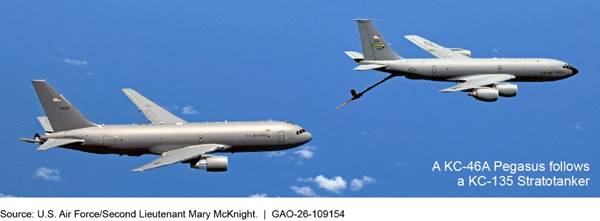
The Air Force’s aerial refueling tanker fleet includes the KC-135 Stratotanker, which was first deployed in August 1956 and entered service in June 1957, and the more recently acquired KC-46A Pegasus aircraft (see fig. 1).[9] It previously included KC-10 aircraft, which the Air Force retired in 2024.[10] As of early March 2026, the Air Force reported 373 KC-135s and 103 KC-46As, slightly more than the 466 minimum aerial refueling tankers previously required by statute.[11]
The tanker fleet’s primary mission is to provide aerial refueling capabilities to U.S. and allied aircraft. The tanker fleet’s other missions include aeromedical evacuation and personnel and cargo transportation. The aerial refueling tanker fleet supports ongoing air mobility operations and must be prepared to refuel U.S. military aircraft in the event of a conflict. Air Force personnel from active, Air Force Reserve, and National Guard units fly and maintain the aerial refueling aircraft.
The KC-135 has provided the Air Force’s core aerial refueling capability to Navy, Marine Corps, allied nation, and its own aircraft for more than 60 years. Since 2019, the Air Force has added the KC-46A, which provides improved refueling, cargo, and aeromedical evacuation capabilities.[12] For example, KC-46As can refuel two aircraft simultaneously and be refueled in flight. However, the aerial refueling capacity among the aircraft varies. According to Air Force documentation and as shown in figure 2, the legacy KC-10 aircraft had a maximum fuel capacity of 356,000 pounds, while that capacity is 200,000 pounds and 212,299 pounds for KC-135 and KC-46A aircraft, respectively.
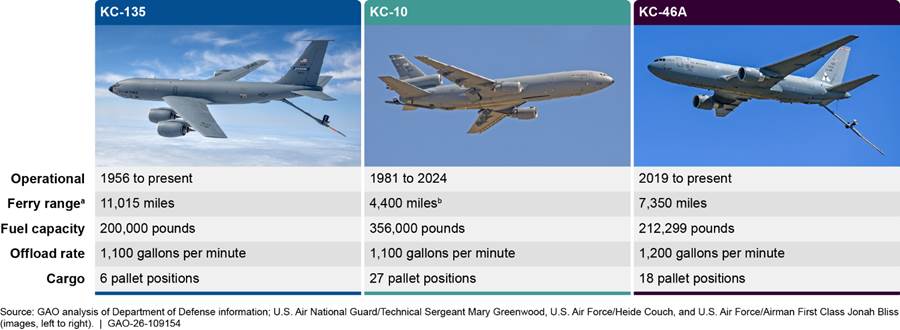
aFerry range refers to the maximum distance an aircraft can fly between takeoff and landing without adding fuel, according to Air Force officials.
bThe range for KC-10 assumes 75 passengers and 170,000 pounds of cargo, according to Air Force officials.
Air Force’s Availability and Capability Metrics
The Air Force uses the aircraft availability (AA) metric, among others, to convey the readiness of its aircraft, including aerial refueling tankers. Aircraft availability refers to the percentage of all aircraft in the fleet that are available for flight operations, including aircraft that may be awaiting depot-level maintenance or in storage. Another performance metric, the mission capable (MC) rate, is the percentage of aircraft a unit possesses that can fly at least one mission.
In addition to aircraft availability and mission capable metrics, the Air Force’s fully mission capable (FMC) rate measures the ability of the aircraft to fulfill all required missions. Therefore, mission capable aircraft that could meet some of its missions would not be considered FMC if it cannot meet all of them.[13]
The Air Force Changed the Composition of the Aerial Refueling Tanker Fleet, but Experienced Fielding Challenges
The Composition of the Aerial Refueling Fleet Has Changed Since Fiscal Year 2019
Since fiscal year 2019, the Air Force has changed the size and composition of its aerial refueling tanker fleet, primarily by divesting the KC-10 tanker fleet and gradually fielding the KC-46A aircraft. Specifically, the Air Force divested all 59 KC-10s, retired 21 KC-135s, and fielded 84 newly acquired KC-46As from fiscal year 2019 through fiscal year 2025. Changes in the Air Force fleet are shown in figure 3.
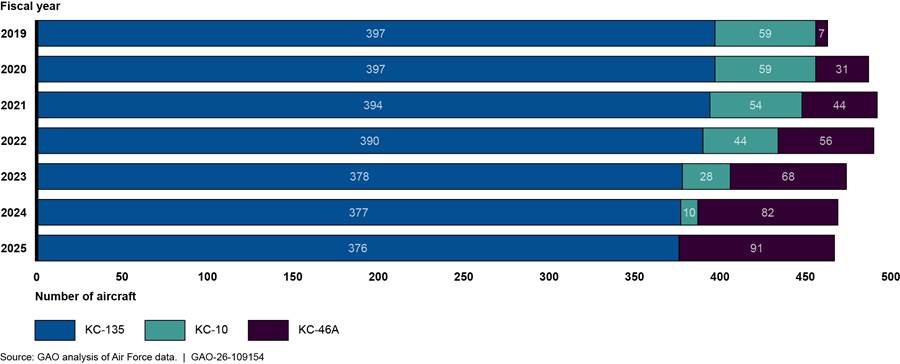
Notes: According to Air Force officials, the number of aircraft reflects fiscal year averages calculated at the end of the fiscal year, and these numbers fluctuate throughout the year. The data provided by Air Force officials showed that, as of early March 2026, the Air Force reported 373 KC-135s and 103 KC-46As in its aerial refueling tanker inventory. Officials expected the composition of the fleet to change to 365 KC-135s and 113 KC-46s by the end of the fiscal year as new KC-46As become available.
The Air Force’s fielding of the KC-46A aircraft presented enhanced capabilities to the aerial refueling fleet, such as the ability to switch between different types of refueling, refueling of multiple aircraft in flight, and improved defensive capabilities. For example, the KC-46A is equipped with subsystems that allow for two types of refueling: (1) a refueling boom, and (2) a permanent hose-and-drogue refueling system. This dual refueling capability is an enhancement from legacy tanker aircraft because it enables the KC-46A to use boom refueling for Air Force aircraft, and drogue refueling for Navy or allied aircraft on a single flight. The legacy KC-135 tankers were configured for only one of these types of refueling, necessitating the aircraft to land and be reconfigured to use the other refueling system. Additionally, the KC-46A includes panoramic displays within the aircraft to help personnel with their missions and can carry up to three times more pallets of cargo, compared to the KC-135. Moreover, it is equipped with self-protection, defensive, and communication features that make it more survivable in a contested environment.
Challenges with Fielding KC-46A Have Led to Continued Reliance on KC-135 Aircraft
The Air Force experienced fielding delays and deficiencies associated with the new KC-46A aircraft, resulting in continued reliance on the legacy KC-135 fleet, according to Air Force officials. We have previously reported on the challenges of developing and fielding KC-46A aircraft, including critical deficiencies that delayed use of the KC-46A’s aerial refueling capabilities.[14]
In 2019, we reported that the Air Force was accepting aircraft that did not fully meet contract specifications and experienced critical deficiencies that affected the operators’ ability to guide the fuel delivery boom into position and the boom itself. We further reported that the deficiencies could affect operations and cause damage to stealth aircraft being refueled, making them visible to radar.[15] In 2022, we again reported on critical deficiencies, including those affecting the aircraft’s remote vision system.[16] We subsequently reported in June 2025 that a full-rate production decision on the KC-46A, or a point where the aircraft is ready to be approved for full-scale production and fielding, is not expected until after September 2026, at the earliest. This is about a 9-year delay from the original schedule due to issues with the aircraft’s remote vision system and refueling boom.[17]
In the course of our work, we continued to hear about these challenges. As of February 2026, Air Force officials reported one critical deficiency related to the KC-46A aircraft’s refueling boom and two related to its remote vision system. During our site visits to units with KC-46As, unit officials also expressed concerns about Boeing’s quality control procedures and described a variety of issues that they observed with the new aircraft, including frequently failing electrical components on the boom, sensors that do not perform accurately, airframe cracks, and other structural issues.
As a result of these issues with the KC-46A, the Air Force is continuing to rely on a fleet composed largely of KC-135 aircraft. The Air Force has worked to modernize and sustain the majority of its KC-135 fleet with newer components, such as upgraded avionics suites. Air Force officials noted these efforts will help extend the life of the aircraft until at least 2050, and potentially to 2075. However, according to Air Force officials, the continued reliance on the KC-135 has led to an increase in the missions assigned to the aircraft, thereby increasing the necessary sustainment and maintenance work to ensure the KC-135 fleet is available and mission capable.
Air Force’s Existing Metrics Do Not Provide a Full Picture of the Fleet’s Ability to Meet the Refueling Mission
The Air Force Fell Short of Aircraft Availability and Capability Standards for Its Aeriel Refueling Tankers
From fiscal year 2019 through fiscal year 2025, the Air Force did not meet its availability and capability standards for the aerial refueling tanker fleet.[18] While the aircraft availability and mission capable rates for both the KC-135 and KC-46A aircraft fluctuated slightly from year to year, they remained below standard during each of those years.
In May 2026, we issued a sensitive report with data on availability and mission capable rates for KC-135 and KC-46A aerial refueling tankers from fiscal year 2019 through fiscal year 2025. DOD deemed that information to be Controlled Unclassified Information (CUI), which must be protected from public release. Therefore, we omitted specific KC-135 and KC-46A annual availability and mission-capable rates from this report.
The Air Force Does Not Have a Complete Picture of Its Aerial Refueling Fleet’s Ability to Meet the Refueling Mission
The Air Force monitors aircraft availability and mission capable rates, but these measures do not specifically account for the tankers’ ability to carry out their primary mission. As previously mentioned, the Air Force’s aerial refueling tankers have multiple missions. While aerial refueling is their primary mission, tankers are also used for aeromedical evacuations and cargo transport missions. Therefore, an aircraft capable of fulfilling at least one of its assigned missions may be declared mission capable even if it is not able to perform aerial refueling mission.
A different measure—the fully mission capable (FMC) rate—measures the tankers’ capability to perform all missions, including their primary mission. The annual FMC rates declined for both the KC-135 and KC-46A aircraft from fiscal years 2019 through fiscal year 2025. We omitted the specific annual fully mission capable rates, which DOD deemed to be CUI, from this report. Air Force officials said that by measuring the aircraft’s ability to perform all of its possible missions, FMC is a more valid or quicker measure of the aircraft’s ability to carry out its primary mission of aerial refueling. However, these officials also said that the aircraft may not need to perform all of its missions on any given day and that some of these missions are not related to aerial refueling. Moreover, they said that even an aircraft deemed non-FMC due to problems with some components or systems may still be able to perform aerial refueling, which is its primary and most critical mission.
In an effort to more clearly articulate the aerial refueling availability and capability of KC-46A aircraft to the senior leadership, the Air Mobility Command issued a memorandum in January 2025 that directed units to designate all KC-46A aircraft not capable of meeting the primary refueling mission as non-mission capable airworthy.[19] Air Force officials said this memorandum places emphasis on the tankers’ ability to meet their primary refueling mission.
Air Force guidance on aircraft maintenance management requires Air Force commanders to establish and report to Air Force headquarters on standards and capability goals, including but not limited to aircraft mission capable goals.[20] However, the instruction does not specify or direct the establishment of or reporting on standards, goals, and corresponding metrics specifically focused on the aircraft’s primary mission, such as KC-135 and KC-46A tankers’ refueling mission. Standards for Internal Control in the Federal Government state that management should obtain relevant data from reliable internal and external sources based on identified information requirements and communicate such information internally and externally through reporting lines.[21]
The Air Force has relied on reporting AA and MC rates, rather than metrics that could better characterize an aircraft’s ability to perform its primary refueling mission. For example, the Air Force’s aircraft availability improvement plans for the KC-135 and KC-46A have a stated goal of improving and sustaining the fleet’s availability and mission capability. However, the plans do not include other metrics that could provide a more complete picture of the fleet’s aerial refueling capability. The Air Force recognizes the potential shortcomings of existing metrics. Without directing the use of and regular reporting on metrics and standards that specifically assess the aerial refueling tanker fleet’s ability to carry out its primary refueling mission, the Air Force risks not having a complete understanding of the tankers’ capability to meet key operational demands in peacetime and wartime.
The Air Force Has Not Conducted a Comprehensive Risk Assessment or Developed a Mitigation Plan to Address Sustainment Risks
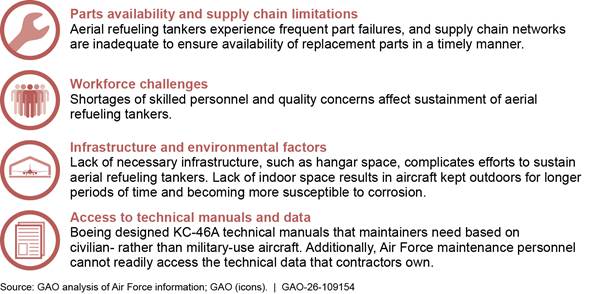
Air Force officials identified similar sustainment risks for KC-135 and KC-46A fleets. These risks relate to parts availability and supply chain limitations, workforce challenges, infrastructure and environmental factors, and access to technical data (see fig. 4).
The Aerial Refueling Tanker Fleet Faces Multiple Sustainment Risks
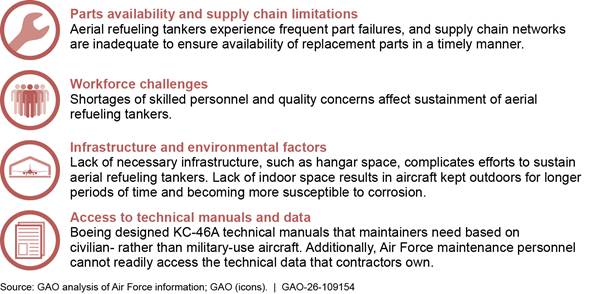
Officials from across the Air Force sustainment enterprise described the implications of each of these sustainment risks to maintaining the overall health of the aerial refueling tanker fleet.
Parts Availability and Supply Chain Limitations
The Air Force faces critical shortages of key maintenance parts for both KC-135 and KC-46A aircraft, according to Air Force command and unit officials. Maintainers from multiple units cited parts failure to be the key contributing factor to low availability and mission capable rates.
KC-135 parts. Unit officials told us that the age of the fleet and the growing demand for aerial refueling capabilities have led to increased failure of key parts. Additionally, older parts are more difficult to refurbish or acquire, leading to shortages. In the course of our work, the most critical part shortages that Air Force officials reported for the KC-135 aircraft included the Common Computing Modules (CCM) and Input Output Concentrator (IOC) avionics components. Air Force officials stated that these components are vital for operating the aircraft. If these components are not working, the Air Force considers the aircraft to be non-mission capable.
The 2025 KC-135 Program Improvement Plan noted problems with the CCMs and IOCs that led the Air Force to designate some of its KC-135 aircraft as non-mission capable. We omitted specific information on the implications of CCM and IOC shortages on the aircraft mission capable rates, which DOD deemed to be CUI. Air Force officials stated that the service has since resolved the critical shortages affecting CCMs through improved coordination with the contractor to ensure timely parts delivery and internal measures such as reverse-engineering of key components. While IOC components remain a challenge, the program office has a recovery plan in place to address it.
KC-46A parts. Although this aircraft is a new addition to the aerial refueling tanker fleet and first entered service in January 2019, it has experienced critical parts failures that occurred much earlier than anticipated, according to Air Force and DLA officials. In particular, unit officials noted failure of auxiliary power units, which serve as a critical power source for KC-46A engines. Some unit maintainers said the unexpected failures result in increased cannibalization (“canning”), where maintainers use parts from other aircraft. They said that the frequency with which they need to resort to such tactics is higher than one would expect for an aircraft at the beginning of its lifespan.
Air Force and DLA officials attributed high failure rates for KC-46A parts to assumptions used during the development process. Specifically, Boeing designed the KC-46A based on its civilian aircraft. However, the requirements for a military version of the same aircraft differ substantially and result in higher usage and subsequently shorter lifespan of critical parts. Air Force Materiel Command officials said the Air Force did not plan for the correct number of parts to ensure timely replacements. DLA officials said the Air Force is still in the process of analyzing what parts are breaking and what its sustainment needs for the newly fielded KC-46A aircraft will be.
Air Force and DLA officials identified significant limitations of the defense industrial base to provide replacements for failing parts. Many of the parts are no longer in production or have a very limited number of suppliers given the age of the KC-135 fleet. Although the KC-46A aircraft is new, officials with KC-46A program office said it was designed approximately 15 years ago, rendering some of its components outdated. For example, Air Mobility Command officials said that the aircraft’s software system became outdated by the time Boeing delivered its very first KC-46A plane to the Air Force.
Ongoing supply chain issues have further exacerbated parts shortages. Air Force officials said that DLA has struggled in recent years to procure parts, given the declining capacity of the defense industrial base that began during the COVID-19 pandemic. DLA officials confirmed the diminishing sources of raw materials and suppliers for parts. They said they are now seeing a higher number of back orders for parts than ever before.
Maintainers from multiple units told us they considered parts shortages to be the key contributing factor to low availability and capability rates. For example, KC-135 maintainers from one unit said they have planes that are sometimes grounded for many months due to unavailable parts. KC-135 operators further said that the lack of available parts correlates with the need to swap functional parts between aircraft, resulting in more aircraft considered to be non-mission capable. According to the current improvement plan for KC-135, failure of parts and scarcity of replacement packages produce adverse effects on aircrew training, readiness, and aircraft availability for deployments and other taskings.[22] Unit officials said this situation is not sustainable in the long-run and will have significant impacts on the health of the aerial refueling tanker fleet.
Workforce Challenges
Program office and unit officials stated that there are shortages of skilled maintainers to conduct scheduled maintenance work at the depots, as well as unexpected repairs at the unit level.[23] Some unit officials said that the transition from military to civilian maintainers at the depots in recent years led to an influx of new and less experienced personnel. Officials at one of the bases we visited that operates both KC-135 and KC-46A aircraft said that while they are at 100 percent staffing level for aircraft maintenance, about 75 percent of the maintainers lack the necessary experience. They also expressed concerns about the training that military maintainers receive.
Officials from the KC-46A program office said the Air Force did not sufficiently plan for skilled personnel that would be needed to service the new aircraft once it became available. In particular, they said that the Air Force did not activate space and personnel for KC-46A maintenance at Oklahoma City Air Logistics Complex until 4 years later than its initial plans. As a result, not enough skilled personnel were available when the new aircraft began to arrive.
Unit officials also expressed concerns about workforce impacts resulting from the quality of the work at the depots. For example, officials from several Air Force units stated that unit maintainers sometimes must fix issues overlooked during depot maintenance. Officials from one unit told us about a crew that had to conduct emergency landing of an aircraft that was partially due to an error made at the depot. Officials from another unit said they had to conduct up to 72 hours of additional work to fix a problem that had not been addressed at the depot level. Some unit officials expressed concerns that additional maintenance workload negatively affects retention. Other unit officials also reported problems such as foreign objects found in the aircraft, cables that were not routed correctly, and engines that had not received required maintenance.
Infrastructure Limitations and Environmental Factors
Officials at the installations that we visited cited a variety of infrastructure limitations affecting KC-135 and KC-46A sustainment. For example, officials at multiple bases told us about the lack of adequate hangar space or hangars not appropriately sized for the KC-46A aircraft. Maintainers of aerial refueling tankers at Joint Base McGuire-Dix-Lakehurst in New Jersey identified issues such as hangars lacking drains and inadequate office space. Officials at Seymour Johnson Air Force Base in North Carolina noted lack of heat in the hangar, which affected the ability of the paint to dry and affected working conditions for maintenance personnel in the winter.
According to officials, some bases required a lengthy infrastructure modification process to receive KC-46A aircraft, which have different infrastructure requirements than the KC-135. For example, Tinker Air Force Base required construction of 17 new hangars, according to Air Mobility Command officials responsible for base infrastructure projects related to KC-46A. The 6th Air Refueling Wing officials at MacDill Air Force Base stated that they needed to wait for the historically protected hangars to be enlarged to accommodate the unit’s future KC-46As. According to officials, these challenges are especially acute at KC-135 bases that the Air Force is converting to fit the new KC-46A fleet. In contrast, officials said that bases that previously housed the KC-10 aircraft are more adaptable to KC-46A sustainment needs because KC-46A base infrastructure requirements, such as those for hangars and runways, are more like the KC-10 than the KC-135.
Air Force guidance on construction projects discusses a process of identifying requirements prior to construction, including responsibilities for identifying and planning necessary infrastructure for weapon systems.[24] However, some unit officials said the new construction projects did not provide for adequate infrastructure and that there was a lack of sufficient planning to prepare for the needs of the KC-46A aircraft. For example, officials at Seymour Johnson Air Force Base said the infrastructure projects there emulated the projects implemented at a different airbase hosting KC-46As without accounting for specific space needs at their base. They mentioned a new hangar that lacks sufficient vertical and horizonal space to accommodate both the aircraft and personnel working on it, as well as a door that is not large enough to fit their needs.
Air Force officials said that each base chosen to receive KC-46A aircraft had gone through an extensive infrastructure evaluation process. However, they had to determine infrastructure needs before some bases received and flew the aircraft, which limited the Air Force’s knowledge about the full extent of those infrastructure needs. This was especially true for some of the early recipients, such as Seymour Johnson Air Force Base, according to Air Mobility Command officials responsible for base infrastructure there. Air Force officials said they continually monitor and modify infrastructure requirements, which they hoped will address some of the earlier infrastructure issues. Officials with the Air Force Life Cycle Management Center said they expected infrastructure requirements to increase as the KC-46A fleet continues to grow.
Unit officials also identified environmental factors, particularly corrosion, affecting the physical condition of the aerial refueling tankers and impacting sustainment needs of the fleet. Officials at multiple bases we visited around the country reported premature damage to both KC-135 and KC-46A aircraft due to corrosion. For example, officials at Joint Base McGuire-Dix-Lakehurst in New Jersey told us that, according to depot maintainers who work on their aircraft, all the KC-46As that they disassembled exhibited corrosion on engine mounts.
Infrastructure and environmental challenges are related because aircraft left outside due to lack of available indoor space are more likely to sustain weather-related damage. For example, maintenance officials at Altus Air Force Base in Oklahoma reported damage to the aircraft resulting from the state’s frequent storms, winds, and tornadoes. Although they try to move aircraft to safer locations, officials said they do not have adequate indoor facilities for their KC-46A fleet.
Access to Technical Manuals and Data
Air Force officials noted challenges with accessing technical information for the maintenance of KC-46A aircraft. For example, Boeing produced maintenance manuals based on how personnel would repair a civilian Boeing 767-2C, but the manuals do not account for how maintainers typically perform work on the military aircraft, according to DLA officials and Air Force maintenance personnel. Officials with KC-46A program office told us the Air Force needs to create its own technical manuals to supplement commercial manuals that are not written for the audience of military technicians. Maintainers at one base we visited said that they attempt to share knowledge through informal working groups, but that this process does not result in a single, authoritative information source and takes more time. In August 2025, DLA officials stated that the Air Force is working with Boeing to update the manuals and adapt them to military standards.
Air Force officials also discussed the challenges of accessing technical data that is owned by contractors. KC-46A program officials and unit maintainers we interviewed at two units said that contractors do not always share the technical data that they own, making it difficult for both operators and maintainers to have complete information on the aircraft.[25] Officials with a supply chain management unit that we visited said that because the Air Force does not own the technical diagrams for replacement parts, the unit relies on commercially produced replacements, which the Air Force cannot modify even if its engineers identify areas for improvement.
The Air Force Has Taken Some Actions to Address Sustainment Risks for Its Aerial Refueling Tanker Fleet
The Air Force has taken some actions to address the risks associated with sustaining the aging KC-135 and the newly fielded KC-46A fleets. These included efforts to increase the number of available mission-ready aircraft, as well as strategies to address parts shortages, workforce challenges, and infrastructure limitations. Some of the efforts were driven by command headquarters (such as those involving additional military construction to address infrastructure needs), and others were spearheaded by individual units (such as local strategies to manufacture parts or adjust existing space to aircraft sustainment needs).
Availability of Mission Capable Aircraft. Officials described various ways in which they try to increase the number of available aircraft. For example, unit officials at Tinker Air Force Base discussed “regionalization” efforts, where bases “borrow” aircraft from each other to meet their mission needs. Air Mobility Command officials told us about ongoing discussions to increase the amount of time between scheduled depot maintenance periods from 5 to 6 years, which they estimated would increase the availability of aircraft by about 6 percent.
Parts Shortages. Given critical shortages of key parts for sustainment of aerial refueling tankers, officials described various efforts to identify alternative sources for such parts. These included manufacturing parts organically, coordinating with other organizations for parts, and reusing existing parts.[26] For example, personnel at Joint Base McGuire-Dix-Lakehurst told us they use 3-D printing technology to produce parts, while unit maintainers at Altus Air Force Base found a way to reverse-engineer parts that are difficult to obtain on the market. Unit officials at McConnell Air Force Base said they are also considering the use of 3-D technology to produce parts but are still waiting for engineering approvals. However, officials at Oklahoma City Air Logistics Complex that performs maintenance on aerial refueling tankers said that trying to produce parts organically is a slow process, and that they choose to focus their efforts on identifying commercial suppliers of parts instead.
Some officials said they coordinate with others for critical parts such as CCM components. For example, officials from a reserve unit that operates KC-135s said they obtained spare CCMs from the Coast Guard, which helped mitigate the shortages of this critical part that they experienced. Air Mobility Command officials also discussed reliance on “canning” to take parts, such as radar and navigation equipment, from another aircraft. However, officials at one unit with responsibilities for maintaining KC-135 aircraft said that canning is labor intensive, as the part must first be removed from an aircraft, transferred to the recipient aircraft, and then later replaced with a second, newly acquired part on the other aircraft.
Further, several officials mentioned using parts from divested aircraft at the Air Force’s “boneyard” facility in Arizona.[27] However, officials cautioned that not all parts found there are serviceable since they come from aircraft that may have been exposed to the elements for many years.
Workforce Challenges. Faced with shortages of skilled maintainers and depot-related delays, some units are exploring ways to expand organic maintenance capabilities. For example, unit officials at McConnell Air Force Base said they have a program that allows maintainers at the base to repair aircraft that otherwise would be sent to the depot. As part of this program, officials said they send maintainers to other locations to improve their technical skills, thus expanding the overall maintenance expertise available at the base. However, these aircraft still require depot maintenance for major repairs and overhauls.
Infrastructure Limitations. The Air Force has taken steps to address infrastructure-related limitations associated with KC-46As that it has received since 2019, according to Air Force officials and documentation. For example, it has upgraded infrastructure at such installations as McConnell Air Force Base (the first base to receive KC-46As); Tinker Air Force Base (where personnel perform depot-level maintenance on the aircraft); and Seymour Johnson Air Force Base, among others. These upgrades have included new or renovated or enlarged hangars, new apron areas for refueling, and taxiway updates, among other improvements, according to officials from units located at those bases and Air Force documentation. Individual units have also worked to develop their own methods to mitigate KC-46A-related maintenance issues. For example, Air Force personnel at McConnell Air Force Base developed a hand truck/dolly capable of holding the aircraft’s boom during maintenance.
The Air Force Has Not Conducted a Comprehensive Risk Assessment to Guide Mitigation Efforts
The Air Force has not conducted a comprehensive assessment of the risks associated with sustainment of its aerial refueling tanker fleet or developed mitigation plans that prioritize these risks based on their likelihood or impact, according to our review of KC-135 and KC-46A sustainment plans and other documentation. For example, the Air Force has not fully assessed the risk of relying on sustainment assumptions for Boeing’s civilian aircraft that did not account for the requirements of the military aircraft.
Additionally, the Air Force has not fully assessed other significant risks, such as the ability of the defense industrial base to supply the necessary parts for aircraft sustainment or the availability of a skilled workforce for sustaining the aging KC-35 and the new KC-46A tankers. Our review of the Air Force’s lifecycle management sustainment plans and aircraft availability improvement plans for KC-135 and KC-46A aircraft showed that while they acknowledged some of the sustainment risks we discussed above, such as shortages of parts, they did not include a comprehensive assessment of sustainment risks based on their likelihood and impact that could guide the Air Force’s mitigation efforts.
DOD and the Air Force have guidance directing their organizations to plan for the specific risks that we identified above, including planning for parts and infrastructure requirements. With regard to parts, for example, DOD Instruction 4140.01 requires the military services to conduct demand and supply planning for spare parts, including those with diminished manufacturing sources and other materiel shortages.[28] With regard to infrastructure requirements, Department of the Air Force Instruction 32-1020 lists user-identified requirements as among the factors to consider in infrastructure project planning, such as unique requirements to house KC-46A aircraft.[29]
Additionally, Department of the Air Force guidance on risk management defines the steps in the risk management process for Air Force organizations to follow, including assessment of risks that could lead to mission degradation and the development of related mitigation strategies to address these risks.[30] GAO’s enterprise risk management framework, aimed at helping agencies handle complex and risky missions, also states that an agency should develop a comprehensive list of risks and assess those risks for both likelihood and impact on the mission in order to prioritize the risk response.[31]
However, the Air Force has not ensured a service-wide comprehensive assessment of risks associated with sustainment of its aerial refueling tanker fleet, such as risks associated with availability of parts, workforce, and infrastructure necessary to sustain the fleet. Completing such an assessment would allow the Air Force to develop related mitigation plans based on its results. Without a comprehensive assessment of risks, including their likelihood and impact, and the development of a mitigation plan to target those risks, the health of the aerial tanker fleet and its ability to meet key operational requirements may be jeopardized.
Conclusions
The aerial refueling tanker fleet plays a key role in ensuring readiness and operational success in both peacetime and wartime. Over the years, the Air Force invested heavily in modernizing the fleet and modifying its composition, including pursuing an effort to gradually replace its legacy tankers with the new KC-46A aircraft. However, the Air Force’s KC-46A program is faced with major production delays and deficiencies, continuing to put increased pressure on the aging KC-135 fleet.
The percentage of aerial refueling tankers that are available and mission capable has remained persistently below the standards that the Air Force established for the fleet. Moreover, the percentage of fully mission capable tankers—those capable of performing all their missions—is even smaller. However, the Air Force has not directed the use of metrics and standards that specifically assess the tankers’ ability to carry out their primary refueling mission. Doing so would allow the Air Force to have a more complete picture of the overall health of its aerial refueling tanker fleet and to take timely actions to prepare the fleet for the ever-growing demand for its capabilities and possible contingencies in years to come.
The existing aerial refueling tanker fleet faces multiple sustainment risks, including long-standing supply chain limitations, workforce challenges, infrastructure issues, and difficulties accessing key technical data. These risks affect both the legacy KC-135 aircraft and the newly fielded KC-46A aircraft. While the Air Force is aware of these risks, it has not conducted a comprehensive risk assessment or developed mitigation plans based on the likelihood and impact of these risks. Conducting a comprehensive assessment of risks related to sustainment and developing a mitigation plan based on its results will help the Air Force target scarce sustainment resources to areas of greatest risk, as well as best position its aerial refueling tanker fleet for operational success.
Recommendations for Executive Action
We are making four recommendations to the Air Force:
The Secretary of the Air Force should direct the use of metrics and standards that specifically assess the aerial refueling capability of its tanker fleet. (Recommendation 1)
The Secretary of the Air Force should require the Air Mobility Command, in coordination with its subordinate organizations and relevant program offices, to regularly report on the metrics and standards adopted to assess the aerial refueling capability of its tanker fleet. (Recommendation 2)
The Secretary of the Air Force should direct a service-wide comprehensive assessment of risks associated with sustainment of its aerial refueling tanker fleet, including their likelihood and impact. (Recommendation 3)
The Secretary of the Air Force should direct the development of a mitigation plan based on the results of a risk assessment associated with sustainment of its aerial refueling tanker fleet. (Recommendation 4)
Agency Comments and Our Evaluation
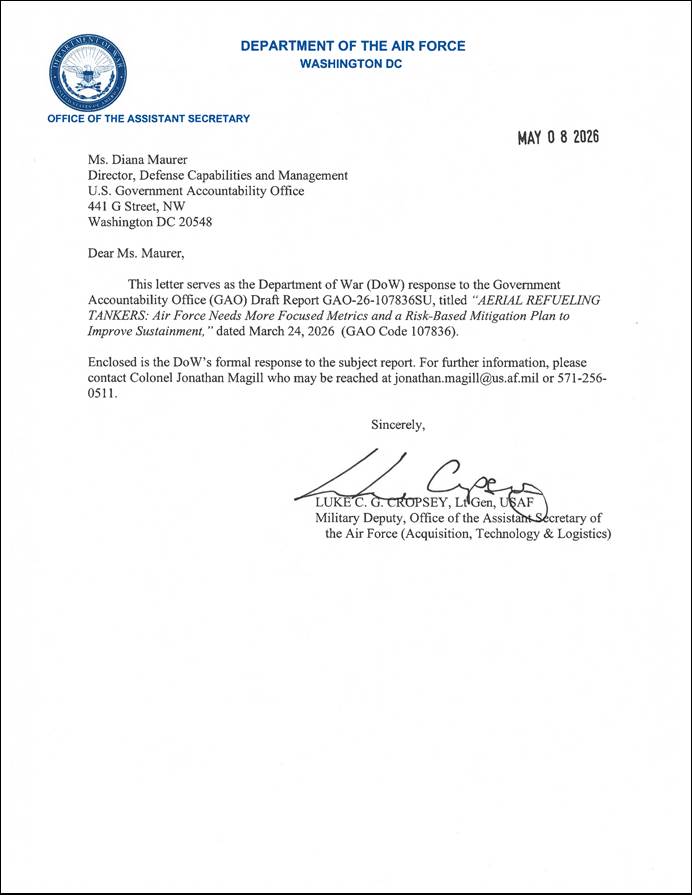
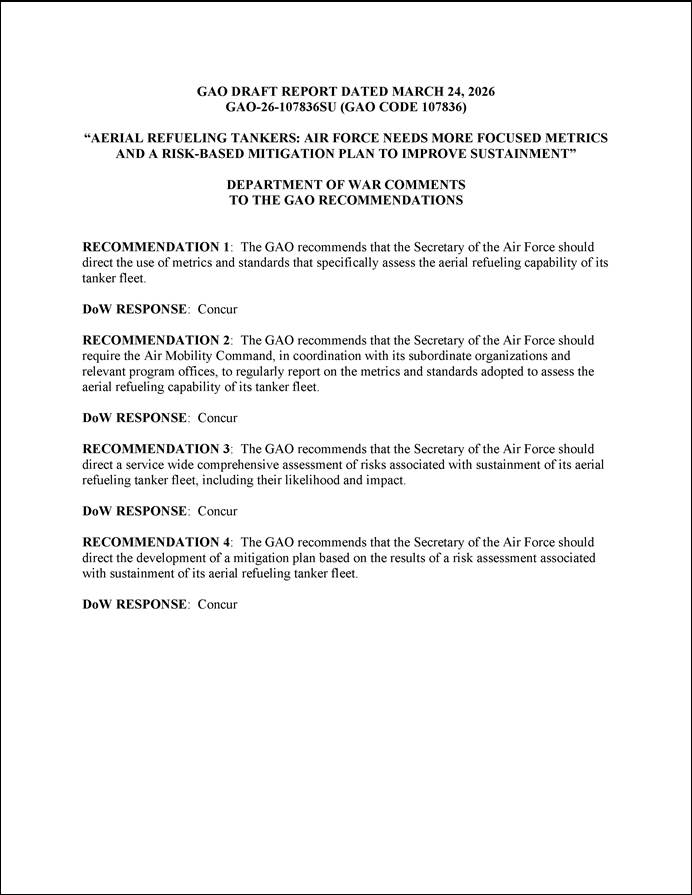
We provided a draft of this report to the Department of the Air Force for review and comment. The Air Force concurred with our recommendations. The Air Force’s comments are reprinted in their entirety in appendix II.
We are sending copies of this report to the appropriate congressional committees and the Secretary of the Air Force. In addition, the report is available at no charge on the GAO website at http://www.gao.gov.
If you or your staff have any questions about this report, please contact me at maurerd@gao.gov. Contact points for our Offices of Congressional Relations and Media Relations may be found at the end of this report. GAO staff who made key contributions to this report are listed in appendix III.
Diana Maurer
Director, Defense Capabilities and Management
This report addresses (1) how the composition of the Air Force’s aerial refueling tanker fleet has changed since 2019; and the extent to which (2) the Air Force’s aerial refueling tanker fleet meets its current and future needs, and (3) the Air Force has assessed risks and developed mitigation plans associated with sustainment of its KC-135 and KC-46A aerial refueling aircraft. Our scope included active-duty Air Force, Air National Guard, and Air Force Reserve organizations with responsibilities for the operation and sustainment of aerial refueling aircraft.
For objectives 1 and 2, we requested and obtained Air Force data showing the composition of the aerial refueling tanker fleet, as well as the extent to which the aerial refueling aircraft were available and capable of carrying out their missions from fiscal year 2019 through fiscal year 2025.[32] We conducted interviews with knowledgeable Air Force officials about the system for collecting, maintaining, and analyzing these data.[33] We determined the data that the Air Force provided to be reliable for the purposes of reporting on the overall composition, availability, and capability of KC-135 and KC-46 aircraft.
We further interviewed Air Force headquarters and command officials, as well as officials from the U.S. Transportation Command and U.S. Strategic Command about the existing aerial refueling capabilities and the extent to which they are sufficient to meet current and future missions, existing deficiencies, and any planned efforts to augment aerial refueling capabilities. In addition, we interviewed officials about the utility of existing metrics to assess the health of the aerial refueling tanker fleet. We assessed the Air Force’s existing capabilities and actions against the Air Force’s own reported standards for aircraft availability and capability, Air Force equipment reporting guidance, and Standards for Internal Control in the Federal Government.[34]
For objective 3, we discussed operation and sustainment of the aerial refueling tanker fleet with officials from a nongeneralizable sample of 16 units across 11 bases.[35] Our sample included a mix of active, National Guard, and reserve units given the role that all three types of units play in operating and maintaining the aerial refueling tanker aircraft.[36] We used separate sets of questions for unit operators and unit maintainers. We then analyzed the information that we gathered from these interviews to identify themes across each of our research objectives. Although the information we gathered from these units cannot be projected to all relevant units, it provides valuable information on the experiences of personnel responsible for the operation and maintenance of the aerial refueling tanker fleet. We selected unit locations from the Air Force’s list of bases hosting KC-135 or KC-46A aircraft, as of December 2024. Our primary selection criteria included the presence of KC-135 and KC-46A aircraft at the base, the units’ aerial refueling mission, and units’ colocation at the base with other Air Force organizations that play a role in sustainment of the aerial refueling tanker fleet.
We interviewed both tanker operators and maintainers, as well as officials from KC-135 and KC-46 program offices, Air Force Headquarters, Air Mobility Command, Air Force Materiel Command, and other relevant organizations to understand the risks associated with sustainment of the aerial tanker fleet and steps the Air Force has taken to assess and mitigate these risks. We also reviewed Air Force documentation on sustainment risks, including KC-135 and KC-46A lifecycle sustainment plans and information on orders of critical parts from the Air Force and Defense Logistics Agency.
We assessed the Air Force’s efforts against relevant Air Force and DOD guidance on supply chain management, risk assessment, and infrastructure planning, as well as GAO’s enterprise risk management framework and Standards for Internal Control in the Federal Government.[37]
For all three objectives, we interviewed Department of Defense and Air Force officials to determine their roles and responsibilities for aerial refueling aircraft, existing and planned aerial refueling capabilities, and the Air Force’s actions to sustain, modernize, and address challenges with the KC-135 and KC-46A fleets. We interviewed officials from the following organizations:
Department of Defense
· Office of the Secretary of Defense, Cost Assessment and Program Evaluation
· Defense Logistics Agency
· Joint Staff, Logistics Directorate (J4)
· U.S. Transportation Command
· U.S. Strategic Command
· U.S. Indo-Pacific Command
Department of the Air Force
· Secretary of the Air Force Acquisition–Global Reach
· Headquarters of the Air Force, Logistics (A4)
· Headquarters of the Air Force, Strategy, Integration, and Requirements (A5/7)
· Strategic Plans and Programs Directorate (A8)
· Air Mobility Command, Scott Air Force Base, Illinois
· Air Combat Command, Joint Base Langley-Eustis, Virginia
· Air Force Materiel Command, Wright-Patterson Air Force Base, Ohio
· KC-135 Program Office, Tinker Air Force Base, Oklahoma
· KC-46A Program Office, Wright-Patterson Air Force Base, Ohio and Tinker Air Force Base, Oklahoma
· Oklahoma City Air Logistics Complex, Tinker Air Force Base, Oklahoma
· Air Force Life Cycle Management Center, Wright-Patterson Air Force Base, Ohio
Active Air Force Units
· 18th Air Force, Scott Air Force Base, Illinois
· 22nd Areial Refueling Wing, McConnell Air Force Base, Kansas
· 448th Supply Chain Management Wing, Tinker Air Force Base, Oklahoma
· 97th Air Mobility Wing, Altus Air Force Base, Oklahoma
· 6th Air Refueling Wing, MacDill Air Force Base, Florida
· 92nd Air Refueling Wing, Fairchild Air Force Base, Washington
· 305th Air Mobility Wing, Joint Base McGuire-Dix-Lakehurst, New Jersey
· 605th Aircraft Maintenance Squadron, Joint Base McGuire-Dix-Lakehurst, New Jersey
Air National Guard Units
· 126th Air Refueling Wing, Scott Air Force Base, Illinois
· 157th Air Refueling Wing, Pease Air National Guard Base, New Hampshire
· 108th Air Refueling Wing, Joint Base McGuire-Dix-Lakehurst, New Jersey
· 141st Air Refueling Wing, Fairchild Air Force Base, Washington
Air Force Reserve Units
· 459th Air Refueling Wing, Joint Base Andrews, Maryland
· 931st Air Refueling Wing, McConnell Air Force Base, Kansas
· 507th Air Refueling Wing, Tinker Air Force Base, Oklahoma
· 916th Air Refueling Wing, Seymour Johnson Air Force Base, North Carolina
The performance audit upon which this report is based was conducted from September 2024 to May 2026 in accordance with generally accepted government auditing standards. Those standards require that we plan and perform the audit to obtain sufficient, appropriate evidence to provide a reasonable basis for our findings and conclusions based on our audit objectives. We believe that the evidence obtained provides a reasonable basis for our findings and conclusions based on our audit objectives. We worked with DOD from May 2026 to June 2026 to prepare this version of the original Controlled Unclassified Information (CUI) report for public release. This public version was also prepared in accordance with these standards.
GAO Contact
Diana Maurer, MaurerD@gao.gov
Staff Acknowledgments
In addition to the contact named above, individuals who made key contributions to this report include Sally Newman (Assistant Director, retired), Kevin O’Neill (Assistant Director), Kevin Newak (Analyst in Charge), Natalya Barden (Analyst in Charge), Christopher Gezon, Justin Jaynes, Jennifer Leotta, Patrick Netherclift, Andrew Ringlee, Michael Silver, McKenna Storey, Colson Sutherland, Theologos Voudouris, and Lillian Moyano Yob.
The Government Accountability Office, the audit, evaluation, and investigative arm of Congress, exists to support Congress in meeting its constitutional responsibilities and to help improve the performance and accountability of the federal government for the American people. GAO examines the use of public funds; evaluates federal programs and policies; and provides analyses, recommendations, and other assistance to help Congress make informed oversight, policy, and funding decisions. GAO’s commitment to good government is reflected in its core values of accountability, integrity, and reliability.
Obtaining Copies of GAO Reports and Testimony
The fastest and easiest way to obtain copies of GAO documents at no cost is through our website. Each weekday afternoon, GAO posts on its website newly released reports, testimony, and correspondence. You can also subscribe to GAO’s email updates to receive notification of newly posted products.
Order by Phone
The price of each GAO publication reflects GAO’s actual cost of production and distribution and depends on the number of pages in the publication and whether the publication is printed in color or black and white. Pricing and ordering information is posted on GAO’s website, https://www.gao.gov/ordering.htm.
Place orders by calling (202) 512-6000, toll free (866) 801-7077,
or
TDD (202) 512-2537.
Orders may be paid for using American Express, Discover Card, MasterCard, Visa, check, or money order. Call for additional information.
Connect with GAO
Connect with GAO on X,
LinkedIn, Instagram, and YouTube.
Subscribe to our Email Updates. Listen to our Podcasts.
Visit GAO on the web at https://www.gao.gov.
To Report Fraud, Waste, and Abuse in Federal Programs
Contact FraudNet:
Website: https://www.gao.gov/about/what-gao-does/fraudnet
Automated answering system: (800) 424-5454
Media Relations
Sarah Kaczmarek, Managing Director, Media@gao.gov
Congressional Relations
David A. Powner, Acting Managing Director, CongRel@gao.gov
General Inquiries
[1]The Air Force defines air mobility operations as the rapid movement of resources to, from, or within a theater by air. Air refueling is one of the core functions of air mobility operations and refers to the in-flight transfer of fuel from a tanker aircraft to a receiver aircraft in support of strategic, operational, and tactical objectives. Air Force Doctrine Publication 3-36, Air Mobility Operations (June 24, 2024).
[2]GAO, KC-46 Tanker: Air Force Needs to Mature Critical Technologies in New Aerial Refueling System Design, GAO-22-104530 (Washington, D.C.: Jan. 27, 2022). Under this contract, Boeing modified the design of a commercial aircraft—the Boeing 767—into a military KC-46A tanker.
[3]H.R. Rep. No. 118-529, at 102-03 (2024).
[4]GAO, Aerial Refueling Tankers: Air Force Needs More Focused Metrics and a Risk-Based Mitigation Plan to Improve Sustainment, GAO-26-107836SU (Washington, D.C.: May 26, 2026).
[5]GAO, Standards for Internal Control in the Federal Government, GAO‑25‑107721 (Washington, D.C.: May 2025); and Enterprise Risk Management: Selected Agencies’ Experiences Illustrate Good Practices in Managing Risk, GAO‑17‑63 (Washington, D.C.: Dec. 1, 2016).
[6]The Air Staff is a standardized Air Force organizational structure representing the following functions: A1 Manpower, Personnel, and Services; A2 Intelligence, Surveillance, Reconnaissance, and Cyber Effects Operations; A3 Operations; A4 Logistics, Engineering, and Force Protection; A5/7 Strategy, Integration, and Requirements; A6 Communications; A8 Strategic Plans and Programs; A10 Strategic Deterrence and Nuclear Integration.
[7]The Air Force MAJCOMS are the Air Force Materiel Command; Air Mobility Command; Air Combat Command; Air Education and Training Command; Air Force Space Command; Air Force Reserve Command; Air Force Special Operations Command; Air Force Global Strike Command; U.S. Air Forces in Europe-Air Forces Africa; and Pacific Air Forces.
[8]The U.S. Transportation Command is one of DOD’s functional combatant commands that provides air, land, and sea transportation to accomplish DOD’s global mobility missions, including aerial refueling.
[9]The KC-46A entered service in January 2019.
[10]The Air Force divested its KC-10 fleet in September 2024, marking the end of its 44-year service. Air Force officials attributed divestment of the KC-10 fleet to its rapidly increasing costs.
[11]10 U.S.C. § 9062(j) stipulated an inventory of no less than 466 aerial refueling tankers. The minimum inventory was increased in the National Defense Authorization Act for Fiscal Year 2026. Specifically, the Act required no less than 478 aircraft between October 1, 2026 and September 30, 2027; no less than 490 aircraft between October 1, 2027 and September 30, 2028; and no less than 502 aircraft beginning on October 1, 2028. National Defense Authorization Act for Fiscal Year 2026, Pub. L. No. 119-60, § 141 (2025).
[12]The KC-46A provides additional mission capability by pumping the aircraft’s fuel through the boom, drogue, and wing aerial refueling pods. The boom is a rigid telescope that delivers fuel to the receiver aircraft. A drogue is a refueling system comprised of a long, flexible hose and a parachute-like metal basket used to provide stability. The KC-46A has less refueling capacity than the KC-10, but slightly more than the KC-135.
[13]Further, in January 2025, the Air Force began using a new metric—non-mission capable, airworthy—to identify tanker aircraft that were capable of flying, but unable to perform their refueling missions. Other designations, including “non-mission capable, supply” and “non-mission capable, maintenance,” measure the percentage of possessed aircraft that are not mission capable due to supply or maintenance issues, respectively.
[14]Critical deficiencies are those shortfalls that can cause death or injury, or loss or damage to the aircraft.
[15]GAO, KC-46 Tanker Modernization: Aircraft Delivery Has Begun, but Deficiencies Could Affect Operations and Will Take Time to Correct, GAO‑19‑480 (Washington, D.C.: June 12, 2019).
[16]Remote vision system enables a crew member to remotely maneuver the refueling boom and insert it into receiver aircraft. For our prior findings related to critical deficiencies involving this system, see GAO, KC-46 Tanker: Air Force Needs to Mature Critical Technologies in New Aerial Refueling System Design, GAO‑22‑104530 (Washington, D.C.: Jan. 27, 2022).
[17]GAO, Weapons System Annual Assessment: DOD Leaders Should Ensure That Newer Programs Are Structured for Speed and Innovation, GAO‑25‑107569 (Washington, D.C.: June 11, 2025).
[18]Air Force officials defined the standard as the level at which the fleet needs to be to meet operational requirements. The Air Force establishes specific aircraft availability and mission capability standards each fiscal year for the KC-135 and KC-46A.
[19]Air Mobility Command Memorandum, KC-46A Status Reporting Procedures for Aircraft Air Refueling Capabilities (Jan. 20, 2025). The Air Force defines non-mission capable airworthy as flyable but not able to refuel through the boom.
[20]Department of the Air Force, Instruction 21-103, Equipment Inventory, Status and Utilization Reporting (Nov. 1, 2022) (incorporating change 1, effective July 23, 2025).
[21]GAO, Standards for Internal Control in the Federal Government, GAO‑25‑107721 (Washington, D.C.: May 2025), Principles 13.04, 14, and 15.
[22]Air Force, KC-135 Aircraft Availability Improvement Program Plan FY25-27, (Feb. 18, 2025) (CUI).
[23]We previously reported on DOD challenges in hiring and retaining skilled depot maintenance workforce. See GAO, DOD Depot Workforce: Services Need to Assess the Effectiveness of Their Initiative to Maintain Critical Skills, GAO‑19‑51 (Washington, D.C.: Dec. 14, 2018, reissued with revisions Dec. 26, 2018).
[24]Department of the Air Force Instruction 32-1020, Planning and Programming Built Infrastructure Projects (Jan. 23, 2026); AFI 32-1020, Planning and Programming Built Infrastructure Projects (December 18, 2019) (incorporating change 1, Jan. 19, 2022) (superseded).
[25]We recently reported that even though DOD guidance requires programs to plan for data rights necessary to sustain programs throughout their life cycles, it focuses largely on programs early in the acquisition cycle and does not fully consider the data needs during sustainment. We recommended that DOD issue guidance on obtaining necessary data rights. DOD agreed with this recommendation. See GAO, Weapon System Sustainment: DOD Can Improve Planning and Management of Data Rights, GAO‑25‑107468 (Washington, D.C.: Sept. 29, 2025).
[26]Generally, in the context of weapon system maintenance, the term organic is used to refer to capabilities the military services manage and operate. Organic assets are non-contractor and non-commercial.
[27]The boneyard refers to the 309th Aerospace Maintenance and Regeneration Group, located on Davis-Monthan Air Force Base in Arizona.
[28]As part of the planning, component services are required to conduct part demand forecasting, and inventory level setting throughout the live cycle of the part’s supply. Department of Defense Instruction 4140.01, DOD Supply Chain Materiel Management Policy (Mar. 6, 2019) (incorporating change 1, effective Sept. 2, 2025).
[29]Department of the Air Force Instruction 32-1020, Planning and Programming Built Infrastructure Projects (Jan. 23, 2026); Air Force Instruction 32-1020, Planning and Programming Built Infrastructure Projects (Dec. 18, 2019) (incorporating change 1, effective Jan. 19, 2022) (superseded).
[30]Department of the Air Force Instruction 90-802, Risk Management (Jan. 20, 2026).
[32]We describe the various metrics that the Air Force can use to assess availability and capability of its aerial refueling tanker fleet in the Background section of this report.
[33]The data on aircraft availability and capability rates came from Basing & Logistics Analytics Data Environment system, which serves as a single source of basing and logistics data for the Department of the Air Force, according to Air Force officials.
[34]Department of the Air Force Instruction 21-103, Equipment Inventory, Status and Utilization Reporting (Nov. 1, 2022) (incorporating change 1, July 23, 2025); GAO, Standards for Internal Control in the Federal Government, GAO‑25‑107721 (Washington, D.C.: May 2025).
[35]These units typically were designated as Air Refueling Wings, which carry out aerial refueling mission or Air Mobility Wings. These wings have air refueling, air lift, and other related missions. The units and their host bases are listed below in this appendix.
[36]We held in-person interviews with the officials at eight of these units. We met virtually with three of the units and received written responses to our questions from two units. Officials we interviewed included enlisted, officer, and civilian personnel.
[37]Air Combat Command Supplement to Air Force Instruction 90-802, Risk Management (Apr. 4, 2023); Department of the Air Force Instruction 32-1020, Planning and Programming Built Infrastructure Projects (Jan. 23, 2026); Air Force Instruction 32-1020, Planning and Programming Built Infrastructure Projects (Dec. 18, 2019) (incorporating change 1, effective Jan. 19, 2022) (superseded); Department of Defense Instruction 4140.01, DOD Supply Chain Materiel Management Policy (Mar. 6, 2019) (incorporating change 1, effective Sept. 2, 2025); GAO, Enterprise Risk Management: Selected Agencies’ Experiences Illustrate Good Practices in Managing Risk, GAO‑17‑63 (Washington, D.C.: Dec. 1, 2016); and Standards for Internal Control in the Federal Government, GAO‑25‑107721 (Washington, D.C.: May 2025).