
Before the Committee on Indian Affairs, U.S. Senate
For Release on Delivery Expected at 2:30 p.m. ET
United States Government Accountability Office
A testimony before the Committee on Indian Affairs, U.S. Senate
Contact: Alicia Puente Cackley at CackleyA@gao.gov or Jill Naamane at NaamaneJ@gao.gov
What GAO Found
GAO’s preliminary observations indicate that 30 federal programs can provide housing support targeted to Native American communities, including those that are American Indian and Alaska Native (AI/AN) and Native Hawaiian. These include grant programs—of which the largest is the Indian Housing Block Grant program—and mortgage assistance programs. Tribes, tribal organizations, and Native Hawaiian organizations that GAO contacted indicated that they use federal programs primarily to maintain existing housing and, to a lesser extent, to construct new housing. They also identified limitations in the reach of these programs, including limited funding that had not kept pace with rising construction costs and certain program restrictions.
While tribal communities experience both sheltered and unsheltered homelessness, doubling up (or temporarily staying with others) is also widespread, according to GAO’s preliminary analysis of its interviews and prior HUD and GAO research. Tribes and tribal organizations that GAO contacted for its ongoing work on homelessness described a variety of strategies they use to address homelessness, including operating emergency shelters or transitional housing and providing supportive services.
GAO’s preliminary observations indicate that many of the Tribes and tribal organizations GAO contacted had used Department of Housing and Urban Development (HUD) programs to support their homelessness strategies. However, several challenges may limit broader use of these programs. For example, some Tribes and tribal organizations described using a portion of their Indian Housing Block Grant funding to address homelessness but noted that the need to fund operation and maintenance costs for existing housing left little funding for homelessness-related efforts, such as providing shelters or emergency housing assistance. They also described requirements of the Continuum of Care program—HUD’s largest homelessness assistance program—that may limit tribal participation. For example, some Tribes and tribal organizations raised concerns that Tribes may be less competitive for funding because forms of homelessness more common in their communities, such as doubling up, do not align with the program’s definition of homelessness.
Why GAO Did This Study
Native American communities have faced longstanding housing challenges, including poor housing conditions, overcrowding, and homelessness.
This statement is based on preliminary observations and discusses (1) federal programs providing targeted housing support to Native American communities and views on program uses and limitations; (2) tribal strategies for addressing homelessness among AI/AN people; and (3) challenges associated with Tribes’ use of HUD programs to support these strategies.
GAO analyzed agency documentation on federal programs supporting Native American housing and interviewed a nongeneralizable sample of 12 Tribes and tribal organizations and one Native Hawaiian organization to obtain their views on those programs. In addition, GAO interviewed a nongeneralizable sample of 19 Tribes and tribal organizations regarding homelessness strategies and challenges. GAO selected Tribes to reflect factors such as regional variation, use of federal housing funds, and approaches to addressing homelessness.
Chairman Murkowski, Vice Chairman Schatz, and Members of the Committee:
Thank you for the opportunity to discuss preliminary observations from our ongoing body of work on Native American housing and homelessness issues. Native American communities, including American Indian and Alaska Native (AI/AN) and Native Hawaiian communities, have long faced housing challenges, including poor housing conditions, overcrowding, and homelessness.[1] These communities also face obstacles to developing new housing, such as insufficient infrastructure, remote locations, and restrictive land use regulations. We have previously issued reports addressing some of these challenges.[2]
This statement describes our preliminary observations on (1) federal programs providing targeted housing support to AI/AN and Native Hawaiian people and views of selected Tribes and tribal and Native Hawaiian organizations on program uses and limitations, (2) strategies selected Tribes and tribal organizations have used to address homelessness among AI/AN people, and (3) selected Tribes’ and tribal organizations’ use of Department of Housing and Urban Development (HUD) programs to fund those strategies and associated challenges.[3]
In addition to our ongoing work on these topics, we plan to begin work on issues related to collecting data on homelessness and housing needs among Native American populations, housing and homelessness issues affecting Native Hawaiians, and coordination of federal housing support for Native American communities. We are conducting this body of work at the request of Chairman Murkowski.
To conduct the ongoing work on which this statement is based, we reviewed relevant literature and federal statutes, regulations, and program documentation and interviewed HUD officials. For our first objective, we identified federal housing programs that provided targeted housing support for AI/AN and Native Hawaiian communities in fiscal year 2025 by reviewing agency websites and program documentation and interviewing officials from the Bureau of Indian Affairs (BIA), Department of Agriculture (USDA), Federal Housing Finance Agency, HUD, and Veterans Affairs (VA).
To obtain views on federal housing programs, we interviewed a nongeneralizable, judgmental sample of eight Tribes and four tribally designated housing entities (TDHE). We selected them primarily because our research identified them as having leveraged additional housing resources to complement federal housing support. We also considered geographic coverage to include entities from Alaska and each of the four census regions in the contiguous United States. We also considered Tribe size as measured by HUD’s fiscal year 2025 Indian Housing Block Grant (IHBG) allocation to ensure we included small, medium, and large Tribes. In addition, we interviewed officials from the Department of Hawaiian Home Lands.
For our second and third objectives, we interviewed representatives of 19 Tribes and tribal organizations (TDHEs and regional intertribal organizations) and seven Continuums of Care (CoC).[4] To select these entities we focused on those that our research identified as potentially taking innovative approaches to addressing homelessness among AI/AN people or facing notable challenges in doing so. We then made selections across HUD’s six Office of Native American Programs regions to ensure regional variety. We met in person with officials of eight of the selected Tribes or tribal organizations and toured relevant facilities and programs during site visits to Alaska, Minnesota, and South Dakota. We met virtually with the remaining Tribes, tribal organizations, and CoCs. Our interviews are not generalizable.
The work on which this statement is based is being conducted in accordance with generally accepted government auditing standards. Those standards require that we plan and perform the audit to obtain sufficient, appropriate evidence to provide a reasonable basis for our findings and conclusions based on our audit objectives. We believe that the evidence obtained provides a reasonable basis for our findings and conclusions based on our audit objectives.
Background
Federally Recognized Tribes and the Federal Government
Tribes vary greatly in culture, language, population, land base, location, and economic status. The Federal government has a trust responsibility for Tribal Nations and their citizens.[5] This responsibility includes a general trust responsibility that extends to HUD and other federal agencies, whether or not tribal affairs are the agency’s primary responsibility.
The federal government provides some programs exclusively for Tribes and tribal citizens based on their political status rather than race. In addition, Tribes are eligible applicants for certain other federal housing and homelessness programs. Tribes can designate an entity—a tribally designated housing entity, or TDHE—to administer their HUD-funded housing assistance programs.
Tribal governments have many of the same responsibilities as other sovereign governments. Tribes provide certain services to people residing on lands under their jurisdiction, which can include their citizens, citizens of other Tribes, and non-AI/AN residents. Tribes may also provide services to their citizens who live outside those lands. For this statement, we use the term “tribal community” to refer to any people to whom a Tribe provides services, regardless of whether they reside on lands under its jurisdiction.
Native Hawaiians and the Federal Government
Native Hawaiians have a unique relationship with the federal government and receive unique forms of housing assistance. Unlike with federally recognized Tribes, the federal government does not maintain a relationship with the Native Hawaiian community as an organized, sovereign entity.[6] The federal government provides housing assistance primarily through the State of Hawaii, and Native Hawaiians do not have recognized housing entities to operate housing programs with other federal funds.
Hawaii’s Department of Hawaiian Home Lands manages the Hawaiian Home Land Trust, which consists of more than 200,000 acres used for homesteading by the Native Hawaiian community. Qualifying members of the Native Hawaiian community may apply for leases to live on the trust land.[7]
Federal Homelessness Assistance and Continuums of Care
The CoC program is HUD’s largest homelessness assistance program. The program awards grants to states, local governments, Tribes and TDHEs, and nonprofit providers to deliver housing and supportive services to individuals and families experiencing or at risk of homelessness.
CoCs are local or regional planning bodies that receive funding under HUD’s CoC program to coordinate homelessness services within a defined geographic area. CoCs are responsible for planning and coordinating among the homelessness service providers in their area, including establishing policies for prioritizing potential beneficiaries. These coordination efforts may also involve Tribes that participate in the CoC program.
CoCs also coordinate the local application process for CoC funding. They solicit applications from organizations in their area, use a local ranking and review process to select applicants, and submit them to HUD for funding consideration. After HUD evaluates applications and awards grants, CoCs are to monitor the recipients to ensure they meet program requirements and agreements.
As of July 2025, there were 387 CoCs that covered areas ranging from a single city or county to multiple jurisdictions or an entire state. Tribal areas are generally not part of a CoC’s geographic area. In 2022, following expansion of the program to allow tribal participation, HUD established a process for an existing CoC to add a tribal area to its geographic area with the Tribe’s authorization.[8] As of 2026, nine CoCs included tribal areas within their geographic boundaries, according to HUD.
Homelessness Services
Service providers and Tribes may offer varied housing and other services to people experiencing or at risk of homelessness. Such services may include shelter programs (emergency shelter, transitional housing, and safe havens), permanent supportive housing, and supportive services.[9] Some providers or programs focus on specific populations, such as families, youth, domestic violence survivors, or veterans. Depending on their preferences and the local services available, an AI/AN person experiencing or at risk of homelessness may seek services from a nontribal homelessness service provider, a Tribe or tribal organization, or both.
Federal Programs Support Native American Housing Activities, but Selected Tribes and TDHEs Reported Limitations
Thirty Federal Programs Support Native American Housing
Our preliminary analysis identified 30 federal programs that can provide housing support targeted to AI/AN and Native Hawaiian populations as of September 2025.[10] These programs are administered by four federal agencies—HUD, BIA, USDA, and VA—and 10 government-sponsored enterprises, including Fannie Mae, Freddie Mac, and some of the Federal Home Loan Banks.[11] The programs provide housing support through grants and mortgage assistance.
· Support through grants. Grant programs provide funds for a wide range of housing activities. For example, IHBG—the largest of the grant programs—was authorized under the Native American Housing Assistance and Self-Determination Act of 1996 (NAHASDA).[12] The program can be used for activities including home construction, purchase, and remodeling; rental assistance; homelessness-related services; and administration of tribal housing programs. Another example is the IHBG Competitive program, which supports many of the same eligible activities as IHBG but prioritizes housing construction, rehabilitation, and related infrastructure projects.
· Support through mortgage assistance. Federal programs also provide mortgage assistance through direct loans, mortgage insurance, loan guarantees, purchases of mortgage loans on the secondary market, and guarantees of mortgage-backed securities that include loans to AI/AN borrowers. For example, HUD’s Section 184 program helps borrowers obtain mortgage loans from private lenders by guaranteeing payment of outstanding principal and interest if a borrower defaults.
Of the 30 programs we identified, three specifically serve Native Hawaiian communities. HUD administers these programs, which are similar to the grant and mortgage assistance programs supporting AI/AN communities. For example, the Native Hawaiian Housing Block Grant provides funds to Hawaii’s Department of Hawaiian Home Lands to support housing development and repair, rental assistance, and homelessness prevention—similar to the activities IHBG supports. Additionally, HUD’s Section 184A program helps Native Hawaiian borrowers obtain mortgage loans.
Tribes and TDHEs Primarily Used Federal Support to Maintain Existing Housing
All 12 of the Tribes and TDHEs selected for our ongoing work on housing told us they used federal support to maintain existing housing. Many also told us they used federal support to help build new housing.[13]
Maintain existing housing. Nearly all the Tribes and TDHEs we spoke with told us that IHBG is the primary source of funding for their housing activities, and the most common use of IHBG funds is to repair and maintain existing housing.
· These activities include replacing aging roofs, doors, and windows and making repairs in the home. For example, one Tribe in Virginia said it used IHBG funds to repair floors, heating systems, and air conditioning.
· One Tribe in New York told us it used IHBG funds to make accessibility improvements to existing housing, including installing wheelchair ramps.
However, many of the Tribes and TDHEs we spoke with said that the federal funds they received did not fully meet their home maintenance needs. For example, a TDHE in South Dakota told us it does not receive enough funding to address all immediate rehabilitation needs or plan for future upkeep.
Build new housing. A few of the Tribes and TDHEs we spoke with said they used a portion of their IHBG funds to build housing, and some also used funding from other HUD programs:
· Some Tribes and TDHEs used Indian Community Development Block Grant funds to build or purchase new homes. For example, one Tribe in Michigan used these funds to remove temporary trailer homes and replace them with multifamily duplexes.
· Some Tribes and TDHEs also used funding from the IHBG Competitive, Title VI, and Section 184 programs to build new housing.
However, some of the Tribes and TDHEs we spoke with told us they had not built any additional housing using federal funding.
Department of Hawaiian Home Lands officials told us that they used Native Hawaiian Housing Block Grant funding provided under NAHASDA for similar purposes to those supported by IHBG. They said the department operates a home repair program with its Native Hawaiian Housing Block Grant funds. The department also used these funds to help build new housing. For example, in fiscal year 2023, it used Native Hawaiian Housing Block Grant funds to build four new homes.
Our ongoing work on housing will review to what extent HUD grant program funding levels reflect the estimated cost of building homes in tribal and Native Hawaiian areas.
Tribes and TDHEs Highlighted Some Limitations of Federal Housing Support
While Department of Hawaiian Home Lands officials and many Tribes and TDHEs we spoke with said federal housing support was generally helpful, they also described limitations in how well the support met their housing needs:
· Program restrictions. Some Tribes and TDHEs we spoke with highlighted specific program requirements that limited the reach of federal housing support. For example, some said that income restrictions for certain programs—including some HUD grant programs—make it difficult to support the housing needs of middle-income households.[14] Department of Hawaiian Home Lands officials told us that households with multiple adult income earners may not qualify for certain programs, even though they need housing assistance.
· Limited federal funds. Many Tribes and TDHEs, as well as Department of Hawaiian Home Lands officials, said that federal funding had not kept pace with rising construction costs, particularly in rural tribal areas or the Hawaiian home lands. For example, a TDHE in Alaska told us the cost of transporting materials to construct one building had risen to about $110,000 in some areas, roughly equal to the entire fiscal year 2025 IHBG allocation for some Alaska Native Villages. Nearly all Tribes and TDHEs said that federal funding was not sufficient to keep pace with construction, rehabilitation, or maintenance needs.
· Housing shortages. Availability of housing in tribal areas limited a few Tribes’ and TDHEs’ ability to fully use certain programs. For example, a TDHE in Alaska noted that certain homeownership programs, such as Section 184, were of limited use in many Alaska Native communities because there were few homes available to purchase and limited opportunities for new construction.
Tribes and TDHEs described some strategies for reducing gaps in federal housing support:
· Leveraging other funding sources. Tax credits, including the Low-Income Housing Tax Credit program; certain state and local programs; and private funding, such as funding from Native Community Development Financial Institutions, local banks, or nonprofits, can complement federal housing programs targeting Native Americans. For example, a Tribe in Michigan used tax credits to help build a 44-unit housing development.
· Lowering construction costs. A Tribe in Arizona served as its own general contractor on housing construction projects, a strategy it estimated lowered costs on a recent project by at least 19 percent. In addition, a TDHE in Alaska explained that it had lowered costs by pooling several Alaska Native Villages’ IHBG funding to build two or three homes at one time.
However, representatives of a few of the Tribes and TDHEs we spoke with stated that these strategies may be unavailable to many Tribes and TDHEs. For example, a Tribe that successfully used the Low-Income Housing Tax Credit program told us the process was resource-intensive and challenging. Some Tribes and TDHEs told us that it is difficult to apply for additional funding opportunities because their resources are limited or application requirements are complicated.[15]
Selected Tribes Used Housing Development and Supportive Services to Address Homelessness
Tribes and Tribal Organizations Described Experiences with Homelessness
While tribal communities experience both unsheltered and sheltered homelessness, the 19 Tribes and tribal organizations selected for our work on homelessness also described widespread doubling up (temporarily staying with others) in their communities.[16] Many Tribes and tribal organizations described community members living completely without shelter; living in tents, vehicles, or broken-down trailers or campers; or staying in emergency shelters. All the Tribes and tribal organizations we spoke with also described examples of doubling up in their communities, and HUD has found widespread use of doubling up as a strategy to avoid sheltered and unsheltered homelessness in tribal areas.[17]
Doubling up can lead to overcrowded living conditions. For example, some Tribes and tribal organizations described 15 or more people living in one home.[18] While multigenerational living is often common in tribal cultures, a 2023 study of Minnesota Reservation Homelessness conducted by Wilder Research and some Tribes and tribal organizations indicated that individuals and families may also live in overcrowded conditions out of necessity rather than tradition.[19]
HUD and some Tribes and tribal organizations attributed doubling up in tribal communities to a shortage of housing. For example, HUD reported that a lack of affordable housing contributed to the need to double up. Further, Wilder Research found that a lack of affordable housing was the most consistently identified barrier to obtaining housing.[20] In addition, when we asked Tribes and tribal organizations about their experience with homelessness, many volunteered that there was a shortage of housing in their communities and linked this shortage to homelessness or overcrowding. For example, one Tribe in South Dakota told us that many community members were living in overcrowded conditions and that the Tribe needed 400 to 500 additional units to adequately house its current population.
Tribes and Tribal Organizations’ Strategies for Addressing Homelessness
Some Tribes and tribal organizations we spoke with described a range of strategies for addressing homelessness. Some focused on developing additional housing because of the link between housing shortages in tribal communities and homelessness, while some described operating emergency shelters, providing emergency assistance, and partnering with local service providers.
· Developing housing on or near tribal lands. Some Tribes and tribal organizations described developing housing in general or setting aside units for individuals exiting homelessness. Some also described building supportive housing units where people exiting homelessness could receive supportive services. For example, one Tribe we visited in Minnesota told us it built a supportive housing development on the reservation that prioritizes housing individuals experiencing homelessness. The Tribe noted that it was building a second permanent supportive housing development and had plans to build a third.
· Operating emergency shelters or transitional housing. Many Tribes and tribal organizations described operating seasonal or year-round shelters or transitional housing. For example, one Tribe in Washington told us it operated an emergency shelter between November and April but lacked the funding needed to operate the shelter year-round.
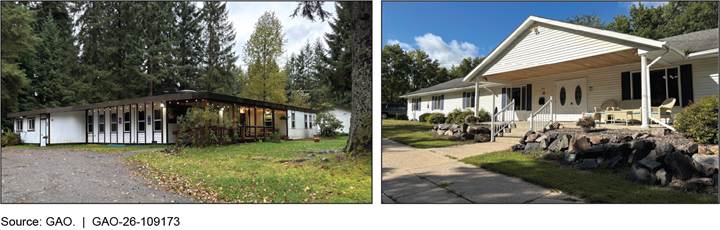
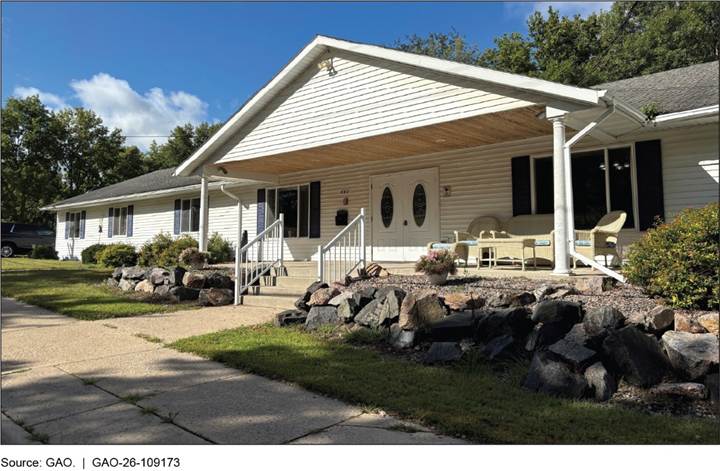
We also visited transitional housing owned and operated by the Upper Sioux Community’s housing authority in Minnesota (see fig. 1). The Tribe purchased an assisted living home and converted the building into 10 individual units with a shared kitchen and living space, according to the TDHE. The facility is open to any tribal member in need of temporary housing. The TDHE also told us that individuals generally stay for 3 months, during which time the Tribe can provide supportive services.
· Providing financial assistance or supportive services for individuals and families. Many Tribes and tribal organizations said they provide rental assistance, hotel vouchers, or other forms of financial assistance. Some also described providing supportive services to help individuals exiting homelessness, such as mental health services, employment assistance, and transportation to job interviews or other appointments.
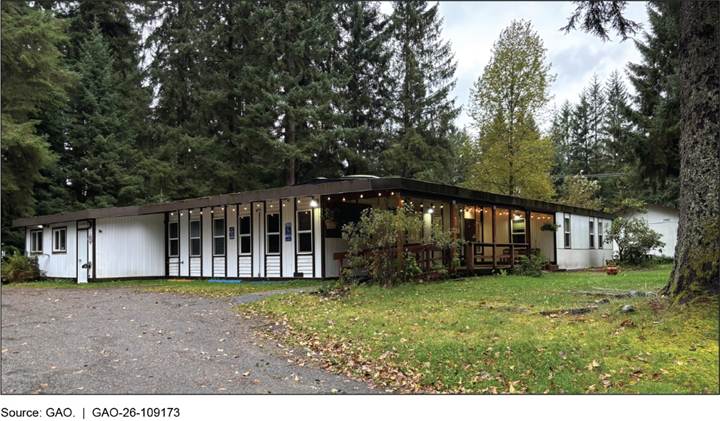
· Partnering with local, nontribal service providers. Some Tribes and tribal organizations described partnering with or referring people to local, nontribal service providers. For example, we visited Shéiyi X̱aat Hit (translated as Spruce Root House), an emergency shelter for runaway and homeless youth in Juneau, Alaska. The shelter is a partnership between the Tlingit-Haida Regional Housing Authority and Zach Gordon Youth Services, a division of Juneau Parks and Recreation (see fig. 2). The Tlingit-Haida Regional Housing Authority contributed funding to renovate a vacant building owned by the city and continues to support ongoing maintenance, while Zach Gordon Youth Services manages day-to-day operations.
Figure 2: Example of a Youth Emergency Shelter in Alaska Operated Through a Partnership Between Tribal and Nontribal Organizations
Multiple Factors Limited Selected Tribes’ Use of HUD Programs to Address Homelessness
Limited or Expiring Funding Affected Tribes’ Use of IHBG and COVID-19 Relief Funding
Many of the Tribes and tribal organizations we spoke with discussed using IHBG or supplemental funding made available in response to the COVID-19 pandemic to support their homelessness strategies. However, they said limited funding and the expiration of temporary COVID-19 relief funds affected their ability to use these programs to address homelessness.
· IHBG funds. Many Tribes and tribal organizations told us they used a portion of their IHBG annual funding for emergency housing assistance or to purchase or operate emergency shelters or transitional housing. However, many Tribes and tribal organizations said they need to devote a large portion of their IHBG annual funding to operate and maintain existing housing, which leaves limited funding available for homelessness-related efforts or new housing construction.
· COVID-19 relief funds. Many Tribes and tribal organizations also provided examples of homelessness-focused projects funded with supplemental COVID-19 relief funding, such as building or operating shelters or providing additional emergency housing assistance.[21] However, these funds were one-time supplemental funding sources and cannot sustain projects after they expire. For example, one Tribe in Alaska told us it used COVID-19 supplemental funds for the past 2 years to operate a seasonal, overnight emergency shelter and did not know how it would continue funding the shelter once the funding expires.
Challenges Limited Tribal Participation in the CoC Program
Tribes and tribal organizations we spoke with had varying levels of familiarity and experience with the CoC program, ranging from very little knowledge to active participation in their local CoC or receipt of CoC funding. For example, one Tribe in Alaska was not aware of the program at all, while another Tribe in North Dakota had attended several meetings with its local CoC but had not received funding.[22] Some Tribes and tribal organizations we spoke with that were familiar with the program described actual or potential benefits of tribal participation in the program, such as obtaining funding for homelessness projects and building relationships with other local service providers.
These Tribes and tribal organizations also described challenges that may limit participation in the CoC program:
· Complexity. Some Tribes and tribal organizations described the CoC program as complex with a steep learning curve. They said it can be difficult to navigate the program’s multiple requirements, such as completing the steps required to join a CoC or ensuring compliance with program rules. For example, one TDHE in Washington noted that staff had been trying to learn more about the CoC program but had been unable to do so on top of their other responsibilities.
Tribal areas may also overlap with multiple CoC boundaries, which can cause additional burden. For example, one tribal organization told us that some Tribes within its organization overlapped with two or three different CoCs. Participating in multiple CoCs could require Tribes to understand different policies and travel long distances to attend multiple monthly meetings.
· Funding access. Some Tribes and tribal organizations raised concerns about accessing CoC funding. The annual CoC competition has generally prioritized renewing funding for established projects with a history of success and limited funding has been available for new projects. Some Tribes and tribal organizations said Tribes new to the CoC program would be at a disadvantage when competing against more experienced service providers with longstanding projects. In addition, some Tribes and tribal organizations noted they were hesitant to compete for the same funding as nontribal community partners because of concerns about harming those relationships.
· Definition of homelessness. CoC-funded projects are required to serve people who meet the program’s definition of “homeless,” which does not necessarily include individuals and families who are doubling up or living in overcrowded situations.[23] As previously discussed, doubling up is widespread in tribal communities. Some Tribes and tribal organizations raised concerns that these definitions may limit Tribes’ competitiveness for CoC funding because common experiences of homelessness in tribal communities may not meet the program’s eligibility requirements.
· Fair housing and nondiscrimination requirements. In general, CoC-assisted programs are required to have policies and procedures that reflect certain fair housing and nondiscrimination requirements. Some Tribes and tribal organizations cited concerns about their ability to prioritize serving tribal members if they participated in the program. For example, one tribal organization and the relevant CoC described a tribal project to build 24 efficiency homes and a community center for individuals facing housing insecurity. The Tribe and CoC worked closely to develop an application for funding, but the Tribe ultimately did not move forward because it believed the project would have been required to serve the general public. The Tribe had planned to provide medical and mental health services along with the housing through a tribal program that serves only tribal citizens.
HUD provided conflicting information on how the CoC program’s fair housing and nondiscrimination requirements apply when prioritizing tribal members. Officials from HUD’s Office of General Counsel and Office of Native American Programs told us in July 2026 that the agency had not yet determined how the program’s nondiscrimination requirements apply when prioritizing tribal members. However, in August 2026, officials from HUD’s Office of Community and Planning and Development, which oversees the CoC program, said that fair housing requirements prohibit Tribes from implementing a tribal preference under the program. HUD did not provide information to clarify or reconcile these offices’ views as of September 11, 2026. We will continue to examine HUD’s interpretation of this issue as we complete our ongoing work.
Housing Availability Limited Use of the Tribal HUD-VA Supportive Housing Program
Some Tribes and tribal organizations described using the Tribal HUD-VA Supportive Housing (Tribal HUD-VASH) program, which pairs HUD-supported rental assistance for AI/AN veterans experiencing or at risk of homelessness with case management provided or funded by VA. However, some Tribes and tribal organizations noted that housing shortages in tribal communities meant that rental assistance funding may go unused as veterans struggle to find available units.
Additionally, some Tribes and tribal organizations noted concerns about the effect of IHBG program requirements on the availability of housing units for Tribal HUD-VASH program participants, an issue that we discussed in our recent report on veteran homelessness programs.[24] The amount of IHBG funding allocated to Tribes is partially based on a count of the number of older units. Under HUD requirements, these units are subtracted from the count when veterans with Tribal HUD-VASH assistance occupy them. As a result, the Tribe’s future funding available under IHBG is reduced. HUD counts the units again only after they are vacated by the Tribal HUD-VASH assisted veterans. As we previously reported, this requirement may dissuade Tribes from placing veterans accessing the Tribal HUD-VASH program in IHBG-funded units, thereby reducing options for veterans to use their vouchers in areas with scarce available units.
When we asked HUD officials about this issue for our recent report on veteran homelessness programs, officials stated that the rationale for excluding units occupied through Tribal HUD-VASH from the IHBG formula was to avoid duplicative funding for the same unit. Officials said they had considered the concerns raised by Tribes but viewed their current approach as balanced because a unit may be counted toward the formula again once a Tribal HUD-VASH participant no longer occupies it.
As part of our ongoing work on housing, we will continue to review the scope and purpose of federal housing programs targeted to Native American people; the extent to which IHBG funding levels reflect the estimated cost of building or purchasing homes in tribal areas; the reach of targeted federal housing programs that facilitate the participation of Native American people in the housing market; and strategies these populations use to address any gaps in federal housing assistance.
As part of our ongoing work on homelessness, we will continue to review federal programs Tribes can use to address homelessness; available evidence on how these programs are used; challenges affecting tribal participation; and the extent to which HUD has taken actions to address these challenges. We will also make recommendations, as appropriate.
Chairman Murkowski, Vice Chairman Schatz, and Members of the Committee, this concludes my prepared statement. I would be pleased to respond to any questions that you may have at this time.
GAO Contacts and Staff Acknowledgments
If you or your staff have any questions about this testimony, please contact Alicia Puente Cackley, Director, Financial Markets and Community Investment at cackleya@gao.gov or Jill Naamane, Director, Financial Markets and Community Investment at naamanej@gao.gov. Contact points for our Offices of Congressional Relations and Media Relations may be found on the last page of this statement. GAO staff who made key contributions to this testimony are Patricia MacWilliams (Assistant Director), Lisa Moore (Assistant Director), Charlene Calhoon, Dan Corstange, Julianne Dieterich, Kaitlan Doying, Blake Faucher, Laura Gibbons, Marc Molino, Jessica Sandler, Mary Stack, and Joshua Stick.
This is a work of the U.S. government and is not subject to copyright protection in the United States. The published product may be reproduced and distributed in its entirety without further permission from GAO. However, because this work may contain copyrighted images or other material, permission from the copyright holder may be necessary if you wish to reproduce this material separately.
The Government Accountability Office, the audit, evaluation, and investigative arm of Congress, exists to support Congress in meeting its constitutional responsibilities and to help improve the performance and accountability of the federal government for the American people. GAO examines the use of public funds; evaluates federal programs and policies; and provides analyses, recommendations, and other assistance to help Congress make informed oversight, policy, and funding decisions. GAO’s commitment to good government is reflected in its core values of accountability, integrity, and reliability.
Obtaining Copies of GAO Reports and Testimony
The fastest and easiest way to obtain copies of GAO documents at no cost is through our website. Each weekday afternoon, GAO posts on its website newly released reports, testimony, and correspondence. You can also subscribe to GAO’s email updates to receive notification of newly posted products.
Order by Phone
The price of each GAO publication reflects GAO’s actual cost of production and distribution and depends on the number of pages in the publication and whether the publication is printed in color or black and white. Pricing and ordering information is posted on GAO’s website, https://www.gao.gov/ordering.htm.
Place orders by calling (202) 512-6000, toll free (866) 801-7077,
or
TDD (202) 512-2537.
Orders may be paid for using American Express, Discover Card, MasterCard, Visa, check, or money order. Call for additional information.
Connect with GAO
Connect with GAO on X,
LinkedIn, Instagram, and YouTube.
Subscribe to our Email Updates. Listen to our Podcasts.
Visit GAO on the web at https://www.gao.gov.
To Report Fraud, Waste, and Abuse in Federal Programs
Contact FraudNet:
Website: https://www.gao.gov/about/what‑gao‑does/fraudnet
Automated answering system: (800) 424-5454
Media Relations
Sarah Kaczmarek, Managing Director, Media@gao.gov
Congressional Relations
David A. Powner, Acting Managing Director, CongRel@gao.gov
General Inquiries
[1]Unless otherwise indicated, for this statement, we use the term “AI/AN” to refer to people who self-identify their race as American Indian or Alaska Native, including in combination with other races or ethnicities. We recognize that some people and entities use the terms Kānaka Maoli and Kānaka ʻŌiwi to refer to Native Hawaiians. In this statement, we use the term “Native Hawaiian” to reflect the language used in statute.
[2]GAO, Native American Housing: Additional Actions Needed to Better Support Tribal Efforts, GAO‑14‑255 (Washington, D.C.: Mar. 27, 2014); and Native American Housing: Tribes Generally View Block Grant Program as Effective, but Tracking of Infrastructure Plans and Investments Needs Improvement, GAO‑10‑326 (Washington, D.C.: Feb. 25, 2010).
[3]As of June 2026, there were 575 federally recognized Tribes in the contiguous United States and Alaska, which we refer to as Tribes in this statement. Indian Entities Recognized by and Eligible To Receive Services From the United States Bureau of Indian Affairs, 91 Fed. Reg. 4102 (Jan. 30, 2026). The federal government recognizes these Tribes as distinct, independent political entities that possess certain powers of self-governance and that maintain government-to-government relations with the United States.
[4]Based on the structure and preferences of the selected Tribes and TDHEs, in six cases we interviewed only tribal representatives, in four cases we interviewed only TDHE representatives, and in four cases we interviewed representatives from a Tribe and its TDHE. We also interviewed five regional intertribal organizations that focus on housing or homelessness issues.
[5]Through treaties, statutes, and historical relations with Tribes, the United States has undertaken a unique trust responsibility to protect and support Tribes and tribal members.
[6]Native Hawaiians are the Indigenous people who settled the Hawaiian archipelago, exercised their sovereignty, and eventually formed the Kingdom of Hawaii. Certain federal laws have established a special trust relationship between the United States and the inhabitants of Hawaii, but Native Hawaiians do not have a formal, organized government. The Department of the Interior refers to the relationship between the United States and Native Hawaiians as one of government to sovereign.
[7]According to Pub. L. No. 104-42 and section 201(7) of the Hawaii Homes Commission Act, “Native Hawaiian” means any descendant of not less than one-half part of the blood of the races inhabiting the Hawaiian Islands previous to 1778. Definitions of Native Hawaiian can differ based on the housing program qualifications.
[8]The Consolidated Appropriations Act, 2021 made Tribes and TDHEs eligible to receive funding through the CoC program by forming a new CoC or participating in an existing CoC. Pub. L. No. 116-260, div. Q, title I, § 102(a)(2), 134 Stat. 1182, 2166 (2020) (codified at 42 U.S.C. § 11389).
[9]Emergency shelters are facilities with the primary purpose of providing temporary shelter for people experiencing homelessness. Transitional housing programs provide people experiencing homelessness a place to stay and supportive services for up to 24 months. Permanent supportive housing provides permanent housing and intensive supportive services on a long-term basis to people who were experiencing homelessness when they entered the program and who have disabilities that reduce their ability to maintain housing without additional support. Supportive services, including case management and housing search and counseling, help people experiencing or at risk of homelessness obtain and maintain housing.
[10]Some of the programs we identified support other activities in addition to housing, including community and economic development.
[11]Government-sponsored enterprises are federally chartered, for-profit, shareholder-owned corporations.
[12]NAHASDA, as amended, reorganized the system of housing assistance HUD provided to Native Americans into three block grant programs and created a loan guarantee program, known as Title VI, to assist Tribes in obtaining private market financing which can be used for housing. Eligible Tribes receive annual noncompetitive grants under IHBG.
[13]In this section of the statement, in characterizing responses from representatives of the 12 Tribes and tribal organizations selected for our ongoing work on federal housing support, we defined “a few” to mean two to three Tribes or tribal organizations, “some” to mean four to six, “many” to mean seven to nine, and “nearly all” to mean 10 or 11.
[14]For example, assistance provided through IHBG is generally limited to families whose income does not exceed 80 percent of the median income for the area.
[15]GAO has previously reported on systemic barriers faced by tribal applicants when accessing federal programs. GAO, Tribal Issues: Barriers to Access to Federal Assistance, GAO‑25‑107674 (Washington, D.C.: Dec. 03, 2024).
[16]Definitions of homelessness vary among federal programs and data collection efforts. In this statement, we use definitions from HUD’s reports on homeless population estimates. “Sheltered homelessness” refers to people who are staying in emergency shelters (facilities that provide temporary shelter), transitional housing (programs that provide a place to stay combined with supportive services for up to 24 months), and safe havens (projects that provide long-term housing for people with severe mental illness and are limited to serving no more than 25 people within a facility). “Unsheltered homelessness” refers to people whose primary nighttime location is a public or private place not designated for, or ordinarily used as, a regular sleeping accommodation for people. Neither of these definitions includes people who are doubling up. In this statement, we include doubling up in our discussion of homelessness in tribal communities because many Tribes and tribal organizations that we met with included it in their descriptions of homelessness in their communities.
[17]See Nancy Pindus et al., Housing Needs of American Indians and Alaska Natives in Tribal Areas: A Report from the Assessment of American Indian, Alaska Native, and Native Hawaiian Housing Needs (Washington, D.C.: Department of Housing and Urban Development, Office of Policy Development and Research, Jan. 2017). In addition, in prior work on homelessness among older adults, we reported that two Tribes described doubling up as more common in their communities than unsheltered or sheltered homelessness and noted that it could lead to overcrowding. GAO, Homelessness: Actions to Help Better Address Older Adults’ Housing and Health Needs, GAO‑24‑106300 (Washington, D.C.: Sept. 9, 2024). Also, in prior work on rural homelessness, we observed doubling up as a form of homelessness in tribal areas. GAO, Rural Homelessness: Better Collaboration by HHS and HUD Could Improve Delivery of Services in Rural Areas, GAO‑10‑724 (Washington, D.C.: July 20, 2010).
[18]For the remainder of this statement, in characterizing responses from representatives of the 19 Tribes and tribal organizations selected for our ongoing work on homelessness, we defined “some” to mean three to eight Tribes or tribal organizations, “many” to mean nine to 16, and “nearly all” to mean 17 or 18.
[19]In a 2023 study of homelessness among six Minnesota Tribes, Wilder Research found that despite a strong cultural tradition in Native American communities to welcome friends and family into their homes when they need a place to stay, those who are doubled up often face uncomfortable conditions and unstable situations. Some lack basic amenities. Nearly all respondents of the research survey (98 percent) said they would live in their own housing—not doubled up with family or friends—if they could find or afford it. Wilder Research, Homelessness on Minnesota Native American Reservations: Findings from the 2023 Minnesota Reservation Homeless Study (St. Paul, MN: June 2025).
[20]Wilder Research, Homelessness on Minnesota Native American Reservations.
[21]The American Rescue Plan Act of 2021 and the Coronavirus Aid, Relief, and Economic Security (CARES) Act provided additional funding to prevent, prepare for, and respond to COVID-19. The American Rescue Plan Act included $450 million for IHBG, $280 million for Indian Community Development Block Grants, and $10 million to provide technical assistance for these specific programs. The CARES Act included $200 million for the IHBG program and $100 million for the Indian Community Development Block Grant program.
[22]As of March 2025, HUD identified four Tribes or TDHEs that had received funding through the CoC program.
[23]The CoC program uses a definition of “homeless” that includes individuals or families who lack a fixed, regular, and adequate nighttime residence, and individuals or families who will lose their primary nighttime residence within 14 days of applying for homeless assistance, have no subsequent residence identified, and lack the resources or support networks needed to obtain other permanent housing. The definition also includes individuals or families who are fleeing or attempting to flee domestic violence, have no other safe residence, and lack the resources or support networks to obtain other permanent housing. 24 C.F.R. § 578.3. HUD’s definition is based on the definition of “homeless” set forth in the McKinney-Vento Homeless Assistance Act, as amended. 42 U.S.C. § 11302.
[24]GAO, Veteran Homelessness Programs: Opportunities to Improve Data Collection and Establish an Evaluation Plan, GAO‑26‑107517 (Washington, D.C.: Mar. 30, 2026). We recommended that HUD establish clear objectives, performance measures, and evaluation plans for the Tribal HUD-VASH pilot program to help assess its effectiveness and future scalability. HUD neither agreed nor disagreed and had not yet implemented the recommendation as of August 2026.