
Before the Subcommittee on Aviation, Committee on Transportation and Infrastructure, House of Representatives
For Release on Delivery Expected at 10:15 a.m. EDT
United States Government Accountability Office
A testimony before the Subcommittee on Aviation, Committee on Transportation and Infrastructure, House of Representatives
Contact: Derrick Collins at CollinsD@gao.gov
What GAO Found
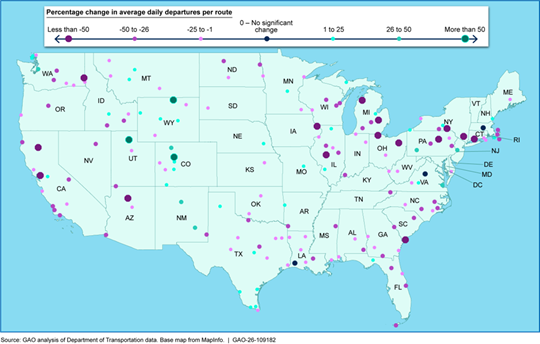
In general, small communities continue to face declining scheduled passenger air service, especially at nonhub airports—airports that have more than 10,000 annual commercial passenger boardings but less than 0.05 percent of the annual total of U.S. commercial passenger boardings. At these airports, the average number of daily departures per route in 2024 was 19 percent lower than the 2018 level. Over 70 percent of nonhub airports that were not receiving federal support from the Essential Air Service (EAS) program experienced a decline in average daily departures per route from 2018 to 2024.
Percentage Change from 2018 to 2024 in Average Daily Departures per Route for Nonhub Airports Not Receiving Subsidized Essential Air Service
According to GAO’s prior work, stakeholders have cited pilot and maintenance workforce supply challenges, increased airline operating costs, and heightened airline expectations for revenue guarantees as among the market factors contributing to changes in air service to small communities in recent years. Some of these factors also contributed to higher EAS subsidy costs, which increased about 31 percent from 2018 to 2023. Higher airline operating costs also limited the effect of Small Community Air Service Development Program (SCASDP) grants that communities used to incentivize airlines to initiate air service.
As GAO has previously reported, selected stakeholders and recent studies have identified options to improve air service to small communities. These include increasing aviation workforce supply and supporting other transportation modes, such as bus service, or new technologies, such as electric aircraft, that could lower airline operating costs. Stakeholders also identified options to change EAS—such as focusing EAS assistance on more remote communities or expanding EAS to better ensure small airports do not lose air service—and to modify SCASDP in response to rising airline operating costs.
Why GAO Did This Study
Communities of all sizes seek access to air transportation services. However, the economics of the airline industry have traditionally made it difficult to establish or sustain viable air service in small communities.
Small communities are generally served by small airports, which for scheduled passenger air service typically include small hub, nonhub, and non-primary nonhub airports. The Department of Transportation administers federal programs that provide subsidies and grants to help eligible small communities retain a link to the national aviation system.
This testimony discusses (1) changes in scheduled passenger air service to small communities in recent years; (2) market factors affecting air service to small communities and related federal programs; and (3) options that aviation stakeholders and recent studies identified to improve air service to small communities. It draws from GAO’s September 2024 report on air service to small communities (GAO-24-106681), December 2025 report on nonhub airports (GAO-26-107751), and April 2026 report on regional airline pilots (GAO-26-107856). Details about the scope and methodology for each report are included in those reports.
What GAO Recommends
In April 2026, GAO made two recommendations that could help strengthen pilot supply. Specifically, GAO recommended that FAA establish and publicly communicate timelines for finalizing two pilot training initiatives that were provided for in statute. DOT agreed with the recommendations.
Chairman Nehls, Ranking Member Carson, and Members of the Subcommittee:
I appreciate the opportunity to testify before you today on the issues affecting air service to small communities in the United States. Communities of all sizes seek access to air transportation services as a driver for attracting investment, generating employment, and providing mobility for citizens. However, the economics of the airline industry have traditionally made it difficult to establish or sustain viable air service in some smaller communities.
The Airline Deregulation Act of 1978 phased out the government’s control over fares and service and allowed market forces to determine the price and level of domestic airline service in the United States.[1] Since then, airlines have largely been free to decide where in the United States they want to operate, how often they want to fly there, the type of aircraft they want to fly to or from a community, and how much they want to charge passengers. The act also created the Essential Air Service (EAS) program, to help eligible smaller communities retain a link to the national aviation system through subsidies paid to airlines. In 2000, the Small Community Air Service Development Program (SCASDP) was established to help eligible communities with insufficient air carrier service or unreasonably high airfares improve their air service through discretionary grants. Both programs are administered by the U.S. Department of Transportation (DOT). Although subsidies and grants from these programs can assist eligible smaller communities in retaining a link to the national aviation system, the COVID-19 pandemic contributed to a significant reduction in passenger traffic and financial losses for a variety of aviation businesses and airports, especially in small communities. As we reported in December 2025, the smaller airports impacted by declines in air service included certain nonhub airports that had not regained pre-pandemic service levels by 2024.[2]
This testimony discusses (1) changes in scheduled passenger air service to small communities in recent years; (2) market factors affecting air service to small communities and related federal programs; and (3) options that aviation stakeholders and recent studies have identified to improve air service to small communities. This statement is drawn from several GAO reports issued since 2024.[3] The reports cited in this statement contain more detailed explanations of the methods used to conduct our work. DOT reviewed a draft of this statement and provided technical comments, which we incorporated where appropriate.
The work upon which this testimony is based was conducted in accordance with generally accepted government auditing standards. Those standards require that we plan and perform the audit to obtain sufficient, appropriate evidence to provide a reasonable basis for our findings and conclusions based on our audit objectives. We believe that the evidence obtained provides a reasonable basis for our findings and conclusions based on our audit objectives.
Background
Air Service to Small Communities
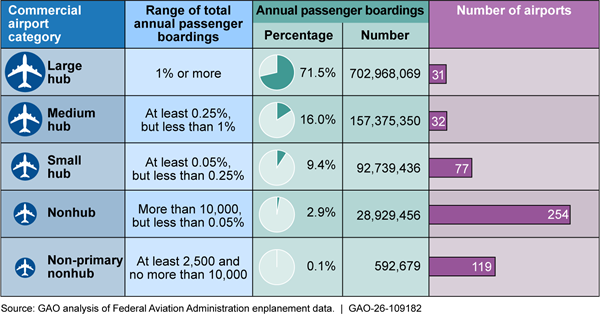
Although there is no common definition of “small community” in the context of aviation, we have previously reported that small communities are generally served by small airports, which for scheduled passenger air service typically include small hub, nonhub, and non-primary nonhub airports. These airports by definition serve comparatively fewer passengers than medium and large hub airports. Federal law divides commercial service airports into various categories based on the annual number of passenger boardings (i.e., enplanements); categories range from large hub airports to non-primary nonhub airports (see fig. 1).
Figure 1: Commercial Service Airport Categories for U.S. Airports Based on Calendar Year 2024 Passenger Boardings
Federal Programs that Support Air Service to Small Communities
Two federal programs administered by DOT support air service to small communities.[4]
Essential Air Service (EAS). EAS was established by the Airline Deregulation Act of 1978 and provides federal subsidies to air carriers to serve certain eligible communities.[5] The program is funded through a combination of appropriations from the Airport and Airway Trust Fund and overflight fees collected by FAA from foreign aircraft traveling over U.S. airspace. According to DOT, in November 2025 EAS supported air service at 108 airports in eligible communities within the contiguous United States. EAS also served 70 communities in Alaska, four communities in Hawaii, and one community in Puerto Rico.
Small Community Air Service Development Program. SCASDP was established in 2000 to, among other things, provide federal discretionary grants to fund strategies to improve air service and address issues at eligible communities that DOT determines have insufficient air carrier service or unreasonably high airfares, among other factors. Communities that receive EAS-subsidized service are not eligible for SCASDP funds. DOT is authorized to award up to 40 SCASDP grants per fiscal year to communities (not more than four per state) with underserved airports that seek to obtain airline service or to implement other measures to lower the cost and improve availability of air service.[6] Grantees often use the award for marketing or to fund a minimum revenue guarantee (revenue guarantee).[7] SCASDP offers some flexibilities that DOT may use to amend grants in response to changing industry conditions, which include modifications to limit a grant scope to only the grant funded-elements or elements achieved if DOT determines that the amendment is reasonably consistent with the original purpose of the project or the community’s current air service needs. According to DOT, this flexibility may increase future project eligibility or support grant modification to address new hub destination opportunities.[8] These flexibilities were expanded in the FAA Reauthorization Act of 2024. SCASDP grants are time-limited, and once a grant has ended, communities must find other means of support for air service.[9]
Small Communities Lost Departing Flights but Gained More Seats per Departing Flight in Recent Years
In September 2024 and December 2025, we reported on the following changes in air service to small communities in recent years:
Departures. We found that, on average, small communities had fewer total departures annually and fewer daily departures per route from 2018 to 2023 (see fig. 2).[10]
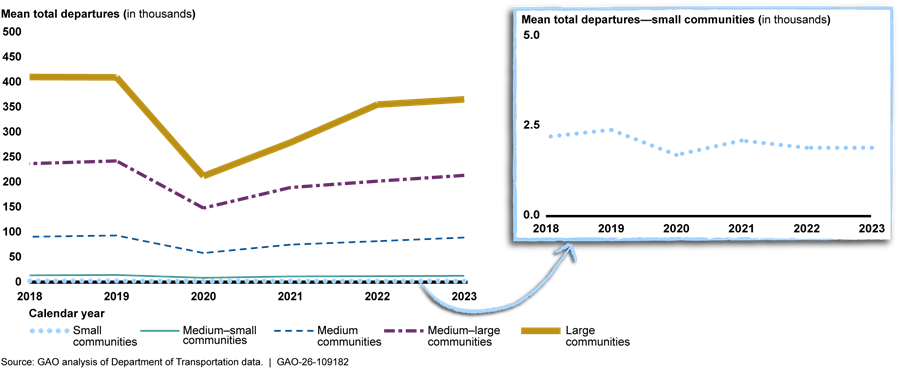
Note: We assigned communities into five size groups (small, medium-small, medium, medium-large, and large) based on their population, such that each size group represents roughly 20 percent of the population of the contiguous U.S.
For nonhub airports specifically, the average number of daily departures per route in 2024 was 19 percent lower than the 2018 level, and over 70 percent (123 of 170) of non-EAS nonhub airports experienced a decline in average daily departures per route (see fig. 3).[11]
Figure 3: Percentage Change from 2018 to 2024 in Average Daily Departures per Route for Nonhub Airports Not Receiving Subsidized Essential Air Service
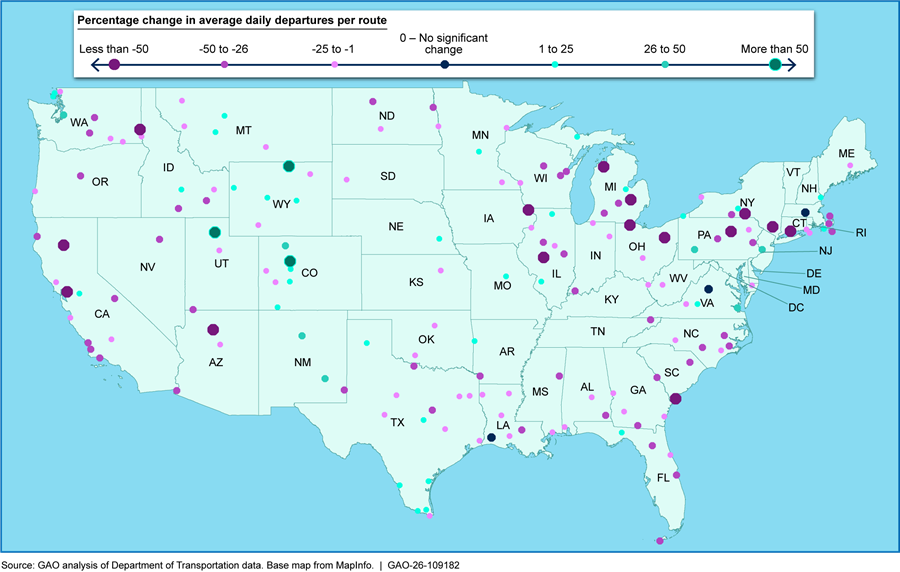
Note: Our analysis includes average daily departures per route for nonhub primary airports not receiving subsidized service under the Essential Air Service (EAS) program. We conducted our analysis for calendar years 2018-2024. Nonhub primary airports have less than 0.05 percent of annual U.S. commercial enplanements but have more than 10,000 annual enplanements. We used Federal Aviation Administration enplanement data for 2018 to determine airport size.
Seats. Flights from small communities generally had more seats, an indication that airlines were using larger aircraft (see fig. 4).
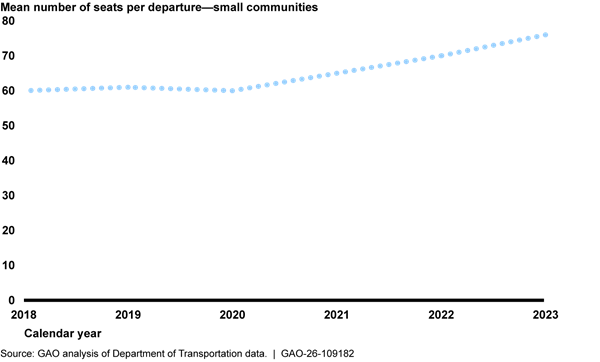
Note: We assigned communities into five size groups (small, medium-small, medium, medium-large, and large) based on their population, such that each size group represents roughly 20 percent of the population of the contiguous U.S.
Connectivity. On average, small communities’ connectivity, a measure of a passenger’s degree of access to the national aviation system, decreased slightly from 2018 to 2023.[12]
Non-EAS versus EAS. Air service trends varied by airport size and by whether the airport received support through EAS. We found that from 2018 to 2024, non-EAS nonhub airports generally experienced a greater decrease in average daily departures per route (falling 21 percent) than EAS nonhub airports (falling 5 percent). Similarly, during this period, the mean connectivity index score of non-EAS nonhub airports declined 8.9 percent, while the mean connectivity index score of EAS nonhub airports declined 2.6 percent.
Market Factors Affected Air Service to Small Communities and Federal Air Service Programs
In interviews we conducted for our prior work, aviation stakeholders identified a range of market factors that have affected air service to small communities in recent years.
Market Factors
Pilot supply. We have previously reported on aviation industry concerns that there is an insufficient supply of qualified pilots to support current and future demand from U.S. regional and mainline airlines. In our 2024 work, aviation stakeholders identified a shortage of pilots as a factor affecting air service to small communities in recent years at the time, as larger airlines rebounded from the COVID-19 pandemic by filling pilot vacancies with pilots hired from regional airlines. This hiring exacerbated regional airlines’ pre-pandemic pilot shortages. However, in April 2026 we reported that pilot supply had been rebounding in more recent years, as regional airlines have significantly increased pilot pay and pilot certifications have grown.
Aviation maintenance worker supply. Airlines have also faced shortages of aviation maintenance workers, including aircraft mechanics and aviation maintenance technicians, according to stakeholders we interviewed for our September 2024 report. Representatives from one airline told us shortages among these workers have affected the airline’s ability to operate its fleet of aircraft. FAA administers Aviation Workforce Development Grants to projects that aim to generate and increase interest in aviation maintenance careers and to prepare students for aviation maintenance programs. FAA is accepting applications for the current grant cycle through June 22, 2026. We have ongoing work examining high school aviation maintenance programs, which have the potential to bolster the pipeline of individuals interested in aviation maintenance careers.
Increased airline operating costs and switch to larger planes. Rising costs of labor, fuel, and fleet maintenance have increased airline operating costs and made air service to small communities less economically feasible, contributing to reductions in air service, according to stakeholders we have interviewed. Recent increases in jet fuel prices have also affected airline operating costs, according to the trade association Airlines for America. Our 2025 report on nonhub airports noted that airlines have sought to lower costs by replacing smaller planes across their fleet with larger planes and reducing frequency of flights at smaller airports (i.e., upgauging). Our analysis of aircraft seats per departure reflected this shift, as flights from small communities generally had more seats in 2023, compared to 2018, an indication that airlines were using larger aircraft.
Travelers choosing to drive. Another long-standing challenge for small community air service is when residents that live close to a smaller airport either drive to their destination instead of flying or drive to a larger airport. Residents of small communities are often willing to drive or take a bus to a larger airport to take advantage of the fares offered by low-cost or ultra-low-cost carriers and for nonstop service, according to our 2025 report on nonhub airports.
Heightened airline expectation for revenue guarantees. As airlines seek to increase revenue and reduce costs, many smaller communities not receiving service through EAS find themselves in a “pay-to-play” environment for air service, according to our 2025 report on nonhub airports. According to DOT, in 2024 airline expectations for minimum revenue guarantees ranged from $1.5 to 2 million for a year of service, up from $500,000 to $800,000 before the COVID-19 pandemic. In response, communities may have to leverage various sources of funding, including state or local funding and SCASDP grants, to secure or maintain air service. For example, in 2023, Wenatchee, WA used public funding from the local regional port authority and contributions from entities including local municipalities and businesses to pay a 1-year, $500,000 revenue guarantee to Alaska Airlines for a second daily flight to Seattle. A second example is Wyoming’s capacity purchase agreement with SkyWest Airlines to serve some airports in the state, including the airport in Rock Springs. Communities that have received funding for a revenue guarantee through a SCASDP grant may need to find other means to support air service once the grant has ended. Dubuque, IA lost commercial air service entirely in early 2026 when the community’s revenue guarantee—that had been partially funded with a SCASDP grant—was expended.
Effects on Federal Air Service Programs
In turn, some of these market factors affected federal air service programs.
EAS. From 2018 through 2023, increased airline operating costs contributed to a 31 percent increase in total EAS subsidies for communities in the lower 48 states in real 2023 dollars. As we previously reported, according to DOT, factors contributing to the increase in EAS subsidies included higher aviation labor and fuel costs, inflation, and an increase in the use of regional jets, which consume more fuel than smaller turboprop aircraft, to serve communities.[13] We have ongoing work examining EAS costs in response to a provision in the FAA Reauthorization Act of 2024.[14]
The way airlines serve EAS communities has also changed in recent years. For example, the number of EAS communities served by a Part 135 public charter operator more than doubled (8 to 20) from 2018 to 2023. In our 2024 work, representatives from Contour Airlines, the public charter operator serving those 20 communities, told us operating under Part 135 enables them to hire from a larger pool of pilots than under Part 121.[15]
Additionally, over this time period, more EAS communities participated in the Alternate EAS program (which allows them to forego subsidized air service for a period of time in exchange for a grant) and all of them used the grant to receive public charter service.[16] DOT told us that participation in Alternate EAS has grown as communities have been dissatisfied with airline proposals under traditional EAS, as well as communities’ desire for air service from regional jets versus smaller turboprop aircraft.[17]
SCASDP. Higher airline operating costs have also affected SCASDP by limiting the effect of the grants that communities use for revenue guarantees, according to airport and airline representatives we interviewed in our September 2024 report. Representatives from airlines told us that SCASDP grants intended to fund revenue guarantees cover less of the cost of serving small communities than in the past. Additionally, our recent work on nonhub airports found that applications for grant assistance continue to exceed the support SCASDP offers. For the most recent grant opportunity, for example, 40 communities applied for more than $30 million to support air service at their local airports for fiscal year 2023, and DOT awarded SCASDP grants totaling nearly $12 million to 14 communities (see table 1).[18] DOT has announced that it awarded up to $12 million in grants for fiscal year 2024.[19]
Table 1: Small Community Air Service Development Program (SCASDP) Grant Applications and Awards, Fiscal Years 2018–2023
|
Award cycle |
Number of eligible communities (of total applications) |
Total amount requesteda |
Number of awards |
Total amount granted |
|
2018 |
54 (of 57) |
> $37 million |
18 |
$12,242,000 |
|
2019 |
71 (of 78) |
> $58 million |
22 |
$17,972,111 |
|
2020 |
|
|
No grants awardedb |
|
|
2021 |
45 (of 48) |
> $33 million |
25 |
$16,931,000 |
|
2022 |
45 (of 48) |
> $34 million |
20 |
$14,815,000 |
|
2023 |
40 (of 46) |
> $31 millionc |
14 |
$11,955,000 |
Source: GAO analysis of Department of Transportation data. │ GAO‑26‑109182
aIn its SCASDP award announcements, Department of Transportation (DOT) provides the minimum amount requested.
bDOT did not award SCASDP grants for fiscal year 2020. According to agency officials, DOT instead combined no-year funds provided by Congress in fiscal year 2020 for grant awards in fiscal year 2021.
cFiscal year 2023 total amount requested is based on eligible communities; requests for other years are based on applicant communities.
Selected Stakeholders and Recent Studies Identified Various Options to Improve Air Service to Small Communities
Aviation stakeholders we interviewed and recent studies we reviewed in our prior work identified a number of options to improve air service to small communities.[20]
Modifying EAS. Aviation stakeholders we interviewed for our September 2024 report identified options for modifying the EAS program. These options were identified before the FAA Reauthorization Act of 2024 was enacted, and, for the most part, were not included in the FAA Reauthorization Act of 2024. For many of these options, statutory amendments would be required, should Congress choose to adopt them. To focus assistance on more remote communities, stakeholders suggested 1) eliminating the waivers DOT may allow for communities that do not maintain certain eligibility requirements; 2) requiring communities to provide a local match to the EAS subsidy; or 3) providing funding to the states for distribution, rather than direct subsidies to the airlines.[21] Stakeholders also suggested that DOT be required to consider the cost of the subsidy when awarding airline contracts—a requirement that was included in the FAA Reauthorization Act of 2024.[22] Stakeholders noted that Congress could also expand EAS by loosening requirements, such as by raising the per-passenger subsidy caps, or allowing previously eligible communities to regain eligibility.[23]
Modifying SCASDP. We and others have found that SCASDP grants have a mixed record of success in attracting air service.[24] In interviews for our 2024 report, aviation stakeholders identified a range of options for modifying SCASDP in response to rising airline operating costs. These options were identified before the FAA Reauthorization Act of 2024 was enacted. Some of these options Congress might consider would require statutory amendments, such as increasing total funding for the program or allowing more flexibility in how grants may be used when a community’s circumstances change.[25] Stakeholders also suggested allocating funding to fewer communities per cycle or shifting the focus of the program away from revenue guarantees.
Increasing pilot supply. Aviation stakeholders we interviewed for our September 2024 report identified a number of options that Congress could consider to increase pilot supply. These include, for Part 121 pilots, 1) revising the statutory requirement that captains and first officers have 1,500 hours of flight time to hold an Airline Transport Pilot certificate; and 2) raising the statutory mandatory retirement age from 65 to 67.[26] To help strengthen the pilot pipeline, the FAA Reauthorization Act of 2024 required FAA to take action on two pilot training initiatives by November 2024.
· Enhanced Qualification Program. Requires FAA to establish requirements so that qualified air carriers, among others, may provide enhanced training to eligible pilots seeking a restricted-privileges airline transport pilot certificate.[27] This enhanced training includes instruction on fundamental aviation subjects as well as airline operations and procedures.
· Nationwide office for Designated Pilot Examiners. Requires FAA to establish a nationwide office for oversight of Designated Pilot Examiners—experienced pilots designated by the FAA to conduct tests with student pilots. The act also requires FAA to submit reports to congressional committees evaluating the use of Designated Pilot Examiners.
In April 2026, we recommended that FAA establish and publicly communicate timelines for issuing 1) the Enhanced Qualification Program requirements and 2) the first required report to Congress on the Designated Pilot Examiner’s national office. DOT concurred with the recommendations. We are continuing to monitor FAA’s efforts to address the recommendations.
Using alternative transportation modes or technologies. Aviation stakeholders we interviewed and recent studies we reviewed in our prior work also identified options to address higher airline operating costs—namely, the use of bus service and electric aircraft. We have previously reported that a multimodal approach, including bus service to larger airports, is an alternative to providing scheduled passenger service to small communities. For example, the Landline Company currently provides short-haul bus service from certain smaller airports to large hub airports in a manner that substitutes for a connecting flight offered by a regional airline. Stakeholders we previously interviewed have had mixed views on bus service as a feasible alternative. While some were supportive, others cited obstacles like the length of time of bus trips and airport resistance because bus passengers do not count toward the minimum 10,000 annual passenger enplanements that airports must maintain to qualify for Airport Improvement Program funding.
Additionally, aircraft with electric propulsion technologies may have the potential to lower operating costs for airlines, according to publications we reviewed for our September 2024 report. We previously reported that regional air mobility—an application of advanced air mobility—could use electric or hybrid-electric aircraft to carry passengers to adjoining regions and cities, and could open up new regional corridors.[28] In interviews for our December 2025 report on nonhub airports, stakeholders also told us that electric or hybrid-electric aircraft—which include short-range aircraft in development that would accommodate nine, 30, or 100 passengers—may be more suitable for some smaller communities than the larger jets that airlines currently use. However, some aviation stakeholders we interviewed were skeptical of electric aircraft as a viable near-term option for air service to small communities due to the cost and feasibility of installing charging infrastructure and the need for FAA regulatory approval of such aircraft, among other things.
Planning at the state level. Based on interviews with officials from certain state DOTs for our December 2025 report, we identified examples of state-level air service development and planning. For example, two of the selected nonhub airports we reviewed—in Rock Springs, Wyoming and Traverse City, Michigan—are located in states that provided funding for air service through their state aviation programs. In addition, while not directly funding air service development, Washington State DOT was part of a regional effort funded through SCASDP to assist smaller airports—like the one in Wenatchee—with local air service issues in Oregon and Washington. In interviews for our December 2025 report, officials from the state DOTs in Michigan, Washington, and Wyoming told us that state or regional support for air service development can be limited by funding and other constraints. Our prior analysis of SCASDP grants found several other examples of SCASDP funding being used to support state or regional planning efforts, although such uses were infrequent. While the statute enables—and according to agency officials, DOT encourages—applications by groups of communities, DOT most frequently receives individual applications for SCASDP funding, rather than applications that are part of a more holistic assessment of state or regional needs.
Chairman Nehls, Ranking Member Carson, and Members of the Subcommittee, this completes my prepared statement. I would be pleased to respond to any questions that you may have at this time.
GAO Contact and Staff Acknowledgments
If you or your staff have any questions about this statement, please contact me at (202) 512-2834 or collinsd@gao.gov. Contact points for our Offices of Congressional Relations and Media Relations may be found on the last page of this statement. GAO staff who made key contributions to this testimony are Jonathan Carver (Assistant Director), Justin Reed (Analyst in Charge), Melissa Bodeau, Jean Cook, Melanie Diemel, Molly Laster, Dan Luo, Rebecca Morrow, Dominic Nadarski, and Elizabeth Wood.
This is a work of the U.S. government and is not subject to copyright protection in the United States. The published product may be reproduced and distributed in its entirety without further permission from GAO. However, because this work may contain copyrighted images or other material, permission from the copyright holder may be necessary if you wish to reproduce this material separately.
The Government Accountability Office, the audit, evaluation, and investigative arm of Congress, exists to support Congress in meeting its constitutional responsibilities and to help improve the performance and accountability of the federal government for the American people. GAO examines the use of public funds; evaluates federal programs and policies; and provides analyses, recommendations, and other assistance to help Congress make informed oversight, policy, and funding decisions. GAO’s commitment to good government is reflected in its core values of accountability, integrity, and reliability.
Obtaining Copies of GAO Reports and Testimony
The fastest and easiest way to obtain copies of GAO documents at no cost is through our website. Each weekday afternoon, GAO posts on its website newly released reports, testimony, and correspondence. You can also subscribe to GAO’s email updates to receive notification of newly posted products.
Order by Phone
The price of each GAO publication reflects GAO’s actual cost of production and distribution and depends on the number of pages in the publication and whether the publication is printed in color or black and white. Pricing and ordering information is posted on GAO’s website, https://www.gao.gov/ordering.htm.
Place orders by calling (202) 512-6000, toll free (866) 801-7077,
or
TDD (202) 512-2537.
Orders may be paid for using American Express, Discover Card, MasterCard, Visa, check, or money order. Call for additional information.
Connect with GAO
Connect with GAO on X,
LinkedIn, Instagram, and YouTube.
Subscribe to our Email Updates. Listen to our Podcasts.
Visit GAO on the web at https://www.gao.gov.
To Report Fraud, Waste, and Abuse in Federal Programs
Contact FraudNet:
Website: https://www.gao.gov/about/what-gao-does/fraudnet
Automated answering system: (800) 424-5454
Media Relations
Sarah Kaczmarek, Managing Director, Media@gao.gov
Congressional Relations
David A. Powner, Acting Managing Director, CongRel@gao.gov
General Inquiries
[1]Pub. L. No. 95-504, 92 Stat. 1705.
[2]GAO, Commercial Aviation: Certain Nonhub Airports Face Significant Challenges in Securing and Maintaining Air Service, GAO‑26‑107751 (Washington, D.C.: Dec. 17, 2025). Nonhub airports are defined in statute as those that have less than 0.05 percent of annual U.S. commercial enplanements (i.e., passenger boardings) but have more than 10,000 annual enplanements.
[3]See GAO, Commercial Aviation: Trends in Air Service to Small Communities, GAO‑24‑106681 (Washington, D.C.: Sept. 25, 2024; Commercial Aviation: Certain Nonhub Airports Face Significant Challenges in Securing and Maintaining Air Service, GAO‑26‑107751 (Washington, D.C.: Dec. 17, 2025); and Aviation Workforce: FAA Could Strengthen Regional Pilot Pipeline by Establishing Timelines for Training Initiatives, GAO‑26‑107856 (Washington, D.C.: April 30, 2026).
[4]The Federal Aviation Administration’s (FAA) Airport Improvement Program (AIP) also provides funding to airports, including those serving small communities. AIP generally focuses on capital and infrastructure projects and does not provide funding directly for air service.
[5]To be eligible for EAS (in communities other than in Hawaii and Alaska), a community must require a subsidy per passenger of less than $650 during the most recent fiscal year, unless the community is 175 miles or more from the nearest large or medium hub airport or DOT issues a waiver; have had a subsidy per passenger of less than $1,000 during the most recent fiscal year regardless of the distance from a large or medium hub airport (lowered to $850 effective October 2026); have had an average of 10 or more enplanements per service day during the most recent fiscal year, unless the community is more than 175 driving miles from the nearest medium or large hub airport or unless DOT is satisfied that any decrease below 10 enplanements is due to a temporary decline in demand and issues a waiver; and have received subsidized EAS, or received a 90-day notice of intent to terminate essential air service and the Secretary required the air carrier to continue to provide such service to the community, at any time during the period between September 30, 2010, and September 30, 2011. Beginning in 2022, annual appropriations laws have waived certain EAS eligibility criteria, including the enplanements minimum and per-passenger subsidy cap. Communities in Alaska and Hawaii have different eligibility requirements than those in the contiguous U.S.
[6]Pursuant to statute and FAA policy, airports that receive federal funding are not able to use airport revenue to provide revenue guarantees. See 49 U.S.C. §§ 47107(b)(1), 47133; FAA Policy Regarding Air Carrier Incentive Program, 88 Fed. Reg. 85,344 (Dec. 7, 2023) (stating that airport revenues must be used for the capital and operating costs of the airport or local airport system, and air carrier operations are not a capital or operating cost).
[7]Revenue guarantees are designed to limit an airline’s risk in initiating air service by guaranteeing that the airline will generate a specified amount of revenue from the ticket sales associated with new service over a specified time frame. When offering a revenue guarantee, the community agrees to pay the airline the difference between ticket sales and the guaranteed minimum if ticket sales do not meet the guaranteed minimum amount.
[8]No community may participate in SCASDP in support of the same project more than once in a 5-year period, but any community may apply to participate in the program in support of a different project at any time.
[9]For example, SCASDP grants can provide funding for revenue guarantees to subsidize service for a period of no more than 3 years.
[11]GAO‑26‑107751. Our analysis of nonhub airports excludes non-primary nonhub airports.
[12]We analyzed the connectivity index introduced by Wittman and Swelbar. The connectivity index is a function of the frequency of available scheduled flights, the quantity and quality of nonstop destinations serviced, and the quantity and quality of connecting destinations. Michael Wittman and William Swelbar, “Modeling Changes in Connectivity at U.S. Airports: A Small Community Perspective,” Report No. ICAT-2013-05 (June 2013).
[14]See FAA Reauthorization Act of 2024, Pub. L. No. 118-63, § 567, 138 Stat. 1025, 1219.
[15]Under Part 121, captains and first officers must hold an airline transport pilot (ATP) certificate, which requires a minimum of 1,500 hours of flight time. In contrast, under Part 135, captains must hold an ATP certificate, but first officers do not have to meet the 1,500-hour requirement.
[16]As of October 2025, 12 communities were participating in the Alternate EAS program. Alternate EAS allows communities to forego their EAS in exchange for receiving a grant to spend in a variety of ways that might better suit their individual needs. These options are spelled out in statute and include more frequent service with smaller aircraft, on-demand air taxi service, scheduled or on-demand surface transportation, or regionalized air service. 49 U.S.C. § 41745.
[17]The FAA Reauthorization Act of 2024 includes a provision for GAO to conduct a study on effectiveness of the Alternate EAS program. Pub. L. No. 118-63, § 563.
[18]In fiscal year 2023, DOT received $10 million in appropriations for the program and awarded nearly $12 million in grants. According to DOT officials, the amount of funds available in a given fiscal year has at times exceeded the appropriated amount for that year. For example, in certain years, funds recovered from prior grant awards became available and supplemented the appropriated funding.
[19]In March 2026, DOT issued an order soliciting applications from communities or consortia of communities for fiscal year 2024 SCASDP grants (utilizing FY 2024 and a portion of FY 2025 funding); applications were to be submitted by May 4, 2026.
[20]For a detailed discussion of the various stakeholder views on each of these options, see GAO‑24‑106681 and GAO‑26‑107751.
[21]The FAA Reauthorization Act of 2024 limited the circumstances under which DOT may waive certain EAS eligibility requirements. Beginning in fiscal year 2027, DOT may not provide a waiver of the minimum enplanements or certain per passenger subsidy cap requirements to any location in more than two consecutive fiscal years or in more than five fiscal years within 25 consecutive years. However, beginning in 2022, annual appropriations laws have waived certain EAS eligibility criteria, including the enplanements minimum and per-passenger subsidy caps. For suggestions (2) and (3), the FAA Reauthorization Act of 2024 did not include a cost-sharing requirement for EAS communities or provide EAS funding to the states.
[22]According to information provided by DOT, although DOT was not previously required to consider cost, DOT has considered the relative subsidy requirements of the various options when selecting an EAS carrier since the inception of the program. Furthermore, prior to the FAA Reauthorization Act of 2024, DOT was authorized by Congress to consider the relative subsidy requirements of applicant air carriers.
[23]Prior to the FAA Reauthorization Act of 2024, the per-passenger subsidy cap was $200, unless the community was more than 210 miles from the nearest large or medium hub airport or unless DOT issued a waiver. The FAA Reauthorization Act of 2024 raised the per-passenger subsidy cap to $650 for locations that are less than 175 miles from the nearest large or medium hub airport, unless DOT waives the requirement based on a temporary decline in demand. The FAA Reauthorization Act of 2024 did not modify the program to allow ineligible communities not in Alaska to re-enter.
[24]In 2019, we reported that half of the 66 grantees that received awards for fiscal years 2010 through 2014 were successful in achieving their goals during the award period, and that just over a third sustained their results for at least 24 months after the award period had ended. Additionally, a 2014 article calculated that of the 115 grantees from 2006 through 2011 that requested funds to attract new service or achieve other outcomes, fewer than half were ultimately successful in meeting the goals of their proposal within 28 months of accepting the grant. See GAO, Small Community Air Service Development: Process for Awarding Grants Could Be Improved, GAO‑19‑172 (Washington, D.C.: Mar. 26, 2019) and Michael D. Wittman, “Public Funding of Airport Incentives in the United States: The Efficacy of the Small Community Air Service Development Grant Program,” Transport Policy, vol. 35 (September 2014).
[25]The FAA Reauthorization Act of 2024 increased the authorization of funding for SCASDP to $15 million annually. The FAA Reauthorization Act of 2024 gave DOT the authority to amend the scope of a grant agreement at the request of the community or consortium and any participating air carrier, and limit the scope of a grant agreement to only the elements using grant assistance or to only the elements achieved, if the Secretary determines that the amendment is reasonably consistent with the community’s current air service needs.
[26]The FAA Reauthorization Act of 2024 did not amend the 1,500 flight-hour training requirement for Part 121 pilots or raise the retirement age for Part 121 U.S. airline pilots.
[27]FAA allows pilots with fewer than 1,500 hours of total time as a pilot to obtain a restricted-privileges airline transport pilot (R-ATP) certificate when they meet certain requirements. The R-ATP certificate allows pilots to serve as first officers in certain operations until they obtain the necessary 1,500 hours of total time as a pilot needed for an ATP certificate.
[28]The FAA Reauthorization Act of 2024 defines advanced air mobility as a transportation system that comprises urban air mobility and regional mobility. Both of these mobilities involve the use of advanced technologies such as fully electric and hybrid-electric aircraft for passenger transport, cargo transport, and emergency services, inside and outside of cities. According to DOT officials, fully electric aircraft have utility over shorter distances, such as trips up to 40 miles, and hybrid-electric aircraft can fly up to 300 miles before charging. For more information, see GAO‑24‑106681.