
Testimony Before the Subcommittees on Border Security and Enforcement and Counterterrorism and Intelligence, Committee on Homeland Security, House of Representatives
Expected at 2 p.m. EDT
United States Government Accountability Office
A testimony before the Subcommittees on Border Security and Enforcement and Counterterrorism and Intelligence, Committee on Homeland Security, House of Representatives
Contact: Heather MacLeod at MacLeodH@gao.gov
What GAO Found
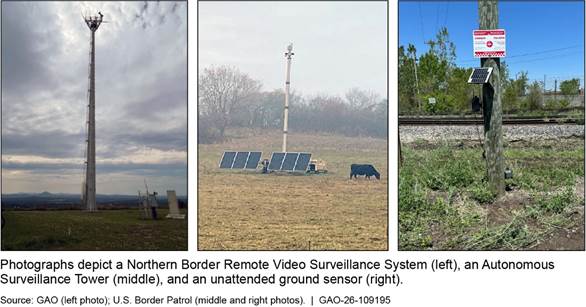
U.S. Border Patrol and Air and Marine Operations (AMO), within U.S. Customs and Border Protection (CBP), are responsible for securing U.S. borders between ports of entry in the land, air, and maritime environments. CBP uses aircraft, vessels, and surveillance technology—such as cameras, radar sites, and sensors—in its efforts to secure the northern border (see figure). CBP also participates in task forces with other agencies such as U.S. Immigration and Customs Enforcement to support its efforts. From fiscal year 2019 through fiscal 2024, Border Patrol apprehensions along the northern border increased, with sharp increases in 2023 and 2024. Apprehensions subsequently decreased in fiscal year 2025 and have generally remained consistent at these reduced levels as of April 2026, according to CBP’s publicly reported data.
GAO previously reported that CBP has faced longstanding challenges addressing staffing gaps. In 2026, GAO found that the number of Border Patrol agents on the northern border decreased from fiscal year 2019 through fiscal year 2024. Although the number of authorized agents increased, the number of agents assigned to and working in these sectors decreased by about 6 percent. There was also a decrease in the staffing rate for Law Enforcement Information Systems Specialists who monitor surveillance technology. GAO recommended that CBP develop and implement a plan to address this staffing gap, which could help the agency better carry out its responsibilities.
In 2019, GAO found that CBP did not have measures to assess its effectiveness at securing the northern border between ports of entry. Border Patrol had performance measures that assessed security in remote areas, but the measures did not include data from maritime border areas. Two AMO measures included data across all border areas and were not specific to the northern border. GAO recommended that Border Patrol and AMO each develop and implement such measures to better assess operations on the northern border.
Why GAO Did This Study
CBP, within the Department of Homeland Security, has primary responsibility for securing the nearly 4,000-mile border between the U.S. and Canada. Key security threats along the northern border include terrorism, contraband smuggling—specifically, the bidirectional flow of illicit drugs—and violations of U.S. immigration law such as migrant smuggling.
CBP received billions of dollars in the 2025 law commonly known as the One Big Beautiful Bill Act and the 2026 Secure America Act to hire and train additional personnel. According to CBP, the One Beautiful Bill Act funding alone will support hiring an additional 5,000 CBP officers, 3,000 Border Patrol agents, and 200 AMO agents.
This statement is based primarily on GAO’s June 2019 and February 2026 reports. It discusses CBP’s (1) resources across the northern border, (2) staffing in the region and related challenges, and (3) performance measures for assessing its effectiveness at securing the northern border.
What GAO Recommends
GAO made a total of three recommendations to CBP in the 2019 and 2026 reports to help address challenges related to staffing gaps and measuring the effectiveness of Border Patrol’s and AMO’s efforts to secure the northern border. The Department of Homeland Security agreed with GAO’s recommendations.
CBP has taken some steps to address the recommendations but has not yet fully implemented them. GAO will continue to monitor CBP’s progress in implementing these recommendations.
Chairmen Guest and Pfluger, Ranking Members Correa and Magaziner, and Members of the Subcommittees:
I am pleased to be here today to discuss GAO’s work examining U.S. Customs and Border Protection’s (CBP) operations and resources at the northern border. The U.S and Canada share the longest common non-militarized border between two countries, spanning nearly 4,000 miles of land and maritime borders. CBP, within the Department of Homeland Security (DHS), has the primary responsibility for securing U.S. borders at and between ports of entry.[1] U.S. Border Patrol and Air and Marine Operations (AMO) are CBP subcomponents responsible for securing U.S. borders between ports of entry in the land, air, and maritime environments.
In 2025, CBP received $4.1 billion in Public Law 119-21, commonly known as the One Big Beautiful Bill Act, available until September 30, 2029, to hire and train additional CBP agents and officers, rehired annuitants, and field support personnel.[2] Specifically, the CBP Commissioner testified that the act supports the agency’s hiring goals by funding an additional 5,000 CBP officers, 3,000 Border Patrol agents, and 200 AMO agents.[3] In June 2026, the Secure America Act provided CBP appropriations available through September 30, 2029, of $9.55 billion to hire, pay, train, and equip Border Patrol agents and support personnel, and over $13 billion to hire, pay, train, and equip CBP agents and necessary support staff (and for CBP mission support, operations and maintenance).[4]
Key security threats along the northern border include terrorism, contraband smuggling—specifically, the bidirectional flow of illicit drugs—and violations of U.S. immigration law such as migrant smuggling.[5] In addition, Border Patrol has reported other threats between ports of entry that affect border security operations along the northern border. For example, the number of vehicle incursions into and out of the U.S increased by 540 percent from fiscal year 2021 through fiscal year 2024.[6] In addition, drones—small unmanned aircraft systems—can smuggle illicit drugs and firearms.
Border Patrol’s area of responsibility along the northern border is divided among eight sectors: Blaine, Spokane, Havre, Grand Forks, Detroit, Buffalo, Swanton, and Houlton.[7] Border Patrol agents patrol international land borders and waterways to detect and prevent the illegal movement of people, narcotics, and contraband into the U.S. Agents rely on nonuniformed personnel for mission support duties, including communications, surveillance, and other administrative tasks.
AMO operations along the northern border are divided among three branches that constitute its Northern Region: Bellingham Air and Marine Branch in Washington, Great Lakes Air and Marine Branch in Michigan, and Manassas Air Branch in Virginia.[8] AMO air interdiction agents pilot airplanes, helicopters, and drones, while aviation enforcement agents conduct airborne law enforcement operations, such as operating sensors, executing warrants, and seizing evidence. Marine interdiction agents command and crew vessels and conduct maritime patrols.
In addition, CBP participates in task forces with federal, tribal, state, and local agencies—including U.S. Immigration and Customs Enforcement’s Homeland Security Investigations—to support its efforts to secure the northern border between ports of entry. For example, Border Patrol and AMO agents are assigned as task force officers along the northern border on the U.S. Immigration and Customs Enforcement-led Border Enforcement Security Task Forces to identify, investigate, disrupt, and dismantle transnational criminal organizations.[9] According to Border Patrol and AMO officials, task force officers help enhance partnerships, information sharing, and situational awareness along the northern border.
My statement today discusses the results of our 2019 and 2026 reports on CBP’s northern border activities.[10] Specifically, this statement discusses (1) CBP data on apprehensions, use of assets and surveillance technology, and drug seizures along the northern border, (2) the extent to which CBP’s staffing along the northern border changed since fiscal year 2019 and the steps it has taken to address any challenges, and (3) the extent to which CBP has developed and implemented performance measures to assess its effectiveness at securing the northern border.
For the 2019 and 2026 reports, we analyzed CBP, Border Patrol, and AMO policies, documentation, and data, and we interviewed officials from agency headquarters and selected field locations. More detailed information on our scope and methodology, including analyzing data and determining a sufficient level of reliability for our reporting, can be found in the reports. For this statement, we also reviewed information on the status of agency implementation of our prior recommendations.
We conducted the work on which this statement is based in accordance with generally accepted government auditing standards. Those standards require that we plan and perform the audit to obtain sufficient, appropriate evidence to provide a reasonable basis for our findings and conclusions based on our audit objectives. We believe that the evidence obtained provides a reasonable basis for our findings and conclusions based on our audit objectives.
Apprehensions and Aircraft, Vessels, and Surveillance Technology Use Increased from Fiscal Year 2019 to Fiscal Year 2024
Total Border Patrol Apprehensions Increased from Fiscal Year 2019 to Fiscal Year 2024 and Varied Across Sectors
In February 2026, we found that the total number of Border Patrol apprehensions along the northern border between ports of entry increased from fiscal year 2019 through fiscal year 2024, with sharp increases in 2023 and 2024 and a subsequent decrease for the first 6 months of fiscal year 2025 (see fig. 1).[11]
Figure 1: Monthly U.S. Border Patrol Apprehensions Along the Northern Border Between Ports of Entry, Fiscal Year 2019 Through the Second Quarter of Fiscal Year 2025
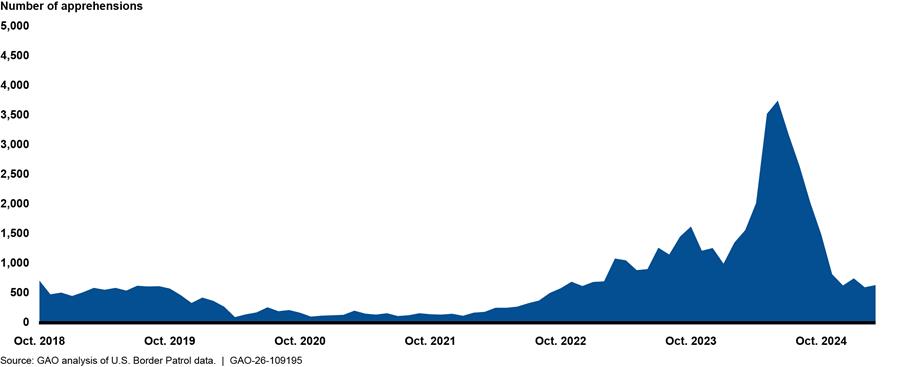
Notes: In this statement, an apprehension is the physical control or temporary detainment of any person encountered by Border Patrol between ports of entry for suspected violation of U.S. law. Fiscal year 2025 apprehensions reported for October 1, 2024, to March 31, 2025.
According to data on CBP’s public website, Border Patrol apprehensions along the northern border remained generally consistent at these reduced levels from April 2025 through April 2026, the most recent data available.[12]
In particular, our analysis showed that the total number of apprehensions increased from 6,618 in fiscal year 2019 to 24,968 in fiscal year 2024.[13] The Swanton and Blaine sectors had the greatest increase in apprehensions during this period. Apprehensions in the other six sectors combined decreased by 49 percent, from 4,455 apprehensions in fiscal year 2019 to 2,255 apprehensions in fiscal year 2024. Table 1 shows the number of apprehensions for Border Patrol’s northern border sectors and the percentage change for each sector during this period.
Table 1: Total Number of Apprehensions in U.S. Border Patrol’s Northern Border Sectors, Fiscal Year (FY) 2019–2024
|
Border Patrol Sector |
FY 2019 |
FY 2020 |
FY 2021 |
FY 2022 |
FY 2023 |
FY 2024 |
Percentage change |
|
Blaine |
600 |
290 |
169 |
454 |
1,604 |
2,940 |
390% |
|
Buffalo |
736 |
374 |
131 |
107 |
319 |
508 |
-31% |
|
Detroit |
1,767 |
760 |
310 |
318 |
651 |
718 |
-59% |
|
Grand Forks |
693 |
360 |
122 |
93 |
331 |
281 |
-59% |
|
Havre |
209 |
75 |
91 |
86 |
88 |
109 |
-48% |
|
Houlton |
425 |
361 |
222 |
424 |
448 |
472 |
11% |
|
Spokane |
625 |
306 |
75 |
96 |
200 |
167 |
-73% |
|
Swanton |
1,563 |
822 |
413 |
1,134 |
7,265 |
19,773 |
1,165% |
|
Total |
6,618 |
3,348 |
1,533 |
2,712 |
10,906 |
24,968 |
277% |
Source: GAO analysis of U.S. Border Patrol data. | GAO‑26‑109195
Border Patrol officials told us that the increase in apprehensions along the northern border for fiscal years 2023 and 2024 can be partially attributed to individuals without valid travel documents seeking entry into the U.S. from Canada after entering that country under its Electronic Travel Authorization system.[14] Specifically, Border Patrol officials stated that many foreign nationals who did not have valid travel documents to enter the U.S. traveled to Canada first and then attempted to enter the U.S during this period. Border Patrol attributed the subsequent decline in apprehensions along the northern border after June 2024 to border enforcement policies intended to discourage individuals from seeking illegal entry into the U.S.
CBP’s Use of Aircraft, Vessels, and Surveillance Technology Along the Northern Border Increased from Fiscal Year 2019 to Fiscal Year 2024
We found that CBP increased the number of hours aircraft and marine vessels operated from fiscal year 2019 through fiscal year 2024 across the northern region, while the number of aircraft and marine vessels available to CBP decreased slightly during those years. During this same period, CBP increased the deployment of land-based surveillance technology across the northern border, including camera towers and unattended ground sensors.
AMO air and marine vessels. The number of hours that AMO operated aircraft and marine vessels increased. Specifically, our analysis of AMO data showed that the number of hours AMO spent in the air (i.e., flight hours) focused on enforcement activities along the northern border increased about 7 percent from about 7,800 in fiscal year 2019 to 8,300 in fiscal year 2024.[15] In addition, we found that the number of hours that AMO marine vessels operated (i.e., float hours) focused on enforcement activities along the northern border varied for fiscal years 2019 through 2024. Overall, the number of float hours along the northern border increased from about 3,900 in fiscal year 2019 to 4,600 in fiscal year 2024—an increase of about 17 percent.
Even though the number of AMO flight and float hours generally increased along the northern border, the number of AMO aircraft and vessels available to AMO agents along the northern border decreased from fiscal year 2019 through fiscal year 2024. In April 2019, AMO units along the northern border had 13 planes, 16 helicopters, and three unmanned aircraft systems. In October 2024, these units had 11 planes, 15 helicopters, and two unmanned aircraft systems. Overall, this was a decrease of four aircraft.[16] The number of marine vessels along the northern border decreased slightly from 28 in fiscal year 2019 to 27 in fiscal year 2024. The number of vessels equipped to operate on rivers decreased from 66 in October 2019 to 59 in August 2024.[17]
CBP land-based surveillance. Border Patrol has increased the deployment of land-based surveillance technology along the northern border—namely, camera towers and sensors. Specifically, from the end of fiscal year 2019 to the end of fiscal year 2024, Border Patrol deployed 28 additional camera towers and 1,450 additional unattended ground sensors along the northern border.[18] Land-based surveillance technology encompasses several types of systems. For example, Northern Border Remote Video Surveillance Systems provide surveillance in the Great Lakes environment. The systems utilize tower- or structure-mounted day and night (infrared) cameras and, in some cases, have radar capabilities. Autonomous Surveillance Towers are a newer technology system that is capable of autonomously detecting, identifying, and tracking illicit cross-border activity.[19] In addition, flat-panel radar sites provide Border Patrol with maritime detection capabilities in the Great Lakes region.
Drug Seizures Along the Northern Border Varied and Firearms and Currency Seizures Increased from Fiscal Year 2019 to Fiscal Year 2024
Drug seizures. We found that the total number of Border Patrol drug seizure events fluctuated year to year, but overall, they increased by about 6 percent from fiscal year 2019 to fiscal year 2024.[20] In particular, our data analysis showed that Border Patrol was involved in 958 drug seizure events in fiscal year 2019 compared with 1,012 drug seizure events in fiscal year 2024.[21] In addition, Border Patrol was involved in 566 drug seizure events in the first two quarters of fiscal year 2025. Table 2 shows the total number of Border Patrol’s drug seizure events along the northern border from fiscal year 2019 to March 31, 2025 (which marked the end of quarter 2 of fiscal year 2025).
Table 2: U.S. Border Patrol Drug Seizure Events Along the Northern Border, Fiscal Year (FY) 2019 Through Quarter 2 of FY 2025
|
Sector |
FY 2019 |
FY 2020 |
FY 2021 |
FY 2022 |
FY 2023 |
FY 2024 |
FY 2025 |
|
Blaine |
27 |
16 |
18 |
36 |
31 |
69 |
56 |
|
Buffalo |
88 |
95 |
45 |
79 |
92 |
170 |
57 |
|
Detroit |
316 |
427 |
426 |
384 |
572 |
522 |
274 |
|
Grand Forks |
51 |
70 |
67 |
22 |
11 |
10 |
24 |
|
Havre |
50 |
17 |
13 |
15 |
20 |
43 |
15 |
|
Houlton |
132 |
158 |
81 |
50 |
66 |
41 |
30 |
|
Spokane |
129 |
103 |
86 |
40 |
64 |
118 |
90 |
|
Swanton |
165 |
169 |
87 |
41 |
40 |
39 |
20 |
|
Total |
958 |
1,055 |
823 |
667 |
896 |
1,012 |
566 |
Source: GAO analysis of U.S. Border Patrol drug seizure data. | GAO‑26‑109195
Notes: This table reports drug seizures events in which Border Patrol participated. A drug seizure event represents one or multiple drug seizures. In our analysis, we define a “drug seizure” as each individual drug type seized within a drug seizure event.
aFiscal year 2025 drug seizure events reported for October 1, 2024, to March 31, 2025.
We also found that the change in the number of Border Patrol drug seizure events varied based on the area. For example, Blaine sector had 27 drug seizure events reported in fiscal year 2019, compared to 69 reported events in fiscal year 2024. On the other hand, Swanton sector had 165 events reported in fiscal year 2019, compared to 39 reported events in fiscal year 2024. The decline in drug seizures between ports of entry at the northern border in certain sectors does not necessarily reflect a decline in drug trafficking activity, according to Border Patrol officials. For example, Border Patrol officials in the Swanton sector stated that they have not been able to target as many drug shipments due to increasingly spending their time processing migrant encounters.
Firearms and currency seizures. We found that Border Patrol also seized a higher number of firearms in fiscal year 2024 compared to fiscal year 2019.[22] Specifically, our data analysis showed that Border Patrol participated in the seizure of 141 firearms in fiscal year 2019 and 839 firearms in fiscal year 2024.[23] Border Patrol was involved in the seizure of 451 firearms in the first two quarters of fiscal year 2025. Most of these seizures took place in the Detroit and Spokane sectors during this time, and firearms are generally smuggled from the U.S. into Canada, according to CBP officials.
In addition, we found that Border Patrol’s Blaine sector substantially increased the seizure of currency in fiscal year 2024, whereas currency seizures were largely unchanged in other northern border sectors.[24] Specifically, in fiscal years 2019 through 2023, Blaine sector reported 14 U.S. currency seizures events combined and 118 U.S. currency seizures events in fiscal year 2024. As of March 31, 2025, Blaine sector reported 51 U.S. currency seizures events for fiscal year 2025, compared to the other northern border sectors that reported between zero and five cash seizures events each. Blaine sector seized between $5 and $10,415, with a median of $1,000, for each currency seizure event in fiscal years 2024 and 2025.
Number of CBP Agents Decreased from Fiscal Year 2019 Through Fiscal Year 2024, and Border Patrol Has Not Fully Addressed a Key Staffing Gap
Number of Border Patrol and AMO Agents Along the Northern Border Decreased from Fiscal Year 2019 Through Fiscal Year 2024
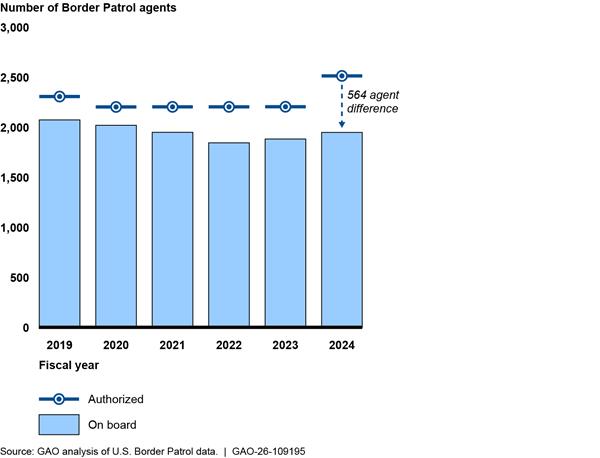
We found that the number of Border Patrol agents authorized in northern border sectors increased by about 9 percent from fiscal year 2019 to fiscal year 2024, while the number of agents on board in these sectors decreased.[25] Specifically, at the end of fiscal year 2019, Border Patrol reported that 2,306 agents were authorized to be stationed in sectors along the northern border. At the end of fiscal year 2024, Border Patrol reported that 2,512 agents were authorized.
Despite the number of agents authorized in sectors along the northern border increasing, the actual number of Border Patrol agents assigned to and working in these sectors decreased by about 6 percent during this period. In particular, the total number of Border Patrol agents assigned to these sectors decreased from 2,073 at the end of fiscal year 2019 to 1,948 at the end of fiscal year 2024. The Border Patrol agent staffing level across northern border sectors—which measures the actual number of Border Patrol agents as a percent of authorized staffing levels—decreased from 90 percent at the end of fiscal year 2019 to 78 percent at the end of fiscal year 2024. Overall, the staffing level along the northern border was 78 percent at the end of fiscal year 2024. In comparison, the staffing level along the southwest border at the end of fiscal year 2024 was 90 percent. The levels of authorized agents and on board agents assigned to sectors on the northern border are shown in figure 2.
Figure 2: Number of Authorized and On Board U.S. Border Patrol Agents Assigned to Sectors on the Northern Border, Fiscal Year 2019 Through Fiscal Year 2024
According to Border Patrol officials, the staffing rate was low, in part, due to limited funding levels at the time for Border Patrol agent transfers between sectors. In addition, officials stated that some agents had declined relocation offers because of high housing prices along the northern border. In March 2025, Border Patrol restarted efforts to place new agents in northern border stations. We reported that Border Patrol reasoned that it could increase staffing levels along the northern border without relying on transfers from other sectors.
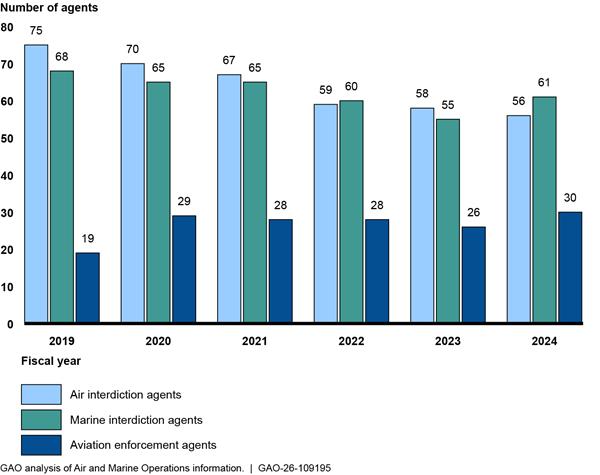
Regarding AMO, we found that the number of AMO agents on board at branches and units near the northern border decreased from 162 at the end of fiscal year 2019 to 147 at the end of fiscal year 2024—a decrease of about 9 percent.[26] These changes are shown in figure 3. Despite the decreased number of AMO agents along the northern border, AMO flight and float hours increased from fiscal year 2019 through fiscal year 2024, as previously discussed.
Figure 3: Number of Air and Marine Operations Agents On Board at Branches and Units Along the Northern Border, Fiscal Year 2019 Through Fiscal Year 2024
However, CBP expects that an upcoming retirement surge could have significant effects on CBP’s ability to meet its mission. As we reported in September 2024, CBP expects significant increases in retirement rates due to a hiring surge for Border Patrol agents that took place from 2007 through 2009. Agents hired during this period will be eligible to retire beginning in 2027.[27]
Border Patrol Has Not Fully Addressed Staffing Gaps for Key Support Position
We have previously reported that CBP has taken action to help strengthen its recruitment, hiring, and retention efforts for Border Patrol agents.[28] For example, in fiscal year 2024, CBP offered recruitment incentives of $20,000 per recipient, with an additional $10,000 for recipients stationed in remote locations. CBP also has increased its use of financial incentives to retain law enforcement personnel, including for Border Patrol agents. In July 2025, CBP received over $2 billion, available until September 30, 2029, to provide recruitment bonuses, performance awards, or annual retention bonuses to eligible CBP officers and agents.[29]
However, in February 2026, we found that Border Patrol had not filled or retained staff for all authorized Law Enforcement Information Systems Specialist positions across northern border sectors, something that we also raised in 2019.[30] These are professional, nonuniformed staff members who support Border Patrol’s sector intelligence units and have a range of responsibilities, including monitoring land-based surveillance technology (such as the feeds from camera towers and unattended ground sensors).
At the end of fiscal year 2024, Border Patrol authorized 115 supervisory and nonsupervisory Law Enforcement Information Systems Specialist positions, and 88 of these positions were filled, a staffing rate of 77 percent. Staffing rates ranged from 57 percent in Swanton sector to 92 percent in Spokane sector. For fiscal years 2019 through 2024, the staffing rate varied between 76 percent and 84 percent across all sectors.[31] With the exception of one year (fiscal year 2022), these staffing rates were lower than in fiscal year 2018, the year in which the Law Enforcement Information Systems Specialist position was created. Where such staffing gaps exist, they can reduce a sector’s ability to fully monitor surveillance camera and sensor feeds.
The senior Border Patrol official in charge of workforce planning told us that Border Patrol did not have plans to improve the recruitment or retention of Law Enforcement Information Systems Specialists. This official stated that Border Patrol expects them to leave the agency and look for better career opportunities.[32]
We recommended in February 2026 that CBP develop and implement a plan with strategies for addressing workforce gaps in the Law Enforcement Information Systems Specialist position. Such a plan would help ensure Border Patrol has sufficient personnel with the appropriate skills to effectively use the surveillance technology currently deployed along the northern border. DHS agreed with our recommendation and described steps CBP is taking to hire additional Law Enforcement Information Systems Specialists. In addition, DHS noted that Border Patrol plans to analyze the feasibility of offering a retention incentive to reduce attrition in this position. DHS estimates that CBP will complete these efforts by January 2027. We will continue to monitor Border Patrol’s actions in response to this recommendation.
CBP Has Not Developed Performance Measures to Assess Its Effectiveness at Securing the Northern Border between Ports of Entry
We reported in 2019 that CBP had performance measures (strategic and management) that assessed certain border security operations or programs, some of which include data from the northern border.[33] But we found that Border Patrol and AMO did not have specific measures to assess their effectiveness at securing the northern border between ports of entry.
Regarding Border Patrol, we found that its two strategic and four management measures included some data from the northern border but did not assess Border Patrol’s effectiveness at securing the northern border between ports of entry. The strategic measures assessed Border Patrol’s use of reports developed using geospatial intelligence technology of potential illicit cross-border activity.[34] However, this technology was not applied in maritime environments, so the measures did not include data from two northern border sectors that have maritime-only borders. Of Border Patrol’s four management measures, three included data from the northern border combined with other areas such as the southwest border.[35]
Regarding AMO, we found that its one strategic and one management measures included data from the northern border but did not assess AMO’s effectiveness at securing the northern border between ports of entry in the air and maritime environments. For the strategic measure, AMO reported the percentage of detected conventional aircraft incursions resolved.[36] For the management measure, AMO reported its air mission launch rate, which is the percentage of all requests made for aircraft to which AMO was able to respond. These two measures included data across all border areas, including the northern border, but were not specific to the northern border.
We recommended that Border Patrol and AMO develop and implement performance measures to assess their effectiveness at securing the northern border between ports of entry. Such measures could help CBP assess the effectiveness of its northern border operations, including challenges due to limited staffing and resources, and take corrective actions, as necessary.
DHS agreed with both recommendations, and Border Patrol and AMO have taken some steps to address them. Regarding Border Patrol, in August 2024, officials told us that the Chief of the U.S. Border Patrol directed all sectors to develop operational objectives and tasks that will serve as a framework for the development of new performance measures. In April 2026, officials stated and agency documentation indicates that this effort for the northern border—referred to as the Northern Border Index—is ongoing, and they anticipate Border Patrol will implement new performances measures beginning in fiscal year 2027.
In May 2024, AMO provided us with a northern region strategic plan that contained strategic goals and associated objectives, as well as short-term goals and accomplishments for fiscal year 2024. In January 2025, AMO officials told us they were working on an implementation plan and standard operating procedures related to northern border measures. As of June 2026, we are coordinating with AMO to obtain additional information on its strategic goals, associated objectives, and performance measures beyond fiscal year 2024.
We will continue to monitor Border Patrol’s and AMO’s efforts to address these recommendations.
In conclusion, the northern border spans almost 4,000 miles across 12 states and comprises widely different types of terrain—a fact that challenges border security efforts. CBP continues to focus its border security operations along the northern border on key threat areas while also monitoring and addressing other threats such as vehicle and drone incursions. CBP received billions of dollars in the One Big Beautiful Bill Act and the Secure America Act to hire and train additional CBP agents and officers, and around $2 billion in the One Big Beautiful Bill Act for recruitment and retention bonuses, among other things. We have reported that CBP has faced challenges meeting its staffing targets for the northern border. We have made recommendations related to staffing as well as performance management that would help to address some of these challenges. Addressing our recommendations would help CBP assess the effectiveness of its northern border operations and help ensure that Border Patrol has sufficient personnel with the appropriate skills to effectively use surveillance technology.
Chairmen Guest and Pfluger, Ranking Members Correa and Magaziner, and Members of the Subcommittees, this completes my prepared statement. I would be pleased to respond to any questions that you may have at this time.
GAO Contacts and Staff Acknowledgments
If you or your staff have any questions about this testimony, please contact me at MacLeodH@gao.gov. Contact points for our Offices of Congressional Relations and Media Relations may be found on the last page of this statement. GAO staff who made key contributions to this statement are Kathryn Bernet (Assistant Director), Christopher Ferencik (Assistant Director), Eric Warren (Analyst in Charge), Michele Fejfar, Sasan J. “Jon” Najmi, and Natalie Swabb. Other staff who made key contributions to the reports cited in the testimony are identified in the source products.
This is a work of the U.S. government and is not subject to copyright protection in the United States. The published product may be reproduced and distributed in its entirety without further permission from GAO. However, because this work may contain copyrighted images or other material, permission from the copyright holder may be necessary if you wish to reproduce this material separately.
The Government Accountability Office, the audit, evaluation, and investigative arm of Congress, exists to support Congress in meeting its constitutional responsibilities and to help improve the performance and accountability of the federal government for the American people. GAO examines the use of public funds; evaluates federal programs and policies; and provides analyses, recommendations, and other assistance to help Congress make informed oversight, policy, and funding decisions. GAO’s commitment to good government is reflected in its core values of accountability, integrity, and reliability.
Obtaining Copies of GAO Reports and Testimony
The fastest and easiest way to obtain copies of GAO documents at no cost is through our website. Each weekday afternoon, GAO posts on its website newly released reports, testimony, and correspondence. You can also subscribe to GAO’s email updates to receive notification of newly posted products.
Order by Phone
The price of each GAO publication reflects GAO’s actual cost of production and distribution and depends on the number of pages in the publication and whether the publication is printed in color or black and white. Pricing and ordering information is posted on GAO’s website, https://www.gao.gov/ordering.htm.
Place orders by calling (202) 512-6000, toll free (866) 801-7077,
or
TDD (202) 512-2537.
Orders may be paid for using American Express, Discover Card, MasterCard, Visa, check, or money order. Call for additional information.
Connect with GAO
Connect with GAO on X,
LinkedIn, Instagram, and YouTube.
Subscribe to our Email Updates. Listen to our Podcasts.
Visit GAO on the web at https://www.gao.gov.
To Report Fraud, Waste, and Abuse in Federal Programs
Contact FraudNet:
Website: https://www.gao.gov/about/what-gao-does/fraudnet
Automated answering system: (800) 424-5454
Media Relations
Sarah Kaczmarek, Managing Director, Media@gao.gov
Congressional Relations
David A. Powner, Acting Managing Director, CongRel@gao.gov
General Inquiries
[1]CBP’s Office of Field Operations conducts immigration and customs inspections at ports of entry to prevent the illicit entry of travelers, cargo, merchandise, and other items. This statement focuses on CBP’s activities between ports of entry.
[2]See An Act to provide for reconciliation pursuant to title II of H. Con. Res. 14, Pub. L. No. 119-21, title IX, subtitle A, § 90002(a)(1), 139 Stat. 72, 358. The act also provided CBP over $2 billion, available until September 30, 2029, to provide recruitment bonuses, performance awards, or annual retention bonuses to eligible CBP officers and agents.
[3]Rodney S. Scott, Commissioner, U.S. Customs and Border Protection, Oversight of the Department of Homeland Security: ICE, CBP, and USCIS, testimony before the House Committee on Homeland Security, 119th Cong., 2nd sess., February 10, 2026.
[4]Pub. L. No. 119-98, title I, § 101, title II, § 201, 140 Stat. 837, 837 & 839.
[5]See GAO, U.S. Customs and Border Protection: Resources Deployed and Challenges Faced in Securing the Northern Border, GAO‑26‑107501 (Washington, D.C.: Feb. 12, 2026).
[6]CBP defines a vehicle incursion as the unauthorized crossing of a vehicle over the international boundary of the United States at a place other than at an open port of entry. U.S. Customs and Border Protection, Emergency Driving Including Vehicular Pursuits by U.S. Customs and Border Protection Personnel, Directive No. 4510-26 (January 2021). Border Patrol reported 48 vehicle incursions in fiscal year 2021, and in fiscal year 2024, the number of vehicle incursions increased to 307.
[7]Border Patrol sectors along the northern border are further divided into 49 total stations, with each station assigned a certain geographic area of responsibility within the sector.
[8]Each AMO branch is further divided into units to conduct air or maritime missions, and there are a total of seven air units and nine marine units along the northern border. Manassas Air Branch, the New York Air Unit, and the Chicago Air Unit are part of the Northern Region but do not generally operate along the northern border. In addition, the National Air Security Operations Center-Grand Forks, located in North Dakota, operates as an air unit and provides training for operating drones (i.e., unmanned aircraft systems).
[9]See 6 U.S.C. § 240.
[10]See GAO‑26‑107501 and GAO, Northern Border Security: CBP Identified Resource Challenges but Needs Performance Measures to Assess Security Between Ports of Entry, GAO‑19‑740 (Washington, D.C.: June 26, 2019).
[11]For the purposes of this statement, the term “apprehension” refers to an enforcement action by Border Patrol to physically control or temporarily detain any persons (noncitizens or U.S. citizens) encountered between ports of entry based on suspected violation of federal law, including laws governing entry into the U.S. DHS documentation we reviewed for our underlying report used the terms “alien,” “migrant,” and “noncitizen” interchangeably. For readability, we generally use the term “noncitizen” or “foreign national” to refer to an “alien,” which is defined by statute as any person who is not a citizen or national of the U.S., except when quoting language in statute, regulation, or executive orders that use the term “alien.” 8 U.S.C. § 1101(a)(3). See GAO‑26‑107501.
[12]This analysis is based on encounter data released publicly by CBP. In contrast to other analyses in this statement, CBP officials stated these data include only apprehended individuals who are subject to deportation; our other analyses included all non-permanent resident foreign nationals and U.S. citizens or lawful permanent residents apprehended by one of Border Patrol’s eight sectors along the northern border.
[13]These figures include non-permanent resident foreign nationals and U.S. citizens or lawful permanent residents. While U.S. citizens are not subject to statutory admissibility restrictions (i.e., inadmissibility) applicable to noncitizens, Border Patrol may enforce U.S. law against U.S. citizens for criminal offenses or non-immigration civil violations. 8 U.S.C. § 1182(a) (grounds of inadmissibility applicable to noncitizens); regarding CBP officer and agent law enforcement authority, see, e.g., 8 U.S.C. § 1357 (powers of immigration officers and employees); 19 U.S.C. § 1589a (enforcement authority of customs officers).
[14]Canada’s Electronic Travel Authorization is an entry requirement for visa-exempt foreign nationals travelling to Canada by air. The authorization costs $7 (Canadian) to apply. The authorization provides an affordable option for individuals to enter Canada, and, according to Border Patrol officials, once in Canada, these individuals may decide to enter the U.S. between ports of entry.
[15]These flight and float hour calculations include time spent on enforcement activities and exclude other activities, such as training and maintenance.
[16]Aircraft counts include National Air Security Operations-Grand Forks, which is not part of AMO’s Northern Region but operates along the northern border. These counts exclude aircraft assigned to Manassas Air Branch, Chicago Air Unit, and New York Air Unit. Although they are subordinate to AMO’s Northern Region, these units do not generally operate along the northern border.
[17]These riverine vessels are owned by AMO but operated by Border Patrol.
[18]Unattended ground sensors are remotely monitored sensors placed in or on the ground—or, in some cases, in trees—to detect, track, identify, and differentiate humans, animals, and vehicles. Sensors have various detection capabilities, including seismic, magnetic, and passive infrared capabilities. Along the northern border, about 60 percent of unattended ground sensors have imaging capabilities and send photographs or videos to agents and to the communications centers.
[19]According to Border Patrol officials, these towers are 33 feet tall, can withstand cold weather, and are a variant of towers deployed along the southwest border. Because Autonomous Surveillance Towers send alerts to agents, they do not need to be continuously monitored.
[20]When a CBP agent seizes one or multiple drugs from one or multiple offenders, the entire incident is referred to as a drug seizure event. Within a drug seizure event, there may be one or multiple drug seizures. In our analysis, we defined a “drug seizure” as each individual drug type seized within a drug seizure event. GAO‑26‑107501.
[21]Border Patrol may be the lead agency in a drug seizure or may assist another federal, state, or local agency. These figures include seizures that Border Patrol led or provided assistance to.
[23]Records of Border Patrol seizures include firearm-related equipment, such as silencers and parts.
[24]When a Border Patrol agent seizes one or multiple currencies from one or multiple offenders, the entire incident is referred to as a currency seizure event.
[25]Authorized staff for Border Patrol agent positions represent the authorized staffing levels or number of such positions determined by Border Patrol to be supported by its appropriation and informed by legislative language contained in explanatory statements and other congressional documents.
[26]These data include National Air Security Operations-Grand Forks, which is not part of AMO’s Northern Region but operates along the northern border. These data exclude Manassas Air Branch, Chicago Air Unit, and New York Air Unit. Although they are subordinate to AMO’s Northern Region, they do not generally operate along the northern border. Unlike Border Patrol, AMO currently does not set an authorized number of agents per branch or unit.
[27]See GAO, U.S. Customs and Border Protection: Efforts to Improve Recruitment, Hiring, and Retention of Law Enforcement Personnel, GAO‑24‑107029 (Washington, D.C.: Sept. 25, 2024).
[29]See An Act to provide for reconciliation pursuant to title II of H. Con. Res 14, Pub. L. No. 119-21, § 90002(a)(2), 139 Stat. 72 at 358.
[31]These figures combine the Law Enforcement Communications Assistant position and the Law Enforcement Information Systems Specialist position. Border Patrol employed Law Enforcement Communications Assistants until fiscal year 2020.
[32]According to Border Patrol headquarters officials, factors that affect Border Patrol’s ability to hire include a lengthy background investigation process, during which applicants may find other employment; limited local applicant pools; high cost of living; and minimal career advancement opportunities. Officials from three sectors told us that Law Enforcement Information Systems Specialists leave the Border Patrol due to the low pay of the position compared to what they can earn at other local or federal agencies. Law Enforcement Information Systems Specialists are hired at the GS-5 or the GS-7 level with promotion potential up to GS-9. Supervisory Law Enforcement Information Systems Specialists are at the GS-11 level. GAO‑26‑107501.
[33]GAO‑19‑470. Performance measures include strategic and management measures and their associated targets or goals identified by DHS and CBP. Strategic measures communicate results delivered for agency goals by mission programs and are reported in the DHS Annual Performance Report. Management measures highlight mission program performance expectations related to budgetary plans and are reported in CBP’s annual congressional budget justification. See generally Government Performance and Results Act Modernization Act of 2010. Pub. L. No. 111-352, 124 Stat. 3866 (2011) (updating the Government Performance and Results Act of 1993).
[34]The two strategic measures—the percent of recurring border surveillance implemented in remote, low-risk areas between ports of entry and the percent of time Border Patrol meets its goal of responding to potential illegal activity in remote, low-risk areas—were based on information from CBP’s National Border Geospatial Intelligence Strategy.
[35]See GAO‑19‑470 for more information about Border Patrol’s four management measures at the time of our review.
[36]The measure represents the percent of conventional aircraft detected visually or by sensor technology, suspected of illicit cross-border activity, which are brought to a successful resolution by its Air and Marine Operations Center.