
Before the Subcommittee on Coast Guard and Maritime Transportation, Committee on Transportation and Infrastructure, House of Representatives
For Release on Delivery Expected at 10:00 a.m. ET
United States Government Accountability Office
A testimony before the Subcommittee on Coast Guard and Maritime Transportation, Committee on Transportation and Infrastructure, House of Representatives
For more information, contact: Triana McNeil at McNeilT@gao.gov
What GAO Found
The Department of Homeland Security (DHS) and Coast Guard leadership have made a case that the service needs transformation. Since 2019 GAO has reviewed four Coast Guard reform efforts and identified steps the service took to incorporate leading practices as well as gaps in key areas. For example, in prior reviews of Coast Guard sexual misconduct and modernization of mission planning and reserve component reform efforts, GAO found that the Coast Guard did not fully assess its workforce needs. Additionally, for two of the reform efforts, the Coast Guard did not fully establish goals and outcomes, making it difficult to determine if the reforms had the intended effects.
According to GAO’s review of Force Design 2028 foundational documents, the Coast Guard has taken some steps to implement leading practices in its current reform effort but gaps remain. For example, the service has assigned leaders to its reform efforts and focused on addressing long standing challenges, including workforce and technology and contracting and acquisitions. However, GAO’s review also found that certain goals are not well-defined. For example, the execution plan states that the service will delegate decision-authority to maximize mission impact. However, the document does not describe how the Coast Guard will measure this effort or know when it achieves its reform goals. Further, how proposed reforms align with Coast Guard missions is unclear, and there is no performance plan or other mechanism to assess the results.
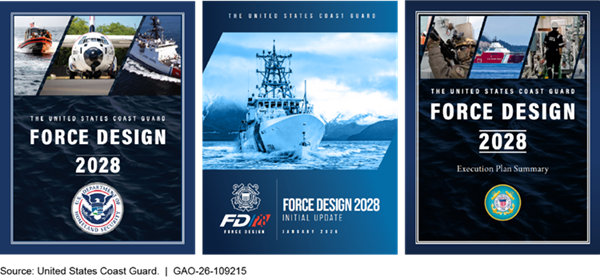
The Coast Guard has received significant funding to carry out its modernization reform efforts. Therefore, incorporating leading practices throughout the duration of the Coast Guard’s reform efforts is important. Specifically, updating its foundational modernization documents and developing an evaluation plan and mechanisms for assessing the effectiveness of its actions would better ensure that Coast Guard management, Congress, and the public has the information needed to evaluate whether its actions—which are using billions of taxpayer dollars—are helping to mitigate identified challenges pertaining to the service’s organization, people, technology, and contracting and acquisitions.
Why GAO Did This Study
The U.S. Coast Guard—a multi-mission military service—is facing a readiness crisis, according to DHS and Coast Guard leadership. In May 2025, DHS announced an effort called Force Design 2028 to modernize operations and capabilities. The effort aims to transform the Coast Guard into a more capable and agile force to meet future challenges across four areas—organization, people, technology, and contracting and acquisition.
For fiscal year 2026, Congress appropriated about $13.5 billion to the service. Congress also included nearly $25 billion in Coast Guard funding for fiscal year 2025 in the law commonly known as the One Big Beautiful Bill Act—the largest single commitment of funding in Coast Guard history. The service has stated that this funding supports the intent of Force Design 2028.
This statement focuses on (1) key themes from GAO work evaluating prior Coast Guard reform efforts, and (2) our assessment of the Coast Guard’s recent modernization reform efforts.
This statement is based on reports GAO has issued since 2018 on prior Coast Guard reform efforts and some of its mission and management activities. GAO also analyzed Coast Guard Force Design 2028 documentation and compared them to selected leading practices for agency reform.
What GAO Recommends
GAO is making two recommendations that the Coast Guard (1) update its foundational modernization documents as necessary to ensure strategic alignment with Coast Guard missions, desired outcomes, and measurable targets, and (2) develop an evaluation plan with mechanisms for each of the four areas of reform emphasis.
Chairman Ezell, Ranking Member Carbajal, and Members of the Subcommittee:
I am pleased to be here today to discuss oversight of Coast Guard modernization reforms. After being weakened by decades of underinvestment, neglect, and strategic drift, the U.S. Coast Guard—a multi-mission military service with the Department of Homeland Security (DHS)—is facing a readiness crisis, according to DHS and Coast Guard leadership. In May 2025, DHS announced an effort called Force Design 2028 (Force Design) to modernize operations and capabilities. The effort aims to transform the Coast Guard into a more capable and agile force to meet future challenges across four areas—organization, people, technology, and contracting and acquisition. The Coast Guard considers Force Design one of its largest transformations since World War II.
For fiscal year 2026, Congress appropriated about $13.5 billion to the service—a typical amount in recent years.[1] Congress also included nearly $25 billion in Coast Guard funding for fiscal year 2025 in Public Law 119-21—commonly known as the One Big Beautiful Bill Act—the largest single commitment of funding in Coast Guard history.[2] This funding was for Coast Guard procurement of cutters and aircraft and modernizing shore infrastructure and maritime surveillance systems. The service has stated that these investments support the intent of Force Design. According to Coast Guard officials, this funding directly supports Force Design initiatives, including to develop and increase remote and autonomous systems and maritime domain awareness capabilities. The funding could also strengthen the Coast Guard’s ability to counter drug trafficking, conduct search and rescue, enhance navigational safety, enable maritime trade, and conduct the service’s other missions, according to the Coast Guard.
The organizational transformation needed to improve the performance of federal agencies can be challenging and take years to fully implement. For example, we testified before this subcommittee in April 2026 that the service faces persistent challenges managing its major acquisition programs to modernize its vessels.[3] Further, in September 2024 the DHS Office of Inspector General found that the Coast Guard did not implement effective planning for procurement, construction, and other projects funded through the Infrastructure Investment and Jobs Act.[4]
My statement today focuses on (1) key themes from our work evaluating prior Coast Guard reform efforts, and (2) our assessment of the Coast Guard’s recent modernization reform efforts. The statement is based on our prior work since 2018 on Coast Guard reform efforts and some of its mission and management activities.[5] For these reports, published from November 2019 to January 2026, we analyzed Coast Guard policy, documentation, and data, and interviewed agency officials, among other methodologies.
We reviewed Coast Guard documentation on its reform actions and assessed them against selected leading practices for agency reform.[6] More detailed information on our scope and methodology can be found in the reports we cite in this statement. In addition, for this statement we analyzed Coast Guard Force Design documentation, including the executive plan summary, executive report, senior leaders’ letter, and January 2026 initial update. We compared this information with selected leading practices for agency reform.[7]
We requested comments on the contents of this statement, including our recommendation, from DHS and the Coast Guard. The Coast Guard provided technical comments, which we incorporated as appropriate.
The work upon which this statement is based was performed in accordance with generally accepted government auditing standards. Those standards require that we plan and perform the audit to obtain sufficient, appropriate evidence to provide a reasonable basis for our findings and conclusions based on our audit objectives. We believe that the evidence obtained provides a reasonable basis for our findings and conclusions based on our audit objectives.
Coast Guard Inconsistently Applied Leading Practices During Prior Reform Efforts
The Coast Guard did not fully implement leading practices for its prior reform efforts for (1) addressing sexual misconduct, (2) modernization of mission planning and mission support functions, (3) reorganization of its reserve component, and (4) reorganization of its deployable specialized forces.[8] Since 2019, our reports have identified steps the Coast Guard has taken to incorporate aspects of leading practices to support its reform efforts as well as gaps in key areas that may affect its ability to maintain progress and achieve lasting results (figure 1).
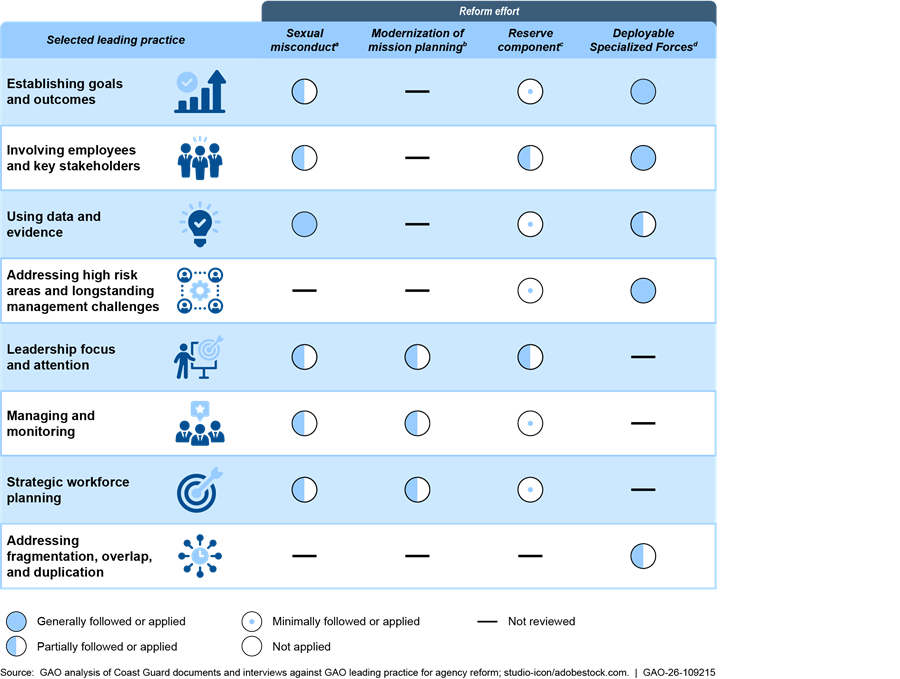
Note: Three GAO reports covered (1) reform efforts to address sexual misconduct (GAO‑26‑107685), (2 and 3) modernization of mission planning and mission support functions, as well as reorganization of the reserve component (GAO‑20‑223), and (4) the reorganization of deployable specialized forces (GAO‑20‑33). We determined that not all of the leading practices were applicable to each of the reform efforts. Because the key practices and considerations depend on what an agency is trying to achieve, not all practices may be applicable to a given reform. For the full list of leading reform practices and their associated key questions, see GAO‑18‑427.
aWe used the following scale to evaluate the Coast Guard’s implementation of its efforts to address sexual misconduct in our January 2026 report. Generally followed—the service took actions that addressed most or all aspects of the selected key questions we examined for the practice. Partially followed—the Coast Guard partially followed a reform practice if the evidence showed that the service took actions that addressed some, but not most, aspects of the selected key questions we examined for the practice. Did not follow— the Coast Guard had not followed a reform practice if the evidence showed that the service took no actions that addressed the selected key questions we examined for the practice.
bWe used the following scale to evaluate the Coast Guard’s implementation of its modernization of mission planning in our February 2020 report. Generally applied—the agency documentation demonstrated that Coast Guard officials substantially applied applicable key practices. Partially applied—the agency documentation demonstrated that Coast Guard officials applied some key practices but not to a significant degree. Not at all applied—the agency documentation did not demonstrate that Coast Guard officials applied key practices. For this reform effort, we assessed subcomponents of the leading practices (e.g., for leadership focus and attention, we assessed whether the Coast Guard identified a case for change, established a dedicated implementation team, and held leaders accountable). For the purposes of this graphic, if we determined that any one of these subcomponents was partially applied, we categorized the leading practice as partially applied.
cWe assessed the Coast Guard’s reorganization of its reserve component in our February 2020 report using the same criteria that we used for its modernization of mission planning. We used an additional determination, minimally applied, to assess the Coast Guard’s recent component integration since this effort was in its initial implementation stage. We determined that a subcategory was minimally applied where Coast Guard documentation demonstrated that officials applied a limited number of key reform practices, with significant gaps in actions associated with each practice.
dIn our November 2019 report, we used the following scale to evaluate the Coast Guard’s Deployable Specialized Forces against the key practices, questions, and considerations pertaining to a leading practice: Generally applied—the agency documents demonstrated that Coast Guard officials considered applicable key practices and considerations. Partially applied—the agency documents demonstrated that Coast Guard officials considered some, but not all, key practices and considerations. Not at all applied—the agency documents did not demonstrate that Coast Guard officials considered any key practices and considerations.
As shown above, we identified gaps in the Coast Guard’s implementation of the same leading practices across multiple reform efforts in our prior work since 2019.
Establishing goals and outcomes. In January 2026, we updated preliminary observations we reported in our March 2024 testimony before this committee, which found that the Coast Guard did not have a plan to assess whether reform efforts to address sexual misconduct were working.[9] Similarly, in February 2020, we assessed the Coast Guard’s reorganization of its reserve component and found that the service did not have finalized documentation that demonstrated outcome-oriented goals and performance measures to assess the progress of the effort.[10] Further, it did not have a finalized implementation timeline.
Involving employees and key stakeholders. In January 2026, we reported that the Coast Guard obtained input from its employees and stakeholders and reviewed prior studies and data on sexual misconduct in the service to identify areas for corrective actions.[11] However, we found that the lack of a defined channel for Coast Guard personnel to share feedback on the effects of the reforms may limit transparency and hinder personnel engagement with reform effort. In February 2020, we found that for the reorganization of its reserve component, the Coast Guard collected internal stakeholder feedback during the early planning stage of the reform but did not demonstrate that external input, such as from Congress, was obtained during the development process.[12]
Using data and evidence. In November 2019, we reported that that the Coast Guard did not assess Deployable Specialized Forces workforce needs with regard to the number of personnel required to conduct its operations.[13] Similarly in February 2020, we found that the Coast Guard did not demonstrate the extent to which it used data to justify its selected course of action (e.g., cost benefit analyses) when reorganizing its reserve component.[14]
Leadership focus and attention. In our reports in January 2026 and February 2020, we found that the Coast Guard identified leaders to be responsible for its sexual misconduct reform efforts, modernization of mission planning, and reserve component modernization efforts, but leadership attention waned during implementation of these efforts. For example, during the modernization of mission planning, the Coast Guard disestablished its office responsible for reform oversight and did not specify any office responsible for ensuring organizational change efforts met intended goals. Subsequent shifting leadership priorities affected what parts of the modernization effort were implemented and, in some cases, resulted in years spent working toward a change that was later terminated.
Managing and monitoring. In our reports, we found that the Coast Guard took some steps to track progress of sexual misconduct, modernization of mission planning, and reserve component reform efforts, such as developing initial timeframes and milestones. However, the Coast Guard did not keep its tracking or related milestones up to date.
Strategic workforce planning. In our reports on Coast Guard sexual misconduct reforms, modernization of mission planning, and reserve component reform efforts, we found that the Coast Guard did not fully assess its workforce needs.
Across our work assessing Coast Guard’s reform efforts, we made 12 recommendations to the Coast Guard to improve its reform effort implementation, with which the service generally concurred. As of June 2026, the Coast Guard has taken actions to fully address seven of these recommendations. Five recommendations remain open.
For example, in March 2024, we recommended that the Coast Guard develop an evaluation plan and mechanisms for assessing the effectiveness of actions taken to help ensure service members have an experience free from sexual assault and harassment.[15] In January 2026 we reported that the service had taken steps to develop that evaluation plan. Coast Guard officials stated that the agency has contracted three full-time staff to develop a Service Culture Index—a tool to leverage relevant metrics from its current surveys and other reports to establish a baseline for assessing the cumulative impact of the reform actions.[16] Contractors delivered the first iteration of the index in January 2026, but the associated documentation remains incomplete due to the lapse in appropriations, according to Coast Guard officials. They told us that completion and delivery of the documentation is anticipated no later than July 2026. Coast Guard officials told us that the results of the index will be used to evaluate effectiveness, and they are developing outcome-oriented goals and performance measures for the index.
Further, in our report on Coast Guard mission modernization, we recommended that the Coast Guard measure progress in achieving the goal of modernization, update a plan with time frames and milestones for completing its workforce assessment goal, and obtain information on the resources needed to meet its goal.[17] The service has taken some steps to address all of these recommendations. For example, in September 2023, Coast Guard officials confirmed that it updated its 2023 Organizational Survey to include two questions that measured employee satisfaction with organizational change efforts.
However, it has not yet determined time frames and milestones to fully implement its workforce requirements plan even as it is embarking on another reform effort. By updating its plan to complete workforce planning and obtaining information on the resources needed to achieve its workforce assessment goal, the Coast Guard will be better positioned to ensure that it has the right number of people with requisite skills in the right units to meet its mission demands—particularly important as the service undergoes another comprehensive transformational change through Force Design.
Coast Guard Has Taken Steps to Implement Some but Not All Leading Practices for Agency Reform for Force Design
The Coast Guard has taken some steps to implement leading practices in its Force Design reform efforts to modernize operations and capabilities across four areas—organization, people, technology, and contracting and acquisition. These steps pertain to the leading practices of involving employees and key stakeholders, addressing high-risk areas and long-standing management challenges, leadership focus and attention, and establishing goals and outcomes. However, we also identified gaps in the Coast Guard’s implementation steps related to establishing goals and outcomes and using data and evidence—leading practices that are important for agencies to implement at the onset of a reform effort.
Involving employees and key stakeholders. The Coast Guard is communicating actions taken to implement Force Design with its personnel. For example, Force Design has a dedicated website that provides updates, the service has broadcast messages describing implementation efforts, and senior leaders have held townhalls, according to Coast Guard press releases.
Addressing high-risk areas and long-standing management challenges. In our prior work, we have identified challenges facing the Coast Guard in the four Force Design areas of emphasis—organization, people, technology, and contracting and acquisition.[18] For example,
· Over the past four decades, we have reported on the Coast Guard’s challenges to maintain an adequate staff of experienced marine safety personnel to ensure that vessels meet federal safety standards. In January 2022, we recommended ways to better predict—and meet—the Coast Guard’s inspector needs.[19] The Coast Guard concurred with these recommendations and has taken some steps to address them, but as of June 2026, four of the five recommendations remain open. The Force Design execution plan acknowledges the need to change the force posture and operational concepts to maximize operational effectiveness across all mission sets as well as reengineer the services training systems.
· The Coast Guard has had longstanding issues managing its technology resources. In July 2020, we reported on longstanding challenges the Coast Guard has had with its Marine Information for Safety and Law Enforcement (MISLE) IT system, which is a data system that tracks and reports results data for nearly all Coast Guard missions.[20] We found that the Coast Guard did not follow key systems development processes in its efforts to invest in MISLE. As a result, we recommended that the Coast Guard follow its key systems development processes to identify and analyze alternatives to select solutions to meet mission needs. The Coast Guard concurred and said it plans to replace MISLE. As of June 2026, replacement efforts were ongoing. The Force Design execution plan states that service will identify, test, and deliver modern technology to equip the Coast Guard workforce to meet mission demands around the world.
· For over a decade, we have reported on the Coast Guard’s persistent challenges in managing major acquisition programs, including billions in cost growth, years of schedule delays, and an unaffordable portfolio.[21] Since 2012, GAO has made 54 recommendations on how to better address these challenges. The Coast Guard has taken steps toward addressing these recommendations, but as of June 2026, 16 remain open. Common themes across these recommendations include the need for the Coast Guard to (1) take a portfolio-level approach to its acquisitions, (2) conduct better long-term planning to ensure affordability, and (3) gain key knowledge before making significant investment decisions.
The Force Design plans include promising steps, such as reorganizing and creating program executive offices with the intent of reducing stovepipes and implementing a lifecycle management approach for acquisitions.[22] Other initiatives, such as streamlining pre-acquisition planning and bypassing upfront analyses in the name of speed, may allow the Coast Guard to “start fast” and award large contracts quickly. The Coast Guard stated that it plans to obligate $20 billion of the $25 billion in funding from the One Big Beautiful Bill Act by the end of calendar year 2026. For example, the Coast Guard has already obligated about $2.4 billion on contracts for the Arctic Security Cutter program.
However, as we found in our November 2025 report on one of the Coast Guard’s highest priority acquisition programs, the Offshore Patrol Cutter, investing time upfront to gain knowledge reduces the risk of cost overruns and schedule delays later.[23] In light of the weaknesses we have identified with how the Coast Guard manages its acquisitions and how quickly the Coast Guard is planning to spend the significant amount of funding it has received, we have raised questions about the extent to which the Coast Guard is doing the due diligence necessary to gain critical knowledge before making large investments. For example, while the Coast Guard has already obligated billions on Arctic Security Cutter contracts, it has yet to complete an analysis of the cost and sequencing for its polar icebreaker fleet expansion, as we had recommended in December 2024.[24] More recently, the Coast Guard did not agree with our November 2025 recommendation to stabilize the design for the Offshore Patrol Cutter program prior to authorizing additional ships, consistent with shipbuilding leading practices we have identified.[25]
Leadership focus and attention. Based on our review of Force Design foundation documents, the Coast Guard took certain actions that align with leading practices for effective agency reforms pertaining to leadership focus and attention, which includes assigning designated leaders and a reform implementation team to institutional accountability in implementing the changes.
· The Force Design execution plan states that the effort is to be guided by flag officers, members of the senior executive service, and command senior enlisted leaders.[26]
· The service directed a captain to lead the implementation team.
· The Coast Guard developed teams to monitor outcomes in certain operational areas (Border Control, Flow of Commerce, and Responding in Crisis) as well as other teams to implement actions items pertaining to Force Design’s four focus areas, according to Coast Guard press releases. The teams are to report directly to the commandant.
A robust leadership structure is important throughout the entire reform effort.
Establishing goals and outcomes. The Coast Guard has articulated certain goals with desired outcomes for Force Design, such as growing its workforce by 15,000 uniformed service members. Other goals are not well-defined and do not have clearly articulated desired outcomes or measurable targets. For example, the execution plan states that the service will empower decision-makers at all levels by, among other things, delegating decision authority to the appropriate level to maximize mission impact. The plan further states that the Coast Guard will adopt, leverage, and incorporate AI into daily Coast Guard operations. However, the document does not describe how the Coast Guard will measure these efforts or know when it has achieved the goals outlined in Force Design. In addition, the execution plan and executive report mention “mission” 40 times, but they do not show how the proposed reforms align with the agency’s 11 statutory missions and strategic plan—a key aspect of this leading practice.[27]
Further, the Coast Guard has not developed a performance plan or similar mechanism to assess the results of Force Design, even as it has already implemented certain actions. The effort’s foundational documents posted on the Coast Guard website—the Executive Plan Summary, Executive Report, and Senior Leaders Letter—did not include any direction to develop a plan to assess the results to ensure the actions are helping to meet the Coast Guard’s goals.[28] In addition, while the January 2026 Force Design initial update details reforms implemented over the prior year, it does not systematically evaluate progress or outcomes against the Force Design execution plan.
Establishing goals and outcomes is a leading practice for agency reform and is important to be completed at the onset of the reform effort.[29] Agreement on specific goals can help decision makers determine what problems genuinely need to be fixed, how to balance differing objectives, and what steps need to be taken to create, not just short-term advantages but long-term gains. Our prior work also shows that establishing a mission-driven strategy and identifying specific desired outcomes to guide that strategy are critical to achieving intended results.[30] It emphasizes that by combining strategic alignment, clear outcome mapping, measurable targets, and transparent monitoring, agencies can effectively drive desired results.
Further, according to the Coast Guard’s Commandant instruction on internal controls, plans are to be developed to assess control performance and evaluate results in the planning stage. However, we have previously reported that the Coast Guard has not consistently engaged in effective strategic planning or developed performance metrics and actionable goals for some of its efforts.[31]
According to the Coast Guard, the implementation teams are moving at a fast pace to implement the reforms. Coast Guard officials stated that they do plan to build out metrics that will measure change and evaluate Force Design outcomes, but they have not yet done so. Without (1) reassessing the foundational Force Design documents and clarifying them, as necessary, to ensure strategic alignment with Coast Guard missions, desired outcomes, and measurable targets, and (2) developing an evaluation plan and mechanisms for assessing the effectiveness for each area of reform emphasis, Coast Guard leadership will not have the information needed to evaluate whether its implementation steps fully align with the set of Coast Guard missions. Its leadership will also not know if these steps are helping the service achieve the intent of the transformation—to renew the Coast Guard to become a more agile, capable, and responsive service. Further, without such a plan, the Coast Guard, Congress, and the public are not well-positioned to assess how the service is spending the billions of dollars invested in the reform effort.
Using data and evidence. It is unclear how or if the Coast Guard used data and evidence to develop and justify its modernization reform effort. For example, as discussed above, one of the goals of Force Design is to grow the workforce by 15,000 uniformed service members, which includes active duty and reserve members. Coast Guard officials stated that this is a minimum number based on, among other things, assets the service is acquiring.
The Coast Guard has faced continued challenges in determining its workforce needs and conducting strategic workforce planning. In our prior work reviewing how Coast Guard has leveraged its workforce to meet mission needs, we found that Coast Guard has not fully assessed its workforce needs and recommended Coast Guard improve its workforce assessment process.[32] Specifically, in 2020, we found that the Coast Guard had completed workforce requirements determinations for only 6 percent of its workforce.[33] We recommended in 2020 that the Coast Guard update its Workforce Requirements Plan with time frames and milestones for achieving its goal of assessing its entire workforce.
Since then, the Coast Guard has made some progress. As of March 2026, the Coast Guard has up-to-date workforce requirement determinations for around 26 percent of its total workforce. Fully addressing our prior recommendation would better position the Coast Guard to ensure that it has the right number of people with the requisite skills in the right units. Without data and evidence for its entire workforce need, the basis for which the Coast Guard plans to increase by 15,000 uniformed service members is not clear.
Conclusions
DHS and Coast Guard leadership have made a case that the service needs transformation. Such efforts are not new and have achieved mixed results. Since 2019, we have reviewed four Coast Guard reform efforts and identified gaps in implementation steps. For example, in three of the four prior reform efforts, leadership attention waned. Two of the reform efforts did not fully establish goals and outcomes, making it difficult to determine if the reforms had the intended effect. Similarly, the Coast Guard’s current reform effort—Force Design—which the Coast Guard considers its most consequential transformation since World War II—has not fully established goals and outcomes or a plan with which to evaluate implementation.
The Coast Guard has received unprecedented funding, including billions towards recapitalizing its assets and to carry out its modernization reforms efforts. Updating its foundational modernization documents and developing an evaluation plan and mechanisms to assess transformation actions would better ensure that Coast Guard management has the information it needs to evaluate whether its actions—which are using billions of taxpayer dollars—are helping to mitigate its organization, people, technology, and acquisitions challenges.
Recommendations for Executive Action
The Commandant of the Coast Guard should update the service’s foundational modernization documents as necessary to ensure strategic alignment with Coast Guard missions, desired outcomes, and measurable targets for each area of reform emphasis—organization, people, technology, and contracting and acquisition. (Recommendation 1)
The Commandant of the Coast Guard should develop an evaluation plan with mechanisms for assessing the effectiveness of reform actions for each area of reform emphasis—organization, people, technology, and contracting and acquisition. (Recommendation 2)
Chairman Ezell, Ranking Member Carbajal, and Members of the Subcommittee, this concludes my prepared statement. I would be pleased to respond to any questions you may have at this time.
GAO Contacts and Staff Acknowledgments
If you or your staff have any questions about this testimony, please contact Triana McNeil, Director, Homeland Security and Justice, at McNeilT@gao.gov or Shelby S. Oakley, Director, Contracting and National Security Acquisitions at OakleyS@gao.gov. Contact points for our Offices of Congressional Relations and Media Relations may be found on the last page of this statement. GAO staff who made key contributions to this statement are Paul Hobart (Assistant Director), Claire Li (Assistant Director), Jeffrey Love (Analyst in Charge), Patrick Breiding, Jamarla Edwards, Michelle Fejfar, Samantha Lyew, Ashley Rawson, Kevin Reeves, and Jason Vassilicos. Other staff who made key contributions to the reports cited in the testimony are identified in the source products.
This is a work of the U.S. government and is not subject to copyright protection in the United States. The published product may be reproduced and distributed in its entirety without further permission from GAO. However, because this work may contain copyrighted images or other material, permission from the copyright holder may be necessary if you wish to reproduce this material separately.
The Government Accountability Office, the audit, evaluation, and investigative arm of Congress, exists to support Congress in meeting its constitutional responsibilities and to help improve the performance and accountability of the federal government for the American people. GAO examines the use of public funds; evaluates federal programs and policies; and provides analyses, recommendations, and other assistance to help Congress make informed oversight, policy, and funding decisions. GAO’s commitment to good government is reflected in its core values of accountability, integrity, and reliability.
Obtaining Copies of GAO Reports and Testimony
The fastest and easiest way to obtain copies of GAO documents at no cost is through our website. Each weekday afternoon, GAO posts on its website newly released reports, testimony, and correspondence. You can also subscribe to GAO’s email updates to receive notification of newly posted products.
Order by Phone
The price of each GAO publication reflects GAO’s actual cost of production and distribution and depends on the number of pages in the publication and whether the publication is printed in color or black and white. Pricing and ordering information is posted on GAO’s website, https://www.gao.gov/ordering.htm.
Place orders by calling (202) 512-6000, toll free (866) 801-7077,
or
TDD (202) 512-2537.
Orders may be paid for using American Express, Discover Card, MasterCard, Visa, check, or money order. Call for additional information.
Connect with GAO
Connect with GAO on X,
LinkedIn, Instagram, and YouTube.
Subscribe to our Email Updates. Listen to our Podcasts.
Visit GAO on the web at https://www.gao.gov.
To Report Fraud, Waste, and Abuse in Federal Programs
Contact FraudNet:
Website: https://www.gao.gov/about/what-gao-does/fraudnet
Automated answering system: (800) 424-5454
Media Relations
Sarah Kaczmarek, Managing Director, Media@gao.gov
Congressional Relations
David A. Powner, Acting Managing Director, CongRel@gao.gov
General Inquiries
[1]Homeland Security and Further Additional Continuing Appropriations Act, 2026, Pub. L. No. 119-86, div. A, tit. II, 140 Stat. 773, 780-81. The act requires the Coast Guard to brief the Committees on Appropriations of the House of Representatives and the Senate on the initiatives of organization, people, technology, and contracting and acquisitions before funds under the act may be available to implement Force Design. 140 Stat. at 785.
[2]An Act To provide for reconciliation pursuant to title II of H. Con. Res. 14, Pub. L. No. 119-21, tit. IV, § 40001(a), 139 Stat. 72, 127-28 (2025). This funding remains available until September 30, 2029.
[3]GAO, Navy and Coast Guard Shipbuilding: A Disciplined, Strategy-Driven Approach Is Needed to Achieve Ambitious Goals, GAO‑26‑109068 (Washington, D.C.: Apr. 22, 2026).
[4]Pub. L. No. 117-58, 135 Stat. 429 (2021). Department of Homeland Security, Office of Inspector General, Coast Guard Needs to Implement Effective Planning for Infrastructure Investment and Jobs Act Projects, OIG-24-56 (Washington, D.C.: Sept. 17, 2024).
[5]We chose 2018 because it aligns with the issuance of our leading practices on agency reform. GAO’s leading practices for agency reform are organized into four categories and 12 subcategories. For our purposes, we identified and used subcategories of the leading practices that were relevant to the Coast Guard reform efforts we assessed.
[6]See, for example, GAO, Coast Guard: Assessing Deployable Specialized Forces’ Workforce Needs Could Improve Efficiency and Reduce Potential Overlap or Gaps in Capabilities, GAO‑20‑33 (Washington, D.C.: Nov. 21, 2019); Coast Guard: Actions Needed to Evaluate the Effectiveness of Organizational Changes and Determine Workforce Needs, GAO‑20‑223 (Washington, D.C.: Feb. 26, 2020); and Coast Guard: Opportunities Exist to Strengthen Reform Efforts to Address Sexual Misconduct, GAO‑26‑107685 (Washington, D.C.: Jan. 14, 2026).
[7]See GAO, Government Reorganization: Key Questions to Assess Agency Reform Efforts, GAO‑18‑427 (Washington, D.C.: June 13, 2018). “Reform” broadly includes any organizational changes—such as major transformations, mergers, consolidations, and other reorganizations—and efforts to streamline and improve the efficiency and effectiveness of government operations. Our prior work on agency reforms has shown that successful reforms or transformations depend upon following change management practices, such as agreement on reform goals and outcomes; involving Congress, federal employees, and other key stakeholders; and using data and evidence to justify the proposed changes. We selected leading practices for which there was relevant publicly available information about Force Design. For the purposes of this statement, these leading practices are the subcategories outlined in GAO‑18‑427. We reviewed publicly available information relevant to the practices, and we selected two practices to evaluate against that are relevant to the beginning phase of a reform—(1) establishing goals and outcomes, and (2) using data and evidence.
[8]We determined that not all of the leading practices were applicable to each of the reform efforts. Specifically, five were applicable to the reorganization of deployable specialized forces, three to the realignment of mission planning and mission support functions, seven to the reorganization of the reserve component, and six to the reform efforts to address sexual misconduct. For the full list of leading reform practices and their associated key questions, see GAO‑18‑427.
[9]GAO, Coast Guard: Action Needed to Evaluate Efforts to Address Sexual Assault and Harassment, GAO‑24‑107388 (Washington, D.C.: Mar. 6, 2024).
[13]To help carry out its missions, the Coast Guard maintains deployable specialized forces units with the capabilities needed to deploy with specialized training to handle counter-drug, terrorism, and other threats to the U.S. maritime environment. GAO‑20‑33.
[16]Coast Guard officials said the Service Culture Index will use the following five data sources: First Unit Arrival Survey, Defense Organizational Climate Survey, Career Intentions Survey, and Federal Employee Viewpoint Survey, Organizational Assessment Survey.
[18]See GAO, Coast Guard: Asset, Workforce, and Technology Challenges Continue to Affect Law Enforcement Missions, GAO‑24‑107144 (Washington, D.C.: Nov. 14, 2023) and Coast Guard Acquisition: Actions Needed to Address Affordability Challenges, GAO‑24‑107584 (Washington, D.C.: June 12, 2024).
[19]GAO, Coast Guard: Enhancements Needed to Strengthen Marine Inspection Workforce Planning Efforts, GAO‑22‑104465 (Washington, D.C.: Jan. 12, 2022).
[20]GAO, Coast Guard: Actions Needed to Ensure Investments in Key Data System Meet Mission and User Needs, GAO‑20‑562 (Washington, D.C.: Jul. 16, 2020).
[21]GAO, DHS Annual Assessment: Dynamic Environment Affects Efforts to Manage Acquisition Risks, GAO‑26‑108118 (Washington, D.C.: June 9, 2026).
[22]In April 2026, we testified that as the Coast Guard implements this reorganization, our recent work on how leading companies organize portfolios of products to help facilitate speed to market can provide guidance. See GAO, Navy and Coast Guard Shipbuilding: A Disciplined, Strategy-Driven Approach Is Needed to Achieve Ambitious Goals, GAO‑26‑109068 (Washington, D.C.: Apr. 22, 2026).
[23]GAO, Offshore Patrol Cutter: Coast Guard Should Gain Key Knowledge Before Buying More Ships, GAO‑26‑107583, (Washington, D.C.: Nov. 25, 2025).
[24] GAO, Coast Guard Acquisitions: Further Cost and Affordability Analysis of Polar Fleet Needed, GAO‑25‑106822, (Washington, D.C.: Dec. 19, 2024).
[25]GAO‑26‑107583. We also have ongoing work examining how Coast Guard is spending funds appropriated by the One Big Beautiful Bill Act on major acquisitions, managing its contracts, and applying shipbuilding leading practices.
[26]U.S. Coast Guard, Force Design 2028 Execution Plan Summary (Washington D.C.: July 25, 2025).
[27]See 14 U.S.C. § 102(a) (providing for Coast Guard’s missions).
[30]For additional information about the GPRA Modernization Act of 2010, as amended, requirements and our related work, see our web page on leading practices for results-oriented management at http://www.gao.gov/key_issues/managing_for_results_in_government.
[31]See, for example, GAO, Coast Guard: Actions Needed to Address Law Enforcement Mission Challenges, GAO‑26‑108847 (Washington, D.C.: Jan. 13, 2026) and GAO‑26‑109068.
[32]Coast Guard’s preferred tool for assessing workforce needs is its workforce requirements determination process. See GAO‑20‑223.