
Report to the Committee on Armed Services, House of Representatives
United States Government Accountability Office
Actions Needed to Address Costly Attack Submarine Maintenance Challenges
A report to the Committee on Armed Services, House of Representatives
Contact Diana Maurer at maurerd@gao.gov
What GAO Found
The U.S. Navy has not fully mitigated attack submarine fleet maintenance and other challenges affecting readiness. Over the last 10 years, the U.S. Navy has lost more than 15,000 operational days due to maintenance delays and idle time on active attack submarines. These delays resulted in an estimated $3.4 billion in costs to sustain crews and submarines that provided no operational capability.
U.S. Navy Attack Submarine Depot Maintenance Delays, Length of Depot Maintenance Periods, and Idle Time, Fiscal Years 2016–2025
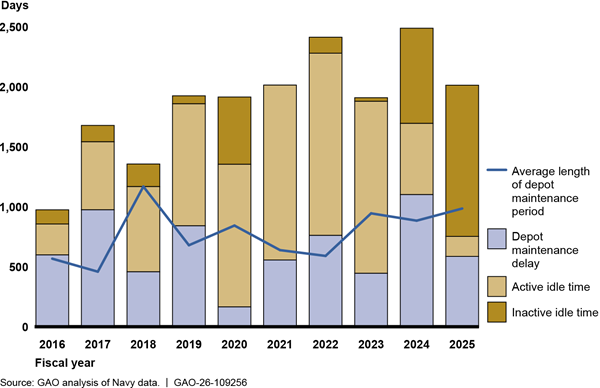
Lost operational days include delays completing depot maintenance and active idle time. Active idle time describes a period when an attack submarine and its crew must remain pier-side because they are no longer certified to conduct normal operations and cannot be inducted into a maintenance period. In addition to lost operational days, the Navy faces significant challenges with managing inactive idle time for attack submarines. Inactive idle time describes when an attack submarine designated for decommissioning cannot be inducted into a dry dock in a shipyard. As a result, the submarine and its crew must remain pier-side until a shipyard has the capacity in a dry dock to defuel their nuclear reactor.
While the U.S. Navy has made recent progress in reducing active idle time, inactive idle time for submarines has grown and is projected to worsen. Without mitigation, 15 attack submarines will enter inactive idle time from fiscal year 2026 through fiscal year 2030—during which time the Navy could incur more than 14,000 days of inactive idle time and $3.1 billion in costs to operate and support these inactive submarines. The U.S. Navy has not fully evaluated alternative options to more efficiently decommission attack submarines and develop and implement an inactivation plan that could allow them to reduce inactive idle time for crews and save billions.
Why GAO Did This Study
According to the U.S. Navy, its 44 attack submarines, as of fiscal year 2025, provide the United States an asymmetric advantage to gather intelligence undetected and attack enemy targets, among other missions. These capabilities make attack submarines some of the most requested assets by the global combatant commanders.
House Report 118-529 includes a provision for GAO to assess the readiness and availability of the U.S. Navy’s attack submarine fleet. This report discusses the extent to which the Navy has effectively maintained its attack submarine fleet and has mitigated any challenges. GAO analyzed U.S. Navy attack submarine maintenance data from fiscal years 2016 through 2025, reviewed U.S. Navy documentation, and interviewed officials.
This report is a public version of a classified report GAO issued July 16, 2026. GAO omitted information the Department of Defense deemed classified or sensitive, such as attack submarine operational availability and how the U.S. Navy’s approach to attack submarine force generation compares to strategic competitors’ approaches.
What GAO Recommends
GAO is making two recommendations including that the U.S. Navy fully evaluate alternative options to more efficiently decommission attack submarines and develop an attack submarine inactivation plan that reduces inactive idle time. The Navy verbally concurred with GAO’s recommendations, but did not provide written comments.
|
Abbreviations |
|
|
|
|
|
DOD FRTP OFRP |
Department of Defense Fleet Response Training Plan Optimized Fleet Response Plan |
This is a work of the U.S. government and is not subject to copyright protection in the United States. The published product may be reproduced and distributed in its entirety without further permission from GAO. However, because this work may contain copyrighted images or other material, permission from the copyright holder may be necessary if you wish to reproduce this material separately.
August 27, 2026
The Honorable Mike Rogers
Chairman
The Honorable Adam Smith
Ranking Member
Committee on Armed Services
House of Representatives
The U.S. Navy’s attack submarines provide the United States an asymmetric advantage to gather intelligence undetected and attack enemy targets, among other missions. These capabilities ensure attack submarines are some of the most requested assets by the global combatant commanders. To prepare the U.S. Navy for warfighting, the Chief of Naval Operation’s 2024 Navigation Plan established a goal to reach 80 percent operational availability for attack submarines by 2027.
House Report 118-529, accompanying a bill for the National Defense Authorization Act for Fiscal Year 2025, includes a provision for us to assess the readiness and availability of the U.S. Navy’s attack submarine fleet.[1] This report is a public version of a classified report that we issued July 16, 2026. This report discusses the extent to which the Navy has effectively maintained its attack submarine fleet and has mitigated any challenges. The classified report included objectives on the following areas: (1) to what extent is the U.S. Navy positioned to meet its attack submarine fleet’s operational availability goal by 2027; and (2) how the U.S. Navy’s approach to attack submarine force generation compares to strategic competitors’ approaches. The Department of Defense (DOD) deemed this information to be classified, which must be protected from loss, compromise, or inadvertent disclosure. Consequently, this public version excludes that information and additional recommendations we made to address these issues.
Although the information provided in this report is more limited, it uses the same methodology as the classified report. For our objective, we analyzed data from fiscal year 2016 through fiscal year 2025, unless otherwise noted, on attack submarine maintenance completion and timeliness, crewing rates, and other key factors. To estimate costs associated with maintenance and other delays, we calculated average daily cost factors using data from the U.S. Navy’s Visibility and Management of Operating and Support Cost system. We also reviewed relevant U.S. Navy guidance, plans, and program documentation, as well as interviewed relevant officials and experts. We determined that two key principles of internal control, as outlined in Standards for Internal Control in the Federal Government, were significant to this objective: (1) that management should identify, analyze, and respond to risks related to achieving defined objectives; and (2) that management should design controls to effectively monitor and mitigate the analyzed risks on a timely basis.[2]
We assessed the reliability of each of the data sources by reviewing system documentation, interviewing officials to understand system operating procedures, and conducting our own error checks to identify potentially inaccurate data. We determined that the data series were sufficiently reliable for the purposes of summarizing attack submarine maintenance and other trends and related information. Our scope and methodology are discussed in greater detail in appendix I.
We conducted the performance audit upon which this report is based from January 2025 to July 2026 in accordance with generally accepted government auditing standards. Those standards require that we plan and perform the audit to obtain sufficient, appropriate evidence to provide a reasonable basis for our findings and conclusions based on our audit objectives. We believe that the evidence obtained provides a reasonable basis for our findings and conclusions based on our audit objectives. We worked with DOD to prepare this unclassified version of the report for public release. This public version was also prepared in accordance with these standards.
Background
U.S. Navy Attack Submarine Force Generation
The Optimized Fleet Response Plan (OFRP) serves as the force generation construct to build readiness and integrate U.S. Navy commands, activities, demands, resources, and schedules. Some units, such as submarines, deploy independently and will follow type commander-specific certification directives and platform and force-specific cycle lengths. The U.S. Navy’s 44 attack submarines (20 Los Angeles class and 24 Virginia class), as of fiscal year 2025, follow the Fleet Response Training Plan (FRTP).[3]
The FRTP is a 12-month training and certification process that is followed by a deployment. According to U.S. Navy officials, deployments are notionally 6 months, resulting in an 18-month operational cycle.[4] Unlike U.S. Navy surface ships, such as aircraft carriers, cruisers, and destroyers that begin a notional 8-month depot maintenance period at the end of their deployment period approximately every 3 years, U.S. Navy officials stated attack submarines begin an extensive depot maintenance period only a few times throughout their life cycle. As a result, attack submarines may repeat their 18-month operational cycle three to four times before they enter an extensive depot maintenance period—lasting 24 to 36 months (see fig. 1).

Note: The attack submarine operational cycle includes a 30-day stand-down period following deployment—extending the operational cycle to 19 months between full cycles. Long-term maintenance period refers to depot maintenance periods, which are the most involved and time-consuming work, such as overhauls, alterations, refits, restorations, nuclear refueling, and decommissionings. Intermediate maintenance periods occur between depot maintenance periods and have a much shorter duration and less complex work.
U.S. Navy Shipyards
The four public naval shipyards in the United States—Portsmouth Naval Shipyard, Norfolk Naval Shipyard, Puget Sound Naval Shipyard, and Pearl Harbor Naval Shipyard—provide depot maintenance on attack submarines and other nuclear-powered vessels. The U.S. Navy describes this maintenance as the most involved and time-consuming work, such as overhauls, alterations, refits, restorations, nuclear refueling, and decommissionings.[5] Two private shipyards—General Dynamics Electric Boat at Groton, Connecticut and Huntington Ingalls Industries Newport News Shipbuilding at Newport News, Virginia—build the U.S. Navy’s nuclear-powered ships, including attack submarines, and in some cases provide depot maintenance for attack submarines.
Roles and Responsibilities
Multiple U.S. Navy organizations have roles and responsibilities related to military readiness and attack submarine force generation, including:
· Office of the Chief of Naval Operations coordinates the global force management of ships and submarines across the world.
· Fleet commanders—U.S. Fleet Forces Command in coordination with U.S. Pacific Fleet, and U.S. Naval Forces Europe/Africa—oversee the OFRP force generation, including developing and disseminating standards; developing performance and effectiveness metrics; conducting readiness improvement and assessments; certifying the readiness of forces; and assisting and coordinating with the Office of the Chief of Naval Operations.
· Type commanders train and oversee the readiness and maintenance of specific platforms and units, such as attack submarines.
· Naval Sea Systems Command oversees ship and submarine design, construction, delivery, and maintenance.
· Navy Personnel Command ensures individual sailors are assigned to crews at the correct location and time.
· Naval Supply Systems Command oversees supply for ships and submarines, including issuing policies and procedures and ensuring standard stock materiel is procured and available to support certain maintenance.
Navy Has Not Fully Mitigated Attack Submarine Fleet Maintenance and Other Challenges
Maintenance Delays and Other Factors Have Affected Attack Submarine Readiness and Cost Billions of Dollars
Maintenance Delays, Idle Time, and Associated Costs
We analyzed U.S. Navy attack submarine data from fiscal year 2008 through 2025 and found persistent depot maintenance delays, increased lengths of depot maintenance periods, and increased idle time (see fig. 2).
Figure 2: U.S. Navy Attack Submarine Depot Maintenance Delays, Length of Depot Maintenance Periods, and Idle Time, Fiscal Years 2008–2025
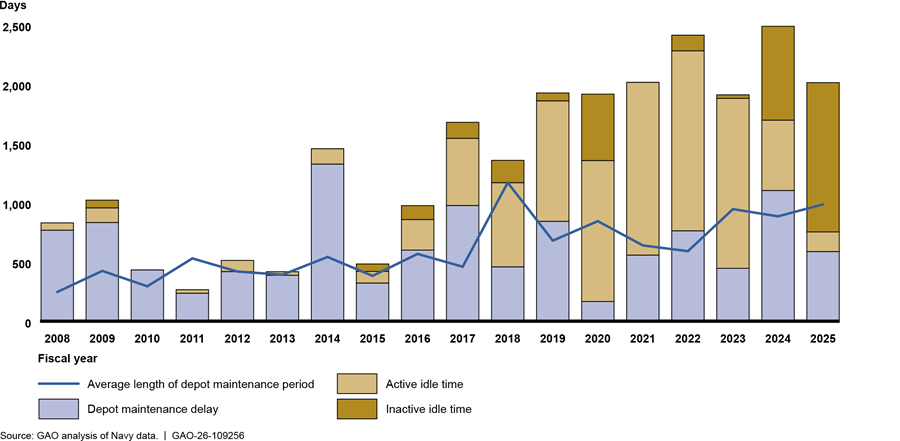
Note: Active idle time describes a period when an attack submarine and its crew must remain pier-side because they are no longer certified to conduct normal operations and cannot be inducted into maintenance. Inactive idle time describes a period when an attack submarine and its crew designated for decommissioning must remain idle pier-side because they cannot be inducted into a public shipyard to defuel the nuclear reactor.
· Days of depot maintenance delay. The U.S. Navy’s attack submarine maintenance backlog has persisted since fiscal year 2008. Examining the last 10 years, the U.S. Navy incurred 3,040 days of maintenance delay from fiscal years 2016 through 2020 and 3,454 days from fiscal years 2021 through 2025. Additionally, from fiscal years 2016 through 2020, the average depot-level maintenance period was 744 days compared with 809 days for fiscal years 2021 through 2025. Further, the U.S. Navy only completed about 11 percent of attack submarine depot maintenance on time at the public shipyards, from fiscal years 2016 through 2025.
· Idle time for active attack submarines. Active idle time describes a period when an attack submarine and its crew must remain pier-side because they are no longer certified to conduct normal operations and cannot be inducted into a maintenance period. The attack submarine is considered active because it is not being decommissioned and will continue operations after completing its maintenance period.[6] These attack submarines and their crew must wait until a shipyard has the capacity to begin their maintenance period. From fiscal years 2016 through 2025, the U.S. Navy incurred 8,906 days of active idle time for active attack submarines, hitting its peak in fiscal year 2022 with 1,518 days. Since this peak, the U.S. Navy reduced active idle time to 166 days in fiscal year 2025.
|
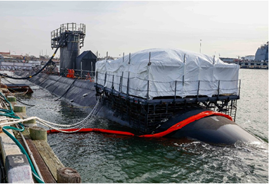
Inactive Idle Time on the USS Pasadena The USS Pasadena entered inactive idle status on January 1, 2025 and is not expected to be inducted into Norfolk Naval Shipyard for decommissioning until November 15, 2028 (1,414 days)—due to shipyard capacity constraints. During this time, the attack submarine is unable to be operational since its dive certification is expired, but is still fully crewed with sailors. According to U.S. Navy officials, the U.S. Navy is attempting to maximize the utility of this inactive attack submarine by using it as a training platform to train crews. However, this extended delay is costing the U.S. Navy over $300 million in operating and support costs over its nearly 4 year inactive idle period, according to our analysis.
Source: GAO analysis of U.S. Navy data and interviews with U.S. Navy officials, U.S. Navy (Photo). I GAO‑26‑109256 |
Idle time for inactive attack submarines. Inactive idle time describes a period when an attack submarine designated for decommissioning cannot be inducted into a dry dock in a public shipyard. The attack submarine and its crew—including those required to maintain and supervise the nuclear reactor—must remain pier-side because they are no longer certified to conduct normal operations and must wait until a shipyard has the capacity in a dry dock to defuel their nuclear reactor (see sidebar for example). Additionally, once they are inducted into a dry dock, inactive attack submarines retain crews and take limited dry dock space away from the operational fleet. Inactive attack submarines faced significant increases of idle time over the last ten years, incurring 3,287 days from fiscal years 2016 through 2025, reaching a peak of 1,260 days of inactive idle time in fiscal year 2025. For most fiscal years prior, one or two attack submarines entered inactive idle time each year. However, without mitigation, the U.S. Navy projects a significant increase of inactive idle time through fiscal year 2030.
In addition to lost operational availability for attack submarines, the U.S. Navy incurs significant operating and support costs for attack submarines that are not ready for operations due to maintenance delays and idle time. All delayed attack submarines—whether delayed during a maintenance period or sitting idle pier-side—are generally fully crewed.[7] We analyzed the operating and support costs the U.S. Navy incurs on average to estimate the costs of crewing, maintaining, and supporting attack submarines that are delayed in entering and leaving the shipyards. Using historical daily cost data that the U.S. Navy adjusted for inflation, we estimated that from fiscal years 2016 through 2025, the U.S. Navy spent about $4.2 billion ($3.4 billion for days of maintenance delay and active idle time and $722 million for inactive idle time) in calendar year 2025 dollars on attack submarines sitting idle while waiting to enter the shipyards and on those delayed in completing their maintenance at the shipyards (see table 1).[8]
Table 1: Estimated Operating and Support Costs for Delayed and Idle U.S. Navy Attack Submarines, Fiscal Years 2016–2025
|
|
Active idle time in days (cost) |
Inactive idle time in days (cost) |
Depot maintenance delay in days (cost) |
Total days and costs |
|
Los Angeles class ($219,700 daily cost) |
7,296 |
3,287 ($722 million) |
4,582 |
15,165 ($3.3 billion) |
|
Virginia class |
1,610 |
0 |
1,912 |
3,522 |
|
Total |
8,906 |
3,287 |
6,494 |
18,687 |
Source: GAO analysis of U.S. Navy data. I GAO‑26‑109256
Note: Active idle time is a period when an attack submarine must remain pier-side as it awaits entering a public shipyard but is expected to return to operations after completing its maintenance period. Inactive idle time is a period when an attack submarine must remain pier-side as it awaits entering a public shipyard to defuel the nuclear reactor in preparation for decommissioning. Attack submarines undergoing inactivation are crewed, and they are still commissioned U.S. Navy vessels, but they are no longer capable of undertaking operations.
Virginia-Class Construction Delays
Delays in construction of new Virginia-class attack submarines also limits operational availability since it decreases the number of attack submarines the U.S. Navy can deploy. Virginia-class construction rates are at a one-per-year pace as of June 2025—half the rate of the Navy’s two per year goal. While the Navy received delivery of two Virginia-class submarines in 2025, both were over 3 years late. Late material deliveries from suppliers and limited availability of experienced workers due to competition in the labor market drive these trends. The Navy plans to improve performance by investing billions of dollars in the supply chain and shipbuilder wages, among other mitigation efforts.[9]
U.S. Navy Has Taken Steps to Reduce Attack Submarine Maintenance Delays but Has Not Fully Addressed Inactive Idle Time
In November 2018, we found that the U.S. Navy was unable to begin or complete the vast majority of its attack submarine maintenance periods on time, resulting in significant maintenance delays and operating and support cost expenditures.[10] We made four recommendations to the U.S. Navy to address delays, including that the U.S. Navy conduct a business case analysis to inform maintenance workload allocation across public and private shipyards, evaluate the resource priorities at the public shipyards, and complete an analysis of spare parts shortages and options for minimizing parts-related disruptions. We recommended that the business case analysis include an assessment of private shipyard capacity to perform attack submarine maintenance, and incorporate a complete accounting of the costs and risks associated with attack submarines sitting idle, among other things.
The U.S. Navy agreed with these recommendations and has implemented all four of them, which included a December 2018 report to Congress on attack submarine depot maintenance. That report outlined the U.S. Navy’s plan to restore operational availability and fully use public and private shipyards through increased public shipyard hiring, training initiatives, and moving some depot maintenance periods to private shipyards.[11] According to this report, the U.S. Navy assessed that its actions would eliminate idle time and the attack submarine maintenance backlog by the end of fiscal year 2023. Although the U.S. Navy has not eliminated the attack submarine maintenance backlog, it has made significant progress in reducing attack submarine active idle time as shown in figure 2 above.
While the U.S. Navy has reduced active idle time, we found inactive attack submarine idle time has grown and will continue to worsen. The U.S. Navy incurred 2,216 days of idle time on seven attack submarines waiting to decommission over the past 5 fiscal years—resulting in more than $480 million in operating and support costs. We found this challenge will likely worsen as more Los Angeles-class attack submarines are planned for decommissioning over the next 5 years. As of January 2026, without mitigation, the U.S. Navy projects that 15 more attack submarines and their crews will enter inactive idle time from fiscal years 2026 through 2030—during which time the U.S. Navy will incur more than 14,000 days of inactive idle time and $3.1 billion in operating and support costs, according to our analysis (see fig. 3). This significant increase is due largely to an aging Los Angeles class reaching the end of their service lives as new Virginia-class attack submarines enter the fleet and to seismic constraints at Puget Sound Naval Shipyard.
Figure 3: U.S. Navy Attack Submarine Inactive Idle Time, Fiscal Years 2021-2025, and Projections for Future Inactive Idle Time, Fiscal Years 2026-2030
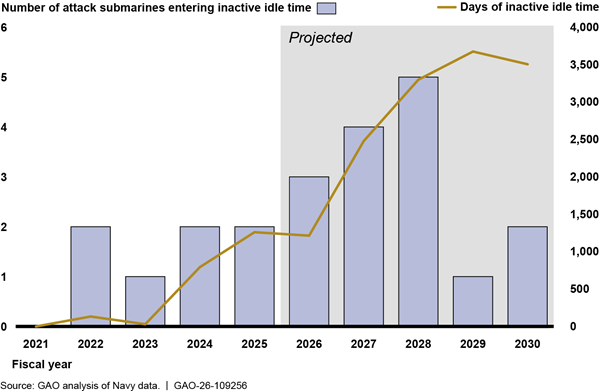
Note: Inactive idle time is a period when an attack submarine must remain pier-side as it awaits entering a public shipyard to defuel the nuclear reactor in preparation for decommissioning. Attack submarines undergoing inactivation are crewed, and they are still commissioned U.S. Navy vessels, but they are no longer capable of undertaking operations.
Standards for Internal Control in the Federal Government state that management should define objectives so they are understood at all levels of the entity, including how objectives are to be achieved and time frames for completion. Additionally, these standards state that management should identify, analyze, and respond to risks related to achieving the defined objectives.[12] These standards further state that management should design controls to effectively monitor and mitigate the analyzed risks.
According to U.S. Navy officials, the U.S. Navy has examined some opportunities to alleviate inactive idle time and its negative effects on the crew, including pier-side defueling (whereby an attack submarine nuclear reactor could be removed outside of a dry dock), reduced crewing models for inactive attack submarines, and service-life extensions for attack submarines so they could have more operational time. However, we found the U.S. Navy has not fully evaluated or established plans for implementing these alternative options for decommissioning attack submarines more efficiently and optimizing shipyard capacity for the operational fleet. Specifically:
· Pier-side nuclear reactor defueling. According to U.S. Navy officials, pier-side defueling would allow attack submarine and ship maintenance to continue at the public shipyards, as inactive attack submarines would not be occupying limited dry dock space. U.S. Navy officials stated pier-side defueling of the Los Angeles-class attack submarine nuclear reactors is not cost effective and should not be used for inactivating Los Angeles-class attack submarines. However, officials were unable to provide documentation of detailed analyses conducted on the feasibility and cost-effectiveness of this option. Additionally, U.S. Navy officials stated there are several other potential options for defueling an attack submarine outside a traditional dry dock, including the use of floating dry docks, which would require additional analysis to determine technical viability. They also said the U.S. Navy has focused analysis in this area on pier-side defueling of Ohio-class submarines to improve dry dock capacity.
· Reduced crewing initiative. According to U.S. Navy officials, the U.S. Navy is working to introduce a reduced crewing model, referred to as the Alternate Inactivation Construct, to release a portion of the inactive attack submarine crew back to the operational fleet over three phases: (1) the first month during system turnover to the public shipyard; (2) the first 6 months when idle conditions begin; and (3) nuclear reactor defueling once a dry dock is available (no later than 4 years into the Alternate Inactivation Construct). During this final stage, the entire crew is released back to the fleet. However, U.S. Navy officials stated, as of November 2025, only two attack submarines have been decommissioned using this construct out of 18 Los Angeles-class attack submarines identified for decommissioning from calendar year 2014 through calendar year 2025. According to U.S. Navy officials, a limited number of attack submarines are planned to use this construct in the next 5 years. U.S. Navy officials cited public shipyard pier capacity constraints—as attack submarines continue to be delayed getting into public shipyards—as reasons for not pursuing additional Alternate Inactivation Construct opportunities in the future but did not provide documentation on any analyses conducted to reach this conclusion.
· Service-life extensions. U.S. Navy officials stated that they continue to routinely assess feasibility and materiel condition of attack submarines to determine if the vessels can safely extend operations beyond original planning assumptions. Working to extend the service life of several of its attack submarines, the U.S. Navy regularly shifts, shortens, or removes periods of idle time. For example, U.S. Navy officials stated, as of September 2025, the U.S. Navy projected that it can reduce inactive idle time by 1,715 days for fiscal years 2026 through 2029 for two attack submarines. However, these service life extensions are still pending approval.
Fully evaluating these options to address the impending wave of Los Angeles-class inactivations over the next 5 years would enable the U.S. Navy to develop a plan for inactivating attack submarines that would reduce inactive idle time for crews and submarines. Specifically, developing and implementing a plan for inactivating attack submarines that includes how objectives are to be achieved and timeframes for completion would effectively allow for monitoring and mitigating risks during implementation. Without fully evaluating alternative options for decommissioning attack submarines more efficiently in the face of growing inactivation requirements and developing and implementing a plan with timeframes to reduce inactive idle time, the U.S. Navy will not be able to fully employ its crews, optimize the public shipyards’ limited capacity, or reduce costs associated with attack submarines not providing any operational availability. If the U.S. Navy is able to identify attack submarine inactivation alternatives and develop and implement a plan that incorporates these alternatives, the U.S. Navy may be able to reduce the more than 14,000 days of projected inactive idle time and $3.1 billion in associated costs.
Conclusions
The U.S. Navy faces a variety of maintenance and other challenges affecting attack submarine readiness. Over the last 10 years, the U.S. Navy has lost more than 15,000 operational days to maintenance delays and idle time on active attack submarines and incurred $3.4 billion to crew and support these attack submarines that provided no operational capability.
While the U.S. Navy has recently made some progress in reducing attack submarine active idle time, inactive idle time has grown and will continue to grow with the impending wave of Los Angeles-class inactivations over the next 5 years. Fully evaluating alternative options for decommissioning attack submarines more efficiently and optimizing shipyard capacity would enable the U.S. Navy to develop an attack submarine inactivation plan—including steps to achieve objectives, timeframes to effectively monitor implementation, and ways to mitigate risks—that reduces inactive idle time for crews and submarines and associated operating and support costs.
Recommendations for Executive Action
We are making the following two recommendations to the Department of the Navy:
The Secretary of the Navy should ensure that the Chief of Naval Operations directs the Naval Sea Systems Command to fully evaluate alternative options for decommissioning attack submarines more efficiently to optimize shipyard capacity for the operational fleet. Such options may include, but are not limited to, defueling outside of dry docks and reducing crewing for attack submarines awaiting decommissioning. (Recommendation 1)
The Secretary of the Navy should ensure that the Chief of Naval Operations directs the Naval Sea Systems Command to use the evaluation above to develop and implement a plan for attack submarine inactivations that reduces inactive idle time for crews and submarines. This plan should include steps to achieve objectives and timeframes for monitoring and mitigating risk for inactive idle time reduction. (Recommendation 2)
Agency Comments
In April 2026, we provided a draft of the classified version of the report to DOD for review and comment. That draft contained the same recommendations as this unclassified version as well as two additional recommendations DOD deemed sensitive. The Navy, on behalf of DOD, verbally concurred with the recommendations in this report, but did not provide written comments. The Navy also provided technical comments, which we incorporated as appropriate.
We are sending copies of this report to the appropriate congressional committees, the Secretary of the Navy, and other interested parties. In addition, this report will also be available at no charge on the GAO website at https://www.gao.gov.
If you or your staff have any questions about this report, please contact me at MaurerD@gao.gov. Contact points for our Offices of Congressional Relations and Media Relations may be found on the last page of this report. GAO staff who made major contributions to this report are listed in appendix II.
Diana Maurer
Director, Defense Capabilities and Management
House Report 118-529, accompanying a bill for the National Defense Authorization Act for Fiscal Year 2025, includes a provision for us to assess the readiness and availability of the U.S. Navy’s attack submarine fleet.[13] This report is a public version of a classified report that we issued July 16, 2026. This report discusses the extent to which the Navy has effectively maintained its attack submarine fleet and has mitigated any challenges. The classified report included objectives on the following areas: (1) to what extent is the U.S. Navy positioned to meet its attack submarine fleet’s operational availability goal by 2027; and (2) how the U.S. Navy’s approach to attack submarine force generation compares to strategic competitors’ approaches. Consequently, this public version excludes that information and additional recommendations we made to address these issues.
Although the information provided in this report is more limited, it uses the same methodology as the classified report. To assess the extent to which the Navy has effectively maintained its attack submarine fleet, we analyzed data from fiscal year 2016 through fiscal year 2025, unless otherwise noted, on attack submarine maintenance completion and timeliness and other key factors. Additionally, we analyzed public and private shipyard depot maintenance records based on Naval Sea Systems Command data. Within this analysis, we compared the planned completion date for depot maintenance periods with the actual completion date, and calculated the difference in days for each fiscal year, by class, from 2008 through 2025. Additionally, we discussed with private shipyard officials the impact private shipyards and the production of new attack submarines have on the shipyard industrial base capacity.
To estimate costs associated with maintenance and other delays, we calculated average daily cost factors by using data from the U.S. Navy’s Visibility and Management of Operating and Support Cost system. We analyzed the operating and support costs the U.S. Navy incurs on average to estimate the costs of crewing, maintaining, and supporting attack submarines that are delayed in entering and leaving the shipyards by using historical daily cost data that the U.S. Navy adjusted for inflation in calendar year 2025 dollars.
We also gathered data on, and met with U.S. Navy officials to discuss, additional factors that impact attack submarine readiness and how the U.S. Navy has mitigated any challenges. We also reviewed relevant U.S. Navy guidance, plans, and program documentation, as well as interviewed relevant officials and experts. We determined that two key principles of internal control, as outlined in Standards for Internal Control in the Federal Government, were significant to this objective: (1) that management should identify, analyze, and respond to risks related to achieving defined objectives; and (2) that management should design controls to effectively monitor and mitigate the analyzed risks on a timely basis.[14]
We performed data reliability assessments on the maintenance and cost data provided by the U.S. Navy. To assess the reliability of the data provided by the U.S. Navy, we reviewed and compared it with the same data provided in previous years. Additionally, we performed manual testing, such as identifying missing data, outliers, obvious errors, and/or logic tests. We determined that the data series were sufficiently reliable for the purposes of summarizing attack submarine maintenance and other trends and related information.
Finally, we interviewed officials, or where appropriate, obtained documentation from the following:
Department of Defense
· U.S. Indo-Pacific Command
· U.S. European Command
Department of Navy
· Office of Chief of Naval Operations
· U.S. Fleet Forces Command
· Commander, Submarine Force Atlantic
· Commander, Submarine Force Pacific
We conducted the performance audit upon which this report is based from January 2025 to July 2026 in accordance with generally accepted government auditing standards. Those standards require that we plan and perform the audit to obtain sufficient, appropriate evidence to provide a reasonable basis for our findings and conclusions based on our audit objectives. We believe that the evidence obtained provides a reasonable basis for our findings and conclusions based on our audit objectives. We worked with DOD to prepare this unclassified version of the report for public release. This public version was also prepared in accordance with these standards.
GAO Contact
Diana Maurer at MaurerD@gao.gov
Staff Acknowledgments
In addition to the contact named above, Chris Watson (Assistant Director), Matthew Thompson (Analyst-in-Charge), Nicole Ashby, David Ballard, Amie Lesser, Jean McSween, Kieran Pierce, Kaitie Trabucco, and Theologos Voudouris made key contributions to this report.
The Government Accountability Office, the audit, evaluation, and investigative arm of Congress, exists to support Congress in meeting its constitutional responsibilities and to help improve the performance and accountability of the federal government for the American people. GAO examines the use of public funds; evaluates federal programs and policies; and provides analyses, recommendations, and other assistance to help Congress make informed oversight, policy, and funding decisions. GAO’s commitment to good government is reflected in its core values of accountability, integrity, and reliability.
Obtaining Copies of GAO Reports and Testimony
The fastest and easiest way to obtain copies of GAO documents at no cost is through our website. Each weekday afternoon, GAO posts on its website newly released reports, testimony, and correspondence. You can also subscribe to GAO’s email updates to receive notification of newly posted products.
Order by Phone
The price of each GAO publication reflects GAO’s actual cost of production and distribution and depends on the number of pages in the publication and whether the publication is printed in color or black and white. Pricing and ordering information is posted on GAO’s website, https://www.gao.gov/ordering.htm.
Place orders by calling (202) 512-6000, toll free (866) 801-7077,
or
TDD (202) 512-2537.
Orders may be paid for using American Express, Discover Card, MasterCard, Visa, check, or money order. Call for additional information.
Connect with GAO
Connect with GAO on X,
LinkedIn, Instagram, and YouTube.
Subscribe to our Email Updates. Listen to our Podcasts.
Visit GAO on the web at https://www.gao.gov.
To Report Fraud, Waste, and Abuse in Federal Programs
Contact FraudNet:
Website: https://www.gao.gov/about/what-gao-does/fraudnet
Automated answering system: (800) 424-5454
Media Relations
Sarah Kaczmarek, Managing Director, Media@gao.gov
Congressional Relations
David A. Powner, Acting Managing Director, CongRel@gao.gov
General Inquiries
[1]H.R. Rep. No. 118-529, at 116 (2024).
[2]See GAO, Standards for Internal Control in the Federal Government, GAO‑25‑107721 (Washington, D.C.: May 2025).
[3]While the U.S. Navy has three additional Seawolf-class attack submarines, we did not include them in this report, unless otherwise noted, because of their mission set. The Seawolf-class mission set is drastically different than the other classes as they do not perform traditional attack submarine missions.
[4]According to U.S. Navy officials, within the operational cycle, attack submarines will undergo intermediate maintenance as well as specified training evolutions.
[5]The U.S. Navy also conducts intermediate and organizational maintenance. Intermediate maintenance periods occur between depot maintenance periods and have a much shorter duration and less complex work. Organizational maintenance periods consist of work that attack submarine’s crews perform during both planned maintenance periods pier-side and while underway.
[6]In order to submerge, each submarine must maintain an active unrestricted operations certification. According to the U.S. Navy, this certification is part of the SUBSAFE program, and it consists of tests and inspections that provide early identification of any degradation to SUBSAFE systems, thus preventing flooding and allowing the submarine to recover in the event of an accident. According to the U.S. Navy, the unrestricted operations certification is one of the central ways the U.S. Navy ensures the safety of its submarine sailors.
[7]As discussed below, the U.S. Navy started a reduced crewing program for inactive attack submarines, but, as of November 2025, only two attack submarines have entered into this program.
[8]To determine the daily cost for attack submarines from fiscal years 2008 through 2025, we used the U.S. Navy’s operating and support costs weighted daily average for calendar year 2008 through 2023.
[9]GAO, Weapons Systems Annual Assessment: Requiring Mature Technologies Could Enable Shift to Rapid Delivery, GAO‑26‑108457 (Washington, D.C.: Jul. 2, 2026).
[10]GAO, Navy Readiness: Actions Needed to Address Costly Maintenance Delays Facing the Attack Submarine Fleet, GAO‑19‑229 (Washington, D.C.: Nov. 19, 2018).
[11]Secretary of the Navy, Report to Congress on Submarine Depot Maintenance (Dec. 28, 2018).
[13]H.R. Rep. No. 118-529, at 116 (2024).
[14]See GAO, Standards for Internal Control in the Federal Government, GAO‑25‑107721 (Washington, D.C.: May 2025).