
Before the Subcommittee on Housing and Insurance, Committee on Financial Services, House of Representatives
For Release on Delivery Expected at 2 pm EDT
United States Government Accountability Office
A testimony before the Subcommittee on Housing and Insurance, Committee on Financial Services, House of Representatives
For more information, contact: Jill Naamane at NaamaneJ@gao.gov.
What GAO Found
The Federal Home Loan Bank (FHLBank) System is a government-sponsored enterprise that consists of 11 federally chartered FHLBanks that support liquidity in the financial system by making loans—known as advances—to member financial institutions, including banks. These advances offer member institutions a low-cost source of funding to make mortgage loans or manage the risk of not meeting financial obligations in a timely and cost-efficient manner (liquidity risk).
A December 2025 GAO report found that as of June 2025, 93 percent of banks were FHLBank members and more than three-quarters had taken out at least one advance from June 2015 through June 2025. GAO’s analysis of banks’ quarterly Call Report data found that large banks—those with more than $10 billion in total assets—were responsible for a majority of banks’ FHLBank borrowing in this period. These banks represented approximately 3 percent of active FHLBanks members and held, on average, nearly 74 percent of all outstanding FHLBank borrowing during the period.
A March 2024 GAO report found that Silicon Valley Bank and Signature Bank had borrowed substantial advances before their failures in spring 2023.
· Silicon Valley Bank increased the balance of its outstanding advances by 50 percent in the first week of March 2023 before its failure on March 10.
· Signature Bank increased its outstanding advances by 37 percent in March 2023 before its failure on March 12.
The two FHLBanks continued to assess risk and provide advances to the two banks before they failed. FHLBanks generally lend to members if the requested amount is within the member’s available borrowing capacity based on its pledged collateral or credit limit. FHLBanks may limit or deny advances based on supervisory information from the member’s primary regulator. The FHLBanks and federal banking regulators increased their frequency of communication in March 2023, but the banks’ relatively fast decline limited further action.
Timely coordination between FHLBanks and Federal Reserve Banks is critical when a bank is at risk. This coordination must negotiate overlap in membership between the two systems. The March 2023 bank failures revealed such coordination challenges. After March 2023, the FHLBanks and Federal Reserve System initiated two efforts to improve coordination during periods of stress: (1) increasing engagement between FHLBanks and Federal Reserve Banks and (2) establishing a working group to improve interoperability.
These efforts are intended to address the coordination challenges experienced during the March 2023 bank failures and are consistent with federal internal control standards related to control activities and information and communication. At the time of GAO’s December 2025 report, these efforts were in the early stages. Continued commitment to these coordination efforts will be important to help ensure that the FHLBanks and Federal Reserve Banks are prepared to respond quickly to member liquidity needs during future periods of financial stress.
Why GAO Did This Study
The failures of Silicon Valley Bank and Signature Bank in March 2023 renewed questions about the FHLBanks’ role in providing liquidity during periods of financial stress. In the weeks leading up to the failures, these banks had borrowed large sums from their FHLBanks. That same month, total advances outstanding to all members reached about $1 trillion, exceeding levels reached during previous financial market disruptions.
This statement discusses (1) the FHLBank System's role in providing financial system liquidity through advances, (2) banks’ use of advances during the March 2023 bank failures, and (3) efforts to improve emergency coordination between FHLBanks and Federal Reserve Banks.
This statement is based on reports GAO issued from April 2023 to December 2025. For those reports, GAO reviewed relevant legislation, regulations, policies, and agency reports, and interviewed federal officials, representatives of FHLBanks and member banks, and other stakeholders.
Chairman Flood, Ranking Member Cleaver, and Members of the Subcommittee:
I am pleased to be here today to discuss our work on the Federal Home Loan Bank (FHLBank) System. The failures of Silicon Valley Bank and Signature Bank in March 2023 renewed questions about the FHLBanks’ role as a liquidity provider during periods of financial stress. In the weeks leading up to the failures, these banks had borrowed large sums from their FHLBanks through secured loans (known as advances). That same month, total advances outstanding to all members reached about $1 trillion, exceeding levels reached during previous financial market disruptions.
The FHLBank System is a government-sponsored enterprise that consists of 11 federally chartered FHLBanks and a joint Office of Finance, which issues debt on their behalf.[1] Each FHLBank is cooperatively owned by its members, which may include banks, thrifts, credit unions, insurance companies, and community development financial institutions.[2] The FHLBanks support liquidity in the financial system and promote housing and community development. FHLBanks are overseen by the Federal Housing Finance Agency (FHFA), which is responsible for ensuring they operate in a financially safe and sound fashion, remain adequately capitalized and able to raise funds in the capital markets, and operate in a manner consistent with their housing finance mission.
My statement discusses (1) the FHLBank System’s role in providing financial system liquidity through advances, (2) banks’ use of advances during the March 2023 bank failures, and (3) efforts to improve emergency coordination between FHLBanks and Federal Reserve Banks.
This statement is primarily based on two reports. The first, issued in March 2024, examined the FHLBank System’s role in the spring 2023 bank failures, including its coordination with federal regulators.[3] The second, issued in December 2025, examined FHLBank borrowing trends and outcomes for member banks from 2015 through mid-2025.[4] This statement also includes information from reports we issued between April 2023 and November 2024 on the March 2023 bank failures and bank supervision.[5]
For these reports, we reviewed relevant legislation, regulations, policies, and agency reports and interviewed federal officials and representatives of the FHLBanks, member banks, trade associations, and other stakeholders. We also analyzed bank financial reports, FHLBank membership data, economic indicators, and documentation from FHLBanks, banking regulators, and FHFA. More information on our scope and methodology can be found in each of the reports cited throughout this statement.
We conducted the work on which this statement is based in accordance with generally accepted government auditing standards. Those standards require that we plan and perform the audit to obtain sufficient, appropriate evidence to provide a reasonable basis for our findings and conclusions based on our audit objectives. We believe that the evidence obtained provides a reasonable basis for our findings and conclusions based on our audit objectives.
FHLBanks Provide Liquidity Through Advances
Characteristics of and Process for Obtaining FHLBank Advances
As discussed in our March 2024 and December 2025 reports, banks primarily fund their operations through customer deposits, like checking and saving accounts, but may also use other funding sources, including secured loans from FHLBanks. These secured loans—known as advances—offer member banks and other member institutions a low-cost source of funding to make mortgage loans or manage the risk of not meeting financial obligations in a timely and cost-efficient manner (liquidity risk).
Although regulations require that advances have certain features, each FHLBank has the flexibility to structure the specific terms of advances within those legal parameters. FHLBanks offer a variety of advance products, but fixed-rate advances typically represent more than half of those provided to members.[6] Maturities range from overnight to 30 years, although most advances mature within 3 years. According to FHFA officials and FHLBank representatives, members choose advances with shorter or longer maturities depending on the interest rates and their strategies for using advances as a liquidity source.
The process for obtaining an FHLBank advance includes an ongoing assessment of members’ creditworthiness and the pledging of eligible collateral.
· Creditworthiness. When an institution applies for FHLBank membership, the FHLBank evaluates its creditworthiness and assigns it a financing limit, typically based on a percentage of the applicant’s total assets. FHLBanks periodically reassess member creditworthiness based on both the pledged collateral and the member’s financial condition.
· Collateral. Members are required to secure FHLBank advances with eligible collateral, such as certain mortgage loans, securities, cash, or U.S. Treasuries, ensuring the FHLBank is fully collateralized. Required collateral levels incorporate the cost to sell or liquidate the pledged collateral and the risk of a decline in market value. As a result, the pledged amount generally exceeds the amount owed. Members commonly grant the FHLBank a lien on all eligible collateral, which allows members to borrow as needed, according to FHLBank representatives.
Members must also purchase and maintain stock in their FHLBank, consistent with the capital structure plan of the FHLBank, as part of their membership obligations and as a condition of transacting business with the FHLBank.[7] In turn, the FHLBank holds a lien on that stock as additional collateral for advances.
An FHLBank generally lends the requested amount if it is within the lesser of the member’s available borrowing capacity or its credit limit (subject to market conditions). Under certain conditions—including if a member’s financial condition is deteriorating—the FHLBank may reduce a member’s borrowing capacity, require more collateral, or take physical possession of collateral as a condition for new or outstanding advances. An FHLBank may also limit or deny a member’s advance based on supervisory information from the member’s primary regulator. FHFA regulations currently allow for certain banking regulator interventions in FHLBank credit decisions, but, according to banking regulator officials, they generally do not intervene in those decisions.[8]
Member Banks’ Use of Advances
Our December 2025 report found that from the first quarter of 2015 through the second quarter of 2025, most U.S. banks were active FHLBank members that borrowed regularly from their FHLBank. As of June 2025, 93 percent of banks in the U.S. were FHLBank members, and more than three-quarters had taken out at least one advance during the period. On average, 67 percent of these active members had outstanding FHLBank borrowing in each quarter.
Our analysis indicates that banks typically do not change their reliance on FHLBank borrowing significantly from one quarter to the next. We measured this reliance by comparing member banks’ FHLBank borrowing to their total assets, with a higher percentage reflecting greater reliance. From the first quarter of 2015 through the second quarter of 2025, 76 percent of active members had FHLBank borrowing that was 5 percent or less of their total assets. On average, 62 percent did not change their borrowing ratio compared with the previous quarter during this period. Of the remaining 38 percent that did change their borrowing ratio between quarters, 69 percent changed it by 2 percentage points or less.
Our analysis of banks’ quarterly Call Report data found that large banks—those with more than $10 billion in total assets—were responsible for a majority of FHLBank borrowing from the first quarter of 2015 through the second quarter of 2025.[9] These large banks represented approximately 3 percent of active FHLBank members and held, on average, nearly 74 percent of all outstanding FHLBank borrowing during the period.
After controlling for bank health characteristics, higher FHLBank borrowing was generally associated with positive outcomes for most banks from 2015 through 2024, especially smaller banks (those with $10 billion or less in assets).[10] For smaller banks, higher borrowing was associated with more lending—including increases in real estate lending—and lower likelihood of being flagged as a problem bank or of failing or closing voluntarily.[11] In contrast, for large banks, we found no evidence of a relationship between FHLBank borrowing and lending, and the relationship between borrowing and the risk of being flagged as a problem bank or of failing or closing voluntarily was unclear.
Banks often use a mix of funding sources to meet funding demands, diversify funding structures, and maintain an appropriate ratio of assets to liabilities. According to executives from 10 banks we interviewed, FHLBank advances offer some advantages over other types of funding, including the speed and availability of funds, flexible maturity options, and lower costs.[12] However, because this funding is fungible, it is unclear to what extent FHLBank members are using advances to make loans for housing and community development activities.
Use of Advances Increased During the March 2023 Bank Failures
Silicon Valley Bank and Signature Bank Failed in March 2023
Several banks experienced stress in March 2023. On March 8, 2023, Silvergate Bank announced its intent to wind down operations and voluntarily liquidate after experiencing a bank run that began in late 2022 amid concerns about its involvement with the digital assets industry. This announcement prompted broader market uncertainty, especially at banks with depositors affiliated with the digital assets industry and venture capital.
Silicon Valley Bank (SVB) and Signature Bank were two such banks. Founded in 1983, SVB was a state-chartered commercial bank and primarily served entrepreneur clients in technology, health care, and private equity. Signature Bank, founded in 2001, was a state-chartered nonmember commercial bank that provided services to the private equity industry, including venture capital companies and the digital assets industry.[13] At the end of 2022, SVB had about $209 billion in assets and Signature Bank had about $110 billion. In March 2023, SVB was the 16th largest U.S. bank and Signature Bank was the 29th largest.
Between March 10 and March 12, 2023, SVB and Signature Bank failed, and state banking regulators named the Federal Deposit Insurance Corporation (FDIC) as receiver. As we reported in April 2023, federal banking regulators identified liquidity and risk management concerns at both banks in the 5 years prior to 2023, but the banks were slow to mitigate these concerns.[14] In addition, as we reported in November 2024, regulators did not escalate supervisory actions in time to prevent the failures.[15]
FHLBank Advance Use Increased in March 2023, Especially Among Large Banks
As we reported in December 2025, banks’ total outstanding FHLBank borrowing increased substantially at the onset of the March 2023 bank failures.[16] This increase was driven by a small number of large banks—fewer than 160 out of more than 4,400 FHLBanks, or 3 percent of active bank members. Even for these large banks, however, increases in FHLBank borrowing represented a small fraction of their total assets.
In the first quarter of 2023, which included the March 2023 bank failures, banks’ total outstanding FHLBank borrowing reached $804 billion—the highest level from the first quarter of 2015 through the second quarter of 2025 and a 37 percent increase over the previous quarter. Large banks were responsible for the great majority of these increases, both in total FHLBank borrowing and in their share of outstanding FHLBank advances. Specifically:
· Total outstanding FHLBank borrowing. In the first quarter of 2023, total outstanding borrowing grew by $217 billion, of which 97 percent ($211 billion) was attributable to large banks. During that quarter, the total outstanding FHLBank borrowing of large banks was about 73 percent higher than the median level from the first quarter of 2015 to the second quarter of 2025.
In contrast, although smaller banks increased their borrowing by about $6 billion in the first quarter of 2023 compared with the prior period, their total outstanding FHLBank borrowing was the same or lower than the median level from the first quarter of 2015 to the second quarter of 2025.
· Share of outstanding FHLBank borrowing. During the first quarter of 2023, large banks’ share of total outstanding FHLBank borrowing increased to 84 percent—10 percentage points higher than the average from the first quarter of 2015 through the second quarter of 2025.
We interviewed executives from two banks with between $10 billion and $100 billion in assets. Both reported increasing their use of FHLBank advances in the first quarter of 2023 due to heighted economic uncertainty or pressure on regional banks to secure funding.[17] For example, one executive reported using FHLBank advances to maintain confidence in the bank’s ability to meet customer needs.
Following the March 2023 bank failures, banks’ total outstanding FHLBank borrowing decreased by 18 percent, to $659 billion in the second quarter of 2023.[18]
In March 2023, FHLBanks Provided Advances to Banks That Subsequently Failed
As we reported in March 2024, at the beginning of 2023, SVB and Signature Bank were among their respective FHLBanks’ largest borrowers.[19] SVB held 17 percent of the FHLBank of San Francisco’s total advance balance outstanding and was its largest borrower. Signature Bank held approximately 10 percent of the FHLBank of New York’s total advance balance outstanding and was its fourth largest borrower.
According to the FHLBanks of San Francisco and New York, they did not deem the failed banks to be significant credit risks until March 2023. Federal banking regulators are required by law to share supervisory information, including confidential examination findings, with an FHLBank upon request.[20] The FHLBanks of New York and San Francisco requested and received examination reports for the two banks at various points before their failures. Beginning in March 2023, the two FHLBanks and federal regulators increased the frequency of their communication.
· SVB. On March 9, 2023, FHLBank of San Francisco officials contacted staff in the Federal Reserve Bank of San Francisco after SVB announced a significant loss from sales of its securities on March 8. However, by that point SVB had experienced a large volume of withdrawals and closed within 48 hours of announced losses. FHLBank of San Francisco officials told us that, as a result of SVB’s quick decline, they did not have time to formally request information about SVB’s creditworthiness before its failure.
· Signature Bank. On March 10, 2023, FHLBank of New York officials met with FDIC (Signature Bank’s primary regulator) to discuss the bank’s overall liquidity position and borrowing capacity, according to FHLBank representatives. On March 11 and 12, the FHLBank and FDIC continued to communicate about Signature Bank’s liquidity. FDIC did not advise the FHLBank as to whether it should lend to the bank. According to FDIC officials, they generally do not have a role in the credit decisions of FHLBanks.
The two FHLBanks continued to provide advances to both banks in March 2023.
· SVB. From March 1 to March 8, 2023, SVB increased the balance of its outstanding advances by 50 percent, from approximately $20 billion to $30 billion. The balance remained at $30 billion through SVB’s failure on March 10, 2023.
On the afternoon of March 9, the FHLBank of San Francisco was unable to fill a $20 billion advance request from SVB. According to FHLBank representatives, this was due to market conditions, the size and late timing of the request, and the FHLBank’s need to better understand ongoing events, including the withdrawal of more than $40 billion in deposits by SVB customers that day.
· Signature Bank. From March 1 through its failure on March 12, 2023, Signature Bank increased its outstanding advances by 37 percent, from approximately $8.2 billion to $11.2 billion. The FHLBank of New York continued to fill Signature Bank’s new and renewed advance requests with maturities of 30 days or less during this period.
The FHLBanks of New York and San Franscisco also made several efforts to help the failing banks pledge collateral to obtain liquidity from the Federal Reserve Banks’ discount window. The discount window generally provides short-term advances to eligible institutions. In some circumstances, such as urgent or large funding needs, FHLBank members may need to reallocate excess FHLBank collateral (i.e., collateral pledged to an FHLBank but not needed to support outstanding advances) to a Federal Reserve Bank to access the discount window.[21]
· SVB. FHLBank of San Francisco representatives said they attempted to help SVB de-pledge certain excess collateral at the FHLBank and pledge it to the Federal Reserve Bank of San Francisco on March 9. However, SVB failed the next morning, before the collateral could be moved. According to Federal Reserve Bank officials, although SVB was able to borrow up to its existing lendable value at the discount window, it was not prepared to quickly reposition collateral from the FHLBank to access additional discount window funding.
· Signature Bank. On March 10, the FHLBank of New York subordinated its interest in a total of approximately $7.1 billion of Signature Bank’s excess pledged securities collateral to the Federal Reserve Bank of New York to allow Signature Bank to access discount window funding. At Signature Bank’s request, the FHLBank initiated a second subordination agreement for additional loan and securities collateral the weekend of Signature Bank’s failure. However, the bank was closed and placed into receivership before it and the FHLBank finalized the collateral schedule for the agreement.
The March 2023 bank failures revealed coordination challenges between the two systems. In particular, the Board of Governors of the Federal Reserve System found that SVB had limited collateral pledged to the discount window, had not conducted test transactions, and could not quickly reallocate collateral from the FHLBank of San Francisco.[22]
FHLBanks and Federal Reserve Banks Have Taken Steps to Help Improve Emergency Coordination
As we reported in December 2025, timely coordination between FHLBanks and Federal Reserve Banks is critical when a bank is at risk.[23] In some cases, the bank may need to access the Federal Reserve System’s discount window to mitigate liquidity shortfalls. If a bank lacks sufficient unencumbered collateral to pledge to the discount window, it may pledge excess FHLBank collateral to its district Reserve Bank. To do so, the FHLBank and Reserve Bank may need to take steps, such as establishing an intercreditor or subordination agreement, to ensure that the Reserve Bank can obtain a perfected security interest in such collateral.
Coordination between FHLBanks and Federal Reserve Banks is complicated by the overlap in membership between the two systems. Thirty-seven unique combinations of FHLBanks and Federal Reserve Banks share at least one common member bank (see fig. 1). While some institutions share members with only one counterpart, others share with up to seven. In addition, procedures can vary among FHLBanks. For example, one Federal Reserve Bank can share member banks with multiple FHLBanks that each use slightly different subordination agreements, according to Federal Reserve System officials.
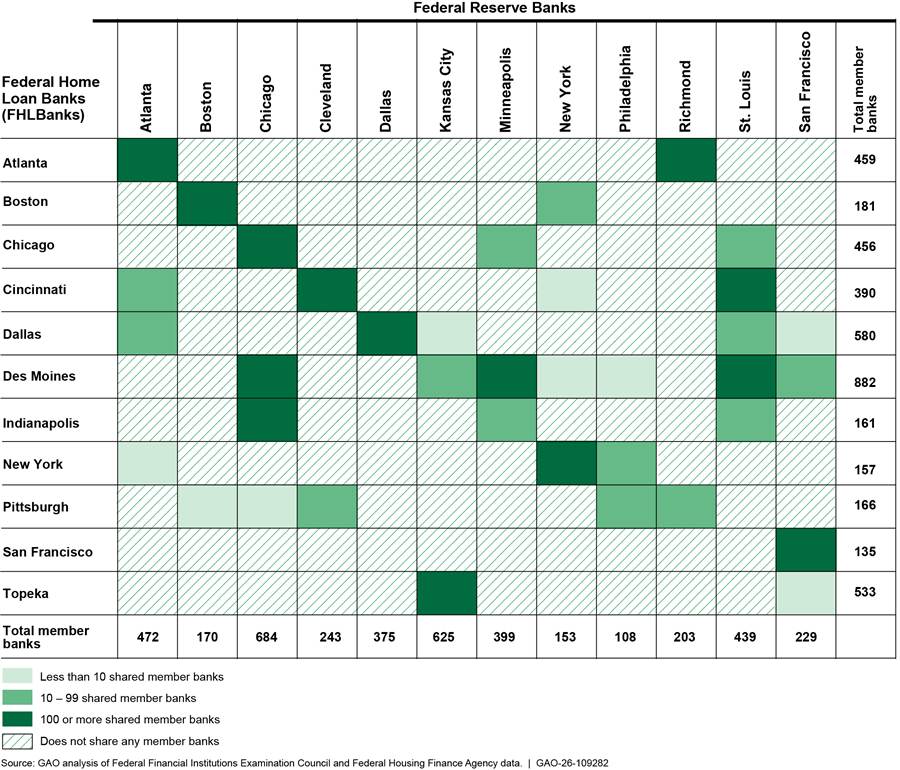
After March 2023, the FHLBanks and Federal Reserve System initiated two efforts to improve coordination during periods of stress, as follows.
· Increased engagement between FHLBanks and Federal Reserve Banks. According to Federal Reserve System officials and FHLBank representatives, the two systems undertook efforts to address challenges to timely reallocation of collateral. For example, as of July 2025, some FHLBanks and Federal Reserve Banks with shared members conducted tabletop exercises to test collateral reallocation procedures under hypothetical scenarios involving banks of varying sizes, financial conditions, and readiness to borrow from the discount window, according to FHLBank representatives. Some also arranged for member banks to conduct actual collateral transfers between the two systems to test the reallocation process.
· Established working group to improve interoperability. In January 2025, the FHLBank and Federal Reserve Systems established a working group to improve interoperability between the FHLBanks and the Federal Reserve Banks. As of December 2025, the group intended to establish several workstreams to develop standard procedures, including subordination agreements, information-sharing agreements, and a coordination playbook for reference during emergencies, according to documentation. Each workstream was to include members from both systems.
As we reported in December 2025, these efforts are intended to address the coordination challenges experienced during the March 2023 bank failures and are consistent with federal internal control standards on implementing control activities and information and communication.[24] At the time of our report, these efforts were in the early stages. Continued commitment to these coordination efforts will be important to help ensure that the FHLBanks and Federal Reserve Banks are prepared to respond quickly to member liquidity needs during future periods of financial stress.
Chairman Flood, Ranking Member Cleaver, and Members of the Subcommittee, this completes my prepared statement. I would be pleased to respond to any questions you may have at this time.
GAO Contact and Staff Acknowledgments
If you or your staff have any questions concerning this testimony, please contact Jill Naamane, Director, Financial Markets and Community Investment, at NaamaneJ@gao.gov. Contact points for our Offices of Congressional Relations and Media Relations may be found on the last page of this statement.
GAO staff who made key contributions to this statement are Patricia MacWilliams (Assistant Director), Danielle Curet (Analyst-in-Charge), Lauren Capitini, Pin-En (Annie) Chou, Victor Elliott, Jill Lacey, and Jennifer Schwartz. Key contributors for the previous work that this testimony is based on are listed in each product.
This is a work of the U.S. government and is not subject to copyright protection in the United States. The published product may be reproduced and distributed in its entirety without further permission from GAO. However, because this work may contain copyrighted images or other material, permission from the copyright holder may be necessary if you wish to reproduce this material separately.
The Government Accountability Office, the audit, evaluation, and investigative arm of Congress, exists to support Congress in meeting its constitutional responsibilities and to help improve the performance and accountability of the federal government for the American people. GAO examines the use of public funds; evaluates federal programs and policies; and provides analyses, recommendations, and other assistance to help Congress make informed oversight, policy, and funding decisions. GAO’s commitment to good government is reflected in its core values of accountability, integrity, and reliability.
Obtaining Copies of GAO Reports and Testimony
The fastest and easiest way to obtain copies of GAO documents at no cost is through our website. Each weekday afternoon, GAO posts on its website newly released reports, testimony, and correspondence. You can also subscribe to GAO’s email updates to receive notification of newly posted products.
Order by Phone
The price of each GAO publication reflects GAO’s actual cost of production and distribution and depends on the number of pages in the publication and whether the publication is printed in color or black and white. Pricing and ordering information is posted on GAO’s website, https://www.gao.gov/ordering.htm.
Place orders by calling (202) 512-6000, toll free (866) 801-7077,
or
TDD (202) 512-2537.
Orders may be paid for using American Express, Discover Card, MasterCard, Visa, check, or money order. Call for additional information.
Connect with GAO
Connect with GAO on X,
LinkedIn, Instagram, and YouTube.
Subscribe to our Email Updates. Listen to our Podcasts.
Visit GAO on the web at https://www.gao.gov.
To Report Fraud, Waste, and Abuse in Federal Programs
Contact FraudNet:
Website: https://www.gao.gov/about/what-gao-does/fraudnet
Automated answering system: (800) 424-5454
Media Relations
Sarah Kaczmarek, Managing Director, Media@gao.gov
Congressional Relations
David A. Powner, Acting Managing Director, CongRel@gao.gov
General Inquiries
[1]The Office of Finance facilitates the issuance and servicing of the FHLBanks’ consolidated obligations. These obligations serve as the FHLBanks’ primary source of funds and allow them to provide advances. Consolidated obligations are the joint and several liability of the FHLBanks collectively.
[2]To qualify for membership, banks must meet certain criteria, including that they must be regulated by the appropriate federal or state banking regulator, purchase or originate home mortgage loans with terms of 5 years or more, and hold at least 10 percent of their assets in residential mortgage lending at the time of application. However, the requirement to hold at least 10 percent of total assets in residential mortgage loans does not apply to community financial institutions—insured depository institutions with average total assets for a 3-year period below a given asset cap. The Federal Housing Finance Agency adjusts the asset cap annually. As of January 1, 2026, the asset cap was $1.541 billion.
[3]GAO, Federal Home Loan Banks: Actions Related to the Spring 2023 Bank Failures, GAO‑24‑106957 (Washington, D.C.: Mar. 8, 2024).
[4]GAO, Federal Home Loan Banks: Role During Financial Stress and Members’ Borrowing Trends and Outcomes, GAO‑26‑107373 (Washington, D.C.: Dec. 17, 2025).
[5]See GAO, Bank Regulation: Preliminary Review of Agency Actions Related to March 2023 Bank Failures, GAO‑23‑106736 (Washington, D.C.: Apr. 28, 2023); Federal Deposit Insurance Act: Federal Agency Efforts to Identify and Mitigate Systemic Risk from the March 2023 Bank Failures, GAO‑25‑107023 (Washington, D.C.: Jan. 23, 2025); and Bank Supervision: Federal Reserve and FDIC Should Address Weaknesses in Their Process for Escalating Supervisory Concerns, GAO‑25‑106771 (Washington, D.C.: Nov. 19, 2024).
[6]Other advance types include hybrid, convertible, and overnight advances. Advances may be callable (allowing certain early repayment without penalty), convertible (fixed to floating rate or vice versa), or putable (payable upon FHLBank demand).
[7]This stock is not publicly traded and is issued, redeemed, and repurchased at par value by each FHLBank.
[8]For example, an FHLBank may not make an advance to a member without positive tangible capital unless the member’s primary regulator or insurer requests it. A member bank’s regulator can also prohibit FHLBank advances to a capital-deficient member with positive tangible capital by notifying the FHLBank in writing that a member’s use of FHLBank advances has been prohibited. 12 C.F.R. § 1266.4(b), (d).
[9]Call Reports are quarterly financial reports that certain financial institutions must submit at the end of each quarter. They serve as a primary source of financial data used for bank supervision and regulation.
[10]In our models, we controlled for the following bank-level health indicators that could affect banks’ outcomes, in addition to macroeconomic indicators: capital adequacy, asset quality, earnings, liquidity, and interest-rate risk.
[11]Banks are added to the Problem Bank List when their supervisory rating falls below a certain threshold.
[12]We interviewed executives from a nongeneralizable sample of 10 banks to obtain their perspectives on the role of FHLBank borrowing during recent stress periods. The 10 banks each had FHLBank borrowing in the first quarter of 2020, the first quarter of 2023, or both.
[13]A nonmember bank is a bank that is not a member of the Federal Reserve System.
[14]GAO‑23‑106736. The three federal banking regulators are the Board of Governors of the Federal Reserve System, FDIC, and the Office of the Comptroller of the Currency. These regulators supervise the banks that are members of the FHLBanks and promote safety and soundness.
[15]GAO‑25‑106771. In this report, we made two recommendations to the Board of Governors of the Federal Reserve System and three to FDIC to strengthen their processes for escalating supervisory concerns. These agencies have taken steps toward implementing the recommendations. As of July 2026, two have been implemented and three remain unaddressed.
[17]“Regional banks” is a term with varying definitions and asset thresholds, but it often refers to banks that are neither small community banks nor very large, systemically important banks. The failures of March 2023 were often referred to as regional bank failures.
[18]From March 2023 through early 2024, the Board of Governors of the Federal Reserve System provided funding to banks through the Bank Term Funding Program, which peaked at more than $167 billion in outstanding loans.
[20]12 U.S.C. § 1442(a).
[21]Conversely, members can reallocate collateral from the Federal Reserve to an FHLBank, depending on liquidity strategies, reductions in collateral value, and other factors.
[22]Board of Governors of the Federal Reserve System, Review of the Federal Reserve’s Supervision and Regulation of Silicon Valley Bank (Washington, D.C.: Apr. 28, 2023).
[23]GAO‑26‑107373. In the first quarter of 2025, 4,100 banks were members of both an FHLBank and a Federal Reserve Bank.
[24]Federal internal control standards state that management should implement control activities (actions management establishes to mitigate risks to achieving the entity’s objectives) through policies and procedures. Additionally, the standards state that management should communicate—both internally and externally—relevant and quality information necessary to support the functioning of the internal control system. GAO, Standards for Internal Control in the Federal Government, GAO‑25‑107721 (Washington, D.C.: May 15, 2025).