
Before the Subcommittee on Communications and Technology, Committee on Energy and Commerce, House of Representatives
For Release on Delivery Expected at 2:00 p.m. ET
United States Government Accountability Office
A testimony before the Subcommittee on Communications and Technology, Committee on Energy and Commerce, House of Representatives
Contact: Andrew Von Ah at vonaha@gao.gov
What GAO Found
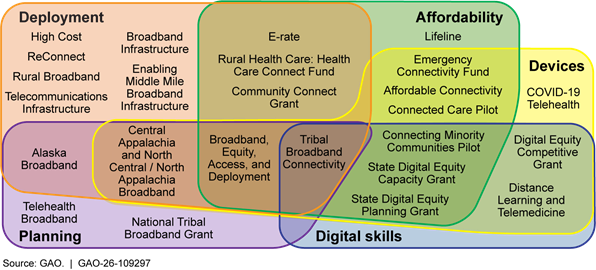
Federal broadband efforts are fragmented, with over 100 programs administered by 15 agencies, as GAO reported in May 2022. Some programs support broadband as their main purpose, while others support broadband as one possible purpose (see figure).
The Mosaic of Federal Programs with Broadband as a Main Purpose as of November 2021, by Purpose Category
GAO has found that a national strategy, continued interagency coordination, and better mapping data could strengthen federal broadband efforts.
National Strategy. Strategies to coordinate programs that address issues of broad national need can help mitigate the negative effects of fragmented federal programs, but no national strategy exists for federal broadband efforts. In May 2022, GAO recommended creating such a strategy to synchronize these efforts.
Interagency Coordination. With or without a national strategy, effective coordination among agencies that administer broadband programs is also important. In April 2025, GAO reported that the Federal Communications Commission (FCC), National Telecommunications and Information Administration (NTIA), and Departments of Agriculture (USDA) and the Treasury coordinate to administer the bulk of federal broadband funding and have mechanisms in place to do so. GAO recommended improvements to further strengthen those efforts. Agency officials reported taking steps to implement these recommendations, but have not yet fully addressed them, as of July 2026.
Mapping Data. Agencies rely on FCC’s National Broadband Map—which displays where broadband is already available—to target tens of billions of dollars in federal broadband funding, but the accuracy of the map’s availability data is uncertain. In April 2025, GAO recommended FCC document and evaluate the effectiveness of its processes for ensuring the map’s data quality. Not doing so could increase the risk of inaccurate data on the map, which could jeopardize agencies’ ability to make effective funding decisions. FCC has not yet addressed the recommendations as of July 2026, but officials reported taking steps to do so.
Why GAO Did This Study
Access to broadband is critical for employment, education, health care, and other daily activities. The federal government has invested tens of billions of dollars over the past decade across a myriad of broadband-related programs managed by different agencies. Yet millions of Americans lack broadband access.
Information on where broadband is already available is key to expanding access. Coordination among the federal agencies that administer the various federal programs is also key, particularly since U.S. broadband efforts are not guided by an overarching national strategy.
This testimony discusses findings from GAO’s previous reports on (1) a national broadband strategy and interagency coordination efforts, and (2) FCC’s efforts to ensure the quality of data in its National Broadband Map. It is primarily based on GAO’s May 2022 and April 2025 reports.
What GAO Recommends
In May 2022, GAO recommended that the Executive Office of the President develop a national broadband strategy. The Executive Office of the President did not take a position on the recommendation. In April 2025, GAO recommended that FCC, NTIA, USDA, and Treasury strengthen aspects of their coordination; and that FCC strengthen aspects of its processes for ensuring the quality of the National Broadband Map's data. FCC, NTIA, and Treasury agreed with these recommendations; USDA did not take a position. GAO will continue to monitor the agencies’ progress in implementing the recommendations.
Chairman Hudson, Ranking Member Matsui, and Members of the Subcommittee:
I am pleased to be here today to discuss our work on federal broadband efforts as the subcommittee considers proposed legislation. Access to broadband is critical for employment, education, health care, and other daily activities. The federal government has invested tens of billions of dollars over the past decade across a myriad of broadband-related programs managed by different agencies. Yet millions of Americans lack broadband access. Information on where broadband is already available is key to expanding access and to preventing duplicative federal funding—where separate programs fund broadband deployment in the same area, for the same population, at the same level of service. Also key is coordination among the federal agencies that administer the various federal programs, particularly since U.S. broadband efforts are not guided by an overarching national strategy.
The proposed legislation being considered by the subcommittee would address various aspects of federal efforts to expand broadband access. In particular, the PLAN for Broadband Act would direct the Assistant Secretary of Commerce for Communications and Information (i.e., the Administrator of the National Telecommunications and Information Administration, or NTIA) to develop a national strategy to close the digital divide—generally referred to as the gap between those with and without access to broadband.[1] The Data BRIDGE Act would direct the Federal Communications Commission (FCC) to make certain updates to its National Broadband Map—that is, the map that shows specific locations in the U.S. where broadband is available based on data FCC collects from providers of broadband service.[2]
My statement today describes findings from our previous reports on (1) a national broadband strategy and interagency coordination efforts, and (2) FCC’s efforts to ensure the quality of data in its National Broadband Map. It draws primarily on reports we issued in 2022 and 2025.[3] More detailed information on the objectives, scope, and methodology for that work can be found in the issued reports. We conducted the work on which this statement is based in accordance with generally accepted government auditing standards. Those standards require that we plan and perform the audit to obtain sufficient, appropriate evidence to provide a reasonable basis for our findings and conclusions based on our audit objectives. We believe that the evidence obtained provides a reasonable basis for our findings and conclusions based on our audit objectives.
National Broadband Strategy and Other Coordination Efforts
In May 2022, we inventoried federal programs that either must or can be used to support expanding broadband access, identifying more than 100 programs administered by 15 federal agencies.[4] Some of these programs support broadband as their main purpose, while others support broadband as one possible purpose. Aside from funding broadband deployment, some of the programs support other aspects of broadband access, such as making service affordable, providing devices, and building digital skills. Eligible recipients for these programs range widely and include internet providers, other private sector entities, nonprofits, state and local governments, Tribes, education agencies, and healthcare providers. While many agencies provide funding to support broadband access, FCC, NTIA, and the Departments of Agriculture (USDA) and the Treasury administer the bulk of federal funding for deployment of new or enhanced broadband networks.
We found that this myriad of programs created a fragmented, overlapping patchwork of funding, which could lead to wasteful duplication of funding and effort.[5] Moreover, we found that no overarching national strategy existed to provide clear roles, goals, or objectives, or to synchronize the numerous federal broadband efforts. We have reported that strategies to coordinate programs that address cross-cutting issues of broad national need can help identify and mitigate negative effects associated with fragmented, overlapping, and potentially duplicative federal programs.[6] Accordingly, we recommended that the Executive Office of the President, through the National Economic Council, develop and implement a national broadband strategy with clear roles, goals, objectives, and performance measures to support better management of fragmented, overlapping federal broadband programs and synchronize coordination efforts. Such a strategy could help agencies manage existing fragmentation and overlap of programs and mitigate the risk of potentially wasteful duplicative efforts. As of July 2026, this recommendation has not yet been addressed. We are pleased to see the subcommittee considering the importance of developing a national broadband strategy.
In addition to the need for synchronizing federal efforts, other work we have conducted has highlighted the importance of sustaining the broadband networks deployed using federal funds, a factor that could be considered in the creation of a national broadband strategy. For example, in our June 2024 report on an NTIA program that targets broadband deployment on tribal lands, we concluded that, without helping to ensure that program recipients have achievable financial sustainability plans, NTIA risks the long-term success of its substantial investment in broadband infrastructure.[7] We recommended actions related to providing technical assistance to recipients to help sustain these investments, and reporting on projects’ financial sustainability needs; NTIA has not yet addressed these recommendations as of July 2026. In addition, we have ongoing work that we expect to issue later in 2026 which will discuss how selected agencies have addressed challenges that program participants face in sustaining broadband service—in particular, NTIA’s actions for participants of its Broadband Equity, Access, and Deployment program.
With or without a national strategy, effective coordination amongst the agencies that administer federal broadband programs will continue to be important. In April 2025, we reported on the mechanisms that FCC, NTIA, USDA, and Treasury use to coordinate with each other on their administration of federal broadband funding.[8] For example, these agencies have established an information sharing memorandum of understanding. However, we found that the agencies’ collaborative efforts could be further improved in line with leading practices we have previously identified as aiding collaborative efforts.[9] Accordingly, we made recommendations to each agency aimed at enhancing interagency coordination. For example, we recommended that some of the agencies, in collaboration and agreement with each other, clearly define and formally document their broadband funding de-duplication process. Clearly defining, agreeing upon, and formally documenting guidance would better position the agencies to sustain their collaborative efforts, especially should changes in leadership or staff occur. It would also help ensure that billions of dollars in federal funding are spent efficiently and effectively to expand broadband access, including to areas with the greatest need.
As of July 2026, the agencies have not yet fully addressed these recommendations, though agency officials have reported taking steps to begin implementing them. For example, agencies are in the process of developing and documenting a de-duplication process, according to officials. We have started to receive supporting materials for agencies’ implementation of some of these recommendations, and we are in the process of reviewing these materials and working with officials to determine whether these efforts address our recommendations.
National Broadband Map Data Quality
In April 2025, we reported that federal agencies rely on FCC’s National Broadband Map as a key information source to target tens of billions of dollars in federal broadband funding by knowing where high-speed internet is already available.[10] However, we found that a nontrivial amount of inaccurate data ends up on the map, and the accuracy of the broadband availability data on the map is uncertain. In particular, we found that while FCC has processes to ensure the quality of the map’s data (such as various validations and verifications), it has not formally assessed the processes’ effectiveness or documented them. Federal internal control standards state that an agency’s management should establish and operate monitoring activities to monitor the internal control system and evaluate the findings of those activities.[11] Accordingly, we recommended that FCC document its processes for ensuring the quality of the National Broadband Map’s data, and that FCC evaluate the effectiveness of those processes. Without taking these steps, FCC cannot be assured its processes are sufficient to ensure the data’s quality, increasing the risk that inaccurate data appear on the map, which could, in turn, jeopardize agencies’ ability to make the most efficient and effective funding decisions.
As of July 2026, these recommendations remain open. FCC has taken steps toward implementing each of the recommendations and expects to provide updated information when finalized, according to FCC officials. We are pleased to see the subcommittee also considering the importance of the National Broadband Map and seeking ways to further enhance it. We have ongoing work that we expect to issue later in 2026 which will discuss FCC’s process through which entities (state, local, and tribal governments and consumers) can challenge FCC data on broadband availability and on the location of structures that can receive broadband.[12]
Chairman Hudson, Ranking Member Matsui, and Members of the Subcommittee, this completes my prepared statement. I would be pleased to respond to any questions that you may have at this time.
GAO Contact and Staff Acknowledgments
If you or your staff have any questions about this testimony, please contact Andrew Von Ah, Director, Physical Infrastructure, at VonAhA@gao.gov. Contact points for our Offices of Congressional Relations and Media Relations may be found on the last page of this statement. GAO staff who made key contributions to this testimony are Nalylee Padilla (Assistant Director), Rebecca Rygg (Analyst In Charge), Melissa Bodeau, Keith Cunningham, Melanie Diemel, and Mike Soressi.
This is a work of the U.S. government and is not subject to copyright protection in the United States. The published product may be reproduced and distributed in its entirety without further permission from GAO. However, because this work may contain copyrighted images or other material, permission from the copyright holder may be necessary if you wish to reproduce this material separately.
The Government Accountability Office, the audit, evaluation, and investigative arm of Congress, exists to support Congress in meeting its constitutional responsibilities and to help improve the performance and accountability of the federal government for the American people. GAO examines the use of public funds; evaluates federal programs and policies; and provides analyses, recommendations, and other assistance to help Congress make informed oversight, policy, and funding decisions. GAO’s commitment to good government is reflected in its core values of accountability, integrity, and reliability.
Obtaining Copies of GAO Reports and Testimony
The fastest and easiest way to obtain copies of GAO documents at no cost is through our website. Each weekday afternoon, GAO posts on its website newly released reports, testimony, and correspondence. You can also subscribe to GAO’s email updates to receive notification of newly posted products.
Order by Phone
The price of each GAO publication reflects GAO’s actual cost of production and distribution and depends on the number of pages in the publication and whether the publication is printed in color or black and white. Pricing and ordering information is posted on GAO’s website, https://www.gao.gov/ordering.htm.
Place orders by calling (202) 512-6000, toll free (866) 801-7077,
or
TDD (202) 512-2537.
Orders may be paid for using American Express, Discover Card, MasterCard, Visa, check, or money order. Call for additional information.
Connect with GAO
Connect with GAO on X,
LinkedIn, Instagram, and YouTube.
Subscribe to our Email Updates. Listen to our Podcasts.
Visit GAO on the web at https://www.gao.gov.
To Report Fraud, Waste, and Abuse in Federal Programs
Contact FraudNet:
Website: https://www.gao.gov/about/what-gao-does/fraudnet
Automated answering system: (800) 424-5454
Media Relations
Sarah Kaczmarek, Managing Director, Media@gao.gov
Congressional Relations
David A. Powner, Acting Managing Director, CongRel@gao.gov
General Inquiries

[1]Proper Leadership to Align Networks (PLAN) for Broadband Act, H.R. 2805, 119th Cong. (2025).
[2]Data Broadband Reporting and Integration for Deployment in Geographically Essential Areas (Data BRIDGE) Act, H.R. 4950, 119th Cong. (2025).
[3]GAO, Broadband: National Strategy Needed to Guide Federal Efforts to Reduce Digital Divide, GAO‑22‑104611 (Washington, D.C.: May 31, 2022); GAO, Broadband Programs: Agencies Need to Further Improve Their Data Quality and Coordination Efforts, GAO‑25‑107207 (Washington, D.C.: Apr. 17, 2025).
[6]GAO, Fragmentation, Overlap, and Duplication: An Evaluation and Management Guide, GAO‑15‑49SP (Washington, D.C.: Apr. 14, 2015).
[7]GAO, Tribal Broadband: Additional Assistance to Recipients Would Better Support Implementation of $3 Billion in Federal Grants, GAO‑24‑106541 (Washington, D.C.: June 24, 2024).
[9]GAO, Government Performance Management: Leading Practices to Enhance Interagency Collaboration and Address Crosscutting Challenges, GAO‑23‑105520 (Washington, D.C.: May 24, 2023).
[11]GAO, Standards for Internal Control in the Federal Government, GAO‑14‑704G (Washington, D.C.: September 2014).
[12]These locations are typically referred to as “broadband serviceable locations” and include homes and businesses but not locations like trailheads or buildings where fixed broadband is not needed or may not be possible due to a lack of electricity. Under 47 U.S.C. § 642(b), a serviceable location refers to locations in the U.S. where fixed broadband internet access service can be installed, as determined by FCC.