
FISCAL YEAR 2027
Budget Request U.S. Government Accountability Office
Statement
of Orice Williams Brown,
Acting Comptroller General of the United States
Before the Subcommittee on the Legislative Branch, Committee on Appropriations, United States House of Representatives
For Release on Delivery Expected at 9:00 am ET
United States Government Accountability Office
A testimony before the Subcommittee on the Legislative Branch, Committee on Appropriations, United States House of Representatives
Contact: Dave Powner at pownerd@gao.gov
What GAO Found
GAO’s work continues to make an impact. Executive branch agencies use GAO’s work to improve their operations, performance, and efficiency, and Congress uses it to inform key legislative decisions. For example, consistent with GAO’s recommendation to Congress, the Ending Improper Payments to Deceased People Act requires the Social Security Administration to permanently share its Death Master File with the Department of the Treasury to help prevent payments to deceased individuals. This will save millions of dollars each year.
To meet congressional demand for GAO’s work, GAO is requesting $860 million in appropriated dollars for fiscal year (FY) 2027. This is a 5.9 percent increase over the FY 2026 enacted level. GAO’s FY 2027 budget request also uses $50 million in offsetting receipts, for $910 million in total budget authority for the fiscal year. The FY 2027 budget request will support 3,210 full-time equivalents, a reduction of 4.2 percent compared to FY 2026 and 10.2 percent since the end of FY 2024.
With these resources, GAO will continue to focus on the priority needs of the Congress, including five key areas of importance: advancing efforts to address fraud, waste, and abuse in federal programs; evaluating national security activities; assessing the impacts of emerging science and technology issues; assessing efforts to address evolving cybersecurity threats; and analyzing health care spending.
GAO also plans to make targeted, critical investments in its information technology systems, advanced analytic capabilities, and cybersecurity. To help drive efficiency, an important focus will be increasing the use of emerging technology, including artificial intelligence.
Background
GAO’s mission is to support Congress in meeting its constitutional responsibilities and to help improve the performance and ensure the accountability of the federal government for the benefit of the American people. GAO’s work spans the full breadth and scope of the federal government’s responsibilities.
Congress relies on GAO’s nonpartisan, objective, and high-quality work to help inform congressional deliberations as well as oversight of the executive branch. GAO routinely conducts work for the Chairs or Ranking Members of over 90 percent of all standing committees.
Since 2002, GAO’s work has resulted in over $1.51 trillion in financial benefits and almost 30,800 program and operational benefits that helped create or change laws, improve public safety and other services, and promote better management throughout the government.
Chair Valadao, Ranking Member Espaillat, and Members of the Subcommittee:
I appreciate the opportunity to discuss GAO’s fiscal year (FY) 2027 budget request. GAO’s mission is to support Congress in carrying out its constitutional responsibilities and improve government efficiency and effectiveness through our fact-based, nonpartisan, and objective analysis and recommendations.
Fiscal Year 2027 Budget Request
The FY 2027 budget request reflects our commitment to delivering on this mission and being prudent stewards of federal dollars. We are requesting $860 million in appropriated dollars. This is a 5.9 percent increase (or $48.2 million) over the FY 2026 enacted level. As instructed by the Committee, our request includes the projected cost-of-living (COLA) and inflation adjustment factors determined by the Congressional Budget Office (CBO). GAO’s FY 2027 budget request also uses $50.2 million in offsets and supplemental appropriations, for $910 million in total budget authority for the fiscal year. (See table 1.)
Table 1: Summary of GAO Resources by Program, Fiscal Years 2025–2027
|
(dollars in thousands) |
||||||||
|
|
Fiscal Year 2025 Actual |
Fiscal Year 2026 Enacted |
Fiscal Year 2027 Request |
Net Change Fiscal Year 2026 / 2027 |
||||
|
Program |
FTE |
Amount |
FTE |
Amount |
FTE |
Amount |
FTE |
Amount |
|
Human capital |
3,540 |
$760,649 |
3,336 |
$736,498 |
3,190 |
$742,663 |
(146) |
$6,165 |
|
Engagement support |
|
9,498 |
|
9,500 |
|
10,100 |
|
600 |
|
Infrastructure operations |
|
144,355 |
|
150,482 |
|
151,405 |
|
923 |
|
Center for Audit Excellence |
|
3,664 |
|
1,880 |
|
180 |
|
(1,700) |
|
Office of Inspector General |
16 |
4,236 |
17 |
4,900 |
20 |
5,999 |
3 |
1,099 |
|
IIJA No-Year Direct Carry Over |
|
1,181 |
|
0 |
|
0 |
|
0 |
|
Lapse |
|
13 |
|
0 |
|
0 |
|
0 |
|
Total budget authority |
3,556 |
$923,596 |
3,353 |
$903,260 |
3,210 |
$910,347 |
(143) |
$7,087 |
|
Offsetsa |
|
($111,702) |
|
($91,366) |
|
($50,263) |
|
$41,103 |
|
Appropriationb |
3,556 |
$811,894 |
3,353 |
$811,894 |
3,210 |
$860,084 |
(143) |
$48,190 |
Source: GAO. | GAO‑26‑900720
aIncludes offsetting receipts and reimbursements from program and financial audits; rental income; training fees, collection of bid protest system user fees; supplemental funds for specific program oversight, as well as disaster and pandemic related audits.
bSalaries and expenses appropriation includes $5.0 million in no-year funding to evaluate program spending pursuant to the Infrastructure Investment and Jobs Act (PL 117-58). FY 2026 offsets include $1.18 million of these funds carried forward from FY 2025.
The FY 2027 budget request will require further reductions in the size of GAO’s workforce. The request will support 3,210 full-time equivalents (FTE), a reduction of 4.2 percent compared to FY 2026 and 10.2 percent since the end of FY 2024. The reduction in staffing levels is needed, even with the requested 5.9 percent budget increase, due to several factors. In particular, GAO’s budget has been flat since FY 2024, when we received a 2.7 percent increase in direct appropriations. This has required the agency to absorb inflationary and other cost increases, such as COLA, increases in the costs of the employer share of health care benefits, and other personnel-related cost increases.
My remaining comments will focus on the results that we have delivered with the funds that you have previously entrusted to us and how we will use the requested FY 2027 funding.
Commitment to Improving Government Effectiveness and Efficiency
GAO’s work continues to make an impact. Agencies use our work to improve their operations and performance, and Congress uses it to inform key legislative decisions. For example, the FY 2026 spending bills alone contained more than 30 provisions directed at federal agencies based on GAO’s findings and recommendations, with a similar number of provisions across the One Big Beautiful Bill Act and the Servicemember Quality of Life Improvement and National Defense Authorization Act for FY 2025. The examples below highlight how GAO’s findings and recommendations informed numerous provisions of legislation.
Public Law 119-21, commonly known as the One Big Beautiful Bill Act
GAO’s work contributed to a number of provisions in the act. For example, the act provides for the following:
· Establishes new statutory limits on states’ use of taxes on health care providers to finance their nonfederal share of Medicaid expenditures. These new limits would save an estimated $191 billion in the next decade, according to CBO.
· Directs the Centers for Medicare and Medicaid Services’ Chief Actuary to certify budget neutrality for Medicaid demonstration projects before they are approved, which could save approximately $3 billion over the next decade, according to CBO.
· Directs the Office of Personnel Management (OPM) to implement a process to verify Federal Employees Health Benefit Program records and confirm eligibility of family members, conduct a comprehensive audit of existing family members, and develop a process to disenroll ineligible family members, which could save approximately $2 billion over the next decade, according to CBO.
· Requires that updates to the Thrifty Food Plan—the basis for maximum Supplemental Nutrition Assistance Program (SNAP) benefits—be cost-neutral and that future reevaluations of the Plan generally do not increase costs beyond inflation.
· Extends the Pandemic Response Accountability Committee, including its Pandemic Analytics Center of Excellence, which we have recommended be made permanent to enhance advanced analytics and prevent fraud, for 9 additional years.
Servicemember Quality of Life Improvement and National Defense Authorization Act for Fiscal Year 2025
The act includes several directives consistent with GAO’s findings and recommendations, including requiring the following:
· DOD to enhance the cybersecurity of background investigation systems to ensure they comply with current standards for cybersecurity and privacy; take steps to ensure the quality and nutrition of food available to military service members; take certain actions to improve implementation of financial relief for civilians treated in military medical treatment facilities; and implement a program to improve pre- and post-natal mental health services for military health care beneficiaries.
· The Department of the Navy to assess and report on cost targets for its Ford-Class ships and use commercial industry leading practices to help the agency deliver new ships that meet its needs faster.
The Ending Improper Payments to Deceased People Act
GAO recommended that Congress amend the Social Security Act to allow the Social Security Administration (SSA) to share its full death data (known as the Death Master File) with the Department of the Treasury to help prevent payments to deceased individuals. In December 2020, Congress enacted legislation for SSA to share this data with Treasury for a 3-year period. In April 2025, Treasury determined this led to $109 million in payment errors identified, prevented, or recovered in 2024, the first year of the 3-year period. The Ending Improper Payments to Deceased People Act makes permanent the requirement that SSA share its database of deceased individuals with Treasury, which could result in millions of dollars in savings annually.
Financial and Other Impacts of GAO’s Work and Services
In addition to informing legislative activity, our work leads to additional financial benefits (i.e., cost savings, cost avoidance, and revenue enhancements) and other programmatic and operational improvements when Congress and agencies act on our recommendations.
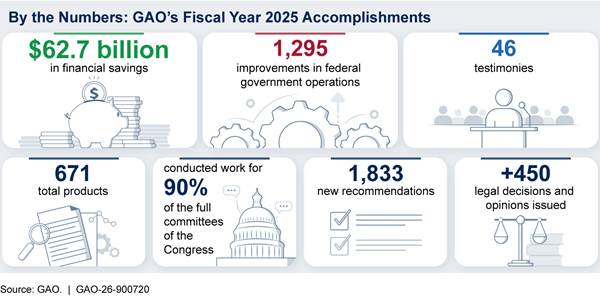
In FY 2025, our work resulted in a total of $62.7 billion in financial benefits and 1,295 programmatic and operational improvements. Implementation of our open recommendations to Congress and executive branch agencies could result in hundreds of billions of dollars in measurable future financial benefits. For example, as of October 2025, we estimated that implementation of open recommendations could result in $132 billion to $251 billion in measurable future financial benefits. We will continue to discuss the benefits of implementing these recommendations with Congress and agencies.
GAO support of Congress extends well beyond these numbers. Congressional committees and subcommittees regularly ask our subject matter experts to testify at hearings or use our work to inform the focus of the hearing. In FY 2025, GAO was asked to testify 46 times before 31 separate committees or subcommittees on various topics. GAO’s work was cited by members of Congress and witnesses in over 185 hearings beyond those at which we testified.
Further, we provided over 640 instances of technical assistance at the request of Members of Congress, which includes briefings on prior work by GAO experts, data analysis, white papers, or comments on legislative bills. This included 218 instances of technical assistance on appropriations law matters. Additionally, we continued to hold events for congressional staff in our dedicated space at the Longworth House Office Building. We offer information sessions each week on appropriations law and science and technology. In the last year, GAO also hosted 14 events covering various topics, including data privacy in artificial intelligence (AI) and quantum technology.
Congressional Priorities Continue to Drive GAO’s Work in FY2027 and Beyond
As we plan for FY 2027, we will continue to focus our resources on congressional priorities. Congressional requests and mandates consistently account for 95 percent or more of our resources. We identify congressional priorities through regular outreach to Members and staff and our strategic planning process. Based on these inputs, we have identified five areas of focus for our audit work in FY 2027, including the following:
Advancing efforts to address fraud, waste, and abuse in federal programs
We will continue to build our body of work on rooting out fraud, waste, and abuse across the federal government. We have previously estimated the federal government could lose between $233 billion and $521 billion annually, based on 2018-2022 data. To help agencies combat fraud, we issued A Framework for Managing Fraud Risks in Federal Programs. Since the issuance of the framework in 2015, we have examined the extent to which over 40 agencies and program offices are adhering to leading practices to safeguard their programs from fraud. As of January 2026, we have made approximately 200 recommendations to agencies and programs to better manage their fraud risks.
Moving forward, we plan to develop additional estimates of fraud related to federal revenue and for specific program areas and examine how federal agencies can help prevent schemes that defraud the government and scam Americans.
Evaluating national security activities
In FY 2027, we will continue to evaluate U.S. government efforts across the spectrum of national security activities. This includes focusing on how well the United States can organize, train, and operate complex military forces and intelligence capabilities to meet the challenges laid out in the 2025 National Security Strategy and the 2026 National Defense Strategy. We will also continue to evaluate DOD’s progress in improving the acquisition of its weapon systems. This work is critical as DOD plans to invest more than $2.4 trillion to develop and acquire its costliest weapon programs.
Assessing the impacts of emerging science and technology issues
We will continue to build our body of work on emerging science and technology issues to provide policymakers reliable and timely information. For example, last year we issued our first science and technology trend paper—which provides foresight into emerging science and technologies that could have significant impacts on the American people. This first paper explored gene editing, manufacturing in space, and biodegradable plastics. We will issue the next trend paper this spring.
We will continue to issue technology assessments—which describe current and emerging technologies and offer policy options for enhancing their benefits or mitigating challenges they may present. For example, last year we issued a technology assessment on the potential effects of generative AI technologies and policy options to enhance the benefits or mitigate the challenges of these technologies. Looking ahead, we plan to issue technology assessments on hydrogen energy, water quality sensors, and technologies for reducing critical mineral dependence, to name a few. We will also continue to issue Science & Tech Spotlights—which distill complex issues into 2-page summaries.
Assessing efforts to address evolving cybersecurity threats
Federal agencies and our nation’s critical infrastructure depend on IT systems to carry out operations and process essential data. However, risks to IT systems are increasing, highlighting the importance of our cybersecurity work. In FY 2025, we reported on agencies’ efforts to improve monitoring of their networks, assessed the U.S. national quantum computing cybersecurity strategy, and reported on how AI can impact our nation’s critical infrastructure.
In FY 2027, we will continue to assess cutting-edge technologies as they are incorporated into federal and critical infrastructure networks. These assessments include the threat that quantum computing poses to many of the encryption methods used by federal and critical infrastructure networks; and federal efforts to implement zero trust architectures and ensure the cybersecurity of private-sector cloud service providers.
Analyzing health care spending
Health care spending now accounts for around 27 percent of the federal budget and is one of the fastest growing federal expenditures. In addition, federal health programs may face significant vulnerabilities to fraud, waste, abuse and mismanagement due to their size and complexity.
Our work in this space has improved the delivery of care while reducing costs. In FY 2025, we documented over $16 billion in savings from agencies acting on our recommendations. In FY 2027, we will continue to examine the Medicare and Medicaid programs, which are expected to place additional strain on the federal budget in the coming years. Together, these programs accounted for over $1 trillion in federal expenditures and over $95 billion in improper payments in FY 2025. Agency and congressional action on GAO recommendations related to Medicare and Medicaid has resulted in over $210 billion in financial benefits since FY 2008.
We understand that congressional priorities and interests can quickly shift. Notably, national emergencies or disasters can change Congress’s priorities for work overnight, and Congress frequently turns to us for real-time, fact-based information during these times. We will continue to engage in regular communication with our clients to help ensure that we are working on their highest priorities across the federal landscape and adjusting as needed.
Continuing GAO’s Efficiency and Effectiveness
We will also seek to meet evolving congressional needs by continuing to improve the agency’s agility, efficiency, and effectiveness. We have a number of initiatives underway to help us more quickly shift staff resources to emerging congressional priorities, modernize our processes and products, and meet increasingly accelerated congressional time frames. Funding these efficiencies is an imperative as we will have a smaller workforce to continue to meet the demand for our work.
We plan to increase efficiency through targeted, critical investments in our IT systems, advanced analytic capabilities, and cybersecurity. Investments are needed to improve network reliability and ensure our staff have the tools needed to streamline and shorten the time required to complete aspects of our audit work so that we can deliver results faster for our clients.
An important focus will be increasing the use of emerging technology, including AI for our audit work and operations. This will require investments in technology and training our staff, as they will need to become proficient in using this technology. But, by integrating AI into workflows, staff can boost efficiency and speed—creating opportunities for them to focus on higher-order work. We believe some of the tools that we are developing and testing could have applicability for other legislative branch agencies. The Legislative Branch AI Working Group serves as a forum for us to share our experiences and collaborate on AI use cases with other legislative branch agencies.
Summary
We have a proven track record of supporting Congress with fact-based, nonpartisan, and objective information and analysis. We have also consistently demonstrated that we are a good investment, as we regularly deliver financial benefits in excess of 70 times the amount of funding we are provided. But we understand that we cannot be satisfied with maintaining the status quo. GAO has changed significantly over its 105-year history, evolving from checkers of financial vouchers to a leading professional services organization and the standard-setter for the auditing community. We must continue to evolve and modernize to support Congress in meeting the challenges of today and tomorrow. We have a plan for doing so. With the subcommittee’s support, we will execute this plan and continue delivering the results that Congress and the American taxpayer have come to expect from GAO.
This concludes my prepared remarks. I would be pleased to answer any questions at the appropriate time.
This is a work of the U.S. government and is not subject to copyright protection in the United States. The published product may be reproduced and distributed in its entirety without further permission from GAO. However, because this work may contain copyrighted images or other material, permission from the copyright holder may be necessary if you wish to reproduce this material separately.
The Government Accountability Office, the audit, evaluation, and investigative arm of Congress, exists to support Congress in meeting its constitutional responsibilities and to help improve the performance and accountability of the federal government for the American people. GAO examines the use of public funds; evaluates federal programs and policies; and provides analyses, recommendations, and other assistance to help Congress make informed oversight, policy, and funding decisions. GAO’s commitment to good government is reflected in its core values of accountability, integrity, and reliability.
Obtaining Copies of GAO Reports and Testimony
The fastest and easiest way to obtain copies of GAO documents at no cost is through our website. Each weekday afternoon, GAO posts on its website newly released reports, testimony, and correspondence. You can also subscribe to GAO’s email updates to receive notification of newly posted products.
Order by Phone
The price of each GAO publication reflects GAO’s actual cost of production and distribution and depends on the number of pages in the publication and whether the publication is printed in color or black and white. Pricing and ordering information is posted on GAO’s website, https://www.gao.gov/ordering.htm.
Place orders by calling (202) 512-6000, toll free (866) 801-7077,
or
TDD (202) 512-2537.
Orders may be paid for using American Express, Discover Card, MasterCard, Visa, check, or money order. Call for additional information.
Connect with GAO
Connect with GAO on X,
LinkedIn, Instagram, and YouTube.
Subscribe to our Email Updates. Listen to our Podcasts.
Visit GAO on the web at https://www.gao.gov.
To Report Fraud, Waste, and Abuse in Federal Programs
Contact FraudNet:
Website: https://www.gao.gov/about/what-gao-does/fraudnet
Automated answering system: (800) 424-5454
Media Relations
Sarah Kaczmarek, Managing Director, Media@gao.gov
Congressional Relations
David A. Powner, Acting Managing Director, CongRel@gao.gov
General Inquiries