
Report to Congressional Requesters
United States Government Accountability Office
A report to congressional requesters
Contact: Tranchau (Kris) T. Nguyen at nguyentt@gao.gov
What GAO Found
Private equity is one type of investment within a broad, undefined category called alternative assets. It differs from publicly traded equity in who can invest in it, how it is valued, and what disclosures are required, among other things. GAO’s review of selected research papers that analyzed private equity investment fund performance found no consensus on the performance of private equity relative to publicly traded equity, which is an important consideration when making investment decisions. GAO found a range of performance findings among research papers we reviewed, as well as ranges in data analyzed, benchmarks for performance comparisons, and methodologies. For example, one group of papers found that private equity funds outperformed publicly traded equity for the sample of funds they analyzed during the specific time-periods studied. The size of the overperformance varied widely. In one paper the benchmarks did not include a risk premium, the excess return that some experts believe a private equity investment should provide to justify higher investment risks. Another group of papers found that private equity funds underperformed publicly traded equity during the time-period studied, accounting for the underlying risk or fees, which can be higher for private equity than for publicly traded equity products. Our review of these papers also found that there is no consensus on how to effectively benchmark private equity performance. Financial regulations require open-end management investment companies (e.g., mutual funds) reporting investment performance data to include a benchmark that is the average annual total returns of an appropriate broad-based securities market index. Our review found a range of benchmarks for private equity fund returns, including several publicly traded equity indexes and custom indexes.
Given the complexity of private equity and its recent use in 401(k) plans, plan sponsor and industry association representatives GAO interviewed said that plan sponsors need education on key aspects of private equity, such as how its valuation differs from traditional investments, like mutual funds. Consumer organization representatives also told us that participants should understand certain aspects about private equity, such as its illiquidity. Under law, the Department of Labor (DOL) is authorized to provide not only regulations, but also other guidance, as needed, to promote retirement security. However, GAO found that DOL has not yet issued specific guidance to help sponsors and participants better understand basic aspects of private equity. For example, the agency has not issued guidance to plan sponsors to help these fiduciaries to better understand how private equity’s liquidity and valuation differ from traditional investments, and how it is regulated, among other things. In addition, the agency has not issued guidance to participants, such as a fact sheet, to help them understand how private equity differs from traditional investments. By providing guidance to both plan sponsors and to participants, DOL can help them understand this asset type, which is expected to grow among 401(k) plan investment options.
Why GAO Did This Study
Private equity is historically reserved for certain investors, including wealthy individuals or institutional investors, like pension plans. Recent industry developments and federal actions suggest that more products offered to 401(k) plans may soon have more significant allocations to this asset class. However, little is known about the extent to which private equity is used in 401(k) plans and how its use might be communicated to plan sponsors and to participants, who rely on their 401(k) investments to safeguard retirement.
GAO was asked to review 401(k) plan investments’ use of private equity.
GAO examined research on private equity investment performance against publicly traded equity benchmarks and how private equity investment information is communicated to 401(k) plan sponsors and participants, among other objectives.
To answer these questions, GAO analyzed available federal and private data sources, conducted a literature review of selected research papers, assessed a selection of disclosures, including Securities and Exchange Commission and other fund documents, and interviewed industry representatives, consumer advocates, and officials from the U.S. and four countries.
What GAO Recommends
GAO is making three recommendations to DOL, including that DOL should provide guidance to plan sponsors and participants to help them understand key aspects of private equity such as how it differs from traditional investments. DOL neither agreed or disagreed with our recommendations.
Abbreviations
CIT Collective investment trust
DC Defined contribution
DOL Department of Labor
EBSA Employee Benefits Security Administration
ERISA Employee Retirement Income Security Act of 1974, as amended
NAV net asset value
OCC Office of the Comptroller of the Currency
SECURE 2.0 SECURE 2.0 Act of 2022
SEC Securities and Exchange Commission
TDF target date fund
This is a work of the U.S. government and is not subject to copyright protection in the United States. The published product may be reproduced and distributed in its entirety without further permission from GAO. However, because this work may contain copyrighted images or other material, permission from the copyright holder may be necessary if you wish to reproduce this material separately.
October 8, 2026
The Honorable Patty Murray
Vice Chair
Committee on Appropriations
United States Senate
The Honorable Bernard Sanders
Ranking Member
Committee on Health, Education, Labor, and Pensions
United States Senate
The Honorable Jesús G. “Chuy” García
House of Representatives
In August 2025, the President of the United States signed an Executive Order that requires the Department of Labor (DOL) and Securities and Exchange Commission (SEC) to consider ways to facilitate access to alternative assets, including private equity in 401(k) investments.[1] Several of the largest 401(k) plan asset managers have announced plans to add allocations to private equity to the investment options they offer to 401(k) plans. Little is known about if and how private equity is used in investment options offered to participants in 401(k) plans. Assets in 401(k) plans were valued at $10 trillion as of September 2025.[2] They are the most common type of defined contribution (DC) retirement plans, in which investment risk is borne by plan participants. However, these new developments suggest that allocations of 401(k) plan assets to private equity may grow, which may create policy considerations for regulators of retirement assets regarding risks, liquidity, transparency, and valuation of private market assets.
Some policymakers have raised questions about the potential for private equity to be among the investment options available in 401(k) plans, which have traditionally offered public market assets. As a result, you asked us to examine how private equity is used in 401(k) plan investments. This report examines: 1) what available data and other sources show about the use of private equity in 401(k) plan investments; 2) what investment industry and consumer advocacy representatives as well as officials from other countries say about the benefits and challenges of private equity in DC plan investments and broader potential connections between plans and private equity; 3) what research shows about private equity investment performance compared to public equity benchmarks; and 4) what types of information about private equity investments are communicated to 401(k) plan sponsors and participants and what more, if anything, could help them make informed choices concerning private equity investments.
To address all these objectives, we reviewed relevant DOL and SEC regulations and guidance regarding the treatment of private assets. We interviewed officials from DOL, Office of the Comptroller of the Currency[3], and the SEC to understand how different regulators’ oversight intersects regarding the investments offered by 401(k) plans. We also interviewed six of the largest 401(k) plan asset managers and collected limited information in writing from two, selected for their large size to give us an overview of investment policies by firms that serve a large portion of 401(k) plans. In total, these asset managers had over $7.6 trillion in DC plan assets under management at year-end 2023, representing about three-quarters of the DC plan assets under management.[4] Two smaller asset managers were also selected to give us an additional perspective of policies at smaller asset manager firms. In addition, we interviewed government officials and retirement professionals from Australia, Canada, Kenya, and the United Kingdom. These selected countries were the largest that have DC retirement plan systems that permit investment in private equity and that have English as an official language. We analyzed the information collected through our interviews to identify themes and to provide illustrative examples.
To assess what available data show about the use of private equity in investments offered to 401(k) plan participants, we analyzed relevant federal data. Specifically, we reviewed DOL’s 401(k) plan data from plan year 2023, and SEC data from the fourth quarter of 2024, the most recent data available during the period we conducted the analysis.[5] We further reviewed the instructions DOL has released for the Form 5500 for plan years 2022 to 2025 to inform our knowledge of updated Form 5500 instructions regarding disclosure of private equity assets.
To describe what investment industry and consumer advocacy groups’ representatives identify as the potential benefits and challenges of private equity investments in 401(k) plans, we interviewed three alternative asset industry associations and three consumer interest associations. We identified these through background research and from related prior work and selected them based on their large membership and having demonstrated engagement in retirement plan policy issues. To identify broader connections between private equity and 401(k) plans, if any, we interviewed plan sponsor and industry association representatives about these potential relationships and analyzed merger and acquisition records for six of the most common 401(k) service providers in plan year 2023.
To evaluate what research shows about private equity investment performance against publicly traded equity benchmarks, we conducted a literature review of research published from 2015 to 2025, to ensure recency. We limited the selection to papers that included original analysis of private equity performance data at least as recent as 2010 to account for the relatively long period of private equity fund investment cycles, often 10 years, and the lag in research publication. We initially identified 100 papers by searching academic publications databases using key words to identify relevant work and reviewed the papers for relevant and original analysis (see app. I). We reviewed the papers and selected 18 papers that were relevant and met our quality standards to support our findings related to private equity performance.
To describe how private equity in retirement plan investments is communicated to plan sponsors and plan participants, we analyzed a selection of disclosures, including a participant disclosure, SEC-required fund documents, and collective investment trust (CIT) investment documentation.[6] To understand the extent to which private equity is disclosed in a participant disclosure, we reviewed one participant disclosure we were able to obtain for one selected large 401(k) plan, based on the number of active participants and potential allocation to private equity.[7] To understand the extent to which private equity is disclosed in SEC-required documents, we reviewed selected public documents for large target date funds (TDFs) and closed-end funds.[8] We selected the three largest TDF families that were structured as mutual funds in the 2060 series by total assets as of 2023 year-end.[9] We also selected two closed end funds, by asset size and an indication that there was some allocation to private equity, according to the SEC’s monthly portfolio investments report (N-PORT) data as of 2024 year-end.[10] To understand how CITs communicate information about private equity to plans and participants, we reviewed disclosures for three CITs with allocations to private equity from one of the largest national banks.[11] In addition, we interviewed the two largest CIT providers and two out of five state regulators (only Maryland and South Dakota’s regulators responded to interview requests), selected for the large amount of CIT assets and bank assets, respectively.[12]
To determine what more, if anything, could help plan sponsors and participants to make informed choices concerning private equity investments, we interviewed three plan sponsor organizations as well as groups noted above, to obtain multiple perspectives. Retirement plan sponsor organizations are known from prior work. See appendix I for a detailed discussion on our objectives, scope, and methodology.
We conducted this performance audit from March 2024 to October 2026 in accordance with generally accepted government auditing standards. Those standards require that we plan and perform the audit to obtain sufficient, appropriate evidence to provide a reasonable basis for our findings and conclusions based on our audit objectives. We believe that the evidence obtained provides a reasonable basis for our findings and conclusions based on our audit objectives.
Background
Private Equity Investment Options
There is no single, commonly accepted definition of private equity. Private equity is one type of investment within a broad, undefined category called alternative assets. For the purposes of this report, we considered two forms of private equity:
· private securities representing an ownership interest in operating companies that are not publicly traded on a stock exchange or otherwise registered with the SEC (private securities); and
· private equity funds, which are privately managed pools of capital that invest in privately offered, unregistered securities of operating companies that are not publicly traded on a stock exchange or otherwise registered with the SEC.[13]
According to the SEC’s analysis of investment adviser disclosures, there were 28,623 private equity funds as of June 30, 2025, with aggregate gross assets of $8.4 trillion dollars.[14] For our purposes, private equity does not include other alternative investments like real estate, private credit, or hedge fund strategies.[15] However, private equity itself is a relatively broad category of assets. As we previously reported,[16] private equity assets take a variety of forms and in some cases are referred to by the investment strategies they are designed to employ, including:
· Buyout funds, which generally invest in larger established companies to add value, in part, by increasing efficiencies and, in some cases, consolidating resources by merging complementary businesses or technologies. Often private equity funds using a buyout strategy employ debt to increase potential returns by acquiring larger businesses than would be possible with their own capital.
· Venture capital funds, which invest in young companies that often are developing a new product or technology.
For both investment strategies, investors hope to profit when the company is eventually sold, either when offered to the public or when sold to another investor or company. Investors may have limited information on the value of private equity investments until the underlying investments are sold, unlike stocks and bonds, which are traded and priced in public markets (see fig.1). On the other hand, SEC officials said that an investor in a private equity fund may negotiate for extensive information on an underlying investment.
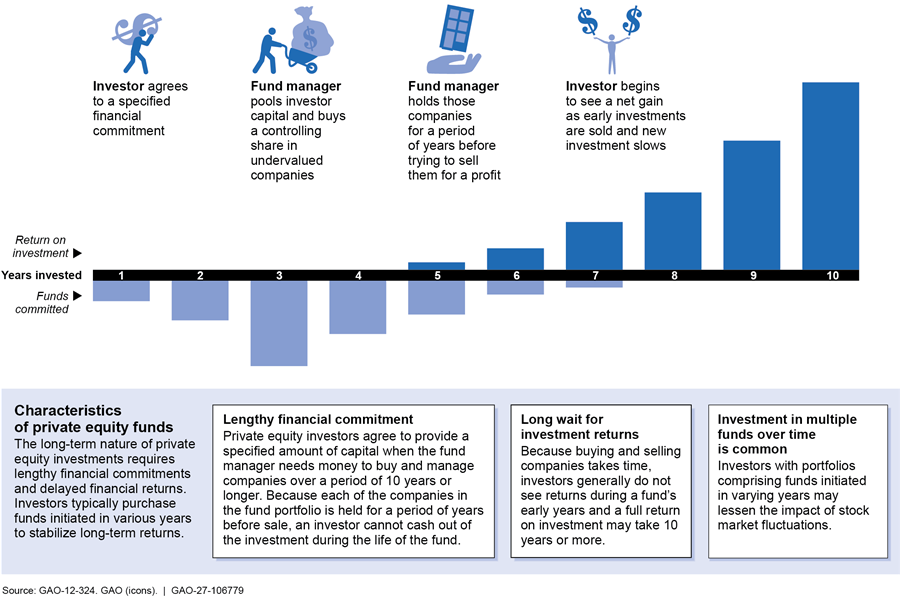
Note: This information is most relevant to more long-term private equity investments, such as leveraged buyouts. Other types of private equity investment, such as distressed debt, may have a shorter financial commitment. Vertical bars are notional, based on our research rather than actual values.
Most Investors are Not Able to Invest in Private Equity
Direct investment in private equity, in the form of private securities or private equity funds, is not typically available through 401(k) plans. Private equity funds raise capital from investors through exempt offerings that restrict participation primarily to accredited investors or qualified purchasers to qualify for exemptions from certain federal securities laws and regulations (see table 1).[17] In 2020, SEC expanded the definition of “accredited investor” to include individuals holding certain professional certifications or credentials, a change which increased the number of potential accredited investors.
|
|
Qualified purchaser |
Accredited investor |
|
Criteria for who meets the definition |
Generally, individuals or certain companies who own at least $5 million in investments or any person, acting for its own account or the accounts of other qualified purchasers who in the aggregate owns and invests on a discretionary basis not less than $25 million in investments. |
Individuals with: · A net wortha (individually or joint with a spouse or spousal equivalent) that exceeds $1 million; · An income of more than $200,000 (or $300,000 joint income with a spouse or spousal equivalent) in each of the prior 2 years and reasonably expects the same for the current year; or · Certain professional certifications or credentials. Certain trusts, with total assets of more than $5 million, whose purchase is directed by a “sophisticated” person, defined by regulation; Certain entities with total investments of more than $5 million; or Any entity in which all of the equity owners are accredited investors. |
Source: GAO analysis of relevant federal laws and regulations. | GAO‑27‑106779
aUnder the accredited investor definition, the calculation of net worth generally excludes an investor’s primary residence and any indebtedness that is secured by the primary residence, up to its estimated fair market value.
SEC Oversight of Private Equity
Private equity funds themselves are not registered with the SEC. As a result, they are not subject to requirements related to issuing a prospectus or summary prospectus, or periodic financial reporting that are applicable to SEC-registered investment companies. However, advisers to private funds—including, but not limited to, private equity funds—may be required to register with the SEC.
As a result of the Dodd-Frank Wall Street Reform and Consumer Protection Act, many previously unregistered advisers to private funds were required to register with the SEC. Investment advisers who are registered with the SEC have an obligation to comply with the Investment Advisers Act of 1940 and the related rules that have been adopted by the SEC.[18] For example, private equity fund managers who are registered investment advisers must annually report information about themselves and the private equity funds they advise on Form ADV. In addition, registered investment advisers for large private equity funds who had at least $2 billion in private equity fund assets under management at the end of their last fiscal year must report, for each private equity fund they advised, additional information about debt, defaults on certain debt, and other information on Form PF.[19]
Publicly Traded Equity Versus Private Equity
There are key differences between publicly traded equity (i.e., registered securities) and private equity that affect who can invest in such assets and the availability of financial and valuation information, among other differences (see table 2). More companies are private than public. In 2022, there were 4,642 publicly traded companies compared to 21,041 private companies with 500 or more employees.[20]
|
|
Publicly traded equity (i.e., registered securities traded on an exchange) |
Private equity funds |
|
Investors |
Anyone |
Generally, only accredited investors and qualified purchasers |
|
Registered with the Securities and Exchange Commission (SEC) |
Yes |
Not directly |
|
Required periodic reporting |
Annual and quarterly, available to the public |
Noa |
|
Liquidity |
Investments in most open-end funds are generally liquidb |
Investments in traditional private equity funds are generally illiquid |
|
Valuation |
Continuously each trading day, based on actual market pricing, publicc |
Infrequent, may be based on various methods (e.g., modeling assumptions) |
Source: GAO analysis of federal laws, regulations, and agency-provided information. | GAO‑27‑106779
aAdvisers to private equity funds may be required to register with the SEC, and, if so, they generally annually report information about themselves and the private equity funds they advise.
bMost open-end funds (e.g., mutual funds) are subject to a 15 percent cap on illiquid assets.
cAn exchange traded fund is valued continuously through market prices, and then officially valued once per day at NAV.
Regulation of Collective Investment Trusts
CITs are not generally regulated by SEC and are not subject to the same registration and reporting requirements as SEC-registered investment companies (e.g., mutual funds), such as providing a prospectus. CITs are maintained by banks and trust companies[21] and are primarily regulated by the Office of the Comptroller of the Currency (OCC)[22] or state banking regulators.[23] Among other requirements, OCC regulations require that national banks administering CITs establish and maintain each CIT in accordance with a written plan and applicable law, including state law and applicable fiduciary duties.[24]
ERISA and Oversight of 401(k) Plans
The Employee Retirement Income Security Act of 1974, as amended (ERISA), establishes minimum standards and requirements for most private employer-sponsored retirement plans, including 401(k) plans. In 401(k) plans, workers can save for retirement by diverting a portion of their wages, and sometimes employer contributions, into investment accounts. Employers may sponsor 401(k) plans for their employees, making them plan sponsors, and typically serve as their plans’ named fiduciaries. Plan sponsors may also hire third-party service providers to help with their 401(k) plans. Some of these service providers may act in a fiduciary capacity when they make investment decisions, give advice on which investment options to offer participants, or administer the plan.[25]
ERISA sets standards of conduct for fiduciaries with respect to ERISA-covered plans, including employer-sponsored retirement plans (such as 401(k)s). Among their responsibilities, fiduciaries must act prudently in selecting and monitoring plan investment options, including options with allocations to private equity, and in selecting and monitoring service providers to the plan.
Participants in 401(k) plans are often responsible for choosing how to invest contributions to their plan accounts, including balancing their assets over time to maintain appropriate exposure to investment risks.[26] One popular approach to managing risk over time is investment in a TDF, which automatically rebalances assets over time based on participants’ targeted retirement dates.[27]
DOL’s Employee Benefits Security Administration (EBSA) is responsible for, among other things, administering and enforcing the fiduciary, reporting, and disclosure provisions of Title I of ERISA, as well as issuing guidance to fiduciaries, participants, and beneficiaries. EBSA requires 401(k) plans to submit data using the Form 5500—the government’s primary means of collecting annual data about retirement plans and other tax-qualified benefits programs. With limited exceptions, 401(k) plans, and other employee benefit plans, must report detailed information annually by filing Form 5500 or the abbreviated version—the Form 5500-SF—for small plans.[28] EBSA uses these data to monitor plans and ensure their compliance with ERISA.[29]
DOL issued an Information Letter in 2020 explaining its view that a plan fiduciary does not violate their fiduciary duties under ERISA solely because they offer a professionally managed asset allocation fund with a private equity component as a designated investment alternative.[30] The letter listed several factors that a fiduciary would want to consider before selecting such a product for a plan’s investment menu.[31]
On March 31, 2026, DOL published a proposed rule to clarify, and provide a safe harbor for, a fiduciary’s duty of prudence under ERISA in connection with selecting plan investments (called designated investment alternatives) for a participant-directed individual account plan (e.g., a 401(k) plan), including asset allocation funds that include alternative assets like private equity.[32] According to DOL officials, the proposed rule requires an objective, thorough, and analytical process and includes valuation, liquidity, and complexity factors to consider for all investments, including those with private equity or other alternative investments.
401(k) Plan Allocations to Private Equity are Small, but DOL Lacks Data to Monitor Growth
Asset Managers and Investment Industry Groups Report that 401(k) Plan Investments Generally Have Little Allocation to Private Equity
Large 401(k) plan asset managers we interviewed said that, as of the end of 2024, 401(k) plans’ investment options have little to no allocation to private equity. While three asset managers said they do not have any current allocation to private equity among the investment products that they offer to 401(k) plan clients, two reported some allocation to private equity. The remaining three asset managers could not definitively say whether their 401(k) plans’ investment options had allocations to private equity, either because it is a small underlying allocation of a larger asset held by the fund or because they lack data on investments made through a plan’s brokerage window.[33] Of the hundreds of CITs one asset manager offered to its 401(k) plan clients, just three CITs had an allocation to private equity. Those three had allocations of 2.8 percent or less.[34]
Five of the six plan sponsor and investment industry groups that we interviewed agreed that private equity was uncommon in 401(k) plans.[35] For example, an association of 401(k) plan sponsors informally polled its 2,420 401(k) plan members in November 2024, and found that just 2.4 percent offered plan participants investments with allocations to private equity.[36] The association’s official annual survey of members found that in plan year 2023, only a small percentage of TDFs had underlying investments in private equity or other alternative assets.[37] Also, private equity was not offered through the brokerage window platforms of two of the large asset managers we interviewed.
|
We are at the early stages of the private equity boom in DC plans, …
which has finally come to pass after a decade of discussing it as the next
big thing. The path forward to include private equity in DC plans is still
complicated and litigious, but also clearer than it was 10 years ago. |
Source: “What Does Provider Consolidation and Scale Mean for DC Plans of the Future?,” Defined Contribution East Conference, Fort Lauderdale, FL, Mar. 9–11, 2025. | GAO‑27‑106779
Federal Data Show that 401(k) Plans Have Little Direct Private Equity Investment
DOL data suggest little to no direct investment of 401(k) plan assets in private equity.[38] DOL officials told us that plan assets in joint ventures or limited partnerships may reflect direct investment in a private equity fund. In 2023, less than 1 percent of large[39] 401(k) plans reported plan assets in joint ventures or limited partnerships and 3.8 percent of small plans that submitted financial data on plan investments reported assets in joint ventures or limited partnerships (see table 3). About 9.5 percent of large plans reported assets invested in the “other” asset type which DOL officials told us can also include direct investment in private equity (such as private securities and private equity funds) but is not limited to that asset.[40]
|
|
Small plans Fewer than 100 participants |
Large plans 100 or more participants |
|
|
Asset information type by Form 5500 submission |
Form 5500-SF, Short Form Annual Return/Report for small plansa (601,828 plans) |
Schedule I Financial Information - small plansb (29,335 plans) |
Schedule H Financial Informationc (54,983 plans) |
|
Joint ventures/limited partnership |
No line item |
3.8% (1,099 plans) |
< 1% (237 plans) |
|
Other |
No line item |
No line item |
9.5% (5,209) |
|
Private securities |
No line item |
No line item |
No line item |
Source: GAO analysis of the 2023 Form 5500 Private Pension Plan Research File data. | GAO‑27‑106779
aAccording to the Form 5500 instructions, small plans are eligible to file the Form 5500 Short Form (SF) if, among other things, all the plan’s assets are invested in certain secure investments with a readily determinable fair market value (i.e. eligible plan assets). Plans that file the Form 5500-SF report total plan assets but not a schedule of assets that would break down plan assets by investment type. Plan year 2023 was the first year that new regulatory guidance from DOL went into effect, allowing DC plan filers with fewer than 100 participants with account balances at the beginning of the year to file as a small plan (Form 5500-SF or Form 5500 with a Schedule I) and receive a plan audit waiver. DOL’s 2023 Form 550 Private Pension Plan Research File, however, still used end of the year participant counts to define small plan size.
bSmall plans that are ineligible to file the Form 5500-SF would instead file the Form 5500 and attach the Schedule I to report investment assets and other financial information.
cSome plans that meet the DOL definition of a large pension plan—those with greater than 100 but no more than 120 participants at the beginning of the plan year—may also meet exemption requirements that allow the plan to file the Form 5500 Schedule I or the Form 5500-SF. Accordingly, we limit our analysis of large plans to those plans that submit their financial information on the Form 5500 Schedule H.
One reason that direct investment in private equity is relatively rare in 401(k) plans—an investment association representative told us—is because applicable rules, including non-discrimination rules that apply to retirement plans,[41] and SEC rules that require investors in private equity funds that rely on an offering exemption to meet certain wealth, income, or financial sophistication criteria, exclude many plan participants. Those criteria refer to an “accredited investor” standard.[42] According to the SEC’s Office of the Investor Advocate, approximately 12.6 percent of the U.S. population qualified as an accredited investor in 2025, although SEC’s research did not provides estimates of how many 401(k) plan participants may qualify.[43] 401(k) participants may be more likely to have access to private equity through the underlying assets of another investment product, like a mutual fund, or in a CIT or separately managed account, in which underlying assets are selected and managed by fiduciaries (see fig. 2).[44]
Figure 2: 401(k) Plan Participants Have More Options for Private Equity Exposure through Underlying Investment Allocations Compared to Direct Allocations
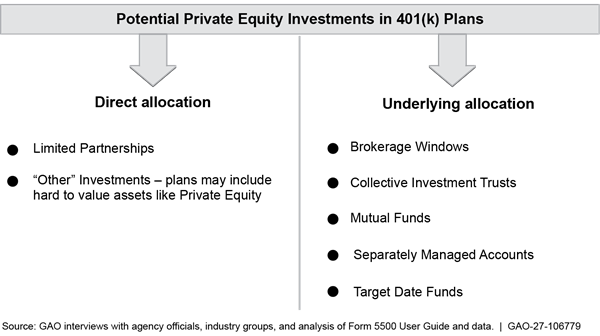
Note: Limited partnerships are associations managed by one or more general partners, who have unlimited liability, according to a partnership agreement with one or more partners with limited liability. Brokerage windows are arrangements under which 401(k) participants may select investments outside their plan menu of fiduciary-selected options. Collective Investment Trusts (or collective investment funds) are a pooled investment vehicle available to individual investors only through qualified retirement plans, like 401(k)s, in which money from multiple investors is invested as a single portfolio with a specific investment strategy. Separately Managed Accounts are investment services, through which investment advisers make investment decisions for participants. Target Date Funds automatically rebalance assets over time based on investors’ targeted retirement dates.
Publicly offered SEC-registered funds like mutual funds (public funds) are a common investment option in 401(k) plan menus.[45] Our analysis of SEC data about these funds found that few are likely to invest in private equity and, among those that do, allocations are small. While SEC data do not specifically identify funds’ underlying allocation to private equity, we identified characteristics that SEC data analysts agreed may suggest an underlying private equity allocation—namely, the type of investment entity issuing the asset, the kind of asset and the valuation method (i.e., level-3 valuation, an accounting classification which most private equity investments are under). Using these variables, we analyzed quarterly data to estimate the prevalence of funds with underlying investment allocations to private equity. We found that 7 percent of our sample of public funds from the fourth quarter of 2024 (885 of approximately 12,000) invested in private securities, one form of private equity.[46] In that minority of public funds in our sample, furthermore, the allocation to private securities remained small. Of those funds, 86 percent invested less than 1 percent of assets in private securities. Just 21 funds in our sample invested in private funds, which may include, but are not limited to, private equity funds. We cannot cross-reference SEC data with products used by 401(k) plans due to a lack of fund ticker information in DOL plan disclosures for 401(k) plans.[47]
Mutual funds are public funds and may have underlying investments in private securities, which is a form of private equity.[48] Our analysis of individual SEC investment disclosures for three of the largest TDF mutual funds’ 2060 vintage fund found that all three funds potentially held small, underlying investments in private securities. The allocations of investments in level-3 securities among these TDFs’ underlying investments ranged from 0.0004 to 2.74 percent of total assets.[49]
Investors in publicly traded equity and registered funds may have indirect exposure to private equity because the public companies those funds invest in are also investors in privately offered securities of unregistered companies. According to one industry estimate, based on corporate accounting records, the 20 largest U.S. public companies invest about $100–$150 billion directly in private companies.[50] Investors in these public companies—and in the mutual funds that invest in their securities—are therefore also investing in private equity, although an individual 401(k) plan participant’s indirect exposure may be relatively small.
|
Allocations to private equity in defined contribution plan investments in four selected countries are 5 percent or under. The defined contribution plan fund-level allocations to private equity, among the four countries we considered, reportedly range from 0.44 to 5 percent. In the Australian and Canadian funds for which we examined records, the private equity allocations are not in the alternative assets portfolio. In all four countries, direct investment in a private equity fund is generally not offered to defined contribution plan participants. Instead, private equity allocations are part of professionally managed funds in these countries. |
Source: GAO analysis of interviews and industry documentation. | GAO‑27‑106779
DOL Collects Data on Large 401(k) Plan Assets but Lacks Information on Underlying Private Equity
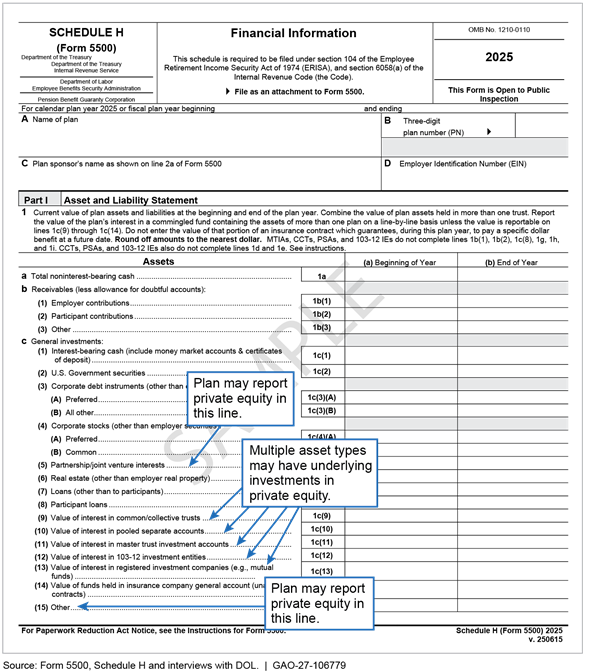
Our review of the instructions for the Form 5500 and data that large 401(k) plans submit annually to the DOL, found that the agency does not collect data on plans’ underlying assets invested in private equity.[51] While large plans report the amount of plan assets invested in many different types of investments on the Schedule H and the accompanying Schedule of Assets, that form is not intended to collect the amount of underlying assets, including in private equity (see fig. 3). DOL officials identified multiple investment types that are listed on the Schedule H that could have underlying assets in private equity, but they noted that those investments would also include other assets. For example, assets in mutual funds are reported but not the underlying assets of those funds. A plan does not have to report a CIT’s assets if the CIT is acting as a direct filing entity, rather banks or trusts report CIT assets by submitting their own Form 5500 disclosure, which also does not need to include underlying assets.[52] DOL officials told us they had observed instances of 401(k) plans offering CITs with underlying assets in private equity.[53] Plans report individual investments in separately managed accounts according to their different asset types, but again do not report underlying assets. A plan’s brokerage window may provide participants’ access to private equity and plans can report assets invested through brokerage window either disaggregated among different investment types or aggregated as “other” investments.[54]
Figure 3: Multiple Investments on DOL Schedule of Assets May Provide Exposure to Private Equity Allocations
Other related data collected also does not provide DOL with a full picture of 401(k) plans’ underlying assets in private equity. While large 401(k) plans typically complete part of the Schedule R to the Form 5500, Retirement Plan Information, DOL only instructs defined benefit pension plans with 1,000 or more participants to complete the line for the overall percentage of plan assets invested in private equity. Agency officials explained that the Pension Benefit Guaranty Corporation, with which DOL shares the form along with the Internal Revenue Service, asked DOL to add the requirement for defined benefit pension plans to report the percentage of plan assets in private equity and other asset types, for its own purposes. Overall, these estimates of hard-to-value assets would exclude underlying allocations to private equity in CITs or other multi-asset funds.[55]
|
Hard-to-Value Investments Investments that are hard to value are typically classified as “level 3” under the fair value hierarchy accounting standards. According to the standard, level 3 inputs are unobservable inputs used to value the investment when there are no observable inputs, such as comparable market prices. An example of an unobservable input includes a financial forecast developed from an entity’s own data and assumptions. Source: Financial Accounting Standards Board (FASB) Accounting Standards Codification (ASC) 820 and GAO analysis of relevant accounting rules. | GAO‑27‑106779 |
DOL also does not collect data on underlying assets invested in private equity by small plans—those with fewer than 100 participants with account balances—because the forms they submit do not require it. Small plans may qualify to submit the simplified Form-SF, which generally does not require the Schedule of Assets and does not ask for underlying assets. Small plans that do not qualify to submit Form-SF, such as those with some assets invested in private equity or other hard-to-value investments would submit the Schedule I, which likewise does not ask for data on underlying investments.
DOL’s website states that data collection from plans is an important compliance, research, and disclosure tool for the agency, and a source of information and data for use by other Federal agencies, Congress, and the private sector in assessing employee benefit, tax, and economic trends and policies.[56] Moreover, ERISA established an overall reporting and disclosure framework, which is intended to ensure that employee benefit plans are operated and managed in accordance with certain prescribed standards. These standards require that participants and beneficiaries, as well as regulators, are provided or have access to sufficient information to protect the rights and benefits of participants and beneficiaries under employee benefit plans. Relevant Standards for Internal Control in the Federal Government components also include control activities and program monitoring, which depend on the collection of quality information.
However, the Schedule H and the accompanying Schedule of Assets disclosure that large plans submit annually do not require data on funds’ underlying assets, including allocations to private equity.[57] Without a requirement in its current data collection efforts to obtain data on plans’ underlying assets invested in private equity and other alternative assets, the agency will continue to have insufficient information on private equity in 401(k) plan investments.[58] By collecting data on plan assets’ underlying exposure to private equity, which we later describe has both potential benefits as well as challenges, DOL can monitor growth and any issues related to private equity in order to protect the rights and benefits of 401(k) plan participants and beneficiaries as private equity potentially becomes more of an investment option in 401(k) plans.
U.S. and International Officials Identified Potential Benefits and Challenges of Private Equity Investments in Defined Contribution Retirement Plans
Industry Representatives and International Officials Reported Better Performance and Added Diversification as Potential Benefits of Private Equity
Five of the six large 401(k) plan asset managers we interviewed said that they are considering adding or increasing private equity allocations in their 401(k) plan investment options.[59] Asset managers of 401(k) plans, investment industry groups, and officials from countries that include private equity in their DC plans that we interviewed identified potential improved investment performance and asset diversification as potential benefits to including private equity allocations in DC plans (e.g., 401(k)s) (see table 4).
Table 4: Potential Benefits to Including Private Equity in Defined Contribution (DC) Plans, According to Interviewees
|
|
Large 401(k) Plan Asset Managers (N=6) |
Investment Industry Groups (N=3) |
Plan Sponsor Organizations (N=3) |
Consumer Advocate Groups (N=3) |
Officials from Countries that Include Private Equity in DC Plans (N=4) |
|
Potential Benefits to Including Private Equity in DC Plans |
|||||
|
Improved performance vs. public equity |
5 |
1 |
1 |
0 |
3 |
|
Asset diversification |
4 |
2 |
2 |
0 |
4 |
Source: GAO analysis of interviews. | GAO‑27‑106779
Note: The reported number of responses is the number of officials in each group who responded that 401(k) plans would be seeking improved performance vs. public equity or asset diversification to the following question: “What benefits are 401(k) plans seeking when they include on the plan’s investment menu a designated investment alternative that has an allocation to private equity? (For example, higher returns or asset/risk diversification.)” Because there is currently little to no allocation to private equity in 401(k) plans, these reported benefits are anticipated or theoretical rather than based on experience in the 401(k) setting.
Investment performance. Five of the six large 401(k) plan asset managers we spoke with said that, in the future, they would consider including private equity in their funds to try to provide better investment performance than could be attained with public investments alone. One said that independent modeling showed improved investment outcomes by including private equity over investing solely in public markets, and that their research showed a 10 percent allocation to private equity would be the right amount to get private equity’s benefits, such as enhanced returns while limiting its risks.
Countries that include private equity allocations in their DC plans stated that they also do so with the goal of enhancing investment performance. In Kenya, officials said that DC plans include private equity to improve returns. UK officials said the same but acknowledged that there is no track record of private equity’s historical performance and it was too early to know what the investment performance was for the private equity placements made by a large public plan.
Diversification. Four of the 401(k) plan asset managers we spoke with also mentioned diversification as a potential advantage for including private equity allocations in 401(k) plans. For example, these asset managers said that using private equity in their 401(k) investment products would add diversification because it:
· better reflects the overall market, of which private markets are an increasingly large part;
· can behave differently than public markets; and
· is not monolithic, with each of private equity’s asset classes behaving differently, so a firm might use venture capital-oriented private equity in a portfolio to provide U.S. growth exposure instead of public market small-cap funds, or buyout funds to replace some public market large-cap value funds.[60]
Investment officials from countries with private equity in their DC plans spoke of private equity’s advantages related to portfolio diversification. For example, officials said that Australian DC plans may include private equity because it is not correlated to public equities. In a Canadian plan, officials noted that private equity investment in specific sectors, such as technology and small companies, mitigates risks.
However, a medium-sized asset manager said that they do not use private equity for diversification in their funds for 401(k) plans because there are many public market options for diversification that carry less risk. For example, they said to diversify the equities allocation, given the shrinking relative size of public equities compared to private equities, a fund could use global investment opportunities, cash, fixed income, real estate funds, and commodities—all of which offer daily valuation, unlike private equity.[61]
Investment industry group representatives told us that because fewer companies are going public overall, and those that become public do so later in their lifecycle, the public equities in which most 401(k) participants are invested may lack the growth and profitability of private equity assets. They said this is why it is important to provide investors with access to something different from what is in the S&P 500, a popular index of the largest public equities in the U.S.[62]
Investors’ lack of access to private equity in 401(k) is also an issue of fairness, an investment industry group representative said. A consumer advocate we interviewed noted that accredited investors do have access to private assets, but outside of the tax-deferred, ERISA-protected 401(k) environment. A middle-sized asset manager told us that the reason the accredited investor and qualified purchaser standards are important is because private equity presents high risk and liquidity constraints to investors that are not compatible with the daily liquidity required in 401(k) plans.
Industry Representatives and International Officials Cited Potential Challenges Related to Including Private Equity in DC Plans
Asset managers of 401(k) plans and investment industry, plan sponsor, and consumer protection groups we interviewed said that challenges related to including private equity in 401(k) plan investments have prevented it from being more widely used and would need to be addressed before that use increases. They described challenges relating to: illiquidity, lack of transparency and daily valuation, high fees, litigation risks, potential conflicts of interest, and lack of regulatory and legal clarity (see table 5).
Table 5: Potential Challenges Related to Including Private Equity in Defined Contribution (DC) Plans, According to Interviewees
|
|
Large 401(k) Plan Asset Managers (N=6) |
Investment Industry Groups (N=3) |
Plan Sponsor Organizations (N=3) |
Consumer Advocate Groups (N=3) |
Officials from Countries that Include Private Equity in DC Plans (N=4) |
|
Potential Challenges to Including Private Equity in DC Plans |
|||||
|
Illiquidity |
5 |
2 |
1 |
3 |
3 |
|
Lack of transparency and daily valuation |
2 |
2 |
0 |
3 |
2 |
|
High fees |
3 |
3 |
1 |
2 |
3 |
|
Litigation risks |
4 |
3 |
3 |
0 |
1 |
|
Potential conflicts of interest |
0 |
0 |
1 |
3 |
N/A |
|
Lack of regulatory and legal clarity |
4 |
2 |
1 |
0 |
N/A |
Source: GAO analysis of interviews. | GAO‑27‑106779
Note: The number of responses is the number of entities in each group who cited one of these challenges when answering the following question: “Are there any challenges or concerns affecting private equity investment options in 401(k) plans and, if so, what steps should federal regulators take to address them, if any?” Because there is currently little to no allocation to private equity in 401(k) plans, these reported challenges are anticipated or theoretical.
Illiquidity. Five of the six large 401(k) plan asset managers we spoke with mentioned private equity’s illiquidity, including a private equity fund’s long lockup period and legal and regulatory liquidity requirements, as a potential challenge to including it in 401(k) plans.[63] For example, private equity funds are often committed for 10 years or more, presenting a timeframe that may be incompatible with a 401(k) plan participants’ expectation of daily liquidity. There were different viewpoints on whether plan sponsors could face liquidity issues if a plan investment held illiquid assets. On one hand, an asset manager said that plans would need to maintain very liquid assets to balance an allocation to private equity.[64] Conversely, another asset manager told us that managing funds with private equity through CITs leads to greater coordination between the plan sponsor and the asset manager than seen in mutual funds, and that this coordination helps ensure liquidity. For example, this asset manager said, in CITs, but not in mutual funds, the asset manager can ensure liquidity by contributing assets in kind from the asset manager’s other investments. Another asset manager said that even managed at a fund-level, the need to provide liquidity could lead a manager to sell liquid assets at a suboptimal time, thereby decreasing the fund’s overall return.[65] Lastly, an asset manager said a liquidity crisis would inflict reputational damage across a financial firm’s portfolios, providing an added incentive for the firm to ensure that its funds are designed to manage clients’ liquidity needs.
Five large 401(k) plan asset managers noted that either regulatory requirements or practical considerations related to illiquidity would restrict mutual funds’ use of private equity. Primarily, they referred to SEC’s liquidity rule, which limits illiquid assets to 15 percent of such funds.[66] One asset manager said their firm carefully monitors illiquidity to ensure the allocations in funds it uses in 401(k) plan investment line-ups also do not approach that 15 percent limit, keeping allocations at a single digit percentage to ensure liquidity even in the case of a “black swan” event—an unexpected, high-impact event that in retrospect appears to have been inevitable—that would grow or shrink certain asset classes disproportionately to others. A consumer advocate noted that private equity’s illiquidity may also depend on overall economic conditions. For instance, while cash flow may not be an issue for private equity investments during growth periods, fund managers may have difficulty selling their investments during economic downturns and plans therefore may not have the liquidity needed to ensure participants have timely access to their savings.
Representatives from three of the four countries also noted challenges for DC plans pertaining to private equity’s illiquidity. For example, Kenyan officials said that if a fund exits a private equity investment before realizing its potential long-term gains, the fund could be forced to reduce its return targets. UK officials said that funds can manage illiquidity because they have large monthly inflows of assets—from employer and participant contributions—with which to meet liquidity needs. Australian officials said that the exception to these large positive flows would be a sudden large-scale early release event, like that seen during the COVID pandemic. Australian regulators recalled that, in March 2020—during the COVID pandemic—many DC plans had to take action to facilitate the necessary liquidity. This included, but was not limited to, DC plans with higher private equity allocations, which needed to liquidate private equity assets to meet liquidity needs.
|
Evergreen funds, secondary markets, and co-investment. According to investment industry group representatives and 401(k) plan asset managers we interviewed and literature we reviewed, several financial innovations can help to address the illiquidity challenges associated with traditional private equity funds. · Evergreen private equity funds, also known as semiliquid private equity funds, are generally registered with the SEC. Through a rolling and perpetual investment cycle, different from the 10-year life cycle of a traditional private equity fund they typically offer investors lower investment minimums, immediate investment of capital, and greater liquidity than traditional private equity funds—with some limitations. · Private equity secondary markets generally refer to limited partner (LP)-led and general partner (GP)-led transactions in which interests in a private equity fund are transferred to a new investor. An LP-led secondary transaction is when an LP transfers its partnership interest in a private equity fund to another investor.a A GP-led secondary transaction is when a GP to a private fund sells assets of the fund to new investors or to another investment fund. A common structure for a GP-led transaction is a “continuation vehicle,” where assets are rolled into a new fund that is capitalized by new investors alongside existing limited partners who choose to reinvest. Secondary markets have increased in popularity in recent years as a way for LPs to access liquidity and for GPs to extend the life of the fund and attract new capital. · Co-investment can refer to an arrangement in which open-end and closed-end funds are permitted to co-invest alongside affiliated private funds.b Private equity co-investment funds typically allow GPs to gain greater control over the takeover process with earlier returns while LPs do not have to engage with the fund-raising process. |
Source: GAO analysis of interviews and industry documentation. | GAO‑27‑106779
aLimited partners may face costs if using a secondary market, including the potential cost of harming relations with general partners, that may prevent them using that option, according to one study. Brian H. Boyer, Taylor D. Nadauld, Keith P. Vorkink, and Michael S. Weisbach, “Discount-Rate Risk in Private Equity: Evidence from Secondary Market Transactions,” Journal of Finance, vol. 78, No. 2 (2023). In technical comments provided on a draft of this report, SEC officials stated that using a secondary market could also mean selling assets at a discount, which may also discourage LPs from using this option.
bThese transactions are between affiliates and would otherwise be prohibited by Section 17(d) of the Investment Company Act of 1940.
Four of the six large 401(k) plan asset managers we interviewed noted that one way the need for liquidity in funds offered to 401(k) plans—both at the participant and plan levels—can be met is through plans’ use of TDFs. They said that TDFs are probably the most likely investment vehicle for including private equity in 401(k) plans because such funds are very liquid, easily providing participant-level liquidity. One reason for TDFs’ liquidity, according to one asset manager, is that those funds enjoy a steady influx of contributions, from often being the default investment for auto-enrolled participants, that allows fund managers to plan for liquidity needs. In addition, fund managers can require advance notification from plans before they can withdraw all plan assets—such as when withdrawing from a plan—to plan for necessary plan-level liquidity.
Lack of transparency and daily valuation. Two of the six large 401(k) plan asset managers we spoke with also mentioned the lack of transparency in assessing private equity’s valuation as a potential challenge to including private equity assets in 401(k) plans’ investments. Specifically, they noted the lack of daily valuation—funds may only be valued once a quarter due to a multi-year investment horizon—which makes comparison to public equities difficult. Valuation would be especially problematic for newer private equity funds that lack performance history, a medium-sized asset manager told us. Another asset manager added that during these interim periods before the date of sale, the valuation is entirely based on a best estimate, and that because there is no active trading within the private equity or secondary markets to determine the value of private equity investments, investors cannot determine their actual value until they are sold.
All three of the consumer advocate groups we interviewed told us they were concerned with private equity’s lack of overall transparency, related both to its valuation and past performance. Specifically, they noted that private equity’s transparency is poor compared to other investments, and that the amount of information available is insufficient for even sophisticated investors, let alone a retirement plan participant. For example, one consumer advocate said that investors need historical performance information—which private equity does not provide—to make informed investment decisions.
International officials noted some additional considerations related to the infrequent valuation of private equity. For example, Canadian investment officials explained that because of its lack of daily valuation, private equity may appear less volatile and better performing than public markets even when that is not the case. In Australia, regulators said that private equity’s lack of transparency meant that fund managers must conduct significantly more upfront research than they do for public equities.
High fees. Asset managers of 401(k) plans told us that private equity funds are known for having high fees relative to many other assets. For example, one asset manager told us that the 2 and 20 fee structure, where the limited partner is expected to pay 2 percent of their invested capital and 20 percent of gross returns to the fund, would make private equity in 401(k) plans unaffordable for retail investors. For comparison, mutual fund TDFs had an average asset-weighted net expense ratio of 0.27 percent of net assets in 2025, according to Morningstar.[67] A consumer advocate we interviewed said that the private equity fund fee structure is inappropriate for 401(k) plans because the funds’ high fees are excessive. However, two of the six large 401(k) plan asset plan managers and one of the investment industry group representatives that we interviewed said that 401(k) investments should not be judged on fees alone, but on their return net of fees (i.e., on the investment’s performance after fees have been taken out).
Officials that we interviewed from other countries described varied approaches to fees in DC plans that allow investments in private equity. UK officials said they have encouraged plans to select investments based on returns net of fees—and not on fees alone—by introducing national policy to encourage a “value for money” approach to investment selection. At the same time, they noted that the government has instituted a 0.75 percent fee limit on annual management charges for their DC plans generally, not specific to private equity. According to government officials, performance fees are excluded from the UK fee cap to remove this barrier to investing in private equity.
|
Value for Money Framework. In the UK, The Pension Schemes Act 2026 introduces a new annual Value for Money (VFM) framework—where plans focus on investments’ long-term value as opposed to solely costs—for most DC plans, according to UK officials. Under the act, there will be assessments comparing DC plans across investment performance, costs and charges, and service quality, with the first assessments expected in 2028. DC plans that do not demonstrate value may be required to implement improvement plans or, in some circumstances, consolidate into better-performing arrangements. |
Source: Information provided to GAO in an interview and written response from UK government officials. | GAO‑27‑106779
Canadian and Kenyan government officials acknowledged that high private equity fees are a concern. A Kenyan official added that fund managers may negotiate for lower fees under pressure from participants for lower fees overall.
Litigation risks. Four of the six large 401(k) plan asset managers we spoke with mentioned plan sponsors’ litigation concerns as a reason for slow adoption of private equity in 401(k) plans. One asset manager explained that because of fear of litigation from offering products with high fees there is a higher hurdle when potentially considering options with an allocation to private equity, an asset associated with higher costs.
|
Conflict of Interest The interests of financial professionals and firms often conflict with the interests of retirement investors. Those conflicts of interest can arise from proprietary products, payments from third parties, and compensation arrangements, among other things. Professionals who are fiduciaries to a retirement plan must generally avoid conflicts of interest. Source: GAO report GAO‑24‑104632. | GAO‑27‑106779 |
An investment industry group representative said that plan fiduciaries’ fear of litigation is the biggest reason for plan investment product managers’ low use of private equity in 401(k) plans. They explained that, because plans’ investment selection is a litigious area, plan sponsors have a herd mentality, where it is riskier to make choices that put one at the edge of what’s typical and it is safer to do what other plan sponsors are doing. This representative said that it is safer for plan sponsors to be in the middle of the pack than out on the edges where they might get eaten by wolves.
Potential conflicts of interest. Officials from all three of the consumer advocacy groups we interviewed said that private equity firms purchasing 401(k) service providers or adjacent businesses, such as annuity and valuation services, introduced potential conflicts of interest (see sidebar). For example, they noted that there may be a conflict of interest if a 401(k) plan record keeper, owned by a private equity firm, influences the investment options offered on behalf of its own affiliated funds to benefit the private equity owner or its affiliates. Our analysis of merger and acquisitions records of six of the most common 401(k) plan service providers found that two were owned by private equity firms.[68] As a result of one merger and acquisition we identified, one private equity firm-owned retirement plan record keeper now holds about $932 billion in assets under administration for about 16 million customers, including plan participants.
The extent to which private equity fund ownership of a large 401(k) services provider presents a conflict of interest regarding the plans’ investment selection or other fiduciary concerns was a matter of disagreement among those we interviewed. According to a medium-sized 401(k) plan asset manager and a plan sponsor group we interviewed, the potential for a conflict of interest around service provider transactions is a part of normal business activity and not unique to private equity. Additionally, an investment industry group representative said, existing prohibited-transaction rules are sufficient to protect 401(k) plan participants’ interests. However, two of the three consumer advocate groups we interviewed said that private equity acquisitions create complex, extended, interrelated, and opaque corporate structures, potentially making it difficult to identify conflicts of interest that may harm participants.
Selected literature we reviewed on the outcome of private equity firms acquiring insurance companies and investment advisory firms, types of entities that could serve as a 401(k) provider, found that there were higher investment risks and increased rates of misconduct among advisers post-acquisition (see table 6).
Table 6: Summary of Selected Research on Effects of Private Equity Firm Acquisition of Insurance Companies and Investment Advisory Firms
|
Type of Company Acquired |
Change following acquisition by private equity firm |
Summary of Research Findings |
|
Insurance Companiesa |
Investment portfolio increased higher-risk assets |
After being acquired by private equity, insurance companies: · increased their exposure to lower credit-quality asset-backed securities, which the authors argue can result in higher returns in the short run but also higher risk for annuitants. As a result, they predicted higher long-term expected losses which could hurt consumers in a downturn;b · increased investment in private credit from 2017 through 2024. Private equity-backed insurers lead the life insurance industry in investing in private credit during the period. The authors argue that the reason behind higher investment in private credit by private equity backed insurers is because it allows them to have higher yields than comparable longer duration investments, such as public corporate bonds;c and · were associated with increased use of asset management affiliated with the parent private equity firm. Private equity backed insurers increased their holdings of private placements by 6.37 percentage points compared to insurers never owned by private equity, which accounts for approximately 60 percent of the unconditional mean. According to the authors, this increased the credit risk of the insurance companies’ assets without a consistent improvement in risk-adjusted yields, potentially putting retirement consumers at greater risk.d |
|
Investment Advisory Firms |
Change in reports of Registered Investment Advisor (RIA)e misconductf |
After an RIA firm was acquired by private equity, the estimated treatment effects of private equity buyouts on misconduct probability where individual advisors are reported to the Securities and Exchange Commission for misconduct relative to similarly sized and geographically located firms not owned by private equity amount to 27 percent of the full sample mean. According to the authors, the acquired RIA firms had relatively low rates of reported advisor misconduct before being purchased by private equity, but the rate increased to the industry average after the acquisition.f |
Source: GAO analysis of selected research papers. | GAO‑27‑106779
aInsurance companies may offer annuities or other insurance products to retirement investors. Annuities are financial contracts issued by life insurance companies that offer tax-deferred savings and a choice of payout options to meet an owner’s needs in retirement.
bDivya Kirti and Natasha Sarin, “What Private Equity Does Differently: Evidence from Life Insurance,” Review of Financial Studies, vol. 37, no. 1 (2024): 201-230. Data from 2005–2014.
cRalf R. Meisenzahl, Jackson Overpeck, and Andy Polacek, “Life Insurers’ Private Credit Investments and Annuity Market Share Capture”, Working Paper, No. WP 2025-09, Federal Reserve Bank of Chicago (2026). https://doi.org/10.21033/wp‑2025‑09.
dKyeonghee Kim, J. Tyler Leverty, and Joan T. Schmit, “How Does Private Equity Impact Insurer Asset Management?” (2026). https://papers.ssrn.com/sol3/papers.cfm?abstract_id=4981378.
eA Registered Investment Adviser is an individual or company that provides investment advice to clients for a fee and is registered with either the Securities and Exchange Commission (SEC) or a state securities regulator.
fAlbert Sheen, Youchang Wu, and Yuwen Yuan. “Private Equity and Financial Adviser Misconduct.” (2025). https://papers.ssrn.com/sol3/papers.cfm?abstract_id=3986875. Data from 2000–2020.
Lack of regulatory and legal clarity. Four of the six large 401(k) plan asset managers we interviewed told us that, because of mixed messaging from DOL, plan sponsors need reassurance that it is permissible to include in their plans investment products with allocations to private equity. For example, one asset manager said, DOL’s 2020 Information Letter seemed to provide a roadmap for including private equity in 401(k) plans with appropriate guiderails. However, the asset manager noted DOL’s 2021 Supplemental Statement said that the 2020 Information Letter was not meant as an endorsement of including private equity in 401(k) plans and emphasized that fiduciaries not already familiar with alternative investments in 401(k) plans, such as through management of private equity funds in a defined benefit plan, may not be in the position to properly evaluate private equity investments for inclusion in their plans.[69] These asset managers told us that this type of regulatory “ping pong” led to plan sponsors’ unwillingness to include private equity allocations in plan offerings for fear of exposure to litigation from participants. One plan sponsor group representative also said that “If [plan sponsors] feel that something is a political football, [they] will wait for an issue to die down before acting on it.”
Industry Officials and Consumer Advocates Suggested Federal Actions Related to Offering Private Equity in 401(k) Plan Investments
Investment industry and consumer advocate groups we spoke with suggested several actions the federal government could take related to plan sponsors offering investment options with allocations to private equity on their plan menus.[70] Suggested actions are: creating a safe harbor to protect plan sponsors from litigation for including private equity in plan offerings, updating prohibited transaction exemptions, revising the accredited investor rule, and changing regulations that address illiquidity in investment funds.[71]
Safe harbor. Asset managers of 401(k) plans and investment industry group officials that we interviewed said that providing a safe harbor for plan sponsors that would provide them protection in the event of lawsuits based on private equity’s high fees and risk, would encourage plan sponsors to consider 401(k) investment options with allocations to private equity, if they otherwise wished to do so.
The plan asset managers and investment industry and plan sponsor group representatives provided several suggestions including that a safe harbor should:
· Contain specific actions that plans must take to include private equity allocations in investment options so as to not be found violating fiduciary duty in selecting options.
· Provide maximum latitude for plan fiduciaries to select what is best for their participants because an overly restrictive safe harbor would limit that flexibility.
· Be included in statute to provide greater reassurance than a regulatory safe harbor.
· Allow for fiduciaries to consider a balance of characteristics, including asset diversification and net returns, rather than low cost alone.
· Maintain ERISA’s neutrality toward asset classes used in retirement plans’ investments to permit fiduciaries the flexibility to make the best choices for their participants.
Updating prohibited transaction exemptions. A 401(k) plan asset manager told us that adding exemptions for private equity to the prohibited transaction exemptions—similar to what ERISA provides for selecting annuity providers—might reassure plan sponsors considering adding private equity to their 401(k) plan investment menus. For example, they said that DOL could add private equity to a Prohibited Transaction Class Exemption that currently permits a retirement plan to buy and sell shares of a registered open-end investment company when the product’s adviser is also a plan fiduciary (or an affiliate of such a fiduciary).[72] This asset manager said that an OCC fiduciary regulation could add exemptions for allocating assets to private equity, as well.
Updating the accredited investor rule. An asset manager and consumer advocate groups we spoke with suggested that the accredited investor rule should be revised to further limit the number of individuals eligible to invest in private equity, due to its high risk. For example, a middle-sized asset manager we spoke with said that it is a problem that the dollar thresholds required by the rule are low today, because it means that a larger chunk of the population can access riskier investments. They said that the Accredited Investment Rule helps ensure investors have the financial knowledge and means to take extra risk and to sustain investment losses. Consumer advocates we interviewed said that the level of household wealth or income necessary to satisfy the accredited investor criteria should be adjusted for inflation. Another suggestion was to exclude retirement assets from the rule’s definition of wealth.
Changes to federal regulations to address illiquidity. Some 401(k) plan asset managers suggested that federal regulations should address liquidity requirements for retirement plans. They noted that an SEC rule[73] related to open-end mutual funds, which are the most prevalent investment option in 401(k) plans, helps to ensure liquidity but that some retirement plan investment options, like CITs, are not subject to a similar standard liquidity requirement. The share of large 401(k) plans’ assets invested in CITs was 34 percent in plan year 2023, up from about 17 percent in 2015.[74] Three of the six large 401(k) asset managers we interviewed said that they currently incorporate private equity into their 401(k) plan investment options through CITs or that CITs would be a likely vehicle to potentially add private equity to 401(k) plan investment options in the future.
Timely distributions from 401(k) plans are required after the occurrence of certain events, such as the participant attaining the normal retirement age specified under the plan. Asset managers of 401(k) plans told us that investment products with private equity allocations will therefore need to assure plan fiduciaries that they can provide the necessary liquidity to support plan distributions before plans are likely to start offering investments with allocations to private equity.[75]
Selected Research Found No Consensus on Relative Private Equity Fund Performance or Benchmarks
Our Review Found No Consensus on Investment Performance Relative to Publicly Traded Equity Because of Varying Methodologies and Factors
Our review of 18 selected published research papers that analyzed private equity funds’ investment performance found no consensus on the performance of private equity relative to publicly traded equity, which is one factor investors may consider when comparing investment alternatives.[76] One group of papers found that private equity funds outperformed publicly traded equity (public securities) for the sample of funds they analyzed during the specific time-periods studied. The size of the outperformance varied widely in this group of papers, from 3.5 to 13 percent. For example, one paper that only looked at a small sample of 294 private equity funds of funds from 1987 to 2007 found that their mean return outperformed an index of large cap publicly traded equity by an average of 13 percent when the S&P 500 index was used and 4 percent when the Russell 2000 index was used as a benchmark.[77] Another paper found that the buyout private equity funds sampled from 1986 to 2014 consistently outperformed multiple publicly traded equity benchmarks.[78]
Another group of papers found that private equity funds generally underperformed publicly traded equity during the time-period studied, accounting for the underlying risk or fees. For example, one paper found that the long-term median funds’ returns for both buyout and venture capital funds —after fees were accounted for—underperformed the publicly traded equity market benchmark, which was the S&P 500 Index.[79] Another paper found that, relative to a benchmark based on geographic blends of small-cap equity which is historically a difficult benchmark to beat, the private equity portfolios’ returns they examined, from a database largely comprised of pension funds, underperformed by less than 1 percent over 1996 to 2018.[80]
Other papers we reviewed were inconclusive about private equity fund performance, as the results of their analyses depended on the time-period examined, type of fund strategy examined, and how fees and risk were accounted for. For example, one paper found that buyout fund returns, even after accounting for leverage and volatility, demonstrated some outperformance in the short run but not in the longer run.[81]
|
Private Equity Fund Performance in the UK While one UK investment industry representative cited their own research showing that—based on an internal rate of return basis compared to the MSCI Europe and FTSE All Share indices—private equity funds with vintage years 2005 through 2020 outperformed public equities, officials with a large public UK plan said the plan’s investments in private equity funds, less than four years earlier, were too recent to have returns yet. Private equity funds can sometimes take 10 years or more, from the initial capital commitment to the full maturity (i.e. payout) of the fund. |
Source: GAO analysis and interviews with officials from the UK. | GAO‑27‑106779
We found that the range of findings related to private equity fund performance were the result of research using varying methodologies and factors. As shown below, the papers varied in the source and type of performance data they used, and their definition and methodology of how they measured private equity fund returns.
Private Equity Data
There is no large, public source of data for private equity fund returns as there is for publicly traded equity. Data on private equity fund performance can reflect subsets of private equity fund investments, reliant to some extent on voluntary self-reporting by funds’ general partners. This lack of regularly observed returns for private equity fund investments complicates performance analysis and comparison. Among the 18 papers we reviewed, there were at least seven sources of return data. This diversity of private equity return data sources differs from publicly traded equity, for which historical return data are available for the universe of thousands of specific, exchange-traded companies and investment products, free and accessible to analysts and investors.[82]
|
“Private equity seems to be well named; indeed, it is virtually impossible to find high-quality data, and there are no regulations in place that force general and limited partners to share their data. [Limited partners] are even prevented from sharing and are legally bound to confidentiality agreements.” |
Source: Andreas Gruener and Leon Marburger, “New Insights into Private Equity: Empirical Evidence from More Than 500 Buyouts,” Journal of Portfolio Management, vol. 48, no. 9 (2022). Citing Harris, Jenkinson, and Kaplan (2015). | GAO‑27‑106779
Note: This paper was not among those included in our literature review.
All the papers we reviewed examined buyout strategies, a common private equity fund strategy, which can impact the findings on private equity performance. Among the papers we reviewed that compared buyout funds to venture capital funds, there were differences between performance of buyout compared to venture capital strategies. One group of these papers found that performance relative to publicly traded equity was similar, either outperforming or underperforming, while another group found that buyout funds outperformed publicly traded equity while venture capital funds did not.
Definition of and Methodology for Measuring Private Equity Fund Returns
Among the literature we reviewed, the definition and methodology for measuring private equity fund returns varied. According to an asset manager we interviewed and several papers we reviewed, private equity returns are generally self-reported estimates and lack the public record of transactions that provide timeliness and transparency to return estimates, unlike for publicly traded equities. In technical comments provided on a draft of this report, SEC officials stated that, in addition to more limited public records of transactions relative to publicly traded equity, the illiquidity of underlying investments in private equity funds means they do not produce realized capital gains or income such as dividends for many years and are therefore inherently more difficult to value. For example, one study noted, “each of our [private equity returns] inputs is debatable, as data limitations on private equity necessitate many simplifying assumptions.”[83] Several factors—valuation, accounting for risk, measures of return, the treatment of fees, and reporting the mean or median performance measure—influence conclusions about private equity fund returns.
Valuation. The papers we reviewed described the complexity and ambiguity inherent to valuing private equity fund investments, for which regularly observed market activities are not available. DOL’s Inspector General reported that some plans have invested in unaudited alternative assets, like private equity, and stated that without an independent evaluation of asset value, there is no assurance about the assets’ value.[84] Because of the long-term illiquidity and private nature of a fund’s investment activities, valuation may be determined not by the market but by the fund’s general partner. According to SEC officials, valuations are often based on sophisticated economic analysis though there is usually some element of discretion and it is common practice for an adviser to a private equity fund to engage a valuation agent to value illiquid assets on at least an annual basis, procedures for which may be specified in the fund prospectus and/or a limited partnership agreement. One paper noted that the role of the general partner in providing private equity data, can cause research to be accused of survivorship bias (see sidebar).[85]
|
Survivorship Bias Survivorship bias is a form of selection bias that occurs when a data set only considers “surviving” or existing observations and fails to consider observations that no longer exist. Survivorship bias can affect performance data from a range of investment products, including but not limited to private equity funds. Source: Corporate Finance Institute and GAO analysis. | GAO‑27‑106779 |
Several papers we reviewed considered private equity funds’ net asset value (NAV).[86] One paper critiqued using the NAV for private equity, saying it both reflects stale information and fails to reflect variation in discount rates.[87] The delay in the reported NAV—which is reported periodically, not available daily—also means it does not immediately reflect the impact of economic events that might impact public equities (see text box), making the reported value less volatile. Two authors noted that this delayed response to the market is a benefit to investors, who may value the apparent stability this brings to their portfolio in the short term.[88]
|
“Why, then, is [private equity] vaunted for its diversification benefits? The answer lies in the lack of regular, mark-to-market pricing for illiquid assets in general. This induces the common practice of appraisal-based or self-reported NAVs that do not reflect the daily fluctuations in public markets, making for artificially smoothed returns that understate risk and correlation to public markets.” |
Source: Antti Ilmanen, Swati Chandra, and Nicholas McQuinn, “Demystifying Illiquid Assets: Expected Returns for Private Equity,” Journal of Alternative Investments, vol. 22, no. 3, (2020). | GAO‑27‑106779
In technical comments provided on a draft of this report, DOL officials stated that infrequent valuations of private securities lead to return smoothing, which can artificially inflate risk-adjusted returns and make it difficult to compare private and public returns.
Accounting for risk. One group of papers we reviewed also explicitly assessed and accounted for risks associated with volatility or illiquidity when comparing the potential returns of private equity to publicly traded equity. The methods papers used to assess and account for risk varied.
|
Risk-adjusted returns are how some investors assess how well an investment has compensated them for the risk they have taken. For private equity funds, use of leverage and illiquidity increase risks which could factor into a risk-adjusted return. Source: GAO review of financial information. | GAO‑27‑106779 |
Studies that adjust for risk examine whether private equity delivered higher returns than publicly traded equities after accounting for the additional risk investors took on to earn those returns. For example, one study used secondary-market transaction prices for 287 buyout funds over the 2006–2018 period to estimate the market risk embedded in private equity returns. The authors found no evidence that the funds outperformed publicly traded equities on a risk-adjusted basis. Because secondary-market prices may also reflect illiquidity, the authors examined whether liquidity conditions affected the result. They concluded that if secondary markets became more liquid over the period, adjusting for that change would make the evidence that private equity did not outperform publicly traded equities even stronger.[89]
According to one non-profit research organization made up of professionals from finance, business, and other fields, “given the overall illiquidity of a private equity investment, it should be expected that fund investors are compensated with an illiquidity premium. The greater the liquidity risk, the higher the illiquidity premium (i.e. higher return).”[90]
Measures of return. The papers we reviewed also used different measures of return, such as internal rate of return and public market equivalent.
· Internal rate of return is the expected compound annual return that will be earned on an investment. It is not a fund’s actual, realized rate of return over a given period.[91] The internal rate of return may overstate the investment performance of a fund if it excludes the performance fees earned by the fund’s general partner. In addition, one paper stated that private equity funds can increase the apparent internal rate of return by requiring purchased companies to pay a dividend to the fund immediately after they are purchased.[92]
|
“…[A] headline figure that is often shown prominently as a rate of return in presentations and documents is, in fact, an internal rate of return (IRR). IRRs are not rates of return. Something large [private equity] firms have in common is that their early investments did well. These early winners set up those firms’ since-inception IRRs at an artificially sticky and high level. Because of the mathematics of IRR, their IRRs will stay near this level forever as long as the firms avoid major disasters” |
Source: Ludovic Phalippou, “An Inconvenient Fact: Private Equity Returns and the Billionaire Factory,” Journal of Investing, vol. 30, no. 1 (2020). | GAO‑27‑106779
· Public market equivalent compares private equity’s cumulative return over the life of the fund to the broader market, so it effectively builds in the publicly traded equity benchmark.[93] However, there are multiple different public market benchmarks, as described above, and we found that some papers using this public market equivalent to measure private equity fund performance found that it outperformed publicly traded equity and others found that it did not.
Fees. Among the papers we reviewed, we found variation in how private equity fund returns accounted for fees. Given that private equity funds are known to have relatively high fees—typically 2 percent of the invested balance annually and, later, 20 percent of profits—not accounting for these costs can impact perceptions of performance.[94] One study found that, on average, the benefit in private investing of managers producing growth through different strategies seems to be entirely “paid away” from investors to private equity fund managers in the form of fees.[95] In technical comments provided on a draft of this report, DOL officials stated that accounting for fees is an important component of assessing performance.
Mean and Median. We also found variation in whether papers evaluated the mean or median private equity fund return. One group of the papers did not report the median return of private equity funds. Given the difference in the range of private equity fund investment performance described in several papers that we reviewed, reporting the mean—if skewed up by the highest performing funds—may not reflect the performance reported by most funds in a dataset.[96]
Our Review Found a Range of Benchmarks for Private Equity Returns
The research we reviewed highlights that there is no single performance benchmark for private equity fund return data.[97] Financial regulations require open-end management investment companies (e.g., mutual funds) to provide a comparison of 10 fiscal years of investment performance, if available, against a benchmark—when presenting performance data in their shareholder reports. Specifically, performance data must include the average annual total returns compared to an “appropriate broad-based securities market index.”[98]
The 18 papers we reviewed used a range of benchmarks to compare private equity performance to that of public markets. These included: the S&P 500, Russell 2000, MSCI World, and custom indexes.[99] For example, one paper replicated a public portfolio of firms with similar types of stocks and similar leverage to private equity buyout funds.[100] The paper found that direct investments in private equity buyout funds earned 3.4 percent per year lower returns over the period 1994 through 2017 than the replicating publicly traded equity portfolio.
However, there are various factors that make benchmarking private equity funds complex, according to our literature review (see table 7). Moreover, the difficulty in measuring private equity fund returns themselves makes it challenging to appropriately benchmark performance.
|
Factors |
How they make benchmarkinga difficult |
|
Small cap versus large cap publicly traded equitiesb |
Some papers we reviewed argued that the S&P 500 Index—an index of the largest U.S. companies—is not an appropriate benchmark for private equity funds. One paper explained that the very large companies that, by definition, make up the index are mature and unlikely to see a surge—or plummet—in value, which make them a poor comparison for private equity’s investment in relatively small companies for which growth may be an investment goal.c An alternative publicly traded equity benchmark, the Russell 2000 Index, indexes smaller companies, and may be an easier or harder benchmark to outperform than the S&P 500 Index, depending on the markets. |
|
Domestic vs Internationald |
Because most private equity fund performance data is based on U.S.-based investments, using a global equity index for benchmarking, like the MSCI Index, may not be appropriate.e International equities can underperform U.S. equities, making the MSCI World Index or other international indexes easier benchmarks to outperform than a U.S. equities index, depending on the markets. |
|
Time periods |
Aligning the time-period of publicly traded equity performance for comparison to private equity fund return is not straight forward, because the start of a private equity investment—a fund’s vintage year—may precede any returns by five years or more. In contrast, publicly traded equity returns are measured daily on an ongoing basis and open-end mutual funds publish data for 10 years of performance or since the fund’s creation if it is less than 10 years. |
Source: GAO analysis of selected research papers and financial information. | GAO‑27‑106779
aA performance benchmark is comparative information to use when evaluating an investment’s return or performance. For example, for registered mutual funds, Securities and Exchange Commission Form N-1A, Item 27A(d)(2) states that a fund’s performance data should include the average annual total returns of an “appropriate broad-based securities market index.”
bLarge-capitalization (large-cap) equities or stocks refer to stock listings for companies with a market capitalization of more than $10 billion. Small-capitalization (small-cap) equities or stocks are companies with market capitalization of $300 million to $2 billion. These distinctions are also used when benchmarking public equities.
cAlexander Beath and Christopher Flynn, “Benchmarking the Performance of Private Equity Portfolios of the World’s Largest Institutional Investors: A View from CEM Benchmarking,” Journal of Investing, vol. 30, no. 1 (2020).
dDomestic and international distinctions are also used when benchmarking public equities.
eLudovic Phalippou, “An Inconvenient Fact: Private Equity Returns and the Billionaire Factory,” Journal of Investing, vol. 30, no. 1 (2020).
Officials in four selected countries where private equity investments are used in DC type plans agreed that there was no standard approach to benchmarking private equity investment returns (see app. II). The Board of one large provincial plan in Canada benchmarked private equity allocations within its investment options using a global stock index plus 3 percent, which amounted to a 24.6 percent benchmark in 2025 (see fig. 4).[101] That benchmark goes into a blended benchmark for the asset-allocation funds, proportionate to each fund’s asset allocation to private equity, which was 4.8 percent for the more aggressive “Accelerated Growth” fund and 1.2 percent for the more conservative fund in 2025.[102] An official with the plan explained that this private equity benchmark, which they apply over all time periods—usually quarter, year, and four-year periods—is not effective for analysis over shorter periods, but is useful over the longer term.
Figure 4: Example of a 2025 Private Equity Performance Benchmark As a Small Component of a Larger Fund Benchmark
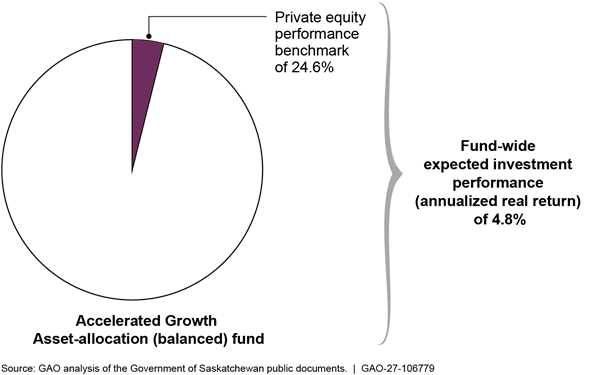
Note: Allocation targets are from the province’s Pension Plan Statement of Investment Policies and Goals, approved March 26, 2025.
|
DOL Guidance Related to Benchmarks for 401(k) Plan Participant Disclosures. Participant disclosures are required to include investment performance benchmarks based on broad-based securities market indices.a The SECURE 2.0 Act of 2022 (SECURE 2.0), Section 318, requires DOL to promulgate regulations that provide, in the case of an investment option that contains a mix of assets, that plan administrators may use a benchmark that is a blend of different broad-based securities market indices (i.e., a blended benchmark).b DOL officials told us that efforts to implement the regulations required under SECURE 2.0 would be closely coordinated with its March 31, 2026 proposed rulemaking, which included an illustrative example discussing how an investment advice fiduciary could assist a named fiduciary to develop a blended benchmark with respect to a designated investment alternative that included private equity.c |
Source: GAO analysis of federal laws, regulations, and guidance. | GAO‑27‑106779
a29 C.F.R. § 2550.404a-5(d)(1)(iii). DOL issued guidance related to these regulations in the form of frequently asked questions. See DOL, Field Assistance Bulletin No. 2012-02R(1), Q-16 (July 30, 2012).
bPub. L. No. 117-328, div. T, § 318, 136 Stat. 4459, 5275, 5353.
c91 Fed. Reg. 16,088, 16,142-43 (Mar. 31, 2026). The preamble to the proposed rule notes that the examples regarding benchmarks illustrate the principle that a performance benchmark must be a meaningful comparator by sharing similar traits, including mandates, strategies, objectives, and risks to the designated investment alternative.
Additional Guidance from DOL Could Help Plan Sponsors and Participants Better Understand Key Aspects of Private Equity Investment Options in 401(k) Plans
Participant and Plan Fiduciary Disclosures Provide Certain Information About 401(k) Investment Options
|
Disclosure and Guidance Disclosure refers to information that administrators of employee benefit plans are required to give participants, beneficiaries, and certain other individuals under Title I of ERISA. Guidance refers to non-binding statements issued by an agency to inform the public of its policies or legal interpretations, explain an agency’s programs and policies, or communicate other important information to regulated entities and the public. Guidance materials can convey useful or educational information to the public in language that is clearer and more accessible than statutes and regulations. Source: GAO analysis of federal agency information. | GAO‑27‑106779 |
DOL regulations require that participant disclosures include certain investment related information for each fiduciary selected investment option (i.e., designated investment alternative) available under the plan.[103] For example, participant disclosures are required to include information on investment fees and expenses, and performance benchmarks based on broad-based securities market indices.[104] DOL regulations also generally require plan service providers to disclose information to the plan fiduciary, such as with respect to each fiduciary selected investment option for which the provider will provide fiduciary services to the plan, information related to the compensation the provider will charge and the expense ratio of the fiduciary selected investment option.[105]
Industry association representatives and asset managers we interviewed said that the high-level information that plan sponsors’ and participants’ required disclosures provide is sufficient to make decisions about plans’ investment options, without getting into detail about funds’ asset allocation to private equity. For example, one plan sponsor organization said participants already receive important product-level information on fees and on any restrictions on selling a specific product or on withdrawing money from the plan more generally. In addition, another plan sponsor organization noted regulations already require that plan sponsors receive information on liquidity constraints from service providers.
We reviewed the annual participant disclosure of a large 401(k) plan, selected because DOL data indicated that it may offer investment options with underlying private equity investments, and found that information about private equity was limited to a statement that, among three investment options in the plan, there was a target allocation to “real assets and private equity”[106] (see fig. 5). The disclosure provided an allocation range for real assets and private equity combined, so it did not indicate the actual amount invested in private equity.
Figure 5: Excerpt of High-Level Investment Information Provided in a 401(k) Plan’s Annual Disclosure, for One Balanced Fund that Includes Private Equity
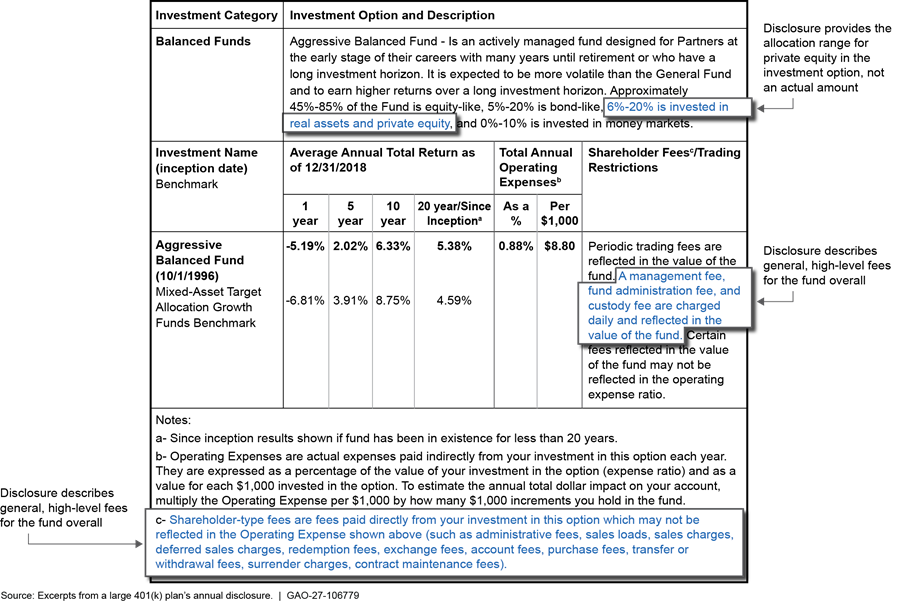
Note: A balanced fund or an asset allocation fund is a mutual fund that invests in different assets such as equities, bonds, and money market funds to reduce risk through diversification of its assets. Disclosure data was current as of 2018 year-end.
Selected TDF and CIT Financial Disclosures Provided High-Level Investment Information, While Closed-End Funds’ Disclosures Provided Detail on Private Equity
Our review of SEC-required financial documentation for selected TDFs, as well as other fund documentation for CITs not structured as TDFs, found that most included high-level investment information about these funds and did not include detailed information about private equity allocations.[107] While further analysis of underlying fund financial disclosures could help to identify potential allocations to private equity, our review of such documents found that the large volume of information in such documents could make that challenging. For example, when we reviewed SEC-required documentation for three TDFs—selected based on largest total fund assets as of 2023 year-end—we found that to identify allocations that may be private equity, one would need to research layers of separate disclosures for the suballocations of each of the multiple underlying funds, totaling hundreds of pages (see fig. 6).[108]
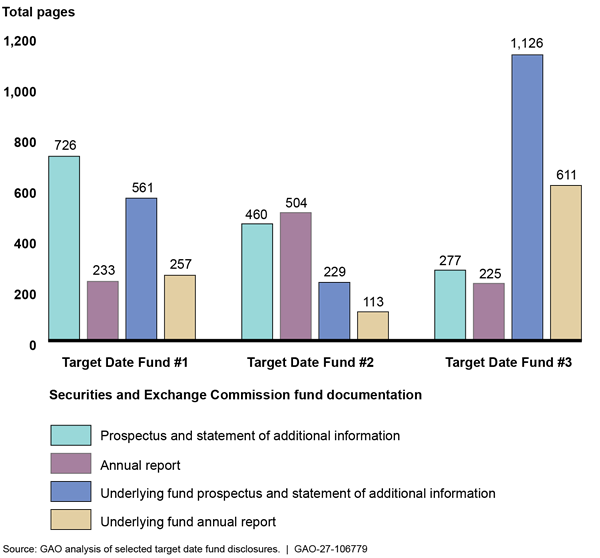
Note: We reviewed the largest underlying fund for each corresponding target date fund for simplicity. We also reviewed certain recent and available Securities and Exchange Commission (SEC) filings including prospectuses, statements of additional information, summary prospectuses, semi-annual reports, and annual reports. As a result, the extent of investment materials read will be larger if all underlying funds are researched and if all recently available SEC filings are reviewed.
We also found that none of the annual audit reports, prospectuses, or other reports for the selected TDFs, their underlying funds, and CITs disclosed specific allocations to private securities in operating companies and private equity funds.[109] Instead, our analysis of audit reports’ schedule of investments and notes to the financial statements found that they identified allocations to hard-to-value investments, which is a category that may include potential private equity allocations. In addition, we found that general investment risks were disclosed in TDF and CIT documents we reviewed, but we did not identify any disclosed risks specific to private equity. For example, the summary documents for the three selected CITs that we reviewed described general investment risks, including liquidity risk and valuation risk, as well as fees and expenses, and redemption restrictions for the funds overall, but not for any underlying assets.[110] In technical comments provided on a draft of this report, SEC officials stated that the lack of disclosed risks specific to private equity implies that these funds do not have material exposure to private equity.
However, our review of financial documentation for two closed-end funds shows examples of how private equity information can be disclosed.[111] For example, our review found that disclosures contained specific investment information about private equity, the illiquid nature of these funds, and the strategic role of private equity investments in these funds. The specific investment information about private equity included whether the investment was in a private company or private equity fund; the name of the investment or issuer;[112] the range of performance-based fees and how fees are calculated; valuation methods and inputs; and risks relating to illiquidity and valuation. One closed-end fund contained additional information about private equity like the definition of private equity as an asset class and descriptions of a private equity fund lifecycle.
|
Types of Risk in SEC Disclosures. Our review of SEC-required disclosures for selected closed-end funds found the following detailed disclosures of potential risks associated with private equity, including: · Valuation risk. Because private equity securities are not readily marketable, valuation of the fund’s private equity investments is to a degree subjective and determined by the adviser of the fund. The adviser may have a conflict of interest because the valuation determines the extent of unrealized losses incurred by the fund. · Limited Information risk. Investments may have limited operating histories and information. Due to this constraint, the investment adviser may have limitations evaluating past performance and validating investment strategies. Advisers rely on information provided by the issuer of securities it receives, or the portfolio fund manager. However, the adviser may not be able to independently verify this information. · Liquidity risk. Private equity fund investments are generally illiquid, with orders to purchase securities subject to restrictions or delays. As a result, the closed-end fund may not be able to dispose of interests in private equity funds in a timely manner.
|
Source: Financial disclosure edited for brevity. | GAO‑27‑106779
Note: Risk descriptions are excerpts from a much longer list of investment risks disclosed by one closed-end fund prospectus. GAO edited descriptions for brevity. Valuation of the fund’s private equity investments also impacts the fund’s unrealized gains and the fees the adviser collects, contributing to the conflict of interest, according to SEC officials.
Such risk disclosures must be obtained independently by participants and require some effort to identify and find the information among multiple SEC documents.
According to representatives from six industry associations and three asset managers, there is no need for additional information about underlying assets, including private equity, in plan sponsors’ and participants’ required disclosures. Higher-level investment information is sufficient because, they said, 401(k) plan investment products would typically use only a small underlying allocation to private equity in managed, asset allocation funds.[113] For example, one asset manager said the cost and investment return of private equity is already reflected with that of other underlying assets in the overall cost and return information provided for an asset allocation fund like a TDF, making the specific fee structure of a private equity investment less important for the participant to understand.
The subjective and complex nature of private equity would also make more detailed disclosure consistency a challenge, according to a consumer organization and an asset manager. For example, it is difficult to consistently determine and summarize performance for private equity funds that have no performance history available. They noted that comparing private equity directly to traditional plan investments—like mutual funds and TDFs—is especially challenging, because private equity valuation is highly subjective and the average participant may not understand the differences.
Plan sponsors’ access to outside expertise also makes additional disclosure about private equity unnecessary, according to one plan sponsor organization and one industry associations’ representatives.[114] For example, when using CITs or separately managed accounts in the plan, plan sponsors—as fiduciaries—typically select an investment manager to help perform a thorough analysis of underlying investments and, therefore, do not need to understand every detail about private equity. Industry association representatives also indicated that even the smallest 401(k) plans lean on an adviser or an intermediary to help assess investment options.
|
International Approach to Disclosing Private Equity Allocations in Defined Contribution Plans International government officials from all four selected countries (Australia, Canada, Kenya, and the U.K.) said that investment information communicated to participants primarily includes detailed information about a defined contribution retirement plan’s investment options. However, international government officials from three countries said that investment information communicated to participants may also identify a private equity allocation when included in a plan’s investment portfolio, but it may not include additional detailed information about the private equity allocation. For example, in Australia—where plans are managed by trustees and not plan sponsors—certain disclosures to participants describe investment options’ portfolio compositions, including the percentage allocated to private equity. One type of disclosure describes the different investment options and their risk levels, but not a private equity allocation’s performance or risks specifically. |
Source: GAO interviews with officials from four selected countries. | GAO‑27‑106779
Different countries used varying approaches to disclosing private equity among funds’ asset allocations (see fig. 7).
Figure 7: Excerpt of a Disclosure of a Balanced Fund’s Asset Allocation to Private Equity, by Australia’s Largest Defined Contribution Retirement Plan
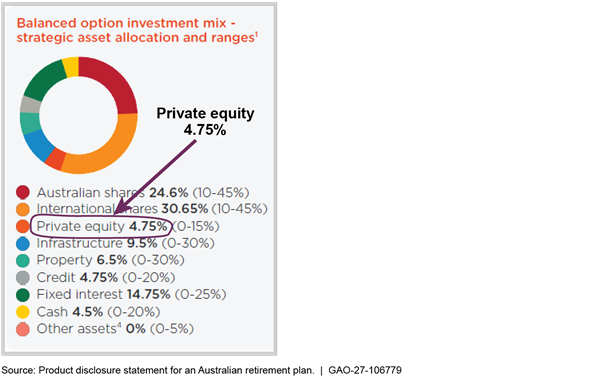
Note: A balanced fund or an asset allocation fund is a mutual fund that invests in different assets such as equities, bonds, and money market funds to reduce risk through diversification of its assets.
Guidance from DOL Can Help Plan Sponsors Better Understand Key Aspects of Private Equity
Representatives from two plan sponsor organizations, one industry organization, and one consumer organization stated that it is important for plan sponsors to understand and have guidance—not required disclosures about specific plans—on certain key aspects about private equity, including its risks and fees. For example, they said plan sponsors could use help understanding:
· Private equity’s valuation. For example, how private equity’s valuation is derived, which differs from traditional plan investments that can be valued daily in public securities markets.
· Private equity investments’ risks. For example, its liquidity risks.
· Professionally managed products. For example, what it means for some investment products that include private equity to be professionally managed.
· Regulation of funds with private equity. Specifically, how funds with private equity are regulated, including CITs.
Plan sponsors comprise a wide spectrum of sophistication levels, and many are not professional investors. Although large plans tend to be more sophisticated and plan sponsors of smaller plans may often rely on investment advisers, plan sponsors still need education about private equity, according to representatives from one plan sponsor organization, one industry organization, and one large asset manager we interviewed. For example, the industry organization said that plan sponsor education is needed because of the complexity and confusion associated with private equity, and such education could help support sponsors’ ability to evaluate and use investments with private equity allocations in the plan. In addition, the asset manager said plan sponsors need education on private equity that walks them through the investment case for balancing illiquidity and the potential added value.
|
International Perspective on What Defined Contribution Plan Fiduciaries Should Understand About Private Equity International officials we interviewed stated that a retirement plan’s trustees or administrators should understand and consider certain aspects of private equity, so that they can perform their fiduciary duties. For example, they expect the trustee to understand how private equity investments work, how they fit within a plan’s investment portfolio, their fee structures, and the long-term nature of their performance. |
Source: GAO interviews with officials from four selected countries. | GAO‑27‑106779
Representatives from three investment industry organizations also discussed various other challenges that they said support the need for guidance to inform plan sponsors about private equity, including:
· Service providers’ limited expertise with private equity. Service providers may not have the infrastructure or resources to conduct due diligence of private equity investments on behalf of plan sponsors, given their traditional expertise in public markets; and
· Changes to DOL’s position on private equity use. DOL’s messaging around the use of investments with private equity has changed, leaving uncertainty.[115]
There is currently no guidance available from DOL to inform plan sponsors about private equity’s characteristics. However, according to organizations we interviewed, plan sponsors need more basic guidance about private equity. DOL has not provided information about key aspects of private equity more generally, which can help plan sponsors to understand this complex asset class. According to DOL, they do not provide guidance about private equity or any particular investment primarily to ensure their neutrality and to avoid the appearance of favoring a specific investment strategy. DOL officials additionally noted that current regulations already ensure that plan participants receive basic information about the investment options on the plan menu, including an explanation of each option’s principal strategies and risks, written in a manner calculated to be understood by the average plan participant.[116] Nevertheless, DOL officials also stated that they are considering whether, and to what extent, the Department can update its educational materials to remain helpful and neutral, jointly with the proposed rule to clarify a fiduciary’s duty of prudence in connection with selecting plan investments.
ERISA requires plan sponsors, as fiduciaries, to select and monitor investments with care, skill, and diligence and solely in the interests of plan participants and beneficiaries.[117] In addition, according to EBSA’s web page, their mission is to ensure the retirement security of participants, and in support of this mission, EBSA may assist and educate plan sponsors. Standards for Internal Control in the Federal Government state that management—in this case, DOL—should communicate relevant, quality information so that external parties can help to achieve program objectives.[118] DOL has authority to provide not only regulations, but also other guidance—as needed—to carry out ERISA.[119] By providing plan sponsors with guidance about key aspects of private equity, DOL can help these fiduciaries to better understand its complexities, including how private equity is defined, how its liquidity and valuation differ from traditional investments, and how it is regulated.
Guidance from DOL Can Help 401(k) Participants to Understand Differences Between Public Funds and Private Equity Investments
Representatives from three consumer organizations stated that it is important for participants to understand and have guidance—not required specific disclosures about participant accounts—on certain general aspects about private equity, like:
· High fees for underlying private equity allocations. For participants to make an informed investment selection, they should know about any high fees for underlying private equity allocations in a fund, regardless of whether they are rolled up into the fund.
· Private equity’s illiquidity and valuation challenges. Participants should understand private equity’s illiquidity, the challenges with valuing private equity, and how private equity’s hard-to-value nature may impact illiquidity.
Representatives from two consumer organizations also discussed various other challenges that support the need for guidance about private equity for participants, including:
· An unclear definition of private equity. Investors may find it a challenge to evaluate the risks and types of private equity investments because the investment category is broad and not clearly defined; and
· Investment product disclosures have limited detail. Disclosures may not be able to clarify complex products, such as those with allocations to private equity. For example, there is no transparency into the underlying assets of private equity, but an investor can research the underlying assets of public equities.
|
International Approach to Private Equity Disclosure in Defined Contribution Plans International officials we interviewed said that participants generally do not need detailed private equity information in their countries primarily because they are not making independent investment decisions that are specific to private equity allocations. For example, according to a government official in Kenya, participants are not expected to know or be responsible for investment selection under their retirement system, since the trustee and fund manager have sole responsibility over fund allocations. In addition, in certain cases, participants are only expected to choose among three broad investment options classified by risk level. International officials also said that participants do not need specific private equity information in their countries because they are generally able to redeem their money in a short period of time under their retirement systems. For example, in Australia, one industry official said because there is a three-day distribution standard that generally applies to superannuation funds (i.e., DC plan), participants may be able to easily transfer their money from one superannuation fund to another, even if there are private investments. (For more information on the four selected countries’ DC retirement systems see app. II.) |
Source: GAO analysis of interviews and industry documentation. | GAO‑27‑106779
Although participants need guidance about private equity, according to consumer organizations we interviewed, DOL has not issued guidance to help participants understand how private equity assets differ from other traditional investments in a 401(k) plan. DOL has published informational materials for 401(k) participants on many important topics related to 401(k) plan investments, including TDFs and understanding fees, but the agency has not issued guidance, such as a fact sheet, to help participants to understand private market assets, including private equity. According to DOL, the agency has not provided this guidance because under ERISA participants already receive basic information about investment options on the plan menu. However, private equity, like other private market assets, has historically not been included as an investment option in most 401(k) portfolios, therefore it has not been necessary for plan participants to understand differences between public and private market assets.
DOL regulations require plan administrators, as fiduciaries, to take steps intended to ensure that participants have the information they need to help them to make informed investment decisions.[120] In addition, according to EBSA’s web page, their mission is to ensure the retirement security of participants, and in support of this mission, EBSA may assist and educate participants. Standards for Internal Control in the Federal Government state that management—in this case, DOL—should communicate relevant, quality information so that external parties can help to achieve program objectives.[121] By providing guidance to participants, such as a private equity fact sheet, DOL can help them understand the ways in which certain key characteristics of private equity differ from more traditional, public market investments, like liquidity and valuation, so they can make an informed comparison between investment products. Plans offering an investment option with private equity could include a link to a DOL fact sheet in the annual participant disclosure.
Conclusions
401(k) plan investments may have limited allocations to private equity. However, given actions and statements by regulatory and industry officials, private equity allocations are expected to increase, especially in CITs. As private equity becomes more prevalent, DOL can make this a smoother transition for plan sponsors and participants by improving the data it collects and providing guidance. For example, providing a specific revision to the Schedule R can provide DOL with a clear line of sight on the percentage of a large plan’s assets invested in private equity—ensuring that it has visibility on the extent to which plan sponsors and participants face risks associated with investing in private equity. In addition, by providing guidance to support plan sponsors’ and participants’ understanding of private equity, such as an explanation of how its valuation and regulation differ from traditional investments, DOL can help ensure that 401(k) plan investment options including allocations to private equity are well understood and that choices to invest in those products help to optimize plan participants’ retirement savings.
Recommendations for Executive Action
We are making the following three recommendations to DOL:
The Assistant Secretary of the Employee Benefits Security Administration should collect data on the total amount of 401(k) plan assets invested in private equity, through all designated investment alternatives’ underlying assets. Such data for large plans could be collected on the Schedule R or on a new section of the Schedule H. (Recommendation 1)
The Assistant Secretary of the Employee Benefits Security Administration should provide guidance for retirement plan sponsors to help them understand the key aspects of private equity. Such guidance could include information about how private equity is defined, how its liquidity and valuation differ from traditional investments, and how it is regulated. (Recommendation 2)
The Assistant Secretary of the Employee Benefits Security Administration should provide guidance for participants that highlights key differences between private equity and public market investments, such as differences in liquidity, valuation, and other factors that may inform their ability to compare investment products available in their retirement plans. (Recommendation 3)
Agency Comments and Our Evaluation
We provided a draft of this report to the Department of Labor, Office of the Comptroller for the Currency, and Securities and Exchange Commission. DOL, OCC, and SEC provided technical comments, which we have incorporated where appropriate. DOL also provided written comments, which are summarized below and reproduced in Appendix III.
DOL neither agreed nor disagreed with our three recommendations but stated it may consider whether and how to require plan administrators to report all private equity investments held in designated investments under their plans as part of its long-term project on improving the Form 5500 Series. In response to DOL technical comments, we included in our first recommendation the suggestion that such private equity data for large plans could be collected on a new section of the Schedule H. Concerning our recommendations that the agency provide guidance to plan sponsors and plan participants, DOL’s letter states that the agency is committed to providing education and outreach programming to participants and beneficiaries in employee benefit plans. However, DOL stated that it would be premature to commit to any additional guidance for either plan sponsors or participants since it is currently considering public comments on its proposed regulation concerning a fiduciary’s duty of prudence in connection with selecting investments for a plan like a 401(k) plan. DOL added that any guidance it may provide will be consistent with its goal of remaining neutral with respect to particular investments and investment strategies.
Our report demonstrates that by collecting data on underlying allocations to private equity, DOL can monitor growth and any issues in order to protect the rights and benefits of 401(k) plan participants and beneficiaries. Moreover, providing guidance to plan sponsors and participants on private equity can help both to understand key aspects of private equity investments, such as how its liquidity and valuation differ from publicly offered investments, like mutual funds. For example, plan sponsors could benefit from guidance explaining how challenges valuing private equity differ from traditional plan investments, which can be valued daily. Guidance to participants can highlight key differences between private equity and public market investments, which may inform their ability to compare investment products available not only through their retirement plans but also through a brokerage window. By collecting data and providing guidance DOL can ensure that the agency, plan sponsors, and plan participants have the information each needs to monitor, compare, and optimize 401(k) investment options.
As agreed with your offices, unless you publicly announce the contents of this report earlier, we plan no further distribution until 30 days from the report date. At that time, we will send copies to the appropriate congressional committees, the Secretary of Labor, the Comptroller of the Currency, and the Chairman of the Securities and Exchange Commission. In addition, the report will be available at no charge on the GAO website at https://www.gao.gov.
If you or your staff have any questions about this report, please contact me at nguyentt@gao.gov. Contact points for our Offices of Congressional Relations and Media Relations may be found on the last page of this report. GAO staff who made key contributions to this report are listed in appendix IV.

Tranchau (Kris) T. Nguyen, Director
Education, Workforce, and Income Security Issues
This appendix discusses in detail the methodologies we used to examine: 1) what available data and other sources show about the use of private equity in 401(k) plan investments; 2) what investment industry and consumer advocacy representatives as well as officials from other countries say about the benefits and challenges of private equity in defined contribution (DC) plan investments and broader potential connections between plans and private equity; 3) what research shows about private equity investment performance compared to public equity benchmarks; and 4) what types of information about private equity investments are communicated to 401(k) plan sponsors and participants and what more, if anything, could help them make informed choices concerning private equity investments.
To address these questions, we interviewed officials from the Department of Labor (DOL), Federal Trade Commission, Internal Revenue Service, Office of the Comptroller of the Currency (OCC), and the Securities and Exchange Commission (SEC) to understand the intersection of different regulatory agencies’ oversight of investments offered by 401(k) plans. After meeting initially with the Federal Trade Commission and Internal Revenue Service, we determined that the agencies did not have relevant oversight of areas related to our research questions and they are not mentioned in this report. To describe the regulatory environment, which may impact the use of private equity in plan investments, we reviewed relevant federal laws, regulations, guidance, an executive order, and related actions by DOL and SEC.
We also interviewed six of the largest 401(k) plan asset managers and collected limited information from two more, selected for their large size to give us an overview of investment policies by firms that serve a large portion of 401(k) plans. We also interviewed an asset manager of a smaller firm and received limited information from an asset manager of another smaller firm, as measured by the dollar value of DC assets under management. We selected these 401(k) plan asset managers to reflect and compare perspectives on the inclusion of private equity in DC plans across the retirement investment industry. In total, these asset managers had over $7.6 trillion in DC plan assets under management at year-end 2023, representing about three-quarters of the DC plan assets under management in the U.S.[122] We also interviewed representatives of investment industry, plan sponsor, and consumer protection groups to gain deeper insights on the potential impacts of increasing allocations to private equity in 401(k) plan investments. We selected these groups based on publicly available information on an organization’s market size or expertise in the U.S. private equity market. In addition, we considered DOL input or previous exposure to certain organizations due to prior GAO work. We also interviewed government officials and retirement industry professionals from the largest four selected countries with DC retirement plan systems that permit investment in private equity and that have English as an official language: Australia, Canada, Kenya, and the UK. We did not conduct an independent legal analysis to verify the information that plans and officials provided about the laws, regulations, or policies of their countries. Instead, we analyzed the information collected through our interviews to identify themes and provide illustrative examples, and relied on appropriate secondary sources, interviews, and other information to support our work. We submitted key report excerpts to government officials in each country, as appropriate, for their review and verification, and we incorporated their technical corrections as necessary (see table 8).
|
|
Number of interviews with government officials |
Number of interviews with retirement industry professionals |
|
Australia |
2 |
1 |
|
Canada |
1 |
1 |
|
Kenya |
1 |
0 |
|
United Kingdom |
2 |
4 |
|
Total Interviews |
6 |
6 |
Source: GAO audit records. | GAO‑27‑106779
To examine the current use of private equity in 401(k) investment options, we reviewed survey from a 401(k) plan sponsor association. We also identified several proprietary data sources but determined that they were unreliable for our purposes due to limitations pertaining to incomplete data and unclear methodologies. We reviewed the instructions DOL has released for the Form 5500 for plan years 2022 to 2025 and the Form 5500 SF for 2023 and 2025 to inform our knowledge of updated Form 5500 instructions regarding disclosure of private equity assets. We evaluated data from the Employee Benefits Security Administration’s (EBSA) publicly available Form 5500 Series, the agency’s primary source of information on 401(k) plan investments, as provided in the Private Pension Plan Research File. To assess the reliability of Form 5500 Series Private Pension Plan Research File data, we reviewed relevant documentation describing tests and checks EBSA performs on counts of participants, plans, types of service providers, and assets. According to DOL’s website, the private pension plan research files correct many statistically important logical and arithmetic data inconsistencies that remain after completion of electronic processing. The data are lagged by 2 years, therefore the most recently available data at the time of our analysis for 2023. In addition, to report on change in the number of plans and amount of assets invested in collective investment trusts, we analyzed 2015 private pension plan data. We also obtained written responses from EBSA officials about the data. We identified limitations that prevented us from systematically measuring the use of private equity in 401(k) plans’ investment options. Despite these limitations, we concluded Form 5500 Series Private Pension Plan Research File data were sufficiently reliable for reporting on the size of the 401(k) market as measured by counts of plans and assets, for selecting common service providers for 401(k) plans, and for providing context on the limited presence of private equity assets relative to other types of assets held in 401(k) plans.
To examine the use of private equity investments in public market funds, we reviewed publicly available SEC N-PORT data for Q3 and Q4 of 2024. For the purposes of our analysis, we defined two types of private equity investments: potential investments in private equity funds issued by a private fund either missing a valuation or with a level-3 valuation in the data, and investments in private securities defined as an equity investment issued by a corporation without an indication of being traded on an exchange either missing a valuation or with a level-3 valuation. SEC-regulated investment funds are required to file detailed information quarterly, including about the type of underlying investments in funds and the amount of assets invested in each holding on this form. To determine the reliability of these data, we reviewed related documentation and tested for missing values, outliers, and errors. We also obtained written responses and detailed methodologies from SEC officials. We assessed the reliability of all data during this review and determined they were sufficiently reliable for the purpose of reporting counts of SEC-registered open-end funds invested in private funds that may include private equity funds and private securities.
To further identify both the extent to which private equity in investment products is currently used in 401(k) plans as well as to identify who communicates what information about private equity to whom, we reviewed SEC disclosures for three of the largest target date funds (TDF) by assets under management.[123] These funds were selected because the large amount of assets under management indicate that they are broadly available through 401(k) investment menus to a large percentage of all 401(k) participants.
To identify broader potential connections between 401(k) plans and private equity, such as through 401(k) service providers, we used the S&P Capital IQ subscription data service to link data on mergers and acquisitions to information on six service providers we obtained through analysis of Form 5500 Schedule C for plan year 2023. We selected two of the most often reported service providers for each of the three most often report service provider types. S&P Capital IQ collects recent information from a variety of sources such as government filings, press releases, surveys, and corporate websites on public and private companies, operating subsidiaries, investment firms (including private equity firms) and their respective portfolio companies. Data on companies is paired with data on corporate transactions. S&P Capital IQ has records of approximately 3 million transactions in its database. Of those transactions, approximately 1.3 million are mergers and acquisitions and another 850,000 are private placements as of 2026. These transaction data include mergers and acquisitions conducted by private equity firms. To identify a transaction, we attempted to determine whether any mergers and acquisitions had occurred throughout a service provider’s corporate hierarchy until we arrived at the ultimate parent company. If we could not identify an acquisition in the corporate hierarchy, we determined that we could not establish a connection between the service provider and private equity. If a firm had been acquired after 2015, we proceeded to review the acquiring companies or funds and their relationship to private equity. If we identified an acquisition conducted between a private equity fund and a service provider, we verified this information outside of the S&P Capital system through a media search. We excluded three instances where the corporate relationship between the service provider and private equity entity could not be established via media search.
To evaluate the potential impact of broader connections between plans and private equity, specifically the impact of private equity ownership on service provider behavior, we conducted a literature review of published peer-reviewed research and working papers from 2020 through 2025 that included original analysis of private equity mergers and acquisitions on types of entities that are plan service providers. We excluded from our analysis papers that only summarized other work or were theoretical. From 74 papers initially identified for review by a research librarian using standardized search terms in several databases, our review process identified four papers that met our objective criteria. See table 9 for methodological details on each of these papers described in the report.
Table 9: Methodological Details for Relevant Findings in Selected Research Relating to Service Provider Outcomes After Purchase by Private Equity
|
Selected research |
Details |
|
Divya Kirti and Natasha Sarin, “What Private Equity Does Differently: Evidence from Life Insurance,” Review of Financial Studies, vol. 37, no. 1 (2024): 201-230. |
Authors use 2005 through 2014 data of life and annuities insurance firms as well as information on their bond holdings, investment transactions and annuity rates. The authors run a statistical model to compare average changes in the asset allocation of insurance companies that were acquired by private equity before and after the acquisition to average changes in those that are never acquired by private equity, controlling for time-invariant characteristics of insurers and economy wide events that affect all insurers in a given quarter. |
|
Ralf R. Meisenzahl, Jackson Overpeck, and Andy Polacek, “Life Insurers’ Private Credit Investments and Annuity Market Share Capture”, Working Paper, No. WP 2025-09, Federal Reserve Bank of Chicago (2025). |
The authors use data on U.S. life insurers’ bond holdings from 2004 through 2024, the asset type of these holdings and information on private equity acquisition of life insurers. The authors run a statistical model examining the relationship between the change in private placements from 2017 through 2024 and whether the insurer firm was private-equity owned in 2017, whether the firm was taken over by private equity between 2018 and 2023 and firm characteristics, such as total assets and the annuity market share in 2017. They also compare the share of private placements between insurers that had been acquired by private equity and those that had not while controlling for firm characteristics that do not change over time, national level factors that affect all firms in a given year and firm characteristics in a given year, such as general account assets and share of industry annuity reserves. For bonds held in 2024 and purchased in 2020, they also look at the relationship between the yield relative to public bonds and the type of private placements while controlling for asset characteristics such as bond rating and origination month. |
|
Kyeonghee Kim, J. Tyler Leverty, and Joan T. Schmit, “How Does Private Equity Impact Insurer Asset Management?” (2026). |
Authors collect data for life insurance companies from 2011 through 2020. They collect several types of data for these insurance companies, including insurer financial data and data on insurers acquired by private equity firms. They include only insurers that have over $10 million in total invested assets, thus they exclude small insurers and the results are not representative of all insurers. The treatment group consists of 25 unique insurers acquired by private equity firms between 2014 and 2018 that were not previously private equity owned. For each acquisition, they compare the treated insurers with a control group of 496 unique insurers that remained non-private equity owned throughout the 2011 through 2020 period. Thus, they examined changes in outcomes of private equity acquired insurer firms before and after private equity acquisition to insurer firms that were never acquired while controlling for firm characteristics that do not change over time and for national level factors that affect all firms in a given year for each 6-year event window. |
|
Albert Sheen, Youchang Wu, and Yuwen Yuan, “Private Equity and Financial Adviser Misconduct.” (2025) |
The estimated treatment effects of private equity buyouts on misconduct probability where individual advisers are reported to the Securities and Exchange Commission (SEC) for misconduct relative to similarly sized and geographically located firms not owned by private equity amount to 27 percent of the full sample mean. The 95 percent confidence interval for this estimate is between 14 percent and 41 percent of the full sample mean. Authors use SEC data on advisor misconduct from 2000-2020 at the individual advisor level for each firm as well characteristics of the firm. Data are for firms with more than $100 million in assets under management (AUM), thus are not representative of smaller firms. To estimate the effect of a private equity buyout, for each private equity-acquired firm, the authors first find a control non-acquired firm based on having similar historical misconduct rates, AUM and number of advisors as well as having the same state, year and registration status. They estimate several statistical models, including one that compares the misconduct of advisers at private equity-acquired firms to the misconduct of advisors at control firms while controlling for several characteristics such as whether the advisor had passed a qualification exam. The model allows them to control for firm characteristics that do not change over time as well as factors that affect a given pair of treatment-control firms in a given year. |
Source: GAO analysis of selected research. | GAO‑27‑106779
To evaluate private equity investment performance against benchmarks, we conducted a literature review of research published from 2015 to 2025 that included original analysis of private equity performance data. The relatively long period of private equity fund investment cycles, often 10 years, requires that data much earlier than the earliest date of publication, 2015, be included in the analysis, so we required that data are at least as current as 2010, while including older data. We excluded from this literature review those articles that only summarized other work or were theoretical.
From 100 papers initially identified for review by a research librarian using standardized search terms among several databases, and an iterative review by two separate analysts—including a senior economist—our review process identified 18 papers that met our objective selection criteria (see table 10). We conducted due diligence to assess whether the publication source of the selected research articles could introduce bias that would affect the findings. Specifically, we researched whether private equity firms owned the journals that published the selected 18 articles, identifying eight articles published in journals owned by private equity firms. We then compared these articles’ findings on private equity compared to publicly traded equity performance to the other papers. We determined that the findings were similar enough that they did not indicate bias by ownership of publication source and therefore determined that it was appropriate to report the 18 articles’ findings together. We make no claim as to the appropriate or inappropriate valuation at a fund or firm level of any of the underlying datasets among the literature that we reviewed.
Table 10: Research Papers Selected for Analysis of Private Equity Fund Investment Performance Compared to Publicly Traded Equity Benchmarks
|
Research Papers Selected (in alphabetical order by first listed author) |
|
1) Andrew Ang, Bingxu Chen, William N. Goetzmann, and Ludovic Phalippou. “Estimating Private Equity Returns from Limited Partner Cash Flows,” Journal of Finance, vol. 73, no. 4 (2018). |
|
2) Alexander Beath and Christopher Flynn. “Benchmarking the Performance of Private Equity Portfolios of the World’s Largest Institutional Investors: A View from CEM Benchmarking,” Journal of Investing, vol. 30, no. 1 (2020). |
|
3) Brian H. Boyer, Taylor D. Nadauld, Keith P. Vorkink, and Michael S. Weisbach. “Discount-Rate Risk in Private Equity: Evidence from Secondary Market Transactions,” Journal of Finance, vol. 78, no. 2 (2023). |
|
4) Gregory W. Brown and Steven N. Kaplan. “Have Private Equity Returns Really Declined?” Journal of Private Equity, vol. 22, no. 4 (2019). |
|
5) Gregory W. Brown, Wendy Y. Hu, and Jian Zhang. “The Evolution of Private Equity Fund Value,” Journal of Alternative Investments, vol. 23, no. 4 (2021). |
|
6) Lily Fang, Victoria Ivashina, and Josh Lerner. “The Disintermediation of Financial Markets: Direct Investing in Private Equity,” Journal of Financial Economics, vol. 116, no. 1 (2015). |
|
7) Arpit Gupta and Stijn Van Nieuwerburgh, “Valuing Private Equity Investments Strip by Strip,” Journal of Finance, Vol. 76, No. 6 (2021). |
|
8) Robert S. Harris, Tim Jenkinson, Steven N. Kaplan, and Ruediger Stucke. “Financial Intermediation in Private Equity: How Well do Funds of Funds Perform?” Journal of Financial Economics, vol. 129, no. 2 (2018). |
|
9) Antti Ilmanen, Swati Chandra, and Nicholas McQuinn. “Demystifying Illiquid Assets: Expected Returns for Private Equity,” Journal of Alternative Investments, vol. 22, no. 3 (2020). |
|
10) Vishv Jeet, Amit Partani, and Rüdiger R. Stucke. “Estimating the Alpha and Beta of Private Capital Using State Space Modeling and Bayesian Inference,” Journal of Portfolio Management, vol. 50, issue 7 (2024). |
|
11) Will Kinlaw, Mark Kritzman, and Jason Mao. “The Components of Private Equity Performance: Implications for Portfolio Choice,” Journal of Alternative Investments, vol. 18, issue 2 (2015). |
|
12) Radu-Dragomir Manac, Jens Martin, and Geoffrey Wood. “Varieties of Funds and Performance: The Case of Private Equity,” European Journal of Finance, vol. 28, issue 18 (2022). |
|
13) Ludovic Phalippou. “An Inconvenient Fact: Private Equity Returns and the Billionaire Factory,” Journal of Investing, vol. 30, no. 1 (2020). |
|
14) Nicolas Rabener. “Private Equity is Still Equity, Nothing Special Here,” Journal of Investing, vol. 30, no.1 (2020). |
|
15) David T. Robinson and Berk A. Sensoy. “Cyclicality, Performance Measurement, and Cash Flow Liquidity in Private Equity,” Journal of Financial Economics, vol. 122 (2016). |
|
16) Alexander Rudin and David Farley. “Public and Private Equity Returns: Different or Same?” Journal of Portfolio Management, February (2022). |
|
17) Erik Stafford. “Replicating Private Equity with Value Investing, Homemade Leverage, and Hold-to-Maturity Accounting,” Review of Financial Studies, vol. 35 (2022). |
|
18) David Turkington. “Explaining Buyout Industry Returns: New Evidence,” Journal of Investment Management, vol. 17, no. 1 (2019). |
Source: Selected research papers. | GAO‑27‑106779
To evaluate the types of information about private equity investments that are communicated to 401(k) plan sponsors and participants, we reviewed various sources of documentation including: participant disclosures; publicly available SEC-required fund documents; and collective investment trust (CIT) documentation.
To evaluate the disclosure of private equity in a participant disclosure, we reviewed a disclosure for one selected large 401(k) plan. To identify this large plan, we relied on Form 5500 Private Pension Plan Research File data obtained from the DOL’s website as of 2021 year-end. From this data, we generated a random sample of 34 plans spanning three broad categories—small, medium, and large—that had exposure to joint venture capital or limited partnership investments. We defined the three categories by number of active participants: small plans had 100 to 999, medium plans had 1,000 to 9,999, and large plans had 10,000 or more active participants.[124] Next, we reviewed each plan’s Form 5500, including the Schedule H, auditor’s report, financial statements, notes to the financial statements, and schedule of assets, to determine whether it had a potential private equity allocation. We found several indicators that indicated whether a plan’s investments may have included private equity, including: the amount of level 3 (or hard-to-value) assets, plan assets that are measured at net asset value (NAV), joint venture exposures, or details on any liquidity constraints that are commonly associated with private equity investments. Plans that did not have any indicators or that contained limited evidence of private equity were excluded from further selection. Within this random sample, we initially selected seven 401(k) plans, consisting of four small, two medium-sized, and one large plan. Ultimately, we were unable to collect documentation directly from the plans but identified one publicly available participant disclosure and corresponding summary plan description for one selected large plan. We also corroborated information with two of the seven plans but the remaining plans did not respond to outreach.[125]
To evaluate the disclosure of private equity in SEC-required documents, we reviewed publicly available SEC documents, including prospectuses, annual reports, and semi-annual reports for three selected TDFs and two selected closed-end funds.[126] We selected the three largest TDF fund families by total assets as of 2023 year-end that were structured as mutual funds in the 2060 series based on available Morningstar reporting. We selected funds in the 2060 series because they are more likely to have the largest allocation to equities, including potentially private equity, given the position of these funds in the TDFs’ glidepath. The three selected TDFs had about $1.085 trillion in total assets and made up about 61 percent of the total TDF mutual fund market. We also selected two closed-end funds based on largest total asset size and estimated allocation to private equity, according to SEC Form N-PORT data as of 2024 year-end. To arrive at the selected closed-end funds, we first sorted all funds with some allocation to private companies or private funds by the largest amount of assets. Among the largest by asset size, we selected the fund with the highest allocation to private funds and another with the highest allocation to private companies, which are types of private equity, as a percentage of total assets.
To evaluate the disclosure of private equity in collective investment trusts (CITs) and how that use is disclosed to plans and participants, we reviewed investment documentation from three CITs with an allocation to private equity from one of the largest national bank CIT providers. Because data and investment information on CITs are not publicly available, we relied on the primary federal regulator, the OCC, for any available information on CITs. According to the OCC, 90 percent of CIT assets are held at two large national banks as of 2024 year-end, with one of them having three CITs with a small allocation to private equity, while the other did not have any CITs with an allocation to private equity. In addition, we interviewed the two largest national bank CIT providers, according to the OCC, and two state regulators (only Maryland and South Dakota’s regulators responded to interview requests).[127] Because CIT information is private, we primarily selected the four state regulators by relying on publicly disclosed information on the amount of bank assets overseen as of the third quarter of 2024.[128] We also selected Maryland to interview because one of the largest CIT providers is chartered in the state, according to the state regulator’s website.
We examined four selected countries’ use of and policies for allocations to private equity among defined contribution (DC) plan investments. Our review included interviews with government officials, investment industry representatives, and one consumer interest association as well as the review of government and retirement plan reports. We drew from our interviews and documentary review some observations of this use, which are described in this report. The following tables highlight some key characteristics of the DC plans in other countries. We did not conduct an independent legal analysis to verify the information that plans and officials provided about the laws, regulations, or policies of their countries. We submitted key report excerpts to government officials in each country, as appropriate, for their review and verification, and we incorporated their technical corrections as necessary. International currencies (as of different dates) were converted to U.S. dollars on August 4, 2026.
Table 11: Australia—Key Characteristics of Defined Contribution Type Plans and Their Allocations to Private Equity
|
|
Defined Contribution-type (DC) plan characteristics |
|
DC plans at-a- glance |
· DC plans, called Superannuation Funds (super funds) or registrable superannuation entities, are used by private sector and public sector employers. A majority of super funds are now available to the general public, and with many employer-set-up funds merging to form some of these larger super funds. · Super funds are trusts, and the trustee of the fund is responsible for prudent management of the fund and safeguarding its assets. · These plans may be managed by a trustee that is a third-party financial institution, like a bank or insurance company, or they may be employer-sponsored, for example. · Trustees are fiduciaries and must act in the best financial interest of participants. Trustees are responsible for investment selection and management and are required to have an investment governance framework for the plan, including each separate investment option. · As of March 2026, DC plan assets—for plans regulated by an Australian regulator and that include more than six participants—totaled about U.S. $2.16 trillion across 79 super funds. · Plans have a steady and predictable stream of incoming cash, as employers are required to contribute 12 percent of certain earnings from participants at each pay period, up to a certain income cap. Participants may also contribute but are not required to. · Participants can choose between plans, generally when they start employment. Often a default plan is used by the employer because no choice is made by the participant. · After a plan is selected, participants may generally choose among various investment options offered by the plan, such as mixed asset funds or direct investment in certain securities. Investments are typically mixed asset funds that range from conservative to aggressive. Funds may be professionally managed by an investment manager or managed internally by the plan. · Plans have no cap or limit on what they can allocate to unlisted assets, including private equity. However, plans are subject to regulatory requirements related to investment risk management. |
Source: GAO interviews with government and industry officials and analysis of government websites and documents. | GAO‑27‑106779
Table 12: Canada—Key Characteristics of Defined Contribution Ttype Plans and Their Allocations to Private Equity
|
|
Defined Contribution-type (DC) plan characteristics |
|
DC plans at-a- glance |
· There are three main types of retirement plans in their retirement system: defined benefit plans, DC plans, and hybrid plans. · DC plans specify the contributions made by the employer, if the plan is contributory, as well as by the employee. · As of 2024-year end, DC plan assets were about U.S. $82.8 billion, making up about 5 percent of workplace pension plan assets, according to officials. · As of 2024-year end, there were about 5,828 DC plans which served about 1.35 million active participants. · The employer may decide its own level of contribution in a DC plan. · Participants have various investment choices, but by default, are typically offered asset allocation funds that differ based on their risk profile. Most DC plan assets are invested in a type of target date fund, according to officials. · There is no federal regulation or timeline requirement for distributing money to participants. · DC plans are not subject to federal regulations related to liquidity, such as a limit on private equity investment. |
Source: GAO interviews with government and industry officials and analysis of government websites and documents. | GAO‑27‑106779
Table 13: Kenya—Key Characteristics of Defined Contribution Type Plans and Their Allocations to Private Equity
|
|
Defined Contribution-type (DC) plan characteristics |
|
DC plans at-a- glance |
· There are three main types of retirement plans or schemes in their retirement system: defined benefit schemes, DC schemes, and hybrid schemes. · A large proportion of DC schemes are set up by employers. However, setting up a DC scheme is voluntary for employers. The only required scheme is the National Social Security Fund, to which every employer must contribute on behalf of employees. · There are no mandated contribution rates for both employers and employees. Contribution rates are determined by the employer when setting up the scheme and may be either fixed as a percentage of earnings or a fixed monetary amount. · DC schemes make up a large majority of Kenya’s retirement system, at about U.S. $15.1 billion out of $17.3 billion as of 2024 year-end. · The retirement system had a total of 951 active schemes as of 2024 year-end. DC schemes had about 8.6 million participants. · The trustees’ role and responsibility, comprised of individuals or corporate legal entities, is to act in the best interest of participants. In addition, the trustee is required to select and provide general instructions to a licensed fund manager that is responsible for managing investments within the scheme. · For employer-based schemes, participants cannot access their benefits while employed. For other voluntary schemes, participants can choose to move their account to another scheme. · Participants are generally not expected to know or be responsible for investment selection. If a scheme offers asset allocation funds, participants may potentially choose among three broad risk levels—low, medium, and high risk—and do not control the underlying investment selection or allocation within a fund. · The responsibility to select investments rests largely on the trustee of the scheme and fund manager. · Schemes are allowed to invest within asset classes under certain limits, which are defined under a regulator’s investment guidelines. For private equity and venture capital funds, for example, there is a limit of 10 percent of a scheme’s total assets. |
Source: GAO interview with government officials and analysis of government websites and documents. | GAO‑27‑106779
Table 14: United Kingdom—Key Characteristics of Defined Contribution Type Plans and Their Allocations to Private Equity
|
|
Defined Contribution (DC)-type plan characteristics |
|
DC plans at-a- glance |
· The employer is required to choose a scheme or structured retirement plan. There are three types of DC schemes: o Contract-based schemes are managed by a service provider and an independent governance committee, according to a contract with the participant; o Trusts are usually established by an employer, who appoints a trustee board to administer the plan; and o Master Trusts are workplace schemes that include multiple employers and are overseen by trustees. The scheme provider is typically either an insurance company, financial services company, other service provider, or an operator owned by the trust. · As of December 2025, trust-based DC scheme assets amounted to about $425 billion. · As of 2025-year end, there were about 420 trust-based DC schemes, each with 12 or more participants. · DC scheme employers, trustees, or providers have a fiduciary duty toward participants, including making investment decisions in the best interests of participants. · By law, employees earning U.S. $13,200 or more and aged 22 to 66 are automatically enrolled into a scheme, although participants may opt out. · The total minimum automatic enrollment contribution is 8 percent of qualifying earnings. The employer is required to contribute at least three percent of the total contribution. If the employer contributes the minimum, then the employee must contribute the remainder. · 94 percent of participants are in a default investment option, which may be a professionally managed fund with a mix of assets. · Participants can access their savings. Schemes may need to permit participants to redeem their investments in 45 days, according to a UK industry official. · Schemes are not required to have a cap or limit specific to private equity investment. However, scheme trustees may set limits within their own investment policies because of the cost and governance challenges associated with private market assets. |
Source: GAO interviews with government and industry officials and analysis of government websites and documents. | GAO‑27‑106779
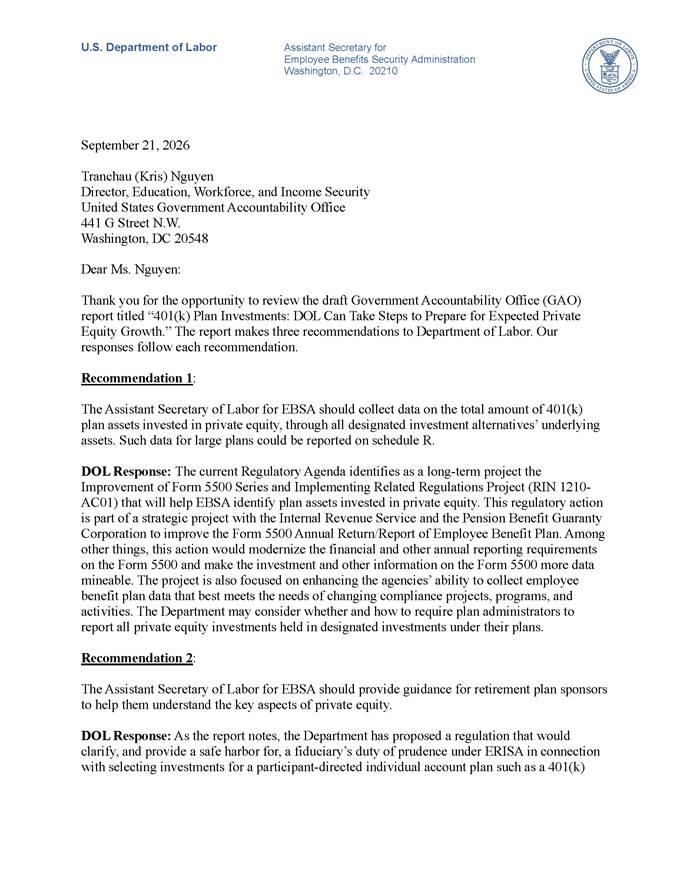
GAO Contact
Tranchau (Kris) T. Nguyen, Director, nguyentt@gao.gov
Acknowledgments
In addition to the contact named above, Tamara Cross (Assistant Director), Angie Jacobs (Analyst-in-Charge), Bailee Donahue, John Sanchez, and Stephen Yoder made key contributions to this report. Also contributing to the report were Andrew Bellis, Namita Bhatia-Sabharwal, John Bornmann, Abigail Loxton-Duan, Katherine McElroy, Mimi Nguyen, Jessica Orr, Lindsay Shapray, and Adam Wendel.
401(k) Plans: Industry Data Show Low Participant Use of Crypto Assets Although DOL’s Data Limitations Persist. GAO‑25‑106161. Washington, D.C.: November 19, 2024.
401(k) Retirement Plans: Department of Labor Should Update Guidance on Target Date Funds. GAO‑24‑105364. Washington, D.C.: March 28, 2024.
401(k) Retirement Plans: Many Participants Do Not Understand Fee Information, but DOL Could Take Additional Steps to Help Them. GAO‑21‑357. Washington, D.C.: July 27, 2021.
Defined Benefit Pension Plans: Recent Developments Highlight Challenges of Hedge Fund and Private Equity Investing. GAO‑12‑324. Washington, D.C.: February 16, 2012.
Defined Benefit Pension Plans: Plans Face Challenges When Investing in Hedge Funds and Private Equity. GAO‑11‑901SP. Washington, D.C.: August 31, 2011.
Defined Benefit Pension Plans: Guidance Needed to Better Inform Plans of the Challenges and Risks of Investing in Hedge Funds and Private Equity. GAO‑08‑692. Washington, D.C.: August 14, 2008.
The Government Accountability Office, the audit, evaluation, and investigative arm of Congress, exists to support Congress in meeting its constitutional responsibilities and to help improve the performance and accountability of the federal government for the American people. GAO examines the use of public funds; evaluates federal programs and policies; and provides analyses, recommendations, and other assistance to help Congress make informed oversight, policy, and funding decisions. GAO’s commitment to good government is reflected in its core values of accountability, integrity, and reliability.
Obtaining Copies of GAO Reports and Testimony
The fastest and easiest way to obtain copies of GAO documents at no cost is through our website. Each weekday afternoon, GAO posts on its website newly released reports, testimony, and correspondence. You can also subscribe to GAO’s email updates to receive notification of newly posted products.
Order by Phone
The price of each GAO publication reflects GAO’s actual cost of production and distribution and depends on the number of pages in the publication and whether the publication is printed in color or black and white. Pricing and ordering information is posted on GAO’s website, https://www.gao.gov/ordering.htm.
Place orders by calling (202) 512-6000, toll free (866) 801-7077,
or
TDD (202) 512-2537.
Orders may be paid for using American Express, Discover Card, MasterCard, Visa, check, or money order. Call for additional information.
Connect with GAO
Connect with GAO on X,
LinkedIn, Instagram, and YouTube.
Subscribe to our Email Updates. Listen to our Podcasts.
Visit GAO on the web at https://www.gao.gov.
To Report Fraud, Waste, and Abuse in Federal Programs
Contact FraudNet:
Website: https://www.gao.gov/about/what-gao-does/fraudnet
Automated answering system: (800) 424-5454
Media Relations
Sarah Kaczmarek, Managing Director, Media@gao.gov
Congressional Relations
David A. Powner, Acting Managing Director, CongRel@gao.gov
General Inquiries
[1]Exec. Order No. 14,330,90, Fed. Reg. 38,921 (Aug. 7, 2025).
[2]Investment Company Institute analysis of their own data and DOL data. Investment Company Institute, Quarterly Retirement Market Data, Third Quarter 2025 (Jan. 15, 2026).
[3]OCC is discussed in the report with regard to federally-regulated trusts, but is not described separately in the Background.
[4]2022 plan year data were the most current Department of Labor (DOL) data at the time we were developing our methodology. DC asset manager asset under management data are from “The Largest DC Managers,” Pensions & Investments, June 24 (2024): 15–16.
[5]According to DOL’s website, the private pension plan research files correct many statistically important logical and arithmetic data inconsistencies that remain after completion of electronic processing. These corrections contribute to a 2-year lagged release of data.
[6]A CIT (also called Collective Investment Funds, Commingled Funds, Common Trust Funds, or Collective Trusts) is defined as a pooled investment vehicle that combines the money of multiple investors into a single portfolio with a specific investment strategy and is available to individual investors only through qualified retirement plans, like 401(k)s.
[7]Based on Form 5500 Private Pension Plan Research File data obtained from the DOL’s website as of 2021 plan year-end.
[8]A TDF is an investment option available in 401(k) plans that invests in a mix of stocks, bonds, and other investments that automatically rebalance to become more conservative as a participant gets closer to retirement. TDFs are typically structured as mutual funds and refer to the target retirement date in the name of the fund. In this case, TDFs in the 2060 series refer to funds with a target retirement date of 2060. A closed-end fund (or closed-end investment company) is generally registered with the SEC and subject to SEC regulation. A closed-end fund invests the money it raises from investors, often in an initial public offering, in stocks, bonds, money market instruments, and other securities. We considered closed-end fund disclosures as illustrative of how private equity information might be communicated.
[9]We selected funds in the 2060 series because dates further into the future may be more likely than those with nearer dates to have a larger allocation to equities or longer-term investments, which may include private equity. Fund family size is based on Morningstar reporting. The three selected fund families had about $1.085 trillion in total assets, making up about 61 percent of the total target date mutual fund market at year-end 2023. Morningstar, 2024 Target-Date Strategy Landscape (Chicago: 2024).
[10]The Form N-PORT is used by certain SEC registered funds to file reports of monthly portfolio holdings.
[11]Because data and investment information on CITs are not available to the public, we relied on the primary federal regulator, the Office of the Comptroller of the Currency (OCC), for information on the funds.
[12]Bank assets used for state selection were as of the third quarter of 2024. The four states with the largest amount of bank assets for the period included Ohio, South Dakota, North Carolina, and New York. Maryland was also selected because one of the largest CIT providers is chartered in that state, according to the state regulator’s website. One other state regulator from New York responded that they do not collect the type of information that would be responsive to our interview questions.
[13]The term “private equity” is often used to refer to private equity funds specifically and to the investment strategies they use. However, for the purposes of this report, we consider private equity funds one form of a broader term, private equity, referring to equity investments in companies that are not listed on public markets.
[14]In technical comments provided on a draft of this report, SEC officials stated that these private equity fund data include private credit funds. SEC reports private equity fund and venture capital fund data separately, but we combined them here because we have included venture capital in our definition of private equity fund. Securities and Exchange Commission, Private Fund Statistics, Form PF and Form ADV Data, Second Calendar Quarter 2025. Form PF currently captures private funds reported by RIA Private Fund Advisers with at least $150 million in private fund assets under management. Form PF would not include smaller private fund advisers or private funds advised by Exempt Reporting Advisers.
[15]According to SEC officials, private credit funds may also report as private equity funds on Form PF. Prior GAO work examined defined benefit retirement plan investments in hedge funds and private equity. GAO, Defined Benefit Pension Plans: Guidance Needed to Better Inform Plans of the Challenges and Risks of Investing in Hedge Funds and Private Equity, GAO‑08‑692 (Washington, D.C.: Aug. 14, 2008). Ongoing GAO work is looking at the role of private credit in financial markets.
[16]GAO, Defined Benefit Pension Plans: Recent Developments Highlight Challenges of Hedge Fund and Private Equity Investing, GAO‑12‑324 (Washington, D.C.: Feb.16, 2012).
[17]According to SEC officials, most private equity funds are restricted to qualified clients, which is a higher threshold for investment than the accredited investor standard.
[18]Pub. L. No. 111-203, § 403, 124 Stat. 1376, 1571 (2010).
[19]The SEC requires the Form PF disclosure to be submitted by an SEC-registered investment adviser, who acted as an investment adviser to at least one private fund; and who had at least $150 million in private fund assets under management at the end of the last fiscal year.
[20]World Bank Group, “World Federation of Exchanges (WFE) Listed domestic companies, total - United States,” Data Catalog. Accessed September 25, 2026. In 2025, there were 3,908 publicly traded companies. Listed domestic companies, including foreign companies which are exclusively listed, are those which have shares listed in an exchange at the end of the year. A company with several classes of shares is counted once. Private company data are from the Census Bureau’s “2022 County Business Patterns and Economic Census.” Data from 2022 were the most recent available as of September 2026.
[21]In this case, the responsible bank or trust acts as the fiduciary and holds legal title to the CIT assets.
[22]The OCC seeks to ensure that national banks and federal savings associations operate in a safe and sound manner, provide fair access to financial services, treat customers fairly, and comply with applicable laws and regulations.
[23]CITs offered by state-chartered banks or other institutions are regulated by federal banking regulators or state banking regulators, depending on the institution’s charter.
[24]12 C.F.R. § 9.18(b).
[25]See 29 U.S.C. § 1002(21) (defining fiduciary).
[26]Further, we have reported that 401(k) participants bear investment risk for their account. GAO, 401(k) Plans: DOL Could Take Steps to Improve Retirement Income Options for Plan Participants, GAO‑16‑433 (Washington, D.C.: Aug. 9, 2016).
[27]We have reported that TDFs are widely offered by 401(k) plans and have become the most popular investment option used by participants. GAO, 401(k) Retirement Plans: Department of Labor Should Update Guidance on Target Date Funds, GAO‑24‑105364 (Washington, D.C., Mar. 28, 2024).
[28]Generally, plans with 100 or more participants file Form 5500 and plans with fewer participants file Form 5500-SF, an abbreviated form.
[29]DOL, the Internal Revenue Service, and the Pension Benefit Guaranty Corporation jointly developed the Form 5500 Series to satisfy annual reporting requirements for employee benefit plans under ERISA and the Internal Revenue Code. This framework is further intended to give participants, beneficiaries, and regulators access to sufficient information to protect the rights and benefits of participants and beneficiaries. As such, Form 5500 filings serve as a research tool for DOL and other federal agencies, Congress, and the private sector to assess employee benefit, tax, and other economic trends and policies.
[30]DOL, “Information Letter to Jon W. Breyfogle” June 3, 2020, https://www.dol.gov/agencies/ebsa/about-ebsa/our-activities/resource-center/information-letters/06-03-2020.
[31]In 2021, DOL issued a Supplemental Statement that emphasized that the 2020 letter was not an endorsement of plans selecting investment products with allocations to private equity, among other things. DOL, “U.S. Department of Labor Supplement Statement on Private Equity in Defined Contribution Plan Designated Investment Alternatives,” Dec. 21, 2021 https://www.dol.gov/agencies/ebsa/about-ebsa/our-activities/resource-center/information-letters/06-03-2020-supplemental-statement. In August 2025, the DOL withdrew the 2021 Supplemental Statement.
[32]91 Fed. Reg. 16,088 (Mar. 31, 2026).
[33]The eight large asset managers described here include two that provided limited written responses, in addition to six that we interviewed. Brokerage windows, referred to by a variety of names, including brokerage accounts and self-directed brokerage windows, are arrangements under which 401(k) participants may select investments beyond those on the plan investment menu. GAO, 401(k) Plans: Industry Data Show Low Participant Use of Crypto Assets Although DOL’s Data Limitations Persist, GAO‑25‑106161 (Washington, D.C.: Nov. 19, 2024).
[34]According to the OCC, 2.5 percent of the CIT’s assets were invested directly in private equity. The asset manager defined private equity investment as the direct exposure to an individual private company, not an investment in a private equity fund or fund of funds. As a result, the count does not include or account for other ways in which a trust may be exposed to private equity.
[35]One of the plan sponsor groups we interviewed did not discuss the commonality of private equity in 401(k) plans.
[36]Plan Sponsor Council America (PSCA), “Plan Sponsor Interest in Alternatives, Private Equity, ESG, and More,” Question of the Week, Nov. 18, 2024. (2024). PSCA asked their plan sponsor members whether they had added or considered adding (to their plan menu) environmental, social, and governance funds, private equity, other alternatives, in-plan annuities, and managed accounts.
[37]PSCA, 67th Annual Survey of Profit Sharing and 401(k) Plans. (2024: Arlington, Va.).
[38]In 2024, DOL officials told us that they had observed very little allocation to private equity among 401(k) plan investments and that they had only observed private equity in CITs and mutual funds. As of 2026, the DOL confirms that they have not observed substantial changes in investment in private equity by 401(k) plans.
[39]Plan year 2023 was the first year that new regulatory guidance from DOL went into effect, allowing DC plan filers with fewer than 100 participants with account balances at the beginning of the year to file as a small plan (Form 5500-SF or Form 5500 with Schedule I) and receive a plan audit waiver. DOL’s 2023 Form 5500 Private Pension Plan Research File, however, still used end of the year participant counts to define small plan size. DOL defines large plans as those plans that covered 100 or more participants as of the beginning of the plan year.
[40]According to comments received from DOL, some small plans may file the Form 5500 Schedule H and report assets on the “Other” line. The number of small 401(k) plans reporting assets in “Other” on the Schedule H for data from 2023 is about 40 plans.
[41]Non-discrimination rules for retirement plans are established in ERISA and the Internal Revenue Code and require that benefits, rights, and features provided under a plan not discriminate in favor of highly compensated employees. In particular, Treasury regulations clarify that the right to a particular form of investment is a right or benefit that must be made available in a nondiscriminatory manner. 26 C.F.R. § 1.401(a)(4)-4(e)(3).
[42]See 17 C.F.R. § 230.501(a). According to SEC officials, many private equity funds require investors to be “qualified purchasers” which is generally a higher standard than “accredited investor.”
[43]SEC Office of the Investor Advocate, Exploring Accredited Investors and Private Market Securities Ownership, June 2025, OIAD Working Paper 2025 No. 1. https://www.sec.gov/files/exploring-accredited-investors-june-2025.pdf.
[44]Separately Managed Accounts are investment services under which investment advisers make investment decisions for specific participants to allocate their retirement savings among a mix of assets they have determined to be appropriate for the participant based on their personal information.
[45]Our analysis is limited to SEC registered open-end funds which can include mutual funds and exchange traded funds.
[46]Data from the Form N-PORT are derived from information provided by individual registrants. As described above, we considered private equity to include both private equity funds and private securities in operating companies that are not publicly traded on a stock exchange or otherwise registered with the SEC. Our analysis of investment by publicly-traded registered funds limits investments in private securities to equities issued by companies with no indication of trade on a stock exchange and that have no valuation or are valued at level 3.
[47]See Appendix I for detail on the types of investment entities and valuation methods we used to estimate allocations that may be private equity. We previously recommended that DOL add fund tickers to the list of investment information required in plan disclosures. GAO, 401(k) Retirement Plans: Many Participants Do Not Understand Fee Information, but DOL Could Take Additional Steps to Help Them, GAO‑21‑357 (Washington, D.C.: Jul. 27, 2021).
[48]SEC officials noted that target date funds can also be organized as collective investment trusts generally not regulated by the SEC.
[49]These TDFs were from the largest target date fund families by assets under management as of year-end 2023, which we selected because they are likely to be in 401(k) plan investment menus. From the largest families, we selected the 2060 vintage TDF. In prior work, we reported that in “through” glide path type TDFs the allocations to “other,” which may include private equity, generally increased as they neared, reached, then passed the target date. See GAO-24-105364.
[50]Byung Hyun Ahn, Kaitlin Hendrix, and Namiko Saito, “Hiding in Plain Sight: Private Asset Exposure Through Public Equities” link, Dimensional Fund Advisors, Jan. 2026.
[51]ERISA requires a plan’s annual report to include a financial statement that contains a statement of the assets and liabilities of the plan aggregated by categories and at their current value. 29 U.S.C. § 1023(b)(3)(A).
[52]Generally banks or trust companies report CIT holdings to the DOL as a Direct Filing Entity (DFE).
[53]Approximately 47 percent (25,951of 54,983) of large 401(k) plans that submitted the Schedule H—generally, those with more than 100 participants—have investments in CITs as of 2023, based on GAO analysis of Form 5500 Private Pension Plan Research File data for end of plan year 2023.
[54]The Form 5500 instructions permit brokerage window assets in the other category unless the investment are loans, partnership or joint-venture interests, real property, employer securities, or investments that could result in a loss more than the account balance of the participant or beneficiary who directed the transaction.
[55]This category of hard-to-value assets is described as those for which the value is not obtained from an established market, like a public stock exchange, or from a third-party appraiser. A private equity fund’s value is typically an estimate provided by the fund’s general partner.
[56]https://www.dol.gov/agencies/ebsa/employers-and-advisers/plan-administration-and-compliance/reporting-and-filing/form-5500.
[57]In 2016, DOL proposed changing the asset breakouts to the Schedule H for plans so that it would have a more accurate and detailed picture of the types of assets held by plans, including hard-to-value assets (such as private equity), alternative investments, and investments held in CITs. See 81 Fed. Reg. 47,496 (July 21, 2016). This proposal would have added a direct line for investments in private equity, but would not have provided data on underlying allocations to those assets. On December 29, 2021, DOL released final form revisions to address other proposals and did not implement changes to the Schedule H. 86 Fed. Reg. 73,976 (Dec. 29, 2021). DOL officials noted that the agency deferred other proposals for future rulemakings. As of June 2026, DOL has not proposed similar or additional changes to the Schedule H.
[58]Agency officials previously indicated that EBSA had been focusing its regulatory resources on the multiple regulatory, guidance, and report projects it was assigned under SECURE 2.0. GAO, 401(k) PLANS: Industry Data Show Low Participant Use of Crypto Assets Although DOL’s Data Limitations Persist, GAO‑25‑106161 (Washington, D.C.; Nov. 19, 2024). EBSA officials told us that the Form 5500 modernization project remains on the agency’s long-term regulatory agenda. EBSA has also been implementing section 101 of the Setting Every Community Up for Retirement Enhancement Act of 2019 (SECURE Act), as cited in the Dec. 2021 final forms revisions affecting MEPs and PEPs.
[59]A seventh, medium-sized, asset manager we interviewed said that their firm is not considering adding private equity to its 401(k) plan investment options.
[60]Certain stock indexes or investment funds will use market capitalization, the total value of a company’s outstanding shares of stock, to categorize companies by size. Large-capitalization (large-cap) equities or stocks generally refer to stock listings for companies with a market capitalization of $10 billion or more. Small-capitalization (small-cap) equities or stocks are generally companies with market capitalization of $250 million to $2 billion. Growth funds seek to invest in stocks whose earnings grow at a faster rate than the market average; value funds seek to invest in stocks that have a low price-to-earnings ratio, meaning they are cheaper to buy than stocks with a higher price-to-earnings ratio, in the hopes that the stock’s price will rebound.
[61]While these other investment options may present value in terms of diversification, each also is not without volatility and risk.
[62]The S&P 500, formally known as the Standard & Poor’s 500 Index, is a benchmark generally tracking the stock performance of the 500 largest publicly-traded companies in the U.S.
[63]In this case, lock-up period refers to the long-term capital commitment that an investor makes in a private equity fund. Often an investor cannot expect to see an investment return for several years.
[64]In technical comments provided on a draft of this report, DOL officials stated that a TDF’s ability to meet redemptions using an influx of new contributions requires careful stress testing and that participants may make redemptions during a market downturn at the same time that the assets intended to be liquid suffer significant losses, potentially leading to a liquidity crunch.
[65]This is not just an issue with funds holding illiquid assets; managers of funds with only liquid assets may also have to sell assets at a suboptimal time to ensure large-scale participant redemptions are satisfied.
[66]17 C.F.R. § 270.22e-4(b)(1)(iv). In addition, OCC regulations, which apply to CITs offered by national banks, require that withdrawals are facilitated within a one-year period, which is generally shorter than private equity funds’ long investment horizons. A bank may request the OCC’s approval for extensions to the standard withdrawal period. 12 C.F.R. § 9.18(b)(5)(iii).
[67]Morningstar, 2026 Target-Date Fund Landscape (Chicago: March, 2026).
[68]Specifically, we identified acquisition transactions between service providers and private equity firms from 2015 to 2025. We identified private equity firms using S&P Capital IQ and independently verified that they were private equity firms by conducting research on each identified firm’s website. These private equity firms typically act as general partner of a private equity fund and are responsible for sourcing investments and day-to-day operations of portfolio companies. In contrast, limited partners typically commit capital and are not responsible for the operations of portfolio companies. These were the service providers named most often among certain commonly reported service provider type codes in 2023 Form 5500 records for 401(k) plans.
[69]DOL, “Information Letter to Jon W. Breyfogle,” June 3, 2020, https://www.dol.gov/agencies/ebsa/about-ebsa/our-activities/resource-center/information-letters/06-03-2020; DOL, “U.S. Department of Labor Supplement Statement on Private Equity in Defined Contribution Plan Designated Investment Alternatives,” Dec. 21, 2021, https://www.dol.gov/agencies/ebsa/about-ebsa/our-activities/resource-center/information-letters/06-03-2020-supplemental-statement.
[70]Analyzing what impact these suggested changes would have on plan sponsors’ adoption of private equity in 401(k) plan investment options and if the specific changes are warranted was beyond the scope of this report.
[71]In March of 2026, DOL published a proposed rule to clarify, and provide a safe harbor for, a fiduciary’s duty of prudence under ERISA in connection with selecting plan investments (called designated investment alternatives) for a participant-directed individual account plan (e.g., a 401(k) plan), including asset allocation funds that include alternative assets like private equity. 91 Fed. Reg. 16,088 (Mar. 31, 2026).
[72]See Prohibited Transaction Exemption 77-4, 42 Fed. Reg. 18,732 (Apr. 8, 1977). This exemption prevents conflicts of interest charges when a plan fiduciary directs plan assets into funds they advise, by requiring, among other things, that the plan does not pay a “double” fee (i.e., the plan may not pay both a plan-level fee (investment management fee) and a fund-level fee (investment advisory fee). The exemption is available to all plans and their fiduciaries, as long as the terms and conditions are met.
[73]See 17 C.F.R. § 270.22e-4. These regulations are designed to promote effective liquidity risk management for open-end mutual funds, and, among other things, they generally limit a fund to investing no more than 15 percent of its net assets in illiquid investments.
[74]These numbers are based on GAO analysis of Form 5500 Private Pension Plan Research File data for plan years 2015 and 2023 for large 401(k) plans that submitted the Schedule H.
[75]DOL’s March 2026 proposed regulations state that a fiduciary must appropriately consider and determine that a designated investment alternative will have sufficient liquidity to meet the anticipated needs of the plan at both the plan and individual levels. In addition, the proposed regulations provide an example of when a fiduciary will be deemed to have met the consideration and determination requirements for an investment alternative that is not a mutual fund (such as a CIT), which includes obtaining a representation from the person managing the investment alternative that the investment alternative has adopted and implemented a liquidity risk management program that is substantially similar to a program that meets SEC liquidity requirements applicable to open-end mutual funds.
[76]In addition to an asset’s return performance, factors including volatility and correlation to other assets may also be relevant considerations when comparing investment alternatives. We limited our literature search to papers that addressed private equity fund investment performance and benchmarking that were published in 2015 or later with data at least as current as 2010. Through a multi-step, two-party review process, we limited the papers for analysis to those containing original analysis of actual private equity return data, which included buyout strategies, that compared the returns to a benchmark. We excluded papers with only projections and those defining private equity more broadly to include private credit, for example. See Appendix I for details.
[77]Robert S. Harris, Tim Jenkinson, Steven N. Kaplan, and Ruediger Stucke, “Financial Intermediation in Private Equity: How Well do Funds of Funds Perform?” Journal of Financial Economics, vol. 129, no. 2 (2018). This paper uses a public market equivalent approach to benchmarking private equity funds of funds returns to public market indices. A fund of funds is an actively managed fund made up of multiple investments in other funds. In this way an investor can invest once and gain exposure to more underlying investments. According to the paper, “by pooling capital across investors, (funds of funds) create a second level of intermediation that potentially provides specialized investment skills, diversification, and lower cost services (e.g., due to economies of scale) for investors wanting exposure to private equity. Against these advantages must be weighed the additional fees charged by the (funds of funds) manager.”
[78]Gregory W. Brown and Steven N. Kaplan, “Have Private Equity Returns Really Declined?” Journal of Private Equity, vol. 22, no. 4 (2019).
[79]Venture capital funds invest in young companies that often are developing a new product or technology. Private equity fund managers may provide expertise to a fledgling company to help it become suitable for an initial public offering. Gregory W. Brown, Wendy Y. Hu, and Jian Zhang “The Evolution of Private Equity Fund Value,” Journal of Alternative Investments, vol. 23, no. 4 (2021). Data are from Burgiss for 1,400 funds spanning 1987–2017.
[80]Alexander Beath and Christopher Flynn, “Benchmark the Performance of Private Equity Portfolios of the World’s Largest Institutional Investors: A View from CEM Benchmarking,” Journal of Investing, vol. 30, no. 1 (2020). The paper also acknowledged that returns on private equity (relative to other asset classes) have not been poor and exceeded those of most other asset classes over many periods of time. The private equity portfolio data used are primarily from private equity funds and funds of funds, while direct private equity investment and co-investment are less common.
[81]Alexander Rudin and Daniel Farley, “Public and Private Equity Returns: Different or Same?” Journal of Portfolio Management, February (2022). Volatility refers to the propensity of the price of an asset to move up or down over time; if the price of an asset moves up or down rapidly over a short period of time, it is considered to have higher volatility.
[82]As of the end of 2025, there were approximately 5,600 individual company stocks listed on major U.S. stock exchanges, with about 2,200 listed on the New York Stock Exchange and 3,400 listed on the Nasdaq Stock Market.
[83]Ilmanen, Chandra, and McQuinn, “Demystifying Illiquid Assets: Expected Returns for Private Equity.”
[84]DOL-IG, EBSA Needs to Provide Additional Guidance and Oversight to ERISA Plans Holding Hard-to-Value Alternative Investments, No. 09-13-001-12-121. The report discussed multiple alternative asset types, including private equity.
[85]Beath and Flynn, “Benchmarking the Performance of Private Equity Portfolios of the World’s Largest Institutional Investors: A View from CEM Benchmarking.”
[86]To calculate the NAV, liabilities are subtracted from assets. Public equities may also report NAV.
[87]Brian H. Boyer, Taylor D. Nadauld, Keith P. Vorkink, and Michael S. Weisbach, “Discount-Rate Risk in Private Equity: Evidence from Secondary Market Transactions,” Journal of Finance, vol. 73, no. 2 (2023).
[88]Arpit Gupta and Stijn Van Nieuwerburgh, “Valuing Private Equity Investments Strip by Strip,” Journal of Finance, vol. 76, no. 6 (2021). Phalippou, “An Inconvenient Fact: Private Equity Returns and the Billionaire Factory.”
[89]Boyer, Nadauld, Vorkink, and Weisbach, “Discount-Rate Risk in Private Equity: Evidence from Secondary Market Transactions” (2023). The authors constructed their estimates from secondary-market transaction prices, which may not capture all the risks faced by investors who commit capital to private equity funds at inception and hold those investments over the fund’s full life. The extensive initial due diligence when selecting a private equity fund as well as the ongoing monitoring required are other factors that an investor may consider when questioning whether private equity funds are worth the investment or can be replicated more efficiently with publicly traded equities, according to another study. Nicolas Rabener, “Private Equity is Still Equity, Nothing Special Here” Journal of Investing, vol. 30, No. 1 (2020).
[90]Committee on Capital Markets Regulation, “Expanding Opportunities for Investors and Retirees: Private Equity,” (Nov. 2018).
[91]According to Fidelity, compound returns is a concept that includes compound interest, but also extends to other types of investment returns, such as dividends and capital gains. This is commonly used in the context of stocks, mutual funds, and other types of investment vehicles. DOL describes internal rate of return as a type of capital-weighted return that calculates the return rate necessary to equate the invested capital with the present value of the assets.
[92]Rabener, “Private Equity is Still Equity, Nothing Special Here.”
[93]PME calculated by aligning a private equity fund’s cash flow—both contributions (capital calls) and distributions (returns to investors)—with the value of a chosen public market index on the same date. Each cash flow is then adjusted by the index’s performance from the cash flow date to the end of the analysis period. In addition, if the public market equivalent for a given private equity fund was less than one it would have underperformed the public market and if it was more than one it would have outperformed it.
[94]The fees an investor may expect to pay to invest in private equity can also differ depending on the investment method. One paper explained that institutional investors, like pension plans, may have sophisticated pension investment boards that can place direct investments in a private company, avoiding the high fees of a private equity fund of funds. Alexander Beath and Christopher Flynn, “Benchmarking the Performance of Private Equity Portfolios of the World’s Largest Institutional Investors: A View from CEM Benchmarking,” Journal of Investing, vol. 30, no. 1 (2020).
[95]Rudin and Farley, “Public and Private Equity Returns: Different or Same?” (2022).
[96]We previously reported on the wide gap between the investment performance among private equity funds at the top and bottom performance quartiles, meaning that investor outcomes vary, at least in part, depending on their ability to identify and access the higher performing funds. See GAO, Defined Benefit Pension Plans: Recent Developments Highlight Challenges of Hedge Fund and Private Equity Investing, GAO‑12‑324 (Washington, D.C.: Feb. 16, 2012). Defined benefit pension plan representatives that we interviewed for that report said that, because private equity performance varied widely, it was important to invest in the top performing private equity funds and they would not invest in private equity unless they could invest in funds considered to be in the top quartile for investment return performance.
[97]Mutual funds may use a range of performance benchmarks, according to fund characteristics like size and strategy. One consumer interest group representative that we interviewed said that private equity does not have comparable, reliable benchmarks that would make it possible to make comparisons with public markets.
[98]This requirement is found in item 27A(d) of Form N-1A. See SEC, Office of the Investor Advocate, How do Consumers Understand Investment Quality? The Role of Performance Benchmarks, April 2022, OAID Working Paper 2022-01. https://www.sec.gov/files/performance-benchmarks-2022-01.pdf.
[99]According to the S&P Dow Jones Indices website, the S&P 500 Index gauges large-cap U.S. equities and an estimated $13.5 trillion was indexed or benchmarked to the index, as of Dec. 31, 2020. The Russell 2000 Index is a stock market index of 2,000 small-cap, U.S.-based companies. Large-cap and small-cap stocks are not SEC classifications. According to its website, the MSCI World Index captures large- and mid-cap stock representation across 23 countries designated as developed markets, including the U.S..
[100]Erik Stafford, “Replicating Private Equity with Value Investing, Homemade Leverage, and Hold-to-Maturity Accounting,” Review of Financial Studies, vol. 35 (2022).
[101]In 2025, the MSCI World Index return was 21.6 percent. Public Employees Pension Plan (PEPP), Statement of Investment Policies and Goals. Last reviewed and approved March 26, 2025. The public DC plan was established by the Government of Saskatchewan and other participating public sector employers. According to the plan’s website, PEPP has over 75,000 participants and more than $13.7 billion Canadian assets under management. The plan is the largest DC plan in Canada based on assets.
[102]The expense ratio for the plan’s accelerated growth fund was 1.16 percent in 2025 and for the conservative fund it was 0.82 percent. For both plans, the target private equity allocation is 10 percent of total equity exposures, which began to build in 2020, with a maximum allocation of 13 percent and a minimum allocation of 0 percent. In June 2025, both funds’ mid-year after-fees returns outperformed their benchmarks, the accelerated growth fund by 0.7 percent and the conservative fund by 0.2 percent. As noted above, private equity is just one of many assets that make up these investment funds.
[103]See 29 C.F.R. § 2550.404a-5(d).
[104]See 29 C.F.R. § 2550.404a-5(d)(1)(iii) and (iv); DOL, Field Assistance Bulletin No. 2012-02R(1), Q-16 (July 30, 2012).
[105]See 29 C.F.R. § 2550.408b-2(c)(1)(iv).
[106]For this selected large 401(k) plan, the three fund investment options are structured as asset allocation funds, or funds with a mix of different assets such as equities, bonds, real assets, private equity, and money market funds. Real assets are generally defined as tangible or physical assets, such as real estate.
[107]For the purposes of this report, we considered two forms of private equity: private securities in operating companies that are not publicly traded on a stock exchange or otherwise registered with the SEC, and private equity funds, which are privately managed pools of capital that invest in privately offered, unregistered securities of operating companies that are not publicly traded on a stock exchange or otherwise registered with the SEC. There may be underlying private equity allocations within investment funds—including publicly-traded, SEC-registered funds—which invest directly or indirectly in one of the two forms of private equity investments listed above. For our purposes, private equity does not include other alternative investments like real estate, private credit, or hedge fund strategies.
[108]According to Morningstar data, the three largest selected TDF families structured as mutual funds make up about 61 percent of the $1.8 trillion total assets in TDFs structured as mutual funds, as of 2023 year-end.
[109]In technical comments provided on a draft of this report, SEC officials stated that if there was a material exposure to private equity, it would be stated in a fund’s prospectus. We did not examine N-PORT filings in this context, as 401(k) plan disclosures are required to refer to fund prospectuses for more investment detail, not to SEC N-PORT data.
[110]GAO selected three CITs with the highest allocation to private equity among large national banks, according to the OCC. The three selected CITs are not structured as, and do not include, TDFs.
[111]A closed-end fund (closed-end investment company) is generally registered with the SEC and, as such, is subject to SEC regulation. A closed-end fund invests the money it raises from investors, often in an initial public offering, in stocks, bonds, money market instruments and other securities. We selected two closed-end funds with the largest amount of total assets and estimated allocation to private funds and private companies, which are types of private equity, according to SEC Form N-PORT data as of 2024-year end.
[112]The annual and semiannual reports specifically described the type of private equity investment, the name of the investment or issuer, and the number of shares, valuation, and percent allocated to private equity out of total net assets.
[113]As noted earlier, plan sponsors generally invest in mixed asset funds and do not invest in private equity directly. Given that a 401(k) investor’s access to private equity is likely to be a small underlying allocation, the individual is not able to invest a significant part of their assets directly in a private equity fund.
[114]According to PSCA’s survey as of 2024, about 84 percent of 401(k) and other plan respondents retain an independent investment adviser to assist with fiduciary responsibility.
[115]DOL issued an Information Letter in 2020 explaining its view that a plan fiduciary does not violate their fiduciary duties under ERISA solely because they offer a professionally managed asset allocation fund with a private equity component as a designated investment alternative. In 2021, DOL issued a Supplemental Statement that emphasized that the 2020 letter was not an endorsement of plans selecting investment products with allocations to private equity, among other things. In August 2025, the DOL withdrew the 2021 Supplemental Statement. In addition, the preamble to DOL’s March 2026 proposed rule stated the Supplemental Statement was rescinded because it deviated from the DOL’s historically neutral and principles-based approach to fiduciary investment decisions, which it stated created a potentially costly chilling effect on the market. 91 Fed. Reg. 16,088 (Mar. 31, 2026).
[116]29 C.F.R. § 2550.404a-5.
[117]See 29 C.F.R. § 2550.404a-1.
[118]GAO, Standards for Internal Control in the Federal Government, GAO‑25‑107721 (Washington, D.C.: May 2025).
[119]29 U.S.C. §1135.
[120]29 C.F.R. § 2550.404a-5(a). ERISA also requires that DOL maintain an ongoing program of public outreach designed to promote retirement income savings through effective communication, including the creation of educational materials. 29 U.S.C. § 1146.
[121]GAO, Standards for Internal Control in the Federal Government, GAO‑25‑107721 (Washington, D.C.: May 2025).
[122]2022 plan year data were the most current Department of Labor (DOL) data at the time we were developing our methodology. Defined contribution (DC) asset manager asset under management data are from “The Largest DC Managers,” Pensions & Investments, June 24 (2024): 15–16.
[123]A target date fund is an investment option available in 401(k) plans that invests in a mix of stocks, bonds, and other investments that automatically rebalances to become more conservative as a participant gets closer to retirement. Target date funds are typically structured as mutual funds and refer to the target retirement date in the name of the fund.
[124]For the purposes of our review, the categories for the number of active participants were generally based on the DOL’s Abstract of 2023 Form 5500 Annual Reports. However, we consolidated the DOL’s number of active participant categories into three broad categories for our purposes to ensure a sufficient pool of plans to randomly select from within each category.
[125]Of the seven selected 401(k) plans, two responded via phone, two declined to schedule a meeting, and the remaining three did not respond.
[126]A closed-end fund (or closed-end investment company) is generally registered with the SEC and subject to SEC regulation. A closed-end fund invests the money it raises from investors, often in an initial public offering, in stocks, bonds, money market instruments, and other securities.
[127]One other state regulator from New York responded that they do not collect the type of information that would be responsive to our interview questions.
[128]According to available data, the four states overseeing the largest amount of bank assets as of the third quarter of 2024 were: Ohio, South Dakota, North Carolina, and New York.