
Report to Congressional Requesters
United States Government Accountability Office
A report to congressional requesters
Contact: Rachel Frisk at FriskR@gao.gov
What GAO Found
The Department of the Interior’s Office of Surface Mining Reclamation and Enforcement (OSMRE) was created under the Surface Mining Control and Reclamation Act of 1977 (SMCRA) to, among other things, administer programs for controlling the impacts of surface coal mining operations in the U.S. As of spring 2025, available data show there were over 5,000 permitted coal operations across 25 states and four Tribes. The majority of permits had no associated coal production since 2000, and about 35 percent of all permits were associated with sites in the process of being reclaimed.
In interviews and survey responses, stakeholders cited several challenges to ensuring timely reclamation of coal mine operations, including the capacity for overseeing and administering programs. From 2024 to May 2026, OSMRE’s staff decreased from 408 to 265, a reduction of 35 percent, primarily as a result of deferred resignations, a hiring freeze for the executive branch, and restructuring within the Department of the Interior. OSMRE officials indicated that staffing reductions have affected several aspects of its program oversight. However, Interior officials told GAO they did not conduct strategic workforce planning prior to these staffing reductions, and as of August 2026, had not assessed OSMRE’s future operational capacity. Without conducting strategic workforce planning to identify critical staff skills and competencies, OSMRE may face challenges fulfilling its oversight and regulatory program responsibilities.
OSMRE uses four performance measures to evaluate progress toward the SMCRA goals of protecting people and the environment and reclaiming mined lands. However, OSMRE does not have measures to identify the length of time it takes operators of non-producing mines to complete reclamation and return sites to beneficial post-mining uses—key information for determining which mines may risk financial exposure for the federal government or pose an environmental risk. In addition, since 2020, OSMRE has not issued a statutorily required annual report with information about activities conducted pursuant to SMCRA. OSMRE officials stated this is because they have had other priorities since that time. However, by not issuing annual reports, OSMRE is forgoing an opportunity to provide Congress with information about program performance nationwide that it could use to take actions to help OSMRE fulfill the goals of SMCRA and hold the agency accountable for results.
Why GAO Did This Study
As the nation relies less on coal, and coal consumption and production decline, concerns have been raised that operators of non-producing coal mines may delay or forgo reclaiming lands disturbed by mining operations. Unreclaimed mining sites create risks of environmental, health, and safety hazards, and delay returning lands to other productive uses, which can negatively affect local economies. OSMRE administers its Title V program to address the impacts of surface coal mining operations and ensure ongoing efforts to reclaim mined lands.
GAO was asked to examine OSMRE’s Title V program. This report discusses (1) information on the number of coal permits and selected characteristics of those permits; (2) regulatory authority officials’, Tribes’, and stakeholders’ views on challenges to ensuring timely reclamation of lands disturbed by mining operations; and (3) the extent to which OSMRE assesses and communicates progress toward meeting its reclamation goals.
GAO analyzed documents and data from OSMRE and state regulatory agencies responsible for implementing their own oversight programs. GAO surveyed and interviewed OSMRE officials, state regulatory and tribal officials, and environmental and industry stakeholders. GAO conducted site visits to Kentucky and Tennessee.
What GAO Recommends
GAO is making four recommendations, including that Interior (1) conduct strategic workforce planning related to OSMRE, and that OSMRE (2) develop performance measures and collect data to track the length of time to fully reclaim mines to beneficial uses; and (3) resume publishing annual reports. Interior did not provide comments on the report.
|
Abbreviations |
|
|
|
|
|
|
|
CFCMS |
Coal Fee Collection Management System |
|
|
FY |
fiscal year |
|
|
IMCC |
Interstate Mining Compact Commission |
|
|
OSMRE |
Office of Surface Mining Reclamation and Enforcement |
|
|
SMCRA |
Surface Mining Control and Reclamation Act of 1977 |
|
This is a work of the U.S. government and is not subject to copyright protection in the United States. The published product may be reproduced and distributed in its entirety without further permission from GAO. However, because this work may contain copyrighted images or other material, permission from the copyright holder may be necessary if you wish to reproduce this material separately.
October 15, 2026
The Honorable Jared Huffman
Ranking Member
Committee on Natural Resources
House of Representatives
The Honorable John Fetterman
United States Senate
The Honorable Donald S. Beyer Jr.
House of Representatives
The Honorable Morgan McGarvey
House of Representatives
The Honorable Alexandria Ocasio-Cortez
House of Representatives
For over a century, coal was a critical component of the U.S. economy used to power freight trains, generate electricity, and produce steel. Operating several decades before modern environmental standards were established, the early coal industry left behind an estimated 1.1 million acres of abandoned coal mine sites causing severe environmental damage and physical safety hazards. The Surface Mining Control and Reclamation Act of 1977 (SMCRA) was enacted to address the legacy of coal mining and help protect society and the environment from the adverse effects of surface coal mining into the future.[1] The Office of Surface Mining Reclamation and Enforcement (OSMRE) was established by SMCRA within the Department of the Interior to carry out the act’s requirements. OSMRE’s mission is, in part, to ensure that active coal mining is conducted in a manner that protects surrounding communities and the environment (known as the Title V program).[2]
Under the Title V program, mine operators must obtain permits for lands used for coal mining operations and are required to reclaim lands disturbed by activities associated with those permits.[3] SMCRA emphasizes contemporaneous reclamation in which operators restore one disturbed area of a mine as additional mining begins in another area. In this way, SMCRA requirements aim to help ensure that timely reclamation reduces the negative impacts of mining, rather than leaving mining lands disturbed for years before being restored.
To accomplish its goals nationwide, OSMRE relies on a system of cooperative federalism. Under this system, states and federally recognized Tribes that demonstrate the ability to manage a regulatory program that complies with all SMCRA requirements can be approved to regulate active coal mines on lands within their jurisdiction (including tribal, federal, state, and private lands).[4] These states and Tribes then become the primary regulator (known as the regulatory authority) for which OSMRE provides oversight.
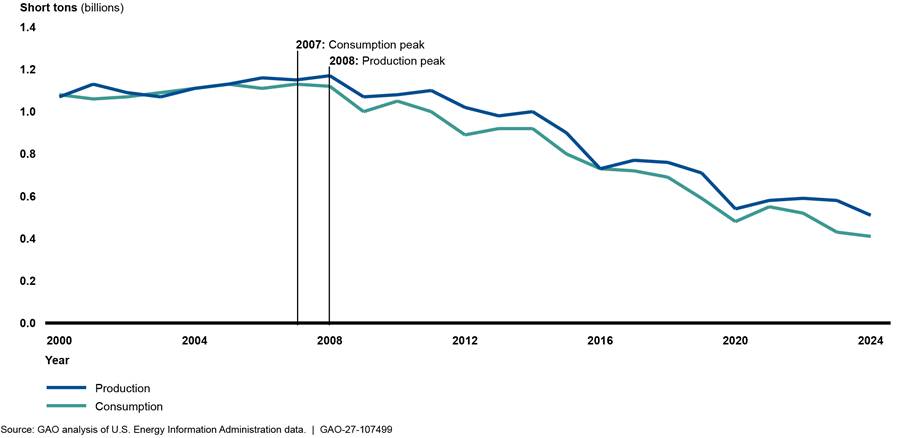
The nation’s shift toward other energy sources in recent years has led to a 64 percent decrease in coal consumption from its peak in 2007 through 2024.[5] Coal accounts for roughly 8 percent of our nation’s total energy production, as of 2024. As the nation increasingly relies on other sources for power, and coal demand and production decline, concerns have been raised about whether mine operators with declining revenue may delay reclamation or declare bankruptcy, and if SMCRA’s approach for ensuring timely reclamation will continue to work as intended.
You asked us to review issues related to coal mine reclamation and OSMRE’s Title V program, in light of the substantial changes in the coal industry since SMCRA was enacted. This report discusses (1) information on the number of coal permits and selected characteristics of those permits; (2) regulatory authority officials’, Tribes’, and selected stakeholders’ views on challenges to ensuring timely coal mine reclamation; and (3) the extent to which OSMRE assesses and communicates its progress toward meeting reclamation goals.
To determine the number and characteristics of coal permits, we used a data collection instrument to collect information from regulatory authorities for 24 states and four Tribes with coal permits. From each of their unique data systems, we obtained information about the size in acres, operational status, and location of each coal permit issued by regulatory authorities under SMCRA as of spring 2025.[6] To determine when permits last produced coal, we analyzed data from OSMRE’s Coal Fee Collection Management System (CFCMS) for January 2000 through December 2025.[7] We assessed the data we received from these sources, clarified discrepancies with regulatory authorities and OSMRE, and determined that the data were sufficiently reliable to report what is known about the current number of coal permits and selected characteristics of those permits. Appendix I contains additional information on the methodology we used to determine the number and characteristics of coal permits.
To identify regulatory authority officials’, Tribes’, and selected stakeholders’ views on challenges for ensuring timely reclamation, we administered a survey to state regulatory authorities and interviewed OSMRE officials from headquarters, its three regional offices, and seven field offices. We also interviewed officials from three of the four Tribes for which OSMRE separately manages the coal program, two nongovernmental environmental organizations knowledgeable on coal mining issues, the Interstate Mining Compact Commission (IMCC), a multistate governmental mining commission, and the National Mining Association.[8]
To determine the extent to which OSMRE assesses and communicates its progress toward meeting its reclamation goals, we reviewed relevant laws, regulations, agency performance measures, and guidance documents. We also gathered and analyzed relevant reports and studies, including OSMRE’s annual evaluation reports for states and Tribes. We interviewed OSMRE headquarters, regional, and field officials, and surveyed state regulatory authorities. We also interviewed Tribes and relevant stakeholders noted above. We evaluated OSMRE’s efforts to assess and communicate its performance against statutory requirements for the program and relevant Standards for Internal Control in the Federal Government.[9]
To support addressing all three objectives, we also conducted one site visit to locations in Kentucky and Tennessee to observe coal mine sites in various stages of production and reclamation, and to gain a better understanding of how OSMRE’s Title V program works.
We conducted this performance audit from April 2024 to October 2026 in accordance with generally accepted government auditing standards. Those standards require that we plan and perform the audit to obtain sufficient, appropriate evidence to provide a reasonable basis for our findings and conclusions based on our audit objectives. We believe that the evidence obtained provides a reasonable basis for our findings and conclusions based on our audit objectives.
Background
Coal Mining and Reclamation
The consumption and production of coal in the U.S. peaked in 2007 and 2008 respectively, and both consumption and production have declined by more than 50 percent since then, as coal-fired power plants across the nation were shut down and coal was replaced with other energy sources (see fig. 1). However, a recent executive order has aimed to remove federal regulatory barriers to mining coal and expand coal production to meet future energy needs.[10]
Note: A short ton of coal is a unit of weight equal to 2,000 pounds. Short tons are the standard unit of measurement for coal production and consumption in the U.S.
There are two main types and uses for coal: thermal coal used in electricity production, and metallurgical coal used in the production of steel. While thermal coal has many substitutes, there are fewer substitutes for metallurgical coal. In the U.S., metallurgical coal is sourced almost exclusively from the Appalachian Region and often exported to other steel-producing countries.
Operators extract coal through both surface and underground mines. In surface coal mining, before the underlying coal can be extracted, the land is cleared of forests or other vegetation, and topsoil is removed and stored for later use. Explosives or other techniques are then used to break up the overlying solid rock, creating dislodged earth, rock, and other materials known as spoil. Surface coal mines can cover an area of many square miles. In underground coal mining, tunnels are dug to access coal that is too deep for surface mining methods. In some cases, underground coal mines are designed to leave sufficient coal in the mine to provide support for the overlying surface land. In other cases, underground mines are designed to extract higher quantities of coal, resulting in subsidence, or gradual settling or sinking, of the overlying surface as mining progresses.
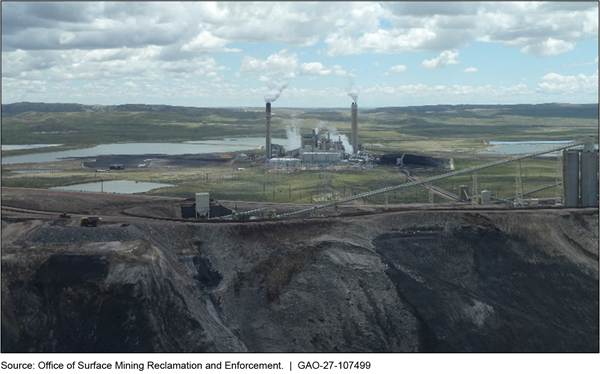
In addition to mines, coal mine operations also include facilities for processing or transporting coal (e.g., roads and preparation plants). SMCRA’s reclamation requirements apply to surface coal mines, surface effects of underground coal mines, and these other coal mining related structures, which we refer to as ancillary facilities. Figure 2 shows an example of a surface mine in Wyoming and an associated ancillary facility.
Coal mining by its very nature disturbs the land and creates the potential for environmental, human health, and safety hazards. For example, mining exposes minerals and heavy metals to air and water, resulting in a condition known as acid mine drainage, which can lead to long-term water pollution and harm some fish and wildlife species. To address these potential hazards, SMCRA requires mine operators to obtain a permit before starting to mine. The permit process requires operators to submit plans describing the extent of proposed mining operations and how and on what timeline the mine sites will be reclaimed. In general, an operator must reclaim the land to a use it was capable of supporting before mining, or to an alternative postmining land use that OSMRE or the state regulatory authority deems to be better than the pre-mining land use. In reclaiming a mine site, operators must comply with regulatory standards that govern, among other things, how the reclaimed area is regraded, replanting of the site, and the quality of water flowing from the site. Specifically:
· Operators are required to return mine sites to their approximate original contour.[11] To return sites to this contour, the surface configuration achieved by backfilling and grading of the mined area must closely resemble the general surface configuration of the land before mining and blend into and complement the drainage pattern of the surrounding terrain. In addition, all highwalls (cliffs of exposed rock and soil left behind after mining) and spoil piles (rock and other excavated material that is produced by mining) must be eliminated.
· Operators are also required to demonstrate successful revegetation of the mine site. States have requirements for what vegetation may be planted depending on the approved postmining land use.
· SMCRA also requires financial assurances (bonds) to be sufficient to ensure reclamation complies with applicable water quality standards, including those established by EPA or states under the Clean Water Act.[12]
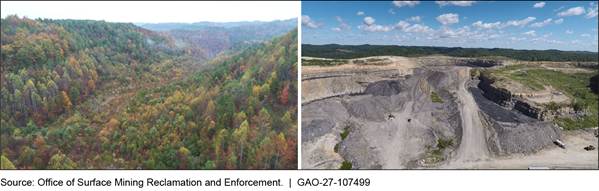
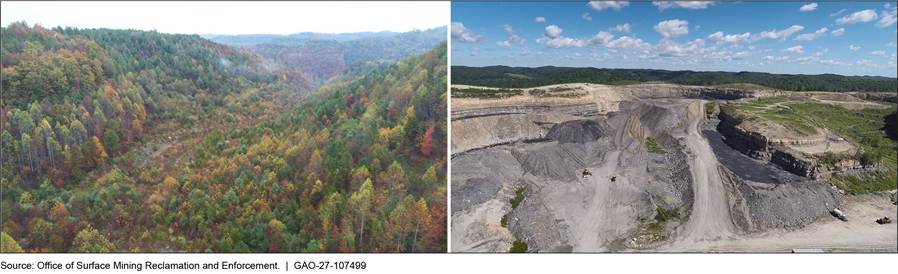
Figure 3 shows examples of reclamation and mining at mining sites in Appalachia.
SMCRA generally requires these bonds in an amount sufficient to ensure that adequate funds will be available for OSMRE or the state regulatory authority to complete reclamation if the operator does not do so. One way that regulators incentivize operators to complete reclamation is by releasing portions of bonds based on the extent to which an operator completes one of three phases of reclamation. To obtain a bond release, operators must perform reclamation work in accordance with permit standards and requirements of the act. SMCRA and its implementing regulations establish a sequence for bond release based on phases of reclamation work completed.
· Up to 60 percent of the bond amount may be released after the first phase of reclamation is completed, whereby the mined area is backfilled, regraded, and a drainage system reestablished.
· An additional portion of the bond may be released after the second phase of reclamation is completed, whereby vegetation such as grasses, shrubs, or trees have been seeded and established; and certain standards related to erosion or soil productivity are met.
· After all reclamation requirements of the act and permit are met and the revegetation time has expired—a minimum of 2 to 10 years depending on the post-mining use of the land and the amount of annual precipitation at a mine location—the regulatory authority may approve the final phase of bond release.
The Role of States and Tribes for Managing Coal Mine Reclamation
SMCRA specifies that the primary governmental responsibility for regulating surface mining and reclamation operations should rest with states.[13] To achieve and maintain primary regulatory responsibility, states must demonstrate that they are able to manage a coal mining regulatory program that complies with all SMCRA requirements, including the administrative capabilities and legal enforcement authority necessary to carry out the act. The Surface Mining Control and Reclamation Act Amendments Act of 2006 authorized Tribes to apply for and obtain primary regulatory authority, in whole or in part, for surface coal mining and reclamation operations on reservation land under the jurisdiction of the Tribe.[14]
Currently, 23 states and no Tribes have primary regulatory authority under SMCRA.[15] OSMRE acts as the regulatory authority for states and Tribes that do not have their own regulatory programs. Such states and Tribes include Oklahoma, Tennessee, Washington, the Crow Tribe, Hopi Tribe, Ute Mountain Ute Tribe, and the Navajo Nation.[16] Mining and reclamation issues often vary geographically. OSMRE is organized into three regions: the Appalachian Region, the Mid-Continent Region, and the Western Region (see fig. 4).
Figure 4: Regulatory Coal Programs by Office of Surface Mining Reclamation and Enforcement (OSMRE) Region
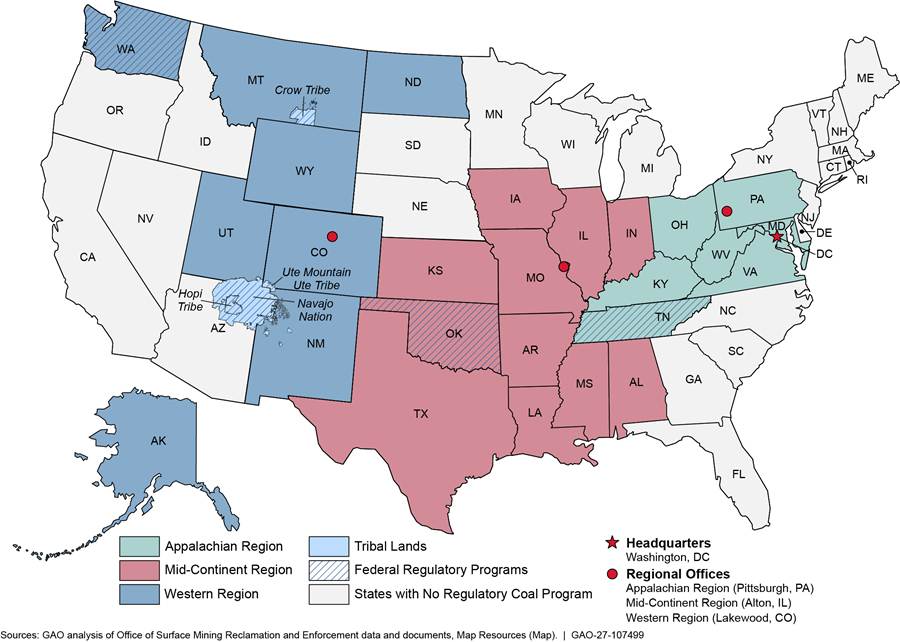
Note: OSMRE alternately reports that Oklahoma has regulatory authority under SMCRA and that it has a federal regulatory program. For purposes of this report, we have chosen to represent Oklahoma as having a federal regulatory program since OSMRE has jurisdiction over the only surface coal mining and reclamation activities in the state, which are on Indian lands in the eastern part of the state.
Components of Oversight
The regulatory authority for a particular state or Tribe is responsible for permitting surface coal mining operations, which include the mines themselves and any ancillary facilities associated with the mines.[17] A mining operation may have one or more permits. For inspection purposes OSMRE classifies operations as “inspectable units” that may consist of an individual permit or a consolidation of several permits issued to the same permittee, but which, for all practical purposes, constitutes the same operation. In this report, we refer to inspectable units as permits. The regulatory authority is required to conduct inspections of coal mining operations on a specified minimum frequency.[18] The number of required inspections, along with the number and size of inspectable units located in a state or on Indian lands, drive the inspection workload for the regulatory authority.
Regulatory authorities are to take enforcement actions to ensure operators address any violations. If a violation exists, regulators issue a notice of violation. If the violations are not corrected within a given time frame, a regulatory authority shall order that mine operations cease entirely or for the portion relevant to the violation. In addition, operators with outstanding violations may have their permits revoked and may not be able to receive new permits.[19]
As described in an OSMRE directive,[20] when a state or Tribe has primary regulatory authority for regulating coal mining and reclamation, OSMRE’s oversight of these regulatory authorities includes the following:
· Monitoring the state or Tribe, and conducting joint oversight inspections of a sample of surface coal mining and reclamation operations to ensure the state or Tribe is effectively implementing, administering, maintaining, and enforcing its state or Tribal program
· Ensuring the state or Tribe maintains its capability to fulfill SMCRA responsibilities
· Assisting the state or Tribe in implementing its responsibilities
· Reporting on the evaluation of the state or Tribal program
· Working with states and Tribes to resolve, in a reasonable and timely manner, program and implementation issues identified through oversight
· Providing support to states and Tribes as requested and needed
· Pursuing corrective actions provided under SMCRA, applicable federal regulations, and OSMRE policy if states or Tribes are not meeting program requirements.
OSMRE also developed a process for evaluating the administration, implementation, and maintenance of each regulatory program using annual performance agreements. These agreements detail the data that will be collected and the performance measures OSMRE will use to evaluate the extent to which the regulatory authority is meeting the primary objectives of its program.
If a regulatory authority fails to adequately implement, enforce, or maintain its approved program, OSMRE may initiate a formal process to withdraw approval for a state program and directly administer the program. For example, if a state is unable to fund its regulatory program or meet other SMCRA requirements due to budget constraints, OSMRE may assume either partial or full control of the program. However, a regulatory authority has opportunities to correct deficiencies before a program is withdrawn.
Of Over 5,000 Permits Related to Coal Mining, About Half Produced Coal Since 2000
Data from regulatory authorities identify 5,247 permits related to coal mining as of spring 2025, with 35 percent of permits in reclamation status and about half producing coal since 2000.
Available Data Identify 5,247 Coal Permits Across 25 States and Four Tribes, Varying in Acres Covered and Coal Produced
Data from regulatory authorities as of spring 2025 identify 5,247 permits related to coal mine operations covering approximately 2.5 million surface acres across 25 states and four Tribes. Mines accounted for 79 percent of all permits (47 percent surface, 31 percent underground, and 1 percent combined surface/underground).[21] Ancillary facilities accounted for 21 percent of all permits.
Ninety-one percent of coal permits (4,752) were located in the Appalachian Region. The remaining permits were located in the Mid-Continent Region (7 percent, or 367) and Western Region (2 percent, or 128). Three Appalachian states—Kentucky, Pennsylvania, and West Virginia—collectively manage over 80 percent (4,258) of the total permits nationwide. Figure 5 shows the number of permits in each state and Tribe, as of spring 2025, by OSMRE region.
Figure 5: Number of Permits in Each State and Tribe, as of Spring 2025, by the Office of Surface Mining Reclamation and Enforcement (OSMRE) Region
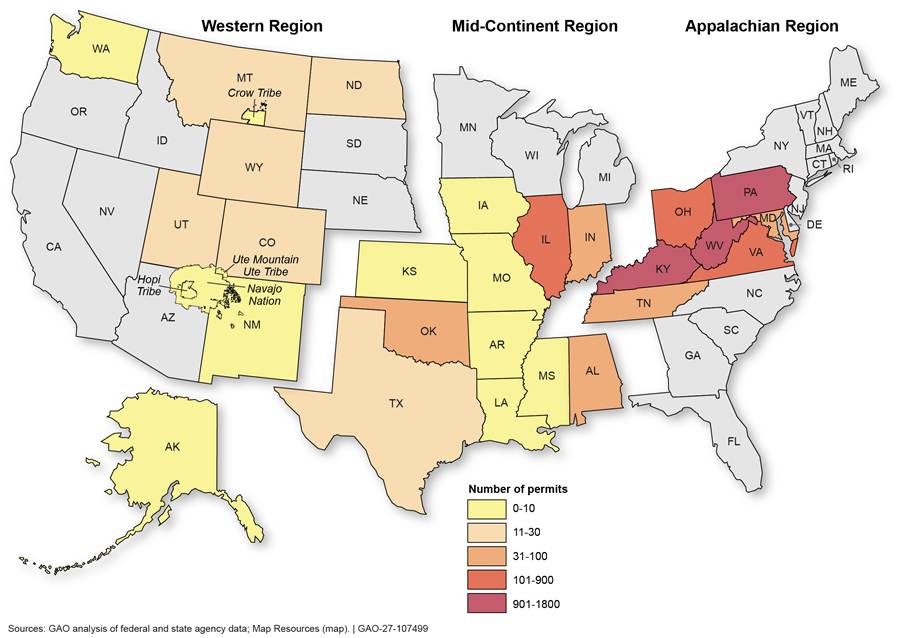
The number of permits associated with a state or Tribe does not correlate to the number of acres covered by mining operations or the amount of coal produced, due to differences in coal deposit formation and landscape variation. For example, as of spring 2025, Wyoming had 25 permits covering over 369,000 acres and was the top producer of coal, accounting for 37 percent of total U.S. coal production in 2024. In contrast, West Virginia had 1,758 permits as of spring 2025, covering a similar number of acres as Wyoming, yet accounted for 15 percent of total U.S. coal production in 2024. Figure 6 shows, by OSMRE Region, the number of permits and acres covered as of spring 2025, and 2024 coal production amounts. See appendix II for details on number and type of coal operation permits and acres covered by state and Tribe, as of spring 2025.
Figure 6: Number of Permits, Acres Covered, and Coal Production, by Office of Surface Mining Reclamation and Enforcement (OSMRE) Region, as of Spring 2025
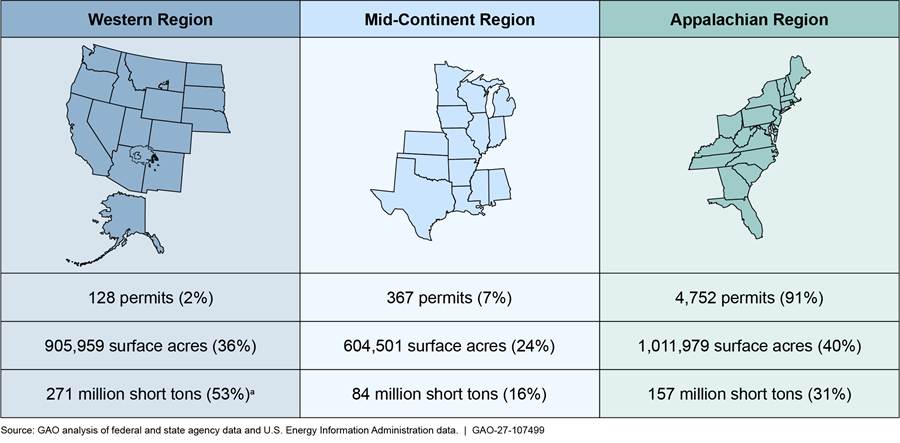
aU.S. coal production data listed above are for 2024. A short ton of coal is a unit of weight equal to 2,000 pounds. Short tons are the standard unit of measurement for coal production and consumption in the U.S.
One-Third of Permits Were in Reclamation and the Mid-Continent Region Had the Largest Proportion in Reclamation, as of Spring 2025
Our analysis of data from regulatory authorities indicates that, as of 2025, 35 percent of permits were in reclamation, meaning that reclamation on those permits was ongoing or complete. In contrast, 17 percent of permits were in bond forfeiture, indicating the operator failed to comply with reclamation requirements or other applicable terms and conditions of the permit. The remaining permits fell into the following categories: active, temporary cessation, non-disturbed, and other.[22] Table 1 shows each permit category and number of permits, as of spring 2025.
|
Permit category |
Number |
Description |
|
|
Reclamation |
1,838 (35 percent) |
Permits identified by the regulatory authorities as (a) having completed reclamation; (b) having completed reclamation but requiring long-term water treatment; or (c) being in one of the three phases of reclamation, where some proportion of the permit has been partially reclaimed and for which some of the operators’ bond was released. |
|
|
Active |
1,707 (33 percent) |
Permits identified by regulatory authorities as active, which included mines actively producing coal, mines not actively producing coal, or ancillary facilities not intended to produce coal. |
|
|
Forfeiture |
908 (17 percent) |
Permits identified by regulatory authorities as being in bond forfeiture, or in the process of bond forfeiture. For these permits, the operator failed to comply with reclamation requirements or other applicable terms and conditions of the permit, and the regulatory authority determined that enforcement actions have not been, or will not be, effective in ensuring compliance with SMCRA. According to OSMRE officials, no coal removal may occur when a bond is in the forfeiture process. |
|
|
Temporary cessation |
343 (7 percent) |
Permits where the operator has informed the regulatory authority of their intent to temporarily halt mining and reclamation operations. SMCRA and its implementing regulations do not require operators to conduct reclamation activities while in temporary cessation status, even if they remain in such status indefinitely. Operators are not relieved of their obligation to comply with the provisions of the approved permit during temporary abandonment. |
|
|
Non-disturbed |
258 (5 percent) |
Permits for which no coal mining or reclamation activities have started. |
|
|
Other |
193 (4 percent) |
Permits that were distinct from the categories listed above, including those that regulatory authorities identified as abandoned or suspended. |
|
|
Total |
5,247 |
|
Source: GAO analysis of federal and state agency data. | GAO‑27‑107499
The proportion of permits in each of the six categories varied across regions. For example, the Mid-Continent Region had a greater proportion of permits in reclamation compared to the Appalachian and Western Regions. The Western Region had the largest proportion of permits in the active category and the lowest proportion in bond forfeiture.
Figure 7 shows permit categories by OSMRE region, as of spring 2025. See appendix II for the permit categories by state and Tribe, as of spring 2025.
Figure 7: Permit Categories, by Office of Surface Mining Reclamation and Enforcement (OSMRE) Region, as of Spring 2025
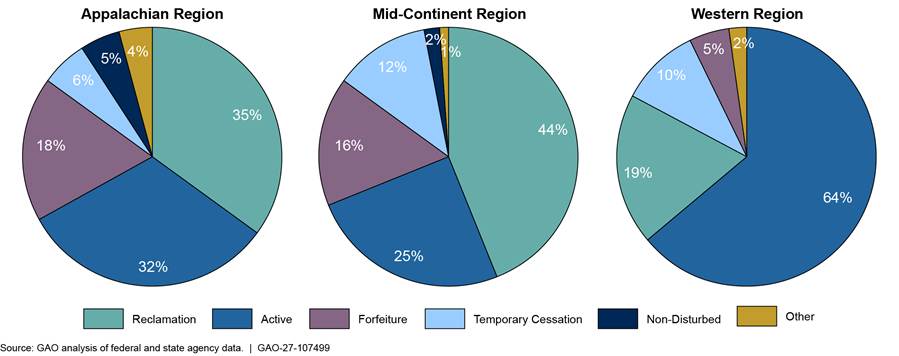
Note: Reclamation included permits that either completed reclamation or were in a phase of reclamation. Active included permits of mines producing coal, mines not producing coal, and facilities not intended to produce coal. Forfeiture included permits in bond forfeiture, or in the process of bond forfeiture. Temporary cessation included permits that temporarily halted mining activities. Non-disturbed included permits for which no coal mining or reclamation activities have started. Other included permits in some other status, such as abandoned or suspended.
Available Data Show Less than Half of the Permits Had Coal Production Since 2000
OSMRE collects quarterly data on coal production dating to 2000, and these data identify that 44 percent (2,311 of 5,247) of all permits last produced coal from 2000 through 2025.[23] Of those 2,311 permits,
· 843 last produced coal from 2000 through 2014,
· 474 last produced from 2015 through 2019, and
· 994 last produced from 2020 through 2025.
When comparing dates of last coal production across regions, the Western Region had a greater proportion of permits with reported coal production from 2020 through 2025, compared to other regions. In contrast, the Appalachian Region had the largest proportion of permits with no reported coal production since 2000. Table 2 shows the number and percentage of permits with dates of last coal production reported to OSMRE from 2000 through 2025, by OSMRE region.
Table 2: Number and Percentage of Permits with Dates of Last Reportable Coal Production, by Office of Surface Mining Reclamation and Enforcement (OSMRE) Region, 2000–2025
|
Region |
2020–2025 |
2015–2019 |
2000–2014 |
No reportable |
Total |
|
Appalachian |
838 (18%) |
402 (8%) |
749 (16%) |
2,763 (58%) |
4,752 (100%) |
|
Mid-Continent |
99 (27%) |
61 (17%) |
74 (20%) |
133 (36%) |
367 (100%) |
|
Western |
57 (45%) |
11 (9%) |
20 (16%) |
40 (31%) |
128 (100%) |
Source: GAO analysis of OSMRE Coal Fee Collection Management System data. | GAO‑27‑107499
Notes: OSMRE uses the Coal Fee Collection Management System to capture reportable coal production data from operators each quarter. The percentages may not total to 100 percent due to rounding.
According to our analysis, 56 percent (2,936 of 5,247) of permits had no associated coal production identified in OSMRE’s quarterly data on reportable coal production from 2000 through 2025.[24] While some of these permits were not expected to have reportable coal production, our analysis also suggests that hundreds of permits last produced coal over 25 years ago and have not been fully reclaimed. At the same time, the extent to which permits without recent production reflect potentially unaddressed reclamation liabilities is unclear based on the permit data alone, and OSMRE does not systematically track or document this information.
According to our analysis, the permits with no associated coal production from 2000 through 2025 fell into three categories:
· Thirty-five percent of the permits (1,029) were issued before 2000, and regulatory authorities identified these permits as mines in a category other than non-disturbed. As such, these permits may have previously produced coal but likely have not done so in decades. For example, data we received from regulatory authorities indicate that some permits in this group last produced coal in the 1990s. Of the 1,029 permits, 35 percent (359) were in reclamation, and 55 percent (570) were in bond forfeiture.[25] Regulatory authorities may initiate bond forfeiture when an operator fails to conduct approved reclamation activities, fails to abate a violation, or violates the terms and conditions of the permit. Many of these permits likely have not yet been fully reclaimed.
· Just over one-quarter of the permits (782) were issued after 2000 and showed no reportable coal production in OSMRE’s data based on our analysis but may have conducted some limited mining activities, according to data we received from federal and state regulatory authorities.
· Almost 40 percent of the permits (1,125) were not expected to have reportable coal production. These included permits that regulatory authorities identified as mines that were non-disturbed, and ancillary facilities not intended to produce coal. Although ancillary facilities are not expected to produce coal, some may require reclamation due to surface disturbance and to ensure the land is restored to a beneficial use.
Appendix II provides additional information about the date of last reportable production by state and Tribe, as of spring 2025.
Several Challenges Affect Timely Reclamation, Including Limited OSMRE and State Capacity
OSMRE officials, tribal officials, and stakeholders we interviewed, as well as state regulatory officials we surveyed, identified several challenges for ensuring timely reclamation of coal mine operations. These include limitations in OSMRE and state regulatory authority capacity for overseeing and administering programs and lengthy review times for proposed program changes that may affect reclamation. They also identified certain challenges to timely reclamation that some states have taken steps to address. These other challenges include the absence of required time limits for how long a permit may remain in temporary cessation, the extent to which the design of certain bonding mechanisms to ensure reclamation occurs, and the absence of required time frames for operators to release bonds on reclaimed lands.
OSMRE Workforce and Funding Reductions Have Diminished Regulatory Program Capacity
OSMRE Oversight Capacity
OSMRE officials we interviewed in about half of the bureau’s offices described staffing as a challenge they face in overseeing programs. From 2024 to May 2026, OSMRE’s staff decreased from 408 to 265, a reduction of 35 percent, primarily as a result of deferred resignations, a hiring freeze for the executive branch, and restructuring within Interior.[26] According to officials from several OSMRE offices, staffing reductions resulted in vacancies in several field offices, regional offices, and headquarters, including leadership positions.
OSMRE officials indicated that staffing reductions have affected several aspects of its Title V program oversight, including its capacity to provide technical assistance and training, monitor programs, and conduct national studies. Specifically, one of OSMRE’s key components of oversight is providing technical assistance and training for regulatory staff that help ensure states and Tribes have the skills and expertise to effectively operate their programs. Regulatory program officials from nearly half of the OSMRE offices and some state regulatory programs told us the SMCRA training programs have been particularly helpful to them, and in fiscal year 2024, OSMRE surpassed its performance target of training 500 individuals. However, with reductions in staff, OSMRE officials from nearly half of the offices told us that OSMRE has reduced its training capacity. According to OSMRE officials, travel restrictions and operational limitations influenced the agency’s training capabilities, and as a result, OSMRE instead provided greater online and self-paced training to state and tribal partners.
Another key component of OSMRE’s oversight is to monitor states and Tribes and jointly conduct oversight inspections of a sample of surface
|
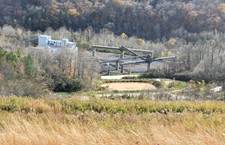
Inspection and Enforcement Challenges in Meeting the Goals of the Surface Mining Control and Reclamation Act (SMCRA) Officials with the Office of Surface and Reclamation Enforcement (OSMRE) described challenges they experienced in fulfilling their regulatory program duties for the permittee of a coal washing facility in Tennessee that has been idled since 2012. The permittee had become unresponsive to enforcement actions and had received 13 violations for not complying with permit requirements. The additional oversight and inspection of these operations required ever greater OSMRE attention, as the coal refuse from the plant consisted of elevated clay and iron levels and is located in close proximity to the New River. Photo of Idled Coal Operations in Tennessee Source: GAO. | GAO‑27‑107499 Source: GAO analysis of federal and state agency data. OSMRE officials told us they pursued almost every option and have exhausted many SMCRA enforcement tools to resolve concerns at this including issuing violations, abatement orders, and three bond forfeiture notices as of November 2025. As the operator appealed multiple determinations, OSMRE continued to inspect the site and discovered more violations. In the meantime, the nearby community and non-governmental organizations have expressed concerns about the potential for contamination of the river and significant harm to the environment. Source: GAO analysis of interviews with OSMRE officials. | GAO‑27‑107499 |
coal mining and reclamation operations. According to OSMRE headquarters officials, inspections have been unaffected by recent staff reductions, and in evaluation year 2025, which spans from July 1, 2024, through June 30, 2025, OSMRE met or exceeded its target of oversight inspections for all but four states with primary regulatory authority. However, going forward, officials we interviewed from several OSMRE offices said they anticipate a reduction in oversight capacity, which may include the number of oversight inspections that will be conducted each year due to resource constraints. The data for the evaluation year 2026 were not available at the time of this report.
Regarding studies, OSMRE policies establish a system of periodically conducting state and national studies to help ensure OSMRE has the information it needs to meet the goals established in SMCRA. OSMRE conducted special studies with many states from 2019 through 2024, including studies on stream sampling and groundwater monitoring, and bond adequacy to reclaim bond forfeited permits. OSMRE last conducted a national study in 2010, and regulatory authority officials identified a few areas in which a national study could help understand how changing conditions in the coal industry are affecting the program and identify potential solutions.[27] However, some officials told us that due to reductions in staff, OSMRE will likely not have capacity to conduct state or national studies in the future due to the significant resources they require and the need to prioritize oversight inspections.
OSMRE has multiple statutory responsibilities related to overseeing and administering state programs for controlling surface coal mining. However, Interior officials told us they did not conduct strategic workforce planning prior to the substantial workforce reductions that occurred from January through September 2025, and as of August 2026, had not assessed OSMRE’s future operational capacity. We have previously identified key principles that can enhance the effectiveness of an agency’s strategic workforce planning, including determining critical skills and competencies that it will require to achieve current and future programmatic results.[28] Without strategic consideration of staff resources moving forward, OSMRE will be challenged to fulfill its administration and oversight responsibilities in support of the goals of SMCRA, including ensuring timely reclamation and protecting the environment and the public from the adverse effects of surface coal mining operations.
State and Tribal Capacity
Officials from nearly all 23 state regulatory programs we surveyed identified funding constraints as somewhat or very challenging to administering their programs. State regulatory authorities, which manage 98 percent of the 5,247 permits, as of spring 2025, must demonstrate that they are able to manage and fund regulatory programs for surface coal mining and reclamation. Funding for state programs generally consists of federal regulatory grants and other sources, which may include state general funding, permit and production fees, and taxes on coal mining operators. However, federal regulatory grant funding to states and Tribes was reduced from $68.6 million in fiscal year 2021 to $63.7 million in fiscal year 2026.[29] For most states, the amount in federal regulatory grants a state is eligible to receive from OSMRE cannot exceed 50 percent of a state program’s total cost, and states generally request up to the maximum amount to support their regulatory programs.[30]
OSMRE requires states and Tribes to submit a current program budget 3 months prior to the beginning of the federal fiscal year for which a grant will be requested. OSMRE then conducts a detailed analysis of these program budgets and provides a regional recommendation. In recent years, states and Tribes have generally received less than that amount due to the overall reduction in regulatory grant funding.[31] Specifically, the funding gap between OSMRE’s recommended and actual tribal and primary state regulatory grant distribution has been increasing, as it grew from $4.2 million in fiscal year 2021 to $16.7 in fiscal year 2026. Due to this funding gap, in fiscal years 2025 and 2026, few states received 100 percent of the OSMRE recommended amount. In addition, roughly half of the Tribes and state regulatory programs received less than 80 percent of the OSMRE-recommended amount in fiscal year 2025, and roughly 70 percent received less than 80 percent of the OSMRE-recommended amount in fiscal year 2026 (see table 3). See appendix III for each state and Tribe’s fiscal year 2026 grant distribution compared to OSMRE’s recommended amount.
Table 3: Percent of Recommended Regulatory Grant Amounts the Office of Surface Mining Reclamation and Enforcement (OSMRE) Distributed for Tribes and State Regulatory Programs, Fiscal Years 2025 and 2026
|
|
Number of states and Tribes |
|
|
Percent of recommended amount received |
Fiscal year 2025 |
Fiscal year 2026 |
|
100% |
3 |
1 |
|
80–99% |
10 |
7 |
|
0–79% |
13 |
18 |
Source: GAO analysis of OSMRE data. | GAO‑27‑107499
Under SMCRA, state regulatory authorities must demonstrate that they have sufficient funding to carry out their programs, including securing other funding sources when regulatory grants do not match the amount requested. However, if states rely on coal production fees as part of their revenue stream, this source of funding has declined as coal production decreased over the last decade. For example, according to state regulatory officials in Louisiana, where two of the state’s three coal mines have stopped mining in the last few years, the state’s annual production tonnage decreased from a few million tons to less than 300,000 tons, drastically decreasing the associated production fees operators paid to the state.
If states are unable to carry out the responsibilities of SMCRA, OSMRE is required to assume responsibility of the program, which Interstate Mining Compact Commission officials we interviewed said could cost the federal government more than it would cost to increase the grant distribution. For example, in the 1980s, Tennessee decided it no longer wanted to implement a state program, repealed its surface coal mining laws and regulations, and effectively gave regulatory control back to OSMRE. OSMRE formally withdrew its approval of Tennessee’s program in 1984, and as a result, the federal government now pays the full cost of regulating surface coal mining and reclamation in Tennessee.
To date, other states have not repealed their primary regulatory status due to funding constraints or any other reason. However, according to Interstate Mining Compact Commission officials, the decline in coal production has counterintuitively increased the need for regulatory funding. Specifically, they said that states face growing difficulty securing compliance from mine operators whose revenue is shrinking and who must navigate complex bankruptcies. At the same time, the number of permitted operations that regulatory authorities must administer and inspect has not declined at the same pace as coal production—making it harder for states to effectively regulate the environmental impacts of a declining coal industry.
Lengthy Federal Review Times for Proposed State Regulatory Program Amendments Delay Program Improvements
The time it takes OSMRE to review state-proposed regulatory program amendments was identified as a challenge by over half of state regulatory authority officials we surveyed and over half of OSMRE regional and field office officials whom we interviewed. OSMRE regulations outline a process for reviewing proposed state program amendments. In its oversight role, OSMRE must review and approve any significant events or proposed changes which affect the implementation, administration, or enforcement of the approved state program. For example, OSMRE must review any changes in state laws or regulations that affect a state’s regulatory program to ensure the program will remain in compliance with minimum requirements outlined in SMCRA.
OSMRE must complete final action on all amendment requests within 7 months after receiving the proposed amendment from the state.[32] One OSMRE official we interviewed said that the timely processing of state program amendments ensures that each state has the real-time ability to tailor its approved program to changing conditions in its state, as Congress envisioned.
As of June 2026, 10 states were waiting for OSMRE’s approval of 32 program amendments, some of which had been in the review process for over a decade and are particularly relevant to timely reclamation, according to OSMRE officials. Officials we interviewed from the majority of OSMRE offices, as well as several of the states, attributed the lengthy review times to OSMRE’s review process, including review by OSMRE headquarters. According to officials from several state regulatory programs, these lengthy reviews can delay states from implementing initiatives, including those that their state legislatures or regulatory authorities have determined could improve timely reclamation.
In other instances, the delay in reviewing program amendments has affected the ability of states with primary regulatory authority to address problems that OSMRE has identified. For example, in 2008 and 2009, OSMRE identified the need for Colorado to revise its coal regulations in several areas. In response, Colorado officials developed proposed revisions to its regulations and submitted them to OSMRE for review and approval in 2011. However, OSMRE did not approve the changes until 2019. During the 8-year period of OSMRE’s review, Colorado’s revised regulations could not take effect, and Colorado continued to use the existing regulations that OSMRE had determined were inadequate 10 years earlier.
In the absence of timely OSMRE reviews of state program amendments, consistent with federal regulatory requirements, changes that could improve reclamation cannot take effect.[33]
Some States Have Taken Steps to Help Address Other Challenges to Ensuring Timely Reclamation
Permits in Temporary Cessation Status
Officials from several OSMRE offices identified the absence of limits on the length of time that permitted operations may remain in temporary cessation status as a challenge to timely reclamation. SMCRA and its implementing regulations do not specify a maximum amount of time permits may remain in temporary cessation status. While operators are not relieved of their obligations to comply with the provisions of their approved permit when they temporarily cease operations, operators are also not required to conduct reclamation activities while permits are in this status, even if they remain in such status indefinitely.[34] Officials from some OSMRE offices explained that some operators place permits in temporary cessation when temporarily halting coal production due to unfavorable market conditions, then move out of that status when more favorable conditions emerge. Officials said that other operators, however, do not restart operations even under better market conditions, and they instead keep permits in this status indefinitely and do not reclaim sites. While in temporary cessation status, the regulatory authority is required to continue inspecting the operations covered by the permit on a quarterly basis.[35]
As of spring 2025, 343 of the 5,247 permits were in temporary cessation status. Of those, 71 permits last reported coal production over 10 years ago, before the decline in coal demand, with some last reporting coal production over 20 years ago. For example, according to regulatory officials in Ohio, two of the 14 permits in temporary cessation status last reported coal production in the 1990s, and the regulatory authority continues to inspect the sites.
Some OSMRE officials we interviewed noted that the lack of a statutory or regulatory time limit for how long a permit may remain in temporary cessation increases the risk an operator may fail to reclaim a site. According to OSMRE officials, while there is little regulatory officials can do to force reclamation on those permits, they are obligated to investigate and issue violations if operators are out of compliance.
Because a goal of SMCRA is to ensure timely reclamation, placing time limits or requirements on permits in temporary cessation can help ensure that mines with no intention of continuing mining operations will be reclaimed. To that end, some state regulatory authorities have adjusted their temporary cessation requirements. For example, in Kentucky, operators must periodically notify the regulator that they will continue temporary cessation. In West Virginia, operators cannot have any outstanding violations and must be approved in order to obtain inactive status. In addition, operators can only be in temporary cessation for a limited amount of time, specifically half the amount of time of their original permit term.
Bonding Instruments
Officials from several OSMRE offices and each of the stakeholder groups told us that the design of certain bonding instruments permissible under SMCRA and used by some regulatory authorities may pose a challenge to completing reclamation. For example, regulatory authorities reported to us that in six states the operator’s bond amount did not cover the full cost of reclamation for over half of the 125 permits for which reclamation was completed from 2019 through 2024. In such cases, states used other state funds to complete reclamation.
SMCRA generally requires operators to submit a financial assurance in an amount sufficient to ensure that adequate funds will be available for OSMRE or the state regulatory authority to complete the reclamation if the operator does not do so. Regulatory officials in most states in the Western Region told us they required such full-cost bonds. In the two Western states where states completed reclamation for two permits from 2019 through 2024, the operators’ bonds covered the full cost of reclamation.
SMCRA also authorizes states to enact an OSMRE-approved alternative bonding system as long as the alternative achieves the same objectives. One kind of alternative bonding system is known as a bond pool. Under this type of system, the operator may post a financial assurance based on a per-acre assessment which may be less than the estimated cost of reclamation. The operator generally must also pay a fee for each ton of mined coal and may also be required to pay other types of fees. These funds are pooled and can be used to reclaim sites that participants in the alternative bonding system do not reclaim. Several states in the Appalachian Region use such alternative bonding systems. In West Virginia, where the state reclaimed 55 mines from 2019 through 2024, the bond amounts for 46 of those permits did not cover the full cost of reclamation, and the state used its Special Reclamation Fund to pay the $9 million cost not covered by operator bonds.[36]
See appendix IV for details about additional states where regulatory authorities reported completing reclamation for permits between fiscal years 2019 and 2024.
Bond Release
Regulatory authorities are to sequence the release of reclamation bonds to operators in phases of reclamation completion. However, the process of bond release is initiated upon the request of an operator, after which it is reviewed by the regulatory authority to ensure the operator has fully met their reclamation obligations.
Officials from several OSMRE offices we interviewed said that their inability to require operators to request bond release for permitted lands an operator has reclaimed creates challenges for ensuring those lands are made available for other uses. Moreover, regulators are required to continue oversight of the inspectable units associated with these lands, even if some of those lands meet or surpass site-specific reclamation requirements. According to officials from some OSMRE offices, some operators do not request bond releases of lands they have reclaimed, sometimes waiting several years after reclamation is completed and vegetation has been successfully reestablished.
According to one OSMRE official, historically, permittees were self-motivated to initiate this process so that they could re-invest in new coal mine endeavors, but with the overall decline in the coal industry, this is less of an incentive. Moreover, operators incur costs while preparing for bond release approval, such as those associated with completing vegetation surveys and other monitoring tests that regulatory authorities use to ensure the operator met all necessary requirements before releasing the bond. According to an OSMRE official, operators therefore may delay requesting bond release if the bond amount is less than the associated expenses and effort.
In response, some states have taken actions to incentivize operators to release bonds. For example, one OSMRE official explained that more operators in the West promptly request bond release because, as noted above, many western states require full cost reclamation bonding. Such bonding mechanisms can tie up a mine operator’s assets such as cash or collateral or require ongoing payment of bond premiums. In Louisiana, a statute enacted in 2019 charges a fee on each acre of permitted land. OSMRE officials told us that the fee encourages operators to apply for phased bond releases sooner, while also generating revenue for the state.
OSMRE Does Not Fully Assess or Communicate Progress Toward Meeting Its Reclamation Goals
OSMRE does not fully assess or communicate progress toward meeting its reclamation goals. OSMRE uses four primary performance measures linked to its strategic objectives to evaluate progress on minimizing the environmental impacts of coal mines and ensuring lands are restored to beneficial uses following mining. However, these measures do not help identify mining operations that may be at-risk for not being fully reclaimed by the operator. As a result, OSMRE does not have a complete picture of the status of reclamation nationwide. Furthermore, OSMRE stopped issuing annual reports in 2020, thereby limiting the information accessible to internal and external stakeholders about program progress, challenges, and potential solutions.
OSMRE Does Not Measure the Liability Risks of Non-Producing and Unreclaimed Mines
OSMRE uses four performance measures to evaluate the program’s strategic objectives of minimizing the impacts of mining on people and the environment and ensuring reclamation efforts restore mined lands to beneficial uses (see table 4). Appendix V lists these and other measures OSMRE uses to evaluate the performance of its Title V program and includes information on targets and results for each measure from fiscal years 2021 through 2025.
Table 4: Performance Measures for the Office of Surface Mining Reclamation and Enforcement’s (OSMRE) Title V Program
|
Strategic objective: To ensure that coal mine activities are operated in a manner that protects citizens and the environment during mining |
|
Performance measure: Percent of coal mining sites free of off-site impacts (e.g., blasting or water runoff that affect people or areas outside the permitted mine operations) |
|
Strategic objective: To ensure that the land is restored to beneficial use following mining |
|
Performance measures: Number of acres released from Phase I and II bondsa Number of acres released from Phase III bondsa Percent of bonded acres reclaimed to intended post-mining land usea, b |
Source: GAO analysis of OSMRE documents. | GAO‑27‑107499
aBonds are required to ensure that funds are available for reclamation in case the operator fails to reclaim the mined land. The operator must file an application for each of three release phases. The timing for requesting bond release is up to the coal operator.
bThis performance measure represents the ratio of the cumulative number of reclaimed acres released from Phase III bond requirements relative to the cumulative number of bonded acres for disturbance under permit since the Surface Mining Control and Reclamation Act was enacted in 1977. Forfeited acres are not included in this calculation because forfeited acreage is not released from phase III bonding requirements.
OSMRE officials from headquarters, regional, and field offices generally told us the performance measures were reasonable for evaluating the strategic objectives of the program. For instance, officials from some OSMRE field offices told us that measuring the percent of coal mining sites free of off-site impacts is a valuable indicator of the extent to which mining activities are conducted in an environmentally responsible manner. According to one OSMRE official, this measure adds an appropriate focus on impacts occurring outside the permitted bonded area that are not addressed by reclamation activities in the permitted bonded area (e.g., dust blowing off the property that can cause health issues, or flowing water that can cause erosion and sedimentation).
Officials from some OSMRE offices said the number of acres released by bonding phase is a practical measure for tracking land successfully reclaimed to pre-mining uses. For example, an official from one OSMRE office told us that measuring bond release, which occurs after reclamation has been completed, is appropriate given the Title V program’s objective of returning land to viable uses after coal is extracted.
However, in measuring reclamation success, OSMRE does not analyze the length of time between a mine’s date of last production and progress toward completing reclamation and returning the site to beneficial post-mining uses. As reported above, a sizeable proportion of mining permits last produced coal more than 10 years ago, and some permits have not produced coal since the 1990s. Until fully reclaimed, these lands can pose varying degrees of health, safety, environmental, and financial risks.
Moreover, as described above, the longer an operator goes without reclaiming lands on a non-producing permit, the greater the likelihood the operator may not have sufficient production revenues to fund reclamation or may declare bankruptcy. In these circumstances, the costs of reclamation may become a liability for the regulatory authority, according to officials from most OSMRE regional and field offices we interviewed and several state regulatory authorities we surveyed.
The mission and primary objectives of OSMRE’s Title V program are to ensure that coal mines are operated in a manner that protects citizens and the environment during mining, and that lands disturbed by mining are restored to beneficial use following the mining process. In addition, Standards for Internal Control in the Federal Government state that agency management should define objectives clearly to enable identification of risks and define risk tolerances. Agency management can do so by determining appropriate performance measures for evaluating those objectives.[37]
However, OSMRE’s performance measures do not evaluate mines at risk for not meeting reclamation goals. By not measuring the length of time between a mine’s date of last production and progress toward completing reclamation and returning the site to beneficial post-mining uses, OSMRE is missing key information on mines that may be at risk for not being fully reclaimed by the operator. Developing additional performance measures and collecting corresponding data to address this gap would help OSMRE better understand the non-producing and unreclaimed mines that may pose health, safety, and environmental risks as well as fiscal exposure risks for state regulatory authorities and the federal government. This information is helpful to ensuring the program achieves its intended goals. Moreover, such information would help OSMRE and regulatory agencies direct limited resources to address sites that are not being reclaimed and may pose the greatest risks.
OSMRE Is Not Meeting Statutory Requirements for Communicating National Results
As required by an OSMRE directive, for several decades, OSMRE has prepared an annual evaluation report for each state and Tribe that assesses program implementation and results.[38] These reports provide state- and tribal-specific information, including a summary of the state’s or Tribe’s coal mining industry and performance information, such as mining and reclamation status, inspection frequency, and program challenges. OSMRE officials emphasized the importance of state annual evaluation reports and the value of the information they contain for local stakeholders.
However, since fiscal year 2020, OSMRE has not issued its statutorily required annual report to the President and Congress summarizing activities conducted pursuant to the act and making recommendations for changes needed to accomplish its purposes.[39] OSMRE’s fiscal year 2020 report, as well as earlier annual reports, include data on federal funding, regulatory activities, and the performance of each state regulatory authority. OSMRE officials told us that the agency had not completed an annual report since 2020 because they have had other priorities since that time. In June 2026, OSMRE officials told us they were drafting the annual report focused on activities in fiscal year 2025.
Without OSMRE’s statutorily required annual reports, Congress, states, Tribes, and other stakeholders lack information necessary to understand program performance nationwide and make informed decisions about how to improve the program. Further, by not issuing the annual reports, OSMRE is forgoing an opportunity to inform Congress about program progress and challenges, which may support administrative or legislative actions to help the agency fulfill the goals of SMCRA and hold the agency accountable for results.
Conclusions
As the nation increasingly relies on other sources for power, and coal demand and production decline, concerns have been raised about whether the approach of coal mining with timely reclamation established in SMCRA is working as intended. Because declining coal production has reduced some operators’ revenues, operators may delay reclamation activities or possibly abandon mining sites entirely. State regulatory authorities are also collecting less in fees for permitting and production, leaving them with fewer resources to complete work necessary to ensure mining operations remain in compliance. This decline in fees is further compounded by reductions in OSMRE grant funding to regulatory authorities.
Recognizing that there have been and may continue to be substantial changes in the coal industry in the U.S., maintaining OSMRE’s ability to effectively oversee coal mine reclamation and report on program progress is critical. By ensuring it has sufficient staff resources with the necessary skills and competencies, OSMRE would be better positioned to fulfill its oversight responsibilities, including overseeing coal mine reclamation and completing timely reviews of proposed amendments intended to improve state programs. Without these resources, OSMRE will likely be unable to fully execute its statutory responsibilities and ensure the reclamation of mined lands to minimize the impacts of mining on the environment and the public and return them to beneficial uses.
By ensuring its performance measures fully capture reclamation efforts, including tracking the length of time between a mine’s date of last production and returning the site to beneficial post-mining uses, OSMRE would have more complete information about the status of reclamation nationwide, and be better positioned to issue statutorily required annual reports on the performance of the Title V program. Without this information, OSMRE, Congress, states, Tribes, and key stakeholders lack a complete picture of the program’s effectiveness and potential areas for improvement, which could inform administrative or legislative actions to support the goals of SMCRA.
Recommendations for Executive Action
We are making a total of four recommendations to Interior. Specifically:
The Secretary of the Interior should conduct strategic workforce planning related to OSMRE—particularly the Title V program to oversee active coal mines—that defines critical skills and competencies that will be required to meet its strategic program goals in the future. (Recommendation 1)
The Secretary of the Interior should direct the Director of OSMRE to take actions to improve its timeliness for reviewing proposed amendments to regulatory authority programs. (Recommendation 2)
The Secretary of the Interior should direct the Director of OSMRE to develop performance measures and collect corresponding data to track the length of time between a mine’s date of last production and progress toward completing reclamation and returning the site to beneficial post-mining uses. (Recommendation 3)
The Secretary of the Interior should direct the Director of OSMRE to resume publishing the required OSMRE annual nationwide performance report on the Title V program. (Recommendation 4)
Agency Comments
We provided a draft of this report to Interior for review and comment. Interior provided technical comments, which we incorporated as appropriate.
We are sending copies of this report to the appropriate congressional committees, the Secretary of the Interior, and other interested parties. In addition, the report will be available at no charge on the GAO website at https://www.gao.gov.
If you or your staff have any questions about this report, please contact me at FriskR@gao.gov. Contact points for our Offices of Congressional Relations and Media Relations may be found on the last page of this report. GAO staff who made key contributions to this report are listed in appendix VI.
Rachel Frisk
Acting Director, Natural Resources and Environment
Data Collection
To determine the number and selected characteristics of coal permits, we collected information through a data collection instrument. To ensure the questions on the instrument were understandable, we pretested the questions with federal and state regulatory officials from four states. We revised it based on their feedback. We also discussed available data with the Office of Surface Mining Reclamation and Enforcement (OSMRE) and with representatives of the Interstate Mining Compact Commission (IMCC), a multistate governmental mining commission.[40] We also met or corresponded with state regulatory authorities, as necessary, to increase consistency in data collected from each regulatory authority about the size in surface acres, operation type, and operational status of each coal permit subject to annual inspections under Surface Mining Control and Reclamation Act (SMCRA), as of spring 2025.[41] Twenty-two states with primary regulatory authority under SMCRA that OSMRE identified as having inspectable coal permits in 2025 and the three states and four Tribes with coal permits for which OSMRE directly manages the coal program responded to our data collection instrument.
To assess the reliability of the data states provided, we tested the data for accuracy by checking for missing data and errors, requested information about how the data are collected and maintained, and clarified discrepancies with regulatory authorities and OSMRE. We determined that the data were sufficiently reliable to report the number of coal permits and selected characteristics of those permits, as of spring 2025.
Data Analysis and Permit Matching
To determine the operational status of each permit, we analyzed data we received from regulatory authorities and assigned permits into relevant categories. Because regulatory authorities have different approaches for assigning permit statuses, the data we reviewed included over 100 unique permit statuses across 25 states and four Tribes. For example, some states use an overarching “active” permit status, but depending on the state, “active” does not consistently indicate if the permit is actively producing coal, active but not producing coal, in reclamation only, or some other status. We communicated with state regulatory authorities to obtain clarification on their permit statuses, reviewed permit definitions in documentation provided, and compared these statuses with those in OSMRE’s INE-23 directive.[42] We found that states’ permit statuses could generally be grouped into a smaller number of categories. For our report, we used the following categories: reclamation, active, forfeiture, temporary cessation, non-disturbed, and other, if permits could not be accurately grouped in the other categories. Although our categories may encompass a mixture of states’ permit status definitions, the categories allowed us to estimate the numbers of coal permits that were in various degrees of operational status nationwide at the time of our review.
Similarly, regulatory authorities have different approaches for assigning permit types, which are characteristics we considered to help understand whether a permit might have a history of coal production fees. For example, office buildings or support facilities such as haul roads might not ever report any coal production. To quantify permit types on a national level, we reviewed each permit type we received from regulatory authorities and sought clarifications from federal and state officials as necessary. We classified states’ and Tribes’ permit statuses into four categories: surface, underground, surface/underground, and ancillary facility.
To determine the date of last reportable coal production for coal permits, we analyzed data from OSMRE’s Coal Fee Collection Management System (CFCMS) for January 2000 through December 2025. OSMRE uses the CFCMS to capture reportable coal production data from operators each quarter, which the agency uses to determine reclamation fee payments. We used reportable coal production as an indicator of a permit’s date of last coal production. For permits with no reportable coal production since January 2000, we used permit issuance dates and operational status categories, as described above, to provide additional context about the extent to which they may have last produced coal or completed reclamation. To assess the reliability of the CFCMS data, we reviewed it for discrepancies and clarified discrepancies with OSMRE. We determined that the data were sufficiently reliable to report the date of last coal production for coal permits.
This appendix provides additional details about the 5,247 permits across 25 states and four Tribes, as of spring 2025.
Table 5 shows the number of permits and total surface acres for each state and Tribe, by Office of Surface Mining Reclamation and Enforcement (OSMRE) region, as of spring 2025.
Table 5: Number of Permits and Total Surface Acres for Each State and Tribe, by Office of Surface Mining Reclamation and Enforcement (OSMRE) Region, as of Spring 2025
|
Region |
State/Tribe |
Permits |
Surface
acres on |
Total surface acres |
|
Appalachian Region |
Kentucky |
1,565 |
156 |
321,246 |
|
Maryland |
44 |
— |
5,674 |
|
|
Ohio |
101 |
— |
41,646 |
|
|
Pennsylvania |
935 |
— |
240,569 |
|
|
Tennessee |
78 |
181 |
14,244 |
|
|
Virginia |
271 |
— |
64,878 |
|
|
West Virginia |
1,758 |
14 |
332,722 |
|
|
Appalachian totals |
|
4,752 |
351 |
1,011,979 |
|
Mid-Continent Region |
Alabama |
100 |
793 |
51,787 |
|
Arkansas |
5 |
— |
1,760 |
|
|
Illinois |
133 |
— |
54,173 |
|
|
Indiana |
48 |
— |
141,440 |
|
|
Kansas |
2 |
— |
1,959 |
|
|
Louisiana |
3 |
— |
23,489 |
|
|
Mississippi |
2 |
— |
9,936 |
|
|
Missouri |
5 |
— |
6,786 |
|
|
Oklahomaa |
43 |
4,816 |
14,042 |
|
|
Texas |
26 |
— |
299,130 |
|
|
Mid-Continent totals |
|
367 |
5,609 |
604,501 |
|
Western Region |
Alaska |
9 |
— |
12,363 |
|
Colorado |
25 |
57,116 |
162,808 |
|
|
Crow Tribe |
2 |
— |
10,549 |
|
|
Montana |
11 |
2,785 |
90,207 |
|
|
Navajo Nationb |
4 |
— |
46,831 |
|
|
New Mexicoc |
5 |
14,858 |
64,537 |
|
|
North Dakota |
20 |
18,016 |
136,466 |
|
|
Utah |
24 |
853 |
2,657 |
|
|
Ute Mountain Ute Tribe |
1 |
— |
23 |
|
|
Washington |
2 |
— |
10,196 |
|
|
Wyoming |
25 |
83,580 |
369,322 |
|
|
Western totals |
|
128 |
177,208 |
905,959 |
|
Totals |
|
5,247 |
183,168 |
2,522,439 |
— = No acres
Source: GAO analysis of federal and state agency data. | GAO‑27‑107499
aOSMRE alternately reports that Oklahoma has regulatory authority under SMCRA and that it has a federal regulatory program. For purposes of this report, we have chosen to represent Oklahoma as having a federal regulatory program since OSMRE has jurisdiction over the only surface coal mining and reclamation activities in the state, which are on Indian lands in the eastern part of the state.
bOSMRE has identified that one of the Navajo Nation’s surface mine permits has coal and mineral rights equally shared with the Hopi Tribe.
cData for 24 states and four Tribes were as of spring 2025; however, New Mexico provided data valid as of December 2024.
Table 6 shows the number of permits by operation type for each state and Tribe, by OSMRE region, as of spring 2025.
Table 6: Number of Permits by Operation Type for Each State and Tribe, by Office of Surface Mining Reclamation and Enforcement (OSMRE) Region, as of Spring 2025
|
Region |
State/Tribe |
Surface mine |
Underground mine |
Surface and underground mine |
Ancillary facility or other |
Total permits |
|
Appalachian Region |
Kentucky |
662 |
626 |
— |
277 |
1,565 |
|
Maryland |
31 |
6 |
— |
7 |
44 |
|
|
Ohio |
61 |
18 |
— |
22 |
101 |
|
|
Pennsylvania |
570 |
128 |
— |
237 |
935 |
|
|
Tennessee |
28 |
20 |
3 |
27 |
78 |
|
|
Virginia |
92 |
103 |
42 |
34 |
271 |
|
|
West Virginia |
710 |
599 |
— |
449 |
1,758 |
|
|
Appalachian totals |
|
2,154 |
1,500 |
45 |
1,053 |
4,752 |
|
Mid-Continent Region Mid-Continent Region |
Alabama |
78 |
15 |
— |
7 |
100 |
|
Arkansas |
4 |
1 |
— |
— |
5 |
|
|
Illinois |
46 |
75 |
1 |
11 |
133 |
|
|
Indiana |
37 |
11 |
— |
— |
48 |
|
|
Kansas |
1 |
— |
— |
1 |
2 |
|
|
Louisiana |
3 |
— |
— |
— |
3 |
|
|
Mississippi |
2 |
— |
— |
— |
2 |
|
|
Missouri |
5 |
— |
— |
— |
5 |
|
|
Oklahomaa |
38 |
4 |
— |
1 |
43 |
|
|
Texas |
26 |
— |
— |
— |
26 |
|
|
Mid-Continent totals |
|
240 |
106 |
1 |
20 |
367 |
|
Western Region Western Region |
Alaska |
6 |
1 |
— |
2 |
9 |
|
Colorado |
9 |
14 |
— |
2 |
25 |
|
|
Crow Tribe |
2 |
— |
— |
— |
2 |
|
|
Montana |
10 |
1 |
— |
— |
11 |
|
|
Navajo Nationb |
4 |
— |
— |
— |
4 |
|
|
New Mexicoc |
5 |
— |
— |
— |
5 |
|
|
North Dakota |
20 |
— |
— |
— |
20 |
|
|
Utah |
4 |
15 |
— |
5 |
24 |
|
|
Ute Mountain Ute Tribe |
— |
1 |
— |
— |
1 |
|
|
Washington |
2 |
— |
— |
— |
2 |
|
|
Wyoming |
22 |
— |
2 |
1 |
25 |
|
|
Western totals |
|
84 |
32 |
2 |
10 |
128 |
|
Totals |
|
2,478 |
1,638 |
48 |
1,083 |
5,247 |
— = No permits
Source: GAO analysis of federal and state agency data. | GAO‑27‑107499
aOSMRE alternately reports that Oklahoma has regulatory authority under SMCRA and that it has a federal regulatory program. For purposes of this report, we have chosen to represent Oklahoma as having a federal regulatory program since OSMRE has jurisdiction over the only surface coal mining and reclamation activities in the state, which are on Indian lands in the eastern part of the state.
bOSMRE has identified that one of the Navajo Nation’s surface mine permits has coal and mineral rights equally shared with the Hopi Tribe.
cData for 24 states and four Tribes were as of spring 2025; however, New Mexico provided data valid as of December 2024.
Table 7 shows the operational status of permits for each state and Tribe, by OSMRE region, as of spring 2025.
Table 7: Operational Permit Statuses for Each State and Tribe, by Office of Surface Mining Reclamation and Enforcement (OSMRE) Region, as of Spring 2025
|
Region |
State/Tribe |
Reclamation |
Active |
Forfeiture |
Temporary cessation |
Non-disturbed |
Other |
|
|
Appalachian Region |
Kentucky |
446 |
347 |
461 |
97 |
72 |
142 |
|
|
Maryland |
11 |
24 |
6 |
2 |
1 |
— |
||
|
Ohio |
47 |
28 |
— |
14 |
12 |
— |
||
|
Pennsylvania |
367 |
361 |
133 |
59 |
15 |
— |
||
|
Tennessee |
25 |
24 |
19 |
2 |
— |
8 |
||
|
Virginia |
16 |
168 |
6 |
34 |
11 |
36 |
||
|
West Virginia |
742 |
581 |
217 |
78 |
140 |
— |
||
|
Appalachian totals |
|
1,654 |
1,533 |
842 |
286 |
251 |
186 |
|
|
Mid-Continent Region |
Alabama |
34 |
29 |
20 |
13 |
4 |
— |
|
|
Arkansas |
— |
1 |
4 |
— |
— |
— |
||
|
Illinois |
62 |
40 |
7 |
22 |
1 |
1 |
||
|
Indiana |
20 |
14 |
— |
9 |
2 |
3 |
||
|
Kansas |
— |
— |
2 |
— |
— |
— |
||
|
Louisiana |
2 |
1 |
— |
— |
— |
— |
||
|
Mississippi |
1 |
1 |
— |
— |
— |
— |
||
|
Missouri |
4 |
1 |
— |
— |
— |
— |
||
|
Oklahomaa |
16 |
— |
27 |
— |
— |
— |
||
|
Texas |
21 |
5 |
— |
— |
— |
— |
||
|
Mid-Continent totals |
|
160 |
92 |
60 |
44 |
7 |
4 |
|
|
Western Region |
Alaska |
— |
5 |
1 |
3 |
— |
— |
|
|
Colorado |
3 |
15 |
3 |
2 |
— |
2 |
||
|
Crow Tribe |
— |
2 |
— |
— |
— |
— |
||
|
Montana |
2 |
8 |
— |
— |
— |
1 |
||
|
Navajo Nationb |
2 |
2 |
— |
— |
— |
— |
||
|
New Mexicoc |
3 |
2 |
— |
— |
— |
— |
||
|
North Dakota |
7 |
13 |
— |
— |
— |
— |
||
|
Utah |
— |
16 |
2 |
6 |
— |
— |
||
|
Ute Mountain Ute Tribe |
— |
1 |
— |
— |
— |
— |
||
|
Washington |
2 |
— |
— |
— |
— |
— |
||
|
Wyoming |
5 |
18 |
— |
2 |
— |
— |
||
|
Western totals |
|
24 |
82 |
6 |
13 |
— |
3 |
|
|
Totals |
|
1,838 |
1,707 |
908 |
343 |
258 |
193 |
|
— = No permits
Source: GAO analysis of federal and state agency data. | GAO‑27‑107499
aOSMRE alternately reports that Oklahoma has regulatory authority under SMCRA and that it has a federal regulatory program. For purposes of this report, we have chosen to represent Oklahoma as having a federal regulatory program since OSMRE has jurisdiction over the only surface coal mining and reclamation activities in the state, which are on Indian lands in the eastern part of the state.
bOSMRE has identified that one of the Navajo Nation’s surface mine permits has coal and mineral rights equally shared with the Hopi Tribe.
cData for 24 states and four Tribes were as of spring 2025; however, New Mexico provided data valid as of December 2024.
Table 8 shows the date of last reportable production of permits for each state and Tribe, by OSMRE region, as of fiscal year 2025.
Table 8: Date of Last Reportable Coal Production of Permits for Each State and Tribe, by Office of Surface Mining Reclamation and Enforcement (OSMRE) Region, 2000–2025
|
Region |
State/Tribe |
2020–2025 |
2015–2019 |
2010–2014 |
2005–2009 |
2000–2004 |
Total 2000–2025 |
|
Appalachian Region |
Kentucky |
192 |
95 |
60 |
34 |
27 |
408 |
|
Maryland |
23 |
6 |
2 |
1 |
2 |
34 |
|
|
Ohio |
25 |
23 |
13 |
4 |
3 |
68 |
|
|
Pennsylvania |
285 |
134 |
75 |
39 |
41 |
574 |
|
|
Tennessee |
2 |
4 |
9 |
2 |
1 |
18 |
|
|
Virginia |
54 |
33 |
24 |
11 |
4 |
126 |
|
|
West Virginia |
257 |
107 |
191 |
111 |
95 |
761 |
|
|
Appalachian totals |
|
838 |
402 |
374 |
202 |
173 |
1,989 |
|
Mid-Continent Region |
Alabama |
40 |
22 |
18 |
3 |
3 |
86 |
|
Arkansas |
— |
2 |
— |
1 |
— |
3 |
|
|
Illinois |
21 |
17 |
14 |
10 |
7 |
69 |
|
|
Indiana |
21 |
9 |
10 |
2 |
2 |
44 |
|
|
Kansas |
— |
— |
— |
1 |
— |
1 |
|
|
Louisiana |
2 |
1 |
— |
— |
— |
3 |
|
|
Mississippi |
1 |
1 |
— |
— |
— |
2 |
|
|
Missouri |
2 |
— |
— |
— |
— |
2 |
|
|
Oklahomaa |
4 |
2 |
— |
1 |
— |
7 |
|
|
Texas |
8 |
7 |
2 |
— |
— |
17 |
|
|
Mid-Continent totals |
|
99 |
61 |
44 |
18 |
12 |
234 |
|
Western Region |
Alaska |
2 |
— |
1 |
— |
— |
3 |
|
Colorado |
6 |
5 |
2 |
2 |
1 |
16 |
|
|
Crow Tribe |
2 |
— |
— |
— |
— |
2 |
|
|
Montana |
8 |
1 |
1 |
— |
— |
10 |
|
|
Navajo Nationb |
1 |
1 |
1 |
— |
— |
3 |
|
|
New Mexicoc |
3 |
— |
— |
— |
1 |
4 |
|
|
North Dakota |
7 |
— |
2 |
1 |
2 |
12 |
|
|
Utah |
11 |
3 |
1 |
2 |
— |
17 |
|
|
Ute Mountain Ute Tribe |
1 |
— |
— |
— |
— |
1 |
|
|
Washington |
1 |
— |
— |
1 |
— |
2 |
|
|
Wyoming |
15 |
1 |
1 |
1 |
— |
18 |
|
|
Western totals |
|
57 |
11 |
9 |
7 |
4 |
88 |
|
Totals |
|
994 |
474 |
427 |
227 |
189 |
2,311 |
— = No permits
Source: GAO analysis of OSMRE Coal Fee Collection Management System data. | GAO‑27‑107499
Note: OSMRE uses the Coal Fee Collection Management System to capture reportable coal production data from operators each quarter.
aOSMRE alternately reports that Oklahoma has regulatory authority under SMCRA and that it has a federal regulatory program. For purposes of this report, we have chosen to represent Oklahoma as having a federal regulatory program since OSMRE has jurisdiction over the only surface coal mining and reclamation activities in the state, which are on Indian lands in the eastern part of the state.
bOSMRE has identified that one of the Navajo Nation’s surface mine permits has coal and mineral rights equally shared with the Hopi Tribe.
cData for 24 states and four Tribes were as of spring 2025; however, New Mexico provided data valid as of December 2024.
Table 9 shows Office of Surface Mining Reclamation and Enforcement’s (OSMRE) fiscal year 2026 actual regulatory grant distribution compared with OSMRE’s recommended amount for Tribes and state regulatory programs.
Table 9: Office of Surface Mining Reclamation and Enforcement (OSMRE) Recommended and Actual Coal Regulatory Grant Distributions for Tribes and State Regulatory Programs, Fiscal Year 2026
|
State |
FY 2026 |
FY 2026 |
FY 2026
difference |
FY 2026
percent of |
|
Alabama |
$2,295,038 |
$1,792,774 |
$502,264 |
78% |
|
Alaska |
$468,010 |
$354,724 |
$113,286 |
76% |
|
Arkansas |
$156,651 |
$118,732 |
$37,919 |
76% |
|
Colorado |
$2,770,345 |
$2,629,522 |
$140,823 |
95% |
|
Crow Tribe |
$696,631 |
$539,355 |
$157,276 |
77% |
|
Hopi Tribe |
$394,889 |
$341,245 |
$53,644 |
86% |
|
Illinois |
$5,227,907 |
$3,962,446 |
$1,265,461 |
76% |
|
Indiana |
$1,371,298 |
$1,039,363 |
$331,935 |
76% |
|
Iowa |
$5,000 |
$5,000 |
$0 |
100% |
|
Kansas |
$25,731 |
$19,503 |
$6,228 |
76% |
|
Kentucky |
$17,169,590 |
$13,329,314 |
$3,840,276 |
78% |
|
Louisiana |
$310,740 |
$235,523 |
$75,217 |
76% |
|
Maryland |
$1,258,442 |
$953,825 |
$304,617 |
76% |
|
Mississippi |
$173,682 |
$131,641 |
$42,041 |
76% |
|
Missouri |
$290,384 |
$220,094 |
$70,290 |
76% |
|
Montana |
$3,181,537 |
$3,119,928 |
$61,609 |
98% |
|
North Dakota |
$1,361,855 |
$1,243,181 |
$118,674 |
91% |
|
Navajo Nation |
$2,470,604 |
$1,422,067 |
$1,048,537 |
58% |
|
New Mexico |
$1,174,343 |
$1,114,648 |
$59,695 |
95% |
|
Ohio |
$1,526,285 |
$1,156,834 |
$369,451 |
76% |
|
Oklahomab |
0 |
$0 |
$0 |
— |
|
Pennsylvania |
$15,608,507 |
$11,830,331 |
$3,778,176 |
76% |
|
Texas |
$3,117,945 |
$2,363,219 |
$754,726 |
76% |
|
Utah |
$2,503,631 |
$2,455,149 |
$48,482 |
98% |
|
Virginia |
$3,538,708 |
$2,682,133 |
$856,575 |
76% |
|
West Virginia |
$11,022,834 |
$8,387,543 |
$2,635,291 |
76% |
|
Wyoming |
$2,290,720 |
$2,251,906 |
$38,814 |
98% |
|
Total |
$80,411,307 |
$63,700,000 |
$16,711,307 |
79% |
— = No permits
Source: GAO analysis of OSMRE data. | GAO‑27‑107499
aOSMRE requires states and Tribes to submit a current program budget 3 months prior to the beginning of the federal fiscal year (FY) for which a grant will be requested. OSMRE then conducts a detailed analysis of these program budgets and provides a regional recommendation.
bIn 2021, OSMRE determined that Oklahoma could no longer implement SMCRA on Indian lands within the exterior boundaries of the Muscogee (Creek) Nation, Cherokee Nation, and Choctaw Nation of Oklahoma Reservations. These determinations were made consistent with McGirt v. Oklahoma, 591 U.S. 894 (2020), and related cases, which recognized the ongoing existence of these reservations. Notice of Decision, 86 Fed. Reg. 26941 (May 18, 2021); Notice of Jurisdiction, 86 Fed. Reg. 57854 (Oct. 19, 2021). Because these lands include all the surface coal mining and reclamation activities in the state, and because OSMRE is the regulatory authority on Indian lands for which Tribes have not developed a regulatory program, OSMRE has further determined that Oklahoma is not currently eligible to receive development or regulatory grants.
Table 10 shows the number of permits by state and Tribe and associated reclamation costs for permits where regulatory authorities reported completing reclamation from fiscal years 2019 through 2024.
Table 10: Number of Permits and Total Cost of Reclamation for Regulatory Authorities That Completed Reclamation on a Permit, by Office of Surface Mining Reclamation and Enforcement (OSMRE) Region, Fiscal Years 2019–2024
|
Region |
State/Tribe |
Number of permits reclaimed by the state |
Number of permits with bond inadequate to cover reclamation costs |
Reclamation cost with bond inadequate to cover reclamation costs |
Type of additional funds used to pay remainder of reclamation cost |
|
Appalachian Region |
Kentucky |
47 |
24 |
$6,134,058 |
Bond Pool Kentucky Reclamation Guaranty Fund |
|
Maryland |
1 |
1 |
$837,340 |
Bond Supplemental Reserve Fund |
|
|
Ohio |
— |
— |
— |
n/a |
|
|
Pennsylvania |
— |
— |
— |
n/a |
|
|
Tennesseea |
— |
— |
— |
n/a |
|
|
Virginia |
6 |
2 |
$678,380 |
No additional information provided |
|
|
West Virginia |
55 |
46 |
$9,038,287 |
West Virginia Special Reclamation Fund |
|
|
Appalachian totals |
|
109 |
73 |
$16,688,065 |
|
|
Mid-Continent Region |
Alabama |
5 |
1 |
$500,000 |
OSMRE Civil Penalty Grant Money |
|
Arkansas |
— |
— |
— |
n/a |
|
|
Illinois |
6 |
4 |
$12,810,087 |
OSMRE Abandoned Mine Land funding and OSMRE Supplemental Enforcement Fund |
|
|
Indiana |
— |
— |
— |
n/a |
|
|
Kansas |
3 |
— |
— |
n/a |
|
|
Louisiana |
— |
— |
— |
n/a |
|
|
Mississippi |
— |
— |
— |
n/a |
|
|
Missouri |
— |
— |
— |
n/a |
|
|
Oklahoma |
— |
— |
— |
n/a |
|
|
Texas |
— |
— |
— |
n/a |
|
|
Mid-Continent totals |
|
14 |
5 |
$13,310,087 |
|
|
|
|
|
|
|
|
|
Western Region |
Alaska |
— |
— |
— |
n/a |
|
Colorado |
1 |
— |
— |
n/a |
|
|
Crow Tribe |
— |
— |
— |
n/a |
|
|
Montana |
— |
— |
— |
n/a |
|
|
Navajo Nationb |
— |
— |
— |
n/a |
|
|
New Mexicoc |
— |
— |
— |
n/a |
|
|
North Dakota |
— |
— |
— |
n/a |
|
|
Utah |
1 |
— |
— |
n/a |
|
|
Ute Mountain Ute Tribe |
— |
— |
— |
n/a |
|
|
Washington |
— |
— |
— |
n/a |
|
|
Wyoming |
— |
— |
— |
n/a |
|
|
Western Totals |
|
2 |
— |
— |
|
|
Totals |
|
125 |
78 |
$29,998,152 |
|
— = No permits or cost n/a = Not applicable
Source: GAO analysis of federal and state agency data. | GAO‑27‑107499
aOSMRE identified 12 permits in Tennessee for which a surety reclamation agreement was reached and the permits did not enter into bond forfeiture.
bOSMRE has identified that one of the Navajo Nation’s surface mine permits has coal and mineral rights equally shared with the Hopi Tribe.
cData for 24 states and four Tribes were as of spring 2025; however, New Mexico provided data valid as of December 2024.
Table 11 shows the performance measures, targets, and
results the Office of Surface Mining Reclamation and Enforcement (OSMRE) uses
to evaluate the performance of its Title V program from fiscal years 2021
through 2025.
Table 11: Office of Surface
Mining Reclamation and Enforcement’s (OSMRE) Performance Measures, Targets, and
Results for its Title V Program, Fiscal Years 2021–2025
|
|
Fiscal year |
|||||
|
|
|
2021 |
2022 |
2023 |
2024 |
2025 |
|
Primary measures |
||||||
|
Percent of coal mining inspectable units free of off-site impacts |
Actual |
93.3% |
91.3% |
93.7% |
94.3% |
94.2% |
|
Target |
91.0% |
92.0% |
92.0% |
93.0% |
93.0% |
|
|
Number of acres released from Phase I and II bonds |
Actual |
50,555 |
74,570 |
50,062 |
89,027 |
81,155 |
|
Target |
65,736 |
64,655 |
66,654 |
63,524 |
63,400 |
|
|
Number of acres released from Phase III bonds |
Actual |
50,861 |
40,814 |
34,837 |
38,820 |
38,259 |
|
Target |
38,549 |
38,613 |
38,418 |
38,980 |
34,542 |
|
|
Percent of bonded acres reclaimed to intended post-mining land-use |
Actual |
44.9% |
46.6% |
47.5% |
48.4% |
49.2% |
|
Target |
44.6% |
46.0% |
47.6% |
48.4% |
49.2% |
|
|
Efficiency and other measures |
||||||
|
Provide appropriate grant funding within 60 days of a complete grant application for regulatory grants |
Actual |
100% |
96% |
92% |
100% |
92% |
|
Target |
96% |
96% |
96% |
96% |
96% |
|
|
Identify initial application deficiencies associated with minor permit revisions, permit renewals and significant permit revisions, and new permits in 30-60-90 in-house days respectively |
Actual |
79% |
93% |
97% |
100% |
98% |
|
Target |
73% |
70% |
70% |
70% |
70% |
|
|
Percent of forestry reclamation approach-compliant acreage planted (annually) |
Actual |
97% |
78% |
92% |
90% |
59% |
|
Target |
41% |
41% |
41% |
41% |
41% |
|
|
Training and technical assistance measuresa |
||||||
|
Customer service rate in the quality of technical assistance |
Actual |
97% |
100% |
100% |
95% |
100% |
|
Target |
97% |
97% |
97% |
97% |
97% |
|
|
Percent satisfaction with the scientific and technical products and assistance |
Actual |
100% |
100% |
100% |
96% |
100% |
|
Target |
97% |
97% |
97% |
97% |
97% |
|
|
Number of students trained—OSMRE’s National Technical Training Program (in-person only) |
Actual |
235 |
527 |
615 |
697 |
34 |
|
Target |
500 |
400 |
450 |
500 |
550 |
|
|
Customer effectiveness rate in the quality of technical training—OSMRE’s National Technical Training Program |
Actual |
94% |
95% |
97% |
94% |
97% |
|
Target |
93% |
93% |
93% |
93% |
93% |
|
|
Customer satisfaction in the quality and timeliness of Applicant Violator System provided services |
Actual |
97% |
98% |
98% |
99% |
99% |
|
Target |
96% |
96% |
96% |
96% |
96% |
|
|
Customer satisfaction rate for technical innovation and professional services training |
Actual |
98% |
97% |
100% |
97% |
95% |
|
Target |
96% |
96% |
96% |
96% |
96% |
|
|
Percent of target groups attending outreach training sponsored by Appalachian Regional Reforestation Initiative |
Actual |
61% |
36% |
27% |
21% |
18% |
|
Target |
12% |
12% |
12% |
12% |
12% |
|
Source: GAO analysis of OSMRE performance data. | GAO‑27‑107499
aThese measures evaluate training and technical assistance OSMRE provides to support both its Title V program as well as its Title IV program that addresses reclamation of abandoned mine lands.
GAO Contact
Rachel Frisk, FriskR@gao.gov
Staff Acknowledgments
In addition to the contact named above, Cardell D. Johnson (Director), Casey L. Brown (Assistant Director), Ulana M. Bihun (Analyst in Charge), Adrian Apodaca, Antoinette Capaccio, John Delicath, Adriana Derksen, Brian Hartman, Ryana Jones, Serena Lo, Joseph Maher, Tricia Moye, Jennifer Natoli, Jerome Sandau, and Swati Sheladia Thomas made key contributions to this report. Also contributing to this report were Jonathan Dent, Barbara Lancaster, Susan Murphy, Leslie Pollock, and Katrina Pekar-Carpenter.
The Government Accountability Office, the audit, evaluation, and investigative arm of Congress, exists to support Congress in meeting its constitutional responsibilities and to help improve the performance and accountability of the federal government for the American people. GAO examines the use of public funds; evaluates federal programs and policies; and provides analyses, recommendations, and other assistance to help Congress make informed oversight, policy, and funding decisions. GAO’s commitment to good government is reflected in its core values of accountability, integrity, and reliability.
Obtaining Copies of GAO Reports and Testimony
The fastest and easiest way to obtain copies of GAO documents at no cost is through our website. Each weekday, GAO posts on its website newly released reports, testimonies, and correspondence. You can also subscribe to GAO’s email updates to receive notification of newly posted products.
Connect with GAO
Connect with GAO on X,
LinkedIn, Instagram, and YouTube.
Subscribe to our Email Updates. Listen to our Podcasts.
Visit GAO on the web at https://www.gao.gov.
To Report Fraud, Waste, and Abuse in Federal Programs
Contact FraudNet:
Website: https://www.gao.gov/about/what-gao-does/fraudnet
Automated answering system: (800) 424-5454
Media Relations
Sarah Kaczmarek, Managing Director, Media@gao.gov
Congressional Relations
David A. Powner, Acting Managing Director, CongRel@gao.gov
General Inquiries
[1]Surface Mining Control and Reclamation Act of 1977, Pub. L. No. 95-87, 91 Stat. 445 (codified as amended at 30 U.S.C. §§ 1201-1328). SMCRA’s reclamation requirements apply to surface coal mines, surface effects of underground coal mines, and other coal mining related structures (e.g., roads).
[2]Section 201 of SMCRA (codified as amended at 30 U.S.C. § 1211). OSMRE’s primary objectives are (1) to ensure that coal mines are operated in a manner that protects citizens and the environment during mining and assures that the land is restored to beneficial use following mining (known as Title V); and (2) to mitigate the effects of past mining by aggressively pursuing reclamation of abandoned coal mines (known as Title IV). As we reported in 2018, in surface coal mining, before the underlying coal can be extracted, the land is cleared of forests and other vegetation, and topsoil is removed and stored for later use. Explosives or other techniques are then used to break up the overlying solid rock, creating dislodged earth, rock, and other materials known as spoil. Surface coal mines can cover an area of many square miles. GAO, Coal Mine Reclamation: Federal and State Agencies Face Challenges in Managing Billions in Financial Assurances, GAO‑18‑305 (Washington, D.C.: Mar. 6, 2018).
[3]In this report, we refer to both permittees and operators as operators. The permittee is the person or entity that holds the permit and is legally responsible for the permit, whereas the operator is the person or entity that conducts coal removal operations. The permittee and the operator may or may not be the same person or entity.
[4]As of September 2026, there were 575 federally recognized Tribes in the contiguous U.S. and Alaska, which we refer to as Tribes in this report. 91 Fed. Reg. 4102 (Jan. 30, 2026). The federal government recognizes these Tribes as distinct, independent political entities that possess certain powers of self-governance and maintains government-to-government relations with them. Federally recognized Tribes are eligible to apply to regulate, in whole or in part, surface coal mining operations on reservation land under the Tribe’s jurisdiction. 30 U.S.C. § 1300(j)(1)(A).
[5]Congressional Research Service, U.S. Coal Industry Trends, R48587 (Washington, D.C.: June 30, 2025).
[6]Data for 24 states and four Tribes were as of spring 2025; however, New Mexico provided data valid as of December 2024. Iowa has primary regulatory authority but has no coal permits therefore it was excluded from the data collection instrument.
[7]OSMRE uses the CFCMS to capture reportable coal production data from operators each quarter, which the agency uses to determine reclamation fee payments. We used reportable coal production as an indicator of a coal operation’s last coal production and refer to reportable coal production as coal production in this report.
[8]The Interstate Mining Compact Commission is a multi-state governmental organization supporting the natural resource and related environmental protection and mine safety and health interests of its member states.
[9]GAO, Standards for Internal Control in the Federal Government, GAO‑25‑107721 (Washington, D.C.: May 2025).
[10]Exec. Order No. 14261, Reinvigorating America’s Beautiful Clean Coal Industry, 90 Fed. Reg. 15517 (Apr. 14, 2025).
[11]An operator may receive a variance for this requirement from the regulatory authority.
[12]The Clean Water Act is codified at 33 U.S.C. §§ 1251–1388.
[13]SMCRA states that “because of the diversity in terrain, climate, biologic, chemical, and other physical conditions in areas subject to mining operations, the primary governmental responsibility for developing, authorizing, issuing, and enforcing regulations for surface mining and reclamation operations subject to this act should rest with the States.” 30 U.S.C. § 1201(f).
[14]Pub. L. No. 109-432, div. C., tit. II, § 209, 120 Stat. 2922, 3019 (codified at 30 U.S.C. § 1300(j)(1)(A)).
[15]On its website, OSMRE alternately reports that a 24th state, Oklahoma, has both a state regulatory authority and a federal regulatory program. While Oklahoma does technically have an approved state regulatory program, OSMRE has determined that Oklahoma can no longer implement SMCRA on any of the lands that include active surface coal mining and reclamation activities in the state. It made this determination in response to McGirt v. Oklahoma, 591 U.S. 894 (2020), and related cases, which recognized the ongoing existence of the Muscogee (Creek) Nation, Cherokee Nation and Choctaw Nation of Oklahoma Reservations. Because OSMRE is the regulatory authority on Indian lands for which Tribes have not developed a regulatory program, there is effectively no state program in Oklahoma. Accordingly, for purposes of this report, we have chosen to represent Oklahoma as having a federal regulatory program.
[16]OSMRE also administers coal mining and reclamation operations on certain tribal lands within Oklahoma, including for the historical Muscogee (Creek), Cherokee, and Choctaw reservations. We identify other Tribes separately in figure 4 because they are managed by OSMRE separately from the programs of the states in which they are located, whereas OSMRE administers all coal mining and reclamation operations in Oklahoma. States without any surface coal mining and reclamation activities do not have regulatory programs under SMCRA.
[17]30 U.S.C. §§ 1267, 1291(28).
[18]For example, the state regulatory authority is to conduct an average of at least one partial inspection per month of each active surface coal mining and reclamation operation under its jurisdiction, and such partial inspections of each inactive operation as are necessary to ensure effective enforcement. Under the regulations, a partial inspection is an on-site or aerial review of compliance with some of the permit conditions and requirements imposed under the approved state program. The state regulatory authority is to conduct an average of at least one complete inspection per calendar quarter of each active or inactive surface coal mining and reclamation operation under its jurisdiction. The state regulatory authority is to conduct such additional inspections of coal explorations as are necessary to ensure compliance with the approved state program. 30 C.F.R. § 840.11.
[19]A key tool and source of data that OSMRE, regulatory authorities, and Tribes use to track violations is the Applicant Violator System.
[20]Department of the Interior, Office of Surface Mining Reclamation and Enforcement, Oversight of State and Tribal Regulatory Programs, Directive REG-8 (2019).
[21]Four states identified permits as being a surface and underground mine.
[22]Regulatory authorities use different definitions for permit statuses. To describe and quantify the operational status of permits on a national level, we reviewed regulatory authorities’ permit status definitions and sought clarifications from federal and state officials as necessary. We then classified states’ and Tribes’ permit statuses into six categories. As a result, our six categories encompass a range of states’ and Tribes’ permit statuses.
[23]OSMRE’s Coal Fee Collection Management System (CFCMS) captures reportable coal production data from operators each quarter. CFCMS maintains electronic data dating back to January 2000. Under SMCRA, operators are required to submit an OSM-1 form to OSMRE each quarter to report all coal produced for sale, transfer, or use, with fees paid per ton. This requirement applies to all surface and underground coal mining operations except extraction of coal (1) by a landowner for personal noncommercial use; (2) as an incidental part of federal, state, or local government-financed highway or other construction; (3) incidental to the extraction of other minerals where coal does not exceed 16 2⁄3 percent of the total tonnage of coal and other minerals removed for commercial use or sale; or (4) less than 250 tons of coal within 12 consecutive months. 30 C.F.R. §§ 870.17, .12, .11.
[24]Due to a lack of electronic data in OSMRE’s Coal Fee Collection Management System (CFCMS) prior to 2000, we were unable to discern the exact date of last production for permits with no associated coal production in CFCMS.
[25]The remaining 10 percent of the 1,029 permits were in the following permit categories: active (67), temporary cessation (25), and other (8).
[26]Deferred resignation was available to full-time federal employees, except for military personnel of the armed forces, employees of the U.S. Postal Service, and those in positions specifically excluded by the employing agency. OPM explained that electing employees would retain all pay and benefits, regardless of workload, until their effective resignation date, which could be no later than September 30, 2025. Electing employees would promptly have their duties reassigned or eliminated and be placed on administrative leave, except during necessary transition activities. Under Interior’s Deferred Resignation Program, employees who were eligible for early or normal retirement during calendar year 2025 could also accept the Deferred Resignation Program but had to retire no later than December 31, 2025. On January 20, 2025, a Presidential Memorandum, Hiring Freeze, initiated a freeze on federal civilian hiring. The memorandum ordered that no vacant federal civilian positions were to be filled, and that no new positions were to be created. The memorandum did not apply to military personnel of the armed forces or to positions related to immigration enforcement, national security, or public safety, and the Director of the Office of Personnel Management was authorized to grant other necessary exemptions. The hiring freeze was extended in April and July 2025. The freeze expired in October 2025, but in that month an executive order also instituted new parameters on federal hiring. Memorandum on Hiring Freeze, 2025 Daily Comp. Pres. Doc. 141 (Jan. 20, 2025); Memorandum on Extension of Hiring Freeze, 2025 Daily Comp. Pres. Doc. 496 (Apr. 17, 2025); Memorandum on Ensuring Accountability and Prioritizing Public Safety in Federal Hiring, 2025 Daily Comp. Pres. Doc. 753 (July 7, 2025); Exec. Order No. 14356, 90 Fed. Reg. 48387 (Oct. 20, 2025).
[27]Office of Surface Mining Reclamation and Enforcement, 2010 National Priority Review: State Calculation of Required Bond Amounts (Washington, D.C.: 2010).
[28]GAO, Human Capital: Key Principles for Effective Strategic Workforce Planning, GAO‑04‑39 (Washington, D.C.: Dec. 11, 2003). In addition, we have also reported that before implementing workforce reduction strategies, it is critical that agencies carefully consider how to strategically downsize the workforce and maintain the staff resources to carry out its mission. This includes determining to what extent the agency conducted strategic workforce planning to determine whether it will have the needed resources and capacity, including the skills and competencies, in place for the proposed reforms or reorganization. See GAO, Government Reorganization: Key Questions to Assess Agency Reform Efforts, GAO‑18‑427 (Washington, D.C.: June 13, 2018).
[29]While, as noted above, no Tribes currently have primary regulatory authority, grants are available for the development of regulatory programs as well as their administration and enforcement.
[30]If a regulatory authority elects to regulate coal mining on federal lands, it is eligible for funding that can exceed 50 percent of its program costs.
[31]OSMRE requires states and Tribes to submit a current program budget three months prior to the beginning of the federal fiscal year for which a grant will be requested. OSMRE then conducts a detailed analysis of these program budgets and provides a regional recommendation
[32]30 C.F.R. § 732.17(h)(13).
[33]OSMRE officials noted that each state program amendment is unique and deals with legal and technical issues of varying complexity. Because of this, according to OSMRE officials, each amendment requires a different period of time to process. According to the preamble to a 2005 final rule amending OSMRE regulations to increase the time period for program amendment review from 6 months to 7 months, the 6-month time period was chosen in 1979 because that was the time allowed under section 503(b)(4) of SMCRA for the Secretary of the Interior to approve or disapprove a state program. 70 Fed. Reg. 61194, 61204 (Oct. 20, 2005). According to the preamble, the agency “thought a similar time period would be appropriate for all [s]tate program amendments, but that has not been the case.” Id. The preamble further noted, OSMRE would endeavor to process all amendments in the shortest amount of time possible. Id.
[34]See 30 C.F.R. §§ 816.131, 817.131.
[35]Operations in temporary cessation are considered “inactive” operations under OSMRE regulations. 30 C.F.R. § 840.11 (f)(1). Specifically, regulatory authorities are not required to conduct partial inspections of inactive operations at the specified frequency required for active operations, but they are required to conduct at least one complete inspection per calendar quarter of all permitted operations, whether active or inactive, as noted previously. 30 C.F.R. § 840.11(a), (b).
[36]West Virginia’s Special Reclamation Fund is one of two state funding sources used for reclamation funded mostly through a tax on coal produced in the state.
[37]GAO, Standards for Internal Control in the Federal Government, GAO‑25‑107721 (Washington, D.C.: May 15, 2025).
[38]Department of the Interior, Office of Surface Mining Reclamation and Enforcement, Oversight of State and Tribal Regulatory Programs. Directive REG-8, 2019. OSMRE maintains Title V oversight documents for each relevant state and Tribe, including annual evaluation reports from 1996 to the current year on its website at https://odocs.osmre.gov/
[39]SMCRA requires the Secretary of the Interior to submit an annual report to the President and the Congress that describes activities conducted by federal and state governments pursuant to the act and which makes recommendations for additional administrative or legislative action necessary to accomplish the purposes of the act. 42 U.S.C. § 1296. According to OSMRE, it submitted the required annual reports each year from 1978 through 2020.
[40]The Interstate Mining Compact Commission is a multi-state governmental organization supporting the natural resource and related environmental protection and mine safety and health interests of its member states.
[41]Data for 24 states and four Tribes were as of spring 2025; however, New Mexico provided data valid as of December 2024.
[42]OSMRE’s INE-23 Directive establishes procedures for completing and processing mine site inspections and includes definitions for permit statuses.