
Report to the Committee on Armed Services, House of Representatives
United States Government Accountability Office
A report to the Committee on Armed Services, House of Representatives
Contact: Melissa Emrey-Arras at emreyarrasm@gao.gov
What GAO Found
When service members move to a new base, the Department of Defense (DOD) requires that the military services provide information about educational benefits, including tuition assistance, during orientation.
However, GAO reviewed the education and orientation policies and practices for the military services and found that two of the services—the Navy and Air Force—do not require their military bases to provide information on education, including tuition assistance information, as part of orientation for newly assigned service members. Officials from the DOD office that oversees educational benefit programs said they encourage the services to provide tuition assistance information at orientation, but they do not enforce the policy because they consider it a guideline rather than a requirement. However, the policy states that each military service “will provide” this information as part of its orientation to each new DOD base. Service members in discussion groups and officials GAO interviewed said that some service members were not aware of the tuition assistance benefit. If DOD ensures that all the services provide the information at orientation in accordance with its policy, the department can deliver equal access to information about this important and valuable benefit.

Note: Quotes from service members have been edited for brevity and clarity.
The services promote tuition assistance to service members using other methods besides orientation, such as one-on-one counseling and informal conversations. These methods are mostly directed at those who are already aware of tuition assistance.
Service member participation in tuition assistance decreased in all but one of the military services from fiscal year 2015 through fiscal year 2024, the most recent year that data were available. While the Marine Corps experienced a 3 percent increase in participation, the Army, Navy and Air Force saw declines ranging from 1 to 6 percent. Marine Corps officials attributed their increase to leadership support for expanded program access, including no longer requiring service members to serve 2 years before being eligible. Officials from the other services said participation declines might have occurred for various reasons, including requirements for service members to serve a certain number of years before being eligible and decreased funding.
Why GAO Did This Study
Many young people want to join the military for the education benefits it offers, according to a spring 2025 DOD survey. The tuition assistance program provides funding for eligible active-duty service members to pursue education in their off-duty hours.
The National Defense Authorization Act for Fiscal Year 2026 authorized approximately $434 million for DOD tuition assistance and other voluntary education programs for the Army, Marine Corps, Navy, and Air Force.
House Report 118-529 includes a provision for GAO to review active-duty service members’ awareness of tuition assistance. This report examines, among other things, to what extent active-duty service members receive information about tuition assistance and how participation in the program has changed.
GAO (1) analyzed summary information on program participation from fiscal year 2015 through fiscal year 2024; (2) reviewed relevant federal laws and budget documents; (3) analyzed the extent to which the services’ tuition assistance policies and practices are consistent with DOD’s policy; (4) conducted four site visits and held 10 discussion groups with a total of 112 active-duty service members; and (5) interviewed DOD and service officials and military education counselors.
What GAO Recommends
GAO recommends that the DOD Under Secretary for Personnel and Readiness take steps to ensure that the Navy and Air Force inform service members about tuition assistance benefits at orientations when they are newly assigned to a base, in accordance with DOD’s existing policy. The agency agreed with our recommendations and officials described steps they had taken to implement them.
Abbreviations
AIT Advanced Individual Training
DOD Department of Defense
FY Fiscal Year
GED General Educational Development
JAMRS Joint Advertising, Market Research & Studies
This is a work of the U.S. government and is not subject to copyright protection in the United States. The published product may be reproduced and distributed in its entirety without further permission from GAO. However, because this work may contain copyrighted images or other material, permission from the copyright holder may be necessary
November 20, 2026
The Honorable Mike Rogers
Chairman
The Honorable Adam Smith
Ranking Member
Committee on Armed Services
House of Representatives
Education is one of the primary reasons young people report interest in military service. Respondents aged 16 to 21 selected “paying for future education” as their second reason for joining the military, immediately following “pay,” according to the Summer 2025 Department of Defense (DOD) Youth Poll.[1] Access to benefits that help pay for education can play an important role in young people’s decisions to join the military and, later, whether to stay in it. Military education benefits include the tuition assistance program.[2] Tuition assistance is funding that eligible active-duty service members can use for educational costs related to high school completion, college degree programs, and vocational or certification programs.
The National Defense Authorization Act for Fiscal Year 2026 authorized approximately $434 million for DOD tuition assistance and other voluntary education programs for the military services.[3]
House Report 118-529 includes a provision for GAO to review active-duty service members’ and potential recruits’ awareness of tuition assistance. This report examines (1) how participation in the tuition assistance program changed from fiscal year (FY) 2015 through FY 2024; (2) how DOD and the military services promote awareness of tuition assistance among potential recruits; (3) the extent to which DOD and the services inform active-duty service members about tuition assistance; and (4) what factors, aside from awareness, may affect active-duty service members’ participation in tuition assistance.
For our first objective, we analyzed summary information on tuition assistance participation from DOD’s Voluntary Education Management Information System’s annual reports. From these reports, we describe changes to participation in tuition assistance from FY 2015 through FY 2024, the most recent complete data available at the time of our review. To compare data across years, we calculated the number of active-duty service members who pursued education using tuition assistance as a percentage of the total number of service members in each service at the end of each fiscal year. To assess the reliability of information contained in the reports, we reviewed relevant documentation and interviewed knowledgeable DOD and service officials. We determined that the information contained within the reports was sufficiently reliable for the purposes of describing service members’ participation in the tuition assistance program.
For our second objective, we reviewed examples of promotional materials from DOD and the services for potential recruits and active-duty service members about tuition assistance. We reviewed how tuition assistance was presented, including the type and amount of information.
In addition, we performed a total of four site visits to selected military bases for the Army, Marine Corps, Navy, and Air Force to interview officials and conduct discussion groups with service members.[4] We selected one base for each of these services. For each service, we identified a base that had among the largest populations of active-duty enlisted service members. We specifically sought to visit larger bases to increase the likelihood that there would be greater representation of service members across different ranks.
During our site visits, we conducted a total of 10 service-specific discussion groups with a total of 112 active-duty service members. We conducted these discussion groups to obtain service members’ perspectives on the tuition assistance program and factors that may affect their participation. We held separate discussion groups with junior enlisted service members, senior enlisted service members, and officers.[5]
We analyzed discussion group responses to identify any common themes. One analyst coded the responses and a second analyst assessed the accuracy of the code. Disagreements between coders were resolved through discussion. The responses obtained from these discussion groups are not generalizable to all active-duty service members but provide illustrative examples of their knowledge of and any experiences with tuition assistance. For this report, we selected quotations from discussion group participants that represent a range of the examples provided during these discussions. The military base education centers recruited the discussion group participants. The resulting groups included individuals who had a range of experience with or knowledge of tuition assistance.
For our third objective, we interviewed DOD, service recruiting command, and service education program officials, as well as education counselors at the four military bases.[6] The interviews focused on understanding how tuition assistance information is communicated to potential recruits and active-duty service members.
In addition, for our third objective, we reviewed DOD’s 2011 policy (updated in 2020) on voluntary education programs, including tuition assistance.[7] Specifically, we reviewed its requirement that the services provide newly assigned service members with information about voluntary education programs as part of their orientation to each new base. We then compared that requirement to the services’ tuition assistance and orientation policies and practices. One analyst assessed whether the services’ policies and practices were consistent with DOD’s policy requirement and a second analyst reviewed the accuracy of the assessment. Disagreements between analysts were resolved through discussion.
We found a service’s policy or practice to be consistent with the DOD policy if it required that information on education benefits be provided at orientation to service members each time they arrive at a new base.[8] A service’s policy or practice was determined to not be consistent with the DOD policy if the service stated that providing information on education benefits to newly assigned service members was optional or up to the discretion of the base or unit commander. If at least one service-level policy or practice was not consistent with the DOD policy, we found that the service overall was not consistent with the DOD policy.
In addition, for all four objectives we reviewed relevant federal laws relating to the tuition assistance program. We also reviewed service Congressional Budget Justification documents to calculate each service’s per capita voluntary education spending.
We conducted this performance audit from October 2024 to November 2026 in accordance with generally accepted government auditing standards. Those standards require that we plan and perform the audit to obtain sufficient, appropriate evidence to provide a reasonable basis for our findings and conclusions based on our audit objectives. We believe that the evidence obtained provides a reasonable basis for our findings and conclusions based on our audit objectives.
Background
Tuition assistance is a DOD program that helps service members pursue education while serving on active duty, by paying all or part of their tuition for off-duty educational expenses.[9] Through tuition assistance, eligible service members may work toward high school completion, college and graduate degrees, or vocational and certification programs (see fig. 1).

aCosts associated with receiving a high school diploma outside of a high school setting include tuition for courses and testing. If the test is for a General Educational Development (GED) credential, it can cost about $450, according to GED Testing Service.
bEducational programs leading to a degree beyond a master’s degree, such as a doctorate, are not eligible for tuition assistance.
Program Parameters
Under DOD policy, in fiscal year 2026 tuition assistance covered up to $250 per semester credit hour and up to $4,500 per service member annually. Each year, DOD reviews these maximum caps and has not raised them since 2002.[10] However, individual services may set caps below these DOD maximum amounts. Service members can use funding for tuition for classes taken in person or through distance learning.
Service members cannot use tuition assistance for other expenses such as books, course materials, transportation, fees, or room and board. The military services pay tuition costs directly to the educational institution. Service members are responsible for any educational costs that exceed the amount covered by tuition assistance.[11]
Service Member Eligibility
DOD establishes baseline eligibility requirements for tuition assistance. Under DOD’s voluntary education policy that includes tuition assistance, active-duty service members must maintain satisfactory academic performance.[12] In the case of commissioned officers, they must commit to serving at least an additional 2 years following completion of education courses paid for by tuition assistance, with some exceptions. For example, a service secretary may reduce or waive the service obligation for an officer who is subject to mandatory separation.[13]
Within the limits established by DOD, each military service may set its own eligibility rules. For example, the services can require service members to complete a minimum time in service or receive approval from their supervisors before being eligible to participate in tuition assistance. In addition, the services may limit the number of courses service members may take at the same time.
Program Administration
Tuition assistance is overseen by DOD’s Under Secretary of Defense for Personnel and Readiness, who establishes department policy and guidance. It is administered by the Office of Officer and Enlisted Personnel Management.
Tuition assistance is administered primarily through service and military base education programs. At the service level, all military services operate their own education offices to administer tuition assistance for their service members and issue service-specific guidance.[14] At the military base level, education counselors and other base leaders are responsible for supporting the administration of tuition assistance. Part of this responsibility is providing service members with information about available education benefits, eligibility requirements, and application procedures.
In addition to the service education offices, other DOD and service entities have marketing roles related to ensuring that prospective service members are aware of the availability of military education benefits. The DOD Joint Advertising, Market Research & Studies (JAMRS) office conducts research on the population eligible for military service and their likelihood of joining.[15] This includes identifying motivators for joining, of which education benefits may be one. Each military service also operates its own recruiting command that is responsible for marketing and advertising military service, including determining how they present education benefits in recruiting materials and discussions with potential recruits.
Figure 2 depicts the key DOD and military services’ offices involved in the tuition assistance program.

Note: The dashed line in this figure connecting the DOD Office of Officer and Enlisted Personnel Management and the Military Services’ Voluntary Education Offices represents the Interservice Voluntary Education Board. This board is composed of a representative from DOD’s Office of Manpower and Reserve Affairs and the senior Voluntary Education Advisor responsible for policy from each service. The board serves as a form for information exchange and discussion on topics related to voluntary education programs, including tuition assistance.
Use of Tuition Assistance Declined Slightly in All but One Service
From FY 2015 through FY 2024, the percentage of active-duty service members participating in tuition assistance declined slightly in the Army, Navy, and Air Force, but increased to some extent in the Marine Corps (see fig. 3).[16] The services considered the trend of their participation rates, among other factors, when they developed their program budget requests, officials from all the services said (see app. I for more information on tuition assistance per capita funding by military service).
Figure 3: Percentage of DOD Active-Duty Service Members Participating in Tuition Assistance by Service, FY 2015–FY 2024
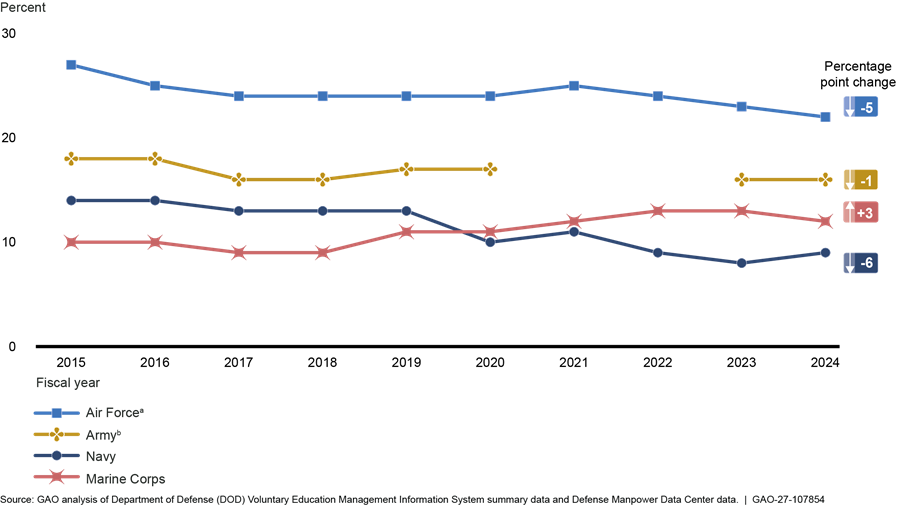
aThe Air Force administers education benefits for the Space Force, which does not operate a separate education program. Therefore, the participation percentage for the Air Force includes participation by the Space Force. The Space Force was established in 2019.
bThe Army does not have reportable data for FY 2021 and FY 2022 due to a system failure and data migration issue, according to Army officials.
Officials in each service cited various reasons for their service’s changes in participation rates, including changes to service eligibility rules, program access, and funding levels.
Marine Corps
Participation in the Marine Corps’s tuition assistance program increased overall by about 3 percentage points. Service officials attributed the start of the increase in FY 2019 to leadership support for expanded access to the program and changes to eligibility requirements.
· As of 2019, the Marine Corps does not require service members to serve a minimum time before using tuition assistance.[17]
· The rule requiring Marines to achieve a minimum aptitude test score to be eligible to use tuition assistance was modified in 2024. Education counselors said this rule discouraged some Marines from taking the test because they did not think they would score high enough. The modified rule, among other things, allows each base’s senior education counselor to make exceptions to the rule on a case-by-case basis.[18]
· Since 2024, Marines may use tuition assistance for a second master’s degree if the first degree was “granted by a resident Service Professional Military Education institution, or by the National Defense University, or The [Dwight D.] Eisenhower School [for National Security and Resource Strategy].”[19]
Army
The Army’s participation declined by about 1 percentage point from FY 2015 to FY 2024, except for an increase in FY 2019.[20] In 2015, the Army began requiring soldiers to complete initial training and at least 1 year of service before becoming eligible for tuition assistance. In 2018, this rule was discontinued. Also, the Army had a system failure and a data migration issue in FY 2021 and FY 2022 with the data systems used to track service member education information. The Army has since remedied that failure and data migration issue. However, following that, Army officials said that soldiers’ feelings of “mistrust” with the system’s reliability may have left them feeling reluctant to use tuition assistance.
Navy
The Navy’s participation declined by about 6 percentage points, with the steepest decline occurring in FY 2020. Navy officials said the decrease could have been due to several reasons.
· In 2016, the Navy began closing its education centers on domestic bases and reduced the number of education counselors. By 2021, it moved its remaining staff to a virtual counseling system. According to a Navy memo announcing the change, the virtual service delivery model would provide access and support to Sailors at the time and place most convenient to them.[21] However, Navy service officials said the change in access to education services could have contributed to the decline in participation.
· In 2019, the Navy began requiring that Sailors serve 2 years before they were eligible for tuition assistance. A Navy memo announcing this change said the Navy was experiencing unsustainable spending on tuition assistance and the change was made to balance available funding with continued access to tuition assistance.[22] In 2021, the requirement was increased to 3 years.[23]
· In 2021, the Navy introduced an additional educational benefit through the U.S. Naval Community College that has no minimum time-in-service requirement.[24]
· The Navy requested and generally received reduced funding for tuition assistance throughout the time period we analyzed due to competing funding priorities.
Air Force
Among the services, the Air Force had the highest overall percentage of service members participating in the tuition assistance program, but participation declined by about 5 percentage points from FY 2015 to FY 2024. Air Force officials attributed the slight increases in FY 2020 and FY2021 to service members having more time during the COVID-19 pandemic to pursue education because military deployments and training requirements decreased at that time. Also, an operational pause of the Community College of the Air Force in 2022 and 2023 may have caused a decrease in the number of service members using tuition assistance, Air Force education officials said.[25] They said this was because service members often use tuition assistance to pay for courses at other colleges and universities to meet some Community College of the Air Force degree educational requirements.
DOD and the Services Inform Potential Recruits About Tuition Assistance Through Marketing Materials and Informal Conversations
Marketing Materials
A service member’s awareness of the tuition assistance program can start as early as when they are recruited to join the military. One way they may learn about tuition assistance is from publications shared with them by military recruiters or school counselors or those that they find online, DOD officials said. DOD’s Joint Advertising, Market Research & Studies (JAMRS) is the primary office responsible for conducting market research aimed at informing and supporting military recruiting efforts. Its work focuses on studying potential recruits’ motivations for joining the military, officials said. JAMRS also creates marketing materials that all services can use in their recruiting efforts.
Our review of marketing materials—including digital and print products, such as websites, brochures, and social media content—found that they communicate the general benefits of joining the military, including various educational programs such as tuition assistance. For example, the DOD Futures magazine, a JAMRS publication meant to publicize aspects of modern military life, featured general information about tuition assistance (see fig. 4).

Note: In 2026, tuition assistance covered up to $250 per semester credit hour and up to $4,500 per service member annually. According to DOD officials, the DOD Futures Magazine was discontinued in 2026.
Some service recruiting commands use JAMRS research and other materials as a starting point for developing marketing materials tailored to their individual service, service recruiting officials said. For example, individual Army recruiting stations may develop recruiting materials or campaigns that speak to the specific interests of a particular demographic or regional market, which could include references to tuition assistance, Army officials told us. Specifically, Army recruiters who visit high schools will sometimes show a promotional booklet for guidance counselors to help the counselors share information with their students about education opportunities available to active-duty service members. This booklet is called the “U.S. Army Education Program Guide” (see fig. 5). This booklet contains more detailed information about tuition assistance. The paragraph on tuition assistance provides information on the program’s financial benefits and instructs potential recruits to visit a website for more information.

Note: Advanced Individual Training (AIT) is the Army’s initial job skills training.
Many of the DOD and services’ print and digital recruiting materials we reviewed also communicated additional information about the tuition assistance program, such as the fact that it can help service members work toward a college degree. Tuition assistance is often mentioned in recruiting materials alongside information about other education programs, such as the GI Bill or credentialing programs.[26]
Service officials said they avoided providing detailed information about tuition assistance in these recruiting documents for specific reasons. For example, Marine Corps officials said they avoided publishing specific details on their website or in marketing pamphlets because the details, such as programs’ eligibility requirements, could change year to year. They said they wanted to avoid communicating information that may be outdated by the time it reached a potential recruit. Officials from the Navy and the Air Force said they provided tuition assistance information at a high level because they did not want to overwhelm potential recruits with too much information too early in the recruiting process.
Informal Conversations
In addition to developing and distributing marketing materials, officials from all the services said that their recruiters deliver group presentations and hold one-on-one conversations with potential recruits and others who may play influential roles in the recruits’ lives.
Some services provide their own presentations that include information on tuition assistance. For example, officials at Army Recruiting Command said that they provided recruiters with a presentation specifically geared toward the high school student population. This presentation includes basic information about tuition assistance.
When talking with potential recruits, recruiters ask about their interests and then focus the discussion on the answer, recruiting officials from all the services said. Recruiters are trained to identify a potential recruit’s motivations and interests for joining the military and then use those motivations to discuss how a career in the military can help them reach their goals. If a potential recruit is interested in the military for the education benefits it offers, recruiters will discuss those benefits, including tuition assistance, they said.
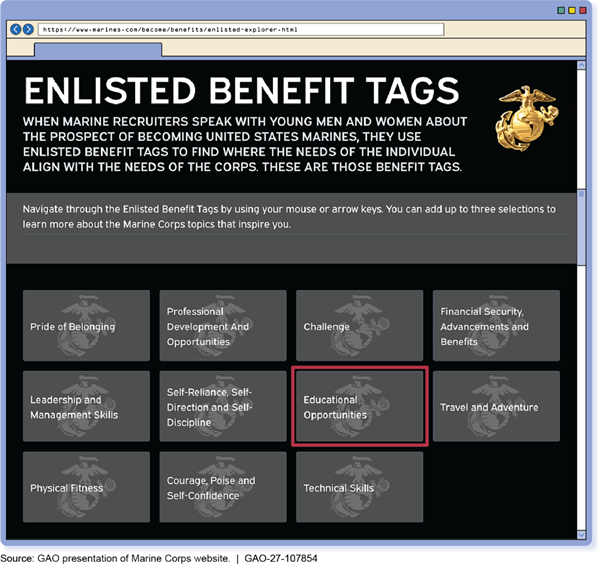
Some recruiters use hands-on tools for identifying potential recruits’ interests. For example, officials from the Marine Corps said they present potential recruits with a set of tags, each listing different interests that might motivate a potential recruit to join the military (see fig. 6). Recruiters ask potential recruits to choose the tags with their favorite motivating factors. The recruiters will then focus the discussion on the factors the recruits choose. If potential recruits choose the educational opportunity tag, recruiters will provide more details about the education benefits available to active-duty Marines, including information about tuition assistance.
Recruiters also share information about tuition assistance with other individuals who may have a role in influencing a potential recruit’s decisions, officials at all service recruiting commands said. These influential figures include parents, teachers, and sports coaches.
For example, recruiters from two services described hosting events and tours of education counseling offices on military bases for high school counselors, teachers, and coaches. Officials from the Air Force said these events are sometimes called “lunch and learns.” This outreach provides these influential figures with the opportunity to speak with service counselors and see first-hand what education benefits are available to their students should they choose to join the military.
Recruiters are also encouraged to share their own personal experiences using tuition assistance with recruits to give them a sense of what it is like to be on active duty and go to school simultaneously, service recruiting officials said. Recruiters from two services said that recruiters sometimes include personal stories about using tuition assistance while on active duty when speaking with potential recruits. Recruiters from the Marine Corps said that by sharing specific examples about how service members can balance work and school responsibilities they can help potential recruits and their families understand what using tuition assistance may look like in real life.
DOD Policy Requires Services to Provide Information About Tuition Assistance, but Not All the Services’ Policies Are Aligned
Air Force and Navy Policies Are Not Consistent with DOD’s Requirement to Inform Service Members About Education Benefits
DOD policy requires the services to inform service members about their education benefits, including tuition assistance, as part of their orientation each time they arrive at a new base.[27] However, our review of the services’ orientation and education policies and practices found that two of the services—the Navy and Air Force—do not consistently require their military bases to inform service members about educational benefits.
All the services have two policies—an education policy and an orientation policy—that determine whether service members receive information about education benefits at orientation.[28] In addition, we heard through our interviews that the services have practices for how they carry out the policies (e.g., education counselors being present at orientation briefings) that also determine whether service and base officials’ actions are consistent with the DOD policy across bases.
Our analysis reviewed the extent to which the services’ policies and practices were consistent with DOD’s policy that service members receive the required information about tuition assistance at orientation upon arriving to a new base.[29] For a service to be found consistent overall, none of the services’ policies or practices could be inconsistent with the DOD policy (see fig. 7).
Figure 7: Comparison of Service Policies and Practices to DOD Policy Promoting Voluntary Education Programs, Including Tuition Assistance

Note: GAO’s analysis included review of service policies and practices (i.e., actions service officials take to implement the policies) related to communicating with service members about tuition assistance when they are relocating to new bases or are new to a service. GAO’s analysis of the services’ policies determined if they were consistent with the DOD policy. Services may require service members of only certain ranks to attend orientation. GAO’s analysis focused on service policy and practice more broadly and did not explore potentially unique requirements for various subgroups. Text in figure bolded by GAO for emphasis.
Army. We found that the Army’s policies and practices are consistent with DOD’s education policy. The Army’s education policy requires soldiers to visit the education center and receive counseling within 30 days each time they are assigned to a new base.[30] Likewise, Army orientation policy requires soldiers to check in at the education center within 90 days of their arrival at a new base.[31] Bases document when soldiers fulfill this requirement in the service member’s personnel file, according to written Army procedures we reviewed and service officials.
Likewise, we found that the Army’s practices are consistent with DOD’s education policy. Army officials said that the lead education counselor at each base is responsible for ensuring that the education center participates in orientation. At the base we visited, officials said the education center sets up an information table at a weekly “newcomer’s brief.”
Marine Corps. We found that the Marine Corps’s policies and practices are consistent with DOD’s education policy. Specifically, the Marine Corps’s education policies state that all active-duty service members should be provided with information about education opportunities.[32] The Marine Corps’s orientation policy also states that education information should be provided at orientation sessions to help service members adapt to new bases.[33]
Likewise, we found that the Marine Corps’s practices are consistent with DOD’s education policy. Service officials and education counselors said that bases provide information about education opportunities during orientation, whether that is during the orientation brief or at a resource table following the brief. In addition, the Marine Corps requires service members in their first enlistment term to attend a Personal Readiness Seminar that includes information on education benefits, Marine Corps officials said.
Navy. The Navy’s education policy requires that commanders ensure that all newly assigned service members are briefed on education programs, including the tuition assistance program.[34] However, we found that the Navy’s orientation policy is not consistent with the DOD education policy.[35] The orientation policy does not require that education be covered during orientation and instead leaves it up to base commands to decide which topics to include. Commanders could exclude the information if they believe tuition assistance is not relevant to their command, service officials said. Also, the policy lists more than 15 topics that commanders must include in orientation, such as spousal employment and stress management, but education opportunities are not included on this list.
In 2024, the Navy education office surveyed service members and found that one of the top reasons for not participating in tuition assistance was that service members were not aware of it. In response, the service education office recommended developing a presentation slide about tuition assistance and providing it to bases as an option for them to include in their orientation presentations. However, Navy officials said they do not know if commands consistently provide Sailors with information on education during orientation. They added that orientation content is likely to vary widely across commands. Officials said they plan to survey service members again to gather more information about how and when they learn about education opportunities.
Air Force. We found that the Air Force’s education policy is consistent with the DOD policy, because it requires that bases comply with it.[36] However, we found that the Air Force’s orientation policy is not consistent with DOD’s education policy.[37] The orientation policy does not require that bases provide information about education programs to newly assigned service members. Instead, the policy assigns this authority to base commands that can individually decide which topics to include and which to omit. The policy lists about 10 topics that commanders must include in orientation, such as substance abuse and safety, but education is not included among these topics. An Air Force official said that the orientation policy is currently being rewritten. When we reviewed the revised policy language, we noted that education was still not a required topic. In response to our comment, the official said his office would add a reference to the DOD policy in the revised Air Force policy and recommend that education be included in the list of required orientation topics.
In addition, an Air Force education official said the Air Force’s interpretation of the DOD policy is that the guidance does not require education briefings every time a service member is assigned to a new base. However, the DOD policy specifically states that each military service will provide information about education programs to service members as part of their orientation when they are assigned to each new base. Furthermore, while the Air Force provides a specific orientation for service members new to the service, the policy for that orientation also does not require that it includes information about education benefits.[38]
We heard from Air Force officials that what happens in practice—what information the service does or does not provide about tuition assistance—can vary when service members arrive at new bases. An Air Force orientation official said most bases have an information fair and typically invite officials from the education office to attend, but it is not mandatory that those officials attend. As such, we found that the Air Force’s orientation practices are not consistent with DOD’s policy to provide education information at orientation.
Providing information about tuition assistance at orientation when service members arrive at a new base is important because not all service members may be aware of the program. Participants in all our discussion groups indicated that they did not believe all service members were fully informed about the tuition assistance program. When asked about what barriers service members may face when pursuing tuition assistance, participants said that service members needed more information than they currently receive to be able to decide whether they want to enroll in the tuition assistance program.
|
Statements from Service Members on Awareness of Tuition Assistance “I think the biggest barrier to that is just knowing about [tuition assistance] and then somebody kind of sitting them down and walking them through the fact that [applying for tuition assistance] is not a difficult process.” “I feel like a lot of the [information is] just kind of hidden…Most people don’t know that they can just go to the front office and ask or go [on] the site because…it’s kind of hidden on the site to find those [tuition assistance 101] classes.” |
Source: Service members in GAO discussion groups. | GAO‑27‑107854
Note: Quotes from service members have been edited for brevity and clarity.
Some services’ officials said that even though all orientation briefings do not include information on tuition assistance, service members are usually required to attend training or counseling before they receive the education center’s approval to enroll in tuition assistance. However, because completing this training is a prerequisite for participating in the program, the training is generally attended by service members who are already aware that tuition assistance is available.
Officials at DOD’s education programs office said they agreed that DOD’s education policy states that information about tuition assistance should be provided at orientation when service members relocate to a new base. However, while they encourage the services to provide the information, they consider the DOD policy to be a guideline rather than a requirement, and open to interpretation by the services. These DOD officials also said they did not know the extent to which education, including tuition assistance, was included as a topic at base orientations.
However, DOD’s education policy, which includes tuition assistance, frames the language around providing this information at orientation as a requirement. Per this policy, the services “will provide to newly assigned personnel, as part of their orientation to each new DOD [base]… information about voluntary education programs available at that DOD [base].” Because DOD does not enforce this policy, we found that the Navy and Air Force’s existing policies and practices do not ensure that newly assigned service members receive information about tuition assistance at base orientations.
By requiring the Navy and the Air Force to provide information about tuition assistance to service members during orientation when they arrive at a new base, in accordance with its own policy, DOD can help ensure equal access to information about this important and valuable benefit. This requirement should also be reflected in the services’ education policies. Service members who are informed about tuition assistance may be more likely to participate in the program, leading to a more highly educated and skilled military force and maximizing the potential of tuition assistance as a retention tool.
Education Counselors Promote Tuition Assistance Through Multiple Channels
While orientation is the DOD-required forum for service members to receive information about tuition assistance, education counselors said they also promote tuition assistance using other methods. These methods include one-on-one counseling, presentations, online marketing, informal conversations with service members, and promotional materials. These methods are mostly directed at those who are already aware of tuition assistance and are not intended to reach all service members, like orientation is designed to do.
One-on-one counseling. Providing one-on-one academic counseling to service members interested in using education benefits is a major function of education counselors. For example, counselors from all services told us they advise service members who want to apply for tuition assistance on topics such as developing an education plan and selecting a school and area of study.
When we asked how they learned about tuition assistance, service members in seven out of 10 discussion groups mentioned interacting with education counselors.
|
Statement from Service Member on Interactions with Education Counselors “I came to the education center and spoke to the [counselor]. And it was more like a one-on-one [conversation]. So, I think being in-person receiving that information helps more.” |
Source: Service member in GAO discussion group. | GAO‑27‑107854
Note: Quotes from service members have been edited for brevity and clarity.
However, education counselors can only provide one-on-one counseling to service members who seek them out because they are already aware of education benefits. This initial awareness can be developed through orientation. For example, as noted previously, as part of orientation the Army requires soldiers to check in at the education center when they arrive at a new base.
In-person presentations. Education counselors at Army, Marine Corps, and Air Force bases we visited told us that they give in-person presentations about education benefits that are separate from orientation. These presentations provide an overview of all programs offered by the education office but are usually voluntary to attend unless required by a service member’s supervisor (see fig. 8).[39] As such, these presentations may not reach all service members.

Presentations on education programs can also be provided to individual military units when requested, education counselors said. Counselors said they accepted as many of these requests as possible. However, an education counselor at one base said that sometimes the counselors must decline because they lack the staff to give the presentation. In contrast, another counselor said they sometimes offered to present to units on education benefits, but unit leaders did not always accept these offers.
Navy education counselors cannot give in-person presentations about tuition assistance because all counseling is now provided virtually. Education counselors told us that offering services only through a call center has made it more difficult to connect with Sailors.
Counselors try to communicate to service members that education benefits are still available even though education centers are closed, an education counselor said. For example, Navy education counselors said they have tried to adapt to the virtual-only counseling model by proactively reaching out to Sailors but have not always been able to do so. Counselors had hoped to travel to bases to present information on education benefits and meet with Sailors face-to-face. However, education counselors said in 2025 that trips had occurred less often due to budget constraints.
Online marketing. Some bases promote tuition assistance through emails, social media, virtual newsletters or brochures, and websites. According to education counselors, these efforts are mainly targeted to service members who are already aware of or interested in education benefits, and do not reach all service members. Also, education counselors with one service said their ability to post on social media about tuition assistance was limited due to new policies.[40]
Because the Navy requires its service members to serve for a specific period of time before they are eligible for tuition assistance, Navy counselors said that awareness efforts are not focused on Sailors in their first few years of service.[41] However, the counselors said it would be a good idea to make junior Sailors aware of education benefits. Once enlisted service members have served for 3 years, the Navy emails them to inform them of their eligibility for tuition assistance, Navy service officials said. While this email is sent to all service members at their point of eligibility, it is a one-time notification and does not remind them about tuition assistance throughout their career as orientation is designed to do.
Other education counselors said that they create flyers and newsletters that promote tuition assistance and display them at base education offices or post them on the education center’s website. This information is intended to reach service members who are already aware of the education center or its website.
Informal conversations and promotional documents. Service members in all 10 discussion groups told us that they learned about tuition assistance through sources such as informal conversations with supervisors or peers. However, these informal conversations could result in service members receiving incorrect information, said one service member we interviewed.
|
Statement from Service Member About Informal Conversations “Word of mouth [is] not always correct.” |
Source: Service member in GAO discussion group. | GAO‑27‑107854
Note: Quotes from service members have been edited for brevity and clarity.
In addition, informal conversations with peers could result in service members receiving incomplete information. For example, to use tuition assistance, the Marine Corps requires service members to achieve a certain score on a test that determines their placement in military occupational specialties. However, not knowing that the base’s lead educational counselor can waive that requirement in certain cases (as discussed above) has discouraged some Marines from applying for tuition assistance, counselors said.
Sometimes, service education offices distribute promotional documents to unit leadership to help supervisors inform junior service members about tuition assistance, Army officials said. For example, the Army’s education office distributed a promotional wallet card for supervisors to hand out to subordinates who seem interested in or suited for education benefits like tuition assistance. Sometimes Army bases customize the documents developed by the service’s education office with base-specific contact information or websites on the back side of the card, Army officials said. However, these efforts rely on supervisors to distribute the information. Therefore, they are not as likely to consistently reach as wide an audience as they could if they provided the information at an orientation for newly assigned service members.
Though information about the tuition assistance program may be available to service members through channels outside of orientation, DOD policy requires that it be communicated to them at orientation when they move to a new base. The information presented at orientation has the highest potential to reach all service members. These other methods of communicating information about tuition assistance—such as at optional events outside of orientation—may not reach all newly-assigned service members. In addition, they tend to attract service members who are already aware of tuition assistance and interested in learning more about the benefit.
Participation in Tuition Assistance Can Also Depend on Job Demands, Out-of-Pocket Costs, and Leadership Support
While service members’ awareness of the existence of tuition assistance is an important first step, once they know about the program other factors can also affect their participation. Service members in our 10 discussion groups mentioned some of these other factors that could either limit or increase their participation. These included military job demands, out-of-pocket costs, leadership support, potential for career advancement, program funding disruptions, and changes in services’ eligibility or program requirements.
Military job demands. Military job demands were cited as a potential barrier to using tuition assistance, according to education counselors in all the services and service members in all 10 discussion groups (see fig. 9).
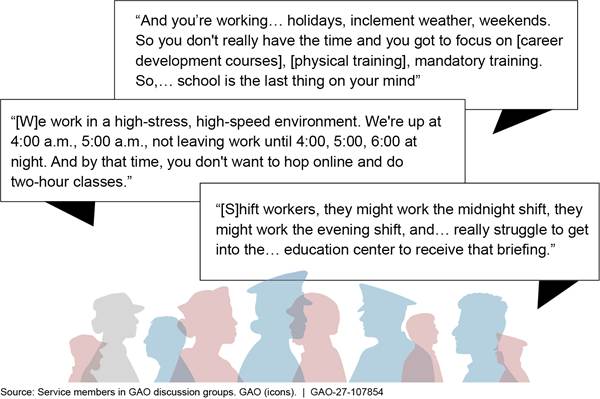
Note: Quotes from service members have been edited for brevity and clarity.
Service members work in a wide range of job types. This includes jobs specific to each service’s mission, such as flying planes or serving in the infantry, according to the U.S. Bureau of Labor Statistics.[42] Other military occupations include equipment maintenance, information technology, law enforcement, and construction. As such, individual service members’ specific job demands can affect what days of the week they work and their work hours, education counselors and service officials told us. Job demands can also affect whether they have internet access and how much off-duty time they have available to attend classes or complete course assignments.
Army and Marine Corps officials said that service members who serve in certain roles—such as operating weapons or serving in a special forces unit—tend to use tuition assistance less often than service members in other occupation types, such as engineering. Marine Corps officials said that infantry and special forces units frequently conduct training exercises in the field and this may cause them to use tuition assistance less often than those in other units.
Additionally, some jobs require service members to complete more training before pursuing education, Air Force officials said. Moreover, service members assigned to ships at sea may experience limited internet bandwidth, making it challenging to complete online courses, education counselors said. Most courses that service members pay for with tuition assistance are online classes, DOD officials said, making consistent internet access essential.[43]
Deployments, some of which can occur unexpectedly, may also change service members’ schedules and possibly prevent them from completing ongoing courses, education counselors with three of the services said.[44] Service members in three of our 10 discussion groups cited deployments as a barrier to using tuition assistance.
Out-of-pocket costs. Out-of-pocket costs can keep some service members from participating in tuition assistance, participants in all 10 discussion groups and education counselors from two services said. These costs can include books, supplies, and college application fees. Also, if tuition exceeds the service’s semester-hour or annual limit, service members must use their own money to pay the remaining balance.[45]
In two of the three officer discussion groups, participants said that graduate coursework can exceed the $250 per semester-hour limit. In school year 2024–2025, the average cost of a graduate course and fees at an in-state public institution was about $505 a semester hour.[46]
|
Statement from Service Member on Out-of-Pocket Costs Affecting Participation in DOD Tuition Assistance Program “… when I was working on my master’s program…, I was paying, like, almost $300 to $400 per course additionally.” |
Source: Service member in GAO discussion group with officers. | GAO‑27‑107854
Note: Quotes from service members have been edited for brevity and clarity.
Leadership support and potential for career advancement. Leadership support for tuition assistance can positively or negatively affect whether service members participate in the program, participants in all 10 discussion groups and education counselors with three of the services said. Leaders, such as commanding officers or unit leaders, can support or inhibit their service members’ interest in tuition assistance in various ways (see table 1).
Table 1: Summary of Service Member Statements About Leaders’ Actions that Can Have a Positive or Negative Effect on Service Members’ Participation in DOD Tuition Assistance Program
|
Positive |
Negative |
|
Encouraging service members to visit the education center |
Providing service members no direction on how to begin learning about tuition assistance |
|
Discussing tuition assistance during regular performance discussions |
Denying service member requests to use tuition assistance for reasons other than failing to meet requirements |
Source: GAO analysis of discussion groups with service members and interviews with education counselors. | GAO‑27‑107854
To prevent service members from failing courses due to their military job demands and possibly having to pay back their tuition assistance, all the services require them to obtain leadership permission prior to using tuition assistance, officials said. Obtaining leadership permission can help ensure that service members are aware of potential disruptions to completing courses, such as unexpected deployments or training, education counselors said.
|
Statements from Service Members on Leadership Support Affecting Participation in DOD Tuition Assistance Program “I definitely felt like that support that I had from my leaders really helped me to pursue [tuition assistance]. I feel like a lot of individuals are really swayed away from [tuition assistance] when their leadership doesn't make it feel like it's available to them.” “[At my previous unit], if you asked about it, they said, ‘Stop asking stupid questions and get back in line.’ But here…the attitude about it is very different. And it's very much of like, ‘Oh, well, why are you not doing it?’” |
Source: Service members in GAO discussion groups. | GAO‑27‑107854
Note: Quotes from service members have been edited for brevity and clarity.
The opportunity to gain military promotions by completing courses or degrees can motivate service members to use tuition assistance, service members in all 10 discussion groups and education counselors with three of the services told us. When military services consider or require academic achievements for promotion, it can lead to increased interest in tuition assistance among service members, officials at three of the services said.
Preparing for future employment after they leave the military may also motivate service members to use tuition assistance, education counselors told us. Some service members want to earn degrees in different fields from their current military job so they can enter new careers as civilians, one education counselor said. In 9 of 10 discussion groups, service members said they would consider using tuition assistance if it could help provide more employment opportunities after they leave the military.
|
Statement from Service Member on Career Advancement Affecting Participation in DOD Tuition Assistance Program “…I’ll be honest. It also looks good on promotions. It looks good when I’m working with my peer group to say I have some sort of a level of education, not just experience, to provide input and advisement to decision makers.” |
Source: Service member in GAO discussion group. | GAO‑27‑107854
Note: Quotes from service members have been edited for brevity and clarity.
Program funding disruptions. If a service experiences a disruption to its tuition assistance funding, it may affect service members’ ability to enroll in courses using tuition assistance, senior enlisted and officer participants in 4 of 10 discussion groups said. The program’s funding can be disrupted when there is a lapse in DOD’s annual appropriation that leads to a government shutdown, officials said.[47] Also, education counselors said that when DOD operated under various continuing resolutions in calendar year 2024, they were delayed in approving service members’ applications for tuition assistance. Interruptions to college enrollment due to the availability of funding can slow down progress toward academic goals.
|
Statement from Service Member on Funding Disruptions Affecting Participation in DOD Tuition Assistance Program “I don't want to delay my timeline, I want to keep progressing and keep that momentum going for education.” |
Source: Service member in GAO discussion group. | GAO‑27‑107854
Note: Quotes from service members have been edited for brevity and clarity.
Changes in services’ eligibility or program requirements. As discussed earlier, the services have changed their eligibility rules and program requirements several times since 2015 based on their available funding and priorities. These changes can either restrict or expand access to tuition assistance, affecting which service members can participate in the program and when, officials from all the services told us.
One such requirement is related to the minimum number of years a service member must serve before being eligible to use tuition assistance. For example, in 2021 the Navy began requiring its enlisted service members to serve at least 3 years before they can use tuition assistance. They must also finish their classes at least 6 months before the end of their enlistment.[48] For service members who have a 4-year active-duty contract, there is a limited time frame during which they can use tuition assistance, Navy and DOD officials said. The Navy instituted this requirement for funding reasons and because it wanted junior service members to focus on developing competency in their military jobs before pursuing further education, according to agency documents and Navy officials.
In contrast, as noted earlier, in 2019 the Marine Corps removed its 2-year minimum service requirement for program participation. One Marine Corps education service official said that the service’s recruiters advocated for the service to lift the minimum service requirement because tuition assistance was one of the biggest selling points in recruitment efforts.
|
Statement from Service Member on Eligibility Requirements Affecting Participation in Tuition Assistance Program “[I]t's a demotivator because [recruits are] being sold something. And then they come in, and it's like, ‘No, you can't [use tuition assistance].’” |
Source: Service member in GAO discussion group. | GAO‑27‑107854
Note: Quotes from service members have been edited for brevity and clarity.
In addition to minimum time-in-service requirements, the services have in some cases reduced the maximum number of credit hours that service members can take in a fiscal year to fewer hours than the DOD maximum. If services set lower credit hour limits, this can affect the number of courses service members may take per year. For example, in the past, both the Army and Navy limited their service members to fewer than 18 credits per year. They have since increased their maximum to 18 credits per year. They did so to be more in line with the other services’ policies, Army and Navy officials said.
Conclusions
Access to educational opportunities may be a reason that some people decide to join the military and stay in it. As one of the military’s education benefits, tuition assistance provides funding that service members can use to pursue further education while on active duty. However, because tuition assistance is a voluntary program, to take advantage of it service members must know this specific benefit exists, what they can use it for, and how to access it.
DOD recognizes the need to inform service members about the tuition assistance benefit because its policy requires the services to include information about this benefit during orientation each time service members arrive at a new base. However, some service members are not aware of the benefits because DOD does not enforce its own policy with all the military services, and the Navy’s and Air Force’s policies are not consistent with DOD’s policy.
Consistently providing information about tuition assistance at orientation would increase the likelihood that all service members receive information about the benefits. Reminding service members of this benefit each time they are assigned to a new base would provide them the opportunity to reassess if their new assignment might allow them to use tuition assistance. Improved awareness of tuition assistance could help improve retention of active-duty service members.
Recommendations for Executive Action
The Under Secretary of Defense for Personnel and Readiness should take steps to ensure that the Navy inform service members about tuition assistance benefits at orientations when they are newly assigned to a base, in accordance with existing DOD policy on voluntary education programs. These steps should include requiring the Navy to develop policies stating that base orientations for newly assigned service members must provide information on tuition assistance. (Recommendation 1)
The Under Secretary of Defense for Personnel and Readiness should take steps to ensure that the Air Force inform service members about tuition assistance benefits at orientations when they are newly assigned to a base, in accordance with existing DOD policy on voluntary education programs. These steps should include requiring the Air Force to develop policies stating that base orientations for newly assigned service members must provide information on tuition assistance. (Recommendation 2)
Agency Comments
We provided a draft of this report to DOD for review and comment. In its comments, reprinted in appendix II, DOD agreed with our recommendations and said it had established a program for the services’ voluntary education offices to annually certify compliance with DOD policies. Following the comment letter, DOD officials clarified that the program was established in September 2026 and was modified in response to our recommendations. The change is intended to ensure that the services comply with DOD’s policy to provide newly assigned service members with information about voluntary education programs as part of their orientation to each new base.
We are sending copies of this report to the appropriate congressional committees, the Secretary of Defense, and other interested parties. In addition, the report is available at no charge on the GAO website at https://www.gao.gov.
If you or your staff have any questions about this report, please contact me at EmreyArrasM@gao.gov. Contact points for our Offices of Congressional Relations and Media Relations may be found on the last page of this report. GAO staff who made key contributions to this report are listed in appendix III.

Melissa Emrey-Arras, Director
Education, Workforce, and Income Security
From fiscal year (FY) 2015 through fiscal year 2024, the estimated voluntary education funding per service member generally increased for all the services except the Navy, according to our analysis of service budget justification reports (see fig. 10). Tuition assistance accounts for most of this funding, Department of Defense (DOD) officials said. Service officials said they determine their budget requests for tuition assistance, in part, by the number of service members who participated in the program in previous years, potential deployments, and other mission priorities.
Figure 10: Estimate of Military Services’ Per Capita Funding for Voluntary Education, FY 2015–FY 2024

Note: GAO calculated an estimate of military services’ voluntary education spending per service member. This was calculated based on the total number of service members in each service at the end of each fiscal year and included all service members regardless of whether they participated in tuition assistance. Tuition assistance accounts for most of the voluntary education funding, DOD officials said.
aThe Air Force administers education benefits for the Space Force, which does not operate a separate education program. Therefore, the participation percentage for the Air Force includes participation in the Space Force. The Space Force was established in 2019.
GAO Contact
Melissa Emrey-Arras, Director, EmreyArrasM@gao.gov
Staff Acknowledgments
In addition to the individual named above, Amy Anderson and Sharon Hermes (Assistant Directors), Summer Pachman (Analyst in Charge), Angelica Guarino-McArdle, Erin McAuliffe, and Zakia Zara made key contributions to this report. Also contributing to this report were Tracy Abdo, Vincent Balloon, Elizabeth Dretsch, Gina Hoover, Abby Marcus, Kara Marshall, Camille Mckenzie, Aaron Olszewski, Trevor Osaki, Cady Panetta, Meg Sommerfeld, Curtia Taylor, and Kate Van Gelder.
The Government Accountability Office, the audit, evaluation, and investigative arm of Congress, exists to support Congress in meeting its constitutional responsibilities and to help improve the performance and accountability of the federal government for the American people. GAO examines the use of public funds; evaluates federal programs and policies; and provides analyses, recommendations, and other assistance to help Congress make informed oversight, policy, and funding decisions. GAO’s commitment to good government is reflected in its core values of accountability, integrity, and reliability.
Obtaining Copies of GAO Reports and Testimony
The fastest and easiest way to obtain copies of GAO documents at no cost is through our website. Each weekday, GAO posts on its website newly released reports, testimonies, and correspondence. You can also subscribe to GAO’s email updates to receive notification of newly posted products.
Connect with GAO
Connect with GAO on X,
LinkedIn, Instagram, and YouTube.
Subscribe to our Email Updates. Listen to our Podcasts.
Visit GAO on the web at https://www.gao.gov.
To Report Fraud, Waste, and Abuse in Federal Programs
Contact FraudNet:
Website: https://www.gao.gov/about/what-gao-does/fraudnet
Automated answering system: (800) 424-5454
Media Relations
Sarah Kaczmarek, Managing Director, Media@gao.gov
Congressional Relations
David A. Powner, Acting Managing Director, CongRel@gao.gov
General Inquiries
[1]Department of Defense, Office of People Analytics, Joint Advertising, Market Research & Studies, Summer 2025 Propensity Update: Youth Poll Study Findings, (Alexandria, VA: March 2026).
[2]Tuition assistance is part of DOD’s Office of Officer and Enlisted Personnel Management. Other military education benefits under voluntary education include credentialing programs and standardized testing to receive college credit.
[3]We looked at the tuition assistance programs administered by the Army, Marine Corps, Navy, and Air Force. The Air Force administers education benefits for the Space Force, which was established in 2019 and does not operate its own education program. In this report, our discussion of the Air Force education program includes the Space Force.
[4]We refer to “bases” when describing military installations or service members’ duty stations.
[5]We were unable to conduct discussion groups with Army senior enlisted service members and officers, as not enough service members were available for these two groups. In the case of Army senior enlisted service members, we conducted individual interviews with three service members.
[6]Because Navy education counselors counsel service members from Joint Expeditionary Base Little Creek–Fort Story in Virginia remotely, we held a virtual interview with those counselors.
[7]Department of Defense, Voluntary Education Programs, DODI 1322.25, (March 15, 2011) (updated April 2, 2020).
[8]Services may require service members of only certain ranks to attend orientation. Our analysis focused on service policy and practice more broadly and did not explore potentially unique requirements for various subgroups.
[9]This education program is authorized by 10 U.S.C. § 2007.
[10]See DODI 1322.25.
[11]These may be referred to as out-of-pocket costs. Also, if service members do not meet passing grade requirements or complete their courses, they are responsible for paying back the applicable tuition assistance they received.
[12]See DODI 1322.25.
[13]For example, mandatory separation may occur when an officer reaches a certain age.
[14]For the purposes of this report, when we refer to the Air Force education program, we include the education services the Air Force provides to Space Force service members.
[15]For the results of JAMRS reports and surveys, see “Market Research & Studies”, U.S. Department of Defense, accessed August 21, 2026, https://jamrs.war.gov/Market-Research-Studies/Reports/.
[16]Since the Air Force administers education benefits for the Space Force, the participation percentage for the Air Force includes participation by the Space Force.
[17]From May 2018 through March 2019, the Marine Corps required service members to serve a minimum of 2 years before using tuition assistance. Commanders could reduce this to 18 months based on a Marine’s performance.
[18]Senior education counselors can waive test score requirements if Marines have completed personal financial management training, attended a briefing about tuition assistance, and completed a survey on their skills and interests.
[19]United States Marine Corps, Marine Corps Guidelines for Tuition Assistance, NAVMC 1560.25 (November 5, 2024).
[20]The Army does not have reportable data for FY 2021 and FY 2022 due to a system failure and data migration issue, Army officials said.
[21]United States Navy, NAVADMIN 219/16 (September 2016).
[22]United States Navy, NAVADMIN 114/19 (May 2019).
[23]United States Navy, NAVADMIN 214/21 (September 2021).
[24]The U.S. Navy Community College supports enlisted Sailors and Marines to earn professional certificates and associate degrees that enhance operational readiness and warfighting capabilities. See https://www.usncc.edu/s/ accessed on August 12, 2026.
[25]The Community College of the Air Force is operated by the Air Force and, in general, provides education in military-related fields for enlisted service members. The program was paused while a new student information system was implemented.
[26]The GI Bill refers to both the Post-9/11 GI Bill and the Montgomery GI Bill-Active Duty. The GI Bill is an education benefit primarily for veterans and administered by the Department of Veterans Affairs. The GI Bill covers tuition and other expenses, which may include housing and books.
[27]Per DOD policy, “In operating its programs, each military service will provide to newly assigned personnel, as part of their orientation to each new DOD [base]…information about voluntary education programs available at that DOD [base].” DODI 1322.25.
[28]The education and orientation policies may be directed to different entities within each service. For example, the Air Force education policy is directed to the Air Force Voluntary Education Programs (United States Air Force, DAFI 36-2681), and the orientation policy is directed to each base’s Military & Family Readiness Center (United States Air Force, DAFI 36-3009).
[29]Our analysis focused on service policy and practices that applied to all service members and did not explore potentially unique requirements for various subgroups. For example, senior enlisted service members and officers may not be required to attend orientation.
[30]United States Army, AR 621-5 (March 19, 2026).
[31]United States Army, AR 600-8-101 (February 19, 2015).
[32]NAVMC 1560.25 (November 5, 2024) and United States Marine Corps, MCO 1560.25 (September1, 2010).
[33]United States Marine Corps, MCO 1754.10B (February 2, 2022). The Marine Corps’s orientation sessions are known as Welcome Aboard workshops or Newcomers’ Briefs.
[34]United States Navy, OPNAVINST 1560.9B (December 28, 2023).
[35]United States Navy, OPNAVINST 1740.3E (October 15, 2021).
[36]United States Air Force, DAFI 36-2681 (December 17, 2025).
[37]United States Air Force, DAFI 36-3009. The Air Force’s Military and Family Readiness Center is responsible for service member orientations and implements its orientation policy, officials said.
[38]This course is known as the First Term Enlisted Course. The course policy recommends, but does not require, that information on education opportunities be included.
[39]In addition to tuition assistance, education program offices may offer professional credentialing programs and information on the GI Bill.
[40]Department of Defense, DODI 5400.17 (February 14, 2025).
[41]The Navy requires enlisted service members to serve 3 years of active duty before being eligible for tuition assistance. Navy officers must have at least 8 years of prior enlisted service or reach the rank of Lieutenant (O-3) before being eligible.
[42]Bureau of Labor Statistics, U.S. Department of Labor, Occupational Outlook Handbook (Washington, DC: August 28, 2025).
[43]For example, in fiscal year 2024, the Army reported that approximately 5,800 enlisted service members used tuition assistance to take in-person college courses while about 58,000 service members used tuition assistance to take online college courses.
[44]A military deployment is the movement of armed forces to support a mission. Not all deployments are combat related. Service members may be deployed to support an enduring mission, provide humanitarian aid, assist in the evacuation of U.S. citizens, restore peace to a region or provide increased security. “Military Pre-Deployments to Reintegration,” Military OneSource, https://www.militaryonesource.mil/deployment/pre-deployment/deployment-101-predeployment-to-reintegration/.
[45]DOD policy directs the services to allow tuition assistance to cover up to a maximum tuition cost of $250 per semester hour and $4,500 per year. However, each service can determine its own maximum amount if it does not exceed the DOD limit.
[46]U.S. Department of Education, National Center for Education Statistics, Integrated Postsecondary Education Data System, Cost Component Final Data (2024-2025).
[47]In general, federal agencies can only spend money once it has been appropriated by Congress.
[48]This applies to sailors with less than 16 years of experience.