
Report to Congressional Committees
United States Government Accountability Office
A report to congressional committees
Contact: Chelsa Kenney at KenneyC@gao.gov
What GAO Found
Federal law contains certain provisions, known as notwithstanding authorities, that allow agencies to provide funding that would otherwise be restricted. Historically, the annual appropriations act has required agencies to notify Congress if they intend to use a notwithstanding authority to provide assistance in countries where U.S. law prohibits U.S. funding. In fiscal years (FY) 2023 and 2024, the joint explanatory statement (JES) accompanying the act included additional directions for providing such notifications. In July 2025 the Secretary of State announced that USAID had ceased to implement foreign assistance. State assumed certain former USAID functions, including some democracy programs, and will submit congressional notifications related to future democracy assistance. While Congress has not included a JES with directions for providing information on notwithstanding authorities with every appropriations act, it did so in fiscal year 2026 and may continue to do so in the future.
GAO’s review of 37 State congressional notifications for FYs 2023 and 2024 funding found that 36 of the notifications do not address one of three criteria, specified in Section 7015(c) of the FYs 2023 and 2024 appropriations acts or in their JESs, for reporting the use of notwithstanding authorities. State bureaus identify the need for, and draft, congressional notifications, but State’s guidance to bureaus for drafting notifications does not address these three criteria. Because the reporting criteria have changed over time, guidance to bureaus that addresses any criteria in each annual appropriations act or JES would help State ensure that it notifies Congress, as required or directed, of the intended use of notwithstanding authorities. Such reporting would enhance Congress’s ability to understand and oversee State’s use of notwithstanding authorities and appropriated funds to provide assistance where it would otherwise be prohibited.
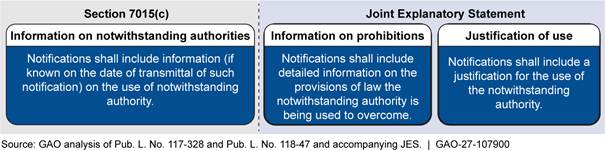
Notwithstanding Authorities Reporting Criteria in Appropriations Acts and Joint Explanatory Statements (JES) for Fiscal Years 2023 and 2024
Congressional notifications that State submitted for FYs 2021 through 2024 funding did not clearly and consistently identify the activities for which State planned to use the democracy assistance notwithstanding authority. GAO’s review of 101 notifications citing the authority found that most notifications lacked a clear linkage to the specific programs or activities for which the authority would be used. State’s guidance for congressional notifications does not direct its bureaus to include such linkage. Guidance that contains this direction would help State ensure that its notifications support Congress’s continuing oversight of its use of appropriated funds to provide democracy assistance where it would otherwise be prohibited.
Why GAO Did This Study
Federal law recognizes promotion of freedom and democracy as a fundamental component of U.S. foreign policy. Annual appropriations acts have authorized agencies to fund democracy programs notwithstanding other provisions of law. Historically, section 7015(c) of these acts has required the notifications include information on the use of such authorities, if known at the date of transmittal. In FYs 2023 and 2024, the JES accompanying the act directed State to report additional information on the use of these authorities.
A 2023 House Appropriations Committee print includes a provision for GAO to assess democracy assistance. This report examines, among other topics, (1) the extent to which State’s congressional notifications of its use of notwithstanding authorities for FYs 2023 and 2024 appropriations address the criteria in Section 7015(c) of the appropriations acts for those years and in the accompanying JES and (2) the extent to which State’s congressional notifications of its use of the democracy assistance notwithstanding authority for FYs 2021 through 2024 appropriations presented this information clearly and consistently. GAO analyzed State notifications that cited notwithstanding authorities and were submitted on behalf of eight bureaus. GAO also analyzed State guidance for drafting notifications. In addition, GAO interviewed and solicited written responses from State officials.
What GAO Recommends
GAO is making two recommendations to State to improve its reporting to Congress on the intended use of notwithstanding authorities. State disagreed with our recommendations. GAO maintains these recommendations could help State provide more complete and useful information to Congress.
|
Abbreviations |
|
|
|
|
|
|
|
DRL |
Bureau of Democracy, Human Rights, and Labor |
|
|
FAM |
Foreign Affairs Manual |
|
|
INL |
Bureau of International Narcotics and Law Enforcement Affairs |
|
|
JES |
joint explanatory statement |
|
|
SPSD |
Standardized Program Structure and Definitions |
|
|
USAID |
U.S. Agency for International Development |
|
This is a work of the U.S. government and is not subject to copyright protection in the United States. The published product may be reproduced and distributed in its entirety without further permission from GAO. However, because this work may contain copyrighted images or other material, permission from the copyright holder may be necessary if you wish to reproduce this material separately.
November 6, 2026
The Honorable Susan Collins
Interim Chair
The Honorable Brian Schatz
Ranking Member
Subcommittee on State, Foreign Operations, and Related Programs
Committee on Appropriations
United States Senate
The Honorable Mario Diaz-Balart
Chairman
The Honorable Lois Frankel
Ranking Member
Subcommittee on National Security, Department of State, and Related Programs
Committee on Appropriations
House of Representatives
According to federal law, the promotion of freedom and democracy is a fundamental component of U.S. foreign policy.[1] Democracy programs are generally authorized by, and receive funding through, annual appropriations acts. Section 7032(b)(1) of the annual appropriations acts for fiscal years 2021 through 2024[2] authorized funding for democracy programs to be made available “notwithstanding any other provision of law.”[3]
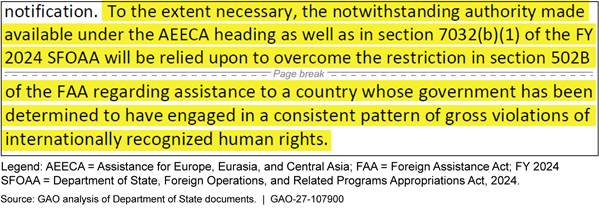
This provision—which we will generally refer to as the democracy assistance notwithstanding authority—allows the Department of State to provide democracy assistance where it would otherwise be restricted. For example, in December 2024, State notified Congress that it planned to use the democracy assistance notwithstanding authority to provide assistance to support democracy, human rights, civil society, and independent media, including in Russia.[4] According to that notification, the democracy assistance notwithstanding authority would be used to overcome the restriction in section 502B of the Foreign Assistance Act of 1961, as amended, regarding assistance to a country whose government has been determined to have engaged in a consistent pattern of gross violations of internationally recognized human rights.[5]
Annual appropriations acts and their accompanying joint explanatory statements (JES) have provided criteria, varying over time, for reporting the use of notwithstanding authorities to Congress. Section 7015(f) of the annual appropriations acts has historically required that agencies notify Congress before obligating or expending funds for assistance to about 30 countries.[6] In more recent years, Section 7015(c) has required that those notifications include information on the use of notwithstanding authorities if known on the date of the notification’s transmittal. In 2023 and 2024, the JES directed agencies to include additional information on the use of notwithstanding authorities.[7] Specifically, Congress directed State and USAID to include in notifications (1) detailed information on the provisions of law being notwithstood and (2) a justification for their use of the authority.[8]
House of Representatives Committee on Appropriations Print 50-348, accompanying the Consolidated Appropriations Act, 2023, includes a provision for us to assess democracy assistance provided by the Department of State’s Bureau of Democracy, Human Rights, and Labor (DRL) and Bureau of International Narcotics and Law Enforcement Affairs (INL) and by the U.S. Agency for International Development (USAID).[9] We were also asked to review this assistance in light of concerns about the use of the democracy assistance notwithstanding authority for nondemocracy programming by State and USAID. Nondemocracy programming includes economic growth, health, and humanitarian assistance, among other categories of foreign assistance.
In March 2025, State and USAID notified Congress of their intent to undertake a reorganization of foreign assistance programming that would involve realigning certain USAID functions to State by July 1, 2025, and discontinuing the remaining USAID functions. State began the reorganization in April 2025, and the Secretary of State announced in July 2025 that USAID had ceased to implement foreign assistance. State assumed certain former USAID functions, including some democracy assistance programs, and will submit congressional notifications related to future democracy assistance.
This report
1. examines the extent to which State’s congressional notifications of its use of notwithstanding authorities for 2023 and 2024 appropriations address the criteria in Section 7015(c) of the appropriations acts for those years and in the accompanying JES;
2. analyzes the extent to which State’s congressional notifications of its use of the democracy assistance notwithstanding authority for 2021 through 2024 appropriations present this information clearly and consistently; and
3. describes the presentation of information in USAID’s congressional notifications of its use of the democracy assistance notwithstanding authority in 2021 through 2024.
To address these objectives, we obtained congressional notifications submitted by State and USAID to Congress. In response to our requests, State provided about 300 notifications that it submitted for funding from 2021 through 2024 and USAID provided about 1,000 notifications that it submitted from 2021 through 2024. While we cannot verify that those notifications we received comprised all relevant notifications, we determined that the notifications provided were sufficient for our purposes.
We conducted automated analysis of the notifications to identify whether each notification included selected search terms based on legal citations associated with notwithstanding authorities. When the automated analysis identified one or more of the selected search terms in a notification, we manually reviewed each notification as part of our subsequent analysis. When the automated analysis did not identify the presence of any of the selected search terms in a notification, we manually reviewed a sample of those notifications to verify that the automated analysis correctly identified the lack of the search terms. On the basis of this methodology, we conducted further analysis of 101 notifications for each agency.
To examine the extent to which State’s congressional notifications of its use of notwithstanding authorities for 2023 and 2024 appropriations address the criteria in Section 7015(c) of the appropriations acts for those years and in the accompanying JES, we reviewed notifications submitted on behalf of eight State bureaus for 2023 and 2024 appropriations that (1) inform Congress about funding for assistance for countries that were subject to the Section 7015(c) and 7015(f) notification requirements and (2) reference the legal citation for at least one notwithstanding authority. We selected a sample of 37 of the 64 notifications that met these two criteria, and we evaluated the degree to which the selected notifications addressed the three congressional criteria for reporting the use of notwithstanding authorities in 2023 and 2024.
Additionally, we reviewed guidance related to State’s process for drafting and transmitting congressional notifications to Congress. We performed this review to identify the degree to which that guidance addressed the three criteria in Section 7015(c) of the appropriations acts for those years and in the accompanying JES. We also interviewed and solicited written responses from State officials in the Bureau of Legislative Affairs, DRL, INL, and the six regional bureaus regarding their processes for creating congressional notifications. In reviewing State’s notifications, documentation, and guidance, we considered Principle 10 of Standards for Internal Control in the Federal Government.[10]
To analyze the extent to which State’s congressional notifications of its use of the democracy assistance notwithstanding authority for 2021 through 2024 appropriations present this information clearly and consistently, we reviewed State guidance for drafting notifications. We also reviewed 101 notifications for appropriations in 2021 through 2024 submitted on behalf of seven State bureaus that (1) address funding for 2021 through 2024 appropriations and (2) cite Section 7032(b)(1) of the annual appropriations act—that is, the democracy assistance notwithstanding authority. We reviewed the notifications to determine where they cite Section 7032(b)(1) of the annual appropriations acts (e.g., in the introduction or the program narrative section of the notification) and the degree to which that citation identifies whether the notified programming related to democracy assistance as defined by State’s Standardized Program Structure and Definitions. We also reviewed the organization and content of the notifications’ narrative sections to determine whether they contain wording consistent with democracy assistance. In reviewing State’s notifications, we considered Principles 10 and 15 of Standards for Internal Control in the Federal Government.[11]
To describe the presentation of information in USAID’s congressional notifications of its use of the democracy assistance notwithstanding authority in 2021 through 2024, we reviewed USAID guidance for drafting notifications and the 101 congressional notifications that the agency submitted from 2021 through 2024 that cited Section 7032(b)(1) of the annual appropriations act. We reviewed the notifications to determine where they cite Section 7032(b)(1) of the annual appropriations act as well as the degree to which that citation identifies whether the notified programming related to democracy assistance as defined by State’s Standardized Program Structure and Definitions.
We conducted this performance audit from October 2024 to November 2026 in accordance with generally accepted government auditing standards. Those standards require that we plan and perform the audit to obtain sufficient, appropriate evidence to provide a reasonable basis for our findings and conclusions based on our audit objectives. We believe that the evidence obtained provides a reasonable basis for our findings and conclusions based on our audit objectives.
Background
Changes to U.S. Democracy Assistance
Before the reorganization of U.S. foreign assistance that began in 2025, several joint State–USAID strategies included the promotion of democracy worldwide. For example, the State–USAID Joint Strategic Plan for 2022 through 2026 articulated the shared goal of strengthening democratic institutions, upholding universal values, and promoting human dignity. Objectives for this goal included the promotion of good governance, led by USAID and DRL, and anticorruption efforts, led by USAID and INL. As we previously reported, from 2018 through 2023, State allocated around a third of U.S. democracy assistance, while USAID allocated about two-thirds (see fig. 1).[12]
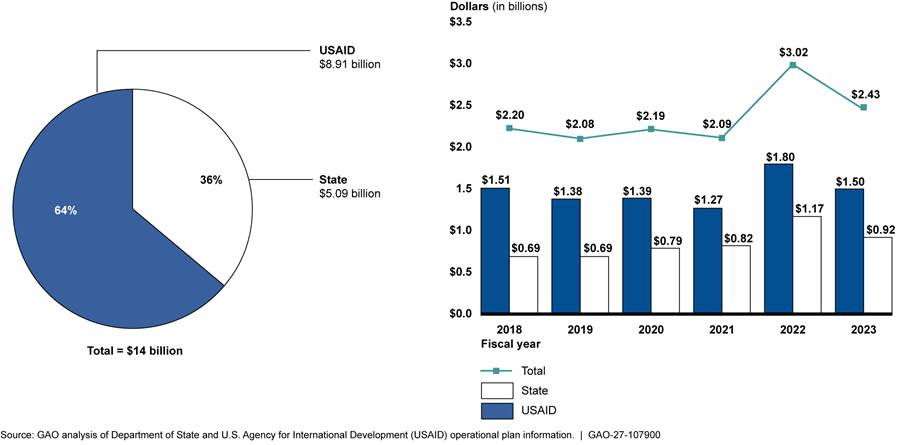
Note: Because of rounding, annual allocations shown may not sum to the totals. The data shown are based on operational plan data that State and USAID operating units submitted to State’s Office of Foreign Assistance. Operating units, such as State bureaus and USAID missions, include allocated amounts in their operational plans. The data shown include allocations for democracy assistance programs from annual appropriations acts as well as about $1 billion from two fiscal year 2022 Ukraine supplemental appropriations acts and one fiscal year 2023 Ukraine supplemental appropriations act.
In July 2025, in addition to announcing that USAID had ceased implementing foreign assistance, State closed DRL’s Office of Global Programming, which was responsible for managing most DRL democracy programming, according to a senior DRL official.[13] In January 2026, State officials told us that regional bureaus were now responsible for bilateral and regional assistance, including democracy assistance, and that DRL would also retain some democracy assistance.
Although DRL’s Office of Global Programming and USAID ceased implementing democracy assistance, the Full-Year Continuing Appropriations and Extensions Act, 2025[14] and National Security, Department of State, and Related Programs Appropriations Act, 2026 appropriated $205 million for DRL’s Human Rights and Democracy Fund in each of those fiscal years.[15] In April 2026, DRL officials told us that they aimed to obligate 2025 funds by the end of the fiscal year.
Funding Restrictions and Notwithstanding Authorities
Funding restrictions. Federal law contains provisions that restrict funding for foreign assistance under various circumstances. Some restrictions apply to assistance to specific countries or to specific types of activities. For example, annual appropriations acts generally prohibit assistance to the governments of Cuba, Iran, North Korea, and Syria, while the Foreign Assistance Act of 1961, as amended, generally prohibits foreign assistance funding from providing training to law enforcement forces of foreign governments.[16]
Other restrictions require determinations to identify countries to which the restrictions apply. For example, Section 7008 of the annual appropriations acts generally prohibits certain foreign assistance to the government of a country where the elected head of government has been deposed by a military coup d’état or decree.[17]
Notwithstanding authorities. Federal law also contains provisions, commonly referred to as notwithstanding authorities, that allow agencies to provide funding that would otherwise be restricted. There are many notwithstanding authorities, covering specific types of activities as well as specific countries or regions. For example, Section 7032(b)(1) of the annual appropriations acts historically has allowed agencies to provide funding for democracy programs notwithstanding any other provision of law.[18]
Congressional Reporting Criteria for Notwithstanding Authorities
The annual appropriations acts and accompanying JES typically provide criteria for reporting the use of notwithstanding authorities. In 2023 and 2024, Section 7015(c) of each appropriations act and the JES for each act provided the following three criteria for notifying Congress about the use of notwithstanding authorities to provide assistance to the countries listed in Section 7015(f):
1. Information on the use of notwithstanding authorities. Section 7015(c) of the 2023 and 2024 appropriations acts required that “any notification submitted pursuant to [Section 7015(f)] shall include information (if known on the date of transmittal of such notification) on the use of notwithstanding authority.”[19]
2. Information on provisions being notwithstood. The 2023 and 2024 JESs directed State and USAID to include detailed information on the provisions of law being notwithstood in notifications submitted pursuant to Sections 7015(c) and 7015(f).
3. Justification for the use of the notwithstanding authorities. The 2023 and 2024 JESs directed State and USAID to include, in notifications that they submitted pursuant to Sections 7015(c) and 7015(f), a justification for the use of notwithstanding authority.
The reporting criteria for notwithstanding authorities have applied only to funds appropriated for that fiscal year and may change in subsequent annual appropriations acts. While Section 7015(c) of the annual appropriations acts has appeared annually for the last several fiscal years, the directions to include detailed information on the provisions of law being notwithstood and a justification for the use of the notwithstanding authorities appeared only in the 2023 and 2024 JESs. The 2025 appropriations act did not have an accompanying JES. However, the 2026 JES directed agencies to report whether the obligation of funds relies on notwithstanding or other extraordinary authorities, with accompanying details regarding the authority and purpose.
Key State Entities with Roles Related to Congressional Notifications
A number of State entities have roles related to State’s congressional notifications. State’s Bureau of Legislative Affairs and Office of the Legal Adviser have the following roles in coordinating development of or providing legal advice for notifications:
· Bureau of Legislative Affairs. According to the State Foreign Affairs Manual (FAM), the bureau provides advice and information to other State bureaus and offices on legislative matters, and manages and transmits correspondences—including congressional notifications—to Congress.[20] The Bureau of Legislative Affairs manages State’s guidance for congressional notifications, while, according to State, specific bureaus are responsible for identifying the need for and drafting notifications related to those bureaus’ programming.
· Office of the Legal Adviser. The office advises State bureaus and missions, including providing legal advice to bureaus on all legal and legal policy issues arising in connection with U.S. foreign policy. For example, according to the FAM, the office provides legal advice to functional and regional bureaus on specific topics, such as law enforcement issues and the promotion of democracy.[21]
In addition, two functional bureaus—DRL and INL—and the six regional bureaus have provided democracy assistance or notified Congress of programming that may rely on the democracy assistance notwithstanding authority.[22] According to State, these bureaus also draft the related congressional notifications.
· DRL. DRL’s activities include promoting human rights, bolstering democratic institutions, and empowering civil society. Although DRL officials told us in July 2025 that DRL’s Office of Global Programming was closed, State said that they expected DRL to continue to implement some democracy assistance programming. DRL officials told us that, as of April 2026, DRL was working to obligate funds appropriated in 2025.
· INL. INL’s responsibilities include strengthening criminal justice systems in partner countries. INL’s responsibilities also include institutionalizing rule of law by developing and expanding criminal justice systems to strengthen partner countries’ law enforcement and judicial effectiveness and advance respect for human rights.
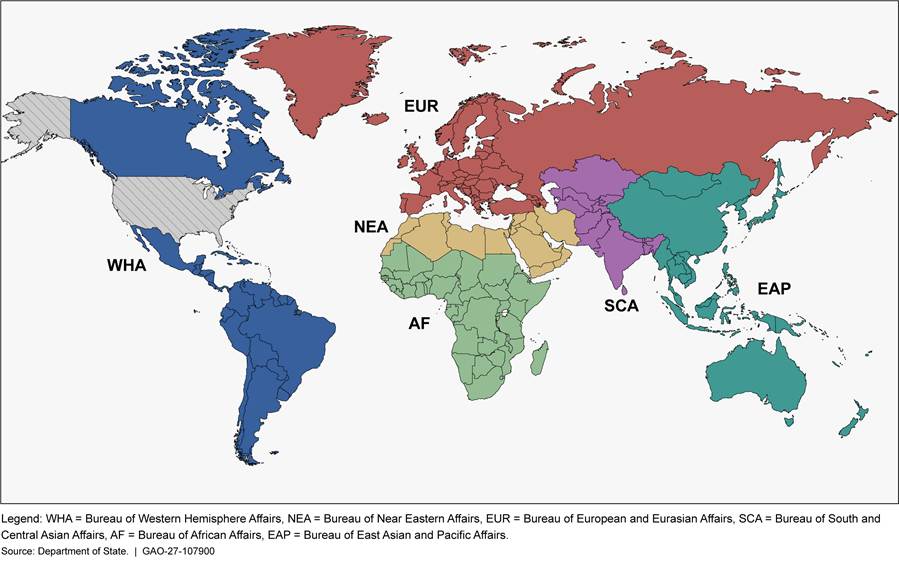
· Regional bureaus. State’s six regional bureaus’ responsibilities include assisting the Secretary of State in providing direction for, and overseeing, interdepartmental U.S. government activities in the countries within their geographic areas (see fig. 2).[23] In January 2026, State officials told us that regional bureaus had been assigned responsibility for bilateral and regional assistance, including democracy assistance.
Foreign Assistance Congressional Notification
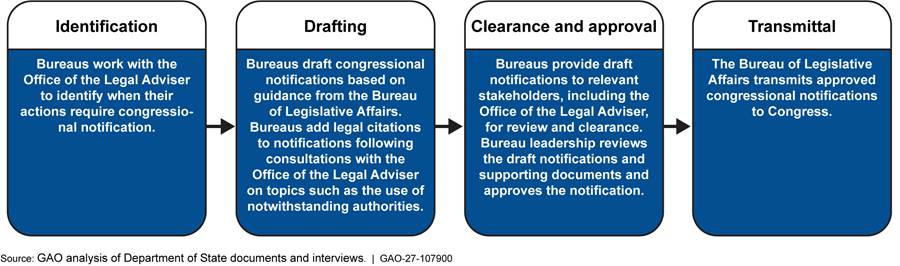
According to State, bureaus are responsible for identifying the need to submit notifications to Congress and for drafting those notifications. According to Bureau of Legislative Affairs guidance, bureaus should work with the Office of the Legal Adviser to identify actions that require congressional notification. For complex congressional notifications, bureaus are encouraged to closely consult the Office of the Legal Adviser to ensure inclusion of all relevant requirements in draft notifications.
State officials told us that statutory citations are added to notifications by bureaus following consultations with the Office of the Legal Adviser. Figure 3 summarizes State’s process for congressional notifications.
Democracy Programs and the Foreign Assistance Standardized Program Structure and Definitions (SPSD)
Historically, the annual appropriations act has defined democracy programs as programs that
· support good governance, credible and competitive elections, freedom of expression, association, assembly, and religion, human rights, labor rights, independent media, and the rule of law and
· otherwise strengthen the capacity of democratic political parties, governments, nongovernmental organizations and institutions, and citizens to support the development of democratic states and institutions that are responsive and accountable to citizens.
During the period of our review (October 2024–November 2026), State and USAID both used State’s SPSD, which provides a common set of definitions and consistent organization for various categories of foreign assistance, including democracy assistance.[24] The SPSD identifies six general program areas for democracy assistance: Rule of Law, Good Governance, Political Competition and Consensus Building, Civil Society, Independent Media and Free Flow of Information, and Human Rights. Each general program area has several subcomponents called program elements. Table 1 shows the six democracy program areas and their 24 program elements.
|
Program area |
Definition excerpt |
Program elements |
|
Rule of Law |
A principle under which all persons, institutions and entities, public and private, including the state itself, are accountable to laws that are publicly promulgated, independently adjudicated, and equally applied and enforced. |
1.1: Constitutions, laws, and legal systems 1.2: Culture of lawfulness 1.3: Checks and balances with judicial independence 1.4: Justice systems and institutions 1.5 Fairness and access to justice |
|
Good Governance |
Includes support for strengthening legislatures and local governments; capacity building; security sector reform; separation of powers through institutional checks and balances between the executive and legislative branches, in particular; and avenues within government structures for accountability and oversight. |
2.1: Legislative authority 2.2: Non-security executive authority 2.3: Local government and decentralization 2.4: Anti-corruption reforms 2.5: Executive authority – security sector |
|
Political Competition and Consensus Building |
Promotes legitimate contestation for ideas and political power through democratic political processes that reflect the will of the people. |
3.1: Consensus-building processes 3.2: Elections and political processes 3.3: Political parties |
|
Civil Society |
Includes supporting a legal environment that protects and promotes civil society organizations; providing capacity development assistance to such organizations; bolstering government oversight and accountability activities; strengthening a democratic political culture that values civic engagement; and strengthening independent trade/labor unions. |
4.1: Enabling environment for civil society 4.2: Civil society organizational capacity development 4.3: Civic education, citizen participation, and public accountability 4.4: Civic education and democratic culture 4.5: Democratic labor and trade unions |
|
Independent Media and Free Flow of Information |
Strengthens information- and media-related legal and regulatory frameworks and associated freedom of expression protections, including self-regulatory mechanisms and access to and freedom of information legislation. |
5.1: Enabling environment for media and free flow of information 5.2: Professional and institutional capacities of media 5.3: Outlets and infrastructure |
|
Human Rights |
Supports programs that promote the inherent dignity of the individual and rights that are to be enjoyed by all without distinction as to race, color, sex, language, religion, national or social origin, property, birth, sexual orientation, gender identity, or other status. |
6.1: Human rights systems, policies, and protection 6.2: Transitional justice 6.3: Equal rights for marginalized communities |
Source: GAO analysis of Department of State information. | GAO‑27‑107900
Note: State maintains the foreign assistance definitions in the Standardized Program Structure and Definitions (SPSD). Before the Secretary of State announced in July 2025 that the U.S. Agency for International Development (USAID) had ceased to implement foreign assistance, USAID used these definitions for its activities because it also disbursed foreign assistance.
State’s Congressional Notifications and Related Documentation Addressed Reporting Criteria Inconsistently
Our analysis of 37 congressional notifications for 2023 and 2024 appropriations that were subject to the three congressional reporting criteria for notwithstanding authorities for those years found that State did not consistently address all three criteria.[25] Because we selected notifications that include a legal citation for a notwithstanding authority, all 37 notifications include information on the use of notwithstanding authorities, as required by Section 7015(c) of the annual appropriations acts.[26] In addition, all of the notifications include program activity descriptions as justification for State’s use of the authority, as directed by the JESs for the 2023 and 2024 annual appropriations acts. However, only one notification includes, as the JESs also directed, additional details about the provisions of law being notwithstood.
Table 2 summarizes our analysis of the 37 notifications.
Table 2: Number of State’s Congressional Notifications That Addressed Fiscal Years 2023 and 2024 Congressional Reporting Criteria for Notwithstanding Authorities
|
Congressional reporting criteria for notwithstanding authorities |
Number of notifications that address the reporting criteria |
|
Information on the use of notwithstanding authoritiesa |
37/37 |
|
Information on provisions being notwithstood |
1/37 |
|
Justification for the use of the notwithstanding authoritiesb |
37/37 |
Source: GAO analysis of Department of State documents. | GAO‑27‑107900
Note: Sections 7015(c) and 7015(f) of the annual appropriations acts have historically required agencies to submit a congressional notification including known information on the use of notwithstanding authority before providing assistance to around 30 countries. The joint explanatory statements for the fiscal years 2023 and 2024 appropriations acts additionally directed agencies to include detailed information on the provisions of law being notwithstood (i.e., the statutory restrictions for which the agencies planned to use notwithstanding authorities) and a justification for the use of such authority.
aAccording to State officials, State does not track the use of notwithstanding authorities. To identify our sample of 37 notifications, we reviewed around 300 notifications that State provided for fiscal years 2021 through 2024 appropriations to determine whether each notification was (1) for fiscal year 2023 or 2024 appropriations, (2) subject to the Section 7015(c) and 7015(f) notification requirements, and (3) referenced the statutory citation of at least one selected notwithstanding authority. We identified 64 notifications that met these criteria, and we selected a sample of 37 of those notifications to analyze. Because we based our sample selection on the presence of the statutory citations, all notifications in our sample contained a reference to a notwithstanding authority.
bTo determine whether a notification contained justification for the use of the notwithstanding authorities, we analyzed only whether the notification included a description of the relevant programming.
The only notification that includes information about the provision being notwithstood cites the relevant statute and explains the restriction of assistance. See figure 4.
Figure 4: Excerpt of State Department Congressional Notification Showing Information About Provision of Law Being Notwithstood
Note: Sections 7015(c) and 7015(f) of the annual appropriations acts have historically required agencies to submit a congressional notification including known information on the use of notwithstanding authority before providing assistance to around 30 countries. The joint explanatory statements for the fiscal years 2023 and 2024 appropriations acts additionally directed agencies to include detailed information on the provisions of law being notwithstood (i.e., the statutory restrictions for which the agencies planned to use notwithstanding authorities) and a justification for the use of such authority.
Our review of State’s congressional notifications guidance to bureaus found that the guidance does not address any of the three congressional reporting criteria.[27] Specifically, although the guidance includes templates for notifications, those templates do not include information about the reporting criteria.
According to State officials, including officials of four bureaus, State’s process to draft congressional notifications has not changed from year to year—for example, to incorporate changes to the congressional reporting criteria. Additionally, although State officials said that the bureaus may have incorporated the JES directions into their processes, officials from five bureaus said that they had not done so.
Congressional notifications guidance that addressed the 2023 and 2024 reporting criteria for notwithstanding authorities would have helped State ensure that it fully and consistently addressed those criteria in its congressional notifications, as required or directed by Congress. State’s policy calls for State to maintain effective systems of management controls and incorporate standards for internal control in the federal government.[28] According to those standards, management should design control activities to achieve objectives, including compliance with laws.[29]
While not every appropriations act has included a JES directing agencies to provide information on the use of notwithstanding authorities, Congress provided such directions in the JES accompanying the 2026 appropriations act and may continue to do so in future years. According to State, bureaus identify the need for, and draft, congressional notifications. Guidance to bureaus that reflects the reporting criteria found in each annual appropriations act as well as in any accompanying JES would help State ensure that congressional notifications of its intended use of notwithstanding authorities consistently provide the required and directed information. Such reporting would enhance Congress’s ability to understand and oversee State’s use of notwithstanding authorities to provide foreign assistance where it would otherwise be prohibited.
Most State Notifications Lack Information Linking Activities to Use of Democracy Assistance Notwithstanding Authority
Our analysis of 101 State congressional notifications that cite the democracy assistance notwithstanding authority for appropriations for 2021 through 2024 found that the notifications contain inconsistent levels of details, and most do not clearly link State’s use of the authority to specific programs and activities. Consistent details linking the intended use of the authority to specific programs and activities would help ensure that Congress has information needed for its oversight of funds appropriated for democracy assistance.[30]
All of the notifications include an introduction that provides legal citations—including the democracy assistance notwithstanding authority—as well as a narrative section that lists programs and activities planned as part of those programs.[31] However, the notifications discuss the democracy assistance notwithstanding authority only in the introduction and at varying levels of detail. Some notifications’ introductions include information about the SPSD democracy program areas and activities for which State planned to use the authority, which helps link the use of the authority to specific activities in the narrative sections. Other notifications’ introductions do not include such information and therefore lack a linkage to specific activities.
Figure 5 shows examples of the varying levels of detail in State notifications that reference the democracy assistance notwithstanding authority.
Figure 5: Examples Showing Varying Levels of Detail in the Introductions of Selected Congressional Notifications on State’s Planned Use of Democracy Assistance Notwithstanding Authority
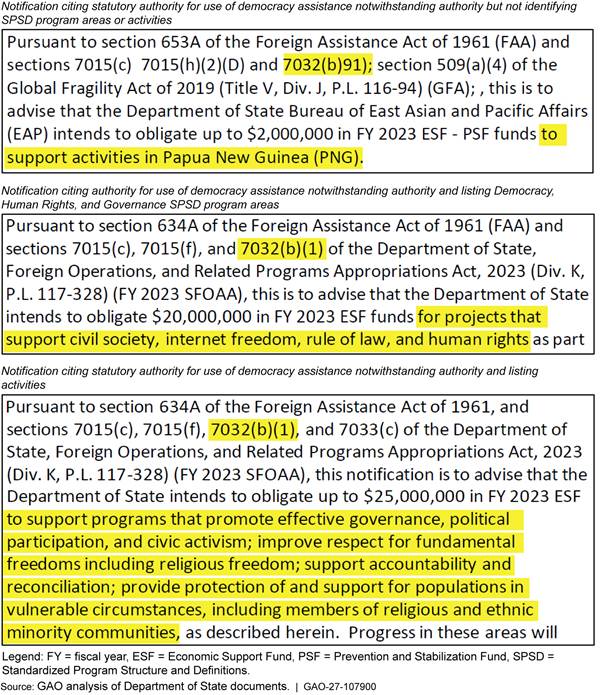
Note: Section 7032(b)(1) of the Department of State, Foreign Operations, and Related Programs Appropriations Act, 2023, states, “Funds made available by this Act for democracy programs pursuant to subsection (a) and under the heading ‘National Endowment for Democracy’ may be made available notwithstanding any other provision of law.”
State uses the SPSD, which identifies seven categories of foreign assistance, including democracy assistance. The democracy assistance category includes six general program areas: (1) Rule of Law, (2) Good Governance, (3) Political Competition and Consensus Building, (4) Civil Society, (5) Independent Media and Free Flow of Information, and (6) Human Rights. Each program area is further broken down into several program elements.
We also found that the notifications’ program narratives are organized inconsistently, even among notifications from the same bureau. Some narratives are organized by SPSD program area or program heading, thus, in some cases, clearly identifying program narrative sections related to the program category of democracy assistance. However, other notifications are organized in ways that make it difficult for the reader to identify activities related to democracy assistance. For example, some notifications are organized by another classification, such as the country of programming, while other notifications either lack organization or combine different types of organization.[32]
Further, only about 40 percent of the notifications show an identifiable linkage between the program narratives and the use of the democracy assistance notwithstanding authority. While the JESs have not directed State to identify the specific programs for which it intended to use notwithstanding authority to provide assistance, consistently including this information where it was known could have helped supplement the justification directed by the JESs by informing Congress of the specific activities for which State planned to use the authority.
· Of the 101 notifications, 43 contain a single heading or narrative that was consistent with the SPSD democracy program areas.[33] We assumed that the authority was linked to the single program that the notification identified, although State’s notifications do not explicitly link the planned use of the notwithstanding authority by discussing its use for specific activities within the program narrative.[34]
· The remaining 58 notifications include multiple headings, making it difficult to link the democracy assistance notwithstanding authority to specific programs or activities within the program narratives and, therefore, to identify activities for which State planned to use the authority. During reviews of these notifications, we found that all 58 contain at least one program heading or activity narrative consistent with the SPSD democracy program areas or element narratives. However, because the notifications do not explicitly link the planned use of the notwithstanding authority by discussing its use for specific activities in the program narratives, it would be difficult for Congress to identify the activities to which State may have intended to apply the authority. Additionally, 18 of these notifications cite at least one other notwithstanding authority without specifying the activities for which State planned to use it.[35] For example, one notification cites five notwithstanding authorities—including the authority for democracy assistance—and lists eight program headings but does not specify activities to which any of the authorities are applied.
State’s policy calls for State to maintain effective systems of management controls and incorporate standards for internal control in the federal government.[36] According to those standards, management should design control activities to achieve objectives and should communicate quality information externally.[37] Additionally, we have previously reported that agencies should communicate relevant information externally and tailor the information to meet stakeholders’ needs, including Congress, who may need that information for oversight.[38]
According to State, bureaus identify the need for congressional notifications and draft them. However, State’s guidance for congressional notifications does not direct bureaus to clearly link the use of notwithstanding authorities to specific programs and activities. Incorporating such direction in its guidance would help State ensure that its notifications, including those related to democracy assistance, consistently identify the programs and activities for which it plans to use notwithstanding authorities. This information would, in turn, support Congress’s continuing oversight of State’s use of appropriated funds to provide democracy assistance where it would otherwise be prohibited.
USAID Notifications Inconsistently Reported Information Linking Activities to Use of Notwithstanding Authority for Democracy Assistance
Our analysis of 101 USAID congressional notifications submitted during 2021 through 2024 that cite the notwithstanding authority for democracy assistance found that USAID reported inconsistently on its use of the authority.[39] In some notifications, USAID cited the statutory authority or stated only that it would apply the notwithstanding authority for democracy programs, without discussing specific SPSD program areas or activities. In other notifications, USAID listed information such as the SPSD program areas of the activities for which it planned to use the authority. In still other notifications, USAID identified specific activities within program areas for which it would use the authority.
Figure 6 shows examples of the varying levels of detail of USAID’s reporting on its use of the notwithstanding authority in the introduction and SPSD program area narratives of the congressional notifications we reviewed.
Figure 6: Examples of Levels of Detail About USAID’s Planned Use of Notwithstanding Authority for Democracy Assistance Reported in Congressional Notifications
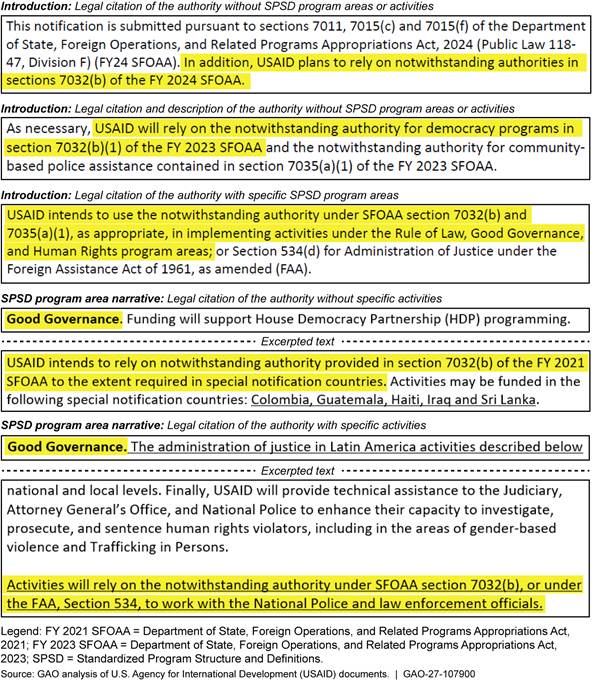
Notes: Section 7032(b)(1) of the Department of State, Foreign Operations, and Related Programs Appropriations Act, 2021, the Department of State, Foreign Operations, and Related Programs Appropriations Act, 2022, the Department of State, Foreign Operations, and Related Programs Appropriations Act, 2023, and the Department of State, Foreign Operations, and Related Programs Appropriations Act, 2024, states, “Funds made available by this Act for democracy programs pursuant to subsection (a) and under the heading ‘National Endowment for Democracy’ may be made available notwithstanding any other provision of law.”
USAID used the Department of State’s SPSD, which identifies seven categories of foreign assistance, including democracy assistance. The category of democracy assistance includes six program areas: Rule of Law, Good Governance, Political Competition and Consensus Building, Civil Society, Independent Media and Free Flow of Information, and Human Rights.
USAID congressional notifications included an introduction and a program narrative organized by SPSD program area.
In addition, information about USAID’s intended use of the notwithstanding authority for democracy assistance is located inconsistently in the notifications, making it difficult for Congress to identify the specific program areas for which USAID planned to use the authority.[40] Half of the USAID notifications that we reviewed discuss the agency’s use of the authority for specific SPSD program areas in one location. Further, about 13 percent of the notifications discuss USAID’s use of the authority for specific SPSD program areas both in the introduction and in the program area narratives, thereby clearly linking the authority’s discussion in the introduction and program areas and activities for which the agency planned to use it (see fig. 7).[41] However, a third of the notifications we reviewed do not include information linking the use of the notwithstanding authority to specific program areas or activities.[42]
Figure 7: Example of USAID Congressional Notification That Reported Planned Use of Democracy Assistance Notwithstanding Authority in Both the Introduction and SPSD Program Area Narrative
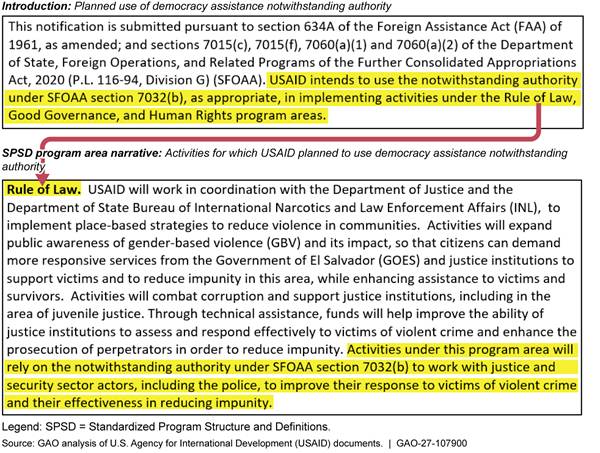
Notes: Section 7032(b)(1) of the Department of State, Foreign Operations, and Related Programs Appropriations Act, 2020 states, “Funds made available by this Act for democracy programs pursuant to subsection (a) and under the heading ‘National Endowment for Democracy’ may be made available notwithstanding any other provision of law.”
USAID used the Department of State’s SPSD, which identifies seven categories of foreign assistance, including democracy assistance. The democracy assistance category includes six program areas: Rule of Law, Good Governance, Political Competition and Consensus Building, Civil Society, Independent Media and Free Flow of Information, and Human Rights.
USAID congressional notifications included an introduction and a program narrative organized by SPSD program area.
Although we found inconsistencies in USAID’s reporting on notwithstanding authority for democracy assistance in congressional notifications, we are not making a recommendation to USAID because the Secretary of State announced that USAID ceased implementing foreign assistance as of July 2025.
Conclusions
Democracy assistance is a fundamental component of U.S. policy and Congress has appropriated hundreds of millions of dollars each year to promote democracy around the world. Congress has additionally recognized the importance of democracy assistance by providing U.S. agencies, through the democracy assistance notwithstanding authority, the flexibility to provide such assistance to foreign countries when it would otherwise be restricted. In addition to providing agencies such flexibility, Congress has required or directed agencies to report certain information about their use of notwithstanding authorities, if known on the date of the notification’s transmittal. The specific requirements, which have varied over time, provide Congress important information on agencies’ use of the authority and inform congressional oversight of the programming for which the agencies are using the authority. The JES accompanying the 2026 appropriations act directs agencies to include in congressional notifications whether the obligation of funds relies on notwithstanding authority, with accompanying details regarding the authority and purpose.
After the Secretary of State announced in July 2025 that USAID had ceased to implement foreign assistance, State became the primary agency responsible for implementing the democracy assistance funds appropriated by Congress. State has a process in place to provide notifications to Congress, including guidance to the bureaus that identify the need for notifications and draft them.
However, we found opportunities to improve State’s process that would provide more complete information to Congress. Specifically, developing guidance that addresses all applicable congressional reporting criteria for notwithstanding authorities would help State to better assure that its notifications consistently address all applicable criteria that annual appropriations acts require or as Congress may direct in future JESs accompanying the acts. In addition, developing guidance that calls for congressional notifications to identify specific programs and activities for which State plans to use a notwithstanding authority would help State ensure that its notifications about the use of the democracy assistance notwithstanding authority provide more useful information to Congress, improving transparency and better informing congressional oversight.
Recommendations for Executive Actions
We are making the following two recommendations to State:
The Secretary of State should ensure that the Bureau of Legislative Affairs develops guidance for congressional notifications that addresses congressional reporting criteria for notwithstanding authorities. (Recommendation 1)
The Secretary of State should ensure that the Bureau of Legislative Affairs develops guidance for congressional notifications that calls for the notifications to identify specific programs and activities, if known, for which State plans to use a notwithstanding authority, such as the democracy assistance notwithstanding authority. (Recommendation 2)
Agency Comments and Our Evaluation
We provided a draft of this report to the Secretary of State and the Acting Administrator of USAID for review and comment. State provided comments that we have reproduced in appendix IV. State also provided technical comments that we incorporated as appropriate. USAID did not provide comments.
In its comments reproduced in appendix IV, State disagreed with our recommendations. State said that the content of notifications is determined on a case-by-case basis consistent with applicable legal requirements and that static, one-size-fits-all guidance is not appropriate or necessary.
As our report notes, we found that only one of the 37 congressional notifications for 2023 and 2024 funding that we reviewed addressed all three of the reporting criteria that applied to those notifications. The JES accompanying the 2026 appropriations act directs agencies to provide certain information on the use of notwithstanding authorities, and Congress may continue to provide such directions in future years. Guidance that instructs bureaus to address all applicable yearly reporting criteria would help State assure that its notifications consistently provide all information required or directed by Congress.
Moreover, such guidance could be updated as needed to account for any changes in the reporting criteria while also allowing for case-by-case internal deliberation as to relevant considerations. For example, the guidance could state that notifications should include the information required as well as any information directed by Congress—specifying those types of information through updates based on the relevant appropriations acts and JES—without prescribing the exact content and timing of the notifications. Such guidance would help provide assurance that notifications include all applicable reporting criteria while allowing for customization based on internal deliberation.
Similarly, guidance that calls for congressional notifications to identify specific programs and activities for which State plans to use a notwithstanding authority would help make its notifications—which may be both lengthy and complex, covering numerous programs and countries—more useful to Congress. Such guidance could also allow for customization based on the circumstances relevant to each notification.
We are sending copies of this report to the appropriate congressional committees, the Secretary of State, the Administrator of USAID, and other interested parties. In addition, the report is available at no charge on the GAO website at https://www.gao.gov.
If you or your staff have any questions about this report, please contact me at KenneyC@gao.gov. Contact points for our Offices of Congressional Relations and Media Relations may be found on the last page of this report. GAO staff who made key contributions to this report are listed in appendix V.
Sincerely,
Chelsa Kenney
Director, International Affairs and Trade
This report
1. examines the extent to which the Department of State’s congressional notifications of its use of notwithstanding authorities for 2023 and 2024[43] appropriations address the criteria in Section 7015(c) of the appropriations acts for those years[44] and in the accompanying joint explanatory statement (JES);[45]
2. analyzes the extent to which State’s congressional notifications of its use of the democracy assistance notwithstanding authority for 2021 through 2024 appropriations present this information clearly and consistently; and
3. describes the presentation of information in USAID’s congressional notifications of its use of the democracy assistance notwithstanding authority in 2021 through 2024.
To address these objectives, we obtained and reviewed congressional notifications submitted by State and USAID to Congress. From State, we obtained about 300 notifications for 2021 through 2024 appropriations that State had submitted to Congress on behalf of the Bureau of Democracy, Human Rights, and Labor (DRL), the Bureau of International Narcotics and Law Enforcement (INL), and State’s six regional bureaus.[46] From USAID, we obtained about 1,000 notifications that it submitted from 2021 to 2024. We interviewed State bureau and USAID officials regarding their controls over archived congressional notifications. Additionally, we assessed the reliability of data in each notification. For USAID, we verified that USAID provided all sequential notifications for each fiscal year and that each notification was dated during 2021 through 2024.[47] For State, we verified the fiscal year of the notified funds and the bureau on behalf of which the notification was submitted. We also reviewed the notifications to eliminate duplicates and unrelated documents. While we cannot verify that what we received comprised all relevant notifications, we determined that the notifications provided were sufficient for our purposes.
We conducted automated analysis of the notifications and manually reviewed the results. First, we compiled a list of selected search terms based on legal citations associated with notwithstanding authorities.[48] We then conducted automated analysis of each notification to determine whether it contained each selected search term. When the automated analysis identified one or more of the selected search terms in a notification, we manually reviewed each notification as part of our subsequent analysis, including verifying the presence of the search term and its relation to a notwithstanding authority. For those notifications that the automated analysis did not identify the presence of any of the selected search terms, we manually reviewed a sample of those notifications to verify that the automated analysis had correctly identified the absence of the search terms.
State
To examine the extent to which State’s congressional notifications of its use of notwithstanding authorities for 2023 and 2024 appropriations address the criteria in Section 7015(c) of the appropriations acts for those years and in the accompanying JES, we reviewed guidance related to State’s process for drafting and transmitting congressional notifications to Congress to identify the degree to which that guidance addressed the criteria in Section 7015(c) of the appropriations acts for those years and in the accompanying JES. We also interviewed and solicited written responses from State officials in the Bureau of Legislative Affairs, DRL, INL, and the six regional bureaus regarding their processes for creating congressional notifications.
Using the results of our automated analysis of State congressional notifications, we identified 64 notifications that (1) address funding for 2023 or 2024 appropriations, (2) address funding for assistance in countries that were subject to the Section 7015(c) and 7015(f) notification requirements, and (3) reference the legal citation for at least one notwithstanding authority. For each bureau, we then selected a sample of notifications to review against the three reporting criteria for notwithstanding authorities identified in the 2023 and 2024 appropriations acts and JES. For the eight bureaus, we selected a total of 37 notifications on the basis of the fiscal year of the notified appropriations, the specific legal citation of notwithstanding authorities, and the country or region of funding being notified.
To determine whether and how the notifications address the 2023 and 2024 appropriations acts and JES reporting criteria for notwithstanding authorities we reviewed each of the selected 37 notifications and assessed the extent to which they contain the following:
1. Information on the use of notwithstanding authorities.[49] We reviewed each notification to determine whether it identifies a notwithstanding authority. We reviewed all legal citations to identify those that reference notwithstanding authorities. Because we based our sample selection on the presence of those statutory citations, all notifications in our sample contain a reference to a notwithstanding authority.
2. Information on provisions being notwithstood.[50] We reviewed each notification to determine whether it identifies funding restrictions. We also reviewed all legal citations present in the notification to identify citations that reference funding restrictions.
3. Justification for the use of the notwithstanding authorities.[51] We reviewed each notification to determine whether it describes the programming for which the notified funding would be used.
To analyze the extent to which State’s congressional notifications of its use of the democracy assistance notwithstanding authority for 2021 through 2024 appropriations present this information clearly and consistently, we reviewed internal guidance related to State’s process for drafting and transmitting congressional notifications to Congress.
Using the result of our automated analysis of State congressional notifications, we identified and manually reviewed 101 notifications from seven bureaus that address funding for 2021 through 2024 appropriations and that cite Section 7032(b)(1) of the annual appropriations act, otherwise known as the democracy assistance notwithstanding authority.[52] We initially reviewed State’s guidance for congressional notifications and a sample of notifications. We determined that the sampled notifications consist of (1) an introduction that identifies relevant legal authorities and funding sources and summarizes the notified programming and (2) a narrative section that discusses details of the notified programming.[53] Subsequently, we reviewed all of the notifications to determine whether they comprise an introduction and narrative section and in which section they cite Section 7032(b)(1) of the annual appropriations act.[54]
During our review of the notifications, we examined the summary in each notification’s introduction for any linkage to democracy assistance. To determine the degree to which each notification’s introduction identifies whether the notified programming related to democracy assistance, we categorized the summaries on the basis of their inclusion of the following:
· The complete name of at least one Democracy, Human Rights and Governance (democracy) program area consistent with State’s Standardized Program Structure and Definitions (SPSD), either in full or as part of a longer description.[55] For example, “Protecting the Human Rights of Afghan Women and Girls” contains the program area “Human Rights.”
· Part of the name of at least one SPSD democracy program area or similar wording. For example, we counted phrases that included “governance” or “independent media” and phrases related to civil society, such as “civic engagement” and “civic space.”
· The phrase “human rights and democracy” or “democracy, human rights, and governance.” For example, the summary of one notification we reviewed states that the notified funds were “to support human rights and democracy programs globally and program administration and oversight.”
· No SPSD democracy program area wording. This category comprised summaries that do not contain any of the wording in the other categories, including summaries with wording that may have related to an SPSD democracy program area but without enough specificity to constitute a clear reference. Examples include summaries that refer to “rights” but not “human rights” (i.e., there are many kinds of rights, such as labor rights, land rights, and legal rights).
On the basis of our review of the notifications, we determined that the notifications’ narrative sections are organized in several ways. To determine the organization of notifications’ program narrative, we categorized the narrative headings as follows:
· SPSD program areas, which includes both democracy program areas, such as “Human Rights” or “Civil Society,” and nondemocracy program areas, such as those from the “Peace and Security,” “Education and Social Services,” and “Economic Growth” SPSD foreign assistance categories;
· activity name or topic area, which includes headings that described programming and may have included SPSD program area wording, such as “Promoting Democracy and Human Rights in Venezuela” and “Effective Governance, Political Participation, and Civic Activism”;
· region or country names, which includes program headings such as “West Africa” or “Sudan”;
· unstructured, which includes paragraphs of program narratives but lacked any identifiable headings; and
· other, which includes bureau names, funding accounts, or implementing partner names.
To examine the extent to which the notifications contain at least one program heading or narrative consistent with SPSD democracy program areas or elements, we analyzed the narrative sections. This analysis allowed us to determine whether each notification contains either headings or narrative wording consistent with an SPSD democracy program area and therefore contains a linkage to democracy assistance.
1. For notifications with at least one heading organized by an SPSD program area, we determined whether the heading was an SPSD democracy or nondemocracy program area. If the heading was an SPSD democracy program area, we considered the notification to be linked to democracy assistance and did not conduct further analysis of the notification to determine additional linkages to democracy assistance.
2. For notifications with at least one heading organized by activity name or topic area, including notifications that were organized by SPSD program area but did not contain an SPSD democracy program area, we assessed whether the heading contained wording related to an SPSD democracy program area. If the notification contained such wording as part of an activity name or topic area heading, we considered the notification to be linked to democracy assistance and did not conduct further analysis of the notification to determine additional linkages to democracy assistance. For example, the activity name “Promoting Democracy and Human Rights in Venezuela” includes wording related to the SPSD democracy program area “Human Rights.”
3. For notifications organized in other ways, such as by bureau name or country name, we reviewed the program narrative to determine whether it contained wording related to an SPSD democracy program area.[56] If it did, we considered the notification to be linked to democracy assistance and did not conduct further analysis of the notification to determine additional linkages to democracy assistance.
4. For notifications with no wording related to an SPSD democracy program area in either the headings or program narratives, we compared the program narratives with the more detailed SPSD democracy program area and element narratives to identify any linkage to democracy assistance.[57] If a narrative contained wording related to an SPSD democracy program area or element narrative, we considered the notification to be linked to democracy assistance and did not conduct further analysis of the notification to determine additional linkages to democracy assistance.
To identify notifications with multiple program headings and references to notwithstanding authorities, we conducted a more detailed analysis. In particular, two analysts counted the number of program headings in each notification.[58] To identify notifications referencing more than one notwithstanding authority, we used the results of our automated analysis of each notification, which included search terms based on legal citations associated with notwithstanding authorities. We then manually reviewed the legal citations to verify that they reference notwithstanding authorities.
In reviewing State’s notifications, documentation, and guidance, we considered State’s policy on management controls, which calls for State to maintain effective systems of management controls and incorporate standards for internal control in the federal government.[59] We also considered Principles 10 and 15 of Standards for Internal Control in the Federal Government.[60] Principle 10 calls for management to design control activities to achieve objectives, including compliance with laws. Principle 15 calls for management to externally communicate the necessary quality information to achieve the entity’s objectives.
USAID
To describe USAID congressional notifications’ presentation of information about the agency’s use of the democracy assistance notwithstanding authority in 2021 through 2024, we reviewed internal guidance related to USAID’s process for drafting and transmitting notifications to Congress. We also interviewed USAID officials regarding their processes for developing, reviewing, and approving congressional notifications.
Using the results of our automated analysis of USAID congressional notifications, we identified and manually reviewed 101 notifications that the agency submitted to Congress in 2021 through 2024 and that reference the legal citation for the notwithstanding authority for democracy assistance.[61] We reviewed these notifications and related guidance to identify the standard formatting and sections: (1) the introduction, identifying relevant legal authorities and funding sources, and includes a summary of the notified programs; (2) the funding source narrative, describing how specific accounts funded activities listed in the notification; and (3) the activity narrative sections, organized by SPSD program area and discussing details of the notified programs.[62] For each notification, we analyzed whether democracy assistance notwithstanding authority is cited in only one, two, or all of the three sections.
To determine the extent to which the notifications discuss democracy assistance notwithstanding authority in each of the sections, and using the same SPSD program area definitions as for the State notifications above, we conducted further analysis as follows:
1. For each notification that references the legal citation for democracy assistance notwithstanding authority in the introduction, we analyzed the accompanying level of detail on specific SPSD program areas. We grouped the notifications by level of detail, using the following categories:
· general democracy, for notifications that refer to general “democracy” programs but do not refer specifically to SPSD democracy program areas;
· democracy program areas, for notifications that refer to one or more SPSD democracy program areas;
· democracy and nondemocracy program areas, for notifications that refer to both SPSD democracy program areas and SPSD nondemocracy program areas;
· nondemocracy program areas, for notifications that refer to one or more SPSD nondemocracy program areas but do not refer to any SPSD democracy program areas; and
· activities not identified, for notifications that do not refer to any SPSD democracy program areas.
2. For each notification that referenced the legal citation for democracy assistance notwithstanding authority in the funding source narrative, we analyzed the accompanying level of detail on specific SPSD program areas. We grouped the notifications by level of detail, using the following categories:
· democracy program areas, for notifications that referred directly to one or more SPSD democracy program areas;
· democracy and nondemocracy program areas, for notifications that referred to both SPSD democracy program areas and SPSD nondemocracy program areas; and
· activities not identified, for notifications that did not refer to an SPSD democracy program area.
3. For each notification that referenced the legal citation for democracy assistance notwithstanding authority in the activity narrative section, we analyzed the accompanying level of detail on specific SPSD program areas. We grouped the notifications by level of detail, using the following categories:
· democracy activities only, for notifications that referred directly to SPSD democracy program areas;
· democracy and nondemocracy activities, for notifications that referred to both SPSD democracy program areas and SPSD nondemocracy program areas; and
· nondemocracy activities only, for notifications that referred only to SPSD nondemocracy program areas.
For notifications that we determined (1) cited the democracy assistance notwithstanding authority in the notifications’ introduction in conjunction with at least one SPSD program area and (2) cited the authority in at least one SPSD program area in the activity narrative section, we analyzed whether the program areas in the introduction and the activity narrative section matched.
For notifications that we determined may have cited the democracy assistance notwithstanding authority for SPSD nondemocracy program areas, we analyzed whether we could attribute the use of the authority to specific SPSD nondemocracy program area narratives. If we could attribute the use of the authority to SPSD nondemocracy program area narratives, we compared the notifications’ relevant program area narratives to the SPSD democracy program areas and elements to identify whether the notification’s SPSD nondemocracy program area narratives contained wording consistent with any SPSD democracy program area or element narrative wording.[63]
We conducted this performance audit from October 2024 to November 2026 in accordance with generally accepted government auditing standards. Those standards require that we plan and perform the audit to obtain sufficient, appropriate evidence to provide a reasonable basis for our findings and conclusions based on our audit objectives. We believe that the evidence obtained provides a reasonable basis for our findings and conclusions based on our audit objectives.
Appendix II: State Notification That Cited Democracy Assistance Notwithstanding Authority for Nondemocracy Program Areas
This appendix describes the single Department of State congressional notification we reviewed that indicates State planned to rely on Section 7032(b)(1) of the fiscal year 2023 appropriations act—known as the notwithstanding authority for democracy assistance—to provide assistance within Standardized Program Structure and Definitions (SPSD) nondemocracy program areas.[64] We identified the notification as part of our analysis of 101 State congressional notifications for fiscal years 2021 through 2024 appropriations that cited the notwithstanding authority for democracy assistance.[65] The SPSD notes that activities falling under multiple program areas should be categorized under the primary area. We reviewed the notification to identify whether the program area narrative described activities consistent with both the listed SPSD program area and SPSD democracy program areas.[66]
The notification contains a single heading for the nondemocracy program area “Conflict Mitigation and Stabilization,” which the SPSD lists in the foreign assistance category “Peace and Security.” The program narrative under this heading discusses several activities, including improving the responsiveness, transparency, and accountability of local government officials and improving civil society resilience. Those activities are consistent with the SPSD democracy program areas “DR.2: Good Governance” and “DR.4: Civil Society,” which include strengthening local governments and supporting civil society and civic participation. The program narrative also discusses activities consistent with the SPSD program area “Conflict Mitigation and Stabilization” and its program elements.[67] Table 3 shows relevant excerpts of the notification and the SPSD democracy program areas.
Table 3: Excerpts of State Congressional Notification 24-210 That Cites the Democracy Assistance Notwithstanding Authority for the SPSD Nondemocracy Program Area “Conflict Mitigation and Stabilization” but Includes Activities Consistent With SPSD Democracy Program Areas and Elements
|
CN 24-210 Introduction |
|
Pursuant to section 634A of the Foreign Assistance Act of 1961 (FAA), sections 7015(c) and (h)(2)(D) and 7032(b)(1) of the Department of State, Foreign Operations, and Related Programs Appropriation Act, 2023 (Div. K, P.L. 117-328) (SFOAA), and section 509(a)(4) of the Global Fragility Act of 2019 (Title V, Div. J, P.L. 116-94) (GFA), this notification is to advise that the Department of State intends to obligate $1,800,000 in FY 2023 ESF-PSF to support radio programming, support creative industries, strengthen local institutions and local civil society, and provide staffing support as part of the implementation of the GFA and subsequent U.S. Strategy to Prevent Conflict and Promote Stability in Mozambique (SPCPS). |
|
CN 24-210 SPSD Nondemocracy Program Area—Conflict Mitigation and Stabilization |
|
Conflict Mitigation and Stabilization ($1,800,000 FY 2023 ESF-PSF). Since October 2017, a wave of violence has displaced one-third of the population in the province of Cabo Delgado. These attacks have been characterized by extreme violence and cruelty, causing a severe crisis, resulting in 1.3 million people in need of humanitarian assistance. Funds will support stabilization and social cohesion in Mozambique communities where violence, displacement, and resettlement have destroyed livelihoods, deteriorated perceptions of the government, caused community-level conflict, and increased vulnerability to terrorist radicalization. Activities will focus on empowering community members, particularly youth and women, to contribute productively to households, communities, and society; strengthening connections between communities and the government; and increasing social cohesion as a protective factor against violent extremism. Illustrative objectives include: (1) improving the responsiveness, transparency, and accountability of local government officials to citizens’ needs and grievances in key areas of Mozambique; (2) increasing rehabilitation of priority infrastructure to allow for resumption of government services and to increase trust between residents and local government officials; (3) improving the capacity of local government officials to provide basic services to citizens in a transparent, accountable, participatory manner; and (4) strengthening community-local government cohesion in Mozambique to build trust, resilience against violent extremism, and durable peace. These objectives will be achieved this year by: (1) supporting public broadcasting programs that promote social cohesion, information-sharing around basic and critical service provisions by the Government of Mozambique (GRM) to the local population, and timely health and security alerts; (2) strengthening arts entrepreneurship opportunities to improve socio-economic inclusion, social cohesion between displaced persons and local populations, and advance legitimate youth employment and educational opportunities; (3) creating local fellowship opportunities the improve civil society resilience; (4) bolstering staffing in northern Mozambique to ensure local buy-in and provincial-level follow through on central government initiatives and Maputo-based plans for civil society programs implemented by local and international NGOs, other foreign missions, and GRM agencies and departments. |
|
SPSD Democracy Program Area—DR.2 Good Governance |
|
Governance refers to the exercise of political, economic, and administrative authority to manage a country’s affairs at all levels, including the capacity to formulate, implement, and enforce public policies and deliver services. Good governance includes modes of administrative authority that are inclusive, participatory, transparent, responsive, effective, and accountable. This includes support for strengthening legislatures and local governments; capacity-building; security sector reform; separation of powers through institutional checks and balances, between the executive and legislative branches, in particular; and avenues within government structures for accountability, oversight and meaningful public participation. In conflict or post-conflict environments, this includes support for reconstruction of state institutions and systems. Activities the primary focus of which is combating corruption should be recorded under DR.2.4 Anti-Corruption Reforms. |
|
SPSD Democracy Program Area—DR.4: Civil Society |
|
Support civil society as an effective arena that empowers citizens to advance democratic values of citizen participation and governmental accountability. This includes supporting an enabling legal environment that protects and promotes civil society and civic action; providing capacity development assistance to CSOs; supporting civic participation; bolstering government oversight and accountability activities; strengthening a democratic political culture that values civic engagement, tolerance, and respect for human rights; and strengthening independent and democratic trade/labor unions. Civil society organizations include, but is not limited to, human rights organizations, youth movements, informal groups, religious organizations, labor and trade unions, professional associations, indigenous organizations, women organizations, LGBT organizations, and think tanks. |
Legend: CN = Congressional Notification; ESF-PSF = Economic Support Fund-Prevention and Stabilization Fund; NGO = nongovernmental organization; CSO = civil society organization; LGBT = lesbian, gay, bisexual, and transgender; DR = Democracy, Human Rights and Governance; SPSD = Standardized Program Structure and Definitions.
Source: Department of State. | GAO‑27‑107900
Notes: Section 7032(b)(1) of the Department of State, Foreign Operations, and Related Programs Appropriations Act, 2023, states, “Funds made available by this Act for democracy programs pursuant to subsection (a) and under the heading ‘National Endowment for Democracy’ may be made available notwithstanding any other provision of law.”
State’s SPSD identifies seven categories of foreign assistance, including “Peace and Security” and “Democracy, Human Rights and Governance.” Each category of assistance includes several general subcategories, or program areas; each program area is further broken down into several program elements. “Peace and Security” includes the program area “Conflict Mitigation and Stabilization,” and “Democracy, Human Rights and Governance” includes the program area “Civil Society.” The SPSD notes that activities falling under multiple program areas should be categorized under the primary area.
Appendix III: USAID Notifications That Cite the Democracy Assistance Notwithstanding Authority for Nondemocracy Program Areas
This appendix describes eight congressional notifications indicating that the U.S. Agency for International Development (USAID) planned to rely on Section 7032(b)(1) of the annual appropriations act—known as the notwithstanding authority for democracy assistance—to provide assistance within nondemocracy Standardized Program Structure and Definitions (SPSD) program areas.[68] We identified these eight notifications as part of our analysis of 101 congressional notifications submitted by USAID for fiscal years 2021 through 2024 that cited the notwithstanding authority for democracy assistance.[69] The SPSD notes that activities falling under multiple program areas should be categorized under the primary area. We reviewed the notifications to identify whether the program area narratives described activities consistent with both the listed SPSD program areas and democracy program areas.[70]
Two of the eight notifications—for assistance to Azerbaijan and submitted in fiscal years 2021 and 2022—indicate that USAID planned to rely on the notwithstanding authority for democracy assistance to provide assistance under the SPSD nondemocracy program area “Trafficking in Persons.”[71] The assistance included providing training to law enforcement officials to aid victims of trafficking. The program narratives included wording consistent with the SPSD democracy program element “Human Rights Systems, Polices, and Protections,” which includes integrating human rights into training for security sector actors. The program narratives also discuss activities consistent with the “Trafficking in Persons” SPSD program area and elements.[72] Table 4 shows relevant excerpts of the two notifications.
Table 4: Excerpts of USAID Congressional Notifications 21-75 and 22-60 for Assistance to Azerbaijan That Cite the Democracy Assistance Notwithstanding Authority for the SPSD Nondemocracy Program Area “Trafficking in Persons” and Include Activities Consistent With SPSD Democracy Program Area and Elements
|
CN 21-75 SPSD Nondemocracy Program Area—Trafficking in Persons |
|
*Trafficking in Persons (TIP). This program area and related activities were not included in the FY 2020 CBJ. The objective of countering trafficking in persons (CTIP) activities is to contribute to the increased effectiveness of the Government of Azerbaijan’s efforts in preventing and combating trafficking in persons in Azerbaijan through enhanced coordination across government and non-government agencies and the private sector. Activities will provide financial support to civil society organizations (CSOs) for improved service provision to potential and confirmed victims of TIP and gender-based violence (GBV). USAID will help local CSOs become financially sustainable to continue provision of specialized services to victims and presumed victims of human trafficking and forced labor. USAID assistance will contribute to improve efficiency of first-responder coordination which could help increase the number of victims identified and referred to relevant services. This will provide key stakeholders with access to empirical evidence of trafficking. USAID may rely on SFOAA Section 7032(b) notwithstanding authority as necessary to provide training to any first responders who are law enforcement officials. |
|
CN 22-60 SPSD Nondemocracy Program Area—Trafficking in Persons |
|
*Trafficking in Persons (TIP). This program area and related activities were not included in the FY 2021 CBJ. USAID’s countering trafficking in persons (CTIP) activities will contribute to the increased effectiveness of the Government of Azerbaijan’s efforts in preventing and combating TIP in Azerbaijan through enhanced coordination across governmental and non-governmental agencies and the private sector. USAID will help civil society organizations (CSOs) improve service provision to potential and confirmed victims of TIP and gender-based violence. USAID will support the efforts to equip lawyers, social workers, and other service providers with skills to provide better and targeted assistance to the confirmed, presumed, and potential victims of trafficking and gender-based violence. USAID will help local CSOs become financially sustainable, to enable them to continue providing specialized services to victims and presumed victims of TIP and forced labor. Assistance will seek to improve efficiency of first-responder coordination, which could help increase the number of victims identified and referred to relevant services. This will provide key stakeholders with access to empirical evidence of trafficking. USAID may rely on FY 2021 SFOAA section 7032(b) notwithstanding authority to provide CTIP training to first responders who are law enforcement officials. |
|
SPSD Democracy Program Element—DR.6.1: Human Rights Systems, Polices, and Protection |
|
Support systems to prevent and address human rights violations through early warning, monitoring, investigating, and reporting. Promote respect for human rights and support human rights defenders through utilization of national, regional, and international legal systems for human rights protection and enforcement. Harmonize domestic laws and policies with international human rights standards; and promote the adoption and implementation of human rights and labor standards; and sponsor legal aid. Harmonize domestic laws and policies with international human rights standards; promote the adoption and implementation of human rights and labor standards; and sponsor legal aid and other assistance for victims of human rights violations. Support the work of National Human Rights Commission. Integrate human rights into training for security sector actors, teachers, civil society leaders, journalists, religious leaders, and government officials. |
Legend: CN = Congressional Notification; CBJ = Congressional Budget Justification; DR = Democracy, Human Rights and Governance; FY = fiscal year; FY 2021 SFOAA = Department of State, Foreign Operations, and Related Programs Appropriations Act, 2021; SFOAA = Department of State, Foreign Operations, and Related Programs Appropriations Act, 2020; SPSD = Standardized Program Structure and Definitions.
Source: U.S. Agency for International Development (USAID). | GAO‑27‑107900
Notes: Section 7032(b)(1) of the Department of State, Foreign Operations, and Related Programs Appropriations Act, 2020 and the Department of State, Foreign Operations, and Related Programs Appropriations Act, 2021, state “Funds made available by this Act for democracy programs pursuant to subsection (a) and under the heading ‘National Endowment for Democracy’ may be made available notwithstanding any other provision of law.”
USAID used the Department of State’s SPSD, which identifies seven categories of foreign assistance, including “Peace and Security” and “Democracy, Human Rights and Governance.” Each category of assistance includes several general subcategories, or program areas; each program area is further broken down into several program elements. “Peace and Security” includes the program area “Trafficking in Persons.” “Democracy, Human Rights and Governance” includes the program area “Human Rights,” which in turn includes the program element “Human Rights Systems, Policies and Protection.” The SPSD notes that activities falling under multiple program areas should be categorized under the primary area.
Three of the eight notifications—for global programming from the USAID Bureau for Conflict Prevention and Stabilization, submitted in fiscal years 2021, 2022, and 2023—indicate that USAID planned to rely on the notwithstanding authority for democracy assistance to provide assistance under the SPSD nondemocracy program area “Conflict Mitigation and Stabilization.”[73] The assistance included promoting women’s participation in government initiatives, engagement of women and girls in community-level conflict prevention and mitigation, and the needs of women and girls affected by violence.
The notifications’ program narratives include wording consistent with the SPSD democracy program elements “Civic Education, Citizen Participation and Public Accountability” and “Equal Rights for Marginalized Communities.” Activities listed under these program elements include promoting citizen engagement in government decision-making and empowering marginalized communities to secure their human rights. The program narratives also discuss activities consistent with the “Conflict Mitigation and Stabilization” SPSD program area and elements.[74] Table 5 shows relevant excerpts of the three notifications.
Table 5: Excerpts of USAID Congressional Notifications 21-106, 22-121, and 23-114 That Cite the Democracy Assistance Notwithstanding Authority for SPSD Nondemocracy Program Area “Conflict Mitigation and Stabilization” and Include Activities Consistent With SPSD Democracy Program Area and Elements
|
CN 21-106 SPSD Nondemocracy Program Area—Conflict Mitigation and Stabilization |
|
Conflict Mitigation and Reconciliation. Under this program area, CPS intends to obligate $6,000,000 in FY 2020 ESF to address the needs of women and girls impacted by violent extremism and conflict under the conflict mitigation and reconciliation area, including activities to: 1) support women’s leadership and active participation in preventing and responding to radicalization and violent extremism; 2) promote and protect the rights, safety, and inclusion of women and girls affected by violent extremism and conflict; and 3) improve institutional capacity to incorporate WPS objectives across all efforts to address violent extremism and conflict. Priority countries for field activities may include the special notification countries of Afghanistan, Iraq, Lebanon, Libya, the Philippines, South Sudan, Sudan, Yemen, and Zimbabwe. USAID intends to rely on the notwithstanding authority for democracy programs in section 7032(b) of the FY 2020 SFOAA, and in Section 8(c)(1) of the Darfur Peace and Accountability Act of 2006, as necessary or applicable. Specifically, funds will support: · Activities to advance women’s meaningful participation in preventing and responding to violent extremism, including practical and strategic support for participation in peace and security initiatives at local, national, and regional levels; · Activities to engage women and girls in community-level conflict prevention and mitigation; · Disengagement, rehabilitation, and reintegration activities designed to address the unique needs of women and girls affected by violence or those radicalized to violence; · Practical research and analytical activities to build the evidence base on gender and countering violent extremism, including the diverse roles men and women play in relation to violent extremism in their communities; and · Training and technical assistance designed to build the capacity of USAID staff to integrate gender perspectives within the Agency’s strategic and programmatic efforts to prevent and respond to violent extremism and conflict. |
|
CN 22-121 SPSD Nondemocracy Program Area—Conflict Mitigation and Stabilization |
|
Conflict Mitigation and Stabilization. CPS intends to obligate $5,000,000 in FY 2021 ESF to address the needs of women and girls impacted by violent extremism and conflict under the conflict mitigation and reconciliation area, including activities to: (1) support women’s leadership and meaningful participation in preventing and responding to violent extremism and conflict; (2) promote and protect the rights, safety, and inclusion of women and girls affected by violent extremism and conflict; and (3) improve institutional capacity to incorporate WPS objectives across all efforts to address violent extremism and conflict. Priority countries for field activities may include the special notification countries of El Salvador, Ethiopia, Haiti, Honduras, Iraq, Lebanon, Libya, Philippines, Sudan, Syria, Uzbekistan, Yemen, and Zimbabwe. USAID intends to rely on notwithstanding authority in sections 7032(b) and 7042(j)(1)(A) of the FY 2021 SFOAA and Section 8(c)(1) of the Darfur Peace and Accountability Act of 2006, as necessary and applicable. Specifically, funds will support: · Activities to advance women’s meaningful participation in preventing and responding to violent extremism, including strategic support for participation in peace and security initiatives at local, national, and regional levels; · Activities to engage women and girls in community-level conflict prevention and mitigation; · Disengagement, rehabilitation, and reintegration activities designed to address the unique needs of women and girls affected by violence or those radicalized to violence; · Practical research and analytical activities to build the evidence base on gender and countering violent extremism, including the diverse roles men and women play in relation to violent extremism in their communities; and · Training and technical assistance designed to build the capacity of USAID staff to integrate gender perspectives within the Agency’s strategic and programmatic efforts to prevent and respond to violent extremism and conflict. |
|
CN 23-114 SPSD Nondemocracy Program Area—Conflict Mitigation and Stabilization |
|
Conflict Mitigation and Reconciliation. *ESF funds and related activities in this program area were not included in the FY 2022 CBJ. CPS intends to obligate $2,500,000 in FY 2022 ESF to address the needs of women and girls in fragile and conflict-affected environments under the conflict mitigation and reconciliation area, including activities to: (1) support women’s leadership and active participation in preventing and responding to violence against women and girls; (2) promote and protect the rights, safety, and inclusion of women and girls affected by conflict and crisis; and (3) improve institutional capacity to incorporate WPS objectives across all efforts to address violence against women and conflict. Priority countries for field activities may include the special notification countries of Afghanistan, Colombia, Egypt, El Salvador, Ethiopia, Haiti, Libya, Philippines, Rwanda, Somalia, South Sudan, Sri Lanka, Syria, Yemen, and Zimbabwe. USAID intends to rely on notwithstanding authority in section 7032(b) of the FY 2022 SFOAA, and section 8(c)(1) of the Darfur Peace and Accountability Act of 2006, as necessary and applicable. Specifically, funds will support: · Activities to advance women’s meaningful participation in preventing and responding to conflict, including violent extremism, practical and strategic support for participation in peace and security initiatives at local, national, and regional levels; · Activities to engage women and girls in community-level conflict prevention and mitigation; · Disengagement, rehabilitation, and reintegration activities designed to address the unique needs of women and girls affected by violence or those radicalized to violence; · Practical research and analytical activities to build the evidence base on gender and countering violent extremism, including the diverse roles men and women play in relation to violent extremism in their communities; and · Training and technical assistance designed to build the capacity of USAID staff to integrate gender perspectives within the Agency’s strategic and programmatic efforts to prevent and respond to violent extremism and conflict. |
|
SPSD Democracy Program Element—DR.4.3: Civic Education, Citizen Participation and Public Accountability |
|
Support activities that advance citizen engagement to hold governments accountable and to participate actively in economic, political, governing and other critical processes aimed at creating more peaceful, democratic, and pluralistic societies. Promote citizen engagement in local decision-making processes, such as through participatory budgeting processes and public-private dialog for economic development priorities. Examples of other activities include, supporting CSO and citizen advocacy efforts; backing citizen monitoring and oversight initiatives; and strengthening citizen engagement in service delivery. Activities in this element relate to the role of civil society in holding public institutions accountable (the watchdog role) whereas DR.2.2: Non-security Executive Authority - Function and Processes is focused on assistance to public institutions to increase their accountability. |
|
SPSD Democracy Program Element—DR.6.3: Equal Rights for Marginalized Communities |
|
Empower marginalized communities, which include groups that have been traditionally discriminated against because of their race, nationality, gender, gender identity, religious affiliation, disability status, ethnicity, socioeconomic status, and sexual orientation, to secure their human rights on the basis of equality and with dignity. Raise awareness on issues affecting marginalized populations, including programs that teach tolerance and acceptance, and build capacity to advocate for the rights of marginalized populations both in and out of the government arena. End discrimination, hostility, or violence against marginalized communities, including promoting robust legal protections against discrimination and hate crimes and seeking redress against discrimination. |
Legend: CN = Congressional Notification; CBJ = Congressional Budget Justification; CPS = Bureau for Conflict Prevention and Stabilization; CSO = civil society organization; DR = Democracy, Human Rights and Governance; ESF = Economic Support Fund; FY = fiscal year; FY 2020 SFOAA = Department of State, Foreign Operations, and Related Programs Appropriations Act, 2020; FY 2021 SFOAA = Department of State, Foreign Operations, and Related Programs Appropriations Act, 2021; FY 2022 SFOAA = Department of State, Foreign Operations, and Related Programs Appropriations Act, 2022; SPSD = Standardized Program Structure and Definitions; WPS = Women, Peace and Security.
Source: U.S. Agency for International Development (USAID). | GAO‑27‑107900
Notes: Section 7032(b)(1) of the Department of the State, Foreign Operations, and Related Programs Appropriations Act, 2020; the Department of State, Foreign Operations, and Related Programs Appropriations Act, 2021; and the State, Foreign Operations, and Related Programs Appropriations Act, 2022 state “Funds made available by this Act for democracy programs pursuant to subsection (a) and under the heading ‘National Endowment for Democracy’ may be made available notwithstanding any other provision of law.”
USAID used the Department of State’s SPSD, which identifies seven categories of foreign assistance, including “Peace and Security” and “Democracy, Human Rights and Governance.” Each assistance category includes several general subcategories, or program areas; each program area is further broken down into several program elements. The category “Peace and Security” includes the program area “Conflict Mitigation and Stabilization.” The category “Democracy, Human Rights and Governance” includes the program area “Civil Society,” which in turn includes the program element “Civic Education, Citizen Participation and Public Accountability.” “Democracy, Human Rights and Governance” also includes the program area “Human Rights,” which in turn includes the program element “Equal Rights for Marginalized Communities.” The SPSD notes that activities falling under multiple program areas should be categorized under the primary area.
One of the eight notifications—submitted in fiscal year 2023 for programming in Mexico by the USAID Bureau for Conflict Prevention and Stabilization—indicates that USAID planned to rely on the democracy assistance notwithstanding authority to provide assistance under an SPSD nondemocracy program area, “Conflict Mitigation and Stabilization.” The assistance included programming to strengthen the capacity of local institutions, including police, to provide services to youth and sustain reconciliation activities. The program narrative includes wording consistent with the SPSD democracy program area “Good Governance” and its program element “Local Government and Decentralization,” which focus on, among other things, strengthening of local governments and provision of local public services. The program narrative also discusses activities consistent with the program area “Conflict Mitigation and Stabilization” and its program elements.[75] Table 6 shows relevant excerpts of the notification.
Table 6: Excerpts of USAID Congressional Notification 23-193 That Cites the Democracy Assistance Notwithstanding Authority for the SPSD Nondemocracy Program Area “Conflict Mitigation and Stabilization” and Includes Activities Consistent With SPSD Democracy Program Area and Elements
|
CN 23-193 Introduction and SPSD Nondemocracy Program Area—Conflict Mitigation and Stabilization |
|
This notification is submitted pursuant to section 634A of the Foreign Assistance Act of 1961, as amended; and sections 7015(c), 7015(f), 7015(h)(2)(C), and 7060(f) of the Department of State, Foreign Operations and Related Programs Appropriations Act, 2022 (P.L. 117-103, Division K) (SFOAA). USAID intends to rely on the notwithstanding authority in FY 2022 SFOAA sections 7032(b) and 7035(a)(1) to provide assistance to law enforcement personnel under the Conflict Mitigation and Stabilization program area in Mexico. Conflict Mitigation and Stabilization ($1,200,000 FY 2022 DA). Pursuant to shared priorities established in the U.S.-Mexico Bicentennial Framework for Security, Public Health, Safe Communities, USAID will support the reintegration of formerly incarcerated youth into their communities in five cities across Mexico. Programming will reduce community-level conflict and violence through building trust between community members, authorities, and at-risk youth by reducing community and individual barriers for youth reinsertion in target communities. Furthermore, programming will strengthen the capacity of local institutions, especially local police, and social service departments, to provide services to youth and sustain the reconciliation processes. |
|
SPSD Democracy Program Area—DR.2: Good Governance |
|
Governance refers to the exercise of political, economic, and administrative authority to manage a country’s affairs at all levels, including the capacity to formulate, implement, and enforce public policies and deliver services. Good governance includes modes of administrative authority that are inclusive, participatory, transparent, responsive, effective, and accountable. This includes support for strengthening legislatures and local governments; capacity-building; security sector reform; separation of powers through institutional checks and balances, between the executive and legislative branches, in particular; and avenues within government structures for accountability, oversight and meaningful public participation. In conflict or post-conflict environments, this includes support for reconstruction of state institutions and systems. Activities the primary focus of which is combating corruption should be recorded under DR.2.4 Anti-Corruption Reforms. |
|
SPSD Democracy Program Element—DR.2.3: Local Government and Decentralization |
|
Provide technical assistance and training to strengthen sub-national government functions, including development of budgets, local revenue raising, provision of local public services, community planning, participation, and implementation of laws, regulations, policies, and programs. Develop and/or strengthen associations of local governments and/or local government officials. |
Legend: CN = Congressional Notification; DR = Democracy, Human Rights and Governance; FY = fiscal year; SPSD = Standardized Program Structure and Definitions.
Source: U.S. Agency for International Development (USAID). | GAO‑27‑107900
Notes: Section 7032(b)(1) of the Department of State, Foreign Operations, and Related Programs Appropriations Act, 2022, states, “Funds made available by this Act for democracy programs pursuant to subsection (a) and under the heading ‘National Endowment for Democracy’ may be made available notwithstanding any other provision of law.”
USAID used the Department of State’s SPSD, which identifies seven categories of foreign assistance, including “Peace and Security” and “Democracy, Human Rights and Governance.” Each category of assistance includes several general subcategories, or program areas; each program area is further broken down into several program elements. “Peace and Security” includes the program area “Conflict Mitigation and Stabilization.” “Democracy, Human Rights and Governance” includes the program area “Good Governance,” which in turn includes the program element “Local Government and Decentralization.” The SPSD notes that activities falling under multiple program areas should be categorized under the primary area.
Two of the eight notifications—for assistance to Haiti and submitted in FY 2024—indicate that USAID planned to rely on the notwithstanding authority for democracy assistance to provide assistance under the SPSD nondemocracy program areas “Private Sector Productivity” and “Workforce Development.” The assistance included building the capacity of, and advancing accountability for, a local authority. The program narratives contain wording consistent with the SPSD democracy program area “Good Governance” and program element “Anti-Corruption Reforms,” which include capacity-building and improving accountability. The program narratives also discuss activities consistent with the SPSD program areas “Private Sector Productivity” and “Workforce Development” and their program elements.[76] Table 7 shows relevant excerpts of the two notifications.
Table 7: Excerpts of USAID Congressional Notifications 24-225 and 24-247 That Cite the Democracy Assistance Notwithstanding Authority for SPSD Nondemocracy Program Areas and Include Activities Consistent With SPSD Democracy Program Area and Elements
|
CN 24-225 SPSD Nondemocracy Program Areas—Workforce Development and Private Sector Productivity |
|
Workforce Development. This program area and related activities were not included in the FY 2023 CBJ. USAID will address the detrimental economic effects of crime and violence through activities that support job creation and contribute to economic recovery: 1) through increased access to capital and improved workforce skills to support business recovery and expansion, and 2) through the rehabilitation of critical port infrastructure to reinforce the business and workforce ecosystem. In collaboration with other bilateral donors, USAID will build the capacity and accompanying essential infrastructure of Haiti’s National Port Authority (APN) to address current barriers and improve operations, thereby reducing the time and cost of moving goods across borders, advancing accountability, improving revenues, and helping to promote increased competitiveness among small- and medium-sized enterprises (SMEs), thus, spurring economic and job growth. USAID intends to rely on the notwithstanding authority for democracy programs contained in Section 7032(b)(1) of the FY 2023 SFOAA to support APN capacity building and governance. |
|
Private Sector Productivity. This program area and related activities were not included in the FY 2023 CBJ. USAID supports investments with MSMEs in Haiti, which are a critical source of economic growth and job opportunities and provide essential services and products in gang-affected zones of the Port-au-Prince metropolitan area. USAID will use risk-tolerant finance as a tool to identify and prepare potential MSME transactions, and engage with and encourage Haitian banks and other finance providers to increase financing for targeted MSMEs (with a particular focus on youth employment and women). Activities will emphasize creating jobs in the agriculture and the clean energy industries, among other promising sectors. Expansion and growth of MSMEs through increased financing is expected to increase economic growth and youth employment opportunities. The expanded geographic coverage will include the peripheral communes of Arcahaie, Cabaret, Gressier, Leogane, and Croix des Bouquets. These locations are essential for reconnecting the capital with the broader economy, in a phased program implementation. It will also include the heart of Port-au-Prince; specific neighborhoods such as Fort Bel-Air, Carrefour Feuilles, Saint Martin, will be targeted because of their critical need for economic revitalization, particularly in response to small business migration due to rising insecurity. USAID will also build the capacity and accompanying essential infrastructure of APN, thereby reducing the time and cost of moving goods across borders, advancing accountability, improving revenues, and helping to promote increased competitiveness among MSMEs, thus spurring Haitian economic and job growth. USAID intends to rely on the notwithstanding authority for democracy programs contained in Section 7032(b)(1) of the FY 2023 SFOAA to support APN capacity building and governance. |
|
CN 24-247 Introduction and SPSD Nondemocracy Program Areas—Workforce Development and Private Sector Productivity |
|
This notification is submitted pursuant to section 634A of the Foreign Assistance Act (FAA) of 1961, as amended; and sections 7015(c) and 7015(f) of the Department of State, Foreign Operations, and Related Programs Appropriations Act, 2023 (P.L. 117-328, Division K) (SFOAA). USAID intends to rely on the notwithstanding authority for democracy programs contained in Section 7032(b)(1) of the fiscal year (FY) 2023 SFOAA to support Haiti’s National Port Authority (APN) capacity building and governance. |
|
Private Sector Productivity ($1,500,000 FY 2023 DA). Funds will complement the Multinational Security Support (MSS) Mission. As the MSS Mission supports the Haitian National Police to stabilize gang-affected communities in Port-au-Prince, access to finance is crucial for at-risk populations to improve their lives, build resilience, break the cycle of poverty, and gain a means of legitimate income and self-sufficiency. USAID will target support to micro-, small-, and medium-sized enterprises (MSMEs) to become bankable enterprises, enabling them to grow, become more competitive, and generate jobs. Funds will use competitive paid-for-performance contracts to deliver business advisory support and workforce development services. In addition, USAID will work with financial institutions to promote the development and strengthening of financial products and services targeting MSMEs, such as digital financial services for small businesses. USAID will also build the capacity of Haiti’s National Port Authority (APN) and support infrastructure improvements to the landside of the port to address current barriers and improve operations, thereby reducing the time and cost of moving goods across borders, advancing accountability, improving revenues, and helping to promote increased competitiveness among small and medium-sized enterprises (SMEs), thus spurring Haitian economic and job growth, which are key to sustaining critical stability |
|
Workforce Development ($1,500,000 FY 2023 DA). Funds will facilitate investment in high-growth businesses in Haiti, particularly in growth-oriented SMEs to help expand and generate employment in support of inclusive economic growth. Through the provision of tailored advisory services, USAID will focus on strengthening business capacity to better plan, manage operations, and raise capital to grow revenues and margins in support of jobs and economic opportunities for the average Haitian. The initiative will integrate innovative workforce components with other related activities. This will also support building the capacity of financial intermediaries to help improve the ecosystem that supports SME growth in Haiti. USAID will also build the capacity and accompanying essential infrastructure of the APN and provide technical job training to address current barriers and improve operations, thereby reducing the time and cost of moving goods across borders, advancing accountability, improving revenues, and helping to promote increased competitiveness among SMEs, thus spurring Haitian economic and job growth. Activities will be complementary to other U.S. government and international efforts to reduce economic instability, citizen insecurity, and the growing rate of irregular migration from the country, and create alternative incomes and outlets to gang activity. |
|
SPSD Democracy Program Area—DR.2: Good Governance |
|
Governance refers to the exercise of political, economic, and administrative authority to manage a country’s affairs at all levels, including the capacity to formulate, implement, and enforce public policies and deliver services. Good governance includes modes of administrative authority that are inclusive, participatory, transparent, responsive, effective, and accountable. This includes support for strengthening legislatures and local governments; capacity-building; security sector reform; separation of powers through institutional checks and balances, between the executive and legislative branches, in particular; and avenues within government structures for accountability, oversight and meaningful public participation. In conflict or post-conflict environments, this includes support for reconstruction of state institutions and systems. Activities the primary focus of which is combating corruption should be recorded under DR.2.4 Anti-Corruption Reforms. |
|
SPSD Democracy Program Element—DR.2.4: Anti-Corruption Efforts |
|
Promote governance institutions, processes, and policies that are transparent and accountable across all levels of governance and all development sectors. Support non-governmental as well as governmental institutions at the national and subnational level (including enforcement and investigation entities, independent audit agencies, anti-corruption commissions, procurement agencies, legislatures, line ministries, independent agencies, political parties, judicial actors, as well as civil society organizations, academia, press and the private sector). Support civic education and advocacy for reform of laws and practices or directly improving accountability and transparency of governance processes covering various development sectors. This element is intended to record funding for programs whose primary focus is combating corruption. Assistance activities that do not primarily focus on combating corruption but that include combating corruption as a secondary or other focus should be recorded in the category of primary focus. OUs should use the “Anti-corruption” Key Issue to record the full range of anti-corruption efforts. |
Legend: CBJ = Congressional Budget Justification; CN = Congressional Notification; DA = development assistance; DR = Democracy, Human Rights and Governance; MSME = micro, small, and medium-sized enterprises; OU = operating unit; SME = small and medium-sized enterprises; SPSD = Standardized Program Structure and Definitions; USAID = U.S. Agency for International Development.
Source: U.S. Agency for International Development (USAID). | GAO‑27‑107900
Notes: Section 7032(b)(1) of the Department of State, Foreign Operations, and Related Programs Appropriations Act, 2023, states, “Funds made available by this Act for democracy programs pursuant to subsection (a) and under the heading ‘National Endowment for Democracy’ may be made available notwithstanding any other provision of law.”
USAID used the Department of State’s SPSD, which identifies seven categories of foreign assistance, including “Economic Growth” and “Democracy, Human Rights and Governance.” Each category of assistance includes several general subcategories, or program areas; each program area is further broken down into several program elements. “Economic Growth” includes the program areas “Private Sector Productivity” and “Workforce Development.” “Democracy, Human Rights and Governance” includes the program area “Good Governance,” which in turn includes the program element “Anti-Corruption Reforms.” The SPSD notes that activities falling under multiple program areas should be categorized under the primary area.
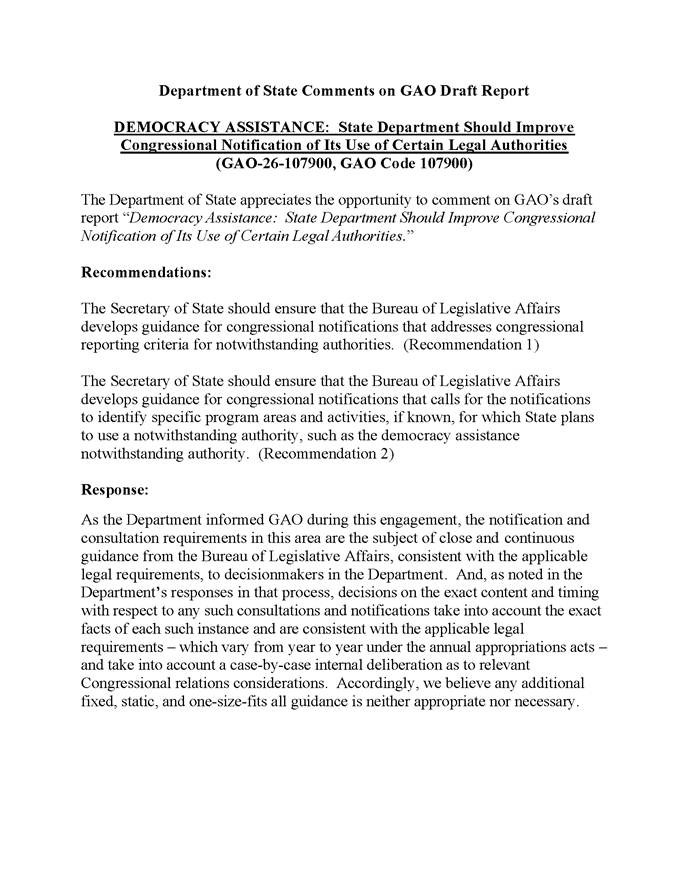
GAO Contact
Chelsa Kenney, KenneyC@gao.gov
Staff Acknowledgements
In addition to the above contact, Judith Williams (Assistant Director), Benjamin L. Sponholtz (Analyst in Charge), Ann Baker, Andrew Kincare, Miguel Navarro, Reid Lowe, Christopher Keblitis, Gergana Danailova, and Gabriel Nelson made key contributions to this report.
The Government Accountability Office, the audit, evaluation, and investigative arm of Congress, exists to support Congress in meeting its constitutional responsibilities and to help improve the performance and accountability of the federal government for the American people. GAO examines the use of public funds; evaluates federal programs and policies; and provides analyses, recommendations, and other assistance to help Congress make informed oversight, policy, and funding decisions. GAO’s commitment to good government is reflected in its core values of accountability, integrity, and reliability.
Obtaining Copies of GAO Reports and Testimony
The fastest and easiest way to obtain copies of GAO documents at no cost is through our website. Each weekday afternoon, GAO posts on its website newly released reports, testimony, and correspondence. You can also subscribe to GAO’s email updates to receive notification of newly posted products.
Order by Phone
The price of each GAO publication reflects GAO’s actual cost of production and distribution and depends on the number of pages in the publication and whether the publication is printed in color or black and white. Pricing and ordering information is posted on GAO’s website, https://www.gao.gov/ordering.htm.
Place orders by calling (202) 512-6000, toll free (866) 801-7077,
or
TDD (202) 512-2537.
Orders may be paid for using American Express, Discover Card, MasterCard, Visa, check, or money order. Call for additional information.
Connect with GAO
Connect with GAO on X,
LinkedIn, Instagram, and YouTube.
Subscribe to our Email Updates. Listen to our Podcasts.
Visit GAO on the web at https://www.gao.gov.
To Report Fraud, Waste, and Abuse in Federal Programs
Contact FraudNet:
Website: https://www.gao.gov/about/what-gao-does/fraudnet
Automated answering system: (800) 424-5454
Media Relations
Sarah Kaczmarek, Managing Director, Media@gao.gov
Congressional Relations
David A. Powner, Acting Managing Director, CongRel@gao.gov
General Inquiries
[1]22 U.S.C. § 8202.
[2]In this report, all years referenced are fiscal years (Oct. 1–Sept. 30) unless specified as calendar years (Jan. 1–Dec. 31). Any reference to the year of an appropriation or joint explanatory statement (JES) means the appropriations law or accompanying JES enacted for that fiscal year.
[3]Department of State, Foreign Operations, and Related Programs Appropriations Act, 2021, Pub. L. No. 116-260, Div. K, § 7032(b)(1), 134 Stat. 1182, 1745 (2020); Department of State, Foreign Operations, and Related Programs Appropriations Act, 2022, Pub. L. No. 117-103, Div. K, § 7032(b)(1), 136 Stat. 49, 617 (2022); Department of State, Foreign Operations, and Related Programs Appropriations Act, 2023, Pub. L. No. 117-328, Div. K, § 7032(b)(1), 136 Stat. 4459, 5027 (2022); Department of State, Foreign Operations, and Related Programs Appropriations Act, 2024, Pub. L. No. 118-47, Div. F, § 7032(b)(1), 138 Stat. 460, 786 (2024).
[4]The notification indicates that State also planned to rely on another notwithstanding authority. In addition to the democracy assistance notwithstanding authority, other notwithstanding authorities cover specific types of activities as well as assistance in specific countries or regions.
[5]See 22 U.S.C. § 2304. According to the notification, no assistance would be provided to the government of Russia.
[6]Specifically, Section 7015(f) of the annual appropriations acts has required agencies to submit a congressional notification before providing assistance to around 30 countries. Those countries have changed on a yearly basis.
[7]Before 2023, the JES did not include reporting criteria for notwithstanding authorities.
[8]H.R. Rep. 50-348 at 2621 (2023); H.R. Rep. 55-008 at 1157 (2024). Because an ‘‘amendments-between-the-Houses’’ process was used instead of a conference committee for the fiscal years 2023 and 2024 appropriations acts, there is no conference report and no ‘‘Joint Explanatory Statement of the Managers.” The two appropriations acts provided that explanatory statements filed in relation to those bills ‘‘shall have the same effect with respect to the allocation of funds and implementation of divisions A through L of this Act as if it were a joint explanatory statement of a committee of conference.” For purposes of this report, we refer to those explanatory statements as JESs.
[9]In addition to issuing this report, we issued a sensitive report in 2025 about State’s and USAID’s efforts to respond to antidemocratic actions overseas. GAO, Democracy Assistance: State Should Require Plans to Mitigate Effects of Reported Antidemocratic Actions Overseas, GAO‑25‑106971SU (Washington, D.C.: Sept. 11, 2025). A public version of that sensitive report is also available. See GAO, Democracy Assistance: State Should Require Plans to Mitigate Effects of Reported Antidemocratic Actions Overseas, GAO‑26‑108754 (Washington, D.C.: Mar. 9, 2026).
[10]GAO, Standards for Internal Control in the Federal Government, GAO‑14‑704G (Washington, D.C.: September 2014). Principle 10 calls for management to design control activities to achieve objectives.
[11]GAO‑14‑704G. Principle 15 calls for management to externally communicate the necessary quality information to achieve the entity’s objectives.
[13]Until it was closed, DRL’s Office of Global Programming managed the Human Rights and Democracy Fund as well as additional programs funded from the Democracy Fund; the Economic Support Fund; the Assistance for Europe, Eurasia, and Central Asia account; and other such appropriations as deemed necessary.
[14]The Full-Year Continuing Appropriations and Extensions Act, 2025 generally carried forward amounts appropriated in the Department of State, Foreign Operations, and Related Programs Appropriations Act, 2024. See Full-Year Continuing Appropriations and Extensions Act, 2025, Pub. L No. 119-4, § 1101(a)(11), 139 Stat. 9. 11 (2025) and Pub. L No. 118-47, Div. F, 138 Stat. at 743.
[15]National Security, Department of State, and Related Programs Appropriations Act, 2026, Pub. L. No. 119-75, Div. F, 140 Stat. 173, 526 (2026).
[16]For the 2024 prohibition on assistance to the governments of Cuba, Iran, North Korea, and Syria, see Pub. L. No. 118-47, Div. F, § 7007. For the prohibition on funding foreign governments’ law enforcement training, see 22 U.S.C. § 2420.
[17]For the 2024 prohibition, see Pub. L. No. 118-47, Div. F, § 7008.
[18]For 2024, see Pub. L. No. 118-47, Div. F, § 7032(b)(1). An example of a country-specific notwithstanding authority is Section 109(a) of the Cuban Liberty and Democratic Solidarity (LIBERTAD) Act of 1996, which authorizes assistance for individuals and independent nongovernmental organizations to support democracy-building efforts in Cuba. 22 U.S.C. § 6039(a). Assistance to Cuba is generally prohibited by both statutory and policy determinations. For example, Section 620(a) of the Foreign Assistance Act of 1961, as amended, prohibits all assistance to the government of Cuba. 22 U.S.C. § 2370(a). Additionally, assistance to Cuba is prohibited based on determinations including Cuba’s status as a state sponsor of terrorism and for having not fully complied with the minimum standards for combating trafficking in persons under the Trafficking Victims Protection Act.
[19]The list of countries in Section 7015(f) of the annual appropriations acts changes from year to year. In the 2024 appropriations act, the listed countries were Afghanistan, Bahrain, Burma, Cambodia, Colombia, Cuba, Egypt, El Salvador, Ethiopia, Guatemala, Haiti, Honduras, Iran, Iraq, Lebanon, Libya, Mexico, Nicaragua, Pakistan, Philippines, Russia, Rwanda, Somalia, South Sudan, Sudan, Syria, Tunisia, Ukraine, Venezuela, Yemen, and Zimbabwe.
[20]In some limited cases, other units within State transmit correspondences to Congress. For example, the Office of the Legal Adviser transmits treaties and executive agreements. See 1 FAM 310—Bureau of Legislative Affairs.
[21]1 FAM 240; 1 FAM 245; 1 FAM 246; 1 FAM 246.7; 1 FAM 246.9.
[22]The six regional bureaus are the (1) Bureau of African Affairs, (2) Bureau of East Asian and Pacific Affairs, (3) Bureau of European and Eurasian Affairs, (4) Bureau of Near Eastern Affairs, (5) Bureau of South and Central Asian Affairs, and (6) Bureau of Western Hemisphere Affairs. State bureaus and offices other than DRL, INL, and the six regional bureaus may also notify Congress of programming that may rely on the democracy assistance notwithstanding authority.
[23]1 FAM 112.
[24]The SPSD also includes, in addition to democracy assistance, six nondemocracy assistance categories, each covering several program areas, and states that activities that fall under multiple program areas should be categorized under the primary area. The six additional program categories are (1) Peace and Security; (2) Health; (3) Education and Social Services; (4) Economic Growth; (5) Humanitarian Assistance; and (6) Program Development and Oversight. State officials noted that “a program’s SPSD funding category does not, by itself, determine whether the program falls within the statutory definition of a “democracy program” [and that] programs funded through categories other than Democracy may nonetheless meet the statutory definition.”
[25]Specifically, we analyzed 37 of 64 congressional notifications that State provided to us and that it had submitted to Congress on behalf of eight bureaus. Each of these 37 notifications (1) addressed funding for 2023 or 2024 appropriations, (2) addressed funding for countries subject to the Section 7015(c) and 7015(f) notification requirements, and (3) referenced the legal citation for at least one notwithstanding authority. In some cases, a particular statutory citation may include multiple provisos, including a notwithstanding authority and other requirements. For example, in some of the notifications that we reviewed, State cited Section 7060(a)(2) of the 2023 appropriations act, which includes notwithstanding authority for higher education as well as directions for spending the appropriated funds and requirements for congressional notification.
[26]According to State officials, the department does not track the use of notwithstanding authorities. To select our sample of 37 notifications, we determined whether the notifications that State had provided referenced the statutory citation of a notwithstanding authority. Because we based our selection on the presence of such citations, all notifications in our sample contained a reference to a notwithstanding authority.
[27]The guidance, managed by the Bureau of Legislative Affairs, comprises several templates for purposes that include notifying Congress of State’s intent to obligate or reprogram funding, changing the program content of previously obligated funds, and transferring funds between accounts. The templates include a basic structure to provide information to Congress. For example, the template for notifying Congress of State’s intent to obligate or reprogram funding provides space for identifying information, including the project title and an explanation of the purpose of the funding. Other identifying information included in the templates include the program, appropriation account, and obligation year and amount.
[28]2 FAM 020—Management Controls.
[29]“Principle 10: Design Control Activities,” GAO‑14‑704G.
[30]Specifically, we reviewed notifications for appropriations for 2021 through 2024 that were submitted on behalf of DRL and the six regional bureaus and that referenced Section 7032(b)(1) of the annual appropriations act. In some cases, the notifications cite other statutes that may have referenced notwithstanding authorities. However, because our analysis focused on how State reported on the democracy assistance notwithstanding authority, we focused our review on linkages specific to that authority. INL officials told us that they do not use the notwithstanding authority for democracy assistance, and our review of congressional notifications submitted on behalf of INL confirmed that they did not cite the authority.
[31]Many notifications have a single introduction paragraph, while others have multiple paragraphs. One notification has a single paragraph containing both the introduction and a short narrative.
[32]For example, some notifications are organized according to the State bureau or the region in which the programs would be implemented, while other notifications’ program narratives lack organizational headings.
[33]Sixteen of these notifications do not have a program heading and instead contain a single program narrative. An additional four of these notifications list the SPSD program area “Program Development and Oversight” and include monitoring and evaluation activities for democracy programs. One notification lists democracy programming under a single SPSD nondemocracy program area. Appendix II describes that notification and related SPSD democracy program areas and elements.
[34]Program narratives may contain multiple activities. For example, in one notification, within a narrative for civil society programs, State said that it intended to support seven to 10 programs with activities including skills building, advocacy, documenting rights violations, enabling diaspora groups, and improving recognition of labor rights.
[35]Because our analysis focused on the use of the notwithstanding authority for democracy assistance, we did not examine the notifications’ linkage of other notwithstanding authorities to specific programs or activities.
[36]2 FAM 20: Management Controls.
[37]“Principle 10: Design Control Activities” and “Principle 15: Communicate Externally,” GAO‑14‑704G (Washington, D.C.: September 2014).
[38]GAO, Evidence-Based Policymaking: Practices to Help Manage and Assess the Results of Federal Efforts, GAO‑23‑105460 (Washington, D.C.: July 12, 2023).
[39]In 2024, USAID internal guidance provided standardized structure and wording for congressional notifications, including notwithstanding authority citations. The standardized structure included (1) an introduction, (2) funding narrative sections organized by funding source, and (3) activity narrative sections organized by SPSD program area. According to the guidance, the funding sections are an organizational tool, and the guidance does not indicate that the funding sections should include any narrative wording. However, our review of the 101 notifications found that some funding source sections included a discussion of the planned use of democracy assistance notwithstanding authority, so we included those sections in our analysis. In addition, the guidance stated that information on the use of notwithstanding authorities for the countries named in Section 7015(f) of the annual appropriations act should be limited to a citation and a very brief description in the notification’s introduction.
[40]Of the 101 notifications that we analyzed, 83 cite the authority in the introduction, 11 cite the authority in the funding narrative, and 40 cite the authority in the activity narrative. Some notifications cite the authority in more than one place.
[41]In some instances, notifications discuss the authority’s use and reference SPSD program areas in the notification’s introduction but do not discuss the authority in those SPSD program areas in the notification’s program narrative section. For example, one notification states in its introduction that the authority would be used for human rights programs, while the program area narrative discusses the authority only under the good governance program area.
[42]We identified eight congressional notifications that indicate USAID planned to rely on the democracy assistance notwithstanding authority to provide democracy assistance within SPSD nondemocracy program areas. Appendix III describes the eight examples and related SPSD democracy assistance program areas and elements. We also identified three notifications in which USAID cited multiple notwithstanding authorities—including the democracy assistance authority—and that include both SPSD democracy and nondemocracy assistance program areas. However, those three notifications do not clearly link the notwithstanding authorities and program areas, and we therefore could not identify areas for which USAID may have planned to use the democracy assistance authority.
[43]In this report, all years referenced are fiscal years (Oct. 1–Sept. 30) unless specified as calendar years (Jan. 1–Dec. 31). Any reference to the year of an appropriation or JES means the appropriations law or accompanying JES enacted for that fiscal year.
[44]Department of State, Foreign Operations, and Related Programs Appropriations Act, 2023, Pub. L. No. 117-328, Div. K, § 7015(c), 136 Stat. 4459, 5010 (2022); Department of State, Foreign Operations, and Related Programs Appropriations Act, 2024; Pub. L. No. 118-47, Div. F, § 7015(c), 138 Stat. 460, 766 (2024).
[45]H.R. Rep. 50-348 at 2621 (2023); H.R. Rep. 55-008 at 1157 (2024). Because an ‘‘amendments-between-the-Houses’’ process was used instead of a conference committee for the fiscal years 2023 and 2024 appropriations acts, there is no conference report and no ‘‘Joint Explanatory Statement of the Managers.” The two appropriations acts provided that explanatory statements filed in relation to those bills ‘‘shall have the same effect with respect to the allocation of funds and implementation of divisions A through L of this Act as if it were a joint explanatory statement of a committee of conference.’ For purposes of this report, we refer to those explanatory statements as JESs.
[46]The six regional bureaus are the (1) Bureau of African Affairs; (2) Bureau of East Asian and Pacific Affairs; (3) Bureau of European and Eurasian Affairs; (4) Bureau of Near Eastern Affairs; (5) Bureau of South and Central Asian Affairs; and (6) Bureau of Western Hemisphere Affairs. We requested and State bureaus provided notifications on a bureau-by-bureau basis. Our requests to those bureaus varied. At a minimum, we requested all notifications submitted on behalf of the bureau that notified funding made available for 2021 to 2024, and notified funding for at least one of the countries listed in Section 7015(f) of the annual appropriations acts.
[47]For example, USAID provided around 400 documents for fiscal year 2024, including 274 congressional notifications with unique numbers (CN 1 through CN 274). We verified that USAID provided each of the 274 numbered notifications indicated by the number sequence. We eliminated from our review duplicates, unreadable documents, and documents outside of our scope.
[48]We compiled the list of search terms from sources including the 2023 and 2024 appropriations acts; the Foreign Assistance Act of 1961, as amended; and other laws.
[49]Section 7015(c) of the 2023 and 2024 appropriations acts required that “any notification submitted pursuant to [Section 7015(f)] shall include information (if known on the date of transmittal of such notification) on the use of notwithstanding authority.” The list of countries in Section 7015(f) of the annual appropriations act changes from year to year. In the 2024 appropriations act, the list included Afghanistan, Bahrain, Burma, Cambodia, Colombia, Cuba, Egypt, El Salvador, Ethiopia, Guatemala, Haiti, Honduras, Iran, Iraq, Lebanon, Libya, Mexico, Nicaragua, Pakistan, Philippines, Russia, Rwanda, Somalia, South Sudan, Sudan, Syria, Tunisia, Ukraine, Venezuela, Yemen, and Zimbabwe.
[50]The 2023 and 2024 JESs directed State and USAID to include detailed information on the provisions of law being notwithstood in notifications submitted pursuant to Sections 7015(c) and 7015(f).
[51]The 2023 and 2024 JESs directed State and USAID to include a justification for the use of notwithstanding authority in notifications submitted pursuant to Sections 7015(c) and 7015(f).
[52]We reviewed notifications submitted on behalf of DRL and the six regional bureaus. INL officials told us that they do not use the notwithstanding authority for democracy assistance, and our review of congressional notifications submitted on behalf of INL confirmed that INL did not cite the authority.
[53]Notifications also include a cover page, which contains the notification number, identifies the notifying bureau and the amount of funds being notified, and includes a one-sentence explanation of the purpose of the obligation or reprogramming of funding, according to State’s guidance. We did not evaluate the cover pages.
[54]Notification introductions typically consist of one paragraph, although some have multiple paragraphs. While most notifications transition from the introduction to the narrative section with a bolded program heading, a few notifications do not have any headings. Two notifications contain a bolded heading within the introduction, and one other notification has a single paragraph that contains both the introduction and a short narrative.
[55]The SPSD provides a common set of definitions and consistent organization for State and USAID foreign assistance. The SPSD identifies six general program areas for the category “Democracy, Human Rights and Governance”: (1) Rule of Law, (2) Good Governance, (3) Political Competition and Consensus Building, (4) Civil Society, (5) Independent Media and Free Flow of Information, and (6) Human Rights. Each of the six program areas has several program elements, totaling to 24. In addition to “Democracy, Human Rights and Governance,” the SPSD includes six nondemocracy assistance categories, each covering several program areas, and states that activities that fall under multiple program areas should be categorized under the primary area. The six additional categories are (1) Peace and Security; (2) Health; (3) Education and Social Services; (4) Economic Growth; (5) Humanitarian Assistance; and (6) Program Development and Oversight.
[56]Included in this analysis were notifications that were organized by SPSD program area and activity name or topic area but that we determined did not contain any SPSD democracy program area wording.
[57]We identified one notification citing the democracy assistance notwithstanding authority in which State listed democracy programming only under a single SPSD nondemocracy program area. See appendix II.
[58]Some notifications had no program headings and contained just one program narrative.
[59]2 FAM 020—Management Controls.
[60]GAO, Standards for Internal Control in the Federal Government, GAO‑14‑704G (Washington, D.C.: September 2014).
[61]Specifically, we reviewed whether the notifications reference Section 7032(b)(1) of the annual appropriations act.
[62]Notifications also included a cover page, which contained the notification number, the transmission date, program names, appropriations account, and amount of funds notified. We did not evaluate the cover pages. Not all notifications contained a funding source narrative. We included any activity that used the SPSD democracy category “Democracy, Human Rights and Governance” as an SPSD democracy program area.
[63]We identified eight USAID notifications in which the use of the authority could be attributed to specific SPSD nondemocracy program area narratives. See appendix III.
[64]State’s SPSD provides a common set of definitions and consistent organization for State and USAID foreign assistance. The SPSD includes seven categories of assistance: (1) Peace and Security; (2) Democracy, Human Rights and Governance; (3) Health; (4) Education and Social Services; (5) Economic Growth; (6) Humanitarian Assistance; and (7) Program Development and Oversight. Each category of assistance contains multiple program areas, which in turn are broken down into program elements.
[65]We analyzed notifications from the Bureau of Democracy, Human Rights, and Labor (DRL) and the six regional bureaus: (1) Bureau of African Affairs; (2) Bureau of East Asian and Pacific Affairs; (3) Bureau of European and Eurasian Affairs; (4) Bureau of Near Eastern Affairs; (5) Bureau of South and Central Asian Affairs; and (6) Bureau of Western Hemisphere Affairs. We found that all 101 of the notifications contained program headings and activity narratives that aligned with the SPSD democracy program area or element narratives. We also found that the majority of the notifications (58/101) contained multiple headings, making it difficult to link the notwithstanding authority to specific programmatic activities. The remaining 43 notifications contained a single program heading or narrative. Of those 43, one notification explicitly listed an SPSD nondemocracy program area.
[66]We did not evaluate whether the program area narrative described activities consistent with the definition of democracy programs in the fiscal year 2023 appropriations act. See Department of State, Foreign Operations, and Related Programs Appropriations Act, 2023, Pub. L. No. 117-328, Div. K, § 7032(b)(1), 136 Stat. 4459, 5027 (2022).
[67]For example, the program narrative discusses strengthening connections between communities and the government. Those activities are consistent with the SPSD “Conflict Mitigation and Stabilization” program area’s program element “PS.6.2: Peace and Reconciliation Processes,” which includes strengthening the relationship between the community, local, and national government stakeholders.
[68]USAID used the Department of State’s SPSD, which provides a common set of definitions and consistent organization for State and USAID foreign assistance. The SPSD includes seven categories of assistance: (1) Peace and Security; (2) Democracy, Human Rights and Governance; (3) Health; (4) Education and Social Services; (5) Economic Growth; (6) Humanitarian Assistance; and (7) Program Development and Oversight. Each category of assistance contains multiple program areas, each of which contains several program elements.
[69]Specifically, we analyzed the notifications for consistency of reporting on the use of notwithstanding authority for democracy assistance, including the location of the reporting within the notifications. In many instances, the notifications did not identify specific program areas for which USAID planned to use the authority. In addition to identifying the eight notifications described in this appendix, we identified three USAID notifications citing multiple notwithstanding authorities—including the democracy assistance authority—and referring to both SPSD democracy and nondemocracy program areas. However, those three notifications did not clearly link the notwithstanding authorities to program activities or areas, and so we could not identify the areas for which USAID may have planned to use the democracy assistance authority.
[70]We did not evaluate whether the program area narratives described activities consistent with the definition of democracy programs in Section 7032(c) of the annual appropriations acts.
[71]The fiscal years (FY) referenced throughout this appendix refer to the FY of the notifications’ transmittal, which can sometimes differ from the FY when the funds were notified.
[72]For example, the program narratives discuss improving the efficiency of first-responder coordination, which could help increase the number of victims identified and referred to relevant services. Those activities are consistent with the SPSD “Peace and Security” category’s “PS.5.1: Protection” program element, which includes supporting victim identification, development of referral mechanisms, and training and technical assistance for first responders.
[73]Two of the notifications use the program area name “Conflict Mitigation and Reconciliation,” whereas the SPSD program area is “Conflict Mitigation and Stabilization.” The “Conflict Mitigation and Stabilization” program area contains the “Peace and Reconciliation Processes” program element. For the purpose of our analysis, we considered the program area’s name in the notifications to relate to the SPSD program area’s name.
[74]For example, the program narratives discuss disengagement, rehabilitation, and reintegration activities designed to address the unique needs of women and girls affected by violence or those radicalized to violence. Those activities are consistent with the “Peace and Security” SPSD program element “PS.6.4: Disarmament, Demobilization, and Reintegration (DDR),” which includes facilitating the return of ex-combatants, including women and children associated with armed forces, to ease their transition to civilian communities to secure sustainable peace.
[75]In Mexico, transnational criminal organizations drive violence and insecurity, and USAID supported efforts to prevent crime, violence and recidivism among at-risk youth. For example, the program narrative discusses supporting the reintegration of formerly incarcerated youth into their communities and reducing community and individual barriers for youth reinsertion in target communities. Those activities are consistent with the “Peace and Security” SPSD program element “PS.6.4: Disarmament, Demobilization, and Reintegration (DDR),” which includes facilitating the return of ex-combatants, including women and children associated with armed forces, to sustainable civilian livelihoods and easing their transition to civilian communities to secure sustainable peace.
[76]For example, the Workforce Development program narrative in CN 24-225 discusses technical and managerial training for employees of targeted businesses. Those activities are consistent with the SPSD “Economic Growth” program area’s program element “EG.6.4: Technical/Vocational Training for Employment,” which includes creating and sustaining career-enhancing education and training programs that are responsive to current and future labor needs. Similarly, the “Private Sector Productivity” program narrative in CN 24-247 discusses targeting support to micro-, small-, and medium-sized enterprises to become bankable enterprises, enabling them to grow, become more competitive, and generate jobs. This is consistent with the SPSD “Economic Growth” program area’s program element “EG.5.2: Private Sector Opportunity,” which includes improving the capacity of businesses, including micro-, small-, and medium-sized enterprises, to start or grow.