
Report to Congressional Requesters
United States Government Accountability Office
A report to congressional requesters
For more information, contact: Elizabeth Curda at curdae@gao.gov.
What GAO Found
Section 508 of the Rehabilitation Act of 1973 generally requires federal agencies to develop, procure, maintain, and use information and communication technology (ICT) that is accessible to people with disabilities. ICT includes things such as websites and electronic forms. According to governmentwide guidance, agencies should test ICT for accessibility before it is deployed. However, in 2025, most federal agencies responding to a federal survey reported inconsistent testing. Further, GAO found that three selected agencies—Department of Homeland Security (DHS), Department of Agriculture (USDA), and Department of Housing and Urban Development (HUD)—varied in the extent to which they followed leading practices from the General Services Administration (GSA) and Office of Management and Budget (OMB) for pre-deployment testing.
· DHS generally follows leading practices, and it was taking action for continuous improvement to address testing gaps for certain types of ICT.
Both USDA and HUD partially follow leading practices. For example:
· USDA has a Section 508 policy, but the policy is outdated, and there is no accompanying manual, thereby leading to gaps in clear guidance for testing.
· HUD has a policy, but due to staffing resources, paused some implementation efforts that affect testing, such as filling key positions, updating procurement forms, and verifying testing results.
When ICT is not tested, agencies cannot ensure federal services and information are accessible to members of the public and federal employees with disabilities.
According to disability groups and researchers GAO interviewed, federal agencies’ formal complaint processes were sometimes lengthier and more complex than informal agency feedback processes. While submitting feedback can be easier for individuals, GAO’s covert testing found that agencies did not consistently fix identified issues. Fourteen of the 23 agencies to which GAO covertly provided feedback fixed the issues that GAO identified from September 2025 through February 2026. Nine agencies had not fixed the issues identified as of May 2026. (See figure.)
Agency Responses to Feedback on Information and Communication Accessibility Issues Submitted Through GAO’s Undercover Investigation

Note: For more details, see fig. 2 in GAO-27-107934. GAO
notified these agencies regarding the investigation results and related General
Services Administration guidance.
Why GAO Did This Study
Federal agencies provide services through ICT such as websites, electronic documents, and kiosks. If ICT is not accessible, millions of Americans who have a disability may be unable to access these services. Section 508 generally requires federal ICT to be accessible, but GSA and others have reported that federal ICT accessibility has been a persistent challenge.
This report (1) describes what federal agencies report about testing ICT for accessibility and assesses the extent to which selected agencies followed related leading practices and (2) describes factors that may affect people’s use of formal complaint processes compared with feedback processes and assesses the effectiveness of agencies’ feedback processes.
GAO reviewed documents and interviewed officials at three agencies—DHS, HUD, and USDA—selected for variation in size, their public-facing services, and other factors. GAO compared agency actions to leading practices from GSA and OMB guidance. GAO also reviewed 23 agencies’ formal complaint and feedback processes and websites. After identifying accessibility issues for each agency, GAO covertly submitted feedback to monitor agencies’ responses. GAO also interviewed officials from GSA and the U.S. Access Board and researchers and representatives from disability groups.
What GAO Recommends
GAO is making two recommendations— that USDA and HUD each address key gaps in following leading practices to improve their pre-deployment ICT testing. USDA and HUD neither agreed nor disagreed with the recommendations.
|
Abbreviations |
|
|
|
|
|
|
|
Assessment |
Governmentwide Section 508 Assessment |
|
|
CFO Act |
Chief Financial Officers Act of 1990, as amended |
|
|
COVID-19 |
coronavirus disease 2019 |
|
|
DHS |
Department of Homeland Security |
|
|
FY |
fiscal year |
|
|
GSA |
General Services Administration |
|
|
HUD |
Department of Housing and Urban Development |
|
|
ICT |
information and communication technology |
|
|
Memorandum |
Memorandum M-24-08, Strengthening Digital Accessibility and the Management of Section 508 of the Rehabilitation Act |
|
|
OMB |
Office of Management and Budget |
|
|
Playbook |
Technology Accessibility Playbook |
|
|
Section 508 |
Section 508 of the Rehabilitation Act of 1973 |
|
|
USDA |
Department of Agriculture |
|
This is a work of the U.S. government and is not subject to copyright protection in the United States. The published product may be reproduced and distributed in its entirety without further permission from GAO. However, because this work may contain copyrighted images or other material, permission from the copyright holder may be necessary if you wish to reproduce this material separately.
November 19, 2026
Congressional Requesters
Millions of Americans use federal information and communication technology (ICT) such as websites, videos, software, electronic documents, computers, and information kiosks to access critical information, benefits, and services from the federal government. Accessible ICT helps federal agencies meet their missions and serve the American people, including the more than 70 million estimated U.S. adults who report having a disability.[1]
Federal ICT accessibility is addressed in Section 508 of the Rehabilitation Act of 1973 (Section 508). Section 508 generally requires federal agencies to develop, procure, maintain, and use ICT that allows access for federal employees and members of the public with disabilities comparable to those without a disability.[2] Inaccessible ICT can affect people with a wide range of disabilities, including disabilities related to mobility, vision, hearing, or processing information. The U.S. Access Board and General Services Administration (GSA) play key roles related to 508 compliance for federal agencies. The Access Board establishes technical standards with which agencies must comply. GSA develops governmentwide resources, in consultation with the Access Board, and disseminates them through Section508.gov, webinars, and other forums. Both agencies provide technical assistance to agencies. The Office of Management and Budget (OMB) has also played a key role by publishing governmentwide guidance on Section 508.
Although agencies have been required to comply with Section 508 for more than 25 years, GSA and others have reported that compliance has been persistently low across the federal government.[3] In response to 2013 guidance from OMB, GSA reported biannually on 508 compliance; since 2023, it has published an annual comprehensive Governmentwide Section 508 Assessment (Assessment).[4] In its fiscal year (FY) 2025 Assessment, GSA found low compliance overall among responding agencies and, while some agencies might have had more robust programs and processes, all agencies had opportunities for improvement.[5] In 2024, we analyzed findings and recommendations from GSA’s FY 2023 Assessment, as well as requirements and leading practices published in OMB’s Memorandum M-24-08, Strengthening Digital Accessibility and the Management of Section 508 of the Rehabilitation Act (Memorandum).[6] In our report, we described how GSA found in 2023 that 53 percent of agencies that procure ICT reported not always verifying that they met 508 requirements and that 40 percent of all responding agencies did not know the total number of 508 complaints filed at their agency in the prior 12-month reporting period.
You asked us to study key aspects of Section 508 at selected federal agencies. This report (1) describes what federal agencies report about testing ICT for accessibility and assesses the extent to which selected agencies followed related leading practices, and (2) describes factors that may affect people’s use of formal complaint processes compared with feedback processes and assesses the effectiveness of agencies’ feedback processes.
To address our first objective, we reviewed selected findings from GSA’s FY 2025 Assessment regarding agencies’ reported ICT testing. We also selected three agencies: the Department of Agriculture (USDA), Department of Homeland Security (DHS), and Department of Housing and Urban Development (HUD). We selected these agencies because they are included in the Chief Financial Officers Act of 1990 (CFO Act),[7] provided or funded public-facing services, and varied in size and Section 508 maturity according to GSA’s FY 2024 Assessment.[8] For the two larger agencies (USDA and DHS), we also selected up to three components (also called mission areas by USDA) within those agencies that provided or funded public-facing services and varied in Section 508 maturity according to GSA’s FY 2024 Assessment.[9] For each selected agency, we reviewed 508-related policies, guidance, and other relevant information and interviewed officials responsible for implementing Section 508. We identified whether agencies reported consistently testing ICT before deployment, as recommended by GSA and OMB and required by each selected agency’s policies.
To assess the extent to which selected agencies’ testing procedures followed leading practices for accessibility testing, we compiled leading practices from OMB’s Memorandum and GSA’s resources, including its Assessments and Technology Accessibility Playbook (Playbook) available on Section508.gov, into three categories related to establishing a foundation, implementation, and monitoring.[10] We then compared agencies’ responses and policies with leading practices.[11]
To address our second objective, we reviewed 23 CFO Act agencies’ published accessibility statements that describe their formal complaint and feedback mechanisms.[12] We also reviewed these agencies’ websites to identify accessibility issues and found at least one accessibility issue with each agency website. (See app. I for more information about our investigation of agency feedback processes.) We then covertly submitted feedback to the 23 agencies using each agency’s feedback process, representing ourselves as a member of the public. We monitored whether agencies responded to our feedback submissions and whether they fixed the issue.
For both objectives, we also reviewed the results from GSA’s FY 2025 Assessment to identify and describe what all responding federal agencies reported about the extent of their ICT accessibility and their accessibility testing and formal complaints processes. We reviewed the study methodology and findings as reported by GSA and discussed the findings for these selected areas with GSA officials. We determined that the findings we report from the FY 2025 Assessment were sufficiently reliable for the purposes of describing gaps with ICT accessibility and testing procedures as well as formal complaints counts among agencies that responded to the FY 2025 Assessment.[13] We also interviewed agency officials from GSA and the Access Board. Finally, we conducted interviews with individuals from six groups that represent people with disabilities or have studied this issue from the user perspective. These groups included two groups representing people with disabilities, one group representing members of the blind community, one group representing members of the Deaf community, and one researcher and one research team who work on this issue in an academic setting.
We conducted this performance audit from November 2024 to November 2026 in accordance with generally accepted government auditing standards. Those standards require that we plan and perform the audit to obtain sufficient, appropriate evidence to provide a reasonable basis for our findings and conclusions based on our audit objectives. We conducted our related investigative work in accordance with investigation standards prescribed by the Council of the Inspectors General on Integrity and Efficiency. We believe that the evidence obtained provides a reasonable basis for our findings and conclusions based on our audit objectives.
Background
Federal ICT Accessibility
Federal ICT that is inaccessible can significantly impact the lives of people with disabilities and federal agencies’ abilities to fulfill their missions. For example, according to the National Federation of the Blind, during the COVID-19 health emergency, some information that was posted online was inaccessible to blind or low-vision people who rely on assistive technologies such as screen readers.[14] This included key information such as accessing COVID-19 tests and vaccines. In addition, the Department of Justice reported that some self-service federal kiosks and electronic information terminals that allow people to obtain information, complete transactions, and access government services rely exclusively on visual touchscreens, which can prevent blind people from using them independently.[15]
Agencies are required to have ICT that meets Section 508 standards. These standards are developed by the Access Board and provide technical specifications and requirements for ICT products and services procured, developed, maintained, or used by the federal government. They relate to a broad range of ICT such as computer hardware, software, websites, mobile apps, telecommunications, and video. See table 1 for examples of considerations for ICT accessibility.
|
|
Include “alt text” for figures and images so that screen readers can read the information aloud. This allows blind or low-vision people to access visual content. |
|
|
Include text transcriptions for audio-only files to make the audio information accessible for people to read along. This can be useful for Deaf and hard of hearing people or for people who process information more easily when it is written. |
|
|
Make websites navigable using a keyboard so that people with limited mobility are not required to use a mouse. |
|
|
When headings are used in electronic documents, tag and structure these headings appropriately so that they can be read by screen readers. Form fields should be able to be completed using a keyboard, screen reader, or other assistive devices. |




Source: GAO analysis of information from the World Wide Web Consortium and www.Section508.gov; GAO (icons). | GAO‑27‑107934
Under Section 508, all federal employees and contractors who produce, manage, or distribute ICT have a role in helping ensure accessibility. The scope of federal ICT is broad and has increased over time with the growth of digital content. As more federal employees become content creators, the number of people with roles in ICT accessibility has grown and become more dispersed.
Additionally, agencies report managing a large volume of ICT. In GSA’s FY 2025 Assessment, responding agencies reported managing over 1.6 million public-facing web pages, 4.6 million documents and files, 1.8 million hardware devices, and 47,000 software systems. These figures likely understate the total amount of governmentwide ICT because not all agencies responded to the Assessment, and of those that did, many indicated they did not have a method to track ICT or did not provide estimates.[16]
Pre-Deployment Testing
Agencies are expected to conduct pre-deployment testing on ICT to ensure it complies with 508 requirements, according to guidance and leading practices from GSA and OMB. Agencies obtain ICT in different ways, including by using the procurement process to purchase ICT from commercial vendors, building ICT internally, or using a combination of both approaches.[17]
Pre-deployment testing refers to agencies comprehensively testing ICT and fixing (i.e., remediating) issues found during the testing process before the ICT is deployed and used by federal employees, the public, or both. Testing ICT provides critical information to agency officials on whether ICT is accessible per 508 standards before it is widely released. According to GSA and OMB, testing should occur throughout the development or procurement process of ICT before it is deployed. This includes ensuring that appropriate accessibility requirements are included in the design phase for in-house ICT or in contracts for procured ICT. For procured ICT specifically, agencies must account for their responsibility under 508 and review vendors’ descriptions about the accessibility of their ICT products.
Comprehensive testing includes both automated and manual testing procedures (i.e., hybrid testing). Automated testing uses software to identify accessibility issues based on technical standards but is limited in how thoroughly accessibility requirements can be tested. For example, an automated scanning tool may be able to identify that there is some text in an alt text field for an image, but it cannot assess if the alt text is appropriate and accurate. Manual testing by a person, on the other hand, is necessary for evaluating many accessibility features such as testing keyboard navigation (in lieu of using a mouse) and ensuring that color is not the only way of conveying information. Any issues identified from automated and manual testing should be remediated, according to guidance and leading practices from GSA and OMB.
GSA and OMB also recommend that agencies engage people with disabilities in the design and testing process.[18] Engaging people with disabilities during the design and testing of ICT can help agencies identify both accessibility and usability issues that automated and manual testing approaches may miss. GSA recommends several approaches to engaging people with disabilities in the testing process:
· designing technology with people with disabilities in mind,
· using personas during the technology development process to test if the ICT meets different accessibility needs,[19] and
· using contract support for user testing with assistive technology users.
Complaints
Agencies are required to have both formal complaints and feedback (also known as informal complaints) processes. Section 508 requires that agencies have formal complaints processes where people with disabilities can file complaints with agencies for having or using inaccessible ICT.[20] Additionally, starting in 2024, OMB required all agencies to establish feedback procedures and provide or link to their feedback mechanism and instructions for filing a formal complaint through an “accessibility statement” on their websites.
Resources
GSA and the Access Board provide a number of resources to help federal agencies meet accessibility requirements. For example:
· Section508.gov. GSA hosts this website and develops and maintains resources on the website, in conjunction with the Access Board. Resources include information on testing, procurement, and training, with topics targeting federal agencies and vendors. One key resource on Section508.gov is the Playbook, which outlines a comprehensive ICT accessibility approach for an agency including developing a 508 program, training staff, setting up testing processes, and evaluating 508 program performance using key performance indicators. Additionally, GSA disseminates resources such as the Solicitation Review Tool to help agencies identify and apply appropriate 508 requirements for procurement. GSA updated this tool in August 2026 to use expanded artificial intelligence capabilities.
· Section 508 best practices webinar. The Access Board hosts a bimonthly webinar that focuses on a specific ICT accessibility issue. For example, in May 2026, the Access Board hosted a webinar on common accessibility issues with PDFs, which officials have said can generally be difficult to make accessible.
· Newsletters and listservs. GSA publishes two newsletters—Accessibility Bytes and Digital Accessibility—and hosts a listserv for federal officials and others working on ICT accessibility issues.
· Interagency Accessibility Forum. GSA, in conjunction with the Access Board, hosts an annual conference on ICT accessibility issues for federal agencies and other organizations. The May 2026 Interagency Accessibility Forum included sessions on accessibility features for social media, selected agencies’ experiences with developing and improving 508 programs, and the use of artificial intelligence to test accessibility.
· Outreach to vendors. In GSA’s FY 2025 Assessment, agencies reported that the information vendors provide about accessibility requirements and testing can be inconsistent or unreliable. GSA officials described ongoing efforts to educate vendors on accessibility requirements. They also described cases where they have worked directly with vendors that offer products to multiple agencies to improve accessibility.
Leading Practices for Testing ICT
GSA and OMB have disseminated many leading practices for testing ICT that agencies can follow. We compiled leading practices related to testing from OMB’s Memorandum, GSA’s Playbook, and multiple GSA Assessments and organized them into leading practice categories.[21] These leading practices involve multiple aspects of testing including (1) creating a foundation for Section 508 testing at an agency, (2) implementing practices and procedures that support testing, and (3) tracking and monitoring to ensure testing is occurring and to help the agency continuously improve. See table 2 for a summary of such leading practices.
|
Foundation
|
To build a strong foundation for information and communication technology (ICT) accessibility related to Section 508 of the Rehabilitation Act of 1973 (Section 508), including ensuring adequate pre-deployment testing, GSA and OMB guidance state that agencies should: · Establish a 508 program with clear responsibilities and structures · Have a current accessibility policy that outlines testing expectations · Assign staff clear roles and responsibilities related to testing |
|
Implementation
|
To help ensure that testing becomes implemented in agency operations, GSA and OMB guidance state that agencies should: · Test ICT using standardized testing procedures and tools; such as checkpoints or milestones to verify that required testing occurs. Conduct testing in collaboration with stakeholders and users to ensure that Section 508 is considered comprehensively and appropriately. · Provide role-based training and technical assistance to support testers, developers, or other key staff |
|
Tracking and monitoring
|
To confirm that the policies and procedures are being followed and to promote continuous improvement, GSA and OMB state that agencies should regularly track and monitor testing activities and outcomes to identify lessons learned and measure performance over time. |



Source: GAO analysis of General Services Administration (GSA) and Office of Management and Budget (OMB) leading practices; GAO (icons). | GAO‑27‑107934
Note: GAO reviewed OMB’s Memorandum M-24-08, Strengthening Digital Accessibility and the Management of Section 508 of the Rehabilitation Act, GSA’s Technology Accessibility Playbook, and multiple annual Governmentwide Section 508 Assessments from GSA for leading practices related to accessibility testing. GAO developed these categories to serve as an organizational framework through an iterative process.
Agencies Reported Deploying Some ICT Without Testing, and Two of Three Selected Agencies Could Better Leverage Leading Practices
Agencies Reported They Did Not Always Test ICT, Especially Hardware and Software
Federal agencies responding to GSA’s FY 2025 Assessment did not test all reported ICT for accessibility. For example, 60 responding agencies reported testing about 37 percent of their public-facing websites, 25 percent of their electronic documents, 5 percent of their software, and 4 percent of their hardware in the past year. Testing ICT before it is deployed is a key step in avoiding or addressing inaccessible ICT. GSA’s FY 2025 Assessment found that among responding agencies, the overall accessibility of commonly used ICT is low, with fewer than half of agencies’ top-viewed or used ICT reported as fully accessible.[22] For example, the accessibility rate was 37 percent for responding agencies’ top-viewed public web pages and 37 percent for their top-viewed electronic documents.
Testing can be easier if agencies have standardized testing procedures, and agencies reported having such procedures for some types of ICT more than others. In GSA’s Assessment, agencies more commonly reported having standardized testing procedures for public websites and electronic documents compared with software and hardware (see fig. 1).
Figure 1: Number of Federal Agencies Reporting Standardized Accessibility Testing Processes, by Type of Information and Communication Technology (ICT), Fiscal Year 2025
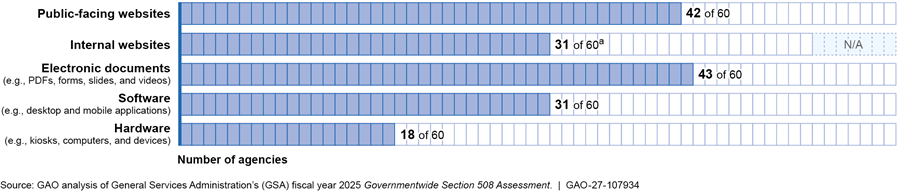
Note: This figure reflects responses to the question, “Does the Department or Agency have a standardized test process to determine Section 508 conformance for <ICT Type>?” Answer choices for all ICT questions were “Yes” or “No” with the exception of internal websites, which also had a valid answer choice of “Not Applicable.” All 60 agencies that responded to this question reported having public-facing websites, electronic documents, software, and hardware. Results are based on data GSA reported in the 2025 Governmentwide Section 508 Assessment. Blue bars reflect the number of agencies that responded “yes” to the question
aSeven agencies responded “Not Applicable - Department or Agency does not have internal web pages” to this question.
The types of ICT that agencies more commonly reported testing and having standardized testing procedures for in the Assessment were also the types of ICT for which more testing resources were available from the Access Board, GSA, and others. In particular, a variety of resources are available to help agencies test websites (see table 3).
|
|
2008 |
2011 |
2021 |
|
Resources |
The World Wide Web Consortium developed Web Content Accessibility Guidelines, which provide internationally recognized technical standards for digital accessibility. The Consortium also updated these guidelines in 2018 and 2023. |
The Department of Homeland Security (DHS) created the Trusted Tester certification program for manually evaluating web accessibility, which the General Services Administration (GSA) and Office of Management and Budget both promote for use by agencies and contractors. DHS has periodically updated Trusted Tester.a DHS officials told us they developed the core Trusted Tester methodology between 2008 and 2009. |
GSA and the U.S. Access Board released a web-testing baseline, which is a standardized set of testing elements for evaluating technical requirements related to Section 508 of the Rehabilitation Act of 1973.b |
Source: GAO analysis of information from Section508.gov, DHS’s website, the World Wide Web Consortium website, and information from DHS and GSA officials. | GAO 27-107934
aEntities have developed automated web-testing tools, such as the Social Security Administration’s Accessible Name and Description Indicator tool, which can test a single web page at a time for accessibility issues. Trusted Tester uses such tools for Section 508 testing on websites.
bBaselines provide a comprehensive set of components that should be included in accessibility testing to ensure full coverage of all accessibility requirements. They are not a step-by-step testing procedure or methodology and are not specific testing tools or software.
Resources are also available to support testing electronic documents although the widespread usage of electronic documents may still lead to accessibility challenges. Specifically, in 2024, GSA and the Access Board released an electronic documents testing baseline after developing a website testing baseline in 2021. In addition, companies that develop commonly used software for creating electronic documents have been increasingly adding accessibility features and checkers to prompt users to fix accessibility issues. Even with such resources, selected agency officials we spoke with described challenges. For example, one official noted that many employees create electronic content, including documents, emails, and forms, which expands the scope of employees who need to understand accessibility requirements.
GSA officials told us that certain types of ICT were more challenging to test than others, often due to testing resources that are still in development or the complexity of testing certain types of ICT. Software and hardware were the most challenging types of ICT to test, according to GSA officials, partially due to less guidance or training resources and the variation of ICT within these categories. Officials from GSA and the Access Board told us they were taking concrete steps to address such challenges. As of summer 2026, GSA and the Access Board were collaborating to create baselines for both software and hardware, which they anticipated would lead to first drafts of the baselines in fall 2026. The Section508.gov website advertised these efforts and provided mechanisms for agencies to provide input.
While complying with Section 508 requirements can be challenging, it is legally required and, as described by disability groups we interviewed (see text box), helps to ensure that people can access information and services from federal agencies.
|
Perspectives on the Impact of Inaccessible Federal Information and Communication Technology (ICT) Selected groups representing people with disabilities highlighted the impact that inaccessible ICT can have on federal employees’ ability to work and on the public’s ability to access services. · Representatives from a group representing blind and low-vision people told GAO that for a federal employee with disabilities, accessibility issues start as early as when someone applies for a job through onboarding and beyond. For example, the application itself may be difficult to complete, onboarding forms or training materials may be inaccessible, or software applications that the employee is expected to use on a daily basis may prevent an individual from doing their job. The inaccessibility of ICT may result in challenges and frustrations that affect an individual’s career growth and even cause an individual to leave their job. · Representatives from a group representing Deaf people told GAO that inaccessible virtual meeting platforms and videos can negatively affect both federal employees and members of the public. For example, representatives said many agencies do not provide sign language interpretation in videos for public release, which can leave members of the public whose first and only language is American Sign Language without access to information about important topics such as issues related to public health. American Sign Language is a distinct language from English, with its own rules for pronunciation, word formation, and word order, as well as regional accents, dialects, and variations. Representatives also shared an example of how the burden may fall on a federal employee to request the use of an alternative meeting platform that is more accessible to attend a staff meeting. · Representatives from another group representing people with disabilities told GAO that inaccessible ICT can create barriers that limit members of the public’s ability to interact with government services. For example, if someone who uses a screen reader is unable to fill out an application due to accessibility issues, the individual may not be able to access public benefits for which they are otherwise eligible. For both federal employees and members of the public, navigating inaccessible ICT can also result in a loss of autonomy and privacy because individuals may need to rely on a family member or colleague to obtain or submit personal information on their behalf. Representatives also explained that inaccessible ICT can compound other access challenges, such as language. For example, if English is not an individual’s first language, this can compound the impact of accessibility issues. |
Source: GAO analysis of interviews with representatives from groups that represent people with disabilities. | GAO‑27‑107934
According to GSA and OMB, testing before ICT is deployed is an important step in ensuring accessibility. GSA officials and two disability groups told us that when issues were found later in the process or after deployment, remediation efforts could be expensive, and inaccessible ICT could put agencies at risk for costly lawsuits. GSA and OMB have published guidance that can help agencies ensure the accessibility of their ICT and improve their pre-deployment testing practices. These resources stress the value of continuous improvement given that overall, agencies have room to grow when it comes to ICT accessibility.
DHS Has Integrated Section 508 Testing and Leading Practices into Many Agency Processes with Plans for Additional Action
DHS has integrated Section 508 testing into its ICT development process, in line with its requirements, and generally follows leading practices related to its Section 508 foundation, implementation, and tracking and monitoring. This limits the risk that ICT will be deployed without testing. In circumstances where DHS officials noted that testing may not occur as systematically, such as for hardware, they have taken or plan to take actions to address these issues.
|
At a Glance · Agency Size: Approximately 226,000 employees (the largest of the three selected agencies) · Section
508 Program · Section
508 Policy Status: Current policy most recently revised in 2024; Source: Department of Homeland Security documents and GAO interviews. | GAO-27-107934 |
DHS Has a Defined Program Structure and Detailed Policies
 DHS
generally follows leading practices related to establishing a foundation, such
as having a 508 program and policy and defining roles and responsibilities. DHS
also has an accessibility policy and policy instruction. These documents
describe roles and responsibilities related to Section 508 activities,
including testing. For example, DHS’s accessibility policy instruction
specifies the positions responsible for testing ICT as well as who is
responsible for fixing issues found during testing.
DHS’s 508 program leads implementation of this policy in collaboration with designated 508 coordinators from DHS components. According to officials, the 508 program’s core responsibilities include providing agencywide guidance; providing training on Section 508 for DHS staff, other federal agencies, and the public; reviewing DHS procurement and testing reports; supporting DHS components with testing and remediation; and collecting data on accessibility performance. As of August 2026, DHS officials reported that they had 16 full-time equivalents, including six contractors, who worked on Section 508 activities at the agency level. DHS officials said this number reflects a reduction of seven staff since summer 2025, as well as a reduction in ad hoc support from staff from the division that houses the 508 program.
In addition to agency-level staff, varying numbers of staff worked on Section 508 at the component level. DHS officials told us that the amount of time component 508 staff spent on Section 508 activities ranged from 0.1 full-time equivalent (Secret Service) to five full-time equivalents (Transportation Security Administration and the Coast Guard), as of January 2026. They reported that these component levels were reduced from previous years and had resulted in increased requests from components for the DHS 508 program to assist with tasks that component 508 coordinators may have completed in the past. DHS officials told us about staff reductions at the component level between summer 2025 and summer 2026. For example, at TSA, 508 staff reduced from five full-time equivalents to 2.5. Officials said staffing reductions have caused staff to take on multiple roles although they said the 508 program continues to deliver its core services.
DHS Generally Follows Leading Practices for Testing ICT Accessibility and Training Testers and Described Planned Next Steps
Testing ICT
DHS generally follows leading practices when it implements ICT testing and has plans to further standardize some testing procedures.

DHS’s 508 policies and procedures require that all types of ICT are tested before they are deployed, with testing processes that are integrated into its ICT development lifecycle, which follows leading practices. For example, during the design phase, DHS officials said that the agency builds prototypes that include usability and accessibility considerations and are tested by users. Its written procedures include checkpoints at different stages of the technology lifecycle where either DHS 508 program staff or component 508 coordinators verify that accessibility testing was conducted for all types of ICT. This also follows leading practices by creating safeguards that ICT is tested before deployment. These checkpoints outlined in written procedures are required for both ICT developed in-house and procured ICT. For procured ICT, DHS developed a tool to help officials identify relevant 508 requirements for procurement and contracting documentation, which GSA officials said they later used as a resource when developing a governmentwide resource called the Accessibility Requirements Tool.[23] According to officials, 508 program staff are expected to review this documentation during a product development checkpoint.
When testing occurs, staff responsible for ICT are expected to submit testing results and other documentation related to accessibility testing and issues to the 508 program using the centralized tracking and evaluation system.[24] In addition, staff responsible for ICT are expected to remediate accessibility issues found during testing and are required to work with component 508 coordinators on remediation plans and time frames. DHS officials said that DHS 508 program staff or component 508 coordinators are responsible for ensuring the issues are remediated.
According to DHS policy, product owners must generally ensure that ICT is tested for 508 compliance before deployment by someone with certified testing expertise. Officials confirmed that the DHS 508 program manager or a component 508 coordinator verifies the product meets accessibility standards, which includes reviewing testing results and contracting documentation. They then sign a form confirming that ICT is ready to be deployed, which is stored in the centralized tracking and evaluation system.[25] DHS 508 officials also told us they use this system to track and resolve ongoing issues.
In addition to these agency-wide processes, we heard instances of individual DHS components also developing and using their own tools to help them fulfill their testing responsibilities. This, combined with the agencywide processes and checkpoints, can help ensure that accessibility testing is conducted. For example, the Federal Emergency Management Agency developed a worksheet to assist product owners with developing accessible websites, hardware, and software. This component’s 508 program also tracked testing and remediation information using a dashboard.
While we found that DHS generally follows leading practices, DHS officials identified areas for improvement as well as planned steps to address the issues:
· Hardware testing. DHS had more systematic procedures for testing websites, electronic documents, and software. This is consistent with GSA’s FY 2025 Assessment, in which the majority of responding federal agencies reported that they did not have defined testing processes for hardware. In lieu of standardized testing for hardware, DHS 508 officials said they tested hardware on an ad hoc basis by relying on subject matter experts and users to test ICT. Officials reported assisting with testing and remediating accessibility issues with some DHS components’ hardware, such as kiosks. Officials said they planned to develop more systematic processes once the governmentwide testing baseline for hardware is completed by GSA and the Access Board.
· “Shadow ICT.” We heard from DHS officials that it is possible that some ICT is not tested—for example, if it is developed by a team that does not go through proper protocols and thereby misses checkpoints. Officials described this as “shadow ICT” and said that, in these cases, the 508 program may only learn about any accessibility issues if they receive a complaint once the ICT is deployed. DHS officials said they were working on measures to identify and eliminate shadow ICT, including by developing a new intake process that officials said could increase the proportion of ICT that goes through appropriate checkpoints.
Training Testers
DHS also generally follows leading practices related to providing role-based training and technical assistance. DHS’s 508 policy requires website and application testing to be completed by individuals who are certified through DHS’s Trusted Tester certification program.[26] DHS tracks the number of employees who hold this certification, which can provide an overview of the agency’s testing capacity.
DHS officials told us that the 508 program recently evaluated all Trusted Tester content and was planning improvements. Specifically, DHS 508 officials said they planned to expand Trusted Tester to include testing for electronic documents in FY 2027 for governmentwide use.[27] Officials also reported that DHS was working on strategies to test for the usability of ICT.[28] Continuing to improve and refine existing procedures and resources follows leading practices from GSA and OMB.
In addition to the Trusted Tester certification program that DHS developed and runs, DHS offered about 20 courses for employees and the public on various topics, ranging from making documents accessible to buying accessible products. DHS reported that over 19,000 individuals received training on accessibility through DHS’s learning management system in FY 2025, and over 10,000 individuals received training during the first half of FY 2026. Officials said they had been working on and were awaiting approval to move a built-in accessibility checker for a document program to a more prominent position to encourage people to test documents for accessibility before making them available to others.
DHS officials described cases where they noticed needs for additional clarity or improvement and took steps to address them. DHS officials said some of the reasons for such efforts were staffing reductions and the need for refresher training. Among other efforts, the 508 program was coordinating with communications staff to disseminate articles on making documents more accessible and designing accessible digital products. In addition, officials described efforts to improve the Trusted Tester certification exam based on student feedback to address ambiguous test pages.
In addition to training, DHS 508 program staff and component 508 coordinators reported offering technical assistance. The 508 program also has an accessibility help desk where DHS employees can submit accessibility questions and requests for support on topics including testing, remediation, and purchasing ICT. Officials reported that the DHS accessibility help desk received and processed over 20,000 requests during FY 2025. They said that help desk staff are responsible for processing submissions, which may include providing one-on-one technical assistance or referring DHS employees who frequently submit requests to relevant training courses.
DHS’s Tracking and Monitoring System Supports Continuous Improvement
 DHS
generally follows leading practices related to tracking and monitoring Section
508 implementation. Specifically, the agency uses metrics to monitor
performance and improve its processes over time, which follows GSA and OMB
guidance that emphasizes the importance of monitoring and evaluating Section
508 implementation. As described earlier, DHS has an agencywide centralized
tracking and evaluation system. GSA’s FY 2025 Assessment found that this
was not common among agencies; about 30 percent of agencies (18 out of 60 that
responded) reported using a centralized system for managing compliance with
Section 508.
According to GSA, agencies that used these tools reported higher testing and remediation and overall accessibility outcomes compared with agencies without them. DHS used its system and an internal dashboard report to collect and monitor pre-deployment testing documentation and evaluate 508 program activities using key performance indicators. Doing so enables the 508 program to make decisions informed by data. For example, DHS provided us with metrics from FY 2026 on the number of contracts the 508 program reviewed (120) and the number of products that were tested for Section 508 compliance and remediated (235). DHS also tracked specific metrics on the accessibility of its website, which agency officials said they continually monitored. Agency documentation showed that their website compliance score was 90 percent in 2026.
USDA Follows Some Leading Practices, but Its Policy Is Outdated and Key Guidance Has Expired
|
At a Glance · Agency Size: Approximately 78,000 employees · Section
508 Program · Section 508 Policy Status: Current policy published in 2014; draft version under review since 2023 Source: U.S. Department of Agriculture documents and GAO interviews. | GAO-27-107934 |
USDA does not consistently test ICT before deployment, despite its requirements to do so, and partially follows leading practices related to testing foundation, implementation, and tracking and monitoring. While USDA requires that all ICT is tested before it is deployed, USDA’s internal data show that about 35 percent of ICT was not tested prior to deployment from January through December 2024.[29]
USDA partially follows leading practices related to establishing a foundation for Section 508 accessibility testing, but its policy is outdated. It partially follows leading practices related to implementation, but its testing procedures and testing qualification requirements are not consistently formalized. Similarly, USDA partially follows leading practices related to testing and monitoring, but it does not have a systematic tracking system.
Without consistent pre-deployment ICT testing facilitated by following leading practices, employees and the public may have to navigate inaccessible ICT, which could limit their ability to conduct work for the agency or access agency resources and benefits.
USDA’s Longstanding 508 Program Has Not Updated Its Policy Since 2014
 USDA
partially follows leading practices for establishing a foundation by having a
Section 508 program and articulating roles and responsibilities, but its policy
was out of date. According to officials, USDA established its 508 program in
2010. As of January 2026, USDA reported having four staff at the agency level
working full time on Section 508 activities. USDA’s 508 program staff support
component 508 coordinators who generally worked on 508 issues part time while
having other primary responsibilities, according to officials. USDA reported
losing eight of about 16 component 508 coordinators in 2025, which they said
was due to staffing changes. They said that all 16 coordinator roles have been
filled as of April 2026, and as a result, some component 508 coordinators were
new to working on 508.
USDA requires all employees to ensure the accessibility of agency ICT, and 508 program staff and component 508 coordinators play key roles in supporting testing. This is in line with GSA’s recommendation to distribute responsibilities for ensuring accessibility. The USDA 508 program’s core responsibilities included developing policies and procedures related to Section 508, reviewing and approving acquisition documentation, and providing technical assistance including testing support and regular meetings with component 508 coordinators, according to documents we reviewed. USDA officials said that the component 508 coordinators’ responsibilities were to oversee the component’s accessibility activities, conduct Section 508 training, and ensure the development and completion of remediation plans for inaccessible ICT.
USDA’s policy is out of date, it does not have a current manual to implement the policy, and efforts to address these issues have been in progress for multiple years. The current Section 508 policy has been in place since 2014, which predates the Access Board’s update to the governmentwide Section 508 standards in 2018 and OMB’s Memorandum in 2023. The agency has not had a manual since 2014, when officials said the previous one expired. USDA officials said that since 2023, the agency had been in the process of developing a revised Section 508 policy and accompanying manual. USDA officials said the draft policy—and the accompanying draft manual—were not available to staff and would not be considered binding until they are finalized. In the absence of such guidance, USDA 508 officials reported providing ad hoc training that is informed by the content in the draft manual. USDA officials acknowledged the importance of finalizing these documents so that this information can be provided consistently and to reinforce the importance of testing. However, the revision process has taken 3 years, and USDA could not provide us with specific time frames for completion. Finalizing the policy and manual update would enable the agency to implement them, such as by developing related training.
USDA’s Testing Procedures and Training Requirements Are Not Fully Formalized
Testing ICT

USDA’s implementation of testing processes partially follow leading practices but also have room for improvement because some aspects of the process are not formalized or are out of date. We found that USDA’s existing policy requires ICT to be reviewed for accessibility prior to deployment, and it has templates to document accessibility test results and remediation. USDA officials said that 508 program staff were responsible for reviewing and approving the results of testing templates for all ICT that is developed internally or procured and costs over a certain amount. Component 508 coordinators confirmed they use these templates. Having review processes and resources such as templates are in line with leading practices.
However, the expectation to use the templates is not explicitly stated in the current policy, and there is also not a manual to systematically describe how USDA is to implement these steps. Further, given that USDA data show that only 35 percent of ICT is tested prior to deployment, some required ICT is not going through these processes. In addition, USDA officials described instances when ICT that had not been tested was deployed, such as agency dashboards and online training materials that were released to the public or to USDA employees. Further, our review of the current policy found that it does not specify the most updated technical standards and resources, including testing baselines developed by the Access Board and GSA. USDA officials said that the upcoming manual will likely include specific testing procedures and expectations to increase knowledge and improve implementation.
Training Testers
USDA also partially follows leading practices related to providing role-based training and technical assistance but is missing formal requirements related to key testing qualifications. Specifically, although USDA officials told us there was an expectation that people who conduct testing for any type of ICT should be Trusted Tester certified, we found that this expectation is not in the current policy. Officials indicated it could be included in the updated policy. While officials estimated that most of their component 508 coordinators had completed this certification, they told us USDA’s 508 program did not have the ability to track the staff at USDA who are certified and thus eligible to test ICT. Having trained testers is a leading practice that can support effective testing, especially for web content.
USDA provided role-based training to coordinators and offered technical assistance, which follows leading practices. Leading practices recommend requiring regular role-based Section 508 training for employees who create, maintain, or contribute to ICT. The USDA 508 program manager has used regular monthly meetings with component 508 coordinators to help them understand how to incorporate accessibility requirements throughout the technology development process. For example, the agendas we reviewed included topics such as upcoming testing training and overviews of different stages in the ICT product development lifecycle. USDA officials told us they focused on helping new component 508 coordinators learn about 508 requirements because they may come to the role with various levels of subject matter expertise. USDA component 508 coordinators we spoke with reported attending these meetings and relying on the 508 program’s support.
Role-based training for other staff involved in ICT testing was more risk-based. Specifically, USDA officials said they provided role-based training for key staff who might be involved with ICT by request or for programs or offices that may not be prioritizing pre-deployment testing. For example, USDA provided us with presentation slides for training on Section 508 in ICT procurement and creating accessible PDF documents that they said they offered to interested staff. Officials said they observed that ICT developers did not always know how to make ICT accessible, suggesting a need to consistently provide such training.
USDA Does Not Systematically Track Accessibility Testing Information
Officials described early efforts to develop a centralized system for storing and tracking testing documentation to increase testing rates. However, they have not fully developed this tracking system and were not able to provide us with specific timelines for when this would be completed. Agencies using these kinds of tools tend to report better testing and overall accessibility outcomes than those that do not, according to GSA’s Assessment. Leading practices recommend that agencies audit testing activities to ensure that employees follow testing policy and procedures and to identify areas for improvement. Additionally, leading practices recommend that agencies assess their current testing approaches, including tracking when testing occurs, by whom, for what types of ICT, and what level of testing is most appropriate. This type of assessment can allow agencies to more effectively focus resources on gaps in accessibility testing.
HUD Recently Established a 508 Program and Policy but Has Not Implemented Key Aspects of Its Policy
|
At a Glance · Agency Size: Approximately 6,000 employees · Section
508 Program · Section 508 Policy Status: Current policy most recently revised in 2024 Source: Department of Housing and |
HUD does not have reasonable assurance that ICT is consistently tested for accessibility prior to deployment, despite its requirements, and partially follows leading practices for accessibility testing related to developing a foundation, implementation, and tracking and monitoring. Although HUD policy requires accessibility testing, HUD officials said it was very likely that ICT was developed without being tested and cited some examples where inaccessible ICT had been deployed.
HUD has established a Section 508 program and policy but does not follow other leading practices that support consistent pre-deployment testing, including some outlined in its policy. In particular, HUD does not follow leading practices related to building a foundation because it has not filled key roles and responsibilities. It partially follows leading practices related to implementing ICT testing, but forms are sometimes out of date, and officials have not consistently verified that required testing occurred. We also found that HUD does not follow leading practices related to tracking and monitoring testing.
In June 2026, officials described next steps HUD planned to take that would help fully follow leading practices but said such steps had been paused indefinitely due to staffing constraints. Without consistent pre-deployment ICT testing facilitated by following leading practices, employees and the public may have to navigate inaccessible ICT, which could limit their ability to conduct work for the agency or access agency resources and benefits.
HUD Has a Program and Detailed Section 508 Policy, but Some Roles Outlined in the Policy Remain Unfilled

HUD partially follows leading practices related to establishing a foundation by having a program and policy but has not followed aspects of its policy, including filling key roles and responsibilities. HUD established a 508 program in 2024, at least partially in response to OMB’s 2023 Memorandum. We reviewed HUD’s accessibility policy and found that it established roles and responsibilities for 508 program staff, required regular testing and remediation of accessibility issues, and required monitoring for compliance. Such policy elements align with leading practices related to building a foundation.
According to officials, HUD has not permanently filled key roles outlined in its policy aside from the 508 program manager position. HUD officials estimated that the 508 program manager generally devoted about 5 hours per week to these duties since the position was filled in 2024. They noted that the 508 program manager spent more time when the program was being stood up in 2024 and again in summer 2026 when the program manager changed.[30] Upon finalizing the accessibility policy in 2024, HUD officials said they relied on up to four temporary staff to assist the program manager in implementing the program, but they lost all temporary and potentially permanent staff in 2025.
Our review of HUD’s policy found that it also outlines roles for 508 coordinator positions within HUD’s components with accessibility expertise to support ICT product owners as well as an agency-wide Digital Accessibility Committee. HUD officials said implementing these roles would improve the integration of Section 508 into day-to-day activities and support broader compliance. In January 2026, HUD officials stated that plans to implement these roles had been delayed due to overall staffing and resource constraints. Officials told us ICT product owners are responsible for ensuring ICT accessibility because HUD’s 508 program has not yet established 508 coordinators.
HUD Partially Follows Leading Practices for Testing ICT and Providing Training and Technical Assistance
Testing ICT
HUD
partially follows leading practices related to implementing ICT testing, but
forms HUD uses for procuring ICT are sometimes out of date, and officials have
not consistently verified that required testing of ICT occurred. Officials
reported that most of its ICT was procured. While they have procedures to test
procured ICT, HUD officials said that key procurement forms were outdated and
not aligned with existing 508 standards and HUD’s own policy. During our
review, we confirmed that these procurement forms had accessibility issues.
Additionally, agency officials said they reviewed some, but not all,
procurement requests to ensure the inclusion of Section 508 requirements. In
June 2026, HUD officials said they were developing broader guidance on
procurement to align with recent OMB guidance, which could include clarifying
the 508 program’s role in the procurement process. However, it has not been
finalized. HUD officials also said they plan to update key procurement forms
but did not provide time frames for this effort.
HUD has some testing procedures for ICT that is developed internally, but officials said the 508 program could not always verify that required testing steps were completed. HUD officials said that ICT developers and project managers were responsible for testing and that the 508 program sometimes confirmed that ICT underwent testing. They also noted that each ICT product should go through one of two types of checkpoints during the pre-deployment phase, depending on whether it is new or being updated. We reviewed the checklist procedures and found that each checkpoint includes a checklist that should be reviewed by the 508 program and that asks whether the ICT has been or will be tested for accessibility. This process partially fulfills the leading practice to have systems in place to monitor accessibility throughout the technology development lifecycle, to validate claims about compliance with Section 508, and to ensure that developers know to incorporate accessibility as a core requirement for ICT. However, while these checkpoints exist, 508 officials said they did not review testing documentation. As a result, such officials reviewing the checklists are unable to verify that testing occurred, it was done properly, or the ICT was deemed accessible. As of June 2026, HUD officials said they were working to improve the test release process to better ensure compliance agencywide but did not provide specific time frames for completion.
Training Testers
HUD partially follows leading practices related to training. HUD does not require certification for testers or formal role-based training beyond general awareness training, though such certification and training is recommended by leading practices. HUD officials were not aware of testers completing certifications like the Trusted Tester program. HUD 508 officials said they would eventually like to develop further training on Section 508 for future 508 coordinators, among others. Leading practices state that agencies should ensure that those responsible for testing ICT have the knowledge to support accessibility testing activities. Without adequate expertise, those who conduct accessibility testing may not understand how to comprehensively test and what to look for to meet 508 requirements.
HUD’s 508 program provides some training sessions and targeted, limited technical assistance, which partially follows leading practices. For example, HUD officials said the agency requires that all employees take annual awareness training on Section 508, which GSA considers a leading practice.[31] HUD officials said that the general awareness training and other broad outreach had led more HUD offices to understand the importance of accessibility and reach out to them. For example, HUD 508 officials told us about a planned training on accessibility in procurement requested by a major HUD office. These officials said this request was a sign that awareness efforts were working. They also noted that, after outreach efforts, HUD’s Public Affairs Office had reduced the use of PDFs, which follows HUD’s Section 508 policy and leading practices. When we reviewed written resources provided to web developers, we found they provided information about Section 508, among other topics. HUD officials described a few instances of providing technical assistance such as remediation support for accessibility issues found during testing and helping offices improve the accessibility of their resources such as a playbook.
HUD Does Not Track or Monitor Testing
HUD does not follow leading practices related to tracking and monitoring testing. HUD officials do not have data on the amount of ICT being developed or procured agencywide, completed testing results, or the accessibility of deployed ICT. HUD officials said the 508 program generally found out about accessibility issues related to testing if a project team, product owners, or developer reached out for assistance or if a user filed a complaint. HUD officials said they would like to monitor whether the agency was following ICT accessibility requirements using a centralized system for tracking testing documentation, but this effort was contingent on staffing resources. Tracking ICT testing would allow HUD to identify issues with its testing approach and use that information to improve it.
Providing Feedback on ICT Accessibility Can Be Easier Than Formal Complaints but Is Not Always Addressed
Formal Section 508 Complaints Processes Can Be Lengthier and More Complex Than Feedback Processes
The number of formal complaints received by agencies likely undercounts the full number of accessibility issues. In the FY 2025 Assessment, GSA reported that, among the 21 responding CFO Act agencies, 10 agencies reported receiving no formal complaints in the prior year or did not report a number;[32] another nine agencies reported receiving 10 or fewer formal complaints; and one agency reported receiving 81 complaints.[33] However, we heard about a range of accessibility issues with ICT from selected agency officials and others. Specifically, GSA’s FY 2023 Assessment stated that the government as a whole was not meeting the minimum standard or legal obligation to provide equal access to all members of the public and federal employees with disabilities; GSA’s FY 2025 Assessment similarly showed challenges with ICT accessibility. In addition, three disability groups and researchers we spoke with described scenarios where members of the public and federal employees encountered inaccessible ICT and did not submit a formal complaint.
|
Accessibility and Usability Information and communication technology that comply with accessibility requirements may still be difficult for users with assistive technology to navigate or easily use. For example, one disability group GAO interviewed described how a form can be technically navigable using just a keyboard, but if it takes several minutes to click on one button using a keyboard, it may not be functionally usable. Agencies’ feedback mechanisms can be an avenue for individuals to raise these issues to federal agencies. Source: GAO analysis of interviews with disability groups and researchers and General Services Administration’s Technology Accessibility Playbook. | GAO‑27‑107934 |
We heard from GSA, the Access Board, and disability groups and researchers we interviewed that people may use feedback as a first recourse when encountering issues with ICT accessibility. Officials from selected agencies said that they received more feedback than formal complaints.[34] While formal complaints are explicitly provided for in Section 508 and can be an important mechanism for identifying cases where ICT does not comply with the law, GSA and OMB have also identified feedback as a useful mechanism for addressing issues. For example, GSA’s Playbook states that feedback is a key part of the process of improving ICT accessibility. In addition, three disability groups and researchers we interviewed described ICT that may be technically accessible, but not functionally usable (see sidebar). Feedback can be used to identify such issues.
Through our review of 23 CFO Act agencies’ formal complaints and feedback processes and our conversations with disability groups and researchers, we identified several factors that may lead people to not submit a formal complaint when they encounter an accessibility issue. These factors may result in the individual submitting feedback instead or not reporting the issue at all.
· Formal complaints processes were sometimes lengthy or complex compared with feedback processes. While some agencies only require an email to file a formal complaint, other agencies have more involved processes. For example, our review of agencies’ complaints processes found that multiple agencies require filling out multi-page PDFs or working within online portals and sometimes require providing documentation. Some agencies specify that complaints need to be submitted within a certain number of days. While agencies’ procedures may be lengthier or more complex to serve a certain purpose such as documenting specific details of potential discrimination, it may also result in people choosing not to use such procedures. Three disability groups and researchers said they had heard that agencies’ complaints processes could be complicated, and the complaint forms themselves are not always user-friendly or accessible. They noted that this complexity can lead people to start the process but then give up.
By comparison, feedback can be easier for people to submit to agencies. Our review of agencies’ feedback processes found that they often involve submitting an email. Three disability groups and researchers as well as officials from all three selected agencies described benefits to feedback mechanisms such as feedback going directly to the 508 program, being quicker to resolve, and requiring less administrative complexity (e.g., navigating detailed and specific procedures).
· Forms and other links may be broken. When reviewing 23 agencies’ formal complaints processes, we also identified three instances where links to complaint forms on agency websites were not functioning. For example, the link to a complaint form might send a complainant to a website that said “page not found” or “access denied,” or the email address to submit a formal complaint did not correctly open.[35] Broken links can place a burden on people to find alternative ways to submit their complaints or lead that individual to decide not to file a formal complaint. Broken links may also send the message that the agency is not committed to processing formal complaints.
· Potential complainants may decide submitting a formal complaint is not useful or has risks. We also heard from five disability groups and researchers that people may decide that submitting formal complaints is not useful because they find the process adversarial, do not hear back about their complaint, or find that the issue is not resolved. We also heard from three disability groups and researchers that federal employees might feel that submitting formal complaints is risky for their careers. Representatives from a couple of disability groups we interviewed said that they generally advised people to submit feedback instead of formal complaints. We heard from another disability group that people with disabilities frequently encounter inaccessible ICT throughout their day-to-day activities and that submitting formal complaints every time this occurs would be too time-consuming.
When people do file formal complaints, challenges with resolving issues sometimes arise. As we reported in 2024, GSA’s FY 23 Assessment found shortcomings in agencies’ processes for receiving complaints from both the public and federal employees.[36] Forty-four percent of responding agencies in 2023 said they lacked formal, written policies and procedures for processing and resolving formal complaints.[37] During our review, we also heard concerns from 508 program managers at selected agencies and three disability groups and researchers related to routing and addressing the complaints appropriately. Specifically, we heard concerns from two selected agencies that agencies’ Civil Rights or Equal Employment Offices may mistakenly code and route a complaint that pertains to 508 as a request for a reasonable accommodation or another type of complaint. However, reasonable accommodations focus on resolving an issue for one person, and Section 508 focuses on resolving an accessibility issue more globally. Therefore, an issue that is routed to reasonable accommodations may not resolve the accessibility issue for all future users. One of these 508 program managers said they were trying to address this issue by communicating with the office that typically handles complaints and providing guidance. GSA also provides best practices related to formal complaints and feedback (see text box).
When identified and resolved, formal complaints and feedback can help agencies identify risk areas to further test or resolve accessibility issues. We heard from selected agencies about instances where formal complaints and feedback resulted in remediation of the accessibility issue. For example, in 2025, HUD received feedback from a member of the public related to a website that was maintained by a contractor. HUD officials said they provided the member of the public with an interim accommodation and then directed the vendor to improve the accessibility of the website. As of April 2026, HUD officials said they were seeking a new vendor to provide and maintain an accessible website.
|
General Services Administration’s (GSA) Resources to Agencies on Formal Complaints and Feedback Related to Section 508 of the Rehabilitation Act of 1973 (Section 508) GSA provides guidance on Section508.gov about formal complaints processes and feedback mechanisms. This includes some information in its Technology Accessibility Playbook as well as specific guidance entitled Best Practices for Establishing and Maintaining a Formal Section 508 Complaint Process and Implementing a Public Feedback Mechanism. This guidance includes leading practices for both formal complaints and feedback. For example, GSA’s guidance on formal complaints includes information about how it relates to reasonable accommodations. Its guidance on feedback includes leading practices for agencies, such as: · Set expectations for communication with the submitter, including how quickly the agency should confirm receipt and how frequently the agency should communicate. · Follow up with the submitter regarding the resolution to ensure the concern is addressed. · Track complaint submissions as well as documentation of final resolution and consider regular reporting of metrics on public feedback. In May 2026 during GSA’s Interagency Accessibility Forum, a conference for federal agencies and other organizations on ICT accessibility, GSA hosted a session on formal complaints and feedback. This session provided walk-throughs of formal complaint and feedback examples, appropriate responses, and opportunities for program managers to discuss their processes. GSA has written plans to enhance its advisory capabilities to provide more targeted accessibility support to agencies that request assistance through a pilot program planned to begin in 2027. GSA indicated this effort was due to resource constraints faced by many agencies, including limited expertise. GSA provided us with plans that outlined how the initiative will offer targeted technical assistance to various agency stakeholders including 508 program managers and other accessibility professionals, testers, acquisition professionals, and content designers and developers. The plans described how GSA will offer a variety of services, baseline assessments, and templates. GSA officials said their assistance will be tailored to what the agency requests, which can include formal complaints and feedback procedures. |
Source: GAO analysis of information from interviews with GSA officials, GSA documents, and Section508.gov. | GAO‑27‑107934
Agencies Did Not Consistently Respond to and Resolve Feedback
When we submitted feedback to 23 CFO Act agencies, posing as members of the public through an undercover investigation, nine agencies did not resolve the issue, and 19 agencies did not reply to the feedback submission as of May 2026.[38] While providing feedback has the potential to address issues quickly and easily, we found evidence that many agencies may not be fully leveraging this mechanism.
To conduct this investigation, we first identified accessibility issues for the purpose of submitting actionable feedback. We found at least one accessibility issue on each agency’s website, either on the agency’s main page, the accessibility statement page, or another page that was directed to the public. These websites included, for example, USDA’s landing page, the Department of Veterans Affairs’ website about health benefits, the Small Business Administration’s website on a guide for businesses, the Department of Labor’s website on how to file for unemployment insurance, and the Office of Personnel Management’s website comparing 2025 health insurance plans for federal employees.[39] (See app. I for a list of agency websites where we found accessibility issues.)
When we submitted feedback representing ourselves as a member of the public, 14 of the 23 agencies fixed the issues we identified. Some of these agencies fixed the issue right away, and others fixed the issue after our investigator submitted a follow-up message (see fig. 2).[40]
Figure 2: Agency Responses to Feedback on Information and Communication Technology Accessibility Issues Submitted Through GAO’s Undercover Investigation

Note: GAO reviewed the websites of 23 agencies included in the Chief Financial Officers Act of 1990 to identify accessibility issues. GAO then submitted feedback to all 23 agencies from September 2025 through February 2026, representing ourselves as a member of the public. At least 4 weeks after submitting feedback, GAO tested each agency’s website to determine if the issue had been fixed; for those that had not, GAO submitted a second feedback submission or reminder email. GAO then tested each outstanding agency’s website at least 4 weeks after the reminder had been sent. GAO tested all websites with outstanding issues in May 2026. If the issue was resolved by May 2026, GAO considered the feedback to have been resolved.
Of the 14 agencies that fixed the issues we identified, four agencies replied with an acknowledgment of receipt or an update.[41] These responses represented a leading practice from GSA that agencies respond to the submitter:
· A Department of Defense official responded on the same day as our submission and connected us with the relevant contact, who asked for clarification and then fixed the issue.
· A Department of Energy official emailed us the pertinent information on the same day as our submission—in this case, alt text for an image—and then made the fix on the website.
· A Department of Veterans Affairs official responded that the agency’s accessibility specialists were thinking about how to redesign and code the website to make it compliant and easy to navigate for individuals using assistive technology.
· A National Science Foundation official responded to say they had investigated the issue and had developed a code update to remediate it. The official provided the date for when the change would be made.
The results of our investigation are not necessarily representative of how all feedback is processed at a given agency, but the number of instances where agencies did not fix the issue or reply to the individual submitting the feedback suggests that the issues with feedback processes we found may be pervasive. The findings of our investigation also align with information we heard from disability groups and researchers. We heard from three disability groups and researchers that feedback was not always fully resolved. The reason agencies did not respond could vary, including issues with feedback submission tracking systems, 508 program staff availability, and other factors. Regardless of the cause, members of the public could wait a month or longer for an agency to address an issue—if it is addressed at all—preventing them from fully accessing information from federal agencies. If agencies do not address such issues, they risk hindering employee and public access to key resources and raise the likelihood that unanswered feedback will escalate to formal complaints or lawsuits.
We notified all the agencies that were part of our investigation about our work and results. For the agencies that failed to reply or resolve the issue by May 2026, we noted that this did not align with leading practices. For all agencies that were part of our investigation, we also provided a link to key GSA resources related to formal complaints and feedback.
Conclusions
Inaccessible ICT is a persistent and widespread issue across the federal government, and federal agencies had room for improvement, according to GSA’s FY 2025 Assessment. Our review of three selected agencies reflects findings from the Assessment, including that pre-deployment testing does not always occur even when required by the agency. In each of the three agencies we selected for review, officials told us about scenarios where inaccessible ICT was deployed, although the scope of the issues varied in scale. While there is room for improvement, DHS generally follows leading practices to ensure testing of most ICT, has plans to formalize its hardware testing, and is taking steps to address shadow ICT. USDA and HUD both follow some of the leading practices, but key gaps remain, and their plans to more fully follow leading practices have stalled. For example, while USDA plans to update its 2014 policy and develop a new manual, this multi-year effort has not been completed. USDA would be better positioned to more fully follow leading practices with the policy and manual in place so that employees can understand and consistently implement testing expectations. Similarly, while HUD’s 2024 policy establishes requirements and structures that would help the agency align with leading practices, the policy has not been fully implemented. Without robust approaches that fully follow leading practices for pre-deployment testing of ICT, agencies may continue to release inaccessible ICT that is costly to fix retroactively. Furthermore, employees and members of the public with disabilities will likely continue to face challenges using federal ICT, including accessing information they need to do their jobs and obtaining federal information and benefits.
Recommendations for Executive Action
We are making the following two recommendations, one to USDA and one to HUD:
The Secretary of Agriculture should ensure the Chief Information Officer addresses key gaps in following leading practices for pre-deployment testing for ICT accessibility. This includes finalizing USDA’s Departmental Regulation (i.e., policy) and Manual on Section 508 procedures, ensuring testing procedures and training requirements are formalized and aligned with the most updated technical standards, formalizing and providing role-based training on the new requirements once the policy is finalized, and tracking and monitoring agencywide adherence to requirements and procedures for pre-deployment testing. (Recommendation 1)
The Secretary of HUD should ensure the Chief Information Officer addresses key gaps in following of leading practices for pre-deployment testing of the accessibility of its ICT. This includes identifying cost-effective ways to fulfill key roles in the policy and meet Section 508 requirements, updating procurement forms that are outdated or inaccessible, verifying that required ICT testing occurs with testing checkpoints, expanding role-based training to those responsible for testing, and tracking and monitoring the effectiveness of the agency’s testing approach. (Recommendation 2)
Agency Comments
We provided a draft of this report to USDA, DHS, HUD, GSA, and the Access Board for review and comment. USDA, DHS, HUD, and GSA did not have comments on the report. The Access Board provided technical comments, which we incorporated as appropriate.
We are sending copies of this report to the appropriate congressional committees, the Executive Director of the Access Board, the Administrator of GSA, the Secretary of DHS, the Secretary of USDA, the Secretary of HUD, and other interested parties. In addition, the report is available at no charge on the GAO website at https://www.gao.gov.
If you or your staff have any questions about this report, please contact me at curdae@gao.gov. Contact points for our Offices of Congressional Relations and Media Relations may be found on the last page of this report. GAO staff who made key contributions to this report are listed in appendix II.

Elizabeth H. Curda
Director
Education, Workforce, and Income Security
List of Requesters
The Honorable Bill Cassidy, M.D.
Chair
The Honorable Bernard Sanders
Ranking Member
Committee on Health, Education, Labor and Pensions
United States Senate
The Honorable Charles E. Grassley
Chairman
The Honorable Richard J. Durbin
Ranking Member
Committee on the Judiciary
United States Senate
The Honorable Kirsten Gillibrand
Ranking Member
Special Committee on Aging
United States Senate
The Honorable Patty Murray
United States Senate
As part of our review of agency feedback processes, we identified issues on agency websites, submitted feedback posing as a member of the public, and observed whether agencies resolved the issue and responded to the feedback. We reviewed the websites of 23 agencies included in the Chief Financial Officers Act of 1990 (CFO Act) to identify accessibility issues.
After identifying accessibility issues, we covertly submitted feedback to each agency using the agency’s feedback process, representing ourselves as a member of the public, and monitored whether agencies fixed the issues and responded to our feedback submissions. Table 4 below describes the results of this investigation. We submitted feedback to the agencies from September 2025 through February 2026.
Because the purpose of this methodology was to test agency feedback processes, we tested agency websites until we identified at least one issue.[42] We first tested all 23 agencies’ main websites as well as the site of each agency’s accessibility statement. We found issues with five agencies’ websites. For the 18 CFO Act agencies that did not have issues during our first test, we selected a judgmental sample of up to eight web pages that were within one to two clicks from the agencies’ main website and appeared to be geared toward the public, such as providing important information about an issue or government program. We tested these web pages until we found an issue, so we did not necessarily test eight web pages per agency.
At least 4 weeks after submitting feedback, we tested each agency’s website to determine if the issue had been fixed.[43] If we found the issues were fixed, we did not send another feedback submission. If we found the issues were not fixed, we submitted a second feedback submission or reminder email. We then tested each outstanding agency’s website at least 4 weeks after the reminder had been sent. Finally, we tested all websites with outstanding issues in May 2026. If the issue was resolved by May 2026, we considered the feedback to have been resolved.
We notified all of the agencies that were part of our investigation about our work and results. For the agencies that failed to reply or resolve the issue by May 2026, we noted that this did not align with leading practices. We considered replies to be non-automated responses from agencies. We considered resolution to be that the issue we identified no longer appeared on the website. For all agencies that were part of our investigation, we also provided a link to key resources from General Services Administration related to formal complaints and feedback.
Table 4: Results of GAO’s Investigation of Chief Financial Officers Act of 1990 (CFO Act) Agencies’ Accessibility Feedback Mechanisms, by Agency
|
Agency name |
Website where issue(s) was found |
Did agency address the issue identified in feedback?a |
|
Department of Agriculture |
http://www.usda.gov/ |
Yes |
|
Department of Commerce |
https://www.commerce.gov/work-with-us/services-for-businesses |
Yes* |
|
Department of Defense |
http://www.defense.gov/ |
Yes |
|
Department of Education |
http://www.ed.gov/ and https://www.ed.gov/about/ed-overview/required-notices/website-policies/accessibility-statement |
Yes* |
|
Department of Energy |
https://www.energy.gov/save |
Yes |
|
Department of Health and Human Services |
https://www.hhs.gov/programs/hipaa/index.html |
Yes* |
|
Department of Homeland Securityb |
https://www.dhs.gov/how-do-i/for-businesses |
Yes |
|
Department of Housing and Urban Development |
https://www.hud.gov/helping-americans#Homeownership |
No |
|
Department of the Interior |
https://www.doi.gov/pathways |
No |
|
Department of Justice |
https://www.justice.gov/action-center/report-and-identify-missing-persons |
Yes* |
|
Department of Labor |
https://www.dol.gov/general/topic/unemployment-insurance |
Yes* |
|
Department of State |
https://www.state.gov/business/ |
No |
|
Department of Transportation |
https://www.transportation.gov/infrastructure-investment-and-jobs-act |
No |
|
Department of the Treasury |
https://home.treasury.gov/policy-issues/tax-policy |
Yes |
|
Department of Veterans Affairs |
https://www.va.gov/health-care/about-va-health-benefits/ |
Yes |
|
Environmental Protection Agency |
https://www.epa.gov/mold |
Yes* |
|
General Services Administration |
https://www.gsa.gov/small-business?topnav=small-business |
Yes* |
|
National Aeronautics and Space Administration |
https://www.nasa.gov/ |
No |
|
National Science Foundation |
https://www.nsf.gov/funding/getting-started |
Yes |
|
Nuclear Regulatory Commission |
https://www.nrc.gov/reactors |
No |
|
Office of Personnel Management |
https://www.opm.gov/healthcare-insurance/healthcare/plan-information/compare-plans/ |
No |
|
Small Business Administration |
https://www.sba.gov/business-guide |
No |
|
Social Security Administration |
http://www.ssa.gov/ |
No |
Source: GAO analysis and investigation of CFO Act agency Section 508 feedback mechanisms. | GAO‑27‑107934
Note: GAO conducted an investigation whereby GAO identified issues on agency websites, submitted feedback posing as a member of the public, and observed whether agencies fixed the issue and responded to feedback. GAO reviewed the websites of 23 agencies included in the CFO Act to identify accessibility issues. GAO tested for Level A accessibility issues with each agency website.
aAgencies listed as not addressing the issue were sent an initial feedback message and a reminder feedback message. Agencies with an asterisk (*) fixed the issue after receiving two submissions from GAO.
bThe Department of Homeland Security was in shutdown status shortly after GAO submitted feedback and mostly stayed in shutdown status during the period when the accessibility issue was outstanding.
GAO Contact
Elizabeth Curda, curdae@gao.gov
Staff Acknowledgments
In addition to the contact named above, Barbara Steel (Assistant Director), Shilpa Grover (Analyst in Charge), Linda Keefer, and Kelly Rolfes-Haase made key contributions to this report. Also contributing to this report were James Bennett, Charlotte Cable, Daniel Dye, Alex Galuten, Kirsten Lauber, Zuhair Mahmoud, John Pak, Norma-Jean Simon, and Angel Zollicoffer.
The Government Accountability Office, the audit, evaluation, and investigative arm of Congress, exists to support Congress in meeting its constitutional responsibilities and to help improve the performance and accountability of the federal government for the American people. GAO examines the use of public funds; evaluates federal programs and policies; and provides analyses, recommendations, and other assistance to help Congress make informed oversight, policy, and funding decisions. GAO’s commitment to good government is reflected in its core values of accountability, integrity, and reliability.
Obtaining Copies of GAO Reports and Testimony
The fastest and easiest way to obtain copies of GAO documents at no cost is through our website. Each weekday, GAO posts on its website newly released reports, testimonies, and correspondence. You can also subscribe to GAO’s email updates to receive notification of newly posted products.
Connect with GAO
Connect with GAO on X,
LinkedIn, Instagram, and YouTube.
Subscribe to our Email Updates. Listen to our Podcasts.
Visit GAO on the web at https://www.gao.gov.
To Report Fraud, Waste, and Abuse in Federal Programs
Contact FraudNet:
Website: https://www.gao.gov/about/what-gao-does/fraudnet
Automated answering system: (800) 424-5454
Media Relations
Sarah Kaczmarek, Managing Director, Media@gao.gov
Congressional Relations
David A. Powner, Acting Managing Director, CongRel@gao.gov
General Inquiries
[1]Centers for Disease Control and Prevention, National Center on Birth Defects and Developmental Disabilities, Division of Human Development and Disability, Disability and Health Data System [data], accessed Aug. 18, 2026, https://dhds.cdc.gov. The source for these data is the Behavioral Risk Factor Surveillance System, and the estimates are derived from six survey items to gauge disability. The same six disability questions are asked across several federal surveys and produce different estimates due to sampling, methodology, and weighting.
[2]29 U.S.C. § 794d. Section 508 uses the term “electronic and information technology.” In 2017, the U.S. Access Board revised the Section 508 standards and began using the term “information and communication technology.” This is also the terminology used in international guidelines and standards. In this report, we generally use “ICT accessibility” to refer to the accessibility of ICT as it pertains to Section 508 legal requirements and standards.
[3]Section 508 was originally enacted in 1986 and was later amended in 1988, 1992, 1998, and 2000.
[4]See, for example, General Services Administration, Office of Government-wide Policy, FY24 Governmentwide Section 508 Assessment (Washington, D.C.: December 2024). In the fiscal year 2025 Assessment, compliance was assessed by a subset of questions related to accessibility conformance. GSA noted in their report that this is not a definitive measure of government compliance. Agency responses were self-reported by 60 agencies and were not independently validated. GSA indicated that 43 agencies did not respond to their fiscal year 2025 Assessment.
[5]General Services Administration Office of Government-wide Policy, FY25 Governmentwide Section 508 Assessment (Washington, D.C.: March 2026).
[6]GAO, Federal Accessibility: OMB is Tracking Agency Implementation of Its Guidance on Information and Communication Technology, GAO‑24‑107031 (Washington, D.C.: Sept. 23, 2024).
[7]See 31 U.S.C. § 901(b) for the CFO Act agencies (24 in total).
[8]At the time of our selection, GSA’s FY 2024 Assessment was the most recent available report. In addition to the selection criteria described above, we also selected at least one agency that provides an ICT product or service to other agencies.
[9]We selected five components: Food and Nutrition Administration—formerly known as Food and Nutrition Service—and Rural Development under USDA and Federal Emergency Management Agency, U.S. Citizenship and Immigration Services, and Transportation Security Administration under DHS.
[10]We generally focused on pre-deployment testing. Our review included identifying how agencies incorporated testing into their procurement processes but did not include a comprehensive evaluation of agencies’ procurement procedures.
[11]See Office of Management and Budget, Strengthening Digital Accessibility and the Management of Section 508 of the Rehabilitation Act, M-24-08 (Washington, D.C.: Dec. 21, 2023) and General Services Administration, Technology Accessibility Playbook (Washington, D.C.: June 2016), accessed January 23, 2025, https://www.section508.gov/manage/playbooks/.
[12]OMB’s Memorandum required all agencies to publish accessibility statements on their websites that include or link to their feedback (also referred to as informal complaint) mechanisms and instructions for filing a formal complaint. In 2024, we reported that OMB was focusing its monitoring of agencies implementing requirements and expectations from OMB’s Memorandum on CFO Act agencies specifically, so we focused our review and investigation on these agencies. While the CFO Act lists 24 agencies, one of them is the U.S. Agency for International Development, which did not have an operating website at the time of our review. Therefore, we did not include this agency in our analyses.
[13]GSA’s FY 2025 Assessment findings were based on self-reported data from 60 agencies, including 21 CFO Act agencies and 39 small and independent agencies. Within the 21 CFO Act agencies that responded, 152 components also submitted responses. GSA indicated that 43 agencies did not respond to the FY 2025 Assessment. For the purposes of our report, we describe results among the 60 agency responses. Agencies reported information and activities in a data collection instrument from OMB for the previous 365 days. This comprised a reporting period between July 31, 2024, 365 days from the first day the tool was released, through September 5, 2025, the submission deadline for the FY 2025 Assessment. GSA did not conduct independent testing or external validation on agency- or component-reported data. Results from the FY 2025 Assessment may not be representative or generalizable of all government agencies and components.
[14]National Federation of the Blind, 2022 Presidential Report: An Address Delivered by Mark A. Riccobono, President, at the Annual Convention of the National Federation of the Blind (Baltimore, MD: July 8, 2022), accessed September 21, 2026, https://nfb.org/resources/speeches-and-reports/presidential-reports/2022-presidential-report.
[15]U.S. Department of Justice, Civil Rights Division, “Kiosks and Other Information Transaction Machines (ITMs),” sec. VI in Information Technology and People with Disabilities: The Current State of Federal Accessibility (Washington, D.C.: April 2000), page last updated July 15, 2021, accessed August 28, 2026, https://www.justice.gov/crt/kiosks-and-other-information-transaction-machines-itms1.
[16]From GSA’s FY 2025 Assessment, 27 of the 60 responding agencies (45 percent) reported an estimate of software systems they managed, and 24 agencies (40 percent) reported an estimate of the number of hardware devices they managed. According to GSA, six agencies said they did not own or operate software, and nine agencies indicated they did not own or operate hardware. Percentages are calculated among all 60 responding agencies.
[17]When purchasing technology, federal agencies are generally required to follow federal acquisition procedures, which govern agencies’ processes for the purchase of goods and services.
[18]This also represents a leading practice within the disability community that people with disabilities should be included in policies and programs that affect them.
[19]Personas are fictional representations of a type of user, including the user’s needs and attributes.
[20]29 U.S.C. § 794d(f).
[21]See General Services Administration, Office of Government-wide Policy, FY24 Governmentwide Section 508 Assessment (Washington, D.C.: December 2024) and FY25 Governmentwide Section 508 Assessment (Washington, D.C.: March 2026). These sources include numerous detailed practices. We compiled these specific practices into the summary categories described in table 2.
[22]GSA calculates governmentwide outcomes of tested ICT as the average of each agency’s conformance rate. Section 508 guidance commonly uses the term “conformance” to describe the extent to which ICT meets applicable accessibility requirements under Section 508 and related technical standards. In this report, we use “accessible” or “508 compliance” when referencing conformance and accessibility more generally. The top-viewed submissions were received from up to 47 agencies and included up to the top 10 web pages and top 10 electronic documents for the entire agency, including its components. GSA considers fully conformant to be when the tested internal and external ICT conforms to Section 508 standards. Among 1,964 ICT reported among responding agencies, 701 ICT were reported as conformant overall. Among 584 public web pages, 208 were reported as conformant, and similarly among 584 electronic documents, 208 were reported as conformant.
[23]GSA developed the Accessibility Requirements Tool to help agencies identify applicable Section 508 requirements and incorporate those requirements into procurement and acquisition documentation.
[24]DHS’s centralized tracking and evaluation system is called the Accessibility Compliance Management System. According to DHS officials, the system captures test results, remediation plans, and data logs. DHS also uses the system to track requests for technical assistance and complaints about accessibility issues.
[25]DHS officials said the agency does not perform this step for ICT that falls under a certain dollar amount if it is purchased by components. This is handled directly by components.
[26]Trusted Tester is an accessibility testing methodology developed by DHS and used by other agencies. The methodology provides standardized test procedures for evaluating websites against applicable Section 508 requirements. DHS also administers a certification program for individuals (including members of the public) who demonstrate proficiency in applying the methodology, and GSA hosts information about the certification program on Section508.gov: https://www.section508.gov/test/trusted-tester/.
[27]According to DHS and GSA officials, DHS played a role in developing the electronic documents baseline with GSA and the Access Board. DHS officials said they would build the Trusted Tester certification course for electronic documents using this baseline. DHS officials also said they would consider expanding Trusted Tester to additional ICT such as hardware and software once the Access Board publishes relevant baselines.
[28]According to disability groups, ICT can be technically accessible but not functionally usable. For example, ICT that complies with accessibility requirements may still be difficult for users with assistive technology to navigate or easily use.
[29]These internal data were from the second quarter of FY 2024 through the first quarter of FY 2025.
[30]HUD officials said there was also an administrative assistant who spent up to 2 hours per week managing the mailbox but that most weeks, the submissions to the mailbox were not related to Section 508.
[31]The required annual training is produced by GSA, called “Section 508: What Is It and Why Is It Important?” The training is publicly available online and was last updated in September 2024.
[32]Three CFO Act agencies reported receiving zero formal complaints; seven agencies did not report any data. GSA officials said they interpreted missing values for these seven agencies as zero complaints for several reasons. First, GSA officials described an issue with the data collection tool where response fields were preliminarily filled with a zero value, but these zero values would not carry over to the final responses unless keyed by a respondent. GSA officials noted that agency officials may have interpreted these pre-populated zero values as their response and therefore did not rekey a zero value. GSA noted that all of these agencies had responded to a prior question that they had a process to track formal complaints, which would support this interpretation. We reviewed agencies’ reported number of complaints from GSA’s 2024 Assessment and found those responses generally aligned with this interpretation of GSA’s FY 2025 Assessment.
[33]The agency that received 81 complaints was Social Security Administration. One agency (Department of Veterans Affairs) was not asked this question due to its response to the prior question indicating the agency does not have a process to track formal complaints. Two agencies (Office of Personnel Management and Small Business Administration) did not submit responses to GSA’s FY 2025 Assessment.
[34]Feedback is sometimes also referred to as “informal complaints.” GSA’s FY 2025 Assessment did not include a question on feedback.
[35]In each case where we identified an issue, we notified the agency of the issue.
[37]GSA’s 2023 Assessment findings were based on self-reported data from 249 agencies related to their information and activities from June 1, 2022, to May 31, 2023.
[38]See app. I for more information about our investigation.
[39]We assessed agency websites against Web Content Accessibility Guidelines 2.0 Level A criteria, which is the most basic level of accessibility criteria. Section 508 standards generally require that federal agencies meet both Level A and Level AA.
[40]In five instances, emails did not go through at first. In those instances, we resent the emails until successful. Approximately 6 weeks later when we sent reminder emails to agencies, this error message issue occurred again with two of the original five agencies. We resent the emails until successful.
[41]One agency (DHS) was in shutdown status shortly after we submitted our feedback and mostly stayed in shutdown status during the period when the accessibility issue was outstanding. While DHS fixed the issue, the agency may have not responded due to its status.
[42]We assessed agency websites against Web Content Accessibility Guidelines 2.0 Level A criteria, which is the most basic level of accessibility criteria. Section 508 standards generally require that federal agencies meet both Level A and Level AA. OMB’s Memorandum M-24-08 required all agencies to publish accessibility statements on their websites that include or link to their feedback (also referred to as informal complaint) mechanisms and instructions for filing a formal complaint. See Office of Management and Budget, Strengthening Digital Accessibility and the Management of Section 508 of the Rehabilitation Act, M-24-08 (Washington, D.C.: Dec. 21, 2023). In 2024, we reported that OMB was focusing their monitoring of agencies implementing requirements and expectations from this Memorandum on CFO Act agencies specifically, so we focused our review and investigation on these agencies. While the CFO Act lists 24 agencies, one of them is the U.S. Agency for International Development, which did not have an operating website at the time of our review. Therefore, we did not include this agency in our analyses.
[43]In five instances, emails did not go through at first. In those instances, we resent the emails until successful. Approximately 6 weeks later when we sent reminder emails to agencies, this error message issue occurred again with two of the original five agencies. We resent the emails until successful.