
Report to Congressional Requesters
United States Government Accountability Office
A report to congressional requesters
Contact: Anna Maria Ortiz at ortiza@gao.gov
What GAO Found
GAO’s analysis of the Department of the Interior’s probate data shows that its ongoing probate caseload grew from about 19,000 cases in October 2013, to about 55,000 cases in April 2026. This was due, in part, to an increase in case files in the case preparation phase, the first stage in the probate process after reporting a death, and a decrease in the number of probate hearings held. GAO found that 80 percent of nationwide probate cases were in the preparation phase.
Interior has a statutory responsibility to probate all trust and restricted fee estates and legal requirements to provide notice of those cases to interested parties. According to Interior, fractionation—which occurs when an individual parcel of trust and restricted fee land has many owners with undivided, small interests in the parcel—has increased the number of future estates to probate. Solutions to address fractionation must be within constitutional limitations. This legal framework, both statutory and constitutional, limits Interior’s options to improve the probate case process.
BIA has taken some steps to improve the probate process, such as easing access to vital records between Interior and state governments. However, the Bureau of Indian Affairs (BIA), Office of Hearings and Appeals (OHA), and Bureau of Trust Funds Administration (BTFA) have not analyzed the number of staff and skills needed to efficiently carry out probate. GAO found that these three agencies experienced staff losses and staffing vacancies. BIA, OHA, and BTFA have acknowledged the importance of such analysis but have not yet developed workforce plans. Developing such plans would help Interior prevent delays in probate, which can result in hardships for potential heirs that are inconsistent with its mission.
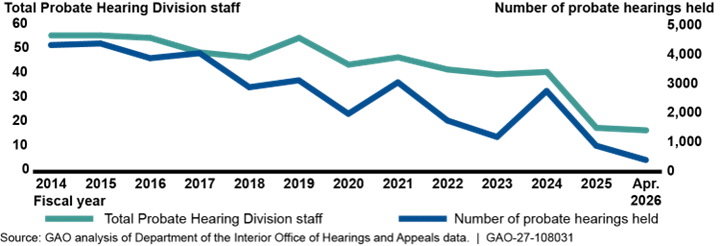
Office of Hearings and Appeals Probate Hearing Division Staff and Number of Probate Hearings Held, Fiscal Year 2014–April 2026
In addition, BIA, BTFA, OHA, and the Office of the Solicitor told GAO that some probate process reforms may be possible, but they have not yet explored such options to determine if they are viable or what regulatory changes or statutory authorizations would be needed. By jointly coordinating to identify reform proposals and submit them to Congress or initiate any rulemaking for the regulatory reforms, actionable steps can be taken towards a timelier and more efficient distribution of trust and restricted fee assets.
 Why GAO Did This Study
Interior is responsible for probating the trust and restricted fee assets of thousands of Indians who die each year. Probate is the legal process by which assets are distributed to heirs using the applicable tribal, federal, or state law governing distribution of a decedent’s estate, among other things. Interior has several offices that are responsible for carrying out the probate process, from gathering family information to adjudicating decisions and distributing assets to heirs. However, Tribes and tribal organizations have raised questions about the length of time taken to probate these estates.
GAO was asked to review Interior’s probate process. This report examines (1) Interior’s ongoing probate caseload from October 2013 through April 2026; (2) factors that affect Interior’s ability to probate trust and restricted fee assets; and (3) actions Interior has taken to improve the probate process and what further actions are needed.
GAO reviewed laws, regulations, policies, and guidance related to Interior’s probate process; analyzed BIA data on probate cases from October 2013 through April 2026 (the most recent and complete data); and interviewed agency officials and a nongeneralizable sample of Tribes and tribal-serving organizations.
What GAO Recommends
GAO is making five recommendations to Interior, including that BIA, OHA, and BTFA develop workforce plans for probate staffing and that these agencies and the Office of the Solicitor jointly develop regulatory and statutory reform proposals to improve the probate process.
Abbreviations
|
AIPRA |
American Indian Probate Reform Act of 2004 |
|
BIA |
Bureau of Indian Affairs |
|
BTFA |
Bureau of Trust Funds Administration |
|
FY |
fiscal year |
|
IIM |
Individual Indian Money |
|
ILCA |
Indian Land Consolidation Act |
|
ILTF |
Indian Land Tenure Foundation |
|
Interior |
Department of the Interior |
|
OHA |
Office of Hearings and Appeals |
|
TAAMS |
Trust Asset and Accounting Management System |
This is a work of the U.S. government and is not subject to copyright protection in the United States. The published product may be reproduced and distributed in its entirety without further permission from GAO. However, because this work may contain copyrighted images or other material, permission from the copyright holder may be necessary if you wish to reproduce this material separately.
November 16, 2026
The Honorable Lisa Murkowski
Chairman
Committee on Indian Affairs
The Honorable Dan Sullivan
United States Senate
The Department of the Interior is responsible for probating the trust and restricted fee land and the trust funds of thousands of Indians who die each year.[1] Probate is the legal process by which the applicable tribal, federal, or state law governing distribution of a decedent’s (deceased individual’s) estate is applied to determine heirs and the validity of wills, among other things. Several federal bureaus and offices within Interior, including the Bureau of Indian Affairs (BIA), Office of Hearings and Appeals (OHA), and Bureau of Trust Funds Administration (BTFA), are involved in the probate of trust and restricted fee assets.[2] BIA gathers the necessary information regarding such assets and the decedent’s family and prepares the probate case file so that OHA can adjudicate the case. After OHA issues a final probate order, BIA and BTFA distribute the trust and restricted fee assets—the estate—to the designated heirs. Some Tribes also have self-determination contracts or self-governance compacts with Interior to handle some of the functions of BIA, BTFA, or both in the probate process.[3]
Timely completion of the probate process is important for heirs to be able to take possession of and utilize the trust and restricted fee assets to which they may be entitled. However, potential heirs and tribal organizations have raised questions about the administrative burden and the length of time it takes Interior to complete the probate process. Specifically, lengthy probate cases can delay the timely inheritance of trust and restricted fee assets, including land on which heirs may reside. An internal Interior document found that some families have waited generations for probate cases to be resolved. In addition, Interior officials reported that caseloads can grow significantly as new cases are added before existing cases can be completed.
You asked us to review how Interior probates trust and restricted fee lands and trust funds. This report examines (1) Interior’s ongoing probate caseload from October 2013 through April 2026,[4] (2) what factors affect Interior’s ability to probate trust and restricted fee assets, and (3) actions Interior has taken to improve the probate process and what further actions are needed.
For all these objectives, we reviewed relevant statutes and regulations, executive orders, agency documents, and relevant GAO and Congressional Research Service reports. We also reviewed relevant documents, including testimony statements from tribal leaders at congressional hearings and tribal documents.
For the first objective, we analyzed BIA data on probate case records from October 2013 through April 2026, the longest period for which data were available.[5] We analyzed how the number of ongoing probate cases changed over this period at the national and regional level. We also calculated the number of ongoing cases in various phases of the probate process—specifically case preparation, adjudication, closing, and other less frequent phases—the length of time cases were in those phases, and regional variation in the ongoing probate caseload.[6] We assessed the reliability of these data by interviewing knowledgeable Interior officials and reviewing technical documentation of the system that stores these data. We determined that the data were sufficiently reliable for the purpose of providing information on Interior’s probate caseload.
For the second objective, to identify factors affecting Interior’s ability to probate trust and restricted fee assets, we reviewed relevant laws, regulations, court decisions, agency guidance, and other Interior documents. Specifically, we reviewed the Indian Land Consolidation Act (ILCA) and the American Indian Probate Reform Act of 2004 (AIPRA).[7] We also reviewed Interior appropriations acts from fiscal year (FY) 2014 through FY 2026.
For the third objective, we analyzed Interior documentation that described actions taken by Interior to improve its probate process and budget justifications from FYs 2007 through 2027. We reviewed workforce staffing data from FY 2014 through April 2026. To assess data reliability, we conducted error checks, reviewed relevant documents describing completed and planned Interior changes to the probate process, and interviewed Interior officials knowledgeable about the data. We determined the data were sufficiently reliable for the purpose of providing information on Interior’s probate staffing resources. We applied federal standards and key principles for internal control related to using quality information, evaluating performance, and developing an efficient workforce to our findings.[8]
To address all three objectives, we conducted a mix of interviews and in-person site visits with officials from Interior headquarters, four BIA regional offices, and eight BIA field offices. We received written information from an additional four BIA regional offices. BIA regional and field offices were selected for variation in geography and the number of ongoing probate cases compared with total probate cases. During site visits, probate staff showed us physical and electronic probate case files and demonstrated how they track case files in the probate process. We also visited three Tribes and interviewed an additional two Tribes and one tribal organization within the BIA regions we selected, some of which conduct probate case preparation through self-determination contracts or self-governance compacts.[9] We also interviewed officials from the Indian Land Tenure Foundation (ILTF), an organization focused on tribal land issues, and two legal organizations that provide estate planning services to individuals with trust and restricted fee assets. While the perspectives of these regional officials and stakeholders are not generalizable, they provide illustrative examples of the unique challenges faced by those involved in the probate process.
We conducted this performance audit from January 2025 to November 2026 in accordance with generally accepted government auditing standards. Those standards require that we plan and perform the audit to obtain sufficient, appropriate evidence to provide a reasonable basis for our findings and conclusions based on our audit objectives. We believe that the evidence obtained provides a reasonable basis for our findings and conclusions based on our audit objectives.
Background
Types of Property
Indians’ property may include land, personal property, trust funds, and cash. Some of these lands have a unique legal status—called trust or restricted fee status—as shown in table 1. Both types of land cannot be transferred (e.g., sold, gifted, or subdivided) or encumbered (e.g., mortgaged or leased) without the approval of the Secretary of the Interior. Much of this trust and restricted fee land resulted from federal laws enacted from 1887 through 1934 that provided for the division of 118 Indian reservations in the continental United States into smaller parcels of land—allotments—for individual Indians.[10] In addition, federal laws provide for Alaska Natives to obtain restricted fee land in certain circumstances.[11]
|
Land type |
Definition |
|
Trust land |
The United States holds the legal title to this land for the benefit of an Indian(s). Trust land cannot be transferred (e.g., sold, gifted, or subdivided) or encumbered (e.g., mortgaged or leased) without the approval of the Secretary of the Interior. |
|
Restricted fee land |
An Indian(s) holds the legal title to this land, subject to restrictions on transfers and encumbrances. Restricted fee land cannot be transferred or encumbered without the approval of the Secretary of the Interior. |
Source: Federal regulations. | GAO‑27‑108031
When these allotted trust and restricted fee lands generate revenue—such as from leases for agricultural purposes or oil and gas production—the federal government is generally required to deposit the revenue into a trust account in the U.S. Treasury, known as Individual Indian Money (IIM) accounts.[12]
Probating of Trust and Restricted Fee Assets
The type of the decedent’s property determines whether it is probated under federal, state, or tribal laws and by whom.
Interior is responsible for probating most decedents’ trust and restricted fee land and IIM account balances. The law, and any implementing regulations, in effect on the day of the individual’s death is the law Interior applies when probating that decedent’s trust and restricted fee assets. Before the enactment of ILCA in 1983, Interior generally used state law to probate these assets.[13] ILCA and subsequent amendments to it, such as AIPRA, are federal laws that establish requirements for Interior’s probate of trust and restricted fee assets.[14] Table 2 summarizes key federal laws that have governed Interior’s probate of trust and restricted fee assets. In addition, there are federal laws that govern Interior’s probate of trust and restricted fee assets owned by Indians of certain Tribes, such as the Standing Rock Sioux Tribe.[15] Moreover, if a Tribe adopts its own tribal probate law for trust and restricted fee lands under its jurisdiction and the Secretary of the Interior approves it, Interior will apply the tribal law in its probate of those lands instead of federal law once the tribal law goes into effect.[16]
Table 2: Key Federal Laws That Have Governed the Department of the Interior’s Probate of Trust and Restricted Fee Assets
|
Federal law |
Year enacted |
Summary |
|
General Allotment Act |
1887 |
Provided for the division of reservations among Indians as allotments and that state probate law would apply to those allotments. However, the act did not authorize state courts to adjudicate probate of the trust and restricted fee allotments. |
|
Indian Reorganization Act |
1934 |
For the Tribes outside of Oklahoma whose members did not vote to reject the act’s application to their reservation, the act provided that trust and restricted fee allotments would be inherited by the Tribe or, in accordance with applicable state and federal law, Indians or their heirs. |
|
Indian Land Consolidation Act (ILCA) |
1983 |
ILCA established federal requirements for the probate of trust and restricted fee land, including that very small interests in such lands would be transferred to the Tribe with jurisdiction over the land rather than inherited pursuant to a will or state law. However, the Supreme Court ruled in 1987 that this provision was an unconstitutional taking of private property without just compensation in violation of the Fifth Amendment of the Constitution.a |
|
American Indian Probate Reform Act of 2004 |
2004 |
The act amended ILCA and established eligibility requirements for the inheritance of trust and restricted fee land. The act also provides that an interest of less than 5 percent in trust or restricted fee land can be inherited by only one individual, unless the decedent’s will provides for multiple heirs. |
Source: GAO analysis of federal statutes. | GAO‑27‑108031
aHodel v. Irving, 481 U.S. 704 (1987).
Probate of non-trust and unrestricted, or fee simple, property and personal property takes place in tribal or state courts. Therefore, an Indian’s property may be probated by Interior as well as tribal and state court. For example, a decedent’s house and personal property located on a reservation may be probated by a tribal court; the decedent’s IIM account and interest in trust or restricted fee land would be probated by Interior; and any off-reservation non-trust, unrestricted fee land would be probated by a state court. The length of time that a probate case takes differs among tribal court, state court, and Interior, but resolution of any probate case requires the cooperation of the decedent’s family.[17]
Interior Bureaus and Offices with Probate Responsibilities
Interior has several bureaus and offices that are responsible for carrying out the probate process, from gathering family information to adjudicating cases and distributing assets to heirs. Interior’s BIA, OHA, and BTFA are responsible for the trust and restricted fee asset probate process. In addition, Interior’s Office of the Solicitor provides legal advice to BIA and BTFA to help ensure they carry out their responsibilities in accordance with the law.
BIA. BIA oversees all major activities associated with managing trust and restricted fee lands. Within BIA, the Branch of Probate Services initiates the probate process and is generally responsible for coordinating BIA’s probate program. The Branch of Probate Services and the Office of Field Operations are responsible for developing policies, guidance, and training for BIA’s 12 regional offices and 80 field offices that deliver probate services. The primary mission of the Branch of Probate Services is to interact with Tribes, potential heirs, and other relevant parties in order to compile inventories of the decedent’s trust and restricted fee assets and family information, and to coordinate with OHA and BTFA for the timely adjudication and distribution of trust assets.
OHA. Judges within OHA’s Probate Hearings Division determine how trust and restricted fee assets are inherited in accordance with applicable law and issue probate orders directing such a distribution.
BTFA. Following adjudication, BTFA distributes trust assets from IIM accounts as directed in OHA’s probate order.
Interior’s Probate Process
Interior’s probate process begins when Interior is notified of a death. The process is divided into four main phases: (1) reporting the death, (2) case preparation, (3) adjudication, and (4) closing. There are no deadlines for Interior to initiate or complete the probate process.
· Reporting a death. According to agency documentation, BIA should be notified immediately upon the death of an Indian; however, there is no deadline for notifying BIA. A death can be reported by a family member or other individual through a BIA field office or through BTFA’s Trust Beneficiary Call Center.[18]
· Case preparation. BIA regulations identify the documentation that BIA—or a Tribe or tribal organization carrying out this responsibility—is required to include in the probate case file.[19] These documents include the decedent’s trust and restricted fee land inventory, death certificate or other evidence of death, marriage license(s), adoption decrees, and the decedent’s will, if provided to Interior. Once BIA has compiled the complete case file—or reviewed the probate case file complied by a Tribe or tribal organization—probate staff provide the file to OHA for adjudication.
· Adjudication. As part of the adjudication process, OHA staff review the probate case file for completeness. In some cases, OHA may return the probate case file to BIA for clarification or further documentation if the judge determines the information in the file is not adequate to make a decision.[20] If the case file is complete and the decedent’s only asset is an IIM account with a balance at or below a certain amount, OHA makes a decision based on the case file without holding a hearing, called a summary proceeding.[21] For completed case files not eligible for summary proceedings, OHA schedules a hearing, and a judge issues a written decision or probate order directing how the decedent’s assets should be distributed.[22] Following a decision, the parties may request OHA review a decision in a summary proceeding or rehear other cases.[23] If such a request is made, OHA conducts the review or rehearing and issues a final order. The parties have 30 days to appeal OHA’s final probate order to Interior’s Board of Indian Appeals.[24] If no appeal is made within 30 days, the probate order becomes final and BIA and BTFA begin the asset distribution 15 days after the order becomes final.[25]
· Distribution. During the distribution phase, BIA updates the land title record with the heirs’ names, as determined in OHA’s probate order, to transfer the interest in trust and restricted fee land. BTFA pays any claims and dispenses any funds from the decedent’s IIM account to the heirs, as determined by OHA’s probate order. Once this process is complete, a case is considered closed.
Tribes can enter into self-determination contracts and self-governance compacts with Interior to assume responsibility for probate case file preparation, BIA land title records, and BTFA data entry.[26] Tribes can also authorize tribal organizations to enter into self-determination contracts or self-governance compacts with Interior to handle these responsibilities. For example, as a result of such authorizations, a tribal organization in Alaska has a self-governance compact to conduct probate case preparation for 20 Tribes.
Interior’s Ongoing Probate Caseload More than Doubled from October 2013 Through April 2026
The Number of Ongoing Probate Cases Has Steadily Increased with Variation Across Regions
Our analysis of Interior’s probate data found Interior’s ongoing probate caseload grew 189 percent from October 2013 through April 2026, due in part to an increase in the number of cases in the preparation phase and a decrease in the number of probate hearings held. During this period, Interior’s overall ongoing probate caseload grew from about 19,000 cases in October 2013 to about 55,000 cases in April 2026, as shown in figure 1.[27] Over this same period, approximately 3,800 new probate cases were opened each year, on average, according to our analysis.
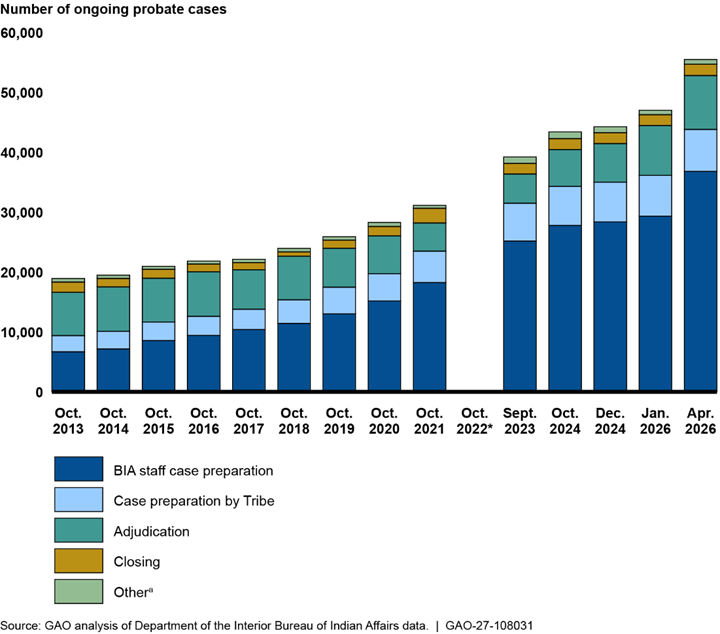
Notes: This graph is based on the Department of the Interior probate caseload reports generated primarily at the beginning of the fiscal year (FY) or in the final days of the preceding FY (October or late September) from FYs 2014 through 2024, with the exception of the December 2024 and January 2026 reports, which were generated a few months later, as indicated in the figure. For April 2026, BIA provided us with raw data, which we then analyzed to provide comparable information to previous reports. Additionally, BIA officials told us due to Interior’s conversion to a new probate tracking system in 2022, Interior did not generate a probate caseload report in October 2022.
aThe other category includes cases in less common statuses, such as probate cases that Interior completed but that need to be reopened and probate cases in which there is a presumption of death but there is no death certificate.
Interior’s probate caseload data indicate that the number of ongoing probate cases increased in all 12 BIA regions. This increase in probate cases was generally consistent across regions despite a wide range in the number of ongoing probate cases by region. For example, the number of ongoing probate cases in both the Eastern Region and the Great Plains Region increased by about 170 percent from October 2013 through April 2026. However, the Eastern Region comprised the smallest number of probate cases in our review with 188 ongoing cases, while the Great Plains Region had the largest number of probate cases, with 9,412 cases, as of April 2026.
While the number of ongoing probate cases varied widely across regions, as of April 2026, we found that the majority of cases in all 12 regions were in the case preparation phase of the probate process. Specifically, during this time, we found that 80 percent of nationwide probate cases (44,000 of 55,000 total ongoing cases) were in the case preparation phase, some of which are paper case files that BIA probate staff have scanned into the electronic tracking system, as shown in figure 2.[28] Of these 44,000 ongoing cases, tribal probate staff are preparing about 16 percent (7,000 cases) while BIA probate staff are preparing the remaining 37,000 cases for adjudication.
In addition, we found that as of April 2026, about 16 percent (9,000 cases of 55,000) of total ongoing cases were in the adjudication phase. Approximately 7,400 of these 9,000 cases (82 percent) were cases in the pre-hearing stage waiting to be reviewed by OHA support staff for completeness or have a hearing scheduled, as shown in figure 3. OHA held hearings and was finalizing the decisions for about 600 cases (7 percent). In addition, about 850 cases (9 percent) were post-initial hearing cases in which the probate judges had issued a decision but (1) the case had been reopened to correct errors and omissions; or (2) the probate order was not yet final because, for example, a party had requested that OHA review or rehear the case. Finally, approximately 160 cases (2 percent) were being adjudicated under the summary proceedings and did not require a hearing.
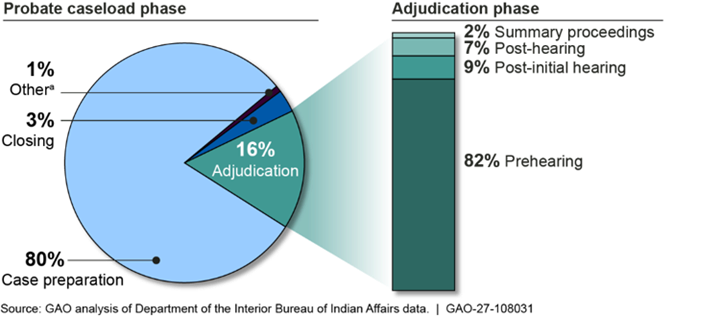
aThe other category includes cases in phases that are not common, such as probate cases the Department of the Interior completed, but that need to be reopened and probate cases in which there is a presumption of death but there is no death certificate.
As of April 2026, BIA and BTFA were in the process of distributing the decedent’s trust and restricted fee assets to their heirs for 1,900 of the 55,000 ongoing cases (3 percent).
The Majority of Ongoing Cases Have Taken About 4 Years to Prepare and 1 Year to Adjudicate
According to our analysis of Interior’s probate data, the average length of time ongoing probate cases were being processed was 5 years, as of April 2026. The average length of time in processing of ongoing probate cases varied among the 12 BIA regions from 3 to 11 years. Seven of 12 regions had average processing times of 4 years or fewer.
Time in case preparation. About 80 percent of ongoing probate cases were being prepared by BIA and tribal probate staff, as of April 2026. We found that these cases had an average preparation time of 4 years, as shown in table 3.[29] As of April 2026, average case preparation time—the amount of time that has passed since BIA opened the probate case file—varies across regions from 2 to 11 years. However, these average times may increase as ongoing cases continue through the case preparation process. According to Interior documentation, the average case preparation time more than doubled from 2 years in October 2013 to 5 years in January 2026.
|
Bureau of Indian Affairs region |
Number of ongoing cases |
Maximum time spent (in years) |
Average time spent (in years) |
Median time spent (in years) |
|
Alaska |
5,224 |
22 |
6 |
5 |
|
Eastern |
164 |
22 |
11 |
15 |
|
Eastern Oklahoma |
1,979 |
22 |
2 |
<0.5 |
|
Great Plains |
6,896 |
20 |
2 |
2 |
|
Midwest |
6,332 |
22 |
5 |
4 |
|
Navajo |
6,473 |
22 |
6 |
5 |
|
Northwest |
3,688 |
22 |
4 |
3 |
|
Pacific |
1,580 |
19 |
4 |
4 |
|
Rocky Mountain |
3,684 |
21 |
3 |
3 |
|
Southern Plains |
3,021 |
22 |
3 |
3 |
|
Southwest |
359 |
16 |
3 |
2 |
|
Western |
4,401 |
22 |
4 |
4 |
|
Total |
43,801 |
|
|
|
|
Average |
— |
21 |
4 |
5 |
— = Not applicable.
Source: GAO analysis of Bureau of Indian Affairs data. | GAO‑27‑108031
Notes: From March 2026 through April 2026, BIA opened approximately 8,300 new probate cases, which are included in this table. Inclusion of these cases lowered the average time spent in case preparation by about half a year. Agency officials told us that they used automation and technology advancements to identify and upload these potential probate cases, but staff had not yet begun working on these cases so they had not confirmed whether they all include trust or restricted fee assets.
Time in adjudication. As of April 2026, probate cases spent 1 year, on average, in the adjudication phase, as shown in table 4. In addition, according to our analysis, the 160 cases in summary proceedings also had spent about 1 year, on average, in adjudication.
Table 4: Time Ongoing Probate Cases Spent in Office of Hearings and Appeals’ Adjudication Phase, as of April 2026
|
Bureau of Indian Affairs region |
Number of cases |
Maximum time spent (in years) |
Average time spent (in years) |
Median time spent (in years) |
|
Alaska |
540 |
3 |
1 |
1 |
|
Eastern |
21 |
2 |
1 |
1 |
|
Eastern Oklahoma |
58 |
3 |
1 |
1 |
|
Great Plains |
2,085 |
4 |
1 |
1 |
|
Midwest |
813 |
3 |
1 |
1 |
|
Navajo |
958 |
3 |
1 |
1 |
|
Northwest |
1,181 |
4 |
1 |
1 |
|
Pacific |
477 |
4 |
1 |
1 |
|
Rocky Mountain |
1,008 |
4 |
1 |
1 |
|
Southern Plains |
1,041 |
4 |
1 |
1 |
|
Southwest |
120 |
3 |
1 |
1 |
|
Western |
699 |
3 |
1 |
1 |
|
Total |
9,001 |
|
|
|
|
Average |
— |
3 |
1 |
1 |
— = Not applicable.
Source: GAO analysis of Department of the Interior Bureau
of Indian Affairs data. | GAO‑27‑108031
A Small Percentage of Probate Cases Take Longer to Process
Approximately 9 percent (5,000 of 55,000 cases) of Interior’s total probate caseload have been ongoing for more than 10 years, according to our analysis.[30] About 460 of the 5,000 cases have been ongoing for over 20 years. As of April 2026, 79 percent of these 5,000 cases were in the case preparation phase, 11 percent were in the closing phase, 10 percent were in other less common phases such as modifications and post-initial hearing cases that have been closed and then reopened, and no cases were in adjudication.
Land Fractionation, Legal Framework for Probate, and Other Factors Limit Interior’s Ability to Streamline and Improve Its Process
Land fractionation—whereby an individual parcel of trust or restricted fee land has many owners with undivided, small (fractional) interests in the parcel—increases the number of future probate cases.[31] Federal laws have been enacted to address fractionation; however, Supreme Court decisions have found some of these laws to be unconstitutional. In addition, Interior has a statutory responsibility to probate all trust and restricted fee lands, including very small interests, and legal requirements to provide notice of those probate cases to interested parties. This legal framework limits Interior’s ability to streamline and improve its probate process. Tribes, tribal organizations, and federal agencies we spoke with identified several other factors that affect the timeliness of the probate process.
Fractionation Increases the Number of Estates for Interior to Probate
Fractionation has led to an increase in the number of estates that Interior is statutorily required to probate, and, according to Interior, the number will continue to grow for decades. [32] Addressing fractionation requires working within constitutional limitations.
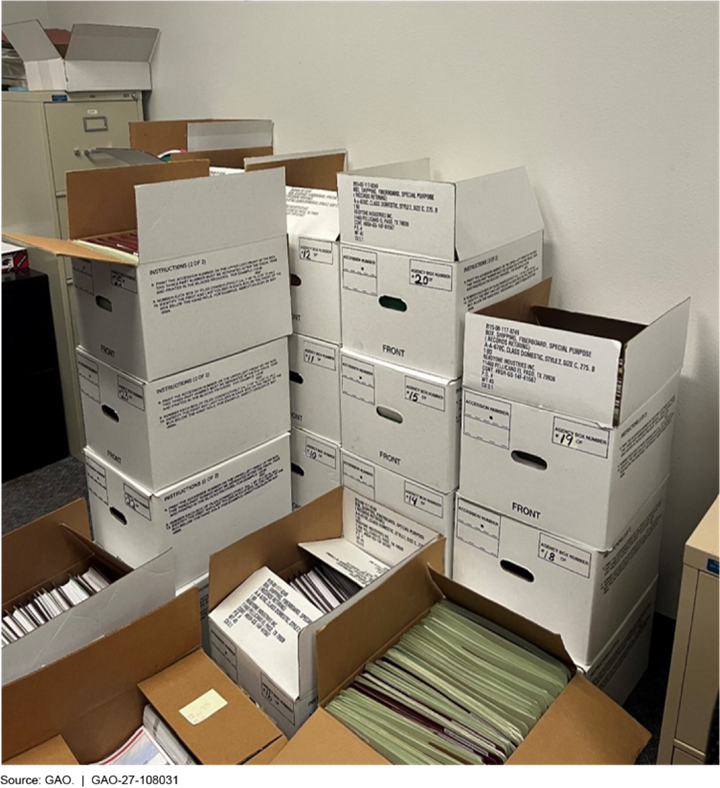
Fractionation is caused by heirs inheriting undivided interests in trust or restricted fee land, meaning all heirs own an interest in the entire parcel of land rather than the parcel being divided among each heir.[33] When accounting for the number of heirs in each successive generation, fractionation has resulted in many allotments having hundreds or thousands of owners who each own hundredths or thousandths of the allotment, as shown in figure 4. For example, as of 2022, a particular parcel of land on a reservation in South Dakota had nearly 1,150 owners due to fractionation, according to Interior documentation. When owners of fractionated interests die, Interior must probate their estates to determine who will inherit these fractional interests and any other trust and restricted fee assets they own.
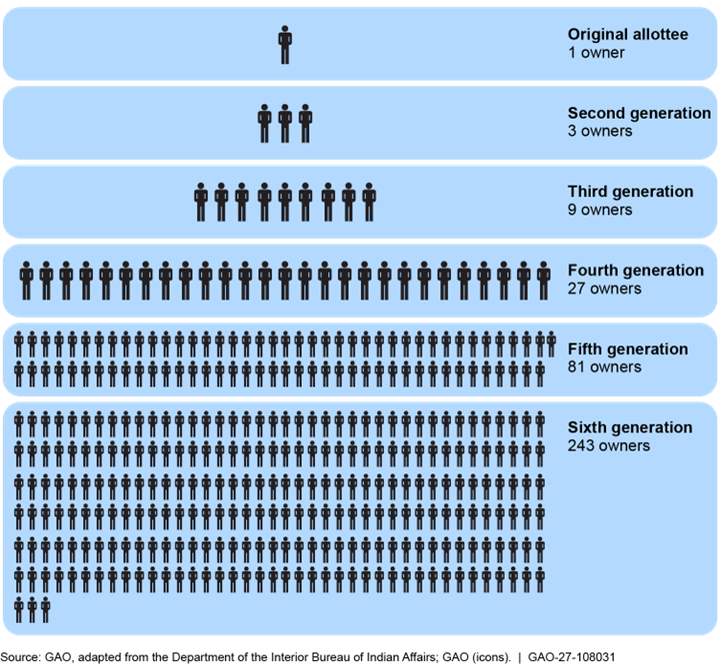
Any solutions to address fractionation must be within constitutional limitations. The Supreme Court ruled that statutory changes made in the 1980s to reduce fractionation were unconstitutional, requiring Interior to reprobate some estates. In particular, in the 1980s, statutory changes were made to Interior’s probate process to give certain small fractional land interests in trust and restricted fee land to a Tribe when an owner died. However, the Supreme Court found these changes to be unconstitutional “takings” of private property without just compensation, even when the fractional interest in trust or restricted fee land was small and valued at less than $100.[34] As a result of these court decisions, Interior probate staff had to identify the probate cases where asset distribution was determined by the unconstitutional statutory provisions, undo the distributions of assets in those cases, and reopen the probate cases so the assets could be re-distributed properly. According to an official in the Office of the Solicitor, these efforts took many years, and some are ongoing today. As a result, any future statutory changes to Interior’s probate process would need to take into account these decisions and not severely restrict an individual’s right to determine who receives their interest in trust and restricted fee estates.
Several mechanisms in AIPRA, that went into effect in 2006, were intended to reduce fractionation, but the act allows fractionation to occur in certain circumstances. For example, AIPRA prohibits interests of less than 5 percent in trust or restricted fee land to fractionate further when the decedent does not have a will, as shown in table 5.[35]
Table 5: Selected American Indian Probate Reform Act of 2004 (AIPRA) Provisions That Reduce Land Fractionation and Enable Consolidation
|
Eligibility Requirements |
To be able to inherit trust and restricted fee land under the act, a person must be an Indian,a a lineal descendent of the decedent, or a pre-existing owner of an interest in the trust or restricted fee land. Tribes with jurisdiction over such land can also inherit interests in them. |
|
One-Heir Rule |
If the decedent does not have a will and has an interest of less than 5 percent of a trust or restricted fee land, that interest can only be inherited by one individual. If the decedent had a will, the interests in the land will be inherited in accordance with it, if the persons designated in the will meet the act’s eligibility requirements. If the will is not valid, the interest in the land will be inherited by a single heir in accordance with the act unless the Secretary of the Interior has approved a tribal probate law. |
|
Purchase at Probate |
Co-owners, other eligible heirs, and Tribes with jurisdiction over the land can purchase the decedent’s interests in trust and restricted fee lands during the probate process, at no less than fair market value. Having co-owners and other eligible heirs purchase a decedent’s interest can reduce the number of future probate cases because there would be fewer people with interests in the land. Interests purchased by Tribes will not go through probate in the future. |
Source: 25 U.S.C. § 2206(a)(1)(B)(i), (a)(2)(B)(v), (a)(2)(D)(iii), (b)(1)(A), (b)(4)(A), (o)(2). | GAO‑27‑108031
aIndian is statutorily defined as any person (1) who is a member of any Indian Tribe, is eligible to become a member of any Indian Tribe, or was an owner of an interest in trust or restricted land at the time of AIPRA’s enactment; (2) with one-half or more Indian blood; (3) who is a descendant of a member of any federally recognized Tribe who, as of June 1, 1934, was residing within the present boundaries of any Indian reservation; and (4) any person who owns an interest in trust or restricted fee land in California. 25 U.S.C. § 2201(2).
|
Trust and Restricted Fee Land Estate Planning Interior and other organizations, like the Indian Land Tenure Foundation (ILTF), have highlighted the importance of estate planning for individuals with trust and restricted fee land to ensure their assets are left to their preferred heirs. Additionally, according to an ILTF analysis, when such individuals engage in estate planning, they can reduce the number of future probate cases by consolidating fractionated interests and limiting the number of heirs. However, an Interior official said it is common for people to leave their property to their children in equal percentages. Interior has the authority to provide grants for estate planning to Tribes and legal assistance service organizations but has not made such grants since 2005, according to BIA officials. Instead, they told us that some regional and field offices have conducted ad hoc estate planning education and outreach when funds are available. Source: GAO analysis of Department of the Interior documents and testimonial information from Bureau of Indian Affairs staff. | GAO‑27‑108031 |
However, AIPRA allows fractionation to occur under certain circumstances, such as when the decedent has a will leaving their land to multiple heirs or when the decedent did not have a will but has an interest of 5 percent or greater in trust and restricted fee land. For example, a decedent’s interest of 20 percent in restricted fee land would be inherited by all four of her children if she did not have a will, with each offspring inheriting 5 percent. This inheritance would increase the restricted fee land’s owners by three people, thus requiring three additional future probate cases when those heirs die compared with the one original probate case.
Interior is Required to Probate and Provide Notice for Every Case
Interior has a statutory responsibility to probate every estate with trust and restricted fee assets, regardless of that estate’s size or value, and in doing so must provide notice of the probate case to all interested parties—including all potential descendants and heirs. This statutory responsibility and constitutional requirements for notice limit Interior’s options to improve the processing of probate cases.
For example, OHA must adjudicate the trust and restricted fee property of every estate, including those with very small land interests and small IIM account balances. This is different from what may happen at the state level for non-trust or unrestricted fee assets, where probate proceedings may not always be necessary for small estates or small value assets. According to our analysis of BTFA data, a large proportion—over 60 percent—of the trust and restricted fee estates that Interior must probate are of small value. In particular, IIM accounts with less than $300 make up more than two-thirds of such estates (68 percent) and 61 percent of IIM accounts have less than $100, as of December 2025.[36]
In order for OHA to adjudicate probate cases, BIA must include required documentation (e.g., vital records) in the probate case file.[37] For example, BIA begins preparing a case file by working with the decedent’s family members to fill out a family history and then collects the required supporting vital records. This takes time and often requires paying for vital records, according to BIA probate staff. Probate staff we interviewed told us that cases can vary widely and some cases can be complex and include collecting dozens of vital records. For example, BIA staff told us that in one case, they had to gather documentation for a decedent’s family (including seven former wives and 15 children), which took many years and was still incomplete. Some probate staff told us that this amount of agency work for very small estates does not appear to be a cost-effective use of government resources.
In addition, Interior has a constitutional, statutory, and regulatory duty to provide potential heirs with notice of the probate proceeding and an opportunity to be heard.[38] For most probate proceedings, the regulations require OHA to provide notice of the proceeding to potential heirs, co-owners, and other interested parties by mail so they have an opportunity to attend the hearing and present evidence.[39] Additionally, co-owners have the opportunity to purchase a decedent’s interest in trust or restricted fee land at probate, so this notification informs them that the land is available for purchase. Absent notification, potential heirs may not be aware that they could possibly inherit an estate.
In order for OHA to provide this required notice, BIA must trace the decedent’s family relationships and locate these individuals, which can be particularly time-consuming for those estates with many owners due to fractionated land interests and in instances where a decedent’s family history is especially complicated. Agency officials told us that in some cases, this process involves mailing hundreds of notices to interested parties, which can be time-consuming and expensive. Moreover, they may not know if the physical addresses for the interested parties in their files are current. For example, BTFA maintains a website listing individuals with whereabouts unknown. According to its website, there are tens of thousands of beneficiaries that have not claimed their IIM account or no longer have a mailing address on file.
Other Factors Affect Timely Probating of Trust and Restricted Fee Assets
Tribes, tribal organizations, and federal agencies we spoke with identified several factors impacting the timeliness of the probate process, including the following:
· Family participation. Interior is responsible for probating decedents’ trust and restricted fee assets. However, the process relies on the decedents’ family members and potential heirs to provide information on the decedent’s family history. Specifically, BIA officials told us that one of the first steps in compiling the probate file is to request family participation in completing a family history form with information about each potential heir.[40] Tribes and agency officials we spoke with told us that getting family participation in this process can be difficult, particularly if the family members know that the trust assets being probated are very small. Additionally, BIA probate staff told us some Tribes may have different views of death so families may not be interested in participating in Interior’s probate process.
· Gathering vital records. Several tribal and agency officials we spoke with told us that gathering the vital records required by regulation for probate case files was a challenge. Specifically, vital records, such as marriage certificates or death certificates, can be costly to obtain.[41] For example, tribal and agency officials told us that the cost of vital records ranged from $25 to $85 for a single document. Moreover, some records may be unobtainable if the record is sealed by a judge, such as adoption records. Further, some state laws limit access to vital records to certain individuals or entities and may require the requestor to show a legitimate need for the document, which BIA officials say makes it difficult for them to access. Family members with limited means may be unable to afford vital records or family members may choose not to purchase records if they know the value of the estate was small or less than the cost of the records.[42] BIA staff said their agency funds for purchasing vital records are also often limited.
· Tribal access to BIA probate tracking system. In 2022, Interior established a probate tracking system to increase automation, store relevant vital records, and simplify probate workflows. However, of the 50 Tribes compacted or contracted to carry out probate functions, as of May 2026, 18 Tribes have access to the tracking system. The other Tribes do not have probate staff with access for a variety of reasons, including that some have not submitted requests for background checks to BIA. Access to the tracking system requires a background check because it contains personally identifiable information, such as social security numbers. In addition, tribal probate staff need a BIA-provided laptop and internet access that meets certain technical specifications to access the tracking system. Tribal probate staff told us that it takes about 2 years to get access to the probate tracking system. Tribal probate staff told us that not having this access creates inefficiencies in their preparation of case files. For example, Alaska regional officials told us that without access to the tracking system, tribal probate staff lack access to thousands of vital records already collected from previously probated estates. In addition, without access to the tracking system to allow them to directly submit probate file information, tribal probate staff in Alaska must manually submit probate files to their BIA office by mail, so BIA staff can enter information and documents into the tracking system. Tribal probate staff in Alaska told us that it can take several months to send and receive probate files and vital records by mail. These additional steps add expense and time to the probate process.
Interior Has Taken Steps to Improve Its Probate Process, but Additional Actions Could Increase Its Efficiency and Timeliness
Interior has taken several steps to improve its probate process, including establishing probate as an agency priority and improving inter-agency coordination through technology modernization efforts. However, additional actions, including developing a workforce plan, assessing funding needs, and exploring potential regulatory and statutory reforms could further improve the probate process’ efficiency and timeliness.
Interior Has Taken Several Steps to Improve Its Probate Process
Interior has taken several steps to improve its probate process, including establishing probate as an agency priority, improving vital records access in some states, and investing in technology modernization efforts to make the probate process more efficient.
Prioritizing probate. In June 2025, Interior prioritized probate by standing up a strike team to identify opportunities to increase the efficiency of the probate process. In August 2025, according to agency documentation, Interior directed all BIA offices to designate probate casework as a top priority because delays in probate can result in hardships for potential heirs that are inconsistent with the agency’s mission and trust responsibilities.[43] In addition, the strike team has sent probate personnel to some BIA field offices with large caseloads to assist in preparing cases. Interior announced that in May 2026, due in part to a temporary staffing surge at a BIA field office with a large number of open cases, BIA closed 379 probate cases and distributed about $66 million to heirs. According to our analysis, this is a 67 percent increase in the number of cases Interior closed compared with the previous year in May 2025. However, offsetting these case closures were the approximately 8,300 new probate cases added to the probate tracking system in early 2026. The strike team told us that they have been gathering information on how to improve the probate process from BIA and tribal probate staff across the U.S. and are leading several initiatives related to aspects of the probate process, discussed below.
Improved access to vital records. In March 2026, Interior signed a memorandum of understanding with the Alaska Department of Health to cooperate in activities, such as establishing a streamlined pilot approach for Interior to request and the state to provide vital records needed for preparing probate cases. Further, as of February 2026, the strike team told us they were in the process of contracting with a third-party vendor to provide access to vital records in at least 16 states.
Technology modernization. In an effort to make the probate process more efficient, the strike team has invested in modernizing technology systems and is exploring the use of artificial intelligence to streamline probate processes. Specifically, in July 2026, BIA began implementing a cloud-based platform that agency officials said would allow for a decedent’s family members to digitally upload vital records and would facilitate probate staff access to vital records already used in related probate cases. BIA officials told us that these changes will allow them to allocate resources more efficiently during case preparation, potentially mitigating the need for future funding or workforce increases. To reduce any future resource needs, it is important for any prospective technological solution to address the challenges we identified, such as how to incentivize cooperation with Interior from family members when an individual has few assets to pass on or how to address the out-of-pocket costs of accessing vital records. These efforts were underway as of July 2026, and we could not assess the extent to which they address these longstanding challenges.
Interior Has Additional Opportunities to Improve Its Probate Process
While Interior has made reducing the number of ongoing probate cases a priority, it has not developed a workforce plan, conducted a funding needs assessment, provided sufficient staff guidance, or developed strategies to address complex probate cases. Further, most of its actions have been concentrated on expediting the completion of existing probate cases rather than exploring legally viable regulatory and statutory reforms to improve the probate process so future probate cases are processed more efficiently.
Workforce Plan
BIA, BTFA, and OHA have not completed a workforce plan to address concerns related to inadequate staff. Based on our analysis of agency data and interviews with stakeholders, BIA, OHA, and BTFA have had difficulty maintaining sufficient staff to complete ongoing probate cases in a timely manner. Moreover, according to our analysis, BIA and OHA both lost staff from FY 2014 through April 2026. BIA and OHA officials told us they needed additional staff to address the accumulated number of probate cases and future expected cases. Further, BTFA officials said with their current number of vacancies, they would have difficulty keeping up with their probate responsibilities if they were to receive an increase in cases from OHA. Specifically, BIA, OHA, and BTFA cited the following difficulties:
BIA. As of December 2025, 43 of 141 (30 percent) BIA probate staff positions were vacant, as shown in table 6.[44] With 37,000 ongoing probate cases in BIA’s case preparation phase, this means each of the approximately 98 probate staff would need to prepare about 375 cases.[45] According to agency officials, BIA’s current probate vacancies stem from structural factors that have compounded over time. For example, staff described how low pay and limited career mobility have resulted in high staff turnover. Further, they told us operational factors such as the government-wide hiring freeze in 2025 made it difficult to fill existing vacancies.[46] As of July 2026, agency officials told us that BIA filled nine vacancies with staff who will be on 1-year term appointments and advertised 146 1-year term positions.[47]
|
Region |
Total positions if fully staffed |
Vacant positions |
Percent of positions vacant |
|
Alaska |
10 |
0 |
0 |
|
Eastern |
1 |
0 |
0 |
|
Eastern Oklahoma |
8 |
0 |
0 |
|
Great Plains |
33 |
11 |
33 |
|
Midwest |
23 |
14 |
61 |
|
Navajo |
7 |
0 |
0 |
|
Northwest |
10 |
3 |
30 |
|
Pacific |
8 |
4 |
50 |
|
Rocky Mountain |
14 |
4 |
29 |
|
Southern Plains |
10 |
1 |
10 |
|
Southwest |
3 |
0 |
0 |
|
Western |
14 |
6 |
43 |
|
Total |
141 |
43 |
30 |
Source: GAO analysis of Department of the Interior Bureau of Indian Affairs data. | GAO‑27‑108031
BIA staff told us that filling all current vacancies would continue to leave insufficient staff to address the probate caseload. Moreover, according to agency documentation, a third of all BIA field offices (27 of 80 field offices) had only one probate staff member dedicated to carrying out probate responsibilities. Twenty percent of all BIA probate staff are eligible for retirement.
OHA. From FY 2014 through April 2026, OHA had a 70 percent reduction in the total number of probate staff. As of April 2026, according to agency data, 42 of 59 probate hearing division positions were vacant (71 percent). According to our analysis, from FY 2014 through April 2026, OHA reduced the number of hearings held by 90 percent, as shown in figure 5.
Figure 5: Total Office of Hearings and Appeals Probate Hearing Division Staff and Number of Probate Hearings Held, Fiscal Year 2014–April 2026
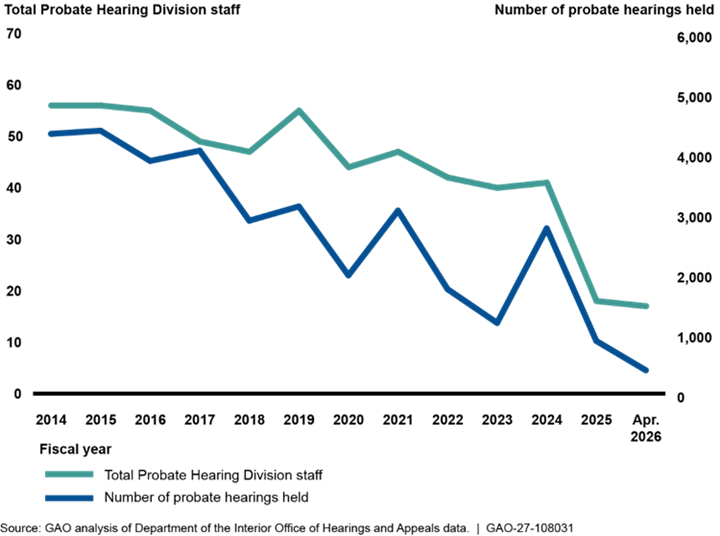
OHA officials told us they had eight judges as of the end of January 2026, who collectively could hear approximately 4,000 cases per year. However, the lack of support staff, such as legal assistants and paralegals, limited the number of hearings to approximately 1,000 cases per year. To adjudicate a probate case, OHA staff told us each judge requires about three support staff to make hearing decisions in a timely manner.[48] As of January 2026, 21 of 24 legal assistant positions were vacant (88 percent). As a result, officials said that judges assisted support staff in transcribing phone calls and making photocopies rather than adjudicating cases. Moreover, OHA support staff is responsible for reviewing probate case files to ensure completeness before they are scheduled for a hearing. According to our analysis, about 5,800 cases have been waiting for 1 year, on average, to be assigned a judge. However, about 125 cases (2 percent) have been waiting for over 2 years.
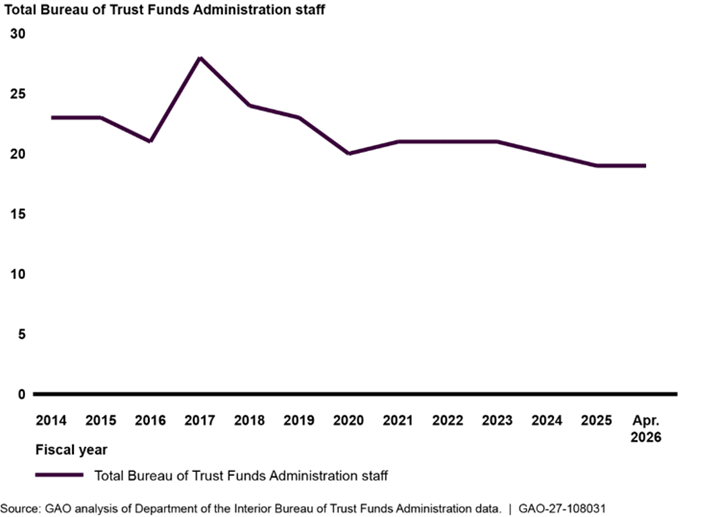
BTFA. As of April 2026, 11 of 30 probate staff positions (37 percent) in BTFA were vacant, according to BTFA officials. These officials told us that, despite these vacancies, they had sufficient staff to distribute assets and close the amount of probate cases they currently process—about 400 a year. However, BTFA staff told us that they would be overwhelmed if BIA and OHA were to increase the rate at which probate cases were prepared and adjudicated, and BTFA would require more staff to address an influx in cases. Historically, BTFA has had between 19 and 28 staff to handle probate distribution from FY 2014 to April 2026, as shown in figure 6.
|
Staffing, Recruitment, and Retention Challenges in Interior’s Probate Process In November 2024, GAO reported on the Department of the Interior’s long-standing capacity challenges, including staffing, recruitment, and retention challenges. GAO recommended that the Bureau of Indian Affairs (BIA) develop guidance clarifying what recruitment incentives and workforce flexibilities can be leveraged for recruitment and retention purposes. BIA agreed with GAO’s recommendation and said that BIA is in the process of developing guidance clarifying recruitment incentives and workforce flexibilities. As of August 2026, these efforts were underway. Both BIA and Office of Hearings and Appeals (OHA) staff told GAO that recruitment and retention were major challenges impacting probate staff, resulting in high turnover. For example, probate staff in one field office told GAO that they had previously advertised for a probate position 12 to 13 times without being able to fill the position due to low pay. According to agency documentation, it can take up to 3 years for new staff to learn the probate process. Additionally, according to agency documentation, many new staff who join the probate program leave after 2 years for better opportunities. According to BIA and OHA probate staff, career immobility hinders recruitment and retention, and many probate staff transfer to other positions that have better career advancement opportunities. Sources: GAO; GAO analysis of Department of the Interior documents and testimonial information from Bureau of Indian Affairs staff. | GAO‑27‑108031 |
As mentioned above, Interior has designated probate as a top priority but has struggled to maintain adequate probate staff. However, Interior has not developed a workforce plan that identifies the number of long term additional full-time employees needed, the necessary skills of each employee to complete the probate process, and strategies for filling vacant positions.
According to agency documentation, the BIA strike team recommended developing a workforce plan that identifies current and projected staffing needs to address the probate caseload. However, BIA officials told us the agency has not yet taken steps to develop such a plan. Further, the joint explanatory statement accompanying Interior’s FY 2026 appropriations directed BIA to provide a report by March 24, 2026 indicating how many full-time employees BIA would need nationally to reduce the probate caseload to less than 2 years in each region, and the resources BIA would need to ensure technical assistance, proper training, and capacity for self-governance providers handling probate case files.[49] BIA officials told us they did not complete this report by the deadline because they were prioritizing the technology update described above.[50] BTFA officials told us that they have begun to develop, but have not completed, a workforce plan. OHA also told us that developing a workforce plan is a priority for FY 2027.
Since 2001, we have identified human capital management as a government-wide High Risk area because of the significant challenges that federal agencies face in areas such as leadership continuity, succession planning, and acquiring and developing staff with skills that meet agency needs.[51] GAO’s Key Principles for Effective Strategic Workforce Planning states that an organization should align its human capital program with its mission and current and emerging programmatic goals.[52] Specifically, an agency should involve top management, employees, and other stakeholders in developing, communicating, and implementing a strategic workforce plan to meet the agency’s goals.[53]
According to Interior documents, including press releases, Interior’s goal is to make measurable improvements to the probate process, so it is more efficient and timely and reduces the probate caseload. Moreover, agency documentation states that delays in probate can result in hardships for potential heirs that are inconsistent with the agency’s mission and trust responsibilities and that BIA will provide sufficient staff to meet their probate responsibilities. We have reported on how staff vacancies and current and emerging skills gaps at BIA have hindered effective management of trust services—including probate—impeding BIA’s ability to provide services to Tribes in a timely manner.[54] Developing a workforce plan will better position BIA, BTFA, and OHA to have the requisite number of staff with the necessary skills to process probate caseloads. This in turn will help ensure that cases are processed in a timelier manner and heirs will not experience delays receiving distributions from the estates to which they are entitled.
Funding Needs Assessment
Many Interior and tribal staff we spoke with identified the need for additional funding to effectively carry out Interior’s probate program, but the agencies involved in probate have not developed a funding needs assessment to identify and periodically assess the funding required to probate trust and restricted fee assets. Interior and tribal staff identified various unfulfilled funding needs related to probate. For example, several BIA probate staff told us that their offices do not have adequate funding to hire sufficient staff to reduce the probate caseload to a manageable level or to purchase the vital records needed to complete probate case file preparation. Some BIA staff also identified a lack of funding to provide grants for estate planning to Tribes and legal assistance organizations. Further, OHA officials told us that budget constraints have sometimes delayed hearings by preventing judges from traveling to hear probate cases. BTFA officials told us that they would need an increase in funding to address any increase in future probate cases.
Tribes and one tribal organization that carry out probate functions have also told us about a lack of consistent funding for probate functions and said that they often make up the difference with tribal funds. For example, the tribal organization told us they used more than $240,000 in tribal funds to supplement the inadequate funding in their self-governance compact for carrying out their probate responsibilities. This tribal organization also told us they had to shift funding from other tribal community programs to support probate functions.
Despite these identified funding needs, Interior has not developed a detailed plan to periodically assess the long-term funding necessary to manage all probate cases in a timely manner. Interior develops annual budget justifications for its probate program, but the level of funding requested has not been sufficient to support staff and tools in reducing the number of ongoing probate cases. In particular, Interior’s enacted budget for the probate program has been relatively stable from FY 2014 through FY 2025. However, over this same period of time, the number of ongoing probate cases increased from about 19,000 cases to about 44,000 cases. Moreover, while Interior’s FY 2026 enacted budget increased the probate program’s funding from FY 2025 by about a fifth to $17 million, the increased funding did not result in a decreased caseload. Instead, the probate caseload increased by about 11,000 cases during FY 2026 (from about 44,000 cases in December 2024 to 55,000 cases in April 2026).
Additionally, recent budget justifications for FY 2026 and FY 2027 have provided little to no operational detail about how Interior will accomplish its goal of reducing the probate caseload. For example, the FY 2027 budget justification generally asserts that case reductions will be achieved through technology advancements, probate surge operations, and performance-driven incentive programs, but both budget justifications provide much less operational detail than budgets from previous years. In contrast, the FY 2007 budget request also came at a time the agency was seeking to reduce a large probate caseload—about 24,000 ongoing probate cases at that time. However, the FY 2007 budget provided more operational detail about how the requested funding levels would help the agency accomplish the reduction. Specifically, in the FY 2007 budget justification, Interior outlined (1) how officials planned to use its budget to address the caseload and (2) a projected schedule for reducing the probate caseload. Interior based their plan to reduce the caseload on a baseline measure that quantified how many hours it takes to complete each stage of the probate process, the progress of each case going through the process, the number of staff required to meet ongoing probate needs, and the average cost per case of processing probate cases. According to BIA officials, through these efforts, Interior reduced the probate caseload to about 12,000 cases by 2011.
The FY 2027 budget justification, on the other hand, reduces requested funding for probate staff and tools by about half from FY 2026 enacted levels and does not include a similar level of operational detail.[55] BIA officials told us that they have not established the baseline metrics necessary to quantify how many hours it takes to complete each stage of the probate process, the average cost per probate case, or similar metrics included in the FY 2007 budget justification. Moreover, the FY 2027 budget justification does not discuss in detail how it will accomplish its goal of reducing the probate caseload with about half of what BIA planned to spend in FY 2026 and less than it spent in FY 2025. According to one BIA official, keeping enough probate staff to address the caseload with substantially less funding in FY 2027 will be “impossible” even with planned automation and technology advancements to help streamline cases.
In addition, annual budget requests address short-term funding needs and do not always account for future changes that could affect Interior’s continuing probate responsibilities. An example from the past illustrates the importance of long-term planning for funding. Between FY 2007 and FY 2010, in addition to its annual probate program funding, BIA requested specific funding to reduce what was seen as a large probate caseload. BIA used the funding for short-term contractors and was largely successful in reducing the number of open probate cases. However, within a few years of the requested funding and contract term ending, the caseload began increasing steadily due to a lack of permanent staff to process probate cases, according to agency officials. More recently, for FY 2027, BIA requested additional funds for surge staff, but its budget request did not analyze whether funding is needed for permanent staff who can maintain the work after surge operations terminate. Additionally, in FY 2026, BIA officials told us pursuing process efficiencies and other technological advancements will allow Interior to streamline its case preparation process, reducing the overall need for probate funding. However, these efficiency changes are in progress, and it is not clear how effectively they will reduce overall probate case numbers or the probate program’s long-term funding needs. Finally, Interior’s budget request has not accounted for other long-term factors such as the future expected growth in cases due to fractionation that are likely to affect net case levels and funding needs.
According to Interior’s Indian Affairs Manual, program management, such as those administering the probate program, are responsible for developing budget proposals and justifications supporting their program.[56] Further, Evidence-Based Policymaking states that organizations should identify strategies and resources, including funding, needed to achieve its long-term outcomes—in this case to achieve Interior’s goal of reducing the probate caseload.[57] Interior must undertake its statutory responsibility for probating trust and restricted fee assets regardless of the agency’s funding resources, which means limited funding will likely translate into delays in providing heirs the assets to which they are entitled. By identifying its funding needs to reduce the probate caseload and informing Congress, Interior would increase the likelihood that it has the funding necessary to efficiently process probate cases and distribute trust and restricted fee assets to heirs.
BIA Probate Staff Handbook
BIA staff receive training and technical updates regarding data entry in BIA’s probate tracking system, the Trust Asset and Accounting Management System (TAAMS). However, BIA probate staff told us learning how to prepare probate cases is a lengthy process. According to BIA probate staff, creating a probate case file is a challenging, muti-step process involving gathering vital records and uploading them into a complicated data system with detailed data entry protocols. Moreover, some BIA probate staff described the process to us as having a steep learning curve despite training opportunities. In addition, high turnover can lead to knowledge gaps among staff preparing cases.
Interior has not updated its probate guidance handbook despite significant changes to the probate process. BIA’s current handbook was published in 2010 and is missing information, such as the 2021 regulatory changes to summary proceedings and how to use TAAMS for probate cases. A probate officer at one regional office told us that due to long-standing vacancies at her office, she did not have anyone to teach her the probate process, and she said she would have benefitted from updated guidance. Further, one Tribe that had recently resumed performing probate functions through a self-governance compact told us that not having guidance from BIA explaining the probate process made it difficult to efficiently prepare probate case files.
The BIA strike team has begun taking steps to update the probate handbook. According to agency officials, revisions to the probate handbook have been drafted and are being reviewed by the strike team, the Office of Trust Services, and the Office of Field Operations. However, as of July 2026, the handbook update has not been completed. Furthermore, based on documentation we reviewed, BIA probate staff initiated other updates to the BIA probate handbook in 2011, 2013, 2021, 2022, and 2023, but the handbook has remained in draft form since March 1, 2010. Interior’s Indian Affairs Manual directs BIA to review its policies and directives, which includes handbooks, every 2 years for need and accuracy.[58] Moreover, it states that program management is responsible for developing and following operational policies and procedures, as well as, developing and implementing improvements as needed.[59] In addition, Standards for Internal Control in the Federal Government state that management should document in policies the internal control responsibilities of the organization.[60] Updating the handbook could help improve probate workflows and better position new probate staff from BIA and Tribes to better understand and execute the probate process, which is particularly important as BIA attempts to fill longstanding vacancies in its probate staff.
Policy for Affidavit of Search and Strategy for Unfinished Case Preparation
Complex probate cases may linger in the case preparation phase for many years, according to our analysis. Approximately 17 percent of cases in the case preparation phase have been ongoing for 6 to 10 years, and 9 percent have been ongoing for more than 10 years. According to agency officials, case preparation can be left unfinished for a number of reasons, including when staff are unable to locate family members to complete the family history form or staff are unable to obtain required vital records. For example, agency officials told us that required vital records may be located in a state with strict confidentiality rules that will not provide records to BIA, or vital records may be permanently lost due to extenuating circumstances, such as a fire. Moreover, there may be unique circumstances that make cases particularly challenging to prepare. For example, one BIA office described cases where the decedent died 3 to 4 decades prior. As a result, BIA staff told us they are trying to collect documentation from great, great, great grandchildren who would not have been alive to know their deceased family member.
In instances where the reason for the open, unfinished case preparation is that BIA staff are unable to locate the decedent’s family members, potential heirs, or vital records, BIA staff may submit a document that certifies to OHA the specific steps BIA has taken to identify and locate potential heirs and family members or required documents. This “affidavit of search” enables BIA staff to submit the case to OHA without complete family history forms or vital records. However, BIA staff told us that they do not have clear guidance on when to make the determination that they have done enough work to prepare a case file and the affidavit of search is warranted. As a result, BIA staff told us they exhaust staff resources when gathering family history information in order to be as thorough as possible, even if that means that the probate case remains in the preparation phase for many years. BIA staff said guidance on when to submit an affidavit of search would be beneficial given that there are no deadlines or set time frames for submitting a probate case file to OHA for adjudication.[61] As of July 2026, BIA agency officials told us that they are in the process of working with OHA to develop guidance on when an affidavit of search is warranted so that it can be included in their new technology system, but this guidance has not been completed.
In addition to case preparation left unfinished because of difficulty in identifying family members or locating vital records, there are an unknown number of probate cases with case preparation left unfinished for other reasons for which no or little action is being taken. For example, BIA staff told us that some cases cannot be completed because the land titles have errors or need to be updated. Additionally, according to BIA officials, cases in which the date of death is unknown cannot be completed because probate staff do not know which law or regulations should apply to the case. However, Office of the Solicitor officials told us that BIA probate staff had not consulted them on how these cases might be prepared for adjudication without the date of death and that there may be options.
As of April 2026, there were 235 cases in the preparation phase that could not be probated because the decedent’s date of death was unknown. These 235 cases have been in the case preparation phase for 6 years, on average. In other instances, BIA officials told us that they are not certain of the circumstances that contributed to the case preparation being left unfinished. For example, we identified around 460 cases that have been in BIA case preparation for 20 to 22 years. When asked what caused the delay in preparing these cases, BIA officials told us that thorough research would be needed to identify the reasons. BIA officials told us that these older cases may determine who owns land interests in more recent probate cases, some of which may have been already adjudicated and closed. Therefore, when probate determinations are made out of order, probate staff may need to go back and reopen and redistribute trust or restricted fee land from individuals.
BIA staff told us they have some procedures in place for addressing unfinished case preparation. However, BIA has not analyzed the number of cases that are unfinished and for which staff have not made recent progress, the reasons the case preparations are challenging to complete, or developed a strategy for completing them. As previously stated, Interior has a statutory responsibility to probate all estates with trust and restricted fee assets and probate cases cannot be adjudicated, or the assets distributed, until case preparation is completed. Furthermore, as noted above, according to Interior documents, including press releases, Interior’s goal is to make measurable improvements to the probate process so that it is timelier and more efficient. According to GAO’s Enterprise Risk Management System, an agency should identify and assess risks to achieving its goals and select a response to addressing those risks.[62] However, absent (1) guidance in the BIA probate handbook for when to submit an affidavit of search when family members and potential heirs or required documentation cannot be found; and (2) a strategy to analyze and address unfinished probate preparation cases that have not made recent progress, probate cases may take longer than necessary, and some could linger indefinitely. This delays heirs’ receiving assets they have inherited and may result in some heirs not receiving the assets to which they are entitled before they die. Moreover, delays in one probate case complicate future cases, for example, when assets from an earlier case cause a future case to be reopened.[63]
Probate Process Reform
While Interior has prioritized probate and organized a BIA strike team to assess the probate process, BIA, BTFA, OHA, and the Office of the Solicitor have not jointly explored and identified legally viable regulatory reforms since 2024 or statutory reforms for probate.[64] Interior has taken some steps to improve the probate process; however, the process remains slow and cumbersome. The majority of agency officials and tribal stakeholders we spoke to identified potential reforms for a timelier and more cost-effective probate process, but some of these reforms would require regulatory change or statutory authorization, including the following:
· Small cash only estates. Interior has revised its regulations to make handling the summary proceeding for small cash-only estates valued at $300 or less, more efficient. However, BIA and tribal probate staff told us that probating small estates continues to be challenging. BIA probate staff told us that family members are less likely to provide documentation for a probate case if there are no land assets or the potential cash assets are minimal, which can make the process inefficient and slow. For example, one BIA field office told us that it was difficult getting family members to fill out the family history forms for an estate worth $5 because the decedent did not keep in contact with his family while alive and the family felt unmotivated to provide documentation given the value of the estate. Agency officials have suggested the need to modify summary proceedings for small estates to reduce the overall workload of probate staff, help heirs receive their assets sooner, and further expedite the probate process. For example, officials said that this could include simplified summary proceedings for very small estates.
· Purchase at probate. Agency officials and tribal stakeholders told us that tribal purchases of land interests were one way to reduce the future probate caseload by consolidating fractionated interests with the Tribe. However, agency officials also described the current process—called “purchase at probate”—as lengthy, overly difficult, and likely to slow down the resolution of the probate case and distribution of the estate. For example, representatives from one Tribe told us that a potential heir had agreed to the Tribe purchasing at probate the parcel of land he would have inherited, but because the probate process had taken so long, the heir had thought the Tribe was no longer interested in purchasing the land, and the Tribe had to wait until the probate was completed in order to make the purchase. BIA officials have suggested modifying the purchase at probate process while officials in the Office of the Solicitor and OHA have suggested removing the purchase at probate option. BIA’s suggestions would require regulatory changes while the other suggestions would require statutory changes.
BIA has told us that as part of their strike team efforts, they have a goal of exploring regulatory and statutory reforms, but these efforts have not yet begun. When they do, interagency cooperation will be important to identify reforms that are legally viable. BIA, BTFA, OHA, and the Office of the Solicitor each have a unique role in the probate process, and in some cases, BIA officials and stakeholders told us they have identified potential reforms in the process that OHA and the Office of the Solicitor had concerns about, highlighting the importance of coordination. We identified two examples of proposed reforms that illustrate the complexity of identifying legally viable reforms to the probate process and the need for coordination across agencies to do so:
· BIA officials and stakeholders have stated a desire to develop and use alternative estate planning mechanisms, such as beneficiary designation forms and transfer on death arrangements, that allow trust and restricted fee assets to be transferred outside of Interior’s probate process more quickly so heirs can have access to those assets sooner.[65] However, according to the Office of the Solicitor, these mechanisms present a risk of fraud and coercion that Interior—because of its fiduciary trust responsibility—must mitigate. In addition, these mechanisms would need to be reviewed to ensure the beneficiaries are eligible to receive trust or restricted fee land, according to OHA judges. Therefore, these officials said that Interior would need to develop safeguards and review the use of these mechanisms, which could result in the creation of a process that parallels the probate process and does not make efficiency improvements.[66]
· Further, the Office of the Solicitor and OHA officials also told us they have legal concerns with some BIA officials’ desire to make regulatory changes to the probate process when the decedent has a will. Since very few wills are found to be invalid—approximately 10 to 15 percent, according to OHA officials—BIA probate staff suggested OHA could adjudicate probate cases for decedents with wills with less documentation so the cases could be finalized more quickly.[67] However, even with a will, OHA needs required documentation in order to provide the required notice of the probate case to all parties, ensure it fulfills fiduciary trust responsibility, and meet other legal requirements, according to officials with the Office of the Solicitor and OHA. Failure to provide the required notice to all interested parties risks a legal challenge to the probate order, according to these officials.[68] As a result, one of these officials said that changing the regulatory process or documentation requirements for probate cases when the decedent has a will could create legal risk for Interior while failing to achieve efficiency improvements.
As mentioned above, Evidence-Based Policymaking states that organizations should identify strategies and resources needed—in this case, to achieve Interior’s goal of clearing the probate caseload—and that it should coordinate with others contributing to the goal.[69] If joint coordination occurred among BIA, BTFA, OHA, and Office of the Solicitor officials with institutional knowledge of the probate process, Indian law, and the trust responsibility, Interior could explore and identify regulatory and statutory reforms, submit any statutory reform proposals to Congress, and initiate any rulemaking to implement regulatory reforms. Through these reforms, actionable steps can be taken toward a timelier and more efficient distribution of trust and restricted fee assets to heirs.
Conclusions
Interior has a statutory responsibility to probate the trust and restricted fee assets of 55,000 ongoing probate cases, and annual caseloads are expected to increase. The lengthy timeframe to prepare, adjudicate, and close these probate cases delays heirs receiving assets they have inherited and may result in some heirs not receiving the assets to which they are entitled before they die. Interior has some opportunities for improving the efficiency of the process. For example, while Interior has made some improvements to the probate process, it has not developed a workforce plan or assessed funding needs for the current and future volume of ongoing cases. By developing a workforce plan and a funding needs assessment, Interior would be better positioned to hire the staff and request the funding necessary to process probate cases, thereby ensuring inheritances are distributed in a more efficient and timely manner.
Further, BIA has not updated its probate handbook despite technology updates and regulatory changes. By doing so, new BIA and tribal probate staff can better understand and execute the probate process and more efficiently prepare probate cases, increasing the likelihood that cases are closed more expeditiously, which is particularly important as BIA attempts to fill longstanding probate staffing vacancies increasing the likelihood that cases are closed more expeditiously. Additionally, BIA and Interior have not developed approaches for addressing cases with case preparation left unfinished for a long time—either a policy for when to submit an affidavit of search or a strategy to analyze and address unfinished cases. Absent such a strategy, probate cases may take longer than necessary, and some could linger indefinitely, which in turn complicates future cases reliant on the asset distribution of these unfinished probate cases.
Finally, until 2025, BIA, BTFA, OHA, and the Office of the Solicitor met regularly to combine their institutional knowledge of the probate process, Indian law, and the trust responsibility and jointly explore and identify legally viable regulatory and statutory reforms for probate. By doing so and submitting the proposed statutory reforms to Congress, Interior could take actionable steps toward a more expedient and efficient distribution of trust and restricted fee assets.
Recommendations for Executive Action
We are making the following five recommendations to Interior:
The Secretary of the Interior should ensure BIA, OHA, and BTFA coordinate to develop a joint workforce plan that identifies, addresses, and periodically assesses their workforce needs to address the probate caseload. This plan should include types of skills needed, vacancies that need to be filled, and long-term additional staffing needs to manage future probate cases and be shared with Congress. (Recommendation 1)
The Secretary of the Interior should ensure BIA, OHA, and BTFA develop a joint funding needs assessment to identify and periodically assess the funding required to reduce the number of open probate cases and more efficiently carry out the probate program and share these results with Congress. (Recommendation 2)
The Secretary of the Interior should ensure the Assistant Secretary for Indian Affairs updates the BIA probate handbook to account for changes to probate regulations, software updates, and updates to the policy for when an affidavit of search should be submitted. (Recommendation 3)
The Secretary of the Interior should ensure BIA, OHA, and the Office of the Solicitor jointly develop and implement a strategy for analyzing the number of unfinished probate cases in the case preparation phase and identify reasons the case files are challenging to complete and approaches for submitting them to OHA. (Recommendation 4)
The Secretary of the Interior should ensure BIA, OHA, BTFA, and the Office of the Solicitor jointly explore and identify regulatory and statutory reforms to improve the probate process, submit any statutory reform proposals to Congress, and initiate any rulemaking to implement the regulatory reforms. (Recommendation 5)
Agency Comments
We provided a draft of this report to Interior for review and comment. Interior did not provide a formal comment letter but stated in an email that the agency generally concurred with our recommendations. Interior also provided technical comments, which we incorporated as appropriate.
We are sending copies of this report to appropriate congressional committees, the Secretary of the Interior, and other interested parties. In addition, the report is available at no charge on the GAO website at https://www.gao.gov.
If you or your staff have any questions about this report, please contact me at ortiza@gao.gov. Contact points for our Offices of Congressional Relations and Media Relations may be found on the last page of this report. GAO staff who made key contributions to this report are listed in appendix I.
Anna Maria Ortiz
Director, Natural Resources and Environment
GAO Contact
Anna Maria Ortiz, ortiza@gao.gov
Staff Acknowledgments
In addition to the contact named above, Paige Gilbreath (Assistant Director), Rose Almoguera (Analyst in Charge), Estelle Bowman, Frank Garro, Gina Hoover, Madeline Kasik, Jeanette Soares, and Sara Sullivan made key contributions to this report. Other contributors include Elizabeth Fan, Benjamin Licht, and Leigh White.
The Government Accountability Office, the audit, evaluation, and investigative arm of Congress, exists to support Congress in meeting its constitutional responsibilities and to help improve the performance and accountability of the federal government for the American people. GAO examines the use of public funds; evaluates federal programs and policies; and provides analyses, recommendations, and other assistance to help Congress make informed oversight, policy, and funding decisions. GAO’s commitment to good government is reflected in its core values of accountability, integrity, and reliability.
Obtaining Copies of GAO Reports and Testimony
The fastest and easiest way to obtain copies of GAO documents at no cost is through our website. Each weekday, GAO posts on its website newly released reports, testimonies, and correspondence. You can also subscribe to GAO’s email updates to receive notification of newly posted products.
Connect with GAO
Connect with GAO on X,
LinkedIn, Instagram, and YouTube.
Subscribe to our Email Updates. Listen to our Podcasts.
Visit GAO on the web at https://www.gao.gov.
To Report Fraud, Waste, and Abuse in Federal Programs
Contact FraudNet:
Website: https://www.gao.gov/about/what-gao-does/fraudnet
Automated answering system: (800) 424-5454
Media Relations
Sarah Kaczmarek, Managing Director, Media@gao.gov
Congressional Relations
David A. Powner, Acting Managing Director, CongRel@gao.gov
General Inquiries
[1]This trust land is owned by the federal government and held in trust for an Indian(s), who are the beneficial owners. Restricted fee land is owned by an Indian(s) and has restrictions against alienation or encumbrance (i.e., the Secretary of the Interior must approve land sales or conveyances). The Indian Land Consolidation Act, as amended, uses and defines the term “Indian” for the purpose of probate. See 25 U.S.C. § 2201(2). “Indian” is defined by statute as “any person who is a member of any Indian tribe, is eligible to become a member of any Indian tribe, or is an owner (as of October 27, 2004) of a trust or restricted interest in land,” among other things. 25 U.S.C. § 2201(2)(A). Given the breadth of the statutory definition, we use the term Indian throughout this report where appropriate.
[2]Interior is not responsible for the probate of restricted fee land owned by Indians of The Osage, Cherokee, Muscogee (Creek), Chickasaw, Choctaw, and Seminole Nations of Oklahoma. For these individuals, BIA prepares a probate case file and submits it to Oklahoma state courts for adjudication.
[3]Under the Indian Self-Determination and Education Assistance Act, as amended, tribal organizations and Tribes can enter into self-determination contracts and self-governance compacts with Interior to assume responsibility for probate case file preparation and BTFA data entry. See Pub. L. No. 93-638, 88 Stat. 2203 (codified as amended at 25 U.S.C. §§ 5301-5423).
[4]For the purposes of this report, we refer to probate cases that have been opened but not yet completed—by distributing the assets—as ongoing cases; these cases may be in the case preparation phase, adjudication phase, closing phase, or other phase.
[5]Ongoing probate numbers are through January 2026, the latest available date for Interior’s Government Performance and Results Act probate reporting. Additionally, to assess the most recent probate caseload data available, we analyzed Interior’s probate tracking system’s data as of April 2026.
[6]For the purposes of this report, we combined less frequent probate status codes such as cases for individuals who are presumed deceased but do not have a death certificate into an “other” phase. Our analysis of cases in the adjudication phase did not include cases adjudicated by the Oklahoma state district courts.
[7]Pub. L. No. 97-459, tit. II, 96 Stat 2517 (1983); Pub. L. No. 108-374, 118 Stat. 1773.
[8]GAO, Standards for Internal Control in the Federal Government, GAO‑25‑107721, (Washington, D.C.: May 15, 2025); and Evidence-Based Policymaking: Practices to Help Manage and Assess the Results of Federal Efforts, GAO‑23‑105460 (Washington, D.C.: July 12, 2023).
[9]Tribal organizations include legally established organizations of Indians that are controlled, sanctioned, or chartered by the governing body of an Indian tribe. 25 U.S.C. § 5304(l).
[10]Federal laws also authorized trust or restricted fee allotments for Indians from public lands, known as public domain allotments. See, e.g., General Allotment (Dawes) Act, Act of Feb. 8, 1887, 24 Stat. 388; Act of Jan. 14, 1889, 25 Stat. 642; Act of Mar. 3, 1921, 41 Stat. 1355.
[11]Alaska Native Allotment Act, Act of May 17, 1906, 34 Stat. 197 (amended 1956), repealed by Pub. L. No. 92-203, § 18(a), 85 Stat. 688, 710 (1971); Alaska Native Townsite Act, Act of May 25, 1926, 44 Stat. 629 (amended 1948), repealed by Pub. L. No. 94-579, § 703(a), 90 Stat. 2743, 2790; Pub. L. No. 105-276, § 432, 112 Stat. 2461, 2516 (1998) (codified as amended at 43 U.S.C. § 1629g); Pub. L. No. 116-9, § 1119, 133 Stat. 580, 630 (2019) (codified as amended at 43 U.S.C. § 1629g-1). We refer to the townsites as allotments in this report.
[12]The revenues are deposited into the IIM general account in the U.S. Treasury, and Interior tracks an individual’s interest in those deposits rather than making deposits into a specific IIM account for an individual. In certain circumstances, the individual can choose to be paid the revenue directly.
[13]Certain federal laws and court decisions governed Interior’s probate of trust and restricted fee assets prior to 1983. For example, a 1910 federal law authorized Interior to determine heirs to trust and restricted fee land in accordance with a will, if one existed. Act of June 25, 1910, § 2, 36 Stat. 855, 856.
[14]ILCA, as amended, does not apply to Alaska. 25 U.S.C. § 2219(b). Interior applies state law to probate restricted fee land and IIM accounts for Alaska Natives.
[15]See, e.g., Pub. L. No. 96-274, 94 Stat. 537 (1980).
[16]25 U.S.C. § 2205. As of August 2026, eight of the 575 federally recognized Tribes had approved tribal probate laws.
[17]According to the ILTF, state probate usually takes about a year to complete, depending on the size of the assets. Officials from one Tribe told us that probate proceedings in their tribal court can generally be completed in about 6 months if the decedent’s family cooperates fully with the process.
[18]BIA staff may become aware of deaths through other means, including reading obituaries, and initiate the probate process if they determine that the decedent had trust or restricted fee assets.
[19]25 C.F.R. §§ 15.202, 15.105.
[20]In some cases, BIA may send OHA probate case files with missing documentation. According to BIA and OHA officials, probate judges may, on a case-by-case basis, be able to make a determination without complete documentation. OHA judges determine what documentation is required for adjudication of probate cases.
[21]43 C.F.R. §§ 30.200, 30.202. For individuals who passed away on or after January 19, 2022, the threshold for summary proceedings is an IIM account balance that does not exceed $300. 43 C.F.R. § 30.200(b). For deaths between August 17, 1999, and January 18, 2022, the threshold was an IIM account balance of less than $5,000.
[22]There is no set time frame for scheduling a hearing. BIA staff in one region we spoke with told us OHA would schedule hearings only when there were five probate files from the same Tribe, which the probate staff member said could be months to years given the size of the Tribes in the region. In another region, OHA would conduct hearings every few months. However, OHA officials told us that prior to the COVID-19 pandemic they would visit the 12 BIA regions in person to conduct hearings, but now conduct hearings both in person and virtually, which can allow for more cases to be heard when fully staffed.
[23]Requests for review of decisions in summary proceedings must allege an error in the decision and explain how the requester is adversely affected by the decision, among other requirements. 43 C.F.R. § 30.207(b)(3), (4). Petitions for rehearings must allege an error of fact or law in the decision. 43 C.F.R. § 30.238(c).
[24]See 43 C.F.R. §§ 30.208(c), 30.240(f). Decisions of the Interior Board of Indian Appeals can be appealed in federal district court.
[25]See 25 C.F.R. § 15.403(d).
[26]Self-determination contracts and self-governance compacts cannot include inherent federal functions carried out by Interior. Inherent federal functions are those functions that cannot be legally delegated to a Tribe. Interior determines which functions are inherent federal functions on a case-by-case basis.
[27]The number of probate cases completed during this period is not available because of changes in how the data were contained in the electronic tracking system.
[28]From March 2026 through April 2026, BIA opened approximately 8,300 new probate cases included in our analysis of the 44,000 ongoing cases in the case preparation phase. Agency officials told us that they used automation and technology advancements to identify and upload these potential probate cases, but staff had not yet begun working on these cases so they had not confirmed whether they all include trust or restricted fee assets.
[29]The probate cases prepared by Tribes have an average preparation time of 6 years.
[30]The earliest electronic data available were from probate cases opened in 2004.
[31]Fractionated interests in trust and restricted fee lands increase the number of estates for Interior to probate when each undivided interest is inherited by multiple individuals. Fractionation can also increase the documentation required to adjudicate the probate case and the number of individuals required to be notified of the case.
[32]Some steps have been taken to reduce fractionation—for example, through the Land Buy Back Program and provisions in AIPRA. Fractionation is expected to continue for several decades. Interior estimated in a 2023 report that fractionated interests will continue to grow, albeit more slowly than before AIPRA, until they plateau around 2090.
[33]For example, if an individual owns a 1/16 fractional interest in an 80-acre parcel of land, they do not own a specific 5-acre area within the parcel. Instead, they share ownership in the entire parcel with other co-owners.
[34]Hodel v. Irving, 481 U.S. 704, 717-718 (1987); Babbitt v. Youpee, 519 U.S. 234, 245 (1997). In Hodel, the Supreme Court held that the ILCA provision requiring the transfer of interests of 2 percent or less in trust and restricted fee lands that had earned less than $100 in the year prior to the decedent’s death to the Tribe with jurisdiction over the land “amounts to virtually the abrogation of the right to pass on” property that has been part of the Anglo-American legal system since feudal times. In Youpee, the Court held that the 1984 amendment to the ILCA provision found unconstitutional in Irving, which created an “ever-so-slight class of individuals” who could inherit the land interests, did not rehabilitate the provision because it “severely restricts the right on an individual to direct the descent of his property.”
[35]25 U.S.C. § 2206(a)(2)(D)(iii). Specifically, if the decedent does not have will, any interest of less than 5 percent can only be inherited by one individual. Id. The act provides a priority order of relatives who will inherit in this scenario and, if no such relatives exist, AIPRA provides that the Tribe with jurisdiction over the land inherits the interest or the other co-owners in a public domain allotment. Id.
[36]Approximately 58,000 of 85,000 IIM accounts contain less than $300, and approximately 51,000 have less than $100. However, BIA officials told us that multiple IIM accounts may be included in a single probate case, therefore, it was not possible to provide data on the number of ongoing probate cases related to these 58,000 IIM accounts. Additionally, a BTFA official told us that they could not provide information on how many of the 85,000 estates had both IIM accounts and trust or restricted fee lands.
[37]25 C.F.R. §§ 15.105, 15.202.
[38]Specifically, the Fifth Amendment of the Constitution requires due process in civil proceedings, which include OHA and IBIA probate proceedings. See, e.g., Estate of Frank Dean Seelatsee, 71 IBIA 250, 253-254 (2026). OHA’s procedural due process includes notice of the probate proceeding and an opportunity to be heard. Section 3 of AIPRA requires the Secretary of the Interior to “seek to provide actual written notice of probate proceedings to all heirs.” Pub. L. No. 108-374, § 3, 118 Stat. 1773, 1808 (codified at 25 U.S.C. § 2206(m)). In addition, Interior has revised its regulatory requirements for notice of probate cases to afford parties due process and reflect that the appropriate amount of due process depends on the circumstances.
[39]43 C.F.R. §§ 30.114, 30.210. Interested parties are potential and actual heirs, devisees under a will, any person or entity asserting a claim against a decedent’s estate, any Tribe having a statutory option to purchase the trust or restricted property interest of decedent, or any co-owner exercising a purchase option. 43 C.F.R. § 30.101. The regulations also require public notices of probate case hearings to be posted on OHA’s website and at, or near, BIA field offices. 43 C.F.R. § 30.211. For summary proceedings, the regulations require OHA to notify the interested parties by mail or delivery after OHA issues a decision. 43 C.F.R. § 30.206.
[40]BIA regulations require probate case files to include a completed family history form. 25 C.F.R. § 15.202(a)(2). For summary proceedings, probate case files should contain a family history form with information provided by potential heirs or Tribes to the greatest extent possible, but BIA is not required to obtain documentation in addition to that provided by heirs or Tribes. 25 C.F.R. § 15.202(b)(2).
[41]The cost to obtain vital records varies depending on the specific type of record (e.g., birth certificate, death certificate, marriage certificate, etc.) and the state or county in which it was issued.
[42]Representatives from one tribal organization told us that families are able to provide vital records about 15 percent of the time.
[43]Previously, in 2022, probate was designated as an agency priority through Interior’s High Impact Service Provider program, which identifies government services or programs that provide critical public facing services. As of April 2026, Interior removed BIA probate’s designation as a High Impact Service Provider and transferred the designation to BTFA.
[44]BIA officials told us that as of April 2026, the number of probate staff had increased to 109 compared with approximately 98 staff in December 2025. Because the latest regional data we have is from December 2025, we use the earlier staff total of 98 in the report for consistency.
[45]In addition, there are about 7,000 case files prepared by tribal probate staff that BIA is responsible for reviewing, according to tribal and BIA probate staff. BIA officials told us probate staff were expected to complete approximately 25 cases per year per person. However, they also told us they had not updated the estimate since before 2022 when BIA’s probate tracking system was implemented.
[46]Hiring Freeze, Presidential Memorandum of January 20, 2025, 90 Fed. Reg. 8247 (Jan. 28, 2025). This prohibition on the hiring of federal civilian employees with certain exceptions was extended, first through July 15, 2025, second through October 15, 2025, and then permanently on October 15, 2025, by Executive Order 14356. Executive Order 14356, Ensuring Continuing Accountability in Federal Hiring, 90 Fed. Reg. 48387 (Oct. 20, 2025).
[47]As of July 2026, agency officials told us that they received more than nine applications, but not all the applicants met the qualifications for the probate positions.
[48]According to OHA officials, this includes one legal assistant as well as an attorney and paralegals who split their time working for different judges.
[49]172 Cong. Rec. H255, H477 (Jan. 8, 2026). Specifically, the joint explanatory statement reminded BIA of the reporting directive in S. Rep. No. 119-46, the committee report accompanying the unenacted Department of the Interior, Environment, and Related Agencies Appropriations Act, 2026.
[50]The Senate committee report accompanying the unenacted Department of the Interior, Environment, and Related Agencies Appropriations Act, 2025 contained the same directive for a report from BIA as the FY 2026 report did. S. Rep. No. 118-201, at 61 (2024). BIA also did not submit a report in response to this directive.
[51]GAO, High Risk Series: An Update, GAO‑01‑263 (Washington, D.C.: Jan. 1, 2001).
[52]GAO, Human Capital: Key Principles for Effective Strategic Workforce Planning, GAO‑04‑39 (Washington, D.C.: Dec. 11, 2003).
[54]A skills gap may consist of (1) a “staffing gap,” in which an agency has an insufficient number of individuals to complete its work; or (2) a “competency gap,” in which an agency has individuals without the appropriate skills, abilities, or behaviors to successfully perform the work. GAO, Indian Affairs: Additional Actions Needed to Address Long-standing Challenges with Workforce Capacity, GAO‑25‑106825 (Washington, D.C.: Nov. 13, 2024).
[55]In the FY 2027 budget justification, in addition to its request for funds for probate staff and technology tools, BIA requested approximately $7 million for the headquarters office for probate surge operations and performance incentives. Including these funds, total funding for probate decreased by 11 percent from FY 2026 funding levels.
[56]While OHA’s Probate Hearing Division is independent from BIA, its funding is passed through the BIA budget. Department of the Interior, “Budget Formulation” in Indian Affairs Manual (revised) (Washington, D.C.: Nov. 2, 2023).
[58]Department of the Interior, Indian Affairs Manual (Washington, D.C.: Feb. 8, 2011).
[59]Department of the Interior, “Overview and Responsibilities” in Indian Affairs Manual (revised) (Washington, D.C.: Aug. 28, 2026).
[61]Officials from OHA and the Office of the Solicitor told us that the regulatory requirements for probate case files are the minimum documentation necessary for adjudication, and that OHA judges may always request additional documentation when it is necessary due to the case’s complexity. OHA judges determine what documentation is required for adjudication of probate cases. In addition, some judges may be willing to accept testimonial evidence instead of documentary evidence.
[62]GAO, Enterprise Risk Management: Selected Agencies’ Experiences Illustrate Good Practices in Managing Risk, GAO‑17‑63 (Washington, D.C.: Dec. 1, 2016).
[63]This may occur if the assets from one case are inherited by an individual who has already died and whose probate case has been closed.
[64]In 2021, Interior issued a final rule making changes to the probate regulations. 86 Fed. Reg. 72068 (Dec. 20, 2021). In 2023, Interior published a final rule making several editorial corrections but no substantive changes to those regulations. 88 Fed. Reg. 39768 (June 20, 2023).
[65]Transfer on death arrangements provide for assets, such as land, to be transferred to designated person(s) upon the decedent’s death without going through probate. According to ILTF—an organization that focuses on tribal land topics—transfer on death is an ideal mechanism for transferring very small land interests and IIM accounts with small balances to heirs.
[66]Officials from OHA and the Office of the Solicitor also observed that such mechanisms would not eliminate the need for a probate case if the beneficiary designation form and transfer on death arrangements do not include all of the decedent’s trust and restricted fee property or if the decedent inherits additional trust or restricted fee property post-death. In addition, the Office of the Solicitor said it would need to ensure that BIA is not providing legal advice to people about the use of such mechanisms.
[67]If OHA finds the will to be invalid, then the case can be returned to BIA for case file preparation, these officials said.
[68]Interested parties to the probate case could challenge the probate order because they did not receive notice of the probate case, as required by section 3 of AIPRA and the Due Process Clause of the Constitution’s Fifth Amendment.