
Report to Congressional Requesters
United States Government Accountability Office
A report to congressional requesters
Contact: Kathryn A. Larin at LarinK@gao.gov
What GAO Found
For children receiving Social Security benefits (beneficiaries), such as disability benefits, the Social Security Administration (SSA) typically assigns representative payees (payee) to manage those benefits. When children enter or exit foster care, SSA may need to change the payee. Since 2018, SSA has encouraged states to set up data exchanges to submit monthly data on children in foster care to help SSA identify when these beneficiaries need a new payee. Twenty-five states were submitting data through these exchanges, as of July 2026. However, no new states have begun submitting data since 2024; officials from four of eight selected states not submitting data had minimal awareness of the data exchanges. Yet, SSA has not changed its state outreach efforts, thereby limiting the number of beneficiaries covered under its exchanges (see figure).
Number of Social Security Beneficiaries in Foster Care With a Representative Payee and States Submitting Data to SSA’s Foster Care Data Exchanges, Fiscal Year 2025
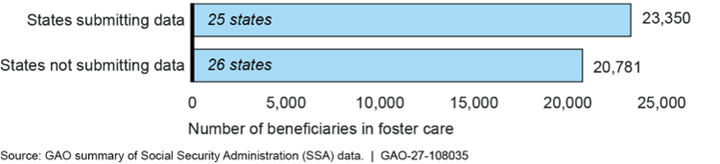
Note: The District of Columbia is counted as a state. The number of states submitting data is as of July 2026.
SSA generates alerts from the data exchanges when a beneficiary enters or exits foster care or changes placement while in foster care. Alerts have helped SSA field office staff identify when to reassess payees. But staff GAO interviewed from four selected field offices reported challenges addressing alerts, such as:
· Each alert had limited information, requiring field office staff to conduct additional, time-consuming research.
· There is a large volume of alerts to address—over 50,000 in fiscal year 2025—but many of these generally do not require a change in payee.
SSA field office staff GAO interviewed had existing practices and ideas for changes SSA could implement to mitigate these challenges. For example, they said that SSA could designate staff to address alerts, include more information in each alert (e.g., payee email addresses), and use artificial intelligence tools to more easily address change of foster care placement alerts that require action. Although field office staff are the end users of the data, SSA has not sought staff input or provided a way for them to share potentially useful practices with each other. Without seeking input, SSA is missing opportunities to improve the efficiency of its processes and ensure beneficiaries in foster care have suitable payees.
Why GAO Did This Study
In fiscal year 2025, payees managed over $270 million in Social Security benefits for about 44,000 children in foster care. Federal law in 2018 called for SSA to enter into agreements for states to provide it with monthly data on children in foster care. These data help SSA identify suitable payees.
GAO was asked to review SSA’s implementation and use of the foster care data exchanges. This report examines (1) selected states’ experiences submitting data and SSA’s efforts to increase state participation and (2) how SSA has used the data exchanges to ensure beneficiaries in foster care have suitable payees.
GAO reviewed SSA documents and policies and analyzed SSA alert data from fiscal years 2019 (when the first state began submitting data) through 2025, the most recent available. GAO interviewed officials from 21 states—13 that submitted data and eight that did not—selected for variation in experience, geography, and size. GAO interviewed SSA officials and staff at four selected field offices identified through interviews with state agencies. Information from state and SSA field office interviews are not generalizable but provide insights on challenges and ways to address them.
What GAO Recommends
GAO is making seven recommendations, including that SSA develop a targeted outreach plan to remaining states, collect input from SSA field office staff, and provide a way for field offices to share practices. SSA agreed with all seven recommendations.
Abbreviations
|
2018 Act |
Strengthening Protections for Social Security Beneficiaries Act of 2018 |
|
agreement |
information exchange agreement |
|
beneficiaries |
children receiving Social Security benefits |
|
eRPS |
electronic Representative Payee System |
|
HHS |
U.S. Department of Health and Human Services |
|
IT |
information technology |
|
OASDI |
Old-Age, Survivors, and Disability Insurance program |
|
OIG |
Office of the Inspector General |
|
payee |
representative payee |
|
SSA |
Social Security Administration |
|
SSI |
Supplemental Security Income |
This is a work of the U.S. government and is not subject to copyright protection in the United States. The published product may be reproduced and distributed in its entirety without further permission from GAO. However, because this work may contain copyrighted images or other material, permission from the copyright holder may be necessary if you wish to reproduce this material separately.
November 9, 2026
Congressional Requesters
When children receive Social Security benefits—such as disability or survivor benefits—they typically have a representative payee (payee) to manage these benefits. Payees can be individuals, such as family members, or organizations, such as child welfare agencies. The Social Security Administration (SSA) is responsible for determining appropriate payees for children receiving Social Security benefits (beneficiaries). The payee may change depending on certain circumstances. For example, if a beneficiary enters or exits foster care, they may require a new payee. In fiscal year 2025, payees managed over $270 million in Social Security benefits for more than 44,000 beneficiaries in foster care, according to SSA data.
The Strengthening Protections for Social Security Beneficiaries Act of 2018 (2018 Act) required SSA to enter into agreements with state agencies administering foster care programs for the purpose of sharing and matching data.[1] To implement this provision of the 2018 Act, SSA established “foster care data exchanges” with states for SSA to receive monthly data on children in foster care. Such data is meant to help SSA identify and redetermine appropriate payees for beneficiaries who have entered or exited foster care or changed foster care placement. The 2018 Act does not explicitly require states to enter into an agreement, provide SSA with a mechanism to compel states to enter into agreements, or specify a deadline for SSA to enter into agreements with all states. In 2021, we reported on the status of SSA’s foster care data exchanges and analyzed data from states that were submitting data at that time.[2] As of July 2026, 25 states were submitting data to SSA through the data exchanges.[3]
You asked us to review SSA’s implementation and use of the foster care data exchanges. This report examines (1) selected states’ experiences submitting data through the data exchanges and SSA’s efforts to increase state participation, and (2) the extent to which SSA has used the data exchanges to help ensure Social Security beneficiaries in foster care have suitable payees.
For both objectives, we analyzed available SSA summary-level monthly data from fiscal years 2019 through 2025 on foster care alerts that SSA creates using data from the foster care data exchanges.[4] These data include the number and types of foster care alerts, the number of new payee applications associated with alerts, and SSA staff’s timeliness in marking alerts as closed in SSA’s system. SSA generates these alerts using monthly data files on children entering, exiting, or changing placement in foster care in each state and matches these with SSA data records to identify existing Social Security beneficiaries. It then creates foster care alerts for those beneficiaries and sends them to SSA field office staff to review and address. The alerts are intended to notify staff that a beneficiary’s payee should be reviewed.
To assess the reliability of these data, we reviewed relevant SSA documentation on foster care alerts, interviewed and obtained written responses from knowledgeable SSA officials, and tested the data for missing values and anomalies. We identified several limitations with the data, and we describe those where applicable. Overall, we found these data to be sufficiently reliable for the purposes of reporting data by fiscal year across all states submitting data to SSA for the states that reported data in that year.
To examine states’ experiences with the foster care data exchanges and SSA’s efforts to increase state participation for our first objective, we also reviewed SSA documents and interviewed officials from SSA and 21 selected states. For instance, we reviewed the agency’s technical requirements for the data exchanges and outreach materials for states about the data exchanges. We also interviewed SSA data exchange coordinators (who are responsible for reaching out to states) to inquire about their outreach efforts and how they help state agencies develop a data file for the data exchanges.
We interviewed officials from state child welfare agencies from 21 states about their experiences with the foster care data exchanges. These included 13 of the 25 states that were submitting data to SSA and eight states that were not, as of July 2026. We selected 17 of these states to achieve variation on three criteria: participation status (submitting data, not submitting data), geographic location, and the number of beneficiaries in foster care who had payees as of June 2025 (the most recent data available at the time of our selection). We selected four additional states because they had unique experiences with the data exchanges, according to information provided by SSA. Specifically, two of these states had technical challenges that prevented them from submitting data. The other two states discontinued their agreement with SSA to participate in the data exchanges.
Our interviews with state agency officials included those with expertise in IT systems and foster care programs. For states that were submitting data, our questions included how states developed their data file, their process for submitting the file each month, and any challenges they experienced. For states not submitting data, we asked state officials the reasons for not participating and how SSA has communicated with them about the data exchanges. The information from our state agency interviews is nongeneralizable and used for illustrative purposes.
We assessed findings related to our first objective against multiple criteria. Specifically, we assessed SSA’s reviews of state data against relevant Federal Data Strategy principles, the agency’s strategic plan, and the federal standard for internal control related to obtaining quality information.[5] We assessed SSA’s efforts to increase state participation against the requirement in the 2018 Act that SSA enter into agreements with states, selected practices from the Federal Data Strategy, and the federal standard for internal control related to sharing information with external parties.[6]
To examine the extent to which SSA has used the data exchanges to ensure beneficiaries in foster care have suitable payees for our second objective, we analyzed available summary-level SSA data, reviewed agency policies, and interviewed SSA central office officials and field office staff.[7] Specifically, we reviewed SSA policies relevant to the foster care data exchanges, such as the guidance SSA field office staff use to address alerts. We interviewed SSA officials about how they designed the data exchanges and how they use the resulting foster care alerts.
We interviewed staff in four selected SSA field offices to collect illustrative information on how field office staff address the foster care alerts and their experiences with the process.[8] We selected these field offices because they were in states that were submitting data and state officials we interviewed identified them as field offices they worked with on beneficiaries in foster care.[9]
We assessed SSA’s use of the data exchanges to ensure that beneficiaries in foster care have suitable payees against several criteria. These included the Federal Data Strategy principle on incorporating stakeholder feedback, evidence-based policymaking practices on using evidence to measure an agency’s progress toward its goals, and the federal standards for internal control related to periodically reviewing policies and procedures and communicating relevant information.[10] We also assessed SSA’s efforts against relevant SSA policies and the agency’s strategic plan.[11] For more information on our methodologies, see appendix I.
We conducted this performance audit from January 2025 to November 2026 in accordance with generally accepted government auditing standards. Those standards require that we plan and perform the audit to obtain sufficient, appropriate evidence to provide a reasonable basis for our findings and conclusions based on our audit objectives. We believe that the evidence obtained provides a reasonable basis for our findings and conclusions based on our audit objectives.
Background
Foster Care and Social Security Benefits
Foster care is intended to be a temporary living arrangement for children who have been placed away from their parents or guardians. A child enters foster care and comes under the responsibility of a child welfare agency when their safety is at risk, such as in cases of abuse or neglect. While in foster care, a child may live in different settings or “change placement”—for example, moving from a relative’s home to a group home to a foster parent’s home. Children exit foster care when they are reunified with their parent, placed in another permanent home, or “age out” of foster care—typically at age 18, though nearly all states allow youth to stay longer, such as to age 21.
Children, including those in foster care, may qualify to receive Social Security benefits. Specifically, qualifying low-income children with a disability may be eligible to receive benefits through the Supplemental Security Income (SSI) program. In addition, certain children, such as those who are eligible survivors, may receive benefits through the Old-Age, Survivors, and Disability Insurance (OASDI) program.
An SSA-appointed payee typically manages a child’s Social Security benefits for the use of the child, such as for their food, clothing, shelter, medical care, and personal comfort items.[12] The payee must conserve any unused benefits or invest those benefits on behalf of the child.[13] Once an individual or organization ceases to be a payee, they must return any unused or invested benefits to SSA. When SSA receives unused or invested benefits, it will reissue those benefits to the new payee to manage. Among the more than 44,000 children in foster care who received Social Security benefits in fiscal year 2025, more than half received SSI. Almost three-fourths of beneficiaries in foster care had a child welfare agency as their payee (see fig. 1).
Figure 1: Percent (and Number) of Social Security Beneficiaries in Foster Care with a Payee, by Social Security Benefit Type and Payee Type, Fiscal Year 2025

Notes: Data include beneficiaries aged 21 and younger in all states, Washington, D.C., and U.S. territories. A representative payee (payee) is an individual or organization that manages benefits for children and others who receive Social Security benefits. In a small number of cases, beneficiaries in foster care can be payees themselves. These payees are included in the “individual” payee type. SSA officials said this can occur, for example, for beneficiaries in foster care who are older.
SSA’s Foster Care Data Exchanges
The 2018 Act was designed in part to improve payee selection, oversight, and monitoring.[14] Specifically, the intent of the data exchanges is for SSA to systematically obtain data from state agencies to help SSA detect when it may need to redetermine a suitable payee for a child in foster care.[15] Prior to the data exchanges, SSA did not have a systematic way to know whether a beneficiary had entered or exited foster care or changed placement unless the child’s payee or another individual proactively submitted a report to an SSA field office.
In a series of reports prior to 2018, the SSA Office of the Inspector General (OIG) identified instances in which SSA had not sufficiently assessed payee suitability for children in foster care.[16] For example, a 2014 report found that of a sample of 50 beneficiaries in foster care that the OIG reviewed, 30 did not have suitable payees. Of those 30, 15 payees had misused Social Security benefits.[17]
|
Required Data for the Foster Care Data Exchanges A state child welfare agency must provide data to SSA each month that include: · Child’s name · Child’s date of birth · State child welfare agency name · Status change (if a child entered or exited foster care or changed placement) · Date of status change · Current payee’s name Source: GAO summary of Social Security Administration (SSA) technical specifications and requirements for the foster care data exchanges. | GAO‑27‑108035 |
To participate in the foster care data exchanges, a state child welfare agency must first sign an information exchange agreement (agreement) with SSA that lays out responsibilities for the state agency and SSA. State responsibilities include financing their own costs related to the data exchanges and ensuring that they can meet technical requirements, including providing mandatory data elements. Although it is called a data “exchange,” the data flow in one direction: from a state agency to SSA.
Multiple offices within SSA have roles and responsibilities with respect to the foster care data exchanges. For instance, within SSA’s central office, data exchange coordinators reach out to state agencies to encourage them to sign an agreement and liaise between the state agency and SSA after an agreement is signed. After a state begins submitting the data file each month, SSA’s central office IT system matches each monthly data file against SSA databases to identify beneficiaries (see fig 2). From these matches, SSA’s central office system generates foster care alerts that are distributed to SSA field office staff to address. These alerts identify when a child who receives Social Security benefits: (1) enters foster care, (2) exits foster care, or (3) changes foster care placement. Upon receiving these alerts in their system, SSA field office staff take steps to determine whether the beneficiary needs a new payee and take any other actions needed (e.g., updating the beneficiary’s address).

aA payee, or representative payee, is an individual or organization that manages benefits for children and others who receive Social Security benefits.
As of July 2026, 25 states were submitting data to SSA. These states accounted for 53 percent of the beneficiaries in foster care who had a payee, based on SSA data from fiscal year 2025 (see fig. 3). Nine additional states had signed agreements with SSA but were not yet submitting data to SSA.
Figure 3: Percent (and Number) of Beneficiaries in Foster Care with a Representative Payee, by State Participation in SSA’s Foster Care Data Exchanges, Fiscal Year 2025

Notes: Data include beneficiaries aged 21 and younger. Data exclude the number of beneficiaries in U.S. territories. A representative payee (payee) is an individual or organization that manages benefits for children and others who receive Social Security benefits.
Selected States Reported Few Issues, but SSA’s Data Checks and Outreach Are Limited
Selected states reported few issues developing and submitting monthly data files for SSA’s foster care data exchanges. However, SSA has limited data validation checks for the files it receives, which affects its ability to identify data irregularities. Further, although no new states have started submitting data since 2024, SSA has not adjusted its outreach efforts to encourage additional states to join.
Selected States Reported Few Problems Developing and Submitting Data Exchange Files
State child welfare agency officials we interviewed from the 13 selected states that submitted data to SSA’s foster care data exchanges said the effort did not require additional staff or funding to develop the monthly file.[18] Officials in these states said that their IT and program staff had the necessary expertise, such as technical skills, and familiarity with their state’s data systems to develop the file. State officials also said they did not need to seek additional funding for this effort, as existing staff worked on it as part of their normal workload.
Selected states took between 3 and 20 months to develop an initial data file that could then be updated and submitted to SSA on a monthly basis, according to state agency officials. Developing the file required several steps, from designing the state’s data file to meet SSA’s requirements to testing the file submission process with SSA (see fig. 4). For example, officials we interviewed from five of the 13 states submitting data said that their agencies developed the data file in 6 months or less.[19]
Figure 4: Steps States Took to Develop the Monthly Data File to Submit to SSA Through the Foster Care Data Exchanges and Selected States’ Experiences

Officials from all 13 state agencies said they tested their newly created data file for accuracy and worked with SSA to ensure it met SSA’s technical requirements. Also, officials from 11 states said that SSA helped identify and resolve issues related to SSA’s technical requirements, such as when SSA’s system rejected a data file because the file contained incorrectly formatted addresses and names with special characters.
|
Example of How the Foster Care Data Exchanges Can Improve a State Agency’s Workload According to officials from one state agency, participating in the Social Security Administration’s (SSA) foster care data exchanges improved their staff’s workload. Prior to participating in the data exchanges, the state agency’s staff sent forms to the local SSA field office each time a beneficiary in foster care had any change, such as when they required a new payee. Officials said that sending in these forms was time consuming for agency staff. Now, the foster care data exchanges have largely replaced this process, streamlining the staff’s workload, according to the state officials. Source: GAO interview with officials from a selected state agency. | GAO‑27‑108035 |
Submitting the monthly data for the foster care data exchanges generally involved minimal staff time, according to state officials. Officials from 10 of the 13 selected states said their states used a fully automated process to submit their monthly data file to SSA. Officials from the other three state agencies said their processes required some manual steps, taking between 10 minutes and a couple of hours each month. In addition, officials from one state said participating in the foster care data exchanges has improved their staff’s workload.
According to our review of SSA data, states have generally submitted their monthly data files to SSA as expected. Specifically, SSA data from April 2019 (when the first state began submitting data) through September 2025 show that states participating in the data exchanges submitted 95 percent of their monthly data files.[20] Officials we interviewed from six selected states said that SSA contacted them when the agency did not receive an expected data file.
SSA’s Limited Data Checks Have Not Identified Data Irregularities Over Time
SSA’s current validation checks of the monthly data files include identifying if required data elements within a file (e.g., a child’s name or Social Security number) are missing or incorrectly formatted in addition to flagging missing data files. SSA central office officials perform these data validation checks before creating foster care alerts for its field office staff to address. When the agency identifies these types of issues, SSA data exchange coordinators reach out to state agency officials to fix these issues. For example, officials from two selected states said SSA data exchange coordinators contacted them when the agency identified a data formatting issue.
However, SSA’s current data validation checks have not identified repeated data irregularities over multiple months of data that might warrant additional review. We identified two states with irregular data patterns in the foster care alerts generated from states’ monthly files. One of these states did not have any change of foster care placement alerts from fiscal years 2023 through 2025.[21] The other state had only three alerts for beneficiaries who exited foster care over a 6-year period (fiscal years 2020 through 2025).[22] SSA officials were unaware of these data irregularities and could not explain the reasons for these unusually low numbers of alerts, such as whether there might be an issue with the state files or SSA’s processing of their files.
SSA officials acknowledged that the agency’s current data validation checks do not effectively identify irregular data patterns over time. Officials said the agency currently lacks the staff resources to manually review each state’s monthly data submission for such irregularities. Officials also said it does not have an automated process to review multiple months of data to identify irregularities and has not established business requirements or a technical analysis to be able to do so. However, SSA previously took some steps to try to automate these processes. Specifically, SSA officials said the agency had planned to move all of its data exchanges, including the foster care data exchanges, into an automated system that would perform data validation checks and processing.[23] SSA paused its plans and did not have a time frame for when such a transition would occur.
One of the principles in the Federal Data Strategy states that agencies should ensure the quality and integrity of data by validating that the data are accurate.[24] Furthermore, SSA’s current strategic plan states that the agency will leverage technology to automate employees’ routine work and enhance their productivity.[25] Incorporating additional data validation checks—such as through automated processes that SSA was previously considering—would help the agency identify irregularities and better ensure the quality and integrity of the data it uses to generate foster care alerts.
SSA’s Outreach Helped 25 States Join the Data Exchanges, but Has Not Been Effective for the Remaining States
Since 2018, SSA has used various methods to inform state child welfare agencies about the data exchanges and encourage them to participate. Specifically, SSA has:
· Emailed informational materials to state agencies that are not submitting data. SSA has sent materials including a letter with information for states on the data exchanges, its technical requirements, relevant SSA contacts, and next steps states could take to sign the agreement to participate in the data exchanges.
· Leveraged other SSA outreach to state agencies. SSA officials said that, in general, they have reminded state child welfare agencies about the foster care data exchanges when reaching out about other initiatives. For example, SSA officials said that they called governors’ offices to discuss SSA’s national initiatives, including the foster care data exchanges.
· Collaborated with the U.S. Department of Health and Human Services (HHS).[26] SSA and HHS engaged in coordinated outreach efforts several times to raise awareness about the data exchanges among state child welfare agencies. Specifically, SSA cohosted webinars with HHS about various data exchanges (including the foster care data exchanges) in 2018 and 2024. The agencies also coauthored a Dear Colleague Letter in 2023 that included information about the foster care data exchanges, among other topics.
These efforts successfully resulted in 25 states submitting data by November 2024. However, as of July 2026, 26 states were still not participating, and no new states had signed an agreement to participate since 2021. (See fig. 5.)

Notes: The number of states in each category from 2019 through 2025 is as of the end of each fiscal year. Data for fiscal year 2026 is as of July 2026. The most recent state began submitting data in November 2024. Two states discontinued their agreements to participate in the data exchanges in 2024, according to SSA. For the purposes of this report, GAO considered the District of Columbia a state.
Officials we interviewed from seven of the eight selected states that were not submitting data to SSA identified barriers related to systems and resources, as well as a lack of general awareness of the foster care data exchanges.[27]
· System and resource barriers. Officials from four selected states said they had challenges with their state IT systems and state financial and staff resources that prevented them from participating in the data exchanges. Specifically, officials from two states said their county-level IT systems maintained SSA’s required data elements and that the state did not centralize these data. Officials from two other states said they ended their agreements with SSA in 2024 because they had limited staff and funds and needed to prioritize other updates to their child welfare IT systems.
· Awareness barriers. Officials from four selected states had limited awareness of the data exchanges, including two states with signed agreements and two states without an agreement. Officials from one of the states with a signed agreement said they did not remember when SSA had last reached out to their agency about the data exchanges or provided information on technical requirements. Officials from another state without a signed agreement said that even though they have been working with SSA on a separate data exchange for a few years, SSA officials had not mentioned the foster care data exchanges to them.
Given that the number of states submitting data has leveled off since fiscal year 2024 and officials we interviewed from four states were unfamiliar with the data exchanges’ existence or its requirements, SSA’s outreach efforts may no longer be effective. Further, nine states that had signed an agreement to participate in 2021 or earlier had not started submitting data as of July 2026.[28] However, SSA has not considered ways to adjust its outreach efforts. Its outreach approach has generally consisted of emailing the same materials to all states that are not submitting data about once a year.[29] These materials have largely stayed the same since they were created in 2019, according to SSA data exchange coordinators.
SSA is missing opportunities to improve the effectiveness of its outreach efforts in multiple ways. First, SSA data exchange coordinators said they have a goal of increasing state participation by one to two states per year, but they have not developed a plan to strategically guide their efforts to meet this goal.[30] The coordinators pointed to other mechanisms for increasing state participation in the data exchanges, such as enacting a federal law to require state agencies to participate in the data exchanges and making funding available for them to do so.
Second, SSA has not taken steps to proactively address state participation barriers. SSA officials said that system and resource issues (such as limited IT systems and lack of state agency staff) were common reasons that prevent states from participating in the data exchanges, based on their communications with state agency officials.[31] However, 25 states have managed these issues. SSA data exchange coordinators said that they have not systematically gathered information from these states on the strategies they used. They said that because all states have unique IT systems, they did not see a benefit to gathering or sharing such information among states. However, officials from two state agencies that were not yet submitting data to SSA said that learning about other states’ experiences would be helpful.
Developing a formal outreach plan to strategically target the agency’s outreach efforts to states could help SSA meet its goal to have one to two additional states join the data exchanges each year. A plan could include time frames for conducting more regular outreach to states to ensure state agency officials are aware of the data exchanges and strategies for tailoring outreach to states.
Furthermore, SSA could increase its chances of success by gathering successful strategies for overcoming potential issues and disseminating those strategies to nonparticipating states, consistent with the Federal Data Strategy. The data strategy calls for federal agencies to proactively assess and address barriers to sharing data with external partners, and to identify opportunities to overcome resource obstacles by coordinating with stakeholders.[32] Federal standards for internal control also state that management should share relevant information with external stakeholders to achieve their objectives.[33]
Without identifying and sharing successful strategies states have used to develop the monthly data file, SSA may still struggle to increase state participation in the data exchanges. Taking such actions and developing an outreach plan could help SSA expand its coverage of the data exchanges, giving SSA more complete information on beneficiaries in foster care and helping the agency deliver benefits to the most suitable payee.
SSA Uses Foster Care Data Exchange Information, But Faces Process and Policy Challenges
SSA field office staff used alerts generated from the data exchanges to help identify when they needed to review payees for beneficiaries in foster care, but staff in selected SSA field offices reported limitations using the data exchange information to identify and assess payees. Field office staff—the end users of the data—shared ideas with us for improving processes to address foster care alerts, but SSA officials have not sought field office staff’s input. SSA also has not assessed its own timeliness standard to close alerts or implemented its policy to use foster care data exchange information to help identify a state agency’s responsibility for overpayments.
SSA Field Office Staff Used Alerts to Help Identify When Foster Care Beneficiaries Needed Their Payees Reviewed
Available SSA data show that, as more states have submitted data to SSA through the data exchanges, the agency has generally identified more applications for a new payee associated with foster care alerts (see fig. 6). A foster care alert may result in SSA determining that a beneficiary in foster care needs a new payee. An individual or organization must submit an application to SSA before they become a payee. Available SSA data on new payee applications for beneficiaries in foster care indicate that between fiscal years 2019 and 2025 there were about 13,000 instances in which an application was associated with an alert from the foster care data exchanges.[34]
Figure 6: Number of New Payee Applications for Social Security Beneficiaries Associated with Foster Care Alerts and Number of States Submitting Data to SSA’s Foster Care Data Exchanges, Fiscal Years 2019–2025

Notes: SSA provided these data by identifying instances in which SSA received an application for a new representative payee (payee) within 60 days of field office staff closing a related foster care alert. SSA generates foster care alerts using monthly data on children entering, exiting, or changing placement in foster care in each state submitting data. Generated alerts are for existing Social Security beneficiaries. Therefore, these data do not include instances in which a state agency or other payee applicant submitted a new application for a child who was not previously receiving Social Security benefits or instances in which an alert resulted in a new application but took longer than 60 days.
Staff in three selected SSA field offices we spoke with said in some instances a foster care alert helped staff identify the need for a payee review faster. For example, staff in one of the selected field offices said that prior to the state participating in the data exchanges, they may not have known about a child entering or exiting foster care until many months later because of infrequent communication with state agency officials.
SSA Has Not Sought Input from its Field Office Staff to Help the Staff Better Address Alerts
SSA staff at selected field offices said that, while the foster care alerts helped them determine if they needed to review a beneficiary’s payee, staff faced various challenges addressing the alerts.
Limited information in each alert. Staff in all four field offices said the information in the foster care alert can be insufficient to determine next steps, requiring staff to conduct additional research on a case. For example, a change of placement alert may indicate that a child has been placed in a medical facility. In that circumstance, staff may also need to know whether Medicaid paid for any portion of the stay in the medical facility to determine if the placement could affect the child’s SSI benefit amount for that time.[35]
Staff from all four field offices said that the limited information is particularly challenging for alerts about beneficiaries exiting foster care. For example, staff at one field office said the alerts provide the address of a beneficiary’s last foster care placement but not a current residence. Without a current residence, staff said it was difficult to contact a beneficiary who was adopted or has “aged out” to ensure they continue receiving their benefits.[36] In fiscal year 2025, SSA staff received about 13,000 alerts for beneficiaries exiting foster care (about 25 percent of the alerts received that fiscal year) based on SSA data.
Cumbersome IT systems. Staff at all four field offices said that they use at least two to three IT systems internal to SSA and navigate multiple screens within one system to address an alert, even when the payee stays the same. Staff at one field office said that it can take several years to learn how to adeptly use the IT systems they need to address the alerts. Further, staff at another field office said within one IT system, they need to click through multiple screens to identify the issue and the action needed to address each alert, which can be time consuming.
Volume of alerts to address. Staff at four selected field offices said that they need to review and address many alerts. SSA data from fiscal years 2020 to 2025 show that each year about half of all alerts were for a change in foster care placement (see fig. 7). This was the case even as the total number of alerts increased over time (from about 6,800 in fiscal year 2019 to 53,000 in fiscal year 2025). Most commonly, the alerts for a change of foster care placement require staff to confirm that the state remains the most suitable payee, according to staff at two field offices. Staff said one beneficiary case can have multiple change of foster care placement alerts each month though the state agency remains the most suitable payee. They added that, in such instances, field office staff update the beneficiary’s address for each alert, which can be time consuming.
Figure 7: Percent of Total Foster Care Alerts Received by SSA Field Offices, by Type, Fiscal Years 2019-2025

Notes: SSA generates foster care alerts using monthly data on children entering, exiting, or changing placement in foster care in each state submitting data. Generated alerts are for existing Social Security beneficiaries. GAO received monthly data from SSA and reported it by fiscal year. Some state agencies participating in the foster care data exchanges did not submit data for all months. This analysis includes the first month each state submitted data. That initial data tends to include more alerts for children entering foster care than the data for subsequent months.
Fewer field office staff. Staff we interviewed at all four field offices said that the number of staff in their offices who address alerts has decreased in recent years. Further, the remaining staff have less time to address and, ultimately, close alerts. For example, staff at one field office said that due to the decline in staff, their office is unable to close alerts as expeditiously as they used to. In another field office, the staff who address foster care alerts said that they now have more responsibilities than in years past, such as issuing Social Security cards.
Information provided by SSA shows that the number of SSA field office staff who worked to address alerts declined 6 percent (1,300 staff) from fiscal year 2024 to fiscal year 2025.[37] Further, staff closed 12,000 fewer alerts in fiscal year 2025 compared to fiscal year 2024. However, the number of foster care alerts the offices received remained fairly steady during that time (around 50,000 alerts). (See fig. 8.) SSA officials said that fewer staff resources as well as agency reorganization efforts in fiscal year 2025 impeded field office staff’s ability to close alerts. They said it also impeded central and field office management’s ability to monitor progress in closing alerts.
Figure 8: Total Number of Foster Care Alerts Received and Total Number Closed, Fiscal Years 2019–2025
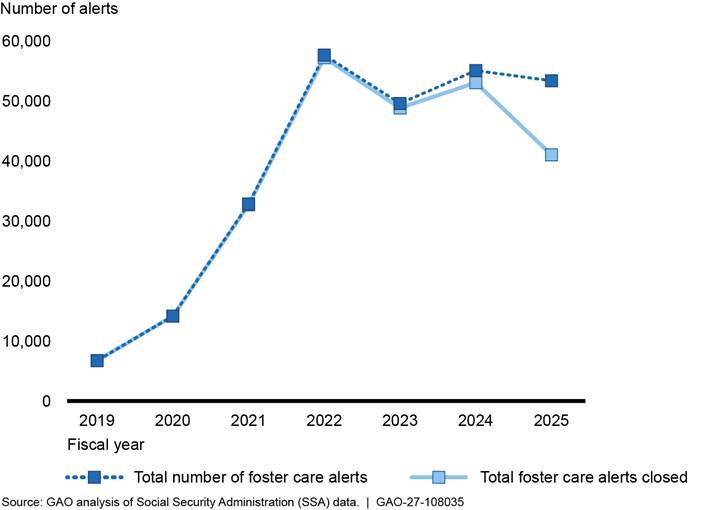
Notes: SSA generates foster care alerts using monthly data on children entering, exiting, or changing placement in foster care in each state submitting data. Generated alerts are for existing Social Security beneficiaries. GAO received monthly data from SSA and reported it by fiscal year. Some state agencies participating in the foster care data exchanges did not submit data for all months.
To help mitigate these challenges and gain efficiencies in addressing foster care alerts, staff at selected field offices developed their own practices (see table 1).
Table 1: Examples of Existing Practices Developed by Staff in Four Selected SSA Field Offices to Mitigate Challenges Addressing Foster Care Alerts
|
Challenge |
Existing Practice Developed by Field Office Staff |
|
Limited information in each alert |
Communicating regularly with state child welfare agency officials to get information needed to address the alert. For example, staff in one field office said they met weekly with the same four to five state agency officials to discuss foster care alerts, which resulted in getting the necessary information to respond to alerts more quickly. |
|
Cumbersome IT systems |
Developing informal guidance, such as taking screenshots of each screen to complete the steps to close an alert in the IT system and sharing it with staff new to addressing alerts and other field offices when a case is transferred. Centralizing the location of information from state agencies to one secure site. Staff at one SSA field office that developed a secure site said the state agency sends information, including documents such as a new payee application, to the field office. As a result, all of the information the field office staff needs on beneficiaries in foster care can be accessed and is stored in a central location. Exporting the list of foster care alerts to a spreadsheet to track actions taken and follow-up needed, allowing staff to view all alerts, actions, and notes for one beneficiary. |
|
Volume of alerts to address Fewer SSA field office staff |
Designating one to two SSA field office staff to review or address alerts, enabling them to develop expertise and establish relationships with state agency officials to more quickly address alerts. |
Source: GAO summary of interviews with staff at four selected Social Security Administration (SSA) field offices. | GAO‑27‑108035
SSA does not have a method to enable field offices to share potentially useful practices with each other on the foster care alerts. SSA officials said that even if some field offices have developed their own practices, all staff are encouraged to follow standard policies and procedures set by the agency. However, field office staff in states submitting data may have valuable experience with addressing foster care alerts efficiently while following agency procedures. This experience could be helpful for field offices in states newer to the data exchanges. For example, a manager in one field office informally connected their staff with a colleague in a state that had more experience with the data exchanges to understand what worked for that state. Their staff said connecting with a colleague in a state that had more experience with the data exchanges was useful to help set up their own processes. Further, staff at two SSA field offices said learning how other field offices address foster care alerts could help improve their own processes.
SSA’s Agency Strategic Plan for Fiscal Years 2026–2030 sets goals to improve productivity and benefit delivery, including modernizing its policies to improve staff’s ability to efficiently manage their workload.[38] Providing a method for field office staff to share or learn about existing practices could help SSA improve how efficiently the agency delivers benefits to beneficiaries in foster care, which is especially important given that field office staff identified limited resources as a challenge.
In addition to its current practices, staff we interviewed at all four selected field offices suggested ways to improve and streamline processes for addressing foster care alerts that would involve changes from SSA (see table 2).
Table 2: Examples of Changes Suggested by Staff in Selected SSA Field Offices to Mitigate Challenges Addressing Foster Care Alerts
|
Challenge |
Changes suggested by selected SSA field offices |
|
Limited information in each alert |
Revise the information in the foster care alert, such as including: · more contact information for a beneficiary or payee (e.g., phone number or email address) to enable faster communication · a beneficiary’s current residence once they have exited care to increase the likelihood of contacting them to ensure they continue to receive benefits. |
|
Cumbersome IT systems |
Include more information on one screen to reduce the need to navigate multiple screens to address a foster care alert. Enable staff to access all the alerts and related details on a beneficiary’s case in a centralized way. |
|
Volume of alerts to address |
Identify tools (e.g., artificial intelligence) that could help field office staff more easily address change of foster care placement alerts that require action. For example, such tools could help field office staff more easily identify the most recent change of foster care placement for a beneficiary who had multiple placement changes in the same month. |
Source: GAO summary of interviews with staff at four
selected Social Security Administration (SSA) field offices. | GAO‑27‑108035
SSA initially established a workgroup in 2019 to develop information requirements for the foster care data exchanges but did not include SSA field office staff—the end users of the data. SSA has also not sought field office staff input since that time. SSA officials said they did not seek such input because, as mentioned, field office staff are encouraged to follow established agencywide procedures and policies. Officials acknowledged that addressing alerts can be time consuming. However, they said field office staff should review and address each alert because an alert may identify a need for staff to make changes related to agency policies that could affect a beneficiary’s benefits.
When designing data collection processes, agencies should keep the end uses and users in mind to ensure that data are necessary and of high enough quality to meet planned and future agency and stakeholder needs, according to the Federal Data Strategy.[39] Furthermore, the strategy states that federal agencies should assess and balance the needs of stakeholders by identifying their needs and incorporating their feedback. Without identifying what field office staff need to more efficiently and effectively address foster care alerts, SSA is missing opportunities that could result in improved processes and, ultimately, ensure beneficiaries have suitable payees.
SSA Has Not Assessed Whether Field Office Staff Can Meet Its Timeliness Standard for Closing Alerts
SSA’s policy requires field office staff to address a foster care alert and close it in SSA’s IT system within 30 calendar days of receiving the alert. However, available SSA data show that field office staff are generally not meeting this standard. Specifically, from fiscal years 2019 through 2025 between 6 and 43 percent of all foster care alerts each year were marked closed in SSA’s system within 30 calendar days. (See fig. 9).
Figure 9: Number and Percent of Total Foster Care Alerts Received that SSA Field Offices Closed Within 30 Calendar Days, Fiscal Years 2019–2025

Notes: SSA generates foster care alerts using monthly data on children entering, exiting, or changing placement in foster care in each state submitting data. Generated alerts are for existing Social Security beneficiaries. GAO received monthly data from SSA and reported it by fiscal year. Some state agencies participating in the foster care data exchanges did not submit data for all months.
|
What Steps Does SSA Take to Assign a Representative Payee for a Beneficiary Who Is Younger Than Age 18? SSA assigns a representative payee (payee)—an individual or organization—to manage benefits for most beneficiaries younger than age 18. Depending on circumstances, SSA field office staff may take some or all of the following steps to determine whether a payee (or change in payee) is needed. · Determine if a beneficiary between ages 15 and 17 is capable of managing their own benefits. If they are not, then field office staff must identify and appoint a suitable payee. · Research potential payees, such as by asking the person or institution who has custody of the beneficiary for information. · Identify a potential payee according to SSA’s ranked list of payee types that would be most suitable (e.g., legal guardian, relative who has custody of the child). · Use payee application information to determine if the applicant meets the qualifications and is suitable to be a payee. · Collect documents with necessary information, such as copies of court documents related to the child in foster care. · Conduct an in-person interview. Source: GAO summary of Social Security Administration (SSA) policy. | GAO‑27‑108035 |
Moreover, SSA data may actually inflate the number of alerts closed in 30 calendar days because field office staff sometimes close alerts earlier than SSA policy advises. SSA policy states that staff should complete a number of sequential steps, as needed, before assigning a new payee and closing the related alert. Staff we interviewed at all four selected field offices said they sometimes closed alerts before completing all listed steps.[40] For example, staff at one field office said they close an alert after an applicant has submitted a payee application, while staff at another field office said they close an alert after a case is forwarded to a specialist for review.
Staff at all four selected SSA field offices said that foster care alerts that require more communication and coordination to address can be difficult to close within 30 calendar days. For example:
· Alerts involving SSI benefits. Staff at two field offices said that they must assess whether beneficiaries continue to meet SSI eligibility requirements. That assessment can take several months to complete. SSA data show that more than half of beneficiaries in foster care receive SSI benefits.
· Alerts for beneficiaries exiting foster care. SSA field office staff said that addressing alerts for beneficiaries exiting foster care (e.g., those who have “aged out” or found a permanent home) can be complex because the staff may not be able to contact the beneficiary for a variety of reasons, as described earlier. As noted, foster care exit alerts accounted for about a quarter of all alerts in fiscal year 2025.
SSA central office officials acknowledged that they are aware that field office staff often close foster care alerts beyond 30 calendar days but stated that they lack resources to determine how often this standard is met. For instance, the agency has not tried to collect consistent data on how long it takes staff to complete the actions needed to close an alert.[41] Instead, central office officials annually send a list of alerts that have been open for 150 days or longer to field office management, asking that these be addressed by the end of the fiscal year.
Additionally, SSA has not gathered information from field office staff on factors that affect their ability to meet the 30-day standard. When asked, officials said there was no need to do so because the standard aligns with 30-day agency standards to take other actions (e.g., to make a decision on a request for evidence for an application for benefits). However, the policies SSA cited as similar generally involve fewer potential steps than what might be needed for staff to assess the suitability of a new payee.[42]
One key practice of evidence-based policymaking is for an agency to use evidence to assess progress toward its goals and understand why its goals were or were not achieved.[43] In addition, federal standards for internal control state that management should implement control activities through policies, and periodically review policies, procedures, and related control activities for continued relevance and effectiveness.[44] Further, SSA’s internal policy notes that cases involving foster care are among the agency’s most sensitive, and that it is essential that SSA do all it can to protect the rights of children who may not be able to rely on their parents or guardians to do so.[45] In its written policy, SSA emphasizes the need for timely closure of foster care alerts. In practice, however, the agency has not actively ensured that staff adhere to this standard. Without assessing its own standard, SSA does not have insight into factors that affect field office staff’s ability to meet an agency standard intended to ensure timely identification of suitable payees for beneficiaries in foster care.
SSA Has Not Implemented Its Policy to Use the Data Exchanges to Help Identify State Agency Responsibility for Overpayments
SSA policy states that the agency will use information from the foster care data exchanges to identify when a state agency may be responsible for an overpayment. Specifically, SSA’s policy manual for its staff lists two purposes for the foster care data exchanges. One purpose is to use the data exchange information to assign an appropriate payee, as needed. The other is to use the information to identify when a state is responsible for an overpayment for a child in foster care.[46]
|
Social Security Benefit Overpayments and Beneficiaries in Foster Care Overpayments occur when a beneficiary receives more Social Security benefits in a given month than they should have been paid. Beneficiaries, their representative payee, or both may be liable for overpayments. Prior to the Strengthening Protections for Social Security Beneficiaries Act of 2018 (2018 Act), this also applied to beneficiaries in foster care. However, Section 104 of the 2018 Act changed this by stating that if an overpayment occurred when a state agency was the representative payee and a beneficiary was in foster care, the state agency was solely liable to repay SSA the excess funds. This section of the law does not include any mention of the foster care data exchanges, which are described in a different part of the 2018 Act. Source: GAO summary of the 2018 Act, Social Security Administration (SSA) policy, and interviews with SSA officials. | GAO‑27‑108035 |
However, SSA has not implemented its policy to use information from the data exchanges to identify when a state agency may be responsible for an overpayment. Instead, SSA officials acknowledged that this policy may have been “aspirational” at the time it was developed and cited several obstacles to implementing it. First, officials said SSA’s existing IT systems limit their ability to implement this policy because SSA uses different IT systems to manage alerts and overpayments. The agency planned to modernize its IT system for overpayments when the policy was issued in 2019. Officials said this modernization might have enabled SSA to use information from the foster care data exchanges to help identify state responsibility for overpayments. However, this modernization effort was paused in 2023 and, as of July 2026, the agency did not have plans to restart it.
Second, officials said that addressing foster care alerts and determining overpayments are two distinct processes and there can be a lag between the two. Checking to see if an overpayment has occurred typically happens after an alert has been closed and may be conducted by a different staff member.
In addition to its internal policy, SSA also listed in its agreement with states that the agency will use the information from the data exchanges to identify state agency responsibility for overpayments. SSA central office officials said that this language was included in the agreement with states to alert state agencies to their potential future responsibility for overpayments. Yet, SSA already does so in its outreach material to state agencies. Further, as currently written, such language could create confusion. For instance, officials we interviewed from two states said that they thought the exchanges would help their state avoid overpayments, but that has not occurred.
Federal standards for internal control state that management should periodically review policies, procedures, and related control activities for continued relevance and effectiveness. Furthermore, management should communicate relevant information internally and externally.[47] Without reviewing whether the agency can implement its policy to use data exchange information to identify state responsibility for an overpayment for a foster care beneficiary, the policy lacks meaning. Moreover, without revising the language in its agreements with states, as needed, SSA risks miscommunicating one purpose of the exchanges and how SSA uses the information the states provide.
Conclusions
The foster care data exchanges are intended to provide SSA with systematic information to help the agency identify suitable payees for beneficiaries SSA describes as among its most sensitive: children in foster care. But SSA’s ability to fulfill this intent is diminished if it is unable to identify ongoing data irregularities. Additionally, the efficacy of the data exchanges is limited, given that only half of the states submit data to SSA, and no new states have begun submitting data since 2024. The agency also has not considered ways to change its outreach approach to states. More strategic outreach to nonparticipating states, along with proactive efforts to share useful information with them, could help SSA increase the coverage of the data exchanges. Such efforts could also provide SSA with more complete and comprehensive information about children in foster care who receive Social Security benefits.
While the data exchanges have provided SSA with information to help ensure that children in foster care have suitable payees, the data exchanges have not fully delivered on their potential. This is in part because SSA has not sought to better understand the experiences of key users of the data exchanges: its own field office staff. Seeking input from these staff and implementing feasible changes would improve the data exchanges’ effectiveness. In addition, SSA has not assessed or fully implemented its own policies on timeliness and intended uses of the data exchanges, hindering their usefulness. Without reviewing its policies, SSA risks delaying access to benefits for this vulnerable population that relies on these benefits.
Recommendations for Executive Action
We are making the following seven recommendations to SSA.
The Commissioner of SSA should incorporate additional data validation checks, such as through automated processes, on the monthly foster care data exchange files to identify data irregularities that could warrant additional review and, as appropriate, resolve these irregularities. (Recommendation 1)
The Commissioner of SSA should develop and document a plan to strategically target its outreach efforts to states that are not yet submitting data through the foster care data exchanges. (Recommendation 2)
The Commissioner of SSA should identify successful strategies states used to develop their monthly data files based on information collected from states that are already submitting data through the foster care data exchanges. SSA should share relevant strategies with states that are not yet submitting data, such as by including this information in its outreach materials. (Recommendation 3)
The Commissioner of SSA should provide a method for SSA field office staff to learn about existing practices among other field offices that could promote efficiencies in addressing foster care alerts. (Recommendation 4)
The Commissioner of SSA should collect input from SSA field office staff—the end users of the foster care alerts—to improve the efficiency and effectiveness of the foster care alerts and related processes. Based on this input, SSA should identify feasible improvements and develop a plan to implement these improvements. (Recommendation 5)
The Commissioner of SSA should assess the 30-day standard for closing foster care alerts by systematically collecting data on how long it takes to close alerts and gathering input from field office staff on the factors affecting the staff’s ability to meet the standard. SSA should take steps, as appropriate, to address any issues it identifies based on the results of its assessment. (Recommendation 6)
The Commissioner of SSA should revisit whether SSA can implement its policy to use information from the foster care data exchanges to identify when a state agency is responsible for an overpayment. If SSA determines it cannot implement its policy as written, SSA should revise its internal documents and its materials for state agencies accordingly. (Recommendation 7)
Agency Comments and Our Evaluation
We provided a draft of this report to SSA for review and comment. In its response, reproduced in appendix II, SSA agreed with our seven recommendations. SSA also provided technical comments, which we incorporated as appropriate.
We are sending copies of this report to the appropriate congressional committees and the Commissioner of the Social Security Administration. In addition, the report is available at no charge on the GAO website at https://www.gao.gov.
If you or your staff have any questions about this report, please contact me at larink@gao.gov. Contact points for our Offices of Congressional Relations and Media Relations may be found on the last page of this report. GAO staff who made key contributions to this report are listed in appendix III.

Kathryn A. Larin, Director
Education, Workforce, and Income Security Issues
List of Committees
The Honorable Mike Crapo
Chairman
The Honorable Ron Wyden
Ranking Member
Committee on Finance
United States Senate
The Honorable John B. Larson
Ranking Member
Subcommittee on Social Security
Committee on Ways and Means
House of Representatives
The Honorable Darin LaHood
Chair
The Honorable Danny Davis
Ranking Member
Subcommittee on Work and Welfare
Committee on Ways and Means
House of Representatives
Interviews with Selected States
To understand state child welfare agencies’ experiences with the Social Security Administration’s (SSA) foster care data exchanges, we interviewed state agency officials from 21 selected states. These included 13 states submitting data and states not submitting data with or without a signed agreement—3 and 5 states, respectively. (See table 3.) Selected states varied in SSA geographic regions and in the number of beneficiaries in foster care who had representative payees (payee) as of June 2025.[48]
Table 3: States Interviewed, by Participation Status in SSA’s Foster Care Data Exchanges as of June 2025
|
Status of Participation |
States |
|
|
States submitting data to SSA |
Alabama, Delaware, District of Columbia,a Illinois, Kansas, Kentucky, Ohio, Oregon, Rhode Island, South Dakota, Texas, Virginia, and Wyoming (13) |
|
|
States not submitting data to SSA |
Signed a data exchange agreement, but not submitting data |
Colorado, Idaho, and Missouri (3) |
|
Not entered into a data exchange agreement |
Michigan, New Jersey, North Carolina, North Dakota, and Washington (5) |
|
Source: Summary of states GAO interviewed; GAO summary of Social Security Administration (SSA) information on participation status. | GAO‑27‑108035
Note: According to SSA, Washington and North Dakota each had a signed data exchange agreement but discontinued their agreements in 2024.
aFor the purposes of this report, GAO refers to the District of Columbia as a state.
SSA Field Offices Selected for Interview
To understand how SSA uses the data exchange information, we spoke with field office managers and staff at four SSA field offices. We also observed their processes for addressing the foster care alerts generated from the data exchanges. The selected field offices were in the District of Columbia, Kansas, Kentucky, and South Dakota, which are all states submitting data to SSA. To select from among the 443 field offices in the 25 states submitting data (at the time of our selection), we selected field offices that state child welfare agency officials we interviewed said they specifically worked with on foster care issues.[49]
SSA Summary Data
We analyzed available SSA monthly, summary-level data from fiscal years 2019 through 2025 on the alerts SSA generates from the foster care data exchanges. These data were provided as of May 2026. Data on alerts are stored in SSA’s electronic Representative Payee System (eRPS), which is an administrative application used to manage the agency’s representative payee (payee) program.
SSA generates the foster care alerts using monthly data files from states on children entering, exiting, or changing placement in foster care in each state and matching these with SSA data records to identify existing Social Security beneficiaries. Foster care alerts are sent to SSA field office staff to review and address and are intended to notify staff that a beneficiary’s payee should be reviewed. SSA generates foster care alerts for existing Social Security beneficiaries. Therefore, SSA’s data on alerts do not include instances in which a state agency or other entity is applying for Social Security benefits on behalf of a child and to be a child’s payee for the first time.
For each of the 25 states submitting data to SSA at the time of our analysis, the agency provided monthly data from the month a state began submitting data through September 2025. The first state to submit data to SSA for the data exchanges started in April 2019. Other states began submitting data at different points in time—most recently in November 2024. We analyzed monthly data by state but reported the data by fiscal year in aggregate for all states submitting data in a given fiscal year. Also, the data for a given fiscal year may include a partial year of data for some states, depending on when that state started submitting data or if a state did not submit data for every month.
We reviewed and analyzed data SSA provided on
· the number of foster care alerts by type (enter, exit, change of foster care placement) and in total;
· the number of applications for new payees associated with a foster care alert; and
· the number of alerts marked closed in eRPS, and the number of alerts marked closed within 30 calendar days of when the alert was created.
For the number of applications for new payees associated with a foster care alert, SSA matched a foster care alert that SSA field office staff closed with a new payee application that field office staff received within 60 days of closing the related alert.
To assess the reliability of these data, we reviewed relevant SSA documentation on foster care alerts, interviewed and obtained written responses from knowledgeable SSA officials, reviewed scripts that generated the summary data, and tested the data for missing values and anomalies. We found several data limitations, which we describe as applicable. For example, some states did not submit files for all months and, therefore, we aggregated data for all states. Overall, we found these data to be sufficiently reliable for the purpose of reporting data by fiscal year and in aggregate across all states submitting data in a given year for our areas of interest. These areas of interest were the total number of foster care alerts, the three types of alerts generated, the number of applications for new payees associated with a foster care alert, the number of alerts that were marked closed in eRPS, and the number marked closed within 30 calendar days.
We also requested and reported fiscal year 2025 summary data from SSA on the number of Social Security beneficiaries in foster care aged 21 years and younger. For those beneficiaries, we also requested and reported the number of beneficiaries by type of payee (e.g., organization or individual) and the number by benefit type (e.g., Supplemental Security Income or Old-Age, Survivors, and Disability Insurance program). To assess the reliability of these data, we interviewed and obtained written responses from knowledgeable SSA officials. We found these data to be sufficiently reliable for the purpose of reporting data on the number of beneficiaries (nationally and by state), and by payee type and benefit type (nationally).

GAO Contact
Kathryn A. Larin, larink@gao.gov
Staff Acknowledgments
In addition to the contact named above, Theresa Lo (Assistant Director), Swati Deo (Analyst in Charge), and Myra Francisco made significant contributions to this report. David Forgosh, Christoph Hoashi-Erhardt, Norma-Jean Simon, Meg Sommerfeld, Stacy Spence, Curtia Taylor, Kassandra Vaught, and Seline Wiedemer also contributed to this report.
The Government Accountability Office, the audit, evaluation, and investigative arm of Congress, exists to support Congress in meeting its constitutional responsibilities and to help improve the performance and accountability of the federal government for the American people. GAO examines the use of public funds; evaluates federal programs and policies; and provides analyses, recommendations, and other assistance to help Congress make informed oversight, policy, and funding decisions. GAO’s commitment to good government is reflected in its core values of accountability, integrity, and reliability.
Obtaining Copies of GAO Reports and Testimony
The fastest and easiest way to obtain copies of GAO documents at no cost is through our website. Each weekday, GAO posts on its website newly released reports, testimonies, and correspondence. You can also subscribe to GAO’s email updates to receive notification of newly posted products.
Connect with GAO
Connect with GAO on X,
LinkedIn, Instagram, and YouTube.
Subscribe to our Email Updates. Listen to our Podcasts.
Visit GAO on the web at https://www.gao.gov.
To Report Fraud, Waste, and Abuse in Federal Programs
Contact FraudNet:
Website: https://www.gao.gov/about/what-gao-does/fraudnet
Automated answering system: (800) 424-5454
Media Relations
Sarah Kaczmarek, Managing Director, Media@gao.gov
Congressional Relations
David A. Powner, Acting Managing Director, CongRel@gao.gov
General Inquiries
[1]Pub. L. No. 115-165, § 103(a), 132 Stat. 1257, 1261-63. The 2018 Act required SSA to enter into agreements with agencies administering federal funds for foster care, which include states, tribes, and territories. For this report, we excluded tribes and territories from the scope of our work.
[2]For the purposes of this report, we use the terms “foster care data exchanges” and “data exchanges” interchangeably. In response to a provision in the 2018 Act, we reported on the number of states participating in the exchanges as of 2021, available data on the beneficiaries, and—for those beneficiaries—the types of payees and uses of Social Security benefits. See GAO, Social Security Administration: New Data Exchanges with Some States Provide Limited Information on Foster Care Beneficiaries, GAO‑21‑441R, (Washington, D.C.: June 2021).
[3]Twenty-four states and the District of Columbia submit data as of July 2026. We refer to the District of Columbia as a state for a total of 25 states submitting data.
[4]These data were provided as of May 2026. These alerts are stored and managed in SSA’s electronic Representative Payee System (eRPS). eRPS is an administrative application used to manage the agency’s representative payee program. We reviewed monthly summary-level eRPS data for our analysis. We reviewed data starting in 2019 because the first state to submit data to SSA for the data exchanges started in April 2019. Other states began submitting data at different points in time.
[5]Office of Management and Budget, Federal Data Strategy – A Framework for Consistency, Memorandum for the Heads of Executive Departments and Agencies, (Washington, D.C.: June 2019); SSA, Agency Strategic Plan Fiscal Years 2026–2030, (Baltimore, MD: August 2026); and GAO, Standards for Internal Control in the Federal Government, GAO‑25‑107721 (Washington, D.C.: May 2025).
[6]Office of Management and Budget, Federal Data Strategy and GAO‑25‑107721. We used the practices from the Federal Data Strategy related to assessing and addressing barriers to sharing and coordinating with stakeholders to identify opportunities to overcome resource obstacles.
[7]For the purposes of this report, we use the term “SSA field office staff” to mean both the managers and staff we spoke with at the field offices.
[8]SSA field office staff also demonstrated how they process foster care alerts using SSA’s IT systems.
[9]We relied on interviews with state officials because SSA could not provide complete data on the number of foster care alerts received by each SSA field office in the 25 states submitting data (443 field offices).
[10]Office of Management and Budget, Federal Data Strategy; GAO, Evidence-Based Policymaking: Practices to Help Manage and Assess the Results of Federal Efforts, GAO‑23‑105460, (Washington, D.C.: July 2023); and GAO‑25‑107721.
[11]SSA, Agency Strategic Plan Fiscal Years 2026–2030.
[12]See 20 C.F.R. §§ 404.2035-404.2040 (OASDI) and §§ 416.635-416.640 (SSI). Other allowable uses may include education and recreational items like toys, movies, cameras, radios, candy, stationery, grooming aids, etc.
[13]20 C.F.R. §§ 404.2045 (OASDI) and 416.645 (SSI).
[14]The 2018 Act is intended to improve and strengthen SSA’s representative payee program overall. Populations other than children in foster care can be assigned a payee.
[15]Legislative History and Technical Explanation of H.R. 4547, the Strengthening Protections for Social Security Beneficiaries Act of 2018.
[16]Social Security Administration Office of the Inspector General, Benefit Payments Managed by Representative Payees of Children in Pennsylvania’s State Foster Care Programs, A-13-12-11245, (Baltimore, MD: December 4, 2012); Social Security Administration Office of the Inspector General, Benefit Payments Managed by Representative Payees of Children in Florida State Foster Care Program, A-13-11-11173, (Baltimore, MD: March 19, 2012); and Social Security Administration Office of the Inspector General, Benefit Payments Managed by Representative Payees of Children in Foster Care, A-13-07-17137, (Baltimore, MD: June 17, 2010).
[17]Social Security Administration Office of the Inspector General, Benefit Payments Managed by Representative Payees of Children in California’s Foster Care Program, A-13-13-23029, (Baltimore, MD: August 14, 2014).
[18]A total of 25 states were submitting data to SSA as of July 2026.
[19]Officials from the other eight states said this process took them longer than 6 months, including those from three states citing delays created by the COVID-19 pandemic.
[20]Participating states submitted 1,366 monthly data files from April 2019 through September 2025, and the percentage of data files submitted ranged from 75 percent to 100 percent.
[21]In fiscal year 2025, this state had 475 beneficiaries in foster care with payees.
[22]In fiscal year 2025, this state had 123 beneficiaries in foster care with payees.
[23]SSA officials referred to this automated system as the Data Exchange Product. The agency currently uses the Data Exchange Product to store and track agreements with states for data exchanges, including the foster care data exchanges, but does not use it for data validation or processing.
[24]Office of Management and Budget, Federal Data Strategy. Principle four calls for agencies to protect the quality and integrity of data by validating they are accurate and understandable. Similarly, standards for federal internal control state that management should obtain quality information that is complete and accurate to support its functions. See GAO‑25‑107721.
[25]SSA, Agency Strategic Plan Fiscal Years 2026–2030.
[26]The U.S. Department of Health and Human Services’ (HHS) Administration for Children and Families is responsible for administering federal programs to support children in foster care.
[27]These eight states included three states that have signed agreements to participate and five states that have not.
[28]In July 2026, SSA officials said that two states with signed agreements were taking steps to develop a data file but had not yet started testing its submission with SSA. Officials also said that one state with a signed agreement submitted a file for testing but was not yet submitting data.
[29]As of January 2026, SSA data exchange coordinators said the last time they emailed the materials to states was in 2024 but they generally try to reach out to states each year. Officials did not reach out to states about the data exchanges in 2025 but emailed states in 2026 about organizational changes that affected the points of contact for the data exchanges.
[30]The 2018 Act requires SSA to enter into agreements with each state to obtain data on beneficiaries who enter or exit foster care or change placement.
[31]SSA officials and state agencies also cited these issues as common reasons that prevented states from signing an agreement to participate in the data exchanges in our 2021 report. See GAO‑21‑441R.
[32]Office of Management and Budget, Federal Data Strategy. Practices 5 and 22.
[34]SSA provided these data by identifying instances in which it received an application for a new payee within 60 days of field office staff closing a related foster care alert. SSA generates foster care alerts using monthly data on children entering, exiting, or changing placement in foster care in each state submitting data. Generated alerts are for existing Social Security beneficiaries. Therefore, these data do not include instances in which a state agency or other payee applicant submitted a new payee application for a child who was not previously receiving Social Security benefits or instances in which an alert resulted in a new application but took longer than 60 days.
[35]Although the purpose of the data exchanges is to help SSA redetermine the appropriate payee for a beneficiary in foster care, officials also noted that information from the data exchanges could result in staff needing to make changes related to other agency policies.
[36]We did not examine the extent to which states can provide information on the current residence of a youth who has exited foster care. A state agency’s ability to provide information on a current residence may vary based on different factors, such as the reason for exiting foster care (e.g., adoption, aging out).
[37]According to SSA officials, field office staff with the following roles work on addressing foster care alerts: Customer Service Representative, Lead Customer Service Representative, Claims Specialist, and Claims Technical Expert. According to information provided by SSA, the agency had 22,458 staff with these roles in fiscal year 2024, compared with 21,113 in fiscal year 2025. Additionally, according to publicly available federal workforce data from the Office of Personnel Management, SSA’s overall workforce decreased by about 6,000 staff from fiscal year 2024 to fiscal year 2025.
[38]Social Security Administration, Agency Strategic Plan: Fiscal Years 2026–2030 (Baltimore, MD: August 2026).
[39]Office of Management and Budget, Federal Data Strategy. Practices 2 and 29.
[40]According to SSA policy, field office staff should mark a foster care alert closed in SSA’s system after determining whether payee development is necessary or, if the alert does not require payee development, after documenting why it is not needed. SSA, Processing Data in the Electronic Representative Payee System for Beneficiaries in Foster Care (GN 00502.157). Payee development refers to the steps SSA field office staff must take to determine whether a beneficiary needs a new payee or a change in payee.
[41]SSA provided data on the number of alerts closed within 30 calendar days at our request, but the agency does not identify the number of alerts closed within 30 calendar days or use such data internally.
[42]SSA, Failure to Submit Essential Evidence (GN 01010.410); SSA, Establishing Followup Dates (GN 02606.150); SSA, Evidence of Mail Development (GN 00301.150).
[45]SSA, Additional Considerations When Foster Care Agency is Involved (GN 00502.159).
[46]The policy states specifically that SSA will also use the information from the foster care data exchanges to identify state responsibility for overpayments incurred while minor beneficiaries (under 18 years of age) were under the responsibility of the state. SSA, Processing Data in the Electronic Representative Payee System for Beneficiaries in Foster Care (GN 00502.157).
[48]June 2025 was the most recent available data at the time we selected states. At that time, the number of beneficiaries in foster care who had payees ranged from 65 to 2,466 beneficiaries in the states we selected.
[49]This was due, in part, to the fact that SSA could not provide us with a comprehensive list of field offices and the number of associated alerts received. Officials said this was due to system limitations.