
Report to Congressional Committees
United States Government Accountability Office
A report to congressional committees
Contact: Nathan Anderson at AndersonN@gao.gov
What GAO Found
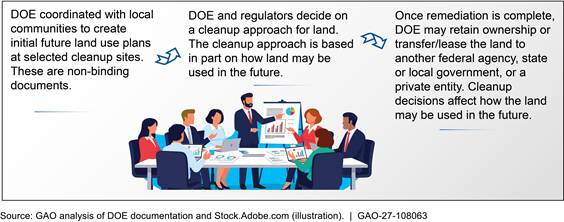
The Department of Energy (DOE) created initial future land use plans in coordination with local communities as early as 1992 at six cleanup sites GAO selected for review. These plans inform but do not bind assumptions about future land use that DOE and regulators make when selecting a cleanup remedy at a site. The remedy selected during the cleanup process has lasting consequences for how a parcel of land can be used, even after DOE transfers or leases it to another federal agency, a state or local government, or a private party. For example, any future use that would increase exposure to residual contamination above the contemplated level could undermine the protectiveness of the remedy. Accordingly, assumptions about future land use provide a framework for the range of uses that are safely available for a given parcel after cleanup.
The Department of Energy’s (DOE) General Process for Identifying Future Land Use and Subsequent Cleanup and Transfer Decisions at Selected Cleanup Sites
At the Oak Ridge, Paducah, Portsmouth, and Savannah River sites, DOE and regulators established cleanup levels that aligned with DOE’s initial future land use plans for these sites. DOE agreed to clean up most of the contaminated areas at these sites to support industrial use. For nearly a third of the Hanford site and most of the contaminated areas of the Idaho site, DOE and regulators set more stringent cleanup standards than needed to meet DOE’s anticipated conservation, preservation, or industrial uses for the land. However, while they agreed to cleanup standards based on residential use, future residential use is unlikely. They said it would be difficult to go back and calculate the cost difference between cleaning up to support residential and the other uses, but others noted cleaning up to support residential use is typically more costly.
DOE has transferred or leased a small amount of land to the community or private entities for industrial use at five of the sites. DOE recently announced new initiatives for energy development, integrated hubs for nuclear fuel cycle activities, or co-located data centers to support artificial intelligence infrastructure. Some community stakeholders have expressed interest in more land transfers, and they generally expressed support for industrial reuse. DOE officials and stakeholders cited some potential benefits, such as economic growth, high-quality jobs, or local tax revenue. They also cited potential drawbacks, such as taking focus and resources away from cleanup, pollution and site recontamination risks, and future DOE liabilities.
Why GAO Did This Study
DOE is responsible for cleaning up sites contaminated from decades of nuclear weapons production and research. DOE estimates cleaning up 15 remaining sites will cost between $641 billion and $840 billion and be completed in 2100. When making cleanup decisions, DOE and its regulators assess risk to people who may use the land in the future—such as for industrial or residential purposes—to inform its approach and set cleanup standards.
Senate Report 118-188 includes a provision for GAO to report on DOE’s future land use planning at cleanup sites. This report describes (1) DOE’s role in future land use determinations, (2) how cleanup decisions align with initial land use plans, and (3) what land DOE has transferred or leased to local communities.
GAO reviewed laws, regulations, policies, and agency documents at six sites selected to represent a range of regulatory frameworks, stages of cleanup, and future land uses. GAO visited two of the sites and interviewed DOE officials, regulators, tribal officials, and community stakeholders.
What GAO Recommends
In a related October 2026 report on defense nuclear waste (GAO-27-107791), GAO recommended that Congress consider clarifying DOE’s and regulators’ roles and decision-making authority in determining future land uses. GAO also recommended, among other things, that DOE direct cleanup sites to evaluate cleanup costs and schedule based on multiple potential future land uses as part of its cleanup decisions. Implementing these recommendations would help DOE link future land use assumptions with cleanup decisions in more transparent and cost-effective ways.
|
Abbreviations |
|
|
|
|
|
|
|
AI |
Artificial intelligence |
|
|
ARAR |
Applicable or relevant and appropriate requirements |
|
|
CERCLA |
Comprehensive Environmental Response, Compensation, and Liability Act of 1980, as amended |
|
|
CRO |
Community Reuse Organization |
|
|
DOE |
Department of Energy |
|
|
EM |
Office of Environmental Management |
|
|
EPA |
Environmental Protection Agency |
|
|
ETTP |
East Tennessee Technology Park |
|
|
FFA |
Federal facility agreement |
|
|
NCP |
National Oil and Hazardous Substances Pollution Contingency Plan |
|
|
RCRA |
Resource Conservation and Recovery Act of 1976, as amended |
|
|
ROD |
Record of Decision |
|
|
WAG |
Waste area group |
|
This is a work of the U.S. government and is not subject to copyright protection in the United States. The published product may be reproduced and distributed in its entirety without further permission from GAO. However, because this work may contain copyrighted images or other material, permission from the copyright holder may be necessary if you wish to reproduce this material separately.
October 16, 2026
Congressional Committees
The Department of Energy’s (DOE) Office of Environmental Management (EM) is responsible for cleaning up sites contaminated by radioactive and hazardous waste resulting from decades of nuclear weapons production and nuclear energy research. DOE has estimated that ongoing cleanup at its 15 remaining sites will cost between $641 billion and $840 billion and be completed in 2100, according to DOE’s fiscal year 2027 budget request.[1] When developing and evaluating cleanup alternatives and selecting a cleanup remedy, DOE and federal and state regulators generally consider future land use.[2] After cleaning up areas of a site, DOE may decide to transfer or lease the land.[3]
In the next few years, DOE plans to transfer some land at some of its cleanup sites to local communities. DOE has expressed interest in repurposing land for economic and energy development purposes, such as data centers and solar or nuclear energy sources.
Senate Report 118-188 includes a provision for GAO to report on DOE’s future land use planning for its nuclear waste cleanup sites.[4] This report describes (1) DOE’s role in determining the future land use at a site, (2) how cleanup decisions align with DOE’s land use plans developed in the 1990s and 2000s (initial land use plans), and (3) what land DOE has transferred or leased, or plans to transfer or lease, at its cleanup sites to local communities.
To address all three objectives, we reviewed applicable laws, regulations, policies, and guidance from DOE and the U.S. Environmental Protection Agency (EPA); EM sites’ future land use plans; and other relevant documents. We focused our review on three phases that affect future land use at DOE cleanup sites: (1) developing initial future land use plans for DOE sites, (2) using these plans to develop assumptions about reasonably anticipated future land uses and determine cleanup levels, and (3) transferring or leasing land at DOE’s cleanup sites to the community.
We selected six sites for this review to gather information on future land use and cleanup level determinations, as well as transfers and leases: (1) Hanford site in Washington State, (2) Idaho site in Idaho, (3) Oak Ridge site in Tennessee, (4), Paducah site in Kentucky, (5) Portsmouth site in Ohio, and (6) Savannah River Site in South Carolina. We selected the sites based on criteria related to future land use, such as the complexity of the cleanup, the regulatory frameworks governing cleanup, future land uses envisioned at the site, and cost and schedule associated with cleanup. We reviewed records documenting DOE’s cleanup decisions since 2001 for two sites—Hanford and Idaho—because information we gathered from interviews indicated that DOE and federal and state regulators ultimately determined cleanup levels at these sites that were more stringent than needed to support DOE’s initially anticipated future land use plans. We conducted site visits at two sites—Oak Ridge and Hanford—and conducted virtual interviews for the other four sites.
Across the six sites, we interviewed officials from DOE, EPA, state regulatory offices, and one Tribe,[5] as well as community stakeholders from site-specific advisory boards, community reuse organizations (CROs), and city and county governments to better understand the process for and perspectives on DOE’s future land-use planning.[6] We also interviewed representatives from three national and international organizations that have knowledge of future land use issues. The views of the stakeholders and organizations we interviewed for the six sites are not generalizable to all stakeholders at those sites or to other sites, but they provide important context and illustrative examples of DOE’s future land use planning efforts. Appendix I includes a description of the full scope and methodology of our review.
We conducted this performance audit from January 2025 to October 2026 in accordance with generally accepted government auditing standards. Those standards require that we plan and perform the audit to obtain sufficient, appropriate evidence to provide a reasonable basis for our findings and conclusions based on our audit objectives. We believe that the evidence obtained provides a reasonable basis for our findings and conclusions based on our audit objectives.
Background
DOE’s Cleanup Sites and Mission Areas
DOE’s cleanup program is managed from its headquarters in Washington, D.C. and consists of 15 cleanup sites across the U.S. DOE headquarters provides management oversight of activities, operations, and program integration across cleanup sites, including coordination, oversight, and leadership on scope, cost, and schedule components. Each of the 15 cleanup sites oversees different mission areas.[7] Figure 1 shows DOE sites’ estimated cleanup end date, remaining estimated cost, and remaining mission areas. The six sites in our review—Hanford, Idaho, Oak Ridge, Paducah, Portsmouth, and Savannah River—have the most extensive, complex, and expensive cleanup work remaining of all the cleanup sites.
Figure 1: Estimated Cleanup Costs and Completion Dates for DOE’s 15 Remaining Cleanup Sites, as of April 2026 (dollars in billions)
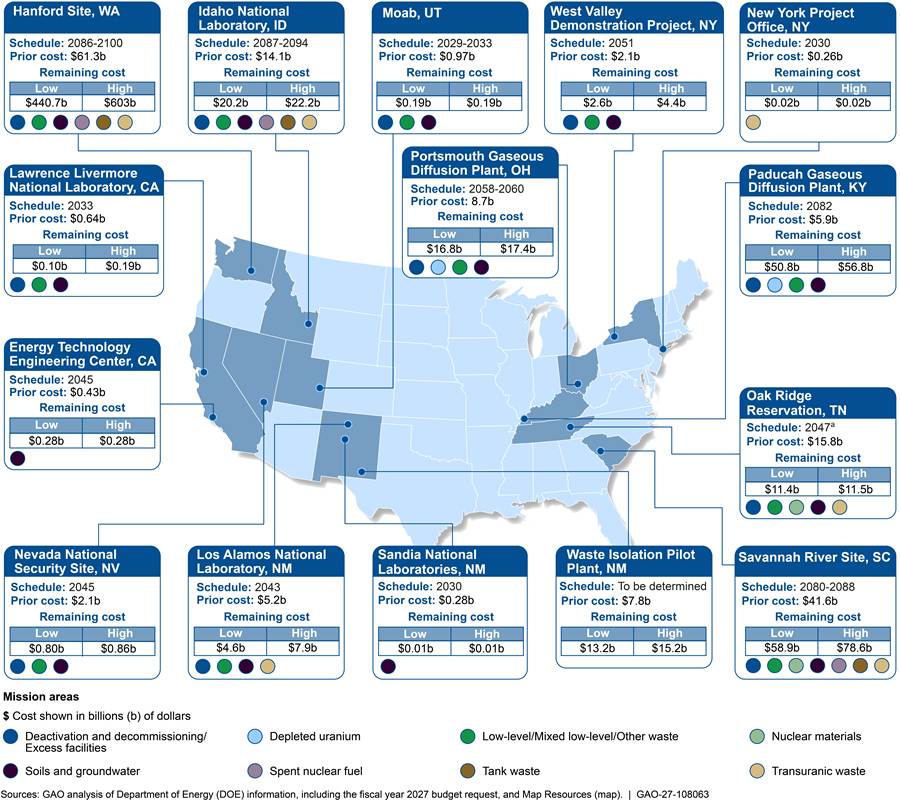
Notes: The cost estimates for each site represent the lifecycle estimates developed by DOE’s Office of Environmental Management, which include costs for work that has already been completed and remaining costs. The costs in this figure are in escalated dollars based on the year of expenditure.
aAccording to the U.S. Environmental Protection Agency (EPA), cleanup may continue beyond 2047 at the Oak Ridge site due to long-term groundwater remediation and the complexities of mercury cleanup.
While EM manages the cleanup work at these 15 sites, other DOE entities, such as the National Nuclear Security Agency (NNSA) and Office of Science, may manage and own parts or all of a site. For example, EM is the landlord at the Paducah and Portsmouth sites, but while EM conducts cleanup work at the Savannah River Site, NNSA became the site’s landlord in fiscal year 2025. In other instances, sites are divided among various entities. For example, at the Oak Ridge site, EM owns part of the site while NNSA and the Office of Science own other parts.
Laws and Regulations Relevant to DOE’s Cleanup Mission
There is no single law governing DOE’s nuclear waste cleanup mission. Rather, cleanup is governed by a complex framework that involves many federal and state laws and regulations, DOE orders, and cleanup agreements. Laws and regulations that are particularly relevant to future land use and remedy selection decisions at DOE cleanup sites include the following:
· Comprehensive Environmental Response, Compensation, and Liability Act of 1980, as amended (CERCLA), commonly known as Superfund and administered by EPA, authorizes response actions to releases or threatened releases of hazardous substances, pollutants, and contaminants to the environment.[8] For federal facilities such as DOE sites, the federal agency bears the primary responsibility for response actions, subject to oversight by EPA and the relevant state.[9] Six EM sites are on the National Priorities List, which includes some of the most seriously contaminated federal and nonfederal sites around the country. At DOE’s National Priorities List sites, CERCLA requires DOE to enter into a federal facility agreement (FFA) with EPA governing the investigation and cleanup of releases. State regulators are frequently parties to these agreements as well.[10]
· National Oil and Hazardous Substances Pollution Contingency Plan (NCP) regulation outlines procedures and standards for responding to releases of hazardous substances, pollutants, and contaminants under CERCLA.[11] The NCP established nine criteria for selecting a remedy, including (1) overall protection of human health and the environment; (2) compliance with “applicable or relevant and appropriate requirements,” also known as ARARs; (3) long-term effectiveness and permanence; (4) reduction of toxicity, mobility, or volume through treatment; (5) short-term effectiveness; (6) implementability; (7) cost; (8) state acceptance; and (9) community acceptance.[12] CERCLA and the NCP do not establish regulatory standards for the cleanup of specific substances, but rather require that long-term cleanups comply with ARARs, which may include a host of federal and state standards that generally regulate exposure to contaminants.[13]
· Resource Conservation and Recovery Act of 1976, as amended (RCRA), establishes a framework for managing hazardous waste from generation to final disposal.[14] Much of the waste at EM’s sites is mixed waste that contains hazardous waste subject to RCRA.[15] Under RCRA, EPA can authorize states to administer their own hazardous waste management programs in lieu of the federal program, as long as the state program is equivalent to and at least as stringent as the federal one. RCRA requires owners or operators—including federal agencies—of facilities that treat, store, or dispose of hazardous waste to obtain a permit for these activities. Under RCRA’s corrective action provisions, DOE must clean up contamination caused by hazardous waste at its sites by implementing remedial measures that protect human health and the environment. Unlike CERCLA’s NCP, there are no comprehensive cleanup regulations under RCRA. Instead, EPA and authorized states primarily use guidance to implement corrective actions and impose cleanup requirements at individual facilities through permits or compliance orders.
Potential Future Land Uses at DOE Sites
DOE may sell or lease real property under a number of statutory authorities, including the Atomic Energy Act of 1954, as amended, and the Department of Energy Organization Act, as amended.[16] There are multiple ways a real property transfer or lease can occur at DOE. In the context of this report, transfer refers to the transfer of land (including at no cost) outside DOE ownership to an entity such as a state, regional, local, or tribal government or nonprofit economic redevelopment organization for beneficial reuse. Lease refers to providing an entity the right to possess and use land for a period of time while DOE maintains ownership. While most land leased by DOE is uncontaminated or remediated, provisions within a lease can allow for the leasing of property that is not yet remediated, with the lease specifying that remediation of a given area is necessary prior to soil disturbance.[17]
After cleanup is complete, land at cleanup sites can support many kinds of reuses, although reuse generally falls into one of the following eight categories: green space, commercial, residential, public service, industrial, military/federal use, subsistence farming, and mixed use, according to EPA documents.[18] For example, these land uses might include the following:
· Industrial. Industrial use refers to traditional light and heavy industrial uses, such as processing and manufacturing products from raw materials, as well as fabrication, assembly, treatment, and packaging of finished products. Examples of industrial uses include factories, power plants, warehouses, waste disposal sites, landfill operations, and salvage yards.
· Conservation or preservation (including agricultural and recreational). Also known as “green space,” these areas encompass a wide range of reuse activities that include agricultural reuse (growing crops, pastureland for livestock); recreational reuse (fishing, biking, hiking, open space); and ecological reuse (wildlife sanctuaries, nature preserves, wetlands).
· Residential. Residential use refers to use for residential purposes, including single-family homes, townhomes, apartment complexes and condominiums, and child/elder care facilities.
The Role of Anticipated Future Land Use in the Cleanup Process
For DOE sites where cleanup activities are proceeding under CERCLA or RCRA, as part of the cleanup process, DOE and regulators typically make assumptions about how the land may be used in the future to help determine how much cleanup needs to occur. Assumptions about anticipated future land uses allow DOE and federal and state regulators to assess the possible risks to people who may use the land in the future to inform the selection of a cleanup approach.
Specifically, assumptions that people may use land in ways that would result in frequent or extensive exposure to contaminants can mean that DOE needs to achieve more stringent cleanup levels, and thus use more intensive cleanup approaches, than would be required if the land is expected to be used in ways that limit human access and exposure. For example, for an assumed industrial land use, a worker might be exposed to contamination on a site for 40 hours a week for a working lifetime—typically 25 years—through various soil and air exposures, depending on whether the person is a construction, indoor, or outdoor worker. On the other hand, for assumed recreational land use, a person might visit a few hours a week or month and may be exposed to contamination through soil/sediment, air, surface water, and biota, depending on the activities performed (e.g., hunting, fishing, and gathering).[19] Finally, for assumed residential land use, a person living on site might be exposed for 24 hours a day, 365 days a year, for a lifetime (up to 70 years for carcinogens or 20 years as an adult and 6 years as a child for non-carcinogens) to contamination by soil, tap water, air, or eating fish. As a result, the land use category selected has significant consequences for both the stringency of cleanup and the long-term safety of an area.
Early in the cleanup process, DOE and its regulators typically make an assumption about the reasonably anticipated future land uses for a site. Generally, after DOE and its regulators make the future land use assumption, DOE completes a series of activities that lead to DOE’s development and evaluation of alternatives to meet cleanup objectives and levels associated with the anticipated future land use (e.g., industrial, recreational, residential). If the cleanup alternatives developed are not cost-effective or practicable, the cleanup objectives may need to be revised, which may result in different assumptions about the potential future land use. DOE and regulators compare cleanup alternatives to a set of evaluation criteria to select a remedy. The remedy selected affects the applicable cleanup levels, amount of contamination to be treated, and the volume and concentration of contamination left at a site, which in turn affects how land may be used in the future.
DOE Developed Land Use Plans and Identified Anticipated Future Land Uses as Part of Site Cleanup
At the six selected sites, DOE worked collaboratively with local communities, state and federal regulators, and other stakeholders beginning in the 199os to develop future land use plans. These plans inform but do not bind assumptions about reasonably anticipated future land use that DOE and regulators make during the remedy selection process for site cleanup. However, the selected remedy, in turn, affects what land uses are feasible once cleanup is completed. Regardless of whether DOE retains ownership or transfers the land to another entity, potential uses of the land are influenced by residual contamination and institutional controls at the site.[20]
Selected Sites Worked with Communities and Stakeholders to Develop Initial Land Use Plans
At all six of the selected sites, DOE developed future land use plans in coordination with local communities, according to DOE documents and officials. The National Defense Authorization Act for Fiscal Year 1997 required DOE to develop future land use plans for the Hanford, Idaho, and Savannah River sites and authorized DOE to develop such plans for its other cleanup sites.[21] In response, DOE developed future land use plans for the Hanford, Idaho, and Savannah River sites, and subsequently for the remainder of our selected sites, the Oak Ridge, Paducah, and Portsmouth (see table 1).
|
Site |
Year |
Initial planned land uses for the sitea |
|
Hanford Site |
1999 |
Industrial Research and Development Recreation Conservation Preservation |
|
Idaho National Laboratory |
1996 (updated 2011) |
Industrial Conservation (Site will be under federal ownership until at least 2095) |
|
Oak Ridge Reservation |
1998 |
Industrial Conservation Recreation Waste management and disposal areas Unrestrictedb |
|
Paducah Gaseous Diffusion Plant |
2011 |
Industrial Recreational Waste management area |
|
Portsmouth Gaseous Diffusion Plant |
2012 |
Industrial |
|
Savannah River Site |
2000 (updated 2013) |
Industrial Conservation |
Source: GAO analysis of Department of Energy information. | GAO‑27‑108063
aThese planned land uses cover specific areas over the entire site including areas that do not require remediation.
bThe initial land use plan at the Oak Ridge site did not address all areas of the site, and for certain areas, future land use still remains to be determined.
The approaches taken to community engagement varied across sites. Paducah and Portsmouth partnered with local universities to draft their initial land use plans, while Oak Ridge convened a working group composed of local community members. According to DOE’s initial land use plans, Hanford, Oak Ridge, and Paducah sites each consulted federal and state agencies during plan development. The Hanford and Idaho sites also consulted relevant Tribes.[22] Additionally, Idaho, Paducah, and Portsmouth sites incorporated public comments into their final plans.[23]
DOE also considered the formal input of local stakeholder groups, such as community advisory boards, established at certain sites and that provide advice on cleanup decisions and potential future land uses.[24] Therefore, according to DOE officials, most of the initial land use plans we reviewed indicate local preferences, and they often inform assumptions about likely future land use during the cleanup process. However, while the land use plans provide important information during the cleanup process, they are not legally binding agreements.
Assumptions About Future Land Use Inform Decisions on Remedy Selection
During the cleanup process, DOE, sometimes together with EPA and state regulators, develops assumptions about reasonably anticipated future land uses—such as residential, commercial, or industrial—that inform the selected remedy. These decisions, and cleanup writ large, are affected by a complex web of site-specific factors, including the location of the site, the types and extent of contamination present, and the laws, regulations, and guidance applicable to a particular cleanup.
CERCLA Process
How DOE is to develop and incorporate assumptions about potential future land use into the cleanup process at DOE CERCLA sites is not explicitly set out in CERCLA or NCP regulations. The NCP preamble broadly instructs that assumptions about future land use should be reasonable in light of land use development patterns and reflect the land use associated with the most significant risk in order to be protective.[25] The preamble clarifies that while these considerations may lead to the assumption of residential use in many cases, CERCLA does not require an assumption of residential use. Specifically, the assumption of future residential land use may not be justifiable if the probability that the site will support residential use in the future is low.
EPA guidance. EPA has issued three guidance documents on how to factor assumptions about future land use into the CERCLA process. According to EPA officials, these guidance documents provide a structured framework for determining reasonably anticipated future land use that support protective and effective remedy decisions. EPA guidance issued in 1995 directs agencies to take into account the preferences of state and local communities to ensure realistic assumptions about future land use and instructs that remedial actions align with the chosen land use.[26] According to this guidance, incorporating realistic future land use assumptions allows agencies to develop practicable and cost-effective remedial alternatives. EPA guidance from June 2001 reaffirmed the importance of using early discussions with stakeholders to develop realistic assumptions regarding future land use, and introduced a reuse assessment guide with a list of information to collect about reasonably anticipated future land uses.[27] Finally, EPA guidance from March 2010 built upon previous guidance, ultimately encouraging regional offices to consider reasonably anticipated future land use in a manner that supports the reuse of sites.[28]
DOE guidance. DOE generally follows EPA guidance on considering future land use during the cleanup process. In a now-rescinded policy document issued in 2003, DOE P 455.1, DOE instructed cleanup sites to formulate a risk-based end state vision in cooperation with regulators and stakeholders, followed by a reevaluation of cleanup activities to determine whether the site should change its baseline documents and renegotiate agreements. According to the policy document, this guidance was needed because DOE sites had made uneven progress in implementing cleanup strategies that integrated both risk and future use considerations. According to DOE officials, the policy was rescinded in 2011, in part to defer to regulatory requirements and legal obligations. DOE officials told us that no additional DOE guidance is required and that future land uses and EPA’s guidance are addressed in the CERCLA process.
RCRA Process
According to EPA officials, EPA’s 1995, 2001, and 2010 guidance on reasonably anticipated future land use assumptions is intended for CERCLA sites but can be used at RCRA sites. In particular, EPA’s 1995 guidance states that discussions with local stakeholders about future land use are also appropriate in the RCRA context. According to the guidance, assumptions about future land use under RCRA raise particular issues (e.g., timing, property transfers, and the viability of long-term controls), and RCRA facilities are typically actively managed industrial properties, meaning that consideration of nonresidential uses is especially likely to be appropriate.
In 1996, EPA published an advance notice of proposed rulemaking with additional information on how to consider future land use during the RCRA process, though no rule was ever finalized.[29] Similar to EPA guidance under CERCLA, the advance notice of proposed rulemaking noted the importance of involving stakeholder groups and developing realistic land use assumptions as early as possible. In the notice, EPA recognized the complexities of developing future land use assumptions and the need for caution when doing so but noted that nonresidential land use assumptions are appropriate for many facilities.
We and others have noted the potential value of having more consistent, formalized guidance for developing and incorporating future land use assumptions during the cleanup process for DOE sites. For example, in 2015, a review organized by the Consortium for Risk Evaluation with Stakeholder Participation recommended that DOE and EPA headquarters arrive at a clear and consistent process and set of criteria for developing assumptions about future land use during the cleanup process.[30] According to DOE officials, however, the agency does not have plans to issue additional guidance or develop criteria on developing and incorporating assumptions about future land use during the cleanup process. These officials told us that it would be difficult to implement this recommendation due to unique circumstances at each site, such as presence of Tribes, urban or rural nature, and specific risk tolerances of stakeholders.
In October 2026, we reported that DOE was conducting cleanup based on unrealistic assumptions about future land and groundwater uses at some of its cleanup sites.[31] For that review, we partnered with the National Academies of Sciences, Engineering, and Medicine to convene meetings with 15 multidisciplinary experts to get their input on legal and regulatory factors affecting DOE cleanup efforts and options to address them. According to these experts and our analysis of literature and case study information, future use assumptions for land and groundwater are sometimes not coordinated with one another, and DOE is cleaning up land and groundwater at certain sites for potential future uses that are unlikely to occur. These experts generally said that DOE is cleaning up some of its sites based on unrealistic assumptions about how the land and groundwater will be used in the future, resulting in increased costs and time for cleanup. We found that unrealistic assumptions about potential future land uses at DOE cleanup sites stem from insufficient EPA and DOE guidance, as well as lack of clarity from Congress about how DOE’s sites should incorporate future land use assumptions into the cleanup process. Thirteen of the 14 experts who participated in our policy option polls agreed that EPA and DOE need to improve the framework for making assumptions about future land use to help ensure they are transparent and realistic.
In the October 2026 report, we recommended, among other things, that EPA clarify or provide additional guidance on considering reasonably anticipated future land use as part of the environmental cleanup process at DOE cleanup sites. We also recommended that DOE direct sites to evaluate and document the expected costs and potential schedule associated with cleanup of a particular area based on multiple potential future land use assumptions when substantial cost or schedule benefits could potentially be achieved using a future land use assumption other than the one initially selected. This evaluation should occur prior to the selection of a cleanup approach for that area and be included as part of its decision-making process.
In our October 2026 report, we also found that congressional action could help ensure cleanup approaches are not based on unrealistic future land use assumptions. Specifically, the gap between DOE’s initial future land use plans and the cleanup remedies selected at some sites is partly due to a lack of clarity about who should select the anticipated future land use—DOE or regulators—and different approaches to making and incorporating assumptions about future land use during the cleanup process between DOE and its regulators. We recommended that Congress consider providing more specific direction about incorporating potential future land uses in the process for DOE’s nuclear waste cleanup, including (1) what role DOE and its regulators should play in making assumptions about future land use as a part of the cleanup process, (2) which federal agency or other entity should have the final decision about the anticipated future land use of a cleanup site, and (3) what types of potential future land use options are acceptable or preferred to consider.
The Remedy Selected During Cleanup Affects How Land Can Be Used After Its Transfer
The remedy selected during the cleanup process has lasting consequences for how a parcel of land can be used, even after DOE transfers or leases it to another federal agency, a state or local government, or a private party. Because cleanup remedies are designed around a specific set of land use assumptions, any future use that would increase exposure to residual contamination above the contemplated level could undermine the protectiveness of the remedy. Accordingly, assumptions about future land use provide a framework for the range of uses that are safely available for a given parcel after cleanup. While land may be used for purposes requiring less restrictive cleanup than the anticipated use, it cannot be used for a purpose that would require more restrictive cleanup without additional remediation.[32] For example, land remediated to residential use could be later used for industrial purposes, but land remediated to industrial use would not be suitable for residential use without additional cleanup.
To ensure cleanup levels and remedies remain protective, land transferred out of DOE’s ownership or leased may be subject to a variety of institutional controls.[33] Institutional controls are maintained until the concentration of hazardous substances in the soil and groundwater is at such levels to allow for unlimited use and unrestricted exposure. Deed restrictions, for example, ensure that even when the property is transferred, the new owner of the land does not engage in practices that would compromise the effectiveness of the remedy. Additionally, land transferred to a nonfederal entity may be subject to local laws and zoning ordinances once it is transferred. Entities—such as a CRO or not-for-profit organizations—may accept and disposition cleaned up land from DOE for economic redevelopment purposes.[34] Even when DOE transfers ownership of the land to another party, DOE generally retains ultimate responsibility for remedy integrity.
Cleanup Decisions Were Consistent with Initial Land Use Plans at Four Sites but More Stringent at Two Others
DOE and environmental regulators at Oak Ridge, Paducah, Portsmouth, and Savannah River established cleanup levels that aligned with DOE’s initial future land use plans for these sites. In contrast, DOE agreed to more stringent cleanup levels than needed to meet its initial land use plans in some areas of the Hanford and Idaho sites. For example, at the Hanford site, DOE and regulators adopted cleanup levels that would support residential uses for nearly a third of the site, despite initially planning for less restrictive conservation, preservation, or industrial uses for these areas. Similarly, DOE and regulators at the Idaho site adopted cleanup levels based on assumed future residential uses for the majority of the contaminated areas that DOE had previously designated for industrial use.
DOE and Regulators Made Cleanup Decisions Consistent with DOE’s Initial Plans at Four Selected Sites
DOE and regulators at Oak Ridge, Paducah, Portsmouth, and Savannah River made assumptions about future land use and established cleanup levels that aligned with the land uses anticipated in DOE’s initial plans. At these sites, DOE and regulators agreed that DOE would clean up much of the contaminated areas based on assumed future industrial use. In areas of these four sites where reaching the desired level of remediation was not possible, DOE agreed to put institutional controls in place, which means that future use of the land will be subject to certain conditions, even if the land is transferred or leased. Areas of these sites that have not been contaminated will have the same use listed in DOE’s initial land use plans—mostly recreation or conservation, depending on the site.
Oak Ridge Site
About half of the 51.4-square-mile site has been affected by previous operations and may require cleanup.[35] One of these areas—the East Tennessee Technology Park (ETTP)—has been mostly cleaned up to allow for industrial use, and most of the land has been or will be turned over to the community for reindustrialization, as discussed below. DOE officials told us there are some institutional controls applied to some areas of ETTP. Specifically, the future owner will not be permitted to dig a well or access the groundwater, and in some areas, the owner will not be permitted to disturb the land past 2 feet or 10 feet below the ground surface, depending on the conditions at that location.
Two other areas of the site—the Oak Ridge National Laboratory and the Y-12 National Security Complex—will be cleaned up based on assumed future industrial use and used to continue DOE’s mission. Additionally, DOE and community stakeholders initially decided other portions of the site could have unrestricted or recreational uses, while portions closer to the mission sites could be used as waste disposal or waste management areas.
DOE officials said the anticipated future land use only differs from DOE’s initial plan in one way: DOE finalized a Record of Decision (ROD) to build a second onsite waste disposal site in 2021, updating the land use to support construction of the landfill, because DOE was running out of space in the first onsite waste disposal.[36] Figure 2 shows the planned land uses, future land use assumptions used to establish cleanup levels, and transferred land at the Oak Ridge site.
Figure 2: Planned Land Uses, Future Land Uses Assumed for Cleanup Levels, and Transferred Land at the Department of Energy’s (DOE) Oak Ridge Site
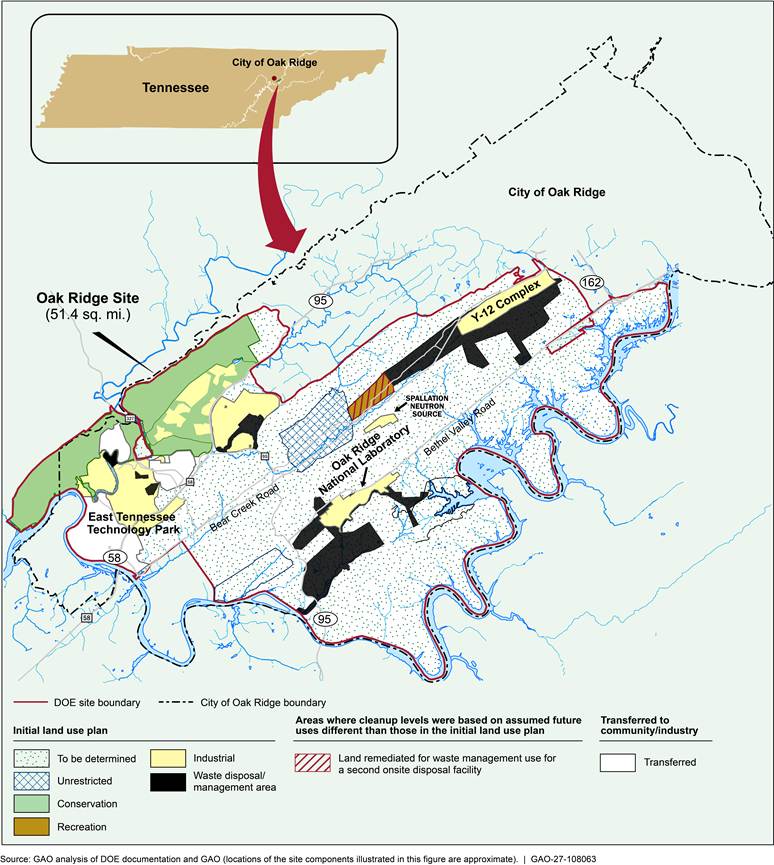
Note: Initial land use plan refers to a plan developed by DOE in collaboration with local communities, state and federal regulators, and other stakeholders in 1998. The initial land use plan did not address all areas of the site, and for certain areas, future land use remains to be determined.
Paducah Site
DOE intended most of the 5.5-square-mile site to be used for industrial purposes, with the remaining northern area of the site planned mainly for recreational use in the initial land use plan.[37] According to DOE officials, DOE has maintained that both recreational and industrial are options for the land surrounding the industrialized area of the site.[38] Currently, DOE is focusing on cleaning up about 1.2 square miles of the site that was the central industrial area and conducting deactivation and decommissioning of the site’s gaseous diffusion facilities within that area, according to DOE officials. DOE officials told us that cleanup is conducted in many areas of the site. Figure 3 shows the planned land uses, future land use assumptions used to establish cleanup levels, and leased land at the Paducah site.
Figure 3: Planned Land Uses, Future Land Uses Assumed for Cleanup Levels, and Leased Land at the Department of Energy’s (DOE) Paducah Site
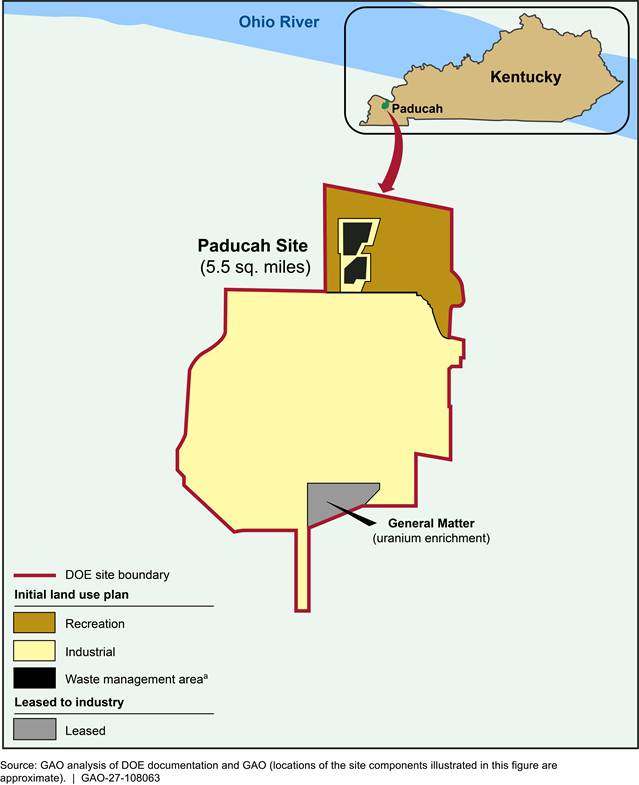
Note: Initial land use plan refers to a plan developed by DOE in collaboration with local communities, state and federal regulators, and other stakeholders in 2011.
aAccording to DOE’s land use plan, this area includes landfills that are active or certified closed and under long-term post-closure care. Therefore, this area is not amenable for unrestricted future industrial use.
Portsmouth Site
According to DOE officials, consistent with the initial land use plan, the future land use at the 5.9-square-mile Portsmouth site has been designated as industrial and all soil cleanup will be conducted to support future industrial use.[39] DOE officials stated that there are no areas at the Portsmouth site where cleanup actions have been required at a higher level than needed to meet the uses set out in DOE’s initial land use plan.[40] Figure 4 shows the planned land use, future land use assumptions used to establish cleanup levels, and transferred or leased land at the Portsmouth site.
Figure 4: Planned Land Uses, Future Land Uses Assumed for Cleanup Levels, and Transferred or Leased Land at the Department of Energy’s (DOE) Portsmouth Site
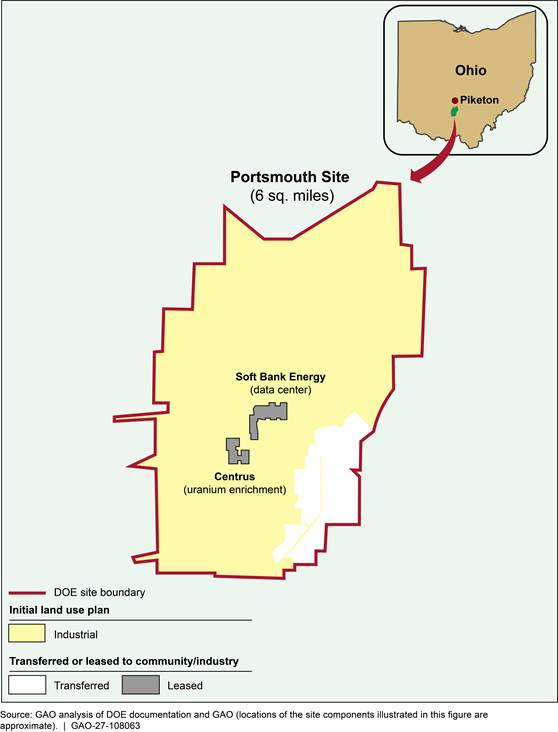
Note: Initial land use plan refers to a plan developed by DOE in collaboration with local communities, state and federal regulators, and other stakeholders in 2012.
Savannah River Site
Consistent with the initial land use plan for the site, roughly 25 of the site’s 310 square miles will have an industrial future land use and will be cleaned up based on this assumption. The remainder of the site, serving as a buffer zone, will be used for natural resource management, according to DOE officials. They explained that some small areas of the site, totaling about 5 square miles, were cleaned up based on assumed future residential use. In these areas of the site, meeting cleanup levels based on assumed industrial and residential uses required the same amount of remediation, meaning that the area could be remediated to support residential use at no additional cost. DOE officials stated that the entire Savannah River Site will remain under federal ownership. Figure 5 shows the planned land use and future lans use assumptions used to establish cleanup levels at the Savannah River site.
Figure 5: Planned Land Uses and Future Land Uses Assumed for Cleanup Levels at the Department of Energy’s (DOE) Savannah River Site
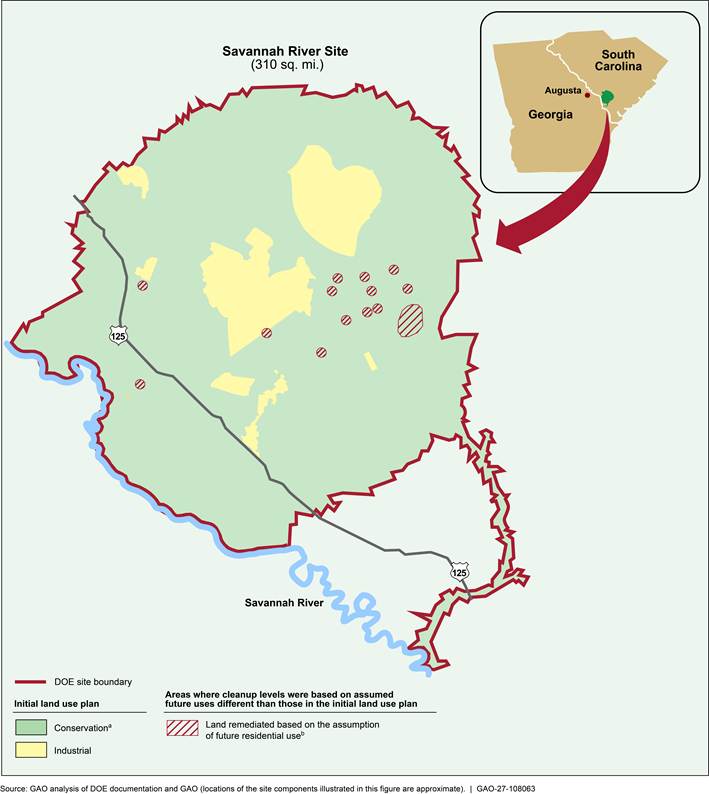
Note: Initial land use plan refers to a plan developed by DOE in collaboration with local communities, state and federal regulators, and other stakeholders in 2000 and updated in 2013.
aDOE calls this area “Natural Resource Management” in its initial land use plan, which we categorize as a conservation use. According to DOE’s land use plan for the site, natural resource management includes wildland fire suppression, threatened and endangered species restoration, invasive species control, habitat management, watershed management, boundary maintenance, management of secondary roads, and related research.
bDOE officials told us that DOE cleaned up certain areas in various locations of the site to meet cleanup levels based on assumed future residential use, totaling about 5 square miles, largely because the cleanup threshold for many contaminants (e.g. arsenic) was at the background level, which was the same for both assumed future industrial and assumed future residential uses.
DOE and Regulators Established More Stringent Cleanup Levels Than Initially Anticipated for Large Areas of Hanford and Idaho Sites
As a result of input from regulators, DOE and regulators agreed to clean up large areas of the Hanford and Idaho sites based on the assumption of potential future residential use even though these areas were designated for future industrial use in DOE’s land use plans.
Hanford Site
At the Hanford Site, DOE and regulators established cleanup levels based on the assumption of residential future land use for nearly a third of the 586-square-mile site.[41] DOE’s initial plans had identified the land as suitable for conservation, preservation, or industrial uses, which generally require less stringent cleanup levels than residential uses. According to DOE officials, this change was the result of EPA and the Washington State Department of Ecology determining that residential use was a reasonably anticipated future land use for these areas.
Our analysis of the Hanford RODs since 2001 found that cleanup levels adopted in the RODs aligned with DOE’s initial plan for the section of the site known as the 200 Area—the Central Plateau where tank waste is stored. However, the parties set stricter cleanup levels than needed to support DOE’s initial plan in the 100 and 300 Areas along the river and closer to the city of Richland:
· 100 Area. For soil cleanup in the 100 Area (which covers 154 square miles along the Columbia River and where several nuclear reactors were built during weapons production), we found that DOE and regulators established cleanup levels for soil based on assumed future residential use, despite proposing to use the area for conservation, preservation, or recreation in both the initial land use plan and the RODs. According to Hanford site officials, the majority of cleanup was done to support residential use under an interim ROD in 1995 prior to the completion of DOE’s initial comprehensive land use plan in 1999. Cleanup levels for the remaining portions of the 100 Area were established in final RODs in 2014 through 2021. For these portions of the site, the parties also established cleanup levels based on assumed future residential use, which required removing soil and debris at a depth of 15 feet below ground surface. The RODs explained that while DOE’s planned future use of these areas was conservation and preservation, EPA and the state regulator believed that residential use was also reasonably anticipated.
· 300 Area. For soil cleanup in the 300 Area, close to the city of Richland, DOE and regulators adopted cleanup levels that would allow for residential use for 39.5 square miles of land that DOE had initially planned for industrial use.[42] According to the ROD and DOE officials, DOE agreed to clean up to these levels in the 300 Area because EPA considered residential use to be reasonably foreseeable, while DOE’s position is that the future land use will be industrial. Figure 6 shows the initial planned land uses anticipated by DOE, future land use assumptions used to make cleanup level decisions established in RODs, and transferred or leased land at the Hanford site.
Figure 6: Planned Land Uses, Future Land Uses Assumed for Cleanup Levels, and Transferred or Leased Land at the Department of Energy’s (DOE) Hanford Site
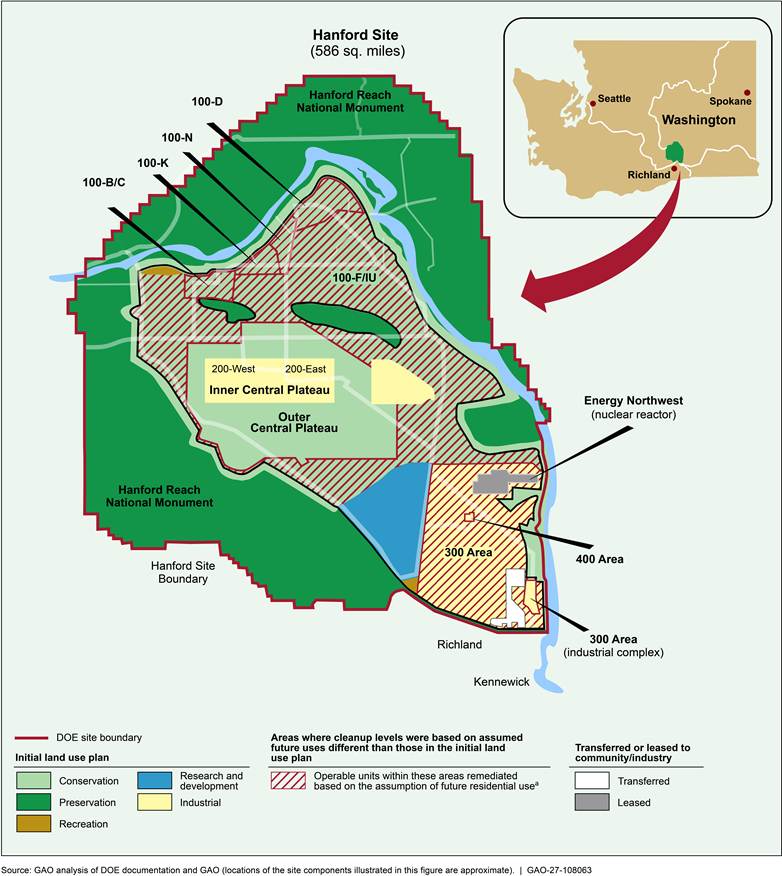
Note: Initial land use plan refers to a plan developed by DOE in collaboration with local communities, state and federal regulators, and other stakeholders in 1999.
aThese boundaries represent entire areas, but cleanup decisions were made for specific operable units within these areas. Not all land within these areas required remediation to support residential use.
Idaho Site
According to Idaho site officials, although none of the 890-square-mile site was planned for residential use in DOE’s 1996 future land use plan, the majority of the cleanup levels at the site are based on the assumption of future residential use. This decision was made with regulators through the RODs that currently govern the cleanup. According to DOE officials and the RODs, a residential future land use assumption was used to develop cleanup levels because regulators favored cleanup that ensured adequate protection of future residents if the areas were to become available for residential use, even though land use projections indicated that nearly all of the site was designated for continued industrial use. Our analysis of Idaho’s RODs since 2001 confirmed that areas of the site are planned for cleanup under the assumption of future residential use. Additionally, for all future soil cleanups at the Idaho site, DOE agreed to excavate soil and debris to a depth of up to 10 feet below ground surface in a future hypothetical residential use area or up to 4 feet below ground surface in a future industrial use area, based on a 2009 ROD.
DOE agreed to cleanup levels based on assumed future residential use in some areas for various reasons. First, DOE officials said that when the RODs were signed, DOE thought technology would be available to clean up to support future residential use by 2095—the year DOE is supposed to relinquish control of the site. Second, DOE officials said that DOE anticipated some areas would be able to support residential use because the radioactive contamination will decay within relevant time frames without the need for additional cleanup. Third, officials said public perception and tribal considerations contributed to DOE’s desire to agree to these cleanup levels, since they would present lower risk to human health and the environment in the future. However, DOE officials said that realistically, due to the level of the contamination on the site, residential use on any part of the site is unlikely, even after 2095. For example, some of the areas where DOE agreed to cleanup levels based on assumed future residential use are so close to the underground waste tanks that they would never be fit for residential use.
DOE officials at Idaho told us that DOE does not currently have the resources to determine which of the more than 780 cleanup areas at the Idaho site—which DOE divided into 10 waste area groups (WAGs)—have been cleaned up to support future residential use. They said this would be a significant effort and would require multiple days of historical research, data compilation, and evaluation.[43] DOE officials explained that most of the cleanup conducted inside the WAGs has been completed in accordance with the RODs and based on assumed future residential use. However, there are some areas within the WAGs that have been cleaned up based on assumed future industrial use, as agreed to by the regulators on a case-by-case basis.
In addition, DOE and the regulators have begun to evaluate changing the cleanup level support industrial rather than residential use in areas where cleanup based on an assumed future residential use does not make sense. This was recommended in the most recent CERCLA five-year review.[44] The majority of the Idaho site, which lies outside of the specific WAGs, will likely be used for industrial purposes due to concerns about unexploded ordnance, and no further cleanup is anticipated unless ordnance is located.[45] Figure 7 shows the initial planned land uses anticipated by DOE, future land use assumptions used to make cleanup level decisions in the RODs, and leased land at the Idaho site.
Figure 7: Planned Land Uses, Future Land Uses Assumed for Cleanup Level Decisions, and Leased Land at the Department of Energy’s (DOE) Idaho Site
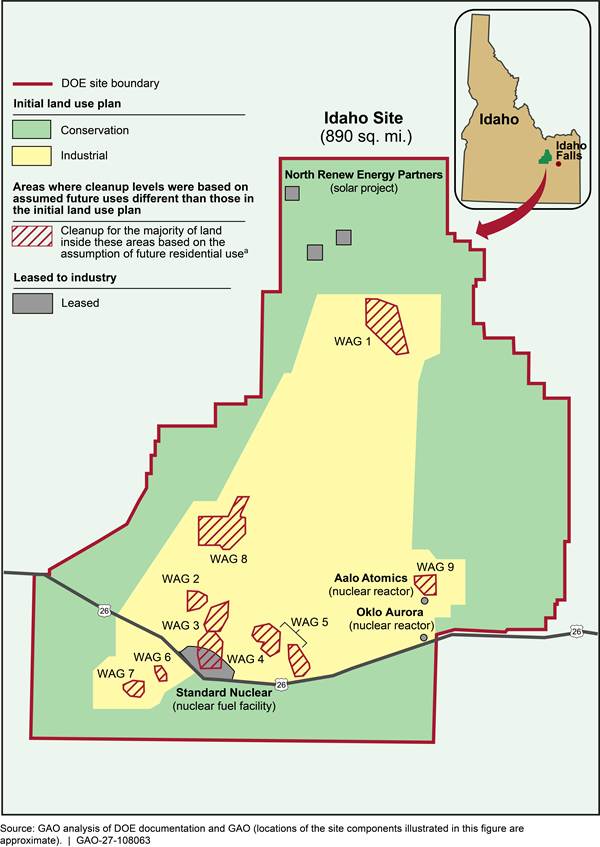
Note: Initial land use plan refers to a plan developed by DOE in collaboration with local communities, state and federal regulators, and other stakeholders in 1996 and updated in 2011.
aDOE officials told us that they divided the cleanup areas that they needed to clean up at the Idaho site within 10 waste area groups (WAG), which were further broken down in more than 780 areas. The majority of these more than 780 areas were cleaned up based on the assumption of future residential use. However, DOE officials said that evaluating which exact areas of the more than 780 areas have been cleaned up based on this assumption at the Idaho site would be a significant effort that would require multiple days of historical research and data compilation. Waste Area Group 10 (WAG 10, not shown on the map) covers, among other things, miscellaneous surface sites over the entire site that need to be cleaned up and are not included in the other WAGs. WAG 10 contains 109 of the more than 780 cleanup areas.
Information on Cost of Cleaning Up Areas at a More Stringent Level Than Initially Anticipated Is Not Available
DOE officials generally explained that it would be difficult to go back and calculate the additional cost to DOE for cleaning up areas based on assumed future residential use, which required more cleanup than would have been required for the conservation or industrial uses articulated in the site’s initial land use plan. Hanford site officials explained that such a cost difference is not quantifiable because it would require standardized conservation/preservation or industrial cleanup levels. Additionally, according to Hanford officials, quantifying cost differences would require a review of hundreds of waste site remediation efforts to find points of distinction in the extent of the excavation. DOE officials added that this calculation is no longer possible now because once a cleanup level decision is established based on a land use scenario, the cost is then calculated based on only that scenario.
These officials explained that they cannot provide even a rough-order-of-magnitude estimate now because the cost of different cleanup scenarios in each area requires site-specific factors, such as type and extent of contamination. For example, Idaho site officials stated that cleaning up to levels that would allow for potential future residential use would result in increased costs for additional excavation and disposal, but without knowing the soil excavation and disposal volumes that would have allowed for industrial versus residential use, this difference cannot be calculated. Moreover, the feasibility studies for these areas did not make any cost comparisons for these two alternative potential future uses.
Others have reported that incorporating a residential future land use assumption into the cleanup process generally results in more extensive cleanup requirements and therefore costs more than would be needed based on an assumed future industrial use. For example, a 2011 EPA land reuse guidebook notes that “[s]ites converted to residential use typically have higher cleanup standards than those slated for commercial or industrial use.”[46] Similarly, in 2015, an independent review organized by the Consortium for Risk Evaluation with Stakeholder Participation found that remediating a site based on potential future residential use can result in cleanup that is “significantly more extensive, and more costly” than cleaning up to allow for future industrial use.
In 2025, we recommended that DOE use information specific to the cost, among other things, of soil and legacy landfill cleanup to enhance technical and policy support provided to sites and inform prioritization of cleanup decisions.[47] DOE did not concur with the recommendation, stating that requiring sites to furnish this data would impose an unnecessary burden without benefitting DOE’s decision-making.[48] We continue to believe that such cost information would help DOE allocate and manage cleanup resources.
DOE Has Completed or Planned Limited Land Transfers or Leases at Selected Sites
DOE has transferred or leased a small amount of land to the community for mostly industrial use at five of the six selected cleanup sites. DOE also announced new initiatives over the last several years to transfer more land at these sites for commercial use. Although most selected sites have not transferred or leased large portions of land, representatives of community advisory boards, CROs, and industry have expressed interest in using portions of the sites for industrial and other purposes.
Selected Sites Have Completed Limited Land Transfers or Leases to Date
Most of the selected sites have transferred or leased a small amount of land for mostly industrial use. The Oak Ridge site has completed the largest transfer of land to date.[49] DOE has transferred approximately 2,546 acres (4 square miles) of land for industrial use at and around the ETTP remediated area of the Oak Ridge site.[50] Other areas at ETTP totaling approximately 3,900 acres (6.1 square miles) are in the process of being transferred. This amount includes DOE’s plan to transfer approximately 3,000 acres—or 4.7 square miles—of uncontaminated land for conservation as part of the Black Oak Ridge Conservation Easement.[51] In February 2026, DOE announced that transferred Oak Ridge land was home to more than 25 nuclear businesses that had announced capital investments of about $10 billion, and they expected to generate 2,500 private sector jobs.
At Hanford, DOE transferred 1,641 acres in 2015 to the CRO as required by Congress.[52] In 2016, the CRO then transferred ownership of 300 acres to Energy Northwest and the remaining land to the Port of Benton and City of Richland.
At Portsmouth, a company purchased about 200 acres (0.3 sq. miles) of land that DOE transferred to the CRO and, in January 2026, announced a project to create 1.2 gigawatts of nuclear power with small modular reactors to support data centers in the region. According to the company, it will create about 500 jobs, tax revenue, and economic revitalization for the community. According to DOE officials, the Portsmouth site has transferred a total of about 354 acres to the CRO, about 10 percent of the site’s footprint.
DOE has also leased, or plans to lease, a limited amount of land to companies for industrial use. For example, in March 2026, DOE leased a 189-acre (0.3 sq. miles) area at the Portsmouth site to a company to build a data center and a natural gas plant that will provide power to support the data center.[53] The area includes the footprint of a demolished process building plus additional industrial areas. As another example, DOE leased land in August 2025 to a company at the Paducah site to construct a new domestic uranium enrichment facility to provide fuel for nuclear reactors. According to DOE, the $1.5 billion investment is expected to create approximately 140 full-time jobs and generate more than $70 million in annual regional economic benefits.[54] In addition, DOE officials told us that DOE has designated an area of about 785 acres (1.23 sq. miles) (parcel B) at the Paducah site as a planned lease to support artificial intelligence (AI) initiatives. This area has been affected by legacy operations and still requires remediation, but DOE officials explained that it can be leased without being fully remediated. According to DOE officials, DOE signed a lease for this area with a private company in July 2026 for AI infrastructure. Furthermore, in July 2026, DOE announced that it entered negotiations with a private company at the Savannah River Site for a phased lease for an AI project. The project includes a 1-gigawatt data center and approximately 2-gigawatts of onsite energy generation consisting of natural gas bridging to nuclear energy.
DOE officials at two selected sites—Oak Ridge and Portsmouth—said they will continue to transfer or lease land as it becomes available. For example, DOE officials at the Portsmouth site said that as land becomes available and the CRO or the community requests the land, all proposals will be evaluated. DOE plans to transfer or lease 3,277 acres (5.1 sq. miles) of the 3,777 acre (5.9 sq. miles) site by or at the completion of the cleanup mission at Portsmouth. In addition, Oak Ridge will have a few small areas of land remaining for transfer at ETTP following completion of the transfers in progress.
Officials at Hanford and Idaho sites said that no future transfers are envisioned or planned. Table 2 in Appendix II describes the areas of the sites selected for transfer or lease as of August 2026.
DOE Has Announced New Initiatives to Reuse Land at the Sites
DOE has announced new initiatives over the last several years at DOE’s cleanup sites. Specifically, according to DOE, in 2023 it identified thousands of acres of land at cleanup sites across the country that could be made available to private developers for electricity generation, including solar, wind, and nuclear power sources. In 2025, DOE officials expanded the scope of possible future land uses to include using former cleanup sites as integrated hubs for nuclear fuel cycle activities, including uranium enrichment and fabrication.
DOE officials have also recently expressed interest in making land on these sites available for co-located data centers powered by solar or nuclear sources. In July 2025, DOE announced the next steps in the plan to accelerate the development of AI infrastructure through siting on DOE lands. DOE has selected four sites—Idaho, Oak Ridge, Paducah, and Savannah River—to move forward with plans to invite private sector partners to develop Al infrastructure and energy generation projects.[55] According to DOE, the chosen locations are well situated for large-scale data centers, new power generation, and other necessary infrastructure.
Additional planned and potential transfers or leases at the sites include the following:[56]
· Hanford. DOE officials said that two realty agreements are in place with private companies for potential development of a solar array and battery park and for research and development and fuel fabrication activities. DOE officials said no final decisions have been made.
· Idaho. DOE officials said that DOE set aside approximately 44,000 acres (68.75 sq. miles) for leases of mostly pristine land for potential AI and energy infrastructure projects, including AI computing capacity, developing an integrated platform to connect supercomputers for testing and deploying of advanced reactors, and establishing fuel production lines.
· Oak Ridge. DOE officials told us that DOE’s request for proposal for an AI data center at the Oak Ridge site is currently paused.
In March 2026, the Assistant Secretary for DOE’s Office of Environmental Management stated that DOE would evaluate each cleanup site potential to accelerate cleanup and transform former weapons production facilities into hubs for nuclear energy, advanced manufacturing, and AI infrastructure by 2040 and to lay the foundation for lasting long-term economic opportunity and leadership in the energy and technology sectors.[57] The Assistant Secretary said that redevelopment of former cleanup sites would create long-term economic opportunities for surrounding communities while helping meet the nation’s growing demand for power.
DOE officials and community stakeholders we interviewed listed a number of potential benefits and drawbacks of such initiatives at these DOE sites for the local communities. For example, they said that these initiatives could stimulate economic growth and create high-quality jobs for surrounding communities, while increasing local tax revenue and fostering regional development of transmission infrastructure. Furthermore, establishing a new nuclear and energy mission at these sites could enhance energy reliability and promote scientific advancement, particularly since some sites already store materials or waste that could be utilized for new nuclear missions.
Conversely, stakeholders and officials raised several concerns, noting that these initiatives could take focus away from the core cleanup mission and create resource strains on local water and housing. Other potential drawbacks include local pollution risks, financial and safety uncertainties, negative impacts on infrastructure, and insufficient existing electrical transmission resources. Additionally, new initiatives could impact cultural sites important to local Tribes, disrupt sagebrush steppe habitats, or cause the recontamination of cleaned areas and the contamination of pristine land. Finally, DOE officials highlighted long-term uncertainties, such as unknown impacts to current or future DOE missions resulting from an emphasis on accelerating the transfer of DOE lands to private entities, the long-term liabilities and impact on DOE and stakeholders from maintaining long-term federal land leases to private entities, and the potential for additional future DOE liabilities if changes in land uses occur after cleaning up to support industrial or recreational uses.
Some Community Stakeholders Expressed Support for More Land Transfers
Representatives of community advisory boards, CROs, and city and county representatives we interviewed expressed interest in portions of the sites being used for industrial and other purposes. They generally expressed support for industrial reuse (reindustrialization) of the site that would create jobs, economic development and tax revenue for the community. For example, the CRO at Hanford said they strongly support reindustrialization of DOE lands in addition to the ongoing cleanup mission. Similarly, city and county representatives at Oak Ridge told us that their community is accustomed to the nuclear mission of the site and has an educated, experienced workforce to continue that mission. Moreover, CRO officials at the Savannah River Site said that while in the past they were against nuclear materials being stored at the site, they now view these materials as an asset, citing one example of small modular reactor companies indicating they would use these assets as fuel.
While some city and county elected officials said that opposition to reindustrialization has been minimal at their site, we spoke with one stakeholder group that is opposed to future industrial uses at a site. Tribal officials at the Hanford site said that the cleanup standards used for future industrial use do not support the tribal subsistence scenario, which includes significantly more intensive use than the residential scenario, and therefore the cleanup levels under this scenario would be stricter than for residential use. According to these officials, even the specific areas identified for restoration or preservation at the Hanford site still do not align with how the Tribes would use the land in the future (e.g., for fishing, using plant and animal resources, building homes, and other activities that the Tribe may have engaged in the past at the site).
Concluding Observations
Considering DOE’s renewed focus on the potential future uses of these sites and the interest among some community stakeholders and industry in using the land for commercial and other purposes, we and others have called for clearer and more formalized process for incorporating future land use assumptions into cleanup decision-making.[58] Given that DOE still needs to make many consequential cleanup decisions over many decades to clean up the remaining contamination, an effort that will cost hundreds of billions of dollars, opportunities exist to improve the process of including future land use assumptions into the cleanup process. These include better guidance from EPA on considering reasonably anticipated future land use as part of the environmental cleanup process at DOE cleanup sites, better cost and schedule analysis of cleanup options based on multiple potential future land use assumptions in advance of making a cleanup decision, and more specific direction from Congress on roles and responsibilities by DOE and regulators. Implementing our recommendations would help the agency link future land use assumptions with cleanup decisions in more transparent, risk-informed, and cost-effective ways and could result in land being available sooner for other uses.
Agency Comments
We provided a draft of this report to DOE and EPA for review and comment. They provided technical comments, which we incorporated in our report, as appropriate.
We are sending copies of this report to the appropriate congressional committees, the Secretary of Energy, the Administrator of the U.S. Environmental Protection Agency, and other interested parties. In addition, the report is available at no charge on the GAO website at https://www.gao.gov.
If you or your staff have any questions about this report, please contact me at AndersonN@gao.gov. Contact points for our Offices of Congressional Relations and Media Relations may be found on the last page of this report. GAO staff who made significant contributions to this report are listed in Appendix III.
Nathan J. Anderson
Director, Natural Resources and Environment
List of Committees
The Honorable Roger F. Wicker
Chairman
The Honorable Jack Reed
Ranking Member
Committee on Armed Services
United States Senate
The Honorable John Kennedy
Chair
The Honorable Patty Murray
Ranking Member
Subcommittee on Energy and Water Development
Committee on Appropriations
United States Senate
The Honorable Mike Rogers
Chairman
The Honorable Adam Smith
Ranking Member
Committee on Armed Services
House of Representatives
The Honorable Chuck Fleischmann
Chairman
The Honorable Marcy Kaptur
Ranking Member
Subcommittee on Energy and Water Development, and Related Agencies
Committee on Appropriations
House of Representatives
Senate Report 118-188 includes a provision for GAO to report on the Department of Energy’s (DOE) future land use planning for its nuclear waste cleanup sites.[59] This report describes (1) DOE’s role in determining the future land use at a site, (2) how cleanup decisions align with DOE’s initial land use plans, and (3) what remediated land DOE has transferred or leased, or plans to transfer or lease, at selected cleanup sites to local communities.
To address our three objectives, we reviewed applicable laws, regulations, policies, and guidance from DOE and the U.S. Environmental Protection Agency (EPA); DOE’s Office of Environmental Management (EM) sites’ future land use plans; and other relevant documents. We focused our review on three phases that affect future land use at DOE cleanup sites: (1) developing initial future land use plans for DOE sites, (2) using these plans to develop assumptions about reasonably anticipated future land uses and determine cleanup levels, and (3) transferring or leasing land at DOE’s cleanup sites to the community.
We selected six sites for this review to gather information on future land use and cleanup level determinations, as well as transfers and leases. The sites were the (1) Hanford site in Washington State, (2) Idaho site in Idaho, (3) Oak Ridge site in Tennessee, (4) Paducah site in Kentucky, (5) Portsmouth site in Ohio, and (6) Savannah River Site in South Carolina. We selected these sites to include representation of some of DOE’s most expensive and complex cleanup challenges, while also covering a range of cleanup costs and schedules, and different regulatory requirements and planned end states at sites across the DOE complex. However, our findings on the selected sites are not generalizable to all DOE cleanup sites. We selected sites based on the following eight criteria:
· Sites with multiple types of cleanup activities (e.g., soil, groundwater, tank waste);
· Sites with multiple regulatory frameworks governing the cleanup;
· Sites with multiple future land use designations envisioned at the site;
· Sites that cover a range of remaining life-cycle costs for cleaning up the site;
· Sites that cover a range of projected completion dates for cleaning up the site;
· A balance of sites on and off the EPA’s National Priorities List, which indicates heightened EPA oversight and community engagement;
· A balance of sites with and without portions of land that are planned for non-DOE ownership in the future; and
· A balance of sites with and without statutory requirement for a formal land-use plan.[60]
For each of the six sites, we reviewed EM sites’ future land use plans, applicable documents from the administrative record under the Comprehensive Environmental Response, Compensation, and Liability Act of 1980, as amended (CERCLA) and the Resource Conservation and Recovery Act of 1976, as amended (RCRA), and relevant agreements between DOE, EPA, and state regulators. Furthermore, we reviewed 13 records of decision (ROD) issued since 2001 at two sites—Hanford and Idaho—where information we gathered from interviews indicated that DOE and federal and state regulators adopted cleanup levels more stringent than those required to support DOE’s initial future land use plan to better understand reasons for the changes.
We visited the Oak Ridge Reservation and Hanford Site where we interviewed site officials, regulators, one Tribe, and community stakeholder groups.[61] While visiting the Hanford Site, we also observed current land transfer or leasing activities. We conducted virtual interviews with site officials, regulators, and community stakeholder groups for the other four sites and community stakeholders at three sites.[62] The interviews generally covered (1) initial land use plans developed at the site and regulator and community involvement in those plans, (2) how cleanup levels at the site reflect anticipated future land uses, and (3) land transfers. We also interviewed representatives from three national and international organizations that have knowledge of future land use issues.
To better understand community stakeholders’ opinions on the benefits and challenges of DOE’s past or future land transfers and interest in using DOE land at selected sites, we analyzed information collected from interviews with stakeholder groups at five of the selected sites.[63] Based on a 2015 report from the Omnibus Risk Review Committee and an interview with experts at a national organization of local governments and communities that host DOE activities, we determined that stakeholder groups relevant to future land-use decisions should include state regulators, Tribes, and site-specific advisory boards, community reuse organizations, and city or county governments. We attempted to interview each of these groups for our six selected sites. The views of the stakeholders and organizations we interviewed for the six sites are not generalizable to all stakeholders at those sites or to other sites, but they provide important context and illustrative examples of DOE’s future land-use planning efforts.
We grouped information from the interviews into categories, including (1) challenges mentioned with DOE’s process to transfer land to the community, (2) benefits of transferring land to the community, and (3) community stakeholders’ interest in using the land. We then reviewed the information in each category to identify common themes raised by community stakeholders about these topics.
We conducted this performance audit from January 2025 to October 2026 in accordance with generally accepted government auditing standards. Those standards require that we plan and perform the audit to obtain sufficient, appropriate evidence to provide a reasonable basis for our findings and conclusions based on our audit objectives. We believe that the evidence obtained provides a reasonable basis for our findings and conclusions based on our audit objectives.
Appendix II: Information on Transferred or Leased Land at the Department of Energy’s Six Sites Selected for GAO’s Review, as of August 2026
Table 2: Information on Transferred or Leased Land at the Department of Energy’s (DOE) Six Sites Selected for GAO’s Review, as of May 2026
|
Transfer or lease |
Transferred or leased area |
Purpose |
Date of transfer/lease |
Size |
Use |
|
Hanford Site |
|||||
|
Transfer |
Area in the 300-Area |
Industrial development |
2015 |
1,641 acres (3 miles2) |
Industrial |
|
Transfer |
Adjacent area in the 300-Area |
Industrial development |
2029 (expected) |
54 acres (0.08 mi2) |
Industrial |
|
Lease |
Energy Northwest – 300-Area |
Commercial nuclear power generation facility providing power to Washington State residents. |
1975 (extended 2017) |
972 acres (1.52 mi2) |
Industrial |
|
Idaho Site |
|||||
|
Lease |
North Renew Energy Partners |
300 MWe solar project |
11/25/2024 |
1,920 acres (3 mi2) |
Industrial |
|
Lease |
Oklo Aurora |
75 MWe sodium cooled reactor |
6/1/2026 |
90 acres (0.14 mi2) |
Industrial |
|
Lease |
Aalo Atomics |
10 MWe sodium cooled reactor |
10/31/2025 |
2.2 acres (0.003 mi2) |
Industrial |
|
Lease |
Standard Nuclear |
A fuel manufacturing facility |
3/19/2026 |
2.1 acres (0.003 mi2) |
Industrial |
|
Oak Ridge Sitea |
|||||
|
Transfer |
Many areas at and around East Tennessee Technology Park (ETTP) |
Various industrial uses |
2003-2026 |
2,546 acres (3.9 miles2) |
Industrial |
|
Transfer |
Black Oak Ridge Conservation Easement |
Conservation |
2027 (expected) |
3,229 acres (5.1 mi2) |
Conservation and recreational |
|
Paducah Siteb |
|||||
|
Lease |
General Matter |
Construct a new domestic uranium enrichment facility to provide fuel for nuclear reactors. |
2025 |
100 acres (0.16 mi2) |
Industrial |
|
Lease |
Brookfield/NextEra |
Artificial intelligence (AI) infrastructure |
2026 |
785 acres (1.23 mi2) |
Industrial |
|
Porstmouth Sitec |
|||||
|
Transfer |
Parcels 1 & 2 |
Hydrogen power plant and 1.2 GW nuclear power campus |
2018 and 2023 |
306 acres (0.48 mi2) |
Industrial |
|
Transfer |
Parcel 3 |
Not yet decided |
2025 |
48 acres (0.08 mi2) |
Industrial |
|
Transfer |
Parcel 4 |
Not yet decided |
To be determined - Officially requested, under evaluation by DOE, not yet transferred |
78.3 acres (0.12 mi2) |
Industrial |
|
Lease |
Centrus |
Uranium enrichment facility to include commercial-scale production of High-Assay, Low-Enriched Uranium |
2019 |
160 acres (0.25 mi2) |
Industrial |
|
Lease |
Soft Bank Energy |
Data center and natural gas plant |
2026 |
189 acres (0.3 mi2) |
Industrial |
|
Savannah River Site |
|||||
|
Lease |
Amentum |
AI data center and on-site dedicated energy generation source. |
2026 |
To be determined |
Industrial |
|
Lease |
Stellar Renewable Power |
Lease amendment for a small strip of land designated for addition to the current Stellar Renewable Power lease. This strip will connect the solar field to a site substation. |
2029 (expected) |
To be determined |
Industrial |
Source: GAO analysis of Department of Energy information. | GAO‑27‑108063
Note: All future transfer dates are estimates and are subject to change.
aDOE is in the process of transferring another 3,900 acres (6.1 square miles) at ETTP for industrial use.
bDOE officials said that no transfers of land have occurred at the Paducah site. The community withdrew a request for a 188-acre (0.29 sq. miles) parcel initially requested in July 2025. DOE officials stated that DOE does not plan to transfer any more land to the community at the Paducah site at this time.
cA parcel is a section of land that is ready to be transferred. There are currently four total parcels at the Portsmouth site.
Nathan Anderson, andersonn@gao.gov
In addition to the contact named above, Jeffrey T. Larson (Assistant Director), Cristian Ion (Analyst in Charge), Viola Chow, Rebecca Conway, Gwen Kirby, Owen Kitzmann and Robert Robinson made key contributions to this report. Also contributing to this report were Adrian Apodaca, Taylor Bailey, Grace Haskin, Eliana Hensley, Daniel Kannell, Andy Payne, Amber Sinclair, and Sara Sullivan.
The Government Accountability Office, the audit, evaluation, and investigative arm of Congress, exists to support Congress in meeting its constitutional responsibilities and to help improve the performance and accountability of the federal government for the American people. GAO examines the use of public funds; evaluates federal programs and policies; and provides analyses, recommendations, and other assistance to help Congress make informed oversight, policy, and funding decisions. GAO’s commitment to good government is reflected in its core values of accountability, integrity, and reliability.
Obtaining Copies of GAO Reports and Testimony
The fastest and easiest way to obtain copies of GAO documents at no cost is through our website. Each weekday afternoon, GAO posts on its website newly released reports, testimony, and correspondence. You can also subscribe to GAO’s email updates to receive notification of newly posted products.
Order by Phone
The price of each GAO publication reflects GAO’s actual cost of production and distribution and depends on the number of pages in the publication and whether the publication is printed in color or black and white. Pricing and ordering information is posted on GAO’s website, https://www.gao.gov/ordering.htm.
Place orders by calling (202) 512-6000, toll free (866) 801-7077,
or
TDD (202) 512-2537.
Orders may be paid for using American Express, Discover Card, MasterCard, Visa, check, or money order. Call for additional information.
Connect with GAO
Connect with GAO on X,
LinkedIn, Instagram, and YouTube.
Subscribe to our Email Updates. Listen to our Podcasts.
Visit GAO on the web at https://www.gao.gov.
To Report Fraud, Waste, and Abuse in Federal Programs
Contact FraudNet:
Website: https://www.gao.gov/about/what-gao-does/fraudnet
Automated answering system: (800) 424-5454
Media Relations
Sarah Kaczmarek, Managing Director, Media@gao.gov
Congressional Relations
David A. Powner, Acting Managing Director, CongRel@gao.gov
General Inquiries
[1]Department of Energy, Fiscal Year 2027 Congressional Justification, Office of Environmental Management, DOE/CF-0227, Vol. 5 (April 2026). DOE has completed cleanup at 92 of the 107 sites for which it was responsible and has spent approximately $241 billion on cleanup work from the beginning of its cleanup program in 1989 through fiscal year 2026. The costs in the fiscal year 2027 budget request are in escalated dollars based on the year of expenditure.
[2]This report focuses on EM cleanup of soil contamination. For information about groundwater contamination at DOE cleanup sites, see GAO, Nuclear Waste Cleanup: DOE Should Use Available Information to Measure the Effectiveness of Its Groundwater Efforts, GAO‑25‑106938 (Washington, D.C.: Nov. 19, 2024).
[3]While most land leased by DOE is uncontaminated or remediated, provisions within a lease can allow for the leasing of property that is not yet remediated.
[4]S. Rep. No. 118-188, at 402 (2024).
[5]As of September 2026, there were 575 federally recognized Tribes in the United States, which we refer to as Tribes in this report. 91 Fed. Reg. 4102 (Jan. 30, 2026). The federal government recognizes these Tribes as distinct, independent political entities that possess certain powers of self-governance and that maintain government-to-government relations with the U.S. We reached out to Tribes affected by activities at Hanford and other DOE sites, but they did not respond.
[6]Site-specific advisory boards provide site-specific advice and recommendations from the communities’ perspective to DOE and involve stakeholders more directly in cleanup decisions, including on future land use. Community reuse organizations (CROs) are organizations recognized by DOE to help minimize the social and economic impacts of workforce restructuring at DOE facilities, including by obtaining government-owned property for the purpose of economic development. Finally, city or county governments can implement zoning restrictions, building and other permit requirements, and ordinances that may affect how a cleanup area, once transferred, can be reused.
[7]EM divides its cleanup work at sites into eight mission areas with associated goals, and each site oversees different mission areas. The mission areas are: (1) nuclear materials - management of the remaining inventory of nuclear materials used for reactor fuel, nuclear weapons, isotope production, research and development, and other needs; (2) spent nuclear fuel - management, storage, treatment/processing, and packaging of spent nuclear fuel; (3) transuranic waste - management, packaging, shipping, and final disposal of transuranic waste; (4) depleted uranium - management and disposition of depleted uranium; (5) low-level waste/mixed low-level waste /other wastes - management (storage, treatment, and disposal) of waste inventories generated mainly from ongoing soil and groundwater remediation, facility demolition and decommissioning, and cleanup; (6) tank waste - management, treatment, and disposition of the radioactive tank waste generated primarily from spent nuclear fuel reprocessing, and the associated tank closure activities; (7) soil and groundwater - characterization, development, and implementation of selected remedies to address soils and groundwater contamination and expedite cleanup completion and transitioning from active remediation to long-term surveillance and maintenance; and (8) excess facilities deactivation and decommissioning - deactivation, decommissioning, demolition, and disposition of excess contaminated facilities and supporting infrastructure.
[8]Pub. L. No. 96-510, 94 Stat. 2767 (codified as amended at 42 U.S.C. §§ 9601-9675). CERCLA was signed into law in 1980, and several years later, Congress passed the Superfund Amendments and Reauthorization Act of 1986 (SARA). Pub. L. No. 99-499, 100 Stat. 1613. SARA amended CERCLA and contained provisions authorizing, and in some cases requiring, the cleanup of federal property prior to its transfer into private hands. Specifically, SARA added section 120, which established a program for cleaning up federal facilities, including section 120(h), which governs the transfer of certain contaminated federal property.
[9]The agency that administers a federal facility where there has been a release of hazardous substances will typically be the lead agency to undertake cleanup activities. Nonetheless, EPA oversees CERCLA cleanup activities at federal facilities on its National Priorities List. For federal facilities that are not on the National Priorities List, most cleanups are overseen by state agencies rather than EPA, as allowed by CERCLA.
[10]Cleanup of contaminated sites not on the National Priorities List may be regulated under CERCLA, the Resource Conservation and Recovery Act of 1976, as amended (RCRA), or state laws, depending on the site’s regulatory status. FFAs often establish one set of consistent requirements for achieving comprehensive site remediation in accordance with RCRA and CERCLA, including setting out a process for deciding cleanup actions, a sequence for accomplishing cleanup work, and enforceable milestones that DOE must meet. FFAs can be amended if the parties agree and follow the amendment process specified in the agreement.
[11]42 C.F.R. Part 300. The NCP regulations, first developed in 1968, have been revised several times, including in response to CERCLA.
[12]40 C.F.R. § 300.430(e)(9)(iii).
[13]CERCLA requires that on-site remedial actions attain or waive federal environmental ARARs, or more stringent state environmental ARARs, upon completion of the remedial action. 42 U.S.C. § 9621. Some of the many sources of ARARs include the Clean Water Act, as amended; Safe Drinking Water Act, as amended; and Clean Air Act, as amended.
[14]Pub. L. No. 94-580, 90 Stat. 2795 (codified as amended at 42 U.S.C. §§ 6901-6992k).
[15]RCRA defines mixed waste as “waste that contains both hazardous waste and source, special nuclear, or by-product material subject to the Atomic Energy Act of 1954 (42 U.S.C. [§] 2011 et seq.).” 42 U.S.C. § 6903(41). Under the Atomic Energy Act of 1954, as amended, DOE is authorized to regulate defense nuclear materials, facilities, and wastes. Nuclear materials covered by the Atomic Energy Act of 1954, as amended, are expressly excluded from RCRA’s hazardous waste regulatory regime, meaning that DOE’s waste that is solely radioactive in nature is not subject to RCRA. But, subject to certain exclusions, RCRA gives EPA and authorized states regulatory and permitting authority over the hazardous components of the mixed waste managed by DOE.
[16]42 U.S.C. § 2201(g); 42 U.S.C. §§ 7256(c-f), 7259.
[17]10 C.F.R. Part 770 contains additional requirements applicable to selling and leasing DOE real property.
[18]According to EPA officials, every type of site reuse can have multiple purposes and benefits for site owners, community members, and others. For EPA's purposes, a reuse is defined by its dominant purpose. According to EPA documents, commercial use refers to businesses that bring employment, shopping, and other opportunities to residents in these communities, and can spur related development projects in the area. These documents note that while all types of reuse provide some level of economic benefit, commercial reuse generates the most.
[19]Biota refers to all the living organisms—such as plants, animals, and fungi—of a specific region, habitat, or geological period.
[20]Institutional controls are legal or administrative restrictions on land or resource use to protect against exposure to residual contamination. They include zoning restrictions, groundwater use restrictions, and easements or covenants.
[21]Pub. L. No. 104-201, § 3153, 110 Stat. 2422, 2839 (1996). DOE was also required to develop a future land use plan for the Rocky Flats site, at which DOE completed cleanup in 2005. According to the accompanying explanatory statement, the congressional committee expected that reaching agreement with local authorities about anticipated future land use would result in cleanup activities that were appropriate to the anticipated future use, as well as more expeditious transfer of property once remediation was completed. H.R. Rep. No. 104-563, at 448 (1996).
[22]According to DOE’s initial land use plans, DOE consulted relevant Tribal Nations at the Hanford site (Nez Perce Tribe, Confederated Tribes of the Umatilla Indian Reservation), Idaho site (Shoshone-Bannock Tribes of the Fort Hall Reservation), and Paducah site (Cherokee Nation, Eastern Band of Cherokee Indians).
[23]Information on those consulted reflects stakeholders listed in DOE’s initial land use plans. Not all consulted entities were in agreement with DOE’s initial land use plan.
[24]Federal agencies are required to inform the public and respond to public comments at specific steps in the CERCLA process. These public comment periods provide an additional mechanism through which local residents can weigh in on cleanup decisions and the land use assumptions underlying them. For example, the lead agency generally addresses comments received from the public in a responsiveness summary, which is included in the ROD.
[25]55 Fed. Reg. 8710 (Mar. 8, 1990).
[26]U.S. Environmental Protection Agency, Office of Solid Waste and Emergency Response (OSWER) Directive No. 9355.7-04 (1995).
[27]OSWER Directive No. 9355.7-06P (June 2001).
[28]OSWER Directive No. 9355.7-19 (March 2010).
[29]61 Fed. Reg. 19,461 (May 1, 1996).
[30]Omnibus Risk Review Committee, A Review of the Use of Risk-Informed Management in the Cleanup Program for Former Defense Nuclear Sites, prepared for the U.S. Senate Committee on Appropriations and the U.S. House of Representatives Committee on Appropriations, August 2015. The explanatory statement accompanying the Consolidated Appropriations Act, 2014 directed DOE to retain a respected outside group to, among other things, undertake an analysis of how effectively DOE identifies, programs, and executes its plans to address risks to public health and safety from DOE’s remaining environmental cleanup liabilities. DOE requested that the Consortium for Risk Evaluation with Stakeholder Participation—an independent, multidisciplinary consortium of universities led by Vanderbilt University—organize this review.
[31]GAO, Nuclear Waste: Addressing Legal and Regulatory Barriers Could Accelerate Cleanup and Reduce Costs, GAO‑27‑107791 (Washington, D.C.: Oct. 16, 2026).
[32]Anticipated land use may be changed during remediation, provided that the cleanup standards being applied are updated as well. Doing so, however, generally requires an Explanation of Significant Difference or ROD Amendment, which addresses changes to a remedy after an ROD has been finalized.
[33]Transferring or leasing DOE cleanup sites may also constitute a major federal action and be subject to the requirements of the National Environmental Policy Act of 1969, as amended. See 42 U.S.C. §§ 4331 – 4370m-11.
[34]A CRO is a governmental or nongovernmental organization that is recognized by DOE and that represents a community adversely affected by DOE workforce restructuring at a defense nuclear facility. 10 C.F.R. § 770.4. In the early 1990s, with the announcement of DOE’s plans to downsize and eventually close many of its facilities across the country in response to the end of the Cold War, Congress authorized DOE to work with appropriate representatives of community groups to address and minimize the negative social and economic impacts of workforce restructuring on communities surrounding DOE facilities. In response, DOE initiated a community transition program in 1993 that encouraged affected communities to chart their own economic development future through the creation of CROs. The primary purpose of the CRO was to reuse former defense nuclear facilities and other unneeded properties by accepting and reusing assets, land, and facilities for industrial, economic, commercial, or civic redevelopment or reuse.
[35]According to a DOE press release from December 2025, DOE worked with regulators to confirm half of the acreage on the Oak Ridge Reservation was not affected by previous operations and does not require cleanup.
[36]During the CERCLA cleanup process, the reasonably anticipated future land use is typically documented in a ROD—a document that must be approved and signed by EPA and sometimes the relevant state regulator. Although the primary purpose of an ROD is to document the selected remedy and the reason for its selection, assumptions about future land use are considered in that process because they shape the risk calculations and exposure pathways that drive remedy selection.
[37]One area of the site was designated as a waste management area in DOE’s initial land use plan. However, according to DOE officials, the waste management area has not been included in future land use scenarios.
[38]While the northern area of the site is currently licensed to the Kentucky Department of Fish and Wildlife for recreational use, DOE officials said the agency could consider industrial use for this area in the future.
[39]The highly developed, central industrial area—which contains the large process buildings, cooling towers, and support facilities—takes up about 1.6 square miles.
[40]DOE officials stated that DOE cleaned up four small parcels of land, totaling approximately 0.3 acres, to a higher level than required. These actions were not required under the ROD and neither action was designed to meet residential risk exposure cleanup criteria. They were maintenance actions conducted by DOE to remove uranium and arsenic soil contamination and to facilitate timely transfer of the land parcels to subsequent ownership as uncontaminated parcels.
[41]These boundaries represent the entire areas for which a decision was made. However, not all land in these areas was remediated based on assumed future residential use. Some land is pristine and does not require remediation.
[42]DOE and regulators established cleanup levels to support future industrial use at the 300 Area industrial complex, an area of about 0.5 square miles to industrial level.
[43]These more than 780 cleanup areas of the Idaho site would also include the sites where institutional controls have been terminated, sites where institutional controls have been implemented, and sites with interim institutional controls. DOE officials at Idaho also said that sites with no institutional controls require evaluation, as it could be the result of the remedy being implemented prior to institutional controls being assigned or no action required upon discovery.
[44]If a remedial action is selected that results in hazardous substances, pollutants, or contaminants remaining at the site above levels that allow for unlimited use and unrestricted exposure, CERCLA requires that DOE review it at least every 5 years following the start of the remedial action. 42 U.S.C. § 9621(c). These reviews provide an opportunity to evaluate the implementation and performance of a remedy to determine whether it remains protective of human health and the environment.
[45]Unexploded ordnances are military munitions that failed to detonate.
[46]Environmental Protection Agency, Handbook on the Benefits, Costs and Impacts of Land Cleanup and Reuse, EPA-240-R-11-001 (Washington, D.C.: October 2011).
[47]GAO, Nuclear Waste Cleanup: DOE Should Collect Information Specific to Soil and Legacy Landfills to Inform Overall Remediation Efforts, GAO‑25‑107565 (Washington, D.C.: Sept. 26, 2025).
[48]In its response, DOE also stated that (1) soil and groundwater remediation information is typically aggregated, given that soil often serves as the source of groundwater contamination, (2) when data specifically related to soil and legacy landfill cleanup is required, individual sites can furnish disaggregated data on a case-by-case basis, and (3) recommendation does not fully account for EM's established budget formulation structure.
[49]According to a DOE press release from December 2025, DOE stated that DOE and EPA had confirmed that about half of the Oak Ridge site (16,377 acres of a total of 33,069 acres) was not impacted by historic operations and did not require environmental cleanup. The release states that this designation provides clarity about the condition of this land, simplifies future land transfers, and supports reuse on those parcels. It further notes that while DOE will not transfer all this acreage under the recent designation, the clarification presents a clearer understanding of the landscape and supports the transfers that do occur.
[50]According to DOE officials, this acreage total includes transfers at the Heritage Center, which is part of ETTP), as well as the Horizon Center and Self-Sufficiency Parcel 2, which are not part of ETTP and were owned by DOE’s Office of Science.
[51]DOE will maintain ownership over about 185 acres (or 0.29 square miles).
[52]Carl Levin and Howard P. ‘Buck’ McKeon National Defense Authorization Act for Fiscal Year 2015, Pub. L. No. 113-291, § 3013, 128 Stat. 3292, 3758 (2014).
[53]In March 2026, the DOE Assistant Secretary of Environmental Management said natural gas would be the initial power source for certain data centers inside the DOE nuclear complex. The longer-term plan envisions new nuclear power at DOE sites for data centers. DOE cited Oklo as one such company planning to build a small modular reactor next to the Portsmouth Site.
[54]DOE officials said these numbers are generated by the private company leasing the land. They said DOE does not calculate the economic benefits of the completed or future land transfers at the selected sites.
[55]According to DOE, these sites were selected to achieve the goals of using federal lands to lower energy costs and help power the global AI race, as set forth in several executive orders. See Exec. Order 14318, Accelerating Federal Permitting of Data Center Infrastructure, Executive Order (July 23, 2025); Exec. Order 14299, Deploying Advanced Nuclear Reactor Technologies for National Security (May 23, 2025; and Exec. Order 14154, Unleashing American Energy (Jan. 20, 2025).
[56]DOE officials said that DOE does not have any new initiatives planned at the Paducah and Savannah River sites.
[57]Department of Energy, “Reenvisioning EM: Assistant Secretary Walsh Outlines Bold Agenda to Advance American Energy Dominance, Innovation and Affordability,” EM Update Newsletter, vol. 17, no. 10 (Mar. 17, 2026).
[59]S. Rep. No. 118-188, at 402 (2024).
[60]See National Defense Authorization Act for Fiscal Year 1997, Pub. L. No. 104-201, § 3153, 110 Stat. 2422, 2839.
[61]As of September 2026, there were 575 federally recognized Tribes in the United States, which we refer to as Tribes in this report. 91 Fed. Reg. 4102 (Jan. 30, 2026). The federal government recognizes these Tribes as distinct, independent political entities that possess certain powers of self-governance and that maintain government-to-government relations with the U.S. We reached out to Tribes affected by activities at Hanford and other DOE sites, but they did not respond.
[62]Site-specific advisory boards provide site-specific advice and recommendations from the communities’ perspective to DOE and involve stakeholders more directly in cleanup decisions, including on future land use. Community reuse organizations (CROs) are organizations recognized by DOE to help minimize the social and economic impacts of workforce restructuring at DOE facilities, including by obtaining government-owned property for the purpose of economic development. Finally, city or county governments can implement zoning or other laws that may impact how a cleanup area, once transferred, can be reused.
[63]We did not interview community stakeholders at the Idaho site because they do not have a CRO, and the community advisory board officials did not respond to our requests for interview.