
Report to Congressional Requesters
United States Government Accountability Office
A report to congressional requesters
Contact: Gretta Goodwin at goodwing@gao.gov
What GAO Found
Tribes and the federal government generally share jurisdiction over certain crimes committed in Indian country. However, Tribes in states subject to Public Law 280 (P.L. 280) generally share criminal jurisdiction in Indian country with their respective state when a tribal citizen commits a crime or, in certain circumstances, is the victim of a crime.
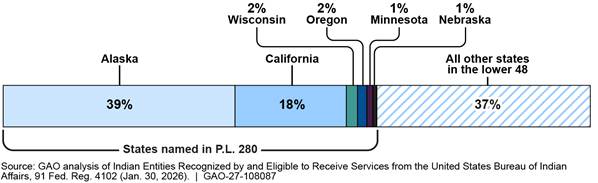
Tribes and states exercise criminal jurisdiction under P.L. 280 in various ways. For example, some Tribes and local law enforcement agencies have entered into cross-deputization agreements. These agreements generally provide tribal police officers with the same or similar jurisdiction and related authorities as local law enforcement officers within and outside of Indian country.
Further, some states have returned the criminal jurisdiction provided by P.L. 280 to the federal government (known as retrocession). Tribal leaders and state law enforcement officials provided various perspectives on retrocession. For example, tribal leaders told GAO retrocession helped enhance their Tribe’s exercise of self-determination and addressed some challenges working with state law enforcement. State law enforcement officials said that retrocession can be a challenge because Tribes would lose access to state public safety and justice services. However, under federal law, Tribes cannot initiate retrocession and tribal consent is not required when states do so. In the absence of amendments to address this, the law impedes Tribes’ exercise of self-determination.
In the lower 48 states, Tribes named in the law may face limitations in accessing certain funding for public safety and justice. GAO’s analysis of funding data from the Bureau of Indian Affairs (BIA) showed that from fiscal years 2017 through 2021, Tribes in states named in P.L. 280 received less funding per capita than Tribes in all other states. BIA officials stated that they have limited discretionary funding and generally prioritize funding for Tribes that do not receive public safety and justice services from their respective states.
Why GAO Did This Study
In 1953, P.L. 280 rescinded most federal criminal jurisdiction in Indian country in select states and instead provided it to these states. As of October 2026, approximately 65 percent of the 575 federally recognized Tribes were located in these states. Some prior research on the effect of P.L. 280 suggests the law may have adverse effects on public safety and justice, including slow police response times and limited access to certain federal funding.
GAO was asked to review the law’s effect on tribal public safety and justice. GAO previously issued a report on P.L. 280’s effect on tribal public safety and justice in Alaska.
This report examines the extent to which the law affects how jurisdiction is exercised in the continental United States, excluding Alaska (lower 48 states) and what federal research and data show about P.L. 280’s effect on Tribes in the lower 48, among other things. GAO analyzed relevant laws and federal memoranda on tribal jurisdiction, as well as federal crime and funding data for fiscal years 2017 through 2024—the most recent data available. GAO interviewed BIA and DOJ officials, non-governmental stakeholders and legal scholars, as well as tribal leaders and state law enforcement officials from three states subject to P.L. 280 in the lower 48 states.
What GAO Recommends
GAO recommends that Congress consider amending the law to authorize Tribes to initiate the retrocession process and require tribal consent for a state to offer retrocession to the Secretary of the Interior.
|
Abbreviations |
|
|
|
|
|
BIA |
Bureau of Indian Affairs |
|
DOJ |
Department of Justice |
|
FBI |
Federal Bureau of Investigation |
|
NIBRS |
National Incident Based Reporting System |
|
P.L. 280 |
Public Law 280 |
This is a work of the U.S. government and is not subject to copyright protection in the United States. The published product may be reproduced and distributed in its entirety without further permission from GAO. However, because this work may contain copyrighted images or other material, permission from the copyright holder may be necessary if you wish to reproduce this material separately.
November 16, 2026
Congressional Requesters
In 1953, Public Law 280 (P.L. 280) rescinded most federal criminal jurisdiction in “Indian country” in certain states and instead provided it to these select states (mandatory P.L. 280 states).[1] As of October 2026, approximately 65 percent of all the 575 federally recognized Tribes are located in mandatory P.L. 280 states.[2] As a result, state authorities—as opposed to the federal government—are generally responsible for providing public safety and justice services—law enforcement, courts, and corrections—in mandatory P.L. 280 states.[3] In addition, with few exceptions, in these mandatory P.L. 280 states, a Tribe’s inherent criminal jurisdiction is concurrent with the state when a tribal citizen commits a crime or, in certain circumstances, is the victim of a crime in Indian country.[4]
While limited empirical research exists in recent years, some prior research on the effect of P.L. 280 suggests the law may have adverse effects on public safety and justice, including slow police response times and limited access to certain federal funding in mandatory P.L. 280 states.[5] In addition, P.L. 280 was enacted without the consent of Tribes and without providing additional resources to state and local law enforcement agencies, whose responsibilities expanded under the law.[6]
You asked us to review P.L. 280’s effect on tribal public safety and justice. In response, we first issued a report in February 2026, which reported on P.L. 280’s effect on tribal public safety and justice in Alaska, including the extent to which the law affects criminal jurisdiction.[7] That report also included information on what federal research and data show about P.L. 280’s effect on Tribes in Alaska, and tribal, federal, and state views on public safety and criminal justice challenges in Alaska Native communities.
This report examines: (1) the extent to which P.L. 280 affects how Tribes, the federal government, and states exercise jurisdiction in the continental United States, excluding Alaska (lower 48 states); (2) what federal research and data show about P.L. 280’s effect on Tribes in the lower 48 states; and (3) tribal, federal, and state views on public safety and justice challenges in P.L. 280 states in the lower 48.[8]
To examine the extent to which P.L. 280 affects how jurisdiction is exercised in the lower 48 states, we analyzed relevant laws and documentation from the Department of Justice (DOJ) and within the Department of the Interior, the Bureau of Indian Affairs (BIA). Specifically, we reviewed P.L. 280 and its subsequent amendments, and federal memoranda on tribal jurisdiction.[9] We also reviewed relevant federal and state law, federal and state cases, federal regulations, and agency memoranda. We interviewed DOJ and BIA officials, as well as state law enforcement officials from three of the six mandatory P.L. 280 states—California, Oregon, and Nebraska. We also interviewed relevant non-governmental stakeholders and legal scholars with subject matter expertise to discuss how P.L. 280 affects criminal jurisdiction among Tribes.[10] We selected these stakeholders and scholars based on their work with Tribes on issues related to P.L. 280 or published empirical research on the law.
To examine what federal research and data show about P.L. 280’s effect among Tribes in the lower 48 states, we reviewed empirical research published in academic journals from 2000 through 2025 that assess the law’s effect on tribal public safety and justice.[11] We also examined the Federal Bureau of Investigation’s (FBI) National Incident-Based Reporting System (NIBRS) to determine the extent to which crime data are collected on “tribal lands.”[12] However, as discussed later in the report, we found NIBRS data were not sufficiently reliable to identify the number of criminal incidents and criminal offenses committed on tribal lands in P.L. 280 states.
We also analyzed federal funding data to identify the level of funding DOJ and BIA provide to Tribes in mandatory P.L. 280 states, compared with Tribes in all other states in the lower 48. Specifically, we analyzed DOJ’s grant award data for fiscal years 2017 through 2024.[13] We assessed the reliability of DOJ grant award data by conducting electronic tests to identify anomalies or duplicate data entries; reviewing relevant documentation; and conducting interviews with knowledgeable agency officials. We found DOJ grant award data to be sufficiently reliable to identify funding differences. We also analyzed BIA public safety and justice funding data for fiscal years 2017 through 2021.[14] We also reviewed relevant DOJ and BIA documentation and interviewed agency officials about policies related to funding for Tribes in mandatory P.L. 280 states.
To identify views on public safety and criminal justice challenges, we reviewed relevant tribal, federal, and state memoranda and publications describing efforts to address these challenges in tribal communities. We also interviewed DOJ and BIA officials to discuss challenges and efforts underway to improve public safety and criminal justice in P.L. 280 tribal communities in the lower 48 states.
To address all objectives, we conducted site visits to three mandatory P.L. 280 states—California, Oregon, and Nebraska. During these visits, we obtained perspectives on P.L. 280 from tribal leaders, state law enforcement officials, and non-governmental stakeholders. The tribal leaders we interviewed included council members, tribal government officials, tribal judges and court staff, and tribal law enforcement officers. We selected Tribes based on whether they are subject to P.L. 280, enrolled population, and existence of tribal codes to perform public safety and criminal justice functions, such as the operation of tribal police departments and court systems. We collected perspectives on issues related to P.L. 280, public safety, and criminal justice to develop profiles on selected Tribes. While information from our site visits is not generalizable across all Tribes, tribal leaders and state law enforcement officials provided important context and illustrative examples of their experiences related to P.L. 280 and tribal public safety and justice.
We conducted this performance audit from January 2026 to November 2026 in accordance with generally accepted government auditing standards. Those standards require that we plan and perform the audit to obtain sufficient, appropriate evidence to provide a reasonable basis for our findings and conclusions based on our audit objectives. We believe that the evidence obtained provides a reasonable basis for our findings and conclusions based on our audit objectives.
Background
Public Law 280
Generally, Tribes and the federal government have concurrent criminal jurisdiction over certain crimes committed in Indian country involving tribal citizens. The federal government’s criminal jurisdiction over such crimes is provided by the Major Crimes Act and General Crimes Act.[15] These laws provide criminal jurisdiction to the federal government in Indian country over certain crimes committed by tribal citizens, as well as crimes between tribal citizens and non-tribal citizens. However, upon its enactment in 1953, P.L. 280 rescinded federal criminal jurisdiction under these laws in certain states, and provided those states with jurisdiction over such crimes in Indian country, with exceptions for certain reservations.[16]
As such, in these states, the state and Tribes have concurrent criminal jurisdiction in Indian country when a tribal citizen commits a crime or, in certain circumstances, is a victim of a crime in Indian country. Criminal jurisdiction includes criminal investigations, prosecutions, adjudications, and corrections in Indian country, according to DOJ. In addition, P.L. 280 granted certain civil jurisdiction to these states.[17]
At the time of enactment, the law designated five states in the lower 48 as mandatory P.L. 280 states—California, Minnesota, Nebraska, Oregon, and Wisconsin.[18] The statute was subsequently amended in 1958 to include the Territory of Alaska, which later became the State of Alaska in 1959, as a mandatory P.L. 280 state.[19] As of October 2026, approximately 65 percent of federally recognized Tribes are located in mandatory P.L. 280 states, as shown in figure 1.
Figure 1: Percent of Federally Recognized Tribes Located in Mandatory Public Law 280 (P.L. 280) States and All Other States in the Lower 48, as of October 2026
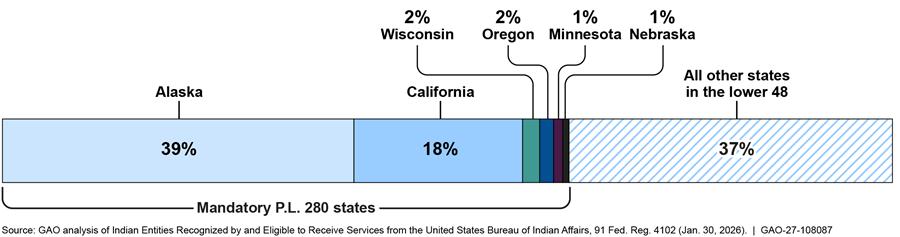
Note: There are 575 federally recognized Tribes in the U.S. The number of federally recognized Tribes located in a state may not be indicative of the total population of tribal citizens in that state. The mandatory P.L. 280 states are those six states that are named in P.L. 280, as amended. This figure does not represent the percentage of Tribes that are subject to state criminal jurisdiction under P.L. 280 because (1) states may have returned jurisdiction over Indian country to the federal government, 25 U.S.C. § 1323(a), or (2) certain Tribes in mandatory P.L. 280 states were exempted from state criminal jurisdiction, 18 U.S.C. § 1162(a).
The law provides the option for additional states, with tribal consent, to assume criminal and certain civil jurisdiction in Indian country in their respective state (these additional states are further referred to as optional P.L. 280 states).[20] Optional P.L. 280 states may assume criminal jurisdiction under state law over all or select crimes committed in Indian country or certain civil jurisdiction under state law. Similarly, optional P.L. 280 states may also assume criminal or certain civil jurisdiction over all or select parts of Indian country in the state.[21] In these states, the federal government retains criminal jurisdiction under the Major Crimes Act and General Crimes Act, as well as over crimes of general applicability and certain federal crimes that specifically apply in Indian country or involve or affect tribal citizens or Tribes.[22]
While the law provides the option for additional states to assume jurisdiction with tribal consent, prior to 1968, states were not required to obtain tribal consent. However, in 1968, the law was amended to require tribal consent before a state could assume criminal jurisdiction.[23]
The 1968 amendment also allowed states to offer to return any or all of their criminal or civil jurisdiction acquired under P.L. 280 to the federal government, in a process known as retrocession.[24] Additionally, the Tribal Law and Order Act of 2010 allowed Tribes in mandatory P.L. 280 states to request the federal government assume concurrent federal criminal jurisdiction to prosecute violations under the Major Crimes Act and the General Crimes Act through a process known as reassumption.[25] After reassumption, both the state and federal government have criminal jurisdiction.[26] Table 1 defines key terms related to P.L. 280.
Table 1: Selected Key Terms in this Report Related to Criminal Jurisdiction under Public Law 280 (P.L. 280)
|
Key term |
Definition |
|
Mandatory P.L. 280 state |
A mandatory P.L. 280 state is one of the six named states in P.L.280—Alaska, California, Minnesota, Oregon, Nebraska, and Wisconsin. P.L. 280 (1) rescinded federal criminal jurisdiction in Indian country under the Major Crimes Act and General Crimes Act in these states, with exceptions for certain reservations, and (2) provided for those states to exercise criminal jurisdiction over crimes committed by or against tribal citizensa in Indian countryb in their states.c |
|
Optional P.L. 280 state |
An optional P.L. 280 state is a state that has opted in to P.L. 280 by assuming any or all criminal jurisdiction in Indian country in the state. Optional P.L. 280 states can choose which offenses and in which parts of Indian country to exercise criminal jurisdiction.d The federal government retains jurisdiction under the Major Crimes Act and General Crimes Act in optional P.L. 280 states.e |
|
P.L. 280 state |
A P.L. 280 state is a mandatory state named in P.L. 280 or is one that opted into P.L. 280 by assuming any or all criminal jurisdiction in Indian country. |
|
Retrocession |
Retrocession occurs when a state offers to return any or all of its criminal jurisdiction under P.L. 280 to the federal government, and the federal government accepts.f |
|
Reassumption |
Reassumption occurs when a Tribe in a mandatory P.L. 280 state requests the federal government reassume criminal jurisdiction under the Major Crimes Act and General Crimes Act in the Tribe’s Indian country, and the Attorney General, after consultation with the Tribe, consents to reassume such jurisdiction.g After reassumption, both the state and federal government have criminal jurisdiction. |
Source: GAO analysis of Public Law 280 and criminal jurisdiction-related laws relevant to Public Law 280. | GAO‑27‑108087
aFor the purposes of this report, we use the term “tribal citizen” in place of the term “Indian” as defined under federal criminal law. There is no statutory definition of Indian for federal criminal jurisdiction purposes, but courts generally require a degree of Indian blood and a sufficient connection to a Tribe, such as tribal citizenship.
bIndian country includes all lands within the limits of reservations, dependent Indian communities, and Indian allotments to which Indian title has not been extinguished. 18 U.S.C. § 1151.
c18 U.S.C. § 1162(a)-(c). The Major Crimes Act provides federal criminal jurisdiction in Indian country over Indian offenders of certain enumerated offenses, such as murder. 18 U.S.C. § 1153. The General Crimes Act provides federal criminal jurisdiction in Indian country over crimes under the general laws of the U.S. in which the victim or offender (but not both) is a tribal citizen and has not been punished by the Tribe. 18 U.S.C. § 1152.
dSee 25 U.S.C. § 1321(a)(1).
e28 C.F.R. § 50.25(a)(2). Since 1953, 10 states opted in to assume criminal jurisdiction over select offenses and select Indian country in their respective state. However, courts have invalidated assertions of state jurisdiction under P.L. 280 in some states, such as South Dakota. See Rosebud Sioux Tribe v. South Dakota, 900 F.2d 1164 (8th Cir. 1990). Furthermore, federal and state statutes have affected assertions of state jurisdiction under P.L. 280 in some of these states.
f25 U.S.C. § 1323(a).
g18 U.S.C. § 1162(d).
Agencies With Public Safety and Justice Responsibilities in Indian Country
Within the Department of the Interior, BIA is the lead federal agency responsible for carrying out federal responsibilities for Tribes and tribal citizens, including public safety and justice responsibilities.[27] DOJ is the federal agency responsible for prosecuting federal criminal cases and is to regularly consult with Tribes on issues relating to law enforcement and public safety.[28] For example, DOJ must seek tribal input through annual consultations on the federal administration of tribal funds and programs established under the Violence Against Women Act and its various reauthorizations.[29]
While BIA and DOJ both provide funding to help support tribal public safety and justice, their funding mechanisms differ. Tribes may be eligible to receive funding from both agencies. BIA funding includes resources through BIA’s direct service model, funding agreements, and support for tribal court systems.[30] From fiscal years 2017 to 2021, BIA expended approximately $2 billion in the lower 48 states to support tribal public safety and justice, through direct services, funding agreements, and tribal court services.
DOJ provides funding to Tribes through competitive grant programs. Three DOJ grant-making components—the Office of Justice Programs, the Office on Violence Against Women, and the Office of Community Oriented Policing Services—collectively provide funding to support tribal public safety and justice programs.[31] These three grant-making components collectively provided approximately $2.1 billion to support tribal public safety and justice programs in the lower 48 states, from fiscal years 2017 through 2024.
Both BIA and DOJ are required to submit annual reports to Congress describing federal spending and other activities related to public safety and justice programs in Indian country. Specifically, the Tribal Law and Order Act requires BIA to report on agency spending, staffing and unmet needs for public safety and justice programs in Indian country.[32] The act requires DOJ to report information on federal investigations and prosecutions in Indian country, including the types of crimes alleged.[33]
In states subject to criminal jurisdiction under P.L. 280, state and tribal law enforcement agencies are responsible for providing public safety and justice services to tribal citizens. In addition, county and local law enforcement agencies can also provide law enforcement services in Indian country in these states.
P.L. 280 Effects on Jurisdiction Vary and Access to Retrocession is Limited
How is criminal jurisdiction exercised in P.L. 280 states in the lower 48?
Under the law, states can exercise concurrent criminal jurisdiction in Indian country differently. Mandatory P.L. 280 states have full criminal jurisdiction over Indian country within their boundaries unless a retrocession has occurred or a Tribe was excepted under the law. Optional P.L. 280 states can assume jurisdiction over all or select parts of Indian country in the state and for certain crimes (e.g., traffic violations) or all crimes, which affects how jurisdiction is exercised. Appendix I compares criminal jurisdiction in Indian country for states not subject to P.L. 280, mandatory P.L. 280 states, and optional P.L. 280 states.
Further, county and local law enforcement agencies often provide public safety and justice services in Indian country in states subject to P.L. 280 jurisdiction. For example, tribal law enforcement officers in two of the three states we visited told us that they primarily worked with county and municipal law enforcement agencies on incident response and criminal investigations.[34] Similarly, tribal leaders in these states told us criminal cases that occur in Indian country subject to P.L. 280 jurisdiction may be heard in county courts and convicted individuals may be detained or serve their sentences in county corrections facilities.
Law enforcement agencies in the three states we visited described how concurrent criminal jurisdiction is exercised and the various ways they formalized their law enforcement coordination.
· Three of the five Tribes we visited entered into cross-deputization agreements with their local county sheriff’s office, which provide tribal law enforcement officials with the same or similar criminal jurisdiction and related authorities available to sheriff’s deputies both within and outside of Indian country.[35]
· One of the three states we visited enacted legislation in 2011 that provides tribal police officers with the authority to enforce state law, including arrest authority, in certain circumstances.[36]
· One Tribe we visited developed a joint jurisdictional court with the county where their reservation is located that allows tribal and county judges to coordinate on cases where jurisdiction overlaps and make joint rulings.
· Two Tribes we visited have a diversion agreement with their respective state and county. In general, these agreements divert tribal citizens accused of certain state crimes into the tribal criminal justice system, which provide services that would otherwise be unavailable to tribal citizens within the county or state criminal justice system.[37]
While tribal leaders we interviewed in two states told us they had developed cooperative relationships with counties and local law enforcement agencies, they explained that it took time to build these relationships. In addition, some leaders noted that prior to building these relationships, there was a history of challenges with the quality and timeliness of county and local law enforcement. Tribal leaders also told us that while some Tribes’ and counties’ law enforcement exercise concurrent criminal jurisdiction cooperatively, these relationships do not exist throughout Indian country in P.L. 280 states.
For example, in 2014 a tribal police officer responded to a call involving a disturbance by a non-tribal citizen in Indian country before sheriff’s deputies arrived at the scene. The county charged the tribal police officer with assault, false imprisonment, impersonating a public officer, and battery. The county and Tribe ultimately reached a settlement agreement in 2019, which ended the case.[38] Moreover, the district court involved in the proceedings noted that the tribal police officer, by virtue of their status as a duly sworn officer of the Tribe, had inherent authority to detain and investigate the non-tribal citizen for potentially violating a state-issued protective order in Indian country.[39] Appendix II includes more detailed information about selected Tribes and their experiences with P.L. 280.
How have court decisions affected how jurisdiction is exercised in P.L. 280 states in the lower 48?
P.L. 280 states in the lower 48 exercise state jurisdiction differently due to varying court decisions. While P.L. 280 granted broad criminal jurisdiction to mandatory P.L. 280 states, it granted these states only certain civil jurisdiction.[40] However, determining whether a state law is criminal and within P.L. 280’s grant of jurisdiction, or whether it is civil and outside of P.L. 280’s grant of jurisdiction has not always been easy.
For example, tribal leaders we interviewed told us that this has resulted in confusion and disagreement over the extent of state jurisdiction. In one example, leaders from a Tribe we visited told us that state law enforcement officers attempted to apply vehicle registration laws on their reservation. However, tribal leaders claimed that vehicle registration laws are not within P.L. 280’s grant of jurisdiction. In this example, the Tribe and state law enforcement resolved the dispute without going to court. However, tribal leaders we spoke with said litigation may be the only means to resolve such disagreements, which requires time and resources.
Two Supreme Court cases established tests for courts to use when determining the extent of state jurisdiction under P.L. 280. In 1976, the Supreme Court described P.L. 280 as “admittedly ambiguous” in a case that examined whether P.L. 280’s grant of civil jurisdiction in Indian country authorized certain state taxes.[41] Specifically, the Court noted that the legislative history on the law’s grant of civil jurisdiction was “sparse” and that Congress’ intent was not evident.[42] Ultimately, the Court held that while P.L. 280 provided states with certain civil jurisdiction in Indian country, it did not grant states general civil regulatory authority over tribal citizens.[43]
In 1987, the Supreme Court reviewed the distinction between P.L. 280’s grant of civil and criminal jurisdiction.[44] In this case, two Tribes sued the State of California over its attempt to apply state gaming laws in Indian country under P.L. 280. The Court provided two tests to determine whether a state law is criminal or civil in nature—the former being fully applicable in Indian country subject to P.L. 280 and the latter in only limited circumstances.[45]
Under the first test, a state law is generally included in P.L. 280’s grant of jurisdiction if its intent is to prohibit certain conduct (e.g., driving under the influence), which the Court described as “criminal prohibitory.” Conversely, a state law is not within P.L. 280’s grant of jurisdiction if the law generally permits the conduct at issue, subject to regulation (e.g., vehicle registration), which the court described as “civil regulatory.”[46] The second test the Court provided is a simplified version of the first test—a state law is considered criminal in nature and generally applicable under P.L. 280 if the conduct at issue violates the “state’s public policy.”[47]
However, at the same time, the Supreme Court said these tests were not a “bright-line rule” and that state laws would have to be examined in detail to determine whether they are criminal prohibitory or civil regulatory in nature.[48] Subsequently, when lower courts have applied these tests to determine whether state laws were within P.L. 280’s grant of jurisdiction, the results have been inconsistent. For example, lower courts have reached opposite conclusions regarding whether state laws limiting certain fireworks sales or traffic laws apply Indian country subject to P.L. 280.
Specifically, a Wisconsin state court held that Wisconsin state law limiting certain fireworks sales was civil regulatory and thus did not apply in Indian country.[49] However, the Ninth Circuit held that a California state law limiting similar fireworks sales was criminal prohibitory in nature for purposes of P.L. 280 and thus applied.[50]
One potential source of lower courts’ inconsistency on this issue may be the Supreme Court decision itself, which established these tests. Specifically, whereas the first test is narrow, the second is relatively broad. Accordingly, legal scholars have noted that lower courts can apply the test that best supports a particular outcome, which can result in inconsistent decisions.[51] These inconsistent decisions create a challenge to amending P.L. 280 to clarify state jurisdiction because, according to DOJ officials, an amendment could have uneven effects in Indian country.
How is retrocession exercised in the lower 48 states?
While some states have returned their criminal or civil jurisdiction under P.L. 280 to the federal government (a process known as retrocession), Tribes cannot initiate retrocession and tribal consent is not required when states do so.[52] Since 1953, the federal government has accepted offers of retrocession of criminal jurisdiction from seven states subject to P.L. 280. This includes four mandatory P.L. 280 states that have retroceded all or partial criminal jurisdiction over seven Tribes, accounting for less than 2 percent of Tribes in these states as of July 2026.[53] In addition, three optional P.L. 280 states have retroceded criminal jurisdiction for over 19 Tribes.[54]
Since 2012, two of the 16 mandatory or optional P.L. 280 states have enacted legislation that allows Tribes to initiate the retrocession process.[55] Tribal leaders, agency, and non-governmental officials we interviewed provided various perspectives on retrocession.
· According to one legal scholar we interviewed, state laws that allow Tribes to initiate retrocession could benefit Tribes that do not have positive relationships with their state, county, or local law enforcement agencies. In such cases, Tribes may prefer concurrent jurisdiction with the federal government instead, according to this legal scholar.
· According to another legal scholar we interviewed, requiring tribal consent is important because a state’s retrocession of criminal jurisdiction could jeopardize public safety and justice for certain Tribes. For example, Tribes that do not already operate their own public safety and justice programs could face limited access to law enforcement, court, and corrections services if a state retrocedes its criminal jurisdiction.
· Tribal leaders from two Tribes we visited, for which the state retroceded criminal jurisdiction under P.L. 280, stated that retrocession provided numerous benefits, including enhancing the Tribes’ exercise of sovereignty through self-determination. These tribal leaders also shared that retrocession helped resolve many of the challenges the Tribe experienced with county law enforcement, including the mistreatment of tribal citizens.
· State law enforcement officials in two states we visited told us that retrocession could create challenges for Tribes that do not already operate their own public safety and justice programs and that Tribes would lose access to state law enforcement, courts, and corrections services.
· According to BIA, state actions to retrocede jurisdiction back to the federal government have helped address some of the effects of P.L. 280 and strengthened the Tribes’ jurisdiction over civil and criminal matters on their reservations. Further, while federal funding opportunities are limited, as described later in this report, Tribes for which the state has retroceded jurisdiction may have improved access to certain BIA funds to establish and operate public safety and justice programs.
· DOJ officials told us that studies on P.L. 280 indicate that retrocession typically results in improvements in public safety. Officials stated these improvements include increased community confidence in the criminal justice system, increased reporting of crime, greater cooperation with criminal investigators, and decreasing crime rates in Indian country.
· DOJ officials cautioned that ensuring an orderly transition from state to federal criminal jurisdiction can be a challenge for Tribes if they do not already operate their own public safety and justice programs. However, these officials noted that since the retrocession process can be lengthy, Tribes may have enough time to prepare for the transition, which can entail developing tribal code and establishing a tribal police department and court system.
While federal law does not allow Tribes to initiate retrocession nor require tribal consent for states to do so, BIA officials stated that they would consult with Tribes if a state offers retrocession prior to making any decision about its acceptance. BIA officials stated that they support exploring a path for Tribes to be able to initiate retrocession from state jurisdiction in a manner that centers on tribal sovereignty and community safety. DOJ officials also noted that while DOJ has not taken a formal position on whether Tribes should be able to formally initiate retrocession, they were not aware of any negative effects that could result from such a process.
However, BIA officials noted an amendment to federal statute would be needed to create a pathway for Tribes to formally initiate retrocession. Further, BIA officials told us that they do not have the authority to require tribal consent prior to accepting a state’s retrocession of jurisdiction.
The Supreme Court has affirmed Tribes’ inherent sovereign powers over their members, including the power to exercise criminal jurisdiction over tribal citizens.[56] Further, case law and DOJ have established that P.L. 280 did not divest Tribes of their sovereign authority to exercise criminal jurisdiction, and that Tribes share criminal jurisdiction in these states.[57] Congress has promoted tribal self-determination and self-governance through legislation. Further, since the 1960s, federal policy has shifted from termination-era policies to the promotion of self-determination and self-governance.[58] However, Congress has not amended the law to authorize Tribes to initiate retrocession or require states to obtain tribal consent before doing so.[59]
In the absence of amendments that (1) authorize Tribes to initiate retrocession and make federal criminal jurisdiction “exclusive as to any state” and (2) require tribal consent before a state may do so, P.L. 280 will continue to impede Tribes’ efforts to exercise self-determination.[60] For example, Tribes cannot initiate the process to end P.L. 280 jurisdiction with a state with which they have a problematic relationship or that they feel is not providing sufficient law enforcement services. Further, Tribes that prefer to share jurisdiction with the federal government would lack the means to initiate retrocession.
For retrocession initiated by Tribes, making federal criminal jurisdiction exclusive as to any state would help ensure a state’s jurisdiction under P.L. 280 is fully removed. Unless federal jurisdiction is exclusive as to any state, retrocession could fail to remove a state’s jurisdiction under P.L. 280 if it was previously codified in state law and not subsequently repealed.[61]
Finally, an amendment for states to obtain tribal consent prior to retroceding jurisdiction under P.L. 280 could protect Tribes from involuntary changes to criminal jurisdiction in Indian country. This is particularly important for Tribes that would lose state services and do not operate their own tribal public safety and justice programs.
P.L. 280 May Hinder Access to Public Safety and Justice Funding
What does empirical research show about the effect of P.L. 280 on public safety and justice?
We identified limited empirical research examining the effects of P.L. 280 on public safety and justice. Specifically, we identified four articles published in 2000 through 2025 that included empirical research examining P.L. 280.
This research showed that (1) the occurrence of crime within jurisdictions subject to P.L. 280 may be higher compared to jurisdictions not subject to P.L. 280, (2) P.L. 280 may impede the establishment and operation of tribal public safety and justice programs, (3) P.L. 280 may have negative impacts on the availability and quality of law enforcement services, and (4) P.L. 280 may create confusion over jurisdiction in Indian country.
What do data show about the effect of P.L. 280 on crime rates, public safety, and justice in the lower 48 states?
Similar to our findings in February 2026, various data constraints, including incomplete data, preclude an assessment on the effects of P.L. 280 on public safety and justice in Indian country.[62] Currently, no system or database maintains a comprehensive view of all criminal offenses in Indian country across tribal, federal, and state jurisdictions.
DOJ’s annual Tribal Law and Order Act reports on criminal jurisdiction in Indian country generally maintain that incidents from P.L. 280 jurisdictions do not appear in federal crime statistics because, in most cases, the state upholds criminal jurisdiction and prosecutes these cases.[63] Additionally, FBI’s database for tracking crimes nationwide—NIBRS—relies on voluntary participation from law enforcement entities and requires agencies, such as tribal law enforcement agencies, to be eligible to submit data.
To be eligible to submit data to NIBRS, Tribes must operate a law enforcement organization with commissioned or sworn law enforcement officers. According to FBI officials, 42 tribal law enforcement agencies in mandatory P.L. 280 states are eligible to submit data, as of July 2026. However, only 29 of these agencies have consistently submitted data to NIBRS since 2020, according to officials.
According to the NIBRS user manual, submissions are to include a “location” field that allows law enforcement agencies to select “tribal lands” as the location.[64] However, our review of publicly available NIBRS data from 2020 through 2023 identified approximately 1,100 criminal incidents occurring on tribal lands in mandatory P.L. 280 states in the lower 48, which is seemingly low given the total number of criminal incidents reported by law enforcement agencies.[65]
Other data suggests crime rates on tribal lands may be higher than what law enforcement agencies voluntarily reported to NIBRS during this period. For example, according to the National Institute of Justice, high rates of domestic violence and crime in tribal communities in Nebraska may contribute to high rates of missing tribal citizen adults and children.[66] However, according to NIBRS data, in fiscal years 2020 through 2023, law enforcement reported 15 criminal incidents on tribal lands in the state, which is likely an undercount.[67]
What do data show about the effect of P.L. 280 on federal funding for public safety and justice in the lower 48 states?
While Tribes in mandatory P.L. 280 states received more DOJ grant funding, per capita, than Tribes in all other states in the lower 48, these Tribes face limitations in accessing BIA public safety and criminal justice funding.[68] This may be due to BIA’s funding limitations and established agreements with a finite number of Tribes not subject to P.L. 280, as discussed in this section below.
DOJ grant funding for public safety and justice. DOJ provides funding to Tribes through competitive grants, which are administered by various DOJ components, including the Office of Justice Programs, the Office on Violence Against Women, and the Office of Community Oriented Policing Services. In fiscal years 2017 through 2024 (the most recent data available), these three DOJ grant-making components generally provided more funding to Tribes in mandatory P.L. 280 states per capita ($3,121) than Tribes in all other states in the lower 48 ($592), as shown in table 2.
Table 2: Department of Justice (DOJ) Grant Award Amounts to Federally Recognized Tribes and Tribal Organizations in the Lower 48 States for Public Safety and Justice, Fiscal Years 2017 Through 2024
|
State |
DOJ grant award |
BIA service population |
Funding per capita |
|
Mandatory Public Law 280 states in the lower 48 |
$ 789,416,410 |
252,976 |
$ 3,121 |
|
California |
$ 212,534,945 |
75,119 |
$ 2,829 |
|
Minnesota |
$ 439,513,546 |
59,336 |
$7,407 |
|
Nebraska |
$ 27,576,050 |
20,088 |
$1,373 |
|
Oregon |
$ 39,104,972 |
29,950 |
$1,306 |
|
Wisconsin |
$ 70,686,897 |
68,483 |
$1,032 |
|
All other states in the lower 48 |
$ 1,315,566,139 |
2,222,982 |
$ 592 |
Source: GAO analysis of DOJ grant award data for the Office of Justice Programs, the Office on Violence Against Women, and the office of Community Oriented Policing Services. Service population data are certified 2021 enrollment numbers from the Bureau of Indian Affairs (BIA) Office of Indian Services. | GAO‑27‑108087
Notes: Table 2 includes funding data for DOJ’s Office of Justice Programs, Office on Violence Against Women, and Office of Community Oriented Policing Services, which DOJ manages through its JustGrants award management system. We selected these three DOJ components for analysis since they provide public safety and justice grants to federally recognized Tribes. “All other states in the lower 48” includes states where P.L. 280 is not mandatory. Act of Aug. 15, 1953, ch. 505, § 2, 67 Stat. 588 (codified as amended at 18 U.S.C. §1162(a)).
While DOJ provided more funding per capita to Tribes in mandatory P.L. 280 states, this could be dependent on the number of Tribes that applied, which DOJ grants they applied for, and how much funding they applied for and received. For example, we found that DOJ’s Office of Community Oriented Policing Services awarded more grant funding to Tribes and tribal organizations in mandatory P.L. 280 states compared to Tribes and tribal organizations in all other states in the lower 48 from fiscal year 2017 through 2024. During this same period, DOJ accepted grant applications for Tribes and tribal organizations in mandatory P.L. 280 states at the same rate for Tribes and tribal organizations in states not subject to P.L. 280.
As we previously reported, DOJ officials said that P.L. 280 does not limit Tribes’ access to DOJ grant funding nor does it limit DOJ’s ability to fund Tribes in P.L. 280 states. DOJ officials explained that some grant funding decisions may be based on Tribes’ capacity to establish and operate law enforcement and justice systems. However, DOJ officials acknowledged the challenges Tribes may have in establishing their own law enforcement and justice systems, and that their access to federal funds is limited. To address these challenges, DOJ officials told us that, in 2025, the Office of Community Oriented Policing Services began giving priority consideration to Tribes subject to P.L. 280 when making funding decisions because these Tribes do not receive funding from BIA for law enforcement services.
BIA funding for public safety and justice. Tribes in mandatory P.L. 280 states are at a disadvantage when pursuing BIA funding for public safety and justice programs.
· BIA does not provide direct public safety and justice services to Tribes in mandatory P.L. 280 states where the federal government does not have criminal jurisdiction. BIA’s Office of Justice Services’ direct service model provides direct public safety and justice services in Indian country where the federal government maintains criminal jurisdiction.[69] These direct services may include law enforcement, dispatch, and corrections services for Tribes. In fiscal year 2025, BIA obligated approximately $44.5 million in direct services to support law enforcement services for Tribes in the U.S.
· Instead of receiving direct public safety and justice services from BIA, all Tribes, including those in mandatory and optional P.L. 280 states, can enter into a funding agreement with the Department of the Interior. In doing so, BIA would provide funds so the Tribe can administer public safety and justice programs itself. In fiscal year 2025, BIA provided approximately $184 million to Tribes in the U.S. through funding agreements. Funding provided through these agreements can be used to staff and operate tribal public safety and justice organizations. According to BIA, 172 federally recognized Tribes have a funding agreement that includes funding for public safety and justice services related to law enforcement and corrections, as of July 2026. Out of these 172 Tribes, 28 Tribes are located in P.L. 280 states.
· BIA also provides funding to support tribal court operations. Specifically, BIA’s Tribal Justice Support Directorate supports up to 400 tribal court systems and BIA can provide technical assistance and onetime funding associated with tribal court assessments. The one-time funding may be used to support tribal court operations, which can include training for tribal court staff, tribal court management and alcohol monitoring systems, and equipment for tribal court staff, such as computers and printers.[70]
BIA estimated that Tribes in mandatory P.L. 280 states in the lower 48 needed approximately $2.8 billion to support public safety and justice programs and services in fiscal years 2017 through 2021, as shown in figure 2. BIA provided approximately $150 million to these Tribes during this period, meeting 5 percent of estimated tribal needs.
Figure 2: Bureau of Indian Affairs (BIA) Public Safety and Justice Estimated Needs and Expenditures to Federally Recognized Tribes in Mandatory Public Law (P.L.) 280 States in the Lower 48, Fiscal Years 2017 Through 2021
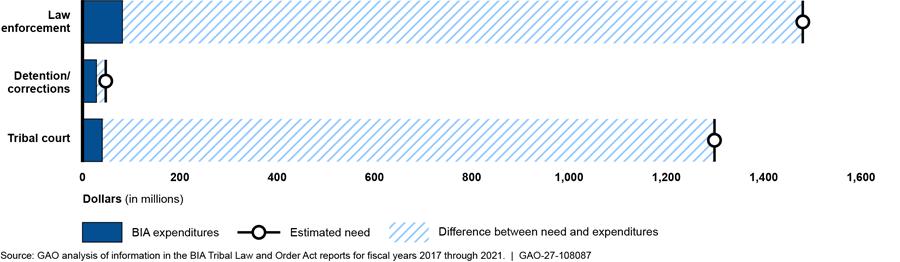
Note: Figure 2 describes BIA public safety and justice funding, which includes self-determination contracts and self-governance compacts with funding agreements and tribal court assessments. It may also include funding for BIA direct public safety and justice services for Tribes in mandatory P.L. 280 states not subject to the law. A mandatory P.L. 280 state is one of the six named states in P.L.280—Alaska, California, Minnesota, Oregon, Nebraska, and Wisconsin. 18 U.S.C. § 1162(a).
According to BIA’s annual Tribal Law and Order Act reports, Tribes in California have high public safety and justice needs, relative to Tribes in other mandatory P.L. 280 states in the lower 48.[71] For example, BIA estimates Tribes in California collectively needed roughly $2 billion to operate standard public safety and justice services in fiscal years 2017 through 2021. BIA provided Tribes in California with roughly 1 percent of their estimated public safety and justice needs during this period. In addition, Tribes in mandatory P.L. 280 states received less funding per capita compared to Tribes in all other states in the lower 48, as shown in table 3. Of this BIA funding, approximately 70 percent supported tribal courts, which may include court assessments, and the remaining 30 percent funded tribal law enforcement.
Table 3: Bureau of Indian Affairs (BIA) Public Safety and Justice Estimated Needs and Expenditures to Federally Recognized Tribes and Tribal Organizations in the Lower 48 States, Fiscal Years 2017 Through 2021
|
State |
Tribal needs estimate |
BIA expenditures |
BIA service population (2021 estimate) |
Need per capita |
Funding per capita |
Percentage of need met |
|
Mandatory P.L. 280 states in the lower 48 |
$2,827,096,000 |
$151,738,000 |
252,976 |
$11,175 |
$ 600 |
5.4% |
|
California |
$1,939,515,000 |
$22,552,000 |
75,119 |
$25,819 |
$300 |
1.2% |
|
Minnesota |
$262,979,000 |
$49,785,000 |
59,336 |
$4,432 |
$839 |
18.9% |
|
Nebraska |
$105,949,000 |
$27,522,000 |
20,088 |
$5,274 |
$1,370 |
26% |
|
Oregon |
$227,537,000 |
$19,695,000 |
29,950 |
$7,597 |
$658 |
8.7% |
|
Wisconsin |
$291,114,000 |
$32,183,000 |
68,483 |
$4,251 |
$470 |
11.1% |
|
All other states in the lower 48 |
$8,695,641,000 |
$1,864,373,000 |
2,222,982 |
$3,912 |
$ 839 |
21.4% |
Source: GAO analysis of information in the BIA Tribal Law and Order Act reports for fiscal years 2017 through 2021. | GAO‑27‑108087
Notes: Table 3 describes BIA public safety and justice funding, which includes funding for direct services, self-determination contracts and self-governance compacts with funding agreements, and tribal court assessments. According to BIA, total cost figures may not equal the sum of individual figures due to rounding. “All other states in the lower 48” includes states where P.L. 280 is not mandatory. Act of Aug. 15, 1953, ch. 505, § 2, 67 Stat. 588 (codified as amended at 18 U.S.C. §1162(a)).
As we previously reported in February 2026, BIA must prioritize the limited discretionary funding it receives for public safety and justice programs among federally recognized Tribes, and BIA prioritizes funding for Tribes that do not receive public safety and justice services from the state (e.g. Tribes in states not subject to P.L. 280).[72]
According to BIA officials, the agency fully allocates its limited public safety and justice funding (roughly $415 million per year in fiscal years 2017 through 2021) among a finite number of Tribes. As a result, increasing funding for one Tribe’s funding agreement would generally require BIA to make an offsetting reduction to another Tribe’s funding agreement, which is generally not permitted under the Indian Self Determination and Education Assistance Act of 1975, as amended.[73]
BIA is required to honor existing funding agreements, according to BIA officials. Tribes in P.L. 280 states with an existing agreement continue to receive annual law enforcement funding from BIA’s Office of Justice Services each year. Additionally, because of the statutory restriction, BIA is generally required to provide the same funding levels to Tribes as the previous year.[74] While BIA has funding agreements for law enforcement and corrections with 28 Tribes in P.L. 280 states, these funding agreements were established prior to budget structure changes in 1999.[75] Since then, BIA has not entered into new funding agreements with Tribes in P.L. 280 states, and the funding Tribes receive for law enforcement and corrections (in both P.L. 280 states and states not subject to P.L. 280) is equal to the amount established in 1999.
Various Public Safety and Justice Challenges Exist in P.L. 280 States
What public safety and justice challenges did tribal leaders, federal, and state officials identify in P.L. 280 states in the lower 48?
Tribal leaders and law enforcement officers as well as federal and state officials identified numerous challenges related to public safety and justice in P.L. 280 states, including those related to jurisdiction, funding, tribal law enforcement hiring and retention, and limited public safety and justice resources.[76]
Jurisdictional confusion. Tribal leaders, tribal law enforcement officers, and state law enforcement officers in all three states we visited told us that P.L. 280 has caused confusion among tribal citizens and local law enforcement about jurisdiction. Specifically, tribal leaders told us that states’ authority to enforce certain laws under P.L. 280 remains ambiguous and has resulted in confusion.
Further, tribal leaders from three states told us that some tribal citizens and local law enforcement have misunderstood Tribes’ jurisdiction over non-tribal citizens in Indian country.[77] In addition, officials from non-governmental organizations shared similar concerns. As noted earlier, this misunderstanding resulted in at least one federal case involving criminal charges against a tribal police officer for impersonating a law enforcement officer, among other things, after the police officer detained a non-tribal citizen in Indian country.[78]
State law enforcement officers we met with from a mandatory P.L. 280 state said that the state’s authority to exercise jurisdiction in Indian country can be unclear and may vary from Tribe to Tribe. For example, two Tribes we visited have adjacent reservations. The state in which these Tribes are primarily located retroceded different aspects of its jurisdiction on each reservation. As a result, despite their immediate proximity, state jurisdiction is different depending on the reservation where the offense occurred and the type of offense committed. Further, both reservations span multiple counties and states. As a result, these Tribes work with multiple law enforcement agencies and authorities depending on the state or county where a potential offense occurred. Due to this jurisdictional complexity, state law enforcement officers told us that officers may be hesitant to provide certain law enforcement services in parts of Indian country. As a result, the Tribe may not receive the public safety services they need.
Lack of access to federal public safety and justice funding. As described above, tribal leaders in two states we visited told us that they generally cannot access the limited federal public safety and justice funding from BIA since, under P.L. 280, their respective states are responsible for providing these services.
Further, according to a 2023 DOJ report, most Tribes do not receive direct funding from their respective states to support tribal public safety and justice programs.[79] As a result, Tribes in P.L. 280 states may utilize tribal resources and seek grant funding from DOJ to support their public safety and justice programs. However, tribal leaders and DOJ officials told us that DOJ’s public safety and justice grants are competitive, meaning not all Tribes that apply are guaranteed to receive grant funding. Further, state law enforcement officers told us that, in general, their agencies do not receive federal funding to provide public safety and justice services in Indian country subject to state criminal jurisdiction under P.L. 280.
Tribal law enforcement hiring, retention, and training challenges. Tribal leaders in two states we visited told us that they compete with the state, county, and municipal law enforcement agencies to recruit and hire well-qualified officers. Tribal leaders also said that tribal law enforcement agencies are generally unable to offer potential recruits the same level of pay and benefits as state and local law enforcement agencies, which may affect their ability to recruit these officers. Additionally, tribal leaders we met with explained that many state and local law enforcement agencies may recruit qualified police officers away from tribal law enforcement agencies, which makes retention a challenge.[80]
State law enforcement officers we met with from a mandatory P.L. 280 state told us that in general, state law enforcement training does not include detailed information on jurisdiction in Indian country, including the state’s authorities and limitations under the law. Officers told us that in most cases, law enforcement officers are expected to learn this information on the job and use their best judgment when providing law enforcement services in Indian country.
State law enforcement officers from two mandatory P.L. 280 states we visited raised training concerns. For example, officers we met with from one mandatory P.L. 280 state told us that it can be challenging to coordinate law enforcement services with tribal police officers who are not certified as state peace officers and who therefore do not have jurisdiction outside of Indian country. These officers also said that they may be unable to use evidence collected by non-certified tribal police officers if these officers are not formally trained on evidence collection and documentation standards.
Lack of public safety and justice resources. Tribal leaders, tribal law enforcement officers, and state law enforcement officers from all three states we visited stated that there is a lack of resources, including infrastructure and personnel. Some tribal leaders explained they do not have adequate resources and are dependent on their county for public safety and justice services. For example, tribal leaders from two states shared that they lack 24-hour dispatch centers and detention facilities with holding cells. Instead, Tribes must rely on county dispatch centers to answer calls for services and may contract with their local county jail to lease bed space, which can be costly.
County and local municipalities may also lack resources to provide adequate public safety and justice services to the community, including in Indian country. For example, tribal leaders from one Tribe we met with told us that due to limited resources, their county can only afford to operate around 50 percent of the cells in the county jail. These tribal leaders also explained that county prosecutors are under resourced and, in response, may reduce their caseloads to focus only on cases involving the most violent offenders.
Tribal leaders and state law enforcement officers from one state we visited told us the local county has a shortage of police vehicles, and that the Tribe has stepped in to loan tribal police vehicles to the county.[81] These tribal leaders also shared that due to limited county resources, their tribal police department shares tribally owned equipment with municipal and county law enforcement, including narcotics canines, to assist with local investigations.
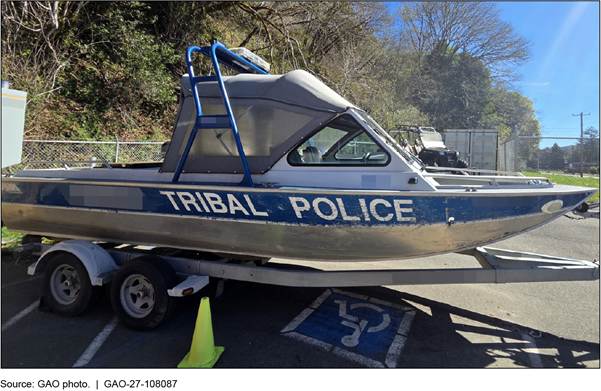
Further, reservations may be in remote locations with limited road access and tribal police may require diverse fleets of vehicles (cars, four-wheelers, boats, etc.) to reach these areas, which can add to tribal fleet maintenance needs. For example, one tribal police department we visited relies on boats to patrol tribal waterways on the reservation for illegal fishing and other illicit activities, as shown in figure 3. Tribal police also use these boats to respond to remote locations on the reservation that are not easily accessible by road. Keeping police boats operational is important since using them can reduce police response times from 2 hours (by car) to as little as 45 minutes (by boat) for certain locations on the reservation.
What federal efforts exist to address public safety and justice challenges in Indian country in the lower 48?
As we previously reported, there are several federal efforts to improve tribal public safety and justice, some of which may help address the challenges identified above.[82] Table 4 identifies examples of federal efforts to address public safety and justice challenges in Indian country in the lower 48 states.
Table 4: Examples of Federal Efforts to Address Public Safety and Justice Challenges in Indian Country in the Lower 48 States
|
Program |
Organizer |
Description |
|
Special Tribal Criminal Jurisdiction |
Department of Justice (DOJ) |
Participating Tribes may exercise special tribal criminal jurisdiction over certain crimes committed by non-tribal citizens in Indian country of a participating Tribe. Participating Tribes may receive technical assistance to develop the capacity to exercise this jurisdiction.a |
|
Tribal Access Program |
DOJ |
The Tribal Access Program is to provide Tribes with access to national crime information systems. The program allows selected federally recognized Tribes to more effectively serve and protect their nation’s citizens by ensuring the exchange of critical data across the national crime information databases. |
|
Training and Technical Assistance |
DOJ |
DOJ may provide training and technical assistance to help implement and enhance tribal justice system efforts. Training and technical assistance may include a variety of topics related to criminal justice, including law enforcement, tribal courts, corrections, victim services, and juvenile delinquency prevention. |
|
Operation Not Forgotten |
DOJ |
Operation Not Forgotten is a multi-agency initiative led by the Federal Bureau of Investigation that surges investigative, intelligence, and victim service support to Indian country to assist with unresolved violent crime cases, with a priority placed on cases involving violence against women and children. |
|
Federal public safety and justice funding programs |
DOJ |
DOJ may provide public safety and justice funding to Tribes through various grant-making components, including the Office of Justice Programs, the Office on Violence Against Women, and the Office of Community Oriented Policing Services. |
|
|
Bureau of Indian Affairs (BIA) |
BIA may provide funding for tribal public safety and justice programs. BIA also provides direct law enforcement, court, and corrections services to select Tribes that are generally subject to federal—and not state—criminal jurisdiction. Further, BIA may contract with entities to conduct court assessments and provide funding to Tribes to support tribal court operations.b BIA’s court assessments review tribal constitutions, codes, and court procedures. BIA may also provide technical assistance and onetime funding that Tribes can use to support tribal court operations, which may include training for tribal court staff, tribal court management and alcohol monitoring systems, and equipment for tribal court staff, such as computers and printers. |
|
Tiwahe Initiative |
BIA |
Created in 2014, the Tiwahe initiative is to allow Tribes flexibility to create solutions that are unique to their Tribe for issues that affect children and families. |
|
Missing and Murdered Unit |
BIA |
The Missing and Murdered Unit is to collaborate with various federal, state, and local agencies to provide critical support and investigative assistance for missing and murdered Indigenous people. |
|
|
|
Operation Spirit Return is an initiative to help solve missing and unidentified person cases involving American Indians and Alaska Natives. The unit and its partners are to focus on identifying unknown human remains utilizing forensic genetic genealogy and work to reunite them with their families and tribal communities. |
|
U.S. Indian Police Academy |
BIA |
The U.S. Indian Police Academy is to provide training for law enforcement officers and supervisors, juvenile officers, criminal investigators, and detention personnel. |
Source: GAO analysis of DOJ and BIA documentation. | GAO‑27‑108087
aViolence Against Women Reauthorization Act of 2013, Pub. L. No. 113-4, tit. IX, § 904, 127 Stat. 54, 120-23 (codified as amended at 25 U.S.C. § 1304).
bSee Indian Tribal Justice Act, Pub. L. No. 103-176, tit. I, §§ 101-102, 107 Stat. 2004, 2005-2007 (1993) (codified at 25 U.S.C. §§ 3611, 3612).
Conclusions
Federally recognized Tribes have the inherent right to self-govern. However, only states have the authority to return the criminal jurisdiction granted by P.L. 280 to the federal government and they can do so without tribal consent. Such actions can result in Tribes not being able to pursue the system of justice (state or federal) that best serves their citizens and can result in the involuntary loss of access to state public safety and justice services. By amending the law to (1) authorize Tribes to initiate retrocession and make federal criminal jurisdiction exclusive as to any state, and (2) require tribal consent before a state initiates retrocession, Congress could better support Tribes’ efforts to exercise self-determination over tribal public safety and justice in Indian country.
Matters for Congressional Consideration
We are recommending the following two matters for congressional consideration:
Congress should consider amending the law to authorize Tribes to initiate retrocession and make federal criminal jurisdiction exclusive as to any state upon the Secretary of the Interior’s acceptance of retrocession. (Matter for Consideration 1).
Congress should consider amending the law to require tribal consent for a state to offer retrocession of state jurisdiction under the law to the Secretary of the Interior. (Matter for Consideration 2).
Agency Comments
We provided a draft of this report to DOJ and the Department of the Interior for review and comment. DOJ provided written and verbal technical comments, which we incorporated as appropriate. Further, in response to these comments, we removed a matter for congressional consideration and adjusted the report accordingly. In their comments, DOJ officials provided additional context and new information about the feasibility of enacting a federal law clarifying state jurisdiction under P.L. 280 that would address each state and Tribe’s unique circumstances.
The Principal Director of Justice Services and Law Enforcement, Office of Justice Services, BIA, Department of the Interior provided comments via email, stating the Department concurs with the matters for Congressional consideration. In addition, with respect to our first matter, the Department stated that Indian Affairs noted “implementing this change will require additional congressional appropriations. Specifically, Tribes that would no longer fall under state criminal jurisdiction would require federal funding to support public safety and justice functions.” The Department of the Interior stated that for Tribes that enter into self-determination contracts or self-governance compacts for public safety and justice functions, the Indian Self-Determination and Education Assistance Act (P.L. 93-638; 25 U.S.C. § 5325) requires the Secretary to provide a certain amount of funding to the Tribes and does not require the Secretary to reduce funding for one Tribe in order to make funds available to another Tribe. As a result, the Department “would not have sufficient resources to fund Tribes that assume exclusive federal jurisdiction following retrocession” absent a specific congressional appropriation for these additional responsibilities.
In addition, we provided draft excerpts of the report to the Tribes involved in our study. They did not provide comments.
We are sending copies of this report to the appropriate congressional committees, the Secretary of the Interior, the Attorney General, and other interested parties. In addition, the report is available at no charge on the GAO website at https://www.gao.gov.
If you or your staff have any questions about this report, please contact me at GoodwinG@gao.gov. Contact points for our Offices of Congressional Relations and Media Relations may be found on the last page of this report. GAO staff who made key contributions to this report are listed in appendix III.
Gretta L. Goodwin,
Director, Homeland Security and Justice
List of requesters
The Honorable Lisa Murkowski
Chairman
Committee on Indian Affairs
United States Senate
The Honorable Jeff Merkley
Ranking Member
Subcommittee on Interior, Environment, and Related Agencies
Committee on Appropriations
United States Senate
The Honorable Jared Huffman
Ranking Member
Committee on Natural Resources
House of Representatives
The Honorable Alex Padilla
United States Senate
Table 5 compares criminal jurisdiction in states not subject to Public Law 280 (P.L. 280), the six named states under the law (mandatory P.L. 280 states), and states that have opted in to jurisdiction under the law (optional P.L. 280 states).[83]
|
Identity of offender |
Identity of victim |
Jurisdiction in states not subject to P.L. 280a |
Jurisdiction in mandatory P.L. 280 statesb |
Jurisdiction in optional P.L. 280 statesc |
|
Indian |
Indian |
If the crime is listed in the Major Crimes Act, the federal government has jurisdiction.d If the crime is also listed in tribal code, Tribes have concurrent jurisdiction. If the crime is not listed in the Major Crimes Act, Tribes have exclusive jurisdiction. |
States and Tribes have concurrent jurisdiction over crimes in state and tribal code. |
The federal government has jurisdiction over crimes listed in the Major Crimes Act. States have criminal jurisdiction where they have chosen to assume it. Tribes have concurrent jurisdiction over crimes in tribal code. |
|
Indian |
Non-Indian |
If the crime is listed in the Major Crimes Act, the federal government has jurisdiction. If the crime is also listed in tribal code, Tribes have concurrent jurisdiction. The federal government also has jurisdiction over crimes punishable under the General Crimes Act. If the crime is contained in tribal code, Tribes have concurrent jurisdiction. However, the federal government cannot prosecute an Indian under the General Crimes Act once the Tribe has prosecuted the Indian.e |
States and Tribes have concurrent jurisdiction over crimes in state and tribal code. |
The federal government has jurisdiction over crimes listed in the Major Crimes Act and over crimes punishable under the General Crimes Act. States have criminal jurisdiction where they have chosen to assume it. Tribes have concurrent jurisdiction over crimes in the tribal code. |
|
Indian |
No victim |
Federal government has jurisdiction. Tribes have concurrent jurisdiction over crimes in tribal code. |
States and Tribes have concurrent jurisdiction over crimes in state and tribal code. |
Federal government has jurisdiction. States have criminal jurisdiction where they have chosen to assume it. Tribes have concurrent jurisdiction over crimes in tribal code. |
|
Non-Indian |
Indian |
The federal government has jurisdiction over crimes punishable under the General Crimes Act. If the crime is listed in the special tribal criminal jurisdiction statute, participating Tribes have concurrent jurisdiction.f States have jurisdiction over all crimes in state code. |
States have jurisdiction over all crimes in state code. If the crime is listed in the special tribal criminal jurisdiction statute, participating Tribes have concurrent jurisdiction. |
The federal government has jurisdiction over crimes punishable under the General Crimes Act. States have criminal jurisdiction over all crimes in state code. If the crime is listed in the special tribal criminal jurisdiction statute, participating Tribes have concurrent jurisdiction. |
|
Non-Indian |
Non-Indian |
States have jurisdiction over all crimes in state code. If the crime is listed in the special tribal criminal jurisdiction statute, participating Tribes have concurrent jurisdiction.g |
States have jurisdiction over all crimes in state code. If the crime is listed in the special tribal criminal jurisdiction statute, participating Tribes have concurrent jurisdiction. |
States have jurisdiction over all crimes in state code. If the crime is listed in the special tribal criminal jurisdiction statute, participating Tribes have concurrent jurisdiction. |
|
Non-Indian |
No victim |
States have jurisdiction over all crimes in state code. |
States have jurisdiction over all crimes in state code. |
States have jurisdiction over all crimes in state code. |
Source: GAO analysis of criminal jurisdiction-related statutes, regulations, and case law relevant to P.L. 280. | GAO‑27‑108087
Notes: In this table, we use the term “Indian” as defined under federal criminal law. There is no statutory definition of Indian for federal criminal jurisdiction purposes, but courts generally require a degree of Indian ancestry and a sufficient connection to a Tribe, such as tribal citizenship. Whether an offender or victim is an Indian is legally significant for purposes of criminal jurisdiction.
Some jurisdictional authorities not affected by P.L. 280 are not included in the table. First, Tribes have inherent sovereign authority to patrol their land, detain anyone suspected of committing a crime, search the suspect, and hold and transport the suspect. See United States v. Cooley, 593 U.S. 345 (2021). Second, the federal government has jurisdiction over certain federal crimes that specifically apply in Indian country or involve or affect Indians or Tribes. See, e.g., 18 U.S.C. § 117 (domestic assault by habitual offender) and 25 U.S.C. § 5306 (embezzlement of certain contract funds), respectively. Third, the federal government also has jurisdiction over federal crimes applicable to anyone nationwide (with no specific application to Indians, Tribes, or Indian country), typically called “crimes of general applicability.” See, e.g., 21 U.S.C. § 841 (certain drug offenses). Most circuit courts have concluded crimes of general applicability apply in Indian country unless (1) they would adversely impact treaty or statutory rights, or matters essential to tribal self-governance, and then (2) only if Congress has not specifically indicated an intent that the specific statute apply. In contrast, the Second Circuit Court of Appeals justifies federal jurisdiction in Indian country only for crimes of general applicability that are “peculiarly federal” but provides no guidance as to the meaning of such term. See United States v. Markiewicz, 978 F.2d 786, 799 (2d Cir. 1992).
aAbsent any statutory grant of jurisdiction or treaty regarding jurisdiction. This column also applies to Tribes statutorily exempt from P.L. 280 (18 U.S.C. § 1162(a)) and Tribes for which a state has retroceded full criminal jurisdiction under P.L. 280 (25 U.S.C. § 1323(a); Executive Order 11435, 33 Fed. Reg. 17339 (Nov. 23, 1968)).
bAbsent retrocession of state criminal jurisdiction under P.L. 280 or reassumption of concurrent federal criminal jurisdiction (18 U.S.C. § 1162(d); 28 C.F.R. § 50.25(a)(1)), or treaty regarding jurisdiction. This column also does not apply to Tribes statutorily exempt from P.L. 280, see 18 U.S.C. § 1162(a).
cAbsent retrocession of state criminal jurisdiction under P.L. 280 or treaty regarding jurisdiction.
d18 U.S.C. § 1153. Major crimes include the following: murder; manslaughter; kidnapping; maiming; sexual abuse/assault under Ch. 109-A; incest; assault with intent to commit murder or in violation of 18 U.S.C. § 2241 or § 2242; assault with intent to commit any felony; assault with a dangerous weapon with intent to do bodily harm; assault resulting in serious bodily injury as defined in 18 U.S.C. § 1365; assault resulting in substantial bodily injury of a spouse, intimate partner or dating partner, or on a person under 16 years old; assault of a spouse, intimate partner or dating partner by strangulation; other felony assaults under 18 U.S.C. § 113; felony child abuse or neglect; arson; burglary; robbery; felony theft under 18 U.S.C. § 661.
e18 U.S.C. § 1152. Crimes punishable under the General Crimes Act include federal crimes applicable in admiralty and maritime jurisdiction and federal enclaves, generally defined in 18 U.S.C. § 7, such as post offices, national parks, and military installations. In the absence of applicable federal law, the Assimilative Crimes Act makes crimes under state law applicable to federal land where crime is committed. See 18 U.S.C. § 13.
fParticipating Tribes have special tribal criminal jurisdiction over “covered offenses,” which include assault of tribal justice personnel, child violence, dating violence, domestic violence, obstruction of justice, sexual violence, sex trafficking, stalking, and a violation of a protection order. 25 U.S.C. §§ 1304 (for Tribes in any state but Alaska), 1305(c)-(e) (for Tribes in Alaska).
gParticipating Tribes have special tribal criminal jurisdiction over certain “covered offenses” committed by a non-Indian against a non-Indian, including assault of tribal justice personnel or obstruction of justice. See 25 U.S.C. §§ 1304(b)(4) (for Tribes in any state but Alaska), 1305(c)(3) (for Tribes in Alaska).
To obtain perspectives on Public Law 280’s (P.L. 280) effect on public safety and criminal justice, we visited selected Tribes and met with tribal council members, tribal leaders, as well as tribal and state law enforcement officials in three mandatory P.L. 280 states—California, Nebraska, and Oregon.[84]
· In California, there are 106 Tribes with a total of over 75,000 enrolled members whose Indian country are located—fully or partially—within the state. The state exercises criminal jurisdiction under P.L. 280 over all 106 Tribes, as of 2026, concurrently with the Tribes’ inherent criminal jurisdiction. In addition, the federal government has reassumed concurrent federal criminal jurisdiction under the Major Crimes Act and General Crimes Act over the Hoopa Valley Indian Tribe.[85]
· In Nebraska, there are four Tribes with a total of over 20,000 enrolled members whose Indian country are located—fully or partially—within the state. As of 2026, the state has criminal jurisdiction under P.L. 280 for one Tribe and retroceded full or partial criminal jurisdiction over the other three Tribes.[86] The state’s criminal jurisdiction is concurrent with tribal criminal jurisdiction.
· In Oregon, there are nine Tribes with a total of nearly 30,000 enrolled members whose Indian country are located—fully or partially—within the state. As of 2026, the state has criminal jurisdiction under P.L. 280 for five Tribes and retroceded all criminal jurisdiction for two Tribes.[87] The remaining two Tribes are statutorily exempt from state jurisdiction under P.L. 280.[88]
The following provides perspectives from a Tribe in each of three states we visited. We did not independently verify statements made during our interviews. While the information we obtained through these interviews is not generalizable and may not be indicative of all tribal or state viewpoints on this topic, the interviews provided us with perspectives on P.L. 280’s impact on tribal public safety and justice.
Tribe A
Population: Nearly 5,500 enrolled members, according to Bureau of Indian Affairs (BIA) data as of 2021. According to the U.S. Census Bureau’s 2020-2024 American Community Survey 5-Year Estimates, nearly 3,000 people resided on the reservation and nearly 70 percent of these residents identified as American Indian or Alaska Native.[89]
Reservation land area: Over 100 square miles, spanning multiple counties across two states.
Tribe A’s experience with P.L. 280 jurisdiction. The state had concurrent jurisdiction over Tribe A’s citizens and lands from 1953 until its retrocession in the 1980s.[90] Tribal leaders told us that prior to retrocession, tribal citizens were subject to mistreatment and abuse by county law enforcement.
For example, tribal leaders explained that prior to retrocession, the state reimbursed the local county sheriff for jailing tribal citizens. To raise county revenues, tribal leaders told us that the county sheriff frequently arrested tribal citizens without cause and held them in the county jail overnight. According to tribal leaders, this practice resulted in years of false imprisonment as well as verbal, physical, and sexual abuse perpetuated by county law enforcement. Tribal leaders explained it was this alleged abuse that prompted the Tribe to pursue retrocession of state criminal jurisdiction under P.L. 280.
Tribal leaders explained that they began their effort to lobby for retrocession in the mid-1980s. They stated it took 2 years of lobbying the state legislature, attending state legislative meetings, and internal legal preparation before the state submitted an offer to retrocede P.L. 280 jurisdiction over Tribe A, which the federal government accepted.
According to tribal leaders, retrocession from P.L. 280 jurisdiction provided numerous benefits, including enhancing the Tribe’s exercise of sovereignty through self-determination. Tribal leaders also shared that retrocession helped resolve many of the challenges the Tribe experienced with county law enforcement, including the mistreatment of tribal citizens.
However, tribal leaders also explained that retrocession from state criminal jurisdiction under P.L. 280 created new challenges for the Tribe. For example, the Tribe needed to establish and operate tribal public safety and justice programs to replace the criminal justice services previously provided by the state under P.L. 280.
According to tribal leaders, the retrocession process was complex and would not have been possible without free legal assistance from a tribal nonprofit organization. The law does not provide a pathway for Tribes to initiate retrocession. However, tribal leaders told us that a change to the law that would allow Tribes to initiate retrocession would support their exercise of sovereignty through self-determination and self-governance and help address many of the public safety and justice challenges associated with P.L. 280.
Tribe B
Population: Over 1,000 enrolled members, according to BIA data as of 2021. According to the U.S. Census Bureau’s 2020-2024 American Community Survey 5-Year Estimates, nearly 500 people resided on the Tribe’s reservation, and nearly 25 percent of those residents identified as American Indian or Alaska Native.[91]
Reservation land area: Approximately 1,000-acre reservation and tribal properties spanning multiple counties.
Tribe B’s experience with P.L. 280 jurisdiction. The state has concurrent jurisdiction over Tribe B’s citizens and lands since the federal government restored their status as a federally recognized Tribe in the 1980s.[92] According to tribal leaders, P.L. 280 created significant confusion over criminal and civil jurisdiction in Indian country. For example, tribal leaders told us that the state’s authority to exercise civil jurisdiction in Indian country is unclear and that they are unaware of any guidance clarifying which state civil laws are enforceable under P.L. 280.
Further, tribal leaders told us that local law enforcement has questioned the Tribe’s authority to exercise concurrent jurisdiction in the past. For example, during a traffic stop of a suspect with a felony warrant, the suspect fled the scene and was later charged with attempting to elude a police officer. However, the suspect alleged that the tribal police officer—who was also cross deputized as a county sheriff’s deputy and had jurisdiction—lacked authority because the stop was not in Indian country and the officer was not in a county sheriff uniform or police vehicle at the time.
State legislation has helped address some confusion related to P.L. 280 jurisdiction and provided Tribes with a mechanism to initiate retrocession, according to tribal leaders. For example, state legislation provided qualified tribal police officers with authority to enforce state law, including arrest authority, in certain circumstances.[93] According to tribal leaders, the law helped address confusion over concurrent jurisdiction and allowed the Tribe to provide public safety and justice services outside of Indian country, which has benefited the broader community.
Further, another state law created a pathway for Tribes to initiate retrocession from P.L. 280. According to tribal leaders, Tribes should have the option to retrocede and choose the jurisdiction—state or federal—that is the most appropriate for their members. However, tribal leaders noted that retrocession could be challenging for Tribes that do not operate their own public safety and justice programs.
Tribal leaders told us the biggest challenge related to P.L. 280 is that it results in limited access to federal public safety and justice funding from the Bureau of Indian Affairs. Tribal leaders explained that since Tribes under P.L. 280 jurisdiction generally do not have access to these funds, these Tribes essentially compete against one another for limited Department of Justice grants.
Limited access to federal public safety and justice funds from the Bureau of Indian Affairs can also have negative impacts on the broader community, according to tribal leaders. For example, tribal leaders told us that their local counties and municipalities are facing severe financial challenges and have cut funding to local law enforcement, courts, and corrections services. In response, the Tribe helps to fill the gap by responding to calls by non-tribal citizens and sharing resources, such as loaning office space and tribal police cruisers to local law enforcement agencies, as well as providing free gasoline. According to tribal leaders, greater access to federal funding would benefit the Tribe, but also the entire local community that may rely on tribal public safety and justice programs and services.
Tribe C
Population: Nearly 6,500 enrolled members, according to BIA data as of 2021. According to the U.S. Census Bureau’s 2020-2024 American Community Survey 5-Year Estimates, over 500 people resided on the Tribe’s reservation, and approximately 35 percent of these residents identified as American Indian or Alaska Native.[94]
Reservation land area: Over 50,000-acre reservation across two counties.
Tribe C’s experience with P.L. 280 jurisdiction. The state has had concurrent jurisdiction with the Tribe over Tribe C’s members and lands since the law’s enactment in 1953. Tribal leaders told us that P.L. 280 has created confusion over jurisdiction at every level of government. For example, tribal leaders said the federal government may operate under the misconception that P.L. 280 divested the federal government of any responsibility to support tribal public safety and justice programs, which the law itself does not explicitly do. Further, these leaders told us that state officials may operate under the misconception that P.L. 280 divested Tribes of the authority to exercise jurisdiction concurrently with the state, which is incorrect. According to tribal leaders, this confusion and misconception has hampered Tribes’ efforts to develop and operate public safety and justice programs.
Tribal leaders also told us that the enforceability of certain state laws under P.L. 280 is unclear, which has resulted in further confusion. Tribal leaders explained that determining whether a law is criminal or regulatory in nature, under Supreme Court precedent, can be difficult.[95] They stated that there are instances in which the Tribe and the state have disagreed over whether a law is enforceable under P.L. 280, such as the enforceability of civil ordinances related to vehicle registration in Indian country. Such disagreements can be settled in state court, though tribal leaders told us these court cases can be time consuming and costly.
Tribal leaders told us that the Tribe has developed good working relationships with the counties in which their reservation is located. Tribe C’s tribal police officers are cross deputized by the county sheriff’s offices, which generally provides tribal police officers with same law enforcement authorities as county law enforcement over tribal citizens and non-tribal citizens within the county. However, tribal leaders noted that the Tribe’s relationship with the counties has not always been positive, and that not all Tribes in the state have good working relationships with their respective counties.
Tribal leaders told us that tribal police officers often encounter non-tribal residents who do not respect the Tribe’s jurisdictional authorities. Specifically, Tribal leaders stated that some non-tribal residents may refuse to comply with tribal police orders, despite their legal obligation to do so under the Tribe’s cross deputization agreements with its county sheriff’s offices. According to tribal leaders, these situations are difficult for tribal police officers, because they must balance enforcing the law while preventing incidents from escalating into unnecessary confrontation.
GAO Contact
Gretta L. Goodwin at GoodwinG@gao.gov
Staff Acknowledgments
In addition to the contact named above, Tracey Cross (Assistant Director), Bruce Crise (Analyst-in-Charge), Catherine Morrissey, Hiwotte Amare, Elizabeth Dretsch, Paige Gilbreath, Samantha Lyew, Raquel Qualls-Hampton, Kevin Reeves, and Jeanette Soares made key contributions to this report.
The Government Accountability Office, the audit, evaluation, and investigative arm of Congress, exists to support Congress in meeting its constitutional responsibilities and to help improve the performance and accountability of the federal government for the American people. GAO examines the use of public funds; evaluates federal programs and policies; and provides analyses, recommendations, and other assistance to help Congress make informed oversight, policy, and funding decisions. GAO’s commitment to good government is reflected in its core values of accountability, integrity, and reliability.
Obtaining Copies of GAO Reports and Testimony
The fastest and easiest way to obtain copies of GAO documents at no cost is through our website. Each weekday afternoon, GAO posts on its website newly released reports, testimony, and correspondence. You can also subscribe to GAO’s email updates to receive notification of newly posted products.
Order by Phone
The price of each GAO publication reflects GAO’s actual cost of production and distribution and depends on the number of pages in the publication and whether the publication is printed in color or black and white. Pricing and ordering information is posted on GAO’s website, https://www.gao.gov/ordering.htm.
Place orders by calling (202) 512-6000, toll free (866) 801-7077,
or
TDD (202) 512-2537.
Orders may be paid for using American Express, Discover Card, MasterCard, Visa, check, or money order. Call for additional information.
Connect with GAO
Connect with GAO on X,
LinkedIn, Instagram, and YouTube.
Subscribe to our Email Updates. Listen to our Podcasts.
Visit GAO on the web at https://www.gao.gov.
To Report Fraud, Waste, and Abuse in Federal Programs
Contact FraudNet:
Website: https://www.gao.gov/about/what-gao-does/fraudnet
Automated answering system: (800) 424-5454
Media Relations
Sarah Kaczmarek, Managing Director, Media@gao.gov
Congressional Relations
David A. Powner, Acting Managing Director, CongRel@gao.gov
General Inquiries
[1]Act of Aug. 15, 1953, ch. 505, § 2, 67 Stat. 588, 588-89 (codified as amended at 18 U.S.C. § 1162(a), (c)). In this report, we refer to “Indian country” as defined in 18 U.S.C. § 1151 as (1) all lands within the limits of reservations, (2) dependent Indian communities, and (3) Indian allotments to which Indian title has not been extinguished. In contrast, the term “Indian Country” is sometimes used to generally describe tribal lands across the U.S. However, it has no legal implication like the statutory definition of Indian country used in this report, and we do not use the term Indian Country in this general sense.
[2]The number of federally recognized Tribes in P.L. 280 states may not be indicative of the total population of tribal citizens within these states. There were 562 federally recognized Tribes when P.L. 280 became law. For this report, we use the term “Tribe(s)” to refer to any federally recognized Tribe. See Indian Entities Recognized by and Eligible to Receive Services from the United States Bureau of Indian Affairs, 91 Fed. Reg. 4102 (Jan. 30, 2026) (providing for 575 federally recognized Tribes).
[3]See 18 U.S.C. § 1162(a). For the purposes of this report, “public safety and justice services” includes law enforcement, courts, and corrections.
[4]For the purposes of this report, we use the term “tribal citizen” in place of the term “Indian” as defined in federal criminal law. There is no statutory definition of Indian for federal criminal jurisdiction purposes, but courts generally require a degree of Indian ancestry and a sufficient connection to a Tribe, such as tribal citizenship. Criminal jurisdiction over crimes committed in Indian country by or against Indians is not limited to Indians who are citizens of the Tribe whose Indian country is the location of the crime. Relatedly, we use the term “non-tribal citizen” in place of the term “non-Indian.”
[5]See footnote 11.
[6]While Congress did not consult with Tribes prior to passing P.L. 280, a 1953 report from the House of Representatives stated that the Department of the Interior discussed the potential transfer of criminal jurisdiction from the federal governments to the states. According to the House report, “Indian groups in those states, were, for the most part, agreeable to the transfer of jurisdiction, with some groups opposing such transfer.” See H.R. Rep. No. 83-848, at 6 (1953); see also S. Rep. No. 83-699, at 5-6 (1953).
[7]GAO, Tribes in Alaska: More Clarity Needed on Concurrent Criminal Jurisdiction and Funding Opportunities, GAO‑26‑107533 (Washington, D.C.: Feb. 18, 2026).
[8]For the purposes of this report, “lower 48 states” refers to the 48 states that are contiguous, or touch each other, and do not include Alaska or Hawaii.
[9]See, for example: Department of Justice, Office of Tribal Justice, Concurrent Tribal Authority Under Public Law 83-280 (Washington, D.C.: Nov. 9, 2000).
[10]We met with two legal scholars and six officials from non-governmental organizations with knowledge of P.L. 280 jurisdiction and its impact on Tribes. While the information we obtained through these interviews is not generalizable, they provided important perspectives on the law’s impact on tribal public safety and justice.
[11]We identified four articles that had empirical findings which assessed the relationship between Tribes located in states subject to P.L. 280 and public safety and criminal justice challenges. These challenges include the occurrence of crime and the availability of law enforcement services, among others. Valentina Dimitrova-Grajzl, Peter Grajzl, and A. Joseph Guse, “Jurisdiction, Crime, and Development: The Impact of Public Law 280 in Indian Country.” Law & Society Review, vol. 48, no. 1 (2014); Duane Champagne, and Carole Goldberg, “Is Public Law 280 Fit for the Twenty-First Century? Some Data at Last.” Connecticut Law Review 38, no. 4 (May 2006): 697-730; David N. Falcone, and L. Edward Wells, “Tribal Policing on American Indian Reservations.” Policing: An International Journal of Police Strategies & Management, vol. 31, no. 4 (2008): 648-673; Duane Champagne, Carole Goldberg, and Heather Valdez Singleton, Final Report Law Enforcement and Criminal Justice Under Public Law 280, n.p. (Nov. 1, 2007).
[12]According to the NIBRS manual, reporting law enforcement agencies can select from nearly 60 location types, including “tribal lands.” This location type is primarily intended for law enforcement agencies to document offenses and incidents that occur on Native American reservations, communities, and/or trust lands.
[13]We analyzed funding data from the JustGrants system, which is DOJ’s grants management system for its Office of Justice Programs, the Office on Violence Against Women, and the Office of Community Oriented Policing Services because these components provide grants for public safety and justice to federally recognized Tribes and tribal organizations. We selected data for fiscal years 2017 through 2024 because they were the most recent data available at the time of our audit.
[14]We obtained BIA spending data from its annual reports to Congress covering fiscal years 2017 through 2021. Department of the Interior, BIA Report to the Congress on Spending, Staffing, and Estimated Funding Costs for Public Safety and Justice Programs in Indian Country, Fiscal Years 2017-2021. (Washington, D.C.: 2020-2024). We selected data for fiscal year 2017 through fiscal year 2021 because they were the most recent data available at the time of our audit.
[15]The Major Crimes Act, as amended, provided the federal government with criminal jurisdiction over tribal citizens charged with committing certain offenses named in the statute in Indian country. 18 U.S.C. § 1153. The General Crimes Act, as amended, extends the criminal laws of the federal government to Indian country and generally establishes federal criminal jurisdiction where either, but not both, the offender and the victim are tribal citizens. 18 U.S.C. § 1152.
[16]18 U.S.C. § 1162(a)-(c) (1958) (since 1934, the U.S. Code is published every 6 years; however, given that the U.S. Code was published in 1952 shortly before P.L. 280 was enacted, the 1958 edition of the U.S. Code would be the earliest this change would appear).
[17]State civil jurisdiction under P.L. 280 is limited to “civil causes of action between Indians or to which Indians are parties which arise in the areas of Indian country in [named states] to the same extent that such state has jurisdiction over other civil causes of action, and those civil laws of such state that are of general application to private persons or private property shall have the same force and effect within such Indian country as they have elsewhere within the State.” 28 U.S.C. § 1360(a). We discuss such jurisdiction later in this report.
[18]Three Tribes were originally excepted from P.L. 280 because they had their own effective law and order organizations. H.R. Rep. No. 83-848, at 6-8 (1953); see also S. Rep. No. 83-699, at 6-7 (1953). These Tribes were the Red Lake Band of Chippewa in Minnesota, the Confederated Tribes of the Warm Springs in Oregon, and the Menominee Indian Tribe of Wisconsin. 18 U.S.C. § 1162(a) (1958).
[19]Act of Aug. 8, 1958, Pub. L. No. 85-615, 72 Stat. 545 (codified as amended at 18 U.S.C. § 1162(a)). Alaska was formally admitted into the United States as its 49th state in 1959. Proclamation No. 3269, 3 C.F.R. 4 (1959).
[20]Act of Apr. 11, 1968, Pub. L. No. 90-284, tit. IV, §§ 401(a), 402(a), 403(b), 406, 82 Stat. 73, 78-80 (repealing Act of Aug. 15, 1953, Pub. L. No. 83-280, § 7, 67 Stat. 588, 590) (codified as amended at 25 U.S.C. §§ 1321-1322, 1326).
[21]For example, Florida assumed jurisdiction over all criminal offenses committed by or against tribal citizens or other people within Indian reservations. Florida also extended its criminal laws to apply on all Indian reservations in the state. See Fla. Stat. § 285.16. In contrast, Idaho assumed criminal jurisdiction only over certain criminal matters in Indian country, including, for example, juvenile delinquency. See Idaho Code Ann. § 67-5101. However, Idaho law also provides that additional state jurisdiction over criminal matters can be extended to particular locations in Indian country with the consent of the affected tribal government via tribal resolution transmitted to the Idaho Attorney General. See Idaho Code Ann. § 67-5102.
[22]See 28 C.F.R. § 50.25(a)(2) (providing for concurrent federal jurisdiction under the Major Crimes Act and General Crimes Act in optional P.L. 280 states); see, e.g., 21 U.S.C. § 841 (establishing certain drug offenses, which are examples of crimes of general applicability) and 25 U.S.C. § 5306 (providing crime of embezzlement of certain grant or contract funds, a federal crime specifically involving Tribes and tribal organizations).
[23]25 U.S.C. § 1321(a)(1).
[24]25 U.S.C. § 1323(a).
[25]Pub. L. No. 111-211, tit. II, subtit. B, § 221(b), 124 Stat. 2258, 2272 (codified as amended at 18 U.S.C. § 1162(d)); see also 18 U.S.C. §§ 1153 (Major Crimes Act, as amended), 1152 (General Crimes Act, as amended).
[26]18 U.S.C. § 1162(d)(2). The Attorney General must be consulted on and consent to a Tribe’s reassumption request.
[27]The federal government has trust responsibilities to all 575 federally recognized Tribes and tribal citizens. The trust responsibility comprises both a general trust responsibility and a more specific fiduciary responsibility for Tribes’ and their citizens’ trust funds and certain trust assets. Arizona v. Navajo Nation, 599 U.S. 555, 565 (2023).
[28]According to DOJ policy, it can seek tribal input through formal consultation with the governments of federally recognized Tribes, as well as through listening sessions, meetings with individual Tribes, and informal discussions with tribal leaders. DOJ, U.S. Department of Justice Policy on Tribal Consultation, U.S. Department of Justice; Policy Statement 0300.01 (2022). In addition, several federal law enforcement agencies including the FBI, the U.S. Marshals Service, and the Drug Enforcement Administration operate nationwide to investigate federal crimes—including in states with jurisdiction under P.L. 280 in the lower 48.
[29]See, e.g., Violence Against Women and Department of Justice Reauthorization Act of 2005, Pub. L. No. 109-162, tit. IX, § 903, 119 Stat. 2960, 3078 (2006) (codified as amended at 34 U.S.C. § 20126).
[30]BIA’s Office of Justice Services’ direct service model consists of BIA funded, staffed, and managed public safety and justice organizations that operate in Indian country and provide services directly to tribal citizens. For the purposes of this report, we refer to self-determination contracts and self-governance compacts as funding agreements. Under the Indian Self-Determination and Education Assistance Act of 1975, as amended, Tribes can enter into self-determination contracts and self-governance compacts with the Department of the Interior to assume responsibility for certain federal programs and services. See Pub. L. No. 93-638, 88 Stat. 2203 (codified as amended at 25 U.S.C. §§ 5301-5423). According to BIA, these agreements provide base funding to cover program expenses BIA would have otherwise incurred if it were to provide these program services directly. Under the Indian Tribal Justice Act, BIA is required to conduct tribal court assessments (part of a tribal justice survey) to evaluate need and provide Tribes with recommendations for improving court operations. Pub. L. No. 103-176, tit. I, § 102, 107 Stat. 2004, 2006-2007 (1993) (codified at 25 U.S.C. § 3612). Under the statute, BIA must contract with non-federal employees to conduct the survey.
[31]These DOJ grant programs are not specifically targeted to assist Tribes. DOJ provides grant funding to support law enforcement and public safety activities in state, local, and tribal jurisdictions.
[32]Pub. L. No. 111-211, tit. II, subtit. A, § 211(b)(2), 124 Stat. at 2264-65 (codified as amended at 25 U.S.C. § 2802(c)(16)). For example, see Department of the Interior, BIA, Report to the Congress on Spending, Staffing, and Estimated Funding Costs for Public Safety and Justice Programs in Indian Country, Fiscal Years 2021. (Washington, D.C.: 2024).
[33]Pub. L. No. 111-211, tit. II, subtit. A, § 212, 124 Stat. at 2267-68 (codified as amended at 25 U.S.C. § 2809). For example, see U.S. Department of Justice, 2023 Indian Country Investigations and Prosecutions, (Washington, D.C.: Dec. 2024).
[34]One state we visited retroceded P.L. 280 criminal jurisdiction over a couple of reservations. Tribes on those reservations now primarily work with the federal government on these matters. However, prior to retrocession, these Tribes generally worked with their respective counties on public safety and justice matters.
[35]For example, a Tribe we visited had cross-deputization agreements with their local counties that allow tribal police to provide services across the county (not just confined to Indian country) and make arrests for both tribal and non-tribal citizens.
[36]2011 Or. Laws ch. 644, §§ 2 (establishing eligibility requirements for tribal police officers to act as authorized tribal police officers), 3 (establishing authority to enforce state law outside of Indian country), 13 (amending Or. Rev. Stat. § 133.005(3) to provide that authorized tribal police officers are peace officers); Or. Rev. Stat. §§ 133.220(1)-(2), 133.235(2), 133.310(1) (providing peace officers certain arrest authority).
[37]According to tribal leaders, tribal services include frequent check-ins and visits from a tribal case manager.
[38]Bishop Paiute Tribe v. Inyo Cnty., 2019 U.S. Dist. LEXIS 103696 (E.D. Cal. 2019).
[39]See Bishop Paiute Tribe v. Inyo Cnty, 2018 U.S. Dist. LEXIS 4643, at 13 (E.D. Cal. 2018). The Ninth Circuit, in holding that the district court had subject matter jurisdiction over the case, stated that “[w]itholding the court’s consideration and resolution of these disputes creates multiple hardships for the Tribe, including ongoing legal costs, intrusions on the Tribe’s ability to keep the peace and security of the reservation, misunderstanding and confusion surrounding the ability of the Tribe and Tribal [police department] to enforce tribal laws and prevent lawlessness on the reservation, and potentially an unlawful limitation on the Tribe’s inherent sovereign powers”). Bishop Paiute Tribe v. Inyo Cnty., 863 F.3d 1144, 1154 (9th Cir. 2017).
[40]Civil jurisdiction for mandatory P.L. 280 states is limited to “civil causes of action between Indians or to which Indians are parties which arise in the areas of Indian country in [named states] to the same extent that such state has jurisdiction over other civil causes of action, and those civil laws of such state that are of general application to private persons or private property shall have the same force and effect within such Indian country as they have elsewhere within the State.” 28 U.S.C. § 1360(a). State civil jurisdiction under P.L. 280 could include, for example, state contract law governing a transaction between private parties. See Bryan v. Itasca Cnty., 426 U.S. 373, 384 n. 10 (1976). However, P.L. 280 does not authorize states to tax trust or restricted fee property; regulate the use of such property in a manner inconsistent with any federal treaty, agreement, or statute; or adjudicate the ownership or right of possession of such property. 28 U.S.C. § 1360(b). Optional P.L. 280 states were authorized to determine the “measure of [criminal] jurisdiction over any or all such offenses committed within such Indian country” they would assume, as well as the “measure of jurisdiction over any or all such civil causes of action arising within Indian country” they would assume. 25 U.S.C. §§ 1321(a)(1), 1322(a).
[41]426 U.S. at 392 (examining whether civil jurisdiction under 28 U.S.C. § 1360 provides states the power to tax reservation Indians except as expressly excluded by the statute).
[42]The Supreme Court emphasized “the marked contrast in the legislative history” between P.L. 280’s grant of criminal jurisdiction and the law’s grant of civil jurisdiction—the latter constituting a “virtual absence of expression of congressional policy or intent.” 426 U.S. at 380-81.
[43]See 426 U.S. at 384, 388-90.
[44]California v. Cabazon Band of Mission Indians, 480 U.S. 202 (1987).
[45]In general, state laws that are civil in nature are applicable in Indian country subject to P.L. 280 only as it may be relevant in private civil litigation in state court. 480 U.S. at 208.
[46]480 U.S. at 209-210. The court ruled that California’s gaming law was civil regulatory, and not criminal prohibitory, in nature and therefore was unenforceable by the state in Indian country subject to P.L. 280.
[47]The Supreme Court’s decision did not further explain how to determine what constitutes a “state’s public policy” or describe how the simplified test is to be applied. 480 U.S. at 209.
[48]Id. at 210.
[49]See State v. Cutler, 527 N.W.2d 400 (Wis. Ct. App. 1994).
[50]See Quechan Indian Tribe v. McMullen, 984 F.2d 304 (9th Cir. 1993).
[51]See Cohen’s Handbook of Federal Indian Law, § 7.04[3][b][ii] (Nell Jessup Newton & Kevin K. Washburn, eds., 2024).
[52]As noted above, retrocession is when a state offers to return any or all of its jurisdiction in Indian country under P.L. 280 to the Secretary of the Interior, and the Secretary of the Interior, after consultation with the Attorney General, accepts the offer by publishing a notice in the Federal Register. 25 U.S.C. § 1323(a); 33 Fed. Reg. 17339 (Nov. 23, 1968).
[53]40 Fed. Reg. 4026 (Jan. 27, 1975); 35 Fed. Reg. 16598 (Oct. 24, 1970); 51 Fed. Reg. 24234 (July 2, 1986); 71 Fed. Reg. 7994 (Feb. 15, 2006); 44 Fed. Reg. 26169 (May 4, 1979); 46 Fed. Reg. 2195 (Jan. 8, 1981); 41 Fed. Reg. 8516 (Feb. 27, 1976).
[54]60 Fed. Reg. 33318 (June 27, 1995); 40 Fed. Reg. 27501 (June 30, 1975); 53 Fed. Reg. 5837 (Feb. 26, 1988); 34 Fed. Reg. 14288 (Sept. 11, 1969); 37 Fed. Reg. 7353 (Apr. 13, 1972); 52 Fed. Reg. 8372 (Mar. 17, 1987); 54 Fed. Reg. 19959 (May 9, 1989); 65 Fed. Reg. 75948 (Dec. 5, 2000); 80 Fed. Reg. 63583 (Oct. 20, 2015); 89 Fed. Reg. 93336 (Nov. 26, 2024).
[55]Wash. Rev. Code § 37.12.160(2); Or. Rev. Stat. § 190.275. Washington state law allows for a federally recognized Tribe in the state to submit a retrocession resolution to the Governor. The resolution must include the Tribe’s desire for retrocession of all or any measure of civil and/or criminal jurisdiction under P.L. 280 and include the Tribe’s plan for exercising jurisdiction following retrocession. In November 2024, the Secretary of the Interior accepted the State of Washington’s offer to retrocede partial criminal jurisdiction under P.L. 280 on trust or restricted fee land within the Skokomish Nation’s reservation. 89 Fed. Reg. 93336 (Nov. 26, 2024). Oregon state law allows for a federally recognized Tribe in the state to formally submit a resolution requesting retrocession of P.L. 280 jurisdiction to the Governor. In June 2026, the Confederated Tribes of the Umatilla Indian Reservation in Oregon formally filed a resolution requesting retrocession of civil jurisdiction under P.L. 280. The Governor approved and filed the offer with the Secretary of the Interior, who has not published a determination on acceptance as of October 14, 2026.
[56]United States v. Wheeler, 435 U.S. 313, 322 (1978).
[57]See, e.g., TTEA v. Ysleta Del Sur Pueblo, 181 F.3d 676, 685 (5th Cir. 1999); Native Vill. of Venetie I.R.A. Council v. Alaska, 944 F.2d 548, 562 (9th Cir. 1991); Walker v. Rushing, 898 F.2d 672, 675 (8th Cir. 1990); Mille Lacs Band of Ojibwe v. Cnty. of Mille Lacs, 650 F. Supp. 3d 690, 727 (D. Minn. 2023). DOJ, Office of Tribal Justice, Concurrent Tribal Authority Under Public Law 83-280 (Washington, D.C., Nov. 09, 2000).
[58]During the termination era, the federal government terminated the federal recognition of many Tribes. The Termination Policy was intended to further promote the assimilation of tribal citizens into mainstream American society, according to BIA. In some cases, termination led to a loss of federal services and resources for those Tribes. Some Tribes terminated during this period have successfully had their federal recognition restored. Since then, two notable laws furthered tribal self-determination and self-governance respectively: the Indian Self-Determination and Education Assistance Act of 1975, Pub. L. No. 93-638, 88 Stat. 2203 and Indian Self-Determination Act Amendments of 1994, Pub. L. No. 103-413, 108 Stat. 4250. See also Cohen’s Handbook of Federal Indian Law, § 2.12 (Nell Jessup Newton & Kevin K. Washburn, eds., 2024).
[59]The Act of Apr. 11, 1968, codified at 25 U.S.C. § 1323, provided for retrocession. As a result, any amendment to the retrocession process would require an amendment to that law or 25 U.S.C. § 1323, rather than P.L. 280 itself.
[60]Exclusive as to any state means that the state no longer has jurisdiction, after retrocession, if a state has enacted laws codifying its jurisdiction in Indian country under P.L. 280.
[61]Federal law contains a similar mechanism for tribal reassumption of child custody proceedings for tribal citizen children. Tribes subject to state jurisdiction in child custody proceedings, such as under P.L. 280, may submit a petition to the Secretary of the Interior to reassume jurisdiction over custody proceedings of tribal citizen children. Indian Child Welfare Act of 1978, Pub. L. No. 95-608, tit. I, § 108, 92 Stat. 3069, 3074 (codified at 25 U.S.C. § 1918). If the Secretary of the Interior approves such petition, the Tribe will have jurisdiction exclusive as to any state over custody proceedings of tribal citizen children who reside or are domiciled within the Tribe’s reservation. 25 U.S.C. § 1911(a). The regulations implementing the Indian Child Welfare Act of 1978 permit Tribes to “secure unquestioned exclusive, concurrent, or partial jurisdiction over Indian child custody matters without relinquishing their claim that no Federal statute had ever deprived them of that jurisdiction” because there are disputes on some reservations concerning state jurisdiction over child custody proceedings. 25 C.F.R. § 13.1(b).
[63]U.S. Department of Justice, 2023 Indian Country Investigations and Prosecutions, (Washington, D.C.: December 2024). DOJ’s Tribal Law and Order Act reports (published between 2011 through 2025).
[64]According to the NIBRS user manual, the system allows reporting law enforcement agencies to identify the type of location where each offense in an incident took place. Within this NIBRS data field, reporting law enforcement agencies can select from nearly 60 location types, including “tribal lands.” According to the manual, the tribal lands location type is primarily intended for law enforcement agencies to document offenses and incidents that occur on Native American reservations, communities, and/or trust lands.
[65]FBI officials stated they have not assessed the accuracy of the tribal lands data. Instead, officials told us they focus on ensuring state and local NIBRS data submissions are complete, which is done through triennial audits of select state data, which may include tribal lands data. Between fiscal years 2020 and 2023, tribal law enforcement agencies reported over 2,500 criminal incidents in California, nearly 5,000 incidents in Minnesota, over 300 incidents in Nebraska, over 2,000 incidents in Oregon, and over 4,000 incidents in Wisconsin. However, not every incident was reported with the tribal lands location type. Additionally, state and tribal law enforcement agencies may not have reported data to NIBRS in each fiscal year. For example, state and tribal agencies in California did not report data to NIBRS in fiscal year 2020.
[66]Department of Justice, National Institute of Justice, “Missing Native American Persons: Nebraska Study Details Scope of Problem, Urges Culturally Sensitive Research and Better Access to Justice,” (Washington, D.C.: May 18, 2023). The National Institute of Justice also attributes some social conditions in tribal communities in Nebraska as contributors to the high rates of missing Native American adults and children. These include endemic poverty, high levels of substance abuse, the geographic isolation of many tribal communities, and a lack of communication and coordination between tribal law enforcement agencies and state and local agencies.
[67]From fiscal years 2021 through 2023, tribal law enforcement agencies in Nebraska reported over 330 criminal incidents to NIBRS. However, these incidents were not reported to have occurred on tribal lands in NIBRS. This could be because the law enforcement agency did not report the incident to NIBRS as occurring on tribal lands or because the incident occurred outside of tribal lands. It is not possible to determine this from NIBRS data.
[68]Our analysis of DOJ grant funding data covered fiscal years 2017 through 2024, and our analysis of BIA grant funding data covered fiscal years 2017 through 2021 (the most recent data available). We previously reported that Tribes in mandatory P.L. 280 states, including Alaska, typically receive more DOJ funding compared with Tribes in all other states in the lower 48. We also found that Tribes in Alaska receive less BIA funding for public safety and justice services compared to Tribes in all other states. See GAO‑26‑107533.
[69]BIA provides direct services in Indian country in states that are not mandatory P.L. 280 states, in states that have retroceded criminal jurisdiction under P.L. 280 to the federal government, and for Tribes in mandatory P.L. 280 states that are exempt from the law or that have requested reassumption of federal criminal jurisdiction.
[70]BIA’s Tribal Justice Support Directorate contracts with other entities to conduct court assessments that assist tribal courts with creating a plan for their respective justice systems. Specifically, BIA’s court assessments review tribal constitutions, codes, court proceedings, and case files, and obtain perspectives from tribal court officials. BIA then presents any findings and recommendations to the tribal court and tribal governments.
[71]Department of the Interior, BIA, “Report to the Congress on Spending, Staffing, and Estimated Funding Costs for Public Safety and Justice Programs in Indian Country, 2017 through 2021, (Washington, D.C.; Feb. 2020 through 2024). BIA’s Tribal Law and Order Act reports provide an estimated total full-time equivalents and cost of law enforcement for all Tribes throughout Indian country, including P.L. 280 states, regardless of whether services are provided by federal, state, local, or tribal entities. Cost estimates for law enforcement programs and tribal courts assume that all Tribes of a similar size have law enforcement agencies or tribal courts with the same composition. Law enforcement programs and tribal courts are usually sized to meet the needs of a population range. The full-time equivalents and cost estimates for detention/corrections are limited to existing structures because not every Tribe may need a separate detention facility, and facilities often are shared regionally.
[72]GAO‑26‑107533. In fiscal year 2023, the joint explanatory statement accompanying BIA’s annual appropriation directed $7 million of the agency’s appropriation to be used to provide law enforcement services for Tribes that are not currently receiving either direct services or funding from BIA, but for which BIA holds law enforcement responsibility. See Staff of H. Comm. on Appropriations, 117th Cong., Joint Explanatory Statement for Division G—Department of the Interior, Environment, and Related Agencies Appropriations Act, 2023 1551 (Comm. Print 2023). As a result, BIA prioritized Tribes not subject to P.L. 280 with existing operational law enforcement programs and provided one-time funding to assist three Tribes that met its prerequisites for operating a law enforcement program, including an operational tribal court and tribal codes.
[73]25 U.S.C. §§ 5325(b), 5368(g)(3)(B).
[74]To allocate any additional funding the agency receives from Congress, BIA looks at the latest violent crime data reported by Tribes and the latest estimates of law enforcement need and land area of the Tribe, according to officials.
[75]Prior to 1999, BIA funded law enforcement and corrections agreements through Tribal Priority Allocations. Tribal Priority Allocations are funds for basic tribal services that give Tribes opportunities to further tribal self-determination by establishing their own priorities and reallocating funds among certain BIA operating programs, such as tribal government, human services, and public safety and justice. As a result, some Tribes in P.L. 280 states re-allocated Tribal Priority Allocations for public safety and justice. Although BIA ended Tribal Priority Allocations for law enforcement and corrections in 1999, these Tribes continue to receive public safety and justice funding despite being subject to state criminal jurisdiction under P.L. 280. See H.R. Rep. No. 105-825, at 1209 (1998) (Conf. Rep.).
[76]Some of these challenges are similar to those we reported for Tribes in Alaska. See GAO‑26‑107533.
[77]Tribes have inherent sovereign authority to patrol their land, detain anyone suspected of committing a crime, search the suspect, and hold and transport the suspect. United States v. Cooley, 593 U.S. 345 (2021).
[78]See 2018 U.S. Dist. LEXIS 4643 (E.D. Cal. 2018), dismissed with prejudice, 2019 U.S. Dist. LEXIS 103696 (E.D. Cal. 2019). The parties entered into a settlement agreement requiring the dismissal of the case with prejudice.
[79]In 2018, DOJ estimated that approximately one in four tribal law enforcement agencies in the lower 48 states received direct funding from their states to support tribal public safety and justice programs. DOJ, Tribal Law Enforcement in the United States, 2018 (Washington D.C.: July 2023).
[80]We previously reported on federal, tribal, state, and local law enforcement hiring and retention challenges. See GAO, Law Enforcement Officers: Observations on Recruitment and Retention at the Federal, Tribal, State, and Local Levels, GAO‑26‑108495 (Washington, D.C.: Feb. 3, 2026).
[81]Tribal leaders from a different state also stated that maintaining police vehicles can be challenging. For example, a tribal police chief explained that tribal police vehicles endure a lot of wear-and-tear due to hard driving over rough terrain. Mechanical parts can fail rapidly, and poor seats and suspension can result in officer injury. According to tribal leaders, tribal police officers that drive vehicles with poor suspension and seats may suffer from chronic back pain, which can result in extended medical leave for related injuries and may be career limiting for some tribal law enforcement officers.
[83]P.L. 280 rescinded federal criminal jurisdiction in Indian country under the Major Crimes Act and General Crimes Act in mandatory P.L. 280 states, with exceptions for certain reservations, and instead provided for those states to exercise criminal jurisdiction over crimes covered by those laws. 18 U.S.C. § 1162(a). The law as amended also provides for optional P.L. 280 states to opt in to P.L. 280 by assuming any or all criminal jurisdiction in Indian country in the state, with tribal consent. 25 U.S.C. § 1321(a)(1).
[84]A mandatory P.L. 280 state is one of the six named states in P.L.280—Alaska, California, Minnesota, Oregon, Nebraska, and Wisconsin. P.L. 280 rescinded federal criminal jurisdiction in Indian country under the Major Crimes Act and General Crimes Act in these states, with exceptions for certain reservations, and instead provided for those states to exercise criminal jurisdiction over crimes covered by those laws. 18 U.S.C. § 1162(a)). Indian country includes all lands within the limits of reservations, dependent Indian communities, and Indian allotments to which Indian title has not been extinguished. 18 U.S.C. § 1151.
[85]Reassumption occurs when a Tribe in a mandatory P.L. 280 state requests the federal government reassume criminal jurisdiction under the Major Crimes Act and General Crimes Act in the Tribe’s Indian country, and the Attorney General, after consultation with the Tribe, consents to reassume such jurisdiction. While reassumption provides the federal government with criminal jurisdiction under these laws, the state would maintain its criminal jurisdiction under P.L. 280—i.e. concurrent jurisdiction. 18 U.S.C. § 1162(d); 81 Fed. Reg. 90870 (Dec. 15, 2016).
[86]35 Fed. Reg. 16598 (Oct. 24, 1970); 51 Fed. Reg. 24234 (July 2, 1986); 71 Fed. Reg. 7994 (Feb. 15, 2006). Retrocession occurs when a state offers to return to the federal government, and the federal government accepts, any or all criminal jurisdiction under P.L. 280. 25 U.S.C. § 1323(a).
[87]18 U.S.C. § 1162(a); 44 Fed. Reg. 26169 (May 4, 1979); 46 Fed. Reg. 2195 (Jan. 8, 1981).
[88]18 U.S.C. § 1162(a); Cow Creek Band of Umpqua Tribe of Indians Recognition Act, Pub. L. No. 97-391, § 3(a), 96 Stat. 1960 (1982) (exempting the Tribe from P.L. 280 jurisdiction upon federal recognition).
[89]U.S. Census Bureau, My Tribal Area Census Tool, 2020-2024 American Community Survey 5-Year Estimates. American Indian or Alaska Native is a race/ethnicity category for the U.S. Census Bureau and the American Community Survey 5-Year Estimates and do not reflect tribal citizenship.
[90]The state retroceded criminal jurisdiction over Tribe A in the mid-1980s. As a result, the state no longer has criminal jurisdiction over crimes involving tribal citizens on Tribe A’s reservation. However, the state maintains criminal jurisdiction over non-tribal citizens on Tribe A’s reservation. For the purposes of this report, we use the term “tribal citizen” in place of the term “Indian” as defined in federal criminal law. There is no statutory definition of Indian for federal criminal jurisdiction purposes, but courts generally require a degree of Indian ancestry and a sufficient connection to a Tribe, such as tribal citizenship. Criminal jurisdiction over crimes committed in Indian country by or against Indians is not limited to Indians who are citizens of the Tribe whose Indian country is the location of the crime.
[91]U.S. Census Bureau, My Tribal Area Census Tool, 2020-2024 American Community Survey 5-Year Estimates.
[92]In the 1950s and 1960s, federal recognition for around 60 Tribes in the state was terminated by federal law. Decades later federal recognition was restored for some of these Tribes.
[93]2011 Or. Laws ch. 644, §§ 2 (establishing eligibility requirements for tribal police officers to act as authorized tribal police officers), 3 (establishing authority to enforce state law outside of Indian country), 13 (amending Or. Rev. Stat. § 133.005(3) to provide that authorized tribal police officers are peace officers); Or. Rev. Stat. §§ 133.220(1)-(2), 133.235(2), 133.310(1) (providing peace officers certain arrest authority).
[94]U.S. Census Bureau, My Tribal Area Census Tool, 2020-2024 American Community Survey 5-Year Estimates.
[95]Laws that are criminal prohibitory are enforceable under P.L. 280; whereas laws that are civil regulatory are not enforceable under P.L. 280. See California v. Cabazon Band of Mission Indians, 480 U.S. 202, 208 (1987).