
Report to the Chair, Committee on Health, Education, Labor, and Pensions, U.S. Senate
United States Government Accountability Office
A report to the Chair of the Committee on Health, Education, Labor, and Pensions, U.S. Senate
Contact: Kathryn A. Larin at larink@gao.gov
What GAO Found
In GAO’s survey, states reported that useful strategies for spending Child Care and Development Fund (CCDF) pandemic funds included obtaining technical assistance from officials in the Department of Health and Human Services (HHS) and using partners such as local organizations to disburse funds.
While states spent more than 99 percent of pandemic child care funds, most reported that it was challenging to do so. States reported gaps in their readiness, such as inadequate technology to disburse a large influx of funds to child care providers. By encouraging states to assess their readiness to spend any new, temporary, or emergency CCDF funds that may be authorized in the future, HHS could help states more effectively disburse funding when those situations arise.
Nearly all states reported that increasing technical assistance for child care providers, auditing providers’ use of funds, and adding monitoring capacity to oversee funds and in some cases prevent fraud, were useful strategies for monitoring pandemic funds. However, over half of states reported specific monitoring challenges, such as ensuring that providers understood allowable uses of the funds. While most states reported that HHS guidance was useful, there were aspects of HHS guidance that several states and stakeholders reported as not useful. HHS has developed a plan for future emergencies, but it has not sought state administrators’ recent feedback on whether its planned approach sufficiently addresses the monitoring challenges states experienced with pandemic funds.
Several States and Stakeholders Reported Aspects of HHS Guidance That Could Have Been Improved So States Could Better Monitor Funds
Nearly all states reported on the survey that since pandemic funding expired, at least one of the outcomes they achieved with pandemic funds, such as serving more families with subsidies, had ended. Moving forward, all states said that they anticipated CCDF program challenges in fiscal year 2026 and most said that additional guidance from HHS could help address these challenges. States’ most frequently expected challenges included the affordability of child care, availability of quality care, and maintaining the financial stability of providers in the state.
HHS officials told GAO that they are helping states with affordability and availability by rescinding certain regulations. HHS officials said they had also updated a business skills training for providers but had not provided additional resources to states on helping providers address rising costs since the pandemic. State officials and stakeholders GAO spoke with said that, in light of rising costs, providers could benefit from more assistance managing their businesses. By providing more support to states to help providers, HHS could better ensure that families have stable access to child care.
Why GAO Did This Study
During the COVID-19 pandemic, Congress appropriated $52.5 billion in supplemental funding for CCDF to stabilize the child care sector. GAO was asked to report on states’ use and HHS’s oversight of these funds. This report examines: (1) strategies states found useful in spending pandemic funds and challenges they encountered, (2) strategies states found useful in monitoring these funds, challenges they encountered, and the extent to which they view HHS oversight as sufficient, and (3) the extent to which states are sustaining key outcomes of this funding, and the extent to which they need HHS support on current challenges. This report follows previous GAO reports on pandemic child care funding (GAO-22-105051 and GAO-24-106258).
GAO reviewed relevant federal laws, regulations, and HHS guidance to states. From January to March 2026, GAO surveyed child care administrators in 49 states. GAO also interviewed officials in four states selected for factors such as amount of pandemic funds received, seven providers across the selected states, 19 stakeholders with expertise in child care and pandemic funding, and HHS officials.
What GAO Recommends
GAO is making three recommendations to HHS to: (1) encourage states to assess their readiness to disburse any new, temporary, or emergency CCDF funding that may be authorized in the future, (2) obtain and incorporate, as appropriate, states’ recent feedback on whether HHS’s planned approach for administering such funding is responsive to monitoring challenges states identified, and (3) provide states additional resources on business skills for child care providers, such as examples of state best practices. HHS agreed with these recommendations.
|
Abbreviations |
|
|
|
|
|
ACF |
Administration for Children and Families |
|
ARPA |
American Rescue Plan Act of 2021 |
|
CCDF |
Child Care and Development Fund |
|
CCR&R |
Child Care Resource & Referral |
|
CRRSA |
Coronavirus Response and Relief Supplemental Appropriations Act, 2021 |
|
HHS |
Department of Health and Human Services |
|
NSECE |
National Survey of Early Care and Education |
|
OIG |
Office of the Inspector General |
|
OPRE |
Office of Planning, Research, and Evaluation |
This is a work of the U.S. government and is not subject to copyright protection in the United States. The published product may be reproduced and distributed in its entirety without further permission from GAO. However, because this work may contain copyrighted images or other material, permission from the copyright holder may be necessary if you wish to reproduce this material separately.
November 16, 2026
The Honorable Bill Cassidy, M.D.
Chair
Committee Health, Education, Labor, and Pensions
United States Senate
Dear Dr. Cassidy:
The COVID-19 pandemic caused significant disruptions to the U.S. child care sector. The supply of available child care diminished after mandatory facility closures. At the same time, the demand for care temporarily decreased after many families lost jobs or otherwise left the workforce and no longer sought or could not afford care.
In fiscal years 2020 and 2021, Congress appropriated $52.5 billion in total supplemental funding for the Child Care and Development Fund (CCDF). These funds were intended to stabilize the child care sector, promote access to affordable child care for low-income families, and allow states to invest in quality improvements that benefit all children in child care—including those not participating in subsidized care. COVID-19 supplemental appropriations to CCDF (pandemic funds) were included in the CARES Act (2020); the Coronavirus Response and Relief Supplemental Appropriations Act, 2021 (CRRSA); and the American Rescue Plan Act of 2021 (ARPA).
The Department of Health and Human Services’ (HHS) Administration for Children and Families (ACF) administered this funding through CCDF. Each COVID-19 supplemental appropriation to CCDF had specific spending rules and deadlines for states to obligate and spend funds. The final deadline for states to spend this funding was in September 2024.[1]
You asked us to report on how states used pandemic funds and on ACF’s oversight of these funds. This report examines (1) strategies states found useful in spending pandemic funds and challenges they encountered; (2) strategies states found useful in monitoring pandemic funds, challenges they encountered, and the extent to which they view ACF support and oversight as sufficient; and (3) the extent to which states are sustaining key outcomes of pandemic funding now that it has expired, and the extent to which they need additional ACF support on current challenges.
To address these objectives, we designed a 51-state survey that we administered to state child care administrators from January to March 2026.[2] We received responses from 49 states.[3] The survey included open-ended and closed-ended questions about how states used pandemic child care funds, what strategies they found useful for spending and monitoring the funds, challenges they encountered during the pandemic, and future challenges they anticipated.[4]
As part of our survey development, we reviewed related literature and interviewed 17 stakeholders with expertise in child care and in states’ experiences with pandemic funding, including representatives from ten child care advocacy organizations and seven researchers. We selected these stakeholders based on whether their published work was relevant to our research questions and based on suggestions from other stakeholders. To ensure the quality and reliability of the survey, we pretested it with child care administrators in four states that vary in geographic location and in the size of their CCDF program. In addition, we asked stakeholders from three organizations with expertise in states’ experiences with pandemic funding to review and provide feedback on our survey.[5] We revised the survey based on the pretests and stakeholder review.
To complement the information gathered from our survey, we interviewed state CCDF administrators in four selected states: Iowa, Louisiana, Maine, and Maryland. We selected these states based on stakeholder suggestions, and to vary based on the amount of pandemic funds the state received, whether any funds were unspent, and whether the state had findings in single audits from fiscal year 2020 through 2023 related to pandemic child care funds.[6] We interviewed representatives of Child Care Resource & Referral (CCR&R) organizations or similar community-based organizations in Iowa and Louisiana because state officials from those two states indicated that these organizations played a key role in distributing or monitoring their pandemic funds.[7] We asked state officials from the four selected states to provide lists of child care providers that had received pandemic funds. From these lists, we selected seven providers across the four selected states who varied in their location (urban vs. rural) and setting (home-based vs. center-based). We interviewed six providers via phone about their experiences applying for and using pandemic funds and in providing information to state officials on their use of the funds. We conducted a site visit to one provider’s facility to observe enhancements made using pandemic funds.
Additionally, we interviewed officials from a large child care provider network, as well as from an organization that supports home-based providers. We also interviewed ACF officials in the Office of Child Care who are responsible for administering CCDF. We also reviewed relevant federal laws, ACF regulations, and ACF documentation for pandemic funds, such as the spending and monitoring guidance it provided to states.
To supplement the analyses discussed above, we also analyzed the total amount of pandemic funding spent nationally and the categories of spending. To do this, we reviewed preliminary ACF expenditure data for all states and the District of Columbia.[8] While not all these data had been finalized at the time of reporting, we determined them to be sufficiently reliable for our purposes of describing total amounts spent and categories of spending.[9] This information is presented in appendix I.
Further, to provide context on pandemic funding outcomes, we analyzed selected economic factors affecting the child care market and how they may have fluctuated before, during, and after pandemic funding. We conducted a literature review and analysis of publicly available data on certain economic indicators: employment, wages, demand for care, availability, price, and parental labor force participation. Two GAO economists reviewed the studies and data, including their sources, methods, limitations, and key findings. For more details on this analysis, see appendix II.
We conducted this study from February 2025 to November 2026 in accordance with generally accepted government auditing standards. Those standards require that we plan and perform the audit to obtain sufficient, appropriate evidence to provide a reasonable basis for our findings and conclusions based on our audit objectives. We believe that the evidence obtained provides a reasonable basis for our findings and conclusions based on our audit objectives.
Background
CCDF Program
CCDF is the largest federal child care program, awarding grants to states that are primarily used to subsidize the child care expenses of low-income families with children under age 13.[10] ACF’s Office of Child Care administers CCDF at the federal level and provides guidance and technical assistance to states on how to operate their subsidy programs. Each state must develop and submit a state plan every 3 years describing how it will use the funds and its processes to investigate and recover fraudulent payments.
Shortly before the pandemic, in March 2020, we recommended that ACF strengthen its oversight and monitoring of risks to the CCDF program’s integrity, including those resulting in fraud and improper payments.[11] CCDF has been designated as a program that is susceptible to significant improper payments, as defined by the Office of Management and Budget. In July 2026, we reported on fraud risks in 20 federally funded state-administered programs, including the Child Care and Development Block Grant, the main federal funding for CCDF. States administer day-to-day program integrity functions for CCDF, including preventing and detecting fraud. Thus fraud risks can vary by state based on their specific administration methods.[12]
COVID-19 Supplemental Appropriations
The $52.5 billion in supplemental funding Congress provided to CCDF in fiscal years 2020 and 2021 was a more than six-fold increase from the fiscal year 2019 appropriation of $8.2 billion (see fig. 1). These funds were intended to stabilize the child care sector during the pandemic and promote access to affordable child care for low-income families. The supplemental funding fell into two categories: 1) funding to supplement the annual CCDF appropriations, provided through CARES, CRSSA, and ARPA, and 2) stabilization grants provided through ARPA.[13] ARPA stabilization grants were intended to be awarded directly to child care providers by states. These grants were a new type of funding and were available to providers that had not previously participated in the CCDF subsidy system.
Figure 1: Annual and Supplemental Appropriations to the Child Care and Development Fund, Including COVID-19-Related Appropriations, Fiscal Years 2019–2026
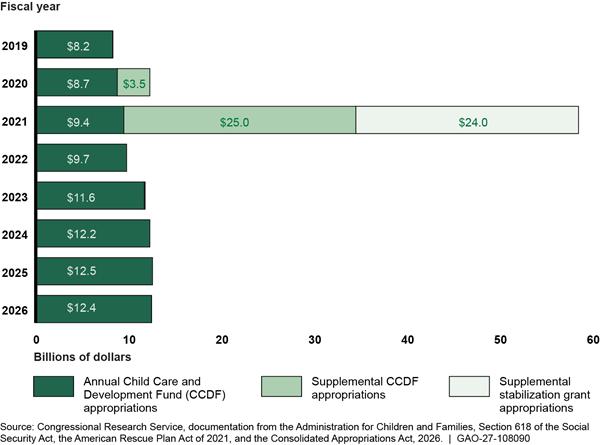
Note: COVID-19 supplemental appropriations to the Child Care and Development Fund (CCDF) were included in the CARES Act (2020); the Coronavirus Response and Relief Supplemental Appropriations Act, 2021 (CRRSA); and the American Rescue Plan Act of 2021 (ARPA). ARPA had two funding streams: supplemental CCDF funds intended to support families and providers, and stabilization grants which were specifically intended to go directly to providers from states.
As we reported in 2021, states used CARES and CRSSA funds to help child care providers experiencing temporary closures or decreased enrollment due to COVID-19; provide child care assistance to essential workers regardless of income; and deliver professional development for the child care workforce.[14] ACF had similar findings in 2022 with respect to CRSSA funds.[15] For ARPA stabilization grants, ACF reported that child care providers used funds to help with operational costs such as wages and benefits, rent and utilities, program materials and supplies, and cleaning and sanitation.[16]
Even before the pandemic, the child care market faced challenges, including inadequate supply in many locations, and lack of affordability for many families.[17] In 2024, we reported that selected state child care officials said states used pandemic funds to address long-standing challenges, including the affordability and availability of child care for families and child care providers’ financial viability and staffing.[18] At the time, state officials said that their states’ ability to secure ongoing funding would affect whether these efforts could be sustained.
Fraud Risks Associated with CCDF Funding
In August 2025, an HHS Office of Inspector General (OIG) report on ARPA stabilization funds found that ACF did not fully monitor states’ compliance with all grant provisions, did not always use reliable data in public reporting, and did not require states to establish specific internal controls or risk assessments.[19] This left pandemic funds vulnerable to misuse, according to the report. HHS OIG recommended that ACF develop a written, adaptable plan for overseeing future funding of new, emergency, or temporary CCDF programs. In June 2026, ACF provided this plan to HHS OIG for its review.
In January 2026, ACF temporarily froze access to CCDF funds in five states, citing allegations of CCDF fraud.[20] ACF also said it would require additional documentation from these states until it determined that the states were in compliance with federal requirements. Additionally, HHS instituted its “Defend the Spend” system, which asks all grantees, including CCDF state administrators, to attest that they have reviewed, made any necessary updates to, and are implementing strategies and controls to identify fraud and ensure program integrity.[21] Further, in May 2026, ACF rescinded parts of a 2024 final rule for CCDF that it said weakened its oversight of CCDF and increased fraud risk.[22] These changes, discussed later in the report, removed some CCDF requirements, including paying providers based on enrollment rather than attendance and paying providers before they provide services.
Several Strategies Helped States Spend Pandemic Funds, but Readiness Was a Challenge
Working with Providers, ACF, and State Leaders and Developing New Guidance Helped Nearly All States Spend Pandemic Funds
States reported in our survey that several strategies were useful for spending pandemic funds, including working with child care providers, ACF, and state leaders; developing new guidance and processes; and adding capacity (see figure 2).
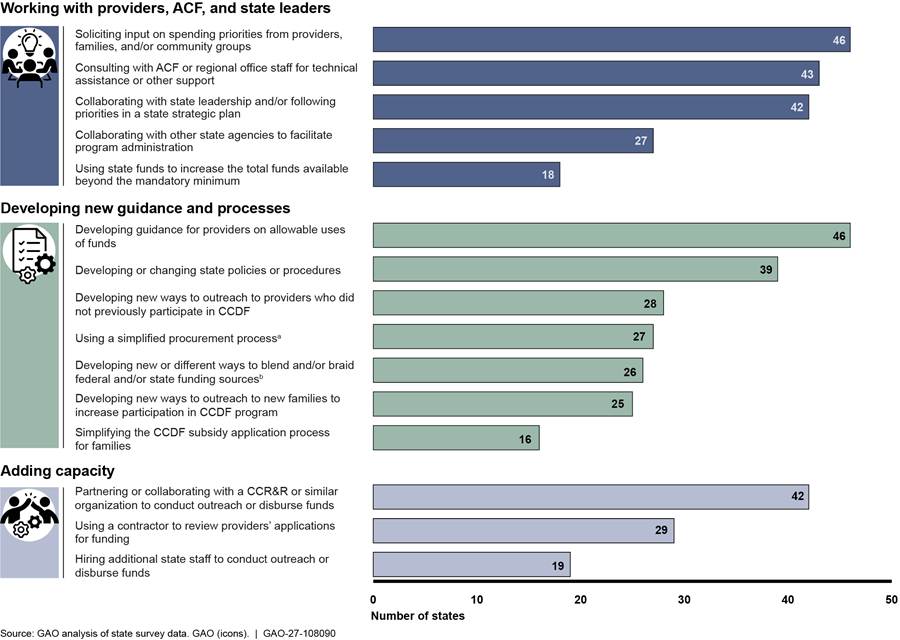
Notes: GAO administered a survey to all 50 states and the District of Columbia from January to March 2026. Illinois and North Dakota did not respond to our survey. Data in this figure are based on 47 states’ responses to the question, “How useful were the following strategies to your state in spending pandemic funds?” The term “useful” in this figure indicates when states reported that they found a strategy was little, moderately, or very useful.
Pandemic funds are COVID-19 supplemental appropriations to the Child Care and Development Fund (CCDF), which were included in the CARES Act (2020); the Coronavirus Response and Relief Supplemental Appropriations Act, 2021 (CRRSA); and the American Rescue Plan Act of 2021 (ARPA).
The Administration for Children and Families (ACF) administers CCDF.
Child Care Resource & Referral agencies (CCR&R) are local organizations that typically help families find affordable, quality child care and support providers with training, resources, and guidance.
aStates use a procurement process for goods and services, such as contracting with intermediary organizations like CCR&Rs.
bState agencies can mix multiple funding streams to support a common goal (blending) and/or coordinate separate funding streams to support a common goal (braiding).
· Working with providers, ACF, and state leaders. Nearly all state officials reported in our survey that soliciting feedback from providers, consulting with ACF for technical assistance, and collaborating with state leadership were useful strategies for spending pandemic funds.[23] Officials we interviewed in three of our four selected states told us they gathered provider feedback through different approaches, including surveys and discussions with providers. According to one state’s written survey response, ACF provided them with timely, detailed, and accurate responses to their questions about spending the funds. Additionally, officials we interviewed in two selected states told us that they worked with their state’s governor’s office before the pandemic to establish priorities for the child care sector and their state used pandemic funds to finance these priorities. One of these officials said they used state and pandemic funds to work with the governor’s office to create a computer system to disburse pandemic funds.
· Developing new guidance and processes. Nearly all state officials reported in our survey that developing new guidance for providers on allowable uses for pandemic funds was a useful spending strategy. In addition, most states said that developing or changing state policies or procedures was useful. For example, one official we interviewed in a selected state said that their state changed their policy to use pandemic funds to pay providers a more accurate reimbursement rate closer to the true cost of care. This official also said their state changed a contracting procedure to increase the provision of infant and toddler care. In addition, more than half of states said that simplifying their procurement process was useful for spending pandemic funds.[24] According to one state’s written survey response, this was the state’s most useful spending strategy.
· Adding capacity. Nearly all state officials reported in our survey that working with CCR&Rs—local organizations that support providers with training, resources, and guidance—or other similar organizations, was a useful strategy that added to the state agency’s capacity to conduct outreach and disburse funds to providers. An official we interviewed in one selected state said that CCR&Rs were crucial to communicating with providers because they frequently delivered cleaning supplies and protective equipment to them, so they were regularly in contact. CCR&Rs also provided virtual training to providers in this state. Over half of states said that adding capacity by using a contractor to review providers’ applications for funding was useful for spending the funds. Officials we interviewed in three selected states told us that they used a contractor to create a payment system. An official in the fourth selected state said the state comptroller’s office helped them disburse funds.
Pandemic-Related Factors and Gaps in States’ Readiness Were Spending Challenges for Most States
While states spent more than 99 percent of pandemic child care funds (see app. 1), about half (24) of states reported in our survey that it was challenging to spend at least one type of pandemic funding.[25] Slightly more states found ARPA funds challenging to spend compared to other pandemic funding types.[26] ARPA provided the largest amount of pandemic funds and included stabilization grants intended to go directly to providers, some of whom had not previously participated in the CCDF program.
Most states said they faced spending challenges related to pandemic factors and gaps in their readiness to spend a large influx of funds (see fig. 3).
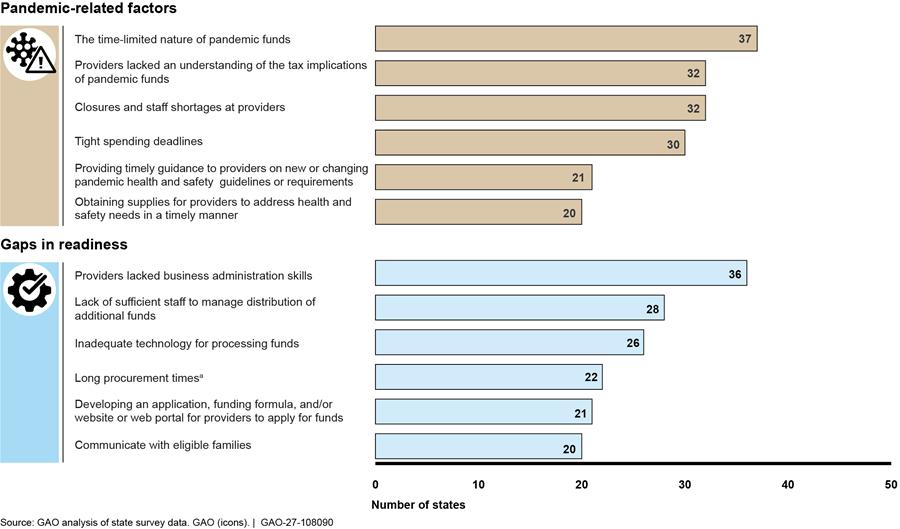
Notes: GAO administered a survey to all 50 states and the District of Columbia from January to March 2026. Illinois and North Dakota did not respond to our survey. Data in this figure are based on 47 respondents to the question, “How challenging, if at all, were each of the following factors for spending federal pandemic funds?” The term “challenging” in this figure indicates when states reported that they found the factor moderately or very challenging. We omitted the number of states that indicated that they found a factor a little challenging to avoid overstating how challenging states may have found a factor. Not all challenges listed in our survey appear here because fewer states reported them as challenging.
Pandemic funds are COVID-19 supplemental appropriations to the Child Care and Development Fund (CCDF), which were included in the CARES Act (2020); the Coronavirus Response and Relief Supplemental Appropriations Act, 2021 (CRRSA); and the American Rescue Plan Act of 2021 (ARPA).
aStates use a procurement process for goods and services, such as contracting with intermediary organizations like Child Care Resource & Referral agencies.
· Pandemic-related factors. States encountered spending challenges related to the emergency nature of pandemic funding and the pandemic’s effects on the child care sector. Most states identified the time limits on spending pandemic funds, gaps in providers’ understanding of the tax implications of the funds, and provider closures and staff shortages as spending challenges.[27] Officials we interviewed in three selected states and two other states’ written survey responses emphasized how challenging it was for states to spend pandemic funds in the required time frames.
· Gaps in readiness. States also faced challenges related to gaps in their overall readiness to adapt their systems and processes to spend new types of funding. These included providers’ lack of business administration skills, insufficient staff, inadequate technology, and long procurement times for goods and services.[28] Officials we interviewed in one selected state told us that developing and implementing processes and systems necessary for spending pandemic funds was a challenge and that some providers were not set up to receive the payments. An official in another state said the spending mechanisms they had in place were inadequate for the large amount of money they received. An official we interviewed in a third selected state said the state’s procurement process could take up to two years, which was a challenge because states were given spending time frames that were shorter than that.
Although states faced challenges related to the readiness of their technology systems and processes to spend pandemic funds, half or more states also reported in our survey that having certain resources and data in place prior to the pandemic was useful (see fig. 4).
Figure 4: Resources and Data States Had in Place Prior to the Pandemic and Considered Useful for Spending Pandemic Child Care Funds
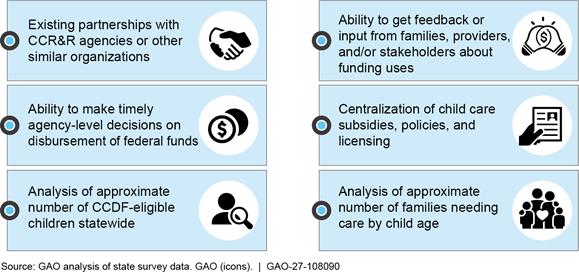
Notes: GAO administered a survey to all 50 states and the District of Columbia from January to March 2026. Illinois and North Dakota did not respond to our survey. Data in this figure are based on 41 states’ responses to the question, “How useful were each of the following resources and data in facilitating the spending pandemic funds?” The term “useful” in this figure indicates when at least 22 states reported that they found a resource a little, moderately, or very useful; not all data and resources listed in our survey appear here because fewer states selected them.
Child Care Resource & Referral agencies (CCR&R) are local organizations that typically help families find affordable, quality child care and support providers with training, resources, and guidance.
CCDF is the Child Care and Development Fund.
Over half of states said that before the pandemic they had an analysis of the approximate number of families needing care and of CCDF-eligible children statewide. Nearly all of these states said these data were useful in spending pandemic funds. In addition, prior to the pandemic about half of states had a state plan that outlined the governor’s long-term priorities and goals, including those for child care, and nearly all of those states said it was useful for spending pandemic funds.
Despite the positive outcomes associated with having resources and data in place prior to the pandemic, ACF has not encouraged states to assess their readiness to receive and disburse any new, temporary, or emergency CCDF funding that may be made available for future emergencies. ACF officials told us they saw limited benefit in encouraging states to assess their readiness to administer potential supplemental funds for a future emergency because emergency funding streams and the associated needs can differ greatly. However, encouraging states to assess their technology and systems’ capabilities to disburse a large influx of funds or having steps to speed up procurement of goods and services can be useful across various new, temporary, or emergency funding. A mechanism is already in place to do so. States could include this assessment as part of the plans they are required to submit to ACF every three years.
ACF’s values emphasize using proven practices to improve performance and reduce administrative burdens through partnerships with states.[29] By encouraging states to assess their readiness to spend any new, temporary, or emergency CCDF funding that may be authorized, such as by encouraging states to present such an assessment in their state plans. ACF can help states more effectively disburse funding when such situations arise. This action, in turn, would help ACF more effectively carry out its mission of promoting the economic and social well-being of families and children.
States Increased Monitoring Activities for Pandemic Funds but There Were Gaps in ACF’s Guidance
Nearly All States Increased Provider Support, Conducted Audits, and Used Additional Capacity to Monitor Pandemic Funds
Nearly all states reported in our survey that increasing provider support, conducting audits of providers’ use of funds, and adding monitoring capacity were useful strategies for monitoring pandemic funds (see figure 5).
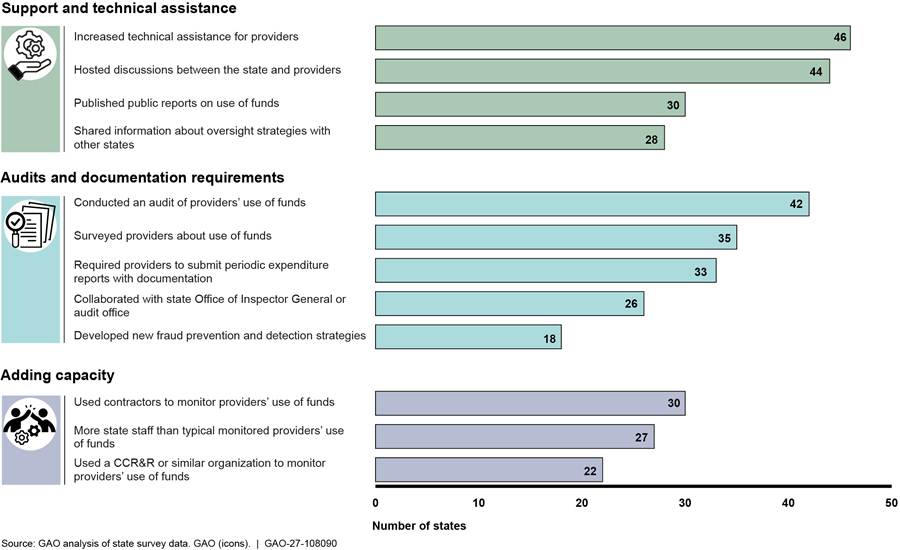
Notes: GAO administered a survey to all 50 states and the District of Columbia from January to March 2026. Illinois and North Dakota did not respond to our survey. Data in this figure are based on 47 states’ responses to the question, “How useful were each of the following strategies for ensuring providers used pandemic funds appropriately?” The term “useful” in this figure indicates when states reported that they found a strategy was little, moderately, or very useful.
Pandemic funds are COVID-19 supplemental appropriations to the Child Care and Development Fund (CCDF), which were included in the CARES Act (2020); the Coronavirus Response and Relief Supplemental Appropriations Act, 2021 (CRRSA); and the American Rescue Plan Act of 2021 (ARPA).
Child Care Resource & Referral agencies (CCR&R) are local organizations that typically help families find affordable, quality child care and support providers with training, resources, and guidance.
· Support and technical assistance. Nearly all states reported that increasing technical assistance for providers and hosting discussions with providers were useful strategies for monitoring pandemic funds. For example, one state’s written survey response said officials quickly realized that providers needed more technical assistance to ensure accountability and accuracy of their reporting and records of the funds.
· Audits and documentation requirements. Nearly all states said it was useful to conduct audits of providers’ use of funds and most states said it was useful to require providers to submit periodic expenditure reports with documentation.
· Adding capacity. Nearly all states said it was useful to add capacity to monitor providers’ use of pandemic funds using their own staff, contractors, or a CCR&R or similar local organization.[30] For example, three states’ written survey responses said that the state relied on several state offices to help audit pandemic funds, including the governor’s office and the state auditor’s office. In addition, officials we interviewed in one state said that CCR&Rs helped them to monitor funds, and in another state an official said they relied heavily on CCR&Rs in part because providers trusted these organizations.
More Than Half of States Had Monitoring Challenges Such as Educating Providers and Documenting Spending
In our survey, more than half (26) of states reported it was challenging to monitor at least one type of pandemic child care funding. More states found ARPA stabilization funds—which provided grants directly to providers and entailed different funding rules—challenging to monitor compared to other pandemic funds.[31]
Monitoring Challenges
Over half of states reported in our survey that ensuring that providers understood allowable uses of pandemic funds and obtaining provider documentation to track pandemic spending were monitoring challenges (see table 1).
|
Monitoring challenges |
Number of states |
|
Ensuring providers understood allowable uses |
28 |
|
Obtaining documentation from providers about specific allowable expenses and activities |
28 |
|
Using existing data systems to track spending |
15 |
|
Ensuring sufficient specialized staff were available to effectively monitor and oversee use of funds |
15 |
|
Obtaining new data systems to track spending |
12 |
Source: GAO analysis of state survey data. | GAO‑27‑108090
Notes: GAO administered a survey to all 50 states and the District of Columbia from January to March 2026. Illinois and North Dakota did not respond to our survey. Data in this figure are based on 47 states’ responses to the question, “Overall, how challenging, if at all, were the following aspects of monitoring providers’ use of pandemic funds for your state?” The term “challenging” in this table indicates when states reported that they found the aspect moderately or very challenging to monitor. We omitted the number of states that indicated that they found an aspect a little challenging to avoid overstating how challenging states may have found an aspect. Not all monitoring challenges listed in our survey appear here because fewer states selected them. Aspects of monitoring that few (6) states found challenging were: understanding or rectifying state single audit findings; verifying eligibility for providers who had not previously received Child Care and Development Fund (CCDF) funds; and monitoring Child Care Resource & Referral agencies or other third-party intermediaries that played a role in disbursing funds.
Pandemic funds are COVID-19 supplemental appropriations to CCDF which were included in the CARES Act (2020); the Coronavirus Response and Relief Supplemental Appropriations Act, 2021 (CRRSA); and the American Rescue Plan Act of 2021 (ARPA).
One official we interviewed in a selected state said they were uncertain about some allowable uses of pandemic funds and ultimately hired an auditor due to this uncertainty. Another state official we interviewed said it was challenging to ensure that providers kept the proper documentation for the funds. According to the official, as of 2025, their state was still conducting audits because some providers did not understand the documentation requirements.
As with spending pandemic funds, pandemic factors also affected the ways states conducted monitoring. For example, according to the HHS OIG, many states requested waivers of ACF from on-site inspections of child care facilities because they were unable to safely conduct them during the pandemic.[32] An official we interviewed in one selected state said that during the pandemic, they ensured that they made in-person inspections when a program was new, or if there were specific complaints.
Many states also reported in our survey that using existing or obtaining new data systems was a challenge for monitoring providers’ use of the funds. For example, one official we interviewed from a selected state said that their system made it difficult to pay new providers before they had direct deposit set up. Until then, the state had to pay them using paper checks and the state did not have a tracking system in place to track the checks. As previously discussed, states’ readiness to spend pandemic funds was sometimes limited by their technology systems and staff capacity, which also affected their ability to monitor the funds.
ACF Monitoring Guidance
Despite these challenges, most states reported in our survey that ACF monitoring guidance and support was useful in helping them monitor pandemic child care funds. For example, most states said that ACF addressed their questions about spending categories and provided them with timely clarification on reporting questions (see table 2).
Table 2: Number of States That Said ACF Monitoring Guidance and Support for Pandemic Child Care Funds Was Useful
|
ACF monitoring guidance or support |
Number of states |
|
Addressing questions about specific spending categories (e.g., major renovation) |
39 |
|
Providing your state with timely clarification on any reporting questions |
37 |
|
Knowing in advance what information needed to be collected for reporting |
35 |
|
Providing your state with feedback or follow-up on your plans for program administration or oversight |
32 |
|
Providing your state with summary information about
uses of pandemic funds nationally, to enable better program administration |
31 |
|
Helping the state respond to monitoring needs for pandemic funds |
28 |
|
Understanding how the state’s information is evaluated and used |
28 |
|
Helping your state address pandemic-related single audit findings |
19 |
|
Supporting your state in identifying and recovering fraudulent payments |
17 |
Source: GAO analysis of state survey data. | GAO‑27‑108090
Notes: GAO administered a survey to all 50 states and the District of Columbia from January to March 2026. Illinois and North Dakota did not respond to our survey. Data in this figure are based on 47 states’ responses to the question, “How useful was Administration for Children and Families’ (ACF) guidance and support related to the following aspects of monitoring pandemic funds?” The term “useful” in this table indicates when states reported that they found a strategy was little, moderately, or very useful to capture all perceived benefits states may have reported on a certain topic.
Pandemic funds are COVID-19 supplemental appropriations to the Child Care and Development Fund (CCDF), which were included in the CARES Act (2020); the Coronavirus Response and Relief Supplemental Appropriations Act, 2021 (CRRSA); and the American Rescue Plan Act of 2021 (ARPA).
While most states reported that ACF monitoring guidance and support was useful, several states in our survey cited issues. For example, one state’s written survey response said the state received limited monitoring guidance from ACF, so state officials independently met with officials from other states to brainstorm about strategies for monitoring funds. Another state’s written survey response said that ACF did not answer many of the state’s important monitoring questions for long periods of time and some questions went unanswered altogether. ACF officials said that representatives from regional offices held monthly phone calls during the pandemic with state child care administrators and gave them the opportunity to ask questions.
In addition, the aspects of ACF monitoring guidance that states most frequently reported to be not useful, which state officials and stakeholders also told us they had challenges with, were:
· Summary information. Ten states reported in our survey that they did not find ACF’s summary information (i.e., aggregated data from required forms) about how pandemic funds were being used nationally to be useful. One state’s written survey response noted that ACF did not provide timely, aggregated information about state spending in a way that could inform state action or decision-making. One stakeholder from a national organization that represents state child care administrators we interviewed said states did not know why the federal government was collecting the data, how the data would be used, and how other states were spending their money.
· Required monitoring information. Nine states reported in our survey that ACF guidance was not useful in understanding in advance what information they would need to collect from providers.[33] Officials we interviewed in two selected states and one state’s written survey response said states did not know which data ACF would be collecting before the money was given to providers. In two of these cases, states designed monitoring systems before they knew which data to collect. One official we interviewed from a selected state said they guessed which data ACF would collect based on previous experience. Another state’s written survey response said the state had to retool their data system after receiving ACF monitoring guidance. ACF officials told us they awarded the ARPA stabilization funds to states as quickly as possible due to the urgent need to stabilize the child care market. Additionally, they said they were required to publish two Federal Register notices seeking public comment and to obtain Office of Management and Budget approval prior to conducting any information collection, such as the new data collection for the ARPA stabilization funds.
· Recovering fraudulent payments. Nine states reported in our survey that ACF guidance was not useful in supporting states in identifying and recovering fraudulent payments. State agencies are required to describe their processes to identify, investigate, and recover fraudulent payments in their state plans. However, according to ACF training materials, because fraud is not defined in the Child Care and Development Block Grant Act, states have flexibility in this area. Officials we interviewed in one selected state said they were concerned about their own lack of expertise in identifying fraud. These officials explained that while they understood how to take some precautions to prevent fraud, the state’s auditing contractor helped them ensure that providers used pandemic funds only for allowable purposes. Another state official we interviewed said that they asked ACF how to define fraud in this context and ACF told them it was up to the state to define.[34] ACF officials said they supported states’ program integrity efforts in administering pandemic funding via multiple webinars, briefs, and tools. They said that for the most recent monitoring cycle (fiscal years 2025-2027), they looked at how states described their internal control activities, as well as processes to evaluate these activities and identify risks, in their state plans.[35] ACF officials also said they plan to modify the state plan requirements in the next submission cycle (fiscal years 2028-2030) to ensure a greater focus on fraud prevention and deterrence.
In response to a recommendation made in an August 2025 HHS OIG report, ACF developed a plan for overseeing future funding of new, emergency or temporary CCDF programs in August 2026.[36] This plan acknowledges actions that ACF would need to take to mitigate monitoring challenges that states reported to us. These challenges include providing timely guidance to states on allowable uses of funds and on identifying and recovering fraudulent payments, but the plan does not provide details on how ACF would address these issues. ACF has not sought, and officials told us they did not intend to seek, state administrators’ feedback on whether their planned approach sufficiently addresses the monitoring challenges states experienced with pandemic funds. ACF officials said this is because they developed the plan to reflect feedback they had received during the pandemic funding period from state CCDF administrators, and this plan is an internal planning document. However, ACF could benefit from more recent feedback on whether ACF’s planned approach sufficiently addresses the challenges states experienced monitoring the pandemic funds, now that states have had the opportunity to reflect upon the entire pandemic funding period and their interactions with ACF during this time. Without more systematically obtaining and incorporating feedback from state CCDF administrators on the planned approach, ACF risks not fully addressing the challenges state administrators experienced.
ACF’s guiding values emphasize clear communication, partnership, and ownership of outcomes.[37] In addition, federal internal controls state that management should communicate and obtain information from entities it oversees to help them understand their responsibility in achieving organizational objectives. Management should also evaluate how effective their operations are and use the results of these evaluations to make necessary changes in their operations.[38]
Several state officials found that some ACF support and guidance was not useful to effectively monitor pandemic funds, according to our survey. ACF has developed a plan to provide improved and timely monitoring guidance for states in a future emergency, but without incorporating feedback from state CCDF administrators, ACF may miss an opportunity to provide useful guidance to effectively monitor CCDF funds in a future emergency.
States Are Sustaining Some Pandemic Funding Outcomes but Said They Want More Support for Ongoing Challenges
States Invested in Child Care to Sustain Some Pandemic Funding Outcomes
States reported in our survey that pandemic child care funds allowed them to achieve several positive outcomes during the pandemic. These included financially stabilizing child care providers, enhancing pay and benefits for child care staff, increasing the quality and affordability of care, and improving their own administrative capacity, such as to collect new data (see fig. 6).[39]
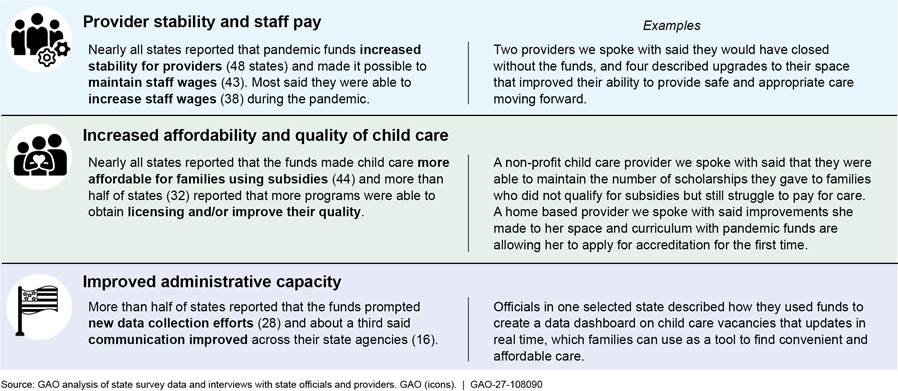
Notes: GAO administered a survey to all 50 states and the District of Columbia from January to March 2026. Illinois and North Dakota did not respond to our survey. Data in this figure are based on 49 state responses to the question, “Did pandemic funding contribute substantially (i.e., the outcome likely would not have been possible without the funding) to any of the following outcomes in your state?”
Pandemic funds are COVID-19 supplemental appropriations to the Child Care and Development Fund (CCDF), which were included in the CARES Act (2020); the Coronavirus Response and Relief Supplemental Appropriations Act, 2021 (CRRSA); and the American Rescue Plan Act of 2021 (ARPA).
More than half of states in our survey (28) reported that they contributed state financial resources to maintain policies, procedures, or initiatives that they started with federal pandemic funds (see fig. 7).
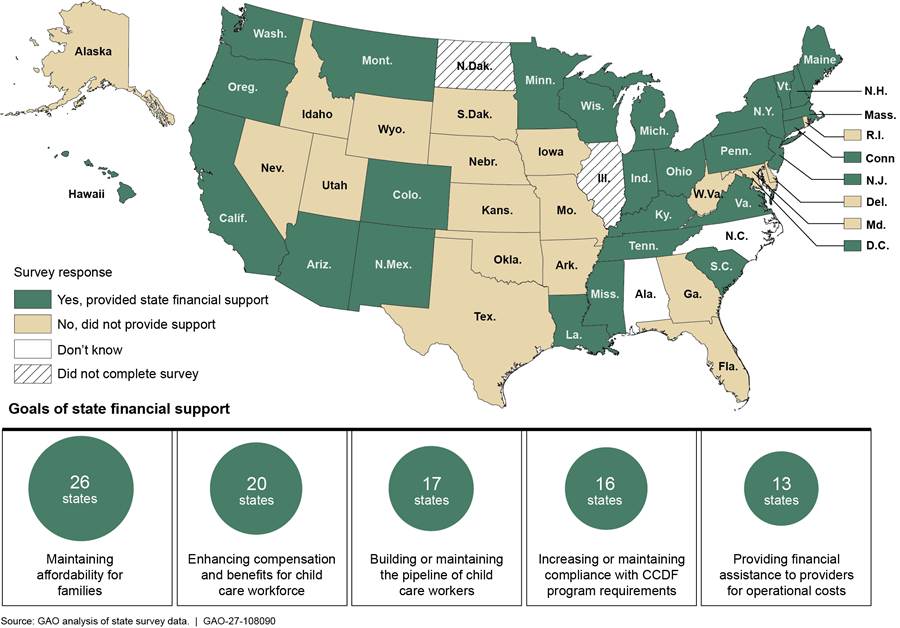
Notes: GAO administered a survey to all 50 states and the District of Columbia from January to March 2026. Illinois and North Dakota did not respond to our survey. Data in the map are based on 49 states’ responses to the question, “Is your state currently contributing state financial resources to maintain any policies, procedures, or initiatives started with federal COVID funds?” and “What is the goal(s) of this financial contribution?”
Pandemic funds are Covid-19 supplemental appropriations to the Child Care and Development Fund (CCDF), which were included in the CARES Act (2020); the Coronavirus Response and Relief Supplemental Appropriations Act, 2021 (CRRSA); and the American Rescue Plan Act of 2021 (ARPA).
|
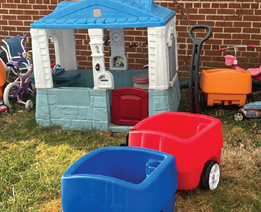
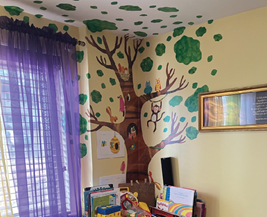
Provider Examples of Facility Enhancements A home-based provider we spoke with told us she used pandemic child care funds for:
· New playground equipment in the provider’s yard.
· New paint and mural to enhance the caregiving space of the provider’s house. Source: GAO interview with a provider and GAO (photos). | GAO‑27‑108090 |
Nearly all of those states reported that a goal of their state’s financial contribution was maintaining affordability for families. About two thirds of those states said a goal was to enhance compensation and benefits for the child care workforce. For example, officials we interviewed in one selected state said they used state funds to maintain a salary supplement for the child care workforce that the state started during the pandemic. This salary supplement provides compensation-based incentives tied to workers’ educational level and experience. These officials said they had seen positive results from incentivizing further training and credentialing among their workforce, and a non-profit child care provider in that state told us this supplement helped them attract and retain child care workers.
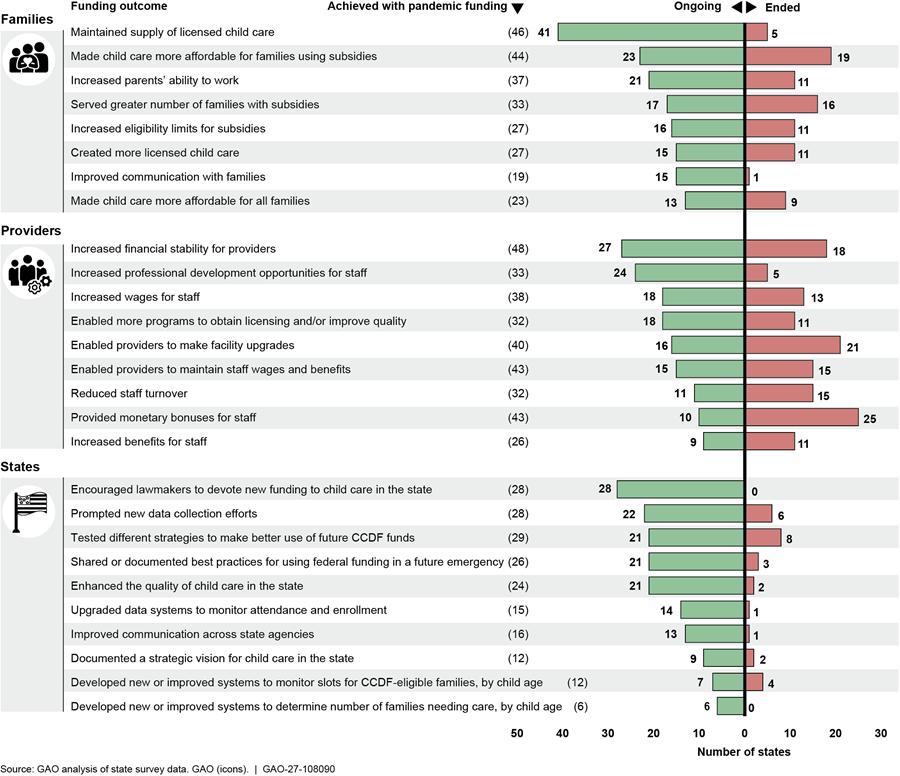
While states have retained some positive outcomes, nearly all states (44) reported in our survey that since January 2026, at least one of the outcomes they achieved with pandemic funds has ended. The outcomes states most frequently maintained related to improved state processes or capacity. The outcomes states more frequently reported had ended related to affordability for families and increased supports for providers (see fig. 8).
Figure 8: Reported Status of Pandemic Child Care Funding Outcomes for Families, Providers, and States as of January 2026
Notes: GAO administered a survey to all 50 states and the District of Columbia from January to March 2026. Illinois and North Dakota did not respond to our survey. Data in this figure are based on 49 states’ responses to the questions, “Did pandemic funding contribute substantially (i.e., the outcome likely would not have been possible without the funding) to any of the following outcomes in your state?” and “Are each of the following outcomes ongoing as of January 2026?” Data on the left and right sides of the bar chart may not sum to the total number of states that reported the outcome had occurred because some states either skipped or reported “don’t know” to the follow-up question.
Pandemic funds are COVID-19 supplemental appropriations to the Child Care and Development Fund (CCDF), which were included in the CARES Act (2020); the Coronavirus Response and Relief Supplemental Appropriations Act, 2021 (CRRSA); and the American Rescue Plan Act of 2021 (ARPA).
About half (16) of the 33 states that reported increasing the number of families they served with subsidies using pandemic funding said they could no longer sustain this. In addition, 36 states reported covering the cost of family co-payments for providers during the pandemic, but 28 states reported that this has been discontinued.[40] About a third of the 43 states that reported maintaining staff wages and benefits with pandemic funding said they could no longer sustain this.
ACF Support Did Not Fully Address Ongoing CCDF Program Challenges
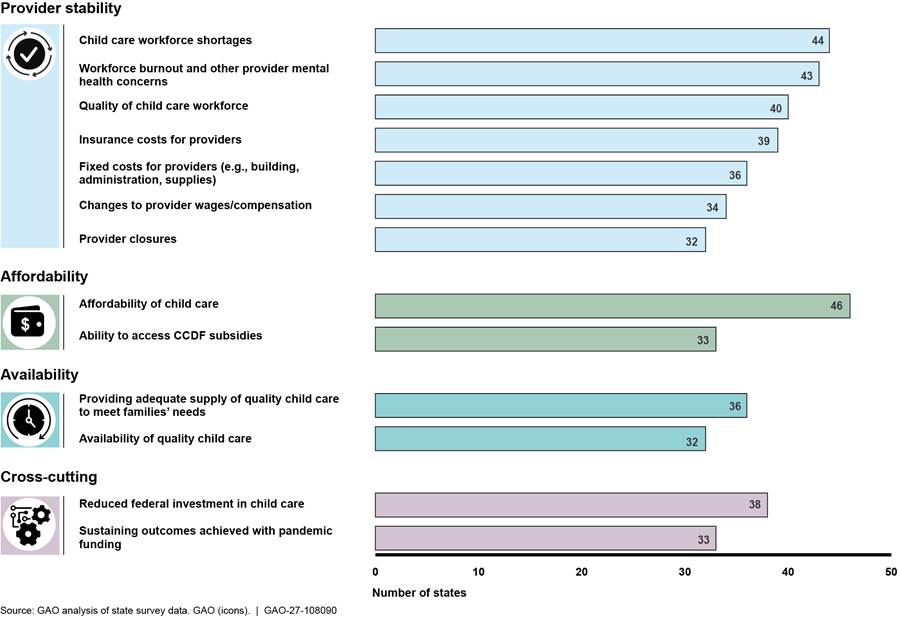
All states reported in our survey that they anticipated CCDF program challenges in fiscal year 2026.[41] Most states said that additional guidance from ACF could help address these challenges.[42] States’ most frequently expected challenges mirrored some of the pandemic funding outcomes that had reportedly ended, including maintaining the stability of providers in the state, the affordability of care, and the availability of quality child care. Most states also reported that reduced federal investment in child care and sustaining outcomes achieved with pandemic funding would be challenging for their CCDF programs moving forward (see fig. 9).[43]
Figure 9: State’s Most Frequently Expected Challenges for Child Care and Development Fund Program in Fiscal Year 2026
Notes: GAO administered a survey to all 50 states and the District of Columbia from January to March 2026. Illinois and North Dakota did not respond to our survey. Data in this figure are based on 49 states’ responses to the question, “Does your state expect each of the following factors to be challenging for its Child Care and Development Fund (CCDF) program in fiscal year 2026?” Not all of the challenges listed in our survey appear here because fewer states reported them as challenging.
Pandemic funds are COVID-19 supplemental appropriations to the Child Care and Development Fund (CCDF), which were included in the CARES Act (2020); the Coronavirus Response and Relief Supplemental Appropriations Act, 2021 (CRRSA); and the American Rescue Plan Act of 2021 (ARPA).
· Provider stability. Nearly all states said they anticipated one or more challenges with the stability of providers in their state, including child care workforce shortages, workforce burnout, and quality of the workforce. Most states said they anticipated challenges related to providers’ financial stability, including insurance costs and fixed costs. A center-based provider we spoke with said that since the expiration of pandemic funding, all her prices for food and supplies had increased and her insurance costs had quadrupled. She said she could not raise rates for families, so her already thin profit margins were getting thinner.
· Affordability. Nearly all states said they anticipated challenges with the affordability of child care generally, and most states anticipated challenges with access to CCDF subsidies specifically. Three of our four selected states said they had either stopped accepting applications from families or instituted a subsidy waitlist. For example, officials in one selected state said their biggest challenge is their waitlist, on which they had about 1,000 families. They said they have never had a waitlist of this magnitude. A provider in one selected state told us that to not raise prices, she sometimes forwent her own paycheck. Another told us they had to increase their rates because all their costs had increased.
· Availability. Most states reported anticipating challenges with the adequacy of the supply of quality child care. For example, county officials from one selected state told us they estimate they are only able to serve about 20 percent of the population of at-risk children. In addition, about half of states in our survey reported that the quantity of licensed care in their states was “somewhat” or “very” insufficient as of January 2026 (see fig. 10).
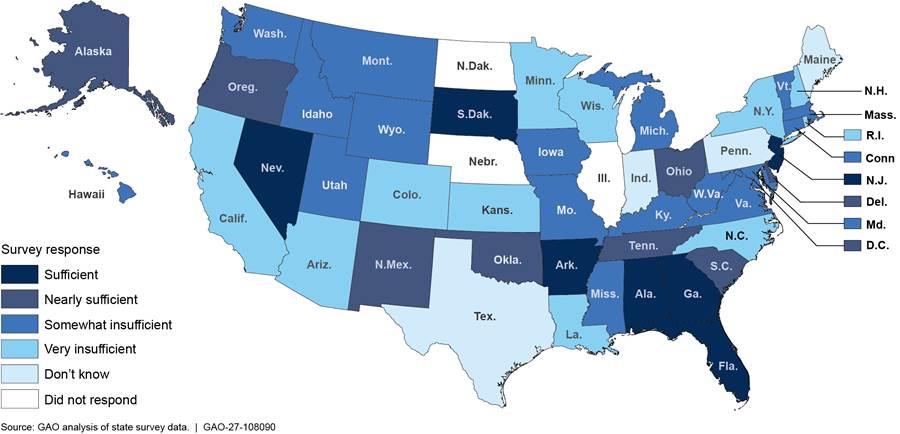
Notes: GAO administered a survey to all 50 states and the District of Columbia from January to March 2026. Illinois and North Dakota did not respond to our survey. Data in this figure are based on 48 states’ responses to the question: “To the best of your knowledge, how sufficient or insufficient was the quantity of licensed child care in your state to meet the need for care after the expiration of pandemic funding (September 2024-current)?”
Pandemic funds are COVID-19 supplemental appropriations to the Child Care and Development Fund (CCDF), which were included in the CARES Act (2020); the Coronavirus Response and Relief Supplemental Appropriations Act, 2021 (CRRSA); and the American Rescue Plan Act of 2021 (ARPA).
ACF officials told us that they are helping states address some of these challenges, particularly around affordability and availability of care. They said they are doing this by rescinding costly and burdensome portions of the 2024 Final Rule, such as the requirement to limit family co-payments to 7 percent of family income.[44] They said this would give states more flexibility on where to focus their funds to best support families.[45] Since pandemic funds expired, ACF officials told us they have made updates to an existing training on business administration that state officials can use to support providers. The officials said that this existing training has become more relevant after the pandemic, and they have made updates to one portion to support discussions about emergency planning and savings for providers, but the core curriculum remains unchanged. The officials said that ACF is considering providing new resources on financial planning for emergencies for providers, but this proposed training, as described, would not focus on helping providers address rising costs since the pandemic.
The pandemic infusion of funds exposed some business administration challenges that child care providers were unprepared to address, according to our survey. Most states reported in our survey that providers lacked business administration skills (36 states) or an understanding of the tax implications of COVID funds they could have applied for (32 states). In our survey, one state said they learned very quickly that providers needed more technical assistance on business management to meet the requirements tied to pandemic funds. Officials in one selected state told us that providers did not understand how accepting pandemic funds affected their taxes and that providers sought help from accountants and other local organizations. Officials in another selected state told us that providers did not have the business acumen to track pandemic funds or to correctly code expenditures such as retention bonuses.
Providers we spoke with echoed these concerns about business-related challenges. One said that other providers approached her with tax questions and were skeptical about applying for pandemic funds because of the tax implications. Another provider said he used his business knowledge to help his family child care business by paying months of rent in advance to offset the tax implications of an influx of pandemic funds at the end of the year. In addition, he said he invests money in a brokerage account and uses the earnings to pay teacher retention bonuses. But he said these are strategies that few other providers are knowledgeable about.
In light of the expiration of pandemic child care funds, coupled with rising costs since the pandemic, state officials and stakeholders we spoke with said that providers could benefit from more assistance in managing their businesses. ACF has an opportunity to provide additional support to states to address business challenges for providers as they move forward from the expiration of pandemic funding. The Child Care and Development Block Grant Act of 2014 includes a provision that requires states to develop and implement strategies to strengthen the business practices of child care providers to expand the supply of child care providers and improve the quality of child care services. Federal internal controls say that agencies should communicate quality information to help achieve their objectives and respond to risks related to the agency’s objective. The financial instability of child care providers is a potential risk to CCDF’s objective of enabling families with low incomes to better support their families while promoting access to affordable, high quality child care.[46] More targeted ACF trainings or resources—such as examples of state best practices—for states to support center- and home-based providers could help address issues such as rising fixed costs, rising insurance costs, and understanding the tax implications of receiving supplemental federal grants. This could contribute to the financial stability of child care providers, better ensuring that families have more stable access to care, and could potentially expand the supply of care by helping providers better manage their businesses.
Conclusions
Supplemental appropriations to CCDF, totaling over $52 billion, were a historic infusion of funds into the child care sector. ACF and states had to act quickly to develop strategies to disburse funds and ensure appropriate oversight and program integrity. States were able to use more than 99 percent of these funds by the spending deadlines and achieved positive outcomes for families and child care providers in their states.
States experienced challenges, however, with both spending and monitoring these funds. By encouraging states to assess their readiness to receive and disburse any new, temporary, or emergency CCDF funding that may be authorized in the future, ACF could help better position states to effectively spend future funds. By seeking state officials’ more recent feedback on whether ACF’s planned approach to administering new, temporary, or emergency CCDF funding is responsive to concerns they identified—reflecting on the entirety of the pandemic funding period and their interactions with ACF—and incorporating that feedback as appropriate, ACF can better position itself to more effectively monitor CCDF funds in a future emergency and prevent the potential misuse of funds.
Since the expiration of pandemic child care funding, states continue to face challenges with their CCDF programs, particularly related to the financial stability of their providers. Since then, rising costs have created additional business complexities for providers, deepening business administration challenges that were exposed during the pandemic. ACF could better ensure that families have more stable access to child care and potentially expand the supply of care by providing more targeted trainings or resources, such as examples of state best practices, to help providers better manage these challenges.
Recommendations for Executive Action
We are making the following three recommendations to the Assistant Secretary for ACF:
Encourage states to assess their readiness (e.g., technology capabilities, procurement processes, and other internal systems) to receive and disburse any new, temporary, or emergency CCDF funding that may be authorized in the future. For example, states could include these assessments in their state plans. (Recommendation 1)
Obtain and incorporate, as appropriate, recent feedback from state CCDF administrators on whether ACF’s planned approach for administering any new, temporary, or emergency CCDF funding is responsive to monitoring challenges states identified with pandemic funding. (Recommendation 2)
Provide additional resources on business administration and development for providers to better assist state CCDF administrators in supporting center- and home-based providers in maintaining their long-term financial stability. For example, these resources could be trainings or resources (such as examples of state best practices) that focus on dealing with rising fixed costs, rising insurance costs, and understanding the tax implications of receiving supplemental federal grants. (Recommendation 3)
Agency Comments
We provided a draft of this report to HHS for review and comment. The agency concurred with our recommendations, and also provided technical comments, which we incorporated as appropriate.
In written comments, reproduced in appendix III, HHS outlined steps the agency will take to implement our recommendations. HHS said the agency will host regional meetings with officials from state CCDF lead agencies in Spring 2027. HHS will incorporate information and resources in these meetings to encourage states to assess their readiness for any future emergencies, including the possibility of administering supplemental funding. HHS said that at the regional meetings, it will share key highlights from its planned approach for administering any new, temporary, or emergency supplemental CCDF funding. HHS also said it will seek input and feedback from states to ensure that the planned approach is responsive to challenges identified with the administration of pandemic funds. In addition, HHS said it will provide technical assistance on insurance in child care settings and on how child care providers in all settings can strengthen business practices.
We are sending copies of this report to the appropriate congressional committee, the Department of Health and Human Services, and other interested parties. In addition, the report will be available at no charge on the GAO website at http://www.gao.gov.
If you or your staff have any questions about this report, please contact me at larink@gao.gov. Contact points for our Offices of Congressional Relations and Media Relations may be found on the last page of this report. GAO staff who made key contributions to this report are listed in appendix IV.

Kathryn A. Larin, Director
Education, Workforce, and Income Security Issues
In fiscal years 2020 and 2021, Congress appropriated supplemental funding for the Child Care and Development Fund (CCDF). COVID-19 supplemental appropriations to CCDF were included in the CARES Act (2020); the Coronavirus Response and Relief Supplemental Appropriations Act, 2021 (CRRSA); and the American Rescue Plan Act of 2021 (ARPA). The final deadline for states to spend this funding was in September 2024. This appendix presents information on national pandemic funding and spending amounts by funding type and spending category.
According to expenditure data provided by the Administration for Children and Families, states were able to spend more than 99 percent of these funds by various deadlines through fiscal year 2024 across all funding types (see fig 11). Officials in two states that had balances told us the state had spent all its funds and that the balances represented funds they recovered, for example, from improper payments.
Figure 11: Funding Amount and Percent Spent, by Supplemental COVID-19 Funding Type, Fiscal Years 2020-2024
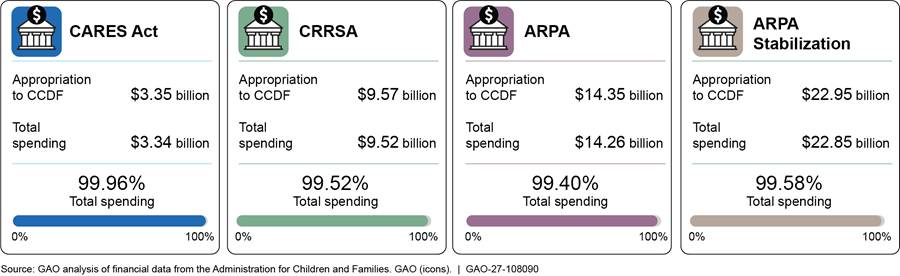
Notes: These award amounts and percentages spent are for 51 states, including the District of Columbia, and do not include appropriated funding for Tribes and Territories. These expenditure data had been reviewed but were considered preliminary by the Administration for Children and Families because states are able to update their expenditure reports beyond the liquidation deadline to account for any returned funds.
COVID-19 supplemental appropriations to the Child Care and Development Fund (CCDF) were included in the CARES Act (2020); the Coronavirus Response and Relief Supplemental Appropriations Act, 2021 (CRRSA); and the American Rescue Plan Act of 2021 (ARPA). ARPA had two funding streams: supplemental CCDF funds and stabilization grants which were intended to go directly to providers from states.
Across the CARES, CRRSA, and ARPA supplemental funds, the biggest categories of spending were for direct services, including vouchers for child care, followed by quality activities, including supporting professional development of the child care workforce (see fig. 12). For the ARPA stabilization funds, the biggest category of spending was subgrants to providers (see fig. 13).
Figure 12: Spending of Supplemental COVID-19 Child Care Funds by Funding Type and Spending Category, Fiscal Years 2020-2024
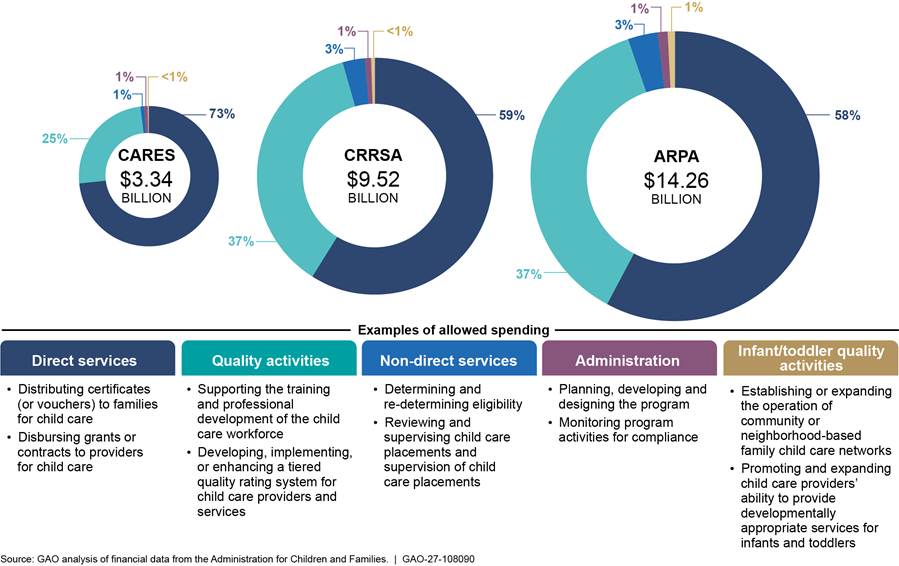
Notes: These spending categories were for 51 states, including the District of Columbia, and do not include funding for Tribes and Territories. These expenditure data had been reviewed but were considered preliminary by the Administration for Children and Families because states are able to update their expenditure reports beyond the liquidation deadline to account for any returned funds.
COVID-19 supplemental appropriations to the Child Care and Development Fund (CCDF) were included in the CARES Act (2020); the Coronavirus Response and Relief Supplemental Appropriations Act, 2021 (CRRSA); and the American Rescue Plan Act of 2021 (ARPA). ARPA had two funding streams: supplemental CCDF funds and stabilization grants which were intended to go directly to providers from states. This figure does not include ARPA stabilization grants.
Figure 13: Spending of ARPA Stabilization COVID-19 Child Care Funds, by Spending Category, Fiscal Years 2021-2023
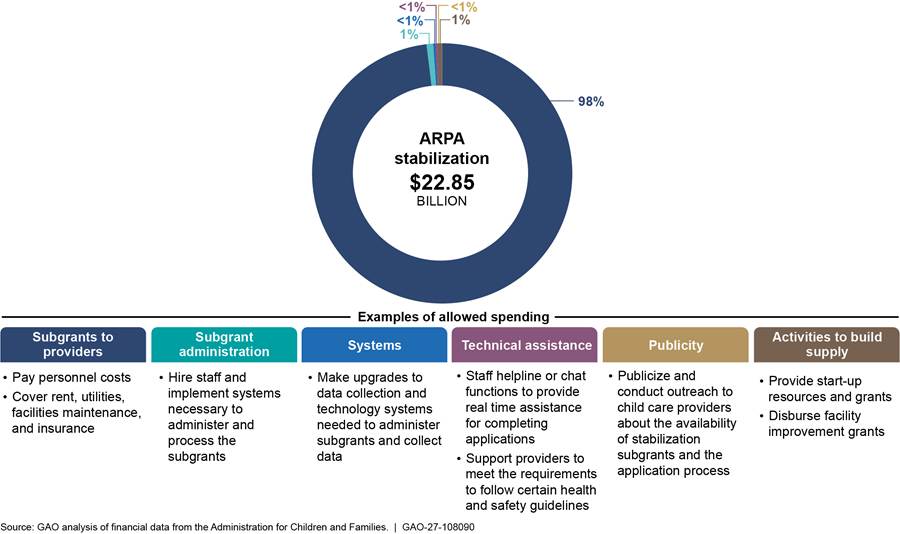
Notes: These spending categories were for 51 states, including the District of Columbia, and do not include funding for Tribes and Territories. These expenditure data had been reviewed but were considered preliminary by the Administration for Children and Families because states are able to update their expenditure reports beyond the liquidation deadline to account for any returned funds.
COVID-19 supplemental appropriations to the Child Care and Development Fund (CCDF) were included in the CARES Act (2020); the Coronavirus Response and Relief Supplemental Appropriations Act, 2021 (CRRSA); and the American Rescue Plan Act of 2021 (ARPA). ARPA had two funding streams: supplemental CCDF funds and stabilization grants which were intended to go directly to providers from states. This figure does not include supplemental funds.
Studies have shown that the child care industry is more sensitive to economic ups and downs than other low-wage industries.[47] In this appendix, we provide an analysis of the selected economic factors affecting both providers’ supply of child care and families’ demand for care before, during, and after the period when pandemic funds were available to states.
We reviewed empirical research on the child care market, including studies published in economics journals; working papers; association, think tank, and nonprofit publications; and government reports published from 2020-2025. We screened studies for relevance and for methodological fatal flaws. We supplemented these studies with publicly available data.
Factors Affecting Child Care Demand and Supply
Demand for child care services depends on many factors, such as the number of young children, families’ needs, and the price of child care. For example, parental labor force participation, work schedules, access to alternative sources of care such as relatives and public pre-Kindergarten, and child care subsidies can affect families’ demand for child care. Affordability of care has long been a challenge for families. GAO reported in 2024 that child care has generally become more expensive for families over time, outpacing inflation since 1992.[48]
Most child care providers operate on narrow profit margins, and monthly enrollment fluctuations can make it difficult for providers to pay necessary fixed costs. In setting prices, providers consider what families in their area can afford and what similar programs charge. Child care is labor intensive, and the supply of child care is constrained by the availability of child care workers. The availability of child care workers is affected by the local labor market, as the child care industry competes with other industries for workers. In recent years (2019-2023), there has been a relative increase in wages for occupations that compete with child care for workers, which can make it more challenging to recruit and retain child care workers.[49] Barriers to entry, such as training or licensing requirements, may also reduce the supply of child care workers.
Pandemic Changes to Child Care Demand and Supply
Demand for care differed across families during the pandemic. Parents and caregivers who were deemed “essential workers” during the pandemic or otherwise worked in person may have continued to need child care. Other parents had a reduced need for care due to job losses, the ability to work from home, and other fiscal stimulus programs. For example, economic impact payments and expanded unemployment insurance may have allowed parents to work less. As parents returned to the office, their demand for care increased.
According to research from the Administration for Children and Families (ACF), among child care programs that were open during the first year of the pandemic, enrollment decreased significantly. Facility closures, coupled with drops in enrollment and attendance, made it difficult for programs to generate enough revenue to cover their operating expenses, and some providers decided to permanently close their programs.[50] According to ACF’s research, program closures varied by program settings and funding during the first year of the pandemic. Program closure rates were higher among centers than home-based providers, and centers saw steeper enrollment declines. As of May 2022, about one-third of households with children under 5 were still experiencing a disruption in child care, with parents making employment adjustments in response.[51]
Pandemic Funding May Have Contributed to Affordability and Higher Mothers’ Labor Force Participation
We found limited research on the direct effects of pandemic funding on the child care market. Findings from a 2023 Council of Economic Advisors report suggested that American Rescue Plan Act of 2021 (ARPA) funds resulted in lower prices in the child care sector than would have occurred otherwise. Specifically, compared to other industries with similar trends prior to ARPA stabilization, prices for child care were lower than the researchers estimated would have occurred in a scenario without ARPA funding.[52] Findings from this report also suggest that the labor force participation of mothers of young children (age 5 and under) was 2 to 3 percentage points higher after ARPA stabilization funds were made available than would be expected based on the experiences of other women.
For more information on economic factors affecting the child care market before, during, and after the time when pandemic funding was available see Table 3.
Table 3: Selected Economic Factors Affecting the Child Care Market Before, During, and After Pandemic Funding, as of July 2026
|
Economic factors |
Before the pandemic (2015–March 2020) |
During pandemic funding (March 2020–September 2024) |
After pandemic funding (September 2024–July 2026) |
Summary |
|
Child care worker employmenta |
As of February 2020, there were an estimated 1.05 million workers in the child care services industry. An analysis found that child care workers left the occupation relatively frequently between 2019 and 2023, often exiting the labor force entirely or moving to other low-wage service sector jobs.b |
Employment in the child care industry decreased roughly 35 percent at the start of the pandemic, to 677,000 workers as of April 2020. About half of this decrease had recovered by January 2021. By January 2024, child care employment had surpassed pre-pandemic levels at approximately 1.09 million workers. |
As of June 2026, there were an estimated 1.1 million workers in the child care services industry, and this number has been relatively stable since September 2024. |
The number of child care workers declined at the start of the pandemic and has since recovered. |
|
Child care worker wagesc |
Child care workers earned below-average wages. For example, the median hourly wage of U.S. child care workers in 2019 (inflation-adjusted to 2025 dollars) was $14.68 compared to $24.12 for all workers. |
The median hourly wage of U.S. child care workers in 2022 (inflation-adjusted to 2025 dollars) was $15.09 compared to $24.51 for all workers.d |
The median hourly wage of U.S. child care workers was $16.82 in 2025 compared to $24.51 for all workers. An analysis found that the median wage paid to child care workers was in the bottom 5 percent of all occupations in 2023.e |
Median hourly wages for child care workers have gradually increased since before the pandemic, but they remain below the median for all workers. |
|
Pricef |
Average day care and preschool prices for urban consumers increased an average of 2.7 percent annually between January 2015 and January 2020. In comparison, prices for urban consumers overall increased by an average of 2.0 percent annually during the same period. |
Average day care and preschool prices for urban consumers increased an average of 2.4 percent annually between January 2020 and 2022, and 5.3 percent annually between January 2022 and January 2024. In comparison, prices for urban consumers overall increased by an average of 4.4 percent annually between January 2020 and 2022, and 4.75 percent annually between January 2022 and 2024. |
Average day care and preschool prices for urban consumers increased an average of 4.9 percent annually between January 2024 and January 2026. In comparison, prices for urban consumers overall increased by average of 2.7 percent annually during the same period. |
Average day care and preschool prices have been rising faster since 2022 compared to before 2022. |
|
Availability of careg |
There were an estimated 91,200 listed home-based
providers serving children under age 13 and an estimated 121,000 center-based
providers serving children age 5 and |
Comparable estimates for the number of providers was not available during this time period. According to our 2021 national survey of state CCDF administrators, the pandemic notably affected the availability of child care for families early in the pandemic, but the percentage of all open child care providers increased throughout the year. States reported that, in March 2020, 59 percent of center-based providers and 82 percent of home-based providers were open. In December 2020, states reported that 87 percent of center-based providers and 93 percent of home-based providers were open.h |
In 2024, there were an estimated 81,600 listed
home-based providers serving children under age 13 and an estimated 117,500
center-based providers serving children age 5 and |
The observed decrease in the estimated number of listed home-based and center-based providers between 2019 and 2024 is not statistically significant. |
|
Labor force participationi |
Between January 2015 and February 2020, the average labor force participation for individuals aged 25–54 with children under age 18 was 93.9 percent for men and 72.5 percent for women. |
Between March 2020 and December 2021, the average labor force participation for individuals age 25–54 with children under 18 was 93.3 percent for men and 72.1 percent for women. These increased to an average of 94.2 percent and 74.8 percent between January 2022 and September 2024. One study showed that mothers with young children (under age 13) experienced a larger decline in employment compared to other women between the beginning of 2020 and 2021, driven by mothers without a 4-year degree. Conversely, fathers with young children experienced a lower decline in employment than other men.j |
Between October 2024 and January 2026, the average labor force participation for individuals aged 25–54 with children under age 18 was 94.6 percent for men and 75.2 percent for women. |
Labor force participation for men and women with children decreased slightly at the start of the pandemic and has since recovered. |
Source: GAO analysis of selected economic data and research. | GAO‑27‑108090
Note: Pandemic funds are COVID-19 supplemental appropriations to the Child Care and Development Fund (CCDF), which were included in the CARES Act (2020); the Coronavirus Response and Relief Supplemental Appropriations Act, 2021 (CRRSA); and the American Rescue Plan Act of 2021 (ARPA). The final deadline for states to spend this funding was in September 2024.
aEmployment data is from the Current Employment Statistics (Establishment Survey), U.S. Bureau of Labor Statistics. All Employees, Child Care Services (CES6562440001), Population, Employment, & Labor Markets, Federal Reserve Bank of St. Louis, accessed on July 24, 2026, https://fred.stlouisfed.org/series/CES6562440001. The series comes from the “Current Employment Statistics (Establishment Survey).” Data reflect employees in the child care services industry, which includes “establishments primarily engaged in providing day care of infants or children. These establishments generally care for preschool children, but may care for older children when they are not in school and may also offer pre-kindergarten educational programs.” Data includes wage-and-salary data; thus self-employed or private household employees are generally not captured. Data has been seasonally adjusted.
bKristin Butcher, Elizabeth Kepner, Kelli Marquardt, and Brianna Smith, The Labor Market for Childcare Workers, Chicago Fed Insights, June 2024 (Chicago, Ill.: Federal Reserve Bank of Chicago, June 2004). The study calculated monthly employment transitions from 2019 to 2023 using BLS’ Current Population Survey, and it reported that median wage growth for child care workers grew less than for similarly paying occupations such as cashiers, retail salespersons, maids and housekeepers, and waitstaff but higher than the growth for all occupations between 2019 and 2023.
cMedian wage data is from the Occupational Employment and Wages Statistics May 2019, May 2022, and May 2025 estimates. U.S. Bureau of Labor Statistics, “Occupational Employment and Wage Statistics Tables,” Occupational Employment and Wage Statistics. Accessed August 5, 2026, https://www.bls.gov/oes/tables.htm. Estimates are based on responses from six semiannual panels collected over a 3-year period. Child care worker wages reflect median wages for occupation child care workers (occupation code 39-9011). Wages were inflation-adjusted using the Consumer Price Index for All Urban Consumers. Wages are not adjusted for employee characteristics such as education or experience.
dOne study reported that median wage growth for child care workers grew less than for similarly paying occupations such as cashiers, retail salespersons, maids and housekeepers, and waitstaff but was higher than the growth for all occupations between 2019 and 2023. Federal Reserve Bank of Chicago, The Labor Market for Childcare Workers.
eFederal Reserve Bank of Chicago, The Labor Market for Childcare Workers.
fPrice data is from the Consumer Price Index and is not seasonally adjusted. U.S. Bureau of Labor Statistics, “Day care and preschool in U.S. city average, all urban consumers, not seasonally adjusted (Series ID: CUUR0000SEEB03).” Accessed July 21, 2026. https://data.bls.gov/timeseries/CUUR0000SEEB03”https://data.bls.gov/timeseries/CUUR0000SEEB03.
gA R Datta, Z Gebhardt, C Zapata-Gietl, National Survey of Early Care and Education (NSECE) Chartbook - NSECE Project Team, Home-Based Early Care and Education Providers in 2012 and 2019: Counts and Characteristics, Office of Planning, Research, and Evaluation (OPRE) Report No. 2021-85 (Washington, DC: OPRE, Administration for Children and Families, U.S. Department of Health and Human Services, 2021); NSECE Education Project Team. Center-Based Early Care and Education Providers in 2012 and 2019: Counts and Characteristics, OPRE Report No. 2021-222 (Washington, DC: Administration for Children and Families, U.S. Department of Health and Human Services, 2021); 2024 NSECE Center-Based Provider Data Files User’s Guide. Washington DC: Administration for Children and Families, U.S Department of Health and Human Services. 2026; National Survey of Early Care and Education Project Team. 2024 NSECE Home-based Provider Data Files User’s Guide. Washington, DC: Administration for Children and Families, U.S. Department of Health and Human Services. 2026. The 2024 NSECE completed interviews for home-based and center-based providers through November 2024. The NSECE identifies center based and listed home based providers using state or national administrative lists of child care providers. While some unlisted providers may represent child care businesses, unlisted providers also captures informal unpaid care provided by family members (such as a grandmother watching her grandchildren on a regular basis). Thus we report estimates for listed providers only. The 95 percent confidence interval for the 2019 estimates is between 78,300 and 104,100 listed home-based providers, and between 110,800 and 131,200 center-based providers. Standard errors were not available for 2024 estimates, thus we could not construct confidence intervals for 2024.
hGAO, COVID-19: Additional Actions Needed to Improve Accountability and Program Effectiveness of Federal Response, GAO‑22‑105051 (Washington, D.C.: October 2021).
iThe Hamilton Project, Brookings Institution, “Tracking the Labor Market and Jobs,” Updated July 14, 2026. https://www.hamiltonproject.org/data/tracking‑the‑labor‑market‑and‑jobs/. Data reflects labor force participation of men and women aged 25-54 whose youngest child is under age 18. The series is based on data from the Bureau of Labor Statistics’ CPS IPUMS. Data excludes October 2025 because the Bureau of Labor Statistics did not collect CPS data in October 2025 due to the lapse in federal appropriations.
jJason Furman, Melissa Schettini Kearney, and Wilson Powell, The Role of Childcare Challenges in the US Jobs Market Recovery during the COVID-19 Pandemic, working paper 28934 (Cambridge, Mass.: National Bureau of Economic Research, 2021). Collectively, job losses among working parents contributed little to the aggregate employment deficit.
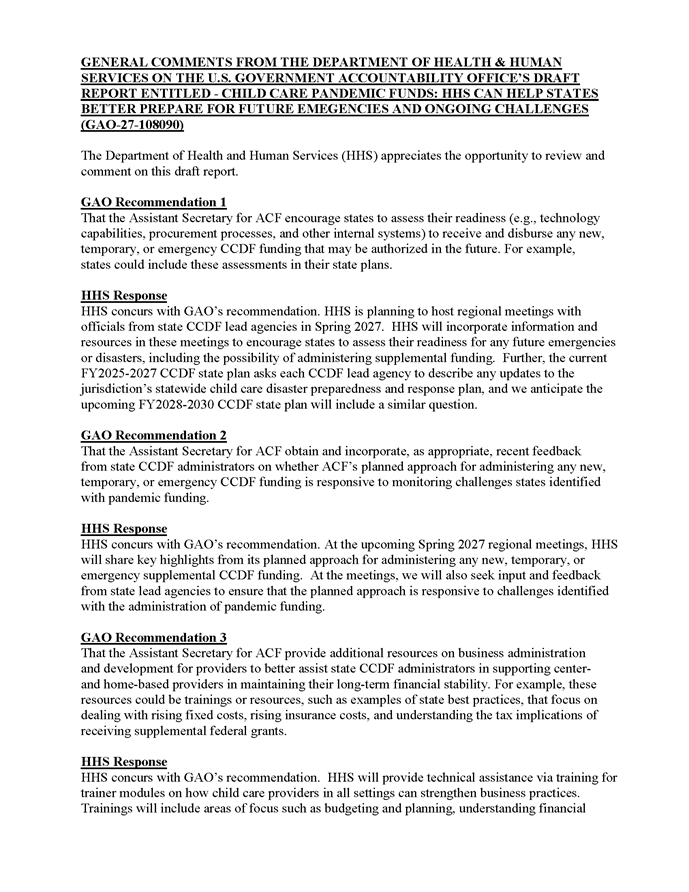

GAO Contact
Kathryn A. Larin, LarinK@gao.gov
Staff Acknowledgments
In addition to the contact named above, the following staff members made key contributions to this report: Kristen Jones (Assistant Director), Alexandra Squitieri (Analyst in Charge), Sandra Baxter, and Christina Lowe Cuthbertson. Also contributing to this report were Alison Cashin, Christian Henry, Christoph Hoashi-Erhardt, Jeff Larson, Kirsten Lauber, Abigail Loxton-Daun, Curtia Taylor, Adam Wendel, and Seline Wiedemer.
The Government Accountability Office, the audit, evaluation, and investigative arm of Congress, exists to support Congress in meeting its constitutional responsibilities and to help improve the performance and accountability of the federal government for the American people. GAO examines the use of public funds; evaluates federal programs and policies; and provides analyses, recommendations, and other assistance to help Congress make informed oversight, policy, and funding decisions. GAO’s commitment to good government is reflected in its core values of accountability, integrity, and reliability.
Obtaining Copies of GAO Reports and Testimony
The fastest and easiest way to obtain copies of GAO documents at no cost is through our website. Each weekday, GAO posts on its website newly released reports, testimonies, and correspondence. You can also subscribe to GAO’s email updates to receive notification of newly posted products.
Connect with GAO
Connect with GAO on X,
LinkedIn, Instagram, and YouTube.
Subscribe to our Email Updates. Listen to our Podcasts.
Visit GAO on the web at https://www.gao.gov.
To Report Fraud, Waste, and Abuse in Federal Programs
Contact FraudNet:
Website: https://www.gao.gov/about/what-gao-does/fraudnet
Automated answering system: (800) 424-5454
Media Relations
Sarah Kaczmarek, Managing Director, Media@gao.gov
Congressional Relations
David A. Powner, Acting Managing Director, CongRel@gao.gov
General Inquiries
[1]The deadline for states to spend CARES Act, CRRSA, and ARPA stabilization funds was September 30, 2023. ARPA supplemental funds had a September 30, 2024, spending deadline. Tribes and Territories were also required to adhere by the same deadlines, although ACF officials told us some Tribes and Territories received waivers allowing additional time to spend the funds. In this report, we focused on states, including the District of Columbia.
[2]Our survey was distributed to all 50 states and the District of Columbia.
[3]North Dakota and Illinois did not respond to our survey. Not all states responded to all sections of the survey. In addition, the survey was designed to have skip patterns, which means not all states responded to all questions, if the question was not applicable to them.
[4]The survey asked states about their experiences with pandemic child care funds from March 2020 to September 2024, and with the CCDF program more broadly through January 2026. In this report, we used the following indefinite quantifiers to report the number of states that responded to each question: “nearly all” = 40 to 49 states; “most” = 30-39 states; “many” = 20-29 states; “some” = 10-19 states; “several” = at least 9 states.
[5]The three organizations were: Child Care Aware of America, the American Public Human Services Association, and the National Association for the Education of Young Children.
[6]The Single Audit Act requires nonfederal entities that spend a threshold amount or more in federal awards in a year to undergo a single audit, which is an audit of an entity’s financial statements and federal awards. Between fiscal years 2020 and 2023, that threshold amount was $750,000.
[7]CCR&Rs are local organizations that typically help families find affordable, quality child care and that support providers with training, resources, and guidance.
[8]These data cover pandemic funds provided to states in fiscal years 2021 and 2022, with spending deadlines through fiscal year 2024.
[9]ACF officials told us they had longer timeframes in finalizing and posting pandemic spending data compared to CCDF spending data from years without supplemental funding because states are able to update their expenditure reports beyond the liquidation deadline to account for any returned funds. In addition, ACF officials said that for fiscal year 2021 data specifically, there were specific issues that delayed publication of the data, including the incorporation of multiple new funding streams, a migration in the data aggregation systems, and changes in personnel staffing.
[10]Families apply to qualify for subsidies, and states generally make subsidy payments directly to child care providers.
[11]GAO, Child Care and Development Fund: Office of Child Care Should Strengthen Its Oversight and Monitoring of Program-Integrity Risks, GAO‑20‑227 (Washington, D.C.: March 2020).
[12]GAO, Combating Fraud: Managing Risks in Federally Funded, State-Administered Programs, GAO‑26‑109100 (Washington, D.C.: July 2026).
[13]ARPA had two funding streams: supplemental CCDF funds and stabilization grants, which were intended to go directly to providers.
[14]GAO, COVID-19: Additional Actions Needed to Improve Accountability and Program Effectiveness of Federal Response, GAO‑22‑105051 (Washington, D.C.: October 2021).
[15]HHS, ACF Office of Child Care, Report on the Use of Coronavirus Response and Relief Supplemental Appropriations (CRRSA) Act Child Care Funds, 2022 (Washington, D.C.: 2022).
[16]HHS, ACF Office of Child Care, National ARP Child Care Stabilization Program Fact Sheet, Sept. 2023 (Washington, D.C.: September 2023).
[17]These challenges are affected by interrelated economic factors. For more information on economic factors that influence the child care market and how they fluctuated before, during and after pandemic funding, see app. 2.
[18]GAO, Child Care: Selected States Are Taking Steps to Sustain Program Changes Implemented with COVID-19 Funding, GAO‑24‑106258 (Washington, D.C.: March 2024).
[19]HHS-OIG, ACF Did Not Monitor States’ Compliance With All American Rescue Plan Child Care Stabilization Grant Provisions, A-02-23-02007 (Washington, D.C.: August 2025).
[20]In February 2026, a federal court granted a preliminary injunction and stay that blocked the freeze. The case remains ongoing as of November 2026. New York et al., v. Admin. for Child. & Families et al., No. 26-cv-00172 (S.D.N.Y. filed Jan. 8, 2026). In June 2026, another federal court granted a preliminary injunction and stay in a similar case challenging the same funding freeze. Am. Fed’n of State, Cnty. & Mun. Emp. et al v. U.S. Dept. of Health & Hum. Serv. et al., No. 26-cv-00759 (N.D. Cal. filed Jan. 23, 2026). The case remains ongoing as of November 2026.
[21]The “Defend the Spend” system was instituted across federal agencies following Executive Order 14222 and requires grantees to provide a justification for any requested payment. ACF asks grantees to provide the following information as part of their justification: attestation that they have reviewed, made any necessary updates, and are implementing strategies and controls to identify fraud and ensure program integrity; strong justification for the use of funds that aligns with CCDF program purposes, that at a minimum includes a description or summary of expenses or activities, by CCDF expenditure category.
[22]Improving Child Care Access, Affordability, and Stability in the Child Care and Development Fund (CCDF), 89 Fed. Reg. 15,366 (Mar. 1, 2024) (partially rescinded by 91 Fed. Reg. 25,796 (May 12, 2026)). In June 2026, as discussed later in this report, a lawsuit was initiated challenging the May 2026 rule. Am. Fed’n of State, Cnty. & Mun. Emp. et al. v. U.S. Dept. of Health & Hum. Serv. et al., No. 2:26-cv-02282 (W.D. Wash. filed June 30, 2026).
[23]For the purposes of this report, unless otherwise noted, we use the term “useful” to indicate when states reported that they found a strategy was “a little,” “moderately,” or “very” useful to capture all perceived benefits states may have reported on a certain topic.
[24]States use a procurement process for goods and services, such as contracting with intermediary organizations like CCR&Rs.
[25]For the purposes of this report, unless otherwise noted, we use the term “challenging” when states reported that they found a topic “moderately” or “very” challenging. We omitted the number of states that indicated that they found a topic a “little” challenging to avoid overstating how challenging states may have found a topic.
[26]Seventeen states reported that the CARES and CRRSA funds were challenging to spend and 20 states reported this for ARPA stabilization and supplemental funds.
[27]We further discuss the gaps in providers’ understanding of the tax implications of pandemic funds later in this report.
[28]We further discuss providers’ business administration skills later in this report.
[29]“ACF Vision, Mission, Values, Priorities, & Guiding Principles,” Administration for Children and Families, accessed July 9, 2026, https://acf.gov/about/acf-vision-mission-values. Federal internal controls also emphasize designing control activities, such as information technology, to mitigate risks to achieving objectives. GAO, Standards for Internal Control in the Federal Government, GAO‑25‑107721 (Washington, D.C.: May 2025).
[30]To calculate the number of states that reported using added capacity to monitor providers’ use of pandemic funds, we counted the number of states that reported that at least one of these three strategies was useful: using contractors to monitor providers’ use of funds, using more state staff than typical to monitor providers’ use of funds, and using a CCR&R or similar organization to monitor providers’ use of funds. We report the data for these categories separately in figure 5.
[31]Twenty-five states reported that ARPA stabilization funds were challenging to monitor, 20 states reported this for ARPA supplemental funds, and 18 states reported this for CARES and CRRSA funds.
[32]Department of Health and Human Services, Office of the Inspector General, National Snapshot of State Agency Approaches to Child Care During the COVID-19 Pandemic, A-07-20-06092 (Washington, D.C.: September 2020). States agencies are required to submit a waiver to ACF and have it approved when a state agency wants to administer changes to its CCDF program outside of what is required or permitted by federal law. On-site inspections are required for enforcement of child care facility licensing and health and safety requirements. This 2020 HHS OIG report found that 21 states made waiver requests to ACF that addressed state agencies’ inability to safely conduct required onsite inspections of child care facilities. Due to this and other challenges, as previously mentioned, a 2025 HHS OIG report found that there was a risk that states may not have established adequate procedures to ensure that ARPA funds were used in accordance with requirements. ACF officials told us they have revised the state plan instructions to elicit more targeted information on how states define, implement, and evaluate effective internal controls, and have developed new internal criteria to evaluate state plans. HHS-OIG, ACF Did Not Monitor States’ Compliance With All American Rescue Plan Child Care Stabilization Grant Provisions, A-02-23-02007 (Washington, D.C.: August 2025).
[33]ACF used a new form to monitor ARPA stabilization funds because this was a new type of funding that provided grants directly to providers and entailed different funding rules. ARPA was enacted in March 2021, and the new form was finalized in December 2021. ACF provided preliminary lists of potential data elements and drafts of the new form to states from May to September 2021.
[34]In 2015, we issued the Fraud Risk Framework, which provides a comprehensive set of leading practices for program managers to use when developing or enhancing efforts to combat fraud in a strategic, risk-based manner. GAO, A Framework for Managing Fraud Risks in Federal Programs, GAO‑15‑593SP (Washington, D.C.: July 2015).
[35]In August 2025, HHS OIG found ACF did not require states to develop internal controls to ensure integrity and accountability of their ARPA child care stabilization grant programs. HHS-OIG, ACF Did Not Monitor States’ Compliance With All American Rescue Plan Child Care Stabilization Grant Provisions, A-02-23-02007 (Washington, D.C.: August 2025).
[36]HHS-OIG, ACF Did Not Monitor States’ Compliance With All American Rescue Plan Child Care Stabilization Grant Provisions, A-02-23-02007 (Washington, D.C.: August 2025).
[37]“ACF Vision, Mission, Values, Priorities, & Guiding Principles,” Administration for Children and Families accessed July 9, 2026, https://acf.gov/about/acf-vision-mission-values.
[38]GAO‑25‑107721, 87, 91, 93.
[39]In our survey, we use the term “outcome” to broadly describe changes or results that states may have implemented or observed due to pandemic funding. Many outcomes are related to one another and can be influenced by interrelated economic factors. For more information on economic factors that influence the child care market and how they fluctuated before, during, and after pandemic funding, see app. 2.
[40]States reported this information in response to the survey question: “When, if at all, did your state have each of the following policies in place?” A co-payment is the portion of the cost of child care that a family pays. Co-payment amounts vary by state, income, and family size. ACF gave states additional flexibilities during the pandemic to waive co-payments for all families.
[41]Assessing the extent to which states actually experienced these challenges in fiscal year 2026 was beyond the scope of our review, because our data analysis concluded before the end of the fiscal year.
[42]Fourteen states said additional guidance would be “very useful,” 17 said it would be “moderately useful,” and eight said it would be “a little useful.”
[43]Our survey focused on the expiration of pandemic funding, not regular CCDF appropriations.
[44]The 2026 Final Rule rescinds requirements from the 2024 CCDF Final Rule to limit family co-payments to 7 percent of family income, provide some direct services through grants or contracts, pay providers based on child’s enrollment rather than attendance, and pay providers before they provide services. According to ACF, rescinding the co-payment provision gives states with limited resources the flexibility to choose between serving more families with higher co-payments, or fewer families with lower co-payments.
[45]In February 2026, over 200 national, state, and local organizations and child care programs wrote a joint letter to ACF expressing opposition to these changes, saying that rolling back these provisions could result in greater costs and burdens on parents and families with low incomes and on smaller providers who operate on small profit margins and benefit from more stable and consistent payment practices. For example, child care advocates have expressed concern that without a federal limit, individual states could raise co-payments to a point where some families may no longer be able to afford child care. A lawsuit was filed in June 2026 challenging ACF’s May 2026 rule for repealing provisions of the 2024 rule.
[46]Office of Child Care, “Office of Child Care Fact Sheet,” Administration for Children and Families, last modified June 23, 2025, https://acf.gov/occ/fact-sheet.
[47]For example, see Jessica H. Brown and Chris M. Herbst, “Childcare over the Business Cycle,” Journal of Labor Economics, vol. 40, (April 2022).
[48]GAO, Child Care: Selected States Are Taking Steps to Sustain Program Changes Implemented with COVID-19 Funding, GAO‑24‑106258 (Washington, D.C.: March 2024).
[49]Kristin Butcher, Elizabeth Kepner, Kelli Marquardt, and Brianna Smith, The Labor Market for Childcare Workers, Chicago Fed Insights, June 2024 (Chicago, Ill.: Federal Reserve Bank of Chicago, June 2004).
[50]Administration for Children and Families, Office of Planning, Research, & Evaluation (OPRE), Understanding Child Care and Early Education Program Closures and Enrollment During the First Year of the COVID-19 Pandemic, OPRE Report #2023-237 (Washington, D.C.: August 2023).
[51]OPRE, Rates of child care and employment disruptions during the COVID-19 pandemic for households with children under age 5: Variation by household characteristics, OPRE Report #2024-190 (Washington, D.C.: September 2024).
[52]CEA, Did Stabilization Funds Help Mothers Get Back to Work After the COVID-19 Recession?, Council of Economic Advisers Working Paper (Washington, D.C.: November 2023). The comparison industries included financial preparation services and motor vehicle repair. While the study’s methodology could not rule out all potential alternative explanations, it provides suggestive evidence of the effects of ARPA stabilization funding.