
Report to Congressional Requesters
United States Government Accountability Office
A report to congressional requesters
Contact: James R. McTigue, Jr. at mctiguej@gao.gov
What GAO Found
Ghost preparers are paid tax preparers who do not comply with requirements to identify themselves on tax returns they prepare for others. Ghost preparers may intentionally leave identifying information off to get away with filing fraudulent income tax returns, stealing taxpayers’ refunds, and stealing taxpayers’ identities. Courts have ordered individual ghost preparers to pay millions in restitution to the government, but according to Internal Revenue Service (IRS) officials, the total effect of ghost preparers is likely greater, in part, because ghost preparers are difficult to detect.
IRS maintains some data on identified ghost preparers, but the systems IRS uses to track ghost preparer cases and outcomes are not connected and have limitations that impede their usefulness. As a result, IRS does not know how many ghost preparers it has identified, investigated, and addressed. Better understanding existing data, including its limitations, would help IRS direct enforcement resources and protect taxpayers from fraudulent returns or stolen refunds.
IRS identifies and addresses ghost preparers through data analysis, referrals, taxpayer education, and enforcement actions such as investigations. However, these efforts are fragmented across six offices and IRS is missing opportunities to share information and better address risks. A comprehensive, coordinated preparer strategy, including efforts addressing ghost preparers, could help IRS better align resources with risks and identify additional needs.
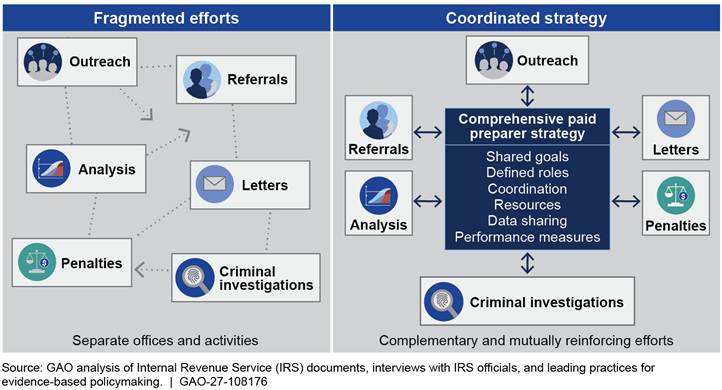
While IRS has some activities to address ghost preparers, including data analysis and taxpayer education, it has not developed measurable objectives or performance goals. Defining objectives, goals, and performance measures could help IRS reliably assess whether its efforts are reducing ghost preparer activity and adjust its strategy and allocate resources more effectively.
Why GAO Did This Study
Paid tax preparers prepared more than half of all tax returns in fiscal year 2025 and have an enormous effect on IRS’s ability to administer tax laws effectively. However, ghost preparers may hide their identities to avoid accountability and leave taxpayers responsible for inaccurate or fraudulent returns they prepare.
GAO was asked to examine IRS’s efforts to address ghost preparers. This report (1) describes how ghost preparers have harmed taxpayers and IRS, (2) assesses the extent to which IRS maintains data on ghost preparers, and (3) evaluates IRS actions to identify and address ghost preparers.
GAO reviewed federal court cases, and IRS documentation and data. GAO compared IRS’s efforts to leading practices for evidence-based policymaking and consumer education planning. GAO also interviewed IRS and Department of Justice officials and stakeholder groups, such as IRS oversight and industry groups.
What GAO Recommends
GAO is making three recommendations including that IRS identify opportunities to enhance data collecting, sharing, and analysis to inform its ghost preparer efforts, incorporate ghost preparer efforts within a comprehensive, coordinated paid preparer strategy, and define measurable objectives and goals. IRS agreed with GAO’s recommendations and described steps it plans to take or started taking, in response to each recommendation.
Abbreviations
|
CASST |
Coalition Against Scams and Scheme Threats |
|
CI |
Criminal Investigation |
|
CIMIS |
Criminal Investigation Management Information System |
|
C&L |
Communications & Liaison |
|
DIY |
Do-It-Yourself |
|
DOJ |
Department of Justice |
|
EFIN |
Electronic Filing Identification Number |
|
EITC |
Earned Income Tax Credit |
|
GITS |
Ghost Inventory Tracking System |
|
IRC |
Internal Revenue Code |
|
IRM |
Internal Revenue Manual |
|
IRS |
Internal Revenue Service |
|
OPR |
Office of Professional Responsibility |
|
PTIN |
Preparer Tax Identification Number |
|
RAAS |
Research, Applied Analytics and Statistics |
|
RICS |
Return Integrity and Compliance Services |
|
RPD |
Return Preparer Database |
|
RPO |
Return Preparer Office |
|
SB/SE |
Small Business/Self-Employed |
This is a work of the U.S. government and is not subject to copyright protection in the United States. The published product may be reproduced and distributed in its entirety without further permission from GAO. However, because this work may contain copyrighted images or other material, permission from the copyright holder may be necessary if you wish to reproduce this material separately.
October 15, 2026
The Honorable Ron Wyden
Ranking Member
Committee on Finance
United States Senate
The Honorable Catherine Cortez Masto
United States Senate
Paid tax return preparers filed over 86 million federal tax returns—more than half of the nearly 163 million individual tax returns—in fiscal year 2025. These individuals have an enormous effect on the Internal Revenue Service’s (IRS) ability to administer tax laws effectively and collect the revenue that funds the government. However, some unscrupulous and unethical paid preparers engage in fraudulent activities, including filing tax returns with false information and stealing taxpayers’ identities.
Among these are ghost preparers who may intentionally prepare a return without signing it or including a valid Preparer Tax Identification Number (PTIN). By law, anyone who is paid to prepare a federal tax return must obtain a PTIN from IRS and use it to indicate that the return was prepared by a third party and not the taxpayer.[1] Ghost preparers may hide their identities to avoid accountability and leave taxpayers responsible for inaccurate or fraudulent returns they prepare.[2] In addition to harming taxpayers, ghost preparers also shortchange the Department of the Treasury—contributing to the estimated $606 billion net tax gap.[3]
Since ghost preparers do not identify themselves on the returns they prepare, these preparers are inherently difficult to detect. IRS uses various data and methods to identify and investigate returns prepared by ghost preparers. However, many ghost preparers likely still evade IRS detection.
We have previously reported that the majority of paid preparers do not have professional credentials and are not subject to IRS regulation, including competency testing, suitability checks, and educational requirements.[4] The absence of this IRS oversight authority can put taxpayers at risk of receiving insufficient or incompetent tax preparation services, including from ghost preparers.[5]
You asked us to review IRS’s efforts to address ghost preparers. This report (1) describes how certain identified ghost preparers have misused PTINs and harmed taxpayers and IRS; (2) assesses the extent to which IRS maintains data on ghost preparers; and (3) evaluates what actions IRS has taken to identify and address ghost preparers and what opportunities exist to improve its efforts.
To describe how certain identified ghost preparers have misused PTINs and harmed taxpayers and IRS, we analyzed 44 federal (23 civil and 21 criminal) cases involving ghost preparers. We initially searched for ghost preparer cases investigated by IRS and brought by the Department of Justice (DOJ) from 2013 through 2025. IRS Criminal Investigation (CI) officials told us that fiscal year 2013 was the earliest year they could potentially find a ghost preparer case in the Criminal Investigation Management Information System (CIMIS). The most current and complete year of case information available at the time of our review was 2025. The ghost preparer cases we ultimately identified all involved defendants who were sentenced or had judgments against them between 2017 and 2025.
To identify an initial list of cases, we conducted a literature search of relevant documents, including court documentation, IRS and DOJ press releases, and news articles. We reviewed those search results for relevancy to our audit objective and scope. Then, we also requested ghost preparer case information from IRS’s CIMIS, which is used to track the status of IRS criminal investigations, and from DOJ. To validate the cases we identified in our literature review, we compared those cases to cases provided by IRS and discussed with IRS officials the differences, as necessary. The ghost preparer cases included in our review are limited to the cases we identified that were reported publicly in the sources discussed above and also provided to us by IRS and DOJ. We did not attempt to identify all federal ghost preparer cases adjudicated in our review time frame.
For the identified cases, we reviewed judgment and sentencing information from DOJ, including civil (injunctions and disgorgement) and criminal (imprisonment and restitution) actions. For details on the illegal ghost preparer activities, we reviewed available court case documentation, such as court opinions, final judgments, plea agreements, and sentencing memorandums. Appendix I provides information on the cases included in our review. We identified themes representing different ways ghost preparers misused PTINs to conceal their identities as paid preparers and the types of fraud they committed. We selected example cases to illustrate each theme, focusing on those with more available information and documentation and reflecting a range of restitution amounts and other relevant characteristics. These illustrative examples are not generalizable to other ghost preparer cases. Finally, we interviewed DOJ officials for more information about the types of actions taken against ghost preparers.
To assess the extent to which IRS maintains data on ghost preparers, we assessed data from multiple IRS databases from 2013 through 2025. The year 2013 is the earliest for which IRS’s Return Preparer Office (RPO) maintained complete annual ghost preparer case data. The year 2025 is the most recent for which complete annual data were available at the time of our analysis. We interviewed IRS officials from the RPO, Small Business/Self-Employed (SB/SE), and CI to understand what data each office tracks on identified ghost preparers and to what extent that information is used to make informed decisions and address risks. In addition, we interviewed officials from the Research, Applied Analytics and Statistics (RAAS) division to discuss efforts to estimate the number of returns with potential ghost preparer involvement. We compared IRS’s existing ghost preparer data collection efforts to leading practices for evidence-based policymaking related to aligning activities with intended outcomes and Standards for Internal Control in the Federal Government related to generating quality information and establishing activities to monitor and evaluate results.[6]
To assess the actions IRS has taken to identify and address ghost preparers, we reviewed Internal Revenue Manual (IRM) sections and other IRS documentation related to ghost preparer efforts, such as annual planning and year end reports. We analyzed data, such as the number of ghost preparer cases opened and the number of enforcement actions taken against ghost preparers from 2021 through 2025, the 5 most recent years of complete annual data available at the time of our analysis. To assess the reliability of the annual case counts and preparer penalties, we reviewed IRS documentation and interviewed knowledgeable IRS officials. Based on these steps, we determined that the data were sufficiently reliable for the purposes of reporting total counts of ghost preparer cases and enforcement actions. We also interviewed IRS officials from IRS’s CI, RAAS, RPO, SB/SE, and Return Integrity and Compliance Services to obtain information about ghost preparers, and the steps IRS takes to identify and address them.
To assess what opportunities exist to improve IRS’s efforts to address ghost preparers, we reviewed IRS’s efforts to educate taxpayers and the tax preparation community about ghost preparers and interviewed IRS officials from Communications & Liaison. We also reviewed IRS documentation to determine how lessons learned from efforts to address ghost preparers are incorporated into other IRS-wide compliance strategies, such as the Service-wide Return Preparer Strategy. We compared IRS’s efforts to leading practices for consumer education planning and evidence-based policymaking related to defining goals and identifying strategies and resources needed to ensure programs achieve intended outcomes.[7]
Finally, we interviewed representatives of a nongeneralizable selection of nine stakeholder groups. We selected these groups to represent a cross section of the relevant issues related to their experiences with ghost preparers and IRS’s efforts to identify and address them. These groups include: IRS oversight and advocacy groups (Electronic Tax Administration Advisory Committee, Internal Revenue Service Advisory Council, Center for Taxpayer Rights, and Taxpayer Advocate Service); industry groups (American Institute of Certified Public Accountants and the American Bar Association); and national tax preparation firms (H&R Block, Intuit, and Taxfyle).
We conducted this performance audit from March 2025 to October 2026 in accordance with generally accepted government auditing standards. Those standards require that we plan and perform the audit to obtain sufficient, appropriate evidence to provide a reasonable basis for our findings and conclusions based on our audit objectives. We believe that the evidence obtained provides a reasonable basis for our findings and conclusions based on our audit objectives.
Background
Tax Preparation Assistance and Types of Paid Preparers
Taxpayers have several options to prepare and file their returns (see fig. 1).
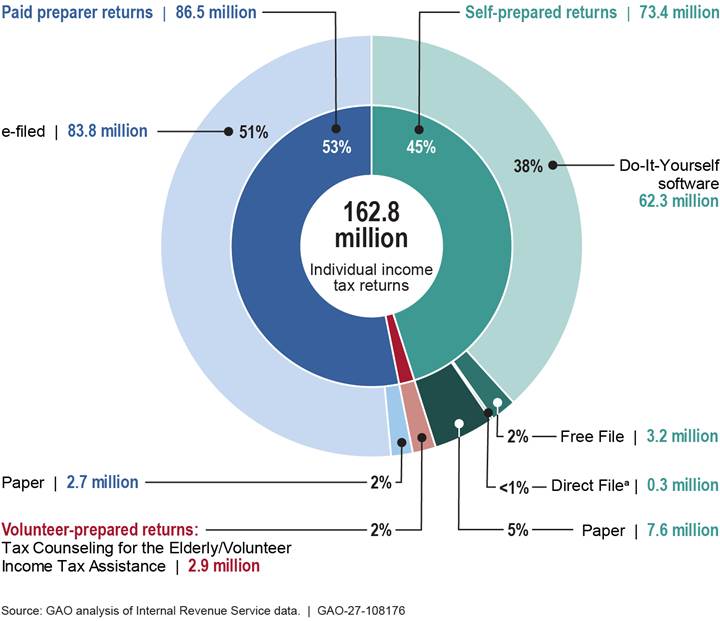
Note: aDirect File was IRS’s free online filing option for eligible taxpayers in participating states to file federal returns directly with IRS. It was available in 25 states during the 2025 filing season. In November 2025, IRS announced that Direct File would not be available for the 2026 filing season.
Self-prepared using commercial Do-It-Yourself (DIY) software, Free File, or paper filing. About 38 percent of taxpayers self-prepared and electronically filed their tax returns using DIY commercial software (e.g., TurboTax, H&R Block, or TaxAct), and 5 percent self-prepared and paper-filed their returns in 2025. IRS also partners with a coalition of software companies to provide the Free File program, a free online tax preparation method for taxpayers who meet certain criteria.[8] Fewer than 3 percent of taxpayers used free filing options.
Volunteer prepared. Volunteer Income Tax Assistance offers free tax help to people who meet certain criteria. Tax Counseling for the Elderly offers free tax help, particularly for those who are 60 years of age and older. Fewer than 2 percent of taxpayers used one of these free filing volunteer options in 2025.
Paid preparers. Around 53 percent (87 million) of taxpayers used a paid preparer to help prepare and file their individual returns in 2025.[9] Paid preparers have differing levels of skills, education, and expertise and generally can be categorized as tax practitioners and unenrolled preparers. Tax practitioners include enrolled agents, certified public accountants, attorneys, enrolled actuaries, and enrolled retirement plan agents. These individuals possess some level of qualifications or professional credentials issued by either IRS or states. All other paid preparers are referred to as unenrolled preparers.
IRS requires that all paid preparers obtain a PTIN to prepare tax returns for compensation.[10] The PTIN is used as the preparer’s unique identification number and must be placed in the Paid Preparer section of a tax return (see fig. 2).[11] Paid preparers must pay a fee to obtain a PTIN and renew it annually.[12] According to IRS data, approximately 870,000 individuals registered or renewed their PTINs in 2025.
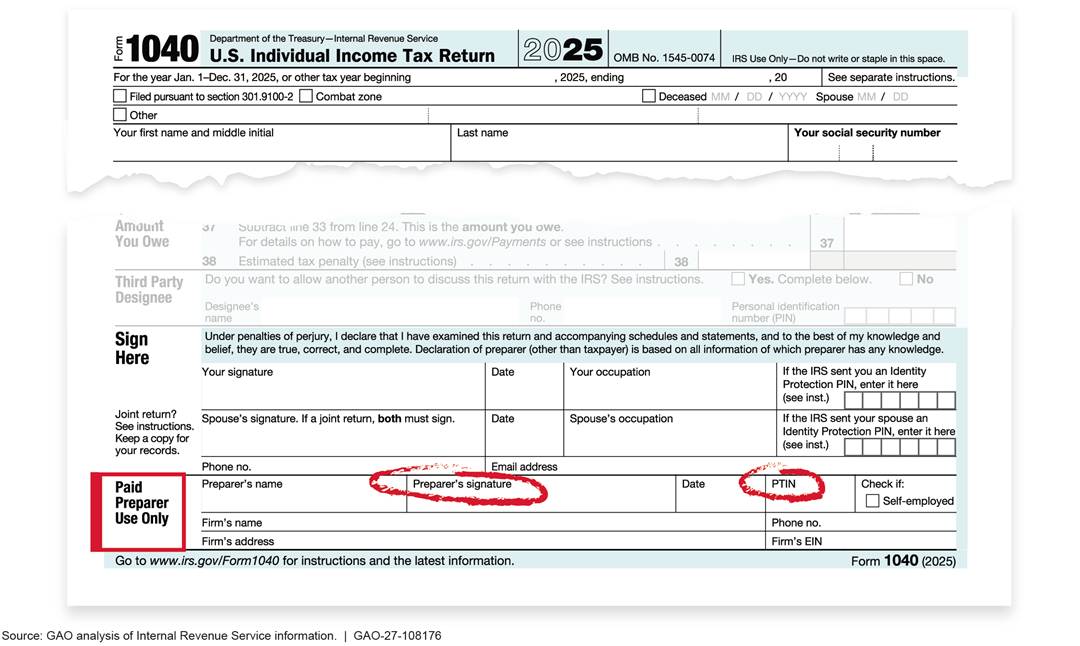
Ghost preparers. IRS uses the term ghost preparer to refer to compensated preparers who do not comply with PTIN requirements. According to the IRM, a ghost preparer is someone who fails to include any identifying information or includes a number that is not their PTIN, such as a PTIN issued to another preparer or a made-up or inactive PTIN.[13]
According to IRS officials, ghost preparer returns are generally not included among the 87 million returns identified as being completed by paid preparers for taxpayers. This number could, however, include ghost preparer returns if the ghost preparer used an active PTIN issued to another preparer.
According to IRS, there are different categories of ghost preparers with increasing levels of risks for taxpayers. These can include:
· Non-compliant “professional” preparers who help taxpayers meet their tax obligation but are either unaware of PTIN requirements or intentionally do not adhere to IRS rules. This category may include preparers who are aware of the rules but avoid signing a return they prepare to circumvent paying for professional software or to hide their lack of a current valid PTIN.
· Unscrupulous
and unethical preparers who intentionally do not sign returns to avoid scrutiny
and accountability. Among these ghost preparers are enablers who—with the
knowledge of their clients—claim unearned and fraudulent refunds. In addition,
there are criminal ghost preparers who victimize taxpayers who are unaware that
the ghost preparer is filing fraudulent returns on their behalf.[14]
Paid Preparer Requirements
IRS only has authority to regulate paid preparers who are tax practitioners.[15] Tax practitioners differ from unenrolled preparers in that they have the right to represent taxpayers before IRS, including by communicating with IRS, submitting documents, and representing taxpayers in certain IRS proceedings.[16] Practitioners are subject to Treasury Department Circular No. 230 standards of conduct and discipline. These practitioners obtain professional credentials or qualifications issued by states, in the case of attorneys and certified public accountants, or by IRS, in the case of enrolled agents.[17] For example, enrolled agents are generally required to pass a three-part examination and complete annual education requirements.
Unenrolled preparers may prepare tax returns for compensation but are not subject to the same IRS practice standards or credentialing requirements.[18] Unenrolled preparers are generally not subject to IRS regulation, including competency testing, suitability checks, or education requirements, and their ability to represent taxpayers before IRS is limited. In most states, anyone can be an unenrolled preparer regardless of education or experience.
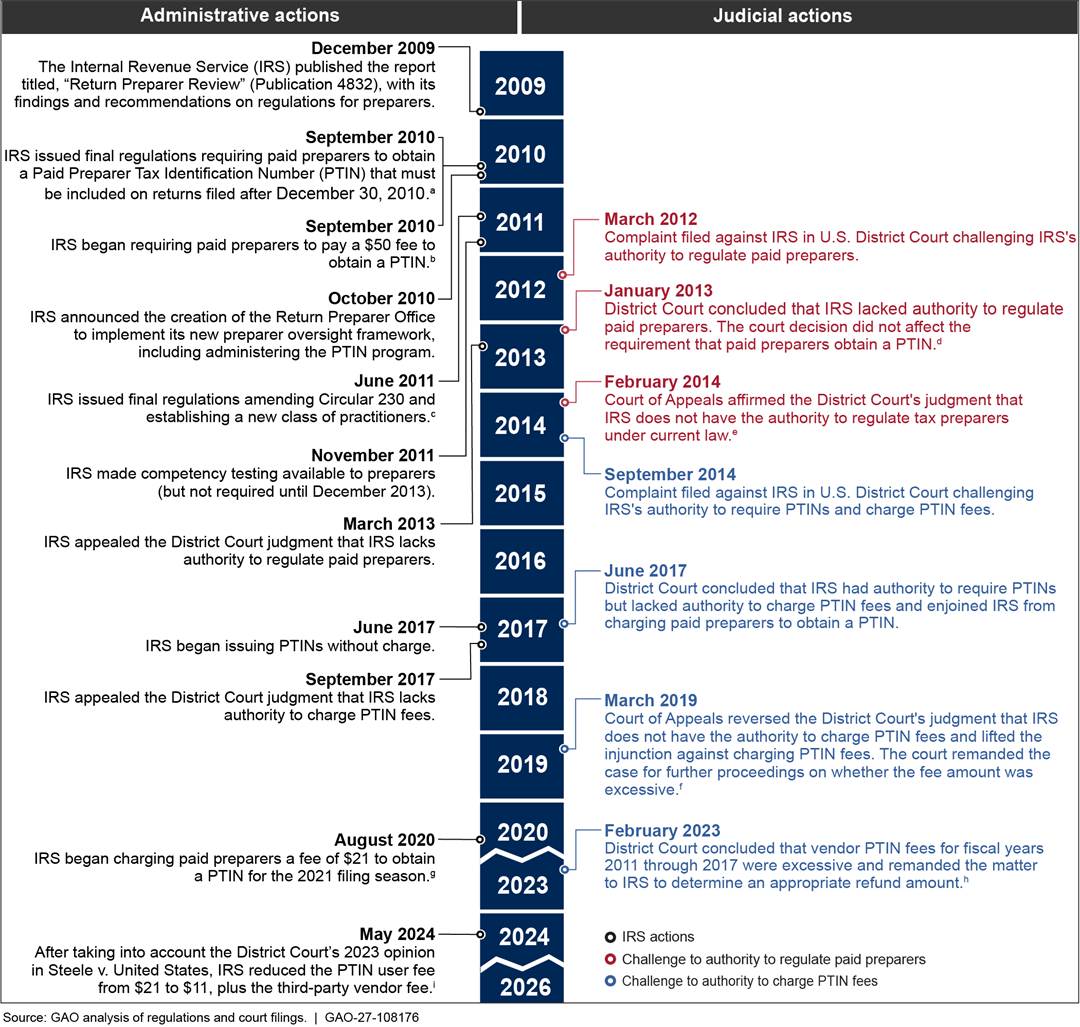
IRS previously tried to require all paid preparers to meet professional standards, but courts later ruled that IRS lacked authority to do so. In 2011, IRS issued final regulations that required registration, competency testing, and continuing education for all paid preparers and subjected new registrants to standards of conduct.[19] However, in 2014, the Court of Appeals for the D.C. Circuit ruled that IRS lacked the statutory authority under section 330 of title 31, United States Code, to regulate all preparers.[20] Since the court’s ruling, as of October 2026, Congress has not provided IRS with the authority to regulate all paid preparers.
In 2017, litigants also challenged IRS’s authority to charge a user fee for PTINs, but a Court of Appeals reversed a lower court’s decision affirming IRS authority.[21] Figure 3 provides a summary timeline of IRS’s implementation of paid preparer requirements and legal proceedings.
Notes:
a75 Fed. Reg. 60309 (Sept. 30, 2010).
bIn addition to the $50 IRS fee, PTIN applicants also paid a $14 third-party vendor fee. 75 Fed. Reg. 60316 (Sept. 30, 2010).
c76 Fed. Reg. 32286 (June 3, 2011).
dLoving v. IRS, 917 F. Supp. 2d 67 (D.D.C. 2013).
eLoving v. IRS, 742 F.3d 1013 (D.C. Cir. 2014).
fMontrois v. United States, 916 F.3d 1056 (D.C. Cir. 2019).
gIn addition to the $21 IRS fee, PTIN applicants also paid a $15 third-party vendor fee. 85 Fed. Reg. 43433 (July 17, 2020).
hSteele v. United States, 657 F.Supp. 3d 23 (D.D.C. 2023). The plaintiffs appealed in March 2025 and the government cross-appealed in May 2025.
i89 Fed. Reg. 42362 (May 15, 2024).
Paid preparers are subject to certain requirements in the Internal Revenue Code (IRC) and may be subject to penalties for noncompliance (see appendix II for more information on selected paid preparer penalties and authorities). For example, the IRC imposes civil monetary penalties on paid preparers who do not provide a PTIN with returns they prepare and paid preparers who understate a taxpayer’s tax liability due to willful or reckless conduct.[22] Other preparer penalties may include imprisonment or an injunction prohibiting preparers from preparing tax returns.
IRS Offices with Oversight of Ghost Preparers
IRS’s Return Preparer Office (RPO) is responsible for matters relating to the registration, renewal, and compliance of return preparers who prepare tax returns for compensation via the PTIN program. After courts ruled IRS does not have authority to regulate all preparers, RPO’s role shifted toward administering the PTIN program.[23] Among other things, RPO administers federal tax credentials, such as the Enrolled Agent program, and oversees the voluntary Annual Filling Season Program designed to encourage unenrolled preparers to participate in continuing education courses.[24] RPO also receives and processes paid preparer complaints, coordinates with other business units regarding identified noncompliance, and oversees efforts to identify and address ghost preparers.
In June 2026, IRS announced a restructuring effort that aligns RPO and the Office of Professional Responsibility (OPR), which oversees tax practitioner conduct and discipline under Circular 230, under a new Tax Professional Management Office. IRS stated that the missions of RPO and OPR would remain intact and that the offices would continue to operate independently within their respective roles and authorities.
In addition to RPO, five other IRS organizational units support ghost preparer efforts across IRS (see fig. 4). These offices are not in a direct hierarchical structure and efforts are fragmented across them, which we discuss later in this report.[25]
Figure 4: Principal Internal Revenue Service Organizational Units Involved in Ghost Preparer Efforts
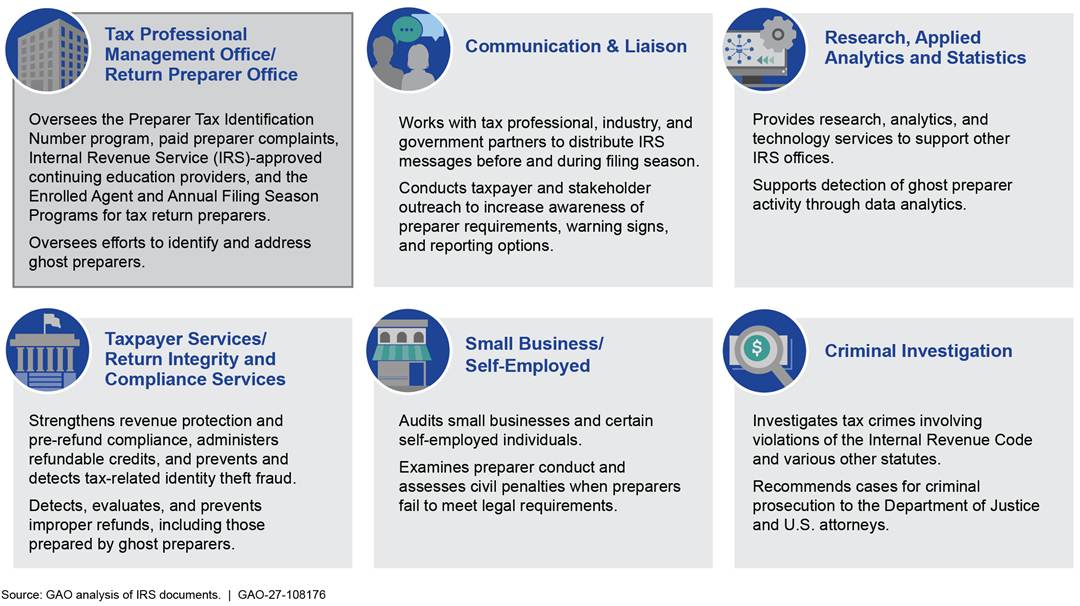
Note: IRS created the Tax Professional Management Office and aligned the Return Preparer Office under it in June 2026.
Ghost Preparers Have Committed Fraud Costing Taxpayers and IRS Millions
We identified 44 federal (21 criminal and 23 civil) ghost preparer cases involving tax fraud from 2017 through 2025.[26] A list of these 44 cases is in appendix I. Our analysis of these 44 ghost preparer cases illustrates the role of ghost preparers in facilitating refund fraud and identifies a range of consequences caused by these ghost preparers.[27] These identified cases and figures do not account for all the consequences of ghost preparers, in part, because we did not attempt to identify all federal criminal and civil cases involving ghost preparers. IRS and DOJ officials agreed that the total effect of ghost preparer fraud is likely greater than the cases we identified because other ghost preparer cases may be charged in state court and others remain undetected by the government, and therefore never adjudicated.
Ghost Preparers Concealed Roles in Tax and Identity Theft Refund Fraud
In general, we found that these ghost preparers took two broad approaches to concealing their identities on the tax returns they prepared:
Preparing returns to appear as if the taxpayer self-prepared. Ghost preparers in our review did not provide required preparer information—such as their name, signature, or PTIN—in the paid preparer section of the tax return. With no evidence of third-party involvement on the returns, these returns appear as self-prepared by the taxpayer.
Preparing returns to conceal the identity of the true paid preparer. Other ghost preparers in our review attempted to conceal their identities by obtaining and using identifying information assigned to another preparer or firm, such as a PTIN or Electronic Filing Identification Number, with or without the preparers’ consent. Figure 5 provides examples of how ghost preparers concealed their identities.
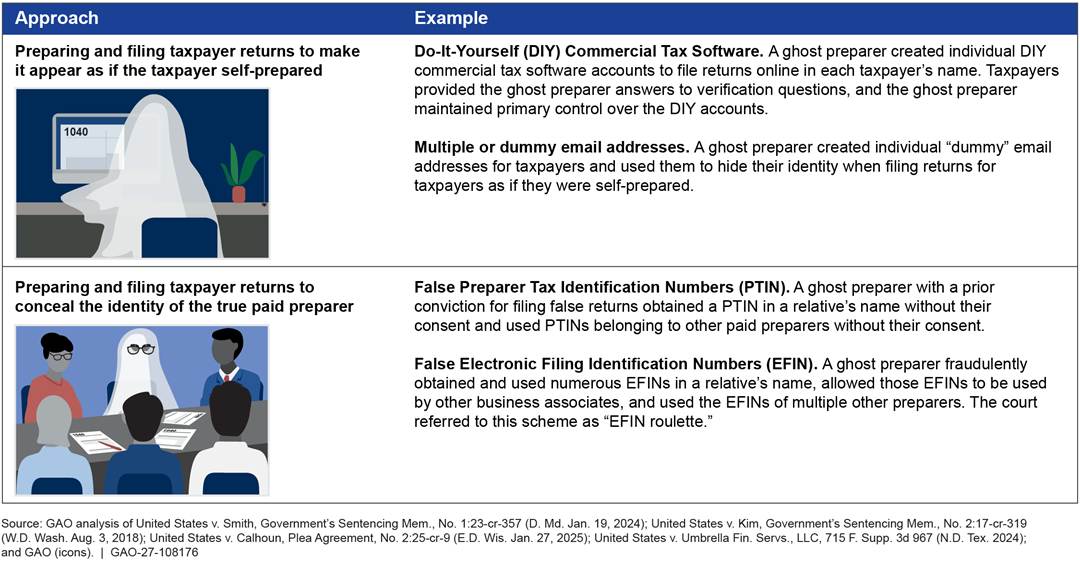
Of the 44 cases we reviewed, we found that ghost preparers concealed their identities to avoid accountability for
· preparing and filling fraudulent income tax returns to obtain or inflate refunds to which the taxpayers were not entitled;
· filing tax returns for the purpose of directing all or a portion of the fraudulent refunds into a bank account managed by the ghost preparer rather than the taxpayer’s bank account; and
· committing identity refund fraud, where the ghost preparer stole taxpayers’ personal information to file a tax return claiming a fraudulent refund.
Ghost Preparers Filed Fraudulent Income Tax Returns to Obtain or Inflate Refunds
IRS has long warned taxpayers about preparers who lure victims in by promising large or inflated tax refunds.[28] To obtain or increase the size of taxpayers’ refunds, in the cases we reviewed, ghost preparers generally used the following tax refund fraud mechanisms on returns they prepared:
Understated federal tax liability. IRS encourages taxpayers to report preparers engaged in fraud or misconduct, such as preparers claiming false expenses and deductions or failing to include income on a tax return to generate a larger tax refund.[29] We found, for example, that ghost preparers in our review sometimes prepared federal tax returns that reported false or fake businesses and expenses and deductions.[30] Figure 6 provides an example of a ghost preparer sentenced on related charges.
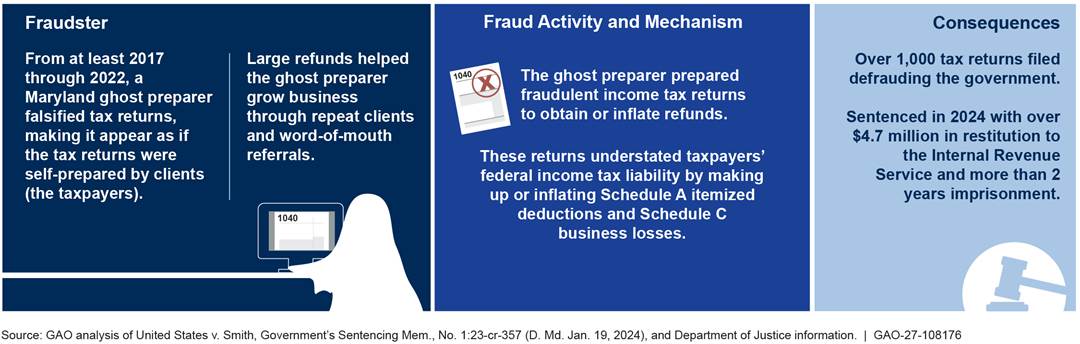
|
Refundable Tax Credits In fiscal year 2025, the Department of the Treasury reported that the following three refundable tax credits provided taxpayers with over $100 billion in tax benefits for tax year 2023 returns: Earned Income Tax Credit - $64.7 billion (26 U.S.C. § 32) Helps low- and moderate-income workers and families reduce the amount of taxes they owe and potentially increase their refunds. Additional Child Tax Credit - $33.4 billion (26 U.S.C. § 24) Helps taxpayers who claim a qualifying child or children as dependents and cannot otherwise claim the full amount of the child tax credit by increasing their refunds. American Opportunity Tax Credit - $5 billion (26 U.S.C. § 25A) Helps taxpayers offset qualified education related expenses for eligible students for the first 4 years of higher education. Source: Department of the Treasury, Agency Financial Report, Fiscal Year 2025 (Jan. 27, 2026), and GAO‑23‑105217. | GAO‑27‑108176 |
Fabricated eligibility to qualify for or increase refundable tax credits. Refundable tax credits can reduce a taxpayer’s liability and, if the credit exceeds the amount of taxes due, can result in a refund.[31] Treasury reported that, in fiscal year 2025, paid preparers assisted one half of all individuals claiming refundable credits.[32]
Three refundable credits—the Earned Income Tax Credit (EITC), the Additional Child Tax Credit, and the American Opportunity Tax Credit—have complex eligibility rules that can be difficult for taxpayers or their representatives to follow and also difficult for IRS to verify (see sidebar).[33] As a result, these credits can also be subject to fraud schemes and efforts to intentionally misstate taxpayer eligibility and over-claim these credits.
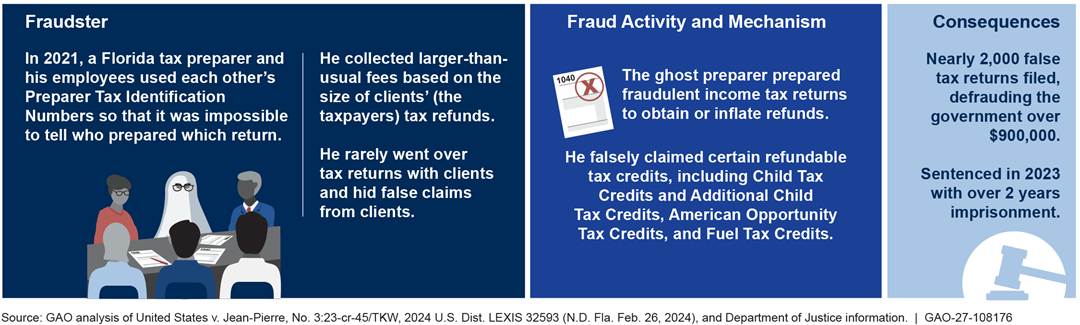
For example, ghost preparers in our review sometimes fabricated expenses for taxpayers with income above the maximum range for the EITC to fraudulently qualify the taxpayer for the EITC.[34] Conversely, for taxpayers with income below the maximum EITC range, these ghost preparers reported false income to raise the taxpayers’ earned income into a range that generated a higher EITC.[35] Figures 7 and 8 illustrate examples of ghost preparers sentenced on charges related to claiming refundable tax credits.
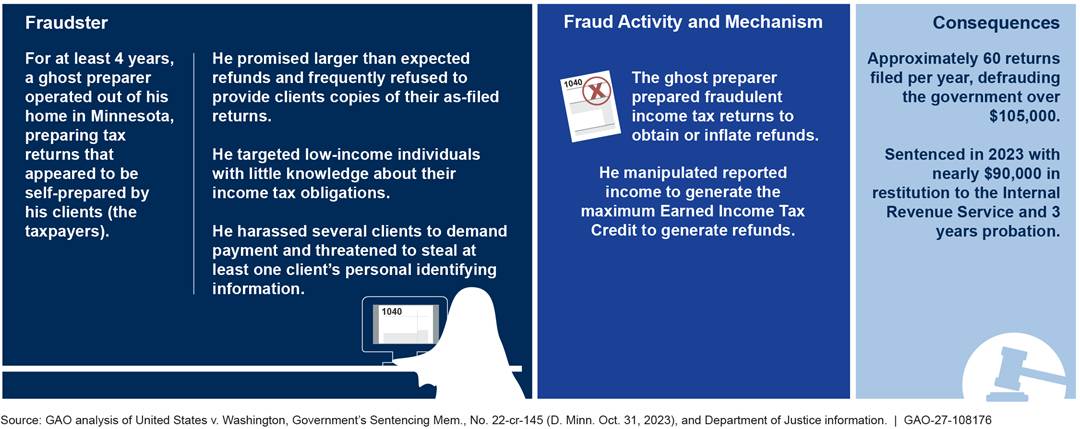
Fabricated eligibility for other types of refundable and nonrefundable credits. We found that some ghost preparers falsely claimed other refundable and nonrefundable credits, including those IRS reports as common tax scams.[36] For example, two ghost preparers in our review falsely claimed fuel tax credits.[37] Due to the credit’s limited availability to most taxpayers and common abuse by paid preparers, IRS has included the fuel tax credit on its annual list of Dirty Dozen tax scams.[38]
One ghost preparer in our review regularly and falsely claimed residential clean energy and electric motor vehicle credits.[39] IRS requires third-party documentation, such as confirmation of the vehicle’s identification number, to file and claim electric motor vehicle credits. According to IRS officials, while IRS requires third-party documentation for solar water heating property, it generally relies on self-reporting for other claims of residential clean energy credits.[40] We have previously reported that IRS uses information reporting by third parties to help identify potential fraud and noncompliance.[41]
Ghost Preparers Stole Taxpayers’ Refunds
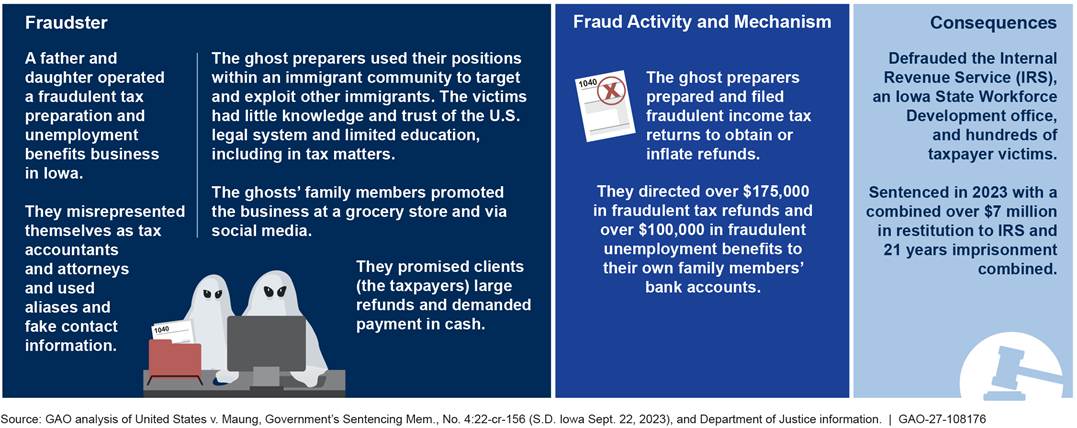
We also found ghost preparers in our review who victimized their clients and stole all or a portion of their refunds. These ghost preparers prepared clients’ returns and then directed the refunds into bank accounts controlled by the ghost preparer or a family member of the ghost preparer. Figure 9 describes an example of a ghost preparer fraud scheme involving stolen refunds.
In another case we reviewed, a ghost preparer split refunds between the ghost preparer’s personal bank account and clients’ accounts, taking over half of their clients’ refunds.[42] As a result of fraudulently diverting taxpayers’ refunds, the ghost preparer also inappropriately received and kept COVID-19 stimulus payments designated for some of these taxpayers and their families.[43]
Ghost Preparers Stole Taxpayers’ Identities
Identity theft refund fraud occurs when a refund-seeking fraudster obtains stolen or otherwise compromised personal information and uses it to file a fraudulent tax return. Identity theft refund fraud is an evolving and costly problem, in which ghost preparers play a part. IRS estimated that it lost close to $250 million in tax revenue to identity theft related returns.[44] In our case review, we found that some ghost preparers stole taxpayers’ personal and financial information to file false tax returns and claim tax refunds without the taxpayers’ knowledge or consent.
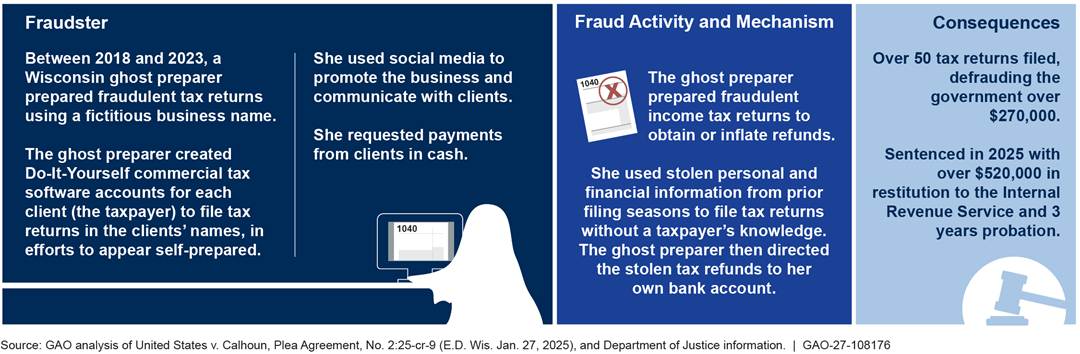
According to DOJ, stolen identity refund fraudsters typically file false returns electronically and early in the tax filing season before the legitimate taxpayer has time to file their returns. For example, in one case we reviewed, a ghost preparer used a previous client’s information to file a return without the client’s knowledge. According to the court case documentation, the client learned about this fraud after visiting another tax professional who said someone else had already filed the tax return.[45] Figure 10 provides additional details on this ghost preparer case.
In another case we reviewed, ghost preparers stole the identities of deceased people. Specifically, the ghost preparers organized a scheme to file false tax returns using the names, birth dates, and Social Security numbers of deceased individuals and direct the refunds to bank accounts controlled by the ghost preparers.[46]
Ghost Preparers Harmed Vulnerable Taxpayers and May Diminish Public Confidence in the Tax System
We identified fraud scheme cases where ghost preparers targeted vulnerable communities, including immigrants and low-income individuals.[47] For example, in one case previously illustrated in figure 9, two ghost preparers took advantage of their positions and trust within immigrant communities to knowingly target other immigrants and refugees. According to court documentation, most of the victims spoke little to no English, lacked formal education—including of the tax system—and had little knowledge and trust of the U.S. legal system.[48] Stakeholders we interviewed told us that these types of circumstances make it more likely that immigrants work with ghost preparers, despite potential risks. According to court documents, these circumstances also made it unlikely that the clients of the ghost preparer would discover and report the ghost preparer fraud on their own.
In addition, ghost preparers in our review sometimes took advantage of low-income individuals by promising large refunds to gain their business. For example, according to court documentation, one ghost preparer targeted low-income individuals who knew little about their income tax obligations.[49] The ghost preparer then prepared and filed fraudulent returns on their behalf. By promising large refunds, the ghost preparer generated word-of-mouth business among similar clients.
We also found that ghost preparer fraud activities have nonfinancial consequences on taxpayers and the government in the following areas:
· Taxpayer victims. Taxpayers are ultimately accountable for the accuracy of their own tax returns. Fraudulent or erroneous ghost prepared returns may be subject to IRS audits and inquiries. In addition, ghost preparers may expose or misuse taxpayers’ personal identifying information and financial information;
· Tax administration. If taxpayers believe some individuals are receiving larger refunds they are not entitled to and are not paying their fair share of taxes, it undermines confidence in the administration of our tax system and erodes voluntary compliance;
· Preparer community. Ghost preparers offering large refunds and generating word-of-mouth business may have an unfair competitive advantage over compliant paid preparers; and
· Government
resources. Investigating ghost preparer activities diverts resources from
DOJ and IRS that could be used towards other priorities.
Courts Ordered Millions in Financial Restitutions from Ghost Preparers
Ghost preparer actions can also lead to financial consequences for individual taxpayers and the federal government. In a federal criminal case, a court can order an individual ghost preparer to pay restitution to reimburse victims for financial losses incurred due to the ghost preparer’s crimes.[50]
In the 21 criminal ghost preparer cases we reviewed:
· IRS restitution. Courts ordered restitution to IRS in response to 19 cases, for a total of over $20 million.
· Taxpayer restitution. Courts ordered restitution to taxpayer victims in response to three cases, for a total of almost $16,000.
· Other restitution. As previously illustrated in figure 9, in one case, a court ordered two co-defendants to pay nearly $62,000 to the Iowa Workforce Development.
According to IRS officials, restitution is based on the amounts proven by the government for the specific tax returns that were charged in the indictment. Since ghost preparers conceal their identities, IRS officials told us that it is difficult for both IRS and DOJ to identify and connect every fraudulent return to the ghost preparer and calculate the exact tax loss. IRS officials told us that, as a result, the charged ghost preparer conduct is a fraction of the overall fraud. Moreover, according to DOJ, many defendants in criminal cases will not have sufficient assets to repay their victims. As a result, the chance of full reimbursement for IRS and taxpayers is low.
According to IRS and DOJ officials, in most federal criminal ghost preparer cases, IRS is the sole victim for purposes of restitution, with the financial loss being the government’s tax loss. The government’s tax loss includes the amount of any false refunds issued and any underpayment of tax resulting from the fraudulent returns.[51] IRS officials told us that taxpayers are only considered victims when they suffer a documented, direct loss such as a stolen refund or fees paid to the ghost preparer for a fraudulent service. The taxpayer’s correct tax liability is not a reimbursable loss because it is an amount the taxpayer legally owed.[52]
We also reviewed 23 civil ghost preparer cases. In these cases, a court can order a ghost preparer to disgorge, or give up, proceeds earned through misconduct, such as preparer fees obtained from preparing fraudulent tax returns. According to IRS officials, since civil cases generally result in injunctions intended to stop ongoing misconduct, disgorgement amounts reflect only amounts identified as unjust enrichment rather than the government’s full tax loss. Courts ordered ghost preparers in nine cases to disgorge a total of over $3 million.
In addition, according to IRS officials, courts may order reimbursement of other costs and fees, such as government litigation or travel costs in contempt cases. Courts ordered reimbursement in three out of the 23 civil cases for a total of nearly $31,000.
IRS Has Limited Data on the Number of Ghost Preparers
IRS maintains some data on identified ghost preparers, but these data are fragmented across multiple systems and have limitations that impede their usefulness. For example, IRS tracks information on ghost preparer cases and outcomes across multiple systems managed by different offices, and these systems are not connected in a way that allows IRS to have quality information and a comprehensive view of IRS’s efforts to address ghost preparers.
These sources of ghost preparer data can be used for limited purposes but none of them provide a comprehensive measure of ghost preparer activity or IRS’s efforts to address them. IRS officials told us ghost preparer data are limited for a variety of reasons and the scope of the ghost preparer problem is likely larger than what current data can capture.
· Ghost Inventory Tracking System (GITS). The Return Preparer Office (RPO) uses GITS to document ghost preparer activity, according to the Internal Revenue Manual. GITS is a case management system and includes information on the counts of ghost preparer cases RPO investigates and actions RPO takes to bring ghost preparers into compliance. However, according to RPO officials, case counts in GITS do not provide an accurate measure of the numbers of ghost preparers IRS has identified because, for example, some ghost preparers may be brought into compliance before RPO opens a case. GITS also does not track the outcomes of ghost preparer cases referred by RPO to other offices, such as Small Business/Self-Employed (SB/SE) and Criminal Investigation (CI).
· Return Preparer Database (RPD). SB/SE uses RPD as an investigative tool when researching paid preparers for compliance and misconduct issues, including tracking some return preparer penalties. According to IRS, RPD is the central repository of paid preparer information. However, it includes limited information on ghost preparers. For example, RPD does not have a flag or way to track whether a paid preparer was previously referred to SB/SE by RPO as a ghost preparer and later brought into compliance. Additionally, while RPD contains information on counts of paid preparer penalties imposed, according to IRS officials, it did not track relevant ghost preparer penalties, such as penalties for failing to sign a return or furnish a valid Preparer Tax Identification Number (PTIN), until 2025.[53] As a result, IRS does not know how many ghost preparer penalties it has enforced.
· Criminal Investigation Management Information System (CIMIS). CI tracks criminal cases, including ghost preparers referred to CI, and case outcomes within CIMIS. CI uses fraud scheme codes to categorize and analyze its investigative activities in this system. Multiple fraud scheme codes can be assigned to a case. However, IRS has not established a unique fraud scheme code for ghost preparers, according to IRS officials. As a result, IRS does not know how many criminal ghost preparer investigations it has opened. For example, as part of this review, CI officials manually searched CIMIS and provided data on ghost preparer cases they investigated. We reviewed the data and found that the data are incomplete.[54]
· Ad hoc data. Other IRS offices maintain some ad hoc data on ghost preparers. For example, Research, Applied Analytics and Statistics (RAAS) analyzes returns for suspected ghost preparer activity and shares data on potential ghost preparer leads with other IRS offices. However, according to RAAS officials, RAAS does not track or monitor the results of this analysis. For example, officials told us RAAS does not know which offices use this information or whether it leads to confirmed ghost preparer cases or other enforcement actions. As a result, IRS does not know how many ghost preparers this analysis has successfully identified and cannot assess the extent to which RAAS’s analysis supports its efforts to identify ghost preparers.
Our evidence-based policymaking practices state that management should assess the coverage and quality of its evidence to identify and prioritize new evidence needs.[55] In addition, Standards for Internal Control in the Federal Government states that management should generate relevant, quality information and establish activities to monitor the internal control system and evaluate results.[56]
As the leader of ghost preparer efforts, RPO is positioned to collect and maintain more comprehensive ghost preparer data. RPO officials agreed that it would be helpful to know the number of ghost preparers it has identified. However, RPO is limited in its ability, because according to RPO officials, GITS was created as a case management system and lacks the capability to track trends, outcomes, or individual preparers. Officials acknowledged that there are several other offices in IRS with ghost preparer efforts and a systematic service-wide review is needed to identify and track all of the information IRS currently has on ghost preparers. According to SB/SE, RPD cannot be used for comprehensive information on ghost preparers because it tracks preparers by PTINs and many ghost preparers do not have PTINs. CI officials said there is not a ghost preparer fraud scheme code because ghost preparers are still an emerging issue or ghost preparers have not been elevated to a priority focus.
Until IRS assesses the quality and usefulness of existing data on ghost preparers, it will be difficult for it to develop comprehensive information and understand how many ghost preparers it identifies, investigates, or treats across the service and the associated costs. While assessing available data is an iterative process, an initial review of existing data could help IRS determine its sufficiency and identify opportunities to improve data collection and sharing over time. Without such information, IRS cannot monitor results or assess the effectiveness of ghost preparer enforcement efforts. IRS also cannot determine whether resources are being directed to the most effective efforts. As a result, IRS may miss opportunities to protect taxpayers from harm, such as fraudulent returns and stolen refunds, and to reduce revenue losses associated with ghost preparers.
A Comprehensive Strategy Would Help IRS Address Ghost Preparers
IRS has various ad hoc efforts across several offices to identify and address ghost preparers. IRS also educates taxpayers to select qualified paid preparers and avoid ghost preparers. However, IRS does not have a comprehensive strategy to address paid preparers, including ghost preparers, and has not developed metrics to track results of its ghost preparer efforts.
IRS Has Various Ad Hoc Efforts to Identify and Address Ghost Preparers
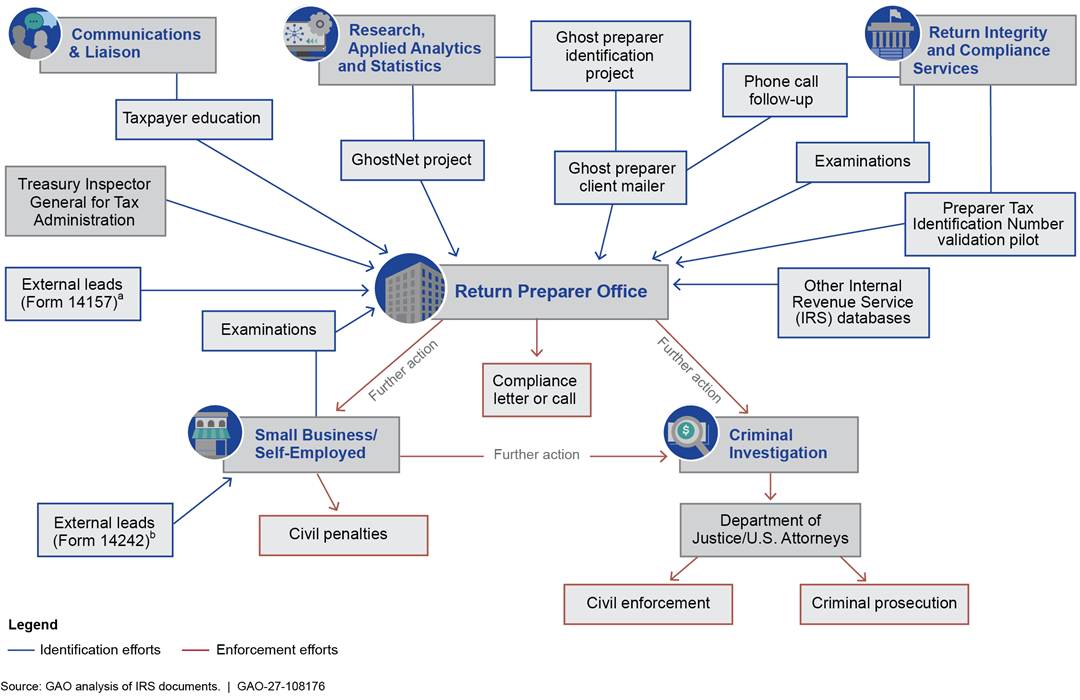
IRS identifies potential ghost preparers through a combination of ad hoc efforts such as data analysis, examinations, and referrals. Once identified, IRS addresses ghost preparers through taxpayer education efforts and enforcement actions such as letters, civil penalties, and criminal investigations. RPO oversees these efforts in coordination with other offices and federal entities (see fig. 11).
Figure 11: Internal Revenue Service Offices and Federal Entity Coordination of Ghost Preparer Oversight Functions
Notes:
aForm 14157 is used by taxpayers or tax professionals to report complaints against a tax return preparer or tax preparation business.
bForm 14242 is used by taxpayers or tax professionals to report suspected abusive tax promotions or preparers who promote such schemes.
Identification Efforts
IRS primarily identifies potential ghost preparers through internal compliance activities, supplemented by external referrals. RPO serves as the central intake point for ghost preparer leads and oversees identification efforts. IRS generates ghost preparer leads from several sources, including: research datasets, data analysis, examinations, and external referrals. These leads result in a relatively small number of ghost preparer cases annually—around 1,400 cases opened on average from 2021 through 2025, compared with around 800,000 paid preparers with PTINs in those years.
Research datasets. RPO uses IRS datasets to identify preparers who appear noncompliant with PTIN requirements, such as those who enter invalid PTINs. Most ghost preparer cases opened by RPO between 2021 and 2025 originated from IRS datasets used to identify returns with invalid PTINs. For example, RPO opened cases based on PTINs associated with deceased preparers, PTINs that appeared to be frequently misused, and PTINs that were not found in IRS’s PTIN database. IRS identifies a smaller number of ghost preparers through data analysis on self-prepared returns without PTINs.
IRS does not currently validate all PTINs when returns are filed but plans to implement an automated version of validation once it modernizes the underlying infrastructure, according to IRS officials.[57] Return Integrity and Compliance Services (RICS) oversaw a PTIN validation pilot in 2025 and 2026 that, if fully implemented, would ensure that preparers use correct PTIN information. This pilot required manual validation and was intended to determine feasibility rather than to detect potential ghost preparers. According to IRS officials, fully implementing automated PTIN validation would help identify certain PTIN compliance issues, such as invalid, inactive, or incorrect PTIN information submitted with a return and could reduce some manual workload. However, PTIN validation would not identify all ghost preparer activity, such as returns filed to appear self-prepared or returns filed with another preparer’s valid PTIN or Electronic Filing Identification Number. IRS officials told us that PTIN validation is one component of their overall ghost preparer identification and enforcement efforts.
Data analysis. RPO also receives ghost preparer leads from other offices’ data analysis projects to identify ghost preparers. For example, RAAS and RICS have projects to identify ghost preparers.
· Ghost preparer identification project. RAAS uses network analysis and machine learning to identify groups of self-prepared returns that have potential ghost preparer involvement.[58] IRS officials told us that the 2026 filing season was their 4th year doing this analysis. RAAS shares this information with different offices across IRS and any IRS staff can request access to it.
· Ghostnet project. RAAS uses machine learning in its Ghostnet project to classify groups of self-prepared returns identified as possibly prepared by ghost preparers. According to IRS officials, RAAS shared the project’s initial results with RPO in September 2025. However, RPO determined the results were inadequate for generating ghost preparer leads. Since this initial delivery, RAAS lost a technical team that supported the project since it transitioned contracts. RAAS staff are now primarily responsible for updating the model.
· Ghost preparer client mailer. IRS uses a mailer pilot to educate taxpayers and obtain information to identify potential ghost preparers. According to IRS officials, the pilot is a collaborative effort among RAAS, RICS, and RPO. RAAS provides RPO with information from its ghost preparer identification project, including the names and mailing addresses of taxpayers whose electronically filed returns may have been prepared by a third party but did not include preparer information. IRS then mails these taxpayers a letter informing them that their paid preparer did not provide a PTIN or other identifying information. The letter describes paid preparer responsibilities, warns taxpayers to avoid unethical ghost preparers, and asks taxpayers to contact IRS to provide information to help identify the preparer.[59]
In 2024 and 2025, RICS staff answered telephone calls from taxpayers and collected information, including the potential ghost preparer’s name, address, and contact information. This information was then shared with RPO to validate and verify those leads. IRS officials said they do not track the outcomes of this pilot. However, RAAS does record this information in a data collection instrument and is able to analyze it. For example, officials told us that IRS recorded over 2,000 responses for the 2025 pilot. Of these responses, IRS generated over 200 distinct ghost preparer leads, of which 68 were corroborated as potential ghost preparers.[60] For the 2026 pilot, IRS mailed 20,000 letters that directed taxpayers to IRS.gov to use an existing electronic preparer complaint form to provide information about their preparer. Officials told us that, as of May 2026, 52 recipients of the 2026 letter had submitted preparer complaints.
Examinations. RICS, SB/SE, and the Treasury Inspector General for Tax Administration may generate ghost preparer leads during examinations and fraud investigations, according to IRS officials. These cases are generally initiated for other reasons, such as suspected identity theft or fraud, and IRS may identify the preparer as a ghost preparer during the examination. IRS also uses identity theft filters and other fraud detection tools to identify potentially fraudulent returns before issuing refunds, as we have previously reported.[61]
External referrals. IRS relies on help from taxpayers and the public to identify noncompliant preparers and preparers who peddle abusive schemes. RPO opened around 150 ghost preparer cases from referrals annually, from 2021 through 2025. IRS established a centralized landing page on IRS.gov in December 2025 that allows taxpayers to submit reports of suspected tax fraud, identity theft and complaints against paid preparers, including ghost preparers.[62] IRS routes reports received via this page to the appropriate office. For example, RPO receives and evaluates complaints against paid preparers for further action.[63]
Enforcement Efforts
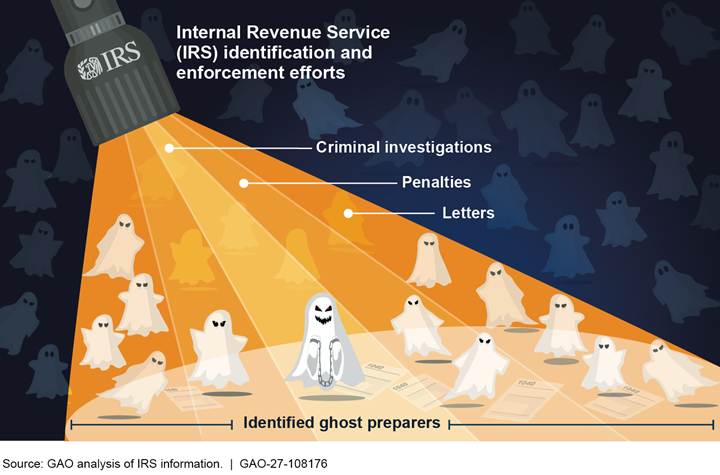
IRS addresses identified ghost preparers using various escalating enforcement actions, including letters, penalties, and criminal investigations (see fig. 12). RPO attempts to bring ghost preparers into compliance with a letter when the issue appears primarily related to PTIN noncompliance or, if appropriate, sends the case to another office such as SB/SE or CI for further enforcement action. IRS takes relatively few of these actions each year and reaches a small portion of the paid preparer population. For example, in 2025 IRS assessed penalties for failure to sign a return or provide a PTIN against fewer than 200 of over 870,000 registered preparers.
Letters and phone calls. RPO assigns different education and compliance actions—also called treatments—to identified ghost preparers. These treatments involve IRS contacting the ghost preparer by letter or potentially by phone to address the PTIN compliance issue. RPO analysts use professional judgment to determine the appropriate treatment, which may include issuing an RPO compliance treatment letter, contacting the preparer by phone, or referring the case to another IRS unit for further treatment. RPO follows up 60 to 90 days later to determine if the preparer has come into compliance. If the preparer has not come into compliance and multiple attempts have been made, RPO may refer the case to SB/SE for further action, such as penalty assessment.
RPO closes the majority of ghost preparer cases after sending the preparer a letter. From 2022 through 2025, RPO opened around 1,400 ghost preparer cases annually and closed around 60 percent of those cases because the preparer returned to compliance after letter or phone contact. RPO referred a smaller number of these cases to other business units for further treatment each year. For example, in 2025, RPO referred 43 ghost preparer cases (less than 5 percent) to other business units, such as SB/SE, for further treatment.
Penalties. SB/SE may assess civil penalties under Internal Revenue Code subsections 6695(b) and (c) for failure to sign a return and furnish a PTIN.[64] These penalties represent a more formal enforcement response than RPO letters or calls and may be appropriate when preparers do not come into compliance or when IRS determines that the conduct warrants a penalty. RPO referred around 50 ghost preparer cases to SB/SE annually from fiscal years 2021 through 2025. SB/SE generally assesses fewer than 200 related section 6695 penalties annually but does not know how many are related to ghost preparers because, as previously discussed, they did not track the data by subsection before 2025.[65]
Criminal and civil investigations. CI investigates ghost preparer cases that are referred to it for criminal investigation. These cases generally involve more serious conduct than PTIN noncompliance alone, such as suspected fraud, abusive return preparation, identity theft, or other conduct that may warrant criminal investigation or civil action. If CI determines that a case merits further action, it may refer the case to DOJ’s National Fraud Enforcement Division, Civil Division, or the appropriate U.S. Attorney’s Office for criminal or civil investigations, according to DOJ officials. As previously discussed, these cases may result in civil or criminal actions, such as imprisonment, restitution, or an injunction prohibiting the preparer from preparing returns.
CI officials told us ghost preparer cases require substantial staff resources because they involve high burdens of proof and lengthy investigations. This contributes to low enforcement activity because these cases compete for limited enforcement resources with other IRS priorities. For example, in 2025 CI initiated almost 3,000 investigations, fewer than 1,000 of which involved the category of legal source tax crimes. This broad category includes employment tax cases and other cases that threaten the tax system, including unscrupulous return preparers. Ghost preparers would represent only a small subset of those preparer cases. In addition, CI investigations in this category have decreased by around half over the past decade.
IRS Educates Taxpayers on Paid Preparer Requirements and Ghost Preparers but Could Enhance Efforts to Research Target Audiences and Measure Success
IRS educates taxpayers on how to select a qualified paid preparer and avoid unscrupulous preparers, including ghost preparers, through a combination of direct outreach and media-based outreach. These efforts are intended to reach populations that may be more likely to be affected by ghost preparers and to educate them on common pitfalls and warning signs, such as preparers refusing to sign a return. IRS’s Communications and Liaison (C&L) office collaborates with RPO and the Stakeholder Partnerships, Education, and Communication office to educate taxpayers on the characteristics of credible preparers and the warning signs of ghost preparers. IRS officials said direct outreach, such as attending events, conferences, and meetings, is their primary method for communicating with taxpayers and community partners about paid preparers. According to IRS officials, IRS supplements this with media outreach, such as annual online campaigns and online guidance.
IRS’s ability to conduct direct outreach has been affected by recent staffing reductions. For example, C&L experienced significant staffing decreases between January 2025 and May 2026, including a nearly 50 percent reduction in its outreach office. According to IRS officials, these reductions are expected to decrease the number of outreach events going forward and limit the agency’s ability to reach as many taxpayers as it has in the past, including taxpayers in rural or immigrant communities. All of the IRS oversight and advocacy groups and one industry group we spoke with said IRS could do more to educate taxpayers on how to choose a qualified preparer and avoid ghost preparers. Several IRS oversight groups said this outreach should focus on communities that ghost preparers may target, such as immigrant communities.
IRS educates the tax professional community on paid preparer requirements and ways to report unscrupulous preparers, including ghost preparers. For example, IRS communicates with tax professionals through collaboration mechanisms such as the Coalition Against Scam and Scheme Threats (CASST) and the Security Summit, among other channels. Formed in 2024, CASST is a coalition of IRS, state tax agencies, and tax industry partners that focuses on combating tax scams and schemes. The Security Summit, a public-private partnership, focuses on information sharing and coordinated outreach on identity theft and fraud. The Security Summit includes IRS, state tax agencies, tax preparation firms, software developers, payroll and tax financial product processors, tax professional organizations, and financial institutions.
IRS relies on established relationships with community partners, professional associations, industry groups, and employers to identify outreach opportunities and audiences. For example, IRS officials told us that stakeholders identified the media and entertainment community as a target for ghost preparers (see text box).
|
Internal Revenue Service Direct Outreach to Media and Entertainment Community Internal Revenue Service (IRS) officials said they became aware of concerns about ghost preparers targeting the media and entertainment industry through community partner input and word of mouth. In response, IRS expanded existing partnerships, identified new partners, and coordinated outreach events in six cities where officials believed the issue was most prevalent, including New York City, Los Angeles, and New Orleans. IRS also engaged tax professionals with experience in the entertainment sector. These efforts were intended to raise awareness of ghost preparer risks and related compliance issues, such as business recordkeeping, gig economy tax issues, Form 1099-K, filing season readiness, online accounts, payment options, and communicating with IRS in other languages. |
Source: GAO analysis of IRS interviews and documentation. | GAO‑27‑108176
Other media outreach channels IRS uses to educate taxpayers include:
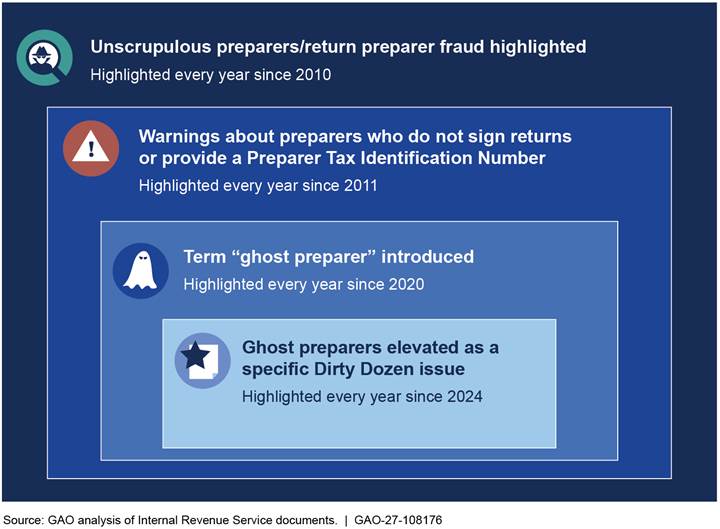
· Dirty Dozen campaign. IRS regularly shares information on unscrupulous preparers through its annual Dirty Dozen campaign, which identifies prominent tax scams. IRS has highlighted unscrupulous preparers in this campaign every year since 2010, when return preparer fraud was listed as the top issue (see fig. 13). After PTIN requirements were implemented in 2011, IRS began warning taxpayers to avoid preparers who do not sign returns or provide a PTIN. The term “ghost preparer” first appeared in the campaign in 2020 as part of the broader issue of unscrupulous tax preparers. Beginning in 2024, IRS elevated ghost preparers as a specific issue in the campaign and has continued to highlight them since.
Figure 13: Internal Revenue Service Dirty Dozen Messaging on Paid Preparers is Cumulative and Increasingly Specific
· Guidance on choosing a paid preparer and avoiding ghost preparers. IRS issues guidance and educational materials that help taxpayers choose a qualified paid preparer and identify common red flags, such as preparers who do not sign returns or provide a PTIN.
· Other public communications and tools. IRS promotes its preparer directory to help taxpayers identify credentialed tax professionals and issues Tax Tips, fact sheets, news releases, and other periodic communications before and during the filing season.[66] According to IRS, its Tax Tips reach more than 1 million subscribers.
We assessed IRS’s education and outreach efforts against our practices for consumer education planning, which identify nine practices agencies can incorporate when planning education and outreach efforts.[67] These practices can help agencies define target audiences, tailor messages, use appropriate delivery mechanisms, and assess whether education efforts are achieving intended results. We found that IRS’s efforts were mostly consistent with these practices (see table 1). However, we found IRS could take additional steps to research target audiences and establish metrics to measure success.
Table 1: Extent to Which Internal Revenue Service Educates Taxpayers on Paid Preparers Consistent with Leading Practices for Consumer Education Planning
|
Leading practice |
Description |
GAO assessment |
|
Analyze the situation |
Analyze the situation, including key target dates and competing voices or messages. Review relevant past experiences to identify applicable “lessons learned” that may help guide efforts. |
● |
|
Identify stakeholders |
Identify and engage all key stakeholders involved in outreach efforts and clarify their roles and responsibilities. |
● |
|
Identify credible messengers |
Identify who will be delivering the messages and ensure that the source is credible with audiences. |
● |
|
Design media mix |
Plan the media mix (e.g., online, print, broadcast) to optimize earned media (e.g., news stories, opinion editorials) and paid media. |
● |
|
Define goals and objectives |
Define the goals of the outreach campaign and the objectives that will help the campaign meet those goals. |
● |
|
Identify resources |
Identify available short-term and long-term budgetary and other resources. |
● |
|
Research target audiences |
Conduct audience research and measure audience awareness. Identify any potential audience-specific obstacles, such as access to information. |
◐ |
|
Develop consistent, clear messages |
Develop clear and consistent audience messages based on budget, goals, and audience research findings. |
● |
|
Establish metrics to measure success |
Establish both process and outcome metrics to measure success in achieving objectives of the outreach campaign. |
◐ |
● Consistent with leading practices.
◐ Partially consistent with leading practices.
○ Not consistent with leading practices.
Source: GAO analysis of Internal Revenue Service information. | GAO‑27‑108176
According to C&L officials, IRS does not rely on empirical data or formal targeting analyses to inform their taxpayer education efforts. Local partnerships can help IRS reach taxpayers through trusted messengers but IRS’s outreach activities vary geographically and depend in part on where such partnerships are available rather than a standardized, data-driven approach to identify and reach populations most vulnerable to ghost preparers. Additionally, IRS does not measure the effectiveness of its existing outreach efforts to taxpayers on paid preparers, including ghost preparers, including whether outreach increases taxpayer awareness or changes behavior. IRS officials said measuring the effect of outreach is inherently difficult. Officials said they gather feedback from stakeholders and use anecdotal information as a diagnostic indicator of whether communications are reaching and resonating with different audiences. IRS officials also said they try to incorporate this feedback into future outreach efforts.
IRS’s recent budget and staffing reductions heighten the importance of determining how best to allocate limited resources. By further researching target audiences for ghost preparer education, IRS could better identify which taxpayers are most vulnerable to ghost preparers, which messages are most likely to reach them, and which outreach channels provide the greatest return on investment. Establishing metrics to measure the effectiveness of its ghost preparer efforts, as we discuss later in this report, will help IRS assess if its education efforts are reaching the taxpayers most vulnerable to ghost preparers or whether its messages are effective in helping taxpayers avoid them.
IRS Does Not Have a Comprehensive Strategy to Address Paid Preparers that Includes Ghost Preparers
Although several IRS offices work collaboratively to identify and address ghost preparers and educate taxpayers, IRS does not have a comprehensive, coordinated strategy for paid preparer efforts that includes ghost preparers. As discussed, IRS invests in multiple paid preparer-related activities, such as outreach, analysis, investigations, and preparer education that are fragmented across many IRS offices. While these offices work collaboratively, they are missing opportunities to share information to better address risks and protect taxpayers and revenue. See figure 14 as a notional example of how fragmented efforts could be organized with a coordinated strategy. We and other IRS oversight groups, including the Electronic Tax Administration Advisory Committee, the National Taxpayer Advocate, and the Treasury Inspector General for Tax Administration, have recommended IRS implement a service-wide paid preparer strategy.[68]
Figure 14: Notional Example of Fragmented Activities Compared to a Comprehensive, Coordinated Strategy
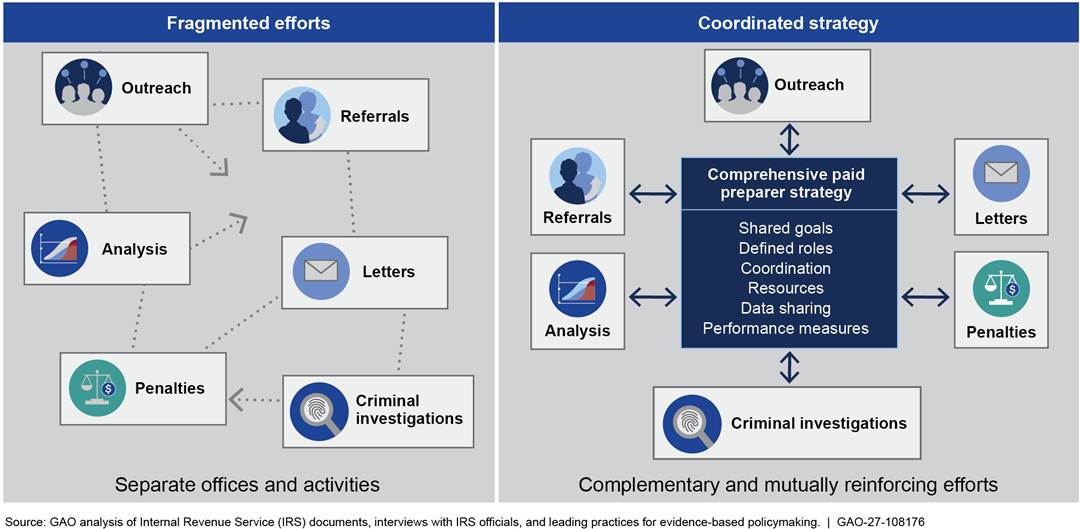
Our past work has shown that having a strategy is a starting point and basic underpinning for better managing federal programs and activities.[69] In addition, our evidence-based policymaking practices state that agencies should identify the strategies, contributing organizations and activities, and resources needed to achieve goals.[70] Further, when multiple offices or activities contribute to similar outcomes, agencies should coordinate those efforts to help manage fragmentation and ensure they are complementary and mutually reinforcing.
In 2020, IRS developed a Service-wide Return Preparer Strategy to coordinate preparer oversight across offices but efforts to implement it have stalled. In 2022, we recommended IRS finalize and implement the paid preparer strategy. In December 2025, IRS officials told us IRS could not implement our recommendation because the agency was undergoing workforce reductions and organizational changes. However, in April 2026, IRS officials told us they were developing a new preparer strategy that would be implemented after the reorganization. According to IRS officials, the new strategy is intended to achieve results even as agency priorities change across administrations and will include ghost preparers. As of July 2026, IRS developed a draft framework to guide development of a paid preparer strategy. Officials told us the new strategy will improve data sharing and analysis, and communications between IRS offices with paid preparer roles. However, IRS has not yet developed or implemented a strategy, nor included ghost preparer identification and treatment efforts into agency-wide planning. IRS officials told us they plan to advance the strategy in phases, beginning with the creation of the Tax Professional Management Office in June 2026, but do not currently have a time frame for full implementation.
Without a comprehensive paid preparer strategy, IRS does not have a framework for coordinating its efforts across a spectrum of paid preparer activities. As a result, offices may continue to operate independently or overlook cross-cutting and emerging risks, such as foreign tax preparers posing as domestic preparers to submit fraudulent returns. A comprehensive strategy could help IRS leadership better determine whether resources devoted to ghost preparers and other paid preparer compliance efforts are appropriately aligned with the risks that pose the greatest harm to taxpayers and tax administration. It could help IRS identify additional evidence needs, including research on taxpayer audiences most vulnerable to ghost preparers, and use data from existing efforts—such as results from the PTIN validation pilot, analysis projects, and outreach activities—to better target education, identification, and enforcement.
A comprehensive strategy is even more important in the absence of broader IRS authority to oversee paid preparers. We have previously recommended that Congress grant IRS authority to establish professional requirements for paid preparers.[71] While a comprehensive strategy would not substitute for additional authority, it could help IRS target its existing preparer efforts more effectively while preparing for any future authority Congress may provide. For example, a strategy could identify which paid preparer risks IRS would address under current law, and what additional actions would require statutory authority. IRS could also determine what data, resources, governance, and performance measures it would need to implement expanded authority. Such planning would help ensure that, if Congress grants additional authority, IRS is positioned to translate that authority into measurable improvements in taxpayer protection and preparer compliance.
IRS Has Not Developed Strategic Objectives, Performance Goals, or Metrics for Its Ghost Preparer Efforts
IRS has not defined and documented measurable objectives or performance goals specific to its ghost preparer efforts. For example, according to the IRM, RPO is responsible for the ghost preparer treatment program, whose goal is to ensure all paid return preparers comply with PTIN requirements. However, this broad goal does not specify what IRS intends to achieve through its other ghost preparer efforts or how IRS will measure progress.
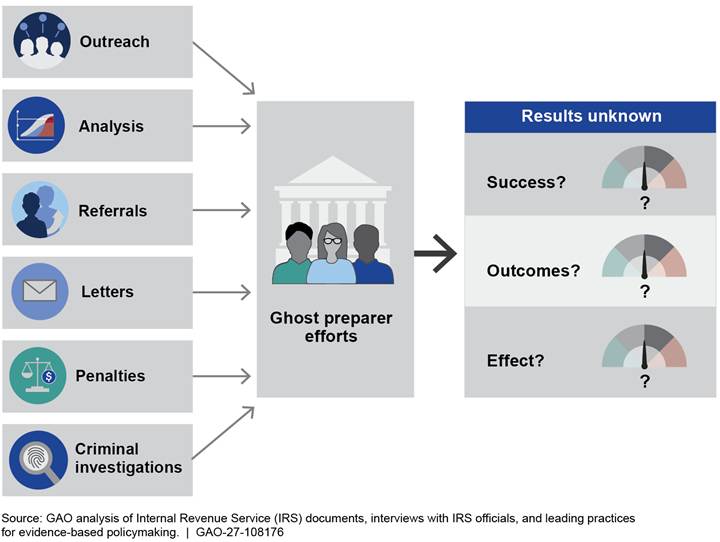
Additionally, IRS has not developed measurable objectives or performance goals for key activities such as identifying ghost preparer leads through data analysis, treating identified ghost preparers, or reducing the number of returns filed by ghost preparers (see fig. 15). IRS also has not established metrics to assess the effectiveness of its taxpayer education efforts, such as whether outreach increases taxpayer awareness, reaches populations most vulnerable to ghost preparers, or changes taxpayer behavior.
Figure 15: Internal Revenue Service Conducts Multiple Ghost Preparer Activities, but Results Are Unknown
Our evidence-based policymaking practices state that agencies should define goals, identify measures to assess progress, assess available evidence, and use evidence to determine whether strategies and activities are achieving intended results or need adjustment.[72] These practices also emphasize that agencies should identify the activities that contribute to each goal and use evidence to assess progress toward those goals. Strategic objectives and performance goals provide the framework for aligning activities toward common outcomes, assessing whether strategies are working, and informing resource allocation.
IRS has not established measurable objectives or performance goals for its ghost preparer efforts because responsibility for these activities is fragmented across multiple offices, relevant data are limited and maintained in separate systems, and IRS has not established a comprehensive paid preparer strategy that includes ghost preparers. IRS offices collect information for their own operational purposes, but IRS does not have an integrated approach for linking ghost preparer activities—such as educational outreach, analysis, leads, mailers, penalties, and investigations—to strategic objectives or performance goals.
Without clearly defined and documented objectives, goals, and performance measures, IRS cannot determine whether its ghost preparer efforts are aligned toward common outcomes or achieving desired results. IRS also cannot reliably assess whether its efforts are reducing ghost preparer activity, which activities are most effective, or how to adjust its strategy and better allocate resources.
Conclusions
Paid tax return preparers play a central role in the tax system, preparing more than half of all individual income tax returns in fiscal year 2025. While qualified preparers can help taxpayers comply with their tax obligations, ghost preparers put taxpayers at risk of filing erroneous or fraudulent returns, identity theft, and stolen refunds.
IRS has taken steps to identify and address ghost preparers, and it tracks some information on cases and outcomes. However, IRS could better leverage information on identified ghost preparers and efforts across the agency to address them. More comprehensive data would help IRS understand the scope of ghost preparer activity and whether its prevention and enforcement efforts are contributing to intended outcomes. It could also help IRS identify patterns in taxpayer harm, such as recurring preparer schemes and affected communities.
IRS’s various ghost preparer efforts occur within a broader paid preparer environment in which responsibilities are fragmented across multiple offices and activities. While IRS has attempted to develop and implement a coordinated Service-wide Return Preparer Strategy since 2020, those efforts have been stalled. A comprehensive, coordinated strategy is particularly important because paid preparer noncompliance can have an exponential effect on tax administration and tax revenue. Unlike an individual taxpayer’s noncompliance, one preparer’s actions may affect many taxpayers’ returns. Further, a comprehensive strategy is even more important in the absence of explicit authority to establish professional requirements for all paid preparers, as we have previously recommended.
Incorporating ghost preparer identification and treatment into a comprehensive paid preparer strategy would help IRS continue to adapt to emerging threats to vulnerable taxpayers and tax revenue. Further, ensuring that IRS establishes objectives and performance goals related to its preparer activities will help IRS make more informed decisions about where to direct limited resources to protect taxpayers, promote preparer accountability, and improve compliance.
Recommendations for Executive Action
We are making the following three recommendations to IRS:
The Commissioner of Internal Revenue should review the quality and usefulness of existing data and identify opportunities to enhance data collecting, sharing, and analysis to inform its ghost preparer efforts. (Recommendation 1)
The Commissioner of Internal Revenue should incorporate efforts to identify and address ghost preparers within a comprehensive, coordinated paid preparer strategy and identify the resources needed to implement it. (Recommendation 2)
The Commissioner of Internal Revenue should define and document measurable strategic objectives and performance goals for ghost preparer initiatives, including methods and measures to assess the effectiveness of taxpayer outreach. (Recommendation 3)
Agency Comments
We provided a draft of this report for comment to the Department of Justice (DOJ) and the Internal Revenue Service (IRS). IRS provided written comments, which are reproduced in appendix III. IRS agreed with all three of our recommendations and described steps it plans to take, or has started taking, in response to each recommendation. IRS and DOJ also provided technical comments, which we incorporated as appropriate.
We are sending copies of this report to the appropriate congressional committees, the Attorney General, and the Secretary of the Treasury, and other interested parties. In addition, the report is available at no charge on the GAO website at https://www.gao.gov.
If you or your staff have any questions about this report, please contact me at McTigueJ@gao.gov. Contact points for our Offices of Congressional Relations and Media Relations may be found on the last page of this report. GAO staff who made key contributions to this report are listed in appendix IV.

James R. McTigue, Jr.
Director, Strategic Issues
Tax Policy and Administration
We analyzed the following 44 federal (23 civil and 21 criminal) cases involving ghost preparers. These cases involved defendants who were sentenced or had judgments against them in federal courts from 2017 through 2025. We did not attempt to identify all federal ghost preparer cases adjudicated during this time frame. As such, this list is not generalizable to other ghost preparer cases.
In our analysis of the fact patterns in these cases, we relied on court documentation to provide sufficient detail on the ghost preparers’ illegal activities. This court documentation included court opinions, final judgments, plea agreements, and sentencing memorandums, as cited in the list below.
Using these cases below, we identified themes representing different ways ghost preparers misused Preparer Tax Identification Numbers to conceal their identities as paid preparers and the types of fraud they committed. We selected example cases to illustrate each theme, focusing on those with more available information and documentation and reflecting a range of restitution amounts and other relevant characteristics. The illustrative examples included in this report are not generalizable to other ghost preparer cases.
Federal Civil Cases
1. United States v. Alberto, No. 3:18-CV-1014, 2020 U.S. Dist. LEXIS 25049 (M.D. Penn. Feb. 13, 2020)
2. United States v. Baker, United States’ Compl. for Permanent Inj., No. 4:19-cv-00073 (E.D. Mo. Jan. 17, 2019)
3. United States v. Bernard, No. 1:18-cv-20947-KMM, 2020 U.S. Dist. LEXIS 104318 (S.D. Fla. June 12, 2020)
4. United States v. Boursiquot, No. 0:17-cv-60550-RNS, 2023 U.S. Dist. LEXIS 162480 (S.D. Fla. Sept. 13, 2023)
5. United States v. Brenes, No. 4:20-cv-10007-KMM, 2020 U.S. Dist. LEXIS 252713 (S.D. Fla. Sept. 16, 2020)
6. United States v. Brooks, No. 4:16-cv-1160 RLW, 2017 U.S. Dist. LEXIS 112064 (E.D. Mo. June 5, 2017)
7. United States v. Brown, 274 F. Supp. 3d 794 (N.D. Ill. 2017)
8. United States v. Davenport, Compl. for Permanent Inj. and Other Relief, No. 1:24-cv-1965 (N.D. Ill. Mar. 8, 2024)
9. United States v. Devallon, Dominique, and Tax Time Group Inc., Compl. For Permanent Inj., No. 0:20-cv-62492-WPD (S.D. Fla. Dec. 4, 2020)
10. United States v. Espinal, No. 1:11-cv-20418-CIV, 2021 U.S. Dist. LEXIS 155552 (S.D. Fla. Aug. 18, 2021)
11. United States v. Fanua, No. 2:16-cv-05940-JAK, 2023 U.S. Dist. LEXIS 234489 (C.D. Cal. Dec. 12, 2023)
12. United States v. Frias, Compl. For Permanent Inj. and Other Relief, No. 3:23-cv-165 (D. Conn. Feb. 9, 2023)
13. United States v. Garrett, Compl. For Permanent Inj., No. 2:22-cv-12654 (E.D. Mich. Nov. 3, 2022)
14. United States v. Johnson, Permanent Enjoinment, No. 8:23-cv-986 (M.D. Fla. Dec. 12, 2023)
15. United States v. Maduro, No. 1:20-cv-2266-JPB, 2022 U.S. Dist. LEXIS 64221 (N.D. Ga. Apr. 5, 2022)
16. United States v. Powell, Op. & Order Containing Findings of Fact and Conclusions of Law Following Bench Trial, No. 2:21-cv-10622 (E.D. Mich. Mar. 29, 2024)
17. United States v. Quiles, No. 6:19-cv-393-ORL-41GJK, 2019 U.S. Dist. LEXIS 153148 (M.D. Fla. July 29, 2019)
18. United States v. Ramirez, No. 20-00204-CJC, 2024 U.S. Dist. LEXIS 87937 (C.D. Cal. Mar. 25, 2024)
19. United States v. Rodriguez, No. 8:24-cv-650-TPB, 2024 U.S. Dist. LEXIS 234487 (M.D. Fla. Dec. 31, 2024)
20. United States v. Sang, No. 21-cv-4266, 2022 U.S. Dist. LEXIS 34043 (E.D. N.Y. Feb. 26, 2022)
21. United States v. Tups Tax, LLC, No. 1:22-cv-21740-JLK, 2023 U.S. Dist. LEXIS 39378 (S.D. Fla. Feb. 7, 2023)
22. United States v. Umbrella Fin. Servs., LLC, 715 F. Supp. 3d 967 (N.D. Tex. 2024)
23. United States v. Zio, No. 1:22-cv-20279-KMM, 2023 U.S. Dist. LEXIS 41190 (S.D. Fla. Jan. 24, 2023)
Federal Criminal Cases
1. United States v. Ajelero, No. 22-1825, 2024 U.S. App. LEXIS 9913 (2d Cir. Apr. 24, 2024)
2. United States v. Benitez, Government’s Sentencing Mem., No. 1:18-cr-45 (S.D. Ohio Aug. 12, 2019)
3. United States v. Calhoun, Plea Agreement, No. 2:25-cr-9 (E.D. Wis. Jan. 27, 2025)
4. United States v. Earnest, 132 F. 4th 905 (5th Cir. 2025)
5. United States v. Exavier, 783 F. Appx. 849 (11th Cir. 2019)
6. United States v. Jackson, Plea Agreement, No. 1:25-cr-00038 (S.D. Ga. July 7, 2025)
7. United States v. Jean-Pierre, No. 3:23-cr-45/TKW, 2024 U.S. Dist. LEXIS 32593 (N.D. Fla. Feb. 26, 2024)
8. United States v. Jones, Plea Agreement, No. 1:24-cr-00201 (S.D. Ala. Apr. 22, 2025)
9. United States v. Judd, Plea Agreement, No. 8:24-cr-00111 (D. Md. Dec. 5, 2024)
10. United States v. Kim, Government’s Sentencing Mem., No. 2:17-cr-319 (W.D. Wash. Aug. 3, 2018)
11. United States v. Louis, Indictment, No. 22-cr-24 (S.D. Ohio Mar. 25, 2022)
12. United States v. Maung, Government’s Sentencing Mem., No. 4:22-cr-156 (S.D. Iowa Sept. 22, 2023)
13. United States v. Mbowamba, Plea Agreement, No. 3:22-cr-05258 (W.D. Wash. Oct. 6, 2022)
14. United States v. Medina, Government’s Judgment Mem., No. 5:20-cr-00186 (W.D. Tex. Apr. 14, 2022)
15. United States v. Patel, 789 F. Appx. 981 (5th Cir. 2019)
16. United States v. Paulino, Plea Agreement, No. 3:23-cr-00178 (M.D. Pa. July 6, 2023)
17. United States v. Randolph, Factual Basis, No. 1:23-cr-00043-MAC (E.D. Tex. Apr. 19, 2023)
18. United States v. Smith, Government’s Sentencing Mem., No. 1:22-cr-00102-MLB (N.D. Ga. Sept. 19, 2022)
19. United States v. Smith, Government’s Sentencing Mem., No. 1:23-cr-357 (D. Md. Jan. 19, 2024)
20. United States v. Vonty, Government’s Sentencing Mem., No. 4:23-cr-00042-SHL-ACA (S.D. Iowa Nov. 9, 2023)
21. United States v. Washington, Government’s Sentencing Mem., No. 22-cr-145 (D. Minn. Oct. 31, 2023)
The Internal Revenue Code provides a range of civil and criminal penalties and other enforcement tools for paid preparers who fail to comply with certain requirements, as shown in table 2.
Table 2: Selected Internal Revenue Code Paid Preparer Penalties and Other Authorities for Returns Filed in Calendar Year 2026
|
Code section |
Description |
Penalty |
|
Civil penalties |
||
|
6694(a) |
Understatement of taxpayer’s liability due to an unreasonable position |
$1,000 per return, or 50 percent (whichever is greater) of the tax preparer’s income to prepare the return |
|
6694(b) |
Understatement of taxpayer’s liability due to willful or reckless conduct |
$5,000 per return, or 75 percent (whichever is greater) of the tax preparer’s income to prepare the return |
|
6695(a) |
Failure to provide copy of return to taxpayer |
$65 per failure, up to a maximum of $32,500a |
|
6695(b) |
Failure to sign return |
|
|
6695(c) |
Failure to furnish identifying number |
|
|
6695(d) |
Failure to retain a copy or list of returns filed |
|
|
6695(e) |
Failure of employers to file correct information on each tax preparer employed |
|
|
6695(f) |
Negotiation of taxpayer’s refund check |
$650 per check |
|
6695(g) |
Failure to be diligent in determining earned income tax credit eligibility |
$650 per failure |
|
6701 |
Aiding and abetting understatement of tax liability |
$1,000b |
|
6713 |
Improper disclosure or use of return information |
$250 per disclosure, up to a maximum of $10,000c |
|
Criminal penalties |
||
|
7206 |
Willful preparation of a false or fraudulent return or other document |
Up to $100,000,d 3 years imprisonment, or both |
|
7207 |
Willfully providing known fraudulent returns or other documents to Internal Revenue Service |
Up to $10,000,e 1 year imprisonment, or both |
|
7216 |
Knowingly or recklessly disclosing or using return information |
Up to $1,000,f 1 year imprisonment, or both |
|
Other authorities |
||
|
7407 |
Authority to enjoin income tax preparers |
|
|
7408 |
Authority to enjoin specified conduct related to tax shelters and reportable transactions |
|
Source: GAO analysis of the Internal Revenue Code (IRC). | GAO‑27‑108176
Notes: This table is not intended to be an exhaustive list of all paid preparer penalties and authorities.
aIRC 6695 penalty amounts listed are subject to an annual inflation index. The penalty rates are based on the year in which the return was filed. Internal Revenue Service Revenue Procedure 2024-40 provides inflation adjustments applying to tax year 2025 returns, that is the returns that are generally filed in calendar year 2026. 2024-45 I.R.B. 1108 (Nov. 4, 2024).
bThe penalty for IRC section 6701 is $10,000 for a corporate tax return.
cIf an unauthorized disclosure or use of information is connected to an identity theft crime, the penalty is $1,000 for each use or disclosure. The maximum penalty assessed cannot be greater than $50,000 in a calendar year.
dThe penalty for IRC section 7206 is $500,000 in the case of a corporation.
eThe penalty for IRC section 7207 is $50,000 in the case of a corporation.
fThe penalty for IRC section 7216 is $100,000 in the case of a disclosure or use to which subsection 6713(b) applies. Subsection 6713(b) substitutes enhanced penalties for improper disclosure or use relating to identity theft.
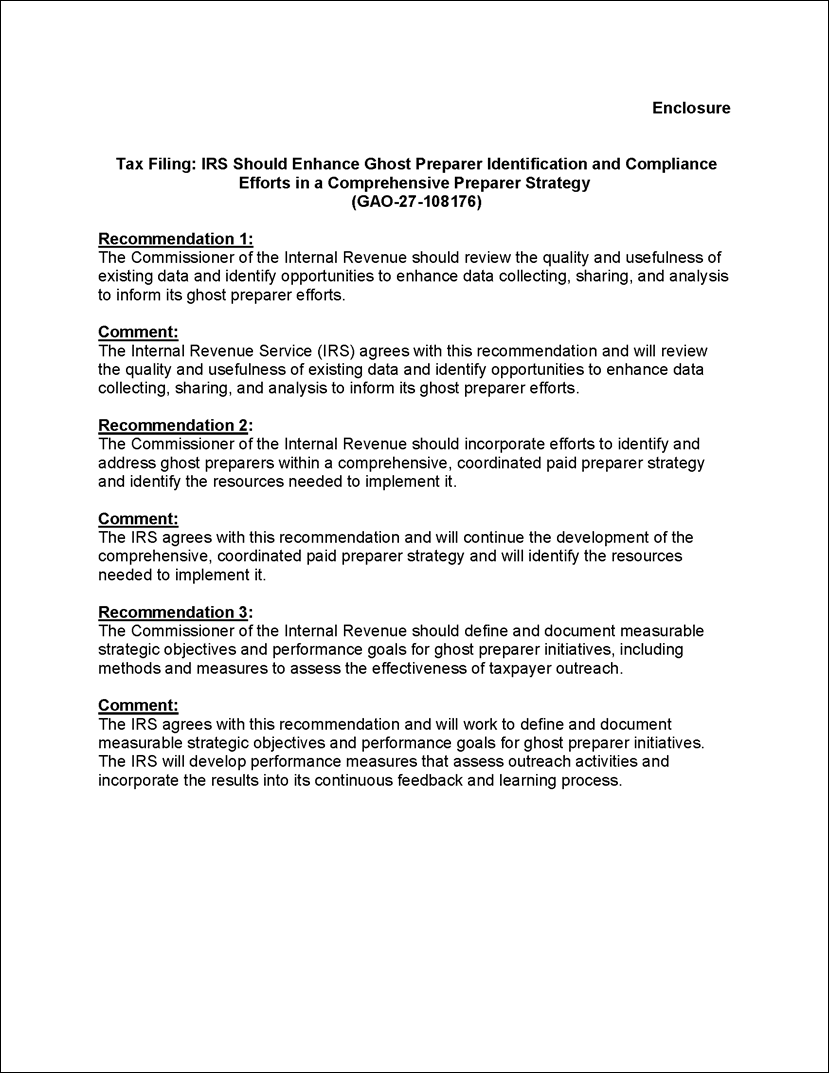
GAO Contact
James R. McTigue, Jr., McTigueJ@gao.gov
Staff Acknowledgments
In addition to the contact named above, Robyn Trotter (Assistant Director), Mackenzie D. Verniero (Analyst-in-Charge), McLeod Brown, Jieun Chang, Michele Fejfar, Rob Gebhart, Emma Hultgren, Daniel Mahoney, Moon Parks, Michael Todd Perry, Andrew J. Stephens, Marc Tucker, and Alicia White made key contributions to this report.
The Government Accountability Office, the audit, evaluation, and investigative arm of Congress, exists to support Congress in meeting its constitutional responsibilities and to help improve the performance and accountability of the federal government for the American people. GAO examines the use of public funds; evaluates federal programs and policies; and provides analyses, recommendations, and other assistance to help Congress make informed oversight, policy, and funding decisions. GAO’s commitment to good government is reflected in its core values of accountability, integrity, and reliability.
Obtaining Copies of GAO Reports and Testimony
The fastest and easiest way to obtain copies of GAO documents at no cost is through our website. Each weekday afternoon, GAO posts on its website newly released reports, testimony, and correspondence. You can also subscribe to GAO’s email updates to receive notification of newly posted products.
Order by Phone
The price of each GAO publication reflects GAO’s actual cost of production and distribution and depends on the number of pages in the publication and whether the publication is printed in color or black and white. Pricing and ordering information is posted on GAO’s website, https://www.gao.gov/ordering.htm.
Place orders by calling (202) 512-6000, toll free (866) 801-7077,
or
TDD (202) 512-2537.
Orders may be paid for using American Express, Discover Card, MasterCard, Visa, check, or money order. Call for additional information.
Connect with GAO
Connect with GAO on X,
LinkedIn, Instagram, and YouTube.
Subscribe to our Email Updates. Listen to our Podcasts.
Visit GAO on the web at https://www.gao.gov.
To Report Fraud, Waste, and Abuse in Federal Programs
Contact FraudNet:
Website: https://www.gao.gov/about/what-gao-does/fraudnet
Automated answering system: (800) 424-5454
Media Relations
Sarah Kaczmarek, Managing Director, Media@gao.gov
Congressional Relations
David A. Powner, Acting Managing Director, CongRel@gao.gov
General Inquiries
https://www.gao.gov/about/contact-us
[1]26 U.S.C. § 6109(a)(4); 26 C.F.R. § 1.6109-2.
[2]IRS identifies different categories of ghost preparers with increasing levels of risks for taxpayers, which we discuss later in this report. Not all ghost preparers hide their identities to avoid accountability for fraudulent or inaccurate tax returns. For example, according to IRS, some ghost preparers are unaware of the PTIN requirement or have allowed their PTIN to expire.
[3]The net tax gap is the difference between taxes owed and taxes paid after accounting for IRS enforcement actions. The tax year 2022 net tax gap of $606 billion is the most recent IRS tax gap projection.
[4]GAO, Paid Tax Return Preparers: Opportunities Remain to Improve IRS Oversight, GAO‑26‑108723 (Washington, D.C.: Feb. 24, 2026).
[5]In 2014 and again in 2022, we recommended Congress grant IRS the explicit authority to establish professional requirements for paid tax preparers. See: GAO, Paid Tax Return Preparers: IRS Efforts to Oversee Refundable Credits Help Protect Taxpayers but Additional Actions and Authority Are Needed, GAO‑23‑105217 (Washington, D.C.: Nov. 30, 2022); and Paid Tax Return Preparers: In a Limited Study, Preparers Made Significant Errors, GAO‑14‑467T (Washington, D.C.: Apr. 8, 2014).
[6]GAO, Evidence-Based Policymaking: Practices to Help Manage and Assess the Results of Federal Efforts, GAO‑23‑105460 (Washington, D.C.: July 12, 2023); and Standards for Internal Control in the Federal Government, GAO‑25‑107721 (Washington, D.C.: May 15, 2025).
[7]GAO, Digital Television Transition: Increased Federal Planning and Risk Management Could Further Facilitate the DTV Transition, GAO‑08‑43 (Washington, D.C.: Nov. 19, 2007); and GAO‑23‑105460.
[8]In addition to the traditional Free File program, IRS also provides fillable forms that all taxpayers can use for free to electronically file returns. For more information on the Free File program, see GAO, IRS Free File Program: IRS Should Develop Additional Options for Taxpayers to File for Free, GAO‑22‑105236 (Washington, D.C.: Apr. 28, 2022).
[9]All paid preparers file returns electronically unless they file 10 returns or fewer per year or have been approved for a waiver.
[10]26 U.S.C. § 6109; 26 C.F.R. § 1.6109-2(d). The application processing fee to obtain or renew a PTIN is $18.75 for 2026.
[11]26 U.S.C. § 6109(a)(4); 26 C.F.R. § 1.6109-2(a).
[12]Most preparers also need an Electronic Filing Identification Number, which IRS issues to individuals or firms approved as authorized IRS e-file providers. Authorized IRS e-file providers are businesses or organizations authorized by IRS to participate in IRS e-file to electronically file clients’ returns.
[13]IRM 25.20.2.1.4(2). According to IRS officials, individuals who provide occasional uncompensated tax return assistance to friends or family members generally do not meet the definition of a ghost preparer and are not required to obtain or use a PTIN.
[14]Criminal ghost preparers may include those who engage in identity theft and refund fraud and victimize taxpayers who are not paying clients of the ghost preparer, as we discuss later in this report.
[15]31 U.S.C. § 330; Loving v. IRS, 742 F.3d 1013 (D.C. Cir. 2014).
[16]Department of the Treasury, Regulations Governing Practice before the Internal Revenue Service, 31 C.F.R. §§ 10.1–10.93 (Circular No. 230).
[17]These credentials are in addition to the obligations required for all return preparers, such as the PTIN requirements.
[18]All preparers may participate in IRS’s voluntary Annual Filing Season Program. The program requires participants to complete continuing education and consent to standards of competency, diligence, and ethical behavior. IRS issues participants a record of completion, includes them in a public return preparer database, and grants participants without other credentials limited representation rights before IRS for examinations of returns they prepared and signed.
[19]76 Fed. Reg. 32,286 (June 3, 2011).
[20]Loving v. IRS, 742 F.3d 1013 (D.C. Cir. 2014).
[21]Steele v. IRS, 260 F.3d 52 (D.C. Cir. 2017).
[22]26 U.S.C. §§ 6695(c); 6694(b).
[23]Loving v. IRS, 742 F.3d 1013 (D.C. Cir. 2014).
[24]Rev. Proc. 2014-42, § 6, 2014-29 I.R.B. 192 (July 14, 2014).
[25]GAO, Fragmentation, Overlap, and Duplication: An Evaluation and Management Guide, GAO‑15‑49SP (Washington, D.C.: Apr. 14, 2015).
[26]Fraud involves obtaining something of value through willful misrepresentation. Whether an act is in fact fraud is a determination to be made through the judicial or other adjudicative system. We reviewed court case documentation for the 44 federal criminal and civil cases and identified fraud schemes involving filing fraudulent income tax returns, stealing taxpayer refunds, and stealing taxpayer identities.
[27]The federal criminal and civil ghost preparer cases we reviewed are not representative of all types of ghost preparer activity as IRS only refers certain ghost preparer cases to DOJ for criminal prosecution or appropriate civil actions. As such, these cases usually involve fraud schemes and larger tax losses rather than smaller, individual instances of ghost prepared returns. As previously discussed, ghost preparer activity does not necessarily always involve return preparer fraud; however, all 44 of the cases included in our analysis did include tax fraud.
[28]For example, see Internal Revenue Service, “Beware of IRS’ 2010 “Dirty Dozen” Tax Scams,” IR-2010-32 (Mar. 16, 2010).
[29]Internal Revenue Service, “Tax return preparer misconduct,” accessed October 5, 2026, https://www.irs.gov/help/report-fraud/tax-return-preparer-misconduct.
[30]Sole proprietors generally report their business-related profit or loss on their Schedule C, Profit or Loss from Business. Taxpayers use Schedule A, Itemized Deductions, to reduce taxable income by listing eligible expenses. Both forms are filed as attachments to individual income tax return, IRS Form 1040.
[31]We have previously reported on IRS’s Refundable Credits Return Preparer Strategy program designed to address improper payments associated with refundable tax credits and other benefits. See GAO, Paid Tax Return Preparers: IRS Efforts to Oversee Refundable Credits Help Protect Taxpayers but Additional Actions and Authority Are Needed, GAO‑23‑105217 (Washington, D.C.: Nov. 30, 2022).
[32]Department of the Treasury, Agency Financial Report, Fiscal Year 2025 (Jan. 27, 2026).
[33]We have previously reported on IRS’s use of information returns to identify and address noncompliance and found that absence of certain data makes refundable credits, such as the EITC, more vulnerable to fraud. See GAO, Tax Administration: Better Coordination Could Improve IRS’s Use of Third-Party Information Reporting to Help Reduce the Tax Gap, GAO‑21‑102 (Washington, D.C.: Dec. 15, 2020).
[34]26 U.S.C. § 32.
[35]Due to the method used to calculate the EITC, for certain income ranges, individuals with higher earned income are entitled to a larger credit than those with lower income. However, the credit also phases out at certain adjusted gross income (or earned income, whichever is greater) limits based on a combination of income, filing status, and the number of qualifying children the taxpayer claims.
[36]Internal Revenue Service, “Recognize tax scams and fraud,” accessed July 29, 2026, https://www.irs.gov/help/tax-scams/recognize-tax-scams-and-fraud.
[37]United States v. Jean-Pierre, No. 3:23-cr-45/TKW, 2024 U.S. Dist. LEXIS 32593 (N.D. Fla. Feb. 26, 2024); and United States v. Espinal, No. 1:11-cv-20418-CIV, 2021 U.S. Dist. LEXIS 155552 (S.D. Fla. Aug. 18, 2021). The fuel tax credit is a refundable credit available only for businesses that meet certain requirements, such as running a farm or purchasing aviation gasoline. 26 U.S.C § 34.
[38]For example, see: Internal Revenue Service, “Dirty Dozen tax scams for 2025: IRS warns taxpayers to watch out for dangerous threats,” IR-2025-26 (Feb. 27, 2025).
[39]United States v. Brenes, No. 4:20-cv-10007-KMM, 2020 U.S. Dist. LEXIS 252713 (S.D. Fla. Sept. 16, 2020). The residential clean energy credit is an annual, nonrefundable credit. The credit equals 30 percent of the costs of new, qualified, clean energy property—such as solar, wind, geothermal, fuel cells, or battery storage technology—installed for homes between 2022 and December 31, 2025. This credit generally has no annual or lifetime dollar limit until it begins to phase out in 2033. The qualified plug-in electric motor vehicle credit is a nonrefundable credit, claimed by individuals and businesses, for up to $7,500 for investments in certain clean vehicles. The credit is only available for vehicles acquired on or before September 30, 2025. 26 U.S.C. § 30D.
[40]26 U.S.C. § 25D does not include other provisions requiring third-party documentation. According to IRS officials, IRS generally requires taxpayers to keep records sufficient to establish the amount of the credit on their tax returns for as long as their contents may become material in the administration of any internal revenue law.
[41]GAO, Tax Enforcement: IRS Can Improve Use of Information Returns to Enhance Compliance, GAO‑24‑107095 (Washington, D.C.: Nov. 15, 2023).
[42]United States v. Zio, No. 1:22-cv-20279-KMM, 2023 U.S. Dist. LEXIS 41190 (S.D. Fla. Jan. 24, 2023).
[43]In March 2020, in response to the COVID-19 pandemic, the CARES Act was enacted, providing Economic Impact Payments of up to $1,200 per eligible individual and $500 per qualifying child. In December 2020, the COVID-Related Tax Relief Act of 2020 was enacted, providing Economic Impact Payments of $600 per eligible individual and $600 for each qualifying child. In March 2021, the American Rescue Plan Act of 2021 was enacted, providing Economic Impact Payments of up to $1,400 per eligible individual or $2,800 for eligible individuals filing jointly, plus $1,400 for each qualifying dependent. These Economic Impact Payments were largely distributed through direct deposits to the bank accounts where taxpayers received their refunds.
[44]IRS’s estimate, the latest available, includes only individual tax returns for tax year 2023 processed in 2024.
[45]United States v. Calhoun, Plea Agreement, No. 2:25-cr-9 (E.D. Wis. Jan. 27, 2025).
[46]United States v. Exavier, 783 F. Appx. 849 (11th Cir. 2019).
[47]While ghost preparers often target immigrants and low-income communities, their reach is not limited to those communities.
[48]United States v. Maung, Government’s Sentencing Mem., No. 4:22-cr-156 (S.D. Iowa Sept. 22, 2023).
[49]United States v. Washington, Government’s Sentencing Mem., No. 22-cr-145 (D. Minn. Oct. 31, 2023).
[50]According to DOJ officials, to qualify as a victim eligible for restitution, the harm must be a “but for” consequence of the charged offense. See, e.g., 18 U.S.C. § 3663A(a)(2).
[51]According to IRS officials, investigative, litigation, and prosecution expenses are not included in restitution. These costs are recovered separately under other statutes or DOJ policies.
[52]According to IRS officials, the taxpayer may seek penalty relief or file an amended return through normal administrative channels.
[53]Subsection 6695(b) of the Internal Revenue Code imposes a penalty on a tax return preparer who fails to sign a return and subsection 6695(c) imposes a penalty on a tax return preparer who fails to furnish an identifying number as required by subsection 6109(a)(4). 26 U.S.C. §§ 6695(b), 6695(c), 6109(a)(4).
[54]For example, the data did not include some of the criminal ghost preparer cases we identified in our literature review and that DOJ identified for us.
[55]GAO, Evidence-Based Policymaking: Practices to Help Manage and Assess the Results of Federal Efforts, GAO‑23‑105460 (Washington, D.C.: July 12, 2023).
[56]GAO, Standards for Internal Control in the Federal Government, GAO‑25‑107721 (Washington, D.C.: May 15, 2025).
[57]PTIN validation refers to efforts to verify whether PTINs used in return preparation or e-file processes are legitimate and associated with current PTIN holders.
[58]RAAS’s network analysis attempts to identify returns filed by ghost preparers by linking individual income tax returns across a range of filing and return characteristics.
[59]The letters sent in 2024 and 2025 ask taxpayers to call IRS for additional information and help identify paid preparers who are not complying with IRS requirements. Letters sent in 2026 advised taxpayers to visit IRS.gov using the provided QR Code and submit Form 14157, Return Preparer Complaint, providing detailed information about the preparer they used when filing their return.
[60]According to IRS, in some cases multiple taxpayers provided the same information about a given preparer.
[61]We previously reported that IRS uses computerized checks, or fraud filters, to screen incoming returns and that IRS’s Return Review Program screens individual tax returns before IRS issues refunds to detect tax fraud and prevent invalid refunds. For example, the Return Review Program prevented about $4.4 billion in invalid refunds during the 2017 filing season. See GAO, Identity Theft: IRS Needs to Better Assess the Risks of Refund Fraud on Business-Related Returns, GAO‑20‑174 (Washington, D.C.: Jan. 30, 2020); and Tax Fraud and Noncompliance: IRS Could Further Leverage the Return Review Program to Strengthen Tax Enforcement, GAO‑18‑544 (Washington, D.C.: July 24, 2018).
[62]Internal Revenue Service, “Report fraud,” accessed July 31, 2026, https://www.irs.gov/help/report-fraud. Taxpayers can also submit complaints against a paid preparer using Form 14157, Return Preparer Complaint.
[63]Taxpayers can submit complaints against a paid preparer to IRS using Form 14157, Return Preparer Complaint. RPO receives and evaluates these complaints for further action. Taxpayers can also report suspected abusive preparer schemes using Form 14242, Report Suspected Abusive Tax Promotions or Preparers, and those complaints are reviewed by SB/SE.
[64]The penalty for subsection 6695(b) and subsection 6695(c) is $65 for each failure (see appendix II). 26 U.S.C. § 6695.
[65]Prior to 2025, IRS tracked penalties for five subsections of Internal Revenue Code sect. 6695 together but only two of these are applicable to ghost preparers. The five subsections are: failure give copy of tax return to taxpayer, failure to sign return, failure to supply PTIN, failure to retain copy or list, and failure to file correct information returns.
[66]The IRS Directory of Federal Tax Return Preparers with Credentials and Select Qualifications is a public, searchable database that taxpayers can use to identify preparers with certain credentials or qualifications. The directory includes certain tax practitioners with valid PTINs, such as attorneys, certified public accountants, enrolled agents, enrolled retirement plan agents, enrolled actuaries, and Annual Filing Season Program participants. IRS notes that not all paid preparers are listed in the directory. For more information, see https://irs.treasury.gov/rpo/rpo.jsf.
[67]GAO, Adoption Tax Credit: IRS Needs a Comprehensive Educational Outreach Plan, GAO‑25‑107429 (Washington, D.C.: Aug. 11, 2025); Affordable Broadband: FCC Could Improve Performance Goals and Measures, Consumer Outreach, and Fraud Risk Management, GAO‑23‑105399 (Washington, D.C.: Jan. 18, 2023); and Digital Television Transition: Increased Federal Planning and Risk Management Could Further Facilitate the DTV Transition, GAO‑08‑43 (Washington, D.C.: Nov. 19, 2007).
[68]GAO, Paid Tax Return Preparers: IRS Efforts to Oversee Refundable Credits Help Protect Taxpayers but Additional Actions and Authority Are Needed, GAO‑23‑105217 (Washington, D.C.: Nov. 30, 2022), recommendation 6. We have also recommended IRS develop and document an agency-wide antifraud strategy. See GAO, Tax Fraud: The Federal Government Loses an Estimated $116 Billion to $304 Billion Annually, GAO‑26‑107810 (Washington, D.C.: Sept. 25, 2026), recommendation 1.
[69]GAO, Countering Violent Extremism: Actions Needed to Define Strategy and Assess Progress of Federal Efforts, GAO‑17‑300 (Washington, D.C.: Apr. 6, 2017); Managing for Results: Practices for Effective Agency Strategic Reviews, GAO‑15‑602 (Washington, D.C.: July 29, 2015); Prescription Drugs: Strategic Framework Would Promote Accountability and Enhance Efforts to Enforce the Prohibitions on Personal Importation, GAO‑05‑372 (Washington, D.C.: Sept. 8, 2005); and Combating Terrorism: Evaluation of Selected Characteristics in National Strategies Related to Terrorism, GAO‑04‑408T (Washington, D.C.: Feb. 3, 2004).
[71]GAO‑14‑467T and GAO‑23‑105217. In addition, the Taxpayer Advocate Service has repeatedly recommended that Congress authorize IRS to establish minimum standards for paid federal return preparers, beginning in 2002 and most recently in 2025. The Internal Revenue Service Advisory Council and Electronic Tax Administration Advisory Committee also recommended Congress grant IRS the authority to regulate paid preparers, most recently in 2018 and 2026, respectively.