
Report to Congressional Requesters
United States Government Accountability Office
A report to congressional requesters
Contact: Rachel Frisk at FriskR@gao.gov
What GAO Found
The Department of the Interior’s Bureau of Land Management (BLM) administers mining claims that grant the exclusive right to extract critical and other hardrock minerals from most federal lands. U.S. mining laws include citizenship requirements for individuals and business entities holding such claims, known as mining claimants. Under these laws, mining claimants generally must be U.S. citizens, which can include individuals as well as business entities incorporated in a U.S. state or territory. Foreign entities are not qualified to be claimants, but their subsidiaries can hold claims if they are incorporated in the U.S. Mining claimants are not required to disclose to BLM if they are a subsidiary of another entity, foreign or domestic, and they do not have to provide information on any foreign investment they may receive.
Under BLM’s regulations and guidance, the agency collects basic identifying information from individuals and business entities holding mining claims. However, BLM generally does not collect citizenship information and does not document if mining claimants meet the U.S. citizenship requirements. In addition, BLM officials said the agency rarely verifies the citizenship of mining claimants. As a result, BLM generally does not know whether mining claimants are qualified to hold mining claims.
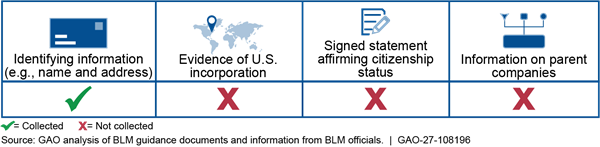
GAO analyzed a nongeneralizable sample of 15 mining claimants that appeared to be business entities and could not find evidence that seven of the claimants were incorporated in the U.S., as required. BLM was unable to help determine if these entities met the requirement to be incorporated in the U.S. because it did not have the necessary information to do so. Until BLM directs staff to collect citizenship information and document that mining claimants meet the U.S. citizenship requirements, BLM lacks reasonable assurance that only qualified individuals and business entities hold mining claims that allow them to extract and profit from the minerals produced on federal lands.
Australia and Canada—examples of top mineral-producing countries—collect detailed information on foreign investors in businesses in their countries. They can use this information to restrict foreign investments in mining and other sectors by prohibiting certain investments or imposing conditions, as each country has done in some cases in recent years. In addition, both countries limit the ability of foreign state-owned enterprises and other foreign investors to acquire control of businesses involving critical minerals.
Why GAO Did This Study
Critical minerals are vital to the U.S. economy and national security. Federal lands are a significant source of hardrock minerals and include some mining operations supported by foreign investments, according to BLM officials. The administration and Congress have expressed concern about U.S. reliance on foreign sources for critical minerals, and the President has called for expanding mineral production from federal lands.
GAO was asked to review issues related to foreign entities’ involvement in mining on federal lands. This report examines (1) the extent to which BLM collects, documents, and reviews mining claimants’ citizenship information and (2) how selected mineral-producing countries address foreign investments in mining. GAO was also asked to report on the extent of foreign investment in mining on federal lands (see GAO-27-108094).
GAO reviewed U.S. laws and regulations; analyzed a nongeneralizable sample of mining claimants to assess if they appear to meet citizenship requirements; examined BLM documents; visited three BLM state offices; and interviewed officials and representatives from BLM and other federal and nonfederal entities. GAO also reviewed Australian and Canadian laws, guidance, reports, and written responses to questions.
What GAO Recommends
GAO recommends that BLM direct staff to collect citizenship information from mining claimants and document that they meet the citizenship requirements to hold mining claims. Interior did not provide comments on this report.
|
Abbreviations |
|
|
|
|
|
BLM |
Bureau of Land Management |
|
USGS |
U.S. Geological Survey |
This is a work of the U.S. government and is not subject to copyright protection in the United States. The published product may be reproduced and distributed in its entirety without further permission from GAO. However, because this work may contain copyrighted images or other material, permission from the copyright holder may be necessary if you wish to reproduce this material separately.
October 6, 2026
The Honorable Jared Huffman
Ranking Member
Committee on Natural Resources
House of Representatives
The Honorable Raja Krishnamoorthi
House of Representatives
The Honorable Teresa Leger Fernández
House of Representatives
The Honorable Joe Neguse
House of Representatives
The Honorable Melanie Stansbury
House of Representatives
Hardrock minerals, such as copper and gold, play a major role in the U.S. and global economies and are widely used in critical industries, including defense, transportation, and renewable energy.[1] Federal lands comprise nearly one-third of the land in the U.S. and are a significant source of such minerals.[2] Some hardrock minerals extracted from federal lands, such as copper, are included in the 2025 list of 60 critical minerals that the Department of the Interior designated as vital to the U.S. economy and national security with supply chains vulnerable to disruption.[3]
The U.S. is highly dependent on foreign countries for its supply of critical minerals, such as rare earth elements for weapons systems and lithium for electric vehicle batteries. We have previously reported that such dependency can pose national security risks by, for example, making supply chains for critical minerals used in weapons systems vulnerable to disruptions by an adversary nation.[4] Since 2025, the President has issued a series of executive orders that aim to reduce the nation’s reliance on foreign minerals and the associated national security and economic risks. As part of this, Executive Order 14241 in March 2025 called for expanding mineral production in the U.S., including from federal lands.[5]
Two agencies—Interior’s Bureau of Land Management (BLM) and the Department of Agriculture’s Forest Service—manage hardrock mining activities on federal lands, with BLM responsible for administering mining claims on all such lands.[6] These claims grant the exclusive right to extract minerals from most federal lands to individuals or business entities—known as mining claimants—that meet applicable citizenship requirements as described under U.S. mining laws.[7] Under U.S. mining laws, to meet these citizenship requirements, mining claimants generally must be U.S. citizens, which include individuals as well as business entities incorporated in a U.S. state or territory.[8] Because courts have held that mining claims are real property, they can be sold, transferred, and inherited.[9]
Foreign investment plays an important role supporting mining operations on federal lands and elsewhere in the U.S., in part because mining requires significant upfront capital costs, according to BLM officials. The officials stated that these mines produce economic benefits and can be an important source of jobs and tax revenues for communities where the mines are located. However, we have previously reported that foreign investment in other economic sectors can pose national security and other types of risks. In addition to the administration’s concerns about U.S. reliance on foreign minerals, Congress has expressed concerns about risks associated with the involvement of foreign entities in mining on federal lands.[10]
You asked us to review issues related to foreign entities taking part in mining on federal lands.[11] This report examines (1) the extent to which BLM collects, documents, and reviews mining claimants’ citizenship information and (2) how selected mineral-producing countries address foreign investments in mining.
To examine the extent to which BLM collects, documents, and reviews mining claimants’ citizenship information, we reviewed relevant laws including the General Mining Act of 1872, as amended, and associated regulations to identify requirements. We also reviewed the Mineral Leasing Act for Acquired Lands of 1947 and associated regulations to understand how the citizenship requirements for mining claimants compare to the requirements for leaseholders. We reviewed BLM handbooks and manuals that outline the agency’s processes and procedures for managing hardrock mining on federal lands. In addition, we interviewed and obtained written responses from BLM headquarters officials involved in managing hardrock mining, and we interviewed officials from BLM’s Colorado, Eastern States, Nevada, and Wyoming state offices. We selected these four state offices based on their involvement in administering mining claims and overseeing mining operations.[12]
We conducted site visits to BLM state offices in Colorado, Nevada, and Wyoming to meet with officials and observe the agency’s Mineral and Land Records System database. We also visited three mines in Colorado and Nevada to obtain information from officials and observe mine operations.[13] We selected these mines based on geographic location. We also interviewed representatives from the American Exploration & Mining Association, Earthworks, the National Mining Association, the Nevada Mining Association, and the State of Nevada’s Division of Minerals to obtain the perspectives of different organizations and entities that are involved in U.S. mining.
We obtained data from BLM on approved hardrock mining operations and analyzed where selected business entity mining claimants were incorporated to see if they appeared to meet the citizenship requirements.[14] Two GAO staff reviewed the names of the claimants from BLM’s data to identify and remove those that appeared to be individual citizens rather than business entities.[15] To assess the reliability of BLM’s data, we interviewed agency officials and obtained written responses on the steps taken to ensure the accuracy of the data. We determined that these data were sufficiently reliable for the purpose of selecting a sample of mining claimants for further analysis to examine if they were incorporated in the U.S.
To select a sample of mining claimants, we first attempted to match the names of the 236 claimants from BLM’s data that appeared to be business entities to records in OpenCorporates, a third-party data aggregator of secretary of state records that includes information on where entities are incorporated. Through this step, we matched the names of 162 of the 236 claimants to the records of business entities incorporated in the U.S. We were unable to match the names of the remaining 74 claimants to entities incorporated in the U.S. We have previously assessed the reliability of the OpenCorporates data by reviewing related documentation, testing for missing data and errors, and obtaining written responses from OpenCorporates officials about data quality and control.[16] We determined that the OpenCorporates data were sufficiently reliable for the purpose of corroborating that entities holding mining claims on federal lands are incorporated in the U.S.
We then selected a nongeneralizable sample of 15 mining claimants out of the remaining 74 for further analysis. This sample included all seven claimants that matched OpenCorporates records for entities incorporated in foreign countries (all of which were from Canada) and a random selection of eight claimants that did not match any records in OpenCorporates. To learn more about their incorporation status, we searched the LexisNexis legal database, secretary of state websites, and the U.S. Securities and Exchange Commission’s Electronic Data Gathering, Analysis, and Retrieval system.
To examine how certain other countries address foreign investments in mining, we selected Australia and Canada as relevant examples of top mineral-producing countries to review based on our previous work.[17] We reviewed relevant laws, regulations, policies, guidance, and reports from Australian and Canadian agencies to understand the countries’ approaches to foreign investments and foreign ownership disclosure. We also obtained written responses from Australian and Canadian officials about these topics and reviewed other applicable publicly available information. In addition, we interviewed representatives from Open Ownership and the Extractive Industries Transparency Initiative to obtain the perspectives of organizations with expertise related to foreign ownership disclosure and transparency in the extractives sector.[18]
We conducted this performance audit from March 2025 to October 2026 in accordance with generally accepted government auditing standards. Those standards require that we plan and perform the audit to obtain sufficient, appropriate evidence to provide a reasonable basis for our findings and conclusions based on our audit objectives. We believe that the evidence obtained provides a reasonable basis for our findings and conclusions based on our audit objectives.
Background
Critical Minerals in the U.S.
Critical minerals such as cobalt and lithium are essential for technologies used in many sectors of the economy, including energy, transportation, national defense, health care, and consumer electronics. In December 2017, the President issued Executive Order 13817, A Federal Strategy To Ensure Secure and Reliable Supplies of Critical Minerals, which, among other things, defined critical minerals and directed the Secretary of the Interior to publish a list of such minerals.[19] In response, in 2018, Interior’s U.S. Geological Survey (USGS) published a list of 35 critical minerals.[20]
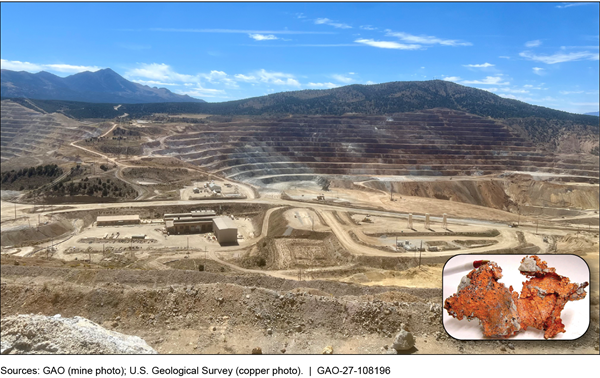
The Energy Act of 2020 subsequently codified the executive order’s definition of critical minerals and required the Secretary of the Interior to review the critical minerals list, and the methodology used to develop it, at least every 3 years.[21] USGS revised its list of critical minerals in 2022, to a total of 50 critical minerals, and in November 2025, the agency updated the list again to add 10 new minerals, including copper (see fig. 1), for a total of 60 critical minerals.[22]
According to USGS, mineral criticality is not static and changes over time as supply and demand dynamics evolve, import reliance changes, and new technologies are developed. We have previously reported that critical minerals are vulnerable to supply chain disruptions for several reasons, including U.S. reliance on foreign sources and the rapid growth in demand for critical minerals in the U.S. and abroad.[23] Concerns about critical mineral availability are not new, and U.S. executive and legislative branch policymakers have a long-standing goal to reduce critical mineral import reliance through technological innovations and other approaches.[24]
In 2025, the President issued a series of executive orders that aim to increase domestic mineral production and bolster critical mineral processing and supply chains, including:
· Executive Order 14213, Establishing the National Energy Dominance Council.[25] This executive order established a 19-member National Energy Dominance Council within the Executive Office of the President, led by the Secretary of the Interior (Chair) and the Secretary of Energy (Vice Chair).[26] Under the executive order, the council’s functions include to, among other things, advise the President on improving the processes for permitting, production, generation, distribution, regulation, transportation, and export of all forms of American energy, including critical minerals; and advise and assist the President in facilitating cooperation among the federal government and domestic private sector energy partners.
· Executive Order 14241, Immediate Measures to Increase American Mineral Production.[27] This executive order sought to increase domestic mineral production, including from federal lands, by, for example: (1) expediting reviews, permitting, and approvals of mineral production projects, including by directing federal agencies to identify priority projects that could be quickly approved; (2) directing Interior to prioritize mineral production and mining-related purposes as the primary land uses for federal lands known to hold mineral deposits and reserves, consistent with applicable law; and (3) accelerating private and public capital investment in domestic mineral production.
· Executive Order 14272, Ensuring National Security and Economic Resilience Through Section 232 Actions on Processed Critical Minerals and Derivative Products.[28] This executive order directed the Secretary of Commerce to investigate the national security effects of imports of processed critical minerals and their derivative products. In conducting the investigation, the Secretary was directed to assess certain factors, including, among others, identification of U.S. imports of processed critical minerals and derivative products; the foreign sources of imports of such minerals; a review and risk assessment of global supply chains for such minerals; and an analysis of the current and potential capabilities of the U.S. to process critical minerals and their derivative products.
Management of Hardrock Mining on Federal Lands
BLM and the Forest Service manage hardrock mining activities on federal lands using two systems, the location system and the leasing system, as shown in figure 2.
Figure 2: Overview of the Location and Leasing Systems for Managing Hardrock Mining on Federal Lands
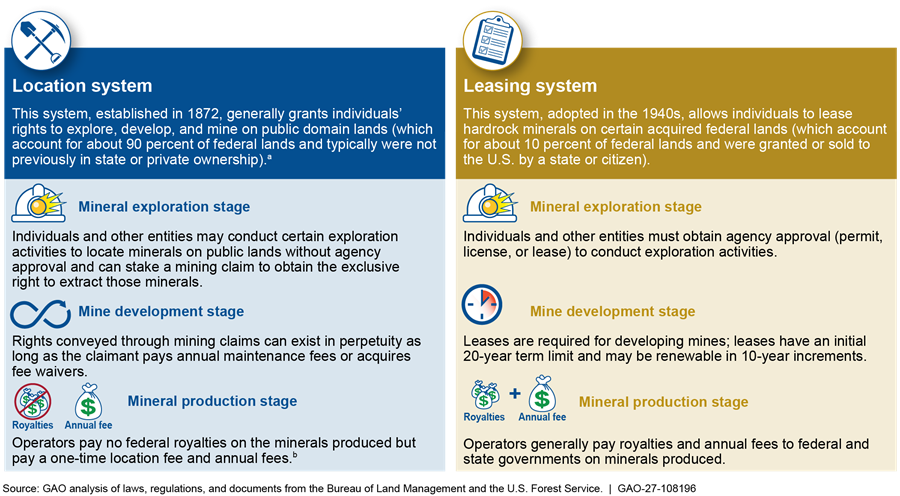
aSome public domain lands have been withdrawn from being available for mineral development, such as national parks, national monuments, and military reservations.
bAn operator is an individual or entity that conducts operations in connection with exploration, mining, and processing hardrock minerals. In some cases, the operator of a mine may be different from the claimant.
We have previously reported that the majority of mining operations on federal lands were managed under the location system on BLM-managed lands, with the remaining mining operations managed under this system largely on Forest Service-managed lands.[29] Under this system, BLM administers mining claims on all federal lands, regardless of which agency manages the surface of the land, and the federal government does not collect royalties on the extracted minerals.[30]
In contrast, hardrock mining operations authorized under the leasing system are generally found on lands acquired by the Forest Service under the Weeks Act.[31] Under this system, BLM administers hardrock mineral leases on lands that it manages and for the federal mineral estate underlying Forest Service-managed lands.[32] Interior collects federal royalties on the minerals produced from lands managed under the leasing system.
Under both the location and leasing systems, mine operators must submit a mine plan of operations for approval to develop a mine.[33] These plans detail the operational aspects of the mine, such as the mining methods and techniques that will be used and how reclamation will occur once operations are concluded. In accordance with each agency’s authorities, BLM and the Forest Service maintain separate programs to evaluate and approve mine plans of operations for the respective lands they manage.
Citizenship Requirements for Hardrock Mining on Federal Lands
Under federal law, mining claimants under the location system and leaseholders under the leasing system generally must be U.S. citizens, which include individual citizens and business entities incorporated in a U.S. state or territory.[34] There are no citizenship requirements specifically for mine operators, which can be contracted by claimants or leaseholders to extract minerals from a mine.[35]
Figure 3 provides an overview of the citizenship requirements for claimants and leaseholders for hardrock mining on federal lands.
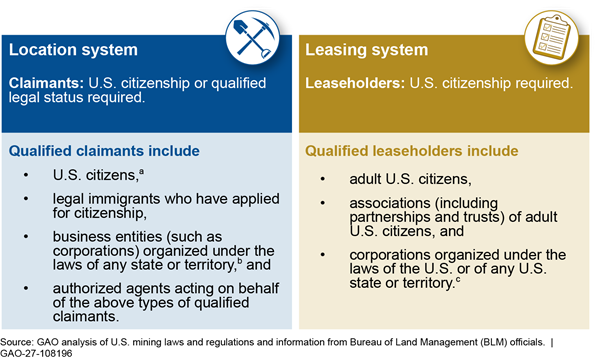
Note: There are no citizenship requirements specifically for mine operators, which can be contracted by claimants or leaseholders to extract minerals from a mine.
aUnder BLM regulations, U.S. citizens “who have reached the age of discretion under the law of their state of residence” are qualified to locate mining claims. See 43 C.F.R. § 3830.3(a).
bQualified business entities include subsidiaries of foreign entities as long as the subsidiaries were organized under the laws of the U.S. or a U.S. state or territory.
cQualified leaseholders include subsidiaries of foreign entities, including corporations that were organized under the laws of the U.S. or a U.S. state or territory. Foreign citizens may not hold permits or leases directly, but under BLM regulations, foreign citizens may hold stock in U.S. corporations that hold leases or permits if the laws, customs, or regulations of their country do not deny similar privileges to citizens or corporations of the U.S. See 43 C.F.R. § 3502.13.
While foreign entities themselves are not qualified claimants or leaseholders, their subsidiaries incorporated under the laws of the U.S. or a U.S. state or territory are qualified to be claimants or leaseholders. For example, based on their knowledge of the mining sector, officials from BLM state offices said it is common for entities from Australia and Canada—countries with mining companies that operate worldwide—to have U.S. subsidiaries involved in mining on federal lands. A BLM state office official said it would also be possible for entities from foreign adversaries to similarly have U.S. subsidiaries involved in mining on federal lands. According to agency officials, BLM does not have discretion to deny mining claims for entities incorporated in the U.S. regardless of where their parent companies are based. We examined foreign parent-subsidiary relationships in the mining sector in a separate report released in October 2026.[36]
Foreign Ownership Disclosure Requirements
BLM does not require entities involved in mining on federal lands under the location system—which covers most mining operations on federal lands—to disclose foreign ownership information but requires some disclosure of such information for entities mining under the leasing system. As previously noted, the leasing system is used on about 10 percent of federal lands.
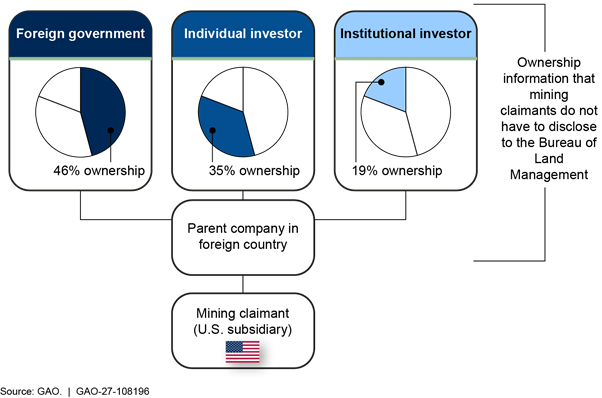
Under U.S. mining law, mining claimants and operators under the location system are not required to disclose information on foreign ownership to BLM, such as information on their parent companies or beneficial owners—the individuals who ultimately own or control companies and other legal entities. As a result, entities that hold mining claims or operate mines under the location system do not have to disclose if they are a subsidiary of another entity, foreign or domestic, and they do not have to provide information on any foreign investment they may receive (see fig. 4).
Figure 4: Hypothetical Example of Foreign Ownership Information That Mining Claimants Do Not Have to Disclose
In contrast, BLM regulations require leaseholders under the leasing system to disclose some information about the citizenship of their owners.[37] Specifically, under BLM regulations, business entities are required to submit evidence, known as qualifications statements, to show they are qualified to hold a permit or lease. For example, in these statements, corporations must include, among other things, their state or territory of incorporation as well as the names and citizenship of any stockholder owning, holding, or controlling more than 10 percent of the stock of the corporation.[38]
In the U.S., many companies are formed by registering with secretaries of state or similar state offices. Most of those jurisdictions do not require disclosure of beneficial owners.[39] Ownership with multiple layers of corporate structures may be created and used for legitimate purposes, such as asset and tax management, and this approach may also obscure information on beneficial owners and their relationships to other companies or individuals. We have previously reported that opaque beneficial ownership information can heighten fraud risks for federal programs and make eligibility determinations for federal benefits difficult, potentially resulting in financial losses and impacts to national security.[40] For example, in 2020, we found that opaque ownership structures could be used in the context of aircraft registrations to disguise potential ineligibility or hide illicit activity.[41]
Beyond the mining sector, the U.S. government’s approach to foreign and beneficial ownership disclosure requirements has undergone changes in recent years and remains in flux. The Corporate Transparency Act, enacted in 2021, requires certain legal entities to report beneficial ownership information to the Department of the Treasury in accordance with Treasury’s implementing regulations.[42] In September 2022, Treasury issued a final rule on requirements for domestic and foreign companies that do not meet exemptions identified in the Corporate Transparency Act to report beneficial ownership information to Treasury.[43] The requirements were effective as of January 2024.
However, in March 2025, Treasury expanded exemptions to the beneficial ownership reporting requirements with an interim final rule, which it finalized in August 2026 to modify the beneficial ownership rule permanently.[44] This action limited beneficial ownership reporting to foreign companies only and removed requirements for all U.S. companies and persons (including U.S.-based subsidiaries of foreign companies) to report their beneficial ownership information to Treasury. In April 2026, a bill that would limit beneficial ownership reporting to foreign-owned entities—codifying Treasury’s current regulatory approach—advanced out of the House Financial Services Committee.[45] Similar legislation was introduced in the Senate in 2025 but had not advanced, as of September 2026.[46]
In May 2026, we reported that the expanded exemptions apply to over 99 percent of entities that previously were required to report such information under the Corporate Transparency Act.[47] We also reported that the exemption of domestic companies and U.S.-based beneficial owners from the beneficial ownership reporting requirements may perpetuate risks of illicit finance activity, and we recommended that Treasury identify potential actions to address these risks.[48] With the narrowing of the Corporate Transparency Act via regulation and legislative efforts to repeal the act, its beneficial ownership reporting requirements face uncertainty.
BLM Generally Does Not Collect Information to Know if Individuals or Business Entities Meet Mining Claimant Citizenship Requirements
BLM generally does not collect citizenship information from individual or business entity mining claimants, document in its mining database if they meet the U.S. citizenship requirements, or review whether they are qualified to hold mining claims. As a result, the extent to which mining claimants meet the citizenship requirements is unknown.
BLM Generally Does Not Collect, Document, or Review Citizenship Information from Mining Claimants
Under BLM’s regulations and guidance, the agency collects basic identifying information—such as names and addresses—from individuals and business entities holding mining claims. However, BLM generally does not collect citizenship information, such as evidence of U.S. incorporation, from these claimants because, according to officials, BLM has not directed its staff to do so and the agency’s regulations do not require claimants to provide this information.[49]
In contrast, under BLM’s regulations for the leasing system, prior to awarding a lease, BLM collects some citizenship information from leaseholders through the qualifications statements discussed earlier in this report. According to agency officials, BLM reviews this information to determine if entities are qualified to hold mineral leases and ensure compliance with statutory requirements, and the agency maintains copies of the qualifications statements in its official case files. Figure 5 provides an overview of information that BLM collects from mining claimants and leaseholders.
Figure 5: Information the Bureau of Land Management (BLM) Collects from Mining Claimants and Leaseholders
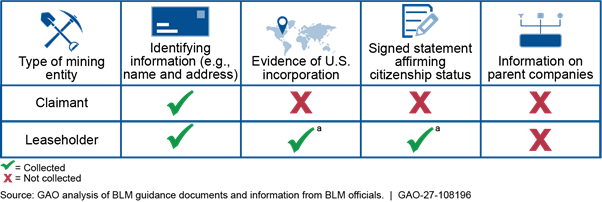
aCorporations are required to provide a signed qualifications statement that includes, among other things, their state or territory of incorporation as well as the names and citizenship of any stockholder owning, holding, or controlling more than 10 percent of the stock of the corporation. Other types of business entities also must submit a signed qualifications statement that includes, among other things, the names and citizenship of all members who own or control 10 percent or more of the entity. BLM maintains copies of the qualification statements in the agency’s official case files, according to officials.
BLM has recorded an average of more than 60,000 mining claims annually since 2021, according to BLM’s Public Land Statistics reports and agency officials. We found that BLM staff record basic identifying information about mining claimants in the agency’s Mineral and Land Records System database, such as the entity’s name and address. However, BLM does not document in its database if claimants meet the U.S. citizenship requirements, based on our review of the database and interviews with agency officials. Officials we interviewed from BLM state offices said they do not document if mining claimants meet the citizenship requirements because BLM has not directed staff to do so or provided guidance on how it should be done.
We also found that BLM generally does not review whether mining claimants are qualified to hold mining claims and only does so in rare situations. For example, agency officials said BLM may verify the citizenship of mining claimants in situations where the public interest would be served, such as when examining the validity of existing claims on federal lands that are being withdrawn from mining activities under the Federal Land Policy and Management Act of 1976. In such situations, BLM will obtain proof of citizenship from the claimants, which for individuals may consist of their own affidavit and for business entities would consist of a copy of their corporate charter or certificate of incorporation that shows they are incorporated in the U.S., according to agency officials and documents. BLM officials said the agency maintains the documentation associated with its reviews in its official case files. BLM has not documented how often public interest-based citizenship determinations have occurred, but they do not take place for most mining claims, according to agency officials. The officials could not tell us how many claims have had their claimant’s citizenship verified because BLM does not maintain that information.
Moreover, BLM’s mining claims handbook states the agency will not summarily challenge mining claimants with a foreign address.[50] However, third parties can challenge whether claimants meet the citizenship requirement. In those cases, the handbook states BLM does not adjudicate private disputes between rival claimants and instead directs the parties to handle such challenges in state or other courts, similar to other property rights disputes.
BLM Does Not Know the Extent to Which Mining Claimants Meet Citizenship Requirements
Since BLM generally does not collect citizenship information from mining claimants or document if they meet the U.S. citizenship requirements, the extent to which individuals and business entities holding mining claims satisfy these requirements is unknown. We analyzed a sample of BLM mining records to see if claimants that appeared to be business entities met the citizenship requirements.[51] In doing so, we identified mining claimants that we could not confirm were incorporated in the U.S. We shared our findings with BLM officials, and they could not verify if these entities met the citizenship requirements to hold mining claims.
Specifically, we reviewed BLM data on mining claimants for approved hardrock mining operations to try to determine where the claimants were incorporated. As discussed previously, we used OpenCorporates to review 236 mining claimants that appeared to be business entities and matched 162 of these claimants to the records of entities incorporated in the U.S.[52] From the remaining 74 mining claimants, we selected a nongeneralizable sample of 15 claimants to examine whether we could find evidence that they met the citizenship requirements by being incorporated in the U.S.[53] We then searched other online databases for evidence of U.S. incorporation for these claimants.[54] Through these searches, we found evidence of U.S. incorporation for eight of the claimants.[55]
However, we did not find evidence that the remaining seven claimants were incorporated in the U.S., as required to meet the citizenship requirements.[56] We asked BLM to provide information to help us confirm if these entities met the citizenship requirement for claimants, but the agency was unable to do so. According to agency officials, BLM was unable to provide such information because, as noted previously, the agency does not collect or document mining claimants’ citizenship information. As a result, the officials stated that BLM did not know where these entities were incorporated and had not reviewed whether they met the citizenship requirements for holding mining claims.
BLM is responsible for administering mining claims under U.S. mining law, under which mining claimants are generally required to be U.S. citizens or business entities incorporated in a U.S. state or territory.[57] Further, federal internal control standards call for agency management to obtain and use relevant, quality information to support the agency’s internal control system, and to design and establish control activities to mitigate risks through documented policies and procedures.[58] Since BLM does not collect or document mining claimants’ citizenship information, the agency has a limited ability to mitigate potential fraud risks from foreign individuals or business entities that may seek to circumvent the citizenship requirement to hold mining claims.[59] Without directing staff to collect citizenship information and document that mining claimants meet the U.S. citizenship requirements, BLM lacks reasonable assurance that only qualified individuals and business entities hold mining claims that allow them to extract and profit from the minerals produced on federal lands.
Australia and Canada Collect Detailed Information on Foreign Investors and Can Restrict Foreign Investments in Mining and Other Sectors
Australia and Canada collect detailed information on foreign investors, including beneficial ownership information for investments in mining, and can use this to restrict foreign investment.[60]
Australia and Canada Require Disclosure of Beneficial Ownership Information for Foreign Investments
Australia and Canada have each enacted laws governing foreign investments economy-wide that require notifying the government of certain proposed investment actions and, in some cases, obtaining government approval before an action can be taken. For example:
· In Australia, investment actions that may require government notification or approval include a foreign entity proposing to acquire a mining right or a foreign government investor seeking to acquire at least 10 percent of a mining, production, or exploration entity; and
· In Canada, a foreign investor seeking to establish a new business or to acquire control of an existing one, including a mining business, must notify the government, and some acquisitions of control must receive approval to proceed.
Australia and Canada require entities submitting notifications and applications under these foreign investment laws to disclose detailed information on beneficial owners and their countries of origin, and the governments may assess penalties for noncompliance. For example:
· In Australia, investors must submit to the Australian government details on owners with a beneficial interest of 5 percent or more in the investor, among other things, according to Australian guidance.[61] They are to submit information such as financial statements and records and a diagram illustrating ownership structure. They must also identify whether the owners are foreign government investors and provide details on any individuals or entities that exercise control rights.
· In Canada, foreign investors making certain investments must identify their board of directors, five highest-paid officers, and any person or entity that owns 10 percent or more of the investor’s equity or voting interests. Investors must also submit information about involvement of foreign states, such as whether foreign states have a direct or indirect ownership interest and whether they have the power to appoint the investor’s senior management officers or board of directors.
|
Registers of Beneficial Owners
Australia and Canada also have or are developing registers of certain beneficial ownership information. · In Australia, foreign investors must register their interests, including in Australian mining, production, or exploration rights, and keep the details current. These data are not public, but Australia uses them to publish annual aggregate statistics of foreign ownership. As of June 2026, Australia is developing a publicly available register of beneficial owners of all domestic and foreign companies operating in Australia. · In Canada, most federally incorporated corporations must file registers of their beneficial owners and keep the details current. Some information is public, such as a beneficial owner’s name and address and a description of their significant control of the corporation. Other information, such as a beneficial owner’s country of citizenship, is available only to law enforcement and other authorized entities. Source: GAO analysis of Australian, Canadian, and World Bank documents. | GAO‑27‑108196 |

Australia and Canada Can Restrict Foreign Investments in Mining and Other Sectors
Foreign investment actions, including in mining, may be assessed—and, in some cases, restricted—through national security reviews (both countries),[62] national interest tests (Australia),[63] or net benefit reviews (Canada),[64] based on factors such as the type of action and its risks, type of investor, and monetary thresholds. For example, Australian officials stated that mining rights in Australia are subject to mandatory screening regardless of the monetary value involved, except for investments from certain free trade agreement partners. In both Australia and Canada, officials said the reviews of investment proposals include consultation with relevant government departments and agencies at various levels, such as security and intelligence agencies; Commonwealth, state, and territory government agencies in Australia; and provincial government agencies in Canada.
In addition, Australian officials said that Australia can limit the ability of foreign state-owned enterprises and other foreign investors to acquire control of businesses involving critical minerals. Similarly, Canada specified in 2022 and 2024 how it will apply its foreign investment review framework to limit foreign control of businesses involving critical minerals.[65] As the result of a review, both countries can mitigate a foreign investment’s risks to national security or the national interest by prohibiting an investment or imposing conditions on an action.[66] They can also, in some cases, restrict foreign investment by requiring that foreign investors divest from interests already acquired. For example, in recent years, Australia and Canada have ordered multiple foreign investors to dispose of shares or divest of investment in critical minerals companies on national interest and national security grounds, respectively, according to Australian and Canadian government media releases.
Both countries have also highlighted the importance of critical minerals to national security for their foreign investment reviews and made national security-related changes to their foreign investment review frameworks in recent years.[67] For example, Australia adopted changes in 2021 and 2026 that were intended to strengthen and streamline Australia’s foreign investment framework by, for example, applying more scrutiny to reviewing investment proposals in critical minerals and expanding certain requirements for acquisitions of mining rights.[68] Similarly, Canada amended its act governing foreign investments in 2024.[69] According to a Canadian report, the purpose of the amendments was to improve national security review provisions.[70]
Conclusions
The U.S. relies on hardrock minerals, including critical minerals like copper, for use in advanced technologies, national defense, and everyday life. U.S. federal lands are a significant source of hardrock minerals, and amid increasing global demand for critical minerals, the President has sought to expand mineral production from federal lands. As the lead agency managing hardrock mining claims on such lands, BLM plays an important role in supporting these efforts and has annually recorded tens of thousands of new mining claims in recent years.
While foreign investment is important in an industry as capital-intensive as mining, U.S. mining laws include citizenship requirements for mining claimants. However, BLM does not know the citizenship of mining claimants because the agency generally does not collect or document citizenship information from claimants and rarely reviews whether they are qualified to hold mining claims. Without directing staff to collect citizenship information and document that claimants meet the U.S. citizenship requirements, BLM lacks reasonable assurance that only qualified individuals and business entities hold mining claims that allow them to extract and profit from critical and other hardrock minerals from federal lands.
Recommendation for Executive Action
The Director of BLM should direct BLM staff to collect citizenship information from mining claimants and document that they meet the citizenship requirements under U.S. mining laws to hold mining claims. (Recommendation 1)
Agency Comments
We provided a draft of this report to the Department of Agriculture and the Department of the Interior for review and comment. The Department of Agriculture did not have any comments on the report. Interior did not provide comments on the report.
As agreed with your offices, unless you publicly announce the contents of this report earlier, we plan no further distribution until 30 days from the report date. At that time, we will send copies to the appropriate congressional committees, the Secretary of Agriculture, the Secretary of the Interior, and other interested parties. In addition, the report will be available at no charge on the GAO website at https://www.gao.gov.
If you or your staff have any questions about this report, please contact me at FriskR@gao.gov. Contact points for our Offices of Congressional Relations and Media Relations may be found on the last page of this report. GAO staff who made key contributions to this report are listed in appendix I.

Rachel Frisk
Acting Director, Natural Resources and Environment
GAO Contact
Rachel Frisk, FriskR@gao.gov
Staff Acknowledgments
In addition to the contact named above, Cardell D. Johnson and Nathan Anderson (Directors), Casey L. Brown (Assistant Director), Joshua Wiener (Analyst in Charge), Krista Breen Anderson, Angela Miles, and Brianna Taylor made key contributions to this report. Also contributing to the report were Mariana Calderon, Irina Carnevale, Frank Garro, Tonita Gillich, Megan Huberty, Nicholas E. Jepson, Jeff Larson, Patricia Moye, Valérie L. Nowak, Sara Sullivan, and Martin C. Wilson.
The Government Accountability Office, the audit, evaluation, and investigative arm of Congress, exists to support Congress in meeting its constitutional responsibilities and to help improve the performance and accountability of the federal government for the American people. GAO examines the use of public funds; evaluates federal programs and policies; and provides analyses, recommendations, and other assistance to help Congress make informed oversight, policy, and funding decisions. GAO’s commitment to good government is reflected in its core values of accountability, integrity, and reliability.
Obtaining Copies of GAO Reports and Testimony
The fastest and easiest way to obtain copies of GAO documents at no cost is through our website. Each weekday afternoon, GAO posts on its website newly released reports, testimony, and correspondence. You can also subscribe to GAO’s email updates to receive notification of newly posted products.
Order by Phone
The price of each GAO publication reflects GAO’s actual cost of production and distribution and depends on the number of pages in the publication and whether the publication is printed in color or black and white. Pricing and ordering information is posted on GAO’s website, https://www.gao.gov/ordering.htm.
Place orders by calling (202) 512-6000, toll free (866) 801-7077,
or
TDD (202) 512-2537.
Orders may be paid for using American Express, Discover Card, MasterCard, Visa, check, or money order. Call for additional information.
Connect with GAO
Connect with GAO on X,
LinkedIn, Instagram, and YouTube.
Subscribe to our Email Updates. Listen to our Podcasts.
Visit GAO on the web at https://www.gao.gov.
To Report Fraud, Waste, and Abuse in Federal Programs
Contact FraudNet:
Website: https://www.gao.gov/about/what-gao-does/fraudnet
Automated answering system: (800) 424-5454
Media Relations
Sarah Kaczmarek, Managing Director, Media@gao.gov
Congressional Relations
David A. Powner, Acting Managing Director, CongRel@gao.gov
General Inquiries
[1]For the purposes of this report, we use “hardrock minerals” as a general term for minerals managed as “locatable” minerals under the General Mining Act of 1872, as amended (e.g., copper, gold, gypsum, lead, magnesium, silver, uranium, and zinc), and for those same minerals managed under other laws as “leasable” minerals. We did not include other commodities and minerals—such as oil, gas, and coal—within the scope of our work.
[2]Not all federal lands are available for mineral development. Federal lands can be withdrawn from being available for mining in several ways, including by the President, by legislation, or by the Secretary of the Interior. Withdrawn lands can include national parks, national monuments, national wildlife refuges, and military reservations.
[3]See Final 2025 List of Critical Minerals, 90 Fed. Reg. 50494 (Nov. 7, 2025).
[4]GAO, Critical Materials: Action Needed to Implement Requirements That Reduce Supply Chain Risks, GAO‑24‑107176 (Washington, D.C.: Sept. 10, 2024).
[5]Exec. Order No. 14241, Immediate Measures to Increase American Mineral Production, 90 Fed. Reg. 13673 (Mar. 25, 2025).
[6]Since BLM is responsible for administering mining claims on all federal lands, including lands for which the Forest Service is the surface management agency, this report primarily focuses on BLM’s activities and responsibilities.
[7]Under the General Mining Act of 1872, all valuable mineral deposits in lands belonging to the U.S. are free and open to exploration and purchase by U.S. citizens and those who have declared their intention to become U.S. citizens. See 30 U.S.C. § 22. Holding a mining claim is not a prerequisite to extract hardrock minerals, but it is rare for someone to do so without first securing the exclusive rights to the minerals through a claim, according to BLM officials. Mining claims are used to grant mineral rights on about 90 percent of federal lands (known as public domain lands) but are not used on certain acquired federal lands that were granted or sold to the U.S. by a state or citizen. On those lands, which account for about 10 percent of federal lands, BLM administers a leasing system that allows individuals to lease hardrock minerals.
[8]Legal immigrants who have filed an application for citizenship with the proper federal agency are also qualified to locate mining claims.
[9]See Forbes v. Gracey, 94 U.S. 762, 767 (1876).
[10]GAO, Foreign Investments in U.S. Agricultural Land: Enhancing Efforts to Collect, Track, and Share Key Information Could Better Identify National Security Risks, GAO‑24‑106337 (Washington, D.C.: Jan. 18, 2024).
[11]We provided additional information in response to this request in a separate report released in October 2026. See GAO, Critical Minerals: Limited Available Information on the Full Extent of Foreign Investment in Mining on Federal Lands, GAO-27-108094 (Washington, D.C.: Oct. 6, 2026).
[12]We also interviewed and obtained written responses from Forest Service officials to help us understand how hardrock mining is administered on Forest Service-managed lands and to learn about BLM’s role in administering mining claims on such lands.
[13]BLM’s Mineral and Land Records System is the agency’s online platform used to manage mineral and land records transactions and case information, including information related to hardrock mining activities.
[14]The BLM data included hardrock mining operations with approved mine plans of operation.
[15]The BLM data included limited personal identifying information for individual citizens that hold mining claims, which prevented us from being able to analyze whether individual citizen claimants met the U.S. citizenship requirements.
[16]For example, see GAO, Fraud in Federal Programs: FinCEN Should Take Steps to Improve the Ability of Inspectors General to Determine Beneficial Owners of Companies, GAO‑25‑107143 (Washington, D.C.: Apr. 8, 2025). Since OpenCorporates data come directly from U.S. state business registration offices (generally secretaries of state), their reliability is dependent on the state office-provided data that we have not assessed.
[17]For example, see GAO, Hardrock Mining Management: Selected Countries, U.S. States, and Tribes Have Different Governance Structures but Primarily Use Leasing, GAO‑21‑298 (Washington, D.C.: June 30, 2021). Specifically, this report identified Australia and Canada as top mineral-producing countries based on the value of minerals produced and found that the countries were perceived by researchers to have good mining governance.
[18]Open Ownership is a nonprofit organization that works with countries on reforms to improve transparency through the disclosure of beneficial ownership—the individuals who ultimately own or control companies and other legal entities. The Extractive Industries Transparency Initiative is a multi-stakeholder organization that seeks to strengthen public and corporate governance and accountability and provide data to inform policymaking in the extractives sector. It has created a set of standards for implementing countries to follow, which includes disclosing beneficial ownership information.
[19]Exec. Order No. 13817, § 2, 82 Fed. Reg. 60835, 60835 (Dec. 26, 2017). Specifically, the executive order defined a critical mineral as a mineral identified by the Secretary of the Interior to be (1) a non-fuel mineral or mineral material essential to the economic and national security of the U.S.; (2) the supply chain of which is vulnerable to disruption; and (3) that serves an essential function in the manufacturing of a product, the absence of which would have significant consequences for our economy or our national security. 82 Fed. Reg. at 60835.
[20]Final List of Critical Minerals 2018, 83 Fed. Reg. 23295 (May 18, 2018).
[21]Pub. L. No. 116-260, § 7002, 134 Stat. 2418, 2562 (codified as amended at 30 U.S.C. § 1606).
[22]2022 Final List of Critical Minerals, 87 Fed. Reg. 10381 (Feb. 24, 2022); Final 2025 List of Critical Minerals, 90 Fed. Reg. 50494 (Nov. 7, 2025). For more information on the 60 minerals included on the 2025 critical minerals list, see https://www.usgs.gov/programs/mineral‑resources‑program/science/about‑2025‑list‑critical‑minerals.
[23]GAO, Critical Minerals: Status, Challenges, and Policy Options for Recovery from Nontraditional Sources, GAO‑24‑106395 (Washington, D.C.: July 31, 2024).
[24]We have reported on concerns about mineral availability and U.S. dependence on mineral imports for several decades. For example, see GAO, U.S. Dependence on Imports of Five Critical Minerals: Implications and Policy Alternatives, ID-75-82 (Washington, D.C.: Jan. 29, 1976); Actions Needed to Promote a Stable Supply of Strategic and Critical Minerals and Materials, GAO/EMD‑82‑69 (Washington, D.C.: June 3, 1982); and, more recently, Critical Minerals: Reducing U.S. Import Reliance with Substitution and Recycling Technologies, GAO‑26‑108687 (Washington, D.C.: July 22, 2026); and GAO-27-108094.
[25]Exec. Order No. 14213, Establishing the National Energy Dominance Council, 90 Fed. Reg. 9945 (Feb. 20, 2025).
[26]In addition to the 19 specified members, the executive order further provides that the council shall include the heads of such other executive departments and agencies as the President may, from time to time, designate. Exec. Order No. 14213, § 3(b)(xviii), 90 Fed. Reg. at 9946.
[27]Exec. Order No. 14241, Immediate Measures to Increase American Mineral Production, 90 Fed. Reg. 13673 (Mar. 25, 2025).
[28]Exec. Order No. 14272, Ensuring National Security and Economic Resilience Through Section 232 Actions on Processed Critical Minerals and Derivative Products, 90 Fed. Reg. 16437 (Apr. 18, 2025).
[29]GAO, Federal Land Management: Key Differences and Stakeholder Views of the Federal Systems Used to Manage Hardrock Mining, GAO‑21‑299 (Washington, D.C.: July 21, 2021), and Mining on Federal Lands: More Than 800 Operations Authorized to Mine and Total Mineral Production Is Unknown, GAO‑20‑461R (Washington, D.C.: May 28, 2020).
[30]Under the location system, BLM and the Forest Service have separate regulations regarding hardrock mining operations on the lands they manage. Regulations implementing the General Mining Act of 1872 for BLM are codified at 43 C.F.R. pt. 3800 and for the Forest Service are codified at 36 C.F.R. pt. 228, subpt. A.
[31]The Act of March 4, 1917, authorized the Secretary to issue regulations permitting mineral resource development on lands acquired under the Weeks Act. 16 U.S.C. § 520. Regulations issued under this provision authorized mineral removal subject to the payment of fees, rentals, and royalties commensurate with the value of the mineral resources. 36 C.F.R. § 251.6 (1938). Reorganization Plan No. 3 of 1946 transferred these responsibilities to the Secretary of the Interior. 60 Stat. 1097, 1099-1100 (1946).
[32]Regulations for hardrock leasable minerals are codified at 43 C.F.R. pt. 3500. BLM must have the written consent of the Secretary of Agriculture before issuing permits or leases that include Forest Service-managed lands.
[33]A mine operator is an individual or entity that conducts operations in connection with exploration, mining, and processing hardrock minerals. In some cases, the operator may be different than the claimant.
[34]Legal immigrants who have filed an application for citizenship with the proper federal agency are also qualified to locate mining claims. For citizenship requirements under the location system, see 30 U.S.C. § 22; 43 C.F.R. § 3830.3. For citizenship requirements under the leasing system, see 30 U.S.C. § 181; 43 C.F.R. § 3502.10.
[35]BLM requires operators to provide a Tax Identification Number as part of their mine plan of operations, which agency officials said is used to help identify the responsible party for reclamation purposes. BLM officials said that providing a Tax Identification Number creates a practical presumption of legal U.S. business status but does not ensure U.S. citizenship since these numbers can also be issued to foreign businesses.
[36]For more information, see GAO-27-108094.
[37]See 43 C.F.R. §§ 3502.28-.30.
[38]Similarly, other types of business entities, such as associations and partnerships, must include in their qualifications statements, among other things, the names, addresses, and citizenship of all members who own or control 10 percent or more of the entity. Individual leaseholders also must submit qualifications statements which specify, among other things, that they are U.S. citizens. 43 C.F.R. § 3502.27(a).
[39]GAO‑25‑107143 and GAO, Illicit Finance: Treasury’s Initial Safeguards for Allowing Access to Information on Corporate Ownership, GAO‑25‑107403 (Washington, D.C.: Feb. 20, 2025).
[41]GAO, Aviation: FAA Needs to Better Prevent, Detect, and Respond to Fraud and Abuse Risks in Aircraft Registration, GAO‑20‑164 (Washington, D.C.: Mar. 25, 2020).
[42]Pub. L. No. 116-283, div. F, tit. LXIV,134 Stat. 4604-4625 (2021). Legal entities required to report their beneficial ownership information include corporations, limited liability companies, or other similar entities that are registered to do business with state registry offices. The Corporate Transparency Act and its implementing regulations define a beneficial owner as any individual who either exercises substantial control over an entity or owns or controls at least 25 percent of its ownership interests.
[43]Beneficial Ownership Information Reporting Requirements, 87 Fed. Reg. 59498, 59539-46 (Sept. 30, 2022) (codified as amended at 31 C.F.R. § 1010.380). The categories of exempt entities include certain financial institutions, securities and futures vehicles, insurance companies, accounting firms, tax-exempt entities, and large operating companies.
[44]Beneficial Ownership Information Reporting Requirement Revision and Deadline Extension, 90 Fed. Reg. 13688 (Mar. 26, 2025). Treasury finalized the rule, with limited changes, in August 2026. See Beneficial Ownership Information Reporting Requirement Revision, 91 Fed. Reg. 52508 (Aug. 14, 2026).
[45]See H.R. 425 (119th Cong.) (2025).
[46]See S. 100 (119th Cong.) (2025).
[47]GAO, Corporate Transparency: Treasury Should Address Gaps in Ownership Information Resulting from Expanded Exemptions, GAO‑26‑107967 (Washington, D.C.: May 29, 2026).
[48]GAO‑26‑107967. Treasury disagreed with the recommendation, but as described in the report, we continue to believe that actions for this recommendation are needed.
[49]The General Mining Act of 1872 does not require prior government approval for claimants to explore for and develop minerals on federal lands covered under the act.
[50]BLM, Administration of Mining Claims, Mill Sites, and Tunnel Sites, BLM Handbook H-3830-1 (Oct. 15, 2015).
[51]As discussed previously, the BLM data included limited personal identifying information for individual citizens that hold mining claims, which prevented us from being able to include individual citizen claimants in our analysis of the BLM mining records.
[52]OpenCorporates is a third-party data aggregator of secretary of state records that includes information on where business entities are incorporated.
[53]As discussed previously, this sample included eight mining claimants that did not match any records in OpenCorporates and seven mining claimants that matched OpenCorporates records of business entities incorporated in Canada.
[54]The other databases we searched were the LexisNexis legal database, secretary of state business registries, and the U.S. Securities and Exchange Commission’s Electronic Data Gathering, Analysis, and Retrieval system.
[55]These claimants included five of the eight entities from our sample that did not match any records in OpenCorporates and three of the seven entities that matched OpenCorporates records of business entities incorporated in Canada. Our analysis found evidence that these entities were incorporated in the U.S. as well, which would allow them to meet the citizenship requirement.
[56]In some cases, this could be a result of differences in data entry between BLM and the other systems, and it is possible that some of these entities may be incorporated in the U.S. The claimants for which we could not find evidence of U.S. incorporation included three of the eight entities from our sample that did not match any records in OpenCorporates and four of the seven entities that matched OpenCorporates records of business entities incorporated in Canada.
[57]As discussed previously, legal immigrants who have filed an application for citizenship with the proper federal agency are also qualified to be mining claimants. See 43 C.F.R. § 3830.3(b).
[58]GAO, Standards for Internal Control in the Federal Government, GAO‑25‑107721 (Washington, D.C.: May 15, 2025). Principle 10 calls for agency management to design control activities to mitigate risks to achieving the agency’s objectives. Principle 12 calls for agency management to establish such activities by documenting in policies what is expected and in procedures specified actions to implement the policies. Principle 13 calls for agency management to obtain or generate relevant, quality information and use it to support the functioning of the internal control system.
[59]Fraud involves obtaining something of value through willful misrepresentation. When fraud risks can be identified and mitigated, fraud may be less likely to occur.
[60]Australia’s Foreign Acquisitions and Takeovers Act 1975 and Canada’s Investment Canada Act 1985 established foreign investment frameworks. Foreign Acquisitions and Takeovers Act 1975 (Cth) (Austl.); Investment Canada Act R.S.C. 1985 c. 28 (Can.). We did not conduct an exhaustive review of all laws or policies at the federal level or other levels of government within these countries that may be relevant to foreign investment in mining. For example, some Canadian provinces, such as Quebec and Ontario, have their own laws that enable them to restrict access to mining rights, which this report does not describe.
[61]Australian Government, the Treasury, Ultimate ownership instructions (Mar. 17, 2026).
[62]For example, according to Canadian documentation, all foreign investments regardless of value are subject to national security review. These reviews may take into account such factors as an investment’s potential effects on Canada’s defense capabilities and interests, potential to enable foreign surveillance or espionage, the potential effects on the transfer of sensitive technology or know-how outside of Canada, and the potential impact on the security of Canada’s critical infrastructure and minerals, according to Canadian guidance.
[63]Australia’s national interest test can consider factors such as national security, supply chain risks, and the character of the investors, according to Australian officials.
[64]When a non-Canadian directly acquires control of a Canadian business valued above certain thresholds, Canada reviews the acquisition of control to examine whether the proposed investment is likely to be of net benefit to Canada. Net benefit reviews of investments by state-owned enterprises are subject to additional considerations, according to Canadian documentation.
[65]See, for example, Government of Canada, “Policy Regarding Foreign Investments from State-Owned Enterprises in Critical Minerals under the Investment Canada Act” (Ottawa, Ontario: Oct. 28, 2022), https://ised-isde.canada.ca/site/investment-canada-act/en/policy-regarding-foreign-investments-state-owned-enterprises-critical-minerals-under-investment and “Ministerial Statement on Net Benefit Reviews of Canadian Critical Minerals Companies” (Ottawa, Ontario: July 4, 2024), https://www.canada.ca/en/innovation-science-economic-development/news/2024/07/ministerial-statement-on-net-benefit-reviews-of-canadian-critical-minerals-companies.html.
[66]See, for example, Australian Government, the Treasury, Guidance Note 11 Protecting the National Interest – Guiding principles for developing conditions, version 2 (July 1, 2023).
[67]Australian Government, the Treasury, Guidance Note 8 National Security, version 2 (July 1, 2023), and Government of Canada, “Policy Regarding Foreign Investments from State-Owned Enterprises in Critical Minerals under the Investment Canada Act.”
[68]For additional information on these changes, see Australian Government, the Treasury, Foreign Investment Review Board Annual Report 2020–21 (2021), Australia’s Foreign Investment Policy (May 2026), and Further Streamlining and Strengthening the Foreign Investment Framework (May 2026).
[69]National Security Review of Investments Modernization Act, S.C. 2024, c. 4 (Can.).
[70]Innovation, Science, and Economic Development Canada, Annual Report Investment Canada Act 2022–2023 (Ottawa, Canada: 2023).