
Report to the Chairman, Committee on Veterans’ Affairs, U.S. Senate
United States Government Accountability Office
A report to the Chairman of the Committee on Veterans’ Affairs, U.S. Senate
For more information, contact: Alyssa M. Hundrup at hundrupa@gao.gov
What GAO Found
Suicide prevention is the Department of Veterans Affairs’ (VA) stated top clinical priority. To this end, VA operates the Veterans Crisis Line (VCL), a 24/7 phone, chat, and text service. The VCL is staffed by crisis responders who support veterans and their family and friends (VA refers to users of the VCL as customers). VA offers a variety of immediate and long-term post-contact services to customers following their crisis line interactions, such as peer support and requests for follow-up from suicide prevention coordinators at local VA medical facilities.
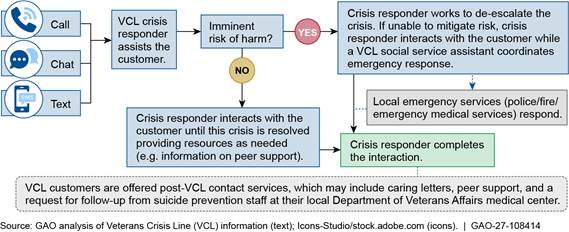
VCL officials and staff at six medical facilities GAO reviewed reported challenges coordinating emergency crisis interventions. In particular, according to VCL officials, some jurisdictions will not dispatch emergency responders to VCL customers due to local challenges, such as low law enforcement availability. GAO found that VCL does not proactively identify other local emergency response resources with which the VCL could coordinate emergency responses in these jurisdictions, such as mobile crisis units. Rather, VA policy calls for VCL employees to research potential local resources in real-time. Having information on alternative resources readily available would help ensure the VCL’s ability to respond in a timely manner to emergencies.
To evaluate the effectiveness of VCL post-contact services, VA researchers have conducted studies on some of these services, such as emergency crisis services and caring letters. VA also collects information on post-contact services provided after a VCL call. For instance, VA tracks whether suicide prevention coordinators at VA medical facilities attempt to contact veterans to discuss requests for follow up care at VA, as required by VA policy. However, VA does not collect and track VCL request data on the extent to which (1) the coordinators are successfully reaching veterans and (2) veterans are connecting to care in accordance with each veteran’s needs and preferences. Collecting and tracking such information would provide evidence VA could use to assess its process for following up with veterans after their interactions with the VCL and to better ensure the department is supporting veterans and meeting their needs and preferences.
Why GAO Did This Study
Suicide is one of the leading causes of death in the United States and veterans suffer a disproportionately high rate of suicide compared to non-veterans. Use of the VCL has grown over the last several years, with over 1.2 million interactions in fiscal year 2025. VCL crisis responders handle initial communications with individuals and can refer customers to post-VCL contact services.
GAO was asked to review aspects of VCL post-contact services. This report (1) describes post-contact services; (2) examines challenges associated with providing post-contact services; and (3) examines the extent to which VA has evaluated the effectiveness of its post-VCL contact services.
GAO reviewed VA policies, interviewed VA officials, analyzed fiscal year 2021-2025 data on post-contact services, conducted site visits at six medical facilities selected based on complexity and geographic variation, and reviewed a non-generalized sample of medical records.
What GAO Recommends
GAO recommends that VA (1) identify alternative crisis response resources the VCL can coordinate with in jurisdictions that have consistently declined to dispatch emergency response; and (2) systematically collect and track VCL data on the extent to which suicide prevention coordinators are successfully reaching veterans following use of the crisis line and track the extent to which such veterans are connected to care in accordance with each veteran’s needs and preferences. VA concurred with GAO’s recommendations.
Abbreviations
VA Department of Veterans Affairs
VCL Veterans Crisis Line
VHA Veterans Health Administration
SPC Suicide Prevention Coordinator
SSA Social Services Assistant
This is a work of the U.S. government and is not subject to copyright protection in the United States. The published product may be reproduced and distributed in its entirety without further permission from GAO. However, because this work may contain copyrighted images or other material, permission from the copyright holder may be necessary if you wish to reproduce this material separately.
November 18, 2026
The Honorable Jerry Moran
Chairman
Committee on Veterans’ Affairs
United States Senate
Suicide is one of the leading causes of death in the United States and veterans suffer a disproportionately high rate of suicide compared to non-veterans. In 2024, the suicide rate for U.S. veterans was more than twice as high as for nonveterans and an average of 17.7 veterans died by suicide per day.[1] Suicide prevention is the stated top clinical priority of the Department of Veterans Affairs (VA). As part of its prevention efforts, VA operates the Veterans Crisis Line (VCL). The VCL is a 24/7 national toll-free number, online chat, and text messaging service for qualifying individuals in need of support, including veterans, and their family members and friends.[2]
VCL crisis responders handle initial communications with individuals who contact the crisis line (VA refers to these individuals as customers) and can also refer customers to post-VCL contact services. Such services include coordinating emergency crisis interventions by local authorities or others for customers experiencing a mental health crisis. VCL crisis responders may also offer a request for follow up with a suicide prevention coordinator (SPC) at a local VA medical facility. SPCs are responsible for helping VCL customers obtain mental or other health care delivered at VA medical facilities or by community providers, as well as providing other services, such as assistance with accessing resources from the Veterans Health Administration (VHA).
VA data show VCL use has been increasing, with the total number of VCL interactions rising from around 800,000 in fiscal year 2021 to over 1.2 million in fiscal year 2025.[3] Given the volume of VCL use and the persistently high rate of veteran suicide, questions have been raised about the type of, and effectiveness of, post-VCL contact services.
You asked us to review various aspects of the post-VCL contact services that VA offers to customers who contact the VCL.
In this report, we
1. describe VCL post-contact services;
2. examine challenges VCL officials and selected VA medical facilities have reported in delivering post-contact services and their efforts to address these challenges; and
3. examine the extent to which VA has evaluated the effectiveness of its post-VCL contact services.
To describe post-contact services, we reviewed information and data on the type and number of post-contact services VA offers to VCL customers. Specifically, we reviewed VA and VCL policies for providing those services and interviewed VA officials, reviewing the types of VCL customers who are eligible for each service. We also reviewed available VA data on the number of post-contact services offered to customers for fiscal years 2021 through 2025 (the most recent data available at the time of our review). To assess the reliability of these data, we reviewed related documentation and interviewed VCL officials on procedures VCL uses to collect and store the data. Based on this assessment, we determined that the data were sufficiently reliable for the purposes of our reporting objectives.
To examine challenges VCL officials and selected VA medical facilities have reported in delivering post-contact services and VA’s efforts to address these challenges, we interviewed VCL officials about the process for delivering post-contact services and any challenges they experience in doing so. We reviewed VCL policies related to providing these services. We selected six VA medical facilities and
· interviewed officials about any challenges they face in coordinating post-contact services for VCL customers and
· reviewed medical records of up to 10 veterans who received a VCL request for follow-up with facility SPCs after the veteran’s VCL interaction. Specifically, we reviewed the nature of each veteran’s interaction with the VCL and actions documented in each veteran’s medical record.
The results of our VA medical facility interviews and medical record review are not generalizable to all VA medical facilities and veterans put in contact with VA medical facilities based on their use of the VCL, but rather they provide illustrative examples of actions taken by VA medical facilities as part of following up with VCL requests to facility SPCs. We also reviewed VA data about the number of emergency services dispatches from fiscal years 2021 through 2025, including the number of dispatches to which local law enforcement did not dispatch a response.
To examine the extent to which VA has evaluated the effectiveness of its post-VCL contact services, we reviewed VA policies, studies, and a strategic plan, and interviewed VA officials about them. We compared the results of our examination of VA’s assessment of VCL’s suicide prevention programs against federal best practices for assessing program effectiveness.[4] For our full scope and methodology, see appendix I.
We conducted this performance audit from April 2025 to November 2026 in accordance with generally accepted government auditing standards. Those standards require that we plan and perform the audit to obtain sufficient, appropriate evidence to provide a reasonable basis for our findings and conclusions based on our audit objectives. We believe that the evidence obtained provides a reasonable basis for our findings and conclusions based on our audit objectives.
Background
VA’s Health Care Services
VA’s health care system provides health care services to more than 9 million veterans. The health care system includes a national central office, regional networks that oversee 139 VA medical facilities, and more than 1,000 outpatient clinics.[5] VA medical facilities deliver a wide range of health care services to veterans, including traditional hospital-based services (e.g., surgery) and other outpatient-based services (e.g., mental health). Such services include psychotherapy to treat conditions such as depression and post-traumatic stress disorder and other mental health care.
In addition, the Veterans Community Care Program allows eligible veterans to receive mental health and other care from community providers when they face certain challenges accessing care at VA medical facilities. For example, veterans may qualify for community care when required services are not available at the nearest VA medical facility or if VA cannot provide care within its designated access standards.[6]
Eligibility for VA Health Care
To receive health care services, including mental health care, through VA facilities or community care providers, veterans must meet basic eligibility requirements and enroll in VA health care. Eligibility for VA health care is based primarily on veteran status resulting from military service. Veterans may enroll in VA health care by completing and submitting VA’s application for health benefits and receiving VA approval.
The Veterans Comprehensive Prevention, Access to Care, and Treatment Act of 2020 requires VA to pay for emergent suicide care for eligible individuals at a VA or non-VA facility, regardless of VA enrollment.[7] In addition to emergent suicide care, eligible individuals can receive an initial mental health assessment from VA and mental health or behavioral health care providers.[8]
History of the VCL
Suicide prevention is VA’s stated top clinical priority for fiscal years 2018 through 2028, according to VA’s Strategic Plan.[9] VA’s Office of Suicide Prevention is responsible for overseeing programs related to suicide prevention, including the VCL.
VA established the VCL in 2007 to assist veterans in crisis. Customers can reach the VCL in a variety of ways, including by phone through the established national hotline 988 number, by online chat, and via text messaging.[10] See figure 1 for more information on the VCL’s history.
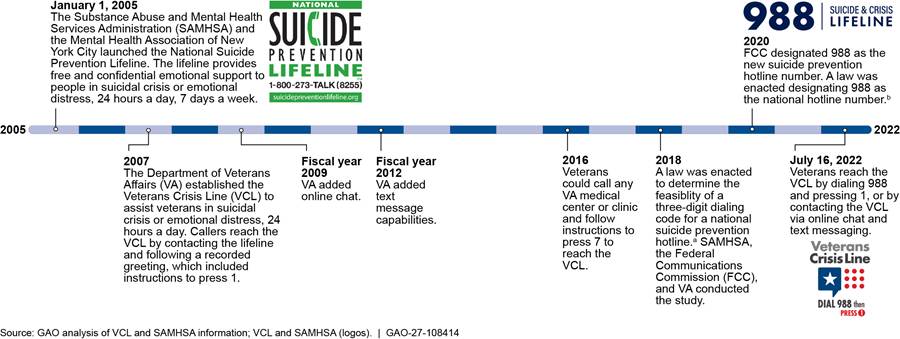
aNational Suicide Hotline Prevention Act of 2018, Pub. L. No. 115-233, § 3, 132 Stat. 2424.
bNational Suicide Hotline Designation Act of 2020, Pub. L. No. 116-172, § 3, 134 Stat. 832.
From fiscal year 2021 through 2024, the VCL had about 3.8 million customer interactions. The number of total interactions increased by about 40 percent during this time frame.[11] In fiscal year 2025, the VCL had approximately 1.2 million customer interactions. In response to the growth of veterans contacting the VCL, in January 2022, VA authorized an increase in the number of VCL crisis responders and crisis responder supervisors employed by the VCL from 916 crisis responders and 90 supervisors in March 2021 to 1,280 crisis responders and 132 supervisors, for a combined staff increase of around 40 percent. VCL crisis responders and other VCL staff are not assigned to particular geographic coverage areas and address crisis communications originating anywhere in the U.S. and internationally.
VCL Customer Interactions
The VCL aims to optimize veteran safety through predictable, consistent, and accessible crisis intervention services 24 hours a day, 7 days per week. To achieve the goal of ensuring customer safety, VCL policy requires crisis responders to conduct risk assessments of customers to help identify suicide or other mental health risk factors and address the crisis presented by the customer.[12] Crisis responders may address crises through safety planning and de-escalation tactics, or, if needed, emergency intervention dispatches. Additionally, VCL crisis responders are to engage with customers on an individual basis to determine what other needs each customer might have that the responder can help address, such as connecting the customer with a local VA medical facility.
VA Offers Various Post-Contact Services to VCL Customers Intended to Address Immediate and Longer-Term Needs
VA offers a variety of immediate and longer-term services to customers who contact the VCL via call, chat, or text, including coordinating emergency crisis interventions, sharing information on local resources, peer support, and VCL requests for follow-up with facility-based SPCs. Services offered depend on customers’ immediate and longer-term needs as determined by crisis responders, per VA policy, as well as other criteria, such as a customer’s request to stay anonymous or interest in engaging in VA health care.[13] (See fig. 2.)
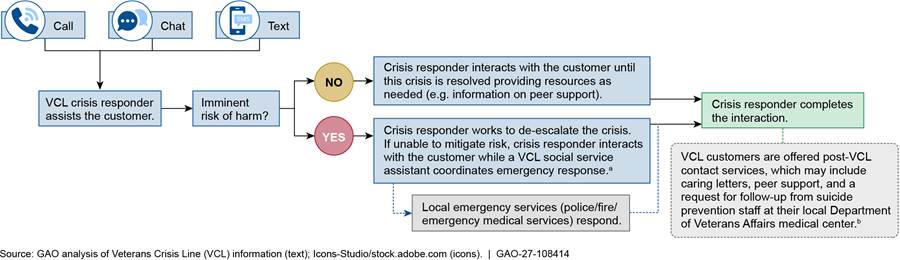
aEmergency crisis intervention could include an emergency dispatch or a plan to ensure a customer gets to a treatment facility safely.
bThe Department of Veterans Affairs’ (VA) Caring Letters program is a service that involves sending periodic letters with expressions of care and concern to veterans enrolled in VA health care who share their name and contact information during an interaction with the VCL. VA’s peer support program is staffed by trained veterans, or peer support specialists, who reach out to VCL customers to create goals for mental health treatment and community engagement. Suicide prevention coordinators at VA medical facilities are responsible for facilitating the resolution of customers’ needs as identified in the VCL’s alert as well as re-assessing the customer for any potential risk. This includes facilitating mental health care follow-up, through a VA medical facility or community referrals, when applicable, within 3 business days.
Emergency crisis interventions. Since the VCL’s creation in 2007, VCL crisis responders can facilitate emergency crisis intervention in cases when there is concern about immediate risk or a customer requests it. In such cases, VCL crisis responders are to coordinate with social services assistants (SSA). SSAs are VCL staff responsible for coordinating with local law enforcement and emergency medical services to dispatch emergency crisis interventions to ensure the customer is safe. Local law enforcement or emergency medical services are then responsible for transporting the customer to an emergency department for medical care. In fiscal year 2025, VA data show that the VCL requested emergency crisis interventions 60,551 times (out of 1,274,043 total customer interactions), which represents about 5 percent of all VCL interactions. From fiscal year 2021 through 2025, the number of times VCL requested emergency services interventions increased by approximately 63 percent, rising from 37,063 requests to 60,551 requests.
Sharing available VA-specific and national resources. VCL crisis responders can offer customers, including anonymous callers and those not enrolled in VA health care at the time of contact, guidance on enrolling in VA health care and other resources available outside of VA.[14] According to VCL officials, during an interaction with a customer, VCL crisis responders can pull information on outside resources from an internal list of vetted national organizations and their local chapters and provide this information to interested customers.[15] Resources include information on organizations focused on community, mental health and substance use, housing, and financial support, such as Veterans Service Organizations and local chapters of Alcoholics Anonymous.
VCL requests for facility SPC follow-up. SPCs are to provide follow-up communication and support based on VCL requests for interested VCL customers. SPCs staffed at each of VA’s 139 VA medical facilities are responsible for providing follow-up coordination for scheduling patient appointments at VA medical facilities or through community care. Specifically, according to VA policy, when a customer expresses interest in additional support, such as accessing mental health care, VCL crisis responders are to submit a request for a SPC at the veteran’s preferred VA medical facility to follow up with the customer. VCL requests to SPCs are also to be made for every veteran customer who receives an emergency crisis intervention. A VCL request to a facility SPC can occur regardless of whether a customer is currently enrolled in VA health care.[16]
According to VA policy, after a VCL responder requests SPC follow-up care at the veteran’s preferred VA medical facility, the SPC is to reach out via phone to the veteran within one business day to assist with resolving issues identified by the veteran, such as providing information about referrals to VHA health care and services, or community resources. If the SPC is initially unable to reach the veteran, VA policy requires the SPC to attempt to contact the veteran for a period of 3 business days and to document contact attempts in both the VCL information system and the veteran’s medical record.
In fiscal year 2025, VA data show the VCL made requests to facility SPCs 196,079 times, and SPCs closed more than 98 percent of these requests within 3 business days.[17] From fiscal year 2021 through 2025, the percentage of VCL requests to facility SPCs out of all VCL interactions dropped from about 20 percent in fiscal year 2021 to about 16 percent in fiscal year 2025. VCL staff attributed the decrease to factors such as an increase in repeat VCL customers over this time period, customers not being interested in connecting to VA health care, and customers unable to be linked to a VA record.
Peer support program. According to VA officials, VCL provides peer support through its Peer Support Outreach Call Center program to interested VCL customers who have transitioned from military service within the last 12 months or declined a VCL request for facility SPC follow-up. VA officials shared that this peer support program has existed since May 2021. Forty-six peer specialists staff the center and, according to VA policy, are to proactively reach out to VCL customers identified as at high risk for suicide by VCL crisis responders. According to program documentation, peer specialists are trained veterans who have had prior lived experience with mental health or substance abuse diagnoses. VA officials shared that peer specialists aim to talk with veterans weekly for 1 to 10 sessions, creating goals for mental health and community engagement. According to VA data, the number of Peer Support Outreach Center calls increased from 1,057 calls made to 154 veterans in fiscal year 2021 to 37,306 calls to 7,871 veterans in fiscal year 2025 (an approximately 3,000 percent increase over the time period).
Caring Letters program. VA’s Caring Letters program is a service that involves sending periodic letters with expressions of care and concern to veterans enrolled in VA health care who share their name and identifying information during an interaction with the VCL. This program began in June 2020. According to VA documentation describing the program, VCL is to send a total of 8 letters over the course of a year to veterans following a veteran’s interaction with the crisis line, reiterating that VA has available information, support, and services. VA officials told us caring communications has been a recommended service since 2008.[18] In fiscal year 2025, the VCL mailed almost 541,000 letters to more than 70,000 veterans, according to VCL data. From fiscal year 2021 through 2025, the number of caring letters sent to veterans decreased by approximately 21 percent. According to VCL officials, the decrease in caring letters sent is likely due to the increase in repeat callers to the VCL and customers providing insufficient contact information.
VCL Officials and Selected VA Facilities Reported Several Challenges and Have Taken Steps to Address Most of Them
Officials at Selected VA Facilities Reported Challenges, Such as Wait Times for Mental Health Care, and Have Taken Steps to Address Them
Officials from the six VA medical facilities we reviewed reported challenges delivering certain post-VCL services including wait times for mental health care, concerns with the quality of community care, and difficulty engaging veterans in services following a VCL request for facility SPC follow-up. Suicide prevention staff, including SPCs, at each VA medical facility shared unique approaches for addressing these challenges.
Wait times for VCL customers seeking mental health care. VCL customers seeking mental health care through VA following their VCL interaction may experience wait times exceeding VA’s access standard for receiving such care. Specifically, suicide prevention staff at three of the six VA medical facilities we reviewed reported wait times exceeding VHA’s access standard of 28 days for some mental health programs delivered at VA medical facilities, such as specialty programs for post-traumatic stress disorder treatment.
|
Examples of Mental Health Care Coordination at Selected Department of Veteran’s Affairs (VA) Medical Facilities Community Care Scheduling: One VA medical facility we reviewed recently implemented a program for more efficiently connecting veterans referred from the Veterans Crisis Line (VCL) with community care appointments. This program allows veterans, the veteran’s assigned suicide prevention coordinator, and community care staff to communicate and schedule community care mental health appointments in real-time through a three-line phone call. Facility officials reported improvements in time spent attempting to contact the veteran and establish an appointment with a community provider, streamlining a process in which the other five facilities we reviewed reported difficulties. Bridge Care: Another VA medical facility we reviewed has a mental health clinician on staff dedicated solely to providing mental health care to veterans who need more specialized treatment but who are facing wait times exceeding the access standard, also known as bridge care. According to an official at the facility, approximately 20 percent of these veterans were referred to mental health care through the VCL. Three other facilities we reviewed reported challenges with providing bridge care to veterans facing wait times for more specialized care. Source: GAO analysis of VA information. │ GAO‑27‑108414 |
To help mitigate wait times exceeding 28 days, each VA medical facility we reviewed offered “bridge care”—generalized mental health treatment such as biweekly therapy appointments—to veterans waiting for care in a specific mental health treatment program. One VA medical facility we reviewed had a mental health provider solely dedicated to providing bridge care (see sidebar). At another VA medical facility, an official told us SPCs reach out to veterans by phone periodically to check in while they are waiting for care to help ensure their immediate needs are met. At another VA medical facility, officials told us they offer peer support programs to veterans waiting for care and provide community support for veteran customers who had not yet entered a more specialized treatment program.
Community care provider quality concerns. Suicide prevention staff at the six VA medical facilities also said they have experienced challenges with mental health care provided in the community. Some facility officials stated that they believe VA offers better quality mental health care than providers in the community. For example, a VA medical facility provider we interviewed said that community providers may not fully understand the unique needs of veterans. We previously reported that military cultural competency—that is, the ability to understand and appreciate military culture and tailor clinical practices based on that understanding, may be lacking among community providers and made a recommendation about the extent to which VA has provided training to community providers on military cultural competency.[19]
Officials at four VA medical facilities said they work to address this challenge by delivering mental health care through VA providers where possible, unless there is a need for care in the community (such as drive-time eligibility or particularly long wait times for VA health care). However, according to officials at certain VA medical facilities, this can be challenging with mental health provider staffing shortages and longer wait times.
Challenges engaging customers in response to SPC requests. Suicide prevention teams at the six VA medical facilities we interviewed reported challenges engaging veterans in mental health care following their calls to the VCL and subsequent VCL requests for facility SPC follow-up care.[20] Challenges include difficulties reaching veterans by phone following the VCL request for SPC follow-up, officials from the selected VA facilities told us.
As described previously, per VA policy, SPCs are required to attempt to contact a customer after a VCL request for SPC follow-up within one business day of the VCL contact, and a total of 3 times over 3 business days if the initial contact is unsuccessful. However, officials from the six selected VA facilities told us it can be difficult to reach customers once their interaction with the VCL is complete. In particular, veterans no longer in immediate crisis may not think further mental health treatment is necessary when contacted by an SPC 24 to 72 hours after their VCL interaction, according to some VA medical facility officials.
In our review of cases at each of the six VA medical facilities, we found that in five of 56 instances (9 percent), customers who contacted the VCL with a mental health concern did not respond to subsequent SPC outreach and did not become engaged in mental health care at the VA medical facility.[21] Suicide prevention staff, including SPCs, at the six VA medical facilities told us they work to sustain veteran engagement by attempting to keep in contact with customers who receive VCL requests for SPC follow-up, including through periodic check-ins by phone. Additionally, two VA medical facilities we reviewed have suicide prevention staff specifically dedicated to engaging with veterans who called the VCL and received mental health care in community hospitals. For example, these staff members help ensure veterans receive a treatment plan for care at the VA medical facility before they are released from the hospital, according to officials from one of these VA medical facilities.
VCL Officials Reported Challenges Arranging for Local Emergency Services in Some Areas
Through policy and data reviews, as well as interviews with VCL officials, we found the VCL faces challenges with arranging for emergency crisis interventions in certain areas. This, in turn, may impede customers’ ability to receive needed emergency services. Specifically, VCL officials said that some local jurisdictions do not dispatch law enforcement or emergency medical responders to conduct wellness checks to individuals determined to be at risk for suicide, even when requested by a VCL SSA. VCL officials attributed this to requirements or restrictions imposed by local laws, as well as lack of law enforcement availability in some areas.
VCL data show that in fiscal year 2025, there were 2,494 instances in which an SSA contacted local law enforcement during a VCL interaction to request an emergency crisis intervention, but the local jurisdiction did not dispatch law enforcement or emergency medical services.[22] This is approximately 4 percent of the 60,261 total requested emergency dispatches during that fiscal year.[23] We found approximately 74 percent (1,846) of these 2,494 instances of emergency services not responding to a customer following an SSA request occurred within fourteen states (Alaska, Arizona, California, Colorado, Georgia, Michigan, Nevada, New York, North Carolina, Oklahoma, Oregon, Texas, Virginia, and Washington).[24] VCL officials told us that they are unable to determine the outcomes associated with these interventions—such as the extent to which a customer has ever suffered harm—because this information is not available in many cases.[25]
VCL policy outlines steps its SSAs are to take if local emergency services do not comply with their request and relies on the SSAs to identify potential alternative local resources that could respond to the crisis.[26] According to VCL policy, if local emergency services do not act upon an initial request for emergency crisis intervention, the SSA is to connect with an available VCL supervisor. After the SSA is connected to an available supervisor, the supervisor is to join the call with local emergency services to elevate the urgency of the request. If local emergency services are not dispatched, SSAs are to then contact the veteran’s nearest VA police department.[27]
If the VA police department contacts local emergency services and they still are not dispatched, SSAs are to then independently research, through online searches, additional emergency services agencies in the customer’s locality. For example, some states have non-law enforcement crisis response teams, such as mobile crisis response teams operated by the 988 Suicide & Crisis Lifeline (988 Lifeline), that may be available for dispatch aside from local law enforcement.[28]
VCL officials said they have made efforts to coordinate with certain local jurisdictions where a lack of response frequently occurs. Specifically, VCL officials said they maintain some information on particular jurisdictions in which law enforcement has commonly declined to assist with VCL emergency services interventions. However, for jurisdictions where requests for assistance regularly go unmet, VA’s policy places a potential burden on SSAs, who are then responsible for identifying alternative emergency response resources individually, in real time. Such unmet requests for emergency assistance create a potential challenge to VA’s ability to ensure all veterans have immediate access to suicide prevention and crisis intervention services, as VCL’s operations policy calls for.[29]
In contrast, VCL officials told us that proactively identifying available crisis response resources–including mobile crisis response teams available through other suicide prevention service lines such as 988 Lifeline—would take time and be resource intensive but could also improve the efficacy of VCL’s emergency response process. Developing such a list of alternative emergency response resources, particularly for use in jurisdictions where unanswered emergency responses have repeatedly occurred, would also align with VA’s National Strategy, which directs VA to integrate and coordinate suicide prevention activities across multiple sectors and settings.[30]
Having a list of alternative emergency resources available for jurisdictions where unanswered emergency responses have repeatedly occurred could improve the SSAs’ process for emergency response by reducing time spent researching other available resources while the crisis is ongoing. This, in turn, would help ensure VCL’s ability to respond in a timely manner and provide customers with the emergency services they need.
VA Studies the Effectiveness of Some VCL Post-Contact Services, but Has Not Fully Assessed the Effectiveness of VCL Requests for SPC Follow-Up
Our prior work has shown that federal decision-makers need evidence about whether programs and activities are achieving intended results. To gain such evidence, agencies should collect and track information to assess the performance and progress towards the intended results. This evidence may come from a variety of sources, including, but not limited to, performance measurement and program evaluation.[31]
One goal in VA’s National Strategy for Preventing Suicide is to evaluate the effectiveness of veteran suicide prevention.[32] To evaluate the effectiveness of suicide prevention programs, VA researchers have studied some post-VCL contact services, such as emergency crisis services and its Caring Letters program.[33] For example, one study of behavioral health use after VCL emergency dispatches found that veterans receiving the dispatch access VA behavioral health care at higher rates in the month after the dispatch.[34] Additionally, one study on caring letters found that there was an association between receiving a caring letter and a higher probability of VA health care use among a national sample of veterans who contacted the VCL.[35] According to VCL officials, they are also in the process of assessing the effectiveness of peer support.
In addition to these studies, VA also collects some performance information on the post-contact services it provides to veterans in crisis. According to VA officials, the performance information can help determine whether services were delivered in accordance with VA policy. For example, as described earlier in this report, VA tracks the number of caring letters sent to VCL customers, the number of VCL customers who receive services through the Peer Support Outreach Center, and the number of VCL requests for facility SPC follow-up. VA also collects information following emergency dispatches, such as whether the veteran was assessed as safe by emergency responders, if the information is available.[36] See Table 1 for the types of information VA collects for its VCL post-contact services.
Table 1: Examples of Information the Department of Veterans Affairs (VA) Tracks for Veterans Crisis Line (VCL) Post-Contact Services
|
Post-contact service |
Information tracked |
Examples of evaluations performed |
|
Emergency Crisis Services |
Number of requests for emergency crisis services Disposition of the requesta |
Research evaluations characterizing VCL calls, outcomes, and satisfaction, including for emergency crisis services and follow-up care at local VA medical facilities.b |
|
VCL Requests for Suicide Prevention Coordinator Follow-Up |
Number of VCL requests for suicide prevention coordinator follow-up made from customer interactions Percentage of VCL requests for suicide prevention coordinator follow-up where contact was attempted within one business day Percentage of VCL requests for suicide prevention coordinator follow-up for which up to three contacts were attempted within 3 business days, if the initial contact attempt was unsuccessful |
Research evaluations characterizing VCL calls and follow-up care at local VA medical facilities.c |
|
Peer Support Outreach |
Number of veterans receiving calls after interaction with VCL Total number of calls made by peer support outreach officials to veterans |
Evaluation of this program is in progress, according to peer support program officials. |
|
Caring Letters |
Number of veterans receiving caring letters Total number of caring letters sent |
Research evaluations assessing outcomes of the program, including suicide attempts and probabilities of mental health care utilization.d |
Source: GAO analysis of VA information. │ GAO‑27‑108414
aAccording to VCL officials, the disposition of the request is sometimes incomplete because the information is not available. For example, sometimes law enforcement declines to provide disposition information to the VCL.
bSee Britton, P. C., et al., “Veterans Crisis Line Call Outcomes: Distress, Suicidal Ideation, and Suicidal Urgency,” American Journal of Preventive Medicine, 62(5), 706-713, (2022). and Britton, P. C., et al (2025), “Behavioral Health Care Use After Initiation of Emergency Dispatches During Veterans Crisis Line Contacts,” Psychiatric Services, 76(5), 502–505.
cSee Hannemann, C. M., et al., (2021), “Suicide Mortality and Related Behavior Following Calls to the Veterans Crisis Line by Veterans Health Administration Patients,” Suicide & Life-Threatening Behavior, 51(3), 596–605, and Stearns-Yoder, K. A., et al., (2024), “Health-Related Outcomes among Veterans Identified as Being at Increased Risk during a Crisis Line Contact,” Psychological Services, 21(3), 454–460.
dSee Landes, S. J., et al., (2023), “Qualitative Evaluation of a Caring Letters Suicide Prevention Intervention for the Veterans Crisis Line,” Psychiatric Services, 74, 1234–1239. and Reger, M. A., et al., (2024), “Caring Letters Sent by a Clinician or Peer to At-Risk Veterans: A Randomized Clinical Trial,” JAMA Network Open, 7(4).
However, we found VA has not fully assessed the effectiveness of VCL requests for SPC follow-up because it does not collect and track information on the outcomes of these requests. Specifically, VA tracks whether SPCs have attempted to contact VCL customers as required by VA policy and the timeliness of this outreach, but it does not track the extent to which SPCs are successful in reaching customers or the extent to which VCL customers are connected to care in accordance with each veteran’s needs and preferences.[37]
Our review identified instances of challenges with SPCs reaching VCL customers in response to a VCL request for follow-up. For example, in our review of 58 cases at six selected VA medical facilities, we found that SPCs had attempted to contact 56 out of 58 VCL customers by phone. For the remaining two customers, phone contact was not necessary because the VCL customers were receiving inpatient treatment at a VA medical facility after the VCL call. We also found that in five of 56 instances (9 percent), customers who contacted the VCL did not respond to SPC outreach and did not become engaged in care at the VA medical facility. (See sidebar.)
|
Examples of Outcomes from Veterans Crisis Line (VCL) Calls and Suicide Prevention Coordinator (SPC) Follow-Up Customer Referred to and Attends Treatment. A spouse called the VCL expressing concerns about a suicidal veteran. VCL dispatched emergency services, and local police assessed the veteran as safe. During follow-up, the Department of Veterans Affairs (VA) medical facility SPC contacted the customer, conducted a risk assessment, and submitted a consultation for marriage and family therapy, which the customer and the spouse attended. Customer Scheduled Treatment but Did Not Attend. A customer, who was homeless, ineligible for VA compensation, and had a history of substance abuse, called the VCL multiple times. In one call, the customer made violent threats against the customer’s family, which resulted in an emergency dispatch. On another occasion, the customer called the VCL while inebriated, resulting in emergency dispatch to transport the customer to an emergency room. The SPC, during follow-up, offered behavioral health services, to include enrollment in a substance use treatment program. However, the customer did not show up for scheduled treatment. Source: GAO analysis of VA information. │ GAO‑27‑108414 |
VA medical facility officials said that veterans not responding to an SPC call was a challenge. For example, VA medical facility officials at two sites told us that, for some customers, SPCs’ phone numbers show up as spam or that veterans may work in jobs that do not allow them to take phone calls when the SPC calls. VA medical facility officials at five sites told us it can be difficult to reach customers once their interaction with the VCL is complete. In particular, veterans no longer in immediate crisis may not think further treatment is necessary when contacted by an SPC 24 to 72 hours after their VCL interaction, according to these VA facility officials. Officials from one VA medical facility added that veteran customers who are not immediately engaged by an SPC following their VCL interaction may not be reached for subsequent care.
Because VA does not collect and track the extent to which SPCs successfully contacted veterans during follow-up and the extent to which veterans are connected to care in accordance with each veteran’s needs and preferences, VA is limited in its ability to evaluate the effectiveness of its post-VCL follow-up process. Having such information would provide more complete evidence about the effectiveness of SPC follow-ups and allow VA to consider whether programmatic changes may be needed. For example, such data would show whether SPCs are reaching veterans or whether they are engaging in care after contacting the VCL. With more information, VA could also explore options to enhance the SPC follow-up process. For example, better follow-up outcome information would allow VA to examine whether real-time transfers between the VCL and SPCs during business hours or options besides telephone outreach (such as text messaging) could increase veteran engagement.[38] Such efforts, in turn, would better ensure VA’s ability to best meet the needs and preferences of the veterans it serves.
Conclusions
Suicide prevention is VA’s top stated clinical priority, and VCL services are an integral part of VA’s efforts to prevent veteran suicide. VA strives to provide mental health and other services to customers who contact the VCL and has a number of critical post-contact services available to interested veterans.
However, our review identified challenges with VCL’s ability to arrange emergency crisis interventions with certain local jurisdictions, which may impede responses to VCL customers in need of emergency services. Having a list of emergency resources—such as mobile crisis response teams—available for jurisdictions where unanswered emergency responses have repeatedly occurred could improve the SSAs’ process for emergency response by reducing time spent researching other available resources while the crisis is ongoing. This, in turn, would help ensure VCL’s ability to respond in a timely manner and provide customers with the emergency services they need.
Furthermore, we found that VA has collected information on the effectiveness of its post-VCL contact services, but does not track information on the outcomes of VCL requests to facility SPCs for follow-up care. Tracking this information could strengthen VA’s ongoing evaluation efforts by providing the information needed to assess the effectiveness of the facility SPC follow-up process, better ensuring it is meeting the needs and preferences of veterans.
Recommendations for Executive Action
We are making the following two recommendations to VA:
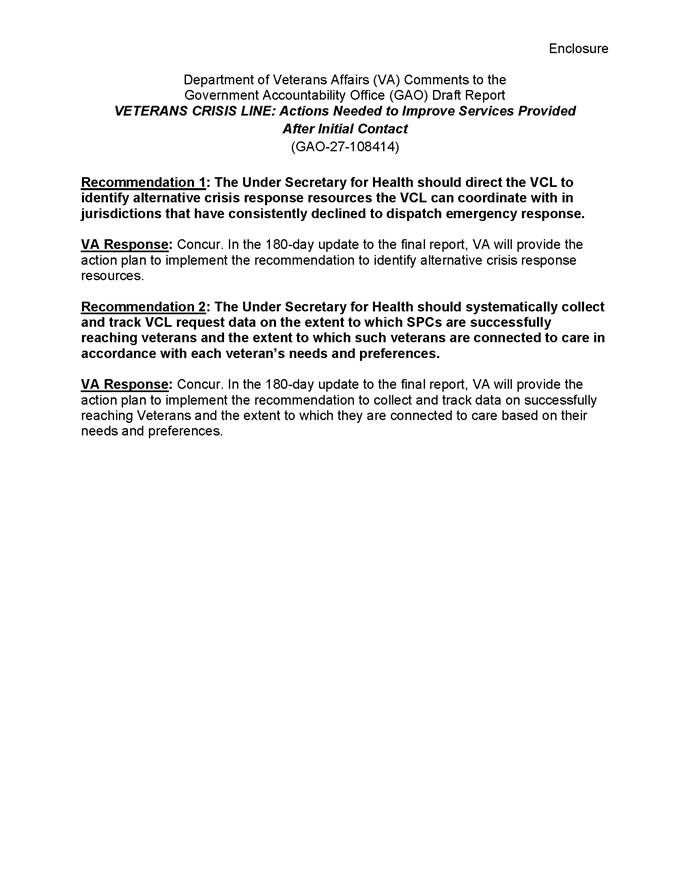
The Under Secretary for Health should direct the VCL to identify alternative crisis response resources the VCL can coordinate with in jurisdictions that have consistently declined to dispatch emergency response. (Recommendation 1)
The Under Secretary for Health should systematically collect and track VCL data on the extent to which SPCs are successfully reaching veterans following use of the crisis line and the extent to which such veterans are connected to care in accordance with each veteran’s needs and preferences. (Recommendation 2)
Agency Comments
We provided a draft of this report to VA for review and comment. In its comments, reproduced in appendix II, VA concurred with our recommendations. VA stated that it would develop an action plan for implementation for each recommendation in an 180-day update to the final report. VA also provided technical comments that we incorporated as appropriate.
We are sending copies of this report to the appropriate congressional committees and the Secretary of Veterans Affairs. In addition, the report will be available at no charge on the GAO website at http://www.gao.gov.
If you or your staff have any questions about this report, please contact Alyssa M. Hundrup at HundrupA@gao.gov. Contact points for our Offices of Congressional Relations and Media Relations are on the last page of this report. GAO staff who made major contributions to this report are listed in appendix III.

Alyssa M. Hundrup
Director, Health Care
This report (1) describes post-contact services the Department of Veterans Affairs’ (VA) provides to customers who used the Veterans Crisis Line (VCL); (2) examines challenges VCL officials and selected VA medical facilities have reported in delivering post-contact services and their efforts to address these challenges; and (3) examines the extent to which VA is or has evaluated the effectiveness of its post-VCL contact services.
To describe post-contact services VA provides to customers who used the VCL, we interviewed VCL officials about post-contact services the VCL offers, including emergency response, caring letters, peer support, and VCL requests for facility suicide prevention coordinator (SPC) follow-up. We also reviewed relevant VA and VCL policies.[39] We received VCL data on the type and number of post-contact services provided to VCL customers from fiscal years 2021 through 2025 (the most recent data available at the time of our review).[40] To assess the reliability of the data, we reviewed related documentation and interviewed VCL officials on procedures VCL uses to collect and store the data. Based on this assessment, we determined that the data were sufficiently reliable for the purposes of our reporting objectives.
To examine challenges VCL faces in delivering post-contact services and strategies they implement to address these challenges, we interviewed VCL officials about the process for dispatching emergency services to customers when necessary and referring veterans to SPCs at local VA medical facilities following VCL interactions. We also reviewed VCL policies related to these procedures.[41] We also reviewed VA’s goals for preventing veteran suicide, such as to integrate and coordinate suicide prevention activities across multiple sectors and settings.[42] We also reviewed data about the number of emergency services dispatches from fiscal years 2021 through 2025, including the number of dispatches to which local law enforcement did not dispatch a response.
We also conducted site visits to a non-generalizable sample of six VA medical facilities that we selected based on the facility’s level of complexity and geographic diversity (see table 2).[43]
|
VA Medical Facility |
Complexitya |
Location |
|
Puget Sound |
1 |
Washington |
|
Atlanta |
1 |
Georgia |
|
Wichita |
1 |
Kansas |
|
Texas Valley |
2 |
Texas |
|
Altoona |
3 |
Pennsylvania |
|
Cheyenne |
3 |
Wyoming |
Source: GAO analysis of Department of Veterans Affairs information. | GAO‑27‑108414
aVA assigns its medical facilities a complexity level based on the characteristics of the patient population, clinical services offered, educational and research missions, and administrative complexity. Facility I are the most complex while Facility III are the least complex.
During our site visits, we met with suicide prevention coordinators, mental health providers, and community care officials, to discuss their experiences and any challenges they faced in contacting veterans referred from the VCL and providing, as appropriate, follow-up services. We also discussed strategies they implement to address their challenges. We also reviewed VA medical facility suicide prevention policies.
As part of our site visits, we reviewed medical records for a selection of customers the VCL requested follow up by VA facility SPCs. To select medical records for review, we received lists of VCL requests for SPC follow-up made to each of the six VA medical facilities we selected from October 1, 2024, through March 31, 2025. We selected this six month time period because it would enable us to evaluate actions that VA had taken in response to a VCL request for SPC follow-up made during fiscal year 2025.[44] At our first site visit, we selected a list of 8 customers where the VCL made a request to the VA medical facility SPC for follow up.[45] At the remaining five site visits, we selected a random sample of 10 names with VCL requests for SPC follow-up. For all six sites, in conjunction with facility staff, we reviewed actions that were documented in the customer’s medical record, such as whether the SPC called the customer back, whether the customer was at high risk for suicide, and the type of care received by the customer. In total, we reviewed medical records for 58 veterans at 6 different VA medical facilities. Our medical record review is not generalizable for all VCL customers with a VCL request for SPC follow-up, but rather provide illustrative examples of actions taken by VA medical facilities.
To examine the extent to which VA has evaluated the effectiveness of its post-VCL contact services, we reviewed VA policies, studies, and a strategic plan, and interviewed VA officials about them.[46] We compared the results of our examination of the VA’s monitoring of VCL’s suicide prevention programs against federal best practices for evaluating program effectiveness.[47]
We conducted this performance audit from April 2025 to November 2026 in accordance with generally accepted government auditing standards. Those standards require that we plan and perform the audit to obtain sufficient, appropriate evidence to provide a reasonable basis for our findings and conclusions based on our audit objectives. We believe that the evidence obtained provides a reasonable basis for our findings and conclusions based on our audit objectives.
GAO Contact
Alyssa M. Hundrup at HundrupA@gao.gov
Staff Acknowledgments
In addition to the contact named above, Michael Zose (Assistant Director), Austin Grattan, Madison Herin, Jim Melton and Catherine Parylo made key contributions to this report. Also contributing were Jennie Apter, David Jones, and Monica Perez-Nelson.
The Government Accountability Office, the audit, evaluation, and investigative arm of Congress, exists to support Congress in meeting its constitutional responsibilities and to help improve the performance and accountability of the federal government for the American people. GAO examines the use of public funds; evaluates federal programs and policies; and provides analyses, recommendations, and other assistance to help Congress make informed oversight, policy, and funding decisions. GAO’s commitment to good government is reflected in its core values of accountability, integrity, and reliability.
Obtaining Copies of GAO Reports and Testimony
The fastest and easiest way to obtain copies of GAO documents at no cost is through our website. Each weekday afternoon, GAO posts on its website newly released reports, testimony, and correspondence. You can also subscribe to GAO’s email updates to receive notification of newly posted products.
Order by Phone
The price of each GAO publication reflects GAO’s actual cost of production and distribution and depends on the number of pages in the publication and whether the publication is printed in color or black and white. Pricing and ordering information is posted on GAO’s website, https://www.gao.gov/ordering.htm.
Place orders by calling (202) 512-6000, toll free (866) 801-7077,
or
TDD (202) 512-2537.
Orders may be paid for using American Express, Discover Card, MasterCard, Visa, check, or money order. Call for additional information.
Connect with GAO
Connect with GAO on X,
LinkedIn, Instagram, and YouTube.
Subscribe to our Email Updates. Listen to our Podcasts.
Visit GAO on the web at https://www.gao.gov.
To Report Fraud, Waste, and Abuse in Federal Programs
Contact FraudNet:
Website: https://www.gao.gov/about/what-gao-does/fraudnet
Automated answering system: (800) 424-5454
Media Relations
Sarah Kaczmarek, Managing Director, Media@gao.gov
Congressional Relations
David A. Powner, Acting Managing Director, CongRel@gao.gov
General Inquiries
[1]Department of Veterans Affairs, Congressionally Mandated Report: 2026 National Veteran Suicide Prevention Annual Report, September 2026. The rate of veteran suicides per day in 2024 was consistent with prior years: between 2019 and 2023, suicide rates per day ranged from 18.03 in 2020 to 18.5 in 2019. Data from 2024 were the most current available at the time of our review.
[2]VA operates the VCL through the National Suicide & Crisis Lifeline, which serves anyone in suicidal crisis or emotional distress, and is administered by the Substance Abuse and Mental Health Services Administration. To reach the VCL, individuals dial 988 and then press 1.
[3]See GAO, Veterans Crisis Line: Actions Needed to Better Ensure Effectiveness of Communications with Veterans, GAO‑25‑107182 (Washington, D.C.: June 2, 2025) and GAO, Suicide Prevention: Capacity and Federal Assessment of the 988 Lifeline, GAO‑26‑108114 (Washington, D.C.: July 1, 2026).
[4]See Department of Veterans Affairs, National Strategy for Preventing Veteran Suicide 2018-2028 (Washington, D.C.: July 2, 2018); Department of Veterans Affairs, Veterans Health Administration, Operations of the Veterans Crisis Line Center, VHA Directive 1503(2) (Washington, D.C.: May 26, 2020)(Amended Dec. 8, 2022); Veterans Crisis Line, Standard Operating Procedure for Call Flow, VCL-S-ACT-216-2601 (January 2026);Veterans Crisis Line, Veterans Crisis Line, Standard Operating Procedure for Social Science Specialists (Crisis Responders) for Initiating an Emergency Dispatch, VCL-S-ACT-214-2508 (June 2025); and GAO, Evidence-Based Policymaking: Practices to Help Manage and Assess the Results of Federal Efforts, GAO‑23‑105460 (Washington, D.C.: July 12, 2023).
[5]On July 15, 2026, VA updated its website to reflect that it reorganized the regional network structure from 18 to five regional networks.
[6]There are six criteria that can qualify a veteran to receive care under the Veterans Community Care Program. In addition to the six criteria, veterans must either be enrolled in VA health care or eligible for VA care without needing to enroll, and in most circumstances, veterans must receive approval from VA prior to obtaining care from a community provider. See 38 U.S.C. § 1703(d), (e), and implementing regulations at 38 C.F.R. §§ 17.4000 - 17.4040.
[7]Pub. L. No. 116-214, § 201, 134 Stat. 1026, 1030 (codified at 38 U.S.C. § 1720J). Eligible individuals include those discharged or released from active duty after more than 24 months of active service under conditions other than dishonorable; former members of the armed forces, including reserve members, who served more than 100 days and discharged under conditions other than dishonorable; and former members of the armed forces who were victims of a physical assault or battery of a sexual nature, or sexual harassment, while serving in the armed forces.
[8]See 38 U.S.C. § 1720I.
[9]See Department of Veterans Affairs, National Strategy for Preventing Veteran Suicide 2018-2028 (Washington, D.C.: July 2, 2018).
[10]The VCL can also be reached online at http://www.VeteransCrisisLine.net, or by sending a text message to 838255.
[11]GAO, Veterans Crisis Line: Actions Needed to Better Ensure Effectiveness of Communications with Veterans, GAO‑25‑107182 (Washington, D.C.: June 2, 2025).
[12]Department of Veterans Affairs, Veterans Health Administration, Operations of the Veterans Crisis Line Center, VHA Directive 1503(2) (Washington, D.C.: May 26, 2020) (Amended Dec. 8, 2022).
[13]Department of Veterans Affairs, Veterans Health Administration, Operations of the Veterans Crisis Line Center, VHA Directive 1503(2) (Washington, D.C.: May 26, 2020). VA officials told us that certain post-contact services, such as enrollment in VA health care, requests for SPCs and additional VA medical facility care, the peer support program, and the caring letters program, are not available to VCL customers who prefer to remain anonymous.
[14]VCL data includes information about whether callers chose to remain anonymous or provided an alias during their VCL interaction. However, VA officials told us the VCL does not track such information reliably, which makes analyzing large data sets difficult. Between January 25th and January 31st, 2025, 6,366 callers out of 27,112 calls were anonymous (23.37 percent). Of those 6,366 anonymous callers, 26 resulted in a request for SPC follow-up (0.41 percent).
[15]VA officials told us they compiled this list of resources through an integrated workshop model that involves VCL responders suggesting resources and VCL policy operations staff vetting the resources. They said they review and update the list by including new resources or removing resources, when needed.
[16]If the customer referred to the SPC is a veteran who is not enrolled in VA health care, the SPC can refer the veteran to the facility eligibility staff for assistance with enrollment.
[17]According to VA policy, SPCs are required to initiate follow-up on all requests from the VCL within one business day and initiate a minimum of three phone calls on three separate days to reach the veteran. If the minimum three documented phone calls are unsuccessful, the SPC is supposed to send the caller a follow-up letter that provides the SPC contact information. Once the attempts have been made, the SPC closes out the request from the VCL using a web-based application to write a summary of the contact attempts made. VHA Directive 1503(2).
[18]See Mark A. Reger et al., “Caring Letters Sent by a Clinician or Peer to At-Risk Veterans: A Randomized Clinical Trial,” JAMA Network Open 7, no. 4 (2024): e248064. This study shows that Caring Letters are associated with higher probability of outpatient and inpatient mental health care use.
[19]See GAO, Veterans’ Community Care: VA Needs Improved Oversight of Behavioral Health Medical Records and Provider Training, GAO‑25‑106910 (Washington, D.C.: May 5, 2025). This report included a recommendation that VA monitor goals and related performance measures for community providers' completion of training related to military culture. VA agreed with this recommendation, and it remains open as of the publication of this report.
[20]VCL allows customers to remain anonymous if they prefer to do so. SPCs are unable to contact those that choose to remain anonymous for further engagement in mental health care. In such cases, VCL policy states that crisis responders should encourage customers, as appropriate, to follow up with VA or elsewhere to seek appropriate treatment.
VCL crisis responders submit a case referral to a SPC at a VA medical facility if a customer who shared their name and contact information wants additional support accessing care or required an emergency service intervention during the contact with the VCL.
[21]We excluded two instances from our review of 58 cases because those two veterans received inpatient mental health care as a result of their contact with the VCL and therefore contact from an SPC was unnecessary.
[22]In fiscal year 2021, there were 1,556 of these instances out of 37,063 total emergency services dispatches, or approximately 4.2 percent; in 2022, there were 1,981 out of 40,799, or approximately 4.9 percent; in 2023, there were 2,297 out of 47,106, or 4.9 percent; and in 2024, there were 3,379 out of 55,494, or approximately 6.1 percent.
[23]According to VA data for fiscal year 2025, there were 56,436 documented occurrences when emergency services responded to the SSAs’ requests. Additionally, there were 1,102 occurrences where the VCL initially contacted law enforcement during a customer interaction, but law enforcement did not call the VCL back to explain the disposition of the dispatch request (such as whether the customer ultimately did not need emergency dispatch, was assessed as safe by dispatch, or was transported to a local hospital).
According to VA data for fiscal year 2025, the total number of instances in which emergency services did not respond to the customer following an SSA request was 2,723. However, for our reporting, we excluded 229 instances in which the customer contacted the VCL from an international location.
[24]Fiscal year 2025 VA data showed instances of a non-response occurred in 49 states and the District of Columbia. The average number of instances in the fiscal year across all the 49 states and DC was 50.
[25]VCL officials told us that they are not always able to obtain information on the outcome of emergency dispatches, such as in cases where local law enforcement is unable or unwilling to provide such information. However, they track this information when it is available. In fiscal year 2025, the VCL was able to obtain information on the outcome of emergency dispatches for about 34 percent of cases.
[26]Veterans Crisis Line, Standard Operating Procedure for Social Service Assistant Emergency Dispatch, VCL-S-ACT-248-2411(1) (November 2024).
[27]The VA police are the armed and uniformed federal law enforcement service of the U.S. Department of Veterans Affairs. The VA police department provides law enforcement and security services to veterans and their families at VA medical facilities. VA police departments do not dispatch law enforcement officers to a VCL customer outside of their jurisdiction (i.e., the local VA medical facility) but can coordinate directly with local law enforcement.
[28]The Department of Health and Human Services administers the 988 Lifeline. For more information on crisis response, see GAO, Behavioral Health: Federal Activities to Support Crisis Response Services, GAO‑25‑107586 (Washington, D.C.: September 4, 2025). Also see GAO‑26‑108114.
Where available, mobile crisis response teams travel to the location of individuals experiencing a crisis to provide an array of in-person assessments and interventions. Teams are responsible for assessing and stabilizing the individual, providing brief treatment, ensuring their safety, and providing transport or coordinating higher levels of care as needed. These teams may include a combination of behavioral health professionals, including crisis counselors and social workers.
[29]See Department of Veterans Affairs, Operations of the Veterans Crisis Line Center, VHA Directive 1503(2) (Washington, D.C.: May 26, 2020) (Amended December 8, 2022).
[30]See Department of Veterans Affairs, National Strategy for Preventing Veteran Suicide 2018-2028 (Washington, D.C.: July 2, 2018).
[31]See GAO, Evidence-Based Policymaking: Practices to Help Manage and Assess the Results of Federal Efforts, GAO‑23‑105460 (Washington, D.C.: July 12, 2023). To identify these practices, we reviewed (1) federal laws and guidance related to evidence-building and performance-management activities and (2) our related past reports. We identified and distilled several hundred relevant actions into 13 key practices. We then refined the practices and actions, as appropriate, based on input from cognizant officials at 24 major federal agencies and Office of Management and Budget staff.
[32]See Department of Veterans Affairs, National Strategy for Preventing Veteran Suicide 2018-2028 (Washington, D.C.: July 2, 2018).
[33]See, for example, Landes, S. J., et al., (2023). “Qualitative Evaluation of a Caring Letters Suicide Prevention Intervention for the Veterans Crisis Line.” Psychiatric Services, 74, 1234–1239 and Britton, P. C., et al., (2022), “Veterans Crisis Line Call Outcomes: Distress, Suicidal Ideation, and Suicidal Urgency,” American Journal of Preventive Medicine, 62(5), 745-751.
[34]Britton, P.C., et al., “Behavioral Health Care Use After Initiation of Emergency Dispatches During Veterans Crisis Line Contacts,” Psychiatric Services. 76, 502-505, 2025. The study was based on VCL data from 2017 through 2019, in which a veteran had contacted the VCL, could be linked to the VA, and noted whether the caller had previous behavioral health use. For veterans with no behavioral health care use (84,714), the VCL made 6,712 emergency dispatches. For veterans with prior VA behavioral health care use (132,827), the VCL made 17,009 emergency dispatches.
[35]See Reger MA, et al., “Caring Letters Sent by a Clinician or Peer to At-Risk Veterans: A Randomized Clinical Trial,” JAMA Network Open: 2024 Apr 29;7(4). The study was based on 102,709 unique identifiable veterans who contacted the VCL on their own behalf between June 11, 2020, and June 10, 2021.
[36]A VCL official told us that they are not always able to obtain information on the outcome of emergency dispatches, such as in cases where local law enforcement is unable or unwilling to provide such information.
[37]According to VA policy, SPCs are required to initiate follow-up on all requests from the VCL within 1 business day and initiating a minimum of 3 phone calls on 3 separate days to reach the veteran. If the minimum 3 documented phone calls are unsuccessful, the SPC is supposed to send the caller a follow-up letter. Once the attempts have been made, the SPC closes out the request from the VCL using a web-based application to write a summary of the contact attempts made. VHA Directive 1503(2).
[38]VA officials told us that the nature of VCL callers who may have recently experienced a crisis and may remain at elevated risk, would introduce significant patient safety and privacy considerations that would require careful evaluation before considering texts or emails to be a standard communication option for SPC outreach but acknowledged that it has been a successful strategy for other VA programs when communication is non-urgent such as interactions for appointment scheduling and follow-up on missed appointments. As we previously reported, VA utilizes text communications for its Solid Start Program, which assists veterans transitioning from military service to civilian life. See GAO, Veterans Benefits: VA Could Enhance Outreach for Its Solid Start Program by Increasing Collaboration with Veterans Organizations. GAO‑23‑105699 (Washington, D.C.: Jan.5, 2023).
[39]See, for example, Department of Veterans Affairs, Veterans Health Administration, Operations of the Veterans Crisis Line Center, VHA Directive 1503(2) (Washington, D.C.: May 26, 2020) (Amended December 8, 2022) and Veterans Crisis Line, Policy for Veterans Crisis Line Social Science Specialist Interaction Standards and Silent Monitoring, VCL-P-ACT-229-2511 (Nov. 2025).
[40]We were only able to obtain certain data, such as the number of anonymous VCL customers, for a more limited time period.
[41]See, for example, Veterans Crisis Line, Standard Operating Procedure for Social Science Specialists (Crisis Responders) for Initiating an Emergency Dispatch, VCL-S-ACT-214-2508 (June 2025).
[42]See, for example, Department of Veterans Affairs, National Strategy for Preventing Veteran Suicide 2018-2028 (Washington, D.C.: July 2, 2018), Veterans Crisis Line, Standard Operating Procedure for Social Service Assistant Emergency Dispatch, VCL-S-ACT-248-2411(1) (November 2024), and Department of Veterans Affairs, Operations of the Veterans Crisis Line Center, VHA Directive 1503(2) (Washington, D.C.: May 26, 2020) (Amended December 8, 2022).
[43]We conducted one of the visits in person and the remaining five virtually.
[44]Our site visits occurred from July 2025 through February 2026.
[45]During our first site visit, our selection of VCL requests for SPC follow-up was based on the number of VCL referrals for a given name. For example, one veteran had 34 VCL requests for SPC follow-up from October 1, 2024, through March 31, 2025.
[46]See, for example, Department of Veterans Affairs, Veterans Health Administration, Operations of the Veterans Crisis Line Center, VHA Directive 1503(2) (Washington, D.C.: May 26, 2020) (Amended December 8, 2022); Veterans Crisis Line, Standard Operating Procedure for Call Flow, VCL-S-ACT-216-2601 (January 2026); and Veterans Crisis Line, Standard Operating Procedure for Social Science Specialists (Crisis Responders) for Initiating an Emergency Dispatch, VCL-S-ACT-214-2508 (June 2025).
[47]See Department of Veterans Affairs, National Strategy for Preventing Veteran Suicide 2018-2028 (Washington, D.C.: July 2, 2018) and GAO, Evidence-Based Policymaking: Practices to Help Manage and Assess the Results of Federal Efforts, GAO‑23‑105460 (Washington, D.C.: July 12, 2023). To identify these practices, we reviewed (1) federal laws and guidance related to evidence-building and performance-management activities and (2) our related past reports. We identified and distilled several hundred relevant actions into 13 key practices. We then refined the practices and actions, as appropriate, based on input from cognizant officials at 24 major federal agencies and Office of Management and Budget staff.