
Report to Congressional Requesters
United States Government Accountability Office
A report to congressional requesters
Contact: Elizabeth Repko at RepkoE@gao.gov
What GAO Found
Traffic control devices consist of signs, signals, and pavement markings that communicate messages, such as warnings and guidance, to roadway users. Uniformity in these devices promotes traffic safety and efficiency across the country by reducing confusion for road users. The Federal Highway Administration (FHWA) issues the Manual on Uniform Traffic Control Devices for Streets and Highways (the “Manual”), to establish uniform national criteria for implementing these traffic control devices.
Almost all traffic engineers and other practitioners GAO interviewed from across the country said they view the Manual as the authoritative source of standards and guidance for traffic control devices. While FHWA allows for deviations from the Manual under certain conditions, including to protect vulnerable road users, almost all practitioners said they have never or rarely done so. Many practitioners told GAO that deviations risk detracting from uniformity. Several reported having deviated occasionally to save on costs or to address local issues affecting efficiency or safety. Many traffic engineers were reluctant to deviate from the Manual’s requirements due to the possibility of facing a lawsuit if a crash were to occur at the site where the deviation occurred.
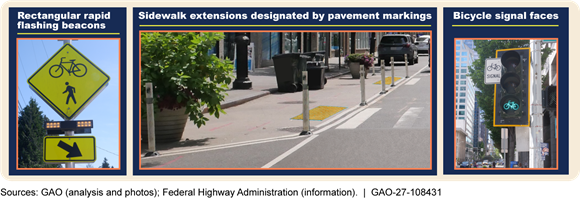
FHWA revises and updates the Manual and considers feedback from practitioners in doing so. This feedback includes change requests and successful experiments that tested new devices or applications. See examples of new devices included in the most recent edition of the Manual in the figure below.
Examples of Traffic Control Devices to Enhance Safety for Vulnerable Road Users from the Manual on Uniform Traffic Control Devices, 11th Edition (2023)
FHWA maintains a public online database tracking requests for experiments, interpretations, and changes to the Manual. But, the database provides few details on experiments or change requests. FHWA told GAO it has this information and provides it to practitioners upon request. However, this option is not clearly stated on FHWA’s website, and many practitioners are unaware of it. By more clearly communicating this option on its website, FHWA would provide practitioners with greater access to information about experiments on traffic control devices. Such information could help practitioners develop and prepare their own requests and test devices and applications on the roads they operate, thus promoting the Manual’s objectives of safety and efficiency.
Why GAO Did This Study
Engineers use the Manual to deploy traffic control devices uniformly across the U.S. Under certain limited conditions, localities may deviate from the Manual and deploy traffic control devices differently than it requires or recommends. Safety organizations have expressed concerns that engineers may be unwilling to deviate even when doing so might make roadways safer for vulnerable road users like pedestrians and cyclists.
GAO was asked to review issues related to how practitioners deviate from the Manual to protect vulnerable road users. This report examines: (1) how selected practitioners use the Manual and under what circumstances they deviate from it and (2) how FHWA updates the Manual and communicates with stakeholders on potential new uses of traffic control devices.
GAO reviewed the Manual, FHWA’s Official Rulings Database and other sections of its website, as well as relevant regulations and statutes. GAO interviewed agency officials; practitioners from a non-generalizable sample of 26 city, county, and state jurisdictions nationwide; as well as traffic engineers and other practitioners from five selected professional membership organizations.
What GAO Recommends
GAO recommends that FHWA prominently display clear instructions on its website on how to obtain more detailed information on experiments related to the Manual on Uniform Traffic Control Devices.
DOT agreed with the recommendation.
Abbreviations
DOT U.S. Department of Transportation
FHWA Federal Highway Administration
IIJA Infrastructure Investment and Jobs Act
Manual Manual on Uniform Traffic Control Devices for Streets and Highways
NCUTCD National Committee on Uniform Traffic Control Devices
This is a work of the U.S. government and is not subject to copyright protection in the United States. The published product may be reproduced and distributed in its entirety without further permission from GAO. However, because this work may contain copyrighted images or other material, permission from the copyright holder may be necessary if you wish to reproduce this material separately.
November 16, 2026
The Honorable Rick Larsen
Ranking Member
Committee on Transportation and Infrastructure
House of Representatives
The Honorable John Fetterman
United States Senate
Across the United States, traffic signs, signals, and pavement markings—known as traffic control devices—communicate messages, such as warnings and guidance, to roadway users. Engineers implement traffic control devices uniformly across states and regions, for both safety and efficiency. To this end, they use the Manual on Uniform Traffic Control Devices for Streets and Highways (the Manual), issued by the Federal Highway Administration (FHWA) under the U.S. Department of Transportation (DOT).[1] The purpose of FHWA’s Manual is to establish uniform national criteria for implementing traffic control devices that meet the needs and expectations of road users, and thus promote safety and efficiency, on all streets, highways, and pedestrian and bicycle facilities open to public travel.
In addition to requirements and prohibitions, the Manual provides many flexibilities for the use of various traffic control devices, and states that the application of engineering study and judgment is a fundamental principle of their use. The Manual also states that it should not be considered a substitute for engineering judgment. Accordingly, under certain limited circumstances, localities may deploy traffic control devices differently than the Manual requires or recommends. For example, when an engineer determines there are safety or other reasons specific to the deployment site, the agency may deviate from the specific guidance or requirements in the Manual, based on the engineer’s judgment or an engineering study. According to the Manual, an engineer must evaluate pertinent information, including the safety of all road users, in using engineering judgment to make these decisions.
While the Manual allows for deviations, safety organizations have expressed concerns that, in the interest of following the rules, engineers may be unwilling to deviate from standards or guidance, even when doing so might make roadways safer for vulnerable road users like pedestrians and bicyclists. According to the Manual, it prioritizes protection of vulnerable road users as directed by the Infrastructure Investment and Jobs Act (IIJA).[2]
You asked us to review issues related to how practitioners deviate from the Manual to protect vulnerable road users. This report examines: (1) how selected practitioners use the Manual and under what circumstances they deviate from it and (2) how FHWA updates the Manual and communicates with stakeholders on potential new uses of traffic control devices.
To examine these questions, we reviewed relevant statutes, regulations, and FHWA’s Manual. We conducted semi-structured interviews with five selected professional and advocacy organizations involved in traffic engineering and safety, based on their involvement in using and revising the Manual.[3] The professional organizations we interviewed are membership organizations composed of practitioners from across the country at different levels of government who spoke to us from their experience,10 of whom were traffic engineers. We refer to these engineers from professional organizations as “engineer interviewees” in this report.
We also interviewed practitioners from a non-generalizable sample of 26 transportation agencies at the city, county, and state levels.[4] These practitioners were primarily traffic engineers but also included transportation planners and other professionals. Fourteen of the selected transportation agencies within our sample were at the city level of government. We selected these city agencies to get a range of population sizes, geographic regions, pedestrian fatality rates, and other factors. From among the states in which the 14 cities were located, we also selected 6 state transportation agencies and 3 county agencies within those states. Based on information found on FHWA’s website and referrals from other practitioners we interviewed, we also interviewed practitioners from two additional county agencies and one city.[5] When discussing the views of groups of practitioners, we use “a few” to indicate three to four, “some” to indicate five to six, “several” to indicate seven to nine, “many” to indicate 10 to 13, “most” to indicate 14 to 21, and “almost all” to indicate at least 22. When discussing the views of engineer interviewees, we list the number whose views support the statement being made.
To describe how selected practitioners use the Manual and under what circumstances they deviate from it, in addition to interviews described above, we reviewed the support, options, guidance, and standards in the 10th and 11th editions of the Manual—the two most recent editions—that practitioners referenced in our interviews.[6]
To describe how FHWA updates the Manual and assess how it communicates with stakeholders on potential new uses of traffic control devices, in addition to the interviews described above, we reviewed information on FHWA’s website, including its Official Rulings database. We analyzed information found in this database on requests practitioners submitted to FHWA and compared it with the information and communication component of the Federal Internal Control Standards, which states that agencies should provide relevant, quality information so that external parties can help achieve agency objectives.[7] We also interviewed FHWA officials about how they update the Manual and the information we found in this database.
We conducted this performance audit from April 2025 to November 2026 in accordance with generally accepted government auditing standards. Those standards require that we plan and perform the audit to obtain sufficient, appropriate evidence to provide a reasonable basis for our findings and conclusions based on our audit objectives. We believe that the evidence obtained provides a reasonable basis for our findings and conclusions based on our audit objectives.
Background
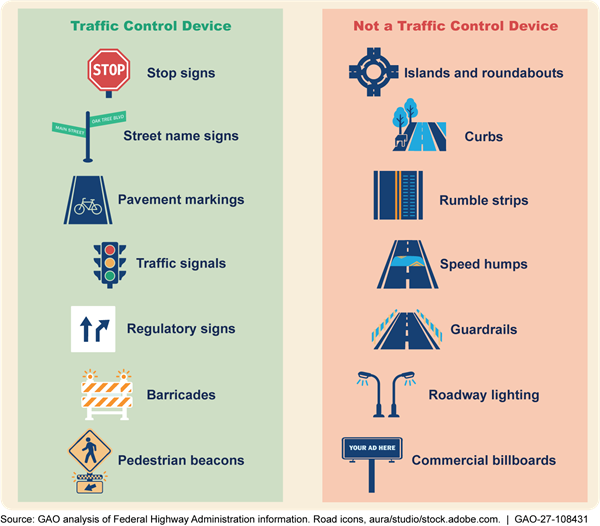
Traffic control devices have a three-fold purpose: to promote (1) highway safety, (2) inclusion and mobility of all road users, and (3) efficiency through the orderly movement of road users on streets, highways, bikeways, and roadways open to public travel throughout the nation. Traffic control devices include all signs, signals, markings, or other devices that use colors, shapes, symbols, words, sounds, or tactile information to communicate to road users such as drivers, cyclists, and pedestrians.[8] Traffic control devices are distinct from roadway design elements, and the Manual states that it is not a roadway design manual (see fig. 1).
Figure 1: Examples of Traffic Control Devices and Roadway Design Elements That Are Not Traffic Control Devices
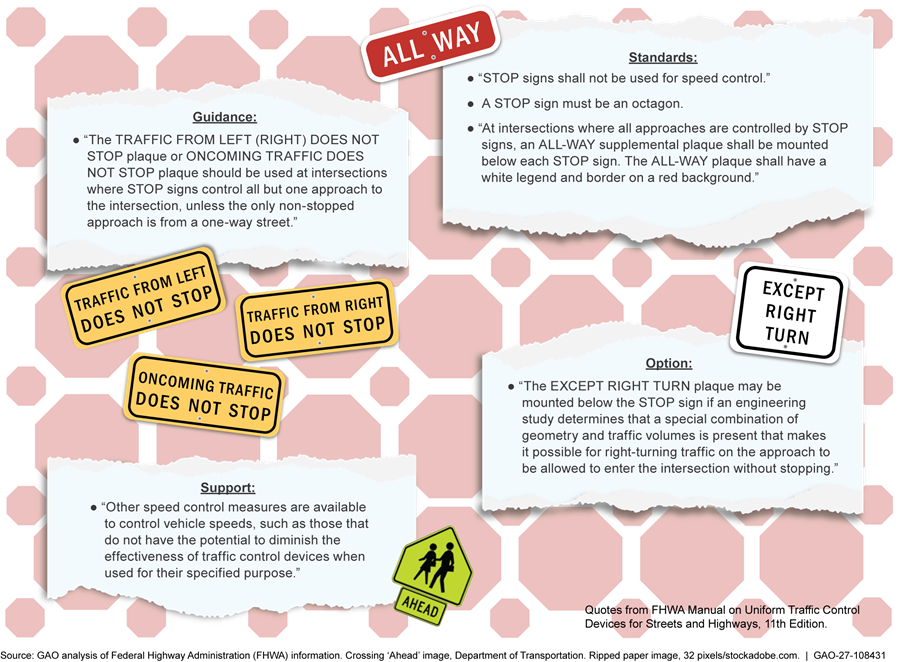
The Manual is recognized as the national standard for traffic control devices on all streets, highways, pedestrian and bicycle facilities, and roadways open to public travel, regardless of their ownership and funding source. Its objectives include promoting (1) safety, inclusion, and mobility for all roadway users, (2) efficiency by creating national uniformity for the meaning and appearance of such devices, and (3) national consistency in their use, installation, and operation.[9] The Manual also seeks to provide basic principles for traffic engineers to use in making decisions regarding the use, installation, operation, maintenance, and removal of traffic control devices.[10] The principles are communicated through a hierarchy of statements—specifically standards, guidance, options, and support—some of which allow for varying degrees of flexibility, as indicated by the terminology used.
· Standards are requirements, typically written with the verb “shall,” as well as prohibitions, or “shall not” statements.
· Guidance consists of recommended practices, typically written as “should” statements.
· Options are permissive practices or “may” statements, which sometimes contain allowable modifications to standards or guidance.
· Support consists of informational statements that do not convey a mandate, recommendation, permissive practice, or prohibition. See figure 2 for examples of standards, guidance, options, and support.
Figure 2: Standards, Guidance, Options, and Support for a STOP Sign, Taken from FHWA’s Manual on Uniform Traffic Control Devices, 11th Edition
The Manual is an evolving publication in that FHWA continually works toward the next revision or edition. With each revision or new edition, the Manual adapts to changes in technology, travel patterns, and the needs of the traveling public. The 11th edition, issued in December 2023, is the most recent edition of the Manual.[11] It includes many new standards and guidance for traffic control devices related to pedestrians and bicyclists. For example, the 11th edition added two chapters in the part devoted to bicycle facilities, which include bicycle signals, signs, and pavement markings, such as for bicycle lanes.
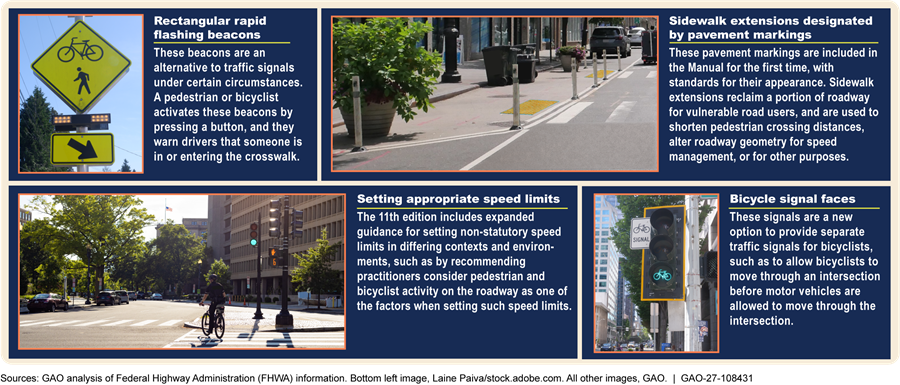
FHWA expanded upon these elements in response to the IIJA, which required FHWA to update the Manual within 18 months of the IIJA’s enactment.[12] As part of this update, FHWA, to the greatest extent practicable, was required to include updates necessary to provide for the protection of vulnerable road users.[13] For example, the 11th edition of the Manual includes new and expanded provisions for traffic control devices meant to enhance safety for vulnerable road users such as pedestrians and bicyclists, as shown in figure 3.
Figure 3: Selected New Provisions for Traffic Control Devices to Enhance Safety for Vulnerable Road Users in the Manual on Uniform Traffic Control Devices, 11th Edition
The IIJA also required FHWA to update the Manual at least every 4 years after the first required update.[14] Prior to the IIJA, which was enacted in 2021, there was no statute governing how often FHWA needed to issue new editions of or revise the Manual, according to FHWA. For example, FHWA issued the 11th edition of the Manual in December 2023, 14 years after it had issued the 10th edition in 2009.[15] New editions and revisions to the Manual must undergo the rulemaking process. This rulemaking process involves publishing a notice of proposed amendments in the Federal Register, soliciting comments on those proposed changes, and analyzing comments received prior to issuing the final rule along with the finalized, new edition or revisions.[16]
When FHWA revises or issues a new edition of the national Manual, states must adopt the changes within 2 years from the final rule’s effective date.[17] States can do so by adopting the national Manual in its entirety, adopting their own state manual based on it, or adopting it along with a state supplement. This means that the state manuals and supplements must be in “substantial conformance” with the national Manual by that date.[18] FHWA reviews manuals and supplements submitted by states, territories, the District of Columbia, and federal land management agencies to determine whether they are in substantial conformance with the national Manual. Once it determines that such a manual is in substantial conformance with the national Manual, it must approve them for use in their respective states and other jurisdictions referenced. The deadline for adopting the 11th edition was January 18, 2026.[19] Twenty-three states adopted the 11th edition of the national Manual; nine states and the District of Columbia adopted a state or agency manual, and 18 states adopted a state supplement with the national Manual, as shown in figure 4.[20]
Figure 4: Map Illustrating States That Adopted the National Manual, a State Manual, or the National Manual with a State Supplement, as of June 2026
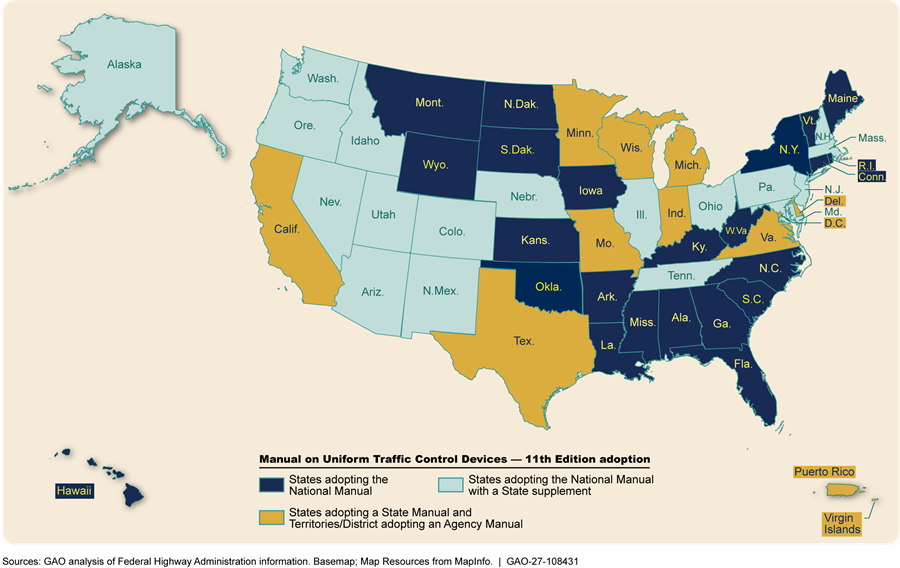
Note: As of October 2026, adoption of the state, agency, or national Manual with a state supplement was pending in five of the entities included in this map, including four states and the District of Columbia.
Following the Manual’s provisions promotes the uniform use of traffic control devices. This is in part intended to reduce confusion among drivers and vulnerable road users and is a core principle in traffic operations, creating a consistent message, meaning, appearance, and application of traffic control devices in different regions across the country. This consistency makes using the roadways safer and more efficient.
However, according to the Manual, the decision to use a particular traffic control device at a particular location should be made on the basis of either an engineering study or the application of engineering judgment. The Manual defines engineering judgment as a professional engineer’s evaluation of available pertinent information including the safety and operational efficiency of all road users and the application of appropriate principles, provisions, and practices contained in the Manual and other sources in deciding the design, use, installation, or operation of traffic control devices.[21] An engineering study is defined in the same way as engineering judgment, except it also includes an analysis of the information and must be documented in writing.
Under certain circumstances, traffic engineers might advise the local agency that has jurisdiction over the roadway to deviate from a standard or guidance provision. For example, the Manual provides that site-specific conditions could result in the engineer’s determination that it is impossible or impracticable to comply with a specific standard at that location. In that case, a deviation from a requirement of that standard might be the only possibility. Under these limited circumstances, the deviation is allowed, provided that the agency having jurisdiction over the roadway fully documents the engineering basis for the deviation through an engineering study.
Selected Practitioners Use Manual as Authoritative Source on Traffic Control Devices, but Some Have Deviated from It at Times Due to Local Circumstances
Practitioners Report Manual Is Authoritative Source for Deploying Traffic Control Devices, and Deviations Are Rare
Practitioners from almost all selected jurisdictions and eight engineer interviewees said they view the Manual as the authoritative source of standards and guidance for traffic control devices.[22] These practitioners and five engineer interviewees also said they consult the Manual on a regular basis, most daily, to deploy or maintain traffic control devices in their jurisdictions.[23] Such widespread adherence to the Manual enables traffic engineers to use traffic control devices in a uniform way, which, as discussed previously, reduces confusion among road users and is a core principle in traffic engineering operations. Most practitioners said they use the Manual in conjunction with industry-standard engineering design manuals covering, for example, roads and bicycle facilities.[24]
FHWA provides training to help familiarize traffic engineers and other users of the Manual with the 11th edition, which includes many new traffic control devices and applications to accommodate changes in road use, such as increased bicycle ridership, according to FHWA officials. Specifically, FHWA provides two recorded training webinars related to revisions in the 11th edition on its Manual website: one on using the Manual more broadly and the other on using devices for vulnerable road users’ safety. In addition, FHWA officials said they receive hundreds of questions from practitioners every year and work with them directly to clarify approved uses of traffic control devices in their specific situations.
Practitioners from most selected jurisdictions and five engineer interviewees reported that the Manual provides the basis for most daily decisions on traffic control device applications and said they have little need to deviate from it. Further, practitioners from many selected jurisdictions and five engineer interviewees reiterated the point that uniformity in the use of traffic control devices reduces confusion for drivers, and deviations risk detracting from that uniformity. According to FHWA officials, no data are available on how often jurisdictions deviate from the Manual nationally. FHWA officials, however, told us that in their opinion road owners deviate from the Manual in rare and specific circumstances, when site-specific conditions make it impossible to adhere to the standards. Practitioners from almost all selected jurisdictions and eight engineer interviewees said they rarely or never deviate from Manual standards or could only remember doing so a handful of times over the courses of their often lengthy careers.[25]
Further, practitioners from many selected jurisdictions and two engineer interviewees said they were reluctant to deviate because of the possibility of lawsuits being brought against their agencies or, in some cases, themselves personally. For example, several practitioners said that if a crash at a site with a deviation led to a lawsuit, attorneys may challenge the basis of the deviation. Practitioners from two selected jurisdictions said that even though the engineering basis for the deviation is documented, having to defend their decisions and professional judgment is stressful and unpleasant, with one adding that actions brought against them personally can put their engineering license, and therefore their livelihood, at risk.
However, not all practitioners we interviewed from selected jurisdictions told us that they were reluctant to deviate. Several of these practitioners and one engineer interviewee said that because the engineering basis for a decision would be documented, they feel prepared to defend their decisions to deviate in lawsuits. Practitioners from two selected jurisdictions who we interviewed said that lawsuits cannot be brought against them due to legal protections in their state, so they feel more free to deviate when they think doing so might improve safety.
In Selected Jurisdictions, Deviations from the Manual Occur Due to Local Circumstances or Cost Savings
Most practitioners in selected jurisdictions and six engineer interviewees provided us with examples of deviations in their jurisdictions that had been made due to local circumstances, cost savings, and issues of cultural significance to the community. The examples of deviations below were self-reported by practitioners and engineer interviewees we interviewed. Their status as deviations is based on the practitioner’s view that, according to their understanding of the relevant standards in the Manual that was in use in their state at the time, those standards did not meet local needs and deviating would not negatively affect safety. We did not determine whether these examples are “deviations” within the meaning of the Manual or whether the reported deviations would or would not affect safety. The Manual in use by the practitioner or engineer interviewee may have been the national Manual, the national Manual with a state supplement, or a state Manual. The year of the deviation, and, therefore, the applicable edition of the Manual, is not known to us.
Most practitioners in selected jurisdictions who reported deviating from the Manual generally cited the following reasons for doing so.[26]
Local Issues
Practitioners from several selected jurisdictions and six engineer interviewees said that they deviated from Manual standards to address local issues affecting safety or efficiency where, in their judgment, the deviation would not have a negative effect on safety. For example:
· Roundabouts. One practitioner and another engineer interviewee said that they chose to deviate from Manual standards for roundabout signage. After crashes had occurred in roundabouts, one practitioner erected signs throughout their jurisdiction warning to watch for trucks in the roundabout. They included text on the sign that they consider to be a deviation but said that the signs enhance safety. One engineer interviewee in another jurisdiction installed yellow chevron sign panels within roundabouts even though they considered this to be a deviation from Manual standards. Based on the jurisdiction’s collected data and traffic engineering experience, these yellow signs are more visible than black-and-white signs, like roundabout directional arrows or one-way signs, thereby enhancing safety.
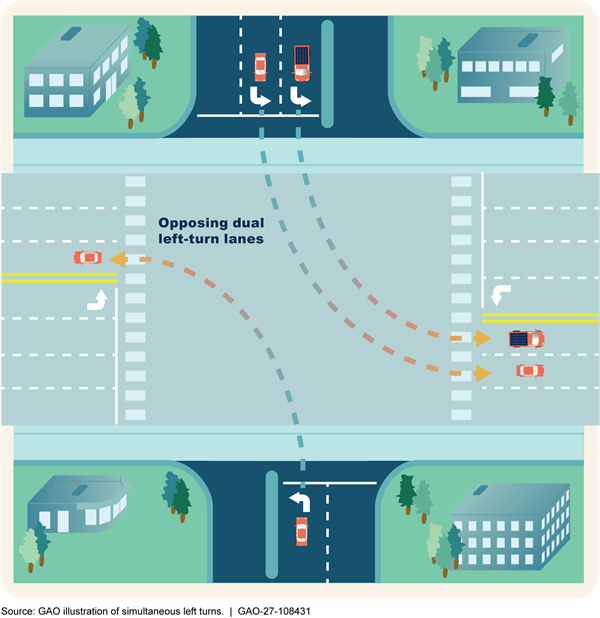
· Left-turn lanes. One practitioner said they undertook a signal-timing modernization project along a busy seven-lane road. The turn lanes in three directions are single lanes; however, one direction has two left turn lanes exiting a commercial driveway, as shown in figure 5. In the practitioner’s account, the Manual required the direction with two left-turn lanes to turn at a different time than the opposing left turn lane to avoid crashes between vehicles turning past each other. However, the practitioner said that having these lanes turn at different times would make the red-light timing on the road excessively long and cause traffic backups. Before the modernization project, this intersection already had simultaneous timing for the opposing left-turn lanes. According to the practitioner, their analysis of safety data at the intersection showed no existing crash problem, so they kept the simultaneous turning timing to improve efficiency even though they considered it a deviation (see fig. 5).
Cost Savings
Practitioners from some selected jurisdictions and five engineer interviewees said they have deviated from Manual standards to better control costs where, in their judgment, the deviation would not have a negative effect on safety. For example:
· Non-compliant signs in school zones. One practitioner said that under previous versions of the Manual, flashing beacons could be embedded in the face of a sign in a school zone. In their account, an 11th edition standard requires the beacons to be installed outside the border of the sign. Almost all local school zone flashing beacons in this jurisdiction are embedded in signs and replacing these would be costly, according to the practitioner. In addition, they said that having two-part signs increases long-term maintenance costs. According to the practitioner, the new standard addresses potential safety issues that do not apply to their jurisdiction, so, in their judgment, new signs would not enhance safety. They intend to continue using the original flashing beacons that are embedded in sign faces, which they said is a deviation from this new standard.
· Non-compliant lettering on signs. One practitioner said that, in the past, a new Manual standard required lettering on signs that would have required replacing all the street signs in their jurisdiction’s low-speed, low-volume residential neighborhoods. Replacing all the signs at that time would have increased costs, according to the practitioner. The practitioner and colleagues conducted an engineering study, the results of which showed that keeping the old lettering would not negatively affect road safety in those neighborhoods compared to signs with the new lettering. They chose to deviate and keep the signs until they were scheduled to be replaced. A practitioner in a different jurisdiction said that they reduced the space between lines of text on a sign so the signs could be smaller. This deviation reduced costs and, in their judgment, had no negative effect on safety.
· Non-compliant sign placement. One practitioner said that the design of narrow roads in older urban areas can sometimes make it difficult for traffic engineers to identify locations to place signs in accordance with Manual standards. They said that design standards when such roads were originally built provided less room for traffic control devices. For example, buildings might be built up to the property line, leaving little room for signs alongside roads. When placing signs on such roads, the practitioner said that engineers adapt to new standards the best they can but will deviate when necessary to place the signs as needed to maintain safety. They said strict adherence to new safety standards on such roads would require property acquisition, making doing so difficult and costly.
Cultural Significance to the Community
Practitioners from several selected jurisdictions said they have deviated from the Manual to implement traffic control devices, such as signs, that are culturally significant to their communities. In their judgment, such signs do not negatively influence safety. For example:
· Signs with non-compliant text. A few practitioners told us they have deployed highway signage including population size, outline of the state’s shape, and metric measurements, which they consider to be deviations. They said they deployed these signs in response to community needs or cultural preferences, or continue to deploy them because of community support, even though they do not align with Manual standards. These practitioners do not consider the signs to have a negative effect on safety.
FHWA Collects Information from Stakeholders to Update the Manual, but Does Not Publicize That Practitioners Can Request Detailed Information
FHWA Uses Feedback from Stakeholders Including Change Requests, Research, and Experiments to Revise the Manual
In developing its draft of the Manual’s recent 11th edition, FHWA considered various forms of feedback and input from practitioners through change requests, research, and experimentation, as described below. FHWA then sought public comments on its updated draft of the Manual through a notice of proposed amendments.[27] After reviewing comments received, FHWA prepared and issued the final 11th edition Manual.[28]
Change Requests
State and local transportation agencies, other entities, or individuals may submit a direct request to FHWA to change an existing provision of the national Manual or to add new traffic control devices to it. Change requests should include a description of the proposed change, any illustration that would help FHWA to understand the request, and any pertinent supporting research data. FHWA officials told us that they have a thorough process for evaluating and responding to change requests, which involves determining the fundamental interests of the requester and if the change is warranted. If a change request is detailed and well-supported by data, they said they may be able to act more quickly than otherwise. If a request is not accompanied by research or data, there might not be time to evaluate and consider it for the next draft revision of the Manual, but FHWA officials said they will consider the merits of the issue being raised and whether it is applicable across the nation. FHWA officials told us that, in addition to wholesale changes and additions to the Manual, they also receive change requests that include clarifications to existing language.
Nearly 95 percent of the change requests between December 2009 and May 2026 originated with the National Committee on Uniform Traffic Control Devices (NCUTCD), a nongovernmental organization.[29] NCUTCD committee members are volunteer practitioners, researchers, manufacturers, and other related professionals and organizations from across the United States. The full committee meets twice per year; however, members work within technical committees that may meet more frequently and cover different aspects of traffic control devices, such as signals, bicycles, and temporary traffic controls. According to FHWA officials, FHWA staff generally attend NCUTCD semiannual meetings as nonparticipating observers, which helps them understand the background for many of the change requests they receive. FHWA staff also provide publicly available information to NCUTCD, such as high-level priorities or focus areas for FHWA, and updates on active research projects relevant to traffic control devices.
Research
In considering revisions to the Manual, FHWA continually reviews completed research on traffic control devices conducted by FHWA and its stakeholders. FHWA may initiate research in areas of interest by reaching out to the National Cooperative Highway Research Program or turn to its Transportation Pooled Fund program for smaller projects or less complex ideas.[30] Research is also initiated and conducted by state departments of transportation and other interested entities, such as local transportation agencies, academic institutions, and private sector organizations. Recent ongoing research includes studies on pavement markings in merge areas, driver information signing needs, and temporary traffic control advance warning sign placement.
Experiments
Experiments testing new or existing traffic control devices in applications not addressed in the Manual are a key part of the process of keeping the Manual up to date. Public agencies at all levels of government can request FHWA’s approval to conduct experiments on roads they operate. In its request for permission to conduct an experiment, an agency must include a detailed research and evaluation plan covering all stages of its field implementation. The agency also must agree to provide semi-annual progress reports to FHWA for the duration of the experiment, as well as report on the final results.
If an experiment is successful, the experimenting agency can request that FHWA change the national Manual to include the new traffic control device or application. If FHWA accepts the change for its next rulemaking to revise or issue a new edition of the Manual, FHWA would then develop provisions for the device or application to include in the next notice of proposed amendments. Pending an official rulemaking, FHWA could also issue an Interim Approval, under which the agency allows the interim use of the new device or application by any jurisdiction in the U.S. However, jurisdictions may not use an Interim Approval until they submit a written request for permission to do so and FHWA grants it. FHWA uses the results from experiments to evaluate the suitability of new devices and applications for national implementation through adoption in a future edition or revision of the Manual.
FHWA’s Website Has Limited Information on Official Rulings and Does Not Highlight How Practitioners Can Obtain Detailed Information
FHWA provides a searchable database on its public website—the Official Rulings database—that tracks requests for (1) changes to the Manual, (2) experiments with new or existing traffic control devices, and (3) FHWA interpretations of existing Manual provisions. Practitioners and other stakeholders may use the Official Rulings database to learn about these topics. In addition to the Official Rulings database, FHWA provides other information relating to potential updates to the Manual on other parts of its website. This other information includes Interim Approvals issued by FHWA and detailed interpretations of existing provisions in the Manual.
Federal Internal Control Standards call for agencies such as FHWA to provide relevant, quality information so that external parties can help achieve agency objectives. However, FHWA provides only limited information in the Official Rulings database. For example, it does not provide information on experiments such as (1) request letters to experiment from jurisdictions, which typically describe conditions prompting the experiment, its design, and its intended outcome; (2) ongoing reports documenting experiment progress; and (3) final reports detailing the results of completed experiments.
Furthermore, the Official Rulings database lacks detailed information on experiments—information that was formerly available in some cases, according to FHWA officials and two practitioners we spoke with. Specifically, in our review of the database, we found that it provides only topical information on each experiment. While there is a “details-level” hyperlink accessible from the top-level search results, these hyperlinks do not provide additional information beyond what is already offered in the top-level search results. Similarly, detailed search results for a change request or interpretation request do not provide any further information on the substance of the request.
Many practitioners told us that these limitations affect the usefulness of the database in significant ways. For example:
o One practitioner said users of the database cannot access much information. Specifically, it is not possible to use the database to access any of the documents detailing experiments, interpretations, and change requests requested by other transportation agencies—information that would be useful to know.
o Another practitioner said the usefulness of the Official Rulings database is currently limited because it is no longer possible for users to access the contents of experiment case files.[31] Upon opening the hyperlinked request number for a particular experiment or change request, the information provided is limited to a record card that includes the requesting agency, contact, topic area, status of the request, and keyword indicators. However, the information that had been provided in the past, such as the request and approval letters, and the research plan for the experiment, are not available. Such information would be useful to understand the solutions other transportation agencies are testing in response to changing technology.
FHWA officials confirmed that the Official Rulings database “details-level” results formerly included links to experiments’ case file documents in some limited cases. These officials explained that they had to remove this capability because of a lack of webserver capacity, which is too limited to accommodate posting case file documents. Furthermore, any posted documents must be in an accessible format, as required by statute for documents posted to federal websites.[32] According to FHWA officials, FHWA did not notify website users about removing the case file documents. FHWA officials said that the agency is making changes to improve its website capacity, but they do not have the resources to ensure documents from outside sources are in an accessible format. In addition, they said they provide additional information and documentation to anyone who asks for it. While this offers a potential solution, the website itself does not describe what additional information is available or prominently display instructions on how to request this information from FHWA. Further, many practitioners we interviewed were unaware of the option to request more information from FHWA.
Many practitioners told us that the lack of detailed information is a shortcoming on FHWA’s part, two said they found it frustrating, and two said they no longer use the database as a result. Absent access to more detailed information on experiments and clear instructions on how to request such information, practitioners who routinely use the Manual in their work may have greater difficulty in applying and implementing Manual provisions and planning future experiments. For example, two practitioners explained that having access to detailed information on experiments would help them plan and implement traffic control devices in their own jurisdictions. Furthermore, providing clear instructions on obtaining more detailed information may help practitioners to effectively decide whether to submit their own requests for change or experimentation, which would help FHWA promote the Manual’s objectives of roadway efficiency and the safety, inclusion, and mobility of all roadway users.
Conclusions
FHWA provides information to state and local transportation agencies on deploying traffic control devices to promote the uniform use of these devices and the safety and efficiency of the nation’s roadways. However, the information FHWA provides on its website for official rulings is lacking in detail, and FHWA does not prominently display on its website that it will provide more detailed information on experiments to practitioners upon request. This lack of transparent communication about how to get more detailed information limits the usefulness of the Official Rulings database to practitioners. By prominently displaying contact information and clear instructions on how the public can obtain more detailed information on experiments and what that detailed information includes, FHWA would provide practitioners with greater access to information that can help them develop, prepare, and implement their own requests to experiment. This could help state and local transportation agencies experiment with devices and applications on the roads they operate, thus promoting the Manual’s objectives of roadway efficiency and the safety, inclusion, and mobility of all roadway users.
Recommendation for Executive Action
The Secretary of Transportation should ensure the Administrator of FHWA prominently displays on the website for the Manual on Uniform Traffic Control Devices contact information and clear instructions on how the public may obtain more detailed information on experiments listed in its Official Rulings database. (Recommendation 1)
Agency Comments
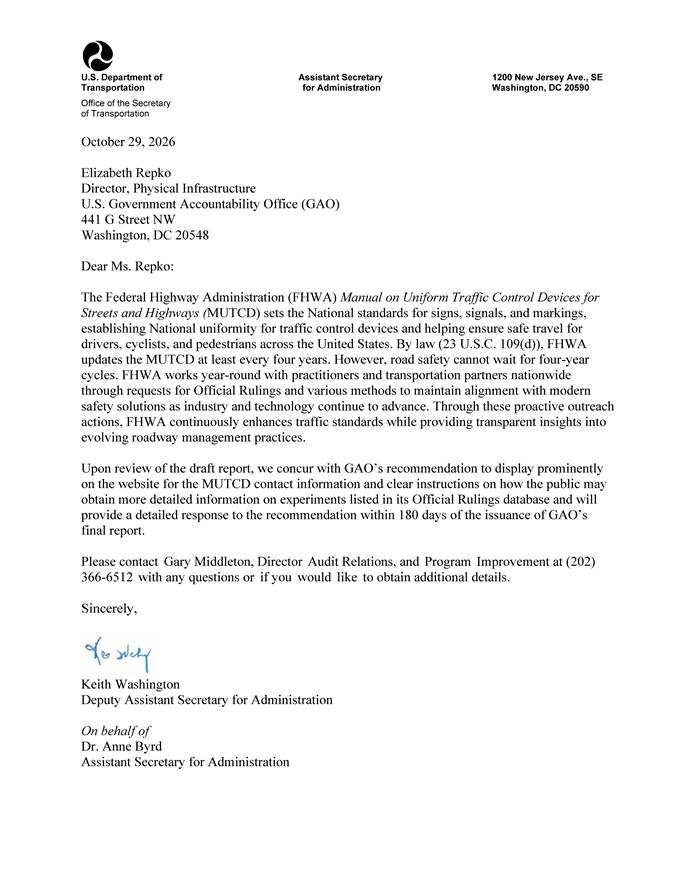
We provided a draft of this report to DOT for review and comment. In its comments, reproduced in appendix I, DOT concurred with recommendation 1, stating that it will provide a detailed response to the recommendation within 180 days of the final report’s issuance. DOT also provided technical comments, which we incorporated as appropriate.
We are sending copies of this report to the appropriate congressional committees, the Secretary of Transportation, the FHWA Administrator, and other interested parties. In addition, the report is available at no charge on the GAO website at https://www.gao.gov.
For any questions about this report, please contact me at RepkoE@gao.gov. Contact points for our Offices of Congressional Relations and Media Relations may be found on the last page of this report. GAO staff who made key contributions to this report are listed in appendix II.

Elizabeth Repko
Director, Physical Infrastructure
GAO Contact:
Elizabeth Repko, RepkoE@gao.gov
Staff Acknowledgments
In addition to the contact named above, Brandon Haller (Assistant Director), Danielle Ellingston (Analyst in Charge), Lindsay Bach, Melanie Diemel, Elke Kolodinski, Melissa Lefkowitz, Mary-Catherine Overcash, Amy Rosewarne, Kelly Rubin, and Alicia Wilson made key contributions to this report.
The Government Accountability Office, the audit, evaluation, and investigative arm of Congress, exists to support Congress in meeting its constitutional responsibilities and to help improve the performance and accountability of the federal government for the American people. GAO examines the use of public funds; evaluates federal programs and policies; and provides analyses, recommendations, and other assistance to help Congress make informed oversight, policy, and funding decisions. GAO’s commitment to good government is reflected in its core values of accountability, integrity, and reliability.
Obtaining Copies of GAO Reports and Testimony
The fastest and easiest way to obtain copies of GAO documents at no cost is through our website. Each weekday, GAO posts on its website newly released reports, testimonies, and correspondence. You can also subscribe to GAO’s email updates to receive notification of newly posted products.
Connect with GAO
Connect with GAO on X,
LinkedIn, Instagram, and YouTube.
Subscribe to our Email Updates. Listen to our Podcasts.
Visit GAO on the web at https://www.gao.gov.
To Report Fraud, Waste, and Abuse in Federal Programs
Contact FraudNet:
Website: https://www.gao.gov/about/what-gao-does/fraudnet
Automated answering system: (800) 424-5454
Media Relations
Sarah Kaczmarek, Managing Director, Media@gao.gov
Congressional Relations
David A. Powner, Acting Managing Director, CongRel@gao.gov
General Inquiries

[1]FHWA, Manual on Uniform Traffic Control Devices for Streets and Highways (11th ed.), with Rev. 1 incorporated, (dated Dec. 2025) (incorporated by reference into 23 C.F.R. Part 655, Subpart F).
[2]The Manual specifically cites Section 11135 of the IIJA. See Pub. L. No. 117-58, § 11135, 135 Stat. 429, 516 (2021) (codified at 23 U.S.C. § 109 note).
[3]We selected seven organizations for interviews, based on their involvement in using and revising the Manual. Of the seven selected organizations, we interviewed the following five: the American Association of State Highway and Transportation Officials; the National Association of City Transportation Officials; the National Association of County Engineers; Transportation for America; and the American Society of Civil Engineers. We were unable to schedule interviews with the other two organizations.
[4]We interviewed practitioners from 25 of these transportation agencies by teleconference and received written responses to our interview questions from one transportation agency.
[5]We interviewed officials from selected city, county, and state transportation agencies from the following states: Arizona, Arkansas, California, Connecticut, Florida, Illinois, Maryland, Michigan, New Jersey, New Mexico, New York, Ohio, Pennsylvania, Tennessee, and Texas.
[6]FHWA, Manual on Uniform Traffic Control Devices for Streets and Highways (11th ed.) (Dec. 2023); FHWA, Manual on Uniform Traffic Control Devices for Streets and Highways 2009 Edition (Dec. 2009) (last revised in July 2022). We specifically reviewed the original 11th edition of the Manual issued in December 2023. FHWA revised the 11th edition in December 2025. However, according to FHWA, the revisions only addressed known errors, such as editorial changes, and did not include any substantive changes that would contradict information in our report.
[7]GAO, Standards for Internal Control in the Federal Government, GAO‑25‑107721 (Washington, D.C.: May 2025).
[8]The Manual defines road users as operators of motor vehicles, including driving automation systems, and vulnerable road users, such as bicyclists and pedestrians, including persons with disabilities.
[9]The operation of traffic control devices includes, for example, the timing of traffic signal phases.
[10]The Manual’s provisions are intended to be interpreted and applied by engineers. However, the agency, official, or owner that has jurisdiction over the street or roadway is ultimately responsible for traffic control devices’ compliance with the Manual.
[11]FHWA published Revision 1 to the 11th edition in December 2025.
[12]See IIJA § 11129(1) (amending 23 U.S.C. § 109(d)); FHWA, National Standards for Traffic Control Devices; the Manual on Uniform Traffic Control Devices for Streets and Highways; Revision, 88 Fed. Reg. 87672 (Dec. 19, 2023).
[13]IIJA § 11135 (codified at 23 U.S.C. § 109 note).
[14]See IIJA § 11129(1) (amending 23 U.S.C. § 109(d)).
[15]See FHWA, National Standards for Traffic Control Devices; the Manual on Uniform Traffic Control Devices for Streets and Highways; Revision, 74 Fed. Reg. 66730 (Dec. 16, 2009); FHWA, National Standards for Traffic Control Devices; the Manual on Uniform Traffic Control Devices for Streets and Highways; Revision, 88 Fed. Reg. 87672 (Dec. 19, 2023). FHWA published three revisions to the 10th edition between May 2012 and July 2022.
[16]Under certain circumstances, FHWA may issue a final rule amending the Manual without issuing a notice of proposed amendments or soliciting comments, such as when it issued Revision 1 to the 11th edition. This was because, according to the relevant final rule, Revision 1 only made minor technical corrections and editorial changes that did not change the underlying legal requirements or substance of the 11th edition of the Manual. See FHWA, National Standards for Traffic Control Devices; the Manual on Uniform Traffic Control Devices for Streets and Highways; Revision, 91 Fed. Reg. 10771, 10771‑10772 (Mar. 5, 2026).
[17]23 C.F.R § 655.603(b)(3).
[18]FHWA’s regulations define “substantial conformance” as conforming, as a minimum, to the standard statements included in the national Manual. In addition, state manuals and supplements may not contain any statements that contravene or negate the standard or guidance statements in the national Manual. See 23 C.F.R. § 655.603(b).
[19]See FHWA, National Standards for Traffic Control Devices; the Manual on Uniform Traffic Control Devices for Streets and Highways; Revision, 88 Fed. Reg. 87672 (Dec. 19, 2023); 23 C.F.R. § 655.603(b).
[20]As of October 2026, adoption of the state, agency, or national Manual with a state supplement was pending in five of the entities in this list—four states and the District of Columbia. According to officials, FHWA continues to work with those entities towards adopting the Manual.
[21]Engineering studies must be performed and engineering judgment must be exercised by a professional engineer with appropriate traffic engineering expertise, or by an individual working under the supervision of such an engineer, through the application of procedures and criteria established by the engineer. Documentation of engineering judgment is not required.
[22]We refer to engineers we interviewed from professional organizations as “engineer interviewees” in this report, to differentiate them from practitioners from agencies chosen through our selection methodology, as described previously.
[23]We refer to a Manual that has been approved by FHWA to be used as “the Manual,” whether it is the national Manual, the national Manual with a state supplement, or a state Manual. Both state supplements and manuals that are in substantial conformance with the national Manual must be approved by FHWA, and thus, for our purposes, they are all the same.
[24]For example: American Association of State and Highway Transportation Officials, A Policy on Geometric Design of Highways and Streets, 7th edition, (Washington, D.C., 2018); Guide for the Development of Bicycle Facilities, 5th edition, (Washington, D.C.). National Association of City Transportation Officials, Urban Bikeway Design Guide, (New York, New York, 2025); Urban Street Design Guide, (New York, New York, 2013).
[25]We considered a traffic engineer’s career to be lengthy if it spanned 15 years or more.
[26]The deviations discussed here are not attributed to any particular edition of the Manual. Their status as “deviations” is based on the judgment of the practitioners who discussed them. According to FHWA, some of the examples from selected stakeholders may not constitute deviations of the national Manual but may be deviations of state manuals or local ordinances.
[27]See National Standards for Traffic Control Devices; the Manual on Uniform Traffic Control Devices for Streets and Highways; Revision, 85 Fed. Reg. 80898 (proposed Dec. 14, 2020).
[28]See National Standards for Traffic Control Devices; the Manual on Uniform Traffic Control Devices for Streets and Highways; Revision, 88 Fed. Reg. 87672 (Dec. 19, 2023).
[29]We analyzed change requests starting with the prior edition of the Manual, which is the 10th edition, published in December 2009. The current, 11th, edition was published in December 2023, and we included change requests for that edition through May 2026 in our analysis. During this period, FHWA received a total of 208 change requests.
[30]The National Cooperative Highway Research Program is an applied research program administered by the Transportation Research Board. The research itself is state-driven and sponsored by state departments of transportation (DOTs) and conducted in a variety of transportation research topics related to nationwide challenges in the planning, design, construction, operation, and maintenance of the nation’s highways. The Transportation Pooled Fund is administered by FHWA in coordination with state DOTs, allowing partners to pool their funds, subject matter expertise, and resources to conduct high-priority research to meet a variety of shared transportation problems. Partners include FHWA, state DOTs, local agencies, academic institutions, and private industry, among other entities, and the research is conducted on a variety of transportation issues, including traffic control devices.
[31]According to FHWA officials, some case files were previously available in the Official Rulings database for a portion of experiments conducted before 2022.
[32]See Rehabilitation Act of 1973, Pub. L. No. 93‑112, § 508, 87 Stat. 355 (1973) (as added by Rehabilitation Act Amendments of 1986, Pub. L. No. 99‑506, § 603(a), 100 Stat. 1807, 1830 (1986) (codified as amended at 29 U.S.C. § 794d).