
Report to Congressional Requesters
United States Government Accountability Office
A report to congressional requesters
Contact: Gretta Goodwin at goodwing@gao.gov
What GAO Found
The Department of the Interior and the Department of Justice (DOJ) fund law enforcement services on tribal lands through self-determination contracts, self-governance compacts, and competitive grants. Additionally, the Bureau of Indian Affairs (BIA) provides policing services directly to approximately 60 Tribes and provides specialized investigative services, such as units for drug enforcement and missing and murdered indigenous people, to all Tribes in conjunction with the Federal Bureau of Investigation (FBI). From 2016 through 2025, inflation-adjusted funding for contracts and compacts supporting law enforcement rose from $133,6 million to $137.5 million, while funding for law enforcement services BIA provides decreased from $40.8 million to $33.2 million.
As shown in the figure below, BIA has faced high vacancy rates for law enforcement officer positions on tribal lands. While BIA has taken some steps to address recruitment and retention challenges, BIA officials told GAO limited outreach to potential applicants, incentives, and housing options result in fewer applicants. Although the Assistant Secretary for Indian Affairs has stated that strengthening tribal law enforcement is a top priority, BIA has not identified and implemented additional actions, such as expanding outreach and enhancing its incentive program. Without taking additional actions, BIA’s understaffing will likely persist, contributing to officer and community safety concerns.

Note: Vacancy rates, provided by BIA officials in January 2026, are a snapshot of vacant positions at the end of each fiscal year, with the exception of 2025, when rates were provided as of May.
Background investigations for BIA law enforcement officers are required to be conducted by the Department of Defense, absent statutory or delegated authority, which BIA officials said takes several months to a year. BIA officials said candidates may move on to other opportunities before the investigation is completed, further prolonging periods of understaffing. BIA officials said that the Bureau conducting its own background investigations would be more efficient, as it already does so within 30-45 days on average for law enforcement officers that Tribes hire. BIA has not pursued a delegation of this authority but could work with Interior’s Office of the Solicitor to request such authority from the Office of Personnel Management. Pursuing authority to conduct background investigations for BIA officers could enable BIA to more effectively fill vacant positions.
Why GAO Did This Study
According to DOJ, communities on tribal lands face persistent levels of violent crime and victimization. Law enforcement services on tribal lands have faced funding and staffing shortfalls for years, limiting their ability to respond to crime and improve public safety.
GAO was asked to review law enforcement personnel shortages on tribal lands. This report examines (1) how BIA and DOJ have provided funding and services for law enforcement on tribal lands, (2) the extent to which BIA has filled vacant positions for federal law enforcement officers on tribal lands, and (3) the challenges Tribes and BIA encounter with providing law enforcement services on tribal lands and the actions they have taken, if any, to address these challenges.
GAO analyzed funding and staffing data as well as policies and procedures, including BIA recruitment and retention guidance. GAO also interviewed officials, visited tribal lands in Maine and South Dakota, and conducted listening sessions with tribal advocacy organizations.
What GAO Recommends
GAO is recommending that the Department of the Interior ensure that BIA (1) identifies and implements additional actions to enhance the recruitment and retention of law enforcement officers and (2) works with the Office of the Solicitor to pursue delegated authority to conduct background investigations for applicants to federal law enforcement officer positions. The Department of the Interior generally concurred with the recommendations.
|
Abbreviations |
|
|
|
|
|
BADGES Act |
Bridging Agency Data Gaps and Ensuring Safety for Native Communities Act |
|
BIA |
Bureau of Indian Affairs |
|
CTAS |
Coordinated Tribal Assistance Solicitation |
|
DCSA |
Defense Counterintelligence and Security Agency |
|
DOJ |
Department of Justice |
|
EPA |
Environmental Protection Agency |
|
FBI |
Federal Bureau of Investigation |
|
OJS |
Office of Justice Services |
|
OPM |
Office of Personnel Management |
This is a work of the U.S. government and is not subject to copyright protection in the United States. The published product may be reproduced and distributed in its entirety without further permission from GAO. However, because this work may contain copyrighted images or other material, permission from the copyright holder may be necessary if you wish to reproduce this material separately.
November 19, 2026
The Honorable John Thune
Majority Leader
United States Senate
The Honorable M. Michael Rounds
United States Senate
According to the Department of Justice (DOJ), communities on tribal lands face persistent levels of violent crime and victimization.[1] For example, the Federal Bureau of Investigation (FBI) reported that it had approximately 4,100 open investigations on tribal lands at the beginning of fiscal year 2026. These include death investigations, child abuse cases, and domestic violence and adult sexual abuse investigations.[2] Similarly, a DOJ study found that American Indian and Alaska Native populations have a higher risk of experiencing violence compared to other racial or ethnic groups. Specifically, 84 percent of women and 82 percent of men from these populations report experiencing violent victimizations in their lifetimes.[3] Moreover, in 2023, there were approximately 3,780 violent crimes reported to 202 tribally operated law enforcement agencies, according to the Bureau of Justice Statistics.[4] In response to these situations, the Department of the Interior established the Indian Country Violent Crime Task Force in May 2026, which aims to address high violent crime rates, unsolved violent crime cases, and illegal drug activity occurring in or around tribal lands.[5]
Within Interior, the Bureau of Indian Affairs’ (BIA) Office of Justice Services (OJS) ensures public safety on tribal lands through law enforcement programs and funding.[6] OJS may provide law enforcement services on behalf of Tribes, including patrol and criminal investigations, or Tribes may operate their own law enforcement agencies through self-determination contracts and self-governance compacts.[7] Certain offices within DOJ are responsible for providing grant funding to support tribal public safety and justice programs, and the FBI investigates certain crimes on tribal lands.
However, law enforcement services on tribal lands have also faced funding and staffing shortfalls for years. According to BIA’s 2021 Tribal Law and Order Act Report to Congress, for example, law enforcement on tribal lands had a funding shortfall of nearly $1.5 billion and a staffing gap of over 11,600 personnel.[8] Our prior work found that understaffing can limit law enforcement agencies’ ability to respond to crime and improve public safety.[9]
You asked us to review law enforcement personnel shortages on tribal lands. This report examines: (1) how BIA and DOJ have provided funding and services for law enforcement on tribal lands; (2) the extent to which BIA has filled vacant positions for federal law enforcement officers on tribal lands; and (3) the challenges Tribes and BIA encounter with providing law enforcement services on tribal lands and the actions they have taken to address these challenges. For the purposes of this report, we use the term “law enforcement” to include federal personnel that were hired as law enforcement officers and criminal investigators under job series 0083 and 1811 as defined by the Office of Personnel Management, and to include law enforcement officers hired by Tribes and serving on tribal lands. While court systems and detention are also part of public safety, we do not include either in the scope of this report. We focused our work on law enforcement.
To examine how BIA and DOJ have provided funding and services for law enforcement and assess how BIA has filled vacant federal law enforcement officer positions on tribal lands, we analyzed funding and personnel data provided by BIA for fiscal years 2016 to 2025. We also analyzed personnel data from Interior’s Federal Personnel and Payroll System to determine staffing levels for law enforcement officers and investigators. We also analyzed grant award data provided by DOJ, specifically the Coordinated Tribal Assistance Solicitation (CTAS) Purpose Area 1 for fiscal years 2016 to 2024, the most recent years for which data was available.[10] We found both BIA financial and personnel data and DOJ grant award data to be sufficiently reliable to identify funding, staffing and vacancy trends over time. We also reviewed relevant laws and regulations.
We also reviewed relevant BIA documentation and interviewed agency officials about policies and actions taken related to recruiting, hiring, and retaining tribal law enforcement officers. We also requested and received information from the Office of Personnel Management (OPM) regarding the requirements for agencies applying for delegated authority to conduct background investigations. Finally, we analyzed legislation, data, and actions that BIA and the Interior’s Office of the Solicitor took regarding background investigations for applicants for federal law enforcement officer positions.
To identify views on law enforcement challenges on tribal lands, we interviewed BIA, tribal, and law enforcement officials and conducted listening sessions with tribal advocacy organizations to discuss challenges and efforts underway to address them. We conducted two in-person site visits and spoke with three additional Tribes by video conference. We selected the states and Tribes to reflect a range of (1) types of law enforcement provision (i.e., BIA-provided direct services or tribally operated law enforcement agencies); (2) community size, including both large and small reservations; and (3) geographic diversity, including Tribes near U.S. borders and in rural and urban areas. We also spoke with FBI field offices and BIA regional offices serving the areas we visited. In addition, we held listening sessions with three advocacy organizations to gather perspectives from a greater number of Tribes. While information from our site visits and listening sessions is not generalizable to all Tribes, tribal leaders and tribal law enforcement officers provided important context and examples of their experiences receiving and providing law enforcement services, respectively.
We conducted this performance audit from April 2025 to November 2026 in accordance with generally accepted government auditing standards. Those standards require that we plan and perform the audit to obtain sufficient, appropriate evidence to provide a reasonable basis for our findings and conclusions based on our audit objectives. We believe that the evidence obtained provides a reasonable basis for our findings and conclusions based on our audit objectives.
Background
Tribes in the United States
As of July 2026, there were 575 federally recognized Tribes in the United States.[11] Federally recognized Tribes operate as distinct political entities and are eligible for certain federal programs and services because of their status.[12] The Federal Government has trust responsibilities to all 575 federally recognized Tribes and tribal citizens.[13]
According to BIA, there are over 56 million acres of trust lands in the U.S.[14] Tribes are located within and across 35 states, with the highest numbers in Alaska, California, Oklahoma, and Washington. Each Tribe may have unique public safety and law enforcement challenges on its land based on different cultures, economic conditions, and geographic location, among other factors.[15]
Tribal, Federal, and State Jurisdiction over Crimes Committed in Indian Country
Tribes have inherent sovereignty over tribal citizens who commit crimes in Indian country.[16] In addition, Tribes have inherent sovereign authority to patrol their land; detain anyone suspected of committing a crime; and search, hold, and transport the suspect.[17] Tribes may also have criminal jurisdiction over certain crimes committed by non-tribal citizens in Indian country if they participate in special tribal criminal jurisdiction.[18]
The federal government has jurisdiction over federal crimes applicable to anyone nationwide (with no specific application to tribal citizens, Tribes, or Indian country), typically called “crimes of general applicability,” that are committed in Indian country.[19] The federal government also has jurisdiction over certain federal crimes that specifically apply in Indian country or involve or affect tribal citizens or Tribes.[20]
The federal government has criminal jurisdiction in Indian country pursuant to various laws, most notably the Major Crimes Act and the General Crimes Act:
· The Major Crimes Act provides the federal government with criminal jurisdiction over tribal citizens who commit certain offenses in Indian country listed in the statute, such as murder.[21] Tribes have concurrent jurisdiction over tribal citizens who commit crimes listed in the Major Crimes Act in Indian country if those crimes are also listed in the tribal code.
· The General Crimes Act provides the federal government with criminal jurisdiction in Indian country over crimes under general laws of the U.S. where either, but not both, the alleged offender or the victim is a tribal citizen.[22] However, the act does not provide for federal criminal jurisdiction if tribal citizens have already been tried and punished by the tribal government for the crime.
The Major Crimes Act and General Crimes Act are not applicable in some states where the state government has criminal jurisdiction in Indian country under a law commonly known as P.L. 280, or other state-specific laws.[23] Enacted in 1953, P.L. 280 rescinded federal criminal jurisdiction under these acts in Indian country in certain states listed in the law. It also provided criminal jurisdiction in Indian country to those states, commonly referred to as mandatory P.L. 280 states, with exceptions for certain reservations.[24] States not named in P.L. 280 may opt in by assuming any measure of criminal jurisdiction in Indian country in the state, with tribal consent.[25]
In P.L. 280 states, state law enforcement and the Tribe provide law enforcement services on tribal lands. Apart from P.L. 280, states have criminal jurisdiction over non-tribal citizens who commit crimes in Indian country.[26] Table 1 summarizes the Major Crimes Act, the General Crimes Act, and P.L. 280.
|
Federal law |
Description |
|
Major Crimes Act |
Enacted in 1885, the Major Crimes Act, as amended, provides the federal government with criminal jurisdiction over tribal citizens charged with committing certain offenses, listed in the statute, in Indian country. 18 U.S.C. § 1153. |
|
General Crimes Act |
Enacted in 1817, the General Crimes Act, as amended, extended the criminal laws of the federal government into Indian country and generally established federal criminal jurisdiction where either, but not both, the alleged offender or the victim is a tribal citizen. 18 U.S.C. § 1152. |
|
Public Law 280 |
Enacted in 1953, Public Law 280, as amended, rescinded federal criminal jurisdiction in Indian country under the General and Major Crimes Acts in six states, and provides criminal jurisdiction in Indian country to those states—Alaska, California, Minnesota, Nebraska, Oregon, and Wisconsin—except as specified by statute. 18 U.S.C. § 1162(a), (c). Public Law 280, as amended, also provides an option for states to opt in by assuming any measure of criminal jurisdiction in Indian country in the state, with tribal consent. 25 U.S.C. § 1321(a)(1). |
Source: GAO analysis of federal statutes. | GAO‑27‑108433
Note: For the purposes of this table, we use the term “tribal citizen” in place of “Indian” as defined under federal criminal law. There is no statutory definition of Indian for federal criminal jurisdiction purposes, but courts generally require a degree of Indian blood and a sufficient connection to a Tribe, such as tribal citizenship. Federal law defines “Indian country” as all lands within the limits of reservations, dependent Indian communities, and Indian allotments to which Indian title has not been extinguished. 18 U.S.C. § 1151.
Interior’s Support for Law Enforcement on Tribal Lands
Interior’s BIA provides a wide variety of services to Tribes and funding for tribally administered programs, including law enforcement. Within BIA, OJS provides direct service law enforcement to approximately 60 Tribes. In addition, 183 Tribes have self-determination contracts and self-governance compacts with Interior that include law enforcement functions. These contracts and compacts include funding agreements that provide Tribes with money to operate law enforcement agencies. As of 2018, about 82 percent of tribally operated law enforcement agencies employed fewer than 25 sworn officers.[27] Figure 1, below, provides an overview of the two types of federally funded law enforcement services on tribal lands.
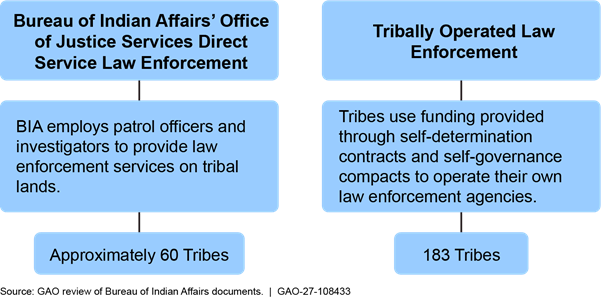
Note: For the purposes of this figure, we use the term “tribal lands” in place of “Indian country.” Federal law defines “Indian country” as all lands within the limits of reservations, dependent Indian communities, and Indian allotments to which Indian title has not been extinguished. 18 U.S.C. § 1151.
In addition, OJS supports tribally operated police departments with specialized investigative services, such as units dedicated to missing and murdered persons and drug enforcement. OJS’s Indian Police Academy and Internal Affairs Division train tribal law enforcement officers and conduct investigations involving law enforcement personnel, respectively. The Tribal Law and Order Act, as amended, requires OJS to report annually to Congress on agency spending, staffing, and unmet needs for public safety and justice programs on tribal lands.[28] Figure 2 provides an overview of BIA’s responsibilities to provide and support law enforcement services on tribal lands. Finally, the Office of the Solicitor performs legal work for Interior.
Figure 2: Overview of the Bureau of Indian Affairs’ (BIA) Responsibilities to Provide and Support Tribal Law Enforcement
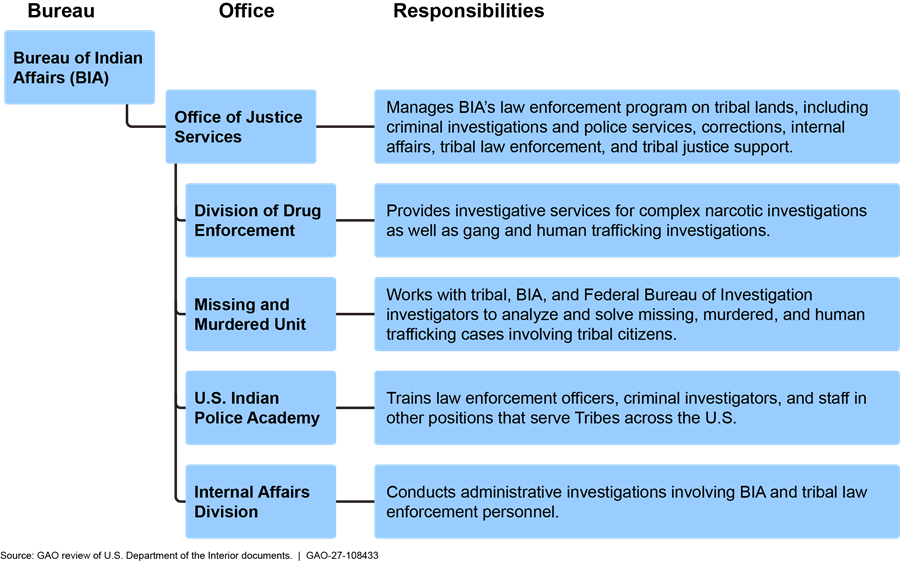
Note: For the purposes of this figure, we use the term “tribal lands” in place of “Indian country.” Federal law defines “Indian country” as all lands within the limits of reservations, dependent Indian communities, and Indian allotments to which Indian title has not been extinguished. 18 U.S.C. § 1151. We also use the term “tribal citizen” in place of “Indian” as defined under federal criminal law. There is no statutory definition of Indian for federal criminal jurisdiction purposes, but courts generally require a degree of Indian blood and a sufficient connection to a Tribe, such as tribal citizenship.
DOJ’s Support for Law Enforcement on Tribal Lands
DOJ supports tribal public safety and justice programs through the Office of Justice Programs, the Office on Violence Against Women, and the Office of Community Oriented Policing Services. In addition, the Office of Justice Programs contains the Bureau of Justice Statistics, which collects, analyzes, and publishes statistical reports on crime and law enforcement services on tribal lands. Also within the DOJ, the FBI investigates crime on tribal lands in accordance with the federal laws governing jurisdiction described above.
Interior and DOJ Administer Funding and Provide Direct Services to Support Law Enforcement on Tribal Lands
Interior and DOJ administer three types of funding for law enforcement on tribal lands. Specifically, Interior funds law enforcement services on tribal lands through self-determination contracts and self-governance compacts, while DOJ awards competitive grants for law enforcement needs on tribal lands. In addition, BIA provides policing services directly to approximately 60 Tribes, and both agencies provide law-enforcement-related investigative services to all Tribes in the U.S.
Interior Provides Funding for Tribal Law Enforcement Services Through Self-Determination Contracts and Self-Governance Compacts
Self-determination contracts allow Tribes to assume responsibility for managing the program’s day-to-day operations. BIA regional offices are responsible for providing technical assistance and ensuring that the Tribe meets contract terms.[29] The contracts provide for the Tribe to receive the amount specified in annual funding agreements for law enforcement services.[30] Generally, self-determination contracts can have a term of up to 3 years.[31] The amount of funding provided through these contracts can be renegotiated annually to account for changes in circumstances.[32] In 2026, 115 Tribes had self-determination contracts that included law enforcement services and operated law enforcement agencies with the funding provided under those contracts.
Self-governance compacts transfer administration of law enforcement services completely to Tribes and provide Tribes with more flexibility in program administration.[33] However, these compacts have eligibility requirements. For example, a Tribe must demonstrate financial stability and financial management capability for the past 3 fiscal years.[34] In 2026, 66 Tribes had self-governance compacts that included funding for law enforcement services.
BIA determines the amount allocated to each Tribe for law enforcement services using a base level of funding and factors for distributing any additional appropriations. The law enforcement services base funding equals the amount the Tribe initially allocated for law enforcement, which in many instances is the allocation from 1999. Funding provided to Tribes under self-determination contracts and self-governance compacts is determined the first year the contract or compact is in place and is based on the base amount from the year prior to the contract or compact being established.[35] Any annual BIA public safety appropriation above that total cumulative amount is allocated among Tribes. The allocation is based first on any congressional directives and second on a set of factors that include base funding levels, violent crime rates, land area, and the level of unfunded need. For example, BIA has determined that higher levels of reported violent crime indicate a more urgent need for funding, so those Tribes are typically granted a larger portion of any additional appropriations. Except in certain circumstances, Interior cannot reduce the amount of base funds provided under a self-determination contract or self-governance compact.[36]
As shown in Figure 3, funding for tribal law enforcement programs administered through self-determination contracts and self-governance compacts rose from $133.6 million to $137.5 million (2.9 percent) between fiscal years 2016 and 2025 when adjusted for inflation. Because self-determination contracts and self-governance compacts may not cover all law enforcement operating costs, many Tribes supplement it with tribal funds. According to 2018 data gathered by the Bureau of Justice Statistics, 84 percent of tribal councils and governments use tribal funds to support law enforcement activities and 23 percent support law enforcement with tribal business enterprises, such as gaming.[37]
Figure 3: Funds Distributed by the Bureau of Indian Affairs (BIA) to Tribes for Law Enforcement Under Self-Determination Contracts and Self-Governance Compacts, Fiscal Years 2016-2025
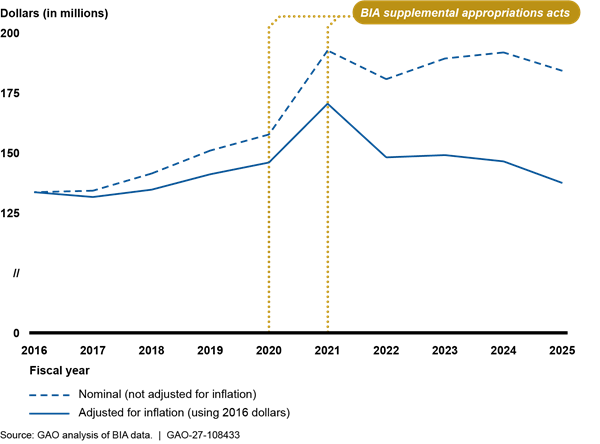
Note: In 2020, the Coronavirus Aid, Relief, and Economic Security Act—a supplemental appropriations act—resulted in BIA obligating an additional $5.7 million over the fiscal year 2020 appropriated amount for law enforcement services provided under self-determination contracts and self-governance compacts. Pub. L. No. 116-136, div. B, tit. VII, 134 Stat. 281, 546. In 2021, another supplemental appropriations act, the American Rescue Plan Actresulted in BIA obligating an additional $36 million that was provided in self-determination and self-governance compacts. Pub. L. No. 117-2, tit. XI, 11002, 135 Stat. 4, 241. Data analyzed is from fiscal year 2016 through 2025 to cover a decade of resources. Inflation adjustments are made using the Consumer Price Index for All Urban Consumers with 2016 as the base year.
DOJ Awards Competitive Grants to Tribes for Law Enforcement Services
According to DOJ data, the department awarded competitive grants totaling $114 million to Tribes in fiscal year 2016 and $233 million in fiscal year 2024, an increase of 104 percent over 9 years. Tribal governments are eligible to apply for a range of DOJ grant programs, including the Community Oriented Policing Services Hiring Program, the Bulletproof Vest Partnership program, and the Body-Worn Camera Partnership program. Tribal applicants compete with non-tribal applicants for these funds.[38] Many of these DOJ grants may be used for multiple purposes, such as detention, courts, general crime prevention, and youth services. As a result, it is not possible to determine how much of the total grant funding is dedicated exclusively to law enforcement services, such as policing and criminal investigations.
DOJ officials told us that most awards for tribal law enforcement stem from the Consolidated Tribal Assistance Solicitation (CTAS), Purpose Area 1. Purpose Area 1 is intended to increase the capacity of tribal law enforcement agencies through prevention strategies, improved criminal investigations, and community policing strategies. Funds may be used to hire law enforcement officers, purchase basic equipment, or support training to enhance community policing efforts. As shown in Figure 4, DOJ awarded between $19 million and $31 million to Tribes each fiscal year from 2016 through 2024 under CTAS Purpose Area 1.[39]
Figure 4: Total Funding Awarded Under Coordinated Tribal Assistance Solicitation Purpose Area 1: Public Safety and Community Policing, Fiscal Years 2016—2024
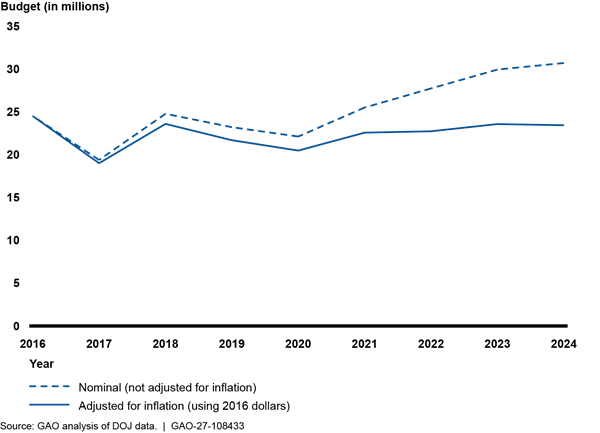
Note: Totals represent funds awarded in each fiscal year although grants are distributed to awardees over a 3-to 5-year period following the date of the award. As of March 2026, DOJ told us they had not completed awarding grants funded in fiscal year 2025. Inflation adjustments are made using the Consumer Price Index for All Urban Consumers with 2016 as the base year.
The most recent census of tribal law enforcement agencies was conducted in 2018 and showed that CTAS Purpose Area 1 funding was concentrated among larger Tribes. Specifically, DOJ awarded CTAS grants to 88.6 percent of Tribes with large police forces and 32.1 percent of Tribes with the smallest police forces.[40] One advocacy organization told us that, in many cases, Tribes do not apply for grant funding because they do not have the administrative capabilities to write grant applications and meet grant requirements.[41] In addition, tribal leaders noted that grants are not useful for law enforcement agencies’ greatest need–hiring additional officers–because competitive grant funds are awarded for a 3- to 5-year period and then a Tribe must either find a way to fund the additional officers, obtain additional grant funding, or potentially lay off the officers.
BIA and DOJ Provide Direct Law Enforcement Services to Tribes
BIA employs law enforcement officers or criminal investigators to provide law enforcement services to about 60 Tribes. BIA officers and investigators are federal employees, and they are a part of a national, BIA-operated law enforcement organization under OJS. Tribes may receive all or some law enforcement services from BIA. For instance, a Tribe may operate its own law enforcement agency but have BIA provide criminal investigators. Figure 5 shows the locations of tribal law enforcement agencies, the type of funding they operate under, and the types of law enforcement services that BIA provides, as of 2025.
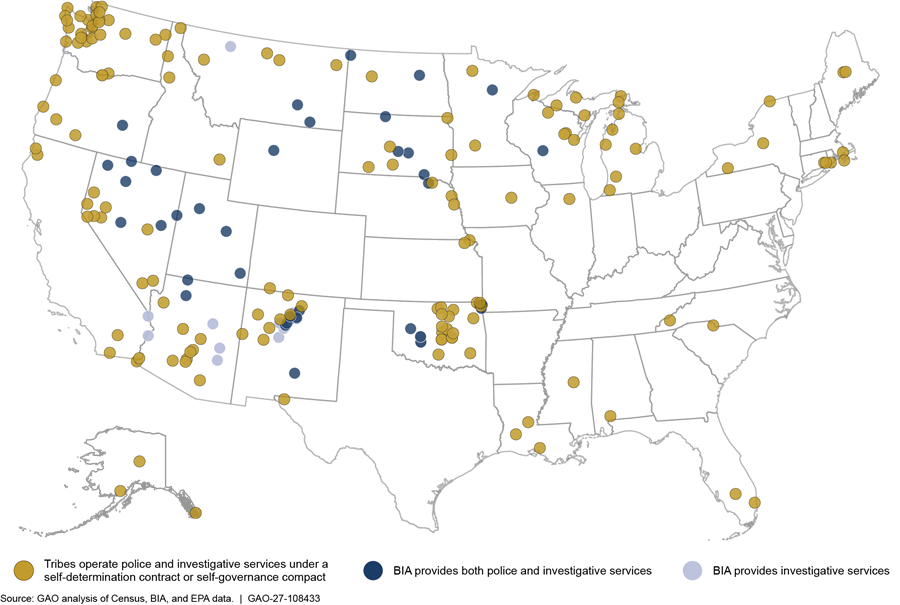
Note: To create this figure, we used the Environmental Protection Agency (EPA) Office of Finance and Administration features service, which depicts geographical information for federally recognized Tribes. We matched Tribe names in data provided by the Bureau of Indian Affairs (BIA) on Tribes that have self-determination contracts or self-governance compacts that include law enforcement services with EPA’s feature service. We manually matched any cases with ambiguous Tribe name information as well as all Tribes that have law enforcement services provided directly by BIA.
As shown in Figure 6, while obligations for BIA direct services to Tribes increased from $41 million to $45 million between 2016 and 2025, funding has not kept up with inflation. When adjusted for inflation, obligations decreased from $41 million to $33 million (19 percent) over the same period. As a result, a BIA official told us that BIA-managed law enforcement agencies could hire fewer officers.
Figure 6: Bureau of Indian Affairs (BIA) Obligations for Policing by BIA-Operated Law Enforcement Agencies, Fiscal Years 2016-2025
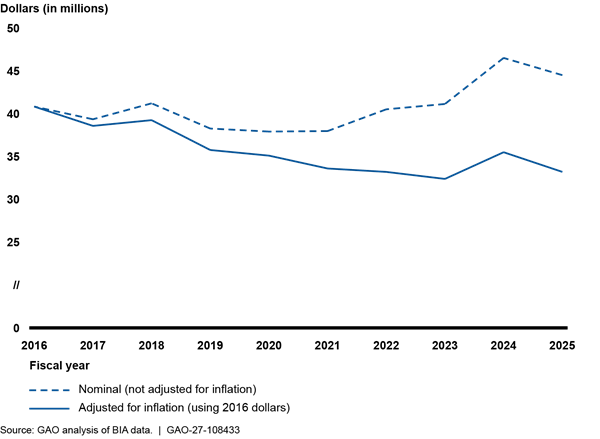
Note: Inflation adjustments are made using the Consumer Price Index for All Urban Consumers with 2016 as the base year.
Congress appropriated the same funding for OJS law enforcement operations in fiscal years 2023 and 2024, with minimal increases in fiscal years 2025 (1.4 percent) and 2026 (1.1 percent).[42] According to a BIA official, the increases do not cover the increases in health care costs or annual pay increases for officers. Further, the agency transitioned law enforcement officers to a new classification with higher pay in fiscal year 2023. As a result, the BIA official told us that OJS can employ 20 percent fewer law enforcement officers than in 2023.
In addition to police and investigative services, federal agencies provide specialized services to support both direct services and tribally operated law enforcement agencies. Table 2 describes services BIA and the FBI provide.
|
Federal law enforcement support services |
Description |
|
Bureau of Indian Affairs (BIA), Department of the Interior |
|
|
Division of Drug Enforcement |
The Division provides services for complex narcotic investigations as well as gang and human trafficking investigations. Specifically, the Division’s investigations focus on the disruption of drug distribution networks and criminal enterprise impacting tribal lands and communities. The Division provides support to track drug cases, evaluate intelligence, and analyze data for trends in drug related issues. It also provides drug-related training and technical assistance to law enforcement programs operating on tribal lands, many of which are conducted at the agency level to ensure access for Tribes. |
|
Missing and Murdered Unit |
The Unit works with tribal, BIA, and FBI investigators to analyze and solve missing, murdered, and human trafficking cases involving tribal citizens. Investigators and other specialists work to enhance the criminal justice system and address the concerns of Tribes regarding missing and murdered people–specifically missing and murdered indigenous women and girls. |
|
U.S. Indian Police Academy |
The Academy trains law enforcement officers serving Tribes. This academy also provides specialized training for supervisors, juvenile officers, criminal investigators, and detention personnel. The basic training program for law enforcement officers takes place at the Federal Law Enforcement Training Center in Artesia, New Mexico and lasts 13.5 weeks. The Academy also operates the Advanced Training Center at Camp Grafton, North Dakota, to provide specialized training in criminal investigation, drug enforcement, and command school programs. |
|
Internal Affairs Division |
The Division is responsible for conducting administrative investigations involving BIA and tribal law enforcement personnel. Administrative investigations generally apply to on-duty and off-duty misconduct, policy violations, and use-of-force reviews. The Background Investigation Unit is also under the purview of the Division. The Background Investigation Unit is responsible for conducting various types of background investigations or adjudications for tribal law enforcement programs upon request. |
|
Federal Bureau of Investigation, Department of Justice |
|
|
General and Major Crimes Investigations |
Pursuant to the General and Major Crimes Acts, the FBI investigates crimes such as murder, rape, arson, burglary, larceny, and certain other federal crimes that occur on tribal lands. FBI agents stationed in an area with a large proportion of tribal lands told us tribal matters make up the majority of their caseload and that BIA and tribal law enforcement agencies most often refer cases. |
|
Operation Not Forgotten |
Since 2023, the FBI has periodically staffed additional agents as surge support to investigate unresolved violent crime cases. According to the FBI, between 2023 and 2025, Operation Not Forgotten efforts supported over 760 cases, resulting in 249 arrests. FBI agents we spoke with noted that additional support is useful in field offices’ efforts to address crime on tribal lands because agents working as surge support often provide fresh perspectives to stalled cases and provide valuable assistance to offices with heavy caseloads. |
Source: GAO analysis of BIA and FBI information. | GAO‑27‑108433
Note: For the purposes of this table, we use the term “tribal citizen” in place of “Indian” as defined under federal criminal law. There is no statutory definition of Indian for federal criminal jurisdiction purposes, but courts generally require a degree of Indian blood and a sufficient connection to a Tribe, such as tribal citizenship. In this table, we also use the term “tribal lands” to mean Indian country, as it is defined in 18 U.S.C. § 1151, which includes all lands within the limits of reservations, dependent Indian communities, and Indian allotments to which Indian title has not been extinguished.
BIA Faces High Vacancies and Recruitment and Retention Challenges for Law Enforcement on Tribal Lands
Through OJS, BIA law enforcement officers serve as the primary federal entity responsible for law enforcement on tribal lands where they provide direct law enforcement services.[43]
However, BIA has consistently faced high vacancies for its law enforcement officers. Specifically, from 2022 through 2025, BIA experienced law enforcement vacancies of 30 percent or more. While BIA has taken some steps to recruit and retain officers, the agency has not taken additional actions that could help mitigate challenges to recruiting and retaining officers. Additionally, prolonged background investigation time frames contributed to BIA’s understaffing.
BIA Has Faced High Law Enforcement Officer Vacancy Rates
We have previously reported that, according to a national survey of law enforcement agencies, resignations and retirements of law enforcement officers have increased nationwide, contributing to staffing declines.[44] For example, according to BIA data, in May 2025 BIA had approved 167 law enforcement officer positions across its nine districts, and employed 93 officers, leaving 74 vacancies.
According to BIA data, vacancy rates for police and law enforcement officers increased between 2022 and 2025, as shown in Figure 7. Specifically, vacancy rates for law enforcement officer positions rose from 37 percent in September 2022 to 44 percent in May 2025, while vacancy rates for criminal investigator positions decreased from 34 percent to 13 percent over the same period. The lower rate for the criminal investigator position can be attributed to several factors, according to BIA officials. BIA officials stated that the relative ease in recruiting and retaining personnel for this position compared to officers is attributable to the position’s higher grade level and corresponding higher pay when compared to the law enforcement officer series. In addition, the criminal investigator position does not require routine patrol duties, which can make the position more appealing to potential candidates according to a BIA official.
Figure 7: Vacancy Rates for Bureau of Indian Affairs (BIA) Law Enforcement Personnel from September 2022 – May 2025
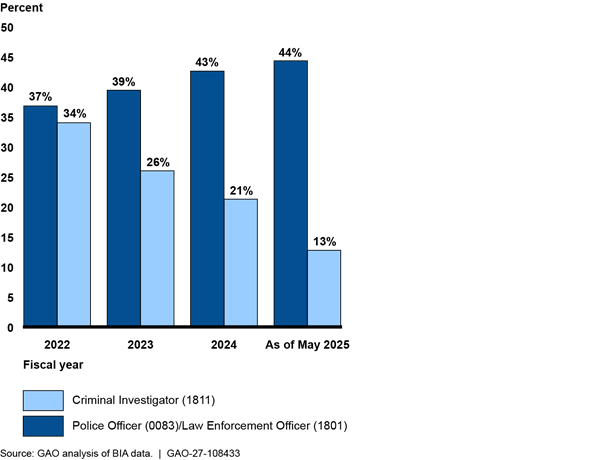
Note: Vacancy rates are a snapshot of vacant positions at the end of each fiscal year. BIA officials told us that in 2023, the bureau transitioned individuals serving in police officer positions to law enforcement officer positions. Vacancy calculations were provided by BIA officials in January 2026.
BIA Has Taken Some Steps to Recruit and Retain Law Enforcement Officers
BIA has taken some steps to address recruitment and retention challenges affecting law enforcement officers working on tribal lands, such as reclassifying police officers and offering reimbursement for moving costs.
Reclassifying police officers. According to BIA officials, in April 2023, BIA reclassified its federal police officers as law enforcement officers to provide parity in pay and benefits with officers in other federal law enforcement agencies.[45] The officials said this reclassification changed how officer positions are structured and graded within the bureau because law enforcement officer positions allow for more robust career progression than police officer positions. Specifically, they said the law enforcement officer series encompasses a broader range of enforcement and investigative duties and provides opportunities for progression into higher‑graded roles. In contrast, the former police officer series was more narrowly focused on patrol-based law enforcement functions.
Law enforcement officer positions also offer higher pay than police officer positions. Specifically, BIA officials stated that for the previous police officer position, officers would start at the GS-5 step while officers entering under the law enforcement officer position would start at the GS-7 step, yielding an average increase of over $8,000 annually.[46] Additionally, in fiscal year 2026, law enforcement officers received a salary increase of 3.8 percent while other federal employees, including police officers, received a 1 percent increase. In a 2024 testimony, the Assistant Secretary for Indian Affairs stated that this reclassification could increase annual salaries up to $30,000 for law enforcement officers.[47] However, while the reclassification may assist the agency’s recruitment efforts, BIA did not receive additional funding, so the change resulted in fewer funded law enforcement officer positions being available overall, according to BIA officials.
Reimbursement of relocation expenses. According to officials, BIA also leverages its authority to provide relocation incentives to both newly hired and currently serving officers, using reimbursements to help fill positions in locations that the agency has determined are difficult to staff.[48] Relocation incentives may be authorized in addition to any retention incentives that are offered. The incentives require officers to sign a service agreement committing to remain in federal service for a specified period of service with the agency. Between fiscal years 2022 and 2025, relocation reimbursements were provided to 114 law enforcement personnel, 44 percent of whom were law enforcement or police officers.
BIA Has Considered but Has Not Implemented Additional Actions to Address Ongoing Recruitment and Retention Challenges
We found that BIA faces a range of ongoing challenges associated with recruiting and retaining its law enforcement officers. These include limited outreach to potential applicants for open positions, limited use of incentives to recruit and retain officers, and limited housing options available to officers on tribal lands. Although BIA has considered additional actions to address its ongoing recruitment and retention challenges and help fill vacant positions, it has not implemented them for various reasons.
Limited outreach to potential applicants. BIA officials said they have considered the following additional enhancements related to outreach:
· Enhance BIA’s relationships with colleges and other potential sources for law enforcement officers. According to a BIA official, the agency tries to attend functions at approximately 30 tribal colleges as well as partnering with the military to attract applicants following completion of their service. BIA officials in headquarters noted that many local agencies cultivate relationships with local schools and colleges, primarily through their BIA OJS Chief of Police. However, BIA officials in district offices have noted that they do not have the time or personnel to consistently reach out to recruiting contacts or attend recruiting events.
· Establish a pipeline from non-law enforcement positions to law enforcement positions at agencies. BIA officials told that non-law enforcement officers sometimes apply for law enforcement officer positions on an ad hoc basis, but the agency has not established a formal program to encourage younger employees in non-law enforcement positions to apply for law enforcement positions when they reach the appropriate age. BIA officials we spoke with acknowledged that the agency could establish a formal program in which individuals under the age of 21 who are interested in law enforcement hold no-law enforcement positions, such as administration or dispatch, until they reach the required age of 21 for law enforcement officer positions.
As of March 2026, BIA officials said they were considering some actions to enhance outreach to applicants. For instance, officials cited targeted recruitment announcements, expanded recruitment incentives, and the development of continuous job announcements. According to BIA officials, the bureau will also establish a dedicated recruiting team to ensure that BIA has a strategy for targeting individuals likely to be interested in serving on tribal lands. To establish this team, BIA officials said the bureau would hire both a recruitment specialist and a marketing specialist in fiscal year 2026.[49] Based on the job descriptions BIA provided, the recruitment specialist will operate within OJS and will be responsible for conducting outreach to recruit potential law enforcement candidates. As the focal point, the specialist will establish a recruitment strategy to locate and attract highly qualified candidates. The marketing specialist will support recruiting efforts by providing guidance regarding styling materials for release through the agency’s website and social media accounts and ensure digital information reflects the strategic objectives of the agency.
Limited use of recruitment and retention incentives. BIA can provide recruitment and retention incentives for both law enforcement officers and criminal investigators but has not done so beyond recruitment incentives used to fill vacancies at a limited number of hard-to-fill locations. Office of Personnel Management (OPM) guidelines limit the offering of recruitment and retention incentives to (1) positions that are likely to be difficult to fill without the recruitment incentive or (2) when an officer has unusually high or unique qualifications and is likely to leave federal service in the absence of a retention incentive, respectively.[50] The agency is required to follow OPM guidance to offer a recruitment or retention incentive, which has specific documentation requirements. As a result, BIA officials told us that it is challenging and time consuming to develop documentation to justify awarding the incentive, which may disincentivize managers. Further, before receiving a recruitment or retention incentive, an employee must sign a written agreement to complete a specified period of service with the agency.[51] According to BIA data, three criminal investigators and no tribal law enforcement officers received retention incentives in fiscal years 2022 through 2025.[52]
We found that the bureau could make additional enhancements to the incentives program, such as the following:
· Developing guidance on using available hiring authorities and incentives more broadly. In 2024, we recommended that BIA develop guidance on incentives. BIA agreed with the recommendation and, as of May 2025, Interior reported that its Office of Human Capital was working to develop written guidance to address this recommendation.[53] As we stated in our 2024 report, developing incentive guidance would reduce the risk of inconsistent or inefficient use of incentives and improve Interior’s ability to target recruitment and retention resources to positions and locations with the greatest staffing needs. The recruitment specialist BIA plans to hire, as described above, could serve as a central point of contact to identify staff eligible for incentives and complete the necessary documentation.
· Implementing a system for monetary awards for high performers. We have found that federal agencies have broad authority to implement monetary incentives that motivate and reward employees.[54] Monetary incentives include performance awards to reward employees for high performance during an appraisal period. Additionally, service awards—which are one-time, lump-sum monetary awards—incentivize employees whose specific accomplishments exceed performance expectations, according to our prior work.
· Offering retention incentives for groups of law enforcement officers. Offering incentives to groups is a way to lessen the administrative burden of justifying an incentive for an individual officer. Specifically, a BIA official stated that retention incentives may be offered to groups or categories of jobs when retaining that group or category is essential to mission continuity. For instance, if the bureau finds that it is in danger of losing a significant number of law enforcement officers, it can offer retention incentives to all the employees that are in that class in a particular location, as law enforcement officers are an essential component to maintaining public safety. One senior BIA official stated that the Bureau has provided group incentives to firefighters in the past, and it will consider doing so for law enforcement officers as well.
· Expanding the number of work locations classified as hard-to-fill. According to BIA officials, recruitment incentives offered for specific positions at hard-to-fill locations has resulted in filling 13 vacant positions since fiscal year 2023.[55] While there are OPM criteria for hard-to-fill positions, BIA officials stated there are no formal criteria for hard-to-fill locations. The Bureau deems locations to be hard to fill when they are in rural areas and have few applications for positions. According to BIA officials, as of April 2026, the bureau has classified positions at five law enforcement agencies as being hard to fill and provided recruitment incentives only to applicants in those locations.[56] In the absence of standardized criteria, the BIA official who makes the determination told us he considers whether a location is receiving applicants and the proximity of the location to a metropolitan area. However, according to BIA data, the bureau’s challenges with recruiting and retaining law enforcement officers extend beyond the limited number of hard-to-fill locations. BIA could consider classifying additional locations as hard-to-fill or offer recruitment incentives for locations that are not currently classified as hard-to-fill.
Limited and unaffordable housing options. Officials noted that housing on tribal lands is limited in availability, and that the lack of affordable housing on tribal lands impedes hiring and retaining law enforcement officers. Moreover, a BIA official said that officers who live outside of reservations do not have the opportunity to learn the local context, culture, and history of the Tribe whose members they serve.
BIA officials told us that the bureau is considering options to mitigate the lack of housing on tribal lands. For example, BIA officials said that they are planning to build new housing in locations where they are building detention facilities. According to officials, another option BIA is considering is transferring responsibility for housing infrastructure to the Tribes. While BIA has taken steps to address the lack of affordable housing, we found that the bureau has identified and considered other options, but has not taken actions such as the following:
· Exploring whether alternative pricing for housing on tribal lands is possible. BIA officials said that the General Services Administration sets the rent prices for government housing and bases those prices on the nearest town or city. However, those prices may be unaffordable based on officers’ locality-based incomes. For example, BIA officials said that one reservation with direct-service law enforcement is adjacent to a tourist community in New Mexico, where rental prices are significantly higher than what local law enforcement officers can afford. As a result, BIA officials said that officers must live further away from the reservation. A BIA official told us the bureau had discussed rental rates with the General Services Administration to establish waivers or subsidies that allow housing to be priced at an appropriate level for local conditions. However, as of May 2026, the official said it is not possible to obtain a waiver for housing on tribal lands.
· Leasing housing from other agencies. While building housing is a positive step, BIA officials told us they are able to build one facility every two years. According to BIA officials, the bureau has considered leasing housing from other agencies that have vacant housing available. For example, BIA officials said the Indian Health Service has housing near select reservations. According to BIA officials, BIA has contacted one Indian Health Service office regarding using their vacant housing, but Indian Health Service preferred to reserve the housing for additional staff. BIA officials told us that the bureau does seek available tribal housing in areas where it is available for officer use, but tribal housing may not always be a suitable option. For instance, officials told us BIA has entered into an agreement with one Tribe to use their housing, when available, for public safety staff. Although Tribes have control over rental rates for housing, which is often limited, BIA could explore the possibility of entering into such agreements with additional Tribes.
Although the Assistant Secretary for Indian Affairs has stated that strengthening tribal law enforcement is a top priority, BIA has not identified and implemented additional actions, such as the ones discussed above, that could mitigate ongoing challenges to the recruitment and retention of law enforcement officers.[57] Moreover, Interior’s Law Enforcement Task Force 2023 Report recommended its law enforcement programs—including BIA—develop strategies to address recruitment and retention challenges.[58] However, BIA officials told us they had not done so as of February 2026.
Standards for Internal Control in the Federal Government states that management should demonstrate a commitment to recruit, develop, and retain competent individuals.[59] The Standards also note that agencies may consider retaining qualified individuals by providing incentives to motivate and reinforce expected levels of performance and desired conduct, such as retention incentives.
Without a clear commitment to proactively identify and implement additional recruitment and retention efforts—whether the actions described above or other initiatives—BIA’s understaffing of law enforcement positions on tribal lands will likely persist. Identifying which options the bureau could readily implement to improve staffing levels and taking action to implement those options would also mitigate some of the more complex challenges stemming from understaffing, such as officer burnout and safety concerns, discussed below.
Prolonged Background Investigation Time Frames Contribute to Law Enforcement Understaffing on Tribal Lands
We found that prolonged background investigation time frames contributed to law enforcement understaffing challenges that BIA has faced on tribal lands. By regulation, law enforcement programs on tribal lands receiving federal funds or authority must ensure all law enforcement officers successfully complete a background investigation.[60] The Department of Defense’s Defense Counterintelligence and Security Agency (DCSA) has primary responsibility to conduct background investigations for the federal government.[61] DCSA conducts investigations for multiple federal agencies nationwide and BIA officials told us DCSA prioritizes cases based on department-wide risk and capacity considerations.
Background Investigations. Background investigations are the most significant factor in the length of the hiring process according to several BIA officials we spoke with. In fiscal year 2025, the average time to complete a Tier 3 background investigation—the standard for law enforcement officers, according to BIA officials—was 138 days, according to DCSA data.[62] However, BIA officials noted the time frame for completing these investigations may be longer for applicants who have lived in multiple locations in the preceding 10 years. For example, if an applicant has lived in multiple states, investigations need to be completed in each state, after which the investigation package is forwarded to DCSA’s headquarters for completion.
BIA officials told us that because DCSA background investigations for BIA law enforcement officers typically take several months to a year, BIA frequently loses qualified candidates before hiring actions are completed, which prolongs the period of understaffing. According to BIA’s district office and law enforcement officials we talked to, BIA’s lengthy hiring process, primarily due to the extended background investigations, has contributed to missed hiring opportunities. According to these officials, the prolonged process has resulted in applicant attrition, as qualified candidates may take other opportunities, often with agencies with faster hiring timelines.
The hiring process is also extended for some applicants by the Indian Preference requirement for hiring BIA personnel.[63] Indian Preference requires that tribal member applicants who meet the minimum qualifications for a position, as set by the Office of Personnel Management, be advanced through the hiring process before non-tribal member applicants can be considered.[64] BIA officials told us the Office of Human Resources evaluates tribal member applications, including conducting background investigations, before beginning to consider applications from non-tribal members. Officials told us that the lengthy background investigation process means that non-tribal member applicants are not considered until months after they have applied for a law enforcement position, at which point they have likely moved on to other opportunities. They also noted that delays can be impacted by previously employed tribal member applicants with known performance issues applying for positions because these tribal member applicants cannot be disqualified until after the background investigation is complete.
Standards for Internal Control in the Federal Government state that management should develop an organizational structure with an understanding of the overall responsibilities and assign these responsibilities to enable the organization to operate efficiently and effectively, comply with applicable laws and regulations, and reliably report information. However, BIA may not be able to operate its hiring processes efficiently and effectively given its current lack of authority over the background investigation process for BIA federal employees.
Investigation Process. BIA officials told us they have processes in place that could be used to conduct background investigations for federal law enforcement officers and that they can do so more quickly than DCSA. BIA is statutorily required to conduct background investigations upon request for tribally operated law enforcement officers employed by a Tribe that has contracted or compacted with Interior.[65] They must generally complete these investigations within 60 days of the Tribe’s request, and the investigation must be no less stringent than a background investigation conducted for a federal officer performing the same duties.[66] According to BIA officials, BIA’s background investigations for tribal law enforcement take 30 to 45 days on average, approximately 68 to 78 percent faster than DCSA’s average investigation time. Officials noted that the unit that currently conducts background investigations for tribally operated law enforcement officers could also perform background investigations for federal BIA law enforcement officers with the number of investigators allocated to the unit as of April 2026.
To conduct its own background investigations for federal BIA law enforcement officers, the Bureau would need specific statutory authority or delegated authority from OPM or through an executive order. BIA officials told us they are pursuing statutory authority by working with members of the Senate Committee on Indian Affairs to explore options for including the authority to conduct background checks for federal law enforcement officers in legislation. In February 2025, the Bridging Agency Data Gaps and Ensuring Safety (BADGES) for Native Communities Act was introduced in the Senate and House of Representatives. This legislation contains language authorizing BIA to conduct its own background investigations for applicants to BIA law enforcement positions under a five-year demonstration program.[67] This bill passed the Senate in December 2025, and, in May 2026, Interior submitted a statement for the record for a subcommittee hearing in the House of Representatives in support of the legislation.[68] As of October 2026, this act had not become law.
Delegation of Authority. OPM may delegate authority to agencies to conduct or contract for background checks.[69] For instance, the Drug Enforcement Administration obtained this authority from OPM in the early 1980s. BIA officials told us the bureau explored the possibility of seeking delegated authority from OPM for conducting background investigations in 2021, but that it did not pursue the initiative. In May 2026, officials from the Interior Office of the Solicitor stated that for the bureau to pursue a delegation from OPM, it would need to develop and submit a justification package. OPM officials said it then evaluates whether a requested delegation would provide a mission-specific benefit that outweighs the efficiencies, consistency, reciprocity, and oversight benefits of using existing shared-service investigative capabilities.[70] Interior officials told us they were unable to estimate a timeline to pursue delegation of authority due to their lack of familiarity with the process and the absence of guidance from OPM. However, officials from the Office of the Solicitor said they were willing to assist BIA in pursuing a delegation of authority.
Without a delegation of authority, BIA does not have the authority to conduct background investigations for BIA federal employees and continues to rely on DCSA. Consequently, the bureau may be missing an opportunity to gain operational control or efficiencies associated with conducting its own investigations.
BIA officials told us they are willing to take on the administrative responsibility to conduct additional background investigations with existing resources and pointed to multiple benefits. For instance, they noted that they would have the ability to customize an investigative approach to address the tribal, law enforcement, and remote‑location mission needs of BIA. They also noted that they would be able to ensure the quality of investigations given they would have oversight over the quality, training and methodology and real-time investigation status, allowing the agency to identify bottlenecks and areas where potential risk may occur within the vetting process. Finally, they anticipated that conducting background investigations for federal law enforcement officers would result in improved coordination among hiring departments and a stronger linkage between suitability, credentialing, and adjudication. This could lead to greater efficiency through stronger integration across vetting functions, including process streamlining, reduced processing time, and a reduction in unnecessary delays and errors.
Having authority to conduct background investigations for applicants to its law enforcement officer positions could enable BIA to more effectively and efficiently fill vacant positions by shortening the time it takes to assess the appropriateness of each candidate. This could help mitigate the loss of qualified candidates during the current lengthy investigation process and shorten periods of understaffing. In turn, more effectively filling vacant positions could help address the many challenges inherent to law enforcement in remote areas of tribal lands and to law enforcement generally, which are identified in this report and by Interior’s 2023 law enforcement task force report.[71]
Law Enforcement Agencies’ Staffing and Other Challenges Pose Risks to Officer and Public Safety
In addition to BIA’s recruitment and retention challenges discussed above, tribal representatives we interviewed also identified numerous challenges related to providing law enforcement services on tribal lands. We spoke to representatives from seven Tribes and held three listening sessions with tribal advocacy organizations.[72] These tribal representatives as well as BIA officials shared challenges with pay and benefits, understaffing, and other limitations.[73]
Tribally Operated Law Enforcement Agencies Offer Lower Pay and Fewer Benefits Than Competitors
Four of the seven Tribes we interviewed have tribally operated law enforcement agencies. Representatives from all four said that the pay and benefits these agencies could offer were lower compared to other agencies, which makes it difficult to attract and retain tribally-employed law enforcement officers.
Pay. Representatives we interviewed from all four Tribes with tribally operated law enforcement agencies said that their agencies face a lack of parity in pay compared to their federal, state, and local law enforcement counterparts. For example, one tribal representative told us that about eight to 10 officers graduate from each of their police academy classes, however, about six of those graduates leave for other agencies with better pay. Our prior work also found that factors for law enforcement officer resignations more broadly are increased compensation and new career opportunities in other agencies or departments.[74] Two tribal representatives said their agencies are looking for ways to increase officers’ salaries and offer recruitment incentives. For instance, one of these tribal representatives said that their agency raised officer salaries using the tribal budget.
Benefits. When asked about challenges with recruitment and retention, representatives from three Tribes with tribally operated law enforcement agencies told us that tribal agencies offer less generous retirement benefits compared to their federal and state counterparts, which impacts their ability to retain officers. Moreover, in a listening session, a participant said that their law enforcement agency cannot compete with other agencies at the state or local levels regarding benefits. One tribal representative noted in an interview that the benefits package their agency offers is not as comprehensive as those available at other law enforcement agencies. When asked about efforts to address recruitment and retention challenges, representatives from two Tribes told us they had joined or hoped to join their states’ retirement programs to improve recruitment and retention.[75]
Understaffing at Law Enforcement Agencies Contributes to Concerns About Officer and Community Safety
The recruitment and retention challenges discussed previously have led to understaffing at law enforcement agencies on tribal lands. When asked about challenges to providing law enforcement services, BIA officials and tribal representatives told us that understaffing at law enforcement agencies contributes to officer and community safety concerns. For instance, as shown in Figure 8, the Crow Creek Sioux and Lower Brule Sioux reservations do not have a sufficient number of law enforcement officers to meet their identified needs, as estimated by a BIA official. The two reservations, which each have a BIA direct service law enforcement agency but often share resources, would require 35 officers to cover the more than 800 square miles, according to a BIA official. However, according to this official, BIA has allocated 17 law enforcement officer positions to these agencies, with 12 of those positions filled as of July 2025. Six officers were available for patrol and other law enforcement duties, with the remaining six being detailed to other reservations or on leave.
Figure 8: Law Enforcement Officer Staffing and Availability on the Lower Brule Sioux and Crow Creek Sioux Reservations, July 2025
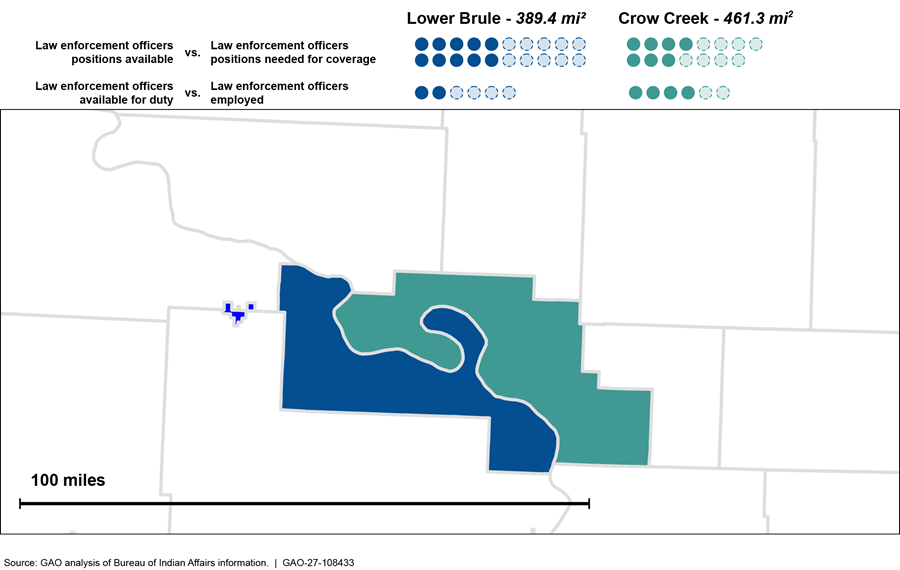
Note: Estimates of need were provided by a Bureau of Indian Affairs (BIA) official familiar with the law enforcement operations on each reservation.
Officer safety. Five out of seven tribal representatives we met with said that they are at or close to minimum staffing levels for 24/7 coverage, leaving one officer to cover the entire reservation alone at any given time. Representatives from three Tribes and participants in two of our listening sessions said that patrolling alone poses a risk to officer safety and that the lack of back up for officers can result in officers being attacked or facing dangerous situations with no back up. For example, one tribal representative said that calls for domestic violence or shots fired incidents normally require at least two officers due to greater potential for violence, but their agency cannot send more than one officer. An official from a BIA direct service law enforcement agency said that officers are regularly attacked by members of the community and must rely on bystanders to assist them in these situations due to lack of back up.
When elaborating on this challenge, a representative from a tribally operated law enforcement agency said that, in some cases, higher-level officers step in to support patrol activities and provide back up when needed. For example, one police chief told us that he assisted a patrol officer dealing with a violent crime even though his shift had already ended and that he covers three shifts each week to ensure that the other law enforcement officers have time off. However, these efforts do not address the long-term need for adequate staffing.
To assist with understaffing issues, representatives from one Tribe with a tribally operated law enforcement agency shared that their agency has cross-deputization agreements with the state agency as well as agreements with local agencies to provide assistance to one another when needed. Cross-deputization agreements can allow non-tribal law enforcement agencies, such as local sheriffs, to investigate and arrest tribal citizens committing crimes that violate federal or tribal laws on tribal lands, and they can allow tribal law enforcement agencies to investigate and arrest non-tribal citizens for state law violations. Similarly, an official from a BIA direct service law enforcement agency said their agency enters into cross-deputization agreements with state troopers for temporary periods to help with coverage.
Officer burnout. When discussing challenges with providing law enforcement services, BIA officials from three district offices and representatives from three Tribes told us that understaffing at law enforcement agencies contributes to officer burnout due to officers working significant overtime hours. For example, one tribal representative said that officers regularly work seven days per week due to lack of coverage. Furthermore, a BIA official noted that when overworked officers must drive long distances within reservations, they are more likely to get into accidents due to fatigue.
BIA district officials also said that officers are sometimes temporarily detailed to different reservations, which may contribute to burnout as officers in the home agency must work more hours to compensate for their absent colleague. For example, officials from a BIA direct service agency told us their officers are regularly detailed to a smaller reservation, resulting in shortages on the lands they are regularly assigned to.
When asked about addressing officer burnout and wellness, BIA officials shared a list of mental health resources available to officers that work at BIA direct service agencies. These resources include short-term counseling and a peer support program, according to BIA officials. In addition, a representative from a Tribe with a tribally operated law enforcement agency said that their agency conducts debriefs after major incidents. However, these efforts do not address the long-term need for adequate staffing to prevent burnout.
Case backlog and call response times. When discussing challenges related to staffing, BIA district officials said that understaffing can result in law enforcement officers taking longer to respond to calls for service. Representatives from two Tribes and participants in all three listening sessions said that longer response times are due, in part, to fewer officers covering large areas. For example, in all three of our listening sessions, participants said that it can take an officer almost 2 hours to respond to a call for service if the call comes from the other end of the reservation. Slow response times can lead to mistrust among community members, according to participants in two listening sessions. Moreover, two tribal representatives we spoke to said case backlogs from understaffing sometimes mean officers cannot fulfill other duties, such as traffic and highway safety activities. As a result, according to two tribal representatives, drivers often speed in the reservation because they know that there are no officers patrolling the highways.
Facilities, Equipment, and Reservation Size Pose Challenges to Providing Law Enforcement Services
In our interviews with tribal representatives, they shared that limited facilities and equipment, as well as reservation size posed challenges to law enforcement services.
Detention facilities. When asked about challenges with providing law enforcement services, three tribal representatives we interviewed talked about limited space in nearby detention facilities. Some reservations lack detention centers, and often those that are available are overpopulated, according to these representatives. Representatives from two Tribes also told us that their closest detention centers have been condemned. For example, a listening session participant said that their law enforcement agency must transport detainees to facilities up to 5 hours away, removing an officer from duty for an entire shift. Moreover, in many cases, juvenile centers are not available near tribal lands and require additional transport hours, according to two tribal representatives we spoke with.[76] For example, a representative from one Tribe told us that the closest juvenile facility was 5 hours away.
The lack of detention facilities may also result in law enforcement being unable to detain or charge suspects, according to four out of seven tribal representatives we interviewed. For instance, one representative told us that when an individual was arrested for a domestic violence complaint, the officer drove him around for a few hours and then returned him to his home, rather than transport him several hours away and leave the reservation without an officer present. Similarly, that same tribal representative told us that in his community, law enforcement does not arrest juvenile offenders because there is no detention facility available to house them. As a result, this representative said that juveniles commit crimes with impunity.
When asked about how BIA is planning to address the challenge of limited detention space, BIA officials said that they are aware that many detention facilities are in disrepair or nonexistent, but that the agency’s appropriations for construction projects allow for building only one new detention facility per year. BIA has been able to lease or contract out detention space in some cases to address limited facilities, according to BIA officials. For example, a tribal representative said that BIA contracts out 20 beds at a local detention center for the law enforcement agency’s use.
Equipment. When asked about the challenges faced with providing law enforcement services, representatives from four out of seven Tribes we interviewed said the equipment they have is not suitable for policing on tribal lands or they lack equipment altogether due to funding constraints. Vehicles experience significant wear and tear from the road conditions, according to one of these tribal representatives. In addition, representatives from two Tribes with tribally operated law enforcement agencies said that their agencies do not have body cameras or dashboard cameras for officers to use. A representative from a different tribally operated law enforcement agency said that the agency does not have its own dispatch system.
BIA officials and three tribal representatives said that they have policies for replacing vehicles regularly. However, due to funding constraints and bureaucratic processes, vehicles are not always able to be replaced as often as planned, according to these officials. To address the challenge of appropriate equipment, law enforcement agencies may apply for grants to cover the costs of new equipment. For instance, one tribal representative said their agency is planning to train staff on how to apply for grants to meet their equipment needs.
Reservation size and terrain. When asked about challenges faced by law enforcement, three tribal representatives told us that roads can be difficult to navigate on their reservations, and many of their reservations cover large areas of land. For example, one tribal representative described their reservation as rocky and mountainous, requiring four-wheel drive trucks to patrol. Another tribal representative said that their reservation’s spread-out land area makes it difficult to patrol.
Representatives from three Tribes said that officers may have to drive long distances when going from call to call, or when they are transporting a suspect to a detention facility. Two tribal representatives said that these long distances may lead to slow response times to calls for service. For example, in a listening session, one participant said that it can take an officer almost 2 hours to respond to a call if it is on the other end of the reservation. While the land size and terrain on tribal lands cannot be changed, increased staffing due to enhanced recruitment and retention efforts could decrease the patrol area covered by each officer and help reduce the need to drive long distances.
Conclusions
According to DOJ, communities on tribal lands face persistent levels of violent crime and victimization, including child abuse, domestic violence, and death. Yet according to BIA, law enforcement agencies on tribal lands have a funding shortfall of nearly $1.5 billion and a staffing gap of over 11,600 personnel. Over the past decade, inflation-adjusted funding has risen slightly for tribally operated law enforcement and fallen 19 percent for direct services. Both BIA officials and tribal representatives told us they face challenges related to funding, such as limited facilities and equipment. In addition, Tribes operating their own law enforcement agencies told us they are able to offer less competitive pay and benefits compared to their federal, state, and local counterparts, which affects staffing rates.
BIA also continues to face challenges with recruiting and retaining officers, leading to understaffing of law enforcement agencies on tribal lands. BIA has reported that it requires thousands of additional personnel to ensure public safety. Although BIA has taken some steps to address recruitment and retention challenges affecting law enforcement officers working on tribal lands, such as reclassifying police officers and offering reimbursement for moving costs, challenges remain. Without taking additional actions to identify and implement recruitment and retention efforts, BIA’s understaffing of law enforcement positions on tribal lands will likely persist, contributing to officer and community safety concerns.
BIA officials told us the lengthy background investigation process poses an additional challenge to filling vacant law enforcement officer positions. The officials also noted that BIA’s experience conducting background investigations for tribal law enforcement applicants has shown the bureau can assess the appropriateness of each candidate in less time than it takes DCSA. BIA has pursued statutory authority to do so, but it has not been enacted to date. Pursuing delegated authority for completing federal law enforcement officer background investigations could better position the bureau to hire candidates for these positions more quickly before candidates move on to other opportunities. Should BIA be delegated this authority, the bureau could shorten the current lengthy investigation process by enabling the bureau to more effectively and efficiently fill vacant positions and address the loss of qualified candidates, shortening periods of understaffing. This, in turn, would better position BIA to meet its stated priority of strengthening tribal law enforcement.
Recommendations for Executive Action
We are making the following two recommendations to the Department of the Interior:
The Secretary of the Interior should ensure BIA identifies and implements additional actions to enhance the recruitment and retention of law enforcement officers. This could include efforts related to incentives and housing. (Recommendation 1)
The Secretary of the Interior should ensure BIA works with the Office of the Solicitor to pursue delegated authority to conduct background investigations for applicants to federal law enforcement officer positions. (Recommendation 2)
Agency Comments
We provided a draft of this report to the Interior and DOJ for review and comment. The Interior Office of the Secretary provided comments via email stating that it generally concurred with our recommendations and had no technical comments on the report. DOJ provided written technical comments, which we incorporated as appropriate. In addition, we provided draft excerpts of the report to the Tribes and tribal advocacy organizations we met with to verify statements made. Representatives from four Tribes and two tribal advocacy organizations agreed with our representation of their views or provided written technical comments, which we incorporated as appropriate.
We are sending copies of this report to the appropriate congressional committees, the Secretary of the Interior, the Attorney General, and other interested parties. In addition, the report is available at no charge on the GAO website at https://www.gao.gov.
If you or your staff have any questions about this report, please contact me at Goodwing@gao.gov. Contact points for our Offices of Congressional Relations and Media Relations may be found on the last page of this report. GAO staff who made key contributions to this report are listed in appendix II.

Gretta L. Goodwin, Director
Homeland Security and Justice
We were asked to review law enforcement personnel shortages on tribal lands. This report examines: (1) how BIA and DOJ have provided funding and services for law enforcement on tribal lands; (2) the extent to which BIA has filled vacant positions for federal law enforcement officers on tribal lands; and (3) the challenges Tribes and BIA encounter with providing law enforcement services on tribal lands and the actions they have taken to address these challenges. For the purposes of this report, we use the term “law enforcement” to include federal personnel that were hired as law enforcement officers and criminal investigators under series 0083 and 1811 as defined by the Office of Personnel Management, and to include law enforcement officers hired by Tribes and serving on tribal lands. Although court systems and detention are also part of public safety, because we were asked to focus on law enforcement, we do not include either in the scope of this report.
To examine how BIA and DOJ have provided funding and services for law enforcement on tribal lands, we analyzed funding and personnel data provided by BIA for fiscal years 2016 to 2025. For example, we analyzed funding data contained in Interior’s Financial Business and Management System to determine annual obligations for BIA law enforcement services provided directly to Tribes and for self-determination contracts and self-governance compacts. We also analyzed personnel data from Interior’s Federal Personnel and Payroll System to determine staffing levels for law enforcement officers and investigators. We assessed the reliability of the data by reviewing documentation, such as the Financial Business and Management System data dictionary and the Federal Personnel and Payroll System privacy impact statement. We also discussed the data with knowledgeable Interior officials to understand the processes for entering and maintaining data. We found the data reliable for the purpose of determining total funding and staffing for law enforcement operations for each fiscal year. Finally, we reviewed relevant laws and regulations.
We also analyzed grant award data provided by DOJ, specifically the Coordinated Tribal Assistance Solicitation (CTAS) Purpose Area 1 for fiscal years 2016 to 2024, the most recent years for which data were available. We focused on the CTAS Purpose Area 1 because DOJ officials told us it is the main DOJ grant that specifically supports tribal law enforcement by providing funds for officer salaries and equipment. DOJ officials told us they award many additional grants to Tribes to support law enforcement, but those grants may be used for purposes other than providing law enforcement, such as victim services, training, detention, or court systems, which are outside of our scope. We analyzed these data to determine trends in funding levels for tribal law enforcement services between 2016 and 2024. Because different systems contained the data, there was a possibility of double-counting grant awards or totals across years being incorrect, so we focused on total amounts awarded in each fiscal year, even if the funds were distributed across multiple years. We also confirmed the totals with DOJ officials.[77] We assessed the reliability of the DOJ grant award data in both systems by reviewing relevant documentation and conducting interviews with knowledgeable agency officials. We found the DOJ grant award data to be sufficiently reliable to identify funding trends for CTAS Purpose Area 1 over time.
To assess the extent to which BIA has filled vacant federal law enforcement officer positions on tribal lands, we reviewed BIA vacancy data for police officer, law enforcement officer, and criminal investigator positions from 2022 to 2025—the most recent data available. We analyzed the vacancy data to identify trends over time related to recruitment and retention of BIA law enforcement positions. We assessed the reliability of the BIA vacancy data by conducting electronic tests to identify anomalies or duplicate data entries; reviewing relevant documentation; and conducting interviews with knowledgeable agency officials. We found BIA vacancy data to be sufficiently reliable to identify vacancy trends.
We also reviewed relevant BIA documentation and interviewed agency officials about policies and actions taken related to recruiting, hiring, and retaining tribal law enforcement officers. We then assessed the extent to which the actions taken so far were consistent with Standards for Internal Control in the Federal Government.[78] We also requested and received information from the Office of Personnel Management (OPM) regarding the requirements for agencies applying for delegated authority to conduct background investigations.
Finally, we analyzed legislation, executive orders, regulations, data, and BIA actions taken regarding background investigations for applicants for federal law enforcement officer positions. We analyzed legislation governing background investigations for federal law enforcement officers, including the proposed language for the Bridging Agency Data Gaps and Ensuring Safety (BADGES) for Native Communities Act.[79] We compared the time BIA reported taking to conduct background investigations on behalf of Tribes hiring law enforcement officers with data provided by the Department of Defense on time it takes to perform background investigations for BIA. We gathered information from multiple offices in the Interior headquarters office, including BIA, the Office of the Solicitor, and the Personnel Security Program to better understand BIA’s
· background investigation process,
· experience in conducting background investigations, and
· approaches for gaining the agency authority to conduct background investigations for applicants to federal law enforcement officer positions.
To identify views on law enforcement challenges on tribal lands, we interviewed BIA, tribal, and law enforcement officials to discuss challenges and efforts underway to address them. We conducted two in-person site visits to Maine and South Dakota. In Maine, we spoke with representatives from the Mi’kmaq and Passamaquoddy Tribes, and in South Dakota we visited the Crow Creek Sioux and Lower Brule Sioux communities. We also spoke with representatives from the Navajo Nation, Hopi Tribe, and Muscogee Nation. We selected the states and Tribes to reflect a range of (1) how law enforcement was provided (i.e., BIA-provided direct services or tribally operated law enforcement agencies); (2) community size, including both large and small reservations; and (3) geographic diversity, including Tribes near U.S. borders and in rural and urban areas. During these visits, we solicited perspectives from tribal leaders and tribal law enforcement officials to obtain their views on tribal law enforcement challenges and observed some physical challenges, such as distance and lack of detention centers. We also spoke with FBI field offices and BIA regional offices serving the areas we visited.
In addition, we held listening sessions with the Coalition of Large Tribes, the National Congress of American Indians, and the Rocky Mountain Tribal Leaders Council. These listening sessions allowed us to gather perspectives from a greater number of Tribes. We also spoke with the Self-Governance Communication and Education Tribal Consortium, which provided context for our discussions with Tribes and tribal councils. While information from our site visits is not generalizable to all Tribes, tribal leaders and tribal law enforcement officers provided important context and examples of their experiences receiving and providing law enforcement services, respectively.
We conducted this performance audit from April 2025 to November 2026 in accordance with generally accepted government auditing standards. Those standards require that we plan and perform the audit to obtain sufficient, appropriate evidence to provide a reasonable basis for our findings and conclusions based on our audit objectives. We believe that the evidence obtained provides a reasonable basis for our findings and conclusions based on our audit objectives.
GAO Contact
Gretta L. Goodwin at goodwing@gao.gov
Staff Acknowledgments
In addition to the contact named above, Christopher Ferencik (Assistant Director), Miriam Hill (Analyst in Charge), Justine Augeri, Lauri Barnes, Ryan Bhandari, Estelle Bowman, Russell Brown, Brianne Cave, Ben Crossley, Elizabeth Dretsch, Paige Gilbreath, Ryana Jones, Samantha Lyew, Grace Pettey, and Jeanette Soares made key contributions to this report.
The Government Accountability Office, the audit, evaluation, and investigative arm of Congress, exists to support Congress in meeting its constitutional responsibilities and to help improve the performance and accountability of the federal government for the American people. GAO examines the use of public funds; evaluates federal programs and policies; and provides analyses, recommendations, and other assistance to help Congress make informed oversight, policy, and funding decisions. GAO’s commitment to good government is reflected in its core values of accountability, integrity, and reliability.
Obtaining Copies of GAO Reports and Testimony
The fastest and easiest way to obtain copies of GAO documents at no cost is through our website. Each weekday afternoon, GAO posts on its website newly released reports, testimony, and correspondence. You can also subscribe to GAO’s email updates to receive notification of newly posted products.
Order by Phone
The price of each GAO publication reflects GAO’s actual cost of production and distribution and depends on the number of pages in the publication and whether the publication is printed in color or black and white. Pricing and ordering information is posted on GAO’s website, https://www.gao.gov/ordering.htm.
Place orders by calling (202) 512-6000, toll free (866) 801-7077,
or
TDD (202) 512-2537.
Orders may be paid for using American Express, Discover Card, MasterCard, Visa, check, or money order. Call for additional information.
Connect with GAO
Connect with GAO on X,
LinkedIn, Instagram, and YouTube.
Subscribe to our Email Updates. Listen to our Podcasts.
Visit GAO on the web at https://www.gao.gov.
To Report Fraud, Waste, and Abuse in Federal Programs
Contact FraudNet:
Website: https://www.gao.gov/about/what-gao-does/fraudnet
Automated answering system: (800) 424-5454
Media Relations
Sarah Kaczmarek, Managing Director, Media@gao.gov
Congressional Relations
David A. Powner, Acting Managing Director, CongRel@gao.gov
General Inquiries
[1]For the purposes of this report, we use the term “tribal lands” in place of “Indian country,” unless discussing a statute that uses the term “Indian country.” Federal law defines “Indian country” as all lands within the limits of reservations, dependent Indian communities, and Indian allotments to which Indian title has not been extinguished. 18 U.S.C. § 1151.
[2]Federal Bureau of Investigation, FBI Surges Personnel to Support Operation Not Forgotten 2026, Expanding Investigative Resources Across Indian Country (Washington, D.C.: Apr. 2, 2026).
[3]A.B. Rosay, Violence Against American Indian and Alaska Native Women and Men, National Institute of Justice Journal, No. 277 (Sept. 2016).
[4]Bureau of Justice Statistics, Violent Offenses Reported and Cleared by Tribally Operated Law Enforcement Agencies, 2022-2023, NCJ 310766 (Washington, D.C.: May 2026). Violent crime, for the purposes of that particular data, includes the offenses of homicide, rape, robbery, and aggravated assault.
[5]U.S. Department of the Interior, Secretary of the Interior, Honoring Our Commitment to Protecting Indian Country Communities, Order No. 3450 (Washington, D.C.: May 5, 2026).
[6]The Bureau of Indian Affairs is responsible for providing, or for assisting in the provision of, law enforcement services in Indian country. 25 U.S.C. § 2802(a).
[7]These contracts and compacts are authorized by the Indian Self-Determination and Education Assistance Act (ISDEAA), as amended. Pub. L. No. 93-638, 88 Stat. 2203 (1975) (codified as amended at 25 U.S.C. §§ 5301-5423). The act, as amended, authorizes Tribes to enter into self-determination contracts and self-governance compacts with Interior to assume responsibility for certain programs, services, functions, and activities that the federal government would otherwise have provided.
[8]Bureau of Indian Affairs, Report to the Congress on Spending, Staffing, and Estimated Funding Costs for Public Safety and Justice Program in Indian Country, 2021 (Washington, D.C.: February 2024).
[9]GAO, Law Enforcement Officers: Observations on Recruitment and Retention at the Federal, Tribal, State, and Local Levels, GAO‑26‑108495 (Washington, DC: Feb. 3, 2026); and Missing or Murdered Indigenous Women: New Efforts are Underway but Opportunities Exist to Improve the Federal Response, GAO‑22‑104045 (Washington, D.C.: Oct. 28, 2021).
[10]We focused on the CTAS Purpose Area 1 because DOJ officials told us it is the main DOJ grant that specifically supports tribal law enforcement by providing funds for officer salaries and equipment.
[11]Indian Entities Recognized by and Eligible to Receive Services from the United States Bureau of Indian Affairs, 91 Fed. Reg. 4102 (Jan. 30, 2026). All listed Tribes are recognized as having the immunities and privileges available to federally recognized Tribes by virtue of their government-to-government relationship with the U.S. as well as the responsibilities, powers, limitations, and obligations of such Tribes.
[12]Federal programs for Tribes and tribal citizens are based on their political status, not on race. Being a tribal citizen is a political classification, not a racial or ethnic classification.
[13]The trust responsibility comprises both a general trust responsibility and a more specific fiduciary responsibility for Tribes’ and their citizens’ trust funds and certain trust assets. Arizona v. Navajo Nation, 599 U.S. 555, 565 (2023).
[14]Bureau of Indian Affairs, Division of Real Estate Services, “Fee to Trust Land Acquisitions,” accessed June 10, 2026, https://www.bia.gov/bia/ots/fee-to-trust. Trust lands are lands for which the title is held in trust by the United States for the benefit of an individual or Tribe. In addition to trust lands, Tribes also have criminal jurisdiction over other tribal lands, including certain other lands within reservation boundaries and certain land around Alaska Native villages.
[15]Not all Tribes have Indian country, defined in 18 U.S.C. § 1151, under their jurisdiction.
[16]United States v. Wheeler, 435 U.S. 313, 322 (1978). For the purposes of this report, we use the term “tribal citizen” in place of the term “Indian” as defined under federal criminal law. There is no statutory definition of Indian for federal criminal jurisdiction purposes, but courts generally require a degree of Indian blood and a sufficient connection to a Tribe, such as tribal citizenship.
[17]See United States v. Cooley, 593 U.S. 345 (2021).
[18]25 U.S.C. § 1304 (providing for special tribal criminal jurisdiction for participating Tribes).
[19]See, e.g., 21 U.S.C. § 801 et seq. (certain drug offenses). Except for the Second Circuit Court of Appeals, circuit courts have concluded crimes of general applicability apply in Indian country unless (1) they would adversely impact treaty or statutory rights, or matters essential to tribal self-governance, and then (2) only if Congress has not specifically indicated an intent that the specific statute apply. In contrast, the Second Circuit Court of Appeals justifies federal jurisdiction in Indian country only for crimes of general applicability that are “peculiarly federal.” See United States v. Markiewicz, 978 F.2d 786, 799 (2d Cir. 1992).
[20]See, e.g., 18 U.S.C. § 117 (domestic assault by habitual offender) and 25 U.S.C. § 5306 (embezzlement of certain contract funds).
[21]18 U.S.C. § 1153. The listed offenses are: murder; manslaughter; kidnapping; maiming; felony provisions of the Sexual Abuse Act of 1986, as amended; incest; assault with intent to commit murder; assault with the intent to commit a felony; assault with a dangerous weapon; assault resulting in serious bodily injury; assault against an individual who has not attained the age of 16 years; felony child abuse or neglect; arson; burglary; robbery; and felony larceny, theft, and embezzlement.
[22]18 U.S.C. § 1152.
[23]Act of Aug. 15, 1953, ch. 505, § 2, 67 Stat. 588, 589 (codified as amended at 18 U.S.C. § 1162(c)); see, e.g., Maine Indian Claims Settlement Act of 1980, Pub. L. No. 96-420, § 6(c), 94 Stat. 1785, 1793; Me. Rev. Stat. tit. 30, §§ 6209-A, 6209-B, 6209-C, 7208. Jurisdiction described under the Major Crimes Act and General Crimes Act is the general legal landscape absent any congressional grant of jurisdiction or treaty.
[24]Federal law designates Alaska, California, Minnesota, Nebraska, Oregon, and Wisconsin as mandatory P.L. 280 states. 18 U.S.C. § 1162(a) (listing states with criminal jurisdiction under the law, including particular exceptions in some states, e.g. the Red Lake Reservation in Minnesota).
[25]See Act of Apr. 11, 1968, Pub. L. No. 90-284, tit. IV, §§ 401(a), 406, 82 Stat. 73, 78-80 (repealing Act of Aug. 15, 1953, Pub. L. No. 83-280, § 7, 67 Stat. 588, 590) (codified as amended at 25 U.S.C. §§ 1321(a)(1), 1326). These states are typically referred to as “optional P.L. states.” Tribes in mandatory P.L. 280 states may request the federal government assume concurrent federal criminal jurisdiction under the Major Crimes Act and the General Crimes Act. Tribal Law and Order Act of 2010, Pub. L. No. 111-211, tit. II, subtit. B, § 221(b), 124 Stat. 2258, 2272 (codified as amended at 18 U.S.C. § 1162(d)). States with jurisdiction under P.L. 280 can return jurisdiction acquired under the law upon acceptance by the United States. Pub. L. No. 90-284, tit. IV, § 403, 82 Stat. at 79 (codified at 25 U.S.C. § 1323(a)).
[26]Oklahoma v. Castro-Huerta, 597 U.S. 629, 639 (2022) (providing for concurrent state criminal jurisdiction over non-tribal citizens who commit crimes against tribal citizens in Indian country); United States v. McBratney, 104 U.S. 621 (1882) (providing for exclusive state criminal jurisdiction over non-tribal citizens who commit crimes against other non-tribal citizens in Indian country).
[27]U.S. Department of Justice, Office of Justice Programs, Bureau of Justice Statistics, Tribal Law Enforcement in the United States, 2018, NCJ 306022 (Washington, D.C.: July 2023).
[28]Pub. L. No. 111-211, tit. II, subtit. A, § 211(b)(2), 124 Stat. 2258, 2264-65 (2010) (codified as amended at 25 U.S.C. § 2802(c)(16)).
[29]See 25 U.S.C. §§ 5321, 5324(q).
[30]See 25 U.S.C. § 5329(c).
[31]25 U.S.C. § 5324(c)(1). The Secretary and Tribe can agree that a term longer than 3 years would be advisable. In addition, mature contracts are not subject to the 3-year term limitation.
[32]25 U.S.C. § 5324(c)(2).
[33]See 25 U.S.C. § 5363(b)4.
[34]25 U.S.C. § 5362(c)(3). Financial stability and financial management capability is demonstrated by the Tribe having no uncorrected significant and material audit exceptions in the required annual audit of its self-determination or self-governance agreements with any federal agency.
[35]BIA officials told us that because OJS exercises limited discretion over funding amounts under ISDEAA, in many instances base funding levels can be traced back to 1999, when Congress removed law enforcement from the Tribal Priority Allocation (TPA) system. See H.R. Rep. No. 105-825, at 1209 (1998) (Conf. Rept.). The TPA system enabled Tribes to reallocate funds among BIA programs. Tribes are still free to reallocate unrestricted TPA funds to law enforcement but can no longer transfer law enforcement funds to other programs.
[36]25 U.S.C. §§ 5325(b), 5368(g)(3)(B).
[37]U.S. Department of Justice, Office of Justice Programs, Bureau of Justice Statistics, Tribal Law Enforcement in the United States, 2018.
[38]According to DOJ officials, some DOJ funding opportunities are noncompetitive. For example, Tribes are eligible to receive to receive an allocation under the Edward Byrne Memorial Justice Assistance Grant program if they report violent crime data to the FBI, which serves as the basis for calculating funding allocations to non-state governments.
[39]Unless otherwise noted, dollar figures are nominal, meaning not adjusted for inflation.
[40]U.S. Department of Justice, Office of Justice Programs, Bureau of Justice Statistics, Tribal Law Enforcement in the United States, 2018. Based on a 2018 census of law enforcement agencies conducted by the Bureau of Justice Statistics, the largest police forces are those with over 50 police officers, while the smallest are comprised of four or fewer police officers.
[41]According to DOJ officials, some DOJ funding opportunities are noncompetitive. For example, the Office for Victims of Crime (within the Office of Justice Programs) provides specific funding for Tribes through the Tribal Victim Services Set-Aside Program.
[42]According to Interior’s Budget in Brief for fiscal year 2027, the President’s budget request for fiscal year 2027 was equal to the amount enacted in fiscal year 2025.
[43]Established under 25 U.S.C. § 2802(b), OJS has authority to investigate federal offenses and to enforce federal and, with tribal consent, tribal law under 25 U.S.C. § 2802(c)(1)-(2), among other responsibilities.
[45]BIA transitioned its uniformed police officers from the GS-0083 (Police Officer) series to the GS-1801 (Law Enforcement Officer) series.
[46]The 2026 base rate for a GS-5, Step 1 employee was $34,799, while the base rate for GS-7, Step 1 was $43,106. The GS classification system is a mechanism for organizing work, notably for the purposes of determining pay, based on a position’s duties, responsibilities, and qualification requirements, among other things. The GS system was created by the Classification Act of 1949, ch. 782, 63 Stat. 954, and was later codified in 5 U.S.C. §§ 5101-5115.
[47]Investigating the Crisis of Missing and Murdered Indigenous Women: Hearing before the Subcomm. on Interior, Env’t, and Related Agencies of the House Comm. on Appropriations, 118th Cong. 4 (2024) (statement of Bryan Newland, Assistant Sec’y for Indian Affairs., U.S. Dep’t of the Interior).
[48]41 C.F.R. §§ 302-1.1-302-18.5; 5 U.S.C. § 5722.
[49]Although the recruitment specialist’s primary function will be those related to recruiting efforts, the specialist will also serve as a commissioned law enforcement officer, under GS-1801-11. The specialist will be responsible for performing law enforcement duties including investigation, apprehension, arrest, detention, or prosecution of persons violating applicable laws, rules, and regulations enacted to protect and provide for the safe use of lands managed by the Interior. The marketing specialist falls under Series 1035, which according to OPM’s Handbook of Occupational Groups and Families, is classified as Public Affairs.
[50]5 C.F.R. §§ 575.106 (recruitment), 575.306 (retention).
[51]5 C.F.R. §§ 575.110, 575.310.
[52]According to OPM guidance, for each retention incentive authorized, the agency must document in writing the basis for determining that the unusually high or unique qualifications of the employee or a special need of the agency for the employee’s services makes it essential to retain the employee and that the employee would likely leave federal service without such incentive. In accordance with OPM policy, before receiving a retention incentive, the prospective employee must sign a written agreement to complete a specified period of employment with the agency. Furthermore, an agency may pay a retention incentive of up to, but not to exceed 25 percent of the employee’s basic pay. To calculate a retention incentive, the rate of basic pay includes the special rate under 5 C.F.R. Part 530, subpart C, a locality payment under 5 C.F.R. Part 531, subpart F, or a similar payment under other legal authority.
[53]GAO, Indian Affairs: Additional Actions Needed to Address Long-Standing Challenges with Workforce Capacity, GAO‑25‑106825 (Washington, D.C.: Nov. 13, 2024).
[54]GAO, Human Capital: Using Incentives to Motivate and Reward High Performance, GAO/T‑GGD‑00‑118 (Washington, D.C.: May 2, 2000).
[55]According to Office of Personnel Management (OPM), the determination to pay a recruitment incentive must be made before the prospective employee enters on duty in the position for which they were recruited, and for each determination to pay a recruitment incentive, an agency must document in writing the basis for determining that a position is likely to be hard to fill without such incentive. Additionally, in accordance with OPM policy, before receiving a recruitment incentive, the prospective employee must sign a written agreement to complete a specified period of employment with the agency. The recruitment incentive may not exceed 25 percent of the employee’s annual rate of basic pay, multiplied by the number of years in the service period, not to exceed 4 years. BIA identified the hard-to-fill locations as: Burns Paiute Reservation (OR); Mescalero Reservation (NM); Northern Cheyenne Reservation (MT); Rocky Mountain Regional Detention Facility (MT); Spokane Detention (WA); Standing Rock Reservation (ND/SD); and Uintah & Ouray Reservation (UT). To calculate a recruitment incentive, the rate of basic pay includes the special rate under 5 C.F.R. Part 530, subpart C, a locality payment under 5 C.F.R. Part 531, subpart F, or similar payment under other legal authority.
[56]BIA told us the agency considers the following locations hard-to-fill: Standing Rock Agency in Fort Yates, SD; Northern Cheyenne Agency in Lame Deer, MT; Uintah & Ouray Agency in Fort Duchesne, UT; Eastern Nevada Agency in Owyhee, NV; and Te-Moak Agency in Elko, NV.
[57]BIA, Indian Affairs Leadership Engages USDA and Tribal Coalition on Shared Priorities, (Dec. 15, 2025).
[58]U.S. Department of the Interior, Law Enforcement Task Force 2023 Report (Washington, DC.: October 2023).
[59]GAO, Standards for Internal Control in the Federal Government, GAO‑25‑107721 (Washington, D.C.: May 2025).
[60]25 C.F.R. § 12.32, 63.14.
[61]See Executive Order 13869, Transferring Responsibility for Background Investigations to the Department of Defense, 84 Fed. Reg. 18125 (Apr. 24, 2019). The Defense Counterintelligence and Security Agency (DCSA), formed in 2019, is the primary unit within DOD responsible for conducting background investigations for the majority of the federal government. Prior to Executive Order 13869, the Office of Personnel Management’s National Background Investigations Bureau conducted such investigations, including for BIA federal employees. 25 C.F.R. § 63.16(a).
[62]An individual’s investigative requirement is determined by the duties and responsibilities of their position and the associated degree of potential damage to the efficiency or integrity of the service or adverse effect on the national security from the misconduct of an incumbent of a position: Tier 1: non-sensitive position; Tier 2: public trust position; Tier 3: non-critical sensitive national security position. This investigation makes the staff member eligible for a secret clearance; Tier 4: public trust position; Tier 5: critical sensitive national security position. This investigation makes the staff member eligible for a top-secret clearance.
[63]25 U.S.C. § 5116 (establishing Indian Preference, generally); 25 C.F.R. § 5.1 (requiring use of Indian Preference for all positions within the BIA).
[64]Officials at Interior told us that Interior interprets the statutory language establishing Indian Preference to require the appointment of qualified tribal member applicants. 25 U.S.C. § 5116 (“Such qualified Indians shall hereafter have the preference to appointment to vacancies in any such positions.”). In other words, Interior interprets the statute to mean that it must consider all tribal member applicants who meet the minimum qualifications before it can consider non-tribal member applicants, absent a tribal waiver. See 25 U.S.C. § 5117(c) (providing that tribal organizations may waive, in writing, the Indian Preference requirement for a specific non-tribal member applicant).
[65]25 U.S.C. § 2802(e)(4)(B).
[66]25 U.S.C. § 2802(e)(4)(B); 25 C.F.R. § 12.32.
[67]S. 390, 119th Cong. tit. II, § 201(a) (2025); H.R. 1010, 119th Cong. tit. II, § 201(a) (2025). The Senate passed S. 390 in December 2025.
[68] The House Natural Resources Subcommittee on Indian and Insular Affairs held a hearing on H.R. 1010 in May 2026. In June 2026, the House of Representatives Committee on Appropriations issued a report accompanying the Fiscal Year 2027 Interior, Environment, and Related Agencies Appropriations Act, H.R. 9171, 119th Cong. (2026). The report encourages BIA to brief the committee, not later than 120 days following enactment, on what would be required to develop a demonstration program for BIA to conduct background investigations for applicants for BIA law enforcement positions, including requirements to expedite the process for receiving and obtaining information related to the background investigation and security clearance. See H.R. Rep. No. 119-687, at 46-47 (2026). For Interior’s statement of support for the legislation, see Hearing before the S. Comm. on Indian Affairs, 118th Cong. 1 (2024) (statement of Bryan Newland, Assistant Sec’y for Indian Affairs, U.S. Dep’t of the Interior).
[69]See 5 U.S.C. § 1104(a)(2); 5 C.F.R. § 736.201(b).
[70]OPM officials told us the agency does not have a public guidance document that prescribes what information is to be submitted for agencies considering whether to seek delegated investigative authority. Rather, OPM officials told us it discusses applicable authorities, standards, and expected agreement conditions with agencies on a case-by-case basis. Officials told us those discussions generally address the agency’s stated reason for seeking delegation, proposed investigative model, compliance with standards, and information security requirements, among other things
[71]U.S. Department of the Interior, Law Enforcement Task Force 2023 Report.
[72]We held these listening sessions virtually with several Tribes in attendance, which allowed us to gather perspectives from a greater number of Tribes. GAO staff moderated the discussions.
[73]Unless otherwise noted, challenges described are for both BIA direct service law enforcement agencies and tribally operated law enforcement agencies.
[75]According to the National Institute of Retirement Security, state and local governments sponsor many pension plans for public safety professionals, including law enforcement officers. National Institute on Retirement Security, The Role of Defined Benefit Pensions in Recruiting and Retaining Public Safety Professionals (Washington, D.C.: June 2024).
[76]GAO, Native American Youth: Involvement in Justice Systems and Information on Grants to Help Address Juvenile Delinquency, GAO‑18‑591 (Washington, D.C.: Sept. 5, 2018).
[77]The data for DOJ grant awards was contained in two different data systems – the Grants Management System for data from fiscal years 2016 through 2019 and the JustGrants system from fiscal years 2020 through 2024.
[79]S. 390, 119th Cong. tit. II, § 201(a) (2025); H.R. 1010, 119th Cong. tit. II, § 201(a) (2025). The Senate passed S. 390 in December 2025.