
Report to Congressional Requesters
United States Government Accountability Office
A report to congressional requesters
Contact: Candice N. Wright at WrightC@gao.gov
What GAO Found
The backlog of unexamined patent applications awaiting an initial decision from the United States Patent and Trademark Office (USPTO) rose to about 838,000 applications in January 2025. In September 2025, the USPTO announced a goal to reduce the backlog to under 599,000 applications but did not specify a time frame for reaching it. The backlog was last at that level in 2020. To reduce the backlog, the USPTO is requiring patent examiners to review more applications, has decreased examiner training, and has expanded the use of AI patent search tools. As of August 2026, the USPTO reduced the backlog to about 756,000 applications, but average applicant wait times for a final patentability decision had increased by 11 percent since January 2025.
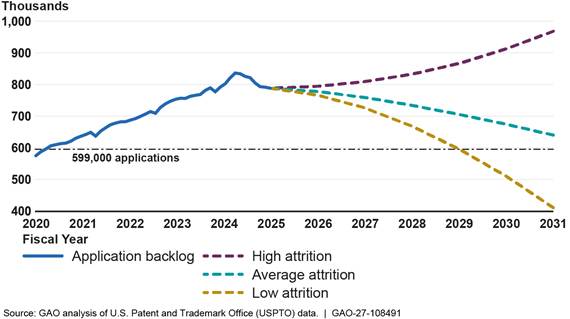
GAO’s analysis found that, even with examiners doing more work, the USPTO is unlikely to reduce the backlog to under 599,000 patent applications before 2031 without lowering examiner attrition (see figure). The examiner attrition rate increased from 2.9 percent in fiscal year 2020 to 7.6 percent in fiscal year 2025. The agency is seeking to hire more examiners, but if high examiner attrition continues, it will affect the USPTO’s ability to reduce the backlog. As of August 2026, the 12-month examiner attrition rate was 7.6 percent.
According to the stakeholders GAO interviewed, including the patent examiners’ union and former agency officials, the USPTO’s efforts to reduce the backlog may not be sustainable and could contribute to high attrition. Requiring examiners to review more applications and eliminating time for subject-matter training pose risks to the quality of examination. While the USPTO has expanded the use of AI tools, stakeholders told GAO these tools are not yet effective, because they do not reliably return useful patent search results. In addition, the USPTO paused a survey that provided the agency with stakeholder views on agency responsiveness and overall examination quality. Assessing and addressing risks to retention and examination quality could better position the USPTO to balance its efforts to reduce the backlog.
Why GAO Did This Study
The U.S. patent system encourages innovation by generally allowing a patent owner to exclude others from making, using, or selling patented inventions for up to 20 years. Patent examiners at the USPTO review applications to determine if the inventions meet legal patentability requirements.
The USPTO has long had a patent application backlog, and GAO reported in 2007 that the agency’s examiner hiring efforts were insufficient to address it. In recent years, the increase in the backlog has resulted in applicants waiting more than 20 months for an initial USPTO decision.
GAO was asked to review
factors related to the patent application backlog at the USPTO. This report
examines
(1) the USPTO’s current goals and efforts to reduce the backlog and
(2) what available data predict about the agency’s ability to achieve those
goals, stakeholder views on these efforts, and the extent to which the USPTO
assessed related risks.
GAO analyzed USPTO fiscal year 2020–2025 patent application and examiner data to estimate the future size of the backlog. GAO also analyzed federal workforce data on recent patent examiner attrition at the USPTO. GAO interviewed the patent examiners’ union, former USPTO officials, patent attorneys, trade associations, and researchers. GAO also sought information from the agency. The USPTO did not provide GAO with requested information.
What GAO Recommends
GAO recommends that the USPTO assess and address the risks that the agency’s backlog reduction efforts pose to patent examiner retention and examination quality. The USPTO did not provide comments.
Abbreviations
GS General Schedule
PTA patent term adjustment
RCE request for continued examination
UPR patent utility, plant, and reissue patent
USPTO United States Patent and Trademark Office
This is a work of the U.S. government and is not subject to copyright protection in the United States. The published product may be reproduced and distributed in its entirety without further permission from GAO. However, because this work may contain copyrighted images or other material, permission from the copyright holder may be necessary if you wish to reproduce this material separately.2.93 percent.
November 5, 2026
The Honorable Jamie Raskin
Ranking Member
Committee on the Judiciary
House of Representatives
The Honorable Henry C. “Hank” Johnson, Jr.
Ranking Member
Subcommittee on Courts, Intellectual Property, Artificial Intelligence, and the Internet
Committee on the Judiciary
House of Representatives
The U.S. patent system has long encouraged innovation and generally allows a patent owner to exclude others from making, using, or selling patented inventions for up to 20 years. Inventors wishing to patent an invention submit an application to the United States Patent and Trademark Office (USPTO), an agency in the Department of Commerce. A patent examiner then reviews the application to determine if the invention meets legal requirements for patentability.
Applicants have experienced long wait times for a patent examiner determination because the USPTO has hundreds of thousands of applications in its queue. The inventory of applications awaiting an initial USPTO decision (known as the backlog) grew from about 538,000 in fiscal year 2016 to 838,000 in January 2025 before declining to 756,000 in August 2026. Also, applicants have waited longer to receive the USPTO’s initial decision on their applications, with average wait times growing from 16 months in fiscal year 2016 to more than 20 months in August 2026. According to USPTO data, the increase in the backlog occurred even as the number of incoming applications remained steady at around 600,000 a year. Long wait times make it harder for inventors to raise capital for their businesses and to protect their inventions from competitors. The USPTO has long had a patent application backlog, and we reported in 2007 that the agency’s examiner hiring efforts at that time were insufficient to address it.[1]
You asked us to review factors related to the patent application backlog at the USPTO. This report examines (1) the USPTO’s current goals and efforts to reduce the backlog and (2) what available data predict about the agency’s ability to achieve those goals, stakeholder views on the potential effects of those efforts, and the extent to which the USPTO has assessed and addressed potential risks to examiner retention and examination quality.
For both objectives, we conducted 36 interviews with patent examiners, former USPTO officials, patent attorneys, companies, trade associations, and researchers. Patent examiners we interviewed were members of the Patent Office Professional Association, the patent examiners’ union. We reviewed congressional testimony and the USPTO’s public reports, budget submissions, statements, and presentations. To analyze what available data predict about the USPTO’s ability to achieve its backlog reduction goals, we developed a model forecasting three different scenarios in which the USPTO could reduce the backlog. The model used USPTO data for fiscal years 2020 through 2025 on utility, plant, and reissue (UPR) patent applications and examiners.[2] (For more information, see app. I.)
We also sought information from the USPTO. In a December 2025 letter, the USPTO’s General Counsel stated that the agency would not participate in this review due to its view that GAO does not have the necessary statutory authority to conduct audit work requested by ranking members of congressional committees. GAO has the authority to carry out this work at the USPTO. In particular, GAO has ample statutory authority to conduct audit work on the initiative of the Comptroller General under 31 U.S.C. § 717(b)(1), despite views expressed by the USPTO. This authority has long supported work conducted in response to requests from ranking members of congressional committees as recognized over decades by Congress and numerous administrations. Although the agency did not provide us with requested information in the course of our review, we provided a statement of facts to the USPTO in August 2026. We routinely provide statements of facts to agencies to confirm that key information used to formulate our analyses and findings is current, correct, and complete. The USPTO provided comments on the statement of facts, and we incorporated its comments as appropriate.
We conducted this performance audit from May 2025 to November 2026 in accordance with generally accepted government auditing standards. Those standards require that we plan and perform the audit to obtain sufficient, appropriate evidence to provide a reasonable basis for our findings and conclusions based on our audit objectives. We believe that the evidence obtained provides a reasonable basis for our findings and conclusions based on our audit objectives.
Background
Patent Application and Examination Process
|
Select Patentability Requirements To be eligible for a utility patent, which is the most common type of patent, an invention must meet the following requirements, among others: Novelty: The invention must be new. Nonobviousness: The invention cannot be an obvious extension of a previous invention. Usefulness: The invention (such as a process or machine) must operate to perform an intended purpose that has public benefit. Source: 35 U.S.C. §§ 101-03. | GAO‑27‑108491 |
The process of obtaining a patent generally begins when the applicant—or more commonly the applicant’s attorney or agent—submits an application to the USPTO. The USPTO reviews the application for completeness and classifies it based on subject matter.[3] The agency then places the application in a queue, where it can wait for months for examination to begin.
Examination begins once the USPTO assigns the application to an examiner at one of the agency’s technology centers.[4] The examiner reviews the application to determine if the invention meets patentability requirements (see sidebar). In carrying out examination, the examiner conducts a thorough investigation of prior art, which generally refers to information related to the subject matter of the invention available before the application was submitted.[5]
Examiners generally issue decisions, known as office actions, on the invention’s patentability, at two milestones: (1) first action, the examiner’s initial decision, and (2) final action, the examiner’s final decision. A USPTO office action is a written document provided to the applicant in which the patent examiner identifies and analyzes all issues in the application pertinent to patentability. Both first and final actions can be a notice of allowance or a rejection, unless the application is abandoned.[6]
If a patent application is rejected at final action, the applicant has an option to reopen examination by filing a request for continued examination (RCE). An RCE enables the applicant to submit new arguments, amendments, or evidence without filing a new application. Applicants can submit more than one RCE.[7]
Patent Application Backlog
The backlog is an inventory of applications awaiting a USPTO first action.[8] The size of the backlog affects the length of time (known as pendency) before the USPTO notifies the applicant of that action. Generally, the more applications in the backlog, the longer it takes the USPTO to assign an application to a patent examiner and the longer the applicant waits to receive the examiner’s first action (see fig. 1). We previously reported on the USPTO’s backlog in 2007.[9]
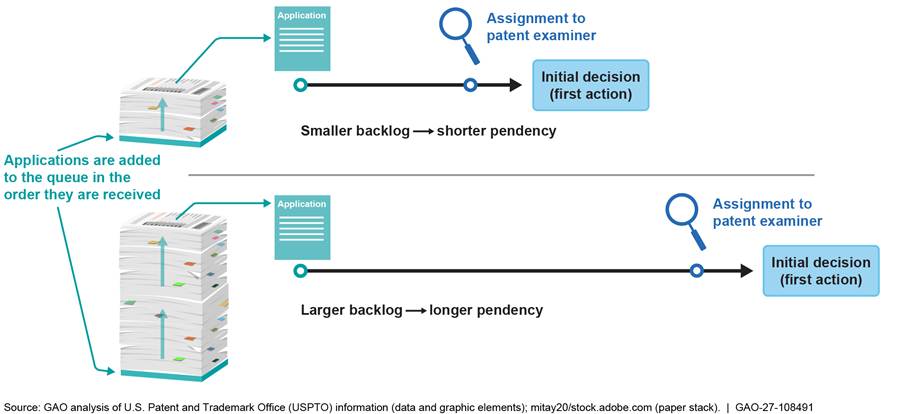
In August 2026, the backlog was at about 756,000 applications, the average first action pendency was 20.6 months, and the average total pendency was 29 months, according to USPTO data.[10] Once an application is assigned to a patent examiner, the applicant generally receives a first action within 2 to 3 months. This means that, as of August 2026, most applications were in the queue for about 18 months before being assigned to an examiner.[11] Because few first actions result in a notice of allowance, for most applicants it took at least 29 months to learn if they would be granted a patent.[12]
Patent Examination Capacity
The backlog indicates that the number of applications awaiting a decision exceeds the USPTO’s capacity to examine them. As shown in figure 2, in fiscal years 2016 through 2025, the annual number of application filings held relatively steady at about 600,000, according to USPTO data. During this period, the USPTO’s issuance of first actions fluctuated, but it increased in recent years from about 520,000 in fiscal year 2021 to nearly 586,000 in fiscal year 2025. At the same time, the backlog grew, reaching a high of about 838,000 applications in January 2025.
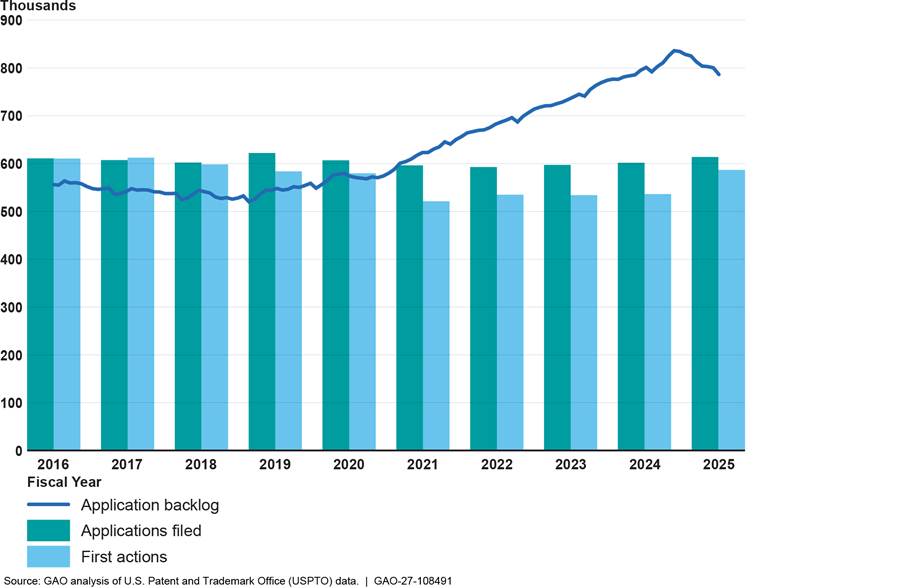
Note: The data represent utility, plant, and reissue patent applications. Applications filed include requests for continued examination (RCE) and first actions include RCE first actions. First actions are the USPTO’s initial decisions on patent applications.
The main factors that shape the USPTO’s examination capacity are the size and composition of the patent examiner workforce and the productivity of that workforce:
· Size and composition. The USPTO employed 8,872 patent examiners at the end of fiscal year 2025, according to agency data.[13] The workforce consists of junior examiners, primary examiners, and supervisory examiners.[14] Because patent examination is a highly specialized occupation, the USPTO typically hires new examiners at the junior level and trains them for the job. Generally, it takes 2 to 4 years to fully train a newly hired junior examiner.[15] The USPTO has faced high attrition among junior examiners in recent years. In fiscal years 2021 through 2023, the attrition rate among new examiners in their first year of employment was around 40 percent, according to USPTO data.
· Productivity. Productivity is the average output per examiner.[16] The USPTO establishes overall output goals for examiners, which determine an examiner’s workload and examination time per application. Examiners’ expected output is based on General Schedule (GS) grade and the technological complexity of the applications under review. Primary examiners are expected to review more applications and to conduct their examinations more quickly compared to junior examiners. Examiners in lower GS grades are allotted more time to examine an application than more experienced examiners in higher GS grades.
Balancing Examination Output and Quality
In April 2025, we reported on the USPTO’s efforts to address persistent examination and quality challenges.[17] We found that patent examiners had to prioritize examination output over examination quality and often worked during personal time, including while they were on vacation, to meet their output goals. Examiners also told us that patent applications had become more complex, and examiners had trouble getting additional time for reviewing applications when it was needed. They noted that they needed better training in relevant technology areas and sometimes experienced difficulty keeping up with the state of the prior art, which was important to their ability to perform high-quality examinations. We recommended that the USPTO take steps related to addressing patent examination challenges and strengthening examination quality.
The USPTO agreed with our recommendations. In its comments on our report, the USPTO acknowledged the need to balance timeliness with examination quality. The USPTO stated that while perfect patent quality seemed a laudable goal, if the USPTO could not issue a timely patent, the technology can turn stale and less marketable for the patent owner.
The USPTO also stated the agency increased examination time in fiscal year 2020 after completing a comprehensive study that reevaluated it in 2019. According to the USPTO, the reevaluation identified an imbalance that put examination quality at a disadvantage and accordingly examination time was increased.[18]
The USPTO Has a Goal to Reduce the Backlog by Requiring Examiners to Review More Applications and Through Hiring
In September 2025, the USPTO announced a goal to reduce the backlog to under 599,000 applications but did not specify a time frame for reaching it. The USPTO is requiring patent examiners to review more applications, has eliminated time for examiner subject-matter training, and is seeking to hire more examiners.
The USPTO Set a Goal to Reduce the Backlog to Under 599,000 Patent Applications
In 2025, the USPTO identified the reduction of the backlog and pendency as the agency’s most pressing challenge. In January 2025, the backlog reached about 838,000 applications. In September 2025, the USPTO announced a goal to reduce the backlog to under 599,000 patent applications but did not identify a time frame for reaching it.[19] In March 2026, the USPTO Director stated the agency’s intent was to reduce the backlog to about 688,000 applications by the end of fiscal year 2026.[20]
In September 2025, the USPTO also announced that it planned to reduce first action pendency to 12 months at some point in the future. In April 2026, the agency reported first action pendency goals through fiscal year 2031.[21] The USPTO projected that it may be able to reduce first action pendency to 12.7 months in 2031 and to 12 months after 2031 (see table 1).
|
USPTO goal |
Fiscal year |
|||||
|
2026 |
2027 |
2028 |
2029 |
2030 |
2031 |
|
|
Application backlog |
688,000 |
– |
– |
– |
– |
– |
|
First action pendency (months) |
20.2 |
18.1 |
16.0 |
14.8 |
13.7 |
12.7 |
|
Total pendency (months) |
28.1 |
25.5 |
23.5 |
21.5 |
20.6 |
19.6 |
Source: GAO analysis of information from the U.S. Patent and Trademark Office (USPTO). | GAO‑27‑108491
Note: First action pendency is the length of time between the application filing date and the date the applicant is notified of the USPTO’s initial decision. Total pendency is the length of time between the filing date and the date of final disposition (a patent is issued or the application is abandoned).
The USPTO’s overall backlog and pendency goals aim for levels not reached in several years. According to USPTO data for fiscal years 2016 through August of fiscal year 2026, the backlog was last under 599,000 applications in November 2020, and first action pendency has not been as low as 12 months in the past decade (see fig. 3).[22]
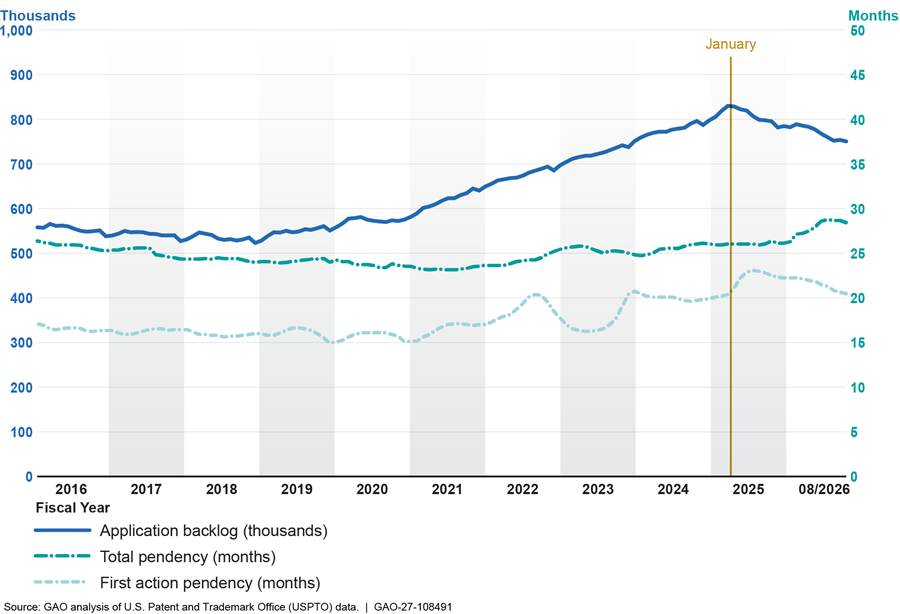
Note: The data represent utility, plant, and reissue patent applications. Total pendency is the length of time between the filing date and the date of final disposition (a patent is issued or the application is abandoned). First action pendency is the length of time between the application filing date and the date the applicant is notified of the USPTO’s initial decision.
Since January 2025, the agency has made some progress in reducing the backlog, but pendency has increased. From January 2025 through August 2026, the USPTO reduced its backlog from about 838,000 to 756,000 applications. During this period, first action pendency increased slightly from 20.5 to 20.6 months, and total pendency increased from 26.2 to 29.0 months.[23] According to the USPTO Director, pendency has increased because the agency has directed its efforts toward examining the backlog’s oldest applications, which skews the average pendency longer since such applications have a longer period from filing to first action.[24]
The USPTO Aims to Maximize Productivity and Hiring to Reduce the Backlog
Since January 2025, the USPTO is seeking to reduce the backlog and pendency through efforts intended to maximize patent examiner productivity and to hire more examiners.
Higher Productivity Expectations for Examiners
Since January 2025, the USPTO has taken several actions intended to maximize patent examiner productivity by changing examiner performance requirements and redirecting resources to examination activities. The agency raised output requirements in the examiner performance appraisal plan for fiscal year 2026.[25] According to this plan, examiners are required to do 5 percent more work than in fiscal year 2025 to meet the fully successful performance rating.[26] The Patent Office Professional Association estimated that the new output requirements add more than 2 additional weeks of work per year for each examiner and would lower the performance ratings of a significant percentage of the examiner workforce. The change in the examination output requirements reversed part of the increase in the examination time per application the agency implemented in fiscal year 2020. That increase in examination time was intended to help ensure examination quality.[27]
|
AI Tools for Patent Applicants and Examiners at the USPTO In January 2025, the USPTO announced a new AI strategy that describes the agency’s vision for harnessing AI to support its mission. Since then, the agency has developed new AI tools and expanded the use of existing ones to assist preexamination processes and patent examination. The agency’s AI initiatives include: · Artificial Intelligence Search Automated Pilot Program (also known as ASAP!), in which applicants may request automated search results related to prior art before examination begins; · Similarity Search tool, which provides examiners with a list of domestic and foreign patent documents that resemble the application being examined; and · Searching, Consolidating, Outlining and Understanding Tool (also known as SCOUT), an AI platform designed to assist USPTO staff with such tasks as responding to general knowledge questions, problem-solving, coding, and analytical work. Source: GAO analysis of U.S. Patent and Trademark Office (USPTO) documents. | GAO‑27‑108491 |
The USPTO eliminated time examiners are allowed for subject-matter training. Previously, each examiner had a bank of 25 hours annually for training, which enabled them to stay abreast of scientific and technological developments. Since March 2025, examiners have been expected to spend that time conducting examination, according to the Patent Office Professional Association. This means that if examiners want to maintain their knowledge of new scientific literature and pursue other subject-matter training, they would do so on their personal time. According to the USPTO, examiners are expected to search for and read technical literature related to applications under review while they conduct examination.
Other actions the USPTO took to reduce the backlog include:
· Limiting patent examiners to 1 hour for preparing and conducting an interview with an applicant without supervisory approval;
· Offering a bonus to examiners who volunteer to conduct additional examinations in technology areas with the largest unexamined application inventories;[28] and
· Investing in AI to help examiners identify prior art more efficiently (see sidebar).[29]
Hiring
The USPTO was under a hiring freeze from January 28, 2025, through June 13, 2025, when it posted junior examiner vacancies in multiple science and engineering disciplines.[30] The agency announced plans in August 2025 to hire 1,100 examiners before the end of calendar year 2025 and again posted junior examiner vacancies in science and engineering in September 2025.[31] In March 2026, the USPTO announced plans to hire more than 900 additional examiners in science and engineering by October 2026.
During the hiring freeze, the USPTO canceled remote work for patent examiners who were in probationary status as of April 2025.[32] These examiners and those hired after the hiring freeze at the USPTO ended in June 2025 were required to work in person at the USPTO headquarters in Alexandria, Virginia. Prior to this change, new examiners were recruited nationwide and were eligible for remote work.
The agency’s hiring in 2025 and 2026 replaces, in part, examiners who have left or had their job offers rescinded since January 2025. After the hiring freeze was lifted, the USPTO hired 1,054 examiners beginning in August 2025 through June 2026, according to agency data. However, USPTO data show that 1,209 examiners separated from the agency from February 2025 through June 2026. The USPTO offered several voluntary separation opportunities in 2025.[33] In addition, during the hiring freeze, the USPTO rescinded job offers made before the freeze.
USPTO Efforts to Reduce the Backlog May Not Be Sustainable and Could Pose Risks to Examination Quality
In our forecast model, we found that, even with increased examiner productivity, the USPTO is unlikely to reduce the backlog to under 599,000 patent applications before 2031 without retaining more examiners. According to stakeholders, various factors, including the USPTO’s efforts to reduce the backlog, could further strain the examiner workforce and contribute to high attrition rates. In addition, these factors pose risks to examination quality, and the USPTO has paused or stopped some efforts that provided useful information for assessing and addressing such risks.
The USPTO Is Unlikely to Achieve Its Backlog Goal Before 2031 Without Retaining More Patent Examiners
We modeled three possible scenarios to forecast the size of the patent application backlog beginning in fiscal year 2026 and found that examiner attrition was a key factor in how long it will take for the USPTO to reduce the backlog.[34] The examiner attrition rate rose from 2.9 percent in fiscal year 2020 to 7.6 percent in fiscal year 2025, and the average attrition rate during this period was 4.8 percent, according to USPTO data. Our analysis found that if the USPTO maintains average hiring and the highest examiner productivity observed in fiscal years 2020 through 2025, it would need to reduce examiner attrition below 4.8 percent to be able to reduce the backlog to under 599,000 applications by 2031 (see fig. 4).[35]
Figure 4: Forecast of the USPTO’s Backlog Through Fiscal Year 2031, Assuming the Average Hiring and High Productivity Observed in Fiscal Years 2020–2025
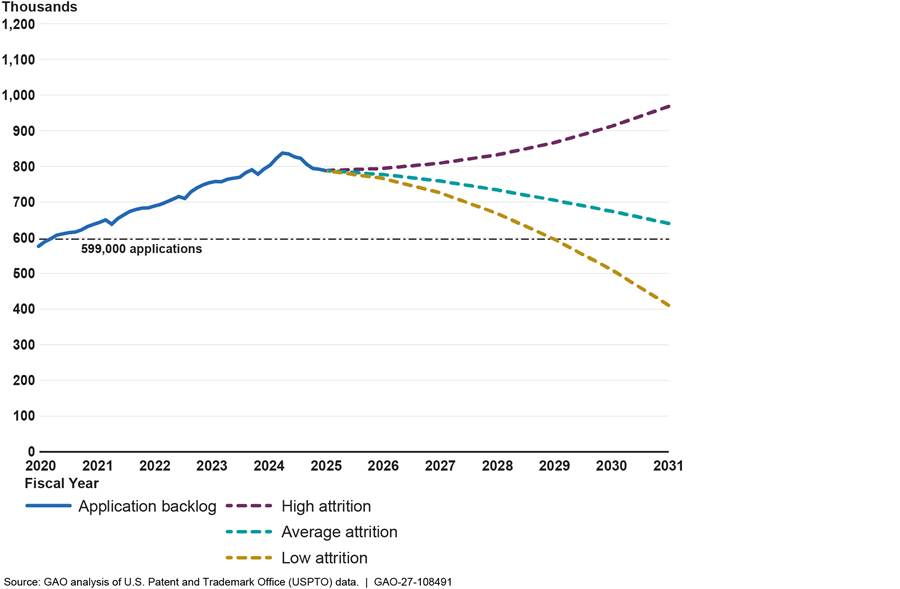
Note: The data represent utility, plant, and reissue patent applications. The three examiner attrition rates are derived from USPTO data for fiscal years 2020 through 2025. During this period, the high, average, and low attrition rates were, respectively, 7.6 percent, 4.8 percent, and 2.9 percent.
The USPTO has continued to face higher than average attrition in recent months, according to several indicators. As of August 2026, the average 12-month examiner attrition rate was 7.6 percent, according to USPTO data.[36] Data from the Office of Personnel Management show that both junior and senior examiners left the agency during that time. Examiners who separated from the USPTO from January 2025 through March 2026 include at least 229 senior examiners in GS-14 and GS-15 grades, according to Office of Personnel Management data.[37] The average tenure of examiners at five technology centers decreased by more than a year since April 2024, according to our analysis of USPTO data.[38]
Stakeholders Noted Various Factors That Could Further Strain the Examiner Workforce
In April 2025, we reported on patent examiners’ views on their workload. During that review, patent examiners told us that they were under pressure to complete work quickly and often had to work unpaid overtime to meet their minimum output requirements.[39] According to the Patent Office Professional Association and former USPTO officials, policy changes introduced by the agency since January 2025 have added further strain to the examiner workforce:
|
AI Tools for Patent Examination Are Not Yet Effective In recent years, the U.S. Patent and Trademark Office (USPTO) introduced AI tools to improve examination efficiency. However, examiners and applicants we interviewed stated those tools were not yet effective. According to the Patent Office Professional Association, the Similarity Search tool examiners were required to use resulted in them spending more time searching for prior art. This is because the tool generated incomplete results, and examiners had to conduct full searches without the tool. Similarly, one applicant we spoke to who had participated in the AI Search Automated Pilot (which ended June 1, 2026) said the search produced results that were irrelevant to the patent application. A former official said the pilot was unlikely to provide benefits to applicants. Some stakeholders, including an industry association representative, noted that examiners still need to verify the search results, which takes time. Additionally, in its most recently published report, the USPTO’s Patent Public Advisory Committee advised that as the use of AI grows at the USPTO, additional training of examiners will be essential to ensure the agency continues to issue quality patents. Source: GAO analysis of interviews with stakeholders and U.S. Patent and Trademark Office, Patent Public Advisory Committee 2024 Annual Report (Nov. 1, 2024). | GAO‑27‑108491 |
· Increased workloads. Members of the Patent Office Professional Association we interviewed told us that examiners have to work unpaid overtime to meet the new output requirements the agency implemented for examiners for fiscal year 2026. As previously noted, they said that the USPTO’s new requirements add more than 2 additional weeks of work per year for each examiner. In addition, they said if an examiner fails to meet a deadline for even one examination, it could result in a lower performance rating and the possibility of termination. According to the USPTO, a timeliness requirement was added to the fiscal year 2026 performance appraisal plan in April 2026 but is not being used to rate examiner performance in fiscal year 2026. However, pressure to meet the new output requirements has resulted in more examiners leaving the agency and fewer seeking promotion to grades where output expectations would be even higher, according to the Patent Office Professional Association. While AI holds potential to aid examiners in their work, examiners are learning how to incorporate new AI tools into their work (see sidebar). The Patent Office Professional Association also told us the USPTO added new administrative duties which examiners did not previously have. For example, examiners are asked to verify fee payment for some applications and have not been given time to complete these additional tasks.
· Reduced workplace flexibility. Stakeholders, including attorneys, academics, and one former USPTO official, said the agency’s reduced use of remote work makes it harder for the USPTO to recruit and retain employees.[40] Several stakeholders said remote work—which the USPTO first implemented in 1997—has improved the agency’s ability to compete with the private sector’s higher salaries for candidates with advanced technology skills.[41] Many employees working within a 50-mile radius of the USPTO headquarters in Alexandria, Virginia, are required to work at that office, as are all newly hired examiners, and this further limits the pool of qualified applicants the agency can hire, according to stakeholders.[42]
· Eliminated subject-matter training. As a knowledge-intensive occupation, patent examination relies heavily on specialized technical skills, complex problem-solving, and continuous learning. According to the Patent Office Professional Association, in March 2025 the USPTO eliminated the time examiners are allowed for training other than initial onboarding training for new hires. Examiners need time for training because technologies and patent law evolve. Previously, each examiner had a bank of 25 hours annually for training. We reported in April 2025 that examiners had found training inadequate for staying abreast of the latest technology trends.[43] In addition, three former officials said that, based on their experience while at the USPTO, they expected that emphasizing productivity at the expense of training or reading recent scientific literature would result in lower examination quality. One of these officials told us that cutting time for these activities could result in examiners being less familiar with scientific and technological advancements, a familiarity that is important for effective patent examination.
· Shortened initial training for new examiners. In a June 2025 USPTO webinar, agency officials said the USPTO reduced new examiners’ initial training from 16 to 8 weeks to more quickly assign them to technology centers where they receive on-the-job training from their supervisors.[44] However, members of the Patent Office Professional Association we spoke to said that because of increased output requirements, experienced examiners have less time to devote to training and mentoring new employees. They said that without sufficient access to training from experienced examiners, including supervisors, new examiners could find it difficult to succeed and be more likely to leave the agency.
USPTO Emphasis on Examiner Output and Other Factors Pose Risks to Examination Quality and Examiner Retention
Several factors associated with the USPTO’s backlog reduction efforts, such as its emphasis on examiner output and decreased training, pose risks to examination quality and examiner retention. The USPTO takes various steps to review and monitor examination quality, including reviews of examiners’ work by supervisors and by the Office of Patent Quality Assurance for compliance and quality.[45] The USPTO has also used several mechanisms to obtain internal information and external stakeholder input that have helped the agency stay abreast of trends in examination quality. More specifically, the agency has regularly surveyed patent examiners and patent applicants and convened meetings of its Public Patent Advisory Committee to obtain insights from internal and external stakeholders’ perceptions of quality. However, since January 2025, the USPTO paused or eliminated some of these efforts, and it is unclear whether or how the agency plans to restart these efforts or use other mechanisms to obtain information to help inform considerations of examination quality. For example:
· Internal and external quality surveys. In 2006, the USPTO developed semiannual surveys to obtain perspectives from patent examiners on factors affecting the quality of patent examinations (internal survey) and from patent applicants on the quality of patent examiners’ decisions (external survey). These surveys have served as an important indicator of quality, according to the agency’s website. For example, the internal survey has provided information on the training, tools, and coaching that affects examiners’ ability to provide high-quality examination. External survey results have provided the agency’s leadership with metrics on patent applicants’ satisfaction with the agency’s responsiveness and the overall quality of patent examination. However, the USPTO has not published survey results and analyses of survey findings since 2024. According to USPTO officials, following a review of cost effectiveness by the Department of Commerce in fiscal year 2025, the USPTO administered the fiscal year 2026 internal and external surveys themselves, rather than using contractors, and completed data collection in September 2026.[46] The agency paused the external survey prior to administering it in 2026.[47] However, the USPTO did not provide us with information on when the agency planned to publish survey results or whether it would use the results to inform any assessments of examination quality.
· Quality reviews to inform examiner training. The USPTO’s Office of Patent Quality Assurance assesses and analyzes examination quality. To do so, it reviews examiners’ work for statutory compliance and clarity, defines and standardizes quality metrics, and provides feedback to technology centers based on the results of its quality reviews to facilitate training opportunities for examiners, among other things.[48] However, the Patent Office Professional Association stated the agency was no longer using the results of examination quality reviews to train examiners, and the USPTO did not provide us with information on the extent to which it uses quality reviews to inform examiner training.
· Public Patent Advisory Committee meetings. Established in 1999, the Public Patent Advisory Committee has traditionally provided the USPTO with input from the stakeholders on the effectiveness of its policies and initiatives, including on the quality and timeliness of patent examination. Members represented inventors, patent holders, entrepreneurs, businesses, and the examiner workforce. The committee met 26 times in 2023 and 2024, and met twice between January 2025 and August 2026.[49] The USPTO did not provide us with information on the change in frequency of these committee meetings or any plans for future meetings.
Without these mechanisms, the USPTO may be missing opportunities to obtain information on potential risks to examination quality, such as insights from examiners on the training they receive for conducting examinations and perspectives from external stakeholders on examination processes and quality, including perspectives from applicants directly affected by examinations.
Some stakeholders we interviewed also expressed concern that the USPTO’s emphasis on increasing examiner output, in addition to other factors, poses risks to examination quality. As we previously reported, examiners had told us before the current requirements were introduced that the increasing complexity of patent applications and the growing body of prior art contributed to time pressures that made it more difficult to conduct thorough searches of prior art.[50] For this report, the Patent Office Professional Association told us examiners did not have time to perform high-quality examination. According to the association, due to higher output requirements, examiners are unable to fully analyze evidence before making a decision on an application, which can reduce the quality of examinations. In addition, representatives of three companies and industry associations also told us that reducing time for examiners to conduct interviews raised concerns because it curtailed opportunities for applicants to exchange information with examiners that could help resolve issues and result in fewer rejections.[51]
In interviews with us, representatives of companies and industry associations said they were concerned about the agency’s focus on examination output. They and other stakeholders said quality of examination was more important than reducing the backlog or pendency because lower quality reviews result in more time and greater expense for the applicant. In addition, four stakeholders we spoke to, including representatives of one industry group, said long examination time was not a major concern and can even be helpful in allowing a company the time to adjust its patent strategy as technology develops. At the end of fiscal year 2024, external stakeholder satisfaction with overall examination quality (at 61 percent) was lower than satisfaction with timeliness of agency written actions (68–75 percent).[52]
In addition, as previously discussed, stakeholders we interviewed identified factors, such as increased workloads and reduced workplace flexibility and training, that could strain the examiner focus. Stakeholders noted that these factors could also pose risks to examiner retention. For example, two former officials said that reducing training time contributes to attrition. High attrition, particularly among more experienced examiners, can affect examination quality by, for example, reducing the amount of technical expertise of the examiner workforce. The 229 senior examiners who separated from the USPTO from January 2025 through March 2026 were among the most experienced examiners.[53] New employees, on the other hand, need time to develop the examination skills that develop over years of experience and continued training, according to USPTO documents. As noted above, experienced examiners provide training and mentoring that help new examiners develop these skills.
Standards for Internal Control in the Federal Government state that agencies should identify, analyze, and respond to risks related to achieving defined objectives.[54] Risk is the possibility that an event will occur and adversely affect the achievement of objectives. The USPTO’s backlog reduction efforts pose risks to examiner retention and could leave less time for high-quality examination. In addition, our analysis found that lowering the patent examiner attrition rate is essential to reducing the backlog by 2031. The USPTO has not provided us with information to demonstrate that it is taking steps to address these risks and has eliminated sources of information to help understand them. Taking steps to assess and address these risks could help better position the USPTO to balance its efforts to reduce the backlog and pendency while maintaining examination quality and supporting examiner retention.
Conclusions
Timely patent examination can spur job creation and innovation. However, the USPTO’s efforts to reduce the backlog by maximizing output may not be sustainable if they result in higher examiner attrition or lead to lower examination quality.
The USPTO has not demonstrated that it has identified, analyzed, or responded to risks of pursuing a maximum reduction in the patent application backlog. Assessing and addressing the risks posed by its efforts to pursue this goal could help better position the USPTO to retain its patent examiner workforce and maintain examination quality.
Recommendation for Executive Action
The Director of the USPTO should assess and address the risks that the agency’s backlog reduction efforts pose to patent examiner retention and examination quality. (Recommendation 1)
Agency Comments
We provided a draft of this report to the Department of Commerce and the USPTO for review and comment. The USPTO did not provide comments on the report.
We are sending copies of this report to the appropriate congressional committees, the Secretary of Commerce, and the Director of the USPTO. In addition, the report will be available at no charge on the GAO website at http://www.gao.gov.
If you or your staff have questions about this report, please contact me at WrightC@gao.gov. Contact points for our Offices of Congressional Relations and Media Relations may be found on the last page of this report. GAO staff who made key contributions to this report are listed in appendix III.
Candice N. Wright
Director
Science, Technology Assessment, and Analytics
This report examines (1) the current goals and efforts at the U.S. Patent and Trademark Office (USPTO) to reduce the patent application backlog and (2) what available data predict about the agency’s ability to achieve those goals, stakeholder views on the potential effects of those efforts, and the extent to which the USPTO has assessed and addressed potential risks to examiner retention and examination quality.
To obtain information on the patent application and examination process and factors contributing to application backlogs at patent offices, we worked with a GAO research librarian to conduct a literature search. We also used the search to identify additional studies as well as researchers whose academic work related closely to our reporting objectives. In total, we reviewed 25 studies published from 2011 through 2025 for background research.
For both objectives, we conducted 36 interviews with patent examiners, former USPTO officials, patent attorneys representing large and small entities that applied for patents, companies, trade associations, and researchers. Patent examiners we interviewed were members of the Patent Office Professional Association, the patent examiners’ union.
We also sought information from the USPTO. In a December 2025 letter, the USPTO’s General Counsel stated that the agency would not participate in this review due to its view that GAO does not have the necessary statutory authority to conduct audit work requested by ranking members of congressional committees. GAO has the authority to carry out this work at the USPTO. In particular, GAO has ample statutory authority to conduct audit work on the initiative of the Comptroller General under 31 U.S.C. § 717(b)(1), despite views expressed by the USPTO. This authority has long supported work conducted in response to requests from ranking members of congressional committees as recognized over decades by Congress and numerous administrations. Although the agency did not provide us with requested information in the course of our review, we provided a statement of facts to the USPTO in August 2026. We routinely provide statements of facts to agencies to confirm that key information used to formulate our analyses and findings is current, correct, and complete. The USPTO provided comments on the statement of facts, and we incorporated its comments as appropriate.
To examine USPTO goals and efforts to reduce the backlog, we reviewed congressional testimony by USPTO officials and the agency’s public reports, budget submissions, statements, and presentations.[55]
To analyze what available data predict about the agency’s ability to achieve its backlog reduction goals, we developed a model forecasting three different scenarios in which the USPTO could reduce the backlog. The model uses public USPTO data for fiscal years 2020 through 2025 on utility, plant, and reissue patent applications and examiners. In particular, the model uses data on annual patent application filings, first actions, and year-end examiner staffing counts from the USPTO’s workload tables that accompany annual reports.[56] Additional data on the year-end backlog as well as annual examiner hiring and attrition come from USPTO technology center data and the Patents Dashboard.[57]
In each scenario, we assume the backlog evolves according to the following equation:

The equation states that the backlog at the end of each fiscal year equals the prior year’s backlog, plus new application filings, minus first actions and preexamination abandonments:[58]
· The
initial backlog,  , is set equal to the observed
fiscal year 2025 year-end value (788,229 utility, plant, and reissue patent
applications).
· Annual filings are assumed to equal values predicted by the USPTO in its fiscal year 2027 congressional budget submission.
· First actions are modeled as a function of examiner productivity and staffing levels.
o Productivity is defined as the number of first actions per examiner in each fiscal year. This measure is calculated for each fiscal year from 2020 through 2025 using the total number of first actions and year-end examiner staff counts. Scenarios 1 and 3 assume average productivity of 66.23 first actions per examiner observed in fiscal years 2020 through 2025, whereas Scenario 2 assumes the highest productivity of 70.32 first actions per examiner observed in fiscal year 2020.
o The number of examiners in each future year is projected as the prior year’s number of examiners plus new hires, minus attrition. Scenarios 1 and 2 assume annual hires to be equal to the average for fiscal years 2020 through 2025 (666 annual new hires), whereas Scenario 3 assumes a 20 percent increase relative to that average (800 annual new hires). Attrition counts are calculated by multiplying a constant assumed attrition rate by the number of prior year examiners. The attrition is assumed to equal one of three annual attrition rates observed in fiscal years 2020 through 2025: the low rate of 2.93 percent observed in fiscal year 2020, the high rate of 7.56 percent observed in fiscal year 2025, or the average rate of 4.75 percent for fiscal years 2020 through 2025.
o Total first actions are calculated as examiner-level productivity multiplied by the number of examiners.
· Preexamination abandonments were not directly observed and are instead inferred using the above backlog equation for fiscal years 2020 through 2025, where all other components are known. Specifically, abandonments are calculated as the residual required for the equation to match observed backlog levels. The average annual value over this period (13,083 applications) is used as a constant assumption in the model.
All backlog forecasting was conducted for utility, plant, and reissue patent applications for the analysis period of fiscal years 2026 through 2031.
To assess the reliability of these data, we conducted manual testing of the data, reviewed related documentation, and spoke with one knowledgeable former official to discuss the data and its suitability for our analysis. We determined the data to be reliable for the purposes of modeling our three scenarios for reducing the backlog.
We used federal workforce data from the Office of Personnel Management to analyze recent patent examiner separations by GS grade at the USPTO. We also obtained data from Lexis-Nexis IP Solutions, which we used for exploratory purposes to develop a better understanding of patent examiner output by grade.
We conducted this performance audit from May 2025 to November 2026 in accordance with generally accepted government auditing standards. Those standards require that we plan and perform the audit to obtain sufficient, appropriate evidence to provide a reasonable basis for our findings and conclusions based on our audit objectives. We believe that the evidence obtained provides a reasonable basis for our findings and conclusions based on our audit objectives.
We developed three scenarios to forecast the size of the patent application backlog at the U.S. Patent and Trademark Office (USPTO) in future years beginning with fiscal year 2026. Each scenario uses different assumptions about examiner hiring and productivity (defined as the annual number of first actions per examiner) informed by USPTO data for fiscal years 2020 through 2025 on utility, plant, and reissue (UPR) patent applications and examiners.[59] First, we project the size of the UPR examiner workforce in future years. Then, based on the size of the UPR examiner workforce in USPTO data for fiscal years 2020 through 2025, we forecast the effect of examiner attrition rates on the UPR application backlog.[60]
For all scenarios, changes in the backlog are driven by the size of the patent examiner workforce. As the workforce grows, there is a point at which the examiners collectively produce more first actions than new application filings are added to the queue, and the backlog decreases.[61] We present the assumptions and results of each scenario in tables and figures below.
|
Scenario 1: Fiscal year 2020–2025 averages |
Scenario 2: Average hiring and high productivity |
Scenario 3: Increased hiring and average productivity |
|
Hiring and productivity assumptionsa |
||
|
Annual hiring and productivity will continue at levels equal to the fiscal year 2020–2025 averages: 666 new examiners and 66.23 first actions per examiner, respectively. |
The same average annual hiring as Scenario 1 (666 new examiners) and the highest annual productivity achieved in fiscal years 2020–2025 (70.32 first actions per examiner). |
Annual hiring 20 percent higher than the fiscal year 2020–2025 average (800 new examiners) and average fiscal year 2020–2025 annual productivity (66.23 first actions per examiner per year). |
|
Summary of results |
||
|
The future backlog is highly dependent on the examiner attrition rate. The USPTO would not reach the backlog goal before 2031. |
The USPTO may be able to reach the backlog goal by fiscal year 2029, if it reduces examiner attrition to the lowest assumed rate. |
The USPTO may be able to reach the backlog goal by fiscal year 2031, if it reduces examiner attrition to the lowest assumed rate. |
|
Effect of examiner attrition on the backlog sizeb |
||
|
Average attrition: The examiner workforce grows by approximately 200–250 examiners (2–3 percent) per year. However, with the average examiner productivity, the increase in the number of examiners is not sufficient to keep up with new application filings. The backlog gradually increases, rising to about 870,000 by fiscal year 2031—a 10.4 percent increase relative to fiscal year 2025. |
Average attrition: The backlog gradually declines to approximately 640,000 applications by fiscal year 2031. |
Average attrition: The increase in hiring is not enough to curtail immediate growth in the backlog. The backlog grows to more than 800,000 applications by fiscal year 2027 before gradually declining. However, the backlog remains above 599,000 in fiscal year 2031. |
|
Low attrition: The examiner workforce grows by 3.5–5 percent per year, which allows the USPTO to examine more applications than are received as new filings. In fiscal year 2031, the backlog drops to about 650,000—a 17 percent reduction relative to fiscal year 2025. |
Low attrition: The combination of increasing productivity and retaining more examiners results in the backlog declining to under 599,000 by fiscal year 2029. |
Low attrition: The combination of increased hiring and retaining more examiners results in the backlog declining to under 599,000 applications by fiscal year 2030. |
|
High attrition: The size of the examiner workforce remains largely stagnant at the fiscal year 2025 level and is not sufficient to keep pace with the increasing number of new filings, with the backlog growing to over 1 million applications by fiscal year 2029. |
High attrition: The backlog continues to grow even with high productivity, exceeding 900,000 applications by fiscal year 2030. |
High attrition: The backlog continues to grow even with the increase in hiring, exceeding 1 million applications in fiscal year 2031. |
Source: GAO analysis of U.S. Patent and Trademark Office (USPTO) data. | GAO‑27‑108491
Notes: The data represent utility, plant, and reissue patent applications and examiners.
aThe hiring and productivity assumptions in our analysis are informed by USPTO data for fiscal years 2020 through 2025. During this period, average annual hiring was 666 new examiners and average annual productivity was 66.23 first actions per examiner. The highest productivity at 70.32 first actions per examiner was observed in fiscal year 2020. USPTO data on first actions include first actions for requests for continued examination. We modeled an additional scenario based on the USPTO’s recent examiner hiring: the agency hired 1,054 examiners from August 2025 through June 2026. Assuming the agency could maintain this hiring level, average attrition, and average productivity, our model predicts the backlog would remain above the goal of 599,000 applications until 2030.
bThe three attrition rates in our analysis are informed by USPTO data for fiscal years 2020 through 2025. During this period, the annual attrition rate among examiners ranged from the low of 2.93 percent in fiscal year 2020 to the high of 7.56 percent in fiscal year 2025. The average annual attrition rate among examiners for this period was 4.75 percent.
Figure 5 and table 3 show the results of Scenario 1.
Figure 5: Scenario 1—Forecast of the USPTO’s Backlog Size Through Fiscal Year 2031, Assuming Average Hiring and Productivity Observed in Fiscal Years 2020–2025
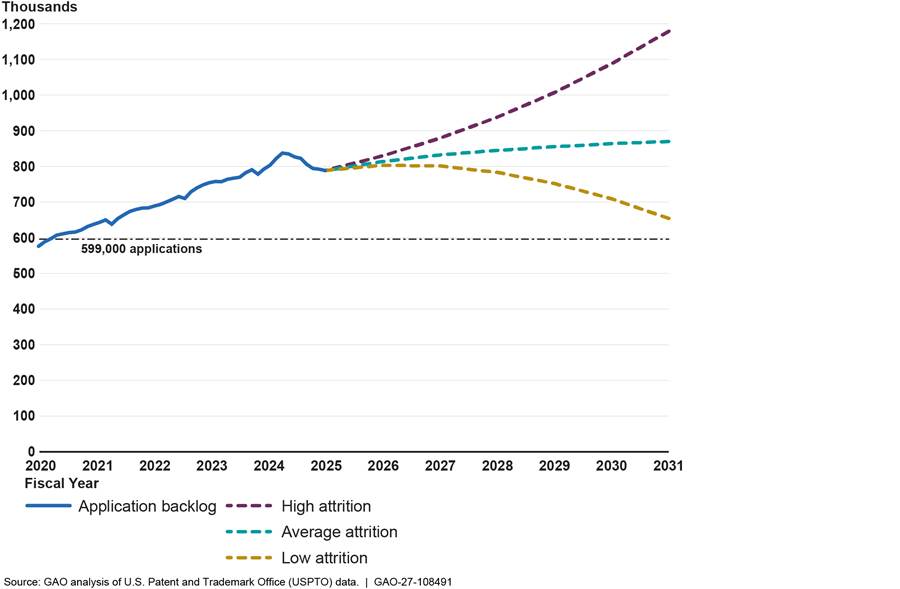
Note: The data represent utility, plant, and reissue patent applications and examiners. The three examiner attrition rates are derived from USPTO data for fiscal years 2020 through 2025. During this period, the high, average, and low attrition rates were, respectively, 7.56 percent, 4.75 percent, and 2.93 percent.
Table 3: Results of Scenario 1—Forecast of the USPTO’s Backlog Size Through Fiscal Year 2031, Assuming Average Hiring and Productivity Observed in Fiscal Years 2020–2025
|
|
Backlog size if examiner attrition is: |
||
|
Fiscal year |
Low |
Average |
High |
|
2026 |
803,120 |
813,402 |
829,253 |
|
2027 |
801,225 |
832,085 |
878,926 |
|
2028 |
783,328 |
845,061 |
937,350 |
|
2029 |
752,191 |
855,077 |
1,006,619 |
|
2030 |
709,554 |
863,843 |
1,087,821 |
|
2031 |
654,135 |
870,037 |
1,179,036 |
Source: GAO analysis of U.S. Patent and Trademark Office (USPTO) data. | GAO‑27‑108491
Note: The data represent utility, plant, and reissue patent applications and examiners. The three examiner attrition rates are derived from USPTO data for fiscal years 2020 through 2025. During this period, the high, average, and low attrition rates were, respectively, 7.56 percent, 4.75 percent, and 2.93 percent.
Figure 6 and table 4 show the results of Scenario 2.
Figure 6: Scenario 2—Forecast of the USPTO’s Backlog Size Through Fiscal Year 2031, Assuming the Average Hiring and High Productivity Observed in Fiscal Years 2020–2025
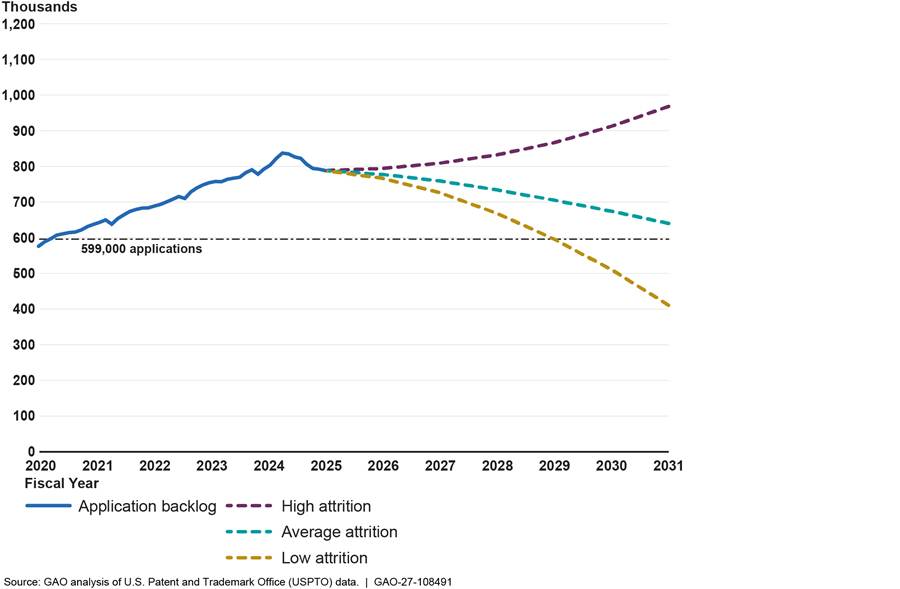
Note: The data represent utility, plant, and reissue patent applications and examiners. The three examiner attrition rates are derived from USPTO data for fiscal years 2020 through 2025. During this period, the high, average, and low attrition rates were, respectively, 7.56 percent, 4.75 percent, and 2.93 percent.
Table 4: Results of Scenario 2—Forecast of the USPTO’s Backlog Size Through Fiscal Year 2031, Assuming the Average Hiring and High Productivity Observed in Fiscal Years 2020–2025
|
|
Backlog size if examiner attrition is: |
||
|
Fiscal year |
Low |
Average |
High |
|
2026 |
766,543 |
777,461 |
794,291 |
|
2027 |
726,416 |
759,183 |
808,918 |
|
2028 |
668,682 |
734,229 |
832,220 |
|
2029 |
596,148 |
705,390 |
866,295 |
|
2030 |
510,600 |
674,421 |
912,237 |
|
2031 |
410,801 |
640,042 |
968,131 |
Source: GAO analysis of U.S. Patent and Trademark Office (USPTO) data. | GAO‑27‑108491
Note: The data represent utility, plant, and reissue patent applications and examiners. The three examiner attrition rates are derived from USPTO data for fiscal years 2020 through 2025. During this period, the high, average, and low attrition rates were, respectively, 7.56 percent, 4.75 percent, and 2.93 percent.
Figure 7 and table 5 show the results of Scenario 3.
Figure 7: Scenario 3—Forecast of the USPTO’s Backlog Through Fiscal Year 2031, Assuming an Increase in Hiring and the Average Productivity Observed in Fiscal Years 2020–2025
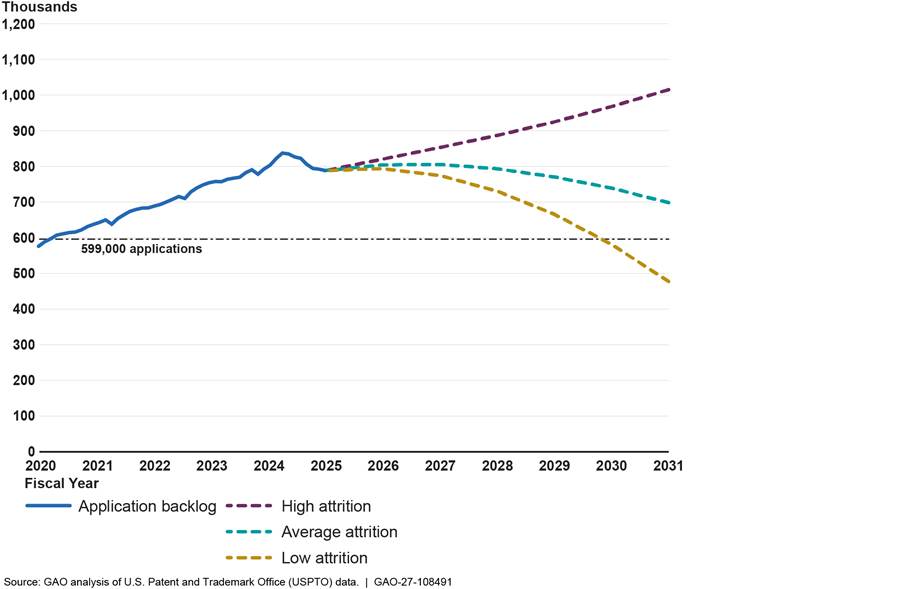
Note: The data represent utility, plant, and reissue patent applications and examiners. The three examiner attrition rates are derived from USPTO data for fiscal years 2020 through 2025. During this period, the high, average, and low attrition rates were, respectively, 7.56 percent, 4.75 percent, and 2.93 percent.
Table 5: Results of Scenario 3—Forecast of the USPTO’s Backlog Through Fiscal Year 2031, Assuming an Increase in Hiring and the Average Productivity Observed in Fiscal Years 2020–2025
|
|
Backlog size if examiner attrition is: |
||
|
Fiscal year |
Low |
Average |
High |
|
2026 |
794,293 |
804,576 |
820,427 |
|
2027 |
775,004 |
806,025 |
853,114 |
|
2028 |
731,395 |
793,760 |
887,009 |
|
2029 |
666,474 |
770,907 |
924,778 |
|
2030 |
582,216 |
739,540 |
968,034 |
|
2031 |
477,569 |
698,681 |
1,015,346 |
Source: GAO analysis of U.S. Patent and Trademark Office (USPTO) data. | GAO‑27‑108491
Note: The data represent utility, plant, and reissue patent applications and examiners. The three examiner attrition rates are derived from USPTO data for fiscal years 2020 through 2025. During this period, the high, average, and low attrition rates were, respectively, 7.56 percent, 4.75 percent, and
GAO Contact
Candice N. Wright, WrightC@gao.gov.
Staff Acknowledgments
In addition to the contact named above, Robert J. Marek (Assistant Director), Sada Aksartova (Analyst in Charge), Jeffrey Rueckhaus, Lauren Gomez, Angela Marler, Michael Walton, Alec McQuilkin, John Bornmann, Patrick Harner, Victoria Aysola, and Joseph Rando made key contributions to this report.
The Government Accountability Office, the audit, evaluation, and investigative arm of Congress, exists to support Congress in meeting its constitutional responsibilities and to help improve the performance and accountability of the federal government for the American people. GAO examines the use of public funds; evaluates federal programs and policies; and provides analyses, recommendations, and other assistance to help Congress make informed oversight, policy, and funding decisions. GAO’s commitment to good government is reflected in its core values of accountability, integrity, and reliability.
Obtaining Copies of GAO Reports and Testimony
The fastest and easiest way to obtain copies of GAO documents at no cost is through our website. Each weekday, GAO posts on its website newly released reports, testimonies, and correspondence. You can also subscribe to GAO’s email updates to receive notification of newly posted products.
Connect with GAO
Connect with GAO on X,
LinkedIn, Instagram, and YouTube.
Subscribe to our Email Updates. Listen to our Podcasts.
Visit GAO on the web at https://www.gao.gov.
To Report Fraud, Waste, and Abuse in Federal Programs
Contact FraudNet:
Website: https://www.gao.gov/about/what-gao-does/fraudnet
Automated answering system: (800) 424-5454
Media Relations
Sarah Kaczmarek, Managing Director, Media@gao.gov
Congressional Relations
David A. Powner, Acting Managing Director, CongRel@gao.gov
General Inquiries
[1]GAO, U.S. Patent and Trademark Office: Hiring Efforts Are Not Sufficient to Reduce the Patent Application Backlog, GAO‑07‑1102 (Washington, D.C.: Sept. 4, 2007).
[2]A utility patent protects the functional aspects of a new or improved product, process, machine, or composition of matter. A plant patent protects a new, distinct variety of plant that has been reproduced asexually. A reissue patent is a corrected replacement patent granted by the USPTO to fix major errors in an already issued patent. UPR patent applications accounted for more than 90 percent of all fiscal year 2020–2025 applications. This report discusses the backlog of UPR applications.
[3]During the initial processing, the USPTO also verifies that the applicant paid the filing fee. The USPTO funds its operations through patent and trademark user fees, not taxpayer funds. If a utility patent is granted, maintenance fees are also required at specific intervals to keep the patent in force. 37 C.F.R. § 1.362 (excluding design and plant patents). For many applicants, the legal costs of obtaining a patent also include patent attorney fees, which exceed USPTO fees.
[4]Patent examiners are grouped into nine distinct technology centers that are focused on specific scientific or technical areas. Eight of them examine UPR patent applications and one examines design patent applications.
[5]Prior art includes, but is not limited to, published research and U.S. and international patents. To be considered novel, the invention must be different from prior art.
[6]A notice of allowance is an official USPTO letter stating that the patent application has been examined and approved, pending final steps. An application can be abandoned at multiple points—before or after an examiner begins their review—if an applicant requests to abandon the application, fails to reply to the USPTO, or fails to pay patent issuance fees in a timely manner.
[7]RCEs are not counted as part of the application backlog, and the USPTO reports data on the RCE backlog separately.
[8]The USPTO defines the patent application backlog as the number of new UPR applications at any given time that are awaiting the patent examiner’s first action.
[9]See GAO‑07‑1102. In 2013, the USPTO’s Office of the Chief Economist, joint with the United Kingdom Intellectual Property Office, conducted a study of factors contributing to the backlog and pendency; see Benjamin Mitra-Kahn, Alan Marco, et al., Patent Backlogs, Inventories and Pendency: An International Framework. UK Intellectual Property Office and U.S. Patent and Trademark Office joint report (June 26, 2013).
[10]The USPTO measures traditional total pendency as the average number of months from the application filing date to the date of final disposition (a patent is issued or the application is abandoned). This pendency includes the times during which an applicant awaits action from the USPTO and the USPTO awaits a reply from the applicant.
[11]To compensate applicants for excessive delays in patent examination, the USPTO is required to use a statutory mechanism called patent term adjustment—established by the American Inventors Protection Act of 1999—to extend the 20-year term of a U.S. utility or plant patent. The law generally requires day-for-day adjustments of a patent term if specific time frames are not met, including that the USPTO issue an office action within 14 months and a patent within 36 months of the application filing date. The USPTO reports its compliance with those time frames, and as of August 2026 the agency reported issuing first actions within the 14-month time frame for 17 percent of applications and granting patents within the 36-month time frame for 68 percent of applications, according to USPTO data.
[12]Studies estimate that about 10 to 15 percent of applications result in allowance at first action. See Alan Marco et al., “USPTO Patent Prosecution and Examiner Performance Appraisal,” USPTO Economic Working Paper, Office of the Chief Economist, June 2017; and Dennis Crouch, “The First Offer Accepted: First-Action Allowances and the Track 1 Premium,” Patently-O, June 17, 2026, https://patentlyo.com/patent/2026/06/the-first-offer-accepted-first-action-allowances-and-the-track-1-premium.html.
[13]Among the 8,872 patent examiners, 8,522 were UPR examiners (95 percent) and 350 were design examiners (4 percent).
[14]Junior examiners include newly hired examiners, who typically begin their employment as trainees in General Schedule (GS) grades 7 or 9 before progressing to grades GS-11 through GS-13. Primary examiners are in grades GS-14 and GS-15, and supervisory examiners are in grade GS-15. Primary and supervisory examiners are authorized to approve USPTO office actions.
[15]U.S. Patent and Trademark Office, Patent Public Advisory Committee 2024 Annual Report (Nov. 1, 2024).
[16]In this report, we use the term “output” in place of the USPTO term “production,” which refers to the amount of work examiners complete.
[17]GAO, Intellectual Property: Patent Office Should Strengthen Its
Efforts to Address Persistent Examination and Quality Challenges, GAO‑25‑107218
(Washington, D.C.: Apr. 30, 2025 [reissued with revisions Sept. 30, 2025]). For
that report, we conducted focus groups with patent examiners in May and June
2024.
We also examined patent quality issues in earlier reports. See, for example,
GAO, Intellectual Property: Patent Office Should
Define Quality, Reassess Incentives, and Improve Clarity, GAO‑16‑490 (Washington,
D.C.: June 30, 2016) and Intellectual Property:
Assessing Factors That Affect Patent Infringement Litigation Could Help Improve
Patent Quality, GAO‑13‑465
(Washington, D.C.: Aug. 22, 2013).
[19]U.S. Patent and Trademark Office, USPTO Hour: Updates on Pendency and Other Patents Priorities (Sept. 24, 2025).
[20]John A. Squires, Under Secretary of Commerce for Intellectual Property and Director of the U.S. Patent and Trademark Office, Oversight of the U.S. Patent and Trademark Office, testimony before the Subcommittee on Courts, Intellectual Property, Artificial Intelligence, and the Internet, House Committee on the Judiciary, 119th Cong., 2nd sess., March 25, 2026.
[21]U.S. Patent and Trademark Office, Fiscal Year 2027 Congressional Submission (April 2026). In the budget submission, the agency also stated its intent to virtually eliminate the unexamined patent application inventory, without specifying a time frame. According to the agency, eliminating most of the backlog would enable it to meet growing demand, thereby allowing it to meet its pendency goals.
[22]According to the USPTO, first action pendency was last at 12 months in fiscal year 1997.
[23]While first action pendency has increased overall since January 2025, it decreased in each month from January through August 2026.
[24]John A. Squires, Under Secretary of Commerce for Intellectual Property and Director of the U.S. Patent and Trademark Office, Oversight of the U.S. Patent and Trademark Office, testimony before the Subcommittee on Courts, Intellectual Property, Artificial Intelligence, and the Internet, House Committee on the Judiciary, 119th Cong., 2nd sess., March 25, 2026.
[25]The USPTO’s performance appraisal plan is the agency’s framework for defining patent examiners’ responsibilities and evaluating their performance. For details of the changes in the fiscal year 2026 performance appraisal plan, see U.S. Patent and Trademark Office, USPTO Hour: Understanding a Patent Examiner’s Role in the IP Community (Oct. 15, 2025).
[26]The USPTO assesses examiners’ performance in each quarter of the fiscal year. According to the fiscal year 2026 performance appraisal plan, an examiner who does not meet the new output requirements in a quarter would be rated a marginal or unacceptable performer who has failed to fully meet job expectations.
[28]This bonus is referred to as the Pendency Balance Award. As of August 2026, examiners who participated in the award had reviewed 64,581 new applications, according to the USPTO.
[29]The agency piloted the Artificial Intelligence Search Automated Pilot Program, which ended June 1, 2026, according to USPTO officials. The program sent applicants a notice of automated search results, which enabled them to decide whether to amend or abandon their applications before examination began.
[30]A presidential memorandum placed restrictions on the hiring of civilian employees (with some exemptions); see Presidential Memorandum, Hiring Freeze, 90 Fed. Reg. 8247 (Jan. 28, 2025). The USPTO obtained an exemption from the governmentwide hiring freeze citing the agency’s priority to reduce the patent application backlog. The exemption provided the USPTO with authority to hire patent examiners, and hiring to fill the vacancies announced on June 13, 2025, was under that authority.
[31]The USPTO hired 513 new examiners from August through December 2025, according to agency data.
[32]Because most new USPTO employees have a probationary period of 1 year, this included examiners who were hired in 2024.
[33]Voluntary separation opportunities included the deferred resignation program and early retirement programs. In addition, according to the USPTO, the agency provided reduction in force notifications to a small number of non-examiner employees, which were later rescinded pursuant to the Continuing Appropriations Act enacted on November 12, 2025. See Continuing Appropriations, Agriculture, Legislative Branch, Military Construction and Veterans Affairs, and Extensions Act, 2026, Pub. L. No. 119-37, § 120, 139 Stat. 495, 500-501 (2025).
[34]We used USPTO patent application and examiner data for fiscal years 2020 through 2025 to develop the model. In the scenarios, we varied assumptions regarding attrition, hiring, and examiner productivity based on actual levels observed during this period. See appendix I for more information about our methodology and appendix II for more information about the three scenarios.
[35]For more information about this scenario, see Scenario 2 in appendix II. We modeled an additional scenario based on the USPTO’s recent examiner hiring: the agency hired 1,054 examiners from August 2025 through June 2026. Assuming the agency could maintain this hiring level, average attrition, and average productivity, our model predicts the backlog would remain above the goal of 599,000 applications until 2030.
[36]This was the average attrition rate for examiners in eight technology centers that examine UPR patent applications. As of August 2026, the attrition rates in those technology centers were as follows: biotechnology and organic fields (8.9 percent); computer architecture software and information security (8.7 percent); mechanical engineering, manufacturing and products (8.0 percent); computer networks, multiplex, cable and cryptography/security (7.6 percent); semiconductors, electrical and optical systems and components (7.5 percent); chemical and materials engineering fields (7.4 percent); communications (6.3 percent); and transportation, electronic commerce, construction, agriculture, licensing and review (6.2 percent). The August 2026 attrition rates are based on 12-month averages, according to the USPTO.
[37]By comparison, 152 senior examiners in GS-14 and GS-15 grades separated from the USPTO from January 2023 through March 2024, according to Office of Personnel Management data.
[38]These are five of the eight technology centers that examine UPR patent applications: biotechnology and organic fields; chemical and materials engineering fields; communications; computer architecture software and information security; and semiconductors, electrical and optical systems and components.
[39]GAO‑25‑107218. We collected examiner perspectives in May and June 2024.
[40]The USPTO reduced use of remote work in the spring of 2025 following a presidential memorandum that directed heads of executive branch agencies to require employees to return to in-person work. Presidential Memorandum on Return to In-Person Work, 90 Fed. Reg. 8251 (Jan. 28, 2025).
[41]Following an executive order issued in August 2025 that canceled the USPTO’s collective bargaining agreement with the examiners’ union (the Patent Office Professional Association), the union could no longer negotiate remote work and other workplace conditions with USPTO management. Exec. Order No. 14343, Further Exclusions from the Federal Labor-Management Relations Program, 90 Fed. Reg. 42683 (Sept. 3, 2025). The order adds the USPTO to a list of agencies that have as a primary function intelligence, counterintelligence, investigative, or national security work and are therefore exempt from certain collective bargaining rights. In September 2025, the union initiated a lawsuit contesting the applicability of the order to patent examiners.
[42]One former official said the requirement to work in office could strengthen retention by enabling stronger relationships among colleagues.
[44]Later, in a March 2026 USPTO webinar, officials said the initial training was scheduled to last 10 weeks. According to information provided in these webinars, the new hires receive additional formal training in their first year to supplement what they learn on the job.
[45]Within the USPTO, the Office of Patent Quality Assurance conducts independent quality reviews of an examiner’s completed work to determine compliance with statutory patentability requirements. The Office of Patent Quality Assurance assesses other aspects of patent examination, such as the completeness and quality of prior art search. The results of these reviews are shared with USPTO’s technology centers to provide insights about quality trends and identify training opportunities.
[46]According to the USPTO, in the past, the internal and external quality surveys were administered by contractors.
[47]According to the USPTO, the agency delayed administering the external survey because it needed the Office of Management and Budget to approve changes to how the survey would be administered. Previously, the survey was administered to a rotating panel of frequent applicants. In 2026, the USPTO began allowing attorneys and agents registered to practice before the USPTO to optionally take the survey through a link on the USPTO website.
[48]In 2025, the Department of Commerce’s Office of Inspector General found that the USPTO had not consistently used the results of reviews conducted by its Office of Patent Quality Assurance to improve examination quality. When the Office of Patent Quality Assurance identifies a quality error during its review, the technology center to which the examiner belongs is responsible for taking appropriate action to address the error. The Office of Inspector General found that supervisors did not consistently correct quality errors and that technology centers did not ensure that supervisors coached patent examiners on those errors. U.S. Department of Commerce, Office of Inspector General, The United States Patent and Trademark Office Needs to Strengthen Its Patent Examination Quality Review Program, OIG-25-029-A (Washington, D.C.: Aug. 28, 2025).
[49]The committee previously published meeting transcripts and annual reports on its website at https://www.uspto.gov/about-us/engage-director/ppac. As of August 2026, the last transcript and annual report posted on the website were from 2024.
[51]According to USPTO data, thousands of rejected applications reenter the system as RCEs. From fiscal year 2024 through August of fiscal year 2026, the RCE backlog grew from 13,659 to 30,520 applications and pendency of applications with at least one RCE increased from 42.4 to 45.3 months. According to stakeholders, a growing RCE backlog is costly and time-consuming for applicants.
[52]The USPTO’s external quality survey asks applicants about perceptions of overall quality and asks additional questions about the correctness, clarity, and consistency of USPTO’s patent application rejections. Survey respondents rated timeliness for three types of written actions as well as responsiveness to telephone and email inquiries. Ratings of “good” or “excellent” for these items were between 68 and 75 percent. This information comes from the results of the USPTO’s October 2024 external quality survey. The USPTO has not published the results since October 2024.
[53]These 229 examiners were in grades GS-14 and GS-15 and represented about 4 percent of all examiners in those grades, according to our analysis of Office of Personnel Management data.
[54]GAO, Standards for Internal Control in the Federal Government, GAO‑25‑107721 (Washington, D.C.: May 15, 2025).
[55]In April 2025, the USPTO initiated a regular public webinar series called USPTO Hour that covers patents, trademarks, and latest developments at the agency: https://www.uspto.gov/about-us/events/uspto-hour.
[56]Application filings include requests for continued examination (RCE), and first actions include RCE first actions, according to the USPTO.
[57]The publicly available Patents Dashboard provides current and historical data on overall patent operations to help the intellectual property community better understand USPTO processes and performance. The USPTO also provides detailed historical data at the technology center level, available for download from the Patents Dashboard webpage.
[58]Preexamination abandonments refer to patent applications that were withdrawn by the applicants prior to examination.
[59]The hiring and productivity assumptions in our analysis are informed by USPTO data for fiscal years 2020 through 2025. During this period, average annual hiring was 666 new examiners and average annual productivity was 66.23 first actions per examiner. The highest productivity at 70.32 first actions per examiner was observed in fiscal year 2020. USPTO data on first actions include first actions for requests for continued examination.
[60]The three attrition rates in our analysis are informed by USPTO’s data for fiscal years 2020 through 2025. During this period, the annual attrition rate among examiners ranged from the low of 2.93 percent in fiscal year 2020 to the high of 7.56 percent in fiscal year 2025. The average annual attrition rate among examiners for this period was 4.75 percent.
[61]Application filings in future years are based on the numbers the USPTO projected in its fiscal year 2027 budget submission to Congress.