
Report to Congressional Committees
United States Government Accountability Office
A report to congressional committees
Contact: David Marroni at MarroniD@gao.gov
What GAO Found
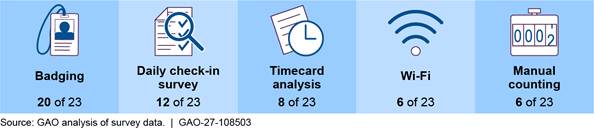
Under the Utilizing Space Efficiently and Improving Technologies (USE IT) Act, enacted in January 2025, federal agencies are now required to collect and report occupancy data. This data is used to calculate utilization rates for agencies’ office space in federally owned buildings and leased locations. While 20 of the 23 agencies that responded to GAO’s survey reported using existing badging systems for this purpose, 16 of these 20 agencies reported supplementing that information with data from other sources such as daily check-in surveys. Nearly all agencies surveyed noted the importance of having easy to implement, cost-effective data collection approaches that they could put in place by the act’s July 2025 implementation deadline. Most agencies reported minimal costs associated with collecting and reporting USE IT Act data—collectively $16 million across 23 agencies in 2025.
Many agencies told GAO they are either using or plan to use their USE IT Act data to identify and dispose of unneeded real property. Some agency officials told GAO that they have already made decisions to consolidate or dispose of underutilized spaces, informed in part by USE IT Act data, and that they expect to save millions of dollars annually as a result.
However, the USE IT Act data submitted to Congress and the public in March 2026 does not have important context—including on GSA-controlled vacant space—needed to fully reflect office space utilization. Without this information, Congress and the public may have an inaccurate impression of the extent to which owned and leased office spaces are being utilized, including some locations that are likely being utilized at lower or higher rates than reported.
While surveyed agencies generally agreed that USE IT Act data are helpful, about one-third expressed concerns about how GSA data collection and reporting guidelines affect their utilization rate calculations. Further, some agencies described approaches to collecting and reporting their occupancy data that are inconsistent with GSA guidelines, resulting in data that are incomplete. For example, one agency reported the number of employees that are assigned to each location rather than measuring the extent to which employees were present in those spaces. By coordinating with agencies to improve the consistency and completeness of their occupancy data, GSA could better position agencies to make informed decisions about which underused spaces to prioritize for disposal, potentially leading to tens of millions of dollars in financial savings.
Why GAO Did This Study
Chronic underutilization of federal buildings is one of the main reasons that the management of federal real property has been on GAO’s High Risk list for more than 20 years. The USE IT Act requires the 24 Chief Financial Officer (CFO) Act agencies to collect and report occupancy data on the number of employees working in certain owned and leased spaces. It also contains a provision for GAO to review the costs to these agencies of this requirement to measure the occupancy and utilization rates of their spaces.
This report examines 1) the approaches CFO Act agencies reported using to collect the occupancy data required by the USE IT Act and their associated costs; 2) how agencies are using USE IT Act data to inform real property decisions and what additional information, if any, may help Congress and the public better understand federal office space utilization; and 3) agencies’ concerns about USE IT Act data collection and reporting and GSA’s actions to address these concerns.
GAO surveyed the CFO Act agencies about their data collection approaches, associated costs, and any limitations to their data or selected approaches. GAO also reviewed GSA guidelines for USE IT Act data collection, analyzed GSA data on vacant spaces, and conducted in-depth interviews with five agencies selected based on the variety of approaches to collecting occupancy data and the size of their real property portfolios.
What GAO Recommends
GAO is making four recommendations to GSA to improve future office space utilization reporting, including that it provide data on vacant space to help fully reflect utilization. GSA did not agree or disagree but stated it would consider these recommendations.
|
Abbreviations |
|
|
|
|
|
|
|
CFO Act |
Chief Financial Officers Act |
|
|
FRPC |
Federal Real Property Council |
|
|
GSA |
General Services Administration |
|
|
OMB |
Office of Management and Budget |
|
|
USAID |
U.S. Agency for International Aid |
|
|
USE IT Act |
Utilizing Space Efficiently and Improving Technologies Act |
|
This is a work of the U.S. government and is not subject to copyright protection in the United States. The published product may be reproduced and distributed in its entirety without further permission from GAO. However, because this work may contain copyrighted images or other material, permission from the copyright holder may be necessary if you wish to reproduce this material separately.
October 15, 2026
The Honorable Shelley Moore Capito
Chairman
The Honorable Sheldon Whitehouse
Ranking Member
Committee on Environment and Public Works
United States Senate
The Honorable Sam Graves
Chairman
The Honorable Rick Larsen
Ranking Member
Committee on Transportation and Infrastructure
House of Representatives
Chronic underutilization of federal buildings—which cost billions of dollars annually to operate and maintain—is one of the main reasons that the management of federal real property has been on GAO’s High Risk list for more than 20 years.[1] While federal agencies have long struggled to determine how much office space they need to fulfill their missions efficiently, the COVID-19 pandemic led to greatly expanded telework and significantly decreased the utilization of federal buildings. As federal employees have returned to the office, there have been significant organizational changes across the executive branch that affect both the utilization of federal space and the need for it.
The Utilizing Space Efficiently and Improving Technologies (USE IT) Act, enacted in January 2025, requires the 24 Chief Financial Officers (CFO) Act agencies to collect and report occupancy data on the number of employees working in certain owned and leased spaces.[2] This occupancy data can then be used to calculate utilization rates, which indicate how much space is being used at individual locations and across agency portfolios. The act also requires the General Services Administration (GSA) to establish methodologies and identify technologies that agencies may use to collect the data, such as badging systems, occupancy sensors, daily check-in surveys, and timecard analysis.[3] Further, the USE IT Act requires GSA to report to Congress annually on owned and leased spaces that do not meet or exceed 60 percent utilization—the ratio of a building’s capacity compared to the daily attendance for that building. In March 2026, federal agencies reported these data to Congress for the first time, which showed that no federal agency reached a 60 percent utilization rate across its entire real property portfolio.[4] Following the release of the 2027 report, GSA, in consultation with the Office of Management and Budget (OMB), is required to take steps to reduce agencies’ spaces that report utilization below the 60 percent minimum rate for a second consecutive year.
The USE IT Act contains a provision for GAO to review the costs for the 24 CFO Act agencies to measure the occupancy and utilization rates of certain owned and leased spaces.[5] This report:
1. describes the approaches that CFO Act agencies reported using to collect the occupancy data required by the USE IT Act and their associated costs;
2. describes how agencies are using USE IT Act data to inform real property decisions and what additional information, if any, may help Congress and the public better understand federal office space utilization; and
3. describes agencies’ concerns about USE IT Act data collection and reporting and assesses GSA’s actions to address these concerns.
To address these objectives, we surveyed the 24 CFO Act agencies about topics including the approaches that agencies are using to collect occupancy data, the extent to which agencies are tracking or able to estimate the costs associated with collecting and reporting these data, and any limitations they may have encountered in using their selected approaches.[6] Twenty-three of the 24 CFO Act agencies completed the survey, resulting in a response rate of 96 percent.[7]
We selected five agencies for in-depth interviews based on their survey responses on the types of approaches they used to collect occupancy data and the size of their domestic real property portfolios.[8] We also interviewed GSA officials about their role in the USE IT Act data collection and reporting process.[9] We used these in-depth interviews to obtain illustrative examples of different approaches to collecting and reporting the required occupancy data. In addition, we requested GSA data on the agency’s vacant owned and leased spaces, which we used to describe the extent to which GSA-controlled space may not be reflected in USE IT Act reporting. We also examined relevant information posted on GSA.gov to determine what USE IT Act data was provided to the public.
We determined that best practices for evidence-based policymaking, previously identified by GAO, were significant to our second objective.[10] We compared GSA’s presentation of agencies’ USE IT Act data to Congress and to the public to the best practice that agencies should frequently and effectively communicate with their stakeholders to help them understand their performance and inform them of decisions made. We also determined that the control activities component of Standards for Internal Control in the Federal Government was significant to our third objective. Specifically, we applied the underlying principle that management identifies information requirements in an iterative and ongoing process so that the data results in quality information that can be used to make informed decisions.[11] We compared agencies’ survey responses and information obtained through follow-up interviews with this principle to evaluate the extent to which the agency-collected occupancy data will result in utilization rates that reflect actual usage and enable informed real property decisions. For more on the objectives, scope, and methodology for this review, see appendix I.
We conducted this performance audit from May 2025 to October 2026 in accordance with generally accepted government auditing standards. Those standards require that we plan and perform the audit to obtain sufficient, appropriate evidence to provide a reasonable basis for our findings and conclusions based on our audit objectives. We believe that the evidence obtained provides a reasonable basis for our findings and conclusions based on our audit objectives.
Background
Measuring the Utilization of Federally Owned and Leased Spaces
We have long reported on the underutilization of federal buildings and noted challenges with measuring the extent to which they are used. In 2022, we reported that most of the 24 CFO Act agencies were not collecting occupancy data for their owned and leased spaces and that agencies expressed concerns about doing so, in part due to the associated costs.[12] We found that GSA had begun several pilot projects to test ways technology could be used to collect these data, such as through badge card readers, motion sensors, mobile devices, and Wi-Fi networks, but it did not plan to broadly distribute information on their costs and benefits. We recommended that GSA develop a plan to do so. We closed this recommendation as implemented in March 2025 when, in response to the USE IT Act, GSA published a list of technologies for collecting space utilization data, including information on their costs.
Subsequently, in 2023, we reported widespread underutilization of federal agency headquarters buildings.[13] Specifically, we found that, on average, 17 of the 24 CFO Act agencies used an estimated 25 percent or less of the capacity of their headquarters buildings in early 2023. Agency officials identified the lack of an agreed upon way for measuring utilization as a main challenge to improving utilization. As a result, we recommended that OMB lead the development and use of a benchmark for measuring building utilization. In January 2025, the USE IT Act established such a benchmark and required agencies to measure the utilization of certain owned and leased spaces using a methodology similar to the one from our 2023 report. In June 2026, following the first annual reporting of USE IT Act data using the new benchmark, we closed this recommendation as implemented.
Implementation of the USE IT Act
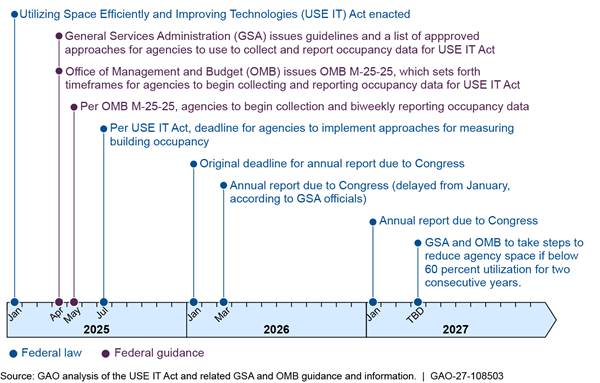
Timeline. The USE IT Act and OMB’s related April 2025 guidance set the timing of USE IT Act implementation, including deadlines for federal agencies to finalize their data collection approaches and when to report data to GSA, OMB, and Congress (see fig. 1).[14]
Figure 1: Implementation Timeline for Utilizing Space Efficiently and Improving Technologies (USE IT) Act Requirements and Related Guidance
Utilization rate calculation. The USE IT Act and OMB guidance also outline the methodology for calculating a building’s utilization rate using the ratio of its capacity and the extent to which an agency uses that capacity. Specifically, the utilization rate can be calculated by dividing the number of employees physically present in a building or leased space during a specific time period (numerator) by its capacity (denominator).[15] Capacity is defined as the total usable square footage of a space divided by the USE IT Act’s benchmark of 150 usable square feet per person.[16] For example, a space that reported 10 employees in a space that has 3,000 usable square feet would have a capacity of 20 employees (3,000 divided by 150) and a utilization rate of 50 percent (10 divided by 20).
Approved data collection approaches. In April 2025, GSA posted guidelines on its website that include a list of 11 approved occupancy data collection technologies and methods. These guidelines state that each agency may use one or more of these 11 approaches to collect their occupancy data including badging systems, occupancy sensors, Wi-Fi tracking, and more manual tracking methods such as daily employee check-in surveys and manual counting.[17] For the full list of GSA-approved approaches that agencies can use to collect occupancy data, see appendix II.
Spaces included in USE IT Act reporting. The USE IT Act, OMB guidance, and GSA guidelines outline which spaces are to be included in occupancy data collection and reporting. For example, the USE IT Act data requirements apply to federally-leased space and public buildings, which excludes a large number of spaces, such as military installations, overseas buildings, and veterans’ hospitals.[18] The OMB guidance indicates that agencies should prioritize reporting for buildings used for general office space. GSA guidelines direct agencies to report on office space square footage, in addition to total usable square footage. GSA’s guidelines for “typical office space” include a range of spaces such as private offices, break rooms, conference rooms, and auditoriums—but exclude specialized areas such as data centers, laboratories, and secure storage from the capacity figures used in the USE IT Act utilization rate calculation (see table 1).
Table 1: GSA Guidelines on Spaces to be Considered “Typical Office Space” for Utilizing Space Efficiently and Improving Technologies (USE IT) Act Occupancy Data Collection and Reporting
|
Considered “typical office space” |
Not considered “typical office space” |
|
Workstations (open office), private offices |
Print shops, light industrial (e.g., mail centers) |
|
Circulation (e.g. hallways), conference rooms, training rooms (unless agency mission) |
Labs, holding cells, sally ports |
|
Regular office storage and administrative space (e.g., file, copy, mail but not warehouse) |
Warehouses, vaults, secure storage, weapons rooms |
|
Collaborative areas, break rooms, pantry/kitchenettes |
Fitness centers, locker rooms, occupational health units |
|
Waiting/reception areas (non-public facing), privacy rooms (e.g., wellness rooms) |
Data centers, public-facing waiting areas |
|
Auditoriums, libraries |
Spaces atypical of commercial office environments |
Source: GAO presentation of General Services Administration (GSA) information. | GAO‑27‑108503
Based on the definitions set forth in the combination of USE IT Act requirements, OMB guidance, and GSA implementation guidelines, federal agencies are reporting occupancy data for a relatively small portion of their federal assets. The CFO Act agencies that responded to our survey reported that 22 percent of their owned and leased office spaces—and 8 percent of their combined usable square footage—are subject to USE IT Act occupancy data collection and reporting requirements.
CFO Act Agencies Reported Using a Mix of Approaches to Collect Occupancy Data, Which Had Generally Low Costs
Most Agencies Reported Using a Combination of Their Security Systems and Manual Methods to Collect Occupancy Data
Nearly all surveyed agencies reported using their existing badging systems—which are used primarily for security purposes—to collect occupancy data to meet USE IT Act requirements in 2025. Specifically, 20 of 23 agencies reported using badging systems to collect occupancy data for at least some of their owned or leased office spaces. While 18 of these 20 agencies reported having badging systems in place at some of their locations prior to the USE IT Act, 13 of these 18 told us they had not used them to collect occupancy data prior to the act.
Despite most agencies using their existing badging systems to collect occupancy data, few agencies were able to collect data for all of their spaces that are subject to the USE IT Act without leveraging additional approaches. While 20 agencies reported using badging to collect occupancy data, 16 of these 20 said they supplemented that with data from other sources in 2025. These 16 agencies reported using a combination of approaches: eight agencies reported using a combination of two approaches and eight agencies reported needing to leverage three or more approaches to collect required data in 2025 (see fig. 2). For example, the 16 agencies that reported using a combination of badging systems with other approaches most often used badging alongside daily-check-in surveys (11), timecard analysis (8), manual counting (6), or Wi-Fi (4).[19]
Figure 2: Agency-Reported Approaches to Collecting Occupancy Data Required by the Utilizing Space Efficiently and Improving Technologies (USE IT) Act, as of September 2025
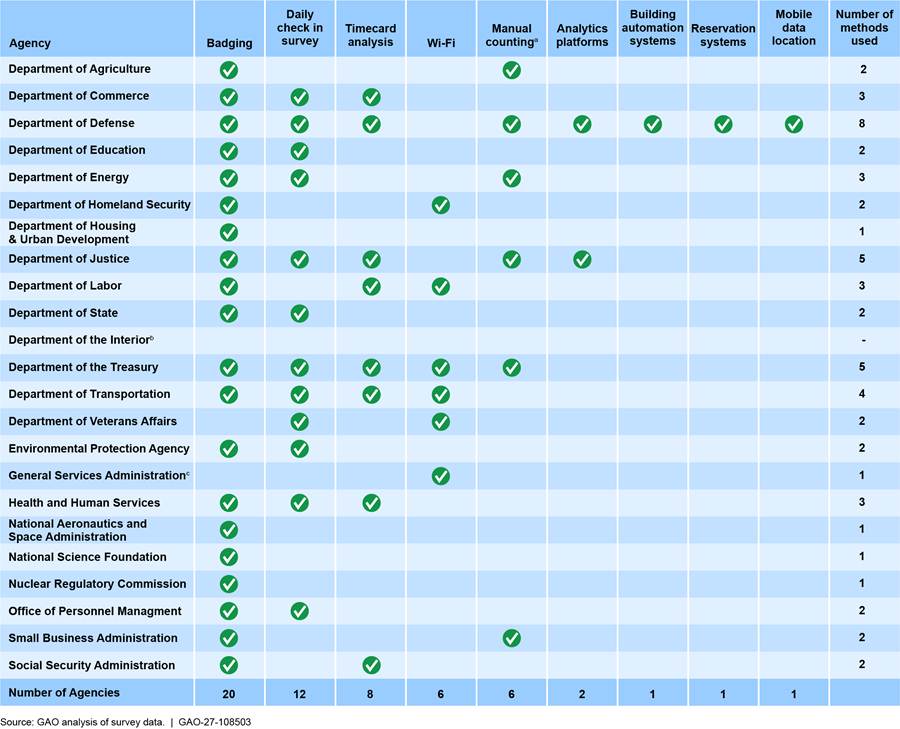
Note: Under the Utilizing Space Efficiently and Improving Technologies (USE IT) Act, federal agencies that are required to collect and report real property occupancy data, are defined as executive departments covered by the Chief Financial Officers (CFO) Act of 1990. Pub L. No. 118-272, § 2302(a)(6), 135 Stat. 3218, 3218 (2025). The CFO Act of 1990, as amended, includes 24 agencies, which are often referred to collectively as CFO Act agencies. See 31 U.S.C. § 901(b). Five of the 23 CFO Act agencies that responded to our survey reported using ‘other’ approaches that, based on their description of those approaches, we were able to categorize within one of the GSA-approved approaches in the table. The United States Agency for International Development declined to submit responses, citing a need to focus on operations related to reducing the agency’s footprint and terminating awards. No agencies reported using either occupancy sensor or video analytics, which are two other approaches approved by GSA for collecting occupancy data for USE IT Act requirements.
aGeneral Services Administration (GSA) guidelines refer to manual counting as ‘visual analysis.’
bThe Department of the Interior selected the ‘other’ option in the survey, noting that it used the “real property system of record” to approximate a measure of building occupancy in 2025. In July 2026, Interior officials told GAO that the agency began reporting badge swipes at its headquarters building in June 2026 while it works toward implementing collecting occupancy data across its portfolio.
cIn October 2026, GSA officials said the agency has expanded its initial occupancy data collection methodology beyond only Wi-Fi to now also include daily check-in data, badging, and timecard analysis.
Agencies gave multiple reasons for selecting their respective approaches for collecting occupancy data, but nearly all noted the importance of identifying low-cost options that were easy to implement by the USE IT Act’s reporting deadline. Across agencies that reported using the most common approaches—badging (20 agencies) and daily check-in surveys (12 agencies)—nearly all cited ease of implementation and cost of implementation as either “very important” or “moderately important” factors in their decisions.[20] Some agencies noted that these decisions were driven by the relatively fast timeline in which they were expected to fully implement data collection for thousands of owned and leased office spaces by July 2025.
In addition, 10 of 23 agencies reported that they also considered other GSA-approved technologies before deciding on their approach or combination of approaches due to cost or implementation concerns. For example, officials from one agency said they considered using occupancy sensors but ultimately decided against doing so due to the associated costs and the time needed for installation. Further, officials from some agencies stated that the high costs of installing badging systems, especially for smaller spaces, led them to use less automated methods that don’t rely on technology (e.g., manual counting) to collect their occupancy data in 2025. In their survey responses, six agencies expressed interest in investing in expanded or new badging systems or Wi-Fi systems in the future, but many also acknowledged that such an investment would be dependent on funding.
Agencies Identified Limitations with Approaches to Collecting Occupancy Data
Agencies identified limitations to collecting accurate and complete occupancy data related to either their use of a specific approach or their use of multiple approaches.
Limitations of specific approaches. In response to our survey, 16 of 23 agencies reported encountering data collection anomalies or challenges in their USE IT Act efforts to date. Specifically, these agencies identified limitations to accurately and consistently documenting employee attendance with some of the most commonly used approaches to collecting USE IT Act data:[21]
· Badging. Ten agencies that either considered using or are using badging to collect USE IT Act data noted difficulty ensuring that their employees are counted when they enter one of their owned or leased spaces. One of these 10 agencies chose not to use badging to collect USE IT data because of these limitations. Another agency said that some employees can enter a space through an open door after another employee uses their badge, resulting in those who do not scan their badge not being counted. A different agency explained that some of its locations with badge readers do not have them at every entrance. As a result, some employees may enter a building without scanning their badges (e.g., by showing their badge to a security guard), which can lead to undercounting the number of employees present.
· Wi-Fi. Six agencies that considered using Wi-Fi to collect USE IT Act data identified limitations of that technology to accurately count all staff working in a building. For four of these six agencies, these concerns contributed to their decision to use a different approach. For example, one agency reported that not all staff have roles that require logging in to the agency’s network daily, which can result in undercounting if the Wi-Fi data is not complemented with other approaches. Another agency said that some of its leased spaces do not have their own Wi-Fi networks. In these spaces, this agency’s staff use a commercial Wi-Fi network that does not allow the agency to collect occupancy data.
· Manual counting. Six agencies reported considering manual counting to collect USE IT Act data, which does not require the introduction of new technology. However, some of these agencies acknowledged that this approach—which requires building staff to regularly monitor and report on workspace usage—is subject to human error as staff may miscount the number of employees present. Beyond the possibility of miscounts, one agency noted that there can also be instances when the staff member assigned to conduct and report the daily count for a space is not present on a given day and the data may not be collected.
Challenges of using multiple approaches. Officials from six agencies that responded to our survey reported that their decision to rely on combinations of the approved approaches to collect occupancy data introduced challenges related to reconciling data from multiple sources. For example, officials from one agency told us that the primary challenge they faced was obtaining data for their locations that are not equipped with badge readers; they said this led them to fill the gaps with static human resources data until additional badge readers could be installed. Officials from another agency explained that, to avoid double counting in some spaces, they had to de-duplicate individual employees’ entries that appear in badging data, timecard data, and manual counting records. These officials told us that their efforts to reconcile multiple data sources from multiple agency components required additional staff time to clean and combine the data manually.
GSA, which established the approved list of data collection approaches and manages the collection on the OMB portal that agencies use to submit occupancy data, acknowledged limitations with the data and agreed that there could be data inaccuracies in what is being reported. Specifically, GSA officials noted that any one single data collection approach would not suit all agencies, and each approach has inherent trade-offs, including related to the accuracy of the data. Further, when posting the data on its public website, GSA included a disclaimer that while every effort was made to ensure transparency and adhere to all mandated reporting standards, it is possible that certain data elements may be incomplete, outdated, or contain inaccuracies.
Most Agencies Estimated Minimal Costs to Meet New Occupancy Data Collection and Reporting Requirements
In response to our survey, 20 of the 24 CFO Act agencies provided their actual or estimated costs to comply with USE IT Act occupancy data collection and reporting requirements in 2025, which ranged from zero (four agencies) to $9.1 million (one agency).[22] As shown in figure 3, 17 of these 20 agencies reported spending less than $550,000 to meet these requirements in 2025. For the four agencies reporting zero associated costs, agency officials said they used existing systems and therefore did not consider there to be any new costs incurred to meet the requirements. The Department of Agriculture reported the largest costs of $9.1 million, most of which it attributed to developing a data platform to collect occupancy data across the agency.[23]
The 20 agencies that provided actual or estimated costs reported a total of $16 million in costs to implement USE IT Act data reporting requirements in 2025. These costs were made up of $10.3 million for one-time costs to install or develop technology (most of which were reported by the Department of Agriculture), and $5.9 million for recurring staff costs for data collection, cleaning, validation, and reporting.
Figure 3: Agency-Reported Costs Associated with Collecting and Reporting Utilizing Space Efficiently and Improving Technologies (USE IT) Act Data in 2025
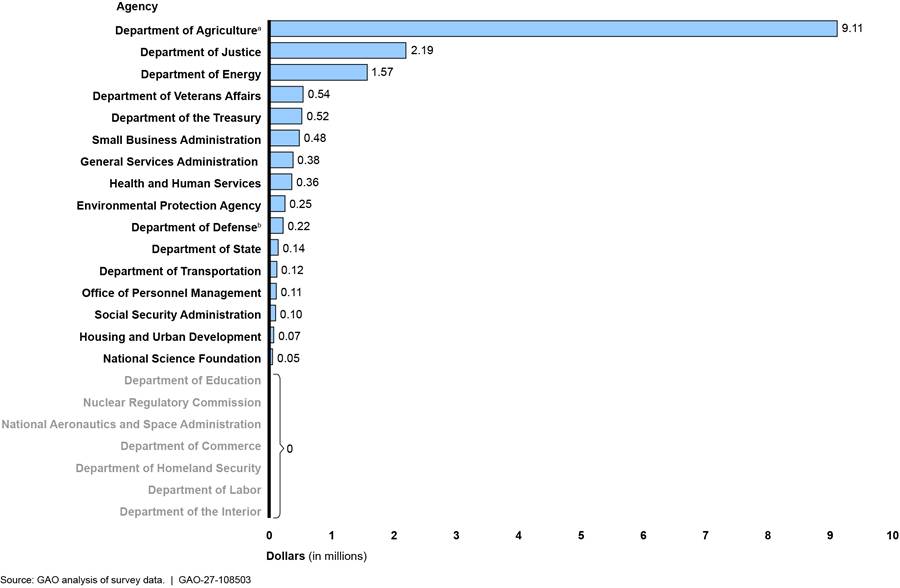
Note: Under the Utilizing Space Efficiently and Improving Technologies (USE IT) Act, federal agencies that are required to collect and report real property occupancy data, are defined as executive departments covered by the Chief Financial Officers (CFO) Act of 1990. Pub L. No. 118-272, § 2302(a)(6), 135 Stat. 3218, 3218 (2025). The CFO Act of 1990, as amended, includes 24 agencies, which are often referred to collectively as CFO Act agencies. See 31 U.S.C. § 901(b). Of the 23 agencies that responded to survey questions on USE IT Act implementation costs, 16 provided a non-zero cost figure, four provided a figure of zero dollars, two (Department of Homeland Security and Department of the Interior) declined to provide a cost figure, and one (Department of Commerce) stated that they had not yet been able to calculate their related costs at the time of survey. Of the 20 agencies that provided cost information, 17 agencies provided estimated costs and three provided actual costs. One agency (United States Agency for International Development) declined to submit responses, citing a need to focus on operations related to reducing the agency’s footprint and terminating awards.
aDepartment of Agriculture officials reported that most of its $9.1 million in costs are attributable to the development of a data platform to collect occupancy data across the agency. The agency reported that it is using this platform for purposes beyond the collection and reporting of USE IT Act data. For example, in addition to monitoring space utilization, officials said it also supports assessing and managing space allocation, evaluating occupancy and usage patterns, and supporting broader workplace management efforts.
bThe Department of Defense estimated that its 2025 costs of collecting and reporting USE IT Act data were around $220,000. However, according to officials, some components of the Department of Defense have not captured their costs associated with implementing the USE IT Act and this figure likely significantly underrepresents the agency’s actual costs.
As previously discussed, a central factor in how agencies selected their data collection approaches was cost. As a result, few agencies installed new technology, which can be expensive, to meet the USE IT Act requirements. Specifically, while 12 of 23 agencies reported that they collected occupancy data for the first time in 2025, only five reported introducing new technology to do so. Further, three of the five agencies that installed new technology either leveraged existing infrastructure or limited the new technology’s rollout to a small number of locations. For example, officials from one agency said that the Wi-Fi technology necessary to collect occupancy data was already available at some of its locations and they used manual counting in spaces where the technology was not available. Officials from another agency reported that all but two of its spaces had badge readers they could use for occupancy data and they were able to install new badge readers for their USE IT Act data collection at those two locations relatively easily.
Agencies Used New Data to Inform Cost-Saving Decisions but Additional Information Could Help Congress and the Public Better Understand Utilization
Agencies Reported Using Utilization Data to Inform Real Property Decisions Expected to Save Millions of Dollars
According to federal agencies, they are either already using or plan to use their collected occupancy data and resulting utilization rates to identify and dispose of unneeded real property. More than half of the agencies surveyed (13 of 23) indicated that they anticipate the USE IT Act data collection and reporting requirements will lead to millions of dollars in cost savings related to the management of their real property holdings. Moreover, in the immediate term, some officials reported that their agencies have taken actions to consolidate or dispose of underutilized spaces in response to the USE IT Act data requirements. For example, as of July 2026:
· Officials from the Small Business Administration told us that the collection and reporting of USE IT Act data has been useful as they seek to replace leases in buildings that are not configured to meet the USE IT Act’s 150 usable square feet per person standard. These officials reported that the agency’s USE IT Act data was at least partially responsible for its decisions to reduce 25 spaces totaling almost 38,000 square feet. Agency officials told GAO they expect these reductions to result in approximately $885,000 in annual cost savings.
· GSA officials reported shedding 40,000 square feet from one of its leases in Kansas City after identifying low occupancy rates in its collected USE IT Act data. In addition, for seven additional spaces GSA had previously identified as underutilized, GSA officials reported that the agency better understood the actual underutilization once it started collecting the required occupancy data. GSA reported it plans to consolidate or dispose of those seven spaces, totaling nearly 73,000 usable square feet. GSA officials estimate that these actions will result in approximately $3.7 million in annual savings.[24]
· Department of Energy officials reported that insights from its USE IT Act data contributed to terminating seven leases for facilities totaling 37,000 square feet. These officials estimated that cancelling these leases will result in $1.6 million in annual savings and added that they are seeking further opportunities to improve the agency’s utilization rates.
· Department of Homeland Security officials reported that, informed by its USE IT Act data, the agency identified at least 15 space reduction projects and expected those projects would remove 95,000 square feet from its real property holdings. Officials told us that these projects—which include the consolidation of several regional Cybersecurity and Infrastructure Security Agency locations in and around Washington, D.C.—are expected to result in estimated savings of $350 million over 20 years.
· Department of Housing and Urban Development officials told us they considered their USE IT Act data alongside other information to validate and prioritize reductions in five field offices in Santa Ana, California; Kansas City, Missouri; Denver, Colorado; Albany, New York; and Greensboro, North Carolina. They said that they expected these field office reductions to reduce the agency’s footprint by nearly 80,000 square feet and generate about $2.2 million in annual rent savings. Officials added that, while the agency had already planned the closure of two satellite offices in the Washington, D.C. area and the relocation of its headquarters prior to the required July 2025 implementation of USE IT Act data collection, they leveraged USE IT Act data to further support those efforts.[25]
· Officials from the Department of Veterans Affairs said they used the agency’s USE IT Act data to help inform and validate a lease reduction of almost 150,000 square feet that will result in approximately $9.7 million in annual cost savings.
Congress and the Public Would Benefit from Additional Context for Utilization Data
While the data provided in response to the USE IT Act has proven useful to some agencies’ space reduction decisions, Congress and the public would benefit from additional context to more fully reflect the actual utilization of some spaces. Specifically, the March 2026 USE IT Act reporting detailing agencies’ utilization rates did not (1) include data on vacant, GSA-controlled owned and leased office spaces that do not have a formal document outlining rental terms—called an occupancy agreement—with a tenant agency; or (2) convey building-wide utilization information that accounts for vacant space within GSA-controlled buildings with multiple tenant agencies.[26] In addition, the public data posted to GSA.gov did not include information on individual owned and leased spaces that met or exceeded the 60 percent utilization rate threshold. This additional information would provide Congress and the public with a more complete understanding of the utilization of federal office spaces, with some likely being utilized at lower or higher rates than reported in March 2026.
Vacant Space
When agencies shared their USE IT Act data with Congress and the public in March 2026, the data did not include GSA-controlled vacant space—nor was it made clear to Congress or the public that this vacant space was excluded.[27] Specifically, while the reporting included utilization data for owned and leased office spaces assigned to tenant agencies, GSA officials confirmed that it did not include data for GSA-controlled vacant spaces without active occupancy agreements.[28] Not including this vacant space in the utilization rate calculation decreases the amount of usable square feet, resulting in greater USE IT Act utilization rates compared to if vacant space were included.
Although agencies’ March 2026 USE IT Act data did not include vacant owned or leased spaces controlled by GSA, July 2026 data that GSA provided to GAO on those spaces illustrate how their inclusion could add valuable context to more fully understand office space utilization. Specifically, as of July 2026, the GSA data show that the agency controlled more than 20 million usable square feet of vacant owned (15.0 million) and leased (5.2 million) space.[29] These data show that more than three-quarters of that vacant space (15.6 million out of 20.2 million usable square feet) was located within federally owned or leased spaces that are partially occupied by other tenant agencies, and the rest was in fully vacant owned or leased spaces (see table 2).
Table 2: Vacant GSA-Controlled Buildings and Leases Not Included in Utilizing Space Efficiently and Improving Technologies (USE IT) Act Reporting, by Number of Locations and Usable Square Feet, as of July 2026
|
|
Vacant space in GSA-owned buildings |
Vacant space in leases |
Total vacant space |
|||
|
|
Number of locations |
Usable square footage |
Number of locations |
Usable square footage |
Number of locations |
Usable square footage |
|
Fully Vacant |
78 |
3,140,339 |
77 |
1,487,343 |
155 |
4,627,682 |
|
Partially Vacant |
500 |
11,904,887 |
224 |
3,711,286 |
724 |
15,616,173 |
|
Total |
578 |
15,045,226 |
301 |
5,198,630 |
879 |
20,243,856 |
Source: General Services Administration (GSA) data. | GAO‑27‑108503
Note: Partially vacant spaces are buildings or leases in which there are one or more tenants as well as vacant space. This table summarizes GSA data on vacant spaces not included in the March 2026 Utilizing Space Efficiently and Improving Technology (USE IT) Act reporting.
Reporting vacant space in addition to agencies’ USE IT Act reporting would likely have a substantive effect on the utilization rates of individual buildings and leases by introducing hundreds of fully vacant spaces that were previously not reported.[30] Based on the July 2026 data on vacant owned and leased spaces provided by GSA, there were 72 partially vacant GSA-controlled spaces (55 owned buildings and 17 leased spaces) that reported utilization rates at or above the 60 percent threshold in March 2026 that could see their rates drop below 60 percent if vacant space were factored into the calculation. For example, one federal building in California could see its utilization rate drop from 68 percent to 57 percent if 33,482 feet of the building’s vacant space were included. Similarly, a leased space in Michigan could see its utilization rate drop from 78 percent to 58 percent if the space’s 5,737 vacant usable square feet were included in the calculation. As shown in table 2, beyond these effects on utilization rates for individual buildings and leases, the July 2026 GSA data indicate that there were 155 fully vacant buildings and leased spaces with a total of 4.6 million usable square feet that were not included in the March 2026 USE IT Act reporting.[31]
GSA officials told us that vacant owned and leased spaces under its control were not included in agencies’ March 2026 USE IT Act reporting for several reasons:
· The USE IT Act directs agencies to report occupied space and OMB guidance instructed agencies to organize their USE IT Act data submissions by occupancy agreement.[32] That said, neither the OMB guidance nor the act preclude GSA from providing additional information that offers valuable insight into the extent to which federal spaces are being utilized.
· The USE IT Act data provides insight on spaces occupied by federal agencies which is used in coordination with other information, such as GSA-controlled vacant space data that the agency posts on a separate page of GSA.gov.[33] GSA officials said that various sources of information inform their assessment of whether space is being used optimally and any decisions to consolidate or dispose of underutilized assets.[34] Given GSA’s assertion that vacancy data is one of the pieces it considers in making real property decisions, it is critical that Congress fully understands how the agency coordinates all of those pieces as it fulfills its oversight role.
· Not all GSA-controlled vacant space should be assumed to be “typical office space” that would otherwise be subject to USE IT Act requirements if occupied. GSA officials stated that, because a space may change significantly once a new tenant agency designs and builds it out for its intended use, it is not clear how much of this currently vacant space would meet the definition of “typical office space” but agreed that some portion would qualify. While the extent to which vacant space would be considered “typical office space” is unclear, the July 2026 data provided by GSA shows that 44 of 78 fully vacant buildings were categorized as having at least some office space and there were an additional 193 buildings categorized as office space that were partially vacant.
· Including GSA-controlled vacant space in future USE IT Act reporting would dramatically affect GSA’s utilization rate. As agencies take actions to consolidate and return buildings and leased spaces to GSA, GSA officials said those GSA-controlled spaces would then be included in the agency’s own utilization rate calculation until they are able to be considered for disposal. However, including all such vacant spaces in future utilization reporting could be done in a manner that does not obscure GSA’s use of its own space in support of its mission. For example, future utilization reporting could include a separate section on GSA-controlled vacant space without active occupancy agreements alongside the existing data on occupied buildings and leased spaces to allow both Congress and the public to better understand overall utilization.
Building-Wide Utilization Information that Includes Vacant Space
The USE IT Act data that agencies shared with Congress was not presented in a way that conveys the building-wide utilization of buildings that have multiple tenant agencies, which can complicate oversight of the utilization of these buildings. While GSA officials acknowledged that the data they aggregated and provided to Congress was not organized at the building level, they said that the data enabled Congress to then aggregate utilization rates for all active occupancy agreements within a federal building. However, even if Congress could more easily view the 2026 USE IT Act data at the building level, it may not receive an accurate picture of building-wide utilization because—as noted above—the data does not include GSA-controlled vacant space. As a result, a federal building with any space lacking an active occupancy agreement can appear to have met or exceeded the USE IT Act’s 60 percent utilization rate threshold due to the absence of that vacant space from the calculation.
For example, as shown in figure 4, a hypothetical 10-floor federal building with three fully vacant floors could have a 65 percent utilization rate based on the current approach to USE IT Act reporting. However, if this building’s three vacant floors were to be included in the calculation, the building’s true utilization rate would be 45 percent—well below the 60 percent threshold set by the USE IT Act.
Figure 4: Hypothetical Example of a Building-Wide Utilization Rate Calculation for a Federal Building with Vacant Space
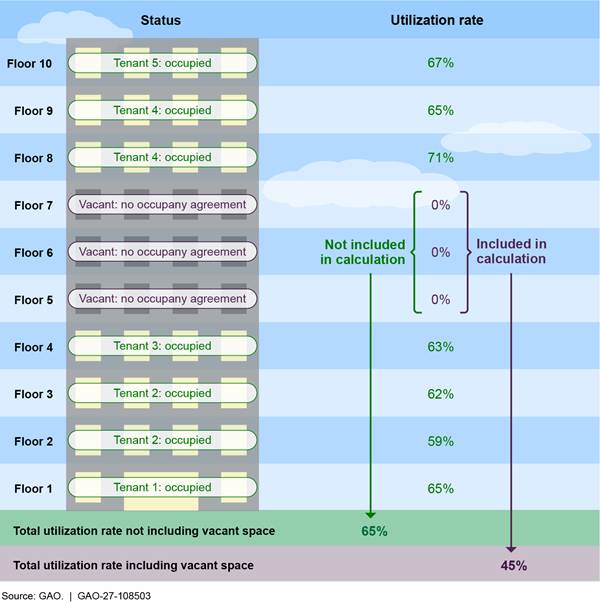
Note: This figure compares how a hypothetical federal building would appear in reporting utilization when unoccupied (vacant) floors are included. In this figure, an occupied floor represents space with an active occupancy agreement between an agency and the General Services Administration. A floor could have multiple occupancy agreements, or an occupancy agreement could be for multiple floors of a building.
GSA officials told us that relevant OMB guidance directed agencies to organize their reporting by occupancy agreement and, as such, the reporting is disaggregated for multi-tenant buildings. That said, these officials noted that the utilization data provided to Congress had all the fields needed to aggregate and view the data at the building level. However, these data required additional analysis to calculate building-level utilization rates and, as noted above, did not include GSA-controlled vacant space that is necessary to understand the actual use of an entire building. Presenting utilization data to Congress with this additional context, in a way that conveys building-wide utilization—including a utilization rate that accounts for vacant space—would increase the transparency of GSA’s process of identifying owned and leased spaces that are candidates for consolidation or disposal.
Agency Spaces at or Above 60 Percent Utilization
The data posted publicly on GSA.gov in March 2026 detailed the individual owned and leased office spaces with utilization rates below 60 percent but did not include information for those that met or exceeded that threshold. GSA officials told us that 22 percent of the CFO Act agencies’ spaces with active occupancy agreements met or exceeded the 60 percent utilization rate threshold in 2026, but these summary figures are not published on GSA.gov. In addition, while agencies’ individual pages show summary statistics for their respective spaces with utilization rates at or above 60 percent, the full dataset with utilization by individual occupancy agreement only includes spaces with utilization rates below 60 percent. As a result, it is not apparent from these data that there are also relatively highly utilized spaces that are likely not candidates for consolidation or disposal.
Further, this exclusion is not clear in the language accompanying these data. While GSA has a USE IT Act overview page that states that the mandated public reporting of the data is for spaces that did not achieve 60 percent utilization, the language on the page with the 2026 USE IT Act data only includes a broad disclaimer on possible limitations, such as inaccuracies or incompleteness.[35]
GSA officials said they did not include aggregated data on all the spaces that met or exceeded 60 percent utilization in the public reporting on GSA.gov because the USE IT Act focused on identifying and reporting on spaces that did not meet the act’s 60 percent threshold. These officials also told us they aggregated and provided agencies’ 2026 utilization data to Congress for all owned and leased office spaces with active occupancy agreements, regardless of whether they achieved 60 percent utilization.
In prior work, we identified key practices that agencies can use to help effectively build and use evidence to manage their performance.[36] These key practices state that agencies should frequently and effectively communicate with their stakeholders to help them understand the agency’s performance and inform them of decisions made. Specifically, when communicating with Congress, agencies should help the body understand how well the agency is performing and how it made decisions, as the body may need the information for oversight or to help implement those decisions. Further, when communicating with the public, agencies should present information in a manner that helps members of the public understand the issues that the federal government seeks to address, and how well federal programs and activities are doing at addressing those issues. We have also separately reported on the importance of communicating key pieces of information on agencies’ real property to Congress to ensure that it is sufficient for the body to effectively conduct its oversight function.[37]
With a more complete understanding of how the exclusion of vacant space affects the reported utilization rates of federally owned and leased spaces and the building-wide utilization of buildings with multiple tenant agencies, Congress could better fulfill its oversight function. In addition, presenting the data posted on GSA.gov in a manner that makes clear which spaces are and are not included would allow members of the public to better understand what the data represent. With this additional context, it would be easier for Congress and the public to draw meaningful conclusions about how federal real property is being managed, including understanding the extent to which owned and leased spaces are being utilized and which should be considered for consolidation or disposal.
GSA Has Not Assessed Effects of Guidelines on Utilization Rates or Coordinated with Agencies to Improve USE IT Act Data They Report
Some Agencies Are Concerned That Utilization Calculations May Not Reflect Their Actual Use of Space
While surveyed agencies generally agreed that USE IT Act data collection and reporting has proven helpful to manage their real property portfolios, about one-third of those agencies expressed concern about how certain directions for data collection affect their calculated utilization rates.[38] These concerns have led some agencies to use their own internal metrics, rather than USE IT Act data, for making real property decisions. In particular, agencies questioned why GSA and OMB guidelines for USE IT Act data reporting direct them to include:
1. non-work areas like kitchens in their usable square footage totals;
2. non-work days such as federal holidays in the reporting periods; and
3. infrequently used spaces that agencies are statutorily required to maintain in their usable square footage totals.
Non-work areas. Eight of the 23 agencies that responded to our survey expressed concerns about including areas where staff do not typically have workstations—such as kitchens, conference rooms, and auditoriums— in their usable square footage totals as “typical office space” and the resulting reduction in their calculated utilization rates. GSA guidelines for what to include in “typical office space” when implementing the USE IT Act clearly indicate that these types of spaces are to be reported in occupancy data, as shown in table 1 above. However, according to officials from some agencies, including such spaces does not reflect actual usage as employees do not work in these areas and they may not be occupied for portions of the day.
|
Utilization rate calculations While Department of State officials told us that they adhere to Utilizing Space Efficiently and Improving Technologies (USE IT) Act reporting requirements, they said they also rely on a workstation-based approach for making real property decisions. This approach removes areas where employees do not typically work, such as lobbies, cafeterias, conference and meeting rooms, and libraries and captures how workstations, as currently configured, are being utilized. This method does not provide insight into how the space could be utilized if it were reconfigured. It also excludes non-workstation space that can comprise a substantial portion of a location’s total space. As a result, the workstation-based approach results in a significantly higher utilization rate versus what is being reported under the USE IT Act. For example, data for the Department of State headquarters building indicates a 55 percent utilization rate under the USE IT Act methodology and an 87 percent utilization rate when using the agency’s internal workstation metric.
Source: GAO analysis of USE IT Act and Department of State information. | GAO‑27‑108503 |
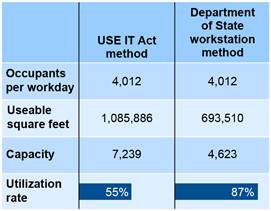
As a result, officials from these agencies stated that the inclusion of these non-work areas in USE IT Act data artificially increased the office space capacity (i.e., usable square footage), which lowered calculated utilization rates. Due to these concerns, some agencies told us that they prefer to rely upon their own internal metrics, rather than USE IT Act data, to understand the utilization of their owned and leased spaces. For example, to understand its space utilization, the Department of State relies on a workstation-based methodology that only includes spaces where employees conduct their work and excludes certain spaces included under USE IT Act reporting (e.g., lobbies, cafeterias, conference and meeting rooms, and libraries), as shown in the sidebar.
One way of looking at the difference between these calculations is that one measures (1) how a space is utilized under its current workstation configuration (e.g., the Department of State’s preferred method), and the other measures (2) how that space could be utilized if it were reconfigured to meet USE IT Act standards. While a workstation-based methodology may be a more accurate barometer of how the space is being used under the existing configuration of workstations, it does not account for the space’s total possible usable capacity if it were to be reconfigured to include more workstations. It also excludes non-workstation space, such as conference rooms and libraries, which can be a substantial portion of a location’s total space.[39] As a result, using the workstation method in isolation could lead agencies to retain and pay for significantly underutilized space.
According to officials from some agencies, reconfiguring older federal buildings to meet USE IT Act standards (i.e., minimum 60 percent utilization rate under the 150 square foot per person benchmark) will require a significant investment of resources. For example, beyond moving walls and adding workstations, some buildings may need to upgrade or replace mechanical, electrical, plumbing, and heating and cooling systems in order to provide service to support increased employee density. As a result, in some cases, it may be more cost effective to relocate from existing federal buildings to more modern space.
Non-work days. Four agencies expressed concerns about USE IT Act utilization rates being calculated using data that includes days when staff are not typically expected to be at work. GSA guidelines for USE IT Act implementation state that agencies are to report occupancy data for 10 weekdays during each biweekly pay period, with federal holidays included. Additionally, some agency officials reported that GSA advised collecting occupancy data on days when employees are told to telework (e.g., due to weather closures), and federal lapses in funding. As a result, agencies are reporting occupancy data for days when they would not expect employees to report to work, which decreased their reported utilization rates. For example, Treasury reported that including the Dr. Martin Luther King Jr. holiday resulted in a 5 percent decrease in their agency-wide utilization rate—from 46 percent to 41 percent—for one reporting period in January 2026.
Statutorily required spaces. Officials from one agency told us that they are required to collect and report occupancy data for office spaces that the agency is statutorily required to maintain as ‘surge space’ for use in emergencies. These officials stated that, although these office spaces are only used intermittently to support critical mission functions during emergencies and otherwise sit empty, USE IT Act guidelines direct the agency to collect and report data on the spaces despite their infrequent use. According to these officials, this agency’s overall utilization rate would increase by 5 percent if it was allowed to exclude two such locations in Texas.
GSA Officials Stated They Understand Agency Concerns and Do Not Intend to Consider USE IT Act Data Alone When Making Space Reduction Decisions
GSA officials said they understood agency concerns with USE IT Act reporting guidelines and stated that a variety of factors can affect USE IT Act utilization rate calculations, including when spaces have large common areas such as auditoriums or conference centers. This is particularly true for many historic federal buildings that are typically inefficiently configured relative to more modern office buildings. GSA officials also agreed that utilization rates can be impacted by operational impacts such as federal holidays, weather-related closures, employee leave, and telework policies.
However, GSA officials also noted that the USE IT Act implementation guidelines were designed to ensure a consistent approach for all agencies, which necessitated a relatively simplified calculation methodology. These officials also noted that new standards introduced in the USE IT Act, such as the minimum 60 percent utilization rate threshold, account for the types of concerns raised by agencies by setting a relatively low bar. For example, the 60 percent utilization rate minimum—rather than a 100 percent target—acknowledges both that federal office spaces include areas that do not typically have workstations and that there are weekdays throughout the year when employees are not expected to work. Further, the 60 percent utilization rate minimum allows agencies to configure spaces larger than the USE IT Act’s 150 usable square feet per person standard—potentially as high as 250 usable square feet per person—and meet the requirement.[40]
GSA officials also stressed that USE IT Act data, while a good indicator of space utilization, is not perfect and GSA does not intend to consider these data in a vacuum when working with agencies to make future space reduction decisions.[41] They said that such decisions will not only examine USE IT Act data, but also consider agency mission needs, as well as any associated costs to renovate the space (e.g., creating more workstations within the existing footprint).
In April 2026, GSA officials said they were gathering feedback from federal agencies on the first annual USE IT Act reports and discussing with OMB the possibility of evaluating the data collection and reporting guidelines. In July 2026, GSA submitted recommendations to OMB aimed at addressing agency concerns, including on the inclusion of non-work areas and non-work days in USE IT Act reporting. For example, one of GSA’s recommendations to OMB was to have agencies include only spaces where employees can be reasonably expected to work in their reported usable square footage data.[42] In addition, GSA recommended that future USE IT Act reporting should exclude days when owned and leased spaces are closed, such as federal holidays, weather- or event-related closures, government shutdowns, and building emergencies.[43] GSA officials told us that these recommendations were informed by analysis of past GSA resources and guidance, as well as by agency requests. These officials said such requests have come directly to both GSA and OMB and have been discussed at quarterly Federal Real Property Council meetings. However, as of October 2026, GSA had not provided documentation of an evaluation of the effects of its proposed recommendations, such as how their implementation might affect agencies’ reported utilization rates. Further, it is not clear whether USE IT Act guidelines will be modified in response to GSA’s recommendations.
Standards for Internal Control in the Federal Government state that management identifies information requirements in an iterative and ongoing process so that the data result in quality information that can be used to make informed decisions.[44] An evaluation of the effects of GSA’s USE IT Act data collection and reporting guidelines—such as the definition of typical office space and inclusion of non-workdays—on agencies’ calculated space utilization rates could help identify ways to modify those guidelines to improve the quality of the data available to GSA, OMB, and other agencies. Better data could, in turn, be used to prioritize and make more informed real property decisions to reduce underutilized spaces.
Some Agencies Acknowledged Their Data Collection and Reporting Is Incomplete or Inconsistent with GSA Guidelines
In addition to expressing concerns over GSA’s USE IT Act implementation guidelines, two agencies acknowledged that they are knowingly not following them, resulting in data that is incomplete. These agencies provided various reasons for their decisions to do so, mostly related to challenges implementing their preferred data collection approaches.
· Officials from the Department of the Interior said that, as of April 2026, their agency had not collected or reported occupancy data to GSA, as required by the USE IT Act. Instead, the agency was reporting data on the number of employees assigned to individual locations and not measuring the extent to which employees were actually present in those locations on a regular basis. Officials cited a lack of badge readers at Department of the Interior facilities and an inability to match timecard data to specific spaces. When asked why they had not used a GSA-approved manual approach in the short-term—which other agencies with similar challenges did—these officials said implementing a timecard analysis approach is preferred because check-in surveys and manual counting require collecting and managing a large amount of manual data across a large real property inventory. In July 2026, Interior officials stated that the agency began reporting badge swipes at its headquarters building in June 2026 while it works toward implementing occupancy data collection for other locations. Agency officials do not expect to be able to measure occupancy data for the rest of the Department of the Interior’s portfolio until the end of fiscal year 2026.
· Officials from the Department of Homeland Security stated that, as of July 2026, their agency was not collecting and reporting occupancy data for nearly 700 agency spaces subject to the USE IT Act due to limited badging technology in those locations. These officials added that they are working to implement Wi-Fi-based technology to collect occupancy data for these locations.[45] When asked about using more manual data collection approaches approved by GSA in the interim, these officials said they are currently exploring those options for the short-term while implementation of their preferred methods are in process.
While other agencies told us that they are reporting the occupancy data required by the USE IT Act, they described using methodologies that may be inconsistent with the approved approaches set forth in GSA’s guidelines. As previously discussed, GSA guidelines state that certain spaces—such as auditoriums and conference rooms—are to be included in agencies’ occupancy data collection and reporting. However, based on our survey and interviews with agency officials, some agencies are excluding such spaces from their USE IT Act reporting. For example, officials from the Department of Commerce said they are excluding five of the agency’s auditoriums from USE IT Act data because they are not configured as office space and have no desk surfaces, and because some are historic spaces that cannot be reconfigured.[46] These officials stated that they are also excluding some conference rooms because they are regularly used for meetings and workshops with non-agency professionals. This approach differs from other agencies who reported including spaces such as meeting and conference rooms in their USE IT Act data.
GSA officials told us that they had been aware of instances of agencies reporting incomplete or inconsistent occupancy data in the first year of the new requirements. However, GSA officials said, they have relied on each agency to accurately identify which of their facilities meet the USE IT Act reporting criteria and which should be excluded. These officials noted that GSA’s role is to advise other agencies on the approved data collection approaches and coordinate the biweekly data submissions, and not to enforce other agencies’ compliance with the USE IT Act’s requirements. In April 2026, GSA officials said they were working collaboratively with individual agencies to audit and identify data anomalies and errors and take necessary corrective actions. In addition, in its July 2026 letter to OMB, GSA suggested that the Federal Real Property Council (FRPC)—an interagency group of all 24 CFO Act agencies—coordinate to discuss best practices and challenges agencies are facing as they implement the USE IT Act.[47] Specifically, GSA recommended that the FRPC reconvene its prior working group focused on occupancy issues to raise awareness of agencies’ challenges and request input to improve the quality of the data collected and reported for the USE IT Act. However, these efforts are not focused on agencies’ purposeful exclusions of spaces and, until OMB agrees to GSA’s recommendations, it is not clear whether or how GSA will regularly coordinate with agencies to ensure the consistency and completeness of their USE IT Act reporting.
As noted earlier, Standards for Internal Control in the Federal Government state that management identifies information requirements in an iterative and ongoing process so that the data results in quality information that can be used to make informed decisions.[48] While GSA is not ultimately responsible for the data that other agencies submit, it is responsible for working with OMB to set standards for collecting the data. Additionally, GSA is responsible for taking actions to reduce space based on the data submitted.
By coordinating with agencies to better ensure they use consistent approaches to collecting and reporting complete occupancy data for all spaces subject to the USE IT Act’s requirements, GSA and OMB could help improve the quality of that data, providing a better understanding of which buildings and leased spaces may be underutilized. This, in turn, would support more informed decisions about which spaces should be prioritized for removal from the federal real property portfolio.
Conclusions
Under the USE IT Act, federal agencies are—for the first time—collecting occupancy data and reporting utilization rates across thousands of their office space locations nationwide. As a result, these agencies have new and important insights into their actual use of federally owned and leased spaces. While not perfect, these data will be a key factor that help inform GSA, OMB, and agency decisions to get rid of chronically underutilized federal real property. Indeed, some agencies have already started making real property decisions that they expect to result in significant financial savings based, in part, on this new data.
While the collection and public reporting of utilization data is a critical step in transforming federal real property management, additional context in several areas could improve utilization reporting. First, the information shared with Congress and the public in March 2026 did not include GSA-controlled vacant space—nor was it made clear that this vacant space was excluded. Including vacant space in utilization reporting would have a substantive effect on the utilization rates of individual buildings and leases and introduce hundreds of fully vacant spaces that were previously not reported. Second, including the ability for Congress to view building-wide utilization that accounts for vacant space in buildings with multiple tenant agencies would provide Congress with a more complete picture of how federally owned buildings are being used. Third, including all individual owned and leased spaces that met or exceeded the USE IT Act’s 60 percent utilization rate threshold in the public data posted on GSA.gov could reduce confusion and paint a more accurate picture of where agencies stand. Providing this additional context would make it easier for Congress and the public to draw meaningful conclusions about whether federal resources are being used efficiently, and which office spaces should be considered for consolidation or disposal.
At the same time, some agencies have expressed concern that the utilization rates alone do not fully reflect the agencies’ actual use of their office space and therefore reduce the value of that data for real property decisions. GSA officials said that the USE IT Act standards—such as the 150 usable square feet per person benchmark and the minimum 60 percent utilization rate—account for these concerns by setting a relatively low bar. To its credit, GSA recently proposed several changes to USE IT Act data collection and reporting that could address agency concerns, including on what counts as office space and the inclusion of non-workdays in utilization calculations. However, it is not clear whether GSA has evaluated how its recommendations would affect utilization rates —nor is the timing of when GSA or OMB will modify reporting guidelines. Completing such an evaluation and implementing appropriate changes would improve utilization data, better inform real property decisions, and help GSA, OMB, and agencies prioritize which underutilized spaces to target.
Further, some agencies are not collecting and reporting occupancy data completely or consistently with USE IT Act requirements or guidelines. This raises questions about whether the calculated utilization rates provide a reasonably accurate picture of the extent to which agencies are using federally owned and leased spaces. By examining the extent to which agencies’ USE IT Act data align with GSA’s guidelines, GSA will more fully understand the effects of OMB guidance and GSA guidelines on agencies’ calculated utilization rates, which may result in more informed future real property decisions. GSA, in consultation with OMB, could improve future years’ data by coordinating with agencies to ensure that USE IT Act data collection and reporting is consistent and complete. In doing so, GSA, OMB, and the reporting agencies would be better positioned to identify unneeded space, potentially leading to tens of millions of dollars in financial savings.
Recommendations
We are making four recommendations to the General Services Administration (GSA):
· The Administrator of GSA, in consultation with OMB, should ensure that future utilization reporting includes additional information to more fully reflect space utilization. Specifically, GSA should:
o Ensure that utilization reporting to Congress and the public includes both utilization data for all spaces occupied by agencies and all GSA-controlled vacant space, regardless of whether owned and leased spaces have active occupancy agreements in place; and
o Provide Congress with utilization data at the building level, including for all GSA-controlled vacant space, to allow for an understanding of building-wide utilization. (Recommendation 1)
· The Administrator of GSA should either clarify that spaces meeting or exceeding the USE IT Act’s 60 percent utilization rate threshold are excluded from the full dataset on GSA.gov or publish utilization data for all spaces subject to the USE IT Act, regardless of whether the spaces achieved 60 percent utilization. (Recommendation 2)
· The Administrator of GSA, in consultation with OMB, should evaluate the effects of its USE IT Act data collection and reporting guidelines on agencies’ calculated utilization rates and, as needed, adjust the guidelines based on its findings. At a minimum, this evaluation should examine the GSA guidelines’ definition of typical office space and the effects of the inclusion of non-workdays in utilization rate calculations to identify potential ways to improve the quality of the data without excluding spaces that contribute significantly to a space’s overall capacity. (Recommendation 3)
· The Administrator of GSA, in consultation with OMB, should develop and implement a plan to coordinate with CFO Act agencies to improve the consistency and completeness of occupancy data reported for all spaces subject to USE IT Act requirements. (Recommendation 4)
Agency Comments
We provided a draft of this report to GSA, OMB, and the CFO Act agencies for review and comment. GSA provided written comments that are reprinted in appendix IV and summarized below. GSA did not agree or disagree with our recommendations but stated that it will, in consultation with OMB, take them under consideration. GSA, the Department of Agriculture, the Department of Commerce, the Department of Defense, the Department of Housing and Urban Development, and the Department of State also provided technical comments, which we incorporated as appropriate. The other CFO Act agencies and OMB either informed us that they had no comments or did not respond.
In response to our first recommendation, GSA stated it has reported the data required by the USE IT Act, which does not require the inclusion of vacancy data. GSA also expressed concern that including these data in USE IT Act reporting could cause confusion and misrepresent GSA’s overall utilization rate. We acknowledge GSA’s efforts related to the USE IT Act requirements, but also maintain that neither the act nor the related OMB guidance preclude GSA from providing additional information that offers valuable insight into the extent to which federal spaces are being utilized. As we noted in our report, data on vacant space could be included in utilization reports in a manner that does not obscure GSA’s use of its own space in support of its mission. For example, future utilization reporting could include a separate section on GSA-controlled vacant spaces without active occupancy agreements alongside the existing data, allowing both Congress and the public to better understand overall utilization. Further, presenting Congress with utilization data that accounts for all vacant space and conveys building-wide utilization would increase the transparency of GSA’s process of identifying owned and leased spaces that are candidates for consolidation or disposal.
In response to our second recommendation, GSA stated that it has implemented this recommendation by clarifying the dataset universe on the GSA.gov site. We acknowledge in our report that GSA.gov includes information on its USE IT Act overview page and on individual agency pages that provides some details on spaces that met or exceeded 60 percent utilization. However, as of October 2026, the language on the page where the full dataset is found does not indicate that spaces that met or exceeded the USE IT Act’s 60 percent utilization rate threshold are excluded. We believe that the GSA.gov page where the most robust utilization data is found should include language that makes clear which spaces are and are not included, allowing members of the public to better understand what the data represent.
In response to our third recommendation, GSA said that it has evaluated the effects of including non-work days and the definition of typical office space and has provided proposed recommendations to OMB for consideration. However, as of October 2026, GSA had not provided documentation of an evaluation of the potential effects of their proposed changes on agencies’ utilization rates. GSA also stated that it cannot unilaterally update USE IT Act guidelines, as it is required to coordinate with OMB on such changes. As such, it is not clear whether GSA and OMB will modify USE IT Act guidelines to address agency concerns.
In response to our fourth recommendation, GSA stated it has partnered with OMB and other executive branch agencies to implement data quality checks to improve the consistency and completeness of agencies’ USE IT Act data. We appreciate these efforts and acknowledge that GSA recommended an interagency working group reconvene to raise awareness of agencies’ occupancy data collection challenges and request agencies’ input to improve data quality. This is a solid step toward improving data accuracy, but does not directly address issues we identified related to the consistency and completeness of the occupancy data collected across agencies. Specifically, it does not identify how GSA will work with agencies to ensure they understand and are following USE IT Act implementation guidelines. Formalizing a plan to improve the consistency and completeness of agencies’ occupancy data would support more informed decisions about which spaces should be removed from the federal real property portfolio.
We are sending copies of this report to the appropriate congressional committees, GSA, OMB, the CFO Act agencies, and other interested parties. The report is also available at no charge on the GAO website at https://www.gao.gov.
If you or your staff have any questions about this report, please contact me at MarroniD@gao.gov. Contact points for our Offices of Congressional Relations and Media Relations may be found on the last page of this report. GAO staff who made key contributions to this report are listed in appendix V.
David Marroni
Director, Physical Infrastructure
This report examines Chief Financial Officers (CFO) Act agencies’ efforts to implement the Utilizing Space Efficiently and Improving Technologies (USE IT) Act, which requires those agencies to collect and report occupancy data on the number of employees working in federal buildings and leased spaces.[49] Specifically, the report (1) describes the approaches that CFO Act agencies reported using to collect the occupancy data required by the USE IT Act and their associated costs; (2) describes how agencies are using USE IT Act data to inform real property decisions and what additional information, if any, may help Congress and the public better understand federal office space utilization; and (3) describes agencies’ concerns about USE IT Act data collection and reporting and assesses GSA’s actions to address these concerns.[50]
To describe the approaches that agencies reported using to collect the occupancy data and their associated costs, we developed and distributed a web-based survey to the 24 CFO Act agencies (see appendix III for a copy of the survey).[51] We provided the survey to these agencies through a unique link to a GAO-operated website. The survey included questions about how agencies selected one or more of the approaches approved by the General Services Administration (GSA) to collect the occupancy data mandated by the USE IT Act, whether they collected occupancy data prior to the USE IT Act, and the extent to which they are tracking or able to estimate the costs associated with collecting and reporting these data.[52] In addition, we asked agencies about the considerations that led them to decide which collection approaches they would employ and any data collection anomalies or challenges they may have encountered in using their selected approaches. We conducted the survey between September 2, 2025 and March 24, 2026.[53] We interviewed GSA officials about their role in the USE IT Act data collection and reporting process. We also contacted officials with the Office of Management and Budget, but they did not respond to multiple requests for interviews throughout the course of this review. [54]
To ensure that the survey questions were clear, the answer choices were appropriate, and the survey was not burdensome, we conducted pre-tests of our survey instrument with four of the 24 CFO Act agencies. We selected GSA for a pre-test because it is the agency receiving and organizing the occupancy data submitted by the other agencies and then using that data to calculate utilization rates. We revised the survey based on feedback from those pre-tests and our internal stakeholders.
Following the distribution of the survey in September 2025, we sent agencies email reminders about completing the survey. We also emailed some agencies to clarify survey responses and pose additional questions raised during our review of their responses. Twenty-three of the 24 CFO Act agencies completed the survey, resulting in a response rate of 96 percent. The United States Agency for International Development (USAID) declined to submit responses to the survey, citing a need to focus on operations related to reducing the agency’s footprint and terminating awards.[55]
Following the survey, we selected five agencies—the Department of Homeland Security, the Department of Housing and Urban Development, the Small Business Administration, the Department of State, and the Department of the Treasury—for in-depth interviews to clarify their survey responses and obtain illustrative examples of experiences with different approaches to collecting and reporting the required occupancy data and further examples of how USE IT Act data informed real property decisions. We selected agencies for in-depth interviews based on their survey responses on the types of approaches they are using to collect occupancy data and the size of their domestic real property portfolios to ensure inclusion of agencies with varied footprint sizes.
To describe how agencies are using USE IT Act data to inform real property decisions and what additional information, if any, may help Congress and the public better understand federal office space utilization, we took a series of steps. To understand how agencies are using their respective utilization data to inform their decisions, we included relevant questions in the survey discussed above. We also requested examples of real property decisions informed by USE IT Act data from agencies that we selected for in-depth interviews, and during our standard process to verify facts with agencies and complete our audit work. In addition, to understand what additional information, if any, may help Congress and the public better understand federal office space utilization, we interviewed GSA officials and requested data on the agency’s vacant space. We used these data to describe the extent to which vacant owned and leased spaces may not be reflected in the USE IT Act reporting. We also examined relevant information posted on GSA.gov to determine what data were provided to the public. To assess the reliability of GSA data, we interviewed GSA officials and asked a series of questions about the source, reliability and validity of the vacant space data. We found the data to be sufficiently reliable for the purpose of producing descriptive statistics about how many vacant GSA-controlled spaces are not included in the reporting. We determined that best practices for evidence-based policymaking that agencies can use to help effectively build and use evidence to manage their performance, previously identified by GAO, were significant to our review.[56] We compared GSA’s presentation of USE IT Act data to Congress and to the public to the best practice that agencies should frequently and effectively communicate with their stakeholders to help them understand the agency’s performance and inform them of decisions made.[57]
To describe agencies’ concerns about USE IT Act data collection and reporting and assess GSA’s actions to address these concerns, we used the same methodologies described above (survey, in-depth interviews, and our fact verification process). In addition, to assess GSA’s efforts to address agency concerns, we determined that the control activities component of Standards for Internal Control in the Federal Government was significant to our review. Specifically, we applied the underlying principle that management identifies information requirements in an iterative and ongoing process so that the data results in quality information that can be used to make informed decisions (principle 13).[58] We considered agencies’ survey responses, information obtained through follow-up interviews and emails with GSA, and our review of GSA and OMB guidelines for USE IT Act data collection. We compared the results of this data collection with principle 13 to evaluate the extent to which the approach taken to collect and report occupancy data will result in quality information on real property utilization and enable GSA, OMB, and the CFO Act agencies to make informed real property decisions.
We conducted this performance audit from May 2025 to October 2026 in accordance with generally accepted government auditing standards. Those standards require that we plan and perform the audit to obtain sufficient, appropriate evidence to provide a reasonable basis for our findings and conclusions based on our audit objectives. We believe that the evidence obtained provides a reasonable basis for our findings and conclusions based on our audit objectives.
The Utilizing Space Efficiently and Improving Technologies (USE IT) Act, enacted in January 2025, requires the General Services Administration (GSA) to establish methodologies and identify technologies that agencies may use to collect occupancy data in federal buildings and leased spaces.[59] In April 2025, GSA posted guidelines on its website that included a list of 11 approved occupancy data collection technologies and methods, which are shown in Table 3. These guidelines state that each agency may use one or more of the 11 approaches to collect their occupancy data including badging systems, occupancy sensors, Wi-Fi tracking, and more manual methods such as daily employee check-in surveys and manual counting.
Table 3: GSA List of Approved Approaches for Agencies’ Utilizing Space Efficiently and Improving Technologies (USE IT) Act Occupancy Data Collection and Reporting
|
Occupancy data collection approach |
Description |
|
Badge and access systems (badging) |
Agencies can manage these data through building entrance systems and door readers. Many agencies already have this technology in place for security purposes, but it can also be leveraged to collect daily occupancy data. |
|
Daily check-in surveya |
Agencies use a daily survey, often submitted via email, to collect information from employees on their work location each day. |
|
Occupancy sensors |
Sensor systems, commonly known as people counters, track workplace occupancy with frequently updated data. They can be placed at entry and exit points or customized to monitor specific office areas. |
|
Video analytics |
Video cameras equipped with analytics software can track the movement of people within a space. This technology can provide more detailed information about occupancy patterns and behavior. Similar to occupancy sensors, this information can be tailored to tenant specific areas for occupancy measurement. |
|
Wi-Fi and Bluetooth aggregatorsb |
Wi-Fi positioning systems allow the tracking of signal strength of Wi-Fi-enabled devices, such as smartphones, to estimate the number and location of occupants within a building. Similar to Wi-Fi, Bluetooth Low Energy beacons can be used to track the location of devices and, by extension, occupants. |
|
Building automation systems |
Building automation systems can infer occupancy based on the use of heating, ventilation, air conditioning, and lighting systems. Analytics on these systems can be used to estimate occupancy and be refined through installation of more granular sensors and/or monitors, such as indoor air quality monitors and lighting sensors. |
|
Analytics platforms |
Specialized platforms integrate data from multiple sensors and systems to deliver comprehensive occupancy analytics. They typically provide real-time monitoring and historical data analysis. |
|
Reservation systems |
In locations where workspace reservations are made, the stored data can also be sorted to generate occupancy reports if the system allows for it. Oftentimes, these systems allow for integration with turnstile and/or sensor data for a more comprehensive analysis of occupancy trends. |
|
Manual countingc |
Agency staff regularly monitor the number of staff present at a location throughout each day to collect and report data on patterns and usage. This does not capture absolute occupancy but does give information about workspace usage. |
|
Timecard analysis |
Using self-reported data input by staff through biweekly timecard reports, agencies can infer building occupancy by analyzing the extent to which staff are present at a location or teleworking. This is not an entirely accurate representation of workspace occupancy, as work travel and site visits often occur—and would show staff as being present at their assigned location. However, if timecards are accurately submitted to report the frequency of telework, sick days, and annual leave, a general understanding of the actual use of duty stations can be established. |
|
Mobile location data |
Mobile location data leverages aggregated and anonymized pings from mobile devices collected through apps that request location permissions to approximate the number of people present at a location over time. |
Source: GAO presentation of General Services Administration information. | GAO‑27‑108503
aGSA developed a guide for agencies interested in Implementing a daily check-in process to monitor employee occupancy. See Playbook: Federal daily check-in survey, https://www.gsa.gov/real‑estate/use‑it‑act‑and‑occupancy‑data/playbook‑federal‑daily‑checkin‑survey, last accessed September 15, 2026.
bGSA developed a guide for agencies interested in developing a building occupancy tool using laptops. See Playbook: Laptop occupancy data, https://www.gsa.gov/real-estate/use-it-act-and-occupancy-data/playbook-laptop-occupancy-data, last accessed September 15, 2026.
cGSA guidelines refer to manual counting as ‘visual analysis.’
This appendix contains the full web-based survey we developed and distributed to the 24 Chief Financial Officers (CFO) Act agencies.[60] This survey asked agencies about topics including the approaches that agencies are using to collect occupancy data mandated by the Utilizing Space Efficiently and Improving Technologies (USE IT) Act, the extent to which agencies are tracking or able to estimate the associated costs of collecting and reporting that data, and agencies’ efforts to ensure the accuracy of the data they collected. Twenty-three of the 24 CFO Act agencies completed the survey, resulting in a response rate of 96 percent.[61] We conducted the survey between September 2, 2025 and March 24, 2026.[62]
GAO SURVEY OF FEDERAL AGENCIES REGARDING COLLECTION AND REPORTING OF OCCUPANCY DATA MANDATED BY THE USE IT ACT
Who We Are
The U.S. Government Accountability Office (GAO) is an independent, non-partisan agency that performs evaluations of federal agency programs for Congress. The Utilizing Space Efficiently and Improving Technologies (USE IT) Act includes a provision for GAO to review the costs for federal agencies to measure the occupancy and actual utilization rates of respective buildings and leased space (“agency space,” for the purposes of this survey).[63]
Purpose of Our Survey
As part of this study, GAO is conducting a survey of the 24 CFO Act agencies.[64] We are requesting your agency’s participation in the survey to learn about your agency’s experience with the steps needed to comply with the requirements of the USE IT Act, including your agency’s efforts to follow the related guidance provided by the Office of Management and Budget (OMB) memo M-25-25.[65]
We are particularly interested in the approaches that your agency is taking to collect and report occupancy data, usable square feet (USF), and location information, and in the estimated costs it has incurred in doing so. This survey consists of the following sections:
· Agency Point of Contact
· Mandated Collection of Occupancy Data Under the USE IT Act (Beginning July 4, 2025)
· Voluntary Collection of Occupancy Data Prior to the USE IT Act (Through December 31, 2024)
· Costs Related to Complying with the USE IT Act (Incurred Between January 2025 to September 2025)
· Mandated Reporting Related to the USE IT Act (Starting January 2026)
· Closing Questions
Why You Were Selected
You were selected for this survey because you were identified as either the authorized representative or the primary point of contact for your agency.
How We Will Use Your Responses
Your responses will be aggregated with the responses of other agencies’ respondents and included in our report to the Congress. GAO intends to provide the results of the survey in summary form. While some answers may be used as illustrative examples in our report, we will exclude any information that could be used to identify individual respondents. Your specific responses will not be released outside GAO, unless compelled by law or requested by Congress.
Definitions
Agency Space: For the purposes of this survey, includes all the following:
· Buildings/spaces owned by your agency;
· Buildings/spaces leased directly by your agency; and
· Buildings/spaces with a GSA occupancy agreement.
Note: We understand that the USE IT Act and GSA guidance direct agencies to collect and report occupancy data for a subset of their real property portfolio based on the definitions of “public buildings” (40 U.S.C. § 3301(a)) and “typical office space”. Most questions in this survey focus on agency spaces for which your agency is required to collect and report USE IT Act data. However, because GAO is seeking to establish a baseline understanding of the extent to which the entire federal real property portfolio is covered by the USE IT Act, questions #2 and #13 ask for data on spaces that your agency is not required to report on for the USE IT ACT; other questions request explanations of how your agency determined which of its spaces are included and excluded from its USE IT Act reporting.
Usable Square Feet (USF): The portion of a building that is available for occupants. GSA guidance for the USE IT Act instructs agencies to measure USF for “typical office space.” The USE IT Act also sets a benchmark of 150 USF per person for the purpose of determining capacity for building utilization rate calculations of agency spaces.[66]
Capacity: Per the USE IT Act, this is determined by dividing a space’s total USF by the 150 USF per person benchmark (i.e., a space with 3,000 USF divided by 150 USF per person would equal a capacity of 20 employees for that space).
Occupancy: The number of employees that your agency measured as having been physically present in an agency space during a specific period. As defined by the USE IT Act, occupancy is to be reported as the average number of employees performing duties in person in an agency space for at least 40 hours per week over a two-month period (i.e. over the course of a two-month period, an agency may report an occupancy of 10 employees based on its data collected).
Building Utilization Rate: The percentage of utilization found by comparing a space’s utilization rate—the total USF divided by occupancy—with its capacity (i.e., a space with 3,000 USF with a capacity of 20 employees that saw an occupancy of 10 employees would have a building utilization rate of 50 percent during the period).
Filling in This Online Survey
· Only one individual should fill in this online survey. If more than one individual fills out the survey, technical difficulties such as the loss of any responses may occur.
· You are encouraged to consult your records and coordinate with other cognizant officials in advance of completing this survey. Here is a copy of the survey to download to aid in its completion.
· You can leave the survey at any time, and it will automatically save your progress.
· You may not see every possible question. The survey may automatically skip some questions based on your prior answers.
· Use the tab key, up and down arrow keys, page up and page down keys, or the scroll bar to navigate through the survey. To select an answer using a radio button, use the mouse to click in the circle. To answer a question requiring you enter a typed comment, click on the answer box and begin typing. The comment area will expand as you type.
Whom to Contact
Please email USEITsurvey@gao.gov with any questions. Thank you in advance for your time filling out this questionnaire and for your participation in this important review.
Agency Point of Contact Information
1. Please provide the name, title, and contact information of the primary official from your agency completing this survey below. We may attribute examples from the responses to the agency—but will not identify an individual by name or title—in our final report. We may conduct limited follow-up with this official based on the responses provided.
Name: __________________________________________
Title: ____________________________________________
Agency: _________________________________________
Phone number: ___________________________________
Email address: ____________________________________
Mandated Collection of Occupancy Data Under the USE IT Act (Beginning July 4, 2025)
OMB M-25-25 states that, under the USE IT Act, agencies had until July 4th, 2025 to fully implement their respective approach(es) to measuring the daily occupancy of their agency space.
This series of questions seeks to understand the extent to which your agency is now collecting occupancy data, as required by the USE IT Act.
NOTE: In the online version, more information was embedded throughout the survey in two ways. Some terms had a blue hyperlink (like the USE IT Act above), where respondents could click and it would bring up a new window with more information. And some terms are bold with a dotted underline (like agency spaces and occupancy data below), where respondents could can scroll over the term to get a reminder of the definition.
2. Please input the total number and total usable square footage (USF) for the agency spaces across your agency’s real property portfolio for which your it is:
a. collecting and reporting occupancy data biweekly to GSA and OMB for the purposes of USE IT Act reporting as of September 2025; and
b. NOT collecting and reporting to GSA and OMB (i.e., all other agency spaces in your agency’s real property portfolio—domestic and international, occupied and vacant. GAO is collecting this information to establish a baseline understanding of the extent to which the entire federal real property portfolio is covered by the USE IT Act).
|
|
Number of Agency Spaces |
Usable Square Feet (USF) |
|
a) Agency spaces for which your agency is collecting and reporting occupancy data biweekly for the purposes of the USE IT Act as of September 2025 |
|
|
|
b) Agency spaces for which your agency is NOT reporting occupancy data for the purposes of the USE IT Act as of September 2025 |
|
|
|
Total building portfolio as of September 2025 (sum of prior two rows above) |
|
|
(Note: the two rows will auto-sum to the number of agency spaces and USF of the agency’s entire real property portfolio as of September 2025.)
3. How did your agency determine which type(s) of its agency spaces would be included or excluded from its USE IT Act data collection and reporting to GSA (e.g., didn’t meet the definition of "public building" in 40 U.S.C. § 3301(a)," was included or excluded based on OMB or GSA guidance). (OPEN ENDED)
Note: GAO is aware that large amounts of certain agency’s owned-building portfolio are excluded from USE IT Act reporting requirements, including military installations, VA hospitals, government property in foreign countries, etc. Please include those exclusions in response to this question and note the approximate share of your portfolio that they represent.
a. How useful, if at all, was GSA guidance in determining which spaces to include in your agency’s USE IT Act data collection and reporting? (MULTIPLE CHOICE)
o Very useful
o Somewhat useful
o Slightly useful
o Not useful
b. Did your agency rely on the GSA definition of “typical office space” when determining which agency spaces to include? (YES/NO)
o YES
o NO
c. Why did your agency rely or not rely on the GSA definition of “typical office space”? (OPEN ENDED)
4. Earlier you indicated that as of September 2025, your agency has ((NUMBER from Q2a)) agency spaces for which it is collecting and reporting occupancy data for the USE IT Act reporting. For these agency spaces, how many used the following GSA-Approved data collection technologies?
(NOTE: IF YOUR AGENCY USES MULTIPLE TECHNOLOGIES AT SOME SPACES, PLEASE INDICATE THE TOTAL NUMBER OF SPACES WHERE EACH TECHNOLOGY IS USED; THIS MAY RESULT IN A TOTAL BELOW THAT IS GREATER THAN THE NUMBER OF SPACES FOR WHICH YOU ARE COLLECTING OCCUPANCY DATA)
|
Badge and access systems |
|
|
Daily check in survey |
|
|
Occupancy sensors |
|
|
Video analytics |
|
|
Wi-Fi and Bluetooth aggregators |
|
|
Building automation systems |
|
|
Analytics platforms |
|
|
Reservation systems |
|
|
Visual analysis[67] |
|
|
Timecard analysis |
|
|
Mobile location data |
|
|
OTHER technologies (please specify) |
|
|
TOTAL |
|
a. (IF TOTAL ABOVE DOESN’T MATCH TOTAL FROM Q2a) You reported a total number of technologies that does not equal the ((NUMBER from Q2a)) agency spaces for which your agency is collecting occupancy data for USE IT Act reporting. What accounts for this difference? (e.g., instances in which a space uses multiple technologies) (OPEN ENDED)
5. Following the enactment of the USE IT Act in January 2025, did your agency have to introduce new technology to collect the occupancy data needed for USE IT Act reporting? (i.e., were any of the technologies now being used to collect USE IT Act reporting data NOT already in use for collecting occupancy data or any other purpose(s) at your agency)? (YES/NO)
o YES
o NO
a. (IF YES TO 5) What steps did your agency take to introduce the new technolog(ies) to collect the occupancy data needed to submit its biweekly reports to GSA and OMB? (OPEN ENDED)
6. Since January 2025, has your agency considered, but not used, other GSA-approved technologies for collecting occupancy data for the purposes of USE IT Act reporting? (YES/NO)
o YES
o NO
a. (IF YES TO 6) Which other GSA-approved technologies did your agency consider for the purposes of USE IT Act reporting, and why were they not selected? (OPEN ENDED)
7. (based on 4 above) You indicated that your agency uses (ANSWER FROM QUESTION 4)) to collect and report occupancy data as required by the USE IT Act. How important were each of the following factors in selecting this technology?
|
|
Very important |
Moderately important |
Slightly important |
Not important |
Was not considered |
|
Ease of implementation by July 4, 2025 deadline |
|
|
|
|
|
|
Cost of implementation |
|
|
|
|
|
|
Agency capability of data collection |
|
|
|
|
|
|
Labor/Union relations |
|
|
|
|
|
|
Employee privacy |
|
|
|
|
|
|
Reliability or accuracy of data |
|
|
|
|
|
|
Other factor (please specify ____________) |
|
|
|
a. You selected Other factors that you considered important when selecting your answers above. Please explain your answer.
b. Please provide any additional context for your answers, including why certain considerations may have been more or less important when your agency selected its approach(es) to USE IT Act occupancy data collection (e.g., technology was already in place prior to the USE IT Act). (OPEN ENDED)
8. What steps, if any, is your agency taking to validate the occupancy data being collected to meet the requirements of the USE IT Act? (OPEN ENDED)
9. Has your agency encountered any occupancy data collection anomalies or challenges in its USE IT Act data collection efforts to date? (YES/NO)
o YES
o NO
a. (IF YES) Please explain the data collection anomalies or challenges that your agency has encountered. (OPEN ENDED)
10. Under the USE IT Act, building utilization rate is determined by comparing a space’s utilization rate—the total USF divided by occupancy—with its capacity, which is based on a 150 USF per person benchmark. For these utilization calculations, what was the source of the USF figures that your agency used? (OPEN ENDED)
Voluntary Collection of Occupancy Data Prior to the USE IT Act (as of December 31, 2024)
Prior to the enactment of the USE IT Act in January 2025, agencies were not required to collect occupancy data for its agency space.
Understanding this, the following questions seek to understand the extent to which, if at all, agencies may have collected occupancy data and/or calculated utilization rates prior to the USE IT Act.
REMINDER: More information is embedded throughout this survey in two ways. Some terms have a blue hyperlink (like the USE IT Act above), where you can click and it will bring up a new window with more information. And some terms are bold with a dotted underline (like agency spaces and occupancy data on the next page), where you can scroll over the term to get a reminder of the definition.
11. Prior to the enactment of the USE IT Act in January 2025, did your agency collect occupancy data? (YES/NO)
o YES
o NO
12. (If NO TO 11 ABOVE) Other than the lack of legal requirement, what were the reasons that your agency did not collect occupancy data prior to the enactment of the USE IT Act in January 2025 (i.e., obstacles that prevented your agency from collecting this data)? (OPEN ENDED)
(IF NO TO question 11; then skip to question 16)
13. (IF YES TO 11 ABOVE) Prior to the enactment of the USE IT Act in January 2025, please input the number and usable square footage (USF) for the agency spaces across your agency’s real property portfolio for which your it:
a. collected occupancy data as of December 31, 2024; and
b. did NOT collect occupancy data as of December 31, 2024 (i.e., all other agency spaces in your agency’s real property portfolio—domestic and international, occupied and vacant. GAO is collecting this information to establish a baseline understanding of the extent to which the entire federal real property portfolio was collected prior to the USE IT Act.).
(Note: the two rows should sum to the number of spaces and USF of the agency’s entire real property portfolio as of December 31, 2024.)
|
|
Number of Agency Spaces |
Usable Square Feet (USF) |
|
a) Agency space for which occupancy data was collected prior to the USE IT Act |
|
|
|
b) Agency space for which occupancy data was NOT collected prior to the USE IT Act |
|
|
|
c) Total building portfolio as of December 31, 2024 (sum of prior two rows) |
|
|
14. (IF YES TO 11 ABOVE) Prior to the enactment of the USE IT Act, how did your agency determine which agency spaces would be among those for which it collected occupancy data? (OPEN ENDED)
a. How, if at all, was your agency’s determination of which spaces would be excluded prior to the USE IT Act different than its determination after the enactment of the USE IT Act? (OPEN ENDED)
15. (IF YES TO 11 ABOVE) Prior to the enactment of the USE IT Act, did your agency use the occupancy data collected to calculate building utilization rates for any or all its agency space? (SELECT ONE)
o Yes for all
o Yes for some
o No
a. (If ‘YES FOR ALL’ or ‘YES FOR SOME’) For what purpose(s), if any, did your agency use its calculated building utilization rates prior to the enactment of the USE IT Act in January 2025? (OPEN ENDED)
(if ‘yes for all’ or ‘yes for some’ to question 15)
16. Prior to the enactment of the USE IT Act, with which of the following GSA-Approved technologies did your agency use for collecting occupancy data and/or any other purpose (e.g., badge systems used to increase security) in its spaces?
|
Used prior to USE IT Act |
Tested but not used prior to USE IT Act |
Not used prior to USE IT Act |
|
|
Badge and access systems |
|
|
□ |
|
Daily check in survey |
|
|
□ |
|
Occupancy sensors |
|
□ |
|
|
Video analytics |
|
□ |
|
|
Wi-Fi and Bluetooth aggregators |
|
|
□ |
|
Building automation systems |
|
□ |
|
|
Analytics platforms |
|
□ |
|
|
Reservation systems |
|
□ |
|
|
Visual analysis[68] |
|
□ |
|
|
Timecard analysis |
|
□ |
|
|
Mobile location data |
|
□ |
|
|
Other technologies (please specify: __________________) |
|
|
□ |
a. (If selected other technologies) You selected Other technologies. Please explain this technology and how it was used.
b. Agencies can use the above technologies for a variety of purposes (e.g. badge systems used to increase security). Prior to the USE IT Act, please describe how, if at all, your agency used any of the above technologies specifically for the purpose of collecting occupancy data? (OPEN ENDED)
Costs Related to Complying with the USE IT Act (Incurred Between January 2025 and September 2025)
Although the USE IT Act does not require that agencies track the cost of complying with its data collection and reporting requirements, it includes a provision for GAO to report on the costs to agencies of implementing these requirements.
For this reason, GAO is requesting your agency provide information on the related costs incurred. If your agency is not tracking the actual costs of complying with the USE IT Act requirements, please compile and provide the best estimates possible.
17. Is your agency tracking the actual costs associated with collecting and reporting the data necessary to comply with the USE IT Act? (YES/NO)
o YES
o NO
a. (IF YES to 17 ABOVE) What is your agency’s methodology for tracking these costs? (OPEN ENDED)
b. (IF YES to 17 ABOVE) For each of the GSA-Approved technologies that your agency is using to collect occupancy data for USE IT Act reporting, please share your agency’s actual costs incurred between January and September 2025 (e.g., installing new technologies or systems, recurring costs such as staffing, analysis, reporting, and data validation, and other costs not captured in those categories).
|
Technology installation costs |
Recurring costs (e.g., staffing, analysis, reporting, validation) |
Other costs |
No 2025 costs (e.g. was in place before January 2025) |
|
|
Badge and access systems |
0 |
0 |
0 |
□ |
|
Daily check in survey |
0 |
0 |
0 |
□ |
|
Occupancy sensors |
0 |
0 |
0 |
□ |
|
Video analytics |
0 |
0 |
0 |
□ |
|
Wi-Fi and Bluetooth aggregators |
0 |
0 |
0 |
□ |
|
Building automation systems |
0 |
0 |
0 |
□ |
|
Analytics platforms |
0 |
0 |
0 |
□ |
|
Reservation systems |
0 |
0 |
0 |
□ |
|
Visual analysis[69] |
0 |
0 |
0 |
□ |
|
Timecard analysis |
0 |
0 |
0 |
□ |
|
Mobile location data |
0 |
0 |
0 |
□ |
|
Other technology (please specify) |
0 |
0 |
0 |
□ |
|
TOTAL |
(formula) |
(formula) |
formula |
--- |
c. (IF YES to 17 ABOVE) How are the recurring costs identified in the table measured?
o Monthly
o Annually
o Other (please explain below) (OPEN ENDED)
d. (IF YES to 17 ABOVE) What concerns, if any, does your agency have with the accuracy of these figures? (OPEN ENDED)
(and then skip to question 22 after this series)
18. (IF NO to 17 ABOVE) Understanding that you are not tracking actual costs, please share your agency’s estimated costs incurred between January and September 2025 for each of the GSA-Approved technologies that your agency is using to collect occupancy data for USE IT Act reporting (e.g., installing new technologies or systems, recurring costs such as staffing, analysis, reporting, and data validation, and other costs not captured in those categories.)
|
Technology installation costs |
Recurring costs (e.g., staffing, analysis, reporting, validation) |
Other costs |
No 2025 costs (e.g. was in place before January 2025) |
|
|
Badge and access systems |
0 |
0 |
0 |
□ |
|
Daily check in survey |
0 |
0 |
0 |
□ |
|
Occupancy sensors |
0 |
0 |
0 |
□ |
|
Video analytics |
0 |
0 |
0 |
□ |
|
Wi-Fi and Bluetooth aggregators |
0 |
0 |
0 |
□ |
|
Building automation systems |
0 |
0 |
0 |
□ |
|
Analytics platforms |
0 |
0 |
0 |
□ |
|
Reservation systems |
0 |
0 |
0 |
□ |
|
Visual analysis[70] |
0 |
0 |
0 |
□ |
|
Timecard analysis |
0 |
0 |
0 |
□ |
|
Mobile location data |
0 |
0 |
0 |
□ |
|
Other (please specify) |
0 |
0 |
0 |
□ |
|
TOTAL |
(formula) |
(formula) |
(formula) |
---- |
19. (IF NO to 17 ABOVE) How are the estimated recurring costs identified in the table above measured? (SELECT ONE)
o Monthly
o Annually
o Other (OPEN ENDED)
20. (IF NO to 17 ABOVE) What was your agency’s methodology for estimating these costs? (OPEN ENDED)
21. (IF NO to 17 ABOVE) What context, if any, is important to know in terms of the accuracy of these estimates? (OPEN ENDED)
22. Given that the USE IT Act did not appropriate funding to agencies, how is your agency funding the work needed to collect and report the required data? (OPEN ENDED)
a. Has as the need to fund the USE IT Act-related data collection and reporting requirements resulted in your agency being unable to pursue other activities? (SELECT ONE)
o YES
o NO
o UNSURE
b. (IF ‘YES’ or ‘UNSURE’ to 22a) What activities has the need to fund the USE IT Act-related data collection and reporting requirements resulted in your agency being unable to pursue? (OPEN ENDED)
c. Does your agency anticipate that the USE IT Act-related data collection and reporting requirements will lead to cost savings related to the management of its real property portfolio (e.g., consolidation or disposal of underutilized properties)? (SELECT ONE)
o YES
o NO
o NOT SURE
d. (IF ‘YES to 22c) Does your agency anticipate that these cost savings will be equal to or greater than the costs related to USE IT Act data collection and reporting? (OPEN ENDED)
o YES
o NO
o UNSURE
e. (IF ‘YES’ or ‘NOT SURE’ to 22c) How could the data collection and reporting lead to cost savings for your agency? (OPEN ENDED)
Mandated Reporting Related to the USE IT Act (Starting January 2026)
Beginning in January 2026, the USE IT Act requires agencies to submit an annual report on its occupancy data and utilization rates and requires OMB, in consultation with GSA, “to ensure building utilization in each public building and federally-leased space is not less than 60 percent, on average, over each 1-year period.”
23. What challenges, if any, does your agency anticipate as it prepares to meet the January 2026 (and annual thereafter) reporting deadline? (OPEN ENDED)
24. Moving forward, do you expect that your agency will make changes to use different and/or additional technologies or approach(es) to those that it is currently using to collect the data necessary to comply with the USE IT Act and the requirements outlined in OMB M-25-25? (SELECT ONE)
o YES
o NO
o NOT SURE
a. (IF ‘YES’ or ‘NOT SURE’ TO 24) What changes is your agency anticipating? (OPEN ENDED)
b. (IF ‘YES’ or ‘NOT SURE’ TO 24) How, if at all, will those changes affect data collection and reporting costs? (OPEN ENDED)
Closing Questions
25. What challenges or concerns, if any, does your agency anticipate in meeting the utilization requirements outlined in the USE IT Act, including the 60 percent building utilization threshold that is based on a benchmark of 150 USF per person? (OPEN ENDED)
26. What actions, if any, could be taken by your agency—or government-wide—that could result in cost savings related to the collection of the data required by the USE IT Act? (OPEN ENDED)
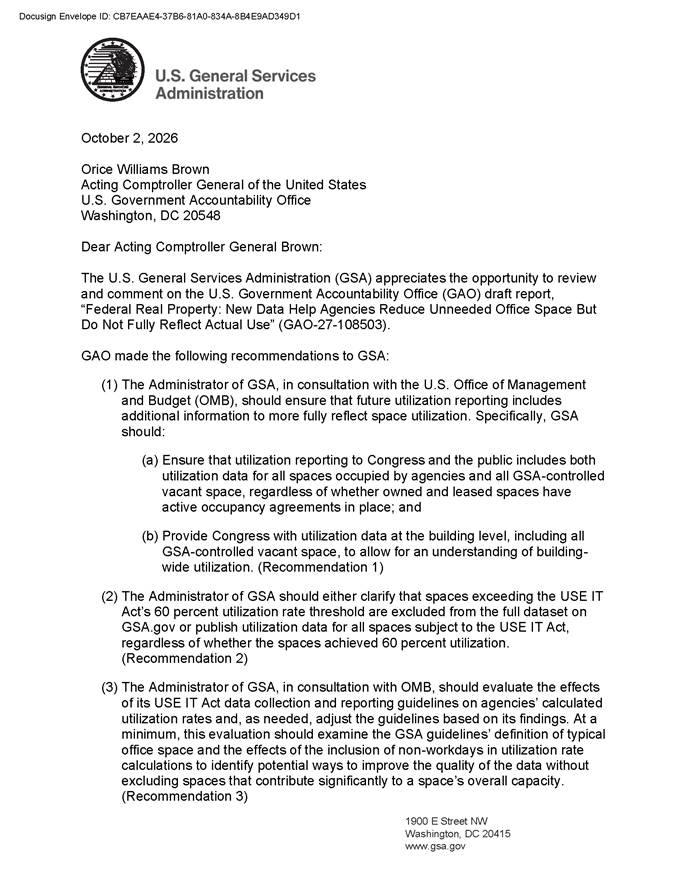
GAO Contact
David Marroni, marronid@gao.gov.
Staff Acknowledgments
In addition to the contact named above, GAO staff who made key contributions to this report are Matthew Cook (Assistant Director); Chad Williams (Analyst in Charge); Drew Buys; Melissa Bodeau; Emily Crofford, Josh Ormond; Kelly Rubin; Michael Soressi; and Amanda Sutter.
The Government Accountability Office, the audit, evaluation, and investigative arm of Congress, exists to support Congress in meeting its constitutional responsibilities and to help improve the performance and accountability of the federal government for the American people. GAO examines the use of public funds; evaluates federal programs and policies; and provides analyses, recommendations, and other assistance to help Congress make informed oversight, policy, and funding decisions. GAO’s commitment to good government is reflected in its core values of accountability, integrity, and reliability.
Obtaining Copies of GAO Reports and Testimony
The fastest and easiest way to obtain copies of GAO documents at no cost is through our website. Each weekday afternoon, GAO posts on its website newly released reports, testimony, and correspondence. You can also subscribe to GAO’s email updates to receive notification of newly posted products.
Order by Phone
The price of each GAO publication reflects GAO’s actual cost of production and distribution and depends on the number of pages in the publication and whether the publication is printed in color or black and white. Pricing and ordering information is posted on GAO’s website, https://www.gao.gov/ordering.htm.
Place orders by calling (202) 512-6000, toll free (866) 801-7077,
or
TDD (202) 512-2537.
Orders may be paid for using American Express, Discover Card, MasterCard, Visa, check, or money order. Call for additional information.
Connect with GAO
Connect with GAO on X,
LinkedIn, Instagram, and YouTube.
Subscribe to our Email Updates. Listen to our Podcasts.
Visit GAO on the web at https://www.gao.gov.
To Report Fraud, Waste, and Abuse in Federal Programs
Contact FraudNet:
Website: https://www.gao.gov/about/what-gao-does/fraudnet
Automated answering system: (800) 424-5454
Media Relations
Sarah Kaczmarek, Managing Director, Media@gao.gov
Congressional Relations
David A. Powner, Acting Managing Director, CongRel@gao.gov
General Inquiries
[1]GAO, High-Risk Series: Heightened Attention Could Save Billions More and Improve Government Efficiency and Effectiveness, GAO‑25‑107743 (Washington, D.C.: Feb. 25, 2025).
[2]Pub. L. No. 118-272, § 2302, 138 Stat. 3218 (2025). The statute applies to public buildings, as defined in 40 U.S.C. § 3301(a), and to federally leased space. Under the USE IT Act, federal agencies are defined as executive departments covered by the CFO Act of 1990. Id. § 2302(a)(6). The CFO Act of 1990, as amended, includes 24 agencies, which are often referred to collectively as CFO Act agencies. See 31 U.S.C. § 901(b). For the purposes of this report, “agencies” refer to the 24 CFO Act agencies unless otherwise specified. The 24 CFO Act agencies are the Departments of Agriculture, Commerce, Defense, Education, Energy, Health and Human Services, Homeland Security, Housing and Urban Development, Interior, Justice, Labor, State, Transportation, Treasury, Veterans Affairs, National Aeronautics and Space Administration, Environmental Protection Agency, United States Agency for International Development, General Services Administration, National Science Foundation, Nuclear Regulatory Commission, Office of Personnel Management, Small Business Administration, and the Social Security Administration.
[3]In April 2025, GSA published a list of 11 approved occupancy data collection approaches that also included technology-free approaches such as ‘visual analysis,’ which we refer to as manual counting in this report. See USE IT Act and occupancy data, https://www.gsa.gov/real-estate/use-it-act-and-occupancy-data, last accessed September 3, 2026.
[4]Agencies’ first annual reports to Congress were originally due by January 2026. According to GSA, a lapse in appropriations in late 2025 resulted in delayed reporting. See Cutting Costs, Adding Value: The Future of Federal Property Hearing Before the Subcommittee on Economic Development, Public Buildings, and Emergency Management of the House Committee on Transportation and Infrastructure, 119th Cong. 27 (December 11, 2025) (statement of Andrew Heller, Acting Commissioner, Public Buildings Service, U.S. General Services Administration). While no federal agency averaged 60 percent utilization rate across its portfolio, individual owned and leased spaces exceeded that mark. GSA did not include those spaces in its public reporting, which we discuss further in this report.
[5]Pub. L. No. 118-272, § 2302(g), 138 Stat. at 3222. While the USE IT Act defines “federal agencies” to mean executive departments covered by the CFO Act, OMB issued a memorandum in April 2025 providing guidance to a broader set of agencies on implementing the act’s requirements. The guidance applies to each executive agency as defined in 5 U.S.C. § 105. OMB M-25-25, Implementation of the Utilizing Space Efficiently and Improving Technologies Act (April 21, 2025). This report limits its scope to the CFO Act agencies.
[6]For the purposes of this report, “agencies” refer to the 24 CFO Act agencies unless otherwise specified.
[7]The U.S. Agency for International Aid (USAID) declined to submit responses to the survey, citing a need to focus on operations related to reducing the agency’s footprint and terminating awards.
[8]The five agencies were the Department of Homeland Security, the Department of Housing and Urban Development, the Small Business Administration, the Department of State, and the Department of the Treasury.
[9]We notified OMB officials of our review in June 2025 and they confirmed receipt of that contact. We sent OMB requests to meet and discuss the review in July 2025, April 2026, and May 2026. OMB did not respond to any of our requests to meet.
[10]GAO, Evidence-Based Policymaking: Practices to Help Manage and Assess the Results of Federal Efforts, GAO‑23‑105460 (Washington, D.C.: July 12, 2023).
[11]GAO, Standards for Internal Control in the Federal Government, GAO‑25‑107721 (Washington, D.C.), May 15, 2025.
[12]GAO, Federal Real Property: GSA Could Further Support Agencies’ Post-Pandemic Planning for Office Space Use, GAO‑22‑105105 (Washington, D.C.), September 7, 2022.
[13]Our 2023 space utilization report predated the USE IT Act, so the methodology we used to calculate utilization differed from this report and analyzed occupancy data for three 1-week periods during each month of January, February, and March 2023. See Federal Real Property: Agencies Need New Benchmarks to Measure and Shed Underutilized Space, GAO‑24‑107006 (Washington, D.C.), October 26, 2023.
[14]According to OMB guidance, federal agencies are to submit their USE IT Act occupancy data biweekly via OMB Collect, a data submission portal through which GSA manages the collection of these data. OMB M-25-25, Implementation of the Utilizing Space Efficiently and Improving Technologies Act (April 21, 2025).
[15]The USE IT Act includes two utilization numbers: (1) the actual utilization rate is a space’s total usable square feet divided by its occupancy and (2) the building utilization is a percentage of utilization calculated by comparing the actual utilization rate with the capacity based on the utilization benchmark of 150 usable square feet per person. Dividing a space’s occupancy by its capacity mirrors the building utilization calculation and produces the same result. This report uses “utilization rate” to refer to the building utilization, which is the rate that must meet the 60 percent minimum. The USE IT Act outlines the reporting time period by defining occupancy to consist of employees performing duties in person in a public building or federally leased space at least 40 hours per week over a 2-month period. As part of the OMB-directed biweekly reporting, GSA guidelines instruct agencies to report daily occupancy totals for each weekday, including holidays.
[16]The act does not define usable square feet. GSA published guidelines directing agencies to include “typical office space” measurements when calculating usable square feet that include examples of what is and is not considered to be “typical office space.”
[17]GSA guidelines refer to manual counting as ‘visual analysis.’ In our survey, shown in appendix III, we used the term ‘visual analysis’ to align with GSA’s guidelines.
[18]Pub. L. No. 118-272, § 2302(a)(8), 138 Stat. at 3219; 40 U.S.C. § 3301(a)(5).
[19]The Department of the Interior selected the ‘other’ option in the survey, noting that it used the “real property system of record” to approximate a measure of building occupancy in 2025. In July 2026, Interior officials told GAO that the agency began reporting badge swipes at its headquarters building in June 2026 while it works toward implementing collecting occupancy data across its portfolio. We discuss the Department of Interior’s approach in further detail later in the report.
[20]Specifically, 18 of the 20 agencies that reported using badging responded to the questions about ease of implementation and cost of implementation; 18 of these agencies said that ease of implementation—and 17 said that cost of implementation—was either “very important” or “moderately important.” For daily check-in surveys, 11 of the 12 agencies who responded to these questions said that both ease and cost of implementation was either “very important” or “moderately important.”
[21]In March 2025, the GSA Office of Inspector General reported on similar limitations of approaches to collecting occupancy data that can impair the accuracy and reliability of the data then used to calculate utilization rates. GSA Is Not Effectively Managing Its Internal Space to Reflect Occupancy Changes, GSA OIG Report Number A240044/P/R/R25001 (March 19, 2025).
[22]Of the 23 agencies that responded to our survey, 20 provided a cost figure and three either declined to do so or stated that they had not yet been able to calculate their related costs at the time of survey. Of the 20 agencies that provided cost information in response to our survey, 17 provided estimated costs and three provided actual costs. One agency that declined to provide an estimate said that its USE IT Act costs could not be isolated from other costs because its approach leveraged technology it already owned.
[23]Department of Agriculture officials reported using this platform for purposes beyond the collection and reporting of USE IT Act data. For example, in addition to monitoring space utilization, officials said it also supports assessing and managing space allocation, evaluating occupancy and usage patterns, and supporting broader workplace management efforts.
[24]GSA officials told us that, as of June 2026, these seven projects remained in process and that their specifics were subject to change.
[25]Department of Housing and Urban Development officials said they leveraged the agency’s USE IT Act data to confirm that the two satellites offices were no longer needed, supporting the reduction of about 83,000 usable square feet. In addition, these officials said the Department used the badging data it collected throughout fiscal year 2026 to inform construction and relocation activities at its new headquarters location in Alexandria, Virginia.
[26]Occupancy agreements are written agreements describing the financial terms and conditions under which GSA assigns, and a tenant agency occupies, GSA-controlled space. GSA also has occupancy agreements for space assigned to itself for use.
[27]GSA officials told us that, as part of their USE IT Act reporting, agencies should be reporting vacant space that they own or lease independently and added that GSA does not have a way to verify if agencies are omitting any vacant space from their respective data submissions.
[28]The USE IT Act requires that agencies report data on “public buildings and federally leased space occupied by the respective agency…broken down by building and lease.” Pub. L. No. 118-272, § 2302(c)(1)(A), 138 Stat. at 3219. Agencies generally reported data broken down by building for buildings they individually owned and, as directed by OMB, reported data broken down by occupancy agreement for spaces leased from GSA. For its own spaces, GSA reported spaces which had occupancy agreements assigned to itself but did not include data on its vacant spaces because they were not occupied by any agency, according to GSA officials. GSA officials told us that, based on the act and on OMB guidance, GSA and the other agencies reported occupancy and utilization information for the spaces that they occupy.
[29]For comparison purposes, the July 2026 data show that agencies reported a total of 114.4 million usable square feet in GSA-controlled owned (39.4 million) and leased (75.0 million feet) spaces as subject to the USE IT Act.
[30]As discussed in the next section, the March 2026 USE IT Act reporting did not include aggregate utilization rates that convey building-wide utilization for buildings with multiple tenant agencies.
[31]As noted in table 2, 78 of the 155 fully vacant spaces were buildings owned by GSA. As of July 2026, GSA reported that it is actively working to dispose of 30 of these 78 fully vacant buildings.
[32]OMB M-25-25 states that agencies must, regardless of the technologies used to collect the data, provide information including the associated occupancy agreement or Real Property Unique Identifier number(s) to be used for occupancy reporting and capacity comparison. It also states that, for spaces within GSA's custody and control, agencies should use an individual occupancy agreement and, if an agency has contiguous space with multiple occupancy agreements, it should report occupancy numbers for each individual occupancy agreement.
[33]See Inventory of GSA Owned and Leased Properties, https://www.gsa.gov/tools‑overview/buildings‑and‑real‑estate‑tools/inventory‑of‑gsa‑owned‑and‑leased‑properties, last accessed September 2, 2026.
[34]GSA officials told us that factors such as market conditions, customer requirements, and lessor negotiations also come into play in the agency’s real property planning process.
[35]For language on the overview page indicating the data only includes spaces below the 60 percent threshold, see USE IT Act and occupancy data, https://www.gsa.gov/real‑estate/real‑estate‑services/for‑federal‑customers/use‑it‑act‑and‑occupancy‑data/reporting‑guidelines, last accessed September 9, 2026. For the USE IT Act data submission and the disclaimer language, see USE IT Act Agency Submissions, https://www.gsa.gov/real‑estate/use‑it‑act‑and‑occupancy‑data/use‑it‑act‑agency‑submissions, last accessed September 9, 2026.
[37]GAO, Federal Real Property: Agencies Should Provide More Information about Increases in Deferred Maintenance and Repair, GAO‑24‑105485 (Washington, D.C., November 16, 2023).
[38]As noted earlier, utilization rates are calculated as follows: Total usable square footage is divided by a 150 square feet per person benchmark; the result is the capacity. Then the average of the total number of actual occupants across the reporting period established by GSA is divided by the capacity. The result of this calculation is the utilization rate for the reporting period.
[39]Department of State officials noted that headquarters buildings will have a larger proportion of non-workstation spaces that are included in USE IT Act reporting than annexes or other facilities.
[40]To illustrate this concept, consider a building with 100,000 usable square feet. Under the USE IT Act's 150 usable square feet per person benchmark, the capacity of this building would be 667 people (100,000 divided by 150). To achieve a utilization rate of 60 percent, an average of at least 400 people would need to use the space per day (667 multiplied by 60 percent) during a reporting period. If 400 people are regularly using the space, the building could be configured to allow for as much as 250 usable square feet per person (100,000 divided by 400) and achieve the minimum 60 percent utilization rate required by the USE IT Act.
[41]Beginning in 2027, the USE IT Act directs GSA, in consultation with OMB, to take actions to reduce spaces, including through consolidation and disposal for spaces that have not reported at least a 60 percent utilization rate for two consecutive years. The USE IT Act also allows OMB to provide exceptions to building utilization metrics when determining actions to take to reduce unneeded space. These exceptions must be based on the amount of non-standard office space an agency demonstrates is required to meet the agency’s mission. Pub. L. No. 118-272, § 2302(d), 135 Stat. at 3220.
[42]The July 2026 GSA letter noted that, while current guidance stated that agencies are to include nearly all office space—including lobbies and conference rooms—this recommendation suggested including only closed office spaces, open workstation space, supporting space, and conference rooms capable of holding 20 or fewer individuals. The letter also included an appendix with proposed updates to the USE IT Act data collection guidelines on standard versus non-standard office space.
[43]In addition to the recommendation to not report on the occupancy of a space when it is closed, the July 2026 GSA letter made recommendations to update the timelines for biweekly data submissions and final annual reporting and to reconvene the Federal Real Property Council’s (FRPC) Occupancy Working Group.
[45]In July 2026, DHS officials responsible for implementing the USE IT Act told us that they had directed the U.S. Coast Guard—which is responsible for half of the 700 spaces that are not reporting the required occupancy data—to begin to report using other methods approved by GSA while awaiting Wi-Fi-based capabilities. These officials added that several DHS components, including the U.S. Coast Guard, have indicated progress in implementing Wi-Fi based technologies and that these components plan to use them to collect occupancy data at locations where feasible.
[46]Commerce officials said that these auditoriums were excluded because they are joint-use spaces that need to be available to all entities located in a building or campus. They noted that one campus has numerous laboratories and research buildings that are used by over 3,000 scientists and other staff members.
[47]See Exec. Order No. 13327, Federal Real Property Asset Management, 69 Fed. Reg. 5897 (Feb. 4, 2004). The executive order established the FRPC, which is chaired by the Deputy Director of the OMB and is composed of senior management officials from certain executive branch departments and agencies including GSA, and any other full-time or permanent part-time Federal officials or employees as deemed necessary by the Chairman. The executive order established the FRPC with the goals of developing guidance, facilitating the implementation of agencies’ asset-management plans, and serving as a clearinghouse for leading practices.
[49]Pub. L. No. 118-272, § 2302, 138 Stat. 3218 (2025). Under the USE IT Act, federal agencies are defined as executive departments covered by the Chief Financial Officers (CFO) Act of 1990. Id. § 2302(a)(6). While OMB Memo 25-25 directs additional agencies to follow guidance on implementing the USE IT Act, we limited our scope to CFO Act agencies. OMB M-25-25, Implementation of the Utilizing Space Efficiently and Improving Technologies Act (April 21, 2025).
[50]The USE IT Act included a provision for GAO to issue a report on the cost to each federal agency of measuring occupancy and actual utilization rates of space in public buildings and federally leased space to prepare the agencies’ required reports. Pub. L. No. 118-272, § 2302(g), 138 Stat. at 3222.
[51]The CFO Act of 1990, as amended, includes 24 agencies, which are often referred to collectively as CFO Act agencies. See 31 U.S.C. § 901(b). For the purposes of this report, “agencies” refer to the 24 CFO Act agencies unless otherwise specified. The 24 CFO Act agencies are the Departments of Agriculture, Commerce, Defense, Education, Energy, Health and Human Services, Homeland Security, Housing and Urban Development, Interior, Justice, Labor, State, Transportation, Treasury, Veterans Affairs, National Aeronautics and Space Administration, Environmental Protection Agency, United States Agency for International Development, General Services Administration, National Science Foundation, Nuclear Regulatory Commission, Office of Personnel Management, Small Business Administration, and the Social Security Administration.
[52]For the list of the 11 approaches approved by GSA for the collection of occupancy data for reporting required by the USE IT Act, see appendix II.
[53]While our survey was in the field, the federal government experienced a funding gap resulting in a shutdown that lasted 42 days, from October 1, 2025 through November 12, 2025. This interrupted our data collection and slowed agency responses.
[54]We notified OMB officials of our review in June 2025 and they confirmed receipt of that contact. We sent OMB requests to meet and discuss the review in July 2025, April 2026, and May 2026. OMB did not respond to any of our requests to meet.
[55]In a State Department press briefing in March 2025, USAID and State announced their intent to undertake a reorganization of foreign assistance programming that would involve realigning certain USAID functions to State by July 1, 2025, and discontinuing the remaining USAID functions.”. According to federal real property data for fiscal year 2024, the most up-to-date available at the time of our survey, USAID was using two domestic buildings that might be subject to USE IT Act requirements.
[56]GAO, Evidence-Based Policymaking: Practices to Help Manage and Assess the Results of Federal Efforts, GAO‑23‑105460 (Washington, D.C.: July 12, 2023).
[57]These practices state that, when communicating with Congress, agencies should help the body understand how well the agency is performing and how it made decisions, as the body may need the information for oversight or to help implement those decisions. Further, they state that, when communicating with the public, agencies should present information in a manner that helps members of the public understand the issues that the federal government seeks to address, and how well federal programs and activities are doing at addressing those issues.
[58]GAO, Standards for Internal Control in the Federal Government, GAO‑25‑107721 (Washington, D.C.), May 15, 2025.
[59]Pub. L. No. 118-272, § 2302(b), 138 Stat. 3218, 3219 (2025).
[60]The CFO Act of 1990, as amended, includes 24 agencies, which are often referred to collectively as CFO Act agencies. See 31 U.S.C. § 901(b). For the purposes of this report, “agencies” refer to the 24 CFO Act agencies unless otherwise specified. The 24 CFO Act agencies are the Departments of Agriculture, Commerce, Defense, Education, Energy, Health and Human Services, Homeland Security, Housing and Urban Development, Interior, Justice, Labor, State, Transportation, Treasury, Veterans Affairs, National Aeronautics and Space Administration, Environmental Protection Agency, United States Agency for International Development, General Services Administration, National Science Foundation, Nuclear Regulatory Commission, Office of Personnel Management, Small Business Administration, and Social Security Administration.
[61]The U.S. Agency for International Aid declined to submit responses to the survey, citing a need to focus on operations related to reducing the agency’s footprint and terminating awards.
[62]The US Government shut down for 43 days, from October 1, 2025 through November 12, 2025, while our survey was in the field.
[63]Pub. L. No. 118-272, § 2302(g), 138 Stat. 3218, 3222 (2025).
[64]These agencies are listed in the Chief Financial Officers Act of 1990, codified as amended at 31 U.S.C. § 901(b).
[65]OMB M-25-25, Implementation of the Utilizing Space Efficiently and Improving Technologies Act (April 21, 2025).
[66]See Occupancy and utilization reporting guidelines, https://www.gsa.gov/real-estate/use-it-act-and-occupancy-data/reporting-guidelines, last accessed September 15, 2026.
[67]GSA guidelines refer to manual counting as ‘visual analysis.’ In our survey, we used the term ‘visual analysis’ to align with GSA’s guidelines.
[68]GSA guidelines refer to manual counting as ‘visual analysis.’ In our survey, we used the term ‘visual analysis’ to align with GSA’s guidelines.
[69]GSA guidelines refer to manual counting as ‘visual analysis.’ In our survey, we used the term ‘visual analysis’ to align with GSA’s guidelines.
[70]GSA guidelines refer to manual counting as ‘visual analysis.’ In our survey, we used the term ‘visual analysis’ to align with GSA’s guidelines.