
Report to Congressional Committees
United States Government Accountability Office
A report to congressional committees
Contact: Chelsa Kenney at kenneyc@gao.gov
What GAO Found
The Fly America Act requires that, except under certain circumstances, all air travel funded by the U.S. government use a U.S.-flag air carrier service—which is generally provided by a U.S. airline or under a code share agreement with a foreign air carrier. GAO found that the Act increases State Department travel costs by an estimated $0.7 million to $1.5 million annually—about 1 to 2 percent of the $69 million State spent on air travel in fiscal year (FY) 2025. To derive this estimate, GAO analyzed a generalizable sample of simulated international travel itineraries for FY 2026. This sample consisted of 1,000 ticket pairs, each containing the least expensive unrestricted fare and most direct flight available for an Act-compliant ticket and -noncompliant ticket. For 5 percent of ticket pairs, GAO estimated that the Act increases State’s costs (reflecting both fare and travel time) by an average of $455 per ticket. For an additional 12 percent of ticket pairs, GAO estimated that the Act does not affect State’s costs. For the remaining 83 percent of ticket pairs, the Act’s effects on cost are uncertain because they are subject to assumptions about airline pricing strategies, among other factors.
Some State travelers experience challenges during urgent and routine travel as a result of the Acts, according to State documents, data, and officials. For urgent travel—for example, authorized or ordered departures from foreign posts and emergency travel for personal circumstances, such as for a funeral—Act-compliant flights can be difficult to find on short notice and approvals for exceptions may take time to process, according to officials. For routine travel, implementation of the Act poses challenges in three main categories: (1) compliant flight availability, (2) travel with pets, and (3) State’s administrative process to apply for an exception to the Act. In FY 2025, State approved employees’ applications for an exception to the Act, allowing them to use a foreign air carrier, for approximately 6 percent of itineraries between U.S. and foreign destinations. State most often approved requests claiming an exception to reduce trip duration, to reduce layovers abroad, to ensure timely arrival to accomplish State’s mission, and to travel with pets for new post assignments and evacuation travel. State rejected approximately 14 percent of waiver requests in FY 2025.
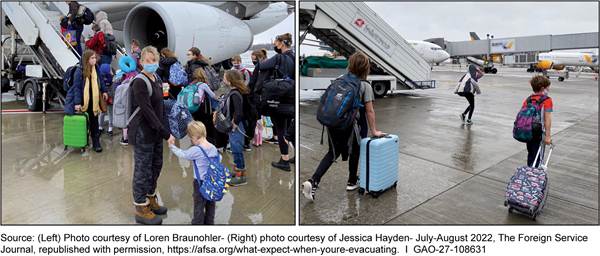
Ukraine Evacuation Flights Prior to Russian Invasion, Including Foreign Service Family Members
Why GAO Did This Study
The Act and its regulations allow travel on foreign carriers under certain circumstances, including when a U.S. air carrier is not available for medical reasons or traveler safety. However, a lower-price ticket on a foreign air carrier does not constitute an exception to the Act. The Act’s travel requirements may particularly affect State personnel, who represent 69 percent of all U.S. government personnel at U.S. posts abroad.
Congress included a provision in law for GAO to review the Act’s effects on U.S. government costs and State personnel. This report examines the Act’s effects on (1) State’s estimated travel costs and (2) State personnel’s experience with urgent and routine travel.
To examine the Act’s effects on State’s estimated travel costs, GAO developed a random, generalizable sample of 600 itineraries from the full universe of State’s 26,906 authorized itineraries for travel between a U.S. and a foreign destination in FY 2025. For each itinerary in this sample, GAO asked State to search for a pair of tickets—one ticket that complied with the Act and one that did not—for each route on specific dates in FY 2026. GAO analyzed any cost differences in the 1,000 resulting ticket pairs and extrapolated the results to derive a total cost estimate. To examine the Act’s effects on State personnel’s travel experience, GAO reviewed documentation, analyzed travel data, and interviewed State officials.
Abbreviations
Act Fly America Act
AD/OD authorized or ordered departure
EU European Union
EVT emergency visitation travel
FAM Foreign Affairs Manual
FY fiscal year
GSA General Services Administration
GSO General Services Officer
TMP Travel Management and Policy Office
This is a work of the U.S. government and is not subject to copyright protection in the United States. The published product may be reproduced and distributed in its entirety without further permission from GAO. However, because this work may contain copyrighted images or other material, permission from the copyright holder may be necessary if you wish to reproduce this material separately.
October 1, 2026
Congressional Committees
The Fly America Act (the Act) requires, except under certain circumstances, the use of a U.S.-flag air carrier service[1]—which is generally provided by a U.S. airline or under a code share agreement with a foreign air carrier—for all air travel funded by the federal government.[2] The Act and its implementing regulations allow some exceptions under certain circumstances—for example, when a U.S. air carrier is not available or a medical emergency requires expedited travel. However, the Act generally requires that travelers use a U.S. air carrier for government-funded travel even if a foreign air carrier offers a lower price or its service is preferred by, or more convenient for, the agency or the traveler.
The Act’s travel requirements may particularly affect Department of State personnel, according to the American Foreign Service Association. State direct-hire staff accounted for approximately 69 percent of all U.S. government personnel staffed at U.S. diplomatic missions abroad in fiscal year (FY) 2025.[3] Also, State personnel are more likely to be assigned abroad for longer periods and travel more frequently between the U.S. and foreign posts for mission needs, leave, and permanent changes of station than other agencies’ personnel, according to State officials. In addition, State personnel based in the agency’s headquarters also undertake frequent international Temporary Duty travel, according to State travel officials.
Section 7112 of the National Defense Authorization Act for FY 2025 includes a provision for us to review the effect of the Act on U.S. government costs and State personnel.[4] This report examines the Act’s effects on (1) State’s estimated travel costs and (2) State personnel’s experience with urgent and routine travel.
To examine the Act’s effects on State’s estimated travel costs, we analyzed prospective data on future travel in FY 2026 comparing the costs of flights that complied with the Act and flights that did not. Specifically, we took a generalizable random sample of 600 itineraries (120 one-way trips, 240 round trips, and 240 where the trip type was unknown) from the full universe of State’s 26,906 itineraries between the U.S. and a foreign destination in FY 2025. For itineraries with an unknown trip type, we randomly assigned them to be either round trip or one-way tickets based on the initial distribution of known route types in the data: one-third of itineraries were one-way and two-thirds were round trip. We therefore assigned 80 out of the 240 unknown itineraries as one-way and the remaining 160 as round trip. In total then, we had 200 one-way itineraries and 400 round trip itineraries.
State travelers are directed to select the least expensive, most direct, usually traveled routes among available routes that meet their mission needs, according to State travel officials. Therefore, for each one-way itinerary and each leg of a round-trip itinerary in our sample, we asked State to provide information on the least expensive unrestricted fare and most direct flight that was compliant with the Act and on the least expensive unrestricted fare and most direct flight that was not compliant with the Act for specific dates in FY 2026.[5] We received data on 1,000 ticket pairs (one pair for each one-way itinerary and two pairs for each round-trip itinerary), which we analyzed to calculate any difference in cost between the Act-compliant and noncompliant tickets.
To examine the Act’s effects on State personnel’s travel experience, we reviewed documentation, analyzed travel data, and interviewed State officials. Specifically, we reviewed laws and regulations related to the Act and compared them with State’s travel policies. We analyzed email queries related to the Act that State employees sent to the Travel Management and Policy Office (TMP) in FY 2025.[6] We also analyzed data for emergency visitation travel (EVT) flights and for authorized or ordered departures (AD/OD) in FY 2025 as well as data, by category of exceptions to the Act, for waiver requests submitted by State employees and for waiver approvals and denials issued by State during the same FY.[7] In addition, as part of our comparative analysis of simulated FY 2026 options, we analyzed the Act’s projected effects on average travel times and number of stops during that FY.
Moreover, we identified common themes related to travel benefits and challenges resulting from the Act by interviewing officials from State’s Bureau for Arms Control and International Security with roles related to personnel travel.[8] We also interviewed several General Services officers (GSO)—one regional officer and four officers at selected posts—whose work involved approving and managing travel abroad. See appendix I for additional details of our scope and methodology.
We conducted this performance audit from July 2025 to October 2026 in accordance with generally accepted government auditing standards. Those standards require that we plan and perform the audit to obtain sufficient, appropriate evidence to provide a reasonable basis for our findings and conclusions based on our audit objectives. We believe that the evidence obtained provides a reasonable basis for our findings and conclusions based on our audit objectives.
Background
State Travel Administration and Guidance
State’s TMP serves as the central hub for managing the department’s worldwide travel. TMP sets travel policies for the agency, oversees operations such as the travel management centers, and supports permanent changes of station.[9] TMP also reviews and approves most requests for waivers based on an exception to the Act.[10] In addition to TMP, GSOs located at posts are involved in approving and assisting with travel abroad, including confirming that travel arrangements comply with the Act and answering questions about topics such as the waiver process.
The Federal Travel Regulation issued by the General Services Administration (GSA) specifies some aspects of how agencies must implement the Act. Additionally, under the Federal Travel Regulation, agency employees must use a contract City Pair Program fare (which we refer to as a GSA contract fare), barring certain exceptions.[11] According to State travel officials, all GSA contract fares available to State travelers through the department’s travel management system are compliant with the Act. However, not all Act-compliant flights have negotiated GSA contract fares.
State’s Foreign Affairs Manual (FAM) provides internal travel guidance for implementing the Act, and a Fast Facts sheet provides such guidance in simplified terms.[12] For example, the Fast Facts sheet states that State travelers are required to use a U.S. air carrier or codeshare service for all air travel funded by the U.S. Government and summarizes permissible exceptions for which a traveler can apply. In addition, State provides a waiver checklist to guide State travelers in assessing whether a particular travel situation may qualify for an exception to the Act.
Exceptions Related to the Act
Under the Act, State travelers must use a U.S. air carrier for travel between a place in the U.S. and a place outside the U.S., subject to certain exceptions. U.S. air carrier service includes service provided under a code-share agreement with a foreign air carrier when the ticket identifies the U.S. air carrier’s designator code and flight number.[13] If a U.S. air carrier is not available, State travelers may claim an exception to the Act and request a waiver that will allow use of a foreign air carrier.
The Federal Travel Regulation requires travelers claiming an exception to the Act to provide a certification that includes a statement justifying use of the exception to purchase travel on a foreign air carrier, or a copy of the agency’s written approval deeming foreign air carrier service necessary.[14] The regulation states that travelers must provide a certification and any additional documents specified by the agency before the agency can pay the foreign air carrier fare.[15]
State’s waiver form lists the following seven exception categories:
· Agency mission
· Authorized class of service not available on a U.S. air carrier
· Bilateral or multilateral treaty (e.g., Open Skies Agreement[16])
· Medical need
· No available service on a U.S. air carrier
· Traveler safety
· Other exception[17]
In addition, the waiver form provides space to include narrative details regarding the selected exception. State travelers must have an approved waiver form before using the foreign air carrier. State personnel complete this form by adding the exception justification and, except under emergency circumstances, submit the form to TMP for approval.
According to State officials, Congress enacted additional exceptions to the Act for State, and State has requested additional exemptions. For example, the Act allows an exception for State personnel traveling between two points outside the U.S.[18] In addition, State travelers can request to travel with up to three cats or dogs on a foreign air carrier if no U.S. air carrier is willing to transport the animals accompanying State personnel. For FY 2027, State requested additional exemptions to the Act for EVT and AD/OD, according to State officials.[19]
The Act Increases State’s Travel Costs by an Estimated $1 Million Annually
On an annual basis, the Act increases costs for around 5 percent of simulated ticket pairs and costs State an estimated $1.1 million, with a 95 percent confidence interval ranging from $0.7 million to $1.5 million. This represents about 1.6 percent of State’s roughly $69 million in travel expenditures for international air transportation in FY 2025, or 1 to 2.2 percent based on the confidence interval.[20] Our estimate accounts for both increased ticket costs and salary costs resulting from differences in travel time for Act-compliant flights. In addition to increasing State’s costs for around 5 percent of ticket pairs, the Act may impose additional costs on the 83 percent of ticket pairs for which the compliant ticket had a GSA contract fare available. However, the magnitude of those costs is sensitive to assumptions about how the Act and the GSA contract fare regulations affect airlines’ pricing decisions and is thus difficult to quantify. For the remaining 12 percent of ticket pairs, GAO estimated that the Act does not affect State’s costs. (See app. II for a detailed description of our analysis.)
The Act Increases Fares for Around 5 Percent of Simulated Ticket Pairs
Our analysis found that the Act directly increases State’s estimated travel costs for 5.3 percent of simulated ticket pairs in a sample of FY 2026 itineraries. The ticket pairs for which the Act increases costs met all three of the following conditions:
1) No GSA contract fare was available. Focusing on ticket pairs for which a GSA contract fare was not available allowed us to identify costs that were directly attributable to compliance with the Act. In ticket pairs where a GSA contract fare was available, it is unclear how the Act and GSA contract fare regulations interrelate to affect airlines’ pricing decisions, as we discuss below.
2) The noncompliant ticket was less expensive than the compliant ticket. This condition ensured that complying with the Act increases the ticket price. If the compliant ticket is already less expensive, compliance with the Act does not increase State’s travel costs.
3) No exception to the Act was available. Travelers may purchase foreign-flag air carrier tickets under specific exceptions to the Act.[21] Excluding ticket pairs in our sample that qualified for these exceptions allowed us to attribute costs to compliance with the Act.
Of the 1,000 ticket pairs that we reviewed, 828 did not meet the first condition because the Act-compliant fare was also a GSA contract fare.[22] Among those 828 ticket pairs, 615 had a cheaper compliant ticket and 213 had a more expensive compliant ticket. That is, when a GSA fare was available, the compliant ticket was cheaper than the noncompliant ticket about 75 percent of the time.
Of the 172 ticket pairs that met the first condition, 79 also met the second condition and had a more expensive compliant fare while 93 had a cheaper compliant fare. Among ticket pairs without a GSA contract fare available, the compliant fare was cheaper only 55 percent of the time.
Of the 79 ticket pairs that met both the first and the second condition, 53 ticket pairs also met the third condition; the remaining 26 pairs included tickets eligible for exceptions to the Act.[23] The 53 ticket pairs that met all three conditions are the basis of our quantitative estimate of the Act’s direct effects on State’s travel costs. Figure 1 shows how we applied each of these conditions to the ticket pairs.
Figure 1: Proportion of GAO Sample of Simulated Fiscal Year 2026 Ticket Pairs for Which Fly America Act Imposes Added Cost for State Department
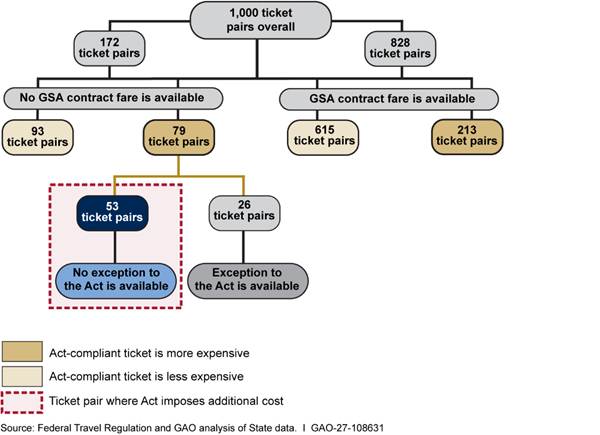
Note: Our sample included 600 travel itineraries (which generated 1,000 ticket pairs) that we randomly sampled from the full universe of State’s 26,906 authorized travel itineraries between the U.S. and a foreign destination in FY 2025.
Among the 53 ticket pairs for which the Act directly increases State’s costs, the price of compliant tickets is, on average, $463 (40 percent) higher than the price of the noncompliant tickets—$1,616 for compliant tickets versus $1,153 for noncompliant tickets. As figure 2 shows, the distribution of fare differences is relatively skewed by the presence of some outlier pairs where the price for the compliant flight is more than $1,500 higher than for the noncompliant flight. Two-thirds of the compliant tickets are less than $400 more expensive than their noncompliant counterparts.
Figure 2: Distribution in Cost Difference Between Fly America Act–Compliant and Noncompliant Fares in GAO Sample of Simulated Fiscal Year 2026 Ticket Pairs for Which the Act Directly Imposes Added Cost for State Department
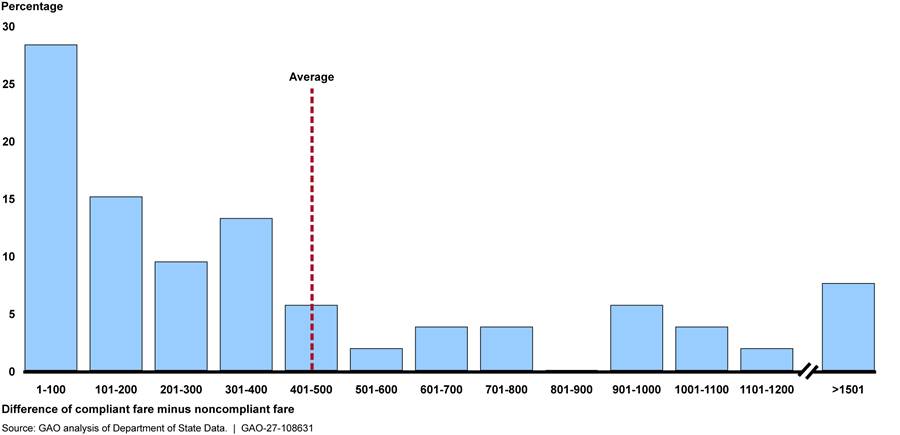
Note: Our sample included 600 travel itineraries (which generated 1,000 ticket pairs) that were randomly sampled from the full universe of State’s 26,906 authorized travel itineraries between the U.S. and a foreign destination in FY 2025. This distribution in cost difference applies to the 53 ticket pairs in our sample for which the Act directly increases State’s costs. The 53 ticket pairs met three conditions—no GSA contract fare was available, an Act-noncompliant ticket was less expensive than an Act-compliant ticket, and no exception to the Act was available.
Differences in Travel Time Slightly Reduced the Estimated Cost of the Act
In addition to analyzing the Act’s effect on ticket prices, we accounted for differences in travel time for compliant and noncompliant tickets, based on an assumption that travel time is an opportunity cost to the agency. For example, time spent traveling can limit a State traveler’s ability to conduct work tasks, such as reading classified or sensitive material. We estimated the Act’s added cost of travel by multiplying the difference in travel time by the median hourly wage for State Foreign Service employees ($63.61) and adding it to the difference in prices.
Among the 53 ticket pairs for which the Act increases airfare costs, the average travel time is slightly shorter for the compliant ticket relative to the noncompliant ticket. The difference is not statistically significant, but accounting for it in our model reduces the difference in cost for a compliant and a noncompliant flight from $463 to $455. For this $455 cost differential, our model calculates a 95 percent confidence interval that ranges from $276 to $634.
The Act Increases Annual Costs by An Estimated $1 Million, but GSA Contract Fares Make Other Costs or Savings Unclear
We estimate that the Act increases State’s annual travel costs by $0.7 million to $1.5 million annually, but additional factors suggest that the Act’s cost to State may be higher. Our estimate assumes that the Act increases costs for 5.3 percent of tickets in our sample that meet the three conditions described above. State purchased 45,030 airline tickets for flights between foreign countries and the U.S in FY 2025. If 5.3 percent of those 45,030 tickets are, on average, $455 more expensive, this translates to a cost of $1.1 million. To calculate a range of estimates, we replaced the $455 point estimate with the lower and upper bound of its confidence interval and found that the cost of the Act to State ranges from $0.7 million to $1.5 million annually.[24]
Our $1.1 million cost estimate does not account for 828 ticket pairs (83 percent of the sample) for which the compliant ticket was a GSA contract fare. Of these 828 ticket pairs, 213 (21 percent of the sample) also had a more expensive compliant ticket, costing an average of $311 more than the noncompliant ticket. GSA contract fare regulations allow the agency to authorize use of a noncontract carrier if it offers a cheaper fare to the general public that, if used, will result in a lower total trip cost to the government.[25] As a result, if not for the Act, State would be able to purchase these cheaper tickets for travel on foreign carriers. Following the approach described in the previous paragraph, we would estimate that the Act adds another $3 million in annual costs.[26]
However, the Act may affect all ticket pairs for which the compliant ticket was a GSA contract fare (not merely the pairs in which the compliant ticket is more expensive than the noncompliant ticket), which limits the accuracy of any cost estimate for ticket pairs with no GSA contract fare available. Depending on the assumptions one makes about the Act’s effects on U.S. airlines’ negotiations with GSA for contract fares on international routes, those contract fares might rise or fall if the Act were not in place. A full exploration of airlines’ approaches to GSA contract fare negotiations without the Act in place is beyond the scope of this report, but we highlight two possible scenarios here to illustrate the uncertainty in discerning the cost of the Act for these ticket pairs.
· Absent the Act, some GSA contract fares could decrease. The Act may be a barrier to competition that prevents the government from receiving the best possible price for contract fares for international routes. Domestic airlines may not offer the lowest possible price to the government for a given route if they know they are not competing with foreign carriers. If the Act serves as a barrier to competition, then it is raising observed GSA contract fares across all (or most) markets, and repealing it could yield substantial cost savings for some number of tickets purchased by State on a route with a GSA contract fare available.
· Absent the Act, some GSA contract fares could increase. For a U.S. airline with a GSA contract fare on an international route, the Act’s restriction on purchasing a foreign carrier ticket increases the passenger volume, all else being equal. If knowing that government workers will likely fill some minimum number of seats on most flights influences an airline’s decision to offer a contract fare or the price it is willing to accept, removing the Act could increase the price of GSA contract fares for certain routes or cause airlines to reconsider those for which they are willing to offer contract fares.[27] In this scenario, the Act is keeping State’s total travel costs lower than they otherwise would be.
Whether the Act keeps GSA contract fares higher or lower than they otherwise would be is difficult to say with certainty and affects any estimate of the Act’s effects on State’s travel costs for international routes with a GSA contract fare available. Because we cannot predict the magnitude of over- or underestimation of the Act’s effect on GSA contract fares, we are not including cost estimates for any of the ticket pairs for which the compliant ticket was a GSA contract fare.
Some State Travelers Experience Challenges Due to the Act, Especially During Urgent Travel
The Act Can Pose Particular Challenges During Urgent Travel
The Act can pose particular challenges for State personnel during urgent travel—that is, emergency visitation travel (EVT) and authorized or ordered departures (AD/OD)—because compliant flights can be difficult to book on short notice and waivers may take time to process, according to officials of State’s Travel Management and Policy Office (TMP). However, such challenges vary according to the circumstances of the emergency and can also vary by origin or destination depending on the frequency of direct routes provided by U.S. and foreign airlines between the U.S. and the destination, according to a regional GSO we interviewed and three of the four General Services officers (GSO) we spoke with at posts.
Emergency Visitation Travel
According to our analysis, State officials, and American Foreign Service Association representatives, the Act can create two primary challenges for State officials who need to undertake emergency visitation travel: difficulty in finding compliant flights quickly and denial of reimbursement after self-purchase of flights on foreign carriers. State personnel took 487 EVT trips during FY 2025, according to State data. These trips included travel after the death of an immediate family member, emergency travel for childbirth, and travel to visit relatives in critical condition.[28]
In urgent situations, travelers may at times, for expediency, purchase their own tickets and apply for reimbursement, according to State officials. However, the waiver form cannot be approved retroactively, which can lead to denial of reimbursements for such emergencies.[29] For example, our analysis of Act-related email queries that State employees sent to TMP in FY 2025 found that one traveler reported being denied reimbursement after self-purchasing a ticket for a foreign carrier after close of business to attend the funeral of a parent. The trip qualified for EVT and an Act exception, but reimbursement was denied because the traveler had not obtained an approved DS-3093 prior to travel, according to the email. Likewise, a regional GSO told us that she was aware of multiple instances in which a traveler or a family member who booked travel outside working hours, when travel assistance was not available, did not receive reimbursement because of a failure to obtain a waiver approval before the trip.
American Foreign Service Association representatives said that they consider EVT to be the type of circumstance that poses the greatest challenge resulting from the Act, because foreign carriers are likely to offer more flights for immediate travel than domestic carriers. The representatives said that in such emergency situations, State travelers may take the available noncompliant flight and later seek reimbursement, but the reimbursement process is burdensome.
This challenge appears to vary by location depending on the availability of U.S. carrier flights. For example, the GSO we spoke with in Côte d’Ivoire said that the Act does not make EVT difficult for personnel at that post, because U.S. carrier and code-share flights between Côte d’Ivoire and the U.S. are more frequent than noncompliant options and have shorter layovers.
Authorized and Ordered Departures
The Act can also pose challenges after State declares an AD/OD event, typically denoting a threat to the safety of personnel serving at post. According to State officials, AD/OD events often increase demand for commercial flights because embassy personnel, family members, and private travelers attempt to depart simultaneously. According to State officials, this competition can reduce the availability of compliant flights when State travelers need to book flights to depart quickly. State declared six AD/OD events in FY 2025, according to State data.
Officials also described administrative challenges associated with processing Act waivers during emergencies. For example, according to a GSO in Bangladesh whom we interviewed, the U.S. embassy was without internet access for up to 24 hours during an AD/OD event there in 2024 and did not have enough bandwidth to process evacuation orders or Act waivers for several days after the host government shut down the internet countrywide. Waivers of the Act’s requirements had to be processed manually. Also, State staff at post had to rely on regional support in Amman, Jordan, to process waivers and book available travel, which increased the administrative time required to book necessary travel.
To facilitate the administrative process for obtaining a waiver during an ordered departure, State has issued guidance to affected posts advising travelers about the Act exceptions they should use. For example, when the conflict in Iran in 2026 affected the safety and availability of air travel from multiple Persian Gulf and Middle East states, State sent a notice to personnel and the travel management center indicating that travelers should use the exception for avoiding “unreasonable risk to employee safety.” The notice also indicated, for regional travel management centers with online reporting systems integrated with TMP, that the required exception should be recorded with the traveler’s ticketing information.[30]
Three GSOs we spoke with, in Colombia, Côte d’Ivoire, and Fiji, said that they did not anticipate challenges related to the Act requirements if an AD/OD event were to occur. The GSOs in Columbia and Côte d’Ivoire said that travelers would be able to find flights because of the availability of Act-compliant flights in those countries. The GSO in Fiji did not anticipate challenges related to the Act requirements because travelers would use available code-share flights or Act exceptions.
Finding Compliant Flights, Transporting Pets, and Navigating the Waiver Process Pose Challenges for Some Routine Travel
According to State officials, our analysis of Act-related email queries from travelers, and State data, challenges that the Act may cause during routine travel relate primarily to compliant flight availability, travel with pets, and the waiver process. The occurrence of such challenges appears to vary by location, depending on the frequency of U.S. carrier flights to and from that location.
Compliant Flight Availability, Duration, and Routing
According to State officials, for some routes, Act-compliant flights are often less direct, depart at less convenient times, or involve more challenging routings than the alternative noncompliant flights. For example, a GSO in Fiji noted that no U.S. carriers operated between the post’s location and the continental U.S. As a result, travelers frequently had to justify the use of exceptions to the Act’s requirements.[31] A GSO in Bangladesh said she had found that Act-compliant flights made up fewer than a third of flights available for common routes from Dhaka to the U.S. She also said that the compliant flights required longer travel times and extended or additional layovers, which increase the risk of missing a connecting flight or losing luggage.[32] A GSO based in Washington, D.C., who arranges travel for multiple State bureaus told us that compliant flights to some foreign destinations are difficult to find and may be longer, involve more layovers, or be less direct than noncompliant flights.
In addition, State officials identified safety concerns related to minors traveling unaccompanied when direct routes are not available on U.S. carriers. Not all airlines offer assistance for unaccompanied minors, and some travelers prefer to use waivers to book direct flights for their dependents on foreign carriers to avoid potential mishaps during airport transfers. Further, our analysis of State personnel’s email queries to TMP found that some queries addressed concerns about U.S. carriers’ short layover times at airports where international travelers must pass through immigration and customs. Similarly, our analysis of State waiver data found that some travelers use the “agency mission” exception and cite justifications related to insufficient time to clear immigration and recheck baggage for connecting flights.
Differences in flight travel time and number of stops for compliant and noncompliant flights can vary by region, according to our analysis of State travel data and prospective flight data (see fig. 3). For example, our analysis of prospective travel data for FY 2026 found that compliant flights were about 1 hour shorter than noncompliant flights, on average, in the Western Hemisphere region and the Middle East and North Africa region. Also, compliant flights had 0.15 fewer stops than noncompliant flights, on average, in the Middle East and North Africa region and the Europe and Eurasia region.[33]
Figure 3: Regional Differences Between Fly America Act–Compliant and –Noncompliant Flights’ Duration and Number of Stops in GAO Sample
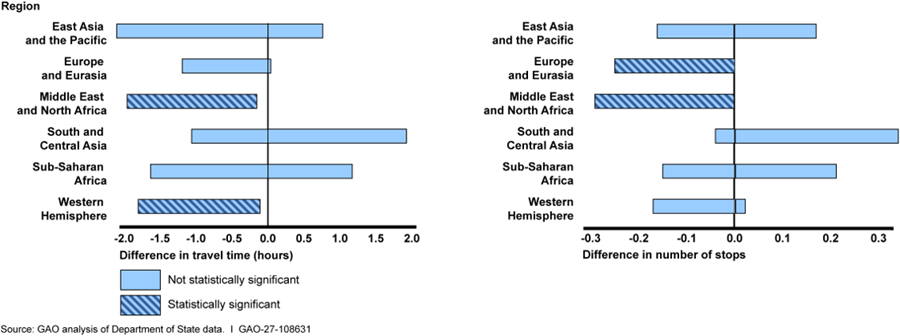
Note: Data shown are from a GAO sample of simulated fiscal year 2026 ticket pairs for State Department flights between the U.S. and a foreign destination for which the Act clearly imposes an added cost. Each bar represents the 95 percent confidence interval of the estimated difference between compliant and noncompliant flights. For example, compliant flights are between 0.21 and 1.69 hours shorter than noncompliant flights for the Western Hemisphere.
Travelers flying to some locations may not experience these or other challenges related to the Act. For example, officials in Côte d’Ivoire did not recount such challenges, owing to the prevalence of compliant code-share flights. Additionally, a GSO in Colombia reported not having faced challenges due to the Act and said that compliant flights are usually available. Three of the four State travel officials we spoke with from the Bureau for Arms Control and International Security who arrange and review travel for staff of multiple bureaus stationed in the U.S. said that these staff had not raised issues with them or submitted complaints related to the Act’s requirements. State officials we interviewed noted that in recent years, the increased prevalence of code-share arrangements has increased the availability of compliant flights. Also, according to a regional GSO, the EU Open Skies Agreement helps ease challenges related to the Act because the exception is easy to use.
Travel with Pets
According to State officials who manage travel, airline policy regarding travel with pets can be challenging to navigate despite an exception to the Act for traveling with pets.[34] For example, using compliant code-share flights can be challenging because U.S. air carriers’ restrictions on traveling with pets are more numerous than foreign air carriers’ and airline pet policies are not applied consistently between U.S. and foreign air carriers, according to State officials.
State travel officials, the American Foreign Service Association, and three of five GSOs we spoke with mentioned traveling with pets as a challenge due to varying airline policies. For example, travel with a pet on a code-share flight requires booking the pet on both airlines and paying a pet fee to each airline, regardless of which one is operating the flight, according to a GSO. Moreover, some Act-related email queries sent during FY 2025 noted varying airline pet policies for code-share flights and requested guidance on how to book travel using the pet exception to the Act. Some queries submitted to TMP also related to complexities of travel with pets—for example, asking how to justify claiming the pet exception to avoid transit through cities, such as Miami or Dallas, when summer temperatures there are high.[35]
In contrast, one of the five GSOs we spoke with said that the pet exception does not present an issue because it is easily approved, and another GSO noted that the addition of the pet exception in 2023 had helped alleviate related challenges.
Our analysis comparing the Act’s exceptions and State policy found that State applies the pet exception to only permanent change of station and evacuation travel, although the law does not specify this limitation.[36] State officials we spoke with said that the policy limits use of the pet exception because it assumes that travelers can arrange care for their pets as during other types of travel, such as travel for home leave or for rest and recuperation.[37]
Waiver Administrative Process
The waiver process creates challenges due to the additional administrative processing required before travel, according to officials we interviewed. For example, an Act exception is applicable when no U.S. carriers are available, but even in such cases the traveler must submit the waiver form and receive approval from State before using the foreign air carrier. Our analysis of State data found that State travelers obtained an approved waiver to fly on a foreign carrier for approximately 6 percent of trips between U.S. and foreign destinations in FY 2025. Most State travelers who submitted waiver forms for a trip submitted one or two forms; however, approximately 17 percent submitted three or more waiver forms for a single travel authorization, according to our analysis of State data.[38] According to State travel officials, multiple waivers are typically required for trips with multiple legs. State travel officials also said that travelers sometimes submit multiple waiver requests for accompanying family members, although only one waiver per group is needed.
According to our analysis of State data and State officials who handle travel, the administrative process for waiver approvals can at times be lengthy and complex. Our analysis of waiver data found that, although the median time to process waiver requests in FY 2025 was 3.6 hours, 16 percent of waiver requests took longer than a day to process.[39] According to State officials, some waiver requests were open for longer periods because the requester may have opened the request well before submitting it or because the requester did not respond to requests for additional information required to process the waiver. Further, according to a GSO posted in Dhaka, Bangladesh, the time to process a waiver can take several business days for posts that are in different time zones and operate on different weekly schedules.
Our analysis of transportation email queries found that some related to concerns that tickets would be cancelled if the travelers could not submit the required approved waiver within tight timeframes. A GSO based in Washington, D.C., who arranges travel for multiple State bureaus told us that the waiver approval process can be complicated or difficult for some travelers due to State regulations.
Of the seven categories of exceptions available on State’s waiver form, the categories most frequently used to justify waiver requests approved in FY 2025 were “other exception,” “agency mission,” and “pet travel,” according to our analysis of State data (see fig. 4). These three exception categories accounted for approximately 80 percent of all approved waivers in FY 2025. For additional details on State’s exception categories and common justifications used by State travelers, see appendix III.
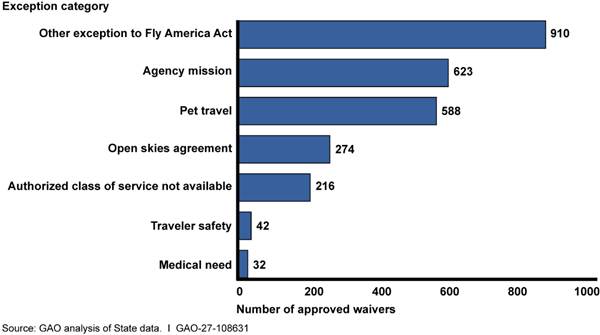
Notes: The seven categories listed represent the exception categories available to State travelers on DS-3093, which this report refers to as the waiver form. See 14 FAM 583.7.
Totals for exception categories are based on the category selected on the waiver form rather than on the narrative justification provided on the form; for example, justifications related to agency mission at times appear in the “Other exception” category.
The “Other exception” category combines multiple exceptions specified in State’s Foreign Affairs Manual, including exceptions related to flight duration and number of stops overseas.
The waiver data shown do not include exception categories for waivers approved at post, which State officials described as rare.
Agency Comments
We provided a draft of this report to State for review and comment. State provided technical comments, which we incorporated as appropriate.
We are sending copies of this report to the appropriate congressional committees and the Secretary of State. In addition, the report will be available at no charge on the GAO website at https://www.gao.gov.
If you or your staff have any questions about this report, please contact me at kenneyc@gao.gov. Contact points for our Office of Congressional Relations and Media Relations may be found on the last page of this report. GAO staff who made key contributions to this report are listed in appendix IV.
Chelsa Kenney
Director, International Affairs and Trade
List of Committees
The Honorable Ted Cruz
Chairman
The Honorable Maria Cantwell
Ranking Member
Committee on Commerce, Science, and Transportation
United States Senate
The Honorable James E. Risch
Chairman
The Honorable Jeanne Shaheen
Ranking Member
Committee on Foreign Relations
United States Senate
The Honorable Brian J. Mast
Chairman
The Honorable Gregory W. Meeks
Ranking Member
Committee on Foreign Affairs
House of Representatives
The Honorable Sam Graves
Chairman
The Honorable Rick Larsen
Ranking Member
Committee on Transportation and Infrastructure
House of Representatives
Section 7112 of the National Defense Authorization Act for Fiscal Year (FY) 2025 includes a provision for us to review the effect of the Fly America Act (the Act) on U.S. government costs and Department of State personnel.[40] This report examines the Act’s effects on (1) State’s estimated travel costs and (2) State personnel’s experience with urgent and routine travel.
State’s Estimated Travel Costs
To examine the Act’s effects on State’s estimated travel costs, we analyzed prospective data on future travel in FY 2026, comparing the costs of flights that complied with the Act’s requirements and flights that did not. The analysis is based on the following steps:
1. Obtaining FY 2025 itineraries
For this analysis, we asked State to provide air fares and schedules for all travel itineraries flown by State personnel to and from the U.S. in FY 2025. State provided data from its travel management system—E2 Solutions—that included 29,587 travel itineraries. We assessed the reliability of these data by reviewing E2 Solutions documentation, submitting written questions, and interviewing State officials regarding the steps taken to ensure data reliability, including the processes used to pull the flight data. We reviewed the data for missing elements and errors and made corrections where needed, such as removing any itineraries that were clearly identified as foreign-to-foreign or domestic routes, which left us with 26,906 travel itineraries. We found the data to be sufficiently reliable for the purpose of this review.
2. Sampling FY 2025 itineraries
We then drew a generalizable random sample of 600 itineraries from the 26,906 itineraries. This sample was stratified by category of itinerary type—one-way, round trip, and unknown. For our sample to match the distribution in the full universe of data, we selected a random sample of 120 one-way trips, 240 round trips, and 240 where the trip type was unknown (either one way or round trip). We took the sample and cleaned the data by correcting any errors, such as itineraries with inaccurate city and country matches. For example, if an itinerary had “London, France” as its origin city and country, we replaced “France” with “United Kingdom.” For itineraries with an unknown trip type, we randomly assigned them to be either round-trip or one-way tickets based on the initial distribution of known route types in the data: one-third of itineraries were one-way and two-thirds were round trip. We therefore assigned 80 of the 240 unknown itineraries as one way and the remaining 160 as round trip. In total then, we had 200 one-way itineraries and 400 round-trip itineraries. We also added a buffer of 300 additional itineraries in case any of the 600 itineraries in the original sample needed to be replaced. For example, itineraries were replaced if a domestic route appeared in the data or if there was not enough identifying information in an itinerary to discern the actual travel route.
3. Constructing ticket pairs for FY 2026
Using this sample, we asked State to provide, in accordance with its general travel practices, the following information for each one-way itinerary and each leg of a round-trip itinerary in our sample for specific future dates in FY 2026: (1) the least expensive unrestricted fare and most direct flight that was compliant with the Act and (2) the least expensive unrestricted fare and most direct flight that was not compliant with the Act. For each ticket pair in our sample of itineraries—one pair for each one-way itinerary and two pairs for each round-trip itinerary—we asked State to also provide data for price, marketing carrier, number of stops, date of search, the availability of a GSA contract fare, and total travel time.
Travel dates were randomly assigned for each itinerary in the sample. State officials pulled the requested ticketing data in April 2026. Although State officials told us that travelers generally book tickets no more than 1 or 2 months in advance, we decided to include a longer window of travel dates from April 20 to September 30, 2026, to capture possible seasonal discrepancies between fares for compliant and noncompliant trips.[41] To account for disruptions due to the conflict with Iran in 2026, we defined the travel window for Middle Eastern routes as starting on June 1, 2026, and ending on September 30, 2026 (the last day of FY 2026).
The duration of the trip was randomly selected from the distribution of observed trip lengths in the full universe of data, subject to the constraints that trip duration should not extend beyond September 30, 2026, and should be at least 2 days long. One-way tickets were not assigned a return date. Round trips were assigned a return date at least 2 days in the future to account for the possibility that it might take more than 1 day to travel to certain locations, so the last possible departure date was September 28, 2026.
4. Analyzing data
We built a regression model to derive a cost estimate for the Act. The analysis excluded administrative costs from the Act (i.e., the cost of time spent processing Act-related waivers) and does not account for Act-related travel costs that cannot be observed in a comparison of compliant and noncompliant ticket fares. For example, if Act-compliant tickets tend to be delayed or cancelled more often than noncompliant tickets, this is a cost of the Act that we would not be able to capture in our data. See appendix II for additional information about our regression model.
State Personnel Experience
To examine the Act’s effects on State personnel’s travel experience, we reviewed documentation, analyzed travel data, and interviewed State officials. Specifically, we reviewed laws and the Federal Travel Regulation related to the Act that were effective during FYs 2025 and 2026 and compared them with State’s travel policies as published in State’s Foreign Affairs Manual for the same FYs. We analyzed email queries regarding State-funded travel related to the Act that State travelers sent to State’s Travel Management and Policy Office in FY 2025. Additionally, we analyzed data for emergency visitation travel (EVT) flights in FY 2025 that State provided from its E2 Solutions database and for authorized or ordered departures (AD/OD) in FYs 2022 through 2025.[42]
We also reviewed data on requests, approvals, and denials of waivers from State’s MyData database, by category of Act exceptions as well as narratives explaining justifications for requesting and approving or denying waiver requests, submitted during the same year.[43] Further, we analyzed the projected effects of the Act on average trip duration and number of stops for FY 2026 as part of our comparative analysis of simulated FY 2026 flight itinerary options.
We performed quality checks of these data. In particular, we reviewed the provided fields for completeness and accuracy, and we cross-checked revised travel authorization and waiver data sets, provided by State for FY 2025, to confirm accuracy. We also interviewed State travel officials to resolve questions concerning the data. We found the data to be sufficiently reliable for the purpose of analyzing waiver use, describing traveler issues related to the Act, and using the data as a factor to help identify posts for interviews.
To identify travel benefits and challenges related to the Act, as well as examples of such benefits and challenges, we interviewed officials from State’s Bureau of Administration with responsibilities related to personnel travel and processing State’s waiver requests. Additionally, we interviewed State travel arrangers from the Bureau for Arms Control and International Security who provided support for international travel–related issues from State employees stationed in the U.S.
We also interviewed General Services officers—one regional officer in Frankfurt, Germany, and four officers at posts in Bangladesh, Colombia, Côte d’Ivoire, and Fiji—whose work involved approving and managing travel abroad. We considered the following factors when selecting these posts: the number of waivers approved for State-funded travel in FY 2025, travel volume in FY 2025, the existence of Act-compliant Open Skies Agreements relevant to the post’s host country, whether an authorized or ordered departure event had occurred in that country since 2024, and countries that represent various State regional bureaus.
We conducted this performance audit from July 2025 to October 2026 in accordance with generally accepted government auditing standards. Those standards require that we plan and perform the audit to obtain sufficient, appropriate evidence to provide a reasonable basis for our findings and conclusions based on our audit objectives. We believe that the evidence obtained provides a reasonable basis for our findings and conclusions based on our audit objectives.
Appendix II: Detailed Methodology for Analysis of the Fly America Act’s Effects on State’s Travel Costs
To derive a cost estimate for the Fly America Act (the Act), we focused on ticket pairs for which the Act increased State’s travel costs. That is, among our sample of ticket pairs, we searched for those with (1) no General Services Administration (GSA) contract fare available, (2) an Act-compliant ticket that was more expensive than the noncompliant ticket, and (3) no available exceptions under the Act that would allow a State traveler to purchase the noncompliant ticket. We developed a regression model to isolate the cost differential on the group of ticket pairs that met all three conditions.
Model Setup
The first model—equation 1—isolated the fare differential between a compliant ticket and a noncompliant ticket across all ticket pairs:

In this equation,
·
 is the fare of ticket i on leg l
of itinerary j on route r (the unique origin/destination) of type t (one way or
round trip) on day of the week d in month m;
is the fare of ticket i on leg l
of itinerary j on route r (the unique origin/destination) of type t (one way or
round trip) on day of the week d in month m;
·
 is a route r by type t fixed
effect;
is a route r by type t fixed
effect;
·
 is a day of the week fixed
effect;
is a day of the week fixed
effect;
·
 is a month fixed effect;
·
 is an indicator of whether ticket
i on leg l of itinerary j on route r of type t on day of the week d in month m
is compliant with the Act;
is an indicator of whether ticket
i on leg l of itinerary j on route r of type t on day of the week d in month m
is compliant with the Act;
·
 is the number of days in advance
that ticket i on leg l of itinerary j on route r of type t on day of the week d
in month m was booked; and
is the number of days in advance
that ticket i on leg l of itinerary j on route r of type t on day of the week d
in month m was booked; and
·
 is the coefficient of interest
in this model, showing any added cost of a compliant ticket relative to the
noncompliant ticket.
is the coefficient of interest
in this model, showing any added cost of a compliant ticket relative to the
noncompliant ticket.
Standard errors are clustered at the route-by-type level. The results of equation 1 are presented in column 1 of table 1.
The second model—equation 2—isolated the fare differential between compliant and noncompliant ticket pairs that met the three conditions outlined above:

In this equation,
·
 is an indicator for whether the
compliant ticket is more expensive than the noncompliant ticket on leg l of
itinerary j on route r of type t on day of the week d in month m, and
is an indicator for whether the
compliant ticket is more expensive than the noncompliant ticket on leg l of
itinerary j on route r of type t on day of the week d in month m, and
·
 is an indicator for whether there
is a GSA contract fare available on leg l of itinerary j on route r of type t
on day of the week d in month m.
is an indicator for whether there
is a GSA contract fare available on leg l of itinerary j on route r of type t
on day of the week d in month m.
Equation 2 allowed us to isolate the average cost
differential between compliant and noncompliant flights on itineraries where
the compliant ticket was more expensive and there was no GSA contract fare
available for purchase. We calculated this by taking the sum of 
 is the average cost for
noncompliant tickets when no GSA fare is available and the compliant ticket is
more expensive, while
is the average cost for
noncompliant tickets when no GSA fare is available and the compliant ticket is
more expensive, while 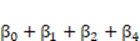 is the average cost for
compliant tickets if no GSA fare is available and the compliant ticket is more
expensive. The difference between the two, [(
is the average cost for
compliant tickets if no GSA fare is available and the compliant ticket is more
expensive. The difference between the two, [( )], is the average cost
differential that we used to estimate the cost of the Act to State. The sum of
)], is the average cost
differential that we used to estimate the cost of the Act to State. The sum of  is presented in table 1.
In our examination of the Act’s effects on State’s travel
costs, we also discuss the group of ticket pairs that have a GSA contract fare
available and a more expensive compliant ticket. We clarify that this group of
tickets is not ultimately included in our cost calculation; however,  is the average difference in
fare for this group of ticket pairs, which is also presented in table 1.
is the average difference in
fare for this group of ticket pairs, which is also presented in table 1.
The results of equation 2 are presented in column 2 of table 1.
The third model—equation 3—shows our primary empirical specification that we use for our estimate of the Act’s effects on State’s travel costs:
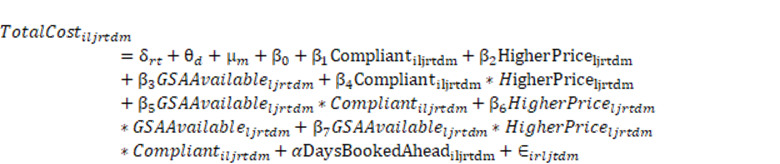
In this equation,  .
.  is the travel time in hours of
ticket i on leg l of itinerary j on route r of type t flying on day of the week
d in month m. Median hourly wage is the typical hourly salary of a State
Foreign Service employee: $63.61. The results of equation 3 are shown in column
3 of table 1.
is the travel time in hours of
ticket i on leg l of itinerary j on route r of type t flying on day of the week
d in month m. Median hourly wage is the typical hourly salary of a State
Foreign Service employee: $63.61. The results of equation 3 are shown in column
3 of table 1.
Results
The results of equations 1, 2 and 3 are shown in the corresponding columns of table 1.[44]
Table 1: Regression Results Showing Cost Differential Between Fly America Act–Compliant and Noncompliant Tickets for Different Ticket Pairs
|
|
Column 1: (Fare) (Equation 1) |
Column 2: (Fare) (Equation 2) |
Column 3: (Total cost) (Equation 3) |
|
Variable |
|||
|
Compliant |
-286.34*** (40.42) |
-503.32*** (59.55) |
-492.96*** (67.28) |
|
Higher price |
— |
-603.61*** (111.39) |
-589.79*** (108.85) |
|
GSA contract fare available |
— |
-5.42 (221.09) |
143.90 (249.87) |
|
Compliant x higher price |
— |
966.53*** (108.26) |
947.99*** (112.39) |
|
GSA contract fare available x compliant |
— |
-83.22 (73.53) |
-135.82* (81.19) |
|
Higher price x GSA contract fare available |
— |
-232.3932* (130.87) |
-208.57* (124.53) |
|
Compliant x higher price x GSA contract fare available |
— |
17.69 (125.83) |
-7.84 (133.54) |
|
|
— |
463.21*** (90.18) [285.87, 640.55] |
455.03*** (91.24) [275.61, 634.44] |
|
|
|
397.68*** (44.62) |
311.36*** (55.87) |
|
Day-of-the-week fixed effect |
Yes |
Yes |
Yes |
|
Month fixed effect |
Yes |
Yes |
Yes |
|
Route-by-type fixed effect |
Yes |
Yes |
Yes |
|
Observations |
2,000 |
1,948 |
1,948 |


Legend: GSA = General Services Administration; — = not applicable; *** = statistically significant at 1 percent level; ** = statistically significant at 5 percent level; * = statistically significant at 10 percent level.
Source: GAO analysis of Department of State data. | GAO‑27‑108631
Note: Standard errors are shown in parentheses, and 95 percent confidence interval is presented in brackets for selected coefficients.
Column 1 shows that, across all 1,000 ticket pairs, the compliant ticket is $286 cheaper, on average, than the noncompliant ticket. Column 2 shows that in the 5.3 percent of ticket pairs that satisfy all three conditions, the average fare is $463 higher for the compliant ticket than for the noncompliant ticket. Column 3 shows that in the 5.3 percent of ticket pairs that satisfy all three conditions, the average total cost of a compliant ticket is $455.03 higher than the noncompliant ticket. Column 3 also shows that for the group of tickets with a more expensive compliant ticket and a GSA contract fare available, the compliant ticket costs $311 more than the noncompliant ticket.
We used the results from column 3 to generate our estimate of the Act’s effects on State’s travel costs. In the methodology we used for the estimate, the cost of the Act for State is equal to $455.03 * 0.053 * 45,030. In this calculation, 0.053 is derived from our finding that the Act imposes a cost for 5.3 percent of tickets purchased by State, and 45,030 is the total number of tickets purchased by State each year.[45] The point estimate of the total cost of the Act is $455.03 * 0.053 * 45,030 = $1.09 million. The lower bound is $275.61 * 0.053 * 45,030 = $0.66 million, and the upper bound is $634.44 * 0.053 * 45,030 = $1.51 million. Using the upper and lower bounds of the confidence interval, we estimate that the total cost ranges from $0.66 million to $1.51 million.
Robustness Tests
We performed a series of robustness tests to verify the
accuracy of our results. The first robustness test replaces the route-by-type
fixed effect with an itinerary ID fixed effect in equation 3. Our primary
specification with a route-by-type fixed effect has 376 clusters, while an
itinerary ID fixed effect expands the number of clusters to 592. Column 1 of
table 2 shows the results of this test; using an itinerary ID fixed effect
narrows the standard error on the combined coefficient of  , so that the average cost
differential between compliant and noncompliant tickets for ticket pairs
meeting all three conditions ranges from $291.82 to $618.23.
, so that the average cost
differential between compliant and noncompliant tickets for ticket pairs
meeting all three conditions ranges from $291.82 to $618.23.
The second robustness test also changes the fixed effect in equation 3, from a route-by-type fixed effect to a route fixed effect. Column 2 in table 2 shows that this test slightly expands the standard error, so that the average cost differential between compliant and noncompliant tickets for ticket pairs meeting all three conditions ranges from $273.71 to $636.35. This range is nearly identical to that in column 3 of table 1 (our primary empirical specification): $275.61 to $634.44.
Table 2: Regression Results for Alternative Models That Show the Robustness of Cost Estimates in Table 1
|
|
Column 1: (Total cost) (Itinerary ID FE) |
Column 2: (Total cost) (Route FE) |
|
Variable |
||
|
Compliant |
-493.27*** (65.93) |
-492.94*** (67.72) |
|
Higher price |
-685.82*** (126.18) |
-591.16*** (110.11) |
|
GSA contract fare available |
68.05 (297.51) |
61.77 (178.81) |
|
Compliant x higher price |
948.29*** (107.44) |
947.96*** (112.38) |
|
GSA contract fare available x compliant |
-135.52* (71.76) |
-135.82* (83.85) |
|
Higher price x GSA contract fare available |
-131.71 (144.17) |
-206.76 (128.08) |
|
Compliant x higher price x GSA contract fare available |
-8.15 (116.82) |
-7.85 (139.81) |
|
|
455.03*** (83.1) [291.82, 618.23] |
455.03*** (92.15) [273.71, 636.35] |
|
Day-of-the-week fixed effect |
Yes |
Yes |
|
Month fixed effect |
Yes |
Yes |
|
Route-by-type fixed effect |
No |
No |
|
Itinerary ID fixed effect |
Yes |
No |
|
Route fixed effect |
No |
Yes |
|
Observations |
1,948 |
1,948 |
Legend: FE= fixed effect; GSA = General Services Administration; *** = significant at 1 percent level; ** = significant at 5 percent level; * = significant at 10 percent level.
Source: GAO analysis of Department of State data. | GAO‑27‑108631
Note: Standard errors are shown in parentheses, and 95 percent confidence intervals are presented in brackets for selected coefficients.
The third and final robustness test makes an adjustment to
equation 3 by replacing  with
with  , which we refer to as equation
4:
, which we refer to as equation
4:
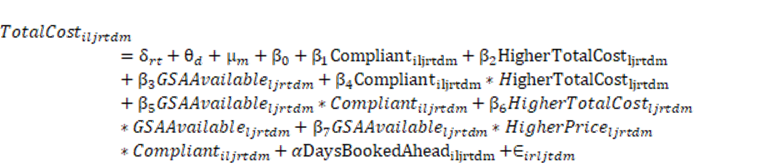
In this equation,  is equal to one when, within a
ticket pair, the compliant ticket has a higher total cost than the noncompliant
ticket. From the start of the analysis, this equation accounts for both fare
and the cost of travel time and is arguably more accurate than equation 2 or 3
for calculating the cost of the Act. If a compliant ticket is $100 cheaper than
the noncompliant ticket but the flight is 3 hours longer, then the compliant
ticket still costs the agency more than the noncompliant ticket (assuming each
hour of time is valued at $63.61, and maintaining the assumption that travel
time is an opportunity cost to the agency). However, this approach is arguably
more dissimilar than equations 2 or 3 to the way that State personnel book
their travel, because it requires a more complicated calculation from the
traveler to determine which ticket is cheaper overall.
is equal to one when, within a
ticket pair, the compliant ticket has a higher total cost than the noncompliant
ticket. From the start of the analysis, this equation accounts for both fare
and the cost of travel time and is arguably more accurate than equation 2 or 3
for calculating the cost of the Act. If a compliant ticket is $100 cheaper than
the noncompliant ticket but the flight is 3 hours longer, then the compliant
ticket still costs the agency more than the noncompliant ticket (assuming each
hour of time is valued at $63.61, and maintaining the assumption that travel
time is an opportunity cost to the agency). However, this approach is arguably
more dissimilar than equations 2 or 3 to the way that State personnel book
their travel, because it requires a more complicated calculation from the
traveler to determine which ticket is cheaper overall.
When we use equation 4, we find that the Act imposes a cost on 5.7 percent of tickets (compared with 5.3 percent of tickets in the primary specification). Also, the cost of the Act increases relative to the results of equations 2 and 3 shown in table 1. Specifically, the estimated difference in total cost of the compliant and noncompliant ticket in ticket pairs affected by the Act increases from $455.03 to $470.51. Given that 5.7 percent of ticket pairs are now affected, this creates a new cost estimate of $470.51 * 0.057 * 45,030 = $1.2 million. Table 3 shows the results from equation 4.
Table 3: Regression Results Showing Effect of Fly America Act on State Department Travel Costs if Travelers Accounted for Cost of Travel Time When Booking a Flight
|
Variable |
(Total cost) (Equation 4) |
|
Compliant |
-545.32*** (65.38) |
|
Higher total cost |
-738.81*** (170.36) |
|
GSA contract fare available |
107.68 (251.68) |
|
Compliant x higher total cost |
1015.83*** (103.2) |
|
GSA contract fare available x compliant |
-79.05 (78.44) |
|
Higher total cost x GSA contract fare available |
-25.77 (180.31) |
|
Compliant x higher total cost x GSA contract fare available |
29.95 (121.93) |
|
Sum of compliant and compliant x higher total cost (added cost of Fly America Act) |
470.51*** (73.02) [326.94, 614.09] |
|
Day-of-the-week fixed effect |
Yes |
|
Month fixed effect |
Yes |
|
Route-by-type fixed effect |
Yes |
|
Observations |
1,948 |
Legend: GSA = General Services Administration; *** = statistically significant at 1 percent level; ** = statistically significant at 5 percent level; * = statistically significant at 10 percent level.
Source: GAO analysis of State data. | GAO‑27‑108631
Note: Standard errors are shown in parentheses.
The results from these three robustness tests confirm the reliability of our estimate of the Act’s effects on State’s travel costs. The robustness test that affects the point estimate produces a result within our confidence interval from the preferred specification. The two robustness tests that affect the confidence interval produce an even narrower confidence interval (in the case of the itinerary ID fixed effect) or essentially the same confidence interval (in the case of the route fixed effect).
Our review of data from approved forms requesting waivers to the Fly America Act (the Act) found that Department of State travelers used the justification options on the form in the following ways to request exceptions to the Act in fiscal year (FY) 2025.[46]
Other Exception
Waiver requests citing the category “Other exception” claimed any of several justifications, including differences between the compliant and noncompliant flight options related to trip duration and number of stops. For example, travelers used this exception category when a flight on a U.S. carrier would increase the number of aircraft changes abroad by two or more stops, require a connecting time of 4 or more hours at an interchange point abroad, or extend travel time by 6 or more hours.
The majority of the waivers approved for this category in FY 2025 permitted the use of a foreign carrier for the purpose of reducing trip duration or the number of stops in foreign locations. Additional approved justifications in this category included the unavailability of a U.S. carrier, and a layover too short for a connecting flight.[47]
Agency Mission
Waiver requests claiming the agency mission exception may be authorized when a State bureau’s executive officer or a post management officer determines that the timing or routing of flights offered by a U.S. carrier cannot accomplish the agency’s mission. For example, our analysis found that this exception is used to ensure high-level officials’ timely arrival to attend mission-critical bilateral meetings or events; for travel to and from certain countries by diplomatic couriers required to take direct routes to avoid layovers; when U.S. carrier service is unavailable; and when the traveler cannot obtain a visa for connections in certain countries.
State has used the agency mission exception for both routine mission needs and urgent travel. For example, during some authorized or ordered departure events, State guidance has instructed all affected travelers to use this exception when U.S. carriers are not available to execute a timely departure.
Pet Travel
Waiver requests citing the pet travel exception may be authorized for State travelers seeking to take up to three cats or dogs on a foreign airline if no U.S. carrier is willing or able to transport them along with the State personnel.[48] Many U.S. airlines ban certain types of dogs and cats from traveling as checked cargo, and some airlines have additional restrictions. For example, United Airlines allows pets to travel only as cargo for active-duty U.S. military personnel and State Department Foreign Service personnel traveling on assignment between Guam and Honolulu, and Jet Blue bans all pets on flights to or from several Latin American, Caribbean, and European countries.
State’s cost for an official’s travel with a foreign carrier due to the pet travel exception may not be greater than the amount that would otherwise have been paid had the transportation been on a U.S. air carrier. If the cost of the foreign carrier is greater, State travelers may pay the cost difference.
Open Skies
Waiver requests claiming the Open Skies exception are submitted by travelers seeking to use foreign air carriers from the countries that are parties to Open Skies Agreements. Four Agreements—with Australia, Japan, Switzerland, and the European Union (EU)—meet the Act’s requirements, according to General Services Administration (GSA) information. The EU agreement is the only one that allows for an origin or destination in a third country, if the flight stops in the EU, according to GSA information. State travelers typically use this feature of the EU agreement for flights to Europe and Africa, according to State’s regional General Services officer in Frankfurt, Germany. According to State officials, waiver requests claiming the Open Skies exception are easier to justify than requests claiming other exceptions.
Traveler Safety
Waiver requests claiming the traveler safety exception are approved on a case-by-case basis when use of a foreign carrier is required to avoid an unreasonable risk to the safety of the traveler, according to State policy.[49] State policy requires that use of the exception be supported by evidence of threat.[50] For example, our analysis of State waiver data found that one justification submitted by a State traveler cited State security threat information related to terrorist threats against U.S. interests and crime against foreigners. Other justifications related to using alternate airports to avoid high-risk ground transportation that would require an armored vehicle.
According to State’s Foreign Affairs Manual, avoiding an unreasonable risk to the traveler’s safety includes ensuring that unaccompanied children aged 16 years or younger are not required to change airports at interchange points abroad or otherwise hindered in their safe and speedy passage traveling abroad.[51] Our analysis of State waiver data found that the majority of traveler justifications claiming this exception in FY 2025 related to reducing or eliminating connections for unaccompanied minors by using foreign carriers.
Medical Need
Waiver requests claiming the medical need exception address instances in which use of a foreign carrier is necessary for medical reasons, including the need to reduce connections or other delays of transport for treatment. This exception may also be used to facilitate emergency visitation travel (EVT), according to State policy.[52]
Our analysis of justifications for the medical need exception in FY 2025 found that travelers claimed this exception to shorten trip duration and reduce the number of stops when accompanying another person as a medical attendant, to travel with authorized medevac orders or in late-term pregnancy, and for EVT.
GAO Contact
Chelsa Kenney, kenneyc@gao.gov
Staff Acknowledgments
In addition to the contact named above, Tatiana Winger (Director), Heather Latta (Assistant Director), Marisela Perez (Analyst-in-Charge), Craig Rossett, Maureen Luna-Long, Ryan Bhandari, Gergana Danailova, Bahareh Etemadian, Reid Lowe, and Alexa Stechschulte made key contributions to this report.
The Government Accountability Office, the audit, evaluation, and investigative arm of Congress, exists to support Congress in meeting its constitutional responsibilities and to help improve the performance and accountability of the federal government for the American people. GAO examines the use of public funds; evaluates federal programs and policies; and provides analyses, recommendations, and other assistance to help Congress make informed oversight, policy, and funding decisions. GAO’s commitment to good government is reflected in its core values of accountability, integrity, and reliability.
Obtaining Copies of GAO Reports and Testimony
The fastest and easiest way to obtain copies of GAO documents at no cost is through our website. Each weekday afternoon, GAO posts on its website newly released reports, testimony, and correspondence. You can also subscribe to GAO’s email updates to receive notification of newly posted products.
Order by Phone
The price of each GAO publication reflects GAO’s actual cost of production and distribution and depends on the number of pages in the publication and whether the publication is printed in color or black and white. Pricing and ordering information is posted on GAO’s website, https://www.gao.gov/ordering.htm.
Place orders by calling (202) 512-6000, toll free (866) 801-7077,
or
TDD (202) 512-2537.
Orders may be paid for using American Express, Discover Card, MasterCard, Visa, check, or money order. Call for additional information.
Connect with GAO
Connect with GAO on X,
LinkedIn, Instagram, and YouTube.
Subscribe to our Email Updates. Listen to our Podcasts.
Visit GAO on the web at https://www.gao.gov.
To Report Fraud, Waste, and Abuse in Federal Programs
Contact FraudNet:
Website: https://www.gao.gov/about/what-gao-does/fraudnet
Automated answering system: (800) 424-5454
Media Relations
Sarah Kaczmarek, Managing Director, Media@gao.gov
Congressional Relations
David A. Powner, Acting Managing Director, CongRel@gao.gov
General Inquiries
[1]This report will generally refer to U.S.-flag air carriers as U.S. air carriers and to foreign-flag air carriers as foreign air carriers.
[2]49 U.S.C. § 40118. The provisions known as the Fly America Act were originally enacted in 1975. The law was designed to support the domestic airline industry and protect national economic interests, according to Airlines for America, an airline industry association.
[3]In contrast, other agencies, such as the Departments of Defense, Homeland Security, and Justice, together accounted for approximately 31 percent, according to State data.
[4]Servicemember Quality of Life Improvement and National Defense Authorization Act for Fiscal Year 2025 (“National Defense Authorization Act for FY 2025”), Pub. L. No. 118-159, § 7112, 138 Stat. 1773, 2526 (2024).
[5]In general and when possible, State uses the lowest-cost unrestricted fares available, respecting the terms of the City Pair Program, which procures and manages discounted air transportation services for federal government travelers. Unrestricted fares are fully refundable and carry no penalty for changes or cancellations.
[6]TMP is located within State’s Bureau of Administration.
[7]State documents the use of approved exceptions to the Act on the DS-3093 Justification Certificate for Use of a Foreign-Flag Air Carrier, which this report refers to as the waiver form. While there are no blanket waivers to the Act, this report uses the term “waiver” for the exceptions under the Act that may permit use of a foreign-flagged air carrier in certain situations.
[8]The Bureau for Arms Control and International Security supports multiple sub-bureaus, including Political–Military Affairs, Arms Control and Nonproliferation, and Counterterrorism.
[9]According to State Officials, State headquarters and State’s posts have entered into contracts for travel services with approximately 90 local and regional travel management centers. These companies assist with booking flights and need to be used when State travelers wish to use a foreign carrier, because State’s online travel system prevents travelers from booking flights that may violate State’s travel policies, including flights on foreign carriers. Travel from the U.S. is serviced by two large travel management centers, while travel from abroad to the U.S. is usually serviced by smaller travel management centers that State posts contract with directly.
[10]For urgent travel bookings, waivers can be processed by management officers at posts.
[11]41 C.F.R. § 301-10.110. GSA’s City Pair Program procures and manages discounted air passenger transportation, negotiating firm-fixed pricing on airline seats, for federal government travelers. Since at least 2016, all GSA City Pair Program contracts have been awarded to U.S. air carriers. The program allows federal employees to change their plans without incurring penalties or additional costs.
[12]For State’s policy regarding the Act, see 14 FAM 583.
[13]41 C.F.R. § 301-10.133. Code sharing is a marketing arrangement in which an airline places its designator code on a flight operated by another airline and sells tickets for that flight, according to the U.S. Department of Transportation
[14]41 C.F.R. § 301-10.141.
[15]Id.
[16]According to the Department of Transportation’s website, Open Skies Agreements are bilateral or multilateral agreements between the U.S. and foreign aviation partners that are designed to eliminate government involvement in airline decision-making about routes, capacity, and pricing in international routes. The U.S. has Open Skies Agreements with the European Union, Australia, Switzerland, and Japan.
[17]The “other exception” category may involve a variety of justifications, including differences between the compliant and noncompliant flight options that meet or exceed certain thresholds for trip duration and number of stops. Specifically, exceptions to the Act for travel between the U.S. and another country include instances in which a U.S. air carrier does not offer nonstop or direct service between origin and destination, and using a U.S. air carrier would increase the number of aircraft changes by 2 or more outside the U.S., require a connecting time of 4 or more hours abroad, or increase travel time by 6 or more hours, as compared to using a foreign air carrier.
[18]49 U.S.C. § 40118(e). State travelers are not required to obtain a waiver to the Act when traveling between two points outside the U.S., including the foreign leg of a trip to or from the U.S.
[19]Authorized departures allow post employees, eligible family members, or both, to leave an overseas post when U.S. national interests or an imminent threat to life requires it. Ordered departures are mandatory evacuation procedures by which the number of U.S. government employees, eligible family members, or both, at an overseas post is reduced.
[20]State officials calculated that $69 million was spent in FY 2025 on air travel between the U.S. and a place outside the U.S. that was subject to the Act. According to officials, State personnel traveled significantly less during FY 2025 than during other recent years due to the pause in foreign assistance, among other potential factors.
[21]The data we received from State for this analysis included information that allowed State to determine whether routes could be eligible for Act exceptions related to travel time, number of stops, and Open Skies Agreements. The data we analyzed did not contain information that would allow State to determine whether the flights were eligible for other categories of exceptions, such as those related to mission need, necessity, and travel with pets. As a result, there is potential for additional exceptions to the Act beyond those included in this estimate.
[22]Our sample included 600 travel itineraries (which generated 1,000 ticket pairs) that we randomly sampled from the full universe of State’s 26,906 authorized travel itineraries between the U.S. and a foreign destination in FY 2025.
[23]Twenty of these ticket pairs have a noncompliant ticket that qualifies for a European Union Open Skies exception because the itinerary for the noncompliant ticket is on an EU-based air carrier. Six other ticket pairs have noncompliant tickets that qualify for an exception because the compliant flight is 6 hours or longer than the noncompliant flight. State travel officials determined that the 26 routes were eligible for exceptions to the Act.
[24]This estimate is robust to several alternative model specifications; see appendix II.
[25]41 C.F.R. § 301-10.111(c). State travelers must complete Form DS-4022 (Justification Certificate for Use of a Noncontract Air Carrier) to request the ability to purchase travel using a noncontract fare. Valid justifications include the existence of a lower public noncontract fare that reduces the total trip cost, the contract air carrier flight being sold out, and schedule conflicts with mission-critical duties.
[26]We estimated the cost of $3 million by assuming that 21.3 percent of the 45,030 tickets purchased by State cost $311 more than they would absent the Act.
[27]An airline needs a minimum number of passengers on any given flight to make it profitable. If the Act is critical to meeting that minimum on certain international routes, price and flight frequency might change without the Act in place.
[28]In an emergency (when travel must commence within 72 hours), waivers may be approved at the overseas post. Waiver requests approved at posts are not transmitted to TMP and were not included in our analysis of waiver data. According to State officials, approval of waivers at post is rare.
[29]When a traveler cannot provide an approved waiver form, State will disallow reimbursement for any legs of the travel that violate the Act, according to State officials.
[30]The Federal Travel Regulation does not require a specific form, such as State’s waiver form, to document Act exceptions. However, the regulation requires certification that includes the traveler name, travel dates, origin and destination, detailed itinerary, and a statement explaining compliance with exceptions in § 301-10.134 or § 301-10.136, or a copy of the agency’s written approval deeming foreign air carrier service necessary in accordance with § 301-10.135. 41 C.F.R. § 301-10.141.
[31]Our analysis of State’s FY 2025 travel and waiver data found that approximately 93 percent of trips to or from Fiji had an approved waiver.
[32]As of May 2026, the number of noncompliant flights available was lower than normal due to flight disruptions in the Middle East, according to the GSO. The GSO said that State personnel flying from Bangladesh to the U.S. most commonly travel via Doha, Qatar.
[33]These duration differences derived from our prospective flight data are not intended to suggest that all compliant flights are 1 hour shorter, on average, than noncompliant flights in the Western Hemisphere or the Middle East. Such a claim would require a representative sample of routes stratified by each region of the world.
[34]The pet exception for State travelers was enacted as part of the Department of State Authorization Act of 2023 and amended by the Department of State Authorization Act for Fiscal Year 2025. Department of State Authorization Act of 2023, Pub. L. No. 118-31, § 6224, 137 Stat. 963, 979-80 (2023); Department of State Authorization Act for Fiscal Year 2025, Pub. L. No. 118-159, § 7604, 138 Stat. 2519, 2553 (2024) (codified as amended at 22 U.S.C. § 4081a). State may pay for State travelers to use a foreign airline if no U.S. air carrier is willing and able to transport up to three cats or dogs accompanying State personnel. This pet exception does not apply to travel between two places in the U.S.
[35]Multiple U.S. airlines’ policies state that the airline will not transport warm-blooded animals when ground temperatures are higher than 80 degrees Fahrenheit at any location on the itinerary.
[36]See 22 U.S.C. § 4081a; 14 FAM 583.6(6).
[37]The purpose of home leave is to ensure that employees who live abroad for an extended period undergo reorientation and re-exposure in the United States on a regular basis. Rest and recuperation is a travel benefit that allows time to gain a measure of relief from conditions at post.
[38]Approximately 73 percent of FY 2025 waiver requests were approved, 14 percent were rejected, 7 percent were cancelled, 4 percent required more information, and 2 percent were drafts.
[39]Our analysis examined the time from the opening to the closing of approved and rejected waivers in State’s online request system.
[40]Servicemember Quality of Life Improvement and National Defense Authorization Act for Fiscal Year 2025 (“National Defense Authorization Act for FY 2025”), Pub. L. No. 118-159, § 7112, 138 Stat. 1773, 2526 (2024).
[41]For example, State officials indicated that booking a ticket for travel in August or September in the month of May would be highly unusual.
[42]State provided data, summarized by country, for all EVT flights and AD/OD events.
[43]State documents the use of approved exceptions to the Act on the DS-3093 Justification Certificate for Use of a Foreign-Flag Air Carrier, which this report refers to as the waiver form. While there are no blanket “waivers” to the Act, this report uses the term “waiver” for the exceptions under the Act that may permit use of a foreign air carrier in certain situations. State consolidated Act exceptions into seven categories on the waiver form for travelers to select and provide justification. State’s Travel Management and Policy Office received 3,661 waiver requests in FY 2025. Of these, 2,685 were approved, 506 were rejected, 275 were cancelled, 133 required more information, and 64 were drafts.
[44]Equations 2 & 3 exclude 26 ticket pairs that State travel officials determined qualify for exceptions to the Act while also meeting the first two conditions. Twenty ticket pairs qualify for a European Union Open Skies exception, and six ticket pairs qualify for a travel time exception (i.e., the compliant flight increases travel time by 6 hours or more). Therefore, in total, the primary model of interest has 974 ticket pairs, yielding 1,948 observations.
[45]We derived the number of tickets that State purchases each year from travel patterns in a single fiscal year, 2025; however, 45,030 tickets may not be representative of a typical year. State officials noted that total travel in FY 2025 was less than in most prior years because of the pause in foreign assistance, among other factors.
[46]Exceptions to the Act are outlined in the Federal Travel Regulation and State’s Foreign Affairs Manual (FAM). 41 C.F.R. § 301-10.134-10.136: 14 FAM 583. The Federal Travel Regulation was amended in December 2025 to streamline text and remove duplicative regulations. We cite the current regulations because the substance of the exceptions referred to in appendix III did not change.
[47]Our analysis found that some justifications related to agency mission were included in the “Other exception” category. According to State officials, they approve some waivers even though the narrative justification provided on the form does not correspond to the most appropriate exception category on the form.
[48]The pet exception does not apply to travel between two places in the U.S.
[49]14 FAM 583.5.
[50]Id.
[51]Id. This justification is not explicitly stated in the Federal Travel Regulation.
[52]Id.