
Report to Congressional Requesters
United States Government Accountability Office
A report to congressional requesters
For more information, contact: Heather MacLeod at MacLeodH@gao.gov
What GAO Found
Within the Department of Homeland Security (DHS), U.S. Immigration and Customs Enforcement (ICE) received $45 billion in immigration detention funding in July 2025 through Public Law 119-21, commonly known as the One Big Beautiful Bill Act, available through fiscal year 2029. In addition to maintaining existing facilities with these funds, ICE began implementing an initiative to buy and renovate a collection of warehouses to use as new detention facilities. However, after acquiring 11 warehouses for about $1.07 billion, ICE scaled down the initiative significantly and plans to sell seven of them. In July and August 2026, ICE also bought four existing detention facilities for about $2.2 billion total. However, the scope, time frames, and estimated costs for further acquisitions remain undetermined. In addition, ICE did not update its spending plan for detention funding to reflect the shifting status of the warehouse initiative or other planned acquisitions, as required by its internal guidance. As a result, the spending plan includes an inflated estimate of planned obligations, which affects oversight efforts and ICE’s ability to assess long-term budget needs.
ICE obligated about $2.8 billion for detention in fiscal year 2025, an increase of about 41 percent from the prior year, amid expanded enforcement activity. Daily costs per detained noncitizen varied by facility type. The nine Federal Bureau of Prisons facilities ICE used charged a median daily rate of $180 per noncitizen, the highest of any facility type. Privately operated facilities had a median rate of $151, while those operated through agreements with the U.S. Marshals Service or state and local governments ranged from $85 to $103. ICE officials said that services provided, detention standards used, and location also influence rates.
ICE employs various processes to manage and oversee facility costs, but some were affected by the rapid expansion of new facilities. For example, the workload of staff who provide oversight and validate invoices for these facilities increased significantly, and ICE is working to fill 55 of the 87 allocated positions nationwide. Further, ICE did not manage detention facility investments in accordance with DHS acquisition practices, which include the development of life-cycle cost estimates. Developing such estimates before making further acquisitions would position ICE to better assess these investments, reduce potential waste, and help ensure the cost effective use of taxpayer dollars.
Why GAO Did This Study
A January 2025 Executive Order directed DHS to increase efforts to detain individuals apprehended for violations of immigration law and to allocate all available resources for ICE detention. ICE received significant funding in July 2025 to operate and expand detention facilities.
GAO was asked to review the costs of ICE’s detention facilities. This report examines (1) the extent to which ICE has planned to use available funds to expand detention capacity; (2) the costs of detention facilities over time and by facility type; and (3) the extent to which ICE has developed processes and procedures for managing and overseeing these costs.
GAO reviewed documentation on detention expansion efforts, agency spending plans, and facility costs from October 2022 through various points in 2026. GAO interviewed headquarters and field officials at four ICE field offices, including site visits to multiple existing and planned detention facilities. GAO selected these locations, in part, because they were the sites of multiple detention expansion efforts. GAO reviewed available cost estimates and compared spending plans to ICE guidance. GAO also analyzed information on the Department of Defense’s and Federal Emergency Management Agency’s costs for supporting immigration detention.
What GAO Recommends
GAO is making two recommendations, that ICE update its spending plan for detention funding in accordance with internal guidance, and develop life-cycle cost estimates, in coordination with DHS, before making new detention investments. DHS concurred with these recommendations.
|
Abbreviations |
|
|
|
|
|
COR |
contracting officer’s representative |
|
DOD |
Department of Defense |
|
DHS |
Department of Homeland Security |
|
ERO |
Enforcement and Removal Operations |
|
BOP |
Federal Bureau of Prisons |
|
FEMA |
Federal Emergency Management Agency |
|
IGSA |
intergovernmental service agreement |
|
OBBBA |
One Big Beautiful Bill Act |
|
OMB |
Office of Management and Budget |
|
ICE |
U.S. Immigration and Customs Enforcement |
This is a work of the U.S. government and is not subject to copyright protection in the United States. The published product may be reproduced and distributed in its entirety without further permission from GAO. However, because this work may contain copyrighted images or other material, permission from the copyright holder may be necessary if you wish to reproduce this material separately.
November 19, 2026
Congressional Requesters
Within the Department of Homeland Security (DHS), U.S. Immigration and Customs Enforcement (ICE) is the lead agency responsible for providing safe, secure, and humane confinement for detained noncitizens in the United States.[1] A January 2025 Executive Order directed DHS to detain individuals apprehended for violations of immigration law to the extent permitted by law, and to allocate all available resources for ICE detention purposes.[2] As a result, DHS allocated significant resources to expand and operate facilities for ICE detention. In July 2025, Public Law 119-21, commonly known as the One Big Beautiful Bill Act (OBBBA) provided ICE with $45 billion to detain single adults and families through fiscal year 2029.[3] Then in June 2026, the Secure America Act provided ICE with over $31 billion for various activities—including immigration enforcement functions—through fiscal year 2029.[4] As a result, DHS pursued various initiatives to significantly expand its immigration detention capacity.
We have previously reported on concerns with how ICE plans and oversees its spending, as well as how it manages facility costs and usage.[5] ICE data show that the average daily number of individuals in detention increased from 39,314 on January 20, 2025, to 67,180 on July 30, 2026, emphasizing the importance of ICE’s management of costs for housing this increased population.
You asked us to review issues related to ICE’s detention facility costs. Specifically, this report examines
1. the extent to which ICE has planned to use available funds to expand detention capacity,
2. the costs of immigration detention facilities over time and by facility type,
3. the extent to which ICE has developed processes and procedures for managing and overseeing facility costs.
To examine the extent to which ICE planned to use available funds, we reviewed agency program execution reports and relevant statutes that appropriated funding to ICE for fiscal years 2025 and 2026. We also evaluated ICE’s spending plans for OBBBA funds to determine the extent to which they adhered to ICE guidance for developing those plans. Further, we interviewed ICE budget and program officials to obtain information regarding the planned use of available detention funding, as well as their processes for developing or updating spending plans.
To describe the costs of immigration detention facilities, we analyzed ICE data on annual obligations by facility, daily bed rates by facility, and annual obligations for ground transportation of detained noncitizens from October 2022 (the beginning of fiscal year 2023) through various points in 2026. We selected this period to compare the costs of the expansion in detention space, which began in January 2025, against the prior 2 fiscal years. In addition, we analyzed data on Department of Defense (DOD) obligations for supporting ICE detention from October 2024 through May 2026.[6] We assessed the reliability of the ICE and DOD data by (1) reviewing relevant documentation, (2) interviewing knowledgeable officials on their management of the data, and (3) testing for obvious errors. We determined the data were sufficiently reliable for describing detention facility costs for ICE and related DOD detention support.
To examine the extent to which ICE has developed processes and procedures for managing and overseeing these costs, we reviewed documentation related to (1) proposed detention space acquisitions and (2) facility invoices and monitoring efforts. Further, we interviewed ICE officials in budget, financial management, and acquisitions roles, as well as ICE Enforcement and Removal Operations (ERO) officials at the headquarters and field level with roles in cost management, cost oversight, and detention expansion.[7] We also interviewed officials in DHS’s Office of the Chief Procurement Officer and Office of the Chief Readiness Support Officer involved in managing and overseeing large infrastructure and other investments within the department. We compared ICE’s efforts to expand detention space against Office of Management and Budget (OMB) guidance on cost-effectiveness analyses and DHS acquisition guidance on managing large investments. Appendix I describes our scope and methodology in greater detail.
We conducted this performance audit from July 2025 to November 2026 in accordance with generally accepted government auditing standards. Those standards require that we plan and perform the audit to obtain sufficient, appropriate evidence to provide a reasonable basis for our findings and conclusions based on our audit objectives. We believe that the evidence obtained provides a reasonable basis for our findings and conclusions based on our audit objectives.
Background
ICE Organizational Structure and Responsibilities
ERO identifies, apprehends, and detains potentially removable foreign nationals, and removes individuals subject to a final order of removal from the country. Several ERO divisions that carry out this work have detention facility management and oversight responsibilities, as well as ICE budgetary processes, including:
· The Field Operations Division. Oversees ERO’s 25 field offices, which manage local detention operations and work directly with detention facilities in their geographic regions. Field offices are generally responsible for identifying needs for additional detention space and preparing detention space acquisition requests.
· The Custody Management Division. Oversees detention facility compliance with ICE detention standards. It is also responsible for analyzing detention space needs identified by ERO field offices and submitting requests for detention contract and agreement action to ICE’s Office of Acquisition Management.
· The Operations Support Division. Oversees the ERO Budget Execution Unit and Contract Management Unit, which are responsible for funding contracts.
Other ICE offices that support the management and oversight of detention facilities include:
· ICE Office of Acquisition Management. Responsible for preparing, executing, and maintaining contracts and agreements for detention facilities, and for processing any contract and agreement modifications. Contracting officers within the office also assign duties and responsibilities to ERO contracting officer’s representatives (COR), whose work is overseen by ERO field office management. CORs assist in acquisition planning, facility invoice processing, and other duties, including assessing facility operator performance to ensure compliance with the government’s performance objectives.
· ICE Office of Budget and Program Performance. Manages ICE budget execution and formulation processes. Within the Office of the Chief Financial Officer, this office provides guidance to program offices on monitoring and distributing funds and approving program office spending plans.
ICE Detention Facility Types
As shown in table 1, ICE uses different types of detention facilities to house noncitizens. Detention services and standards at these facilities are governed by contracts or agreements with federal, state, or local government entities; or private companies.
Table 1: Summary of U.S. Immigration and Customs Enforcement (ICE) Detention Facilities, as of June 2026
|
Facility Type |
Description |
Number of authorized facilitiesa |
|
Contract detention facilities and service processing centersb |
ICE contracts directly with detention facility operators (e.g., private companies) to hold noncitizens at facilities the operators own, or to provide services at five ICE-owned service processing centers. These contracts are generally governed by the Federal Acquisition Regulation, which includes requirements related to competition. |
25 |
|
Dedicated and non-dedicated intergovernmental service agreements (IGSAs)c |
ICE enters into these agreements with state or local governments, which may provide detention services directly or through private contracts. Intergovernmental service agreements that house only noncitizens detained by ICE are referred to as dedicated agreements. Facilities with non-dedicated agreements may house individuals detained by other agencies. |
73 |
|
Intergovernmental agreements with U.S. Marshals Service |
ICE joins an existing Department of Justice U.S. Marshals Service agreement to use Marshals-acquired bedspace in a local prison, jail, or private detention facility. This is known as a “rider” on a Marshals contract or agreement, and the ability to use the beds depends on availability. |
152 |
|
Federal Bureau of Prisons facilities |
In February 2025, ICE signed an interagency agreement to house noncitizens in eight Department of Justice Federal Bureau of Prisons facilities. Prior to 2025, ICE also had a preexisting arrangement to house noncitizens in a ninth Bureau facility in Puerto Rico. |
9 |
|
Naval Station Guantanamo Bay |
Starting in 2025, ICE began placing detained noncitizens at one Guantanamo Bay facility where ICE maintained an existing contract to house migrants interdicted at sea. That year, ICE also began housing noncitizens designated as “high-threat” at a second Guantanamo Bay facility under a memorandum of understanding with the Department of Defense. |
2 |
|
Total authorized facilities |
|
261 |
Source: GAO summary of ICE information. | GAO‑27‑108665
aAuthorized facilities have an active contract or agreement with ICE. Hold rooms—temporary spaces where detained noncitizens are held while awaiting processing, transfer, or removal—are not included. In addition to these facility types, ICE detained noncitizens in two facilities funded and operated by the state of Florida during fiscal years 2025 and 2026. ICE did not enter into a contract or agreement with Florida to operate these facilities. We discuss federal reimbursements to Florida later in this report. ICE also used four short-term staging facilities that house noncitizens temporarily while they await removal or transfer to a long-term facility.
bAmong these facilities is Camp East Montana, located on U.S. Army Fort Bliss. The Army awarded and administered a contract for constructing and operating this facility in fiscal year 2025 as part of a February 2025 Request for Assistance. The Army then transferred contract administration responsibilities for the facility to ICE at the beginning of fiscal year 2026. ICE now considers Camp East Montana a contract detention facility.
cOne IGSA facility, Dilley Immigration Processing Center, is counted twice because it houses both family units and single adult women, categories that are subject to different sets of detention standards for these populations.
Funding for ICE Detention Increased Sharply in 2025, but Spending Plan Remains Undefined
Available Funding for Detention Facilities Increased Significantly in Fiscal Year 2025
ICE received a significant increase in funds for detention facilities in fiscal year 2025. Specifically, in July 2025, ICE received $45 billion through OBBBA, enacted through the reconciliation process, to support the expansion of detention capacity through fiscal year 2029.[8] In comparison, annual appropriations for detention operations from fiscal year 2023 through 2025 ranged approximately from $2.9 to $3.8 billion, about a third of the annualized OBBBA amount, as shown in figure 1.[9]
Figure 1: U.S. Immigration and Customs Enforcement (ICE) Immigration Detention Funding, Fiscal Year 2023-2026
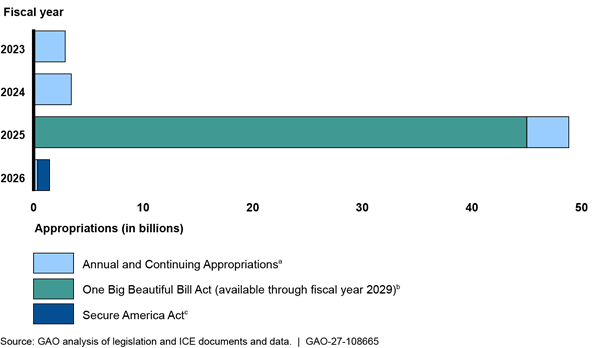
aAnnual and Continuing Appropriations refer to final, full-year appropriations, and continuing resolutions, extending prior year funding amounts when Congress is unable to reach agreement on appropriation levels for the current fiscal year. Prior to enactment of the One Big Beautiful Bill Act, immigration detention funding was generally provided through ICE’s annual appropriation under the ERO Custody Operations account. See 2024 Explanatory Statement, 170 Cong. Rec. H1501, H1812, H1850 (daily ed. Mar. 22, 2024), accompanying Further Consolidated Appropriations Act, 2024, Pub. L. No. 118-47, 138 Stat. 460. In the March 2025 continuing resolution, ICE received additional funds for Operations and Support for the remainder of fiscal year 2025 above the fiscal year 2024 level. See Full-Year Continuing Appropriations and Extensions Act, 2025, Pub. L. No 119-4, div. A, title VII, § 1701(1), 139 Stat. 9, 27. According to ICE’s July 2025 program execution report, ICE’s fiscal year 2025 appropriation for Custody Operations was $3.84 billion including additional funds from the fiscal year 2025 full-year continuing resolution for Operations and Support, which ICE applied to Custody Operations. In fiscal year 2026, DHS experienced lapses in appropriations, and ICE operated under continuing resolutions at fiscal year 2025 funding levels. Continuing Appropriations Act, 2026, div. A, Pub. L. No. 119-37, 139 Stat. 495 (Nov. 12, 2025); Further Continuing Appropriations Act, 2026, Pub. L. No. 119-75, div. H, 140 Stat. 173, 628 (Feb. 3, 2026); Homeland Security and Further Additional Continuing Appropriations Act, 2026, Pub. L. No. 119-86, § 4, 140 Stat. 773 (Apr. 30, 2026). Multi-year funding was subsequently provided to ICE through the Secure America Act, signed on June 10, 2026. Pub. L. No. 119-98, title II, § 202, 140 Stat. 837, 839.
bPub. L. No. 119-21, § 90003, 139 Stat. at 358. According to ICE officials, an additional $550 million in funding provided through section 100052 of this act for ICE operations was designated for facility modernization. Officials stated that ICE might make some improvements to detention facilities it currently owns; however, ICE primarily intends to use those funds to improve field offices and other office space, as well as complete deferred maintenance.
cPub. L. No. 119-98, title II, § 202, 140 Stat. 837. The act provides $31.075 billion for various purposes through fiscal year 2029. In August 2026, ICE reported approximately $1.1 billion was allocated for detention operations in fiscal year 2026.
In fiscal year 2026, DHS (among other federal departments) experienced lapses in appropriations and operated under continuing resolutions at fiscal year 2024 funding levels, until enactment of DHS’s full-year appropriation (excluding ICE) on April 30, 2026.[10] During the most recent DHS funding lapse, which began on February 14, 2026, OBBBA funding remained available to ICE for immigration detention and related purposes. On June 10, 2026, ICE received additional multi-year funding through the Secure America Act.[11] According to officials, ICE allocated approximately $1.1 billion of this funding to detention operations in fiscal year 2026.
According to ICE officials, in addition to ICE’s annual appropriations (including continuing resolutions) and additional appropriations through the reconciliation process, the agency also received funding from several other sources that can be used for detention operations, which include:
· User fees. ICE is allocated a portion of user fees that U.S. Customs and Border Protection collects under several different programs.[12] Allocations for ICE custody operations totaled about $118 million and $60.8 million in fiscal years 2024 and 2025, respectively.[13]
· Budget Transfers.[14] In fiscal year 2025, DHS transferred $312.5 million from other DHS components to support expanded ICE detention facility operations.
ICE Used Available Funding to Support Existing Facilities and Implement New Detention Initiatives, but the Scope of These Efforts Remains Undefined
In fiscal year 2026, ICE used available OBBBA funds to help operate and maintain its existing network of detention facilities; ICE also began implementing an initiative to acquire and renovate a collection of large warehouses for use as detention facilities. However, after acquiring 11 warehouses for a combined cost of about $1.07 billion, ICE scaled down the initiative significantly after review by the new DHS Secretary. Officials reported that ICE is working with the General Services Administration to sell seven of the recently acquired properties. In July 2026, ICE also acquired two existing contractor-operated facilities at a combined price of nearly $1.5 billion. Although ICE plans to make additional detention facility acquisitions in calendar years 2026 and 2027, officials were unable to provide specific details regarding the anticipated scope, time frames, and estimated costs for these future efforts.
ICE Obligated $9.1 Billion in OBBBA Funds Through July 2026
ICE’s use of available OBBBA funds in fiscal year 2026 fell into four categories: (1) support for ICE’s network of existing detention facilities, (2) warehouse acquisitions and related costs; (3) warehouse renovation and operating contracts, and (4) acquisitions of existing contract detention facilities.
|
Budget Terminology Obligations are binding agreements, such as contracts, purchase orders, or grants, that commit an entity to make payments or expenditures, immediately or in the future. Deobligation is the cancellation or downward adjustment of previously incurred obligations. Expenditure is the actual spending of money; an outlay. Source: GAO‑05‑734SP | GAO‑27‑108665 |
Support for existing detention facilities. Beginning in fiscal year 2025, ICE began using available OBBBA funds to help support its network of detention facilities, reporting obligations of approximately $3.3 billion through June 2026.[15] According to officials, ICE needed to use OBBBA funds to support existing facilities during fiscal year 2026, particularly during the extended partial government shutdowns when ICE had not received funding through an annual appropriation or continued resolution. We discuss additional information regarding facility costs and the number of new and expanded facilities later in this report.
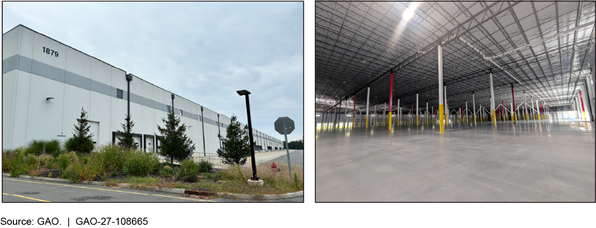
Warehouse acquisitions and related costs. In January 2026, ICE also began implementing a new initiative to further expand detention capacity through purchasing and renovating a collection of warehouse facilities nationwide. As a result, OBBBA obligations began to increase significantly. According to ICE documents, the proposed initiative (referred to as the Detention Reengineering Initiative) was originally envisioned to include eight large-scale detention centers and 16 regional processing centers, as well as 10 existing facilities where ICE already operates.[16] In January 2026, ICE estimated that the new initiative would increase total detention capacity to 92,600 beds at an estimated cost of $38.3 billion.[17] ICE expected many of the facilities to be operational by November 2026. See figure 2 for examples of two of the purchased warehouse detention facilities.
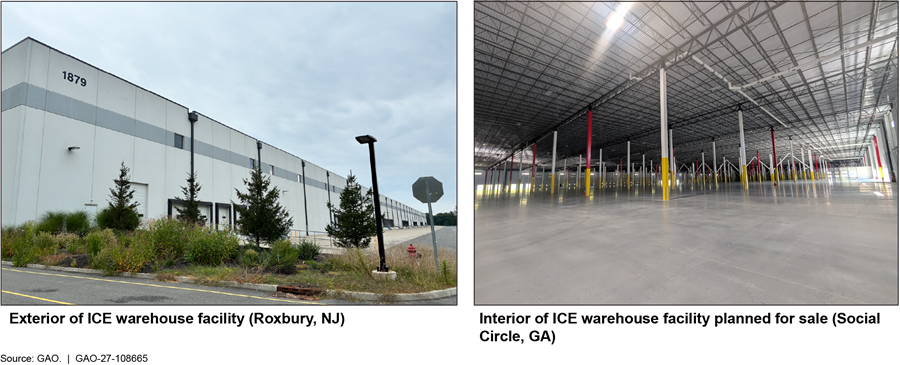
As shown in table 2, ICE purchased 11 warehouse facilities between January and March 2026 (four large-scale and seven smaller processing centers) at a total cost of about $1.07 billion. The facilities ranged in cost between $35 million and $145 million. According to officials, additional acquisition and due diligence costs for these properties totaled approximately $12 million.
Table 2: Warehouse Facilities Purchased by U.S. Immigration and Customs Enforcement (ICE) as of March 2026
|
Warehouse location |
Facility typea |
Purchase price |
Reported due diligence costsb |
|
Romulus, Michigan |
Processing center |
$34,671,500 |
$1,050,022 |
|
San Antonio, Texas |
Processing center |
$66,112,500 |
$1,064,896 |
|
Oakwood, Georgia |
Processing center |
$68,162,500 |
$1,045,729 |
|
Surprise, Arizona |
Processing center |
$70,035,000 |
$1,030,217 |
|
Hamburg, Pennsylvania |
Processing center |
$87,402,500 |
$1,374,788 |
|
Williamsport, Maryland |
Processing center |
$102,400,000 |
$1,154,284 |
|
Roxbury, New Jersey |
Processing center |
$129,300,000 |
$1,328,856 |
|
Tremont, Pennsylvania |
Large-scale facility |
$119,515,000 |
$1,346,927 |
|
Socorro, Texas |
Large-scale facility |
$122,808,000 |
$1,083,659 |
|
Social Circle, Georgia |
Large-scale facility |
$128,555,500 |
$1,047,971 |
|
Salt Lake City, Utah |
Large-scale facility |
$145,440,000 |
$781,897 |
|
Total |
|
$1,074,402,500 |
$12,309,246 |
Source: GAO summary of ICE data. | GAO‑27‑108665
aAccording to ICE documents, processing centers would each detain 1,000–1,500 noncitizens for a period of 3–7 days and are intended to serve as staging locations for transfers or removals. The large-scale facilities would be designed to detain 7,000–10,000 noncitizens for periods averaging less than 60 days.
bAccording to ICE officials, related due diligence costs include, for example: market research, environmental due diligence and assessments, site condition assessments, zoning assessments, and title insurance.
Warehouse renovation and operating contracts. During the second quarter of fiscal year 2026, ICE also awarded renovation and operating contracts for the warehouses purchased in Williamsport, MD, and Surprise, AZ. ICE obligated $113 million and $313 million, respectively, in OBBBA funding for renovations and ramp-up activities at these facilities.
Purchase of existing contract detention facilities. In July 2026, ICE purchased two California contract detention facilities—California City Detention Facility and Otay Mesa Detention Center—for approximately $1.5 billion total.[18] According to officials, purchasing such facilities in areas where state and local governments do not cooperate with ICE enforcement efforts would allow ICE more flexibility to increase or decrease bedspace as needed and help ensure that ICE is able to maintain operations in geographically important regions.
In total, ICE reported OBBBA detention obligations of approximately $9.1 billion through July 2026.[19]
Scope and Time Frames of New Detention Initiatives Remain Undefined
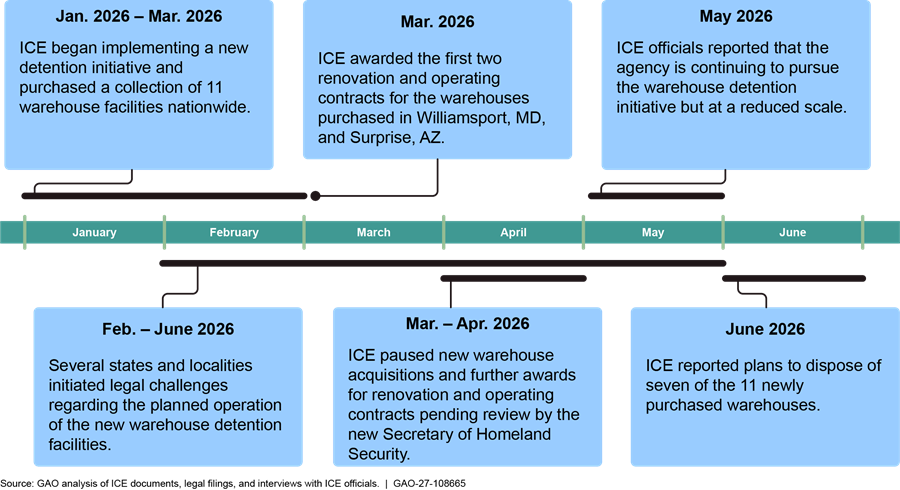
Since ICE initiated its warehouse detention initiative in January 2026, it has faced a series of setbacks and reduced the planned scope significantly. As shown in figure 3, DHS paused new warehouse acquisitions and further awards for renovation or operating contracts for the warehouses pending review by the new Secretary of Homeland Security in March 2026. In addition, a number of lawsuits have challenged the planned operation of the facilities.[20] Although officials reported in May 2026 that the agency was moving forward with plans to award renovation contracts for two additional facilities, they said that ICE no longer planned to use warehouses it recently purchased in several other locations. In June 2026, the Secretary of Homeland Security stated that DHS re-evaluated the warehouse detention model because the department had not conducted appropriate due diligence and planning.[21] Later that month, ICE officials confirmed that the agency initiated plans with the General Services Administration to sell seven of the 11 warehouses.[22]
Given the ongoing legal challenges and limited progress toward renovating warehouses as planned, the scope, time frames, and associated costs of the four remaining warehouses remain uncertain. However, as of July 2026, officials stated that ICE plans to award renovation and operating contracts for the Roxbury, NJ, and San Antonio, TX, facilities by the end of fiscal year 2026. For each of the warehouses, ICE remains responsible for ongoing ownership costs, such as utilities and maintenance. For example, ICE reported that associated costs for the 11 warehouses totaled over $800,000, as of August 2026. ICE also incurred an estimated total of about $15.8 million for security-related costs for these facilities.
Figure 3: Timeline of U.S. Immigration and Customs Enforcement (ICE) Warehouse Detention Initiative, January – June 2026
According to ICE officials, the purchase of existing contract detention facilities represents the next phase of the Detention Reengineering Initiative, but it remains uncertain to what extent ICE plans further acquisitions. In June 2026, officials told us ICE was considering purchasing additional facilities it currently utilizes in states such as New Jersey, Colorado, and Washington. ICE officials were unable to provide any specific details regarding the scope and potential time frames of this new initiative but anticipated that several of these acquisitions would be made in calendar years 2026 and 2027.[23]
ICE Has Not Updated 2026 OBBBA Spending Plan to Reflect Changing Conditions, Limiting the Ability to Conduct Long-Term Budget Planning
As of June 2026, ICE’s OBBBA spending plan for detention funding had not been updated to reflect the shifting status of the warehouse initiative or the planned detention facility acquisitions, which affects oversight efforts and limits the ability to project longer-term budget needs. Specifically, the spending plan still included a total of approximately $38 billion in planned obligations for fiscal year 2026. These planning estimates are the same as those reported in February 2026 and were not updated despite significantly changing conditions and delayed implementation of the warehouse initiative. Given the $9.1 billion in obligations reported through July 2026, it is not realistic that ICE would obligate an additional $29 billion over a period of just 2 months.
Moreover, the OBBBA spending plan for detention funding lacks supporting details to identify how funds are intended to be used or any estimated time frames for planned obligations. The plan provided indicates a single annual obligation estimate for each of the two primary OBBBA detention facility accounts (Operations and Support; and Procurement, Construction, and Improvements) without any additional project identifiers, descriptions, or details about the nature of the underlying projects or facility locations.
According to ICE guidance, spending plans are a critical internal control activity to strengthen financial management and program management. This guidance directs that spending plans be updated midway through the fiscal year, and as operations or other external factors change, such as new appropriations or reprogramming of funds. As we reported in May 2024, ICE has not always updated its spending plans in accordance with this ICE guidance.[24] As of May 2026, ICE was in the process of updating its Spend Plan guidance for fiscal year 2027; however, the draft document ICE provided to us maintains the same criteria for required updates as existed in the prior version. Among other requirements, the draft guidance states that properly developed plans should include obligation breakouts by month as well as accounting details (such as applicable project and task identifiers) to facilitate transparency and accountability of ICE’s resources and financial management. We confirmed that ICE spending plans developed in fiscal year 2025 for the Custody Operations program included these elements.
According to ICE budget officials, the initial OBBBA spending plan was developed quickly and was intended to identify the high-level categories of spending to be monitored across the multi-year funding availability time frame (July 2025 through September 2029). However, they stated that they received subsequent direction from administration leadership regarding spending requirements for fiscal year 2026 and were instructed to obligate most of the OBBBA funds by the end of fiscal year 2027. In July 2026, the officials told us that the budget office had recently requested updated OBBBA spending plans from each of the program offices and developed an agency-wide version that is to undergo review and approval from DHS and OMB. According to the ICE budget office, the updates should reflect changes regarding the warehouse initiative. However, as of October 2026, no additional evidence was provided regarding the extent to which the new versions incorporate more realistic projections of planned obligations for detention facilities or include any level of supporting details such as project and task identifiers.
Given the large amount of funding provided by the OBBBA and the 4-year time horizon, spending plans are a critical tool to help support longer-term budget planning. According to the ICE guidance, ICE uses spending plans to build and justify its mission requirements to DHS leadership, OMB, and Congress. By ensuring that OBBBA spending plans for detention funding are updated in a timely manner in accordance with internal guidance and based on realistic assumptions, ICE would be better positioned to manage these multi-year funds and provide more accurate information to oversight entities. Moreover, the current plan indicates that ICE plans to obligate any remaining OBBBA detention funds before the end of fiscal year 2027. If ICE does so, it may have limited funds available for required maintenance and support of detention operations through fiscal year 2029. More accurate spending plans would help ICE better assess longer term budget needs when OBBBA funding is no longer available.
Detention Expansion Is Correlated with Higher-Cost Bedspace
Annual Detention Costs Increased by 41 Percent in Fiscal Year 2025, Varying by Facility Type
ICE obligated about $2.8 billion to detain individuals in fiscal year 2025, representing an increase from prior years amid expanded enforcement activity. In addition to acquiring and maintaining traditional facilities operated by private contractors and state or local governments, ICE also added detention space operated by other federal agencies. ICE’s costs at the facility and detained noncitizen level varied by ownership type, with newly acquired detention space at Federal Bureau of Prisons (BOP) facilities coming at a higher daily cost per detained noncitizen than any traditional facility type.
Annual Detention Costs
As ICE expanded enforcement activity and detention space in response to executive orders and increased funding, its annual obligations for housing individuals in detention facilities increased. As shown in figure 4, ICE obligated approximately $2.8 billion on detention facilities in fiscal year 2025, 41 percent higher than in fiscal year 2024. Between those 2 fiscal years, the average daily population in ICE facilities increased to approximately 48,400—about 28 percent higher than in fiscal year 2024—and the number of detention facilities increased from 129 to 188.[25] In the first three quarters of fiscal year 2026, ICE obligated about $2.9 billion to detention facilities.[26] Average daily population and the number of facilities continued to increase, reaching approximately 59,400 detained noncitizens in 261 facilities as of June 2026.
Figure 4: Immigration and Customs Enforcement (ICE) Detention Facility Obligations and Average Daily Population from October 2022 Through June 2026
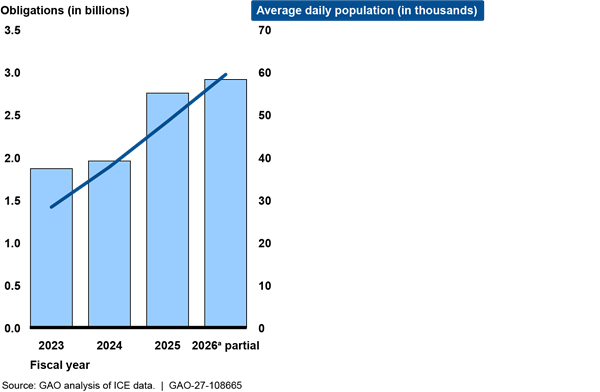
aFiscal year 2026 obligations data are as of June 30, 2026. ICE obligated over $1 billion to one facility, Camp East Montana, representing about 36 percent of total obligations to detention facilities in the first three quarters of fiscal year 2026. We discuss the details of ICE’s obligations for this facility later in this report. Camp East Montana is not included in the fiscal year 2025 data, when it was funded by the Department of Defense.
Note: These data do not include costs related to transportation of detained noncitizens. See appendix II for ground transportation costs related to ICE enforcement and removal activities. Further, the data do not include two state-funded Florida immigration detention facilities that ICE used but did not enter a contract or agreement to operate or reimburse. We discuss federal reimbursements to Florida later in this report and in appendix III.
Costs Per Detention Facility and Detained Noncitizen
Detention costs per facility and detained noncitizen varied by ownership type in fiscal years 2025 and 2026. According to ICE officials, factors such as services provided, facility location, and ICE’s bedspace needs can influence facility costs. For example, ICE’s mission need for bedspace in certain geographic areas may take priority over costs. As shown in figure 5, the highest average obligations in fiscal year 2025 were among contract detention facilities and contract-operated service processing centers, which had an average daily population of about 650 and 760 detained noncitizens during that year, respectively. In comparison to contract-operated facilities, dedicated facilities with an intergovernmental service agreement (IGSA) had a higher average daily population of more than 900 detained noncitizens but were less costly on average. Below, we discuss differences in daily rates by facility type that further contextualize these variations in average annual obligations.[27]
Figure 5: Average Annual Obligations and Daily Population in Adult U.S. Immigration and Customs Enforcement (ICE) Detention Facilities by Type, Fiscal Year 2025
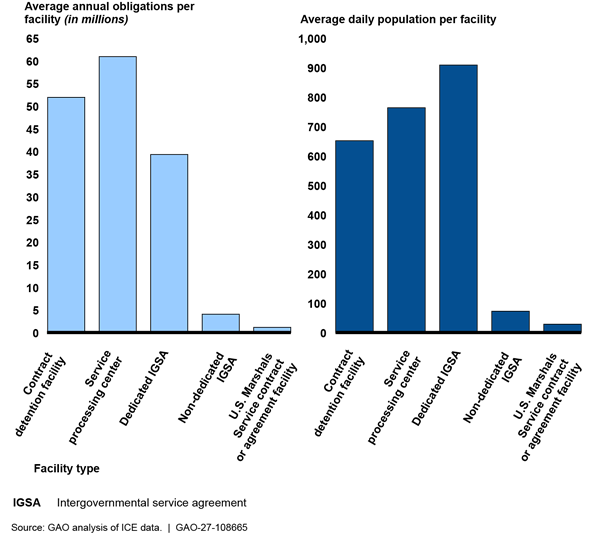
Note: These data do not include costs related to transportation of detained noncitizens; see appendix II for ground transportation costs. Further, we excluded one family facility and two juvenile facilities due to their different operating environments. We also excluded facilities that did not fall into the categories pictured above—that is, short-term staging facilities, Guantanamo Bay, and the Federal Bureau of Prisons (BOP) facilities that ICE utilized in fiscal year 2025. ICE does not track per-facility BOP obligations because BOP reports its costs at the aggregate level, according to ICE officials.
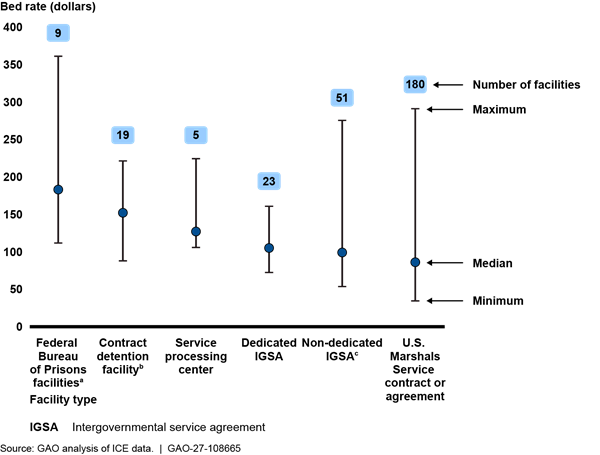
Specifically, we found that bed rates—the cost of detaining one noncitizen for one day—also vary by facility type. Bed rates include (1) bed and guard costs; (2) health care; (3) other direct costs, such as payments to detained noncitizens for voluntary work programs, supplies, and telecommunications; and (4) indirect, facility-wide costs such as rent, security, and equipment. As shown in figure 6, the bed rates documented in ICE’s adult facility contracts and agreements varied by facility type in April 2026.[28] Specifically, BOP facilities had the highest median rate of any facility type, followed by contract-operated facilities.
Figure 6: U.S. Immigration and Customs Enforcement (ICE) Adult Detention Bed Rates by Facility Type, April 2026
aIn February 2025, ICE signed an interagency agreement to house noncitizens in eight Federal Bureau of Prisons facilities. ICE also had a preexisting arrangement to house noncitizens in a ninth Bureau facility in Puerto Rico.
bWe excluded one contract detention facility, Camp East Montana, because its contract is under negotiation and its bed rate is subject to change as of August 2026.
cOne IGSA facility is counted twice because two ICE field offices use this facility at different bed rates.
Note: We excluded one family facility and two juvenile facilities due to their different operating environments. The number of facilities may differ from other sources because it also includes facilities that ICE uses on a limited basis that are not included in the authorized facility list, according to officials. Further, some facilities use a tiered bed rate structure in which ICE pays different rates at different levels of bed usage. For those facilities, we calculated a theoretical bed rate based on 100 percent usage of all beds.
Our analysis identified the following trends by facility type:
|
Bed Rates at Florida-Funded Immigration Detention Facilities The state of Florida also funded two detention facilities that ICE used in fiscal years 2025 and 2026. ICE did not enter into a contract or agreement with Florida to operate these facilities as immigration detention centers. However, the Federal Emergency Management Agency (FEMA) awarded a $608.4 million grant to Florida to support immigration detention. As of October 2026, FEMA had reimbursed Florida about $93 million for operations at the recently constructed Florida Soft-Sided Facility, also known as “Alligator Alcatraz”. The bed rate at this facility is $249 per noncitizen per day, nearly three times higher than ICE’s median bed rate of $92. Florida also requested to use the grant to support Baker Correctional Institution, a brick-and-mortar facility. FEMA approved this request and has reimbursed Florida for expenses at this facility at the same $249 bed rate. See appendix III for more information Source: Documentation and responses from FEMA officials. | GAO‑27‑108665 |
BOP facilities. The nine BOP facilities ICE utilized in April 2026 had a median bed rate of $180, the highest of any facility type. These rates ranged from $110 at Federal Correctional Institution Leavenworth in Kansas to $360 at Federal Detention Center Honolulu in Hawaii. Rates were consistent between 2025 and 2026 at the eight BOP facilities ICE used in both years. According to ICE officials, these are the same rates that BOP calculated to house individuals pending trial or serving sentences for federal charges. ICE did not have the ability to negotiate these rates since it is absorbing BOP’s costs for housing detained noncitizens.
· Contract detention facilities and contract-operated service processing centers. These facilities had median bed rates of $151 and $126, respectively, in April 2026.[29] According to ICE officials, bed rates at contract-operated facilities can be higher than other facility types because they follow more stringent detention standards than other ICE facilities and may provide more medical services. Officials also said that contractors’ expected rate of profit may also contribute to higher bed rates.
Contract detention facility bed rates can also be subject to annual cost increases negotiated at the time of the contract award to account for factors like wage increases and inflation. ICE data show that bed rates increased at 12 of the 21 contract detention facilities and service processing centers ICE used from September 2025 through April 2026, with most rates increasing by between 1 and 7 percent. Of the remaining nine facilities, eight maintained the same rate and one decreased its rate.
· U.S. Marshals Service riders and IGSA facilities. These facilities had median bed rates ranging from $85 to $103. ICE officials said that the state and local partners who operate most of these facilities are not profit-seeking. ICE data show that 190 of the 232 facilities operated through U.S. Marshals Service riders and IGSAs from September 2025 through April 2026 maintained the same bed rate in that period.[30]
These trends are consistent with our previous reporting that contract detention facilities and service processing centers had higher median bed rates than facilities with U.S. Marshals Service riders or IGSAs in fiscal year 2019.[31] In addition to facility type, ICE officials said that bed rates can be influenced by factors such as unique operational requirements, local pay rates, and facility-wide costs, including rent or maintenance.
ICE’s Expanded and Planned Detention Portfolio Includes High-Cost Facilities
As ICE expanded its detention space throughout fiscal years 2025 and 2026, it often acquired and planned for facilities with relatively high costs. Specifically, the number of facilities where ICE makes guaranteed payments for a fixed number of beds increased during that period and ICE has underutilized thousands of those beds, leading to millions in estimated payments for unused beds. ICE also utilized high-cost facilities located on military installations. As discussed previously, ICE also spent about $1.07 billion to acquire 11 warehouses, the majority of which it plans to sell, as well as four facilities it was previously utilizing for about $2.2 billion.
ICE Committed to Pay for an Increasing Number of Fixed Beds
From October 2022 through April 2026, ICE awarded an increasing number of contracts and agreements that require it to make guaranteed payments for a fixed number of beds, regardless of whether those beds are filled.[32] We previously reported that guaranteed payments protect facility operators from financial loss and can save money when structured to include lower-priced bed rates if ICE uses more than the fixed number of beds, according to ICE guidance.[33] Further, we reported that these payment structures help ICE secure detention space when it has an urgent need and limited options, according to ICE officials.[34]
However, guaranteed payments also present the risk of ICE paying for beds it does not use. According to agency data, ICE committed to pay for 46,688 fixed beds across 64 facilities as of April 2026, an increase from prior years.[35] From October 2025 through April 2026, the average daily population at more than a third of those facilities did not meet the fixed number of beds, amounting to a daily average of 9,733 empty beds that ICE was required to pay for.
For example, table 3 identifies five facilities with a large number of fixed beds that ICE acquired after fiscal year 2024. The average daily population of detained noncitizens at four of the five facilities from October 2025 through 2026 was lower than the fixed number of beds. As a result, we estimate that ICE paid millions of dollars per month for empty beds at these facilities.
Table 3: U.S. Immigration and Customs Enforcement (ICE) Guaranteed Payments and Average Daily Populations at Five Recently Acquired Facilities, April 2026
|
Facility Name |
Facility type |
Fixed number of beds ICE pays for |
Daily rate per fixed beda |
Flat monthly feeb |
Average daily population, fiscal year 2026 (partial)c |
Empty fixed beds per day on average |
Estimated amount ICE paid per month on average for empty beds |
|
California City Correctional Facility |
CDF |
2,560 |
$40 |
$ 7,533,333 |
1,353 |
1,207 |
$ 5,020,527 |
|
North Lake Correctional Facility |
CDF |
1,800 |
$15 |
$ 6,118,689 |
1,378 |
422 |
$ 1,627,051 |
|
Folkston D. Ray Processing Center |
DIGSA |
1,308 |
$19 |
$ 3,984,815 |
1,159 |
149 |
$ 540,047 |
|
Diamondback Correctional Center |
DIGSA |
1,200 |
$40 |
$ 6,929,643 |
364 |
836 |
$ 5,844,896 |
|
Delaney Hall |
CDF |
700 |
— |
$ 3,913,524 |
860 |
0 |
— |
|
Total |
— |
— |
— |
— |
— |
2,614 |
$ 13,032,520 |
CDF = Contract detention facility; DIGSA = Dedicated intergovernmental service agreement; — = Not applicable
Source: GAO analysis of ICE data. | GAO‑27‑108665
aAt some facilities, ICE pays both a flat monthly fee that covers facility-wide expenses and a daily rate per bed that covers the care of each noncitizen, according to ICE officials.
bFor contracts at new facilities, ICE generally establishes a ramp-up plan where the monthly fee is gradually phased in to prevent ICE from paying for beds that the vendor is still standing up, according to ICE officials.
cAverage daily population data represent October 2025 through April 2026. Actual facility populations fluctuate daily and an increased number of fixed beds may have been utilized at various times during this period.
Note: We selected the five adult detention facilities with the largest number of fixed beds that ICE acquired and began operating during fiscal year 2025. We excluded two facilities, Camp East Montana and Midwest Regional Reception Center, from the sample because some fixed beds at those facilities may not have been available throughout the entire fiscal year. To estimate the amount that ICE paid per month for empty beds at these facilities, we (1) calculated the overall daily cost per fixed bed, accounting for both the flat monthly fee and daily rate if appliable; (2) calculated the average daily number of empty fixed beds by subtracting average daily population from the total number of fixed beds; (3) multiplied the daily cost per fixed bed by the average number of empty beds; and (4) multiplied the product by the average number of days per month.
In 2021, we recommended that ICE document and implement a strategic approach for using guaranteed minimums in detention contracts and agreements that supports strategic plans, goals, and priorities.[36] In response to this recommendation, ICE reported in 2024 that it planned to phase out the use of guaranteed minimums and shift to a fixed monthly operating charge payment structure, where ICE pays a flat monthly fee for its anticipated usage level and has flexibility to renegotiate if it uses less space than anticipated. Although ICE’s use of fixed monthly charges has increased in subsequent years, this payment structure carries the same risk as guaranteed minimums because ICE is committing to paying for a fixed number of beds regardless of whether they are used, as exemplified in table 3 above. Additionally, as of June 2026, ICE had not provided examples of contracts or agreements that include the flexibility to renegotiate costs if it uses less space than anticipated.
Further, potential changes in policy, priorities, or resources may result in reduced populations in custody while ICE continues to pay for fixed beds at applicable facilities. Given the risk of ICE continuing to pay for empty beds at some facilities for years to come, we continue to maintain that implementing a strategic approach to using guaranteed payments would position ICE to secure better contract and agreement terms while more effectively using federal funds. We will continue to track ICE’s progress in doing so.
ICE Used High-Cost Facilities on Military Installations
ICE utilized high-cost detention facilities at two military installations in fiscal years 2025 and 2026. While expanding detention space in response to presidential directives, ICE requested access to several installations for detention operations in February 2025.[37] According to ICE officials, as of July 2026, ICE plans to maintain the existing detention operations at Camp East Montana (on U.S. Army Fort Bliss) and Naval Station Guantanamo Bay, but does not have plans to use any additional military installations.
Camp East Montana. In June 2026, we reported that the Army and ICE’s expedited time frames for opening Camp East Montana in August 2025 led to millions of dollars of waste.[38] Specifically, the contract for operating the facility did not account for occupancy levels below the maximum, requiring ICE to pay for the full cost of meals and services for 5,000 people even when the facility houses a smaller population. ICE paid the facility operator a flat monthly fee of over $38 million per month but did not consistently operate Camp East Montana at or near full capacity.
Further, agency data show that ICE obligated over $1 billion to Camp East Montana from October 2025 through June 2026, representing about 36 percent of the total $2.9 billion obligated to detention facilities during that period.[39] In our June 2026 report, we recommended that ICE incorporate cost savings measures, such as tiered pricing for meals and other services, into the contracts at Camp East Montana and other facilities to account for fluctuations in population. DHS agreed with this recommendation and stated that it would modify the Camp East Montana contract to include tiered pricing. Accounting for fluctuations in population in detention facility contracts would improve cost efficiency at those facilities.
Guantanamo Bay. In January 2025, a presidential directive required DHS and DOD to expand the Migrant Operations Center, a preexisting DHS facility at Naval Station Guantanamo Bay, to full capacity to detain high-priority noncitizens unlawfully present in the U.S.[40] DHS and DOD also repurposed a second Guantanamo Bay facility, Camp Six, for immigration detention. The combined capacity at both facilities was 400 beds as of August 2026.
We previously reported that Guantanamo Bay detention operations proceeded on a smaller scale than originally planned.[41] However, use of this location has required high investment from ICE and DOD.[42] As shown in table 4, both facilities had a combined average daily population of fewer than 30 detained noncitizens from October 2024 through June 18, 2026. Despite that population, ICE obligated approximately $43 million to expand and operate these facilities from October 2024 through June 2026, while DOD obligated approximately $68 million from October 2024 through May 2026. These costs include DOD’s military flights transporting detained noncitizens to and from Guantanamo Bay, but do not include ICE’s chartered flights.[43] See appendix IV for additional information on DOD’s costs for supporting ICE detention.
|
Fiscal year |
Average daily population |
Maximum daily populationa |
U.S. Immigration and Customs Enforcement (ICE) obligationsb |
Department of Defense (DOD) obligationsc |
Total obligations |
|
2025 |
28 noncitizens |
178 noncitizens |
$ 25,135,498 |
$ 60,645,278 |
$ 85,780,776 |
|
2026 (partial) |
16 noncitizens |
115 noncitizens |
$ 17,582,997 |
$ 7,449,169 |
$ 25,032,166 |
|
Total |
— |
— |
$ 42,718,495 |
$ 68,094,447 |
$ 110,812,942 |
— = Not applicable
Source: GAO analysis of U.S. Immigration and Customs Enforcement (ICE) and Department of Defense (DOD) data. | GAO‑27‑108665
aAverage and maximum daily population data represent both Guantanamo Bay facilities throughout fiscal year 2025. For fiscal year 2026, these data represent the population from October 1, 2025, through June 18, 2026.
bICE data represent obligations through June 30, 2026. These data do not include obligations related to transporting detained noncitizens to and from Guantanamo Bay. ICE aggregates these costs along with other flights performed by its air charter contractor.
cDOD data represent obligations through May 31, 2026. According to agency documentation, the Department of Homeland Security agreed to reimburse DOD for its support of immigration detention provided from the start of fiscal year 2026 through the end of fiscal year 2035.
Guantanamo Bay involves substantially higher costs than facilities where ICE alone is paying for a similar number of beds. For example, in fiscal year 2025, ICE obligated approximately (1) $40 million at Florence Service Processing Center, with 392 fixed beds and an average daily population of 386 detained noncitizens and (2) $41 million at Buffalo Service Processing Center, with 400 fixed beds, 650 total beds, and an average daily population of 626 detained noncitizens. In the same year, ICE and DOD obligated approximately $86 million for 400 beds at Guantanamo Bay with an average daily population of 28 detained noncitizens.
Despite the high costs of detention at Guantanamo Bay, ICE has not restricted the use of Camp Six to detain high-threat noncitizens as originally planned. Specifically, the memorandum of understanding DOD and DHS signed in March 2025 established that ICE would use Camp Six to house high-threat noncitizens with a nexus to transnational criminal organizations or criminal drug activity.[44] According to agency documentation, ICE designates noncitizen threat levels based on criminality and classifies noncitizens without a criminal conviction as having “no threat level.” However, ICE placed multiple noncitizens who had no criminal convictions or pending charges at Camp Six, as shown in table 5.
|
|
Number of Detained Noncitizens |
||
|
|
With Criminal
Conviction or |
No Criminal Conviction or Pending Charges |
Total |
|
August 2025 |
11 |
6 |
17 |
|
September 2025 |
12 |
5 |
17 |
|
December 2025 |
1 |
1 |
2 |
|
February 2026 |
4 |
12 |
16 |
|
April 2026 |
3 |
11 |
14 |
Source: GAO analysis of ICE data. | GAO‑27‑108665
Note: These data represent snapshots in time per each listed month and are sourced from ICE’s public detention statistics. Missing months represent periods when ICE did not update those statistics—which coincided with lapses in federal funding during which some ICE staff were furloughed—or periods when Camp Six did not appear in the data because there were zero noncitizens detained there at the time ICE pulled the data. For example, officials said that neither Guantanamo Bay facility housed detained noncitizens from approximately October through mid-December 2025 due to hurricane evacuation and ensuing damage. ICE most recently updated its public statistics in July 2026, but Camp Six did not appear in the data, likely because it housed zero noncitizens at that time.
ICE officials stated that costs did not factor into the decision to use Guantanamo Bay and that conserving costs is not a goal for operations there. According to ICE officials, the agency plans to continue using Guantanamo Bay based on direction from senior leadership and the White House.
Newly Purchased Detention Facilities Are Likely to Entail High Costs
From the initial property acquisitions to the planned renovations and operations, ICE’s approach to purchasing warehouses and existing detention facilities is likely to entail high costs. Although the scope and timing of this approach remain undetermined, initial obligations and preliminary cost projections indicate that ICE’s approach may have significant long-term budgetary impacts. Specifically:
· Warehouse acquisitions. Our analysis of ICE documentation and public records showed that ICE potentially overpaid for many of the warehouses it purchased. Although tax assessment data is not always a reliable indicator of fair market value, we found that ICE paid at least 50 percent above the state or local government’s assessment of taxable value for nine of the 11 warehouses.
Moreover, given ICE’s plans to sell seven of the warehouses—six for which it paid at least double the assessed value—there is risk that these sales could result in financial losses to the federal government. Additional sunk costs include approximately $7.7 million for related due diligence activities for the purchase of those seven facilities, as well as $12.8 million for utilities, security, and other services as of August 2026. See appendix V for additional information on public records of assessed value and prior sales for the 11 warehouse properties.
· Warehouse renovation and operating costs. Based on obligations to date and preliminary cost estimates, renovating and operating the four warehouses ICE plans to retain may require significant investment from ICE. For example, ICE obligated $313 million for renovation and ramp-up activities at Surprise, Arizona and $113 million on the Williamsport, Maryland warehouse renovation contract.
Further, ICE’s preliminary estimates indicate that the agency believes three of the four warehouses it plans to retain could each have annual operating costs that are significantly higher than those of most ICE facilities in fiscal year 2025, including the five ICE-owned service processing centers.[45]
Although ICE originally planned to phase out existing facilities after renovating warehouses, officials said they are now unlikely to pursue that plan. The four warehouses currently planned would hold a maximum of 6,000 beds, which will require ICE to retain many of its existing facilities to house the current fiscal year’s average daily population of 67,180 detained noncitizens as of July 30, 2026. If ICE proceeds with this approach, it may result in high acquisition and operating costs without securing significant savings, which could have long-term impacts on ICE’s budget and operations.
In addition, ICE’s purchase of four existing detention facilities between July and August 2026 for a combined total of about $2.2 billion indicates this approach will also entail high costs. According to planning documents, ICE was considering purchasing seven additional facilities it currently uses in states such as Colorado, New Jersey, and Washington as of July 2026. Officials noted that while they do not expect this effort to result in cost savings, it will help ICE fulfill its mission in locations where state governments may resist expanded detention efforts. Although ICE planning documents indicate that ICE may expand bedspace in some of the purchased facilities, doing so may require significant investment. For example, ICE’s preliminary estimates for the newly purchased California City facility indicate that the agency believes annual operating costs could be significantly higher than comparable facilities after expanding capacity to 5,000 beds.[46]
ICE Employs Various Cost Management and Oversight Processes, but Did Not Fully Assess Cost Effectiveness Amidst Facility Expansion
ICE Conducts Various Levels of Cost Oversight, but Facility Expansion Has Affected Some Processes
ICE employs various processes to manage and oversee facility costs at several stages and agency levels, but some activities have been affected by the rapid expansion of new detention facilities. We identified three key processes performed by field and headquarters officials that are intended to (1) inform decisions for additional bedspace; (2) validate facility invoices; and (3) track and monitor facility costs:
New bedspace proposals. ICE’s standard process for acquiring additional detention bedspace typically begins with the development of a proposal at the field office level, known as a “white paper.” However, according to officials, this process was not the only mechanism used for preliminary decision-making about new or expanded facilities since January 2025 and did not apply to the warehouse purchases in 2026. As we reported in January 2021, the white paper process is designed to be “bottom up” to identify a field office’s detention needs and evaluate costs and other tradeoffs.[47] The white paper template also directs field officials to include information on transportation requirements, medical care facilities, and key local stakeholders (such as mayors or sheriffs) that indicated their support for the proposal, among other requirements. Field management is to review and approve the white papers before providing them to ERO for final acquisition decisions. We selected a sample of 12 large or high-cost detention acquisitions that ICE made in fiscal year 2025 and found that ICE developed white papers for 11 of them.[48]
Although ICE officials did not identify a specific policy requirement for field offices to complete white papers, they reported that developing white papers remains a standard practice to document new facility proposals and provide preliminary cost estimates based on comparable facilities in the area. However, officials from all four field offices we spoke to told us that white papers were not always the key driver for decisions regarding expansion of detention space since January 2025, given the significant surge in demand for new facilities nationwide. For example, one official noted that several white papers they have submitted since 2025 were developed after a facility acquisition was already initiated by headquarters. According to ERO officials, DHS and ICE leadership also led decisions regarding expanded detention space in many new facilities in 2025, such as those operated by BOP, Guantanamo Bay, and Camp East Montana.
In addition, none of the warehouse acquisitions were subject to the white paper process, which DHS initiated and the ICE Office of Asset and Facilities Management managed centrally. Given the number of legal challenges filed by state and local officials in several of the jurisdictions where ICE purchased the new warehouses, obtaining stakeholder input about these facilities in advance (which we recommended in 2021) could have helped ensure local buy-in and manage risk.[49] Specifically, DHS and ICE leadership may have been able to take steps to minimize legal or other risks before completing warehouse acquisitions in certain jurisdictions, which now has significant cost implications as ICE has initiated plans to sell over half of the existing warehouses.
|
Contracting Officer’s Representative (COR) A COR is appointed by a contracting officer and provides technical direction, clarification, and guidance with respect to the contract or agreement terms. The COR is the technical liaison between the detention facility operator and the contracting officer and is responsible for monitoring the performance of the facility operator according to the contract or agreement Source: GAO analysis of ICE information. | GAO‑27‑108665 |
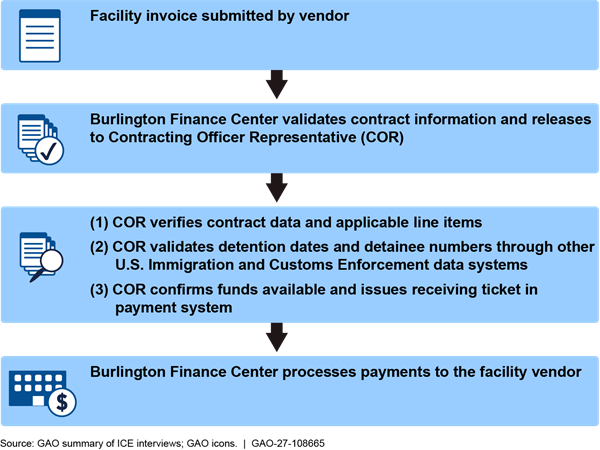
Facility invoice validations. CORs perform routine oversight and validation of all facility invoices; however, the four CORs we spoke to reported that the increased number of detention facilities since January 2025 has strained their ability to dedicate adequate time and attention to this role. In addition to the review and validation of monthly facility invoices, CORs have a range of other roles and responsibilities, such as (1) visiting detention facilities to ensure that vendors comply with the contract or agreement, (2) monitoring the status of funds available for each facility, and (3) supporting new hire processing at the facilities. According to all four of the CORs we spoke to, the expanded number of detention facilities has made it challenging to carry out their assigned duties, including providing rigorous oversight of facility cost invoices. See figure 7 for additional information on the facility invoice validation process.
Figure 7: Key Steps in the U.S. Immigration and Customs Enforcement (ICE) Detention Facility Invoice Validation Process
At the end of December 2025, ICE reported there were a total of 32 CORs who conducted detention facility oversight across ERO’s 25 field offices, and 55 vacant positions. As discussed above, the number of ICE detention facilities roughly doubled between January 2025 and June 2026, which significantly increased the COR workload. For example, one COR reported that their oversight responsibilities increased from 10 to 31 facilities from January to December 2025. Moreover, some of these CORs are the only ones serving this role in their designated field offices and reported they have limited backup support.
ICE headquarters officials acknowledged that the need for additional CORs was a longstanding issue and stated that, as of May 2026, ICE had an open vacancy announcement to hire additional COR positions in fiscal year 2026. In August 2026, officials reported that the hiring actions remained underway to address the 55 vacancies across ICE field offices. However, ICE did not provide any supporting documentation to verify the number of positions available or how many were filled to date. According to ICE officials, the agency generally focused its recent hiring efforts on enforcement positions, stalling COR-related activities, in part, due to the funding lapse and partial ICE shutdown in 2026. According to officials, hiring CORs can also be challenging due to the requirements for prior contract oversight experience. Although hiring additional CORs will help alleviate some of the existing staffing and workload challenges cited, it will likely remain difficult to determine precisely what near- and longer-term COR resources will be needed until ICE determines the scope and timeframes for further warehouse development and other planned expansion of the existing detention facility structure.
ICE headquarters officials noted that ERO has implemented an initiative to assist CORs with reconciling detention invoices. The initiative, referred to as the Robotic Process Automation process, provides an automated validation of vendor submission details, such as detention days, bed rates, mileage reimbursements, and detainees at the facility per ICE records. It also provides a summary report to flag any discrepancies for the CORs attention. According to officials, this process reduces the time required for CORs to review vendor invoice submissions and, as of August 2026, was used for 120 facilities. Each of the four CORs we spoke to were familiar with this new initiative, and three specifically noted it was helpful and saved time by pre-populating contract information and detainee information for the larger facilities.
Monitoring of facility costs and budget execution. ICE headquarters offices conduct routine oversight and monitoring of facility detention costs and budget execution. Specifically, the Operations Support Division conducts regular tracking and reporting of monthly facility obligations, budget execution, and related metrics to support financial oversight of detention services in coordination with the Office of Budget and Program Performance. For cost accounting and reporting purposes, ICE manages annual appropriations and OBBBA funds separately, and allocates funds from these accounts using individual line items for each facility.
Oversight and tracking efforts also include monitoring the timeliness of ICE’s reimbursements to facility vendors. ICE data show that the agency paid over $500,000 in interest on late invoices for enforcement and removal activities from October 2024 through December 2025. According to Operations Support Division officials, ICE has faced significant delays in this area due, in part, to multiple government shutdowns and a prior DHS review policy, which affected the timely obligation of facility funding. See appendix VI for more information.
ICE Has Not Assessed Cost Effectiveness Amidst Facility Expansion
Since ICE initiated its efforts to rapidly expand detention capacity in early 2025, it has entered into multiple acquisition and contracting decisions that raise concerns about cost effectiveness and are not aligned with DHS acquisition management practices.[50] For example, the nine BOP facilities ICE used in 2026 have the highest median bed rate of any facility type, and both facilities on military installations resulted from expedited processes and have entailed high costs and lower than expected usage. The warehouse initiative, in particular, also represents a major investment that was implemented rapidly without a clear accounting of estimated life-cycle costs to inform decision making. As discussed above, ICE estimated total fiscal year 2026 obligations of $38 billion to implement the warehouse detention initiative. However, ICE did not provide any evidence documenting the underlying costs or analyses used to develop these estimates when requested. Further, ICE did not provide any type of cost effectiveness assessment that it may have used to inform the property purchase and selling decisions, amidst other potential alternatives.
Similarly, ICE officials told us they had only developed “rough cost estimates” for the contracted detention facilities they plan to purchase and potentially expand. Although ICE stated that these rough estimates are being used to inform internal decision-making, it is unclear how they were developed and what underlying cost assumptions were used. For example, ICE estimated operating costs at the newly acquired California City facility would be substantially higher than the monthly operating cost of the Camp East Montana facility with similar capacity (at $38 million per month). However, ICE provided no information on the assumptions underlying this estimate.
ICE’s detention facility investments were not managed in accordance with key principles identified in DHS’s acquisition management directive. This directive emphasizes the importance of assessing planned investments, such as developing life-cycle cost estimates and analyzing alternatives or tradeoffs before committing significant resources.[51] In addition, according to OMB guidance, a project is cost-effective if, based on life-cycle cost analysis of competing alternatives, it is determined to have the lowest costs for a given amount of benefits.[52] The guidance notes that a cost-effectiveness analysis is appropriate even if it is unnecessary or impractical to consider the dollar value of benefits. Analyzing alternatives can be done by examining different project scales, methods of provision, and varying degrees of government involvement. For example, in analyzing a decision to acquire a capital asset, the analysis should generally consider potential conversions of existing government property, or leasing, in addition to a direct purchase.
According to ICE ERO officials, administration and DHS leadership were largely responsible for certain detention expansion decisions, such as using military facilities and acquiring warehouses. Officials in the DHS Office of the Chief Procurement Officer and Office of the Chief Readiness Support Officer also noted that certain acquisition management and oversight activities for investments of this size were not conducted. For example, these officials stated that they were not involved in discussions within the department about whether to plan and manage ICE’s initiatives—such as the warehouse, contracted detention facility purchases, or high-dollar detention service contracts—as major acquisition programs. This would have entailed additional planning and analysis including assessing alternatives, documenting major decisions, and developing life-cycle cost estimates. According to these officials, under the current acquisition management directive, the DHS Undersecretary for Management can also require components to follow certain acquisition program pathways at any point.
Given the significant costs and long-term budgetary impacts associated with all of the large detention facilities, it is important that ICE develop robust life-cycle cost estimates to inform any future investment decisions before proceeding with further acquisitions. Without life-cycle cost estimates, ICE is making decisions about which warehouses to sell or renovate and which contracted detention facilities to purchase without complete information, including which efforts may be more cost effective. For example, ICE’s decision to sell seven of the 11 recently purchased warehouses entails immediate sunk costs and demonstrates the potential for significant waste, highlighting the importance of properly evaluating the costs, benefits, and risks of various alternatives before making acquisition decisions. ICE’s planned initiative to acquire additional contract-detention facilities may also present risk if the need for detention space is reduced in the future, as this could result in taxpayer funds being spent on unused beds. Given that ICE plans to make continued investments toward these expansion efforts, their strategic importance to the administration, and the financial risks ICE has already experienced with its efforts to date, it is critical that ICE manage future detention investments in coordination with appropriate DHS Undersecretary of Management offices. Further, managing future detention investments in accordance with established acquisition practices would better inform decision making and avoid the risk of further inefficiency and wasted taxpayer dollars.
Conclusions
As ICE continues to spend the unprecedented detention funding provided by OBBBA and the Secure America Act, it is imperative that the agency uses these taxpayer dollars in a cost-effective manner. The warehouse initiative is an example of a major investment that was implemented rapidly and will likely result in significant waste. Given the need to adequately manage these funds until fiscal year 2029, spending plans remain a critical tool to plan and monitor ICE obligations and ensure adequate funding remains available to support ongoing detention operations. However, ICE did not update its OBBBA spending plan for detention funding throughout fiscal year 2026 to reflect the significantly changing conditions regarding planned facility investments. By ensuring that OBBBA spending plans are updated in accordance with ICE’s own internal guidance and based on realistic assumptions, ICE will be able to provide more accurate information to DHS leadership, OMB, and Congress, and will be better positioned to project longer-term budget needs when OBBBA funding is no longer available.
Although ICE developed preliminary high-level estimates for some of its detention investments, it did not provide evidence for any of the underlying cost assumptions or any analyses conducted to assess the cost effectiveness of these investment decisions. According to OMB and DHS Acquisition guidance, such analyses would consist of developing life-cycle cost estimates for each of these facilities to compare among potential alternatives and inform decision making. Lacking these life-cycle cost estimates, ICE will likely continue to make investment decisions with limited information and risk overpaying for these acquisitions. Now that ICE has awarded renovation and operating contracts for two of the warehouse facilities, it has an opportunity to develop more comprehensive life-cycle cost estimates to evaluate the cost effectiveness of these efforts and inform any further warehouse development plans. Similarly, ICE is making decisions about which warehouses to sell or renovate and which additional contracted detention facilities to purchase without complete information. As ICE proceeds to execute spending on new or renovated detention facilities, these investments can be more fully informed by a cost effectiveness analysis to help ensure that any perceived benefits justify the anticipated costs. Such efforts will be critical to ensure that taxpayer dollars are spent wisely.
Recommendations for Executive Action
We are making the following two recommendations to ICE:
The Director of ICE should ensure that agency spending plans for ICE detention funds, including those received through the reconciliation process, are updated in a timely manner in accordance with ICE policy and include all required elements. (Recommendation 1)
The Director of ICE, in coordination with the DHS Undersecretary for Management, should develop life-cycle cost estimates and evaluate alternatives to inform any significant future detention facility investments. (Recommendation 2)
Agency Comments and Our Evaluation
We provided a draft of this report to DHS, the Department of Justice, and the Department of Defense for review and comment. DOD and the Department of Justice did not provide comments. In its written comments, reproduced in appendix VII, DHS agreed with the two recommendations and requested that we close one as implemented based on activities ICE had completed—and that we considered—during our review. We maintain both our recommendations remain warranted, as discussed below. DHS also provided technical comments, which we incorporated as appropriate.
Regarding our first recommendation, DHS stated that applicable spending plans were developed, approved, and updated in fiscal year 2026 in accordance with ICE policy guidance. However, as discussed in the report, ICE’s OBBBA spending plan for detention funding was not updated in a timely manner to reflect material changes, such as the decision to significantly reduce the scope of the warehouse detention initiative. Specifically, the spending plan information provided to us in July 2026 still maintained an estimate of over $38 billion in planned obligations for fiscal year 2026 although this was no longer a realistic assumption and did not reflect current conditions (ICE reported total OBBBA detention funding obligations of about $10 billion at the end of fiscal year 2026). In addition, the plan provided did not include any supporting information, such as the purpose and schedule for planned obligations. To fully address this recommendation, ICE needs to provide evidence that the fiscal year 2027 spend plan for detention funding includes more realistic budget execution assumptions, as well as documentation regarding the underlying data and supporting details provided by applicable program offices.
With respect to recommendation 2, DHS stated that applicable ICE offices will coordinate with the DHS Management Directorate to develop a standardized process to inform significant future detention facility investments, which will include development of life-cycle cost estimates and evaluation of reasonable alternatives. As part of this effort, ICE is to develop a tracking document that will support fiscal oversight and provide evidence for investment decisions. We will monitor these efforts to address our recommendation.
We are sending copies of this report to the appropriate congressional committees, the Secretary of Homeland Security, and other interested parties. In addition, the report is available at no charge on the GAO website at https://www.gao.gov.
If you or your staff have any questions about this report, please contact me at MacLeodH@gao.gov. Contact points for our Offices of Congressional Relations and Media Relations may be found on the last page of this report. GAO staff who made key contributions to this report are listed in appendix VIII.
Heather MacLeod
Director, Homeland Security and Justice
List of Requesters
The Honorable Jack Reed
Ranking Member
Committee on Armed Services
United States Senate
The Honorable Gary C. Peters
Ranking Member
Committee on Homeland Security and Governmental Affairs
United States Senate
The Honorable Richard J. Durbin
Ranking Member
Committee on the Judiciary
United States Senate
The Honorable Bennie G. Thompson
Ranking Member
Committee on Homeland Security
House of Representatives
This report examines (1) the extent to which U.S. Immigration and Customs Enforcement (ICE) has planned to use available funds to expand detention capacity, (2) the costs of immigration detention facilities over time and by facility type, and (3) the extent to which ICE has developed processes and procedures for managing and overseeing facility costs.
ICE’s Planned Use of Available Funds
To examine the extent to which ICE has planned to use available funds, we analyzed ICE Enforcement and Removal Operations (ERO) program execution reports and other information ICE provided to identify detention funding sources and amounts from October 2022 through September 2026. We reviewed two appropriations acts passed through the reconciliation process and enacted in 2025 and 2026 respectively, that provide funding to ICE to understand the amount available for operating and expanding detention space: Public Law 119-21, commonly known as the One Big Beautiful Bill Act (OBBBA), and the Secure America Act.[53]
Additionally, we evaluated ICE’s fiscal year 2025 and 2026 spending plans for OBBBA funds to understand the intended uses of those funds and the extent to which ICE adhered to internal guidance for developing spending plans. Specifically, we assessed OBBBA spending plans against ICE’s internal guidance, which states that spending plans should be updated regularly.[54]
Further, we reviewed documentation related to the Detention Reengineering Initiative, ICE’s plan to purchase and renovate warehouses into detention facilities and purchase existing detention facilities. Additionally, we visited the warehouse ICE purchased in Social Circle, Georgia, as part of our field office interviews—described in further detail below—to observe the site and interview officials responsible for overseeing it. Finally, we interviewed ICE officials to understand funds available for detention facilities, plans for using those funds, and processes for developing those plans. These included officials from ERO financial and program offices and the Office of Budget and Program Performance.
Costs of Immigration Detention Facilities
To describe the costs of immigration detention facilities, we collected data and other information from ICE and the Department of Defense (DOD) and documentation from the Federal Emergency Management Agency on obligations and other planned costs associated with those facilities. We determined the data we used to be sufficiently reliable for describing detention facility costs.
Specifically, we analyzed ICE data from October 2022 through 2026, with the end dates varying based on when ICE provided the data. We selected this period to compare the obligations for detention space in 2025 and 2026—when expansion efforts began—to obligations for detention space in the prior 2 fiscal years. Specifically, we analyzed data on the following topics:
· The number and type of facilities as of June 2026 and average daily population overall and by certain facilities from October 2022 through June 2026. ICE maintains these data in the ICE Integrated Decision Support system, used for tracking information on individuals in custody, as well as other enforcement information.
· Annual obligations from October 2022 through June 2026 for detention facilities and through July 2026 for ground transportation of detained noncitizens. ICE maintains these data in its financial system, the Federal Financial Management System.
· Daily bed rates, monthly operating charges, and fixed beds by facility from October 2022 through April 2026. ICE maintains files on this information.
· Interest penalties paid on invoices related to ERO activities from October 2022 through December 2025.
We analyzed ICE’s overall obligations for detention facilities and compared annual costs and bed rates by facility ownership type. For facilities that used tiered pricing, which have multiple bed rates at different levels of utilization, we calculated a bed rate based on 100 percent utilization of all beds and leveraged ICE’s April 2026 list of authorized facilities to address data issues with the variables concerning pricing and number of beds at a small number of facilities. We also identified the number of facilities where ICE committed to make guaranteed payments on a fixed number of beds from October 2022 through April 2026 and the average daily population at those facilities throughout fiscal year 2026 (as of April) to understand the extent to which ICE is utilizing fixed beds on average during that year.
Additionally, we selected five adult detention facilities with a large number of fixed beds that ICE acquired after fiscal year 2024. We took the following steps to estimate the amount that ICE paid per month for empty beds at these facilities.
1. We calculated the overall daily cost per fixed bed by (1) dividing the flat monthly fee by the number of fixed beds, (2) dividing that result by 30.42, the average number of days per month, and (3) adding the daily bed rate if applicable.
2. We calculated the average daily number of empty fixed beds by subtracting average daily population from the total number of fixed beds.
3. We estimated the monthly cost for empty beds by (1) multiplying the daily cost per fixed bed by the average number of empty beds and (2) multiplying that product by 30.42 (the average number of days per month).
Further, we collected information on ICE’s reported costs for purchasing 11 warehouses as part of the Detention Reengineering Initiative and related due diligence, security, and utility costs. We searched public records from county and city tax assessors to identify the assessed value of the 11 warehouse properties, and, where possible, previous sale prices from recent years. We compared this information to the prices ICE paid for the warehouses to determine how much ICE paid relative to those assessed values. Further, we reviewed public records on ICE’s purchase of four existing detention facilities to describe the costs of these purchases.
In addition to analyzing ICE’s detention costs, we analyzed DOD data on the costs of its support of immigration detention from October 2024 through May 2026. We selected this period for our analyses because DOD initiated support efforts to address January 2025 presidential directives and subsequent requests from the Department of Homeland Security (DHS). We used these data to present aggregate totals per fiscal year of DOD’s obligations for each activity. Specifically, we analyzed DOD’s obligations for the following activities:
· Supporting three immigration detention facilities: Naval Station Guantanamo Bay, Camp East Montana on U.S. Army Fort Bliss, and a facility previously used by U.S. Customs and Border Protection. Specifically, we used the Homeland Border Security Initiatives Execution Reports that DOD provides to Congress using its Advancing Analytics system (now called the War Data Platform). This system collects and aggregates data via a direct interface with military departments’ financial management systems.
· National Guard support activities performed at ICE detention facilities and other locations. We utilized data from the Army’s financial system of record, General Fund Enterprise Business System.
In order to assess the reliability of the ICE and DOD data used in our analyses, we (1) interviewed and obtained written responses from officials at both agencies about their management of the data; (2) reviewed relevant documentation; and (3) conducted electronic tests to identify missing, duplicate, and erroneous data. We determined the data were sufficiently reliable for describing ICE detention costs from October 2022 through various points in 2026 and DOD’s support of immigration detention from October 2024 through May 2026.
We also interviewed ICE officials to gain their perspectives on trends and variances in ICE facility bed rates. Finally, we reviewed documents and interviewed officials from the Federal Emergency Management Agency regarding the costs associated with a grant awarded to fund two immigration detention facilities operated by the state of Florida.
ICE Oversight of Facility Costs
To examine the extent to which ICE developed processes and procedures for managing and overseeing detention facility costs, we reviewed ICE guidance that described procedures for financial management, including procedures for acquiring new detention space. Specifically, we reviewed ICE’s templates for (1) white papers that ERO field offices submit to headquarters to justify an acquisition, which include initial cost estimates, and (2) detention service cost statements that facility vendors complete at the start of the acquisition process to convey proposed costs to ICE. We selected a sample of 12 large or high-cost detention space acquisitions ICE made in fiscal year 2025 and requested white papers and cost statements for these facilities to understand the extent to which ICE followed internal procedures for those acquisitions.[55] We reviewed the white papers and cost statements ICE provided to understand what cost information the agency collects prior to acquiring detention space.
Further, we examined DHS and ICE guidance and training materials that describe Contracting Officer’s Representatives’ (COR) responsibilities and procedures for reviewing and validating facility invoices. We reviewed data on COR staffing levels across ERO to understand the number of filled and vacant positions as of December 2025.
In addition, we interviewed ICE headquarters officials to understand roles and responsibilities in cost management and oversight, associated challenges and priorities, and the extent of cost analyses conducted for new facilities. Specifically, we interviewed ERO officials in leadership and financial management roles as well as the Office of Budget and Program Performance, Burlington Finance Center, Office of Acquisitions Management, and Office of Asset and Facility Management. We also interviewed officials in DHS’s Office of the Chief Procurement Officer and Office of the Chief Readiness Support Officer involved in managing and overseeing large infrastructure and other investments within the department.
We assessed ICE’s cost estimation processes for the Detention Reengineering Initiative and detention facility purchases against the Office of Management and Budget’s Guidelines and Discount Rates for Benefit-Cost Analysis of Federal Programs, which describe the appropriate use of cost-effectiveness analyses that consider life-cycle costs and alternative options.[56] We also leveraged criteria from DHS’s Acquisition Management Directive, which establishes a framework for managing large investments, including capital assets, infrastructure, and mission-enabling services.[57]
Finally, we interviewed leadership and CORs at four of ERO’s 25 field offices and conducted site visits to existing or proposed detention facilities in two of these locations. We selected these field offices by prioritizing those responsible for more than five newly acquired or expanded facilities since January 2025 to focus on geographic areas of responsibility where ICE had focused its expansion efforts. To the extent possible, we also sought field offices overseeing a Federal Bureau of Prisons or DOD facility to gain perspectives on cost management at those unique facilities. The perspectives of those we interviewed are not generalizable to all ERO field offices; however, they provide illustrative insights into cost management and oversight procedures in the field.
We conducted this performance audit from July 2025 to November 2026 in accordance with generally accepted government auditing standards. Those standards require that we plan and perform the audit to obtain sufficient, appropriate evidence to provide a reasonable basis for our findings and conclusions based on our audit objectives. We believe that the evidence obtained provides a reasonable basis for our findings and conclusions based on our audit objectives.
ICE’s annual costs for ground transportation of detained noncitizens increased as enforcement and detention operations expanded. ICE uses contractors for transportation services, according to officials. Some facilities’ operational contracts include transportation services. In other cases, ICE utilizes separate contracts that serve a broader geographic area. According to officials, ICE tracks transportation costs separately from other detention facility costs because they are funded through a different Program, Project, Activity in ICE’s budget.
As shown in table 6, ground transportation obligations rose from approximately $187 million in fiscal year 2024 to $292 million in fiscal year 2025, an increase of about 56 percent, coinciding with ICE’s expansion in enforcement efforts and detention space starting in January 2025. Obligations continued to increase sharply to about $415 million during the first ten months of fiscal year 2026. These obligations include transportation to detention facilities, medical facilities, and transit hubs for removal from the country, according to ICE officials.
Table 6: U.S. Immigration and Customs Enforcement (ICE) Enforcement and Removal Operations Ground Transportation Obligations, October 1, 2022 – July 31, 2026
|
Fiscal year |
Obligations |
|
2023 |
$ 190,960,481 |
|
2024 |
$ 186,770,514 |
|
2025 |
$ 291,573,008 |
|
2026 (partial) |
$ 414,551,889 |
|
Total |
$ 1,083,855,892 |
Source: GAO analysis of ICE data. | GAO‑27‑108665
Note: Fiscal year 2026 data are as of July 31, 2026.
ICE Enforcement and Removal Operations officials at all four of the field offices we met with described transportation as a challenge in their areas of responsibility. For example, officials said transportation contractors struggle to hire and retain enough drivers due to qualification requirements and limited hiring pools. They noted that driver shortages make it difficult for contractors to meet ICE’s transportation needs. Additionally, transporting noncitizens in areas where ICE lacks nearby detention space can result in high costs and logistical challenges. Some officials said that these issues are longstanding but were exacerbated by the expansion in ICE enforcement efforts that began in 2025.
Appendix III: Federal Emergency Management Agency (FEMA) Grant Supporting Immigration Detention in Florida
In September 2025, FEMA awarded a $608.4 million grant to the state of Florida to support immigration detention, according to FEMA officials. Specifically, the grant supported the Florida Soft-Sided Facility, also known as “Alligator Alcatraz”, which the Florida Division of Emergency Management partnered with contractors to construct and operate. The facility opened in July 2025 with a maximum capacity of 1,500 beds (see figure 8). In June 2026, the Florida governor announced that the facility was closing and all detainees had been relocated. Although the facility housed individuals detained for violations of immigration law, U.S. Immigration and Customs Enforcement (ICE) did not enter a contract or agreement authorizing its operation as a federal immigration detention facility.[58]
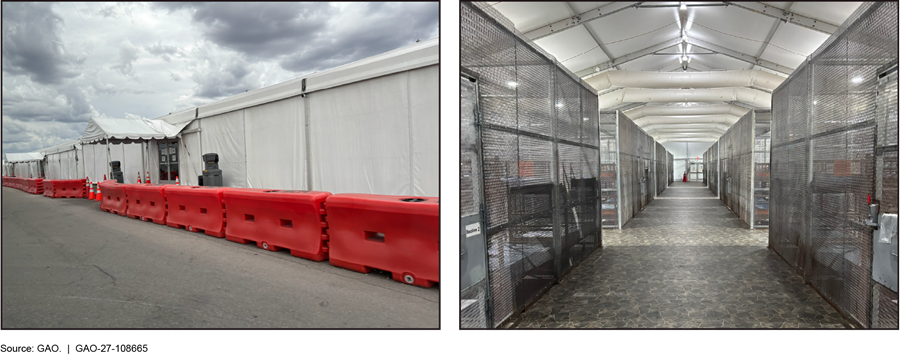
However, the state began receiving FEMA reimbursement in May 2026. Specifically, FEMA used funds appropriated for shelter facilities and services to develop the Fiscal Year 2025 Detention Support Grant Program and designated the Florida Division of Emergency Management as the sole eligible recipient of the program.[59] The funds originated from FEMA’s Shelter and Services program, which last received an appropriation of $650 million for fiscal year 2025.[60]
According to officials, administration leadership tasked FEMA with developing the Detention Support Grant Program in partnership with ICE. According to DHS officials, FEMA restricted grant eligibility to Florida because of its ability to quickly operationalize a large facility and its preexisting partnership with ICE.[61] Although the officials stated they did not design the grant for a specific detention facility, the Florida Soft-Sided Facility was the only site identified on the grant from its initial award through July 2026. Additionally, the facility’s size and proximity to an airstrip were both factors in FEMA and ICE’s justification for designating Florida as the grant’s sole recipient, according to FEMA documentation and officials.
Specifically, state officials submitted their first reimbursement request of approximately $86 million to FEMA, according to FEMA officials. After working with ICE to verify the number and length of stay of noncitizens at the facility, FEMA approved an initial disbursement of approximately $58.3 million in May 2026. Among the allowable activities under the grant are staff salaries; supplies and meals for noncitizens; medical equipment and supplies, and legal and translation services. According to information provided by FEMA officials, the agency approved additional payments for the Florida Soft-Sided Facility in July and October 2026, bringing the total disbursed for that facility to about $93 million.
The reimbursement rate for the Florida Soft-Sided Facility is $249 per day, approximately (1) 65 percent higher than the median rate for ICE’s contract detention facilities and (2) 98 percent higher than the median rate for contract-operated service processing centers. Three of ICE’s adult detention facilities in April 2026 exceeded the Florida Soft-Sided Facility’s $249 bed rate as of April 2026, and two of the nine Federal Bureau of Prisons facilities ICE utilized in the same period neared or exceeded that rate.
Although state officials announced that the Florida Soft-Sided Facility was closing, the state can request reimbursements from the awarded $608.4 million for allowable activities performed from June 1, 2025, through July 31, 2027. According to FEMA officials, FEMA also approved Florida’s request to add a second state-operated detention facility, Baker Correctional Institution, to the grant. According to officials, FEMA has reimbursed Florida for expenses at this facility using the same bed rate originally determined for the Florida Soft-Sided facility, although Baker is a brick-and-mortar former state prison now used to house detained noncitizens.[62] The $249 bed rate is about 140 percent higher than the median rate of $103 for facilities ICE uses through dedicated intergovernmental service agreements with state and local governments. As of October 2026, FEMA had approved nearly $60 million in disbursements from the Detention Support Grant Program for services provided at Baker Correctional Institution, according to information provided by FEMA officials.
DOD provided U.S. Immigration and Customs Enforcement (ICE) with detention space at three locations starting in fiscal year 2025. Additionally, DOD and some state governors authorized the National Guard to assist ICE’s detention operations. According to agency documentation, DOD was responsible for funding its support of immigration detention in fiscal year 2025, while the Department of Homeland Security assumed or committed to reimburse most costs in fiscal year 2026.[63] Specifically:
· Detention in El Paso, Texas. In fiscal year 2025, the U.S. Army awarded and administered a contract to construct and operate the Camp East Montana detention facility on U.S. Army Fort Bliss in El Paso, Texas. The Army modified the contract in September 2025 to transfer contract administration responsibilities to ICE at the start of fiscal year 2026. ICE is responsible for further costs at this facility.[64] Additionally, DOD temporarily supported detention at another facility in El Paso formerly used by U.S. Customs and Border Protection.
· Detention at Naval Station Guantanamo Bay. As described earlier in this report, ICE and DOD expanded immigration detention capacity at two facilities on Guantanamo Bay. Both agencies also incurred costs for transporting detained noncitizens to and from this installation.[65] As part of the February 2026 Memorandum of Agreement, the Department of Homeland Security agreed to reimburse DOD for support of ICE detention at Guantanamo Bay provided from the start of fiscal year 2026 through the end of fiscal year 2035.
· National Guard support. Beginning in July 2025, DOD authorized a request from the Department of Homeland Security to mobilize the National Guard to support ICE in specified states. Authorized tasks include performing logistical and administrative support at ICE facilities, collecting biometric information from detained noncitizens, and assisting with transportation.
According to DOD documentation, 1,562 National Guard service members had conducted ICE support tasks as of May 2026. Eighteen states had authorized the National Guard to carry out these tasks as of January 2026. ICE Enforcement and Removal Operations officials at three of the four Field Offices we met with described leveraging the National Guard’s support to manage the logistics of detention and transportation. For example, during a site visit in Florida we observed National Guard service members conducting administrative work at one ICE detention facility and assisting with security at another facility.
DOD bore the costs of the National Guard’s support of ICE through November 15, 2025, according to agency documentation. The Department of Homeland Security agreed to reimburse DOD’s subsequent costs as part of the Memorandum of Agreement signed in February 2026.
As shown in table 7, DOD’s obligations for supporting immigration detention totaled over $400 million in fiscal year 2025, with detention in El Paso representing the majority of that amount. Although fiscal year 2026 remains incomplete, Guantanamo Bay obligations are likely to decrease between fiscal year 2025 and fiscal year 2026; they were approximately $61 million in fiscal year 2025 and $7 million in the first eight months of 2026. We previously reported that DOD incurred most costs in early calendar year 2025 as it mobilized personnel and equipment for an initial planned capacity of 30,000 beds at that facility, later scaled down to 400 beds.[66] Further, obligations for the National Guard’s support increased from approximately $15 million in fiscal year 2025 to nearly $100 million as of May 2026.
Table 7: Department of Defense (DOD) Obligations for U.S. Immigration and Customs Enforcement (ICE) Support Activities, Fiscal Years 2025 and 2026
|
Support activity |
Fiscal year 2025 |
Fiscal year 2026 (partial) |
|
El Paso detentiona |
$ 365,645,435 |
Not applicable |
|
Naval Station Guantanamo Bay detention |
$ 60,645,278 |
$ 7,449,169b |
|
National Guard support in various locations |
$ 14,568,331 |
$ 98,506,411c |
|
Total |
$ 440,859,044 |
$ 105,955,580 |
Source: GAO analysis of DOD data. | GAO‑27‑108665
aDOD supported two detention facilities in El Paso, Texas, during fiscal year 2025. We previously reported that DOD awarded a contract for constructing and operating the Camp East Montana facility on U.S. Army Fort Bliss in fiscal year 2025 before transferring contract responsibilities to ICE starting in fiscal year 2026. In addition, DOD awarded a contract for detention operations at one preexisting site, which U.S. Customs and Border Protection used until it chose not to extend its contract in March 2025. This site closed in August 2025, and ICE assumed subsequent costs at Camp East Montana.
bThese obligations represent the fiscal year through May 31, 2026. According to agency documentation, the Department of Homeland Security agreed to reimburse DOD for support of immigration detention provided from the start of fiscal year 2026 through the end of fiscal year 2035.
cThese obligations represent the fiscal year through May 9, 2026. The Department of Homeland Security agreed to reimburse DOD’s costs from November 16, 2025 through the end of fiscal year 2035.
Appendix V: Additional Information on U.S. Immigration and Customs Enforcement (ICE) Warehouse Properties
The following includes a summary of ICE documentation and public records from state and local tax assessors. Although researchers have reported that tax assessment data is not always a reliable indicator of fair market value, table 8 shows that ICE paid at least 50 percent more than the state or local government’s assessment of taxable value for nine of the 11 warehouses it purchased, paying at least double the assessed value for seven of the warehouses.[67]
Table 8: Assessed Values and Prices of 11 Warehouses Purchased by U.S. Immigration and Customs Enforcement (ICE)
|
Warehouse Location |
Assessed Value and Tax Year of Assessmenta |
Previous Buyer’s Purchase Price and Year of Saleb |
ICE’s Reported Purchase Price in January–April 2026 |
Percent Difference Between Assessed Value and ICE’s Purchase Price |
||
|
Hamburg, Pennsylvania |
$ 22,148,000 (2026) |
$ 57,500,000 (2024) |
$ 87,402,500 |
295% |
|
|
|
Oakwood, Georgia |
14,984,200 (2026) |
— |
68,162,500 |
355% |
|
|
|
Romulus, Michigan |
7,100,200 (2026) |
22,120,000 (2023) |
34,671,500 |
388% |
|
|
|
Roxbury, New Jersey |
62,232,249 (2026) |
— |
129,300,000 |
108% |
|
|
|
Salt Lake City, Utah |
97,369,800 (2025) |
— |
145,440,000 |
49% |
|
|
|
San Antonio, Texas |
37,600,000 (2026) |
— |
66,112,500 |
76% |
|
|
|
Social Circle, Georgia |
58,323,800 (2026) |
29,392,500 (2023) |
128,555,500 |
120% |
|
|
|
Socorro, Texas |
45,420,355 (2026) |
— |
122,808,000 |
170% |
|
|
|
Surprise, Arizona |
46,581,111 (2026) |
— |
70,035,000 |
50% |
|
|
|
Tremont, Pennsylvania |
59,687,400 (2026) |
129,500,000 (2020) |
119,515,000 |
100% |
|
|
|
Williamsport, Maryland |
90,349,800 (2024) |
104,853,740 (2022) |
102,400,000 |
13% |
|
|
— = Not applicable
Source: GAO analysis of ICE documentation and public records from state and local government tax assessors. | GAO‑27‑108665
aThis table includes assessed values from tax year 2026—the year in which ICE purchased the warehouses—or the most recent tax year available.
bPrevious purchase prices were not publicly available for some locations. In other cases, we omitted this information because the properties were last sold as vacant lots or in unspecified condition, so the previous buyer’s price was not comparable to ICE’s later purchase.
From fiscal year 2023 through the first quarter of fiscal year 2026, U.S. Immigration and Customs Enforcement (ICE) paid an increasing amount in interest penalties due to delays in processing invoices for enforcement and removal activities, including reimbursing detention facility operators on a timely basis. Pursuant to the Prompt Payment Act statute and regulation, executive agencies may incur interest penalties if they do not pay invoices within 30 days after the start of the payment period, which generally begins with receipt of a proper invoice.[68]
As shown in Table 9, ICE paid no more than $40,000 in interest penalties in fiscal years 2023 and 2024. Interest penalties increased to $191,000 in fiscal year 2025—more than eightfold over fiscal year 2024—and continued to rise, exceeding the previous year’s payments in the first quarter of fiscal year 2026 alone.
Table 9: Interest Penalties Paid on Late Invoices for Immigration and Customs Enforcement (ICE) Enforcement and Removal Activities, October 2022 Through December 2025
|
Fiscal year |
Number of late invoices |
Total |
|
2023 |
29 |
$ 39,378 |
|
2024 |
12 |
$ 21,685 |
|
2025 |
250 |
$ 191,303 |
|
2026 (first quarter) |
276 |
$ 333,422 |
|
Total |
567 |
$ 585,788 |
Source: GAO analysis of ICE data. | GAO‑27‑108665
According to ICE officials, delays in invoice processing were caused by approval requirements and lapses in funding.
· Department of Homeland Security (DHS) approval requirements. In June 2025, former Secretary Kristi Noem established a process requiring her office to review obligations of more than $100,000, including obligations on preexisting contracts or agreements. According to ICE officials, this requirement caused delays in invoice processing by affecting the timely obligation of funding, with some invoices waiting 2–4 months to receive approval. In April 2026, Secretary Markwayne Mullin raised the requirement’s threshold to payments of at least $25 million. According to ICE officials, senior ICE leadership continues to review payments below $25 million; however, invoice approval timeframes have improved since the change.
Further, DHS senior leadership conducted an additional review of payments during calendar year 2025. According to ICE officials, this requirement stemmed from the Department of Government Efficiency’s review of DHS and generally took 5 to 7 days to complete. DHS lifted this requirement in October 2025.
· Lapses in funding. ICE experienced three lapses in annual appropriations in fiscal year 2026. According to officials, during fiscal year 2026, ICE was unable to pay some invoices due to lack of available funding. For example, officials said that one invoice had been awaiting approval for about 5 months due to lack of available funding. Although ICE had appropriations from the One Big Beautiful Bill Act available for immigration detention activities during these periods, officials reported that the approval requirements and allotment procedures for this funding impacted timeliness.[69]
Delays in invoice processing cause several challenges, according to ICE officials. Facility vendors rely on timely reimbursements to pay salaries and support detention operations. Vendors grow frustrated when ICE does not reimburse them on time. Further, officials said that interest payments reduce the total availability of funds allotted to each facility.
GAO Contact
Heather MacLeod, MacLeodH@gao.gov
Staff Acknowledgments
In addition to the contact named above, Christopher Ferencik (Assistant Director), Ryan Lambert (Analyst-in-Charge), Ryan Basen, Ben Crossley, Michele Fejfar, Richard Geiger, Jeffrey Hartnett, Alison Knowles, Jennifer Leotta, Thomas McCabe, Sasan J. “Jon” Najmi, Meghan Perez, Janet Temko-Blinder, and Seyda Wentworth made key contributions to this report.
The Government Accountability Office, the audit, evaluation, and investigative arm of Congress, exists to support Congress in meeting its constitutional responsibilities and to help improve the performance and accountability of the federal government for the American people. GAO examines the use of public funds; evaluates federal programs and policies; and provides analyses, recommendations, and other assistance to help Congress make informed oversight, policy, and funding decisions. GAO’s commitment to good government is reflected in its core values of accountability, integrity, and reliability.
Obtaining Copies of GAO Reports and Testimony
The fastest and easiest way to obtain copies of GAO documents at no cost is through our website. Each weekday, GAO posts on its website newly released reports, testimonies, and correspondence. You can also subscribe to GAO’s email updates to receive notification of newly posted products.
Connect with GAO
Connect with GAO on X,
LinkedIn, Instagram, and YouTube.
Subscribe to our Email Updates. Listen to our Podcasts.
Visit GAO on the web at https://www.gao.gov.
To Report Fraud, Waste, and Abuse in Federal Programs
Contact FraudNet:
Website: https://www.gao.gov/about/what-gao-does/fraudnet
Automated answering system: (800) 424-5454
Media Relations
Sarah Kaczmarek, Managing Director, Media@gao.gov
Congressional Relations
David A. Powner, Acting Managing Director, CongRel@gao.gov
General Inquiries
[1]6 U.S.C. § 252 (establishing U.S. Immigration and Customs Enforcement within DHS); 8 U.S.C. § 1103 (powers and duties of the Secretary of Homeland Security). The Immigration and Nationality Act, as amended, provides DHS with broad statutory discretion (subject to certain legal standards) to detain or conditionally release noncitizens depending on the circumstances and statutory basis for detention. See 8 U.S.C. §§ 1226(a), 1231(a)(6), (g)(1) (Secretary shall arrange for appropriate places of detention for aliens detained pending removal or a decision on removal); 8 C.F.R. pts. 236, 241. For readability, we generally use the term “noncitizen,” to refer to an “alien,” (defined under U.S. immigration law as any person who is not a U.S. citizen or national), except when quoting language which includes the term “alien” in statute, regulation, or executive orders. In our audit work, we have found that DHS documentation often uses various terms such as “alien,” “migrant,” and “noncitizen,” among other words or phrases, in reference to those of non-U.S. nationality.
[2]Protecting the American People Against Invasion, Exec. Order No. 14159, 90 Fed. Reg. 8443 (Jan. 29, 2025) (issued Jan. 20).
[3]An Act to provide for reconciliation pursuant to title II of H. Con. Res. 14, Pub. L. No. 119-21, title IX, subtitle A, § 90003, 139 Stat. 72, 358.
[4]Pub. L. No. 119-98, title II, § 202, 140 Stat. 837, 839.
[5]GAO, Immigration Detention: Urgent Planning Needed to Avoid Further Waste of Taxpayer Dollars, GAO‑26‑108663, (Washington, D.C.: Sept. 24, 2026); Immigration Detention: Waste and Performance Issues at Camp East Montana Provide Valuable Lessons Learned for Future Facilities, GAO‑26‑108886, (Washington, D.C.: June 9, 2026). Financial Management: Additional Steps Needed to Improve ICE’s Budget Projections and Execution, GAO‑24‑106550 (Washington, D.C.: May 15, 2024); Immigration Detention: Actions Needed to Improve Planning, Documentation, and Oversight of Detention Facility Contracts, GAO‑21‑149 (Washington, D.C.: Jan. 13, 2021).
[6]In July 2026, we reported that DOD used multiple strategies to fund this support, including realigning and transferring funds and obligating amounts appropriated in OBBBA. Some of DOD’s support activities in fiscal year 2026 are eligible for reimbursement by DHS, as we discuss later in this report. GAO, Southern Border Security: DOD Used Multiple Strategies to Fund Operations, GAO‑26‑108437 (Washington, D.C.: July 13, 2026).
[7]We interviewed ICE officials at four of ERO’s 25 field offices and conducted site visits to existing or proposed detention facilities in two of these locations. We selected these field offices by prioritizing those responsible for more than five newly acquired or expanded facilities since January 2025 to focus on geographic areas of responsibility where ICE had focused its expansion efforts.
[8]Pub. L. No. 119-21, § 90003, 139 Stat. at 358. The reconciliation process is used by Congress to reconcile amounts determined by tax, spending, credit, and debt legislation for a given fiscal year with levels set in the concurrent resolution on the budget for the year. OBBBA multi-year detention funding is subject to an Office of Management and Budget apportionment process based on the agency’s approved annual spending plans. See, Office of Management and Budget, Circular A-11, Preparation, Submission, and Execution of the Budget, August 2025. In addition to the dedicated detention facility funding, ICE received nearly $30 billion (available until Sept. 30, 2029) that could be used for a variety of immigration enforcement activities including hiring and training ICE personnel, transportation costs, information technology investments, and facility upgrades to support ERO operations, among other purposes. The Act also provides $2.055 billion to the Secretary of Homeland Security (available until Sept. 30, 2029) for additional immigration-related purposes, including, among other activities: Immigration and Enforcement activities; Departures and Removals. Further, 50 percent of the new in absentia order, and inadmissible alien fees can be retained and expended by ICE without further appropriation. Id. at §§ 100051, 100052, 100016, 100017.
[9]Equal allocation of the $45 billion across 4 fiscal years is $11.25 billion, approximately 3 times more than the annual appropriation received in fiscal year 2025. In the March 2025 continuing resolution, ICE received additional funds for Operations and Support for the remainder of fiscal year 2025 above the fiscal year 2024 level. See Full-Year Continuing Appropriations and Extensions Act, 2025, Pub. L. No 119-4, div. A, title VII, § 1701(1), 139 Stat. 9, 27. According to ICE’s July 2025 program execution report, ICE’s fiscal year 2025 appropriation for Custody Operations was $3.84 billion including additional funds from the fiscal year 2025 full-year continuing resolution for Operations and Support which ICE applied to Custody Operations.
[10]A lapse in appropriations, commonly referred to as a government shutdown, refers to a period between the expiration of an appropriation and the enactment of a new one. Continuing resolutions typically extend prior year funding levels into the current fiscal year when the House and Senate are unable to reach agreement on final, full-year appropriation levels. Continuing Appropriations Act, 2026, div. A, Pub. L. No. 119-37, 139 Stat. 495 (Nov. 12, 2025); Further Continuing Appropriations Act, 2026, Pub. L. No. 119-75, div. H, 140 Stat. 173, 628 (Feb. 3, 2026); Homeland Security and Further Additional Continuing Appropriations Act, 2026, Pub. L. No. 119-86, § 4, 140 Stat. 773 (Apr. 30, 2026).
[11]Pub. L. No. 119-98, title II, § 202, 140 Stat. at 839. This Act permits funding to be used for ICE’s mission support, including immigration enforcement functions and other activities, as well as detention facility maintenance and sustainment, among other purposes.
[12]User fee allocations to ICE include Immigration User Fees; Breached Bond Detention Fees; and Detention and Removal Office Fees. In addition, OBBBA authorized 50 percent of the new in absentia order, and inadmissible alien fees to be retained and expended by ICE without further appropriation. An in absentia order in immigration law is a court order issued by an immigration judge to remove a person from the U.S. without that person being present in court.
[13]Officials reported that ICE also received about $5.8 million in user fees in fiscal year 2026 under the continuing resolution.
[14]Transfers occur when an agency shifts funds from one appropriation account to another. An appropriation account is the basic unit of an appropriation and typically encompasses a number of activities or projects.
[15]Obligations totaled approximately $357 million in fiscal year 2025 and $2.9 billion in the first nine months of fiscal year 2026.
[16]According to ICE, the 16 Regional Processing Centers would each detain an average daily population of 1,000–1,500 noncitizens for average stays of 3–7 days. These are intended to serve as staging locations for transfers or removals. The large-scale detention facilities would be designed to detain 7,000–10,000 noncitizens for periods averaging less than 60 days. These larger sites would serve as the primary locations for international removals.
[17]According to ERO’s authorized facility list in April 2026, existing detention capacity is approximately 83,000 beds. ERO program officials reported that the Detention Reengineering Initiative was envisioned to largely replace the existing network of detention facilities when fully operational. ICE has provided various bedspace estimates for its facility expansion efforts, see GAO‑26‑108663 for additional information.
[18]ICE reported a purchase cost of about $732.6 million for the California City facility (2,560 capacity) and about $739.2 million for Otay Mesa Detention Center (1,486 capacity).
[19]According to ICE officials, the reported OBBBA obligations include approximately $3 billion in OBBBA funds that remain in an escrow account to meet the terms of the warehouse purchases and fund additional acquisitions, as of August 2026.
[20]For example, in February 2026, the Attorney General of Maryland brought a lawsuit against DHS alleging a failure to conduct environmental impact studies (among other claims), and in April the Maryland federal district court issued a preliminary injunction halting work to retrofit the Hagerstown area warehouse for immigration detention purposes. Maryland v. Mullin, No. 26-cv-733, Order and Memorandum Opinion Granting Preliminary Injunction, ECF No. 42 & 43 (D. Md. Apr. 2026). As of October 7, 2026, the government confirmed continuing compliance with the preliminary injunction and that the only activities at the site since September 16 are activities in support of security and maintenance of the site and warehouse. Id. at ECF no. 68. In April 2026, the Arizona Attorney General sued DHS to block its use of a Surprise, Arizona warehouse as an immigration detention facility, and in June, Arizona and DHS reached an agreement to pause efforts to convert the facility at issue into an immigration detention center until environmental reviews are completed. Arizona v. Mullin, No. 26-cv-02857, Joint Stipulated Motion to Stay Case and Defer Preliminary Injunction Briefing, Stipulated Order Staying Case and Deferring Preliminary Injunction Briefing, ECF No. 18, 19 (D. Az. June & July 2026). As of September 4, 2026, ICE retained a contractor to assist with the environmental review, which remains ongoing. Arizona v. Mullin, No. 26-cv-02857, Defendants’ Status Report, ECF No. 20 (D. Az. Sep. 2026). As of November 4, 2026, the contractor has prepared, and ICE is reviewing a draft environmental assessment addressing the proposed retrofitting and use of the Surprise Facility. Id. at ECF No. 21.
[21]Oversight of the Department of Homeland Security, Before the H. Subcom on Homeland Security Appropriations to Consider FY2027 Budget Request for DHS Programs, 119th Cong. H18-20260625-264438 (2026) (statement of the Secretary of Homeland Security Markwayne Mullin).
[22]According to ICE officials, the agency formally engaged with the General Services Administration and submitted property information to begin the process of disposing of these assets. Federal law requires federal agencies to identify and report excess real property. 40 U.S.C § 524. Once excess real property has been identified as surplus, the General Services Administration is required to supervise and direct its disposition. Id. § 541. The General Services Administration follows a multi-step process to dispose of excess real property, which may result in a competitive public sale. See GAO, Federal Real Property: GSA Should Create Goals to Ensure New Approach Saves Money and Accelerates Disposals of Unneeded Property, GAO‑26‑107760 (Washington, D.C., Apr. 9, 2026).
[23]In August 2026, ICE also acquired a 1,600-bed facility in Appleton, Minnesota for approximately $495.6 million and a 1,033-bed facility in Leavenworth, Kansas for approximately $238.4 million.
[24]GAO, Financial Management: Additional Steps Needed to Improve ICE’s Budget Projections and Execution, GAO‑24‑106550 (Washington, D.C.: May 15, 2024).
[25]The state of Florida funded two detention facilities that ICE utilized in fiscal years 2025 and 2026. As ICE has not provided reimbursement to Florida, the data presented here do not include the costs of either facility. Later in this report, we discuss the Federal Emergency Management Agency’s reimbursements to the state of Florida for immigration detention.
[26]Fiscal year 2026 data are as of June 30, 2026. Further, ICE obligated over $1 billion to one facility, Camp East Montana, representing 36 percent of total obligations to detention facilities in the first three quarters of fiscal year 2026. We previously reported on cost efficiency concerns related to contract design and administration at Camp East Montana. We discuss these concerns and the details of ICE’s obligations for this facility below. GAO‑26‑108886.
[27]ICE data do not allow us to examine per-facility obligations for the BOP facilities where ICE is currently detaining noncitizens. BOP aggregates these costs into one line item and does not provide ICE with per-facility data, according to ICE officials. We excluded the BOP line item from this analysis. Per an interagency agreement, ICE reimburses BOP for the full costs of each noncitizen accepted and housed by BOP, including daily bed costs, medical treatment, employee overtime and travel, and audits to assess compliance with ICE detention standards. ICE obligated about $42 million in fiscal year 2025 and $35 million in the first nine months of fiscal year 2026 to reimburse BOP.
[28]Dilley Immigration Processing Center, which houses families and adult women in separate facilities, had a full capacity bed rate of about $220 in September 2025 and $208 in April 2026. ICE also used two juvenile facilities during this period, Grand Forks Juvenile and Northwestern Juvenile Detention Facility, with bed rates of $150 and $426 in both years, respectively.
[29]We calculated median bed rates using ICE’s reported bed rate data for each facility as of April 2026. However, actual bed rates may vary depending on the structure of the individual contracts, which may include some costs for services under separate line items.
[30]Of the remaining 42 facilities, 13 increased their bed rates by up to 10 percent, 18 increased their rates by 11 to 49 percent, nine increased their rates by 50 percent or more, and two decreased their rates.
[32]Agencies award indefinite delivery and indefinite quantity contracts when the exact quantities and timing for products or services during the contract period are unknown at the time of the award. These contract types require agencies to order, and the contractor to provide, a specified minimum quantity of supplies or services. See Federal Acquisition Regulation §§ 16.501-1, .501-2, 16.504, 48 C.F.R. §§ 16.501-1 (definitions), .501-2 (general; three types of indefinite delivery contracts), 16.504 (indefinite quantity contracts).
[33]We reported on guaranteed minimum payment structures that require ICE to pay a daily rate for each guaranteed bed. More recently, ICE has adopted a facility operating charge structure at some facilities that requires it to pay a flat monthly fee for all guaranteed beds. In some instances, ICE pays both a flat monthly fee that covers facility-wide expenses and a bed rate that covers the care of each detained noncitizen. For the purposes of this report, we refer to these three structures collectively as “guaranteed payments” because they all require ICE to pay for a fixed number of beds.
[35]ICE had 48 facilities with guaranteed payment structures in both fiscal year 2023 and 2024 and 53 facilities in fiscal year 2025, with the number of fixed beds ranging from 27,488 to 32,890 during those three years.
[37]Department of Homeland Security, Request for Department of Defense Assistance in Support of U.S. Immigration and Customs Enforcement Removal Operations (Feb. 12, 2025). ICE has not rescinded this request for assistance as of August 2026.
[38]The U.S. Army awarded and administered a contract for constructing and operating Camp East Montana on U.S. Army Fort Bliss in fiscal year 2025. The Army modified the contract in September 2025 to transfer contract administration responsibilities to ICE at the start of fiscal year 2026. GAO‑26‑108886.
[39]Specifically, ICE obligated about $598 million to the original contractor at Camp East Montana and later terminated that contract for convenience of the government. Contractors can have up to one year from the termination date of a contract to submit a settlement proposal. The government can either pay or negotiate this settlement amount. ICE awarded a new contract for operating this facility with an obligation of about $452 million, which is also subject to change when ICE and the contractor reach agreement on terms, specifications, and prices. According to ICE documentation approving the use of noncompetitive procedures for the new contract, the monthly cost for operating the facility is likely to be significantly higher than $38 million per month. Specifically, ICE estimated that monthly costs could exceed $68 million per month during the 7-month base period and potentially increase to over $90 million per month during optional extension periods up to 2 years.
[40]Expanding Migrant Operations Center at Naval Station Guantanamo Bay to Full Capacity, DCPD No. DCPD202500200 (Jan. 29, 2025). For years prior to this directive, ICE administered a contract at the Migrant Operations Center to temporarily house migrants interdicted at sea in the Caribbean region who need protection and do not consent to be repatriated. According to agency data, ICE spent approximately $1 million on the Migrant Operations Center contract in fiscal year 2023 and $4 million in fiscal year 2024. According to ICE officials, ICE uses surge flexibilities in its current contract to house detained noncitizens unlawfully present in the U.S. in addition to migrants interdicted at sea. However, no migrants interdicted at sea were housed at Guantanamo Bay from February 2025 through August 2026, according to DOD officials.
[42]DOD bore most costs associated with expanding and operating Camp Six in fiscal year 2025, while ICE continued administering and funding the contract at the Migrant Operations Center, according to officials at both agencies. According to agency documentation, the Department of Homeland Security agreed to reimburse DOD for support of immigration detention provided from the start of fiscal year 2026 through the end of fiscal year 2035.
[43]According to officials, ICE aggregates these costs along with other flights performed by its air charter contractor. DOD’s Inspector General and the U.S. Department of State Office of the Inspector General jointly reported that DHS reported spending an estimated $12 million on chartered flights to and from Guantanamo Bay in fiscal year 2025. DOD spent approximately $22 million on military flights that year, with the first flight costing over $22,000 per detained noncitizen. Department of Defense Inspector General and U.S. Department of State Office of the Inspector General, Lead Inspector General Report to the United States Congress: Operation Southern Guard, July 1, 2025 – December 31, 2025.
[44]Memorandum of Understanding Between the U.S. Department of Homeland Security (DHS) and the U.S. Department of Defense (DOD) for DOD Support at Naval Station Guantanamo Bay (NSGB) to U.S. Immigration and Customs Enforcement (ICE) for DHS/ICE Detention of Illegal Aliens Subject to Final Orders of Removal, March 7, 2025. According to agency documentation and ICE and DOD officials, the agencies extended this agreement with the same conditions through fiscal year 2026.
[45]ICE-owned facilities had capacity ranging from 650 to 1,175 beds in June 2026 compared to ICE’s goal of 1,500 beds at each warehouse.
[46]ICE officials also estimate approximately $100 million for renovation costs at this facility in addition to the $730 million purchase price. According to ICE officials, these cost projections are intended to serve as rough estimates for internal purposes. Additional information regarding ICE cost estimates for new facilities is discussed later in this report.
[48]Among these facilities, the Dilley Detention Center was the only facility lacking a white paper. We did not include Delaney Hall in our analysis of white papers because this facility was reopened in 2025 and, according to ICE officials, was awarded as part of a broader facility contract solicitation and not subject to the white paper process.
[49]GAO‑21‑149. In January 2021, we recommended that ERO consistently use a process that includes input from relevant stakeholders and documentation of the basis for decisions made before entering into contracts or agreements for new or expanded detention space. In response, ICE reported taking action in 2022 to provide field offices with additional guidance regarding the bedspace proposal process; however, as of June 2026, ICE had not provided documentation confirming it is using the new process in practice.
[50]DHS’s Acquisition Management Directive establishes a framework for managing large investments, including capital assets, infrastructure, and mission-enabling services. See DHS Directive 102-01, Acquisition Management (Nov. 17, 2025).
[51]Life-cycle costs include the overall estimated cost for a particular project over the time period corresponding to the life of the project, including direct and indirect initial costs plus any periodic or continuing costs of operation and maintenance. We have previously reported that operations and maintenance costs for federal buildings can be significantly higher over time than all other costs, including construction, and typically account for 60 to 80 percent of building life cycle costs. See, for example, GAO, Federal Buildings: More Consideration of Operations and Maintenance Costs Could Better Inform the Design Excellence Program, GAO‑18‑420 (Washington, D.C.: May 2018).
[52]Office of Management and Budget, Circular No. A-94, Guidelines and Discount Rates for Benefit-Cost Analysis of Federal Programs, Revised, Nov. 9, 2023.
[53]An Act to provide for reconciliation pursuant to title II of H. Con. Res. 14, Pub. L. No. 119-21, title IX, subtitle A, § 90003, 139 Stat. 72, 358; Pub. L. No. 119-98, title II, § 202, 140 Stat. 837, 839.
[54]U.S. Immigration and Customs Enforcement, Office of the Chief Financial Officer and Office of Budget and Program Performance, FY 2025 Spend Plan Guidance (July 2024). As of May 2026, ICE was in the process of updating this guidance for fiscal year 2027; however, the draft document ICE provided to us maintains the same criteria for required updates as existed in the prior version.
[55]We reported in 2021 that ICE did not consistently complete white papers for new detention space. GAO, Immigration Detention: Actions Needed to Improve Planning, Documentation, and Oversight of Detention Facility Contracts, GAO‑21‑149 (Washington, D.C.: Jan. 13, 2021).
[56]Office of Management and Budget, Circular No. A-94, Guidelines and Discount Rates for Benefit-Cost Analysis of Federal Programs, Revised, Nov. 9, 2023.
[57]GAO, Cost Estimating and Assessment Guide: Best Practices for Developing and Managing Program Costs, GAO‑20‑195G (Washington, D.C.: Mar. 12, 2020). See DHS Directive 102-01, Acquisition Management, Nov. 17, 2025.
[58]ICE Enforcement and Removal Operations officials said they would have preferred to enter a contract or agreement with the Florida Soft-Sided Facility. However, they noted that senior Department of Homeland Security leadership directed ICE to use the facility without following its traditional acquisition process. As a result, ICE faced challenges enforcing detention standards at the facility. Officials also stated that Florida constructed the facility without consulting with ICE on how to meet detention standards.
[59]In fiscal year 2023, as required by statute, U.S. Customs and Border Protection transferred $800 million to FEMA to “support sheltering and related activities provided by non-federal entities” to relieve overcrowded Customs and Border Protection facilities. FEMA established the Shelter and Services Program in response. Pub. L. No. 117-328, div. F, title II, 136 Stat. 4459, 4730 (2022). The 2023 explanatory statement indicated that this funding is for FEMA and U.S. Customs and Border Protection cooperation with nongovernmental entities and states or localities to fund temporary shelter and related services to individuals released from DHS custody. 168 Cong. Rec. S8553, S8557 (daily ed. Dec. 20, 2022).
[60]No funding was provided for FEMA’s shelter and services program for fiscal year 2026, and in fiscal year 2025 funding continued for the shelter and services program at the fiscal year 2024 level. Pub. L. No. 119-4, 139 Stat. 9 (2025); Pub. L. No. 119-86, § 4, 140 Stat. 773 (2026); Secure America Act, Pub. L. No. 119-98, 140 Stat. 837 (2026). In fiscal year 2024, FEMA received an additional $650 million transfer from CBP for the same purposes. Pub. L. No. 118-47, div. C, title II, 138 Stat. 460, 598. The 2024 explanatory statement states that $650 million is “to provide temporary shelter and other services to individuals released from DHS custody,” and to “facilitate the safe, orderly, and humane release of asylum seekers and families.” 170 Cong. Rec. H1501, H1810 (daily ed. Mar. 22, 2024).
[61]ICE officials cited the existing 287(g) agreement with Miami-Dade County as the legal basis for obtaining detention space at the Florida Soft-Sided Facility. However, these agreements do not reference the facility or otherwise indicate that ICE approved the state of Florida to use it as an immigration detention facility. ICE can enter into agreements through the 287(g) program with state and local law enforcement agencies that provide them with certain immigration enforcement authorities, specified by section 287(g) of the Immigration and Nationality Act. See 8 U.S.C. § 1357(g).
[62]According to ICE officials, ICE is in the early stages of pursuing an intergovernmental service agreement with Florida for the use of this facility.
[63]GAO, Southern Border Security: DOD Used Multiple Strategies to Fund Operations, GAO‑26‑108437 (Washington, D.C.: July 13, 2026). Memorandum of Agreement Between the U.S. Department of Homeland Security and the U.S. Department of War Regarding Reimbursable Missions and Other Activities (February 19, 2026).
[64]GAO, Immigration Detention: Waste and Performance Issues at Camp East Montana Provide Valuable Lessons for Future Facilities, GAO‑26‑108886 (Washington, D.C.: June 9, 2026).
[65]Department of Defense Inspector General and U.S. Department of State Office of the Inspector General, Lead Inspector General Report to the United States Congress: Operation Southern Guard, July 1, 2025 – December 31, 2025.
[66]We previously reported that DOD determined detaining the planned 30,000 noncitizens to be infeasible, in part because building facilities that met ICE detention standards would be cost prohibitive. GAO‑26‑108437.
[67]Huaizhi Chen and Lauren Cohen, “Assessing Assessors,” Working Paper 33238 (Cambridge, MA: National Bureau of Economic Research, December 2024), http://www.nber.org/papers/w33238. David Schleicher, “Your House Is Worth More Than They Think: The Strange Case of Property Tax Regressivity,” Harvard Journal on Legislation, vol. 62.1 (2025).
[68]31 U.S.C. ch. 39; 5 C.F.R. pt. 1315.
[69]An Act to provide for reconciliation pursuant to title II of H. Con. Res. 14, Pub. L. No. 119-21, title IX, subtitle A, § 90003, 139 Stat. 72, 358.