
Report to Congressional Requesters
United States Government Accountability Office
A report to congressional requesters
Contact: Nagla'a El-Hodiri at elhodirin@gao.gov
What GAO Found
The U.S. provides funds and participates in multilateral development banks (MDBs), which support overseas projects that may compete with U.S. producers. GAO found that Treasury’s project review process has gaps in defining and applying criteria for assessing three key provisions in the statute, all of which must be met to trigger the requirement that Treasury oppose an MDB project. For example, Treasury has criteria for assessing whether a commodity or mineral is in surplus on world markets, but it rarely applies it, according to Treasury officials. Also, Treasury does not have criteria for assessing “substantial injury” to U.S. producers. Developing and applying such criteria would better position Treasury to ensure the consistency of its voting decisions and, as a result, its implementation of the statute. Without criteria, Treasury could take different positions on project proposals with similar circumstances because assessments rely on subjective judgment rather than consistent standards. This could put Treasury at risk of unintentionally affecting U.S. producers.
Treasury supported most of the projects that GAO determined were related to commodities or minerals for export relevant to the statute from January 2015 - August 2025. Treasury made more than 11,000 votes on MDB projects during this period and supported 83 percent of the 340 projects that were likely covered by the statute. However, Treasury does not include information in the public voting records about which projects it considered as relevant to the statute. Doing so would enhance transparency for industries that may be adversely affected by MDB projects.
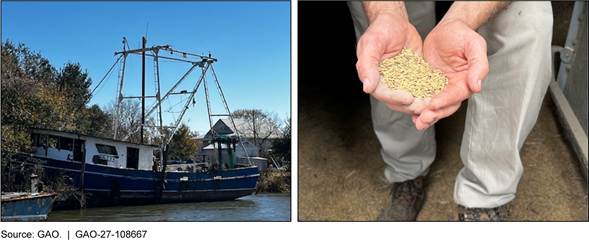
GAO found evidence that MDB-financed projects may be one of several factors that contributed to injury to U.S. producers in the shrimp industry, one of GAO’s two case studies. Specifically, MDB-supported aquaculture projects in Ecuador led to more shrimp imports and may have contributed to lower prices in the U.S., which adversely affected U.S. producers. GAO did not identify evidence linking MDB projects to challenges affecting U.S. rice producers. Shrimp and rice industry stakeholders and available data suggest that both industries have faced a range of other challenges unrelated to MDB-supported projects, such as market competition, regulatory requirements, and environmental conditions.
Why GAO Did This Study
Congress enacted 22 U.S.C. § 262h directing Treasury to instruct U.S. Executive Directors at international finance institutions to oppose any assistance that supports production or extraction of commodities or minerals in surplus on world markets and whose export would cause substantial injury to U.S. producers of the same, similar, or competing product.
GAO was asked to review Treasury’s implementation of this statute. This report examines 1) Treasury’s oversight process to help ensure adherence to the statute, 2) U.S. voting records on MDB-financed projects, and 3) the extent to which relevant MDB projects may have contributed to injury to U.S. producers in selected industries.
GAO reviewed laws and agency documents, analyzed trade data and voting records, interviewed agency officials, and conducted field work in four states to meet with stakeholders from the U.S. shrimp and rice industries.
What GAO Recommends
GAO is making four recommendations to Treasury, including that it develop and apply criteria to assess the statute’s key provisions and include information in public voting records on projects for commodities or minerals for export relevant to the statute. Treasury concurred with all four recommendations.
Abbreviations
IFI international financial institution
MDB multilateral development bank
ODRA Office of Development Results and Accountability
OECD Organization for Economic Cooperation and Development
USITC United States International Trade Commission
WCO World Customs Organization
This is a work of the U.S. government and is not subject to copyright protection in the United States. The published product may be reproduced and distributed in its entirety without further permission from GAO. However, because this work may contain copyrighted images or other material, permission from the copyright holder may be necessary if you wish to reproduce this material separately.
November 10, 2026
The Honorable James Comer
Chairman, Committee on Oversight and Government Reform
House of Representatives
The Honorable Clay Higgins
House of Representatives
The Honorable Troy E. Nehls
House of Representatives
The U.S. contributes funds to international financial institutions (IFIs), including multilateral development banks (MDBs), which finance global development projects that may support industries or private sector firms competing with U.S. producers. For example, MDBs provided financing to firms involved in shrimp aquaculture in Ecuador and Indonesia. Exports to the U.S. from these two countries contributed to harm to the domestic shrimp industry, according to the U.S. International Trade Commission (USITC).[1]
The Secretary of the Treasury is responsible for instructing the U.S. Executive Directors appointed to IFIs on how to vote on projects for consistency with certain statutory mandates.[2] Among the statutory mandates is 22 U.S.C. § 262h, hereby referred to as the “IFI statute,” which directs Treasury to instruct the U.S. Executive Directors to use the “voice and vote” of the U.S. to oppose any assistance for the production or extraction of any commodity or mineral for export, if (1) such commodity or mineral is in surplus on world markets, and (2) the export of such commodity or mineral would cause substantial injury to U.S. producers of the same, similar, or competing commodity or mineral.[3]
Some members of Congress have raised questions about whether U.S. votes on MDB-financed projects that may compete with U.S. producers have been inconsistent with the intent of the IFI statute, and the extent to which Treasury is reviewing MDB-financed projects for consistency with the statute and instructing the Executive Directors accordingly. You asked us to examine several issues related to Treasury’s oversight and implementation of the statute. This report examines (1) the extent to which Treasury has established an effective oversight process to help ensure adherence to obligations under the IFI statute; (2) the U.S. voting record on selected MDB-financed projects; and (3) the extent, if at all, that relevant projects supported by MDBs from 2015 through 2025 contributed to any injury to U.S. producers in selected industries.
To examine the extent that Treasury has established an effective oversight process to help ensure adherence to the IFI statute, we identified Treasury criteria for internal control, consistent with federal internal control standards. We then used these criteria to develop a matrix to assess Treasury’s oversight process, specifically focused on internal controls for developing, communicating, and documenting internal control activities.
To describe the U.S. voting records of selected MDB-financed projects, we analyzed the U.S. Treasury Multilateral Development Bank Loan Review Votes database, which included Treasury’s public voting records data from January 2015 through August 2025. We used the Organization for Economic Cooperation and Development (OECD) Creditor Reporting System data and a keyword search to identify projects related to commodities or minerals that were likely within the scope of the IFI statute. We reviewed project descriptions on MDB websites to assign industries to each project identified and compiled statistics on the number of projects where Treasury voted “yes,” “no,” “abstain”, or other voting categories. Based on a review of related documentation, interviews with knowledgeable officials, and electronic and manual data testing, we found this data sufficiently reliable for the purposes of describing U.S. Executive Director positions on MDB projects.
To assess the extent that relevant MDB-financed projects from 2015 through 2025 contributed to injury to U.S. producers in selected industries, we focused on two industries as case studies: shrimp and rice. Using the voting data discussed above, we selected these two industries based on the following criteria: 1) U.S. production of the potentially competing product; 2) whether the location of the loan recipient’s investment is in a country that exports the product to the U.S.; 3) at least five MDB votes in that product category; 4) total size of loans; and 5) diversity in project location.[4]
We interviewed over 50 U.S. shrimp and rice producers and industry stakeholders in Arkansas, California, Louisiana, and Texas, states that are major producers of shrimp, rice, or both. While the information we gathered was not generalizable, it provided insight to the conditions that the industries encountered in these states. We reviewed related documentation from Treasury about selected MDB-financed projects from 2015 to 2025. To describe the economic trends and outcomes in the shrimp and rice industries, we analyzed statistical data on imports and U.S. production in these sectors from 2015 to 2025. We also used relevant reports from the USITC and the National Oceanic and Atmospheric Administration to understand trends in the U.S. shrimp and rice sectors and interviewed representatives from those industries to understand the extent to which MDB-financed projects may have caused injury. Additional information about our objectives, scope, and methodology can be found in appendix I.
We conducted this performance audit from July 2025 to November 2026 in accordance with generally accepted government auditing standards. Those standards require that we plan and perform the audit to obtain sufficient, appropriate evidence to provide a reasonable basis for our findings and conclusions based on our audit objectives. We believe that the evidence obtained provides a reasonable basis for our findings and conclusions based on our audit objectives.
Background
Within the executive branch, Treasury has the lead role for screening MDB-financed projects for consistency with the IFI statute and implementing U.S. policy toward MDBs, including the World Bank and regional development banks. Within Treasury, the Office of Development Results and Accountability (ODRA) is responsible for analyzing and coordinating with other U.S. agencies on MDB-financed projects and engaging with the MDBs on these projects.
ODRA staff conduct a review process to assess whether a proposed MDB project is likely to provide adequate development impact, efficiently uses scarce development resources, and is consistent with congressional mandates including the IFI statute, according to Treasury officials. ODRA’s process for determining U.S. voting positions includes an internal interagency review from the Working Group on Multilateral Assistance.[5] This working group reviews the projects for consistency with U.S. laws, policies, and foreign policy objectives, then summarizes its implications and any concerns and provides input to Treasury. According to Treasury officials, after the interagency review, ODRA staff compiles a consolidated U.S. position before issuing instructions to the Executive Directors on how to vote.[6] In cases where the instruction is to vote “no” or “abstain”, ODRA staff prepares a summary memorandum of the vote recommendation for approval by Treasury officials, and the approved vote is included in Treasury’s internal loan review database, according to Treasury officials. After MDB board meetings, the Executive Directors report the outcome of the board decision back to Treasury. According to Treasury officials, “no” and “abstain” votes both indicate U.S. opposition to an MDB project.
Treasury’s practice is to post the monthly U.S. voting record on all MDB-financed projects. The record includes, among other things, the MDB and project name, financed amount, and the U.S. position and voting codes associated with “no” or “abstain” votes. As of September 2026, these data were posted on the Treasury public website from January 2004 through August 2025.[7]
Treasury Has an Oversight Process for Implementing the IFI Statute and Other Mandates, but Gaps Risk Inconsistent Decisions that May Affect U.S. Producers
Treasury has an oversight process for addressing statutory mandates, including the IFI statute. However, the agency has gaps in criteria for assessing three requirements in the IFI statute:
· Treasury has not established criteria for determining which products it considers commodities or minerals subject to the statute.
· While Treasury has criteria for assessing whether commodities or minerals are in surplus on world markets, officials stated they are rarely used.
· Treasury has not defined or established criteria for assessing substantial injury to U.S. producers for MDB project reviews.
Treasury Has a Process for MDB Project Reviews
Treasury offices, including ODRA, are to follow a policy directive for developing and implementing internal control activities.[8] Treasury’s directive for internal control states the importance of establishing controls, monitoring their application, and periodically reviewing their effectiveness. According to ODRA officials, the agency’s Loan Review Process guidance reflects the internal control directive and provides formal requirements for oversight, review, recording, and reporting used to determine the position that is then provided to the U.S. Executive Directors for their votes on MDB projects.[9] For example, the guidance includes a checklist for congressional mandates that officials use during project reviews to standardize the process to assign “no” and “abstain” votes. In addition, it specifies how to circulate project documents, provide updates to the MDB Offices of the Executive Directors, and formulate final recommendations for the Executive Directors on how to vote. According to Treasury officials, ODRA management is responsible for ensuring that staff adhere to processes and procedures for MDB-financed project reviews laid out in the guidance.
Treasury Has Gaps in Criteria for Assessing Parts of the IFI Statute
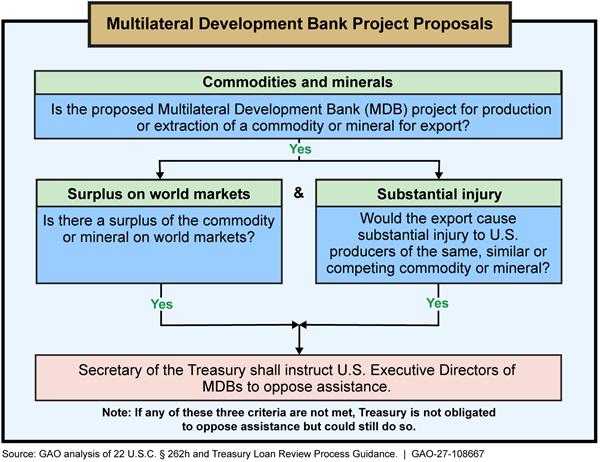
Treasury’s project review process has gaps in defining and applying criteria for assessing three requirements in the IFI statute, all of which must exist to trigger the requirement that Treasury oppose an MDB project (see fig. 1).
Commodities and minerals. Treasury officials stated that they do not have a written definition of the products covered by “commodity or mineral” in the IFI statute to identify projects that may be considered under the statute. The statute does not define “commodity” or “mineral,” nor does it require Treasury to define those terms. Treasury officials told us the focus of their case-by-case approach is not whether a product is a commodity, but instead whether the project satisfies the surplus commodities and substantial injury criteria of the IFI statute. Treasury officials stated that agricultural products and base metal products, such as steel, were covered under the statute, while manufacturing of finished products was out of scope. Beyond this general guidance, Treasury officials stated that they do not make a preliminary assessment of the applicability of the statute based on the product name or category of a specific project. Instead, Treasury considers the applicability of the IFI statute on a case-by-case basis because, according to Treasury officials, the facts and circumstances of individual projects vary significantly, and a standardized approach based solely on a product or product category would not adequately account for those differences. For example, Treasury officials stated that there are commodities used in lithium-ion batteries and semiconductors that were not mined for export 5-10 years ago that would now be covered under the IFI statute.
Surplus on world markets and substantial injury. For projects related to commodities and minerals covered under the IFI statute, the statute requires that Treasury instruct the U.S. Executive Directors to oppose any project if the commodity or mineral to be exported is in surplus on world markets and its export would cause substantial injury to U.S. producers of the same, similar, or competing commodity or mineral.
Treasury’s Loan Review Process guidance includes criteria for assessing whether a project supporting production or extraction of a commodity or mineral for export is in surplus on world markets. Specifically, the guidance used for MDB project reviews considers a commodity or mineral to be in surplus if it moves the market price by 5 percent. However, Treasury officials stated that this specific 5 percent criteria rarely applies because market prices shift rapidly and are affected by factors other than supply. Treasury has not established alternate criteria to gauge whether a commodity or mineral is in surplus on world markets and rather relies on a variety of sources to evaluate each individual case.
The Loan Review Process guidance does not define “substantial injury,” and its checklist for reviewing MDB projects does not include criteria for assessing injury to U.S. producers. According to Treasury officials, the loan review team applies the checklist and looks at each project using a wide range of analyses to judge injury on a case-by-case basis. For example, according to Treasury officials, as part of the analysis they consult relevant USITC reports and Anti-Dumping/Countervailing Duty cases and incorporate information on market conditions.[10] According to Treasury officials, they apply the IFI statute based on the specific facts and circumstances of each project because individual projects may vary significantly, and the nature of a particular market or sector is not static. For example, according to Treasury officials, when they evaluate a project they consider the specific characteristics of the transaction, including the nature of the commodity or mineral involved, the project’s structure, whether the product will be exported, borrower characteristics, the market the investment will be focused on, and the form of financing.
Addressing these gaps in criteria for implementing key aspects of the IFI statute would strengthen internal control and enhance the credibility of project reviews. Federal internal control standards state that management should define objectives clearly and design control activities to achieve objectives, including compliance with laws, and respond to risk.[11] Management also should document control activities through policies and procedures.[12] Specific definitions and criteria for the key requirements in the statute would better position Treasury to ensure the consistency and objectivity of its voting decisions and, as a result, implementation of the IFI statute. Clearly defined criteria would help U.S. officials arrive at coherent, transparent decisions while still providing discretion to make decisions on a case-by-case basis depending on the circumstances of each project. The absence of clearly defined criteria makes it more difficult to explain the rationale behind decisions that may affect certain industries. According to Treasury officials, the U.S. historically supported certain shrimp sector projects in Ecuador based on their assessed financial additionality and development impact. These decisions predated the October 2023 filing of U.S. antidumping and countervailing duty petitions concerning Ecuadorian shrimp imports and the subsequent trade-remedy determinations in October 2024.
U.S. Executive Directors Voted to Support Most Projects We Identified but Voting Records Lack Key Information
Treasury Supported the Majority of the MDB Projects We Identified as Potentially Relevant to the IFI Statute
From January 2015 through August 2025,[13] Treasury supported 83 percent of the MDB projects we identified, abstained in 10 percent of cases, and voted “no” in 7 percent.[14] We identified 340 projects that were potentially relevant to the IFI statute during this period, and that would be relevant for screening to determine if the specific surplus and substantial injury criteria of the statute were met. Some examples of these projects include:
· In 2024, the U.S. voted “no” for a $46 million ($47 million in 2025 dollars) International Finance Corporation project in Bangladesh, which supported investment in a new steel plant.
· In 2025, the U.S. abstained from supporting an International Finance Corporation project in Pakistan, which involved a $450 million investment in a new copper and gold mine.[15]
· From 2016 through 2018, the U.S. voted to approve four projects related to avocado production in Peru, with investments ranging from $0.75 to $48.5 million ($0.9 to 63.2 million in 2025 dollars).
The projects we identified as pertaining to commodities and minerals potentially relevant to the IFI statute represent about 3 percent of the 11,453 MDB project votes from 2015 through 2025 (fig. 2).[16]
Figure 2: U.S. Executive Director Votes on MDB Projects GAO Identified as Potentially Relevant to 22 U.S.C. § 262h, 2015-2025
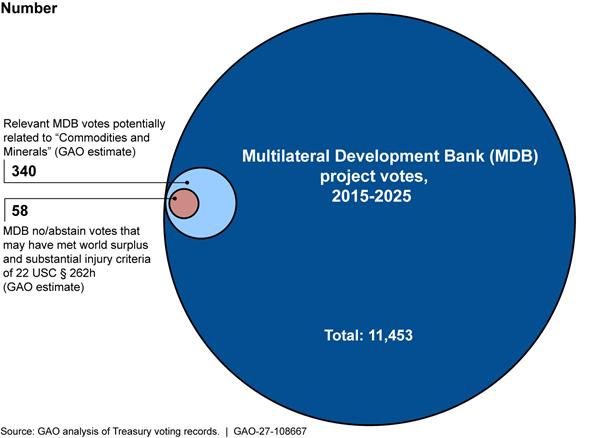
Note: This figure includes project votes at MDBs listed in 22 U.S.C. § 262h. From this universe of MDB project votes, we identified the subset of relevant MDB votes based on whether the products listed in MDB projects appear in Chapters 01-14 (live animals, animal products, and vegetable products), 25-27 (mineral products), and 71-83 (natural or cultured pearls, precious or semi-precious stones, precious metals, metals clad with precious metal, and articles thereof; imitation jewelry; coin; and base metals and articles of base metal) of the WCO Harmonized System, a classification system used worldwide for traded products. The projects we identified do not necessarily represent those that Treasury may have determined were relevant to the 22 U.S.C. § 262h statute during its own project reviews.
For the 340 projects we identified, the U.S. Executive Directors’ voting patterns varied based on the specific products covered. Specifically, U.S. Executive Directors voted “no” or “abstain” for the majority (62.5 percent) of projects investing in base metals but supported most investments in agricultural products.[17] U.S. Executive Directors also voted “no” or “abstain” at a higher-than-average rate[18] when considering projects related to mineral products (37.0 percent “no” or “abstain” votes), livestock and animal products (18.7 percent “no” or “abstain” votes), fisheries and aquaculture (17.3 percent “no” or “abstain” votes), and coffee, tea, maté and spices (18.8 percent “no” or “abstain” votes) (see fig. 3).
Figure 3: Share of “No” or “Abstain” Votes for Projects GAO Identified as Potentially Relevant to 22 U.S.C. § 262h at Multilateral Development Banks by Relevant Product Category, 2015-2025
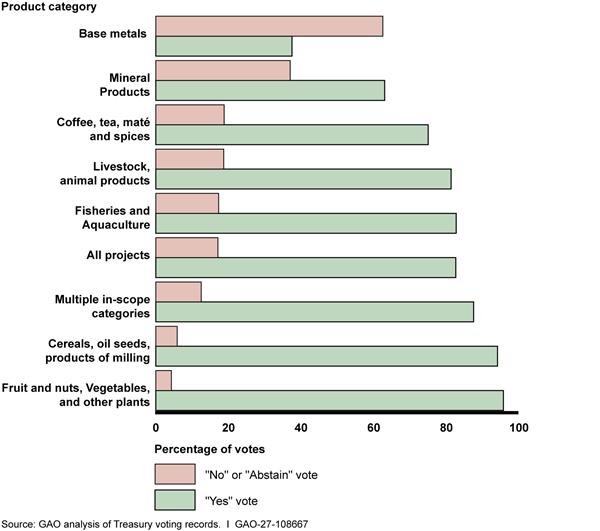
Notes: These product groups correspond to the following World Customs Organization (WCO) Harmonized System chapters 01-14 (live animals, animal products, and vegetable products), 25-27 (mineral products), and 71-83 (natural or cultured pearls, precious or semi-precious stones, precious metals, metals clad with precious metal, and articles thereof; imitation jewelry; coin; and base metals and articles of base metal). The WCO Harmonized System is a classification system used worldwide for traded products. The product category, “multiple in-scope categories” includes projects that invest in in-scope products that span the subcategories of chapters 01-14, 25-27, or 71-83 such as an investment in poultry, eggs, and soybeans. The projects we identified do not necessarily represent those that Treasury may have determined were relevant to 22 U.S.C. § 262h during its own project reviews.
Treasury’s Voting Records Do Not Include Information on Which Projects It Considered under the Statute
Treasury’s public voting records do not include sufficient information to determine which MDB projects it considered as potentially within the scope of the statute and requiring screening against the statute’s provisions. The level of information provided in the public voting records depends on the U.S. vote.
· For “no” and “abstain” votes, Treasury guidance indicates that staff should “enter succinctly why the U.S. voted that way in the reason field and enter the relevant code from the drop-down box.” This information, along with guidance on the interpretation of each voting code, appears in the public voting records data on Treasury’s website. However, because MDB projects can be opposed for multiple reasons, the reported voting code may not reflect every reason a U.S. Executive Director voted “no” or “abstain.” The voting code that Treasury officials said specifically related to the IFI statute (code 57, commodities or minerals in surplus on the world market) was never cited from 2015 through 2025. Table 1 shows the four voting codes that Treasury officials said may indicate the IFI statute was applied and the number of times they were cited from 2015 through 2025. According to Treasury officials, any trade-related concerns for MDB projects would be encompassed in voting code 1 (economic and policy considerations).
Table 1: Summary of Voting Codes Used by Treasury Officials When Instructing U.S. Executive Directors to Vote “No” or “Abstain” on Multilateral Development Banks (MDBs) Projects, 2015-2025
|
Voting code |
Number of citations, all MDB votes |
Number of citations, GAO estimate of relevant projects |
|
57. Commodities or minerals in surplus on world markets, as governed by P.L. 99-472 of the Export-Import Bank Act Amendments of 1986 |
0 |
0 |
|
1. Economic and policy considerations |
526 |
19 |
|
2. Surplus commodities as defined under P.L. 109-102, Foreign Operations 2006, Sec. 514a |
1 |
1 |
|
4. Surplus mineral production, as governed by P.L. 109-102, Foreign Operations 2006, Sec. 514. |
0 |
0 |
|
Other voting codes |
1,229 |
39 |
|
Total |
1,756 |
59 |
Source: GAO analysis of Treasury voting records. | GAO‑27‑108667
Note: This table includes votes for projects at the specific Multilateral Development Banks (MDBs) that are listed in 22 U.S.C. § 262h.
aThe project that cited voting code 2 also cited voting code 1 as a reason for U.S. opposition to the project, which means that this project is counted twice in the tally of voting code citations.
· For “yes” votes, Treasury’s policy has no similar requirement to report in its public voting records whether a particular MDB project pertained to a commodity or mineral that it analyzed to assess whether it could be within the scope of the IFI statute. A “yes” vote could indicate that (1) Treasury determined the MDB project did not involve a commodity or mineral within the scope of the IFI statute, or (2) Treasury determined that the project involved a commodity or mineral within the statute’s scope but did not meet the statute’s other criteria (i.e., “exports causing substantial injury”, and “surplus on world markets”). Treasury officials confirmed that they do not internally distinguish between these two scenarios and do not report this information in public voting records. According to Treasury officials, maintaining such separate tracking systems tailored to the specific analytical elements of each individual mandate would be administratively burdensome and would not enhance the underlying review process.
Federal internal control standards state that management should externally communicate the necessary quality information to achieve the entities objectives.[19] Including information in the public voting records on which projects Treasury determined were related to the IFI statute would enhance the transparency of its decisions. Specifically, it would enable Congress and industries that may be affected by MDB projects to understand when Treasury applied the IFI statute and whether it played a role in a decision to oppose a project.
MDB-Supported Projects Along with Other Factors May Have Contributed to Injury for One of Our Two Selected U.S. Industry Case Studies
We found some evidence that MDB-supported projects may have contributed to injury to U.S. producers in one of our two case study industries.[20] Specifically, certain aquaculture projects supported production and export growth in some shrimp-producing countries, which in turn potentially added to competitive pressures facing U.S. shrimp producers, according to industry stakeholders. In contrast, we did not identify evidence that MDB-supported projects had a similar effect on U.S. rice producers. Industry stakeholders and available data suggest that both industries have faced a range of other challenges unrelated to MDB-supported projects, such as market competition, regulatory requirements, and environmental conditions.
MDB-Supported Projects May Have Contributed to Increased Shrimp Imports and Lower Prices in the U.S.
MDB-supported projects have financed aquaculture development in several shrimp-producing countries that led to more shrimp imports and may have contributed to lower prices in the U.S., which adversely affected U.S. producers. These projects include investments in farm expansion, infrastructure improvements, and processing facilities. According to project documentation we reviewed, selected projects in Ecuador, Indonesia, and Thailand were intended to improve aquaculture productivity, which likely contributed to increased shrimp production capacity and export growth in global markets.[21] We identified seven shrimp-related projects that were approved by MDBs from 2015 through 2025 (see table 2).[22]
Table 2: Multilateral Development Bank (MDB) Approved Projects Related to Shrimp Production from 2015-2025
|
Project Year |
Country |
Project Name |
Reported Proposed Loan Amount (millions 2025 $) |
U.S. Vote |
Project Description |
|
2015 |
Ecuador |
Operadora y Procesadora de Productos Marinos Omarsa S.A. for the Omarsa Ecuador Project |
13.3 |
“Yes” |
Expand and upgrade Ecuadorian shrimp producer’s operations by increasing farm production capacity, improving other shrimp farms, expanding processing and packaging facilities, and providing working capital and debt refinancing. |
|
2017 |
Ecuador |
Operadora y Procesadora de Productos Marinos for the Omarsa II Project |
10.3 |
“Yes” |
Support expansion of shrimp processing operations in Ecuador through construction and development of a new processing plant in Duran, Guayas province. |
|
2021 |
Ecuador |
Agripac LP |
18.7 |
“Yes” |
Finance a new animal-feed production line serving shrimp and other business operations, as well as upgrades to machinery, increased automation of industrial processes, fire-prevention improvements, and new warehouse capacity. |
|
2022 |
Ecuador |
Santa Priscila Project |
49.2 |
“Yes” |
Finance the acquisition of approximately 1,300 hectares of shrimp farms near Guayaquil and connect the farms to the electrical grid, eliminating reliance on diesel generators for water pumping, aeration, and automated feeding systems. |
|
2022 |
Indonesia |
Infrastructure Improvement for Shrimp Aquaculture Project |
101.6 |
“Yes” |
Support the introduction of sustainable shrimp aquaculture practices intended to increase the productivity, quality, profitability, and environmental sustainability of small-scale farmers shrimp farming operations. |
|
2023 |
Ecuador |
Omarsa Farm Project |
21.1 |
“Abstain”a |
Expand shrimp production through the development of 356 hectares of new shrimp ponds at an existing farm. |
|
2025 |
Thailand |
Thai Union Sustainable Shrimp Value Chain Project in Thailand |
25.0 |
“No”b |
Finance working capital for the procurement of sustainably produced shrimp in Thailand and operating expenses associated with the company’s sustainability activities and commitments, among other things. |
Source: GAO analysis of MDB project data and Treasury voting records. | GAO‑27‑108667
Note: The reported proposed loan amount reflects the loan amount reported in Treasury’s public voting records data at the time of the loan review vote, adjusted for inflation and reported in millions of 2025 dollars.
aThis project was approved and funded by the MDB. The U.S. raised trade policy concerns in its project proposal review.
bThis project was approved and funded by the MDB. The U.S. raised trade policy and reputational concerns in its project proposal review.
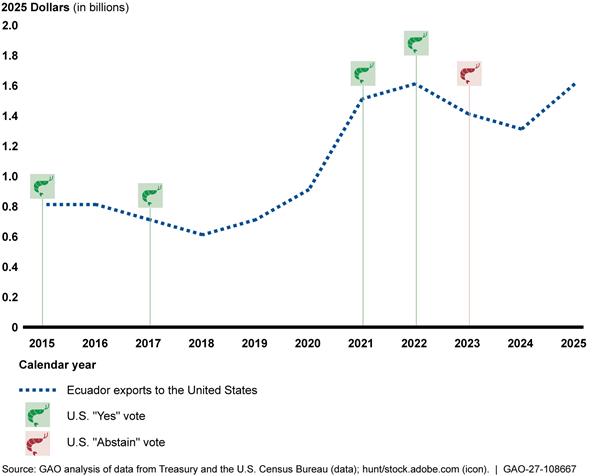
Among the countries we reviewed, projects that took place in Ecuador received the largest concentration of MDB-supported shrimp-related investments from 2015 through 2025. These projects supported private sector companies to improve areas such as shrimp farming operations, shrimp production systems, and infrastructure used to process and export shrimp products. During this period the U.S. voted “yes” on four out of five projects supporting aquaculture in Ecuador. During this time, Ecuador increased its exports of shrimp to the U.S. (see fig. 4).
Figure 4: Ecuador Shrimp Exports to the U.S. and U.S. Voting Record on Multilateral Development Bank Projects in Ecuador Related to Shrimp Production, 2015-2025
Note: Shrimp exports to the U.S. include all products classified under codes 0306.16 (cold-water shrimps and prawns, frozen) and 0306.17 (other shrimps and prawns, frozen), 0306.35 (cold-water shrimp and prawns, live, fresh or chilled), 0306.36 (other shrimp and prawns, live, fresh or chilled), 0306.95 (shrimp and prawns, dried, salted or in brine, smoked) of the Harmonized Tariff Schedule of the U.S. Data are adjusted for inflation and reported in billions of 2025 dollars.
Our analysis found that Ecuador’s shrimp exports to the U.S. increased from about $810 million (2025 dollars), or approximately 15 percent of U.S. shrimp imports in 2015, to $1.61 billion, or approximately 33 percent of U.S shrimp imports in 2025. In contrast, shrimp exports to the U.S. from Indonesia and Thailand declined over this period. Indonesia’s shrimp exports to the U.S. declined from about $1.15 billion (2025 dollars) in 2015, or about 21 percent of U.S. shrimp imports, to $610 million, or about 12 percent of U.S. shrimp imports in 2025. Thailand’s shrimp exports to the U.S. declined from about $410 million (2025 dollars), or 7 percent of total U.S. imports, to $100 million, or 2 percent of total U.S. imports (see fig. 5).
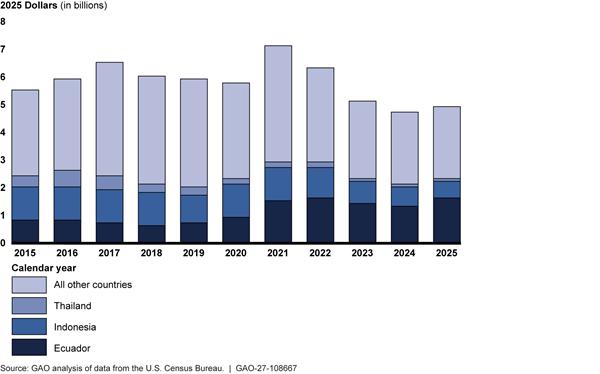
Note: Shrimp exports to the U.S. include all products classified under codes 0306.16 (cold-water shrimps and prawns, frozen) and 0306.17 (other shrimps and prawns, frozen), 0306.35 (cold-water shrimp and prawns, live, fresh or chilled), 0306.36 (other shrimp and prawns, live, fresh or chilled), 0306.95 (shrimp and prawns, dried, salted or in brine, smoked) of the Harmonized Tariff Schedule of the U.S. Data are adjusted for inflation and reported in billions of 2025 dollars.
The overall volume of shrimp exported to the U.S. increased from approximately 453 million kilograms in 2015 to 607 million kilograms in 2025, an increase of about 34 percent (see fig. 6). The increase in volume of shrimp exports to the U.S. compared to the decline in the total value of shrimp exports to the U.S. from 2015 through 2025 (as shown in fig. 5) suggests that the price per kilogram of imported shrimp has declined over time. Lower prices for imported shrimp likely placed downward pressure on shrimp prices market wide. According to the National Oceanic and Atmospheric Administration price data, the average price for headless shrimp across seven shrimp sizes in the Gulf Region declined from $6.06 per pound in 2021 to $5.36 per pound in 2025, a decrease of about 12 percent.[23]
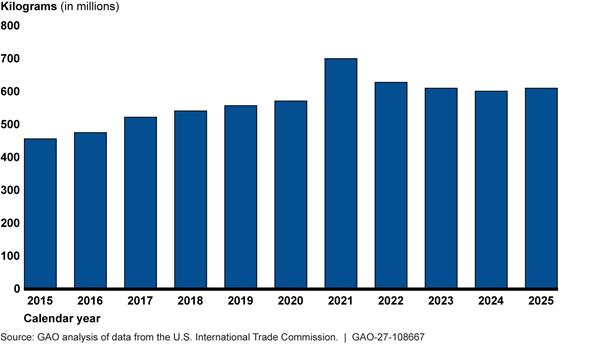
Note: Shrimp exports to the U.S. include all products classified under codes 0306.16 (cold-water shrimps and prawns, frozen) and 0306.17 (other shrimps and prawns, frozen), 0306.35 (cold-water shrimp and prawns, live fresh or chilled), 0306.36 (other shrimp and prawns, live, fresh or chilled), 0306.95 (shrimp and prawns, dried, salted or in brine, smoked) of the Harmonized Tariff Schedule of the U.S.
Industry stakeholders we met with in Louisiana and Texas, such as shrimp fishers (or “shrimpers”) and processors, told us that increased shrimp production capacity in major exporting countries can contribute to greater global supply and increased availability of imported shrimp in the U.S. Stakeholders in Louisiana said that increases in global supply, combined with lower production costs in some countries, put downward pressure on shrimp prices and affected the competitiveness of domestic producers. Industry stakeholders mentioned MDB-financed projects as one of several factors that in recent years contributed to injury to the industry, but generally agreed broader market and industry conditions were the main factors affecting the industry’s operating environment. See below for a more in-depth discussion of the broader market and industry conditions.
We Found No Evidence MDB-Financed Projects Have Adversely Affected U.S. Rice Producers
MDBs supported 49 projects related to rice and rice production from 2015 through 2025, mainly in African and Asian countries, but we did not identify evidence that these projects negatively affected U.S. rice producers. These projects have contributed to increasing crop productivity, building storage capacity, and improving food safety. Among these, we identified six MDB-financed projects in five countries that have exported rice to the U.S. from 2015 through 2025 (see table 3 for details).[24]
Table 3: Multilateral Development Bank (MDB)-Approved Rice Projects in Countries that Have Exported Rice to the U.S. from 2015 to 2025
|
Project Year |
Country |
Project Name |
Reported Proposed Loan Amount (millions 2025 $) |
U.S. Vote |
Project Description |
|
2015 |
Vietnam |
Sustainable Agricultural Transformation Project |
315.6 |
“Yes” |
Improve farming practices and value chains in rice and coffee, including private sector investment in upgrading rice processing technologies to develop high value and quality rice. |
|
2018 |
Cambodia |
Climate-Friendly Agribusiness Value Chains Sector |
113.6 |
“Yes” |
Commercialize production for rice and three other crops. Increase crop productivity and diversification and improve the capacity for storage, processing and quality and safety. |
|
2019 |
Cambodia |
ARMRU Rice Company |
12.4 |
“Yes” |
Develop a sustainable, traceable and inclusive rice supply chain and support the introduction of sustainable rice production to allow ARMRU to enter retail markets. |
|
2022 |
Pakistan |
Sindh Water and Agriculture Transformation Project |
319.1 |
“Abstain”a |
Improve water resources management and restore crop production (including rice production) by small and medium-sized farmers affected by 2022 floods. |
|
2023 |
Bangladesh |
Meghana Rice Project |
22.1 |
“Yes” |
Establish a greenfield automated rice mill with processing capacity and improve food safety through the adoption of best technologies and practices in an otherwise unorganized rice sector in Bangladesh. |
|
2023 |
China |
Methane Reduction and Water Saving Rice Paddy Program (Hunan) |
268.7 |
“No”b |
Reduce methane emissions and support climate resilient rice production in China’s Hunan Province. Support the development and protection of high-standard farmlands, improve rice yields, and implement climate adaptation measures to enhance the climate resilience of rice production. |
Source: GAO analysis of MDB project data and Treasury voting records. | GAO‑27‑108667
Note: In addition to these six projects, GAO identified 43 other approved MDB projects related to rice production in countries that do not export rice to the U.S. The reported proposed loan amount reflects the loan amount reported in Treasury’s public voting records data at the time of the loan review vote, adjusted for inflation and reported in millions of 2025 dollars.
aThis project was approved and funded by the MDB. According to public voting records, this project did not meet Pelosi Amendment requirements, which is the colloquial name for the statute requiring U.S. Executive Directors not to vote in favor on any proposal with significant environmental impacts if specific transparency and assessment criteria were unmet.
bThis project was approved and funded by the MDB.
We did not find evidence of any adverse effects of these six projects on U.S. producers. While the value of imports from Bangladesh, Cambodia and China has increased from 2015 through 2025, these three countries combined represented less than 3 percent of the imported share of rice to the U.S. in 2025, and this percentage has not significantly increased since 2015 (see table 4). While Vietnam and Pakistan represented larger shares of U.S. rice imports in 2015 than the other markets with MDB-financed projects, both the value and share of U.S. imports and from Pakistan and Vietnam were lower in 2025 compared to 2015 (table 4).
Table 4: Rice Import Share and Value from Bangladesh, Cambodia, China, Pakistan, and Vietnam to the U.S., 2015 versus 2025
|
|
2015 |
2025 |
||
|
Country |
Share of imports (percent) |
Import value (millions 2025 dollars) |
Share of imports (percent) |
Import value (millions 2025 dollars) |
|
Bangladesh |
0.2% |
1.7 |
0.2% |
3.0 |
|
Cambodia |
0.3% |
2.5 |
0.3% |
5.0 |
|
China |
0.8% |
7.2 |
1.9% |
29.2 |
|
Pakistan |
5.1% |
48.6 |
3.2% |
47.4 |
|
Vietnam |
3.6% |
34.1 |
1.9% |
28.0 |
|
Total of five countries |
9.8% |
94.1 |
7.5% |
112.7 |
Source: GAO analysis of data from U.S. Census Bureau. | GAO‑27‑108667
Note: This represented the total amount of rice imports for each country, which included any exports potentially funded by the MDBs. Totals may not add up due to rounding
Other Market and Industry Challenges Have Negatively Affected U.S Shrimp and Rice Industries
U.S. industry stakeholders identified a range of market and industry conditions unrelated to MDB-financed projects that have posed challenges for U.S. shrimp and rice producers. Industry stakeholders and state officials we spoke with identified several factors including market competition, regulatory requirements, and environmental conditions. Although specific factors for each industry varied, the stakeholders we spoke with generally reported these factors influenced the competitiveness of U.S. producers and, in some cases, affected their ability to remain economically viable.
Factors Affecting U.S. Shrimp Industry
The U.S. stakeholders we met with told us that the U.S. shrimp industry faces pressures from global market competition, rising operating costs, labor constraints, infrastructure limitations, regulatory requirements, and environmental conditions. While some stakeholders stated that selected MDB-financed aquaculture projects may have contributed to increased global shrimp production, they generally identified broader market and industry conditions as the main factors affecting the industry’s operating environment.
Interviewees frequently cited competition from imported shrimp as a major factor affecting domestic producers. Stakeholders from industry associations, state agencies, processors, wholesalers, and shrimpers told us that imported shrimp has increased competition in the U.S. market. According to some of these stakeholders, imported shrimp often enters the U.S. market at prices domestic producers cannot match while enabling them to make a profit. Shrimpers we met with in Louisiana stated that dockside shrimp prices have declined substantially in recent years contributing to financial pressures throughout the industry.
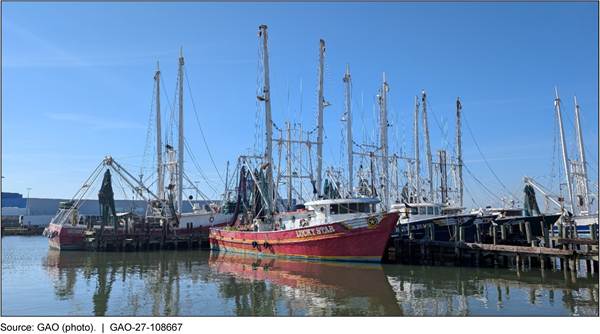
Shrimpers also identified rising operating expenses as affecting financial sustainability of operations. Shrimpers we met in Texas cited fuel, insurance, vessel maintenance, dockage, ice, and nets among their largest operating expenses (see fig. 7). According to stakeholders, these costs have increased while shrimping revenues remain constrained by low market prices, reducing overall profits.
Stakeholders we met with said labor and infrastructure issues were affecting the industry’s long-term outlook. Some individuals reported that the average age of workers is over 60 and fewer younger workers are entering the shrimp industry. Several individuals attributed this trend to declining profitability and uncertainty regarding future earnings. Stakeholders also reported limitations in processing and storage infrastructure. For example, processors and wholesalers we met with in Texas stated that imported shrimp occupies a substantial share of available cold storage, which limits space available for domestic wild-caught shrimp.
Interviewees also cited regulatory requirements and environmental conditions as affecting industry operations. In Texas, stakeholders told us that costs associated with turtle excluder devices,[25] life rafts, and electronic tracking systems add additional operating costs that farm-raised shrimp operators do not incur.[26] Stakeholders also identified severe weather events and changing environmental conditions as factors that can disrupt harvesting activity, damage infrastructure, and affect shrimp populations.
Factors Affecting U.S. Rice Industry
According to industry stakeholders we interviewed, U.S. rice producers are facing a range of pressures including market competition, increasing operating costs, and adverse weather conditions that threaten the profitability and long-term viability of their industry. Some rice stakeholders also said that many rice growers have been operating at losses in recent years because of rising costs and low prices, among other things.
More than half of U.S. rice production is consumed domestically in the U.S. market, and the rest is exported. U.S. producers face competitive pressures in both markets according to a USITC report.[27]
· Import competition. Rice industry stakeholders reported that the industry faces increasing competition in the U.S. from imported rice. The USITC reported that India and Thailand are the largest rice suppliers to the U.S. and that rice imports grew steadily from 2018 to 2023, increasing 49 percent by volume.[28] The report stated this growth has been driven by changes in consumer tastes and the growing Asian American population, among other things. The U.S. rice industry does not produce large volumes of aromatic rice such as basmati rice, mostly from India, and jasmine rice from Thailand.
· Export competition. A rice stakeholder noted that the export of domestic rice has been affected by rising competition, foreign government subsidies, and foreign government policies to protect their domestic industry. USITC reported that U.S. rice exports fell between 2018 to 2023.[29] Arkansas, which mostly grows long-grain rice, is the largest U.S. producer of rice (see fig. 8). Rice farmers we interviewed there said that their export markets are price-sensitive and U.S. rice exports are negatively affected by lower global prices. California is the second largest U.S. producer of rice, and it mainly exports its medium-grain and short-grain rice to Japan. A California rice cooperative official said their export markets have been more stable than the exports for long-grain rice grown in the South.
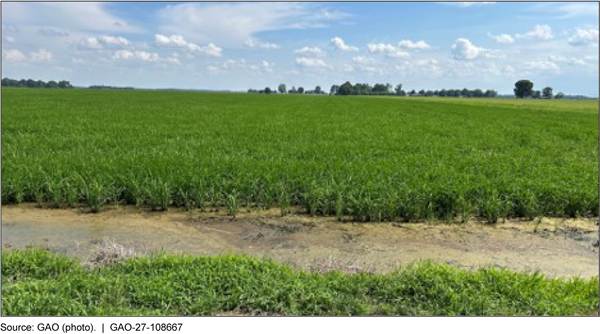
Rice industry stakeholders also reported increasing operating costs. A rice association noted that the 2026 crop cycle will be challenged by an increase in fertilizer cost, rising equipment repair costs, and persistent labor shortages affecting all sectors of the industry. According to the U.S. Department of Agriculture, U.S. rice was estimated to have the highest production costs for most major crops in 2025. An Arkansas rice farmer said that losses led some farmers in the region to cease operations in 2025. The farmer also said that these farm closures not only affect the producers but also affect local banks, agricultural suppliers, and other small businesses that depend on farm-related economic activity.
Rice association representatives also cited multiple extreme weather events—such as periodic droughts in Texas and California, as well as flooding in the South, especially in the Mississippi River Delta region—that have affected the industry since 2015. One California rice farmer said that the drought in California along with water restrictions cut his overall rice production in California by half in 2022, and as a result he left some of his fields unplanted. However, with improved weather conditions, he said that his rice production has recovered. An Arkansas rice grower said that the adverse weather conditions in 2024 led to lower-quality rice and reduced production, resulting in lower prices for their rice crops. Another Arkansas rice farmer said that a surplus of rain destroyed many of his crops in 2025.
Conclusions
The IFI statute is intended to ensure that the U.S. does not support overseas development projects for commodities or minerals in surplus on world markets that would cause substantial injury to U.S. producers of the same, similar, or competing products. While Treasury has guidance and a process for reviewing MDB-financed projects, it lacks specific criteria for key requirements in the statute. Establishing clearly defined criteria for these requirements would help promote consistent voting decisions and implementation of the statute, while still providing Treasury with discretion depending on the circumstances of each project. Additionally, including information in public voting records noting when Treasury considered the IFI statute as relevant to an MDB project would foster greater transparency regarding decisions on projects that may adversely affect U.S. producers.
Recommendations for Executive Action
We are making the following four recommendations to Treasury:
The Secretary of the Treasury should ensure the Undersecretary for International Affairs updates its guidance to include specific criteria for identifying “commodities and minerals” to consider under 22 U.S.C. § 262h. (Recommendation 1)
The Secretary of the Treasury should ensure the Undersecretary for International Affairs reviews the existing criteria in its guidance for assessing “surplus on world markets” under 22 U.S.C. § 262h and, if necessary, updates its guidance. (Recommendation 2)
The Secretary of the Treasury should ensure the Undersecretary for International Affairs updates its guidance to include specific criteria for assessing “substantial injury to U.S. producers” under 22 U.S.C. § 262h. (Recommendation 3)
The Secretary of the Treasury should ensure the Undersecretary for International Affairs includes in the public voting record when Treasury determined a project was relevant to 22 U.S.C. § 262h. (Recommendation 4)
Agency Comments
We provided a draft of this report to Treasury, Commerce, and the U.S. International Trade Commission for review and comment. In its comments, reproduced in appendix II, Treasury concurred with our recommendations. Treasury also provided one technical comment, which we incorporated. Commerce and the U.S. International Trade Commission did not have any comments on the report.
We are sending copies of this report to the appropriate congressional committees, the Secretary of the Treasury, the Secretary of Commerce, the Chairman of the U.S. International Trade Commission, and other interested parties. In addition, the report is available at no charge on the GAO website at https://www.gao.gov.
If you or your staff have any questions about this report, please contact me at ElHodiriN@gao.gov. Contact points for our Offices of Congressional Relations and Media Relations may be found on the last page of this report. GAO staff who made key contributions to this report are listed in appendix III.
Nagla’a El-Hodiri
Director, International Affairs and Trade
This report examines (1) the extent to which Treasury has established an effective oversight process to help ensure adherence to obligations under the IFI statute;[30] (2) the U.S. voting record on selected MDB-financed projects; and (3) the extent, if at all, that relevant projects supported by MDBs from 2015 through 2025 contributed to any injury to U.S. producers in selected industries.
To assess the extent that Treasury established an effective oversight process to help ensure adherence to obligations under the IFI statute, we identified Treasury criteria for internal control, consistent with federal standards for internal control.[31] We used these criteria to develop a matrix to assess Treasury’s oversight process, specifically focused on internal controls for developing, communicating and documenting internal control activities. We determined that the risk assessment and control activities components of internal control were significant to this objective, along with the underlying principles that management should define objectives and design and implement control activities to address risks.[32]
We applied the matrix to assess Treasury actions we identified from the Loan Review Process guidance, officials’ answers to questions from interviews and written responses.[33] We used a three-tier scale to assess the degree to which Treasury’s activities adhered to the standards: (1) met, (2) partially met, or (3) did not meet internal control principles. Two analysts independently reviewed the content from documentary sources and officials’ testimonial information to assign the score. We assigned a score of “met” if either documentary or testimonial evidence clearly matched internal control criteria; “partially met” if documentary or testimonial evidence reflected the intent of internal control criteria but was incomplete or inconclusive, and “not met” if there was no evidence from either documents or testimony that indicated officials’ actions achieved the intent of internal controls. In the cases where the two analysts agreed, the score was recorded. In one case where the two analysts did not reach a consensus, a third analyst independently made the final determination. Based on this scoring, we made a summary determination about Treasury’s oversight process and identified areas of internal control weakness.
To assess the voting record of the U.S. on projects that may be relevant to the IFI statute from January 2015 through August 2025, we developed criteria to identify projects using public voting and loan disbursement data and keyword searches, and we analyzed Treasury’s public voting records (the U.S. Treasury Multilateral Development Bank Loan Review Votes database). Based on a review of related documentation, interviews with knowledgeable officials, and electronic and manual data testing, we found this data sufficiently reliable for the purposes of describing U.S. Executive Director positions on MDB projects.[34] We developed this approach because Treasury’s public voting records do not indicate which MDB projects it considered within the scope of the statute. We determined that the information and communication components of internal control were significant to this objective along with the underlying principle that management should externally communicate the necessary quality information to achieve the entity’s objectives.[35]
When identifying projects that could be relevant to the IFI statute, we focused on projects explicitly targeted at developing specific products (e.g. shrimp) and excluded projects related to infrastructure development, emergency or disaster relief, or general business climate. We used two methodologies to identify a sample of projects targeted at developing specific products. First, we used the Organization for Economic Cooperation and Development (OECD) Creditor Reporting System data, which tracks loan disbursements from MDBs, to identify projects that the OECD has classified as relevant to agriculture, forestry, fishing, industry, or mineral resources and mining. Based on a review of related documentation, and electronic and manual data testing, we found this data sufficiently reliable for the purposes of identifying projects relevant to 22 U.S.C. § 262h. We restricted the matches to the MDBs subject to the statute: the International Bank for Reconstruction and Development, the International Development Association, the International Finance Corporation, the Inter-American Development Bank, the International Monetary Fund, the Asian Development Bank, the Inter-American Investment Corporation, the African Development Bank, and the African Development Fund.[36] We also excluded any projects where the loan amount in the voting data equaled zero (indicating non-financial assistance) or was missing. From 2015 through 2023, the last available year of OECD data at the time of our sample selection, we identified 239 projects. As a secondary means of identifying projects, we employed a keyword search to identify projects with titles that contained words related to agriculture, mineral products, and articles of base metal, following Treasury officials’ statements that those were the types of products covered by the statute. This keyword search identified an additional 916 projects.
From this initial sample of 1,155 total projects, we used descriptions from the websites of the MDBs subject to the statute to identify whether each project included investment in a specific commodity or mineral, based on Treasury’s statements on the scope of the statute.[37] We eliminated 383 projects where the product description was not at least as detailed as the product description in World Customs Organization harmonized system chapter (e.g., steel vs. metals).[38] We also eliminated 247 projects where titles used words related to agriculture, mineral products, and articles of base metal but were not related to those commodities or minerals according to their project descriptions.[39] This left a sample of 396 potentially in-scope MDB votes. Based on Treasury’s statements that “commodity or mineral” in the IFI statute includes agricultural products, mineral products, and articles of base metal, we further refined the sample of MDB votes to include the 340 projects that include products contained in harmonized system chapters 01-14 (Live animals, animal products and vegetable products), 25-27 (mineral products), and 71-83 (natural or cultured pearls, precious or semi-precious stones, precious metals, metals clad with precious metal, and articles thereof; imitation jewelry; coin; and base metals and articles of base metal).[40]
Once we identified projects relevant to the statute, we used Treasury’s public voting records data to compile statistics on the number of projects where Treasury voted “yes,” “no,” “abstain”, or other voting categories. We used the harmonized system classifications to compare voting records across sub-categories of the commodities and minerals identified.
To assess the extent that relevant projects supported by MDBs from 2015 through 2025 contributed to injury to U.S. producers in selected industries, we focused on two industries as case studies: shrimp and rice. Using the voting data described in objective 2, we selected these two industries based on the following criteria: 1) U.S. production of the potentially competing product, 2) whether the location of the loan recipient’s investment is in a country that exports the product to the U.S., 3) at least five MDB votes in that product category, 4) total size of loans, and 5) diversity in project location.
To describe the economic trends and outcomes in the selected industries, we analyzed statistical data on imports and U.S. production in the shrimp and rice sectors.[41] We found these data to be sufficiently reliable for the purposes of describing U.S. and global import and production trends in the shrimp and rice sectors. We also used relevant reports from the U.S. International Trade Commission (USITC) and the National Oceanic and Atmospheric Administration to understand trends in the U.S. shrimp and rice sectors and interviewed representatives from those industries to understand the extent to which MDB-financed projects may have caused injury.
To obtain perspectives on conditions affecting the U.S. shrimp industry, we conducted interviews with stakeholders from the Gulf Coast region and conducted site visits to Louisiana and Texas. We selected these locations based on discussions with U.S. shrimp industry representatives and because these states are major producers of shrimp. We held interviews with a range of stakeholders, including state officials, processors, wholesalers, and commercial shrimpers, regarding the factors affecting industry conditions and competitiveness. During these visits, we interviewed industry representatives to discuss market conditions, operational costs, regulatory requirements, and other factors affecting the industry. Specifically, we met with over 45 representatives from national and regional seafood industry associations, state officials involved in fisheries and economic development, and local shrimpers with extensive experience in the industry. These interviews provided insights into how industry participants view current market and operating conditions affecting U.S. shrimp producers.
To obtain information on the rice industry we interviewed five representatives from national and regional rice associations to discuss market conditions, operational costs, regulatory requirements and other factors affecting the industry. We met with six rice farmers in Arkansas and California, the two largest rice-producing states, as well as a rice mill spokesperson in California to gain their perspectives on conditions affecting their livelihood and the status and future of their industry. We also interviewed a rice farmer in Texas, which is the sixth largest rice-producing state.
We analyzed our interviews with stakeholders in the shrimp and rice industries to identify five categories of challenges to these industries: (1) global market competition and import price pressures; (2) regulatory oversight and compliance burdens; (3) rising operating costs and financial sustainability pressures; (4) workforce shortages, infrastructure limitations, and supply chain constraints; and (5) environmental disruptions and climate-related production risks. We used these categories to systematically group and analyze information obtained through stakeholder interviews, project documentation, and industry data. The categories were intended to provide a consistent analytical framework for assessing factors stakeholders identified as affecting industry conditions and competitiveness. The framework also helped us compare stakeholder perspectives across sectors and identify recurring themes related to market, operational, regulatory, and environmental conditions. Information obtained in these interviews is not generalizable to all industry participants but provides us with contextual information to help inform our analysis.
We conducted this performance audit from July 2025 to November 2026 in accordance with generally accepted government auditing standards. Those standards require that we plan and perform the audit to obtain sufficient, appropriate evidence to provide a reasonable basis for our findings and conclusions based on our audit objectives. We believe that the evidence obtained provides a reasonable basis for our findings and conclusions based on our audit objectives.
GAO Contact
Nagla’a El-Hodiri, Director, ElHodiriN@gao.gov
Staff Acknowledgments
In addition to the contact named above, Drew Lindsey (Assistant Director), Tom Zingale (Analyst-in-Charge), Larissa Barrett, Sergio Enriquez, Sarah Oliver, and Eddie Uyekawa made key contributions to this report. Pedro Almoguera, Gergana Danailova-Trainor, Jeffrey Isaacs, Grace Lui, and Carrie Morrison provided technical assistance.
The Government Accountability Office, the audit, evaluation, and investigative arm of Congress, exists to support Congress in meeting its constitutional responsibilities and to help improve the performance and accountability of the federal government for the American people. GAO examines the use of public funds; evaluates federal programs and policies; and provides analyses, recommendations, and other assistance to help Congress make informed oversight, policy, and funding decisions. GAO’s commitment to good government is reflected in its core values of accountability, integrity, and reliability.
Obtaining Copies of GAO Reports and Testimony
The fastest and easiest way to obtain copies of GAO documents at no cost is through our website. Each weekday, GAO posts on its website newly released reports, testimonies, and correspondence. You can also subscribe to GAO’s email updates to receive notification of newly posted products.
Connect with GAO
Connect with GAO on X,
LinkedIn, Instagram, and YouTube.
Subscribe to our Email Updates. Listen to our Podcasts.
Visit GAO on the web at https://www.gao.gov.
To Report Fraud, Waste, and Abuse in Federal Programs
Contact FraudNet:
Website: https://www.gao.gov/about/what-gao-does/fraudnet
Automated answering system: (800) 424-5454
Media Relations
Sarah Kaczmarek, Managing Director, Media@gao.gov
Congressional Relations
David A. Powner, Acting Managing Director, CongRel@gao.gov
General Inquiries
[1]U.S. International Trade Commission, Frozen Warmwater Shrimp from Ecuador, India, Indonesia, and Vietnam, USITC Publication 5566 (Washington, D.C.: December 2024).
[2]The U.S. Executive Directors are appointed by the President and pursue U.S. policy objectives through their membership on the MDB executive board, according to Treasury. Treasury’s Office of International Affairs protects and supports U.S. economic prosperity by strengthening the external environment for U.S. growth, preventing and mitigating global financial instability, and managing key global challenges.
[3]For purposes of this report, we use “IFI statute” to refer specifically to the requirements of 22 U.S.C. § 262h. Other statutes also require the Secretary of the Treasury to instruct the U.S. Executive Directors of IFIs to use the voice and vote of the United States in other specific ways. The IFI statute covers the International Finance Corporation, the International Bank for Reconstruction and Development, the International Development Association, the Inter-American Development Bank, the Asian Development Bank, the Inter-American Investment Corporation, the African Development Bank, and the African Development Fund. The International Monetary Fund is also noted in the statute text; however, according to Treasury officials, it does not provide assistance relevant to this statute and was not included in this audit.
[4]Our review of selected MDB-financed projects focused on whether these projects may have contributed to injury to their respective U.S. industries rather than determining if a proposed project met the specific legal criteria of the IFI statute.
[5]The working group includes staff from State, Agriculture, Commerce, and other agencies.
[6]According to Treasury officials, projects are generally approved by a majority of votes cast by the Board of Directors. The number of Executive Directors or Directors varies by institution, and the weight of each vote varies by Director based on shareholding.
[7]See https://home.treasury.gov/policy-issues/international/multilateral-development-banks/loan-review-votes.
[8]Department of the Treasury, Directive 40-04 (Washington, D.C.: July 1, 2024).
[9]ODRA Loan Review Process (internal guidance document); July 2021.
[10]U.S. laws authorize imposition of anti-dumping duties on certain imports that are dumped (i.e., sold at less than fair market value) and countervailing (offsetting) duties on certain imports subsidized by foreign governments. For more information see GAO, Antidumping and Countervailing Duties: Process Design Helps Ensure Proceedings Are Based on Accurate and Complete Information, GAO‑23‑105794 (Washington, D.C.: December 12, 2022).
[11]GAO, Standards for Internal Controls in the Federal Government, GAO‑25‑107721 (Washington, D.C.: May 15, 2025). Principles 6 and 10.
[12]GAO‑25‑107721, Principle 12.
[13]August 2025 was the last available month of data as of August 28, 2026.
[14]Treasury does not track which projects were considered under the IFI statute, and the data also include one project where the Treasury voting record was classified as “to be determined.” We relied on public descriptions of MDB projects to estimate the number of projects that may have been considered under the IFI statute, using the World Customs Organization (WCO) Harmonized System, a classification system used worldwide for traded products. We classified projects investing in products under WCO Harmonized System chapters 01-14 (live animals, animal products, and vegetable products), 25-27 (mineral products), and 71-83 (natural or cultured pearls, precious or semi-precious stones, precious metals, metals clad with precious metal, and articles thereof; imitation jewelry; coin; and base metals and articles of base metal) as potentially relevant to the IFI statute. For more information, see Appendix I.
[15]According to Treasury officials, both a “no” and “abstain” vote indicates a withholding of U.S. support.
[16]This total only includes project votes at MDBs listed in the IFI statute.
[17]Treasury officials stated that the statute covers agricultural products, mineral products, and products of base metal such as steel and did not include manufacturing. Based on this statement, we included all products in chapters 01-14 (live animals, animal products, and vegetable products), 25-27 (mineral products), and 71-83 (natural or cultured pearls, precious or semi-precious stones, precious metals, metals clad with precious metal, and articles thereof; imitation jewelry; coin; and base metals and articles of base metal) of the WCO Harmonized System, a classification system used worldwide for traded products. See appendix I for additional details.
[18]Across all product categories, U.S. Executive Directors voted “no” or “abstain” on 17.1 percent of the 340 MDB projects we identified as potentially relevant to the IFI statute.
[19]GAO -25-10721, Principle 15.
[20]To describe the economic trends and outcomes in the shrimp and rice sectors, we analyzed statistical data on imports and U.S. production in those sectors. Our review of selected MDB-financed projects was limited to whether these projects may have contributed to injury to their respective industries.
[21]To assess the extent that selected projects supported by MDBs since 2015 may have contributed to injury to U.S. producers, we interviewed U.S. producers and industry representatives and reviewed Treasury related documentation of selected projects supported by MDBs since 2015. We also used relevant reports from the U.S. International Trade Commission and the National Oceanic and Atmospheric Administration to understand trends in the U.S. shrimp and rice sectors and interviewed representatives from those industries to understand the extent to which MDB-financed projects may have caused injury.
[22]According to Treasury, a U.S. Executive Director’s vote represents the position of the U.S. but does not independently determine whether an MDB project is approved. Project approval is based on the institution’s applicable voting procedures and would generally require a majority vote of the Board; therefore, a project may proceed even if the U.S. votes against it or votes to abstain.
[23]Data is from National Oceanic and Atmospheric Administration ex-vessel price data. Prices represent the average December dockside price (dollars per pound) for headless Gulf shrimp across seven size categories (0/15, 16/20, 21/25, 26/30, 31/35, 36/40, and 41/50) for 2021 through 2025.
[24]These countries exported a variety of rices to the United States. In 2025, the top types of rice exported to the United States by these countries were jasmine (Vietnam), basmati (Pakistan), medium grain (China), long grain (Bangladesh) and broken rice (Cambodia).
[25]A turtle excluder device is a simple grid of metal bars and mesh fitted inside a commercial fishing trawl net. It is designed to trap the target catch (like shrimp) while giving larger marine animals, such as sea turtles, an escape route so they do not drown.
[26]The majority of shrimp imported into the U.S. is farm-raised, while most of domestic shrimp production is wild-caught.
[27]U.S. International Trade Commission, Rice: Global Competitiveness and Impacts on Trade and the U.S. Industry; Corrected September 2025, USITC Publication 5600 (Washington, D.C.: September 2025).
[28]U.S. International Trade Commission, Rice: Global Competitiveness and Impacts on Trade and the U.S. Industry.
[29]We did not find any evidence that MDB projects contributed to these declines in U.S. rice exports.
[30]22 U.S.C. § 262h. For purposes of this report, we refer to the requirements of this provision as “the IFI statute.”
[31]Department of the Treasury, Directive 40-04 (Washington, D.C.: July 1, 2024).
[32]GAO, Standards for Internal Control in the Federal Government. GAO -25-107721 (Washington, D.C.: May 15, 2025). Principles 6,10, and 12.
[33]Office of Development Results and Accountability (ODRA), Loan Review Process, July 2021.
[34]This data may undercount the total number of projects that Treasury reviews, because according to Treasury officials, projects that Treasury opposed internally but never reached an MDB board vote are not included in the data, and sometimes related projects are approved in one package, and as a result individual projects do not appear separately in the public voting records.
[35]GAO-25-10721, Principle 15.
[36]While the International Monetary Fund was included in the voting records data, in practice, we identified a single International Monetary Fund project that may be relevant to the IFI statute and dropped it from the final sample because it was not an investment in a specific commodity or mineral.
[37]We were unable to find project-specific documentation for 129 of the 1,155 projects identified in the initial sample selection.
[38]The harmonized system is a product classification system developed by the World Customs Organization and used to classify traded products by over 200 countries, including the U.S. Although the MDBs do not explicitly categorize their products using the harmonized system, we chose this nomenclature because of its global use.
[39]For example, our keyword search identified projects aimed at developing the “silver economy.” However, the project descriptions indicated these projects were investments related to entrepreneurship in older adult populations, rather than investment in silver mining.
[40]Treasury officials noted that some articles of base metal, such as copper cathodes, would not be considered under the IFI statute. However, absent specific guidance from Treasury on which harmonized system codes within base metals and articles of base metals would not be in the statute’s scope, we chose to include all products within these categories.
[41]Specifically, we used data from the U.S. Census Bureau to measure imports and data from the U.S. Department of Agriculture to measure production in the rice sector.