
Report to Congressional Committees
United States Government Accountability Office
A report to congressional committees
Contact: Jon Ludwigson at ludwigsonj@gao.gov
What GAO Found
To help maintain space-power superiority, the Department of Defense (DOD) relies on satellites in Earth’s orbit that provide important capabilities to the warfighter. The space industrial base and associated supply chains consist of a global network of companies that provide the hardware and software for space technologies and are critical to DOD’s ability to buy and use these satellites.
The three Space Force programs that GAO reviewed reported various supply chain risks such as challenges with manufacturing capability or capacity for some critical satellite components. Recent DOD efforts are underway to address risks more broadly across the space industrial base. These early efforts include initiating a study on supply chain risks facing proliferated constellations in low-Earth orbit and providing investments to increase manufacturing capacity.
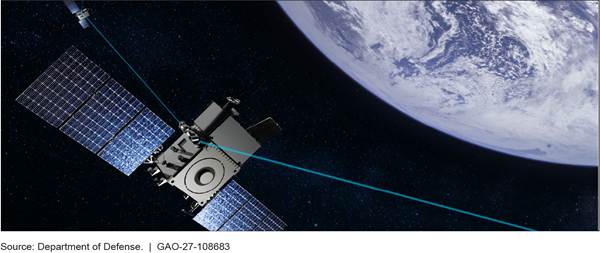
Although the Space Force has taken steps to address its space industrial base risks, it has not yet fully coordinated these efforts across the national security space portfolio. For example, the Air Force issued a memorandum in April 2026 to announce an enterprise risk management service. This service is intended to provide a bird’s eye view of space supply chain risks, among other things. From that vantage point, the Space Force could use this information to support decision-making at a higher level. The memorandum, however, does not identify a lead agency or official to manage the service or clearly define roles and responsibilities—key elements supporting effective enterprise risk management and interagency collaboration. Establishing a clear leadership structure with defined roles and responsibilities would better ensure that management of this new service can effectively support decision-making—at the enterprise level—for the national space portfolio.
In April 2026, Space Systems Command created a guide to establish a process for identifying and addressing space supply chain risks across the national security space portfolio. However, the guide cannot be enforced for stakeholders outside of the Space Force, such as the National Reconnaissance Office. Establishing formal agreements could strengthen stakeholder participation, enhance accountability, and help ensure that all risks are identified and managed as this space portfolio grows and continues to strain the supply chain.
Why GAO Did This Study
DOD’s shift to constellations of smaller satellites in greater numbers, along with a similar shift in the private sector, is straining the space industrial base and its supply chain. This strain poses a risk to the Space Force’s—organized under the Department of the Air Force—ability to procure the necessary technologies it plans to use to carry out future missions. The space industrial base is a subset of DOD’s broader defense industrial base, which GAO monitors as part of its High Risk Series.
A Senate report includes a provision for GAO to assess the military space industrial base and supply chains. GAO’s report addresses (1) the supply chain risks that programs and DOD identified and the efforts to address these risks, and (2) the extent to which DOD has coordinated its approach to addressing supply chain risks.
GAO reviewed program risk documentation and interviewed DOD officials. GAO also compared recent Space Force enterprise risk management efforts to GAO’s essential elements for enterprise risk management and GAO’s leading practices for enhanced interagency collaboration.
What GAO Recommends
GAO is making three recommendations to DOD, including that it establishes: (1) a coordinated enterprise approach with formal agreements providing authority, support, and decision-making across the national security space portfolio, (2) a clear leadership structure with defined roles and responsibilities, and (3) formal guidance for its enterprise-level risk management service. DOD concurred with all three recommendations.
|
Abbreviations |
|
|
|
|
|
|
|
DOD |
Department of Defense |
|
|
GPS IIIF |
Global Positioning System III follow-on |
|
|
LEO |
low Earth orbit |
|
|
MEO |
medium Earth orbit |
|
|
MWT |
Missile Warning and Tracking |
|
|
PTS-G |
Protected Tactical Satellite Communications Global |
|
|
PWSA |
Proliferated Warfighter Space Architecture |
|
|
SDN |
Space Data Network |
|
|
SIBWG |
Space Industrial Base Working Group |
|
This is a work of the U.S. government and is not subject to copyright protection in the United States. The published product may be reproduced and distributed in its entirety without further permission from GAO. However, because this work may contain copyrighted images or other material, permission from the copyright holder may be necessary if you wish to reproduce this material separately.
November 17, 2026
Congressional Committees
The Department of Defense (DOD) relies on the space industrial base for technologies that are critical for maintaining space-power superiority and delivering national security space systems. The space industrial base is the global network of companies providing the raw materials, parts, components, and satellite software and hardware to serve both government—including DOD—and commercial markets. Disruptions to the supply chain can affect readiness by delaying delivery of critical resources and equipment and ultimately result in increased risk to the warfighter and U.S. national defense. The space industrial base is a subset of the defense industrial base. We have reported on the defense industrial base and its ability to support DOD’s acquisition of weapon systems as part of our High Risk Series since 2023.[1] In 2025, we found that gaps remained in DOD’s leadership commitment to mitigate industrial base risks, capacity to focus its workforce and funding toward these risks, and identification of metrics and reporting measures to gauge and report its progress.[2]
To address threats to U.S. space capabilities, DOD is transitioning some of its space systems to proliferated constellations. The term “proliferated” means deploying large numbers of smaller, interconnected satellites—often in low Earth orbit (LEO)—to work together as a single network to provide global coverage of the earth, rather than a few large satellites.[3] DOD is making this transition because strategic competitors to the U.S.—particularly China and Russia—pose a threat to U.S. space capabilities during times of conflict. DOD is concerned that U.S. adversaries can target the traditionally large and expensive satellites in outer orbits that DOD has relied on for missions such as missile warning and missile tracking. DOD plans to spend approximately $33 billion over the next 5 years to execute this transition and ensure U.S. superiority in space.
At the same time, increasing demand from commercial users is straining the space industrial base’s capacity. Companies are pursuing their own constellations of hundreds or thousands of satellites—in lower orbits—to provide commercial services such as space-based internet and communications. For example, SpaceX began launching its Starlink satellites in 2019 to provide space-based broadband internet service and has over 11,000 satellites in orbit with plans for thousands more. Amazon began launching its Amazon LEO constellation in 2025 for a similar purpose and plans to build a constellation of over 3,200 satellites.
Senate Report 118-188 to accompany S. 4638, a bill for the National Defense Authorization Act for Fiscal Year 2025, contains a provision for GAO to assess the military space industrial base and supply chains.[4] Our report addresses (1) the supply chain risks that selected programs have identified to their architectures and how they are addressing those risks, and (2) the extent to which DOD has coordinated its approach to addressing supply chain risks.
Objectives, Scope, and Methodology
To answer these objectives, we reviewed space industrial base and supply chain risks identified through a nongeneralizable sample of five Space Force and joint National Reconnaissance Office/Space Force programs. These programs included (1) the Proliferated Warfighter Space Architecture (PWSA), (2) the Space Data Network (SDN) Backbone, (3) the Protected Tactical Satellite Communications – Global (PTS-G), (4) the Global Positioning System III follow-on (GPS IIIF), and (5) the Resilient Missile Warning and Tracking (MWT) Medium Earth Orbit (MEO).[5] We later excluded the SDN Backbone and PTS-G programs from our report as they told us they had not yet assessed their supply chains in depth at the time we initiated our review.[6] We also reviewed relevant documentation such as critical technology lists, space industrial base mitigation project reports, and supply chain risk mitigation policies and guidance. We compared recent Space Force risk management efforts against our relevant enterprise risk management essential elements (Leaders Guide and Sustain Enterprise Risk Management Strategy) and leading practices for enhancing interagency collaboration (Identify and Sustain Leadership, Clarify Roles and Responsibilities).[7] Additionally, we interviewed relevant stakeholders across DOD, subject matter experts from the Aerospace Corporation, and officials at the National Aeronautics and Space Administration and the Department of Commerce.[8] Appendix I includes more details about our objectives, scope, and methodology.
We conducted this performance audit from August 2025 to November 2026 in accordance with generally accepted government auditing standards. Those standards require that we plan and perform the audit to obtain sufficient, appropriate evidence to provide reasonable basis for our findings and conclusions based on our audit objectives. We believe that the evidence obtained provides a reasonable basis for our findings and conclusions based on our audit objectives.
Background
Key Satellite Constellations Planned and on Orbit
Historically, DOD has largely relied on constellations in geostationary Earth orbits to conduct space-based missions.[9] In 2020, DOD began developing the PWSA—a constellation of satellites in LEO—to reduce its reliance on legacy satellites in higher orbits. The PWSA relies on laser communications technology to transmit data from space-to-space, space-to-ground, and space-to-air platforms. DOD plans to use PWSA to perform a number of missions, including missile warning and missile tracking. More recently, DOD and the National Reconnaissance Office initiated additional programs, including many that will use proliferated architectures in various orbits, including LEO and MEO.
These programs range in mission type from missile warning and tracking to protected communications; space-based data transport; and position, timing, and navigation. These efforts represent a significant increase in the number of satellites required for a given space mission. Table 1 provides details about the mission, planned constellation size, and first launch dates for the space systems in our scope.
|
Program |
Agency |
Description |
Planned |
First launch |
Planned cost over the next 5 fiscal years (in billions) |
|
Proliferated Warfighter Space Architecture (PWSA)a |
Space Development Agency |
Supports missile warning, tracking, and missile defense |
300+ |
Sept. 2025 |
$15.6 |
|
Global Positioning Satellite III follow-on (GPS IIIF)b |
Space Systems Command |
Builds on the efforts of the GPS III program to develop and field next-generation satellites to modernize and replenish the GPS satellite constellation |
22 |
Apr. 2027 |
$3.91 |
|
Resilient Missile Warning and Tracking Medium Earth Orbit |
Space Systems Command |
Provides missile warning, tracking, and defense data to legacy and future missile warning and tracking space systems |
22 |
May 2027 |
$8.3 |
Source: GAO analysis of Department of Defense data. | GAO‑27‑108683
aIn July 2026, a Department of Defense official told GAO that the PWSA was being renamed and split across two programs. This official said that the PWSA Missile Warning/Missile Tracking satellites will be referred to as pLEO MW/MT, and the data transport satellites will be referred to as the Tactical Communications layer and fall under the overall Space Data Network effort going forward. Discussions of the PWSA and Space Data Network programs in GAO’s report refer to their original program configurations.
bAccording to a Department of Defense official, GPS IIIF is a proliferated constellation operating in medium Earth orbit.
A large constellation of satellites has several advantages in meeting the Space Force’s needs. For example, large constellations enable the ability to adapt quickly if a connection to one of the satellites is lost due to attack or a natural event. Placement of these satellites in LEO also has several additional advantages such as significantly lower latency, higher resolution imagery, and greater resilience against attack or interference compared to traditional higher-altitude orbits like MEO and geostationary Earth orbit. Further, satellites designed to operate in LEO are generally smaller and cost less than those in higher orbits. However, the LEO environment also creates some difficulty. According to the Space Development Agency, closer proximity to Earth makes LEO systems more vulnerable to certain types of ground-based electronic warfare threats. As we previously reported, satellites designed for LEO typically operate around 5 years and may be deorbited before they stop working to reduce on-orbit debris. These satellites need to be replaced more often to maintain the constellation.[10] Satellites in MEO and geostationary Earth orbit, however, face greater radiation in space and require protection from that radiation, which can affect how the satellites function over time.
U.S. Space Industrial Base and Supply Chains
The U.S. government and commercial companies rely on the U.S. space industrial base to build space systems. The U.S. space industrial base consists of industry suppliers of the technology; hardware and software systems; data; and financial and insurance capacities that grow the U.S. space economy. Many suppliers in the space industrial base serve both commercial and national defense customers.
The space industrial base can be divided into several tiers: prime contractors; major subcontractors; and lower tiers that include suppliers of subsystems, assemblies, components, parts, and raw materials. The prime contractor—with which DOD directly contracts—is generally responsible for integrating and delivering the end product.[11] Primes are also generally responsible for selecting and managing the subcontractors, sometimes referred to as sub-tier suppliers, that manufacture subsystems or components.[12] These sub-tier suppliers might, in turn, work with another group of companies that supply the parts and raw materials that these sub-tier suppliers combine to produce their product that will be delivered to the prime contractor. Figure 1 illustrates a generic satellite and its associated supply chain tiers.

Supply Chain Risk Management
Supply chain risk management is the systematic process for managing supply chain risk by identifying susceptibilities, vulnerabilities, and threats throughout DOD’s supply chain. It is generally DOD’s practice to delegate risk mitigation to the lowest level possible—for example, the programs—as these offices are the most knowledgeable about risks that threaten the program’s ability to meet cost, schedule, and performance goals. DOD’s Supply Chain Risk Management Guidebook states that program managers are responsible for establishing formal risk management processes that prioritize and mitigate programmatic risks within constraints.[13] According to the guidebook, program managers must have a comprehensive understanding of their supply chains and identify potential risks. The guidebook states that in a dynamic and contentious environment, the ability to quickly establish industrial capabilities to produce essential items for weapon systems is often limited, highlighting the need for proactive risk management.
An enterprise approach to supply chain risk management—coordinated action across all relevant programs and organizations rather than within individual program offices—relies on consistent information flows and feedback from personnel at all levels of the organization.[14] This information flow and feedback aims to ensure that risks are identified and addressed across the full scope of an entity’s activities.
Supply chain illumination can contribute to the flow of information needed for supply chain risk management and as a result, is a key part of identifying supply chain risks. Specifically, supply chain illumination is an analytical process that provides transparency across individual programs and visibility into supply chain entities, products, parts, and raw materials to identify risks and enable proactive mitigation and assured supply.[15] It is not static and must be continuously refreshed using data integration, analysis, advanced risk management strategies, and partnerships with the defense industrial base. According to DOD’s Supply Chain Risk Management Guidebook, programs are responsible for using government and commercial illumination tools to identify emerging risks and to ensure that risk management strategies are effectively implemented. In February 2023, DOD found that while supply chain risks are addressed by multiple organizations, a lack of an enterprise coordination process inhibited the department’s ability to provide coordinated, holistic solutions, including supply chain illumination tools.[16]
Key DOD Organizations Involved in Addressing Space Industrial Base and Supply Chain Risks
Several organizations across DOD manage space industrial base and supply chain risks. See table 2.
|
Organization |
Role |
|
Department of Defense, Office of the Under Secretary of Defense for Acquisition and Sustainment |
|
|
Assistant Secretary of Defense for Industrial Base Policy |
The Assistant Secretary of Defense for Industrial Base Policy is DOD’s principal advisor within the department for issues affecting the industrial base across the DOD enterprise. Among other things, the Assistant Secretary of Defense for Industrial Base Policy office conducts DOD-wide industrial base risk assessments, coordinates certain industrial base investments, and reports on assessments of the defense industrial base and associated risks and mitigation efforts. The space industrial base is a new effort within the Office of Industrial Base Policy. |
|
Department of the Air Force |
|
|
Office of the Assistant Secretary for Space Acquisition and Integration |
This office reports directly to the Secretary of the Air Force and serves as the senior architect for space systems and programs across the DOD. It also serves as the Air Force’s Service Acquisition Executive for space systems and programs. |
|
U.S. Space Forcea |
|
|
Space Systems Command |
This command is responsible for developing and delivering capabilities in, from, and to space. It manages acquisition through six portfolio acquisition executives and program executive offices. Under each portfolio, program executive offices manage mission areas, which are comprised of systems being acquired. |
|
Space Systems Integration Office |
This office, which is organized under Space Systems Command, is responsible for developing space system integration products. Specifically, it is responsible for delivering and directing an enterprise strategy across functions to mitigate risks, including to the space industrial base and supply chain. |
|
Space Development Agency |
Established in March 2019, this agency reports directly to the Space Force. Its stated mission is to accelerate delivery of space-based capabilities to the joint warfighter to support missions on Earth through developing, fielding, and operating the Proliferated Warfighter Space Architecture. |
|
Cross-Agency |
|
|
National security space programs |
In addition to Space Systems Command, this refers to other organizations under the Space Force and within the intelligence community, including the National Reconnaissance Office. GAO generally refers to the systems, their associated program executive office, and mission area as national security space programs. These programs are responsible for monitoring supply chain risks to their systems. |
Source: GAO summary of Department of Defense (DOD) information. | GAO‑27‑108683
aPub. L. No.116-92, § 952 (2019) (codified, as amended, at 10 U.S.C. § 9081). This act established the U.S. Space Force as a separate military service within the Department of the Air Force.
Established in 2009, the Space Industrial Base Working Group (SIBWG) is co-chaired by the Assistant Secretary of Defense for Industrial Base Policy, within the office of the Under Secretary of Defense for Acquisition and Sustainment.[17] The National Reconnaissance Office also co-chairs this working group. The group’s purpose is to promote and protect the space industrial base and ensure access to technologies and capabilities. The SIBWG tracks many different technology items identified by member agencies and prioritizes projects to fund that aim to mitigate space industrial base risks. Defense Production Act Title III investments fund SIBWG projects to purchase industrial resources or critical technology items; make subsidy payments for domestically produced materials; and install and purchase equipment for government and privately owned industrial facilities to expand their productive capacity.[18] The SIBWG is comprised of voting and non-voting members across government that work collaboratively to identify, assess, and fund projects to address shared space industrial base risks to U.S. government space programs.[19]
Risks Facing the Space Industrial Base and Supply Chains
The space industrial base serving DOD is vulnerable because it is a market with specialized and capital-intensive capabilities with demanding requirements that are not supported by the commercial space ecosystem. These specialized production processes require large amounts of capital investments—resources such as money, workforce, and time—to develop.[20] Meanwhile, other manufacturing-intensive sectors, such as automotive, energy, data centers, and industrial manufacturing are also growing, further leading to competition for supplies. This simultaneous growth creates intense competition for critical assets and triggers shortages for semiconductors, electronics, raw materials, and manufacturing capacity. Additionally, DOD demand for space systems is low compared to commercial demand. For example, a September 2026 study of the global space economy found that 94 percent of U.S. satellites on orbit are privately owned.[21]According to an industrial base study from 2025, the space industrial base that serves DOD has been shrinking year after year, in many instances leaving only single suppliers that are qualified to provide DOD’s space products.[22]
The Aerospace Corporation and DOD define several types of risks in a supply chain that can result in bottlenecks or delays, which become more acute as suppliers try to scale production to meet demand. [23] See figure 2.

National security space systems face these selected risk types for several reasons. Specifically:
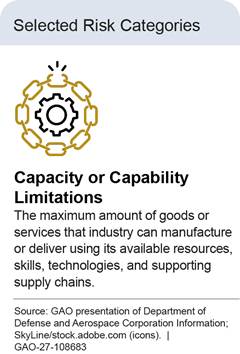
Capacity or capability limitations. To meet demand for greater numbers of satellites, manufacturers are exploring and implementing ways to increase production capacity and capability. Satellite manufacturing processes for greater volumes require companies to make investments in their processes and facilities to accommodate higher volume production. However, a 2026 industry study of the space industrial base found that bottlenecks are caused in part by manufacturing capacity constraints to meet demand.[24] The study also cited low revenue relative to complex manufacturing requirements, among others. It found that manufacturers are using nearly 75 percent of their facilities to meet rising demand but they are not investing in new manufacturing capacity because they are uncertain about future demand from government space programs. In 2025, we reported that some vendors developing critical technology for PWSA were expanding manufacturing capacity in the United States to support their continued involvement in the proliferated architecture. [25] However, we found that other contractors cautioned that participation was dependent on continually receiving contracts for each iteration of satellite development.

Single source or limited suppliers. DOD space systems often need special components that meet national security requirements such as domestic production, encryption capabilities, radiation hardened or space-rated for reliability, or having high technical performance. For example, radiation hardening is important because radiation from the sun degrades items in space more quickly than if these assets were on Earth. As a result, components must be built and tested to reliably withstand the effects of radiation. Space systems may rely on only one or two suppliers of certain materials or parts that can meet these requirements. A June 2025 Aerospace Corporation study found over a dozen assemblies and components had only one supplier that could meet DOD’s needs.[26] The 2026 industry study of the space industrial base found that radiation hardening and other requirements make parts much more expensive, in some cases 100 times more expensive than their commercial counterparts.[27] Moreover, some traditional and new space companies are addressing supply chain risks by vertically integrating their businesses, which removes suppliers from the open market.[28]

Parts obsolescence or diminishing manufacturing sources. The space industry is always evolving, which can result in equipment, parts, or materials becoming obsolete as suppliers adopt new technologies.

Geopolitical instability or foreign dependence. DOD space systems rely on various parts and materials from foreign sources, which DOD considers to be a risk to its space industrial base and supply chains. For example, space systems include certain rare earth elements and other raw materials from China, which is the world’s dominant supplier by far and recently restricted the sale of those materials to the U.S.
Recent Executive Orders have brought attention to space industrial base risks. Executive Order No. 14369 calls for a space policy that will, among other things, develop advanced capabilities and approaches that establish infrastructure and standards that implement U.S. space priorities and enable a robust space industrial base.[29] Executive Order No. 14415 aims to secure U.S. supply chains against physical, cyber, and economic subversion from geopolitical adversaries. The order directs DOD, by January 1, 2027, to stop issuing routine waivers to for the procurement of certain restricted critical minerals, including tungsten, tantalum, and rare-earth magnets from adversarial nations, among other things.[30]

Technology and cybersecurity. Satellites that perform sensitive missions, such as national security space systems, rely on cryptological units to secure space-to-ground communications, gather sensitive information, and support military operations. These units are specialized and go through standards review and certification processes at the National Security Agency. These processes can be lengthy.
Studies of the U.S. space industrial base have also identified policy, acquisition approaches, infrastructure, and workforce as critical variables necessary to achieve the speed and scale required by DOD’s transition to proliferated space systems.[31] We did not assess these variables as they were outside the scope of our review.
Recent GAO Reports Highlighting Industrial Base and Supply Chain Risks
Over the last decade, we have consistently highlighted areas where DOD has fallen short in its efforts to manage risks to the defense industrial base and spend its investments effectively.[32] In 2023, we reported that DOD identified consolidation of its suppliers—the companies serving DOD—as a key risk that may reduce opportunities for competition and increase the risk of higher costs and reduced innovation.[33] We recommended that DOD track the risks associated with certain mergers and acquisitions, but DOD has yet to implement this recommendation. In 2025, we reported that DOD should take steps to identify risks posed by dependence on foreign suppliers.[34] We found that DOD had made progress in gathering supplier information for major subsystems and components. However, these efforts were uncoordinated and limited in scope and provided little insight into the vast majority of suppliers, including those that provide raw materials and parts. In addition, we found that DOD identified actions it could take to improve its ability to identify and mitigate foreign dependency issues, but had not yet identified resources, priorities, and time frames for doing so.
Space Force Efforts Are Underway to Identify and Address Supply Chain Risks to Space Architectures
Selected Programs Identified Various Supply Chain Risks to Their Proliferated Architectures
All three of the programs we reviewed reported that they have identified a variety of supply chain risks, several of which were common among the programs. For example, the GPS IIIF and PWSA programs both identified radiation-hardened processors as supply chain risks. Additionally, both the Resilient MWT MEO and PWSA programs cited optical communications technology as risks.[35] These risks have a variety of underlying causes, including, as noted above, industrial capacity or capability limitations and single-source or limited suppliers. See figure 3 for examples of supply chain risks identified by the three programs we reviewed.
Figure 3: Examples of Space Industrial Base Supply Chain Risks Reported by Selected Programs that GAO Reviewed

aOptical communications terminals are used to establish data transmission through laser communication links.
bFocal plane arrays convert incoming infrared radiation into electrical signals and create an image. They are manufactured in a variety of sizes or formats, based on the number of pixels.
cFeedthrough filters impede or transmit electrical noise signals through a bulkhead in one or more frequency intervals.
dPrinted circuit boards mechanically support and electrically connect electronic components using conductive copper pathways.
eHigh-precision ball bearings are essential for all moving mechanisms on a spacecraft, including control moment gyroscopes, reaction wheel assemblies, shutters, filter mechanisms, and solar-array drives. Space bearings are precision manufactured with extremely tight tolerances and difficult-to-meet material requirements.
fSolar cells convert light energy into electricity.
gCover glass protects the underlying solar cells from the radiation of high-energy particles in space.
hTraveling wave tube amplifiers increase radio frequency signal power.
iField programmable gate arrays and other integrated circuits allow for flexible programming for onboard data processing and can be programmed for many different applications, including after fielding.
jWet tantalum chip capacitors provide high voltage to power supplies and hybrid components.
kStar trackers determine precise vehicle orientation of the satellite by taking images of the surrounding star field and allowing those star images to be compared to an internally stored star map or catalog. This provides a precise orientation of the satellite.
lRadiation-hardened processors are microchips manufactured to withstand severe cosmic radiation and prevent data corruption.
mAtomic clocks are used as precise timing elements and frequency references in communication satellite constellations and for ranging determinations in satellite navigation constellations.
nRadio frequency integrated circuit hybrids combine multiple frequency radio components into one compact module to process signals.
oGermanium is a rare earth metal mined as a byproduct of zinc oxide. High-quality germanium wafers are a critical component of high-efficiency solar cells.
pThermoelectric coolers provide localized cooling by passing an electric current through two dissimilar metals.
qRare earth magnets are the strongest known permanent magnets used in mission critical systems for satellites, including communication and navigation. Tantalum is a dense, corrosion-resistant metal used to make electronics and radiation shielding. Tungsten is an extremely strong and heavy metal with an ultra-high melting point used for various applications requiring high strength, heat resistance, and radiation shielding.
rCryptographic devices play a critical role in the safety of a space vehicle by denying access to the command channel and not allowing an unauthorized user to take control of the space vehicle.
These risks are further exacerbated by the shift to proliferated constellations, which amplifies existing supply chain risks across multiples of satellites. Scaling up manufacturing to meet the demands of proliferation further strains manufacturing capability or capacity limitations, particularly when only one or a limited number of potential suppliers is available. For example, there is only one space-qualified supplier of cover glass—a necessary component of space solar cell arrays. Additionally, various types of ball bearings are used in many commercial applications, but the high-precision bearings necessary for space applications are not as widely available.
Further, ongoing geopolitical concerns mean that reliance on foreign entities for increasing amounts of these parts and materials has become increasingly untenable. For example, germanium, frequently used to build solar arrays that power satellites, is largely supplied by China. Other rare earths and critical materials, such as tantalum and tungsten, are overwhelmingly mined and processed abroad, making the U.S. reliant on foreign suppliers.[36] In some cases, foreign suppliers offer more competitive pricing for components, which further destabilizes already strained domestic production. For example, Aerospace documents state that programs are often able to obtain better pricing from European suppliers of solar cells and star tracker assemblies.
Program officials reported using multiple strategies to identify the supply chain risks. For example, GPS IIIF officials told us they use several standard processes such as monitoring industry alerts and conducting quality or parts, materials, and processes audits. Resilient MWT MEO officials reported that the government team reviews developers’ hardware lists and security reports, among other items, and discusses any identified risks with the developers. PWSA program officials reported that along with monitoring industry alerts, they screen their suppliers for various types of risk using advanced analytics, artificial intelligence, and specialized tools. They also said they review vendors’ bills of materials with a particular focus on parts from foreign vendors or with other risk factors, among other methods.
Programs Address Supply Chain Risks Using Various Approaches
Program offices reported using a variety of approaches for addressing supply chain risks. Examples of ways programs have addressed or are addressing their supply chain risks include:
· Accept some risk but update designs for future launches. GPS IIIF officials reported that after experiencing quality issues with feedthrough filters—devices that impede or transmit electrical noise signals—previously provided by a sole-source supplier, they updated their designs for future satellites to minimize reliance on these parts, among other mitigations.
· Help contractors solve specific supply chain problems. Resilient MWT MEO officials reported security concerns with a foreign-sourced data back-up server. Officials told us the government team conducted research and outreach to the manufacturer and determined that the item was acceptable for use. PWSA program officials told us they get involved in situations where, such as with optical communications terminals, there is a common vendor between two space vehicle contractors, and discussions on prioritization are needed between the contractors. These officials also reported they worked directly with contractors to adapt program workflows to manage the effects of supply chain risks. For example, officials said while they primarily rely on their prime contractors, they have accompanied prime contractor personnel on vendor visits and provided manufacturing feedback and risk reduction ideas to the prime contractors and the vendors.
· Provide financial incentives to vendors. PWSA program officials reported that they provided financial incentives to promote investment and on-time delivery from the program’s contractors. Specifically, officials reported that they modified prime contracts to include these incentives and additionally entered into contracts with second- and third-tier suppliers to enable infrastructure investments to support increased production rates.
· Expand supplier pool or pursue alternate sourcing. Several programs reported expanding their pool of potential suppliers and pursuing alternate sources of needed components to address supply chain risks. For example, GPS IIIF officials reported changing suppliers due to a manufacturing quality issue with feedthrough filters. Similarly, Resilient MWT MEO officials reported that, working with their prime contractor, they selected a different star tracker design due to statutory concerns.[37] Resilient MWT MEO officials said the government can often help address subcontractor performance directly or help to find alternative suppliers. For example, officials said the prime contractor identified another terminated government program that potentially had remaining focal plane array parts. As a result, officials said a program official contacted the managers of the terminated program to initiate a material transfer.
· Coordinate with other agencies to prioritize needs. PWSA program officials told us that they have been able to coordinate with other agencies, such as the Missile Defense Agency and National Aeronautics and Space Administration, to prioritize access to parts available in limited supply. For example, in one instance, officials said they worked directly with the Missile Defense Agency to obtain earlier access to the same electronic components that the agency was planning to use. Since the Missile Defense Agency’s launch schedule was later than PWSA’s, the two entities agreed to informally swap places in line to access the needed parts. Officials reported that they can also leverage Defense Production Act authorities to gain priority rating assistance on parts that are affecting schedule.
· Leverage government-sourced parts. PWSA program officials reported that they actively work to mitigate component shortages by providing government-sourced parts to assist contractors. This can augment the supply chain as such parts are available.
Supply Chain Challenges Have Caused Some Program Delays
Despite the efforts to identify and address supply chain challenges noted above, both the PWSA and Resilient MWT MEO programs have experienced delays due to supply chain risks. For example, in February 2025, we reported that the PWSA program delayed its initial launch of demonstration satellites from September 2022 to April 2023, due, in part, to supply chain risks.[38] Program officials further noted that their vendors struggled to scale up production of optical communications terminals. As a result, the PWSA program has faced continued delays in space vehicle delivery, which in turn has delayed on-orbit testing and warfighter acceptance testing for laser communications technology. Further, in April 2026, program officials reported that supply chain bottlenecks and parts availability, among other factors, continue to delay planned launches.
Resilient MWT MEO program officials reported that lead time duration and shortages for certain components, such as printed circuit boards, have contributed to the delay of the planned first launch from September 2026 to May 2027. Specifically, officials reported that these components present risks due to manufacturing lead times for microelectronic parts. Officials said that suppliers are producing these components for the same vendor over multiple platforms in development, thus contributing to the shortages.
DOD and Space Force Efforts Do Not Yet Provide a Coordinated Enterprise Approach to Address Supply Chain Risks
DOD and the Space Force have efforts underway to address space industrial base risks that cross programmatic and organizational boundaries. The Space Force is in the early stages of coordinating efforts to manage these risks across the programs under its purview. However, DOD has not yet implemented an approach for managing its risks across the national security space portfolio.
Broader DOD Efforts Are Underway to Identify and Address Cross-Program Space Industrial Base Risks
In May 2026, DOD’s Office of Industrial Base Policy established the space industrial base as a new sector of the defense industrial base. Industrial Base Policy office documents state that the scope and stakeholders for analyzing and strengthening this new sector will be updated at a later date. During our review, Industrial Base Policy officials told us that the office plays a coordinating role in identifying and mitigating supply chain risks to proliferated architectures when the Space Force asks for assistance. Generally, officials said, the Industrial Base Policy office relies on the Department of the Air Force, which encompasses both the Air Force and Space Force, to identify and manage industrial base risks to their national security space systems.
The Space Force identifies space industrial base risks using two approaches: (1) by obtaining information via the Aerospace Corporation and its subject matter experts, and (2) by surveying program needs. The Aerospace Corporation created the Space Industrial Base Critical Technology List, which tracks key technology items for national security space systems in the space industrial base.[39] It updated its assessment for this list several times at the request of Space Systems Command and the National Reconnaissance Office.
The Space Systems Integration Office identified the top five risk areas based on the findings from the 2025 Critical Technology List assessment and by surveying programs. Several of these risks were also separately identified by programs we selected for our review. These risks have the potential to broadly affect national security space systems. See table 3.
Table 3: Top Five Space Industrial Base Risks Identified by the Space Force’s Space System Integration Office
|
Tier of supply chain |
Risk |
Description |
Space industrial base issue |
|
3: Assemblies |
Cryptographic devices |
Encrypts telemetry and data to prevent unauthorized access or hacking of spacecraft. |
· lengthy certification process · limited suppliers · required migration to post quantum encryption standard |
|
3: Assemblies |
Optical crosslinks |
Laser-based communication terminals that send data directly between satellites without using ground stations. |
· stringent technical requirement · manufacturing scale production capability limitations |
|
4: Components and Parts |
Readout integrated circuits |
Specialized components bonded to focal plane arrays that help convert collected light particles into digital electronic data. |
· performance requirements changing with adversarial threat |
|
4: Components and Parts |
Radiation test facilities |
Earth-based particle accelerators used to simulate harsh cosmic radiation and verify that electronics will not fail in space. |
· capacity limitation · surging demand for space test environments |
|
5: Hardware and Materials |
Germanium substrates |
Ultra-flat, specialized semiconductor wafers used as the foundational base layer for growing high-efficiency space solar cells. |
· geopolitical availability · required coordination with other military services for limited resources |
Source: GAO presentation of Department of Defense and Aerospace Corporation information. | GAO‑27‑108683
In March 2026, the Space Force initiated a study of the space industrial base and supply chains for proliferated LEO architectures. Specifically, the Acting Assistant Secretary of the Air Force for Space Acquisition and Integration requested that the Defense Contract Management Agency collaborate with the Acting Assistant Secretary’s office to conduct a study to identify current and maximum production capacities, lead times, and bottlenecks facing proliferated architectures. The study aims to assess prime contractor production capacity against DOD needs, identify production bottlenecks and schedule risks, and identify lower tier supply chain vulnerabilities focusing on critical single or sole-source risks.[40] The study also aims to identify investments needed to mitigate production delays. DOD anticipates that the study will be completed in March 2027.
Historically, the Department of the Air Force—prior to creation of the Space Force—leveraged the SIBWG to (1) identify risks that cross organizational boundaries, and (2) fund projects that address the highest priority risks.[41] The National Reconnaissance Office also leverages the SIBWG in its capacity as a co-chair and fund-contributing member. As supply chain risks to proliferated space systems have become more apparent, the SIBWG has initiated several projects to mitigate these risks. According to SIBWG officials, since fiscal year 2020, projects managed by the SIBWG are primarily focused on two risk areas: testing and qualifying components to be used in space; and increasing U.S. production capacity of highly technical and critical components and materials for national security space applications.[42]
· Testing and qualifying for use in space. Projects include expanding domestic production of space qualified germanium substrates—which are used in nearly all space applications—to manufacture solar cells for space solar power arrays. For example, in January 2026, DOD announced providing an investment of $18.1 million to 5N+, a global producer of specialty semiconductors and performance materials, to increase U.S. capacity for refining germanium.[43]
· Increasing domestic production capacity. Projects include increasing technical maturity and production yields of many critical components of space systems. In 2024, SIBWG took steps to address supply chain challenges caused by DOD’s move toward proliferated constellations. Specifically, it initiated the Creating Arrays for Strategic elecTro-optical, proLiferated & Exquisite project. The objective of the project is to improve the underlying processing and manufacturing capability of focal plane arrays to ensure adequate production capability for the various proliferated constellations under development by DOD and the intelligence community. DOD documentation shows it provided $15 million across three companies using Defense Production Act Title III funds, which are funds for expanding production capacity and supplies.[44] The overall effort is expected to cost $80 million between fiscal years 2024 and 2029, with planned additional funding contributions from Air Force Research Labs and Space Systems Command. The project is planned to be completed in late 2029. As a result, many programs across DOD and the intelligence community, including PWSA and Resilient MWT MEO, will be able to use focal plane arrays developed under the project to perform their missions.
The requirement for larger focal plane arrays illustrates the multiple risks facing DOD as it transitions to proliferated architectures that require greater manufacturing capability. According to DOD documentation, focal plane arrays are highly technical and challenging to manufacture, especially at the volume that proliferated architectures require. Additionally, they must be manufactured domestically, the market is relatively small, and large format focal plane arrays require highly skilled staff working on continuously running production lines to maintain skills and keep equipment running at peak performance.
In March 2026, the Space Force joined the SIBWG as a voting member, which ensures that Space Force officials have a say in which space industrial base risks are addressed by SIBWG. However, according to one of the SIBWG co-chairs, the scope and requirements of space industrial base risks go beyond the limited resources—both in funding and in personnel resources—that the SIBWG can provide. As DOD pursues larger constellations of satellites and demand for limited resources—including suppliers, raw materials, and manufacturing capacity—increases, DOD will be required to address an expanding list of space industrial base risks under the new proliferated regime.
Space Force Has Not Yet Fully Implemented Steps to Coordinate on Its Risks
During the course of our audit, the Space Force began taking steps to develop an enterprise approach to supply chain risk management for space programs. However, we found that the Space Force did not have insight into programs outside of its purview to effectively manage space industrial base and supply chain risks.
In December 2025, Space Force officials told us that no coordinated, enterprise approach existed for identifying and addressing industrial base or supply chain risks specific to proliferated space architectures or across national security space programs. They noted that there were several efforts underway to get a broader view into the space industrial base. For example, in August 2025, the Space Development Agency began working with industry to develop a space industrial base tool to map suppliers within their segment of the space industrial base and identify potential manufacturing bottlenecks in the supply chain. Officials from the Space Development Agency said that the first phase of the tool, which is a prototype, was completed in February 2026. The Aerospace Corporation is also transforming its Critical Technologies List report, which the Space Systems Integration Office uses to identify risks, into a digital database. This database is intended to provide authorized users with insight across a broad set of space industrial base technologies to include technology risk ratings and associated suppliers. However, Aerospace Corporation representatives said they have not yet determined when it would be available, which users or programs would have access to it or how to access it, or how the list would be maintained and monitored.
Additionally, Space Systems Integration Office officials said they plan to acquire up to five illumination tools—software tools that map a program’s supplies and suppliers from large parts down to raw materials—in late summer 2026. These officials said they are evaluating these illumination tools in a pilot phase to determine which ones to pursue long term. Because they are still in the pilot phase, the Space Systems Integration Office has not yet established how the supply chain risk information from these tools will be shared across the national security space portfolio. In October 2026, Space Force officials stated that it has established a centralized repository, Warp Core, and is incrementally updating this repository with program and illumination tool data.
Further, Space Force officials told us that while individual space programs were making efforts to identify and address supply chain risks affecting their programs, those efforts were not coordinated across the portfolio. Additionally, programs often relied on their prime contractors to monitor and identify risks within their own programs. However, this approach means neither the program offices nor the prime contractors had visibility into whether adjacent programs face similar risks, or whether suppliers they depend on were also relied upon by other programs.
In April 2026, the Senior Advisor to the Service Acquisition Executive for the Air Force issued a Memorandum for the Record that announced the establishment of an enterprise level service to address space industrial base and supply chain risks. Additionally, the service is to provide robust oversight for the acquisition of space systems for the Department of the Air Force.[45] Specifically, the memorandum announced the following:
· The establishment of an enterprise-level Space Industrial Base and Supply Chain Risk Management service for all national security space systems in the Department of the Air Force. The purpose of this enterprise service is to (1) analyze the U.S. industrial base to ensure access to critical minerals, chemicals, and technologies; and (2) conduct supply chain risk management through risk assessments and continuous monitoring.
· All national security space programs are to support the enterprise service through data sharing, minimizing duplication of services from commercial supply chain vendors, and enabling supply chain illumination down to the component level.[46]
However, our review of this memorandum found that while it states that the enterprise-level service has been established, it does not clearly establish the lead organization, its expected roles and responsibilities, or how the service would be further implemented. For example, the memorandum states that it is implementing the service and identifies various personnel as points of contact for implementation guidance, but it does not clearly state which organization within the Space Force will lead this effort. Additionally, as we noted earlier in this report, agencies outside of the purview of the Department of the Air Force, such as the National Reconnaissance Office, are developing and deploying national security space systems and also face space industrial base and supply chain risks. The Department of the Air Force’s Senior Advisor to the Service Acquisition Executive has authority to direct actions within the Department of the Air Force but not outside of it.[47] The Director of the National Reconnaissance Office, however, reports to the Secretary of Defense and the Director for National Intelligence for all national space activities.[48] In October 2026, Space System Command officials stated that they recognized the lack of specificity in the April 2026 memo. They stated that they are in the process of drafting revised memorandum to implement the April 2026 memo as well as Department of the Air Force Instruction on Integrated Life Cycle Management.[49]
Our essential elements of Enterprise Risk Management emphasize the importance of senior leadership in guiding and sustaining enterprise risk management, including establishing accountability for implementing and managing this process across the enterprise.[50] Our leading practices for interagency collaboration further provide that collaborating entities should identify and sustain leadership, clarify and agree upon roles and responsibilities and decision-making processes, and, when appropriate, document how those entities will collaborate.[51] Establishing a clear leadership structure with defined roles and responsibilities would ensure that management of this new service can effectively support decision-making—at the enterprise level—for the national security space portfolio.
In April 2026, the Space Systems Integration Office released the first version of the Space Enterprise Risk, Issue, Gap, and Opportunity Management Guide to establish a common process for identifying and addressing risks across national security space programs.[52] However, according to Space Systems Integration Office officials, the guide cannot be enforced upon Space Force stakeholders outside of Space Systems Command, such as the Space Development Agency or the National Reconnaissance Office. Instead, they told us that they designed the process around collaboration and collective governance rather than a top-down command structure. These officials stated that the guide’s purpose is to establish a shared framework based on mutual agreements with mission partners. Partners outside of Space Systems Command, these officials stated, have an incentive to participate because risks to national security space systems affect end-to-end capabilities and are too complex for any single organization to solve on its own. However, the guide does not document any formal mutual agreements across agency stakeholders.
Our leading practices for enhancing interagency collaboration state that formal written agreements, such as written guidance and agreements, strengthen participants’ commitments to work collaboratively and enhance accountability for joint operations.[53] Establishing guidance and agreements that apply across the national security space portfolio could better strengthen stakeholder participation, establish roles and responsibilities, and enhance accountability for enterprise-wide efforts to manage risks.
Conclusions
The Space Force has increased its demand for space-based capabilities, largely due to the shift toward proliferated constellations. Some programs are buying hundreds of satellites on recurring build and launch cycles. Further, the Space Force is competing with a rapidly growing commercial space economy. This means there are companies launching or planning to launch hundreds, thousands, or more satellites using some of the same suppliers that the Space Force relies on. This has created supply chain challenges that individual program offices are not positioned to address on their own. Further, the Space Force can no longer afford to miss opportunities to address supply chain challenges earlier and in a more coordinated way, before satellite launch delays or reduced capabilities hinder national security objectives and warfighter safety.
DOD and the Space Force are beginning efforts to identify and mitigate risks to a fragile space industrial base—such as by establishing an enterprise risk management service and evaluating tools that could provide greater insight into the supply chain—but implementation is incomplete. While the April 2026 memorandum that announced the establishment of the risk management service represents a good step, it only applies to the Air Force. Establishing a clear leadership structure with defined roles and responsibilities would better ensure that management of this new process can effectively support decision-making—at the enterprise level—for the national space portfolio. Further, establishing formal agreements could strengthen stakeholder participation, enhance accountability, and help ensure all risks are identified and managed as the national security space portfolio grows and continues to strain the supply chain.
Recommendations For Executive Action
We are making the following three recommendations to DOD:
The Secretary of Defense should ensure that the Secretary of the Air Force and the Director of the National Reconnaissance Office jointly establish a coordinated enterprise approach that includes formal agreements and provides the authority, support, and decision-making capabilities to manage the space industrial base and supply chain risks across the national security space portfolio. (Recommendation 1)
The Secretary of the Air Force should ensure that the Service Acquisition Executive for Space Systems and Programs establishes a leadership structure with clearly defined roles and responsibilities for managing its enterprise-level risk management service across the Space Force’s national security space programs. (Recommendation 2)
The Secretary of the Air Force should ensure that the Service Acquisition Executive for Space Systems and Programs establishes formal guidance for implementing the enterprise-level risk management service that is broadly applicable to the Space Force’s national security space programs. (Recommendation 3)
Agency Comments
We provided a draft of this report to DOD for review and comment. DOD provided technical comments, which we incorporated as appropriate. Additionally, DOD concurred with all three of our recommendations. DOD comments are reproduced in appendix II.
We are sending copies of this report to appropriate congressional committees, the Secretaries of Defense, the Secretary of the Air Force, the Director, National Reconnaissance Office, and other interested parties. In addition, the report is available at no charge on the GAO website at https://www.gao.gov.
If you or your staff have any questions about this report, please contact me at ludwigsonj@gao.gov. Contact points for our Offices of Congressional Relations and Media Relations may be found on the last page of this report. GAO staff who made key contributions to this report are listed in appendix III.

Jon Ludwigson
Director, Contracting and National Security Acquisitions
List of Committees
The Honorable Roger Wicker
Chairman
The Honorable Jack Reed
Ranking Member
Committee on Armed Services
United States Senate
The Honorable Mitch McConnell
Chair
The Honorable Christopher Coons
Ranking Member
Subcommittee on Defense
Committee on Appropriations
United States Senate
The Honorable Mike Rogers
Chairman
The Honorable Adam Smith
Ranking Member
Committee on Armed Services
House of Representatives
The Honorable Ken Calvert
Chair
The Honorable Betty McCollum
Ranking Member
Subcommittee on Defense
Committee on Appropriations
House of Representatives
Senate Report 118-188 to accompany S. 4638, a bill for the National Defense Authorization Act for Fiscal Year 2025 contains a provision for GAO to assess the military space industrial base and supply chains.[54] Our report addresses (1) the supply chain risks selected programs have identified to their architectures and how they are addressing those risks, and (2) the extent to which the Department of Defense (DOD) has coordinated its approach to addressing supply chain risks.
To understand key supply chain risks selected programs have identified and how they are addressing those risks, we selected a nongeneralizable sample of five Space Force and National Reconnaissance Office/Space Force joint programs: two programs with 100+ planned satellites—Proliferated Warfighter Space Architecture (PWSA) and Space Data Network (SDN) – Backbone; and three programs with 10-100 satellites planned—Protected Tactical Satellite Communications – Global (PTS-G), Global Positioning System III follow-on (GPS IIIF), and Resilient Missile Warning and Tracking Medium Earth Orbit.[55]
We selected these programs in part based on whether they planned a large number of satellites and with input from DOD on how it defines proliferated architectures. Generally, “proliferated” means deploying large numbers of smaller, interconnected satellites—often in low Earth orbit—to work together as a single network to provide global coverage of Earth, rather than a few large satellites.
For the selected programs, we reviewed space industrial base and supply chain risks and associated efforts that officials identified to address those risks. We conducted preliminary analysis across the five programs we selected. Two of these programs—SDN Backbone and PTS-G—told us that they had not yet examined supply chain risks in depth and would do so upon the award of production contracts.[56] As a result, we excluded the SDN Backbone and PTS-G programs from our report as they had not yet assessed their supply chains in depth at the time of our review.
We reviewed the space industrial base and supply chain risks identified by the Space System Integration Office and the Aerospace Corporation in the latter’s 2025 Critical Technology Lists.[57] We reviewed DOD supply chain risk mitigation policies and guidance. We collected information regarding Defense Production Act Title III projects related to national security space systems since fiscal year 2020 to identify any recent efforts to address space industrial base risks and associated investments. We identified these projects based on input from the Space Industrial Base Working Group and the Office of the Assistant Secretary of Defense for Industrial Base Policy, which manages the Defense Production Act Title III authority that funds these projects. We also interviewed or collected information about critical technologies and risks from multiple Aerospace Corporation subject matter experts and representatives from two industry associations (Aerospace Industries Association and Satellite Industries Association). We interviewed officials at the National Aeronautics and Space Administration and the Department of Commerce for broader space industrial base and supply chain context.
We assessed how DOD is coordinating its efforts to address supply chain risks by collecting and reviewing program documentation and from interviewing relevant stakeholders. We assessed the Space System Integration Office Space Enterprise Risk, Issue, Gap and Opportunity Management Guide and compared it to our enterprise risk management essential elements (Leaders Guide and Sustain Enterprise Risk Management Strategy) and leading practices for enhancing interagency collaboration (Identify and Sustain Leadership, Clarify Roles and Responsibilities).[58] The stakeholders we interviewed included officials from the Office of the Assistant Secretary of Defense for Industrial Base Policy, the Space Industrial Base Working Group, the Assistant Secretary of the Air Force for Space Acquisition and Integration, the Space Systems Integration Office, and program offices.
We conducted this performance audit from August 2025 to November 2026 in accordance with generally accepted government auditing standards. Those standards require that we plan and perform the audit to obtain sufficient, appropriate evidence to provide reasonable basis for our findings and conclusions based on our audit objectives. We believe that the evidence obtained provides a reasonable basis for our findings and conclusions based on our audit objectives.


Appendix III: GAO Contact and Staff Acknowledgments
GAO Contact
Jon Ludwigson at ludwigsonj@gao.gov
Staff Acknowledgments
In addition to the contact named above, Raj Chitikila (Assistant Director), Erin Roosa (Analyst-in-Charge), Brittany Morey, Chris Pecora, Carrie Rogers, Tanya Waller, and Adam Wolfe made key contributions to this report.
The Government Accountability Office, the audit, evaluation, and investigative arm of Congress, exists to support Congress in meeting its constitutional responsibilities and to help improve the performance and accountability of the federal government for the American people. GAO examines the use of public funds; evaluates federal programs and policies; and provides analyses, recommendations, and other assistance to help Congress make informed oversight, policy, and funding decisions. GAO’s commitment to good government is reflected in its core values of accountability, integrity, and reliability.
Obtaining Copies of GAO Reports and Testimony
The fastest and easiest way to obtain copies of GAO documents at no cost is through our website. Each weekday, GAO posts on its website newly released reports, testimonies, and correspondence. You can also subscribe to GAO’s email updates to receive notification of newly posted products.
Connect with GAO
Connect with GAO on X,
LinkedIn, Instagram, and YouTube.
Subscribe to our Email Updates. Listen to our Podcasts.
Visit GAO on the web at https://www.gao.gov.
To Report Fraud, Waste, and Abuse in Federal Programs
Contact FraudNet:
Website: https://www.gao.gov/about/what-gao-does/fraudnet
Automated answering system: (800) 424-5454
Media Relations
Sarah Kaczmarek, Managing Director, Media@gao.gov
Congressional Relations
David A. Powner, Acting Managing Director, CongRel@gao.gov
General Inquiries
[1]GAO, High Risk Series: Efforts Made to Achieve Progress Need to Be Maintained and Expanded to Fully Address All Areas, GAO‑23‑106203 (Washington, D.C.: Apr. 20, 2023).
[2]GAO, High Risk Series: Heightened Attention Could Save Billions More and Improve Government Efficiency and Effectiveness, GAO‑25‑107743 (Washington, D.C.: Feb. 25, 2025).
[3]Low
Earth orbit (LEO) is the orbit closest to Earth and reaches to approximately
2,000 km above the planet’s surface. Medium Earth orbit (MEO) is between 2,000 km
and 36,000 km above the surface, while geosynchronous Earth orbit is
approximately 36,000 km from the surface. See also “Proliferated,” Space
Development Agency Frequently Asked Questions, accessed Aug 4, 2026, https://www.sda.mil/home/about-us/faq/.
[4]S. Rep. No. 118-188, at 213 (2024).
[5]In July 2026, a DOD official told us that the PWSA was being renamed and split across two programs. This official said the PWSA Missile Warning/Missile Tracking satellites will be referred to as pLEO MW/MT, and the data transport satellites will be referred to as the Tactical Communications layer and fall under the overall SDN effort going forward. Discussions of the PWSA and SDN programs in this report refer to their original program configurations. According to a DOD official, GPS-IIIF is a proliferated constellation even though GPS satellites are positioned in MEO.
[6]In May 2026, the Space Force announced that it awarded a $2.3 billion firm-fixed-price other transaction authority agreement for a fully operational prototype of the SDN Backbone. In June 2026, the Space Force reported that it awarded two production contracts for the PTS-G program.
[7]We compared the Space Force’s efforts to the practices that are particularly relevant at this early stage in coordinating efforts to develop an enterprise approach to risk management. GAO, Government Performance Management: Leading Practices to Enhance Interagency Collaboration and Address Crosscutting Challenges, GAO‑23‑105520 (Washington, D.C.: May 24, 2023); and Enterprise Risk Management: Selected Agencies’ Experiences Illustrate Good Practices in Managing Risk, GAO‑17‑63 (Washington, D.C.: Dec. 1, 2016).
[8]The Aerospace Corporation is a federally funded research and development center under the sponsorship of DOD.
[9]Geostationary Earth orbit, as referenced throughout this report, is a specific type of geosynchronous Earth orbit.
[10]GAO, Missile Warning Satellites: Space Development Agency Should be More Realistic and Transparent About Risks to Capability Delivery, GAO‑26‑107085 (Washington, D.C.: Jan. 28, 2026).
[11]Federal Acquisition Regulation 3.502-1.
[12]Federal Acquisition Regulation 9.104-4.
[13]DOD,
Supply Chain Risk Management Guidebook: Roles, Best Practices, and
Strategies (June 2025).
[14]DOD, Supply Chain Risk Management Guidebook: Roles, Best Practices, and Strategies (June 2025). GAO‑17‑63; and GAO, Standards for Internal Control in the Federal Government, GAO‑25‑107721 (Washington, D.C.: May 15, 2025).
[15]Defense Business Board, Supply Chain Illumination in the Department of Defense: Leveraging Private-Sector Best Practices to Enhance DOD Supply Chain Visibility and Decision Making (Jan. 13, 2025).
[16]DOD, Supply Chain Risk Management Framework: Project Report – Phase I (Feb. 15, 2023).
[17]In 2009, the Space Industrial Base Council created a Memorandum of Agreement in recognition of the need for a systematic process to assess risks in the space industrial base, develop mitigation plans, and fund projects to ensure access to critical technologies and capabilities. The Space Industrial Base Working Group was formed to carry out the intent of the memorandum and has been continued under successor agreements in 2016 and 2022.
[18]Defense
Production Act of 1950, Pub. L. No. 81-774 (1950) (codified at 50 U.S.C. §§
4501–4568). The term national defense is defined in the act as programs for
military and energy production or construction, military or critical
infrastructure assistance to any foreign nation, homeland security,
stockpiling, space, and any directly related activity. This includes emergency
preparedness activities and critical infrastructure protection and restoration.
See 50 U.S.C. § 4552 (14). For our prior work on Defense Production Act
authorities, see GAO, Defense Production Act: Information Sharing Needed to
Improve Use of Authorities, GAO‑25‑107688 (Washington,
D.C.: June 12, 2025).
[19]Voting and non-voting member organizations are distinguished as fund contributor members or non-fund contributor members. Fund contributor members commit to providing funds, such as $6 million per member, for SIBWG-approved projects. They also vote to approve or disapprove SIBWG portfolio project scope and funding, with majority votes directing decisions. Non-fund contributor members may become fund contributor members by committing to provide funds to the SIBWG and submitting a new member request.
[20]DOD, Assessing and Strengthening the Manufacturing and Defense Industrial Base and Supply Chain Resiliency of the United States (September 2018).
[21]Data reported as of June 23, 2026. OECD (2026), The Space Economy at a Glance 2026, OECD Publishing, Paris, https://doi.org/10.1787/cbf9b240-en.
[22]Aerospace Corporation, Critical Technologies List for the Space Industrial Base (June 2025).
[23]For a full list of risk categories, see DOD, Supply Chain Risk Management Taxonomy Version 2.0 (Washington, D.C.: Jan. 22, 2025).
[24]Aerospace Industries Association and PricewaterhouseCoopers, Strengthening America’s Space Supply Chain (March 2026).
[25]GAO, Laser Communications: Space Development Agency Should Create Links Between Development Phases, GAO‑25‑106838 (Washington, D.C.: Feb. 26, 2025).
[26]Aerospace Corporation, Critical Technologies List for the Space Industrial Base (June 2025).
[27]Aerospace Industries Association and PricewaterhouseCoopers, Strengthening America’s Space Supply Chain (March 2026).
[28]Vertical integration is a business strategy where a company takes ownership of multiple stages of its supply chain instead of relying on third-party suppliers.
[29]Exec. Order No. 14369, 90 Fed Reg. 244, Ensuring American Space Superiority (Dec. 23, 2025).
[30]Exec. Order No. 14415, 91 Fed. Reg. 140, Securing America’s Defense Supply Chains and Ensuring Domestic Acquisition of Critical Minerals (July 23, 2026). See also 10 U.S.C. § 4872(e).
[31]NewSpace Nexus, State of the Space Industrial Base SSIB 2025 (April 2026).
[32]For example, see GAO, Defense Supply Chain: DOD needs Complete Information on Single Sources of Supply to Proactively Manage the Risks, GAO‑17‑768 (Washington, D.C.: Sept. 28, 2017), and more recently, GAO, Defense Industrial Base: Actions Needed to Address Risks Posed by Dependence on Foreign Suppliers, GAO‑25‑107283 (Washington, D.C.: July 24, 2025).
[33]GAO, Defense Industrial Base: DOD Needs Better Insight into Risks from Mergers and Acquisitions, GAO‑24‑106129 (Washington, D.C.: Oct. 17, 2023).
[35]The Space Development Agency developed a new government standard—the Space Development Agency Optical Communications Terminals Standard—that defines technical specifications for PWSA optical communications terminals intended to connect to one another in space. The standard specifies unique features that agency officials say support their unique government mission and ensure interoperability among different commercial vendors.
[36]50 U.S.C. § 98h-3 defines strategic and critical materials as materials that (A) would be needed to supply the military, industrial, and essential civilian needs of the United States during a national emergency, and (B) are not found or produced in the United States in sufficient quantities to meet such need. Rare earth elements are a subset of critical materials. For the purposes of this report, strategic and critical materials and rare earth elements are referred to as rare earths and other critical materials.
[37]Space Force officials said the previously selected star tracker supplier was not in compliance with 10 U.S.C. § 4864 - Miscellaneous limitations on the procurement of goods other than United States goods.
[39]The Critical Technology List documents technology items that are at risk for satellites. Each of the technology items on the list are evaluated by one or more Aerospace Corporation subject matter experts with knowledge of each technology item and a deep understanding of space industrial base suppliers, according to the report methodology. Subject matter experts then score each technology based on a number of criteria that measure the instability and impact of a given technology.
[40]According to DOD’s Supply Chain Risk Management Taxonomy, a single source reliance occurs when a company relies too heavily on a single supplier for all of their needs, even when other suppliers are available. Sole source dependency occurs when a company is reliant on a single supplier for a product or service and has no other options. DOD, Supply Chain Risk Management Taxonomy Version 2.0, Office of the Assistant Secretary of Defense for Sustainment (Washington, D.C.: Jan. 22, 2025).
[41]According
to a DOD official, the Air Force was a fund contributing member from 2009 to
around 2020, when the U.S. Space Force was created. Many organizations,
including the National Reconnaissance Office, the Missile Defense Agency, and
civil space organizations—the National Aeronautics and Space Administration and
National Oceanic and Atmospheric Administration—also advocate for risk
mitigation funds from the SIBWG. The SIBWG reviews and approves projects aimed
at addressing space industrial base issues that will benefit the space
community most broadly.
[42]SIBWG-approved projects are primarily funded through the Defense Production Act Title III authority. Other sources of direct investment from DOD to industry can include the Manufacturing Technology Program, which provides collaboration, investments, and workforce development to address critical DOD needs across diverse manufacturing technology areas; the Small Business Innovation Research/Small Business Technology Transfer, which provides funding for small businesses to conduct research and development and commercial innovative technologies and—in certain cases—in collaboration with a research institute; and the Defense Innovation Unit, which accelerates the adoption of commercial technology into DOD across key sectors to strengthen national security and transform military capabilities.
[43]This investment used Defense Production Act Title III authority and Defense Production Act funds from the Additional Ukraine Supplemental Appropriations Act of 2022, Pub. L. No. 117-128, 136 Stat.1214 (2022).
[44]DOD has recognized focal plane arrays as a risk to its space-based capabilities since 2011. At that time, the company producing focal plane arrays for Space-Based Infrared System 5 and 6, the last two vehicles of the legacy missile warning and tracking system, announced it could not provide them. As a result, the organization that preceded the SIBWG recognized the importance of keeping the company viable long enough to provide these assemblies for the final Space-Based Infrared System satellites. Since that time, the number of domestic suppliers of these specific focal plane arrays is down to two.
[45]The Secretary of the Air Force oversees the Space Force as a military service within the Department of the Air Force. See 10 U.S.C. §§ 9013(b), 9081(a).
[46]Department of the Air Force, Enterprise Industrial Base and Supply Chain Service for National Security Space (NSS) Systems, memorandum for record (Washington, D.C.: Apr. 28, 2026).
[47]This authority relates to executing the responsibilities of the Department of the Air Force Service Acquisition Executive for Space Systems and Programs, pursuant to Section 957(c) of the National Defense Authorization Act for 2020 (codified at 10 U.S.C. § 9016 note). Specifically, the Department of the Air Force Service Acquisition Executive for Space Systems and Programs shall have the authority to act as the Service Acquisition Executive for all Department of the Air Force, combatant command, major command, and field command programs and activities that are funded with Space Force investment appropriations (Research, Development, Test, and Evaluation and Procurement), Space Force Operations and Maintenance appropriations, Working Capital Fund resources, and funding from other sources (e.g., Air Force Operations and Maintenance appropriations, National Aeronautics and Space Administration, etc.), to enable integrated life cycle management of space systems and programs. See U.S. Air Force, Headquarters Air Force Mission Directive 1-17 (Sept. 30, 2022). 10 U.S.C. § 1704, 10 U.S.C. § 1725.
[48]50 U.S.C. § 3041a.
[49]Department of the Air Force Instruction (DAFI) 63-101/20-101, Integrated Life Cycle Management (Oct. 23, 2025).
[50]GAO, Enterprise Risk Management: Selected Agencies’ Experiences Illustrate Good Practices in Managing Risk, GAO‑17‑63 (Washington, D.C.: Dec. 1, 2016).
[52]Space Systems Command, Space Systems Integration Office Space Enterprise Risk, Issue, Gap and Opportunity Management Guide (El Segundo, Calif.: April 2026).
[54]S. Rep. No. 118-188, at 213 (2024).
[55]In July 2026, a DOD official told us that the PWSA was being renamed and split across two programs. This official said the PWSA Missile Warning/Missile Tracking satellites will be referred to as pLEO MW/MT, and the data transport satellites will be referred to as the Tactical Communications layer and fall under the overall SDN effort going forward. Discussions of the PWSA and SDN programs in this report refer to their original program configurations. According to a DOD official, GPS IIIF is a proliferated constellation even though GPS satellites are positioned in a medium Earth orbit.
[56]In May 2026, the Space Force announced that it awarded a $2.3 billion firm-fixed-price other transaction authority agreement for a fully operational prototype of the SDN Backbone. In June 2026, the Space Force reported that it awarded two production contracts for the PTS-G program.
[57]The Aerospace Corporation is a federally funded research and development center under the sponsorship of the Department of Defense.
[58]We compared the Space Force’s efforts to the practices that are particularly relevant at this early stage in coordinating efforts to develop an enterprise approach to risk management. GAO, Government Performance Management: Leading Practices to Enhance Interagency Collaboration and Address Crosscutting Challenges, GAO‑23‑105520 (Washington, D.C.: May 24, 2023); and Enterprise Risk Management: Selected Agencies’ Experiences Illustrate Good Practices in Managing Risk, GAO‑17‑63 (Washington, D.C.: Dec. 1, 2016).