
Report to Congressional Committees
United States Government Accountability Office
A report to congressional committees
Contact: Courtney LaFountain, lafountainc@gao.gov
What GAO Found
The Concrete Masonry Checkoff (CMC) program is a federally authorized, industry-funded program that supports research, education, and promotion projects intended to strengthen the concrete masonry industry and expand markets for its products. The term checkoff refers to the way similar programs are funded—that is, through assessments. The CMC Board administers the program, which is funded through mandatory assessments on specified concrete masonry units sold. From 2023 through 2025, the board collected over $27 million in assessments and spent nearly $15 million of the funds, primarily on 17 national projects and 69 regional projects.
|
|
2023 |
2024 |
2025 |
Total |
|
Assessments collected |
$5.4 million |
$11.3 million |
$10.5 million |
$27.2 million |
|
Expenses |
$1.1 million |
$3.5 million |
$10.4 million |
$15.0 million |
|
National projects approved |
0 |
8 |
9 |
17 |
|
Regional projects approved |
0 |
27 |
42 |
69 |
Source: Concrete Masonry Checkoff (CMC) Board information. | GAO-27-108692
The CMC Board uses key performance indicators to track progress toward the program’s objectives. Projects fall within six focus areas, including marketing, research, and education. For each area, the board established output-oriented indicators and corresponding 5-year goals. For example, one research indicator is the number of new engineering courses focused on concrete masonry and has a 5-year goal of 50 courses. As of year-end 2025, the board reported meeting or exceeding five of its 27 goals and achieving at least 20 percent of the target for 10 additional goals in its first year. The board plans to issue its required independent evaluation of the program’s effectiveness in the first quarter of 2027.
The U.S. Department of Commerce is statutorily required to oversee the CMC Board’s compliance with applicable law and the accompanying order primarily through reviews, approvals, and monitoring. To set up its oversight structure, Commerce consulted with the U.S. Department of Agriculture (USDA) because of its experience overseeing agricultural checkoff programs. Commerce reviews and approves the CMC Board’s projects, contracts, annual budgets, objectives, and performance metrics. It also monitors program and contract execution, reviews projects and marketing materials for prohibited activities (e.g., false or misleading advertising), and may investigate violations and assess civil penalties.
However, Commerce has not developed written procedures for approving the CMC Board’s annual program objectives and performance metrics. Commerce could do so using its current resources and thereby take advantage of a relatively low-effort opportunity to enhance its existing oversight controls. For example, such procedures could reduce the risk of inconsistent approvals and preserve organizational knowledge.
Why GAO Did This Study
The Concrete Masonry Products Research, Education, and Promotion Act of 2018 (the Act) directed Commerce to create the CMC program. After industry members approved the referendum to establish the program, Commerce put into effect a final order in 2021. The concrete masonry industry consists largely of small producers, and the checkoff program allows them to pool assessments for industry-wide research, education, and promotion. In 2023, the CMC Board estimated that about 260 concrete masonry producers operated in the United States.
The Act includes a provision for GAO to review the CMC program. This report addresses (1) assessments the CMC Board collected and spent from 2023 through 2025, (2) the extent to which the board has evaluated the program’s effectiveness, and (3) how Commerce has overseen the board’s compliance with the Act and accompanying order.
GAO reviewed CMC Board documents, including audited financial statements, policies and procedures, the strategic plan, and annual reports, including the results reported for key performance indicators. GAO compared Commerce’s oversight procedures and related documents against the Act, accompanying order, and federal internal control standards. GAO also interviewed Commerce, USDA, and CMC Board officials.
What GAO Recommends
GAO recommends that Commerce develop written procedures for approving the CMC Board’s annual program objectives and performance metrics. Commerce had no comments.
|
Abbreviations |
|
|
|
|
|
|
|
CMC |
Concrete Masonry Checkoff |
|
|
CMCB |
Concrete Masonry Checkoff Board |
|
|
USDA |
U.S. Department of Agriculture |
|
This is a work of the U.S. government and is not subject to copyright protection in the United States. The published product may be reproduced and distributed in its entirety without further permission from GAO. However, because this work may contain copyrighted images or other material, permission from the copyright holder may be necessary if you wish to reproduce this material separately.
October 5, 2026
The Honorable Ted Cruz
Chairman
The Honorable Maria Cantwell
Ranking Member
Committee on Commerce, Science, and Transportation
United States Senate
The Honorable Brett Guthrie
Chairman
The Honorable Frank Pallone, Jr.
Ranking Member
Committee on Energy and Commerce
House of Representatives
In 2021, the U.S. Department of Commerce created its first checkoff program designed to help the concrete masonry industry expand markets for its products through industry-funded research, education, and promotion activities.[1] Historically, the U.S. Department of Agriculture (USDA) has overseen commodity checkoff programs, which collect assessments from producers, processors, or others in the marketing chain to fund industry-wide research, education, and promotion activities. These programs are designed to increase overall demand rather than benefit individual companies.
Commerce created the Concrete Masonry Checkoff (CMC) program pursuant to the Concrete Masonry Products Research, Education, and Promotion Act of 2018 (the Act), following an industry approved referendum. The program is administered by a board of industry members, known as the Concrete Masonry Checkoff Board (CMCB), and funded through assessments paid by producers of concrete masonry units.[2]
The concrete masonry industry consists largely of small producers operating in every state. In 2023, CMCB estimated that about 260 concrete masonry producers were operating nationwide. Because individual producers may lack the resources to undertake industry-wide research, education, and market promotion, CMCB funds projects in these areas on the industry’s behalf. It approved the first round of projects in late 2023 and began funding them in 2024. Commerce oversees CMCB, including by reviewing and approving its budget, contracts, and projects.
The Act includes a provision for us to review the status of the CMC program. This report addresses (1) how much CMCB has collected in assessments from 2023 through 2025 and how it spent those funds, (2) the extent to which CMCB has evaluated the program’s effectiveness, and (3) how Commerce has overseen CMCB’s compliance with the Act and accompanying order.
For the first objective, we reviewed CMCB’s policies and procedures for setting and collecting assessments and developing budgets. We also analyzed audited financial statements to determine the amounts collected and spent from 2023 through 2025. To assess the reliability of the assessment data, we reviewed related documentation and interviewed knowledgeable officials. We determined that the data were sufficiently reliable for describing the assessment amounts CMCB collected and spent from 2023 through 2025.
For the second objective, we reviewed CMCB’s policies and procedures for evaluating program performance, its strategic plan, and other documents to identify the CMC program’s objectives, performance metrics, and methodology for evaluating program effectiveness. We also reviewed CMCB’s 2024 and 2025 annual reports, including the results reported for its key performance indicators, to document progress toward meeting its objectives.
To assess the reliability of the data underlying those reported results, we reviewed related documentation and interviewed knowledgeable officials. We could not determine the reliability of the data for measuring the reported results of the key performance indicators because of data limitations that prevented an adequate assessment. Nonetheless, we report the results for CMCB’s key performance indicators because they are the best available data on CMC program’s performance and are used by the CMCB to guide decision-making.
In addition, we reviewed CMCB’s database on the number of national and regional projects it funded in 2024 and 2025 and the amounts awarded. To assess the reliability of these data, we reviewed related documentation, interviewed knowledgeable officials, and reviewed the data for missing entries, outliers, and obvious errors to ensure the data were complete and accurate. We found the data to be sufficiently reliable for describing the number of education, research, and promotion projects CMCB approved and the amounts it awarded in 2024 and 2025. Finally, we reviewed a prior GAO report on USDA-administered checkoff programs and independent evaluations of such programs, to understand how checkoff programs measure their effectiveness.[3]
For the third objective, we reviewed Commerce’s internal memoranda, policies, procedures, and other documents to analyze the organizational structure and processes it uses to oversee CMCB. Specifically, we compared Commerce’s policies and procedures against the Act and accompanying order and against the control activities component of federal internal control standards, including the principle that management should implement control activities through policies and procedures.[4] We also interviewed USDA officials about their agency’s organizational structure and policies and procedures for overseeing checkoff programs.
For all three objectives, we reviewed the Act and accompanying order to identify Commerce’s and CMCB’s respective responsibilities for overseeing and administering the CMC program. We also interviewed Commerce and CMC officials, including board members and professional staff, about their roles and responsibilities under the Act and accompanying order.
We conducted this performance audit from August 2025 to September 2026 in accordance with generally accepted government auditing standards. Those standards require that we plan and perform the audit to obtain sufficient, appropriate evidence to provide a reasonable basis for our findings and conclusions based on our audit objectives. We believe that the evidence obtained provides a reasonable basis for our findings and conclusions based on our audit objectives.
Background
Commerce’s Role and Responsibilities for the Concrete Masonry Checkoff Program
Commerce administers and oversees the CMC program through its Office of the Under Secretary for Economic Affairs. As required by the Act, Commerce took several actions to establish the CMC program (see table 1).
Table 1: Actions Taken by the Department of Commerce to Establish the Concrete Masonry Checkoff Program
|
Year |
Action |
|
2018 |
Congress enacted the Concrete Masonry Products Research, Education, and Promotion Act of 2018. |
|
2020 |
In August, Commerce requested comments on a proposed Concrete Masonry Products Research, Education, and Promotion Order. The proposed order provided for creating a board, establishing an assessment fee, and defining program components. A subsequent proposed rule solicited comments on proposed procedures for conducting a referendum to determine whether manufacturers of concrete masonry units favor issuance of the proposed order. |
|
2021 |
In May, Commerce issued a final rule establishing procedures for a referendum to determine whether manufacturers of concrete masonry products favored issuing the proposed order. |
|
In September, Commerce issued a final rule on the proposed Concrete Masonry Products Research, Education, and Promotion Order. The order sets forth the process to establish Concrete Masonry Checkoff Board (CMCB),a including provisions covering an assessment fee, and defined the respective roles and responsibilities of Commerce and CMCB. |
|
|
From October to November, Commerce conducted the referendum of industry stakeholders on whether to implement the order. |
|
|
In December, Commerce announced that the referendum had passed, thereby putting the order into effect and establishing the Concrete Masonry Checkoff Program. |
|
|
2022 |
In August, Commerce appointed 15 voting members to CMCB, which is responsible for implementing the order and administering the program. |
Source: GAO analysis of legislation, Federal Register notices, and Department of Commerce information. | GAO‑27‑108692
aThe Board was originally established as the Concrete Masonry Products Board and later renamed itself the Concrete Masonry Checkoff Board (CMCB).
Commerce is responsible for ensuring that CMCB properly carries out the provisions of the Act and accompanying order. Accordingly, Commerce must review or approve various CMCB actions (see table 2).
Table 2: Selected Concrete Masonry Checkoff Board Actions Subject to Department of Commerce Review or Approval
|
Action |
Review and approval requirement |
|
Programs or projects |
CMCB must submit for Commerce’s approval any program or project that it receives and evaluates or develops on its own. |
|
Contracts or agreements |
CMCB must obtain Commerce’s approval of contracts or agreements for developing and carrying out programs or projects of research, education, and promotion relating to concrete masonry products before the contracts or agreements become effective. |
|
Annual budget |
Before each fiscal year, and during the fiscal year as necessary, CMCB must prepare and submit for Commerce’s approval a budget for the fiscal year covering its anticipated expenses and disbursements in administering the Order. |
|
Objectives and performance metrics |
CMCB must establish annual research, education, and promotion objectives and performance metrics for each fiscal year. Programs and projects submitted to Commerce for approval shall provide for such objectives and metrics. |
|
Changes to geographic regions |
Every 3 years, CMCB must conduct a review of Board representation and, if warranted, must recommend to Commerce the reapportionment of Board membership to reflect changes in the geographical distribution of the manufacture of concrete masonry products and the types manufactured. At any time, the Board may make recommendations to Commerce to modify the composition of regions and districts. |
Source: GAO analysis of the Concrete Masonry Products Research, Education, and Promotion Act of 2018 and the accompanying order. | GAO‑27‑108692
Responsibilities of the Concrete Masonry Checkoff Board
CMCB is responsible for administering the CMC program in accordance with the Act and accompanying order. Its duties include preparing annual budgets; reviewing and approving national and regional research, education, and promotion projects; and entering into contracts or agreements to carry out those projects.
The order prohibits CMCB from engaging in certain activities. For example, CMCB may not use its funds, programs, or projects to (1) influence legislation, elections, or governmental action; (2) create a conflict of interest; (3) use false or misleading advertising; (4) disparage other construction materials in its projects or programs; or (5) engage in any promotion or project that would benefit an individual manufacturer.
USDA Checkoff Programs
Before establishment of the CMC program, USDA was the only federal agency overseeing checkoff programs. Like the CMC program, USDA’s checkoff programs were formed to strengthen a commodity’s position in the marketplace through promotion, research, and information activities.
Each of USDA’s 21 checkoff programs is administered by a board whose members generally are appointed by the Secretary of Agriculture from nominations submitted by industry. Board staff are responsible for board operations and coordinate with USDA officials. USDA marketing specialists oversee the boards and help ensure that board decisions and operations comply with applicable laws and regulations.
CMCB Collected Over $27 Million and Spent Nearly $15 Million from 2023 Through 2025
CMCB Collected Over $27 Million in Assessments from 2023 Through 2025
CMCB generates revenue primarily from assessments of 1 cent for each concrete masonry unit sold. Producers pay the assessments quarterly.[5] CMCB collected over $27 million in assessments from 2023 through 2025 (see table 3). Producers are required to pay assessments no later than 60 days after the end of each quarter and are subject to penalties and fines, including interest charges, for late or unpaid assessments. CMCB also generates revenue from interest and investment income.
|
Region |
2023 |
2024 |
2025 |
Total |
|
Region 1 |
$610,977 |
$1,151,604 |
$1,221,056 |
$2,983,637 |
|
Region 2 |
$2,474,478 |
$5,481,909 |
$4,913,285 |
$12,869,672 |
|
Region 3 |
$717,033 |
$1,468,076 |
$1,358,245 |
$3,543,354 |
|
Region 4 |
$927,561 |
$1,833,940 |
$1,815,987 |
$4,577,488 |
|
Region 5 |
$697,634 |
$1,341,118 |
$1,236,178 |
$3,274,930 |
|
Total |
$5,427,683 |
$11,276,647 |
$10,544,751 |
$27,249,081 |
Source: GAO analysis of Concrete Masonry Checkoff Board (CMCB) information. | GAO‑27‑108692
Notes: CMCB also generated revenue from interest and investment income and from penalties and fines for late or unpaid assessments. These amounts are not included in the table.
Region 1 comprises Connecticut, Delaware, District of Columbia, Maine, Maryland, Massachusetts, New Hampshire, New Jersey, New York, Pennsylvania, Rhode Island, Vermont, and West Virginia. Region 2 comprises Alabama, Florida, Georgia, Mississippi, North Carolina, South Carolina, Tennessee, and Virginia. Region 3 comprises Illinois, Indiana, Iowa, Kentucky, Michigan, Minnesota, Nebraska, North Dakota, Ohio, South Dakota, and Wisconsin. Region 4 comprises Arizona, Arkansas, Kansas, Louisiana, Missouri, New Mexico, Oklahoma, and Texas. Region 5 comprises Alaska, California, Colorado, Hawaii, Idaho, Montana, Nevada, Oregon, Utah, Washington, and Wyoming.
CMCB provided concrete masonry producers with tools and resources to help them comply with the assessment requirement. According to CMC officials, these resources included virtual learning sessions, an online tool for determining which products are subject to assessment, a portal for submitting questions and remitting assessments electronically, and a form for reporting sales.
As required by the order, CMCB has adopted an evaluation and compliance program for administering and enforcing assessment requirements:
· The assessment policy defines the concrete block products subject to assessment and provides a process for producers to request that certain products be excluded. CMCB has established a standing task group—composed of three board members and two industry representatives—to consider exclusion applications and recommend how the board should resolve them.
· The producers universe procedure establishes a process for identifying and maintaining a current list of U.S. block producers required to pay assessments. Specifically, a CMCB team maintains a producer database, documents changes in a producer’s production status, identifies potential new producers, and notifies management. If CMCB identifies a producer not included on its list, it provides written notice of the assessment obligation and allows the producer a 1-month grace period to fulfill its obligation for the existing quarter.
· The assessment verification procedure provides for an auditor hired by CMCB to randomly select producers and verify they are paying the appropriate assessment amounts. The board’s goal is to validate every producer’s assessment at least once every 5 years. The results are subject to confidentiality safeguards. According to CMC officials, CMCB’s auditor completed 15 reviews in 2025 and had 10 reviews in progress as of April 2026.
· The late payment policy establishes processes for collecting unpaid assessments from producers in a timely and fair manner. The policy includes processes for notifying producers of unpaid assessments and allowing them to dispute the amounts owed. CMCB may impose a late payment penalty and interest charges or refer the matter to Commerce for investigation and potential enforcement action. A civil action in federal court under the Act brought against a producer with an unpaid assessment must be referred to the Department of Justice for appropriate action.
According to CMC officials, CMCB fined 17 producers a total of $4,444 in 2024 and 25 producers a total of $9,938 in 2025 for late assessment payments.[6] In addition, the officials told us that five producers had not paid their assessments since the program was established. CMCB notified the producers of their nonpayments in accordance with its policy and referred the cases to Commerce for potential enforcement action.[7]
|
Concrete Masonry Checkoff Board’s Escrow Requirement Under the Concrete Masonry Products Research, Education, and Promotion Act of 2018 and accompanying order, the Concrete Masonry Checkoff Board (CMCB) may not obligate an amount generally greater than 73 percent of the assessments collected through fiscal year 2030. For fiscal years ending in September 2028 and 2029, the amounts estimated to be collected shall be 62 percent of the assessments collected. CMCB must deposit the collected assessments it is not permitted to obligate into an escrow account until September 30, 2030. CMCB officials told GAO the requirement reduces the number of projects that it can fund. CMCB held $7.5 million in escrow at year-end 2025. According to the Department of Commerce, Congress included the escrow requirement to remain compliant with the Statutory Pay-As-You-Go Act of 2010 (2 U.S.C. §§ 931–939). That act establishes a statutory procedure to enforce a rule of budget neutrality on new revenue and spending legislation. Commerce noted that the U.S. Department of Agriculture’s checkoff programs were created under a statute that predates the Pay-As-You-Go Act and therefore are not subject to the same requirement. |
Source: GAO presentation of Department of Commerce information. | GAO‑27‑108692
CMCB Spent Nearly $15 Million from 2023 Through 2025, Mostly on Projects
CMCB spent nearly $15 million on expenses from 2023 through 2025, mostly on projects that educate industry professionals, support industry research, and promote concrete masonry products.[8] In 2023, around two-thirds of CMCB’s expenses were administrative, reflecting costs associated with establishing the program.[9] According to CMC officials, CMCB approved research, education, and promotion projects in late 2023, but Commerce did not approve the projects and related contracts until January 2024. As shown in table 4, most of CMCB’s total expenses were program expenses in 2024 and 2025, as funding for approved projects began.
|
Expenses |
2023 |
2024 |
2025 |
Total |
|
|
|||||||
|
|
Dollars in thousands |
Percentage of total |
Dollars in thousands |
Percentage of total |
Dollars in thousands |
Percentage of total |
Dollars in thousands |
Percentage of total |
|||||
|
Program |
$360 |
34% |
$2,554 |
72% |
$9,683 |
93% |
$12,598 |
84% |
|||||
|
Administrative |
$705 |
66% |
$973 |
28% |
$691 |
7% |
$2,368 |
16% |
|||||
|
Total |
$1,065 |
100% |
$3,527 |
100% |
$10,374 |
100% |
$14,966 |
100% |
|||||
Source: GAO analysis of Concrete Masonry Checkoff Board (CMCB) information. | GAO‑27‑108692
Note: Program expenses include the cost for approved projects, operational costs associated with specific projects, and administrative costs directly allocable to those projects. Administrative expenses include operational costs not easily attributable to a specific project, administrative costs not directly allocable to a specific project, and general operating costs shared among projects or activities.
CMCB Program Expenses, 2023–2025
From 2023 through 2025, CMCB spent $12.6 million on program expenses. As shown in figure 1, project costs, management fees, and compliance and enforcement expenses accounted for more than 88 percent of the total.[10]
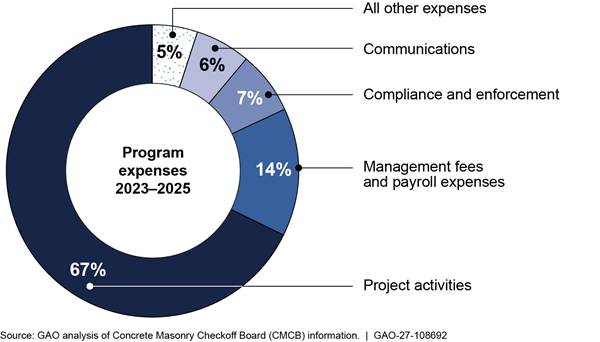
Note: None of the other expenses individually accounted for 5 percent or more of the total. All other expenses include contract labor and consulting, travel, Regional Advisory Committee meetings, and software.
· Project costs include expenses for research, education, and promotion projects approved and funded by CMCB to increase demand for concrete masonry products, according to CMC officials.
· Management fees and payroll expenses include salaries for CMC staff. CMCB allocated approximately 70 percent of the chief executive officer’s salary to program expenses, while it allocated all salaries for other staff to program expenses, such as program directors’ salaries, according to CMC officials.
· Compliance and enforcement include legal and audit fees. Approximately 40 percent of legal fees are allocated to program expenses for reviewing and supporting contracts for research, education, and promotion projects, according to CMC officials.
· Communications expenses include consulting fees to provide administrative and organizational support to CMCB and the chief executive officer and to develop a data infrastructure strategy and policy, according to CMC officials.
CMCB Administrative Expenses, 2023–2025
From 2023 through 2025, CMCB spent nearly $2.4 million on administrative expenses.[11] As shown in figure 2, compliance and enforcement, management fees, communications, and board meetings accounted for 83 percent of the total.
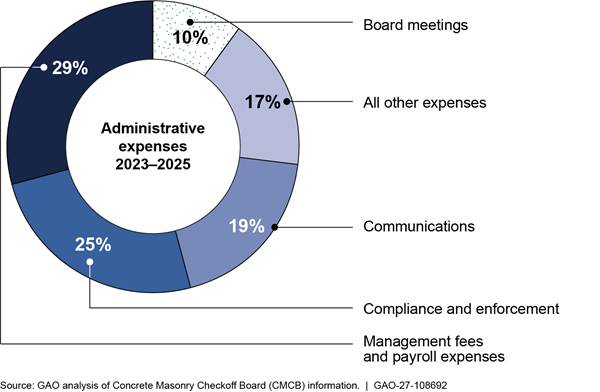
Note: None of the other expenses individually accounted for 5 percent or more of the total. All other expenses include travel, website, insurance, and software.
· Compliance and enforcement expenses include legal and audit fees, approximately 60 percent of which are allocated to administrative expenses, according to CMC officials.
· Management fees include salaries for CMC staff, including approximately 30 percent of the chief executive officer’s salary, and professional fees, such as those for assessment collection and bookkeeping, according to CMC officials.
· Communications expenses include consulting fees to provide administrative and organizational support to CMCB and the chief executive officer and to develop a data infrastructure strategy and policy.
· Board meeting expenses include costs associated with CMCB meetings, which typically include two in-person meetings each year.
|
Limitation on Concrete Masonry Checkoff Board’s Spending The Concrete Masonry Products Research, Education, and Promotion Act of 2018 and accompanying order limit certain spending by the Concrete Masonry Checkoff Board (CMCB). Specifically, starting in fiscal year 2025, CMCB may not expend for administration (except for reimbursement to the U.S. Department of Commerce), maintenance, or functioning of CMCB in a fiscal year an amount that exceeds 10 percent of the assessment and other income received by CMCB for the fiscal year. CMCB complied with the limitation in fiscal year 2025, spending 6.3 percent of the assessment and other income ($11,047,338) on administrative expenses ($690,506). |
Source: GAO analysis of Concrete Masonry Products Research, Education, and Promotion Act of 2018; Concrete Masonry Products Research, Education, and Promotion Order of 2021; and CMCB information. | GAO-27-108692
CMCB Is Tracking Progress Toward Its Objectives and Plans to Complete an Independent Evaluation in Early 2027
CMCB Has Established Program Objectives and Indicators to Track Progress
To support its mission of increasing demand for locally made concrete masonry units, CMCB established objectives that include increasing the market share for concrete masonry block products and demonstrating tangible checkoff value to producers.[12] According to its evaluation program and policies, CMCB plans to invest its assessment funds in projects supporting six focus areas:
· Design assistance: Establish a national resource hub composed of regional technical representatives and eliminate obstacles to the use of concrete masonry.
· Educating design professionals: Establish an educational center targeting architecture, engineering, and contractor communities and university curricula to support the understanding of concrete masonry systems.
· Concrete masonry outreach: Support, cultivate, and expand efforts to recruit and retain a robust labor force across the career spectrum.
· Marketing: Develop and coordinate national and regional initiatives to build interest and awareness and disseminate resources and information.
· Codes and standards: Advance the competitive position of concrete masonry through improvements to building codes, standards, policies, and regulations at the national and regional levels.
· University relations and research: Establish a network of education and research universities in each region that provides leadership in advancing concrete masonry technologies.
Projects Approved in 2024 and 2025
CMCB approved $12.9 million for 86 research, education, and promotion projects in 2024 and 2025 (see table 5). CMCB accepts project proposals twice a year and has established a process for reviewing and approving them (see text box). The CMC program’s public website provides a portal through which interested parties can electronically submit a proposal.[13] Of the 86 approved projects, 17 were national and 69 were regional. Under the order, CMCB must use at least 50 percent of the assessments (less administration expenses) paid by a producer to support projects in the producer’s region. CMC officials told us that 50 of these projects had been completed by the end of 2025.
|
Year approved |
National projects |
Regional projects |
Total projects |
|||
|
|
Number |
Amount (in millions) |
Number |
Amount (in millions) |
Number |
Amount (in millions) |
|
2024 |
8 |
$3.51 |
27 |
$1.73 |
35 |
$5.24 |
|
2025 |
9 |
$3.52 |
42 |
$4.10 |
51 |
$7.62 |
|
Total |
17 |
$7.04 |
69 |
$5.83 |
86 |
$12.86 |
Source: GAO analysis of Concrete Masonry Checkoff Board (CMCB) information. | GAO‑27‑108692
Note: In December 2025, CMCB announced that it had approved $4.8 million for five national projects and 22 regional projects for fiscal year 2026.
|
Concrete Masonry Checkoff Board’s (CMCB) Process for Reviewing Proposals According to CMCB’s compliance policies and officials, the process for reviewing research, education, or promotion project proposals includes the following steps: Step 1. Concrete Masonry Checkoff (CMC) program staff review proposals for completeness and compliance with program requirements and meet with applicants as needed. Step 2. Subject matter experts assess the proposals’ alignment with program goals and summarize their findings. CMC staff review nontechnical proposals, such as promotion and outreach projects, while industry professionals approved by CMCB review technical proposals, such as codes and standards and design assistance projects. Step 3. The National Programs Committee reviews national proposals and the Regional Advisory Committee reviews regional proposals. Each committee ranks the proposals and votes on whether to recommend them for funding. Step 4. CMCB reviews the proposals and votes to fund, not fund, or table them. Step 5. The Department of Commerce reviews CMCB-approved projects and related contracts for compliance with the Concrete Masonry Products Research, Education, and Promotion Act of 2018 and accompanying order and, as appropriate, approves them. |
Source: GAO presentation of Concrete Masonry Checkoff Board (CMCB) information. | GAO‑27‑108692
As shown in table 6, CMCB funded projects in all six focus areas in 2024 and 2025, with the largest amounts going to marketing and design assistance projects.[14] In July 2026, a CMC official told us the board refined its strategic framework by aligning three focus areas—marketing, codes and standards, and educating design professionals—with design assistance to better promote the objective of increasing the adoption of concrete masonry.
|
Focus area |
2024 |
2025 |
||||
|
|
Number |
Amount (in millions) |
Number |
Amount (in millions) |
||
|
Marketing |
3 |
$1.23 |
6 |
$2.52 |
||
|
University relations and research |
11 |
$0.76 |
16 |
$0.63 |
||
|
Codes and standards |
3 |
$0.73 |
4 |
$0.65 |
||
|
Concrete masonry outreach |
4 |
$0.51 |
5 |
$1.07 |
||
|
Educating design professionals |
8 |
$0.67 |
9 |
$0.63 |
||
|
Design assistance |
6 |
$1.34 |
11 |
$2.13 |
||
Source: GAO analysis of Concrete Masonry Checkoff Board (CMCB) data. | GAO‑27‑108692
Key Performance Indicators and Related Goals by Focus Areas
According to its strategic plan, CMCB tracks 27 key performance indicators across the six focus areas to measure the impact of its funded projects and guide long-term growth. According to CMC’s evaluation policies, completed projects produce outputs that are expected to contribute to desired outcomes.
As shown in figure 3, CMCB’s strategic plan established 27 key performance indicators across six focus areas, with four to six indicators for each area. The indicators are output-oriented, and CMCB set a 5-year goal for each one. According to CMC officials, CMCB designed the plan using a “hockey stick” growth model—anticipating relatively limited results during the initial years while programs, resources, relationships, and market engagement are established, followed by substantially greater activity and results in later years. By the end of 2025, after the first year of implementation, a CMCB presentation summarizing the status of its key performance indicators showed the CMC program had met or exceeded five of the goals and achieved at least 20 percent of the target for 10 additional goals.[15]
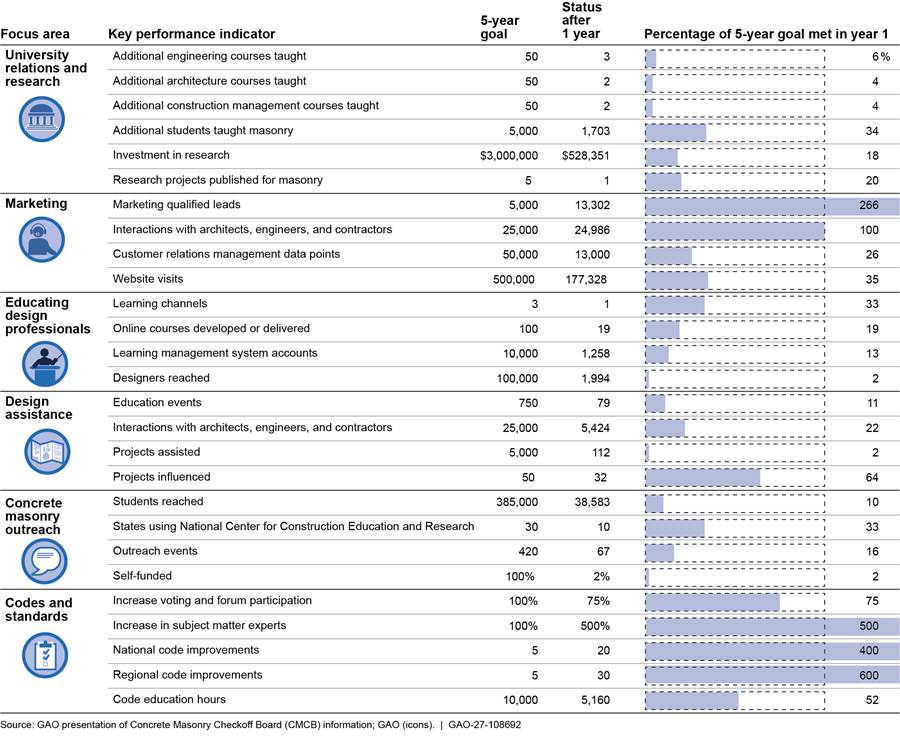
Note: The figure describes CMCB-reported progress; we did not independently verify these data.
In July 2026, a CMC official told us the board updated the key performance indicator framework to better align the CMC program’s activities with the long-term objective of increasing demand for concrete masonry. As such, the six focus areas and related key performance indicators discussed above reflect the framework in place during GAO’s review but not CMCB’s refined strategic and key performance indicator framework put in place in 2026.
Outcome-Oriented Goal for CMC Program
Under its strategic plan, CMCB established a goal of increasing the concrete masonry industry’s market share of the U.S. construction market by 20 percent in 5 years. According to CMCB, the sales volume of concrete masonry products can rise or fall with economic conditions and therefore may not accurately reflect the CMC program’s effectiveness. CMCB considers market share a longer-term outcome indicator that can show trends and progress over an extended period.
CMCB hired a consultant to establish a baseline of the industry’s market share relative to its major competing products: softwood lumber, structural steel, and alternative concrete products, such as tilt-up concrete and insulated concrete forms.[16] The consultant estimated that concrete masonry units accounted for 4.9 percent of the market at the national level in 2024 and between 2.7 percent and 7.4 percent at the regional level.[17] Accordingly, to increase its national market share by 20 percent, CMCB would need to increase its market share from 4.9 percent to approximately 5.9 percent by 2030. However, consistent with its “hockey stick” growth model, CMCB expected growth to be flat during the program’s initial years as project funding began and to increase in later years.
CMCB’s consultant has tracked changes in the market share of concrete masonry units and related economic and construction trends and has periodically reported this information to CMCB and its staff. CMC officials told us that they had not yet determined whether the consultant could develop a methodology to isolate and measure the CMC program’s effect on market share.
CMCB Plans to Complete Its Required Independent Evaluation in Early 2027
According to CMC officials, the board plans to complete its required independent evaluation of the CMC program’s effectiveness in the first quarter of 2027, covering 2024 through 2026. Under the Act and accompanying order, CMCB is required to authorize and fund an independent evaluation of the effectiveness of the CMC program, as administered by the order and other programs and projects performed under the order beginning 5 years after October 5, 2018, and every 3 years thereafter. However, according to CMCB, producers were not required to begin remitting assessments until the second quarter of 2023. As a result, CMCB had not yet begun funding projects when the first evaluation was due later that year.
According to CMC officials, CMCB plans to hire a consultant to conduct the evaluation. They said the evaluation likely will include two metrics aimed at measuring the CMC program’s return on investment. One metric will measure actions taken as a result of the program, and the other will measure changes in demand for concrete masonry products.
Our prior report reviewed eight independent evaluations of USDA checkoff programs, all of which found the programs generated positive returns or benefits.[18] The evaluations used return-on-investment or benefit-cost ratios to assess effectiveness. Although the two measures differ slightly, both compare the financial gain or loss generated by a program with the cost of implementing it. For both measures, the evaluations used industry-specific economic models to determine the economic gains or benefits from the checkoff programs by isolating the impacts of program funding from other variables, such as competing products or changes in consumer income.
For the eight checkoff programs reviewed in the prior report, returns on investment ranged from 2.14 to 17.40. This means evaluations estimated that each dollar invested in the checkoff programs returned between $2.14 and $17.40 in revenue for assessment payers. However, economists we interviewed for the prior report cautioned that the evaluation results should not be compared across programs because evaluation methodologies, data, and product demand differed (see text box below for examples). The economists we interviewed for the prior report and literature we reviewed also suggested that although evaluation results may appear large, promotional spending was small compared to total industry sales.[19] Therefore, the overall impact of promotional activities on the market may be small.[20]
|
Comparison of Two Methodologies Used to Calculate Benefit-Cost Ratios The Softwood Lumber Board’s 2025 independent evaluation found that its checkoff program generated a benefit-cost ratio of $33.54 for every $1 spent in 2025. One of the board’s funded initiatives works with developers and designers to increase the use of softwood lumber in building projects. To calculate the ratio, the evaluation generally (1) estimated the amount of additional lumber used because of the education and expertise the initiative provided; (2) multiplied this total amount of lumber (measured in millions of board feet) by the price of the lumber (per thousand board feet); and (3) divided the total resulting dollar value by the overall checkoff program’s costs. The American Pecan Promotion Board’s 2026 independent evaluation found that the overall checkoff program generated a benefit-cost ratio of $14.1 for every $1 spent over the 4-year evaluation period. To calculate the ratio, the evaluation generally (1) used econometrics to analyze the relationship between the board’s expenditures and both domestic and export demand for U.S. pecans, (2) incorporated the results into an industry-specific simulation model to isolate and measure the checkoff program’s market effects, and (3) divided the model’s estimate of the additional producer net revenue (profit) generated by the program by its costs. |
Source: Douglas C. Adams, Prime Consulting, 2025 Calendar Year: An Independent Evaluation of the Impact of the Softwood Lumber Board (revised Apr. 27, 2026); and Dr. Oral Capps, Jr., Dr. Harry Kaiser, Dr. Gary W. Williams, and Dan Hanselka, Forecasting and Business Analytics, LLC, A Quantitative Analysis and Assessment of the Effectiveness of Marketing Promotion Activities for the U.S. Pecan Industry (Jan. 2026). | GAO‑27‑108692
Commerce Has Established Controls to Oversee the CMC Program but Has an Opportunity to Enhance a Control
Commerce Has Established an Oversight Structure for the CMC Program
Commerce’s primary role in overseeing the CMC program is to ensure that CMCB makes decisions consistent with the Act and accompanying order. Commerce carries out this oversight largely by reviewing and approving CMCB’s policies, procedures, annual budgets, projects, and contracts. The Office of the Under Secretary for Economic Affairs oversees the program, conducts economic analyses, and guides program evaluations.
In setting up its oversight structure, Commerce officials said they consulted with USDA because of its experience overseeing agricultural checkoff programs. USDA has overseen agricultural checkoff programs since 1966 and was overseeing 21 such programs as of July 2026.[21] Similar to USDA, Commerce assigned a staff member to serve as the program lead and work with CMCB to monitor the board’s compliance with the Act and accompanying order. A Deputy Chief Economist supervises the program lead, who obtains technical support from staff attorneys and economists. The Under Secretary of Commerce for Economic Affairs reviews and approves CMCB activities based on information provided by the oversight team.
CMCB must reimburse Commerce fully for its oversight expenses. Commerce officials told us that personnel costs account for most of these expenses. Commerce officials said the agency also incurs overhead costs, such as for travel to CMCB meetings and for technology, legal, administrative, and security expenses. According to CMC data, Commerce’s oversight expenses have increased over time (see table 7). Commerce officials attributed the increase to the agency’s decision to include program overhead costs, beginning in the third quarter of fiscal year 2025. Previously, Commerce requested reimbursement only for the program lead’s salary and benefits.
|
Period |
Amount |
|
October 1, 2023–December 31, 2023 (92 days) |
$68,089 ($740 per day) |
|
January 1, 2024–September 2, 2024 (246 days) |
$198,254 ($806 per day) |
|
October 1, 2024–April 5, 2025 (187 days) |
$154,644 ($827 per day) |
|
April 6, 2025–June 27, 2025 (83 days) |
$87,538 ($1,055 per day) |
|
June 28–September 30, 2025 (95 days) |
$97,751 ($1,029 per day) |
Source: GAO analysis of Concrete Masonry Checkoff Board (CMCB) information. | GAO‑27‑108692
Note: CMCB must fully reimburse Commerce for its oversight expenses. Amounts shown are reimbursements Commerce received for each period. We did not independently verify or validate the data provided by CMC officials.
Commerce Has a Gap in Written Procedures for Some Oversight Responsibilities
Commerce Reviews and Approves Specified CMCB Activities
Commerce is responsible for reviewing and approving CMCB activities involving projects, contracts and agreements, annual budgets, board membership, program objectives and performance metrics, bylaws, and changes to geographic regions (see table 8).
Table 8: Department of Commerce Responsibilities for Approving Concrete Masonry Checkoff Board (CMCB) Activities
|
CMCB activity |
Commerce approval responsibility |
|
Projects |
CMCB must submit for Commerce’s approval any program or project it receives and evaluates or develops on its own initiative, executed under CMCB’s authority. |
|
Contracts and agreements |
CMCB must submit for Commerce’s approval any contract or agreement to develop and carry out programs or projects related to concrete masonry products, executed under CMCB’s authority. |
|
Annual budget |
Before each fiscal year, and during the fiscal year as necessary, CMCB must submit a budget for Commerce’s approval. |
|
Board membership |
Commerce must appoint the initial CMCB members. When vacancies occur, CMCB must submit nominees for Commerce’s appointment. |
|
Program objectives and performance metrics |
Each fiscal year, CMCB must submit for Commerce’s approval its annual research, education, and promotion objectives and performance metrics. |
|
Bylaws |
CMCB must submit for Commerce’s approval bylaws governing its organization and meeting procedures. |
|
Geographic regions |
At least every 3 years, CMCB must review the geographic distribution of its membership. If CMCB determines that a change is warranted, it must submit for Commerce’s approval modifications to its geographic regions and districts. |
Source: GAO analysis of Concrete Masonry Products Research, Education, and Promotion Act of 2018 and Concrete Masonry Products Research, Education, and Promotion Order of 2021. | GAO‑27‑108692
Some Approval Activities Do Not Have Written Procedures
Commerce has developed written procedures for approving four of the seven activities: projects, contracts and agreements, annual budgets, and CMCB membership. The procedures generally identify the activity to be reviewed, the review’s purpose and time frame, the applicable requirements, and the staff involved in the review and approval process.
Commerce has not developed written procedures for approving CMCB’s annual program objectives and performance metrics, bylaws, or changes to geographic regions. Commerce officials said they had not developed written procedures because these actions occur infrequently and can be handled through normal business practices. Commerce documents these approvals through memoranda, emails, or meetings. For example, the program lead consulted Commerce’s chief evaluation officer about CMCB’s objectives and metrics and attended CMCB meetings at which they were discussed.
The Act and accompanying order require CMCB to establish program objectives and performance metrics each fiscal year, subject to Commerce’s approval. These objectives and metrics are intended to help inform producers about the CMC program’s effectiveness. CMCB generally has not revised them annually because its strategic plan establishes 5-year objectives and measures, as discussed above. Consequently, the need for Commerce’s annual review and approval may be limited in practice. Nevertheless, approving the objectives and metrics remains a recurring statutory responsibility, and the Act and accompanying order do not specify the criteria Commerce should apply when making those approvals. For example, Commerce could base its approvals on the evaluation of the types of metrics and availability of reliable data to calculate the metrics.
According to federal internal control standards, management should implement control activities through policies and procedures.[22] Management establishes control activities by documenting in policies what is expected and in procedures the specified actions that implement those policies. Each organizational unit is to document policies and procedures at an appropriate level of detail to allow management to effectively monitor the control activity.
By developing written procedures for approving CMCB’s program objectives and performance metrics, Commerce could make explicit the criteria it will apply, identify which officials and subject matter experts will be involved, and define their respective roles and responsibilities. Such procedures also could reduce the risk of inconsistent approvals over time and preserve organizational knowledge. Finally, Commerce could implement the procedures using its current resources and thereby take advantage of a relatively low-effort opportunity to enhance its existing oversight controls.
Commerce Uses Other Mechanisms to Oversee CMCB’s Compliance
Investigations and Enforcement
Commerce may conduct investigations to determine whether a person has violated the Act, accompanying order, or applicable regulations. It may also assess civil penalties for violations. For example, concrete masonry producers who do not pay assessments may be subject to investigation and potential enforcement action by Commerce or to a civil action in federal court after referral to the Department of Justice. As discussed above, CMCB has referred five producers to Commerce for unpaid assessments since 2023. According to Commerce officials, as of July 2026, the agency was reviewing the five cases to determine whether legal action was warranted and had not taken enforcement action. Commerce officials said the agency was developing written enforcement procedures for the CMC program, modeled on the enforcement process used by USDA for its checkoff programs.
Audits and Ongoing Monitoring
The Act and accompanying order require CMCB to audit its books and records and submit an audit report to Commerce at the end of each fiscal year. In addition, the accompanying order authorizes Commerce to audit the records of people or organizations that have entered into contracts with CMCB but does not require Commerce to conduct such audits. According to Commerce officials, the program lead regularly monitors program and contract execution, typically during weekly meetings with CMCB. Commerce officials told us the agency had not audited any CMCB contractors as of July 2026 but that the Commerce Secretary may request an audit at any time.
Review of Prohibited Activities
As discussed earlier, the accompanying order prohibits CMCB from using its funds, programs, or projects for certain activities, such as influencing legislation, elections, and governmental action, benefiting an individual manufacturer, or engaging in false or misleading advertising. Commerce has established procedures for reviewing CMCB projects and marketing materials for compliance with these prohibitions. For example, Commerce’s policy for reviewing CMCB projects includes guidance for assessing whether proposed projects involve activities prohibited by the order.
Conclusions
The CMC program has the potential to strengthen the concrete masonry industry by supporting research, education, and promotion activities that individual producers may be unable to undertake as effectively on their own. Commerce has established a framework for overseeing the program, but an additional control would enhance its ability to carry out that oversight consistently and effectively. Specifically, Commerce has not developed written procedures for approving CMCB’s program objectives and performance metrics. Establishing such procedures would make explicit the criteria Commerce will apply, identify the officials involved and their respective responsibilities, promote a consistent approval process, and help preserve organizational knowledge over time.
Recommendation for Executive Action
The Secretary of Commerce should develop written policies and procedures for reviewing and approving CMCB’s program objectives and performance metrics. (Recommendation 1)
Agency Comments and Third-Party Views
We provided a draft of this report to CMCB, Commerce, and USDA for review and comment. CMCB provided technical comments, which we incorporated as appropriate. Commerce and USDA did not have any comments on the report.
We are sending copies of this report to the appropriate congressional committees, the Secretary of Commerce, the Chair of the CMCB, Chief Executive Officer of CMC, and other interested parties. In addition, the report is available at no charge on the GAO website at https://www.gao.gov.
If you or your staff have any questions about this report, please contact me at lafountainc@gao.gov. Contact points for our Offices of Congressional Relations and Media Relations may be found on the last page of this report. GAO staff who made key contributions to this report are listed in appendix I.

Courtney LaFountain
Director, Financial Markets and Community Investment
GAO Contact
Courtney LaFountain, lafountainc@gao.gov
Staff Acknowledgments
In addition to the contact named above, Rich Tsuhara (Assistant Director), Chris Ross (Analyst in Charge), Chelsea Carter, LaToya Coleman, Garrett Hillyer, Daniel Horowitz, Jefferey Larson, and Marc Molino made key contributions to this report.
The Government Accountability Office, the audit, evaluation, and investigative arm of Congress, exists to support Congress in meeting its constitutional responsibilities and to help improve the performance and accountability of the federal government for the American people. GAO examines the use of public funds; evaluates federal programs and policies; and provides analyses, recommendations, and other assistance to help Congress make informed oversight, policy, and funding decisions. GAO’s commitment to good government is reflected in its core values of accountability, integrity, and reliability.
Obtaining Copies of GAO Reports and Testimony
The fastest and easiest way to obtain copies of GAO documents at no cost is through our website. Each weekday afternoon, GAO posts on its website newly released reports, testimony, and correspondence. You can also subscribe to GAO’s email updates to receive notification of newly posted products.
Order by Phone
The price of each GAO publication reflects GAO’s actual cost of production and distribution and depends on the number of pages in the publication and whether the publication is printed in color or black and white. Pricing and ordering information is posted on GAO’s website, https://www.gao.gov/ordering.htm.
Place orders by calling (202) 512-6000, toll free (866) 801-7077,
or
TDD (202) 512-2537.
Orders may be paid for using American Express, Discover Card, MasterCard, Visa, check, or money order. Call for additional information.
Connect with GAO
Connect with GAO on X,
LinkedIn, Instagram, and YouTube.
Subscribe to our Email Updates. Listen to our Podcasts.
Visit GAO on the web at https://www.gao.gov.
To Report Fraud, Waste, and Abuse in Federal Programs
Contact FraudNet:
Website: https://www.gao.gov/about/what-gao-does/fraudnet
Automated answering system: (800) 424-5454
Media Relations
Sarah Kaczmarek, Managing Director, Media@gao.gov
Congressional Relations
David A. Powner, Acting Managing Director, CongRel@gao.gov
General Inquiries
[1]Concrete Masonry Products Research, Education, and Promotion Order, 86 Fed. Reg. 51456 (Sept. 15, 2021) (codified at 15 C.F.R. pt. 1500). Checkoff programs have covered agricultural commodities and been overseen by the U.S. Department of Agriculture. The term checkoff refers to the way such programs are funded—an assessment is paid by producers, handlers, processors, importers, or others in the marketing chain for each unit of a commodity sold, produced, or imported. The programs are principally funded by these assessments and do not receive federal appropriations. For additional information, see GAO, Agricultural Promotion Programs: USDA Could Build on Existing Efforts to Further Strengthen Its Oversight, GAO‑18‑54 (Washington, D.C.: Nov. 21, 2017).
[2]The Concrete Masonry Products Research, Education, and Promotion Act of 2018 established the Concrete Masonry Products Board upon approval of a referendum by producers of masonry products. The Board informally refers to itself as the Concrete Masonry Checkoff Board. Commerce appointed the board members in 2022.
[4]GAO, Standards for Internal Control in the Federal Government, GAO‑25‑107721 (Washington, D.C.: May 2025).
[5]Under the Act and accompanying order, mandatory assessments generally apply at the first point of sale to all dry-cast, machine-molded concrete masonry units whose actual width (or bed depth) is 3 inches or greater and that are suitable for use in masonry applications. CMCB began imposing assessments on April 1, 2023, and the first payments were due by the end of August 2023.
[6]Under CMCB’s policy, the fines include one-time late payment charges equal to 10 percent of the assessment, and interest on outstanding balances, including late assessments and late payment charges, at a rate of 1.5 percent per month. The rate of interest and late payment charges on late assessments are specified by the Secretary of Commerce.
[7]The Secretary of Commerce may conduct such investigations as the Secretary considers necessary for the effective administration of the Concrete Masonry Products Research, Education, and Promotion Act of 2018, or to determine whether any person has engaged or is engaging in any act that constitutes a violation of this chapter or any order or regulation issued under the Act. 15 U.S.C. § 8709(a).
[8]CMCB uses the terms “program” and “project” to describe the education, research, and promotion programs it approves and funds with assessments. For our purposes, we use the term “project” to distinguish these activities from the overall CMC program.
[9]According to CMCB’s audited financial statements, CMCB’s policy is to prepare its financial statements on the modified cash basis of accounting—recognizing (1) certain revenues when received rather than when earned and (2) certain expenses and purchases when cash is disbursed rather than when the obligation is incurred.
[10]According to CMCB’s audited financial statements, expenses that can be identified with a program and supporting activity are allocated directly according to their natural expenditure classification. Other expenses are allocated based on estimates of time and effort.
[11]According to CMC officials, certain administrative or operational costs that are directly attributable to specific programs are included within program expenses rather than administrative expenses. As a result, the administrative expense category in the financial statements should not necessarily be interpreted as representing all costs associated with the administration, maintenance, and functioning of CMCB for purposes of the Act’s 10 percent spending limitation (see below text box on CMCB’s spending limitation).
[12]In July 2026, a CMC official told us CMCB adopted a new strategic vision: “Stabilize our position. Grow our share. Expand our future.” The official said CMCB refined its program strategy and performance measures to better align program investments with the objective of increasing the adoption of concrete masonry in construction projects.
[13]According to CMCB program guidelines, applicants submitting proposals must have the requisite background, knowledge, and expertise to manage, execute, and successfully complete proposed projects.
[14]CMCB’s 2024 and 2025 Year in Review reports include summary descriptions of its national and regional research, education, and promotion projects. These reports are available on the CMC website (https://concretemasonrycheckoff.org).
[15]We did not independently verify the data supporting the status of the key performance indicators.
[16]Softwood lumber refers to lumber and products manufactured from conifers, such as pine or spruce. Structural steel is a category of steel used in construction and manufacturing to form the framework of buildings, structures, bridges, and other infrastructure projects that require strength. Tilt-up construction features a series of concrete panels tilted up into place to form a building’s exterior wall. Insulated concrete forms are hollow foam blocks that are stacked into the shape of the exterior walls of a building, reinforced with steel rebar, and filled with concrete.
[17]In its baseline report, CMCB’s consultant estimated the market share of concrete masonry units using a multifaceted approach that combined quantitative and qualitative information from internal industry data, federal government data, and external sources. The consultant also estimated the residential and nonresidential market shares of concrete masonry units at the national and regional levels. We did not independently verify or validate the report’s results.
[19]G.W. Williams, G. Davis, and J.P. Nichols, Check-off Program Evaluation: Why, What, How, When, and Who? Commodity Market Research Report No. CM-2-00 (College Station, Tex.: Texas Agricultural Market Research Center, Texas A&M University, Sept. 2000).
[20]For example, if the CMC program invested $10 million in projects that generated a return on investment of $10 for every $1, the program would have generated $100 million in revenue. The CMCB consultant estimated the size of the concrete masonry product market to be $2.432 billion. Therefore, the program would have increased the market by approximately 4 percent.