
Report to Congressional Committees
United States Government Accountability Office
A report to congressional committees
Contact: Jessica Lucas-Judy at lucasjudyj@gao.gov
What GAO Found
The Internal Revenue Service (IRS) invests in services to help taxpayers meet their tax obligations, such as in preparing and filing tax returns. IRS provides services through its website, telephone assistance, correspondence, and in-person assistance centers. Taxpayer services offer potential benefits, such as increasing tax compliance and reducing taxpayer burden that, if measured, could help inform investment decisions (see figure). Measuring benefits is difficult because of challenges with having sufficient skilled staff and funds to develop data and methodologies for long-term measurement, among others.
Potential Benefits to Consider in Making Taxpayer
Services Investment Decisions 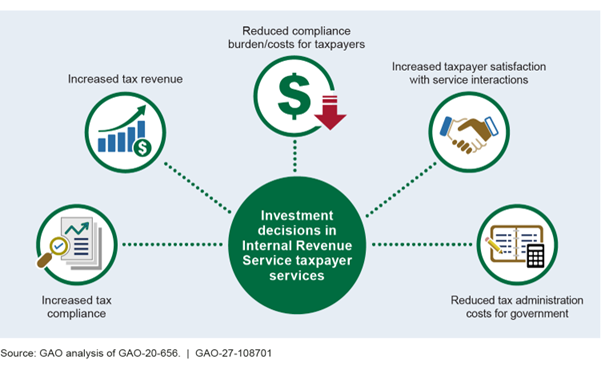
In 2024, IRS called for a reexamination of how its actions—including taxpayer services—affect revenue. IRS has since started a research effort designed to inform investment decisions on services based on their costs and revenues. IRS officials said they have no plans for that research effort to analyze data on other benefits, such as taxpayer satisfaction or burden, although they could do so in the future. In 2007 and 2008, IRS reports had similarly called for more analysis of compliance and revenue benefits to support services investment decisions. Although IRS did not provide documented results from these calls for analysis, GAO identified five IRS studies of how services affected compliance or taxpayer satisfaction. For example, a 2013 study found that lack of satisfaction with services may contribute to noncompliance.
GAO identified 12 studies that measured the benefits of taxpayer services in the national tax administrations of other countries. All these studies cited some positive association between taxpayer services and benefits. For example, two studies in Belgium and in Germany found that customer-oriented service approaches were associated with lower costs to comply for business taxpayers. In addition, some of these and other studies highlighted challenges with measuring benefits similar to those GAO identified.
Why GAO Did This Study
Provisions in what is commonly known as the Inflation Reduction Act of 2022 (IRA) provided funding for IRS to improve various tax administration operations, including the ways it provides services to taxpayers to help them comply with tax requirements. Improving taxpayer services could yield financial and other types of measurable benefits. However, in prior work, GAO found that data to analyze such benefits generally are not readily available.
The IRA includes a provision for GAO to oversee distribution and use of IRA funds. This report describes (1) the challenges that tax administrations face in measuring the benefits of taxpayer service investments; (2) ongoing and planned efforts and past research by IRS to measure the benefits of taxpayer services to inform investment decisions; and (3) the work done in tax administrations in states and other countries to measure the benefits of taxpayer services to inform investment decisions.
GAO summarized studies from a literature search of relevant research and reviewed information that the Federation of Tax Administrators collected by surveying its members on measuring taxpayer service benefits. GAO also interviewed IRS officials and stakeholders such as officials from the Taxpayer Advocate Service, Urban-Brookings Tax Policy Center, and organizations that coordinate with U.S. state and international tax administrations.
No table of contents entries found.
Abbreviations
|
CTR |
Center for Taxpayer Rights |
|
FTA |
Federation of Tax Administrators |
|
IRA |
Inflation Reduction Act of 2022 |
|
IRS |
Internal Revenue Service |
|
OECD |
Organisation for Economic Co-operation and Development |
|
TAS |
Taxpayer Advocate Service |
|
TPC |
Urban-Brookings Tax Policy Center |
This is a work of the U.S. government and is not subject to copyright protection in the United States. The published product may be reproduced and distributed in its entirety without further permission from GAO. However, because this work may contain copyrighted images or other material, permission from the copyright holder may be necessary if you wish to reproduce this material separately.
November 10, 2026
Congressional Committees:
The Internal Revenue Service’s (IRS) stated mission is to “provide America’s taxpayers top-quality service by helping them understand and meet their tax responsibilities and enforce the law with integrity and fairness to all.” IRS serves taxpayers in many ways, including through its in-person Taxpayer Assistance Centers, toll-free telephone assistance, and IRS.gov website.[1] Through these and other service channels, taxpayers can get help in filing a tax return or access their online accounts to learn more about a notice received.[2] Moreover, provisions in what is commonly known as the Inflation Reduction Act of 2022 (IRA) provided funding for IRS to improve various tax administration operations, including how it provides services to taxpayers to help them comply with tax requirements.[3] However, subsequent laws have rescinded or prevented IRS from spending over half the total amount originally appropriated.[4]
Improving taxpayer service could yield financial and other types of measurable benefits.[5] For example, improving services could lower IRS’s administration costs or the taxpayers’ costs to comply with tax requirements. It could also potentially lead to higher voluntary compliance and related tax revenues.
Measurements of the potential benefits of various taxpayer services could help better inform decisions about how to invest federal resources in various IRS taxpayer services.[6] However, as we reported in September 2020, data to analyze such benefits generally are not readily available.[7] As a result, IRS cannot consider all types of issues in a rigorous manner and risks not optimally balancing resources as well as the benefits achieved.[8]
The IRA includes a provision for us to oversee distribution and use of IRA funds.[9] This report describes (1) the challenges that tax administrations face in measuring the benefits of taxpayer service investments; (2) ongoing and planned efforts and past research by IRS to measure the benefits of taxpayer services to inform investment decisions; and (3) the work done in tax administrations in states and other countries to measure the benefits of taxpayer services to inform investment decisions.[10]
To describe the challenges that tax administrations face in measuring the benefits of taxpayer service investments, we analyzed common difficulties identified across multiple sources. Our sources include (1) interviews with IRS officials and stakeholders including those in the Taxpayer Advocate Service (TAS), Center for Taxpayer Rights, and Urban-Brookings Tax Policy Center, and organizations that coordinate with U.S. state tax administrations (Federation of Tax Administrators (FTA)) and international tax administrations (Organisation for Economic Co-operation and Development); (2) reviews of documents provided by the interviewees and identified from a literature search of relevant research, and of our own reports; and (3) a review of results from FTA surveying its members.
To describe ongoing and planned efforts and past research by IRS to measure the benefits of taxpayer services to inform investment decisions, we interviewed IRS officials and reviewed IRS documents, as well as documents identified from our literature search of relevant research, and those recommended or provided by our IRS and stakeholder interviewees.
To describe the work done in other tax administrations to measure the benefits of taxpayer services to inform investment decisions, we reviewed documents identified from a literature search of relevant research, and those recommended by interviewees. To describe the work done in state tax administrations, we also reviewed results that FTA collected by surveying its members on measuring taxpayer service benefits.
We conducted this performance audit from August 2025 to November 2026, in accordance with generally accepted government auditing standards. Those standards require that we plan and perform the audit to obtain sufficient, appropriate evidence to provide a reasonable basis for our findings and conclusions based on our audit objectives. We believe that the evidence obtained provides a reasonable basis for our findings and conclusions based on our audit objectives. Appendix I provides more information on our scope and methodology for each of the three objectives.
Background
IRS and other tax system stakeholders recognize that taxpayer services, along with enforcement programs, are critical to ensuring voluntary tax compliance. To facilitate compliance, IRS provides services for taxpayers to address their tax obligations, such as providing guidance in preparing and filing tax returns. After filing a tax return, a taxpayer may need services to resolve an account issue, such as those involving identity theft and math errors. After filing service interactions and depending on IRS’s further actions on a taxpayer’s account, a taxpayer may also need IRS services to receive a refund or pay any taxes owed. IRS provides these services through what it calls service channels, including IRS.gov, toll-free telephone assistance operations, in-person Taxpayer Assistance Centers, and correspondence (paper-based interactions).[11]
For fiscal year 2026, the IRS 2027 Budget in Brief showed an IRS budget of about $3 billion for taxpayer services.[12] IRS used these funds for services such as telephone assistance in which IRS customer service representatives answered 6.9 million calls as of April 2026.
By considering the costs and benefits of services intended to achieve desired results, federal decision-makers may allocate resources so that federal spending achieves the greatest potential overall benefits. As shown in figure 1, decision-makers can consider several potential benefits of taxpayer services in determining how much to invest in services.[13]
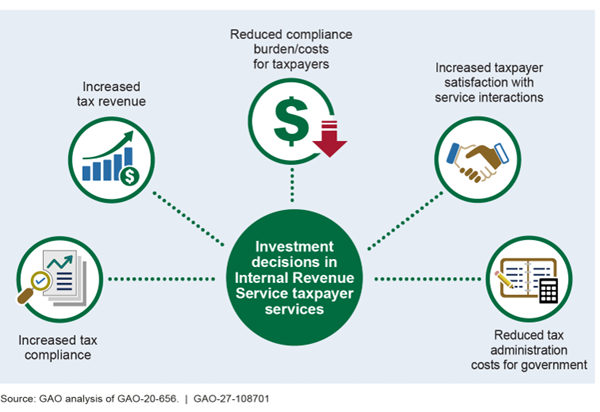
Benefits can also be interrelated. For example, a service investment could not only increase tax compliance but also positively or negatively affect taxpayer burden or satisfaction. In addition, reducing IRS costs for a service may similarly affect taxpayer burden or satisfaction.
Challenges to Measuring the Benefits of Taxpayer Service Investments
Measuring how much any taxpayer service affects one or
more benefits can be difficult, particularly in developing a system or model to
drive investment decisions. Based on our analysis of interviews with officials
and studies we reviewed, we discuss below key challenges to measuring the
benefits of taxpayer service investments.
Maintaining Sufficient Resources over the Longer Term
Tax administrations face the challenge of maintaining sufficient resources (time, money, and skilled staffing) to develop data and related methodologies to measure the benefits of taxpayer services over the longer term when other priorities in the short term may arise. Conducting this work requires time and resources to plan the studies, identify and collect data, and analyze the results. Further, a commitment to use the results to inform investment decisions helps to sustain the measurement efforts.
Understanding Taxpayer Needs and Motivations
Tax administrators face the challenge of understanding taxpayer needs as well as their motivations. Taxpayers may need multiple services to determine their tax obligations as part of what IRS calls a “taxpayer journey,” and the services taxpayers need or are motivated to use will vary between different groups of taxpayers.[14]
When attempting to measure the benefits of taxpayer services, segmenting taxpayer populations is important to understand these benefits across different groups that have different needs. For example, the National Taxpayer Advocate has noted that some vulnerable populations may have difficulties accessing online services compared to other taxpayer segments.[15] However, tax administrators may have difficulties segmenting taxpayer populations as they overlap and contain taxpayers with varying service needs.
Similarly, understanding the motivations of different segments of taxpayers may allow tax administrations to more effectively develop and offer services. For example, taxpayer burden may appear higher for a segment of taxpayers seeking to minimize their tax liabilities by seeking tax incentives. Other taxpayers may value speed and efficiency or seek to meet their tax obligations with minimal human interaction. By contrast, taxpayers with a motivation to evade their obligations may need more than services to enhance compliance, such as enforcement notices or audits that address noncompliance.
Isolating Service Effect on Benefits
Tax administrators also face challenges with isolating the effect of taxpayer services on benefits. Benefits can be affected by many variables, including complex and changing tax laws or regulations or changes in a taxpayer’s financial situation. Similarly, the effect of services on the benefits can be confounded by not knowing whether a taxpayer or group of taxpayers used one or more services and which ones affected benefits. Tax administrations can implement multiple changes during any given time frame that may affect resulting benefits, such as voluntary compliance. Selecting appropriate methodologies would be necessary to control for those variables and isolate the effects of the services to the extent possible.
Developing Reliable, Valid Data Matched to the Methodology
Developing reliable and valid data for the methodologies used to measure the benefits can be challenging. For example, sufficiently and fully accounting for data on taxpayer compliance costs can be difficult. Further, interpreting data when measuring taxpayer satisfaction can be confounded by low response rates on surveys. To measure the effects of one or more services on compliance requires collecting reliable data (or a valid proxy) over a period of time, and the data may not be readily available. The data would need to associate any changes in voluntary compliance with those services and with some acceptable degree of confidence. In addition, it can be difficult to obtain a large enough sample size to collect reliable data, and samples may not be representative of the broader taxpayer population. Moreover, surveys and audits may not sufficiently estimate compliance to evaluate the effects of services.
Balancing Measures for Service Effects on Benefits
Tax administrators have multiple benefits to consider in measuring and investing in services, and balancing these measures can be difficult. The benefit measures are not easily comparable and may be a mix of qualitative and quantitative data. Some relate to the taxpayer whereas others relate to the tax administration, which creates a challenge when trying to balance them. Most of the research that we reviewed that measured the benefits of taxpayer services measured voluntary compliance. But other benefits, such as taxpayer satisfaction, reducing taxpayer burden, or reducing tax administration costs, are important to consider. Tax administrators have an obligation to help taxpayers meet their tax obligations. For example, when evaluating the service performance to ensure balance, IRS policy directs that management consider customer satisfaction, employee satisfaction, and business performance results.[16]
IRS Has Ongoing and Planned Efforts and Past Research to Measure Some Benefits of Certain Services to Inform Investment Decisions
IRS’s Ongoing Planned Effort to Measure Revenue from Services to Inform Investment Decisions Does Not Yet Include Other Benefits
We found that IRS did not yet have a comprehensive system to collect and analyze data to measure benefits across taxpayer services for informing decisions to maximize benefits of investments in services. However, in 2024, an IRS publication called for re-examining revenue estimates for IRS funding and return-on-investment, including the potential effects of services on tax revenue. It also stated that empirical support for the effect of taxpayer services on compliance rates is robust as evidenced by multiple studies. The publication cited two studies as examples.[17] Although the 2024 publication did not propose a plan for research, it called for a broader perspective on the revenue effects of IRS investments. Those included the effects of service on compliance not captured by the IRS’s existing methodology for estimating revenue effects from enforcement efforts.[18]
IRS has since started a research effort to measure service effects on revenue. Because the effort was still in its initial stages as of August 2026, available documentation to describe it was limited to a draft paper dated July 2026, and presentation slides with notes dated June 2025. The documentation stated that this effort is designed to help make investment decisions in services and that the effort is consistent with the 2024 IRS publication on re-examining revenue estimates for IRS funding and return-on-investment.
Based on our review of the available documents and discussions with IRS officials, the research effort is designed to create a dataset that will allow IRS to determine and compare its administrative costs associated with voluntarily filed individual income tax returns to their related tax payments. These costs are to include those for interacting with taxpayers to provide services, along with other costs such as for processing or reviewing tax return information.
According to the IRS research documents, the focus for the dataset is a tax return for a given tax year. For each tax return, IRS is to associate taxpayer contacts with IRS and IRS actions taken on the return with their related administrative costs.[19] The cost data for the tax return are updated as additional taxpayer and IRS interactions occur and continue until IRS takes no additional actions. Finally, IRS is to associate with the tax return the amount of tax voluntarily paid.[20]
IRS officials told us this research effort is also designed to help inform how IRS can make investment decisions on services based on the related costs and revenues. According to IRS officials, the effort is in an early stage and may take some time to finish due to various reasons, such as data challenges and loss of IRS staff. IRS officials also noted that staffing may be a challenge because a limited number of individuals have the skill set needed for such complex research. IRS officials said they have not determined the timeline for completing the research and using the results to make service investment decisions.
We asked IRS officials if they had any ongoing efforts or plans to similarly measure its administrative costs compared with other benefits of service beyond revenue, to include taxpayer satisfaction and taxpayer burden. They said that IRS has ongoing efforts to measure some taxpayer services, such as through burden studies and satisfaction surveys.[21] The taxpayer burden studies are ongoing, and IRS’s post-filing burden study was paused during COVID-19, but is restarting as of August 2026, according to IRS officials. Also, as we reported in July 2025, IRS’s ongoing data analysis project included information on taxpayer effort or burden associated with various taxpayer service journeys.[22] Officials said that taxpayer satisfaction and burden measurement data could be added later to round out the return-on-investment data. As of August 2026, IRS had no documented plans to do this work so that such measures could be used along with revenue measures to provide balanced benefits information for investment decisions in various types of services.
IRS Had Previously Called for Measuring Service Effects on Compliance and Revenue and Studied Some Benefits of Certain IRS Services
In addition to the 2024 publication, we identified two IRS research reports over the past 20 years that called for more data collection and analysis of compliance and revenue benefits to support investment decisions, including for services:
· In 2007, a research paper proposed that IRS have short- and long-term plans for research to estimate the direct and indirect benefits of taxpayer service and enforcement operations.[23] According to the paper, the estimates would allow IRS to cost effectively allocate resources to operations and maximize the net benefits of its activities.[24]
· In 2008, IRS received a contracted research report on measuring the indirect effects of taxpayer services and enforcement on taxpayer compliance.[25] The report stated that understanding how service and enforcement activities affect compliance would significantly benefit IRS by allowing resource allocations to be based on evidence rather than judgments about effects. It also stated that IRS was beginning long-range research to further IRS’s understanding of how its services influenced compliance.
We asked IRS officials what resulted from these calls for research on the compliance and revenue benefits of services to inform investment decisions. IRS did not provide documentation of such research having been completed or research results used to make investment decisions.
Our literature search identified five IRS studies that analyzed data to measure the benefits of IRS taxpayer services.[26] All the studies were one-time efforts to assess any links between certain types of services and benefits rather than ongoing efforts to quantify the benefits generated by investments in services.
Four of the five studies measured the relationship between types of services and voluntary compliance.[27]
· One of these four studies included telephone services among other types of service channels.[28]
· Two of these four studies addressed how correspondence affects compliance.[29]
The four studies reported various effects that services had on compliance. Below are some examples of study conclusions:
· A lack of satisfaction with services may contribute to noncompliance.[30] This study compared taxpayers in a high-compliance group with a low-compliance group. Taxpayers in the low-compliance group were more likely to say (1) IRS does not offer the services they need, (2) it is difficult to access IRS services, and (3) they had greater dissatisfaction with IRS service quality.
· Taxpayers who received services had higher accuracy on selected tax return items studied than taxpayers who did not receive services, although the difference was not statistically significant.[31] The study was intended to compare the results among several types of service channels (e.g., telephone, in-person, tax forms and publications, and online), but low-service usage rates did not allow for accurate comparisons between the types.
· The most effective way to encourage certain taxpayers to file a tax return included a short letter reminding them to file, along with information on how to access IRS’s website and toll-free telephone number for assistance.[32] This result was based on an IRS pilot test study of alternative outreach to taxpayers to promote voluntary filing compliance among those who had failed to file their previous year’s tax return.
The remaining study did not measure compliance benefits but rather focused on how services affected taxpayer satisfaction.[33] Specifically, it compared taxpayer satisfaction levels across various types of service channels used and reported that taxpayers were less satisfied with telephone assistance than using the IRS website or an in-person Taxpayer Assistance Center.
Research Has Generally Found Benefits from Investing in Selected Service in Other Tax Administrations
Based on information obtained through interviews with officials and documents we reviewed about other national tax administrations and state tax administrations, we found no mention of any tax administrations that have a comprehensive system in place to collect and analyze data to estimate benefits across taxpayer services to inform decisions that would maximize benefits for the investments made in services. However, the research we reviewed of other national tax administrations generally found positive benefits of investments in taxpayer services. For example, although the research we reviewed generally indicated that taxpayer services produced compliance benefits, we found no evidence in the research that showed how the other nations used the service effects on the compliance benefit to support investment decisions in allocating resources to different services.[34]
We identified 12 studies that measured the benefits of taxpayer services investments in the national tax administrations of other countries.[35] These studies represent nine countries across North America, Europe, Asia, and Africa. The most frequently represented country in these studies is Indonesia, with four studies coming from the country.
Of the 12 studies, nine attempted to measure how taxpayer services affected voluntary compliance.[36] Beyond measuring service effects on compliance, across all 12 studies, two measured taxpayer satisfaction, three measured tax revenue, two measured taxpayer burden/costs, and one measured tax administration costs for government.[37]
In addition, all 12 studies cited some results demonstrating a positive relationship between taxpayer services and one or more benefits. For example, two studies in Belgium and Germany found that customer-friendly or customer-oriented service approaches were associated with cost reductions for business taxpayers to comply.[38]
The nine studies that measured voluntary compliance effects included a variety of services. For example, a study in China created an aggregate measure for service quality based on several indicators and measured a positive association between service quality and compliance.[39] These nine studies measuring effects on tax compliance covered one or more taxpayer services. For example,
· Five of the studies were conducted at an in-person service center or had at least one indicator involving in-person services.[40]
· Four of the studies involved online services, three of which included electronic filing systems.[41]
· Two of the studies included indicators related to telephone service.[42]
· One of the studies considered taxpayer services generally and did not identify any specific type of service.[43]
Some of these and other studies we reviewed of other national tax administrations cited challenges similar to those we identified, such as developing reliable, valid data. In addition, some of the studies raised concerns about the applicability of one country’s tax system to others. For example, some studies mentioned the effect of trust and perceptions of the tax administration on taxpayers’ voluntary compliance, which can vary across countries. Similarly, one study of the U.S. tax system said that it is difficult to measure compliance with survey data because taxpayers are unlikely to confess to noncompliance.
Based on a summary of survey results that Federation of Tax Administrators (FTA) officials provided to us, some state tax administrators described efforts to measure taxpayer satisfaction with services, but not other benefits.[44] One state official reported measuring revenue collections compared to tax administration expenditures, but not specific to services. The challenges in measuring the benefits of taxpayer services that state tax administrators mentioned generally aligned with those that we identified through other sources, such as maintaining resources to study the benefits of taxpayer services.
Agency Comment
We provided a draft of this report to the Secretary of the Treasury for IRS review and comment. IRS provided written technical comments which we incorporated as appropriate.
We are sending copies of this report to the appropriate congressional committees, the Secretary of the Treasury, responsible IRS officials, and other interested parties. In addition, the report is available at no charge on the GAO website at https://www.gao.gov.
If you or your staff have any questions about this report, please contact me at lucasjudyj@gao.gov. Contact points for our Offices of Congressional Relations and Media Relations may be found on the last page of this report. GAO staff who made key contributions to this report are listed in appendix II.

Jessica Lucas-Judy
Director, Tax Issues
Strategic Issues
List of Committees
The Honorable Mike Crapo
Chairman
The Honorable Ron Wyden
Ranking Member
Committee on Finance
United States Senate
The Honorable Rand Paul, M.D.
Chairman
The Honorable Gary C. Peters
Ranking Member
Committee on Homeland Security and Governmental Affairs
United States Senate
The Honorable Bill Hagerty
Chair
The Honorable Jack Reed
Ranking Member
Subcommittee on Financial Services and General Government
Committee on Appropriations
United States Senate
The Honorable James Comer
Chairman
The Honorable Robert Garcia
Ranking Member
Committee on Oversight and Government Reform
House of Representatives
The Honorable Jason Smith
Chairman
The Honorable Richard Neal
Ranking Member
Committee on Ways and Means
House of Representatives
The Honorable Dave Joyce
Chairman
The Honorable Steny Hoyer
Ranking Member
Subcommittee on Financial Services and General Government
Committee on Appropriations
House of Representatives
In this report, we describe (1) the challenges that tax administrations face in measuring the benefits of taxpayer service investments; (2) ongoing and planned efforts and past research by the Internal Revenue Service (IRS) to measure the benefits of taxpayer services to inform investment decisions; and (3) the work done in tax administrations in states and other counties to measure the benefits of taxpayer services to inform investment decisions.[45]
For all three of these areas, we reviewed documents from a literature review of relevant research, and documents provided by officials we interviewed, including stakeholders in the Taxpayer Advocate Service, Center for Taxpayer Rights (CTR), and Urban-Brookings Tax Policy Center (TPC). We selected these organizations on the basis of studies or reports that they had published on tax administration, including the topic of taxpayer services.[46] In addition, we searched databases such as Scopus, ProQuest Sociology Collection, and EBSCO Business Abstracts with Full Text, to identify studies of services and related benefits published in the past 20 years. The search terms included tax administration; taxpayer or customer service; and benefits or outcomes. We also searched annual IRS Research Conference papers and National Taxpayer Advocate reports. We also interviewed officials and reviewed requested documents from organizations that coordinate with U.S. state tax administrations (Federation of Tax Administrators (FTA)) and international tax administrations (Organisation for Economic Co-operation and Development).
We reviewed these documents and excluded theoretical studies, non-governmental simulations or experiments, or those examining taxpayer needs and preferences.[47] From the 65 studies in our literature review, we identified 25 studies that measure the benefits of one or more taxpayer services; 17 of which were studies of other countries’ tax administrations and eight were studies of IRS. Our expert staff reviewed these studies and determined that of the 17 studies of other tax administrations and the eight studies of IRS, five and three studies, respectively, did not meet our quality review standards for methodological rigor to report on them. We provided a preliminary list of taxpayer services studies and IRS officials did not identify additional IRS studies that measured the benefits of services.
We analyzed these studies to summarize reported effects on the five benefits in our review (tax administration costs, taxpayer satisfaction, taxpayer burden, voluntary tax compliance, and tax revenue) in the service channels identified, including in-person services, telephone service, tax forms and publications, correspondence, and online services.
To describe the challenges in measuring the benefits of taxpayer service investments, we analyzed common difficulties identified across multiple sources. Our sources include (1) interviews with IRS officials, other knowledgeable stakeholders, and organizations that coordinate with state and international tax administrations cited above; (2) reviews of documents provided by the interviewee sources and all studies identified from our literature search, and our own reports; and (3) a review of summary survey results from FTA.
We provided IRS with a list of challenges in measuring the benefits of taxpayer services that we identified from interviews and reviews of documents. We asked IRS to review the challenges we identified in measuring the benefits of taxpayer services. Beyond feedback on one challenge, IRS officials said they did not have feedback on the other challenges we identified, as of August 2026.
To describe ongoing and planned IRS efforts and past research to measure the benefits of taxpayer services to inform investment decisions, we interviewed IRS officials and reviewed IRS documents, as well as documents identified from our literature search, and those recommended or provided by our IRS and stakeholder interviewees.
To describe the work done in other tax administrations to measure the benefits of taxpayer services to inform investment decisions, we reviewed documents identified from our literature search, and those recommended by interviewees.[48] To describe the work done in state tax administrations, we reviewed a summary of responses to a June 2026, survey of FTA members on measuring taxpayer services benefits. FTA officials developed, administered, and summarized the results of its member survey in response to our query about any state tax administrations’ practices and challenges to measure the benefits of taxpayer services investments. FTA’s members include the principal tax administrators of the states, the District of Columbia, and three municipalities.
We conducted this performance audit from August 2025 to November 2026, in accordance with generally accepted government auditing standards. Those standards require that we plan and perform the audit to obtain sufficient, appropriate evidence to provide a reasonable basis for our findings and conclusions based on our audit objectives. We believe that the evidence obtained provides a reasonable basis for our findings and conclusions based on our audit objectives.
GAO Contact
Jessica Lucas-Judy, lucasjudyj@gao.gov
Staff Acknowledgments
In addition to the contact named above, Tom Short (Assistant Director), Ronald W. Jones (Analyst-in-Charge), Jackson Young (Analyst), Michael Bechetti, John Bornmann, Jieun Chang, Rob Gebhart, Rachael Johnson, Sheila R. McCoy, Deirdre Sutula, and Crystal Wesco made key contributions to this report.
The Government Accountability Office, the audit, evaluation, and investigative arm of Congress, exists to support Congress in meeting its constitutional responsibilities and to help improve the performance and accountability of the federal government for the American people. GAO examines the use of public funds; evaluates federal programs and policies; and provides analyses, recommendations, and other assistance to help Congress make informed oversight, policy, and funding decisions. GAO’s commitment to good government is reflected in its core values of accountability, integrity, and reliability.
Obtaining Copies of GAO Reports and Testimony
The fastest and easiest way to obtain copies of GAO documents at no cost is through our website. Each weekday, GAO posts on its website newly released reports, testimonies, and correspondence. You can also subscribe to GAO’s email updates to receive notification of newly posted products.
Connect with GAO
Connect with GAO on X,
LinkedIn, Instagram, and YouTube.
Subscribe to our Email Updates. Listen to our Podcasts.
Visit GAO on the web at https://www.gao.gov.
To Report Fraud, Waste, and Abuse in Federal Programs
Contact FraudNet:
Website: https://www.gao.gov/about/what-gao-does/fraudnet
Automated answering system: (800) 424-5454
Media Relations
Sarah Kaczmarek, Managing Director, Media@gao.gov
Congressional Relations
David A. Powner, Acting Managing Director, CongRel@gao.gov
General Inquiries
[1]IRS uses the terms taxpayer service and customer service interchangeably in referring to these operations.
[2]For more information on IRS’s service channels, see GAO, Taxpayer Service: IRS Could Improve the Taxpayer Experience by Using Better Service Performance Measures, GAO‑20‑656 (Washington, D.C.: Sept. 23, 2020).
[3]Pub. L. No. 117-169, § 10301, 136 Stat. 1818, 1831-1833 (2022).
[4]See, for example, Fiscal Responsibility Act of 2023, Pub. L. No. 118-5, § 251, 137 Stat. 10, 30-31; Further Consolidated Appropriations Act, 2024, Pub. L. No. 118-47, div. B, tit. VI, § 640, div. D, tit. V, § 530, 138 Stat. 460, 572, 708; Continuing Appropriations and Extensions Act, 2025, Pub. L. No. 118-83, § 115, 138 Stat. 1524, 1527 (2024); and Consolidated Appropriations Act, 2026, Pub. L. No. 119-75, § 528, 140 Stat. 173, 321.
[5]In this report, the term benefit does not refer to tax benefits such as credits or deductions that can be claimed on a tax return. Rather, it is similar to its use in economic cost-benefit evaluations of federal government activities to compare the social costs and social benefits associated with those activities. For more information, see appendix III in GAO, Tax Gap: IRS Could Significantly Increase Revenues by Better Targeting Enforcement Resources, GAO‑13‑151 (Washington, D.C.: Dec. 5, 2013).
[6]According to Congressional Budget Office and IRS documents, measurements of IRS tax administration investments benefits focus on enforcement operations and their effects on tax revenue gains.
[7]GAO‑20‑656 discusses these benefits as important issues IRS could consider in allocating resources. Our prior work reviewed IRS’s efforts to improve services in terms of their effects on the taxpayer experience, which is generally the public’s perceptions of and overall satisfaction with interactions with IRS’s products or services. Also, in July 2025, we reported that although IRS had been implementing a strategy including over 150 projects to improve taxpayer services with IRA funds, IRS had not fully established an evidence-based approach to determine the effects of these efforts on the taxpayer experience (see GAO, Taxpayer Experience: IRS Should Fully Establish Its Approach for Using Evidence to Assess Service Improvement Results, GAO‑25‑107408 (Washington, D.C.: July 17, 2025).
[8]Therefore, we recommended in GAO‑20‑656 that IRS develop processes for using performance results on the taxpayer experience as part of resource allocation decisions intended to improve performance. As of August 2026, IRS had not fully implemented this recommendation, in large part because IRS had not established performance goals with measures and targets for experience. Without that performance information, IRS cannot analyze the gap between actual and target performance for taxpayer experiences and identify actions to improve the experience to target levels. Furthermore, IRS said it plans to take action in fall 2026 on our GAO‑25‑107408 recommendation that IRS fully establish an evidence-based approach to determine whether and how improvements to services affect the taxpayer experience.
[9]Pub. L. No. 117-169, § 70004, 136 Stat. 1818, 2087 (2022).
[10]In this report, our references to efforts to measure taxpayer service benefits include ongoing efforts to measure service benefits as well as published research studies.
[11]IRS’s website services include those that are “authenticated” (where a taxpayer logs on to obtain service through an online account or tools like “Where’s My Refund?”) and those that are “non-authenticated” (where a taxpayer accesses general tax information or uses open access tools like the “Tax Withholding Estimator”).
[12]For comparison, IRS had a budget of about $5 billion for enforcement activities in fiscal year 2026.
[13]Other benefits may exist. The benefits in figure 1 come from our work and related recommendation that IRS develop processes for using performance results on the taxpayer experience as part of resource allocation decisions intended to improve performance (see GAO‑20‑656).
[14]A taxpayer journey is a taxpayer’s experience with service channels that could include a series of interactions. For example, when filing a return, taxpayers could access forms and publications, call IRS for assistance, and then access their online account. For more information on how IRS defines taxpayer journeys and examples of them see GAO‑25‑107408.
[15]According to the National Taxpayer Advocate, vulnerable populations include low-income individuals, seniors, those with disabilities, and those with limited English proficiency. See “Taxpayers’ Varying Abilities and Attitudes Toward IRS Taxpayer Service: The Effect of IRS Service Delivery Choices on Different Demographic Groups,” in National Taxpayer Advocate 2016 Annual Report to Congress v. 2, TAS Research and Related Studies (2016).
[16]Internal Revenue Manual § 1.5.5.4(6).
[17]Return on Investment: Re-Examining Revenue Estimates for IRS Funding, IRS Publication 5901 (February 2024). We did not review either of the two studies (one whose authors included IRS research office employees) as part of our search for studies that measured the benefits of taxpayer service investments. As of August 2026, IRS had not provided copies of any IRS studies that measured the benefits of taxpayer services investments.
[18]According to the publication, IRS’s methodology included only direct revenue (including payments received related to enforcement action) and revenue protected (stopping illegitimate refund claims before the refund is issued).
[19]According to IRS officials, IRS’s tracking of service interactions with taxpayers is limited to those for a filed tax return in which the taxpayer is authenticated. Therefore, the dataset will not include interactions where the taxpayer is not authenticated or that precede the filing of a return, such when a taxpayer accesses generally available tax information on IRS’s website to get assistance in completing a return to be filed.
[20]The payment data are from IRS’s Compliance Data Warehouse, data on the various contacts with the taxpayer are from IRS’s CX (or Customer Experience) Analytics data, and the cost data are from IRS’s Office of Chief Financial Officer cost-accounting calculations of IRS activities.
[21]IRS has ongoing efforts to collect and analyze measures data related to taxpayer satisfaction and compliance burden for some services, but these efforts are not intended to measure the benefits of service improvements or link service results to investment decisions. For example, to identify opportunities to improve services and taxpayer satisfaction, IRS collects customer satisfaction survey data from taxpayers who use online accounts or call IRS for assistance. Also, IRS surveys taxpayers to measure their burden in estimated time and money spent preparing tax returns. Such data are collected to comply with the Paperwork Reduction Act.
[22]See GAO‑25‑107408 for a discussion of this project called the Customer Experience Analytics Visualization Tool.
[23]Alan H. Plumley, “A Framework for Optimal Tax Administration,” The IRS Research Bulletin, IRS Publication 1500 (2007). The author was an IRS employee and IRS Publication 1500 contains papers presented at the annual IRS Research Conference. These papers are generally presented with the qualification that the opinions and views presented are those of the authors. Our work included analysis of tax administration literature we identified in our search for relevant research.
[24]According to the paper, direct and indirect effects are distinguished by whether IRS is in contact with the affected taxpayer. The indirect effect of IRS’s taxpayer services activities is improved voluntary compliance in the general population, while the indirect effect of enforcement activities includes the deterrent effect of IRS’s enforcement activities on taxpayers not subjected to enforcement.
[25]IBM, Measuring the Indirect Effects of Services and Enforcement on Taxpayer Compliance Final Report (produced for IRS under Contract TIRNO-08-K-00292) (Dec. 3, 2008).
[26]Anne Herlache, Mary Clair Turner, Crystal Hall, and Elizabeth Bell, "Increasing Take-up of the American Opportunity Tax Credit," The IRS Research Bulletin, IRS Publication 1500 (2022); Anne Herlache, Ishani Roy, Alex Turk, and Stacy Orlett, "Enforcement Versus Outreach–Impacts on Tax Filing Compliance," The IRS Research Bulletin, IRS Publication 1500 (2020); Mike Nestor, Jeff Wilson, and Carol Hatch, “A Further Exploration of Taxpayers’ Varying Abilities and Attitudes Toward IRS Options for Fulfilling Common Taxpayer Service Needs,” National Taxpayer Advocate Annual Report to Congress (Vol. 2), TAS Research and Related Studies & Literature Reviews, IRS Publication 2104-B (2017); Tom Beers, Eric LoPresti, and Eric San Juan, "Factors Influencing Voluntary Compliance by Sole Proprietors: Preliminary Survey Results," Tax Administration at the Centennial: An IRS-TPC Research Conference, IRS Research Bulletin (2013); and Kathleen Holland and Howard Rasey, “Lab Research on Customer Preferences and the Relationship Between Service and Compliance,” The IRS Research Bulletin, IRS Publication 1500 (2007). We identified these studies in our literature search. The studies were authored by at least one researcher who was an IRS employee, including two studies by Taxpayer Advocate Service staff. Four of the studies were from annual IRS Research Conference presentations which generally include the qualification that the opinions and views presented are those of the authors. We identified three additional potential studies but removed them from further consideration as they did not meet our quality review standards for methodological rigor.
[27]Herlache, Turner, Hall, and Bell, “Increasing Take-up;” Herlache, Roy, Turk, and Orlett, “Enforcement Versus Outreach;” Beers, LoPresti, and San Juan, “Factors Influencing Voluntary Compliance;” and Holland and Rasey, “Lab Research on Customer Preferences.”
[28]Holland and Rasey, “Lab Research on Customer Preferences.”
[29]Herlache, Turner, Hall, and Bell, “Increasing Take-up;” and Herlache, Roy, Turk, and Orlett, “Enforcement Versus Outreach.”
[30]Beers, LoPresti, and San Juan, “Factors Influencing Voluntary Compliance.”
[31]Holland and Rasey, “Lab Research on Customer Preferences.”
[32]Herlache, Roy, Turk, and Orlett, “Enforcement Versus Outreach.”
[33]Nestor, Wilson, and Hatch, “Further Exploration.”
[34]Beyond the increased tax compliance benefit, other benefits include increased tax revenue, reduced taxpayer burden/costs, increased taxpayer satisfaction, and reduced costs for government. See figure 1.
[35]Ronghui Zhou, Zhi Liu, and Xuan Li, "How the digital economy moderates the relationship between tax services and tax compliance: A Study based on provincial panel data in China," Current Psychology, Vol. 44 (2025): 12158-12171; Umale Okoh, Philip Jehu, and Mohammed Yusuf Alkali, "Connectivity between Electronic Services, Taxpayers’ Support and Tax Administration Performance," Journal of Information & Knowledge Management, Vol. 23, no. 02 (2024): 2450002; Abdurrahman Rahim Thaha, Rita Purnamasari, and Aji Fajar Suryo Antoro, "Taxpayer Satisfaction Transformation: A Text Mining Analysis of Service Delivery at Jakarta’s Tax Offices," Journal of Tax Reform,, Vol. 10. no. 03 (2024): 441-458; Neni Meidawati and Nanindyas Dewi Waluristyaningtyas, "Analysis of the factors affecting taxpayer compliance," Jurnal Akuntansi dan Auditing Indonesia, Vol. 27. no. 02 (2023): 160-171; Michelle Kahenda Vita and Stephen Makau Muathe, "The Role of Technology Adoption, Tax Base Expansion, Taxpayers' Education, Customer Service, and Strategy Communication on the Organizational Performance of Kenya Revenue Authority," International Journal of Organizational Leadership, Vol. 12, no. 03 (2023): 277-294; Oronde Small and Leanora Brown, "Taxpayer Service Provision and Tax Compliance: Evidence for Large Taxpayers in Jamaica," Public Finance Review, Vol. 48, no. 2 (2020): 250-277; Rusdi Hidayat N, "Taxpayer Compliance Index Business Field Based on Quality of Taxpayer Services, Regional Tax Regulations, Level of Satisfaction and Attitude of Taxpayers Use Structural Equation Modeling," International Journal of Civil Engineering and Technology, Vol. 10, no. 2 (2019): 803-813. Dyah Sawitri, Sukma Perdana, Umi Muawanah, and Kohar Adi Setia, "The Influence of Tax Knowledge and Quality of Service Tax Authorities to the Individual Taxpayer Compliance through Taxpayer Awareness," International Journal of Economic Research, Vol. 14, no. 12 (2017): 217-235; Jingnan (Cecilia) Chen and Shaun Grimshaw, “The effect of HMRC Taxpayer Assistance on compliance: An experimental investigation,” a technical paper prepared for the National Audit Office, U.K.: National Audit Office (December 2017); Stewart Kettle, Marco Hernandez, Simon Ruda, and Michael Sanders, "Behavioural Interventions in Tax Compliance: Evidence from Guatemala," IRS Research Bulletin (2015); Sebastian Eichfelder and Chantal Kegels, "Compliance costs caused by agency action? Empirical evidence and implications for tax compliance," Journal of Economic Psychology, Vol. 40 (2014): 200-219; and Sebastian Eichfelder, Chantal Kegels, and Michael Schorn, "Tax Compliance Costs: the Effect of Authority Behavior and Taxpayer Services," IRS Research Bulletin: Recent Research on Tax Administration and Compliance: Selected Papers Given at the 2010 IRS Research Conference (2010). We identified five additional potential studies but removed them from further consideration as they did not meet our quality review standards for methodological rigor.
[36]Zhou, Liu, and Li, “How the digital economy,” 12158-12171; Okoh, Jehu, and Alkali, “Connectivity between Electronic Services,” 2450002; Meidawati and Waluristyaningtyas, “Analysis factors affecting taxpayer compliance,” 160-171; Vita and Muathe, “The Role of Technology Adoption,” 277-294; Small and Brown, “Taxpayer Services Provision,” 250-277; Hidayat N, “Taxpayer Compliance Index,” 803-813; Sawitri, Perdana, Muawanah, and Setia, “The Influence of Tax Knowledge,” 217-235; Chen and Grimshaw, “Effect of HMRC Taxpayer Assistance;” and Kettle, Hernandez, Ruda, and Sanders, “Behavioural Interventions.” Some of these studies measured a benefit in addition to voluntary compliance.
[37]Okoh, Jehu, and Alkali, “Connectivity between Electronic Services,” 2450002; Thaha, Purnamasari, and Antoro, “Taxpayer Satisfaction Transformation,” 441-458; Vita and Muathe, “The Role of Technology Adoption,” 277-294; Hidayat N, “Taxpayer Compliance Index,” 803-813; Kettle, Hernandez, Ruda, and Sanders, “Behavioural Interventions;” Eichfelder and Kegels, “Compliance costs caused,” 200-219; and Eichfelder, Kegels, and Schorn, “Tax Compliance Costs.” Organisation for Economic Co-operation and Development officials provided us published survey data on whether tax administrations collect data on taxpayer satisfaction and taxpayer burden. As we noted earlier, IRS collects such data.
[38]One study (Eichfelder, Kegels, and Schorn, “Tax Compliance Costs”) was conducted in Belgium and Germany and found that a positive rating for the service orientation of the German tax and the German social insurance administration results on average in a cost reduction of about 30 percent. The other study (Eichfelder and Kegels, “Compliance costs caused”) conducted in Belgium found that a “customer-unfriendly” tax administration increases the average compliance burden by about 27 percent.
[39]Zhou, Liu, and Li, “How the digital economy,” 12158-12171. The study measured service quality indicators, such as online tax filing coverage, timeliness and clarity of tax policy releases, average wait times at tax offices, efficiency of tax hotlines, and online tax processing efficiency. It found a positive association between service quality and compliance.
[40]Zhou, Liu, and Li, “How the digital economy,” 12158-12171; Meidawati and Waluristyaningtyas, “Analysis factors affecting taxpayer compliance,” 160-171; Vita and Muathe, “The Role of Technology Adoption,” 277-294; Small and Brown, “Taxpayer Services Provision,” 250-277; and Sawitri, Perdana, Muawanah, and Setia, “The Influence of Tax Knowledge,” 217-235.
[41]Zhou, Liu, and Li, “How the digital economy,” 12158-12171; Okoh, Jehu, and Alkali, “Connectivity between Electronic Services,” 2450002; Meidawati and Waluristyaningtyas, “Analysis factors affecting taxpayer compliance,” 160-171; and Vita and Muathe, “The Role of Technology Adoption,” 277-294
[42]Zhou, Liu, and Li, “How the digital economy,” 12158-12171; Sawitri, Perdana, Muawanah, and Setia, “The Influence of Tax Knowledge,” 217-235.
[43]Hidayat N, “Taxpayer Compliance Index,” 803-813. There were several studies that measured tax compliance that involved more than one service channel.
[44]FTA officials developed and administered a survey of its members in response to our query about any state tax administrations’ practices and challenges to measure the benefits of taxpayer services investments. FTA’s members include the principal tax administrators of the states, the District of Columbia, and three municipalities.
[45]In this report, our references to efforts to measure taxpayer service benefits include ongoing efforts to measure service benefits as well as published research studies.
[46] We selected CTR because its executive director had experience and knowledge of taxpayer services issues in her prior role as National Taxpayer Advocate. We also selected TPC because since 2011, TPC has co-sponsored the annual IRS Research Conference, where research papers are presented on a variety of tax topics to facilitate dialogue among IRS researchers and others, including tax administrators, researchers, and experts from U.S. states other countries.
[47]Non-governmental simulations or experiments included laboratory studies that examined the reporting behavior of some participants when they were provided information about their tax liabilities in a scenario.
[48]Our review included documents of other national tax administrations, but we did not find any research for state tax administrations during our literature review or contacts with the Federation of Tax Administrators. We did not conduct an independent legal analysis to verify the information we obtained about the tax administration systems selected for this study.