
Report to Congressional Committees
United States Government Accountability Office
A report to congressional committees
Contact: Vijay D'Souza at dsouzav@gao.gov
What GAO Found
The Food and Drug Administration (FDA) has developed a suite of strategic planning documentation to guide modernization of its information technology (IT) systems and support the agency’s IT strategic mission. FDA’s strategic plan suite identifies IT strategic goals and captures key upcoming agencywide modernization efforts. FDA’s strategic plans fully address six of eight strategic planning leading practices. For example, the plan aligns to agency and department-wide missions, identifies performance measures for meeting agency IT goals, and defines roles and responsibilities for meeting the goals.
Comparison of Food and Drug Adminstration (FDA) Strategic Plan Contents Against Leading Strategic Planning Practices
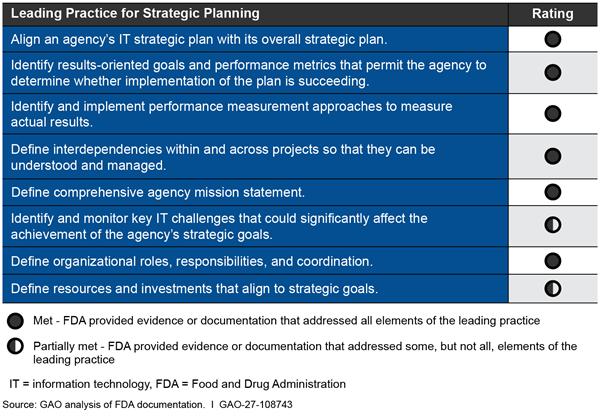
However, FDA has not fully documented ways to monitor mitigation of key challenges to achieve its IT strategic goals or identified links between its major IT investments and its strategic goals, consistent with leading practices. By including these details, FDA will be able to anticipate and overcome key challenges and effectively implement its major IT investments in line with strategic goals.
For the five large major IT investments selected by GAO for review, FDA fully addressed two and partially addressed one of three leading practices for performance measurement. Specifically, FDA created performance metrics for each investment that aligned with IT strategic goals and used these metrics to track investment performance. However, FDA did not demonstrate use of these metrics in managing and improving investment performance for one of the five investments. By doing so, FDA will be able to ensure that the investment is progressing as intended.
Why GAO Did This Study
FDA relies extensively on IT to achieve its mission for protecting the public’s health. GAO previously reported shortfalls in FDA’s ability to develop an IT strategic plan that was comprehensive and aligned with agency goals. The Consolidated Appropriations Act, 2023, called for FDA to develop an updated IT strategic plan.
The Act also includes provisions for GAO to assess the development of FDA’s IT strategic plan and the efficiency and effectiveness of its IT investments. This report examines the extent to which FDA has 1) developed a strategic plan to modernize its IT systems consistent with relevant leading practices; and 2) followed leading performance measurement practices in implementing its strategic plan for selected major IT investments.
GAO compared FDA’s IT strategic planning documents against leading practices for strategic planning. GAO also compared performance metrics for the five largest FDA major IT investments against leading practices for performance measurement. GAO supplemented this information by interviewing knowledgeable FDA officials.
What GAO Recommends
GAO recommends that FDA track key IT modernization challenges described in its IT strategic plan, align details of major IT investments and related resources to IT strategic plan goals, and demonstrate use of performance metrics in managing one of FDA’s major IT investments. The Department of Health and Human Services agreed with all three recommendations and discussed steps it planned to take to implement them.
|
Abbreviations |
|
|
|
|
|
|
|
AEMS |
Adverse Event Monitoring System |
|
|
AI |
Artificial Intelligence |
|
|
CDER |
Center for Drug Evaluation and Research |
|
|
CDRH |
Center for Devices and Radiological Health |
|
|
CPIC |
Capital Planning and Investment Control |
|
|
CTP |
Center for Tobacco Products |
|
|
DME |
development, modernization, and enhancement |
|
|
FDA |
Food and Drug Administration |
|
|
FY |
fiscal year |
|
|
HALO |
Harmonized Artificial Intelligence and Lifecycle Operations |
|
|
HHS |
Department of Health and Human Services |
|
|
IT |
information technology |
|
|
O&M |
operations and maintenance |
|
|
OC |
Office of the Commissioner |
|
|
OII |
Office of Inspections and Investigations |
|
|
OMB |
Office of Management and Budget |
|
This is a work of the U.S. government and is not subject to copyright protection in the United States. The published product may be reproduced and distributed in its entirety without further permission from GAO. However, because this work may contain copyrighted images or other material, permission from the copyright holder may be necessary if you wish to reproduce this material separately.
November 18, 2026
The Honorable Bill Cassidy, M.D.
Chair
The Honorable Bernard Sanders
Ranking Member
Committee on Health, Education, Labor, and Pensions
United States Senate
The Honorable Brett Guthrie
Chairman
The Honorable Frank Pallone, Jr.
Ranking Member
Committee on Energy and Commerce
House of Representatives
The Food and Drug Administration (FDA) is responsible for protecting public health by, among other things, ensuring the safety, efficacy, and security of human medical products marketed in the United States. FDA’s regulatory program is responsible for premarket reviews of drug and medical products; inspections of manufacturers; and post market surveillance of food, drug, and medical products.
In carrying out these responsibilities, FDA relies heavily on information technology (IT). These IT systems are critical to the agency’s product review, adverse event reporting, and compliance activities. Further, FDA relies on the use of IT to support its strategic priorities, investment performance management, and IT modernization.
We have previously reported on limitations in several areas of the agency’s management of IT, including its ability to use technology to improve regulatory effectiveness and investment management, and to develop a comprehensive IT strategic plan.[1] Specifically, we reported that FDA lacked key elements in its IT strategic plan to align the plan with agency-wide mission and goals and allow it to be used for managing IT investments more effectively. As discussed later in this report, we recommended that FDA fully implement its IT strategic plan and better define key related schedule milestones. The agency implemented these recommendations.
Developing and implementing an IT strategic plan that includes key elements such as these is essential to an agency’s ability to align its IT systems to strategic priorities that support its mission, business strategies, and investment decisions. Additionally, use of IT performance measures provides agencies with the information they need to determine whether IT investments meet intended objectives and support agency needs.
Starting in fiscal year (FY) 2023, the Consolidated Appropriations Act, 2023 called for FDA to develop and submit to Congress an IT strategic plan with a focus on modernizing its IT systems.[2] According to the act, this plan is required to include strategic goals and priorities for modernizing IT, identify IT challenges in meeting strategic planning efforts, and include information on specific activities and strategies for achieving strategic goals. The act also includes a provision for GAO to assess the development and implementation of FDA’s IT strategic plan.
This report examines to what extent (1) FDA has developed a strategic plan to modernize its IT systems consistent with leading practices; and (2) FDA has followed leading performance measurement requirements and leading practices for selected major IT investments.
For our first objective, we reviewed our prior reports, guidance from the Office of Management and Budget (OMB), and elements from Section 3627 of the Consolidated Appropriations Act, 2023 to identify IT strategic planning leading practices.[3] We then organized these practices into categories based on similarities across sources and selected the eight practices that were most significantly represented across all sources.
We compared the leading practices to FDA’s suite of six IT strategic planning documents to determine the extent to which the agency had developed a strategic plan to modernize its IT systems.[4] We determined whether the agency fully met, partially met, or did not meet the leading practice. If at least one of the documents in FDA’s suite of IT strategic planning documentation fully addressed the leading practice, we considered the suite to have addressed the leading practice overall.
For our second objective, we selected a non-probability sample of five major IT investments from FDA’s list of 17 active major IT investments for FY 2025.[5] We selected the investments with the highest amount of actual spending in FY 2025, that also contained spending in both operations and maintenance (O&M) and development, modernization, and enhancement (DME).[6]
We took steps to assess the reliability of FDA’s budget and performance metric data by comparing FDA budget and performance metric data from the Federal IT Dashboard to agency data. For example, to assess the reliability of performance metric data for major FDA IT investments, we compared the data to performance metrics documentation that FDA reported on the Federal IT Dashboard to performance metric data from the agency’s performance management tool. We determined that the cost and performance metric data were sufficiently reliable for our reporting purposes.
We evaluated investment performance metrics for the five major IT investments in our sample against government-wide and internal FDA requirements for capital planning and investment control.[7] These requirements, outlined in FDA’s Capital Planning and Investment Control (CPIC) guide, included several activities to monitor the performance of major IT investments. For each, we determined whether FDA fully, partially, or did not meet the requirements.
In addition, for the same five selected investments, we reviewed our prior reports and guidance from OMB to identify performance measure leading practices.[8] We organized these practices into categories based on similarities across sources and chose three practices that were most significantly represented across all sources. We then assessed FDA’s practices for establishing performance measures for the five major IT investments in our sample against these leading practices. For each, we determined whether FDA fully, partially, or did not address the leading practice.
For both objectives, we interviewed knowledgeable agency officials to supplement our understanding. Appendix I provides additional details on our objectives, scope, and methodology.
We conducted this performance audit from September 2025 to November 2026 in accordance with generally accepted government auditing standards. Those standards require that we plan and perform the audit to obtain sufficient, appropriate evidence to provide a reasonable basis for our findings and conclusions based on our audit objectives. We believe that the evidence obtained provides a reasonable basis for our findings and conclusions based on our audit objectives.
Background
FDA Major IT Investments Are Housed Within Six Primary Centers and Offices
FDA, located within the Department of Health and Human Services (HHS), has a mission to protect public health by ensuring the safety, efficacy, and security of human and veterinary drugs, biological products, and medical devices; and ensuring the safety and security of our nation’s food supply, cosmetics, and products that emit radiation.[9] The agency is also responsible for ensuring the proper labeling of foods, drugs, medical devices, tobacco, and cosmetics.[10] Further, the agency’s work includes advancing public health by facilitating innovation and promoting public access to science-based information on medicines, devices, and foods.
Five FDA centers and offices house FDA’s major IT investments. In addition to these centers and offices, FDA’s Office of Digital Transformation manages overall use of IT at FDA.[11] Table 1 describes the functions of each of these six centers and offices.
Table 1: Centers and Offices that Play a Key Role in Managing the Food and Drug Administration’s (FDA) Major Information Technology Investments
|
Center/Office Name |
Center/Office Description |
|
Center for Devices and Radiological Health |
Responsible for assuring that medical devices and radiation emitting products are safe and effective for patients and providers, among other things. Provides consumers, patients, their caregivers, and providers with information about FDA products. |
|
Center for Drug Evaluation and Research |
Regulates over-the-counter and prescription drugs, including biological therapeutics and generic drugs, to ensure that they are safe and effective. |
|
Center for Tobacco Products |
Oversees the implementation of the Family Smoking Prevention and Tobacco Control Act that includes setting performance standards and requiring new warning labels, among other things. |
|
Office of Inspections and Investigations |
Leads all FDA field inspections, investigations, imports, emergency responses, and law enforcement activities to protect the public’s health and safety. |
|
Office of the Commissioner |
Provides centralized direction and management for agency programs to ensure that FDA’s consumer protection efforts are effectively managed within its regulatory framework. |
|
Office of Digital Transformation |
Directs and coordinates enterprise strategic planning, policy, and resource management to ensure that agency IT, data, and cybersecurity investments and activities provide maximum value to FDA. Led by FDA’s Chief Information Officer, whose role is to lead the agency’s IT strategy, as well as its enterprise IT, data management and cybersecurity strategies. |
Source: GAO analysis of FDA data. | GAO‑27‑108743
Note: As part of an agencywide reform effort, in October 2026, FDA’s Office of Digital Transformation became the Office of Mission IT Services.
FDA Has Spent Nearly a Billion Dollars on IT Annually in Recent Years
FDA relies on the use and outcomes of IT to achieve its strategic priorities, fulfill its mission, and support related administrative needs. IT systems are critical to FDA’s ability to conduct activities to achieve its mission including product review, adverse event reporting, and compliance activities, among others.
FDA’s annual IT budget supports its usage of IT to help achieve its agencywide strategic priorities, including major IT investments, mission support, IT infrastructure, and security. In FY 2025, FDA reported spending $898 million on overall IT. From FYs 2020 through 2025, FDA reported spending approximately $5.4 billion on overall IT, or about $900 million per year. For FYs 2026 and 2027, FDA plans to spend $860 million and $868 million on IT, respectively.
The agency projects spending for major IT investments from FYs 2020 through 2027 to total approximately $2.8 billion.[12] FDA spent approximately $296 million on its major IT investments in FY 2025. Table 2 summarizes FDA’s reported IT expenditures by FY.
Table 2: Food and Drug Administration (FDA) Reported Information Technology (IT) Expenditure Totals by Fiscal Year (FY) (in millions)
|
Fiscal Year |
Total IT Spending |
Total IT Operations and Maintenance Spending |
Total IT Development, Modernization, and Enhancement Spending |
Total Major IT Investment Spending |
Major IT Investment Spending as a Percentage of Total IT Spending |
|
2020 |
$832 |
$558 |
$274 |
$376 |
45% |
|
2021 |
$821 |
$576 |
$245 |
$382 |
47% |
|
2022 |
$876 |
$583 |
$293 |
$410 |
47% |
|
2023 |
$1055 |
$666 |
$389 |
$397 |
38% |
|
2024 |
$909 |
$698 |
$211 |
$312 |
34% |
|
2025 |
$898 |
$661 |
$237 |
$296 |
33% |
|
Totals |
$5390 |
$3742 |
$1649 |
$2173 |
40% |
Source: GAO analysis of Federal IT Dashboard data for FDA for FY2020 through 2023 and FDA data for FY2024 through 2025. | GAO‑27‑108743
Note: In April 2026, the Chief Information Officer of the United States announced that the IT Dashboard is refocusing on reporting statutorily required data.
Due to rounding, the totals of the operation and maintenance and development, modernization, and enhancement may not exactly match the overall totals.
For FYs 2026 and 2027, FDA plans to spend about $298 million per year on its major IT investments across five primary centers and offices. Table 3 identifies the centers and offices that house the agency’s major IT investments and their planned spending for FY 2026. Appendix II also provides a breakdown of FDA’s reported spending for major IT investments in FY 2025.
Table 3: Centers and Offices that House the Food and Drug Administration’s (FDA) Major Information Technology (IT) Investments and Planned Spending for Fiscal Year (FY) 2026 (in millions)
|
Center/Office Name |
FY 2026 Planned Major Investment IT Expenditure |
FY 2026 Planned Total IT Expenditure |
|
Center for Devices and Radiological Health |
$40 |
$46 |
|
Center for Drug Evaluation and Research |
$112 |
$159 |
|
Center for Tobacco Products |
$68 |
$73 |
|
Office of Inspections and Investigations |
$46 |
$57 |
|
Office of the Commissioner |
$31 |
$68 |
|
Total |
$298 |
$403 |
Source: GAO analysis of FDA data. | GAO‑27‑108743
FDA Has 17 Ongoing Major IT Investments Among its Five Primary Offices
As of FY 2026, FDA had 17 active major IT investments across all five major offices and centers. [13] Table 4 provides a breakdown of each major IT investment by office or center.
Table 4: The Food and Drug Administration’s (FDA) Major Information Technology (IT) Investment Descriptions and Related Internal Divisions
|
Major IT Investment |
Description |
|
Center for Devices and Radiological Health (CDRH) |
|
|
CDRH Digital Transformation |
Provides comprehensive, integrated technology and
data services to |
|
Center for Drug Evaluation and Research (CDER) |
|
|
CDER Drug Review & Submissions |
Is an automated drug information management system
that provides a |
|
CDER Drug Review and Approval Tools |
Provides data and tools to CDER reviewers to enhance
the business |
|
CDER Integrated Work Management |
Provides users with access to CDER’s strategic
capabilities and |
|
CDER Knowledge Management |
Provides oversight and support to the Artificial
Intelligence Information |
|
CDER Over-the-Counter Monograph Safety, Innovation and Reform |
Provides new technology capabilities to support user
fee management, |
|
CDER Office of Translational Sciences Product Review and Approval |
Provides scientific collaboration and innovation in
drug regulatory review |
|
CDER Regulatory Review Platform (RRP) |
Provides an integrated drug application review
capability for FDA’s |
|
Center for Tobacco Products (CTP) |
|
|
CTP Organizational Operations |
Facilitates CTP’s operational needs and supports a
sustainable IT |
|
CTP Regulatory Compliance and Inspection |
Supports the development, implementation, and
operations and |
|
CTP Regulatory Submission Receipt and Analysis |
Supports development, implementation, and operations
and maintenance |
|
Office of Inspections and Investigations (OII) |
|
|
OII Automated Laboratory Management |
Provides standardization of laboratory information
for OII, the sharing of |
|
OII Imports |
Enables the OII staff to predict risk and screen
imports of FDA-regulated |
|
OII Regulatory Business Information Services |
Provides data management, reporting, business
intelligence, analytics, |
|
OII Systems for Inspections, Recalls, Compliance and Enforcement |
Enables a collection of systems used by OII staff for
workflow |
|
Office of the Commissioner (OC) |
|
|
OC Financial Management Information Systems |
Supports FDA’s regulatory mission by collecting user
fees and reporting |
|
OC Information Governance |
Provides projects and initiatives that advance FDA
information |
Source: GAO analysis of FDA information. | GAO‑27‑108743
Leading Practices Define Essential Actions to Improve Strategic Planning and Performance Measurement
Our prior work and OMB guidance have identified leading practices for developing strategic plans and establishing performance measures for federal agencies. FDA has also developed its own internal requirements for use of performance measures to monitor its major IT investments. Specifically:
Strategic planning. Our prior work, OMB guidance, and the Consolidated Appropriations Act, 2023, Section 3627, titled “Improving Information Technology Systems of the Food and Drug Administration” (and referred to as Section 3627 of the act in this report) call for FDA to follow eight leading practices for IT strategic planning.[14] Table 5 identifies those eight leading practices.
|
Leading Practice |
|
Align an agency’s IT strategic plan with its overall strategic plan. |
|
Identify results-oriented goals and performance metrics that permit the agency to determine whether implementation of the plan is succeeding. |
|
Identify and implement performance measurement approaches to measure actual results. |
|
Define interdependencies within and across projects so that they can be understood and managed. |
|
Define comprehensive agency mission statement. |
|
Identify and monitor key IT challenges that could significantly affect the achievement of the agency’s strategic goals. |
|
Define organizational roles, responsibilities, and coordination. |
|
Define resources and investments that align to strategic goals. |
Source: GAO analysis of Section 3627 of the act, GAO leading practices, and OMB guidance. | GAO‑27‑108743
Performance management. OMB has issued government-wide requirements for capital planning and investment control, and FDA issued internal guidance reflecting these requirements with respect to its major IT investments.[15] These requirements outline several key activities the agency must conduct to monitor the performance of major IT investments. Table 6 identifies FDA’s requirements.
Table 6: Government-wide and FDA Internal Requirements for Major Information Technology (IT) Investments
|
Requirement |
|
Make monthly updates to track performance metrics for major IT Investments. |
|
Assign life cycle designations. |
|
Assign at least one performance metric under the customer satisfaction category. |
|
Assign at least three performance metrics under the strategic and business results category. |
|
Include at least five performance metrics for any given major IT investment. |
Source: GAO analysis of Office of Management and Budget and FDA guidance. | GAO‑27‑108743
Further, our prior work, OMB’s Circular A-11, and OMB’s Capital Programming Guide, call for federal agencies to follow three leading practices for establishing performance measures for major IT investments that align with the agency’s strategic goals and initiatives.[16] Table 7 identifies the performance measurement leading practices.
|
Leading Practice |
|
Ensure alignment of major IT investments’ performance measures with agency strategic goals. |
|
Develop performance measures that determine how effectively the agency is tracking investment performance. |
|
Identify planned versus actual performance for investments. |
Source: GAO analysis of GAO leading practices and OMB guidance. | GAO‑27‑108743
We Have Previously Made Recommendations to FDA to Improve IT Strategic Planning
In December 2015, we reported that FDA had developed an IT strategic plan which, among other things, defined performance measures to support the agency’s strategic goals and identified specific milestones that were mapped to strategic initiatives.[17] However, we found that FDA’s strategic plan lacked key elements that aligned with the agency’s mission and agency-wide goals. We recommended that FDA define schedules and milestones for incorporating into its IT strategic plan elements that align with the agency’s mission and business strategies and fully implement the plan. FDA implemented these recommendations.
FDA Developed a Robust IT Strategic Plan, but Could Further Strengthen Details on Challenges and Ongoing Investments
FDA developed a suite of IT strategic planning documents to modernize its IT systems that are largely consistent with leading practices. These documents encompass the agency’s IT operating, technology modernization, and cybersecurity plans, including describing FDA’s IT consolidation efforts. Our prior work, OMB guidance, and Section 3627 of the act, call for FDA to follow eight leading practices for IT strategic planning.[18] FDA’s suite of IT strategic planning documents fully addressed six of the eight leading practices, including the establishment of strategic goals and initiatives, and the definition of related roles and responsibilities. However, the planning documents partially address practices regarding the identification of key challenges related to meeting IT strategic goals, and alignment with details on the resources and investments planned to be used in achieving those goals.
FDA Has Developed a Strategic Plan to Modernize Its IT Systems
FDA developed a suite of strategic planning documents to guide modernization of its IT systems. Table 8 describes the elements of this suite of strategic plans.
|
FDA’s Plan |
Most Recent Update |
Plan Description |
|
Technology Modernization Action Plan |
September 2019 |
Describes near-term actions that FDA is taking to modernize the use of technology—computer hardware, software, data, and analytics. |
|
Data Modernization Action Plan |
March 2021 |
Describes FDA’s data strategy, stewardship, security, quality control, analysis, and real-time use of data to achieve FDA’s goals. |
|
Cybersecurity Modernization Action Plan |
November 2022 |
Describes FDA’s ability to protect sensitive information, modernize cybersecurity capabilities, and improve situational awareness to decrease overall security risks to the agency. |
|
Information Technology (IT) Strategic Plan |
September 2023 |
Covers fiscal years 2024 to 2027 and lays out FDA’s IT vision and mission to leverage technology to improve public health. It encompasses six strategic goals that support FDA’s business, technology, and regulatory needs. |
|
IT Operating Plan |
January 2025 |
Guides the agency’s organizational technological growth and development in accordance with FDA’s IT Strategic Plan’s goals. It encompasses an IT strategic roadmap, governance, and performance measurement metrics. |
|
Cybersecurity Strategic Plan 2025–2028 |
January 2025 |
Identifies six strategic cybersecurity priorities, including data and information protection, cybersecurity, innovation, and technology. |
Source: GAO analysis of FDA information. | GAO‑27‑108743
FDA’s suite of IT strategic planning documentation supports the agency’s IT strategic mission to safeguard public health through the use of secure technology and data capabilities. Specifically, FDA’s plans list six IT strategic goals to assist in achieving its mission. Table 9 lists these goals and related initiatives as identified in FDA’s strategic planning documentation.
Table 9: The Food and Drug Administration’s (FDA) Information Technology (IT) Strategic Goals and Initiatives
|
Strategic Goals |
Strategic Initiatives |
Initiative Description |
|
Goal 1: Create a Shared OneFDA ecosystem |
1.1 Strategy and governance |
Drive ongoing strategic planning and mature FDA’s IT governance framework to include, among other things, increased project oversight and performance monitoring. |
|
1.2 Acquisitions and vendor management |
Improve acquisitions and vendor management capabilities and processes to enable faster, more responsible procurement cycles while creating improved contract terms. |
|
|
1.3 Internal/external communications |
Drive ongoing communications and change management in support of FDA’s IT Strategy with internal and external stakeholders and implement solutions. |
|
|
Goal 2: Strengthen IT Infrastructure |
2.1 Legacy system stabilization |
Decommission legacy systems, applications, and devices that are approaching the end of their useful life to stabilize enterprise IT services and reduce technical debt. |
|
2.2 Cloud transformation |
Migrate, implement, and transform enterprise IT services by utilizing cloud-based capabilities and platforms. |
|
|
2.3 Zero trust |
Adopt a zero trusta approach to serve as an added layer of protection to FDA’s digital environment and create opportunities for enhancements across the enterprise. |
|
|
Goal 3: Modernize Enterprise Services and Capabilities |
3.1 User and customer experience enhancements |
Create and enhance solutions to increase customer satisfaction by improving accessibility to IT solutions, including external-facing systems, streamlining processes, and easing adoption. |
|
3.2 System modernization |
Transform or upgrade IT systems/solutions by implementing new technologies, streamlining processes, and enhancing user interfaces to meet the evolving needs of FDA’s internal and external stakeholders. |
|
|
3.3 Electronic submission |
Monitor and improve usability of the electronic submission gateway and other industry submission platforms by streamlining processes and increasing structured data ingestion, among other things. |
|
|
Goal 4: Share Data for Mission Outcomes |
4.1 Enterprise data services |
Improve FDA’s ability to collect and analyze data for regulatory review processes and to, among other things, support emerging legislation and cloud-based technologies. |
|
Goal 5: Adopt Artificial Intelligence (AI) Mission Driven Innovations |
5.1 AI implementation and governance |
Develop and refine FDA-specific AI executive order guidelines and implement targeted use cases. This includes, among other things, educating, preparing and licensing key staff responsible for supporting agency-wide integration of AI productivity tools. |
|
5.2 Emerging technologies |
Experiment with current and emerging technologies to develop and test new analytics that can inform policies and drive innovation in regulatory processes and responding to public health threats. |
|
|
Goal 6: Cultivate Talent and Leadership |
6.1 Workforce modernization |
Implement tactics and tools to attract, recruit, develop, and retain leaders and staff with the business and technical expertise needed to advance FDA’s mission. |
Source: GAO analysis of FDA information. | GAO‑27‑108743
aZero trust is a set of principles, strategies, or an approach that ensures the right people have the right access to the right resources at the right time.
FDA’s strategic planning documents also capture key upcoming changes to agency IT operations. For example, according to the IT operating plan, the agency is taking steps to consolidate several of its IT systems and centralize the governance of its IT department as part of implementing several of its six IT strategic goals identified above. Specifically, FDA plans detail the following completed or planned agency-wide IT system consolidations:[19]
· In the second quarter of 2025 FDA began centralizing its multiple IT offices spread across different centers and offices into a unified enterprise IT governance framework with standardized policies and guidance, as part of a larger organizational reform effort. The five FDA centers and offices previously had their own IT groups, budgets, shared services, and federated applications. In October 2026, FDA confirmed this reform effort, including the centralization effort, was complete.
· FDA is currently consolidating seven systems and 22 data sources into a single system called Harmonized AI and Lifecycle Operations (HALO). FDA is taking this action to consolidate fragmented data systems into a unified platform that eliminates silos, reduces IT duplication and costs, and further modernizes FDA’s IT infrastructure. According to FDA, HALO will act as a centralized enterprise platform to enhance collaboration across all FDA centers and offices and will provide a collection of advanced analytical tools to support the business needs of FDA. In August 2026, FDA confirmed this effort was complete.
· FDA developed the Adverse Event Monitoring System (AEMS) to be FDA’s universal platform for processing and managing adverse event cases across all FDA-regulated products and centers.[20] According to FDA, the use of multiple standalone systems has caused substantial operational inefficiencies, including duplicative processes, inconsistent data standards, and limited cross-center visibility into safety signals. Officials stated that this consolidation is to improve data access and adverse event reporting systems to be up to date and cohesive. According to FDA officials, as of June 2026, four of the seven previous FDA adverse event reporting systems, such as the Adverse Event Reporting System and Vaccine Adverse Event Reporting System, have been consolidated into AEMS. FDA plans to consolidate two of the remaining three systems into AEMS by the end of FY 2026 and to consolidate the final system by December 2026.
FDA’s IT Strategic Plan Includes Key Governance Elements, But Does Not Fully Address Challenges and Resources
As stated in our prior work, to be effective as a guide for managing IT investments and addressing agencywide business challenges, an IT strategic plan should define the agency’s vision and provide a roadmap to align information resources with business strategies and investment decisions, among other things.[21] According to OMB guidance, our prior work, and Section 3627 of the act, FDA should follow eight leading practices for IT strategic planning, including defining IT strategic goals, identifying IT strategies and resources needed to achieve goals, and identifying and implementing specific performance improvements. [22] Table 10 provides details on our assessment of FDA’s efforts in these eight areas.
Table 10: Comparison of Food and Drug Administration (FDA) Strategic Plan Contents Against Leading Strategic Planning Practices
|
Strategic Planning Leading Practice |
Rating |
Description |
|
Align an agency’s information technology (IT) strategic plan with its overall strategic plan. |
⬤ |
FDA aligned its IT plans with the agency’s overall strategic plan and its mission. The IT operating plan also demonstrated alignment with the Department of Health and Human Services IT strategy and FDA’s mission. For example, part of the agency’s mission is to help speed innovations that advance public health, which aligns with FDA’s IT strategic goal to modernize enterprise services and capabilities. |
|
Identify results-oriented goals and performance metrics that permit the agency to determine whether implementation of the plan is succeeding. |
⬤ |
FDA identified goals and evaluated progress on goals through associated metrics. Specifically, the IT operating plan identified goals such as adopting artificial intelligence (AI) and identified a targeted set of metrics to assess the effectiveness of FDA’s IT strategy and evaluate progress on IT strategic goals. |
|
Identify and implement performance measurement approaches to measure actual results. |
⬤ |
FDA identified performance measurements such as IT metrics which provide an evaluation of progress against each of the agency’s IT strategic goals. For example, the IT operating plan provided a summarization of progress for each strategic initiative, such as number of positive responses and total responses in the Office of Digital Transformation customer survey. These performance measures are aligned to multiple initiative projects outlined in the plan. |
|
Define interdependencies within and across projects so that they can be understood and managed. |
⬤ |
FDA fully addressed this leading practice in its IT operating plan through defining interdependencies across its projects and strategic initiatives. The plan also included information on completion status for projects to make their progress more understandable and manageable. |
|
Define comprehensive agency mission statement. |
⬤ |
FDA’s IT operating plan defines a comprehensive mission statement, stating that its mission is to advance FDA’s public health mission through technology and data. The mission statement ties into the IT Strategic Plan’s goals and identifies a path forward for use of IT based on meeting remaining progress toward achieving those goals. |
|
Identify and monitor key IT challenges that could significantly affect the achievement of the agency’s strategic goals. |
◑ |
FDA’s IT operating plan identified six key challenges to achieving agency strategic goals, as well as strategies by which it planned to address these challenges. For example, to address the challenge of adopting AI as part of its agencywide effort to improve data sharing, FDA plans to utilize its centralized data platform, the Harmonized AI Lifecycle Operations, to consolidate legacy systems across the agency. However, FDA has not fully ensured that the agency’s progress in mitigating these challenges is directly tracked over time to ensure they are addressed. FDA officials stated that challenges are currently tracked indirectly as part of monitoring overall actions taken toward meeting agency strategic goals. Further, in 2025, FDA’s team responsible for tracking and coordinating initiatives and defining metrics to measure progress on challenges was disbanded. According to officials, this was one of many organization wide changes as part of a recent increased focus on streamlining operations and centralizing administrative functions. |
|
Define organizational roles, responsibilities, and coordination. |
⬤ |
FDA’s IT operating plan defined roles, responsibilities, and coordination between the teams and officials with these roles and responsibilities. Among other things, the IT operating plan defined roles and responsibilities for the Office of Digital Transformation, which serves as the central IT organization for executing FDA’s IT strategy. It also defines roles and responsibilities for the Associate Deputy Chief Information Officers in each primary FDA center and office; these officials are responsible for the delivery of IT capabilities and operations in each office. |
|
Define resources and investments that align to strategic goals. |
◑ |
FDA partially demonstrated alignment of major IT investments to overarching goals and objectives in its IT strategic planning suite. Specifically, FDA demonstrated alignment for nine of its 17 major IT investments by identifying links between these investments and related projects that are directly tied to agency goals in its IT operating plan. However, the plan did not demonstrate similar key linkages fully define its ongoing major IT investments or their projects for the remaining eight major IT investments. Further, FDA’s IT operating plan did not fully identify information on cost expenditures related to the strategic plan and its projects, such as budgetary costs and resources needed to execute the plan. |
Key:
● = fully implemented: FDA provided evidence or documentation that addressed all elements of the leading practice.
◐ = partially implemented: FDA provided evidence or documentation that addressed some, but not all, elements of the leading practice.
Source: GAO analysis of FDA data. | GAO‑27‑108743
FDA has fully implemented six leading practices related to developing a strategic plan. Among other things, FDA’s strategic plan aligns to the agency and department-wide missions, identifies IT goals and performance measures for meeting those goals, and defines roles and responsibilities for meeting the goals. However, FDA only partially met two of the eight strategic planning leading practices. Specifically:
Identify key IT challenges that could significantly affect the achievement of the agency’s strategic goals. FDA identified key IT challenges that could significantly affect the achievement of the agency’s strategic plan goals and initiatives to address these challenges.[23] However, FDA’s strategic plan did not include information on how efforts to mitigate these challenges are directly tracked over time to be sure they are addressed. Instead, an FDA official stated that the agency tracks challenges indirectly, through measures relating to the achievement of the strategic goal(s).
FDA officials stated that the agency’s more indirect tracking of key IT challenges was due, in part, to FDA’s disbanding of a team responsible for coordinating strategic initiatives and defining metrics to measure progress on key IT challenges. According to agency officials, this was one of many organization-wide changes made at FDA to streamline operations, including decreasing its workforce with a focus on streamlining operations and centralizing administrative functions. However, it is important that FDA track these challenges directly to ensure that the impediments they pose to the achievement of FDA’s IT strategic goals are properly and comprehensively resolved. By doing so, FDA will be able to ensure that its mitigation efforts for those challenges are effective, putting its IT investments at less risk.
Define resources and investments. FDA took steps to define how it planned to use resources and investments to achieve the strategic goals outlined in its IT strategic plan. Specifically, FDA identified 24 projects supporting its IT initiatives in the IT operating plan in accomplishing agency goals. For example, FDA highlighted projects to improve its user fee collection system, in support of its initiative to implement new technologies and streamline processes to meet internal and external stakeholder needs. Other highlighted projects include efforts on inspection management for tobacco products, electronic submission of safety concerns, and advanced scientific research. For nine of its 17 major IT investments, the plan included linkages to related projects such as these, as well as details such as milestones, planned activities, and potential risks to the project’s implementation.
However, for the remaining eight major investments, FDA has not fully identified links between its major IT investments and its strategic goals. In particular, while the plan lists some tangential linkages to related projects and programs and their milestones, it does not include key details such as which office or center has primary responsibility for the initiative, identification of possible risks to its completion, or how the investments are aligned to FDA’s IT strategic goals.
According to FDA officials, each major IT investment maintains tracking according to agency capital planning requirements and projects maintain their own project-level tracking. Officials also stated that the agency is kept aware of major IT investment achievements relevant to strategic goals and initiatives by the success or failure of each investment’s projects. However, an agency’s strategic planning documentation should include details on how each of the investments identified in the plan will achieve strategic goals and initiatives, and planned timeframes for the investments’ implementation. By doing so, FDA will be better positioned to ensure greater alignment between its major IT investments and the IT modernization goals it hopes to achieve.
Additionally, FDA’s IT operating plan identified some aspects of the resources it planned to invest in the initiatives and projects it planned to complete. For example, FDA identified key offices responsible for execution of the initiatives and projects. It also identified roles and responsibilities for the IT offices that govern overall strategic plan implementation. However, it did not identify details such as high-level cost expenditures for the projects listed in the plan, budget estimates for the planned projects, or human capital resources needed to execute the plan.
According to FDA officials, the agency tracks costs for investments and projects within its performance management tool. However, as discussed in our prior work, a strategic plan should also include high-level budget estimates to better ensure agencies can demonstrate linkages between planned budget and agency-wide strategic goals. By fully defining how it plans to use resources to achieve its IT strategic goals, FDA will be better able to help ensure that it has the appropriate means for implementation.
Selected IT Investments Implemented Key Performance Measurement Requirements and Most Leading Practices
FDA fully addressed each of five government-wide and internal requirements related to the creation of performance measures for major IT investments. In addition, FDA largely followed leading performance measurement practices for selected major IT investments. However, it did not fully demonstrate use of the metrics it created as part of monitoring and determining the effectiveness of the performance of one of its major investments.
FDA Developed Performance Measures According to Government-wide and Internal Requirements
The capital planning and investment control (CPIC) process is a federally mandated decision-making process that ensures IT investments integrate strategic planning, budgeting, procurement, and management of IT in support of agency missions and business needs.[24] Within CPIC, performance measurement-related requirements focus specifically on the monitoring of performance metrics, ensuring investments are assigned the correct lifecycle designations, and maintaining required metrics (such as number and category) for each investment.[25]
FDA internal guidance addresses CPIC requirements in federal laws and guidance.[26] Specifically, as part of its CPIC process, FDA established guidance regarding the types of metrics that must be established for each of the agency’s major IT investments. According to FDA’s guidance, IT investment managers are required to comply with related OMB and HHS CPIC reporting requirements. FDA’s CPIC guidance includes requirements for effectively governing and managing its IT portfolio, defines roles and responsibilities of all IT investment key stakeholders, and provides a framework and process for the agency to follow.
FDA met each CPIC-related requirement regarding development of performance metric areas for five selected major IT investments. Table 11 provides details on how FDA performance metrics met these government-wide and internal requirements.
Table 11: Comparison of Food and Drug Administration’s (FDA) Performance Measures Against Related Government-wide and Internal Requirements
|
Government-wide and Internal Requirements |
Rating |
Description |
|
Make monthly updates to track performance metrics, such as updating performance metric ratings, for major information technology (IT) investments |
⬤ |
For all five selected investments, FDA’s quality control scorecard demonstrated that internal performance metrics were generated and tracked internally monthly. |
|
Assign life cycle designation (operations and maintenance, development, modernization, and enhancement, or mixed) |
⬤ |
For all five of the selected major IT investments, FDA correctly designated them as being in the mixed life cycle phase. |
|
At least one performance metric under the customer satisfaction measurement category |
⬤ |
For all five of the selected major IT investments, FDA reported at least one metric in the customer satisfaction measurement category. |
|
At least three performance metrics under the strategic and business results measurement category |
⬤ |
For all five of the selected major IT investments, FDA reported at least three metrics in the strategic and business results measurement category. |
|
At least five performance metrics reported for any given investment |
⬤ |
For all five of the selected major IT investments, FDA reported at least five metrics in the performance metrics measurement category. |
Key: ● = fully implemented: FDA provided evidence or documentation that addressed all elements of the leading practice.
Source: GAO analysis of Office of Management and Budget and FDA capital planning and investment control guidance. | GAO‑27‑108743
For each of the five selected major IT investments, FDA implemented CPIC-related government-wide and internal requirements. Specifically, FDA made monthly updates to track investment performance metrics, assigned investment life cycle designations, assigned metrics in appropriate categories (such as those related to customer satisfaction and strategic and business results), and identified the necessary metrics to assess performance for each investment.
As part of implementing these requirements, FDA updates metric information associated with the selected major IT investments monthly using the agency’s performance management tool for investment management. The tool allows the agency to input investment information as well as metric information, such as metric reporting frequency and planned versus targeted results.
FDA develops and maintains the number of metrics tracked for each investment and assigns metrics into one of the four categories. For example, for CDER’s Knowledge Management investment, FDA maintains two metrics related to customer satisfaction, and seven related to strategic and business results performance. These metrics include development of business requirements for future use cases, which helps to track usability of the investment by customers. The development of these business requirements also assists with the incorporation of different analytics dashboards into one overall solution, aiding FDA in monitoring the agency’s strategic and business needs.
FDA Used Metrics to Manage Performance for All but One Selected Investment
OMB guidance and our prior work call for agencies to establish performance measures for their major IT investments that effectively track and improve investment performance.[27] Among other things, well-defined performance measures enable an agency to measure progress towards major IT investments and strategic goals, improve cost-effectiveness, and help determine investment priorities. Based on OMB guidance and our prior work, we identified three leading practices for performance measures: (1) ensuring alignment of major IT investments’ performance measures with agency strategic goals, (2) developing performance measures that determine how effectively the agency is tracking investment performance, and (3) identifying planned versus actual performance for investments.
For its five most significant major IT investments, FDA fully addressed two of the three leading practices for performance measurement and partially addressed one. Table 12 provides details on the extent to which FDA’s performance metrics for the five selected investments meet leading practices.
Table 12: Comparison of Food and Drug Administration (FDA) Major Information Technology (IT) Investments Performance Measures Against Related Leading Practices
|
Performance Measure Leading Practice |
GAO Rating |
Rating Description |
|
Ensure alignment of major IT investment’s performance measures with agency strategic goals |
⬤ |
FDA generated performance metrics according to the Office of Management and Budget guidance, in which at least three metrics must demonstrate alignment with strategic and business results. For each of the five selected major IT investments, FDA developed performance measures that traced back to the agency’s strategic goals. |
|
Develop performance measures that determine how effectively the agency is tracking investment performance |
◐ |
For each of five selected major IT investments, FDA provided evidence demonstrating development and use of specific performance metrics and how these metrics were tracked over time as part of managing investment performance. Specifically, for each of these investments, FDA identified the performance metrics and showed them being tracked quarterly as part of FDA’s quarterly control scorecard. For four of the five investments, the agency also provided evidence detailing how each metric provides insight into decision making on the investments’ overall performance. However, for the Center for Devices and Radiological Health’s Digital Transformation investment, FDA could not provide evidence showing how one of the related metrics was used as part of managing the investment’s performance over time. |
|
Identify planned versus actual performance for investments |
⬤ |
For all five of the selected major IT investments, FDA tracked elements of selected major investments’ actual performance versus their planned performance. Specifically, for each of the investment’s performance metrics, FDA reports on how the metric is measured, its reporting frequency, and comparison against target results. Further, FDA tracked planned and actual cost and schedule values for each of the five investments. Specifically, FDA reports on a quarterly basis each investment’s cost and schedule variance and whether the investment is within the appropriate thresholds. |
Key:
● = fully implemented: FDA provided evidence or documentation that addressed all elements of the leading practice.
◐ = partially implemented: FDA provided evidence or documentation that addressed some, but not all, elements of the leading practice.
Source: GAO analysis of FDA data. | GAO‑27‑108743
FDA created multiple performance metrics for each of the five investments that aligned to at least one of the agency’s six strategic goals (see table 9 for details on FDA’s IT strategic goals). For example, for each of the five selected major IT investments, FDA developed metrics that directly aligned to the agency’s IT strategic goals, allowing FDA to effectively measure how well each investment is meeting the agency’s mission, and strategic goals and objectives.
In addition, FDA identified planned versus actual performance for major IT investments by demonstrating the frequency of which metrics are being measured, the planned and actual unit of measure, and each metric’s target results which allows the agency to identify the major IT investments’ overall performance over time. FDA also uses a quarterly performance metric scoring form to measure planned versus actual performance. In particular, FDA used this form to score individual investments on a quarterly basis against five different components including risk management, requirements management, contractor oversight, performance, and human capital to measure actual performance and monitor investment risk.
Further, for each of the five selected major IT investments, FDA used the performance metrics it developed to track the performance of the selected major IT investments on a quarterly basis and, for four of the five, demonstrated use of these metrics in managing investment performance.
However, for the Center for Devices and Radiological Health (CDRH) Digital Transformation investment, FDA could not fully identify how it used the metrics it identified, including the number of data areas that provide reliable and searchable information, to proactively monitor the investment’s performance. FDA officials stated that usage of the supporting metrics for CDRH investments and applications are tracked within two primary weekly and monthly dashboards. However, information in these dashboards does not include an explanation of how the investment’s metric on data domains was used as part of managing and improving investment performance. By regularly using performance measures to track and proactively monitor the performance of all investments, FDA will be able to ensure that the investment and its component projects are progressing as intended.
Conclusions
FDA relies heavily on its IT systems to carry out its mission to protect public health and ensure the safety of medical products and has funded 17 major IT investments to improve these systems. FDA developed an IT strategic plan that identified goals for modernizing its IT systems, related initiatives that will assist it in achieving these goals, and organizational roles and responsibilities. However, FDA has opportunities to further strengthen its plan by fully documenting ways to monitor the mitigation of key challenges for achieving its IT strategic goals, and by directly addressing how all 17 ongoing major IT investments relate to the initiatives and projects mentioned in the plan. By defining these linkages and including these details, FDA can better ensure that its modernization efforts will be able to overcome key challenges on the way to achieving its planned IT goals.
FDA has created performance metrics for selected major IT investments that track to agencywide IT goals and help to identify differences between planned and actual investment performance. FDA could further strengthen its use of performance metrics by fully identifying how it uses these metrics to manage and improve the performance of all of its major IT investments. By doing so, FDA can more easily uncover any future issues with the investment’s performance and take steps to mitigate them.
Recommendations for Executive Action
We are making the following three recommendations to FDA:[28]
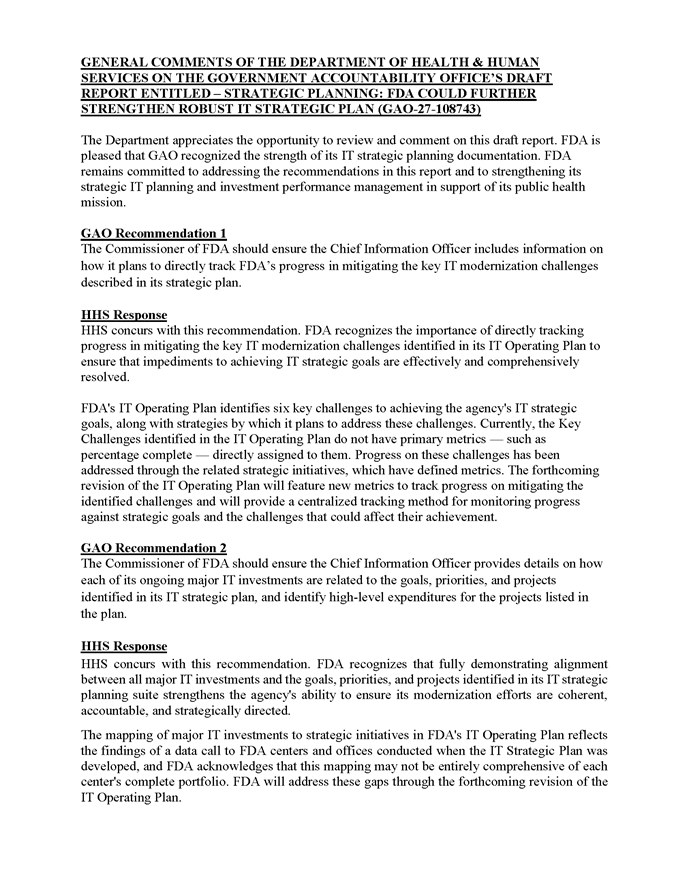
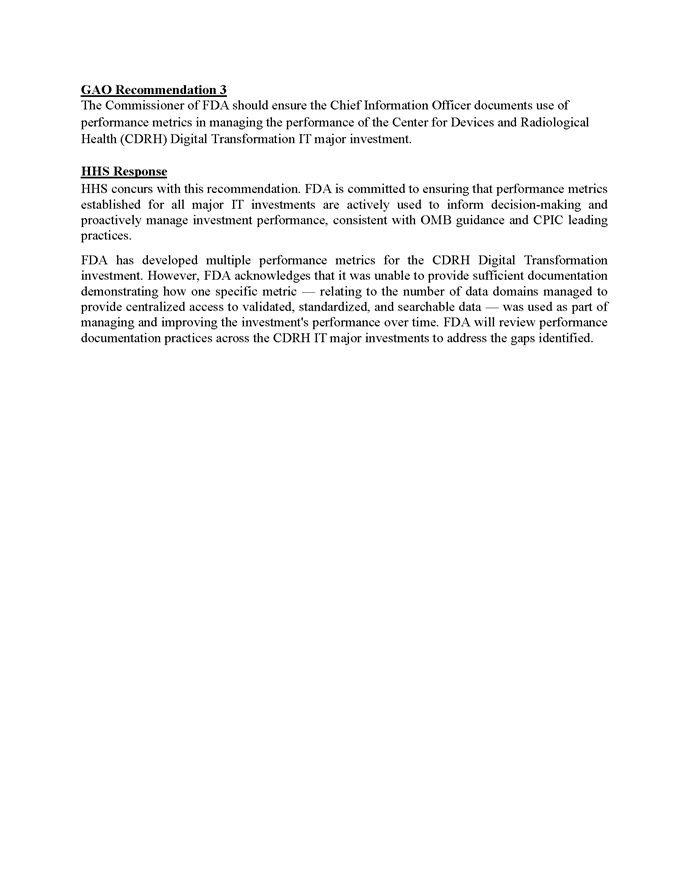
The Commissioner of FDA should ensure the Acting Director of the Office of Mission IT Services includes information on how it plans to directly track FDA’s progress in mitigating the key IT modernization challenges described in its strategic plan. (Recommendation #1)
The Commissioner of FDA should ensure the Acting Director of the Office of Mission IT Services provides details on how each of its ongoing major IT investments are related to the goals, priorities, and projects identified in its IT strategic plan, and identify high-level expenditures for the projects listed in the plan. (Recommendation #2)
The Commissioner of FDA should ensure the Acting Director of the Office of Mission IT Services documents use of performance metrics in managing the performance of the Center for Devices and Radiological Health (CDRH) Digital Transformation IT major investment. (Recommendation #3)
Agency Comments
We received written comments on a draft of this report from HHS. In its written comments, reproduced in appendix III, the department stated that it concurred with each of our three recommendations. The department provided details on steps FDA planned to take to implement each recommendation, including an upcoming planned revision to FDA’s IT operating plan. HHS also provided technical comments, which we incorporated into the report as appropriate.
We are sending copies of this report to the appropriate congressional committees, the Commissioner of FDA, and other interested parties. In addition, the report is available at no charge on the GAO website at https://www.gao.gov.
If you or your staff members have any questions on this report, please contact Vijay A. D’Souza at dsouzav@gao.gov. Contact points for our Offices of Congressional Relations and Media Relations may be found on the last page of this report. GAO staff who made key contributions to this report are listed in appendix IV.

Vijay A. D’Souza
Director
Information Technology and Cybersecurity
This report examines to what extent (1) the Food and Drug Administration (FDA) has developed a strategic plan to modernize its information technology (IT) systems consistent with leading practices; and (2) FDA has followed leading performance measurement requirements and leading practices for selected major IT investments.
For our first objective, we reviewed our prior reports, guidance from the Office of Management and Budget (OMB), and elements from the Consolidated Appropriations Act, 2023, Section 3627, to identify IT strategic planning leading practices.[29] We used each of these documents to identify potential strategic planning leading practices. We organized these practices into categories based on similarities across sources and selected the eight practices that were most significantly represented across all sources. We then used these categories to identify eight strategic planning leading practices. According to our prior work, OMB guidance, and Section 3627 of the act, leading practices for strategic planning include: (1) aligning an agency’s IT strategic plan with its overall strategic plan; (2) identifying results-oriented goals and performance metrics that permit the agency to determine whether implementation of the plan is succeeding; (3) identifying and implementing performance measurement approaches to measure actual results; (4) defining interdependencies within and across projects so that they can be understood and managed; (5) defining comprehensive agency mission statement; (6) identifying and monitoring key IT challenges that could significantly affect the achievement of the agency’s strategic goals; (7) defining organizational roles, responsibilities, and coordination; and (8) defining resources and investments that align to strategic goals.
We then used these leading practices to evaluate FDA’s suite of IT strategic planning documentation. Specifically, we evaluated strategic planning documentation against the eight leading practices to determine the extent to which the agency had developed an IT strategic plan to modernize its IT systems.
To conduct this assessment, we analyzed six documents in this suite: FDA’s IT Strategic Plan, IT Operating Plan, Data Modernization Action Plan, Technology Modernization Action Plan, Cybersecurity Modernization Action Plan, and Cybersecurity Strategic Plan.[30] If at least one of the documents in FDA’s suite of IT strategic planning documentation fully addressed the leading practice, we considered the suite to have addressed the leading practice overall.
We assessed each criterion as either fully met, meaning that FDA provided sufficient evidence and documentation related to strategic planning that addressed or substantially addressed all elements of the leading practice; partially met, meaning FDA provided evidence satisfying some, but not all elements of the leading practice; or not met, meaning that FDA’s evidence or documentation did not address any elements of the leading practice.
In addition, we met with FDA officials in the Office of Digital Transformation and Office of Operations to understand underlying rationale for any differences from the leading practices.[31] We also followed up with FDA officials in writing to, among other things, clarify details documented within and linkages between FDA strategic planning documents.
To address the second objective, we selected a non-probability sample of five major IT investments from FDA’s list of 17 active major IT investments for fiscal year (FY) 2025.[32] The five major IT investments selected were those with the highest amount of actual spending in FY 2025 that contained at least some spending in both operations and maintenance (O&M) and development, modernization, and enhancement (DME). To determine FDA’s actual costs for the five selected investments, we used reported costs from the Federal IT Dashboard and FDA’s performance management tool.[33]
For the five selected major IT investments, we evaluated investment performance metrics against government-wide requirements for capital planning and investment control (CPIC) and internal FDA requirements from its CPIC guide.[34] The requirements outlined in FDA’s CPIC guide included several key activities to monitor the performance of major IT investments at the agency.[35] Among other things, we compared information in IT investment business cases, quality control scorecards, and performance metric documentation that identified how FDA was using the metrics to track investment performance against the leading practices.
In addition, for the same five selected investments, we reviewed our prior reports and guidance from OMB to identify performance measure leading practices.[36] We identified potential performance measurement-related leading practices within each of these sources, organized these practices into categories based on similarities across sources and selected the three practices that were most significantly represented across all sources. According to OMB and our prior work, leading practices for performance measures include: (1) ensuring alignment of major IT investments’ performance measures with agency strategic goals; (2) developing performance measures that determine how effectively the agency is tracking investment performance; and (3) identifying planned versus actual performance for investments. We then compared FDA’s development and use of performance measures for the five selected investments against the three leading performance measurement practices.
For both analyses in this objective, we considered a practice or requirement to be fully met if FDA addressed or substantially addressed all elements of the leading practice or requirement; partially met if FDA provided evidence satisfying some, but not all elements of the leading practice or requirement; and not met if FDA did not address any elements of the leading practice or requirement.
We met with FDA officials in the Office of Digital Transformation and Office of Operations to supplement our understanding of any differences between performance metrics and selected leading practices. We also followed up with FDA officials in writing to clarify details documented within and linkages between FDA performance metric documents.
We took steps to assess the reliability of FDA’s budget and performance metric data by comparing FDA budget and performance metric data from the Federal IT Dashboard to agency data. Specifically, to assess the reliability of the budget data FDA reported on in its performance management tool, we compared the data to cost information from the Federal IT Dashboard for FY 2024.[37] To assess the reliability of performance metric data for FDA IT major investments, we compared the data to performance metrics documentation that FDA reported on the Federal IT Dashboard to performance metric data from the agency’s performance management tool. For both comparisons, we followed up with FDA officials from the Office of Digital Transformation to discuss any anomalies we found in the data. We determined that the cost and performance metric data were sufficiently reliable for our reporting purposes.
We conducted this performance audit from September 2025 to November 2026 in accordance with generally accepted government auditing standards. Those standards require that we plan and perform the audit to obtain sufficient, appropriate evidence to provide a reasonable basis for our findings and conclusions based on our audit objectives. We believe that the evidence obtained provides a reasonable basis for our findings and conclusions based on our audit objectives.
The Food and Drug Administration (FDA) reported implementing 17 major information technology (IT) investments in Fiscal Years (FY) 2025 and 2026. In FY 2025, one of the original 18 major investments was set for decommissioning, specifically, FDA’s Opioid Data Warehouse and Analytics major IT investment will not have appropriations for FY 2026. The agency reported it spent $296 million on these investments in FY 2025 and plans to spend $298 million in FY 2026. For each major investment, planned spending for FY 2026 differed from FY 2025 by no more than $2 million for all but two investments. Table 13 shows what FDA spent and plans to spend on each of these 18 investments for FYs 2025 and 2026.
Table 13: Food and Drug Administration (FDA) Expenditures for Major Information Technology (IT) Investments for Fiscal Years (FY) 2025 and 2026 (in millions)
|
Major IT Investment |
FY 2025 Actual IT Expenditure |
FY 2026 Planned IT Expenditure |
|
Center for Devices and Radiological Health (CDRH) |
||
|
FDA CDRH Digital Transformation |
$34 |
$40 |
|
Center for Drug Evaluation and Research (CDER) |
||
|
FDA CDER Knowledge Management |
$29 |
$29 |
|
FDA CDER Integrated Work Management |
$27 |
$27 |
|
FDA CDER Regulatory Review Platform |
$17 |
$17 |
|
FDA CDER OTS Product Review & Approval |
$17 |
$15 |
|
FDA CDER Drug Review & Submissions Automated Drug Information Management System |
$12 |
$12 |
|
FDA CDER Drug Review and Approval Tools (Pre-Market) |
$8 |
$8 |
|
FDA CDER Over-the-Counter Monograph Safety, Innovation and Reform Act |
$3 |
$3 |
|
FDA CDER Opioid Data Warehouse and Analytics |
<$1 |
N/A |
|
Center for Tobacco Products (CTP) |
||
|
FDA CTP Regulatory Submission Receipt and Analysis |
$51 |
$51 |
|
FDA CTP Organizational Operations |
$9 |
$8 |
|
FDA CTP Regulatory Compliance and Inspection |
$7 |
$9 |
|
Office of Inspections and Investigations (OII) |
||
|
FDA OII Systems for Inspections, Recalls, Compliance and Enforcement |
$21 |
$21 |
|
FDA OII Imports |
$13 |
$13 |
|
FDA OII Regulatory Business Information Services |
$6 |
$6 |
|
FDA OII Automated Laboratory Management |
$10 |
$6 |
|
Office of the Commissioner (OC) |
||
|
FDA OC Financial Management Information Systems |
$22 |
$24 |
|
FDA OC Information Governance |
$8 |
$7 |
|
Grand Total |
$296 |
$298 |
Legend: Light gray shading denotes the largest five investments, which have a combined budget of more than half of the overall IT major investment budget.
Not Applicable = This investment was decommissioned in FY 2025.
Source: GAO Analysis of FDA data. | GAO‑27‑108743
GAO Contact
Vijay A. D’Souza, dsouzav@gao.gov
Staff Acknowledgments
In addition to the contact named above, Shaun Byrnes (Assistant Director), Lori Martinez (Analyst-in-Charge), Elizabeth Harris, Colin Jenkins, and Tommy Luong. Other key contributors include: John Dicken, Smith Julmisse, Beth Killoran, Eric Lee, Ben Licht, Maia Stephenson, Walter Vance, and Adam Vodraska.
The Government Accountability Office, the audit, evaluation, and investigative arm of Congress, exists to support Congress in meeting its constitutional responsibilities and to help improve the performance and accountability of the federal government for the American people. GAO examines the use of public funds; evaluates federal programs and policies; and provides analyses, recommendations, and other assistance to help Congress make informed oversight, policy, and funding decisions. GAO’s commitment to good government is reflected in its core values of accountability, integrity, and reliability.
Obtaining Copies of GAO Reports and Testimony
The fastest and easiest way to obtain copies of GAO documents at no cost is through our website. Each weekday, GAO posts on its website newly released reports, testimonies, and correspondence. You can also subscribe to GAO’s email updates to receive notification of newly posted products.
Connect with GAO
Connect with GAO on X,
LinkedIn, Instagram, and YouTube.
Subscribe to our Email Updates. Listen to our Podcasts.
Visit GAO on the web at https://www.gao.gov.
To Report Fraud, Waste, and Abuse in Federal Programs
Contact FraudNet:
Website: https://www.gao.gov/about/what-gao-does/fraudnet
Automated answering system: (800) 424-5454
Media Relations
Sarah Kaczmarek, Managing Director, Media@gao.gov
Congressional Relations
David A. Powner, Acting Managing Director, CongRel@gao.gov
General Inquiries
[1]GAO, Information Technology: FDA Has Taken Steps to Address Challenges but Needs a Comprehensive Strategic Plan, GAO‑16‑182 (Washington, D.C.: Dec. 17, 2015).
[2]Consolidated Appropriations Act, 2023, Pub. L. No. 117-328, § 3627, 136 Stat. 5888-89 (2022). 21 U.S.C. 393 note. Section 3627 is titled “Improving Information Technology Systems of the Food and Drug Administration” and is referred to as Section 3627 of the act in this report.
[3]Consolidated Appropriations Act, 2023, Pub. L. No. 117-328, § 3627, 136 Stat. 5888-89 (2022). 21 U.S.C. 393 note; Office of Management and Budget, Circular No. A-11, Preparation, Submission, and Execution of the Budget, Section 55—Information Technology Investments (Washington, D.C.: July 25, 2024) and Circular A-130, Managing Information as a Strategic Resource (Washington, D.C.: July 28, 2016); GAO, DOD Financial Management: Navy Needs to Fully Address Strategic Planning and Systems Migration Leading Practices, GAO‑26‑107119 (Washington, D.C.: Apr. 14, 2026); Evidence-Based Policymaking: Practices to Help Manage and Assess the Results of the Federal Efforts, GAO‑23‑105460 (Washington, D.C.: July 12, 2023); and GAO‑16‑182.
Our review of the act informed our development of the leading practices.
[4]FDA’s suite of strategic planning documents included FDA’s IT Strategic Plan, IT Operating Plan, Data Modernization Action Plan, Technology Modernization Action Plan, Cybersecurity Modernization Action Plan, and Cybersecurity Strategic Plan. See Table 8 for details on these plans.
[5]These investments within FDA were (1) the Center for Tobacco’s Products Regulatory Submission Receipt and Analysis, (2) the Center for Devices and Radiological Health’s Digital Transformation, (3) the FDA Center for Drug Evaluation and Research’s Knowledge Management, (4) Integrated Work Management, and (5) the Office of the Commissioner’s Financial Management Information System.
[6]O&M investments include associated projects in operations and maintenance needed to sustain IT assets at the current capability performance level. DME investments include projects that have new IT assets, systems, or activities that change or can be modified for existing IT assets.
[7]Office of Management and Budget, Circular No. A-11, Preparation, Submission, and Execution of the Budget, Section 55—Information Technology Investments (Washington, D.C.: July 25, 2024); Circular A-130, Managing Information as a Strategic Resource (Washington, D.C.: July 28, 2016); and U.S. Food and Drug Administration, CPIC User Guide: Investment Manager Handbook (December 15, 2025).
[8]Office of Management and Budget, Circular No. A-11, Preparation, Submission, and Execution of the Budget, Section 55—Information Technology Investments (Washington, D.C.: July 25, 2024); and Capital Programming Guide v. 3.1 (Washington, D.C.: July 25, 2024). GAO, IT Investment Management: Social Security Administration Needs to Oversee Investments in Operations and Better Evaluate Performance, GAO‑25‑107200 (Washington, D.C.: June 26, 2025); Social Security Administration: Improved Planning and Performance Measures Are Needed to Help Ensure Successful Technology Modernization, GAO‑12‑495 (Washington, D.C.: Apr. 26, 2012).
[9]HHS is responsible for providing services to all Americans, by exploring advances in the sciences for medicine, public health, and social services.
[10]U.S. Food and Drug Administration, “What We Do,” last modified November 11, 2023, https://www.fda.gov/about-fda/what-we-do.
[11]As part of an agencywide reform effort, in October 2026, FDA’s Office of Digital Transformation became the Office of Mission IT Services.
[12]The FDA follows HHS guidance in maintaining three categories for its investments: major, non-major, and standard. To qualify as a major IT Investment, it must (1) have been internally designated as critical to the HHS mission and administration; (2) include financial management and obligate more than $500k annually as defined in OMB A-123, Management’s Responsibility for Internal Control; (3) require special management attention because of importance to the mission; (4) have a significant program or policy implication; (5) have high executive visibility; and (6) have high development, operating, or maintenance costs as deemed by HHS to include annual costs greater than or equal to $10 million or estimated lifecycle costs equal to or greater than $75 million. Non-Major IT Investments are those that have total development, operating, or maintenance costs of less than $10 million in a budget year or have been designated by the HHS Office of the Chief Information Officers as non-major. Standard Investments refer to enterprise-wide IT systems used to support general day-to-day work activities at the agency across different offices/centers.
As of August 2025, detailed actual spending information for FDA IT major investments was available on the Federal IT Dashboard for a period of 6 fiscal years, from 2020 through 2025. FDA also maintained planned spending totals for its IT major investments for an additional two fiscal years, 2026 and 2027.
[13]In FY 2025, FDA had 18 major IT investments. Beginning in FY 2026, one was set for decommissioning. Specifically, FDA’s Opioid Data Warehouse and Analytics major IT investment will not have appropriations for FYs 2026 and 2027 as it is being decommissioned as part of a strategic initiative to stabilize enterprise IT services and reduce technical debt. According to an FDA official, functions associated with the investment were transitioned to the Enterprise HALO Platform for purposes of cost efficiency and improved data sharing.
[14]Consolidated Appropriations Act, 2023, Pub. L. No. 117-328, § 3627, 136 Stat. 5888-89 (2022). 21 U.S.C. 393 note; Office of Management and Budget, Circular No. A-11, Preparation, Submission, and Execution of the Budget, Section 55—Information Technology Investments (Washington, D.C.: July 25, 2024) and Circular A-130, Managing Information as a Strategic Resource (Washington, D.C.: July 28, 2016); GAO‑26‑107119, GAO‑23‑105460, GAO‑16‑182.
Our review of the act informed our development of the leading practices.
[15]Office of Management and Budget, Circular No. A-11, Preparation, Submission, and Execution of the Budget, Section 55—Information Technology Investments (Washington, D.C.: July 25, 2024); Circular A-130, Managing Information as a Strategic Resource (Washington, D.C.: July 28, 2016); and U.S. Food and Drug Administration, CPIC User Guide: Investment Manager Handbook (December 15, 2025).
[16]Office of Management and Budget, Circular No. A-11, Preparation, Submission, and Execution of the Budget, Section 55—Information Technology Investments (Washington, D.C.: July 25, 2024); and Capital Programming Guide v. 3.1 (Washington, D.C.: July 25, 2024). GAO‑25‑107200, GAO‑12‑495.
[18]Consolidated Appropriations Act, 2023, Pub. L. No. 117-328, § 3627, 136 Stat. 5888-89 (2022). 21 U.S.C. 393 note; Office of Management and Budget, Circular No. A-11, Preparation, Submission, and Execution of the Budget, Section 55—Information Technology Investments (Washington, D.C.: July 25, 2024) and Circular A-130, Managing Information as a Strategic Resource (Washington, D.C.: July 28, 2016); GAO‑26‑107119, GAO‑23‑105460, GAO‑16‑182.
[19]According to the acting chief information officer, the next strategic plan update, planned for fall of 2027, will include more information on these consolidations.
[20]The AEMS platform became operational in December 2025.
[22]Consolidated Appropriations Act, 2023, Pub. L. No. 117-328, § 3627, 136 Stat. 5888-89 (2022). 21 U.S.C. 393 note; Office of Management and Budget, Circular No. A-11, Preparation, Submission, and Execution of the Budget, Section 55—Information Technology Investments (Washington, D.C.: July 25, 2024) and Circular A-130, Managing Information as a Strategic Resource (Washington, D.C.: July 28, 2016); GAO‑26‑107119, GAO‑23‑105460, GAO‑16‑182.
[23]Other challenges identified by FDA include modernizing or replacing aging systems and equipment, aligning budgets and allocating costs, and expanding data sharing within the agency.
[24]Clinger Cohen Act of 1996, Pub. L. No. 104-106, § 5112 (Feb. 10, 1996), codified at 40 U.S.C. §11302. The Clinger-Cohen Act requires agencies to use the CPIC process to acquire, use, maintain, and dispose of IT investments. See also Federal Information Technology Acquisition Reform provisions of the Carl Levin and Howard P. “Buck” McKeon National Defense Authorization Act for Fiscal Year 2015, Pub. L. No. 113-291, § 832, div A, title VIII, subtitle D, 128 Stat. 3292, 3438-3450 (Dec. 19, 2014). These provisions, commonly referred to as the Federal Information Technology Acquisition Reform Act (FITARA), enhance the role of Chief Information Officers in the CPIC process at “covered agencies.” The term “covered agencies” refers to the agencies listed under Chief Financial Officers Act of 1990, 31 U.S.C. § 901(b). FITARA applies directly to HHS as a covered agency, rather than the FDA as an individual agency. HHS may, however, implement or flow down applicable FITARA requirements to the FDA.
[25]Metric categories include strategic and business results, customer satisfaction, financial performance, and innovation.
[26]U.S. Food and Drug Administration, CPIC User Guide: Investment Manager Handbook (December 15, 2025).
[27]Office of Management and Budget, Circular No. A-11, Preparation, Submission, and Execution of the Budget, Section 55—Information Technology Investments (Washington, D.C.: July 25, 2024); and Capital Programming Guide v. 3.1 (Washington, D.C.: July 25, 2024). GAO‑25‑107200, GAO‑12‑495.
[28]As part of an agencywide reform effort, in October 2026, responsibility for strategic planning at FDA moved from the Office of Digital Transformation to the Office of Mission IT Services. Therefore, we are making recommendations to the head of this new office.
[29]Consolidated Appropriations Act, 2023, Pub. L. No. 117-328, § 3627, 136 Stat. 5888-89 (2022). 21 U.S.C. 393 note, Section 3627, titled “Improving Information Technology Systems of the Food and Drug Administration”; Office of Management and Budget, Circular No. A-11, Preparation, Submission, and Execution of the Budget, Section 55—Information Technology Investments (Washington, D.C.: July 25, 2024) and Circular A-130, Managing Information as a Strategic Resource (Washington, D.C.: July 28, 2016); GAO, DOD Financial Management: Navy Needs to Fully Address Strategic Planning and Systems Migration Leading Practices, GAO‑26‑107119 (Washington, D.C.: Apr. 14, 2026); Evidence-Based Policymaking: Practices to Help Manage and Assess the Results of the Federal Efforts, GAO‑23‑105460 (Washington, D.C.: July 12, 2023); and Information Technology: FDA Has Taken Steps to Address Challenges but Needs a Comprehensive Strategic Plan, GAO‑16‑182 (Washington, D.C.: Dec. 17, 2015).
Our review of the act informed our development of the leading practices.
[30]U.S. Food and Drug Administration, IT Strategic Plan (Sept. 19, 2023), IT Operating Plan (Jan. 17, 2025), Data Modernization Action Plan (Mar. 3, 2021), Technology Modernization Action Plan (Sept. 18, 2019), Cybersecurity Modernization Action Plan (Nov. 17, 2022), and Cybersecurity Strategic Plan (Dec. 2024).
[31]In October 2026, FDA’s Office of Digital Transformation became the Office of Mission IT Services.
[32]The five selected investments are 1) FDA Center for Tobacco Products Regulatory Submission Receipt and Analysis, 2) FDA Center for Devices and Radiological Health Digital Transformation, 3) FDA Center for Drug Evaluation and Research (CDER) Knowledge Management, 4) FDA CDER Integrated Work Management, and 5) FDA Office of the Commissioner Financial Management Information System.
[33]We performed additional analysis on FDA’s investment spending in other recent fiscal years. Specifically, we analyzed information from the Federal IT Dashboard regarding FDA spending on major IT investments from FY 2020 to FY 2024, including cost totals for operating and maintenance and development, modernization, and enhancement. Further, we examined FDA’s planned spending on major IT investments with data taken from the agency’s performance management tool for FY 2026 and FY 2027, including similar cost breakdowns.
[34]Office of Management and Budget, Circular No. A-11, Preparation, Submission, and Execution of the Budget, Section 55—Information Technology Investments (Washington, D.C.: July 25, 2024); Circular A-130, Managing Information as a Strategic Resource (Washington, D.C.: July 28, 2016); and U.S. Food and Drug Administration, CPIC User Guide: Investment Manager Handbook (December 15, 2025).
[35]These requirements include: (1) monthly updates to track performance metrics for major IT Investments; (2) assigning the lifecycle designation as O&M, DME, or mixed; (3) at least one performance metric under the customer satisfaction measurement area; (4) at least three performance metrics under the strategic and business results measurement area; and (5) at least five performance metrics reported for any given investment. To conduct this assessment, we analyzed selected major IT investment business cases, budget documentation that identified lifecycles of investments, and quality control scorecards.
[36]Office of Management and Budget, Circular No. A-11, Preparation, Submission, and Execution of the Budget, Section 55—Information Technology Investments (Washington, D.C.: July 25, 2024); and Capital Programming Guide v. 3.1 (Washington, D.C.: July 25, 2024). GAO, IT Investment Management: Social Security Administration Needs to Oversee Investments in Operations and Better Evaluate Performance, GAO‑25‑107200 (Washington, D.C.: June 26, 2025); Social Security Administration: Improved Planning and Performance Measures Are Needed to Help Ensure Successful Technology Modernization, GAO‑12‑495 (Washington, D.C.: Apr. 26, 2012).
[37]In April 2026, the Chief Information Officer of the United States announced that the IT Dashboard is refocusing on reporting statutorily required data.