
Report to Congressional Requesters
United States Government Accountability Office
A report to congressional requesters
For more information, contact: Gretta L. Goodwin at GoodwinG@gao.gov
What GAO Found
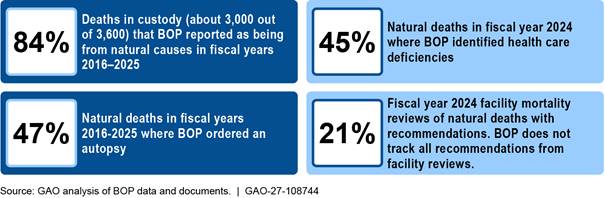
The Federal Bureau of Prisons (BOP) reported that about 3,000 people died from natural causes while in its custody in fiscal years 2016 through 2025. GAO reviewed death investigation records for the natural deaths in BOP custody in fiscal year 2024. The documents showed that BOP identified health care deficiencies in 45 percent of these deaths, and that some of these deficiencies contributed to the natural deaths. BOP identified deficiencies such as delayed offsite medical appointments, failures to order necessary medical tests, and shortcomings in emergency responses.
After a death in custody, BOP requires staff to notify the decedent’s emergency contacts and next of kin. However, BOP could not confirm how many of these individuals received such notifications because it did not require that staff document (nor require that BOP management monitor) that these notifications took place. To help address this issue, in May 2026, BOP began requiring staff to document attempts to notify next of kin. However, BOP did not require staff to document attempts to notify emergency contacts or require management to monitor notifications. By taking these steps, BOP management can better ensure that emergency contacts and next of kin receive notifications.
BOP policy requires staff to share the circumstances surrounding a death with the emergency contacts and next of kin. However, BOP policy does not define what is meant by circumstances surrounding a death, and as a result, staff do not have a consistent understanding of what information to share during death notifications. In addition, GAO found that staff do not always share this information even when it is immediately available or when it becomes available later. Monitoring whether staff share the circumstances, and better defining circumstances surrounding a death for staff, would reduce the risk that families will not receive this consequential information from BOP.
BOP policy requires staff to investigate every death that occurs in BOP facilities, excluding legal executions. However, GAO found that BOP does not record all recommendations resulting from these investigations or whether a facility has implemented them. Doing so would give BOP a more complete picture of deficiencies in its health care delivery and enhance its ability to analyze and address deficiencies, while potentially reducing the government’s liabilities.
Why GAO Did This Study
Federal law enforcement agencies reported that nearly 4,000 people died in their custody in fiscal years 2016 through 2023. Most of these deaths were reported by BOP (85 percent). BOP is responsible for the care and custody of about 155,000 incarcerated people.
GAO was asked to review BOP’s efforts to investigate natural deaths in custody and notify families of these deaths. This report examines what BOP data show about people who died in BOP custody (i.e., in its facilities) from natural causes in fiscal years 2016 through 2025; what deficiencies in care BOP identified that contributed to natural deaths; the extent to which BOP ensures facilities notify families consistently and in a timely manner; and the extent to which BOP investigated natural deaths in its custody.
GAO reviewed BOP policies and documents, and BOP data on deaths in custody. In addition, GAO selected three BOP facilities and interviewed their leadership and staff. GAO selected locations based on variation in the type of facility (penitentiaries versus medical centers) and number of natural deaths. GAO also interviewed BOP headquarters officials responsible for overseeing death investigations and family notifications.
What GAO Recommends
GAO is making 13 recommendations to DOJ, including to ensure BOP tracks and monitors family notifications, defines and monitors the sharing of circumstances surrounding a death, and records all recommendations from death investigations. BOP concurred with our recommendations.
|
Abbreviations |
|
|
|
|
|
|
|
AIDS |
acquired immunodeficiency syndrome |
|
|
BOP |
Federal Bureau of Prisons |
|
|
COVID-19 |
coronavirus disease 2019 |
|
|
DOJ |
Department of Justice |
|
|
FOIA |
Freedom of Information Act |
|
|
FY |
Fiscal Year |
|
|
HIV |
human immunodeficiency virus |
|
|
OIG |
Office of the Inspector General |
|
This is a work of the U.S. government and is not subject to copyright protection in the United States. The published product may be reproduced and distributed in its entirety without further permission from GAO. However, because this work may contain copyrighted images or other material, permission from the copyright holder may be necessary if you wish to reproduce this material separately.
November 16, 2026
The Honorable Richard J. Durbin
Ranking Member
Committee on the Judiciary
United States Senate
The Honorable Jon Ossoff
United States Senate
The Honorable Summer L. Lee
House of Representatives
Law enforcement agencies across the federal government reported a total of 3,960 deaths in their custody from fiscal years 2016 through 2023.[1] Most of these deaths (85 percent) were reported by one agency—the Federal Bureau of Prisons (BOP). BOP, a component of the Department of Justice (DOJ), is responsible for the care and custody of about 155,000 incarcerated people.
The Death in Custody Reporting Act of 2013 requires federal law enforcement agencies, including BOP, to report information about deaths in custody to the Attorney General.[2] The Bureau of Justice Statistics compiles and releases the data, such as the number, manner, and cause of deaths, and certain demographic data. For instance, in fiscal year 2023, the data showed that the manner of death most frequently reported by federal law enforcement agencies was ‘illness/natural’ (72 percent of deaths).
In February 2024, the DOJ Office of the Inspector General (OIG) issued a report on deaths in BOP custody from nonnatural causes (e.g., homicides and suicides). The OIG found, among other things, that longstanding operational and staffing challenges, as well as improper response to medical emergencies, contributed to nonnatural deaths in BOP custody.[3]
We have previously reported on challenges that BOP faces in ensuring the safety and well-being of individuals in its custody, including those related to staffing, infrastructure, delivery of healthcare, and sexual assaults.[4] As a result of these and other challenges, we added Strengthening Management of the Federal Prison System to our High Risk List in 2023.[5] We also previously reported on the DOJ’s efforts to collect and report data in response to the Death in Custody Reporting Act of 2013.[6]
You asked us to review BOP’s efforts to investigate and notify families after a natural death in custody. This report examines: (1) what BOP data show about the number and characteristics of individuals who died in BOP custody from natural causes in fiscal years 2016 through 2025; (2) any deficiencies in care that BOP identified as contributing to natural deaths in custody; (3) the extent to which BOP has policies to ensure death notifications are conducted consistently and in a timely manner; and (4) the extent to which BOP has investigated natural deaths in its custody.
To answer all four objectives, we reviewed BOP’s policies and practices on investigations of deaths in custody and notifying families. We evaluated these policies and practices against relevant guidance, including BOP program statements and strategic goals, the National Institute of Justice’s death investigation guide,[7] and our Standards for Internal Control in the Federal Government.[8] We determined that the control activities, information and communication, and monitoring components of internal control were significant to our objectives.[9]
We also reviewed relevant documents on BOP’s death investigations and family notifications.[10] This included death investigation documents for all deaths in BOP custody during fiscal year 2024 that a medical examiner or coroner determined to be from natural causes. We also reviewed a document BOP uses to track recommendations stemming from these investigations. We analyzed BOP data on deaths that occurred in its custody in fiscal years 2016 through 2025 to report on the demographics and locations of these deaths.[11] We assessed the reliability of the data and determined them sufficiently reliable for our purposes.[12] We also reviewed BOP policies on notifying families of deaths in custody, including program statements on death notifications; patient care; and autopsies.
We visited a nongeneralizable sample of three BOP facilities. We selected these facilities to include variation in the number of natural deaths in custody according to BOP data and type of facility (e.g., correctional institutions versus medical centers). To understand the perspectives of BOP officials and families of incarcerated people regarding BOP communication practices and policies on death notifications, we interviewed the following:
· facility leadership and other employees, such as health services employees, chaplains, and others responsible for communicating with families after a death in custody;[13]
· BOP central office officials responsible for developing and implementing policy on death investigations and family notifications; and
· four nongovernmental organizations that work with families of incarcerated people.[14]
We conducted this performance audit from December 2025 to September 2026 in accordance with generally accepted government auditing standards. Those standards require that we plan and perform the audit to obtain sufficient, appropriate evidence to provide a reasonable basis for our findings and conclusions based on our audit objectives. We believe that the evidence obtained provides a reasonable basis for our findings and conclusions based on our audit objectives.
Background
Investigation of Deaths in BOP Custody
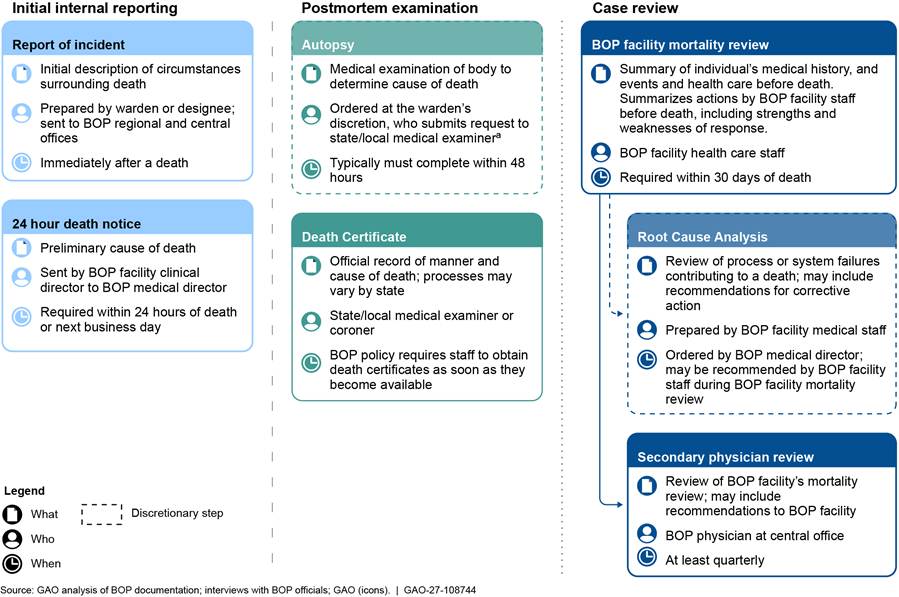
BOP policy requires staff to investigate every death that occurs in BOP facilities, excluding legal executions.[15] Figure 1 summarizes BOP’s process for investigating deaths in custody, including initial internal reporting, postmortem examination by the medical examiner or coroner, and the case review by BOP staff.
Note: When we refer to investigations of deaths required under BOP policy, our review focused on BOP prison facilities and private facilities that confined individuals on behalf of BOP. BOP policy for investigations of deaths in custody excludes legal executions, as well as deaths occurring in home confinement and prerelease custody (e.g., at residential reentry centers). As such, those deaths were outside the scope of this evaluation.
aSee 18 U.S.C. § 4045; 28 C.F.R. § 549.80.
Below we further describe the steps in BOP’s process for investigating deaths in custody. Unless otherwise noted, the information summarizes BOP’s policies.
Initial Internal Reporting
Report of incident. Immediately after a death in custody, the warden (or a designee) is to assemble additional information for the regional and central office. BOP policy requires the report to describe the incident and include the incarcerated person’s offense and sentence, the apparent cause of death, a brief medical history related to the death, any investigative steps underway, and the status of an autopsy request (if one was requested). BOP policy also requires the report to include the name and address of the next of kin and whether BOP has notified them of the death. The report may also include additional evidence, such as photos, fingerprints, staff memos, and medical assessments.
24-hour death notice. Within 24 hours of a death in custody, a BOP facility’s clinical director is to compile information about the death and submit it to BOP’s medical director in central office.[16] The 24-hour death notice includes the incarcerated person’s name, age, date of death, place of death, and whether an autopsy will be performed. The notice also must include a brief clinical synopsis of events leading up to the death, including the staff response, as well as the individual’s medical history. The notice can also include whether BOP expected the death.[17] If the death occurred in a community hospital, the notice must include the length of hospitalization and a description of emergency care that the hospital provided.
Postmortem Examination
The final manner of death (e.g., natural causes, homicide, suicide) and cause of death (e.g., cancer, stroke, sepsis) are determined by an external medical examiner or coroner. BOP does not make these determinations, according to BOP officials.[18] It is BOP’s practice to submit autopsy requests to state or local medical examiners or coroners’ offices. BOP documents the cause of death as follows: natural causes, suicide, homicide, accident, legal execution, lethal force, or unknown. Deaths in BOP custody with an unknown final manner of death indicate that the medical examiner or coroner could not determine a conclusive cause of death, according to BOP officials.
Autopsy. BOP may order an autopsy to determine the cause of death. Under statute, regulation, and BOP policy, a warden has the discretion to order an autopsy if they believe that it is necessary to detect a crime, maintain discipline, protect the health or safety of other incarcerated people, remedy official misconduct, or defend the United States or its employees from civil liability arising from the administration of the facility.[19] The warden may also order other postmortem tests, such as a toxicology report. According to BOP policy, time is a critical factor in arranging for an autopsy, which ordinarily must be performed within 48 hours.
Death certificate. BOP policy requires staff to collect the death certificate for every death in custody as soon as it becomes available and send a copy to the person who received the deceased’s remains.
Case Review
BOP policy requires that every death investigation include a facility mortality review and a secondary review, by a physician, of the facility’s mortality review findings.
Facility mortality review. For every death, facility medical staff must conduct a facility mortality review to identify potential deficiencies in health care, including those that may have directly that contributed to the death.[20] The review compiles a comprehensive clinical summary of the incarcerated person’s medical history, events leading to the death, cause of death, and postmortem test results, such as the autopsy report. The review also summarizes actions by facility staff who responded to the death, along with strengths and weaknesses of their response. Facilities must submit the mortality review to central office within 30 days of a death, unless the facility obtains a waiver to submit the review at a later date.[21]
Root cause analysis. BOP requires a root cause analysis if an unexpected death may have been impacted by the health care the incarcerated person received (e.g., if a medication error led to a patient’s death). Otherwise, BOP’s medical director has discretion to request that a facility conduct a root cause analysis. A root cause analysis seeks to pinpoint factors that led to health care deficiencies and can result in recommendations requiring the BOP facility to take corrective actions aimed at known health care deficiencies. If the facility determines a root cause analysis is necessary during its review, the facility must complete the analysis within 45 days of determining it is needed.
Secondary physician review. Next, a physician at BOP’s central office conducts a secondary review of the findings and recommendations from the facility mortality review. The review also identifies, among other things, potential strengths or weaknesses in the facility’s healthcare delivery.[22] The secondary review may endorse the recommendations from the facility’s mortality review or may offer new recommendations. The facility must submit a plan to the medical director to address these recommendations within 90 days
Notifying Families After a Death in BOP Custody
After a death in custody, BOP requires staff to notify the incarcerated person’s family with both a phone call and a letter of condolence.[23] After notifying the family, BOP staff are to coordinate with the next of kin to transfer the remains and personal property.[24]
Phone call. After a death in custody, BOP policy requires the facility’s warden (or designee) to immediately telephone the individual that the incarcerated person designated on their emergency contact form, who may or may not be next of kin.[25] For example, BOP officials told us that an incarcerated person could list a friend or cousin as their emergency contact who are not considered next of kin, or a parent or sibling who are next of kin. During the call, BOP staff are required to communicate the circumstances surrounding the death.
Letter of condolence. BOP policy requires the warden (or a designee) to mail a letter of condolence to the next of kin as soon as practical to share the circumstances of the death. BOP policy also states that if the death was due to natural causes, the letter should summarize the cause of death.[26]
Transfer of remains and property. After notifying the family, BOP is to coordinate with the next of kin to transfer the remains and personal property. According to BOP policy, when the incarcerated person did not identify a next of kin on their emergency contact form, unit management staff must attempt to locate the next of kin. Only the next of kin may determine the disposition of the deceased’s remains and property, according to BOP policy. Typically, the facility’s case management coordinator and supervisory contract specialist manage the transfer of remains and property.
BOP Reported About 3,000 Natural Deaths in Fiscal Years 2016–2025
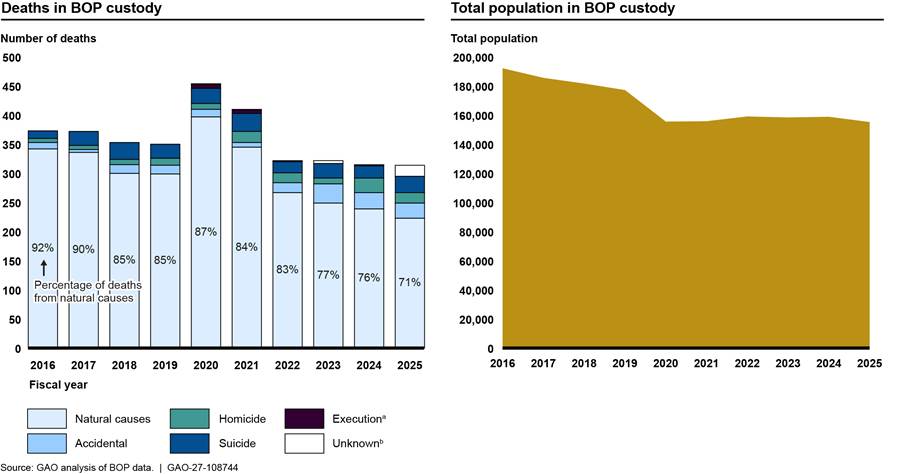
Of the 3,585 individuals who died in BOP custody in fiscal years 2016 through 2025, BOP reported that 2,997 (84 percent) died from natural causes.[27] Figure 2 below shows deaths in BOP custody, by reported manner of death, during that time span. Natural deaths (as a percentage of overall deaths in BOP custody) generally declined, from 92 percent in fiscal year 2016 to less than 85 percent each fiscal year from 2021 through 2025.[28]
The proportion of deaths by homicide and accident (which includes drug overdoses) increased during the same time frame. For example, from fiscal years 2016 through 2021, there were on average 11 accidental deaths in custody each year. However, there were an average of 26 accidental deaths each year from fiscal years 2022 through 2025. In addition, deaths with an unknown manner of death comprise about 1 percent of all deaths during this time frame, but account for over 6 percent of deaths in fiscal year 2025. According to BOP officials, it can take multiple months for BOP to receive a death certificate or autopsy report listing the final manner and cause of death.
Figure 2: Deaths in Federal Bureau of Prisons (BOP) Custody, by Reported Manner of Death, Fiscal Years 2016–2025
Note: According to BOP officials, the Bureau does not determine the final manner of death for individuals in its custody. This information is determined by an external medical examiner or coroner, and can be noted on a death certificate and, if an autopsy is conducted, a final autopsy report. Total population includes individuals in BOP prison facilities and prerelease custody, including residential reentry centers (i.e., halfway houses) and home confinement. For example, the January 2025 population included about 143,000 individuals in BOP-managed facilities and about 12,000 individuals in community-based facilities (primarily residential reentry centers and home confinement).
aThere were 13 deaths by legal execution during this time frame: seven in fiscal year 2020 and six in fiscal year 2021.
bAbout two-thirds of deaths in BOP custody with an unknown manner of death have investigations that are still pending—for instance, BOP has not yet received an autopsy report or death certificate. An unknown final manner of death indicates that the medical examiner or coroner could not determine a conclusive cause of death.
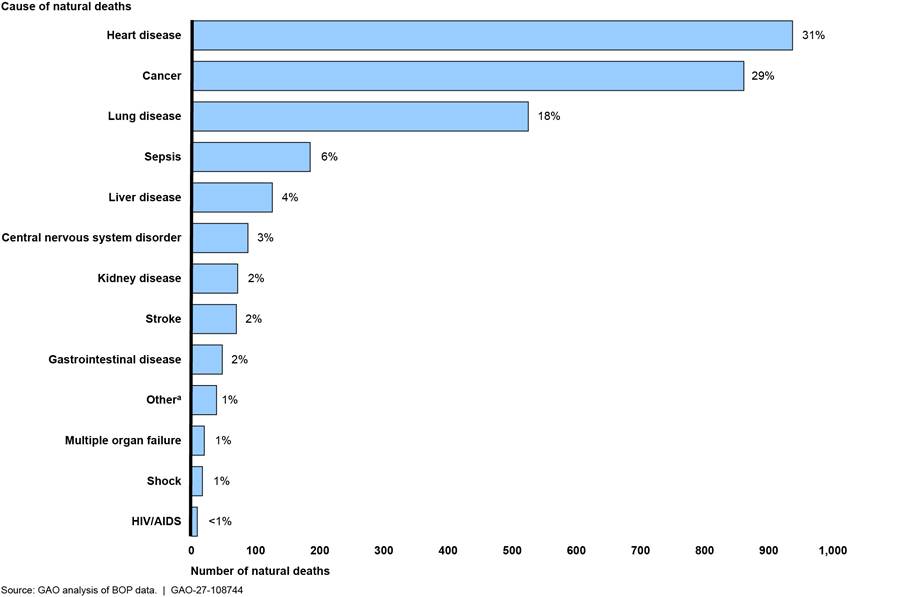
Cause of natural deaths. BOP reported that the three leading causes of natural deaths in BOP custody from fiscal years 2016 through 2025 were heart disease, cancer, and lung disease. Figure 3 shows that these three leading causes accounted for nearly 78 percent of all natural deaths during that time span.
Figure 3: Causes of Natural Deaths in Federal Bureau of Prisons (BOP) Custody, Fiscal Years 2016–2025
Note: According to BOP officials, the Bureau does not determine the final cause of death for individuals in its custody. This information is determined by an external medical examiner or coroner, and can be noted on a death certificate and, if an autopsy is conducted, a final autopsy report.
aOther includes pancreatitis and cases pending an autopsy or death certificate, as of January 2026.
BOP facilities. About half of all natural deaths in BOP custody from fiscal years 2016 through 2025 were individuals confined at one of BOP’s seven medical centers.[29] The medical centers provide care to incarcerated people in need of more advanced medical or mental health care. Seven hundred natural deaths (23 percent of natural deaths in BOP custody) occurred at Federal Medical Center Butner—the most natural deaths of any BOP facility during this time span as reported by BOP. According to BOP officials, Butner generally receives incarcerated patients with the most complicated medical cases in the country.
The ten BOP non-medical facilities with the most natural deaths accounted for 21 percent of all natural deaths from fiscal year 2016 through 2025 and averaged more than 6 natural deaths per year. However, at most BOP facilities a natural death in custody is less common. Specifically, excluding the medical centers, 61 of the 104 BOP facilities (59 percent) experienced a natural death less than once per year on average, and accounted for less than 10 percent of all natural deaths during that time span.[30] Table 1 shows the 10 non-medical center facilities with the most natural deaths from fiscal year 2016 through 2025, and each of the seven medical centers during this time span. For a full list of natural deaths in custody, by facility, see appendix II.
Table 1: Federal Bureau of Prisons (BOP) Facilities with the Most Natural Deaths, Fiscal Years 2016–2025
|
Non-medical centers |
Medical centers |
||||
|
BOP facility |
Number of natural deaths, FY 2016-2025 |
Facility population rangea |
BOP federal medical center |
Number of natural deaths, FY 2016-2025 |
Facility population rangea |
|
Butnerb |
128 |
2,737-3,897 |
Butner |
700 |
759-996 |
|
Coleman |
109 |
5,153-6,797 |
Springfield |
246 |
792-1,095 |
|
Terre Haute |
69 |
2,206-2,786 |
Lexington |
140 |
931-1,446 |
|
Terminal Island |
58 |
700-1,146 |
Fort Worth |
135 |
1,221-1,635 |
|
Beaumont |
54 |
4,235-5,563 |
Devens |
131 |
690-1,055 |
|
Tucson |
46 |
1,559-2,386 |
Rochester |
85 |
581-771 |
|
Hazelton |
40 |
3,100-3,720 |
Carswell |
69 |
843-1,288 |
|
Victorville |
40 |
3,162-4,325 |
- |
- |
- |
|
Florence |
39 |
2,223-2,768 |
- |
- |
- |
|
Seagoville |
39 |
1,483-2,109 |
- |
- |
- |
Source: GAO analysis of BOP data. | GAO‑27‑108744
Note: This table includes the ten BOP non-medical facilities with the most natural deaths during fiscal years 2016 through 2025. Complexes with multiple BOP facilities include totals for all facilities in the complex, except for Butner. BOP operates seven Federal Medical Centers, which are all listed in the Medical Centers section of the table. Our review of natural deaths focused on BOP prison facilities and private facilities that confined individuals on behalf of BOP. BOP policy for investigations of deaths in custody excludes deaths occurring in home confinement and prerelease custody (e.g., at residential reentry centers). As such, those deaths were outside the scope of this evaluation.
aThe incarcerated population at facilities varied across fiscal years 2016 to 2025. As a result, we presented facility population range, which is the minimum and maximum facility population from fiscal years 2016 through 2025, based on a point-in-time population in January. For data from 2018, we used facility populations from March because January data were not available.
bData for Butner includes natural deaths for the three non-medical facilities located within the correctional complex.
Location of death. About 89 percent of natural deaths in BOP custody in fiscal years 2016 through 2025 occurred in a medical setting, such as a community hospital, nursing care center, or medical room at a BOP facility (see figure 4).
Figure 4: Locations of Natural Deaths in Federal Bureau of Prisons (BOP) Custody, Fiscal Years 2016–2025
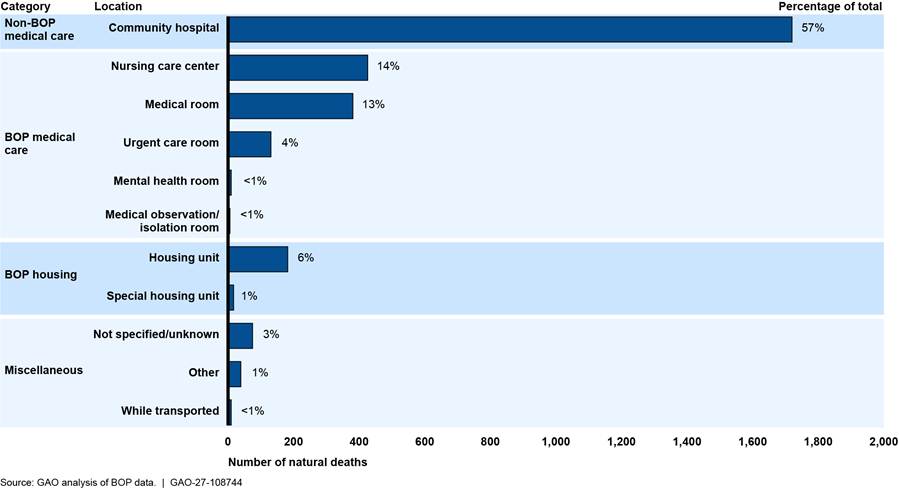
Notes: Other includes recreation areas, the receiving and discharge area (such as during intake), the compound/courtyard area, and work areas. Not specified indicates that a location of the death was not specified in BOP death-related documents, according to BOP officials.
For data on the demographics of individuals who BOP reported died in custody from natural causes, see appendix III.
BOP Identified Various Deficiencies in Health Care Delivery That Contributed to Natural Deaths
BOP Documents Indicate Health Care Deficiencies Contributed to Deaths in Custody
We reviewed more than a thousand death investigation records for 244 deaths in BOP custody in fiscal year 2024 due to natural or unknown causes.[31] We found that BOP identified health care deficiencies in 111 (45 percent) of the deaths. As discussed earlier, BOP policy requires that staff investigate each death in custody and complete a series of documents (e.g., mortality review, secondary physician review, and sometimes a root cause analysis). These documents indicated a range of health care delivery deficiencies in fiscal year 2024, and some of these identified deficiencies contributed to deaths deemed natural or from unknown causes.
Based on our review of the 111 cases with documented deficiencies, we identified eight categories of deficiencies, as shown in figure 5. For example, we found:
· Timeliness of non-emergency care. In 42 cases, deficiencies were related to timeliness of non-emergency medical care, such as delayed off-site medical appointments, delayed follow-up appointments after a doctor consultation, and unavailability of medical specialists.
· Diagnostic. In 13 cases, deficiencies were related to diagnostic failures, such as failures to order necessary tests or consultations.
· Emergency response. In 19 cases, deficiencies were related to emergency response, such as failures of BOP staff to conduct regular checks in facility housing (thus, not identifying ongoing emergencies), perform cardiopulmonary resuscitation (CPR) or use an automated external defibrillator when needed, and call 911 in a timely manner.
Figure 5: Health Care Deficiencies Identified in Federal Bureau of Prisons (BOP) Investigations of Natural and Unknown Deaths, by Category, Fiscal Year 2024
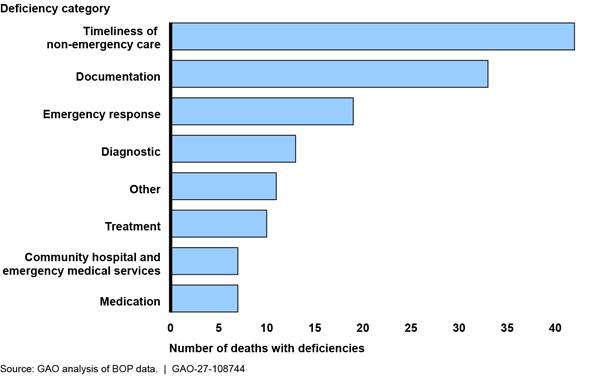
Note: We reviewed death investigation records for 244 deaths in BOP custody deemed natural or unknown in fiscal year 2024 and found that BOP identified health care deficiencies in 111 of the deaths. For each of the 111 deaths with deficiencies, we categorized the deficiencies. Some deaths involved multiple deficiencies, and thus, the sum of the deficiencies is greater than 111. When we refer to investigations of deaths required under BOP policy, our review of natural deaths focused on BOP prison facilities and private facilities that confined individuals on behalf of BOP. BOP policy for investigations of deaths in custody excludes deaths occurring in home confinement and prerelease custody (e.g., at residential reentry centers). As such, those deaths were outside the scope of this evaluation.
Table 2 includes examples of natural deaths where BOP identified a health care deficiency, including the circumstances leading to those deaths and findings from BOP’s investigations.
Table 2: Examples of BOP Identified Deficiencies in Health Care for Deaths in BOP Custody from Natural Causes
|
Health care prior to death |
BOP mortality review findingsa |
BOP root cause analysis findingsb |
|
A patient complained of chest pain and was evaluated. BOP facility staff ordered a cardiology consultation to occur within 5 months, but it was delayed and did not occur for 11 months. The patient suffered a heart attack 1 month after the consultation. Facility medical staff advised calling 911, but corrections staff waited 3 hours to do so. The patient was transported to a hospital where he died. |
Recommended increasing medical staffing, retraining personnel, and directing medical staff to call 911 directly when appropriate instead of asking corrections staff to do so. |
Recommended changing facility procedures for calling 911 and starting to conduct cardiology consultations on-site to reduce the backlog of orders for off-site cardiology appointments. |
|
A patient complained of headaches and intermittent blindness. Facility staff ordered an urgent brain CT scan, but BOP regional office denied the request.c Three weeks later, corrections staff found the patient unresponsive and administered naloxone, suspecting a drug overdose. Later that day, his condition worsened and he was hospitalized. A CT scan at the hospital revealed a brain tumor, and he died three days later. |
Found that BOP staff should have transferred the patient to an emergency room immediately upon reporting his symptoms. |
Found that BOP staff failed to correctly document medical procedures, including administration of naloxone. Did not comment on mortality review findings. |
|
A patient reported chronic back and leg pain. Facility staff ordered x-rays, which indicated possible lung cancer. Staff ordered an urgent PET scan and pulmonology consultation.d The consultation happened after 2 months, followed by a scan 4 months later. The scan was 5 months after BOP’s target date. Patient was diagnosed with cancer, refused treatment, and died 5 months later. |
Identified delayed consultations as weaknesses but did not issue recommendations to address them. |
Not conducted |
|
A patient with history of high cholesterol visited facility medical staff with low blood oxygen saturation and elevated heart rate. The patient was not hospitalized despite abnormal vital signs. Four days later, the individual died of a pulmonary embolism at the prison. |
Found that BOP should have transferred the patient to an emergency room based on abnormal vital signs. |
Found that transferring the patient to the hospital sooner could have resulted in a different outcome and recommended additional staff training. |
Source: GAO analysis of Federal Bureau of Prisons (BOP) documentation. | GAO‑27‑108744
Note: We reviewed death investigation records for 244 deaths in BOP custody deemed natural or unknown in fiscal year 2024 and found that BOP identified health care deficiencies in 111 of the deaths. We selected these four cases as illustrative examples and summarized key information about them.
aBOP facility healthcare staff complete a facility mortality review to identify any health care deficiencies that contributed to a death after every death in custody.
bBOP’s Medical Director may order a root cause analysis in some cases when a death involved serious health care deficiencies. A root cause analysis is meant to pinpoint factors that led to health care deficiencies.
cA computed tomography (CT) scan is an imaging technique that shows the size and structure of organs, bones, and other tissues.
dA positron emission tomography (PET) scan is an imaging technique that can find cancer cells in the body.
|
Negative Impacts of Delayed Off-site Medical Appointments BOP records show that after BOP medical staff evaluated an incarcerated person with elevated liver enzymes, staff recommended an ultrasound, which was conducted 6 months later. Staff then recommended a CT scan, but the patient did not receive the needed scan for another 5 months. The first attempt to conduct a CT scan had to be repeated, delaying care by 2 more months, because the patient was not instructed to fast before the appointment. The patient received a CT scan at the second appointment, which indicated a possibility of cancer, and the provider recommended urgent tests. However, the patient did not receive the tests until 6 months later because the facility did not have enough staff to escort the patient to the off-site appointment. Following the appointment, the patient did not receive additional ordered tests until he was hospitalized 1 month later. He died the following month from cancer. While investigating this death, facility medical staff identified the delays in care and recommended that the facility increase the number of off-site appointments per day. Staff said this was necessary because the current number of trips, if unchanged, would continue to worsen health care outcomes. Source: GAO analysis of BOP documents. | GAO‑27‑108744 |
Appointment challenges. BOP officials told us that completing off-site medical appointments in a timely manner is a major challenge in delivering high quality healthcare, which negatively affects health outcomes. The DOJ OIG has also identified delays in health care, including challenges completing off-site medical appointments, as a longstanding area of concern for BOP.[32] Among fiscal year 2024 deaths from natural or unknown causes, in 34 of 89 cases (38 percent) in which medical providers ordered a consultation with a specialist, BOP staff identified during the mortality review that appointments were not completed in a timely manner or at all.
Off-site medical appointments can include specialist consultations, imaging, and other types of appointments. For example, an internal BOP report from September 2025 stated that a lack of medical equipment for screenings, such as on-site mammography services, created a need for off-site appointments.[33]
BOP officials attributed some delays in off-site medical appointments to staffing constraints. Officials told us that off-site medical appointments typically require multiple corrections officers to escort an incarcerated person. This requires BOP to temporarily reassign officers from their regular posts at a facility. As a result, staffing shortages, which are common at BOP, limit the number of off-site appointments facilities can schedule each day and may lead to the cancellation of scheduled appointments.[34] For example, if a medical emergency occurs that requires transporting an individual to a hospital, facilities may cancel previously scheduled (i.e., more routine) appointments to prioritize the emergency trip, according to officials at one facility. These officials also told us that staff administer naloxone to reverse a suspected overdose at least once a week, and in each of these cases they transport the patient for emergency room observation. This may lead to the cancellation of a previously scheduled non-emergency appointment for another patient. Officials also said that these last-minute cancellations frustrate external medical providers, who may then be less willing to work with BOP and see incarcerated patients in the future.
|
Example of Federal Bureau of Prisons (BOP) Process for Identifying and Addressing a Deficiency An incarcerated person told BOP medical staff that they had a sore throat for several months, difficulty swallowing, ear pain, and a voice change. The provider referred the patient to a gastroenterologist. Three months later, the patient’s symptoms persisted and BOP staff ordered a CT scan and biopsy, which revealed cancer in his neck. He died 4 months later. While investigating the death, the facility identified deficiencies in care, including referring the patient to a gastroenterologist instead of an ear, nose, and throat doctor. The facility submitted a plan to address the deficiencies to BOP’s central office. Central office approved the plan, began tracking the facility’s efforts to implement it, and scheduled a date to follow up with the facility after 6 months. Source: GAO analysis of BOP information. | GAO‑27‑108744 |
An official at one BOP facility told us that the prison has a backlog of over 400 necessary off-site medical appointments. Because of staffing shortages, the facility is only able to conduct two or three off-site appointments per day but meeting the facility’s health care needs would necessitate about seven trips per day. The official also told us that the facility typically must cancel about 30 percent of its scheduled off-site appointments due to insufficient staffing.
Central office officials told us that BOP continues to expand the use of telemedicine, which can help reduce the need for off-site medical appointments and expand access to certain types of care. Officials also told us that telemedicine appointments can include primary care, cardiology, gastroenterology, and dietary consultations, as well as physical therapy appointments. For example, at one facility we visited, officials estimated that telemedicine has reduced the need for about 15 percent of off-site medical appointments. In addition, in March 2026, central office officials told us that 88 of BOP’s 97 sites (counting co-located facilities as a single site) had completed at least one specialist telemedicine consultation.
Historically, the adoption of telemedicine at BOP facilities was slowed by infrastructure incompatibility and staffing shortages, according to BOP officials. For example, they said incarcerated people could not be left alone in a room with a computer, and a staff member, preferably a nurse or other clinician, was needed to facilitate the telehealth visit. BOP officials said the Bureau resolved these infrastructure issues at all facilities. In addition, officials at one facility said the credentialing process (verifying a provider’s training, licenses, and work history) has been a challenge to their facility’s adoption of telemedicine.
We found that staffing shortages also limit the number of appointments and consultations that facilities can provide onsite. BOP staff at all three BOP facilities we interviewed told us that staff shortages have impacted health services. For example, impacts have included facilities prioritizing responding to emergencies and delaying preventative care, ceasing to offer health education classes, and reducing training opportunities for staff. As a result, staff at one facility stated that health outcomes have worsened, contributing to deaths due to natural causes. In addition, while having a clinician onsite 24 hours per day is not a requirement at all BOP facilities, staff at two facilities we visited said that shortages in medical staff have resulted in no longer having medical staff scheduled at the facility overnight to address medical emergencies.[35]
Fiscal exposure. BOP has faced legal actions and fiscal exposure because of alleged deficiencies in health care delivery. From 2016 through 2025, BOP paid out $10.75 million to settle 25 lawsuits involving claims of health care deficiencies that led to death.
BOP Staff Issued Recommendations to Help Address Health Care Deficiencies
As of February 2026, BOP central office was monitoring the implementation of open recommendations that resulted from its investigations of 133 natural deaths. Although BOP investigates all natural deaths, 133 of these investigations resulted in recommendations that are tracked by central office. We examined the 133 cases with open recommendations and categorized them by the type of health care deficiency that the recommendation sought to address (see figure 6). For example, 52 of the 133 cases with recommendations (39 percent) involved deficiencies in diagnosing medical conditions.[36]
Figure 6: Federal Bureau of Prisons (BOP) Deficiencies with Open Recommendations from Investigations of Natural Deaths in Custody, by Category
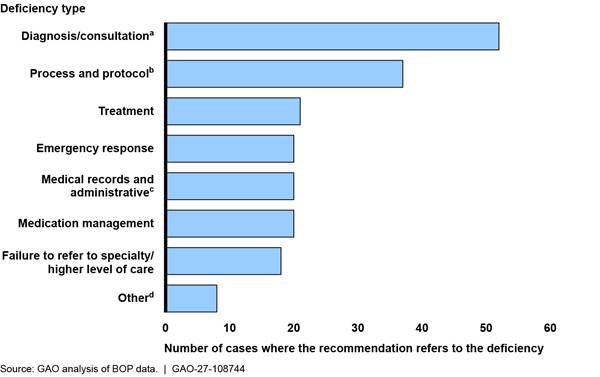
Note: BOP policy requires that staff investigate every death in custody, and these investigations may produce recommendations to improve the delivery of health care. When we refer to investigations of deaths required under BOP policy, our review of natural deaths focused on BOP prison facilities and private facilities that confined individuals on behalf of BOP. BOP policy for investigations of deaths in custody excludes deaths occurring in home confinement and prerelease custody (e.g., at residential reentry centers). As such, those deaths were outside the scope of this evaluation. Central office monitors some recommendations from these investigations, specifically those from secondary physician reviews and root cause analyses. Recommendations can include deficiencies that may or may not have contributed directly to a death. We reviewed the 133 natural or unknown deaths with recommendations in BOP’s recommendation tracker, as of February 2026. We categorized the deficiencies that led to recommendations from these deaths, as shown in the figure. In some instances, there were multiple deficiencies in different categories that led to recommendations. Therefore, the sum of these categories is greater than the total number of deaths with recommendations (133).
aFor example, this category could include failures to make a correct diagnosis based on presenting symptoms, review diagnostic results in a timely manner, or complete a specialist consultation.
bProcess and protocol deficiencies could include failing to provide a routine screening, counsel patients that did not follow doctor recommendations, or document treatment refusals.
cFor example, this could include failing to complete medical records or obtain medical records in a timely manner, such as from a hospital or previous BOP facility.
dOther includes deficiencies that did not fall under other categories, such as cases where the recommendations were too broad to determine a prominent deficiency for the purposes of this analysis.
The recommendations that BOP currently tracks stemmed from secondary physician reviews and root cause analyses. However, as discussed in greater detail later in this report, BOP staff also made recommendations in mortality reviews. In addition, BOP central office has developed recommendations to help address health care deficiencies that were more systemic across its facilities. For example, in September 2025, BOP produced an internal report analyzing data on all 381 deaths in custody in calendar year 2024 (including natural and non-natural deaths).[37] Based on its review, BOP issued three recommendations to improve its medical care. For example, BOP recommended providing national clinical education on diagnosing and treating cardiovascular disease and cancer, as well as on emergency response, and analyzing and developing national best practices for off-site consultations.
BOP Provides Limited Oversight of Family Notifications After a Death in Custody
BOP Policy Does Not Clearly Explain Some Family Notification Steps
BOP has developed policies to notify families of deaths in custody. These policies describe family notification requirements, some of the roles and responsibilities for family notifications, and high-level descriptions for what information staff can share with families, among other information.
BOP staff we interviewed offered varying interpretations of BOP policy on whom to contact following a death in custody. Additionally, we found that BOP policy does not clearly explain how to locate the next of kin. As a result, there is a risk that BOP staff will fail to notify the next of kin and emergency contacts of a death in custody.
Notification phone calls. After a death in custody, BOP policy directs staff to immediately telephone the individual(s) that the incarcerated person designated on their emergency contact form.[38] The individual(s) on the form may or may not be the next of kin. For example, BOP officials told us that some incarcerated people list a girlfriend or childhood friend as their emergency contact, who are not next of kin, or leave the emergency contact section blank.
BOP officials and staff we spoke with had different understandings about whether BOP was to contact the emergency contact, next of kin, or both, during the initial family notification phone call. For example:
· A central office official responsible for overseeing the policy said that BOP is only supposed to contact the next of kin during the initial phone call. Under this interpretation, an emergency contact who is not the next of kin would not be contacted immediately.
· Staff at a facility we visited said they only call the person listed on the emergency contact form. Under this interpretation, the next of kin may not be immediately notified of a death in custody.
· Other facility staff said they call the emergency contact and the next of kin (if those are different people and contact information is available for both). Under this interpretation, both the next of kin and emergency contact would be immediately notified.
These different interpretations lead to inconsistent implementation of BOP’s policies on family notifications. We were unable to determine the extent to which each interpretation was used in practice because, as discussed later in this report, BOP did not track information about whether these calls occurred and who was contacted. However, the emergency contact form sets expectations that BOP staff will contact the individuals identified by the incarcerated person after a death. As such, it is important that these requested individuals are included in BOP’s death notifications.
Identifying and locating next of kin. BOP staff are also required to write a letter of condolence to the next of kin and communicate with them to transfer remains and property. As previously mentioned, next of kin must be determined in accordance with applicable state laws, however, according to BOP officials, BOP policy does not explain how staff are to identify and locate the next of kin when an incarcerated person does not include their contact information on their emergency contact form. If a decedent’s next of kin is not included in the emergency contact form, BOP officials told us that facility staff can review visitation records or pre-sentence investigation reports to try to locate the next of kin. However, according to BOP officials, these sources are not described in BOP policy or guidance. An official at one BOP facility we visited told us that specific step-by-step guidance to help locate the next of kin would be helpful. Officials at another facility told us that they did not know what sources they were allowed to use to locate the next of kin and were worried they could be disciplined for using some of the same methods that central office suggested.
In addition, BOP officials told us that there is no guidance on how long staff should attempt to locate the next of kin. The length of time is important because if a next of kin is not identified, BOP arranges burials of unclaimed remains, according to BOP officials. Central office officials told us that they were unaware of any instances in which staff were unable to identify the next of kin and had to arrange a burial.[39] However, officials at two of the three facilities we spoke with described recent examples of not being able to transfer remains to the next of kin.[40] The officials said that a burial may occur on the grounds of the BOP facility, or a local public cemetery. Officials at one facility told us that they use state law as a guide, which gives 10 days to claim a body. However, they said they continue trying to locate next of kin even after that time until they exhaust any leads, and coordinate with their legal department, before proceeding with a burial.
Clarifying whom staff are required to phone immediately following a death in custody and providing related guidance on locating the next of kin could help ensure BOP notifies families. Such guidance could include an approved list of sources to help locate next of kin and recommended timeframes for how long to search for the next of kin. These steps could help ensure that BOP facilities have the necessary resources and information to identify and notify the appropriate next of kin to help facilitate transfer of remains and personal property. They could also help ensure that the families receive timely notification of a death in custody and that decisions are made by appropriate individuals.
Prior to June 2026, BOP policy required all facilities to develop facility-level policy supplements to bolster BOP-wide family notification policy.[41] According to BOP officials, facility supplements contained the most detailed information about notifying next of kin and steps to take if BOP staff could not reach them. They also said that BOP required facility supplements because state statutes applicable to deaths of incarcerated people vary. For example, states have different statutory definitions of next of kin and varying autopsy requirements.
After we obtained and analyzed several supplements, in June 2026, BOP eliminated the requirement to include family notification guidance following a death in custody from the facility supplements. According to BOP officials, the requirement was eliminated because they consider BOP-wide policies on family notifications following a death in custody to be sufficient. However, as discussed throughout this section, we found that BOP staff do not always have a strong understanding of certain BOP policy requirements regarding family notifications. Discontinuing the facility supplement requirement following a death strengthens the need for BOP to clarify whom staff are required to notify immediately following a death in custody and provide related guidance on how to locate the next of kin.
BOP Does Not Consistently Track or Monitor Family Notifications
We found that BOP does not track and monitor family notifications, and as a result, could not confirm whether its staff notified families according to BOP policy. As discussed earlier, BOP policy requires facility staff to (1) telephone designated emergency contacts immediately after a death, and (2) send a letter of condolence to next of kin as soon as practical. For instance, about 3,600 people died in BOP custody in fiscal years 2016 through 2025, including from natural and nonnatural causes. BOP could not confirm (or provide us with support for) how many of the roughly 3,600 families received notification that their family member had died in BOP custody. BOP also could not confirm whether its staff completed these notifications on time.
BOP central office officials told us in April 2026 that they defer to BOP facilities on whether and how to track family notifications. However, officials from two of the three facilities we visited said they do not have a facility-level requirement to document family notifications. Officials from the third facility said they log all attempts to locate and notify the next of kin, including the contact information that staff used and whether each attempt was successful. These officials said the log has been a useful tool to help maintain visibility into efforts to locate the next of kin.
During the period of our review (fiscal years 2016 to 2025) BOP’s policy on family notifications did not require staff to document whether they attempted family notifications or whether they were successful according to BOP officials. In May 2026, BOP updated its policy to require facility staff to document all attempts to contact next of kin after a death in custody.[42] However, the new policy only pertains to attempts to contact the decedent’s next of kin and does not require facility staff to document attempts to reach the emergency contacts. The policy also does not require BOP management to monitor whether these notifications took place. Further, as of July 2026, BOP had not stated what information staff should document to ensure consistent application of the new requirement.
In addition, according to BOP officials, BOP did not require staff to track family notifications in fiscal years 2016 through 2025, however, the Bureau had a process to track other steps after a death in custody. For example, BOP maintained data on the date facilities submitted a 24-hour death notice to central office.
DOJ’s National Institute of Justice’s Death Investigation: A Guide for the Scene Investigator states that every reasonable effort should be made to notify the next of kin or other authorized individuals as soon as possible after a death in custody.[43] The guide also says that officials should document the time and method of notification, as well as unsuccessful and successful attempts to contact the next of kin or emergency contacts. This, according to the guide, ensures that every reasonable effort has been made to contact the appropriate individuals.
By tracking and monitoring family notifications—including the time and method of notification, as well as unsuccessful and successful attempts to contact the next of kin and emergency contacts—BOP can better ensure facility staff complete all notifications in line with agency policy. Collecting this information could also better position BOP management to oversee whether notifications occur as intended and, if not, take corrective action. These steps can help ensure families receive timely information regarding the loss of a relative.
BOP Facilities Do Not Consistently Share Circumstances Surrounding a Death with Family
After a death in custody, BOP policy requires facilities to share the circumstances surrounding a death with the emergency contacts and next of kin. However, we found that BOP policy does not define what is meant by circumstances surrounding a death, and as a result, staff do not have a consistent understanding of what information to share during death notifications. In addition, BOP officials said that the circumstances surrounding a death may not be available when staff first notify the emergency contacts and next of kin. However, we found that staff do not always share this information even when it is immediately available or when it becomes available later.
Definition of Circumstances Surrounding a Death
Although BOP policy requires staff to share the circumstances surrounding a death with emergency contacts and next of kin, BOP has not defined what elements make up the circumstances in policy or guidance for staff. As a result, BOP central office officials and staff we interviewed had different interpretations of the specific details staff are supposed to share with families after a death. For example, central office officials stated that the circumstances surrounding deaths generally include the manner of death (e.g. natural causes, suicide, homicide, accident) and may also include the cause of death, the events leading up to the death, and the location where the death occurred, such as at a local hospital. However, they also said that circumstances surrounding the death is more of a concept that can be broadly interpreted. These varying interpretations can result in BOP staff sharing inconsistent, and sometimes limited, information with families.
Although BOP policy does not spell out the circumstances surrounding a death that facilities should share with families, it does detail what information facilities are to report to BOP central office. Specifically, BOP policy requires facilities to report a preliminary cause of death, the place of death, a clinical synopsis of events leading to the death, the facility staff’s response leading up to the death, and past medical history.[44] If the death occurred in a community hospital, facility staff are to describe the length of hospitalization or the emergency care provided.
Although BOP policy does not define circumstances of death, it provides some additional information that could be helpful for staff. For instance, BOP policy states that if the death was from natural causes, staff are to summarize the cause of death in the letter of condolence. If the death was accidental, BOP policy states it is appropriate to share the nature of the accident and the cause of death in the letter. However, for deaths that occurred under suspicious circumstances or by “foul play”, BOP staff may provide the cause of death but state in the letter that they cannot provide certain details because the death is under investigation.
Sharing Information with Families
We found that staff do not consistently share the circumstances surrounding a death with families.[45] For example, staff at one BOP facility told us that BOP’s death notification process allows them to clearly explain the circumstances surrounding a death, offer limited counseling in the moment, and offer to be a resource for the family and provide updates in the future. This individual told us that they try to obtain additional information to share with family members during follow-up phone calls. Conversely, staff at another BOP facility told us that during notification phone calls family members often ask how their relative died. However, the staff said they are not permitted to answer such questions until an autopsy is complete, even if they have additional information. These staff also said they typically do not communicate with family members after the initial call.
We heard from BOP officials that at many facilities, chaplains are the primary person that phones family members after a death. However, BOP central office officials told us that BOP chaplains share the information the warden authorizes them to share when notifying families. The officials explained that the chaplain’s task during the initial phone call is to tell the family that their relative died. However, staff at one facility told us that even if the chaplain has more information, they are generally not given authorization to share the additional details. According to BOP officials, subsequent calls are typically from the facility’s business administrator or contract specialist who is prepared to discuss the logistics of transferring remains and personal property, not the circumstances of the death.[46]
BOP officials also stated that sometimes its staff do not know the circumstances surrounding the death when notifying families. However, BOP central office officials told us that they have no expectation that facility staff contact families again when the information becomes available. Moreover, some staff told us they do not share this information even when it is available during the initial death notification.
We spoke with representatives from four nongovernmental organizations that work with families of incarcerated people. Representatives from two organizations said that after learning of a death, one of the most pressing questions families have is about what happened to their relative. Representatives from one organization said it can be difficult for families to obtain information about the events leading up to a death, and another organization told us that families are desperate to learn both the manner of death (e.g., suicide or natural death) and information about any life-saving measures that were taken. The representatives also said that it is not sufficient for BOP to share only the date and time of death because learning the circumstances of the death is a very important part of helping families process the loss.
Standards for Internal Control in the Federal Government call for organizations to communicate information down and across reporting lines to enable personnel to understand and perform key roles in achieving objectives, addressing risks, and supporting the internal control system, and to establish ongoing monitoring in the course of normal operations.[47] However, we found that BOP has not defined circumstances surrounding a death. Defining circumstances surrounding a death would give facility staff a consistent understanding of what elements to share during death notifications. We also found that management does not monitor whether staff share this information, including when the information is immediately available or when the information becomes available. Until BOP takes such actions, some families may be left without knowing the circumstances of how their relative died, which could exacerbate mistrust of BOP and its management of the federal prison system.
BOP Shares Limited Information with Families on Next Steps After a Death
After a death in BOP custody, families may need to simultaneously make important decisions while also searching for answers about the loss of their relative. For example, families may have to make decisions about the transfer of remains, and have questions for BOP about obtaining medical records, BOP’s death investigation process, and BOP points of contact for future questions, according to representatives from four nongovernmental organizations we interviewed. However, BOP does not have a standard practice of providing written information to help answer family’s frequently asked questions or provide detailed information about next steps.[48] For instance, BOP staff generally provide information to families about transferring the remains and property over the phone instead of in writing, according to staff at all three facilities we visited.
Representatives from three nongovernmental organizations we interviewed stated that BOP does not give families sufficient information about how to navigate next steps after their relative dies in custody. For example, officials from one organization told us that when most families receive a call from BOP informing them that their relative died, they are in shock and stop processing information. They said it would be more useful for BOP to post the information families need to know on its website and follow-up with written material that families can review.
DOJ guidance on death notifications (for agencies at all levels of government) outlines best practices for notifying families about deaths in custody.[49] For example, some prison systems, and correctional organizations have developed public-facing resources for notifying families following a death in custody.
As another example, the Correctional Service of Canada published A Guide for Family and Friends to support and inform families after a death in custody.[50] The 15 page guide explains what families can expect after a death in custody, including how families will be notified, funeral and transportation arrangements, costs, release of personal property, investigation of the death, support resources available to families, and access to records or information among other things. The guide also includes a checklist to help guide families through the postmortem process.
According to Standards for Internal Control in the Federal Government, in communicating information to achieve their objectives, agencies should consider appropriate methods of communication with their external audience—in this case, family members of people who died in BOP custody.[51] Additionally, the DOJ guidance on best practices for notifying families about deaths in custody notes that organizations should have resources, including publications and contact information for other resources, available to leave with the family members or emergency contact.
Creating an information-sharing mechanism centered around families could help ensure families have clear information while they navigate a personal loss. For example, this mechanism could include information on BOP’s death notification procedures, logistics and costs for transferring remains and property, BOP’s investigative process, a postmortem checklist, contact information for BOP offices, information about the Freedom of Information Act (FOIA) process, and other necessary information. Such a mechanism could better position BOP facility staff to provide more consistent, clear information to families.
Families Can Face Difficulties Obtaining Medical Records
After a death in BOP custody, families may request medical records from BOP. Obtaining these records can help family members better understand the quality of care the individual received and potentially answer questions about the circumstances surrounding the death. Under BOP regulations, third parties (including family members) generally must request medical records through FOIA.[52] The medical records in BOP’s systems of record can contain information about incarcerated individuals as well as other parties—including correctional officers and health care providers, among others.[53] Under the Privacy Act of 1974, agencies generally may not disclose personally identifiable information to third parties unless required under FOIA.[54]
While FOIA requires federal agencies to provide members of the public with access to certain government information upon their request, there are also exemptions that may limit what the government shares.[55] One FOIA exemption is for records or information compiled for law enforcement purposes to the extent that the records could reasonably be expected to constitute an unwarranted invasion of personal privacy or to endanger the life or physical safety of third parties, such as correctional officers.[56] Accordingly, when families request medical records of deceased incarcerated individuals, BOP reviews those records to determine, among other things, whether third party information in those records is required to be released under FOIA or subject to these exemptions. BOP officials stated that their reviews include ensuring third party privacy interests are considered, which, depending on the volume of documents in the request, can take a significant amount of time and effort.[57]
According to BOP officials, third parties (including family members), must use BOP’s FOIA process to obtain these records.[58] We found that the FOIA process can be lengthy and complex for families to navigate, but BOP has not taken steps to identify and implement actions that could help ease the burden of this process for families. Thus, families may continue to experience delays in obtaining medical records.
FOIA process. Once an agency receives a FOIA request, it assigns a tracking number and acknowledges the request, searches for and locates the requested records, and then redacts any information it cannot disclose, as shown in figure 7.
Figure 7: Simplified Overview of the Federal Government’s Freedom of Information Act Request and Appeal Process
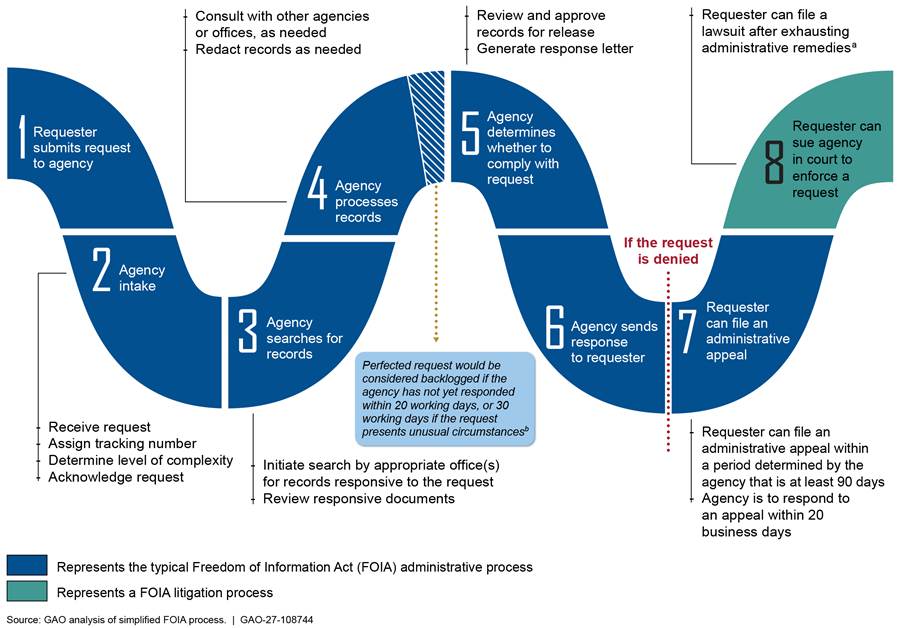
aUnder FOIA, a requester generally must exhaust all administrative remedies prior to seeking judicial review of a federal agency’s decision. Such remedies include administrative appeals filed within a period determined by the agency that is not less than 90 days. However, agency failure to comply with statutory time limits is treated as an exhaustion of administrative remedies. When an agency fails to comply with the 20-day statutory time limit, the requester is considered to have exhausted administrative remedies and can seek judicial review. See 5 U.S.C. § 552(a)(6)(A)-(C).
bThe requirements of FOIA, including requirements related to processing time frames, do not apply until an agency receives a “proper” or “perfected” FOIA request. A perfected FOIA request must reasonably describe the records being sought and must be made in accordance with published rules stating the time, place, fees (if any), and procedures to be followed. See 5 U.S.C. § 552(a)(3)(A).
Obtaining medical records through the FOIA process can take months. FOIA generally requires agencies to respond to a request within 20 working days.[59] As of May 2026, BOP’s website estimates that simple requests can take up to 60 days and complex requests—containing information the FOIA office cannot access directly and requests containing over 500 pages—can take 9 to 18 months.
BOP officials said they consider a death investigation document like a facility mortality review, a secondary physician review, or a 24-hour death notice to be complex requests because the FOIA office must contact a different BOP office to obtain these documents. They said they typically tell requesters it will take 3 to 6 months to fulfill these requests. However, they said that if the requester wanted the deceased’s entire medical record and the deceased had a chronic condition resulting in a high volume of medical records, the request would take significantly longer.
A representative from one nongovernmental organization told us that their office submits FOIA requests to BOP daily for medical information on behalf of clients. They said the FOIA process is far more daunting to families because they do not typically have the time or resources to submit requests for medical records. Officials from another organization told us that these requests can be so burdensome that family members sometimes must choose between trying to learn how their relative died and going to work.
Standards for Internal Control in the Federal Government state that agencies should communicate relevant and quality information with appropriate external parties. Furthermore, they call for agencies to review policies, procedures, and related control activities on a periodic and ongoing basis for continued relevance and effectiveness in achieving the entity’s objectives or mitigating related risks. However, BOP has not taken steps to identify and implement actions that could help ease the burden of this lengthy and complex process for families. For example, BOP support coordinators could serve as points of contact to help families submit medical records requests and answer questions about the FOIA process.[60] By taking steps to assist families in obtaining medical records, BOP could help ensure that families receive information they need in a more streamlined and timely manner.
BOP Investigates Natural Deaths but Has Not Taken Some Key Oversight Steps
BOP Did Not Always Complete a Key Death Investigation Step Within 30 Days as Required
According to BOP, staff investigate all deaths in custody, including deaths deemed natural. These investigations can identify deficiencies in BOP’s health care delivery and lead to recommendations to address deficiencies. In fiscal years 2016 through 2025, BOP investigated 2,997 deaths that were ultimately determined to be from natural causes.[61]
However, our analysis found that BOP facilities, excluding medical centers, sometimes did not complete a key death investigation step (i.e., facility mortality reviews) within the required 30 days. Specifically, we found that facilities did not complete these reviews on time for about a quarter of natural deaths in fiscal years 2016 through 2025. BOP policy requires that facilities complete a mortality review within 30 days of a death to identify any potential health care deficiencies.[62] However, after a death occurs, we found that BOP does not ensure that the reviews are completed on time.
BOP officials told us that some of its facilities, especially medical centers, have received policy waivers to submit these reviews later—for instance, 60 or 90 days after a death.[63] Excluding medical centers, we found that BOP completed 1,491 of these mortality reviews from FY 2016 through 2025, of which 402 (27 percent) were not completed within the 30-day requirement. Of the 1,491 reviews, 138 (9 percent of total reviews) were less than 15 days late, 71 (5 percent) were less than a month late, 165 (11 percent) were between 1 and 2 months late, and 28 reviews (2 percent) were more than 2 months late.
Until BOP takes action to address the root causes of late reviews, facilities may continue to complete them after BOP’s 30-day policy requirement or after the timeframe allowed in a waiver. Mortality reviews are an opportunity for BOP staff to review the medical record of a patient that died and identify whether deficiencies in health care delivery contributed to a death. These reviews are an early step in the death investigation process to identify deficiencies and must be submitted before a secondary physician review can occur. As such, continued delays in these reviews also delay the identification of deficiencies and can therefore delay the implementation of corrective actions to help avoid preventable deaths.
BOP Does Not Record Recommendations from Mortality Reviews
We found that BOP tracks some, but not all, recommendations made during natural death investigations. Specifically, recommendations can be made during three key steps of death investigations, including (1) facility mortality reviews, (2) secondary physician reviews, and (3) root cause analyses. BOP officials told us that in 2024, central office created a process to track recommendations from two of the three key steps—secondary physician reviews and root cause analyses.
As part of the recommendation tracking process, central office records each recommendation that stems from these two steps in a database and requires facilities to submit a plan for implementing them. Central office officials told us they review the plan and may require revisions. Once a plan is finalized, central office officials said they follow up with the facility after 6 months to evaluate if the plan is working to address the targeted deficiencies. They follow up again after another 6 months and can close a recommendation as implemented after 12 months of sustained improvement. If after 12 months the facility has not made progress toward addressing the deficiency, officials stated that central office will require the facility to propose a new plan to address the deficiency.
BOP central office does not track recommendations from facility mortality reviews. We found that these recommendations were present in 21 percent of natural and unknown deaths in fiscal year 2024. BOP officials told us that secondary physician reviews identify the most serious issues that warrant ongoing attention from central office and that these secondary reviews generally incorporate the most salient recommendations from facility mortality reviews. Additionally, officials stated that a recent change from an external consultant to an internal BOP physician completing these reviews has strengthened these reviews.[64] However, our analysis of natural and unknown deaths in fiscal year 2024 identified 42 cases where facilities noted recommendations in the mortality review that had no recommendations in the secondary physician review. As a result, central office did not have a record of recommendations from these death investigations or whether the BOP facility had implemented them.
Some mortality review recommendations related to deficiencies in health care delivery. For example, in one natural death case, an incarcerated person’s ultrasound had an abnormal result. Medical staff recommended a follow-up CT scan, but the patient never received it, and BOP transferred the patient to another facility with no plan for continuity of care. The facility identified this deficiency in care and developed recommendations to address it in its mortality review. Because the recommendations were not included in the secondary physician review and no root cause analysis was conducted, central office did not record them or whether the facility implemented them.
BOP officials stated that recommendations that are not incorporated into the secondary physician review are not significant enough to warrant central tracking of their implementation and are most appropriately addressed through local review and follow-up processes.[65] BOP officials also told us that tracking all recommendations the same way may divert resources from addressing higher-risk issues. Nevertheless, Standards for Internal Control in the Federal Government state that management should establish and operate monitoring activities to monitor the internal control system and evaluate the results. BOP could apply this principle by recording recommendations from mortality reviews without tracking them to the same extent as other recommendations, thus avoiding diverting resources from following up on more significant recommendations.
BOP has taken the positive step of tracking some recommendations from death investigations. By also recording recommendations from facility mortality reviews, and whether a facility has implemented them, BOP would have a more complete picture of deficiencies in its health care delivery. This information would enhance BOP’s ability to analyze and address deficiencies and could potentially reduce the government’s fiscal exposure from alleged deficiencies in health care delivery.
BOP Does Not Have Documented Procedures to Analyze Health Care Deficiency Trends
BOP policy requires the completion of a bureau-wide trend analysis of deaths in custody, including an analysis of contributing factors (e.g., deficiencies in health care).[66] BOP has standard operating procedures describing how (and how often) to conduct the analyses. In addition, starting in fiscal year 2025, BOP expanded its annual analysis by identifying health care deficiency trends and issuing recommendations to address certain challenges. BOP officials also stated that they plan to continue this approach in the fiscal year 2026 report. However, the procedures do not describe how staff should identify nationwide patterns in deficiencies or how to develop and issue related recommendations.
From 2023 through 2025, BOP’s Population and Correctional Health Branch produced three mortality reports to meet the bureau-wide trend analysis requirement.[67] We found that these reports varied in content and format. For instance, the first two reports focused on characteristics of individuals who died in BOP custody across multiple years. However, these reports did not review contributing factors or analyze deficiencies in health care. In comparison, the 2025 report aggregated and analyzed deficiencies that contributed to deaths in BOP custody, in addition to presenting characteristics of individuals who died in custody. Further, the 2025 report included recommendations to address deficiencies. Overall, the 2023 report was 5 pages long, while the 2024 report was 17 pages and the 2025 report was 19 pages. In June 2026, BOP officials told us they planned to issue another report in September 2026 that will also include recommendations to address common deficiencies.
BOP has a strategic goal of operating as a high-quality health care system. The policy requirement to conduct a bureau-wide analysis is a positive step to helping meet this goal. However, BOP does not have standard operating procedures for how to identify nationwide patterns in deficiencies or how to develop and issue related recommendations. This has resulted in inconsistent actions taken to meet the requirement.
BOP has taken positive steps by expanding this analysis in recent years, including identifying patterns in deficiencies, and in 2025, beginning to issue recommendations to address some patterns of particular concern. However, while BOP plans to continue its expanded analysis going forward, without documented procedures for doing so, BOP lacks assurance that it will consistently complete these important steps. Thus, BOP may miss opportunities to identify and address health care deficiencies that contribute to deaths in custody. We have also previously reported that BOP has faced challenges with leadership turnover and monitoring of patient outcomes. Documented procedures for identifying nationwide patterns in deficiencies and issuing recommendations could help ensure that BOP’s positive steps continue despite these challenges.[68] Additionally, Standards for Internal Control in the Federal Government state that documentation is a necessary part of an effective internal control system and that management should document procedures to implement policies.[69]
BOP Does Not Accurately Track Autopsy Data or Have Guidance on Denied Requests
BOP Ordered Autopsies in 47 percent of Natural Death Cases
BOP wardens, under federal law, have discretion on whether to order an autopsy after a death in custody.[70] BOP uses information from the medical examiner or coroner, including autopsy reports and death certificates, to populate the final cause of death for each case in its database.
In January 2026, BOP changed its data practices for autopsies. Before the change, BOP tracked whether the facility’s warden ordered an autopsy and whether central office received a copy of the autopsy report from the facility. However, a limitation of that approach was that when central office did not receive a copy of the autopsy report, the data did not distinguish whether an autopsy was conducted and central office had not received the autopsy report or whether an autopsy was not conducted (e.g., the autopsy request was denied by a state or local authority).
To help address this limitation, starting in January 2026, BOP began tracking each case’s autopsy status with three possible options, according to BOP officials: “No” (meaning the warden did not order an autopsy), “Yes” (meaning the warden ordered an autopsy), and “Pending” (meaning the warden ordered an autopsy but central office has not received the autopsy report).[71] According to BOP officials, the change improved central office’s oversight on which death cases require central office to obtain an autopsy report. We discuss this change in greater detail in the next section of this report.
BOP data show that in fiscal years 2016 through 2025, wardens ordered autopsies for 1,410 of the 2,997 deaths (47 percent) that were ultimately determined to be from natural causes.[72] However, BOP central office only obtained an autopsy report in 1,051 cases (35 percent) of these 2,997 deaths, as shown in figure 8. As this data was gathered before the January 2026 change, we could not determine whether the difference between the 1,410 requested and 1,051 received cases were due to autopsy denials or central office not obtaining a copy of the final report.
Figure 8: Autopsies Requested and Autopsy Reports Received for Natural Deaths in Federal Bureau of Prisons (BOP) Custody, FY 2016-2025
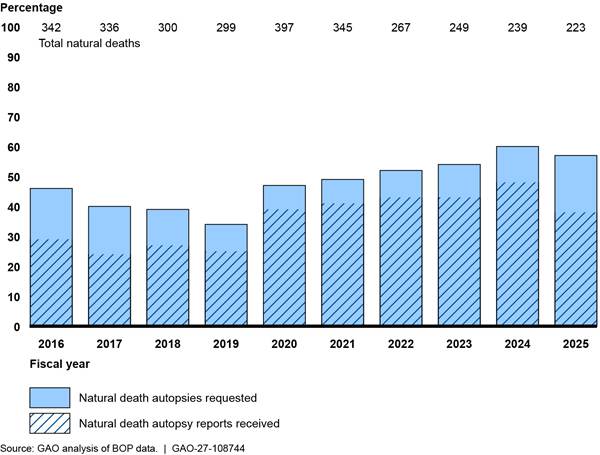
Note: BOP wardens generally submit autopsy requests to a state or local medical examiner or coroner, depending on the jurisdiction. “Natural death autopsy reports received” indicates that BOP’s central office received a copy of the final autopsy report. However, due to data limitations in fiscal years 2016 through 2025, when central office did not have a copy of the final autopsy report, the data did not distinguish whether an autopsy was conducted (and central office had not received the autopsy report) or whether an autopsy was not conducted (e.g., the request was denied by a state or local authority). Also, according to BOP officials, delays in receiving autopsy reports from medical examiners and coroners are common, requiring BOP to follow up to collect final reports. Data in the figure is as of January 2026.
Some fiscal years had a larger number of requested autopsies for which BOP central office did not obtain a copy of the autopsy report. For example, in fiscal years 2016 through 2017, BOP obtained the autopsy report for only 61 percent requested autopsies. BOP officials said that one possible reason was facilities not sending the reports they received to central office. BOP officials said that central office did not have enough staff to follow-up with facilities sufficiently, but in more recent years, BOP increased staff in central office and put procedures in place recommending monthly follow-up for missing autopsy reports. Finally, BOP officials also stated that there is a large gap in fiscal year 2025 between autopsies requested and reports received because it can take several months for BOP facilities to receive final autopsy reports.
BOP Does Not Accurately Track Data on Autopsy Requests and Denials
Based on our review of BOP autopsy data, we found that the Bureau does not accurately track when a warden requests an autopsy. In addition, we found that BOP does not track data on when a state or local authority denies an autopsy request. Specifically, BOP’s changes in January 2026 caused it to maintain inaccurate data on cases where a warden ordered an autopsy. BOP officials said that after a state or local authority denies an autopsy request, they change the “autopsy requested” variable from “Yes” to “No”. This practice of overwriting the data compromises the accuracy of BOP’s data on deaths in custody, resulting in an inaccurate picture of the number of autopsy requests and no data on the number and frequency of denials.
BOP central office officials told us that autopsy denials are likely rare; however, because they do not track these data, they cannot be certain. Central office officials said they do not collect information on autopsy denials because they only collect data for fields tied to an internal reporting requirement, and there is no requirement related to autopsy denials.[73]
BOP has a strategic goal to review and analyze data to inform evidence-based decisions that will be used to improve agency operations, policies, and procedures across all disciplines. In addition, BOP central office officials said they work to encourage wardens to expand how often they request autopsies because the results contain valuable information from risk management and patient care standpoints. BOP officials told us that one reason they updated the agency’s policy on autopsies in May 2026 was to emphasize the need for wardens to order autopsies.[74]
By tracking all autopsy requests and denials, BOP could better ensure that its staff have the most accurate information for developing policies around autopsies and implementing efforts to increase the number of autopsies. For example, tracking the number and frequency of autopsy requests and denials can give a greater understanding of where they occur. Specifically, BOP could more easily identify if some facilities order autopsies at lower rates and identify reasons for the lower rates. Further, maintaining data on where denials occur could enable BOP to communicate with those state and local jurisdictions, understand reasons for denials, and potentially identify alternatives or contingency plans.
BOP Does Not Have Guidance on Denied Autopsy Requests
When a warden determines there is a need for an autopsy, BOP facilities request that a state or local coroner’s or medical examiner’s office perform the autopsy. BOP officials said the state or local authority can either accept or deny the request for an autopsy. The officials also said that a state or local authority may deny an autopsy request if they do not have the capacity to perform it or if they disagree that an autopsy is warranted. For example, officials at one facility told us that the state medical examiner may deny an autopsy request if they are convinced of the cause of death without an autopsy. The facility officials said this could happen, for instance, if the medical examiner has access to medical test results and scans that can provide information about the cause of death. It can also happen when other tests besides an autopsy could answer remaining questions, like a toxicology screening to determine whether drugs contributed to the death.
BOP does not have policy guidance on possible actions a facility could take if an autopsy is denied by a state or local authority. BOP does not have such guidance because central office’s operating practice is that a denied autopsy request by a state or local authority is the final decision, resulting in an autopsy not being performed. Further, central office officials said they were not aware of any BOP facilities that pursue autopsies after a state or local authority denies its initial request.
However, we spoke with BOP facility staff who said it was possible to obtain autopsies from entities other than a state or local authority. For example, they said that in one instance a state medical examiner denied the warden’s autopsy request. Since a nearby university hospital where the patient died offers free autopsies for all patients, BOP officials opted for the hospital to conduct the autopsy.
Federal law grants BOP wardens decision-making authority to determine whether pursuing an autopsy is appropriate and prohibits delegating this authority below the level of acting warden.[75] However, BOP cannot compel a state or local authority to conduct an autopsy. Further, there may be cases in which a state does not have the capacity to perform a requested autopsy, such as when resources to conduct autopsies are limited. This could result in a state or local authority denying a warden’s request for an autopsy. At the same time, a state or local authority should not supersede a warden’s determination of need for an autopsy.
By clarifying that BOP facilities may pursue an autopsy from other providers after an autopsy request is denied by a state or local authority, BOP could help ensure that an autopsy occurs when a warden deems it necessary. Further, according to BOP policy, time is a critical factor in arranging for an autopsy, which ordinarily must be performed within 48 hours. Accordingly, identifying options BOP facilities can pursue after an autopsy denial by a state or local authority would better position wardens to plan ahead in case an autopsy request is denied. For example, advanced planning could help facilities quickly identify alternative providers that may be responsive to autopsy requests, which could help ensure autopsies occur within 48 hours so that time-sensitive tests can be completed.
Conclusions
BOP is responsible not only for the custody of individuals incarcerated in its facilities, but also for their care. After a person dies in BOP’s custody, grieving families often have questions about their relative’s death. While BOP policy requires its facilities to notify families after a death, we identified opportunities for BOP to help ensure families more consistently learn how their relative died and understand next steps. By clarifying notification requirements for staff and tracking and monitoring efforts to contact the appropriate emergency contact and next of kin, BOP can better ensure notifications are taking place in alignment with agency policy. These steps would also help ensure that families receive timely information after a death in custody, including on the circumstances of the death. In addition, creating an information-sharing mechanism centered around families—and identifying ways to better assist families in obtaining medical records—could help BOP ensure that families have clear information about next steps and how to learn more about how their relative died while they navigate a personal loss.
BOP policy requires its staff to investigate every death in custody, which can reveal deficiencies in BOP’s health care and recommendations to improve care. By taking action to address the root causes of late facility mortality reviews, BOP could help prevent delays in identifying corrective actions to help avoid preventable deaths. In addition, by recording recommendations from all mortality reviews and whether a facility has implemented them, BOP can enhance its ability to analyze and address deficiencies. Further, these changes can help BOP provide a higher quality of health care. As BOP takes these steps in response to our recommendations, it could also reduce the government’s fiscal exposure from alleged deficiencies in health care. Finally, by tracking all autopsy requests and providing guidance when those requests are denied by a state or local authority, BOP could better ensure that its staff have the most accurate information for developing policies around autopsies and help ensure that an autopsy occurs when a warden deems it necessary.
Recommendations for Executive Action
We are making the following 13 recommendations to DOJ:
The Attorney General should ensure the BOP Director clarifies whom staff are to contact during the initial notification phone call following a death in custody. (Recommendation 1)
The Attorney General should ensure the BOP Director issues guidance on how staff are to locate the next of kin. (Recommendation 2)
The Attorney General should ensure the BOP Director directs staff to track notifications to both emergency contacts and next of kin after an in-custody death—including the time and method of notification, as well as unsuccessful and successful attempts to make contact. (Recommendation 3)
The Attorney General should ensure the BOP Director directs management to monitor staff compliance with this requirement to document attempts to contact emergency contacts and next of kin following a death in custody. (Recommendation 4)
The Attorney General should ensure the BOP Director defines the phrase “circumstances surrounding a death” included in the Bureau’s family notification policy. (Recommendation 5)
The Attorney General should ensure the BOP Director monitors whether the circumstances of a death in custody are shared with emergency contacts and next of kin. This includes monitoring whether information is immediately shared with emergency contacts and next of kin, when possible, or shared at a later date when the information becomes available. (Recommendation 6)
The Attorney General should ensure the BOP Director develops an information-sharing mechanism that includes guidance and resources to help inform families about BOP processes following a death in custody. (Recommendation 7)
The Attorney General should ensure the BOP Director takes steps to better assist families in obtaining medical records after the death of an individual in custody. (Recommendation 8)
The Attorney General should direct the BOP Director to develop and implement a corrective action plan that addresses the root causes of facility mortality reviews not being completed within the timeframes required by BOP policy or the timeframes required by a waiver. (Recommendation 9)
The Attorney General should ensure that the BOP Director records recommendations from facility mortality reviews and whether a facility has implemented them. (Recommendation 10)
The Attorney General should ensure the BOP Director updates its standard operating procedures for a recurring bureau-wide trend analysis of deaths in custody, to include procedures for identifying nationwide patterns in deficiencies and issuing recommendations. (Recommendation 11)
The Attorney General should ensure the BOP Director tracks when a warden requests an autopsy and whether the request is denied by a state or local authority. (Recommendation 12)
The Attorney General should ensure the BOP Director issues guidance to clarify that facilities may pursue an autopsy if a request is denied by a state or local authority, including guidance about possible actions facilities may take after a denial. (Recommendation 13)
Agency Comments
We provided a draft of this report to DOJ and BOP for review and comment. In its comments, reproduced in appendix IV, BOP concurred with our recommendations and provided technical comments, which we incorporated as appropriate. In response to these comments, we updated recommendation 11 to clarify the aspects of BOP’s standard operating procedures that BOP should update, and made corresponding changes in that section of the report. In addition, consistent with our thirteenth recommendation, BOP provided documentation demonstrating plans to track when a warden requests an autopsy and when a request is denied by a state or local authority.
We are sending copies of this report to the appropriate congressional committees and members, the Attorney General, and other interested parties. In addition, the report will be available at no charge on the GAO website at http://www.gao.gov.
If you or your staff have questions about this report, please contact me at GoodwinG@gao.gov. Contact points for our Offices of Congressional Relations and Media Relations may be found on the last page of this report. GAO staff who made major contributions to this report are listed in appendix V.
Gretta L. Goodwin
Director, Homeland Security and Justice
Compassionate release allows either BOP or individuals in BOP custody to request a reduction in sentence from the court that sentenced those individuals, including for health-related reasons.[76] The number of individuals who die in BOP custody from natural causes is potentially impacted by the number who are granted compassionate release. For example, individuals granted release for health-related reasons, particularly those with a terminal illness, reduce the number who could die in BOP custody from natural causes each year. Table 3 shows that from fiscal years 2020 through 2025, about 5,800 individuals were released from BOP custody after being granted a reduction in their sentences. Of these, nearly 300 cases were due to terminal illness and roughly 3,800 cases were for other health and age-related reasons.
Table 3: Reasons Cited for Individuals Granted Compassionate Release from Federal Bureau of Prisons (BOP) Custody, Fiscal Years 2020–2025
|
Fiscal Year |
Terminal illnessa |
Other health and age-related reasonsb |
All compassionate releases |
|
2020 |
68 |
1,572 |
1,819 |
|
2021 |
49 |
1,498 |
2,052 |
|
2022 |
40 |
323 |
631 |
|
2023 |
39 |
180 |
432 |
|
2024 |
58 |
159 |
481 |
|
2025 |
29 |
116 |
391 |
|
Total |
283 |
3,848 |
5,806 |
Source: GAO analysis of U.S. Sentencing Commission documentation. | GAO‑27‑108744
Note: A person in BOP custody can be granted a reduction in sentence on multiple grounds; consequently, the total number of reasons cited generally exceeds the total number of cases. Sentencing courts may reduce a term of imprisonment if “extraordinary and compelling reasons warrant such a reduction.” 18 U.S.C. § 3582(c)(1)(A)(i). Reductions in terms of imprisonment under this provision are commonly known as “compassionate release.” The U.S. Sentencing Commission began tracking data on compassionate releases in October 2019 (fiscal year 2020). The data in this report is limited to motions for which the U.S. Sentencing Commission received or obtained court documentation and completed its analysis.
aSee U.S.S.G. § 1B1.13(b)(1)(A).
bWe identified other health and age-related reasons based on categories created by the U.S. Sentencing Commission from its analysis of sentencing court orders and opinions. These categories include: 1) Serious physical or medical condition; 2) Deteriorating physical or mental health due to aging process; 3) Serious functional or cognitive impairment; 4) Age 70 and over having served 30 years of sentence; 5) Age 65 and deteriorating health having served 10 years or 75 percent of the sentence; 6) due to the COVID-19 pandemic; and 7) BOP failure to provide treatment. Each category corresponds to a provision in U.S.S.G. § 1B1.13. “BOP failure to provide treatment” refers to when an “extraordinary and compelling reason” warranting a reduction in sentence exists where “the defendant is suffering from a medical condition that requires long-term or specialized medical care that is not being provided and without which the defendant is at risk of serious deterioration in health or death.” See U.S.S.G. § 1B1.13(b)(1)(C). COVID-19 was responsible for the significant increase in the number of releases for other health and age-related reasons in fiscal years 2020 and 2021. Specifically, during those years, 2,589 releases from BOP custody cited COVID-19 as a reason. During that span, releases due to COVID-19 comprised 67 percent of all compassionate releases, and 84 percent of all reasons cited for releases in the other health and age-related reasons column.
Appendix II: Natural Deaths in Federal Bureau of Prisons Custody, by Facility, Fiscal Years 2016-2025
Of the 3,585 individuals who died in Federal Bureau of Prisons (BOP) custody in fiscal years 2016 through 2025, BOP reported that 2,997 (84 percent) died from natural causes.[77]
BOP medical centers. Table 4 shows that 1,506 of the 2,997 (50 percent) natural deaths in BOP custody in fiscal years 2016 through 2025 were individuals confined at one of BOP’s seven medical centers.[78] The medical centers provide care to incarcerated people in need of more advanced medical or mental health care. Federal Medical Center Butner accounted for 23 percent of all natural deaths, as reported by BOP, during this span. According to BOP officials, Butner generally receives incarcerated patients with the most complicated medical cases and those who require a higher level of medical care than their previous facilities could provide.
Table 4: Number of Deaths in Federal Bureau of Prisons (BOP) Custody from Natural Causes, by Medical Center, Fiscal Years 2016–2025
|
Medical Center |
‘16 |
‘17 |
‘18 |
‘19 |
‘20 |
‘21 |
‘22 |
‘23 |
‘24 |
‘25 |
Total |
Facility population rangea |
|
Butner |
94 |
99 |
93 |
88 |
62 |
59 |
59 |
45 |
50 |
51 |
700 |
759-996 |
|
Springfield |
31 |
31 |
29 |
25 |
18 |
34 |
21 |
19 |
19 |
19 |
246 |
792-1,095 |
|
Lexington |
13 |
17 |
13 |
14 |
20 |
10 |
15 |
14 |
11 |
13 |
140 |
931-1,446 |
|
Fort Worth |
14 |
21 |
9 |
20 |
18 |
15 |
16 |
5 |
10 |
7 |
135 |
1,221-1,635 |
|
Devens |
15 |
14 |
14 |
14 |
16 |
17 |
12 |
9 |
14 |
6 |
131 |
690-1,055 |
|
Rochester |
9 |
5 |
8 |
8 |
16 |
6 |
12 |
6 |
6 |
9 |
85 |
581-771 |
|
Carswell |
10 |
10 |
3 |
7 |
12 |
4 |
4 |
10 |
7 |
2 |
69 |
843-1,288 |
|
Total |
186 |
197 |
169 |
176 |
162 |
145 |
139 |
108 |
117 |
107 |
1,506 |
Source: GAO analysis of BOP data. | GAO‑27‑108744
Note: According to BOP officials, the Bureau does not determine whether a death is natural or non-natural for individuals in its custody. This information is determined by an external medical examiner or coroner, and can be noted on a death certificate and, if an autopsy is conducted, a final autopsy report.
aThe incarcerated population at facilities varied across fiscal years 2016 to 2025. As a result, we presented facility population range, which is the minimum and maximum facility population from fiscal years 2016 and 2025, based on a point-in-time population from each fiscal year in January. In 2018 we used facility populations from March because January data were not available.
BOP prison facilities. Table 5 shows that 1,491 of the 2,997 (50 percent) natural deaths in BOP custody from fiscal years 2016 through 2025 were individuals confined at one of BOP’s nonmedical facilities (e.g., a federal correctional institution or federal detention center). During that time span, natural deaths occurred at 104 nonmedical prison facilities, including BOP facilities and private facilities that confined individuals on behalf of BOP.
Table 5: Number of Deaths in Federal Bureau of Prisons (BOP) Custody from Natural Causes, by Facility, Fiscal Years 2016–2025
|
Facility |
‘16 |
‘17 |
‘18 |
‘19 |
‘20 |
‘21 |
‘22 |
‘23 |
‘24 |
‘25 |
Total |
Facility population rangea |
|
Butnerb |
16 |
10 |
2 |
15 |
35 |
12 |
12 |
8 |
8 |
10 |
128 |
2,737-3,897 |
|
Coleman |
9 |
9 |
10 |
8 |
19 |
6 |
14 |
11 |
11 |
12 |
109 |
5,153-6,797 |
|
Terre Haute |
8 |
8 |
7 |
6 |
9 |
9 |
7 |
6 |
1 |
8 |
69 |
2,206-2,786 |
|
Terminal Island |
5 |
3 |
9 |
3 |
14 |
7 |
5 |
8 |
3 |
1 |
58 |
700-1,146 |
|
Beaumont |
4 |
10 |
6 |
1 |
5 |
4 |
4 |
8 |
7 |
5 |
54 |
4,235-5,563 |
|
Tucson |
1 |
3 |
3 |
3 |
3 |
12 |
3 |
6 |
7 |
5 |
46 |
1,559-2,386 |
|
Hazelton |
4 |
3 |
3 |
3 |
6 |
9 |
5 |
3 |
4 |
0 |
40 |
3,100-3,720 |
|
Victorville |
6 |
3 |
3 |
4 |
5 |
4 |
4 |
4 |
2 |
5 |
40 |
3,162-4,325 |
|
Florence |
3 |
1 |
5 |
4 |
4 |
7 |
4 |
4 |
3 |
4 |
39 |
2,223-2,768 |
|
Seagoville |
4 |
2 |
4 |
5 |
8 |
3 |
5 |
2 |
2 |
4 |
39 |
1,483-2,109 |
|
Forrest City |
7 |
3 |
2 |
3 |
5 |
5 |
3 |
4 |
2 |
3 |
37 |
2,670-3,665 |
|
Petersburg |
4 |
3 |
2 |
3 |
6 |
5 |
4 |
1 |
1 |
4 |
33 |
2,118-2,969 |
|
Fort Dix |
2 |
5 |
3 |
1 |
3 |
4 |
1 |
4 |
6 |
3 |
32 |
2,745-4,525 |
|
Allenwood |
1 |
4 |
2 |
0 |
7 |
2 |
3 |
2 |
3 |
2 |
26 |
2,506-3,514 |
|
Atlanta |
3 |
3 |
1 |
5 |
4 |
2 |
2 |
3 |
0 |
2 |
25 |
853-2,335 |
|
Elkton |
2 |
1 |
3 |
3 |
9 |
2 |
2 |
1 |
1 |
1 |
25 |
1,418-2,524 |
|
McCreary |
2 |
4 |
2 |
2 |
1 |
5 |
1 |
2 |
3 |
2 |
24 |
1,402-1,591 |
|
Lompoc |
3 |
3 |
2 |
2 |
4 |
2 |
1 |
4 |
2 |
1 |
24 |
2,070-3,086 |
|
Oakdale |
3 |
3 |
1 |
1 |
8 |
2 |
1 |
1 |
3 |
0 |
23 |
1,686-2,466 |
|
Ashland |
0 |
1 |
1 |
2 |
1 |
8 |
1 |
3 |
0 |
2 |
19 |
957-1,346 |
|
Brooklyn |
2 |
3 |
1 |
1 |
5 |
1 |
2 |
1 |
2 |
0 |
18 |
1,161-1,890 |
|
Englewood |
1 |
1 |
2 |
4 |
2 |
3 |
2 |
0 |
1 |
2 |
18 |
904-1,135 |
|
Yazoo City |
1 |
3 |
1 |
0 |
4 |
3 |
2 |
2 |
1 |
1 |
18 |
3,571-4,783 |
|
Edgefield |
1 |
2 |
2 |
1 |
1 |
2 |
1 |
4 |
2 |
1 |
17 |
1,444-2,031 |
|
Marion |
2 |
0 |
1 |
1 |
4 |
1 |
1 |
1 |
5 |
1 |
17 |
1,216-1,405 |
|
La Tuna |
1 |
4 |
1 |
1 |
2 |
2 |
1 |
2 |
2 |
0 |
16 |
697-1,334 |
|
Leavenworth |
0 |
0 |
1 |
0 |
2 |
3 |
2 |
3 |
3 |
1 |
15 |
1,494-1,968 |
|
Big Spring |
1 |
1 |
1 |
2 |
0 |
4 |
2 |
2 |
1 |
0 |
14 |
607-1,302 |
|
Jesup |
1 |
1 |
0 |
0 |
3 |
5 |
1 |
2 |
1 |
0 |
14 |
1,337-1,662 |
|
Oklahoma City |
2 |
0 |
3 |
3 |
1 |
1 |
0 |
1 |
1 |
2 |
14 |
1,097-1,574 |
|
Greenville |
1 |
0 |
3 |
1 |
1 |
2 |
1 |
0 |
2 |
2 |
13 |
1,183-1,377 |
|
Miami (FDC) |
1 |
0 |
3 |
1 |
3 |
1 |
0 |
0 |
3 |
1 |
13 |
937-1,444 |
|
Sheridan |
2 |
1 |
4 |
1 |
0 |
2 |
2 |
0 |
1 |
0 |
13 |
1,441-1,777 |
|
Talladega |
0 |
1 |
0 |
1 |
1 |
6 |
2 |
1 |
1 |
0 |
13 |
903-1,186 |
|
El Reno |
0 |
1 |
3 |
2 |
1 |
2 |
0 |
1 |
1 |
1 |
12 |
970-1,272 |
|
Big Spring CI |
1 |
3 |
1 |
1 |
2 |
3 |
0 |
- |
- |
- |
11 |
2,843-3,340 |
|
Miami (FCI) |
1 |
1 |
0 |
2 |
3 |
1 |
0 |
0 |
1 |
2 |
11 |
858-1,337 |
|
Milan |
1 |
0 |
1 |
1 |
3 |
1 |
0 |
1 |
1 |
2 |
11 |
1,216-1,590 |
|
Schuylkill |
1 |
1 |
2 |
2 |
0 |
1 |
1 |
0 |
1 |
2 |
11 |
997-1,408 |
|
Texarkana |
1 |
1 |
0 |
1 |
1 |
3 |
1 |
0 |
2 |
1 |
11 |
1,013-1,418 |
|
Williamsburg |
2 |
1 |
0 |
0 |
2 |
3 |
1 |
1 |
1 |
0 |
11 |
1,026-1,613 |
|
Beckley |
1 |
1 |
2 |
0 |
1 |
1 |
1 |
2 |
1 |
0 |
10 |
1,472-1,863 |
|
Otisville |
0 |
2 |
1 |
1 |
0 |
0 |
1 |
2 |
2 |
1 |
10 |
579-1,081 |
|
Dalby CI |
0 |
0 |
2 |
1 |
2 |
2 |
2 |
- |
- |
- |
9 |
1,418-1,730 |
|
Danbury |
0 |
2 |
0 |
0 |
2 |
0 |
0 |
2 |
2 |
1 |
9 |
823-1,259 |
|
Memphis |
2 |
0 |
0 |
0 |
3 |
3 |
0 |
1 |
0 |
0 |
9 |
1,034-1,311 |
|
Pekin |
2 |
1 |
0 |
1 |
0 |
1 |
1 |
1 |
1 |
1 |
9 |
1,124-1,299 |
|
Aliceville |
1 |
0 |
1 |
2 |
0 |
1 |
0 |
0 |
2 |
1 |
8 |
1,255-1,865 |
|
Canaan |
0 |
2 |
1 |
1 |
0 |
1 |
0 |
2 |
0 |
1 |
8 |
1,132-1,501 |
|
Estill |
1 |
0 |
1 |
3 |
2 |
0 |
0 |
1 |
0 |
0 |
8 |
58-1,263 |
|
Gilmer |
0 |
0 |
1 |
1 |
2 |
2 |
1 |
1 |
0 |
0 |
8 |
1,167-1,680 |
|
Phoenix |
1 |
1 |
1 |
0 |
1 |
2 |
1 |
0 |
1 |
0 |
8 |
1,031-1,320 |
|
Tallahassee |
0 |
2 |
0 |
0 |
1 |
1 |
1 |
1 |
1 |
1 |
8 |
786-1,161 |
|
Bennettsville |
0 |
1 |
0 |
0 |
0 |
2 |
2 |
0 |
1 |
1 |
7 |
1,355-1,651 |
|
D. Ray James CI |
1 |
1 |
1 |
0 |
4 |
0 |
- |
- |
- |
- |
7 |
129-2,062 |
|
Guaynabo |
1 |
0 |
2 |
0 |
1 |
0 |
1 |
2 |
0 |
0 |
7 |
1,164-1,397 |
|
Honolulu |
1 |
1 |
2 |
0 |
1 |
2 |
0 |
0 |
0 |
0 |
7 |
210-457 |
|
McDowell |
1 |
0 |
1 |
0 |
0 |
0 |
1 |
1 |
0 |
3 |
7 |
1,218-1,566 |
|
Moshannon Valley CI |
2 |
0 |
0 |
0 |
1 |
4 |
- |
- |
- |
- |
7 |
1,596-1,774 |
|
Pollock |
1 |
1 |
0 |
0 |
0 |
0 |
0 |
2 |
3 |
0 |
7 |
2,495-2,990 |
|
Cumberland |
3 |
1 |
0 |
1 |
1 |
0 |
0 |
0 |
0 |
0 |
6 |
1,010-1,343 |
|
Lee |
3 |
1 |
0 |
1 |
1 |
0 |
0 |
0 |
0 |
0 |
6 |
1,293-1,484 |
|
Lewisburg |
0 |
0 |
1 |
1 |
0 |
1 |
1 |
0 |
1 |
1 |
6 |
501-1,810 |
|
Loretto |
2 |
2 |
0 |
1 |
0 |
0 |
1 |
0 |
0 |
0 |
6 |
782-1,072 |
|
Manchester |
1 |
2 |
0 |
1 |
0 |
0 |
0 |
0 |
2 |
0 |
6 |
1,012-1,265 |
|
Mendota |
1 |
0 |
0 |
0 |
0 |
1 |
2 |
1 |
1 |
0 |
6 |
791-1,459 |
|
Montgomery |
2 |
0 |
0 |
0 |
0 |
3 |
0 |
0 |
1 |
0 |
6 |
305-853 |
|
Oxford |
0 |
0 |
1 |
0 |
1 |
0 |
0 |
2 |
0 |
2 |
6 |
910-1,242 |
|
Philadelphia |
2 |
1 |
1 |
0 |
0 |
0 |
0 |
2 |
0 |
0 |
6 |
797-967 |
|
Seatac |
0 |
0 |
3 |
0 |
0 |
1 |
0 |
1 |
0 |
1 |
6 |
563-933 |
|
Thomson |
1 |
0 |
0 |
1 |
0 |
0 |
0 |
2 |
0 |
2 |
6 |
109-2,069 |
|
Bastrop |
1 |
0 |
1 |
0 |
0 |
3 |
0 |
0 |
0 |
0 |
5 |
978-1,426 |
|
Chicago |
3 |
0 |
0 |
0 |
0 |
0 |
0 |
1 |
1 |
0 |
5 |
470-665 |
|
Duluth |
0 |
1 |
0 |
0 |
1 |
0 |
2 |
0 |
0 |
1 |
5 |
300-688 |
|
Fairton |
0 |
0 |
1 |
1 |
0 |
2 |
1 |
0 |
0 |
0 |
5 |
801-1,275 |
|
Marianna |
2 |
0 |
1 |
0 |
0 |
0 |
0 |
1 |
0 |
1 |
5 |
37-1,410 |
|
Reeves CI |
2 |
0 |
0 |
1 |
2 |
0 |
- |
- |
- |
- |
5 |
948-2,059 |
|
Safford |
0 |
1 |
1 |
1 |
0 |
1 |
0 |
0 |
0 |
1 |
5 |
648-934 |
|
San Diego |
0 |
1 |
0 |
1 |
1 |
0 |
0 |
0 |
0 |
1 |
4 |
647-1,072 |
|
Alderson |
0 |
0 |
1 |
0 |
0 |
0 |
2 |
0 |
0 |
0 |
3 |
526-984 |
|
Big Sandy |
0 |
0 |
0 |
1 |
0 |
0 |
0 |
1 |
0 |
1 |
3 |
1,198-1,491 |
|
Houston |
1 |
0 |
0 |
0 |
0 |
0 |
1 |
1 |
0 |
0 |
3 |
469-894 |
|
McRae CI |
0 |
0 |
0 |
0 |
2 |
0 |
1 |
0 |
- |
- |
3 |
1,453-1,664 |
|
New York |
0 |
1 |
0 |
0 |
1 |
1 |
0 |
- |
- |
- |
3 |
587-804 |
|
North Lake CI |
0 |
0 |
0 |
0 |
3 |
0 |
0 |
- |
- |
- |
3 |
589-1,769 |
|
Rivers CI |
0 |
0 |
0 |
1 |
0 |
2 |
- |
- |
- |
- |
3 |
1,092-1,302 |
|
Taft CI |
2 |
0 |
0 |
0 |
1 |
- |
- |
- |
- |
- |
3 |
1,056-1,754 |
|
Adams County CI |
1 |
0 |
1 |
0 |
- |
- |
- |
- |
- |
- |
2 |
1,866-2,203 |
|
Atwater |
0 |
0 |
1 |
0 |
0 |
0 |
0 |
0 |
0 |
1 |
2 |
1,018-1,304 |
|
Bryan |
1 |
0 |
1 |
0 |
0 |
0 |
0 |
0 |
0 |
0 |
2 |
516-904 |
|
Dublin |
1 |
0 |
0 |
0 |
1 |
0 |
0 |
0 |
0 |
- |
2 |
437-1,303 |
|
Great Plains CI |
1 |
0 |
0 |
0 |
1 |
0 |
- |
- |
- |
- |
2 |
1,476-1,886 |
|
Herlong |
0 |
1 |
0 |
0 |
0 |
0 |
1 |
0 |
0 |
0 |
2 |
962-1,477 |
|
Los Angeles |
0 |
0 |
0 |
0 |
0 |
1 |
0 |
1 |
0 |
0 |
2 |
508-745 |
|
McKean |
0 |
1 |
0 |
0 |
0 |
0 |
0 |
1 |
0 |
0 |
2 |
843-1,297 |
|
Reeves Detention Center |
0 |
1 |
0 |
0 |
0 |
1 |
0 |
- |
- |
- |
2 |
968-1,324 |
|
Waseca |
0 |
1 |
0 |
0 |
0 |
0 |
0 |
1 |
0 |
0 |
2 |
644-852 |
|
Yankton |
0 |
1 |
0 |
0 |
0 |
0 |
0 |
0 |
0 |
1 |
2 |
303-584 |
|
Berlin |
1 |
0 |
0 |
0 |
0 |
0 |
0 |
0 |
0 |
0 |
1 |
614-1,098 |
|
Eden CI |
0 |
1 |
- |
- |
- |
- |
- |
- |
- |
- |
1 |
1,146-1,311 |
|
Morgantown |
0 |
0 |
0 |
0 |
1 |
0 |
0 |
0 |
0 |
0 |
1 |
391-943 |
|
Ray Brook |
0 |
0 |
0 |
0 |
0 |
0 |
0 |
1 |
0 |
0 |
1 |
614-853 |
|
Sandstone |
0 |
0 |
0 |
0 |
0 |
1 |
0 |
0 |
0 |
0 |
1 |
855-1,241 |
|
Three Rivers |
0 |
0 |
0 |
1 |
0 |
0 |
0 |
0 |
0 |
0 |
1 |
998-1,329 |
|
Total |
156 |
139 |
131 |
123 |
235 |
200 |
128 |
141 |
122 |
116 |
1,491 |
Source: GAO analysis of BOP data. | GAO‑27‑108744
Notes: Our review of natural deaths focused on BOP prison facilities and private facilities that confined individuals on behalf of BOP. BOP policy for investigations of deaths in custody excludes deaths occurring in home confinement and prerelease custody (e.g., at residential reentry centers). As such, those deaths were outside the scope of this evaluation. Facilities with no natural deaths in fiscal years 2016 through 2025 are not listed in this table. According to BOP officials, the Bureau does not determine whether a death is natural or non-natural for individuals in its custody. This information is determined by an external medical examiner or coroner, and can be noted on a death certificate and, if an autopsy is conducted, a final autopsy report. Complexes with multiple BOP facilities include totals for all facilities in the complex. CI stands for correctional institution and indicates a private facility that confined individuals on behalf of BOP. FCI stands for federal correctional institution. FDC stands for federal detention center. Data are blank for years when facilities closed or stopped confining individuals on behalf of BOP. For those facilities, we list the facility population range while each was operational.
aThe incarcerated population at facilities varied across fiscal years 2016 to 2025. As a result, we presented facility population range, which is the minimum and maximum facility population from fiscal years 2016 through 2025, based on a point-in-time population in January. In 2018 we used facility populations from March because January data were not available.
bData for Butner indicate natural deaths for the three non-medical facilities located within the correctional complex.
Appendix III: Demographic Data on Natural Deaths in Federal Bureau of Prisons Custody, Fiscal Years 2016-2025
Age. People in Federal Bureau of Prisons (BOP) custody under age 46 comprised about 67 percent of the living population, as of February 2026. These individuals accounted for 12 percent of natural deaths reported by BOP in fiscal years 2016 through 2025.[79] In addition, about 3 percent of the BOP population was over 65 years old, as of February 2026. These individuals accounted for about 36 percent of natural deaths from fiscal years 2016 through 2025 (see figure 9).
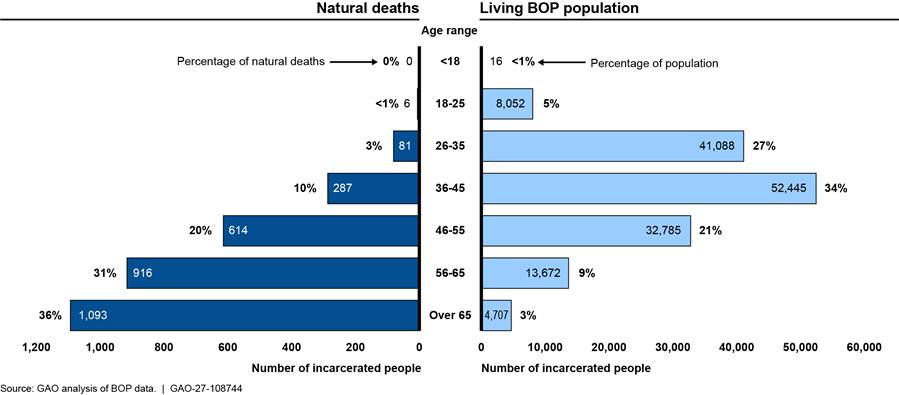
Note: The natural death data includes deaths in BOP custody from fiscal years 2016 through 2025. The living BOP population data is as of February 2026.
Race. Of the individuals who died of natural causes in BOP custody in fiscal years 2016 through 2025, 65.7 percent were white, 28.9 percent were black, 14.4 percent were Hispanic, and 3.7 percent were Native American (see figure 10).[80]
Figure 10: Natural Deaths in Federal Bureau of Prisons (BOP) Custody, by Race, Fiscal Years 2016–2025
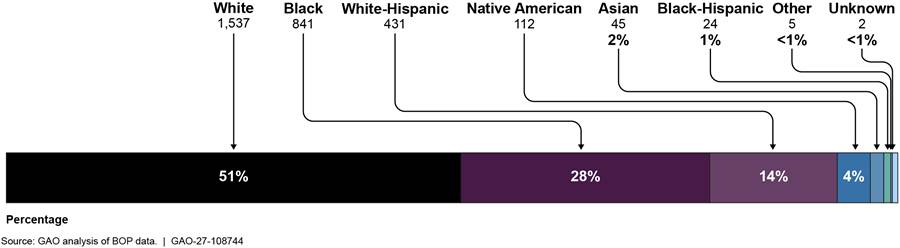
Gender. In fiscal years 2016 through 2025, 96.9 percent of the individuals
who died due to natural causes were male, and 3.1 percent were female,
according to BOP data. By comparison, BOP reported in February 2026 that 93.5
percent of the BOP population was male, and 6.5 percent was female.
Appendix IV: Comments from the Federal Bureau of Prisons
GAO Contact
Gretta L. Goodwin, GoodwinG@gao.gov
Staff Acknowledgments
In addition to the contact listed above, Jeffrey Fiore (Assistant Director), Daniel Kuhn (Analyst in Charge), Lincoln Dow, and Landis Lindsey made key contributions to this report. Other contributors included Lauri Barnes, Elizabeth Dretsch, Emily Flores, Eric Hauswirth, Scott Hiromoto, Lydie Loth, Diona Martyn, Mary Offutt-Reagin, Erin Villareal, Sarah Williamson, and Griffen Wolfe.
The Government Accountability Office, the audit, evaluation, and investigative arm of Congress, exists to support Congress in meeting its constitutional responsibilities and to help improve the performance and accountability of the federal government for the American people. GAO examines the use of public funds; evaluates federal programs and policies; and provides analyses, recommendations, and other assistance to help Congress make informed oversight, policy, and funding decisions. GAO’s commitment to good government is reflected in its core values of accountability, integrity, and reliability.
Obtaining Copies of GAO Reports and Testimony
The fastest and easiest way to obtain copies of GAO documents at no cost is through our website. Each weekday afternoon, GAO posts on its website newly released reports, testimony, and correspondence. You can also subscribe to GAO’s email updates to receive notification of newly posted products.
Order by Phone
The price of each GAO publication reflects GAO’s actual cost of production and distribution and depends on the number of pages in the publication and whether the publication is printed in color or black and white. Pricing and ordering information is posted on GAO’s website, https://www.gao.gov/ordering.htm.
Place orders by calling (202) 512-6000, toll free (866) 801-7077,
or
TDD (202) 512-2537.
Orders may be paid for using American Express, Discover Card, MasterCard, Visa, check, or money order. Call for additional information.
Connect with GAO
Connect with GAO on X,
LinkedIn, Instagram, and YouTube.
Subscribe to our Email Updates. Listen to our Podcasts.
Visit GAO on the web at https://www.gao.gov.
To Report Fraud, Waste, and Abuse in Federal Programs
Contact FraudNet:
Website: https://www.gao.gov/about/what-gao-does/fraudnet
Automated answering system: (800) 424-5454
Media Relations
Sarah Kaczmarek, Managing Director, Media@gao.gov
Congressional Relations
David A. Powner, Acting Managing Director, CongRel@gao.gov
General Inquiries
[1]Based on data reported by the Bureau of Justice Statistics. Examples of federal law enforcement agencies that reported deaths in custody during that span included the Federal Bureau of Prisons (BOP), U.S. Marshals Service, Bureau of Indian Affairs, Immigration and Customs Enforcement, and the U.S. Navy Corrections.
[2]Pub. L. No. 113-242, § 3, 128 Stat. 2860, 2861 (2014) (codified as amended at 18 U.S.C. § 4001 note). The head of each Federal law enforcement agency shall submit to the Attorney General a report that contains information regarding the death of any person who is—“(1) detained, under arrest, or is in the process of being arrested by any officer of such Federal law enforcement agency (or by any State or local law enforcement officer while participating in and for purposes of a Federal law enforcement operation, task force, or any other Federal law enforcement capacity carried out by such Federal law enforcement agency); or (2) en route to be incarcerated or detained, or is incarcerated or detained at—(A) any facility (including any immigration or juvenile facility) pursuant to a contract with such Federal law enforcement agency; (B) any State or local government facility used by such Federal law enforcement agency; or (C) any Federal correctional facility or Federal pre-trial detention facility located within the United States.”
[3]DOJ, OIG, Evaluation of Issues Surrounding Inmate Deaths in Federal Bureau of Prisons Institutions, 24-041 (February 2024).
[4]GAO, Bureau of Prisons: Opportunities Exist to Better Analyze Staffing Data and Improve Employee Wellness Programs, GAO‑21‑123 (Washington, D.C.: Feb. 24, 2021); Bureau of Prisons: Enhanced Data Capabilities, Analysis, Sharing, and Risk Assessments Needed for Disaster Preparedness, GAO‑22‑104289 (Washington, D.C.: Feb. 2, 2022); Bureau of Prisons: Assessment of Health Care Reentry Policies and Procedures Needed, GAO‑23‑105610 (Washington, D.C.: Feb 27, 2023); Federal Prisons: Improvements Needed to Prevent, Detect, and Address Sexual Abuse, GAO‑26‑107343 (Washington, D.C.: May 5, 2026).
[5]GAO, High-Risk Series: Efforts Made to Achieve Progress Need to Be Maintained and Expanded to Fully Address All Areas, GAO‑23‑106203 (Washington, D.C.: Apr. 20, 2023). Each biennial update describes the status of high-risk areas, outlines actions that are needed to assure further progress, and identifies new high-risk areas needing attention by the executive branch and Congress. We reported in February 2025, that BOP had made some progress in key challenge areas. However, staffing gaps and leadership stability continue to be central concerns and affect BOP’s ability to monitor persistent issues, such as employee misconduct. GAO, High-Risk Series: Heightened Attention Could Save Billions More and Improve Government Efficiency and Effectiveness, GAO‑25‑107743 (Washington, D.C.: Feb. 25, 2025).
[6]GAO, Deaths in Custody: Additional Action Needed to Help Ensure Data Collected by DOJ Are Utilized, GAO‑22‑106033 (Washington, D.C.: Sept. 20, 2022).
[7]DOJ, National Institute of Justice, Death Investigation: A Guide for the Scene Investigator (Washington D.C.: July 2024).
[8]GAO, Standards for Internal Control in the Federal Government, GAO‑25‑107721 (Washington, D.C.: May 15, 2025).
[9]Along with these internal control components, we determined that the underlying principles related to: ensuring management documents expectations in policies and procedures, uses quality information, and establishes and operates monitoring activities and remediates identified internal control deficiencies on a timely basis, were significant to our audit objectives.
[10]We use the phrase “family notification” to describe the process of notifying the next of kin or the emergency contact about the death of a person in BOP custody.
[11]Our review, including data analysis and document review, focused on BOP prison facilities and private facilities that confined individuals on behalf of BOP. BOP policy for investigations of deaths in custody excludes legal executions, as well as deaths occurring in home confinement and prerelease custody (e.g., at residential reentry centers). As such, those deaths were outside the scope of this evaluation.
[12]Specifically, to assess reliability of the data, we conducted electronic data testing, reviewed database documentation, and interviewed knowledgeable agency officials about the processes for collecting and maintaining the data. We found the data sufficiently reliable for the purpose of presenting summary data of deaths in BOP custody, including the cause and manner of death, deaths by BOP facility, locations of deaths, demographic information of the population, and timeliness of facility death investigations.
[13]These interviews are not representative of the entire population of employees at BOP, or employees at each of the facilities we visited. However, the anecdotal information we learned during these interviews provided valuable insights and illustrative examples about individuals’ experiences.
[14]We selected a mix of organizations that (1) directly support affected families; (2) conduct investigations into deaths in custody; (3) litigate or advocate on behalf of incarcerated individuals and their families; or (4) conduct reporting and research on deaths in custody. The information from our interviews cannot be generalized to all stakeholder groups that interact with families of incarcerated people that died in federal custody.
[15]BOP policy also excludes investigations of deaths in home confinement and at residential reentry centers (i.e., halfway houses).
[16]If the death occurs on a weekend or holiday, the facility is to submit the notice to central office on the next duty day.
[17]An expected death refers to a death that BOP considers to be expected given the patient’s medical history and other known health factors.
[18]For deaths that do not require an autopsy or when BOP does not request an autopsy, medical examiners and coroners determine the cause and manner of death with an initial investigation of the circumstances of the death, evaluate the decedent’s medical history, and perform an external physical examination to determine the manner and cause of death. BOP obtains the final cause of death and manner of death from the death certificate, according to BOP officials.
[19]In any other situation, a warden may order an autopsy or postmortem operation with the written consent of a person authorized to permit the autopsy or post-mortem operation (e.g., coroner, next-of-kin, or the decedent’s consent in the case of tissue removed for transplanting) under the law of the state in which the facility is located. 18 U.S.C. § 4045; 28 C.F.R. §§ 549.80(a), (b).
[20]BOP refers to these facility-level reviews as multilevel mortality reviews.
[21]For example, BOP approved a waiver for one federal medical center to submit facility mortality reviews 60 days after an unexpected death and 90 days after an expected death. The facility requested the extension due to the number of high number of deaths at the facility.
[22]BOP refers to these reviews as external consultant reviews or external physician reviews.
[23]Specifically, BOP policy states that facilities are to notify two types of individuals: an incarcerated person’s emergency contact and next of kin, as we describe below. When we used these terms, we are referring to specific, defined individuals. In this report, we use the term “family” to refer to these collective individuals.
[24]Next of kin determinations are based on state law and vary from state to state. Compare, e.g., Va. Code Ann. § 54.1-2800 (designating multiple, simultaneous next of kin, including spouse) with, e.g., Tenn. Code Ann. § 30-1-106 (defining spouse and next of kin separately in different circumstances).
[25]According to BOP policy, an incarcerated person is to fill out Form BP-A0408, Acknowledgment of Inmate, parts three and four (emergency contact form), during intake at a BOP facility. This emergency contact form allows the incarcerated person to identify individuals for BOP to contact in case of a death, serious illness, or other emergency, including to share the incarcerated person’s condition. BOP, Inmate Escape and Death Notification Procedures, Program Statement 5553.09 (May 7, 2026). According to BOP officials, unit management staff give incarcerated people the opportunity to update emergency contact information at regular meetings every 90 or 180 days, depending on how long remains on their sentence. Incarcerated people also may request changes to their emergency contact form at any time by contacting unit management staff, according to BOP officials. The emergency contact form includes space for up to six emergency contacts, including their name, address, phone number, and relationship.
[26]Alternatively, BOP policy states that if the death was accidental and not by foul play, it is appropriate to include the nature of the accident and cause of death in the letter. However, for deaths that occurred under suspicious circumstances or by foul play, BOP may provide the cause of death but with a statement that the matter is under investigation and therefore certain details may not be provided.
[27]This data is as of January 2026. BOP does not determine the final cause of death and manner of death for people in its custody. That is the responsibility of an external medical examiner or coroner. The medical examiner or coroner may note the final cause and manner of death on a death certificate and, if an autopsy is conducted, a final autopsy report. BOP central office staff enter these data into a database. According to BOP officials, in cases where no autopsy report is available to document an official cause and manner of death, and until BOP receives a death certificate from the medical examiner or coroner, BOP relies on its preliminary cause and manner of death for data tracking. BOP’s preliminary determination is based on known medical information and circumstances surrounding the death, which is updated once the final determination is made. As discussed later in this report, BOP has taken some step to analyze the data—for example, to identify trends and patterns in causes and manners of deaths in custody in hopes of avoiding preventable deaths in the future.
[28]The number of individuals who die in BOP custody from natural causes is potentially impacted by the number who are granted compassionate release. From fiscal years 2020 through 2025, about 5,800 individuals were released from BOP custody after being granted a reduction in their sentences. Of these, nearly 300 cases were due to terminal illness and roughly 3,800 cases were for “other health and age-related reasons”. For additional detail on compassionate releases from BOP custody, see appendix I.
[29]BOP’s federal medical centers provide more advanced health services to those with end-stage disease states, such as those requiring dialysis or cancer treatment, as well as dementia care and end-of-life care. BOP may transfer an incarcerated person to a medical center when their health care needs exceed the capabilities of their current facility, according to BOP officials. BOP’s Federal Medical Centers are in Butner, North Carolina; Carswell, Texas; Fort Worth, Texas; Devens, Massachusetts; Lexington, Kentucky; Rochester, Minnesota; and Springfield, Missouri.
[30]BOP operated 122 facilities as of May 2026. We report natural deaths by prison complex, some of which included multiple facilities. Complexes with multiple BOP facilities include totals for all facilities in the complex. BOP reported that natural deaths occurred at 111 prison complexes in fiscal years 2016 through 2025, including some facilities that closed or stopped incarcerating people on behalf of BOP during that span.
[31]When we refer to investigations of deaths required under BOP policy, our review focused on BOP prison facilities and private facilities that confined individuals on behalf of BOP. BOP policy for investigations of deaths in custody excludes legal executions, as well as deaths occurring in home confinement and prerelease custody (e.g., at residential reentry centers). As such, those deaths were outside the scope of this evaluation.
[32]For example, in its May 2025 report on colorectal cancer screenings, the OIG found that patients waited an average of 8 months to receive a colonoscopy following a positive screening, well beyond BOP’s 90-day target. The OIG also reported on severe delays in both routine and serious care in its September 2025 inspection of Federal Detention Center SeaTac, reporting that 62 percent of serious medical requests (including respiratory distress and severe pain) they reviewed were never addressed by a healthcare provider. See DOJ, OIG, Evaluation of the Federal Bureau of Prisons’ Colorectal Cancer Screening Practices for Inmates and Its Clinical Follow-up on Screenings, 25-057 (May 2025); DOJ, OIG, Inspection of the Federal Bureau of Prisons’ Federal Detention Center SeaTac, 25-081 (September 2025).
[33]BOP, Mortality Among Federal Inmates in the Bureau of Prisons and Root-Cause Analysis/Corrective Action: Calendar Years 2021-2024 (Sept. 5, 2025).
[34]We reported in February 2021 that staffing shortages can exacerbate BOP’s challenges in ensuring that its facilities are safe and secure. For example, shortages can reduce incarcerated people’s access to medical care and training for BOP medical staff. See GAO, Bureau of Prisons: Opportunities Exist to Better Analyze Staffing Data and Improve Employee Wellness Programs, GAO‑21‑123 (Washington, D.C.: Feb. 24, 2021).
[35]BOP policy only requires certain facilities to have clinicians on site 24 hours per day, such as medical referral centers and facilities with approved short stay units (a nursing care center unit intended for short-duration skilled care). BOP, Patient Care, Program Statement 6031.06 (June 22, 2026).
[36]For example, this category could include failures to make a correct diagnosis based on presenting symptoms, not reviewing diagnostic results in a timely manner, or referring a patient to a specialist consultation but the appointment was not completed.
[37]In its September 2025 report, BOP defined in-custody as the physical holding of a person in an institution operated and/or managed by the BOP, regardless of sentence length or sentence status. BOP, Mortality Among Federal Inmates in the Bureau of Prisons and Root-Cause Analysis/Corrective Action: Calendar Years 2021-2024.
[38]According to BOP policy, an incarcerated person is to fill out Form BP-A0408, Acknowledgment of Inmate, parts three and four (emergency contact form), during intake at a BOP facility. This emergency contact form allows the incarcerated person to identify individuals for BOP to contact in case of a serious illness, other emergency, or death. According to BOP officials, unit management staff give incarcerated people the opportunity to update emergency contact information at regular meetings every 90 or 180 days, depending on the amount of time remaining on their sentence. Incarcerated people also may request changes to their emergency contact form at any time by contacting unit management staff, according to BOP officials. The form includes space for BOP to notify up to six emergency contacts, including their name, address, phone number, and relationship.
[39]According to BOP officials, BOP does not collect data on how often facilities are unable to locate the next of kin, and thus could not be certain how often this might happen.
[40]Staff at two of the three facilities reported that they were unable to locate any next of kin for these decedents or were unable to find next of kin willing to accept the remains of the deceased individual.
[41]Before June 2026, BOP’s Patient Care Program Statement (6031.05) required facility staff to develop a Serious Illness, Serious Injury, and Death Institution Supplement that describes local procedures for notifying next of kin, among other things.
[42]Specifically, BOP began requiring staff to document attempts to contact next of kin using form BP-A0381, Inmate Activity Record, in the incarcerated person’s central file. See BOP, Inmate Escape and Death Notification Procedures, Program Statement 5553.09 (May 7, 2026).
[43]The National Institute of Justice guide identifies a set of investigative tasks that should be performed at every death scene and serve as the foundation for death scene investigators. National Institute of Justice, Death Investigation: A Guide for the Scene Investigator.
[44]BOP, Health Services Quality Improvement, Program Statement P6031.1 (Washington, D.C.: Jan. 15, 2005).
[45]As noted above, BOP did not require facilities to document and monitor family notifications during the timeframe of our review (fiscal year 2016 to 2025). As such, we could not determine the degree to which its facilities shared the circumstances surrounding deaths with families during this timeframe.
[46]The business administrator at BOP facilities is responsible for budgeting and financial management and manages purchasing requests such as processing vouchers used to cover postmortem expenses related to transferring remains, among other duties.
[48]As discussed earlier, BOP provides a written letter of condolence to families that may provide information such as the circumstances surrounding the death. The letter is not designed to provide answers to commonly asked questions or detailed information on next steps (e.g., detailed information about the transfer of remains and property).
[49]DOJ, Guidance on Best Practices for Providing Official Notification of Deaths in Custody.
[50]Correctional Service of Canada, Death of a Person in the Care and Custody of Correctional Service Canada: A Guide for Family and Friends (Ottawa, ON: October 2021).
[52]28 C.F.R. § 513.34(a).
[53]A system of records is a “group of any records under the control of any agency from which information is retrieved by the name of the individual or by some identifying number, symbol, or other identifying particular assigned to the individual.” 5 U.S.C. § 552a(a)(5).
[54]Privacy Act of 1974, Pub. L. No. 93-579, 88 Stat. 1896 (Dec. 31, 1974) (codified as amended at 5 U.S.C. § 552a). See 5 U.S.C. § 552(a). Other Privacy Act exemptions exist to allow information to be provided to third parties from agency systems of record. 5 U.S.C. § 552a(b). One exemption allows for agencies to disclose records for “routine uses,” purposes compatible with the purpose for which the records are collected. 5 U.S.C. §§ 552a(a)(7), (b)(3), (e)(4)(D). BOP officials stated that promulgating a “routine use” for family members seeking the medical records of deceased incarcerated individuals would not be appropriate, as it would expose the personal information of third parties, such as correctional officers. See id. § 552a(j) (allowing agencies that perform correctional activities to exempt records from disclosure under the Privacy Act).
[55]5 U.S.C. §§ 552(a), (b).
[56]See 5 U.S.C. § 552(b)(7).
[57]The Privacy Act generally does not protect information about individuals after death. See generally OMB 1975 Guidelines, 40 Fed. Reg. 28,948, 28,951 (July 9, 1975); see also, e.g., Warren v. Colvin, 744 F.3d 841, 844 (2d Cir. 2014) (“…deceased individuals generally do not enjoy rights under the Privacy Act.”). Ordinarily, individuals are entitled to information pertaining to themselves held in systems of records under the Privacy Act. 5 U.S.C. § 552a(d). However, consistent with the act, BOP has promulgated regulations exempting certain systems of records—including its inmate medical records system—from such disclosure requirements. 5 U.S.C. § 552a(j)(2) (allowing such an exemption if the system is maintained by an agency which performs as its principal function the activities of correctional authorities and the system reports information identifiable to an individual); 89 Fed. Reg. 49,906 (Jun. 12, 2024) (concerning the Inmate Physical and Mental Health Record System, BOP-007). This means that living incarcerated or formerly incarcerated individuals must use the FOIA process to obtain a full set of their own medical records, subject to certain exceptions. 28 C.F.R. § 513.50; see 28 C.F.R. § 16.97.
[58]See 28 C.F.R. § 513.34(a).
[59]5 U.S.C. § 552(a)(6)(A)(i). The 20 working days does not include Saturdays, Sundays, and legal holidays. Agencies may extend the response time under certain circumstances.
[60]BOP’s Support Coordinator Program was created to help external stakeholders, including family and friends, access information related to individuals within BOP facilities.
[61]When we refer to investigations of deaths required under BOP policy, our review focused on BOP prison facilities and private facilities that confined individuals on behalf of BOP. BOP policy for investigations of deaths in custody excludes legal executions, as well as deaths occurring in home confinement and prerelease custody (e.g., at residential reentry centers). As such, those deaths were outside the scope of this evaluation.
[62]BOP, Health Services Quality Improvement, Program Statement 6013.01 (January 2005).
[63]BOP officials told us that medical centers typically seek these waivers more than other facilities because they incarcerate the most medically complex patients in BOP custody. Because the mortality review process requires staff to review a deceased individual’s medical history, officials stated that a more complex medical history results in a more time-consuming mortality review. According to BOP officials, from FY 2016-2025, the only non-medical center that received a waiver of the 30-day completion requirement was FCI Safford, where five deaths occurred during this time period.
[64]BOP officials told us that since spring 2025, a BOP physician in central office (not involved in providing medical care on the case under review) has conducted the secondary physician review. Previously, an external physician contracted by BOP completed these reviews. Officials told us they made this change because the internal physician has more familiarity with BOP medical practices and can devote more time to each case than the contractor. Additionally, officials told us that this change has improved the rigor of secondary reviews.
[65]The DOJ OIG has previously reported that BOP central office does not track recommendations from mortality reviews. The OIG noted that BOP policy requires facilities to incorporate a plan of action to address these recommendations in their local quality improvement programs, and that BOP’s regional offices are required to monitor progress of addressing these recommendations. See DOJ, OIG, Evaluation of Issues Surrounding Inmate Deaths in Federal Bureau of Prisons Institutions, 24-041 (February 2024).
[66]BOP, Health Services Quality Improvement, Program Statement 6013.01 (January 2005).
[67]BOP also produced two shorter “mortality briefs” in 2024 and 2025. These briefs provided information on characteristics of deaths in custody in the preceding year.
[70]A warden may order an autopsy and related scientific or medical tests in the event of homicide, suicide, fatal illness or accident, or unexplained death. A warden may order an autopsy when it is necessary to detect a crime, maintain discipline, protect the health or safety of other incarcerated people, remedy official misconduct, or defend the United States or its employees from civil liability arising from the administration of the facility. For any other reason, a warden may order an autopsy or post-mortem operation to be performed on the body of a deceased inmate of the facility with the written consent of a person authorized to permit the autopsy or post-mortem operation (e.g., coroner, next-of-kin, or the decedent’s consent in the case of tissue removed for transplanting) under the law of the State in which the facility is located. 18 U.S.C. § 4045; 28 C.F.R. § 549.80(a), (b).
[71]After the change, BOP also began tracking the date central office received the autopsy report, according to BOP officials.
[72]The autopsy data for fiscal years 2016 through 2025 was gathered from BOP central office’s mortality database, as of January 2026.
[73]For example, BOP maintains data on the dates BOP completes various documents as part of its death investigation process, such as the 24-hour death notice, the facility mortality review, and the secondary physician review, because BOP has policies requiring each document be completed within a specific timeframe.
[74]BOP, Autopsies, Program Statement 6080.02 (May 7, 2026). This policy replaced BOP’s autopsy policy from 1994.
[75]28 C.F.R. § 549.80(a)(1), (b)(1).
[76]The First Step Act was enacted in December 2018. Pub. L. No. 115-391, 132 Stat. 5194. As part of the act, 18 U.S.C. § 3582 was amended so that sentencing courts may reduce a term of imprisonment if "extraordinary and compelling reasons warrant such a reduction." See 18 U.S.C. § 3582(c)(1)(A)(i); Pub. L. 115-391, tit. VI, § 603(b), 132 Stat. at 5239. Reductions in terms of imprisonment under this provision are commonly known as “compassionate release.” There are several factors courts must consider before they can grant compassionate release, including those laid out in 18 U.S.C. § 3553(a) and in “applicable policy statements issued by the Sentencing Commission.” See U.S.S.G. § 1B1.13. The Sentencing Commission policy statement enumerates “extraordinary and compelling reasons” including the “medical circumstances of the defendant.” U.S.S.G. § 1B1.13(b)(1).
[77]BOP does not determine the final cause of death and manner of death for people in its custody. That is the responsibility of an external medical examiner or coroner. The medical examiner or coroner may note the final cause and manner of death on a death certificate and, if an autopsy is conducted, a final autopsy report. BOP officials told us that BOP central office staff enter these data into a database. Our review of natural deaths focused on BOP prison facilities and private facilities that confined individuals on behalf of BOP. BOP policy for investigations of deaths in custody excludes deaths occurring in home confinement and prerelease custody (e.g., at residential reentry centers). As such, those deaths were outside the scope of this evaluation.
[78]BOP’s federal medical centers provide more advanced health services to those with end-stage disease states, such as those requiring dialysis or cancer treatment, as well as dementia care and end-of-life care. BOP may transfer an incarcerated person to a medical center when their health care needs exceed the capabilities of their current facility, according to BOP officials. BOP’s Federal Medical Centers are in Butner, North Carolina; Carswell, Texas; Fort Worth, Texas; Devens, Massachusetts; Lexington, Kentucky; Rochester, Minnesota; and Springfield, Missouri.
[79]Our review of natural deaths focused on BOP prison facilities and private facilities that confined individuals on behalf of BOP. BOP policy for investigations of deaths in custody excludes deaths occurring in home confinement and prerelease custody (e.g., at residential reentry centers). As such, those deaths were outside the scope of this evaluation. Differences between the percentage in this sentence and the percentages in figure 9 are due to rounding.
[80]Racial data is based on information reported by incarcerated people, according to BOP officials. This includes “other”, where individuals do not identify as fitting any of the predefined categories, and “unknown”, where an individual may not know their racial background. Labels for white, black, and Hispanic overlap.