
Report to Congressional Requesters
United States Government Accountability Office
A report to congressional requesters
Contact: Alicia Puente Cackley at CackleyA@gao.gov
What GAO Found
The U.S. Interagency Council on Homelessness (USICH) is an independent establishment in the executive branch that coordinates the federal response to homelessness. It consists of representatives from designated federal agencies (the Council) and a staff that has ranged from 10 to 18 full-time employees over the past decade.
USICH’s enabling legislation—the McKinney-Vento Homeless Assistance Act—requires it to maintain certain personnel and perform specified duties. These include providing technical assistance to state and local governments through five to 10 regional coordinators employed by the Council, reporting annually to the President and Congress on federal efforts to address homelessness, and developing a national strategic plan to end homelessness.
The act also established a termination date for USICH, which Congress has extended several times, most recently to October 1, 2028. The President’s most recent budget proposes to terminate USICH in fiscal year 2027.
USICH began making changes to its staffing and operations in early 2025, including in response to Executive Order 14238, Continuing the Reduction of the Federal Bureaucracy. In April 2025, 11 of USICH’s 13 employees were placed on paid administrative leave. In the same month, the General Services Administration terminated USICH’s office lease and recovered its equipment.
In November 2025, a federal district court found that USICH’s implementation of the executive order was unlawful. The court noted that the personnel reduction made it impossible for USICH to perform its statutory duties, among other things. The court set aside USICH’s prior actions to implement the order and barred it from doing so in the future. USICH has appealed the decision.
Selected Developments Affecting the U.S. Interagency Council on Homelessness (USICH), January 2025–September 2026
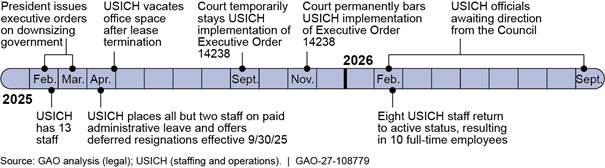
Eight of 11 USICH employees returned from paid administrative leave in mid-February 2026. The other three left USICH prior to employees’ return to active status. As of May 2026, USICH had 10 full-time employees and a part-time executive director. USICH staff told GAO that, since their return, they had not received direction from the Council or the executive director on homelessness policies or priorities to guide their work or help them perform USICH’s statutory duties and functions. The executive director stated that the Council should provide guidance before USICH drafts a strategic plan or undertakes policy initiatives.
Why GAO Did This Study
Several federal agencies administer programs to address homelessness, and USICH was created in 1987 to coordinate these efforts and reduce homelessness.
In early 2025, the President issued a series of directives to downsize the federal workforce and reorganize federal agencies. Among these, Executive Order 14238, issued in March 2025, directed seven federal entities—including USICH—to eliminate nonstatutory functions and to reduce statutory functions and associated personnel to the minimum required by law.
GAO was asked to review USICH’s statutory responsibilities and recent changes to its staffing and operations. This report describes (1) USICH’s responsibilities under the McKinney-Vento Homeless Assistance Act and (2) the status of its staffing and operations.
GAO reviewed the McKinney-Vento Homeless Assistance Act, relevant executive orders, court documents, and appropriations acts. GAO also reviewed USICH documentation, interviewed USICH’s executive director and staff, and requested information from three Council member agencies.
Abbreviations
|
The Council |
Members of the United States Interagency Council on Homelessness, comprising the heads of 19 federal agencies or their designees |
|
GSA |
General Services Administration |
|
HHS |
Department of Health and Human Services |
|
HUD |
Department of Housing and Urban Development |
|
McKinney-Vento Act |
Title II of the McKinney-Vento Homeless |
|
OMB |
Office of Management and Budget |
|
USDA |
Department of Agriculture |
|
USICH |
United States Interagency Council on Homelessness |
This is a work of the U.S. government and is not subject to copyright protection in the United States. The published product may be reproduced and distributed in its entirety without further permission from GAO. However, because this work may contain copyrighted images or other material, permission from the copyright holder may be necessary if you wish to reproduce this material separately.
October 2, 2026
The Honorable Patty Murray
Vice-Chair
Committee on Appropriations
United States Senate
The Honorable Jack Reed
United States Senate
In early 2025, the President issued a series of directives to downsize the federal workforce and reorganize federal agencies. Among these, a March 2025 executive order directed seven federal entities—including the United States Interagency Council on Homelessness (USICH)—to eliminate nonstatutory functions and reduce statutory functions to the minimum required by law.[1] Shortly thereafter, USICH began taking steps to reduce its staff and operations.
USICH is an independent establishment in the executive branch, created by title II of the McKinney-Vento Homeless Assistance Act of 1987 (as amended, the McKinney-Vento Act), to coordinate the federal response to homelessness.[2] The act established USICH’s mission, structure, and functions, and set its termination date, which Congress has extended several times, most recently to October 1, 2028.[3]
You asked us to review USICH’s statutory responsibilities and recent changes to its staffing and operations. This report describes (1) USICH’s statutory responsibilities under the McKinney-Vento Act and (2) the status of USICH’s staffing and operations.[4]
To address the first objective, we reviewed the McKinney-Vento Act, selected case law, USICH public reports, USICH’s agency reorganization and reduction-in-force plan, other USICH documentation, and prior GAO reports.[5] We identified relevant case law by searching Lexis+ for federal and state cases, briefs, pleadings, and motions that referred to the “U.S. Interagency Council on Homelessness” or similar phrases.
To address the second objective, we obtained documentation from USICH and interviewed USICH’s executive director and staff in leadership roles about USICH’s staffing, operations, and use of appropriated funds from January 2016 through May 2026.[6] We reviewed relevant executive orders, court documents, appropriations acts for fiscal years 2016–2027, and the President’s budget for fiscal year 2027.
We requested interviews and documentation from selected member agencies—the Departments of Housing and Urban Development (HUD), Health and Human Services (HHS), and Agriculture (USDA)—about their roles in USICH and its staffing and operations over the past 10 years. We selected these agencies because of their past leadership roles and involvement with USICH.[7] HHS provided a written response. USDA told us it did not have staff assigned to USICH and did not respond to our questions. HUD did not provide information in response to our outreach. We compared USICH’s staffing levels and operations from 2025 through mid-2026 with those from 2016 through 2024.
We conducted this performance audit from November 2025 to October 2026 in accordance with generally accepted government auditing standards. Those standards require that we plan and perform the audit to obtain sufficient, appropriate evidence to provide a reasonable basis for our findings and conclusions based on our audit objectives. We believe that the evidence obtained provides a reasonable basis for our findings and conclusions based on our audit objectives.
Background
USICH’s mission includes coordinating the federal response to homelessness and creating a national partnership at every level of government and with the private sector to reduce homelessness.[8] It consists of the heads of 19 federal agencies or their designees (the Council), and a full-time staff led by an executive director.[9] According to USICH’s website, the Council’s member agencies are HUD, HHS, and USDA; the Departments of Commerce, Defense, Education, Energy, Homeland Security, Justice, Labor, Transportation, Veterans Affairs, and the Interior; Corporation for National and Community Service (AmeriCorps); General Services Administration (GSA); Office of Management and Budget (OMB); Social Security Administration; U.S. Postal Service; and White House Faith Office.[10]
On March 14, 2025, the President issued Executive Order 14238, “Continuing the Reduction of the Federal Bureaucracy,” which directed the elimination of nonstatutory components and functions of USICH to the maximum extent consistent with applicable law.[11] The order directed USICH to reduce its performance of statutory functions and associated personnel to the minimum required by law. It also directed USICH to submit a report to OMB within 7 days confirming full compliance with the order and explaining which components or functions are statutorily required. The order further directed OMB to reject certain USICH funding requests to the extent they were inconsistent with the order. Executive Order 14238 has been the subject of litigation, as discussed later in this report.
The McKinney-Vento Act Requires Certain USICH Staffing Levels and Duties
The McKinney-Vento Act includes requirements for USICH’s staffing and operations. For example, the Council is required to
· meet at least four times each year;
· elect a chair and vice chair annually from among its members;
· appoint an executive director, who reports to the chair; and
· employ at least five regional coordinators responsible for Council activities across 10 federal regions.[12]
The act also requires HUD to provide administrative and support services necessary to ensure the Council carries out its functions efficiently and expeditiously.[13]
The act includes other provisions that can help USICH carry out its mission.[14] For example, the executive director can appoint additional personnel, with Council approval. Additionally, the Council may authorize its members and employees to take any actions the Council itself is authorized to take under the act. Finally, the Council may request personnel detailed from any federal agency.[15] Table 1 includes selected McKinney-Vento Act provisions related to USICH staffing and operations.
Table 1: Selected Provisions of the McKinney-Vento Homeless Assistance Act Related to the Staffing and Operations of the U.S. Interagency Council on Homelessness
|
Sectiona |
Description of provisionb |
|
§ 11312(b)-(c) |
The Council shall elect a Chair and Vice Chair from among its members, which positions shall rotate on an annual basis at the first meeting of each year. |
|
§ 11312(c) |
The Council shall meet at the call of its Chair or a majority of its members, but not less often than four times each year. |
|
§ 11315(a) |
For the purpose of carrying out title II of the McKinney-Vento Act the Council may hold such meetings, and sit and act at such times and places, as the Council considers appropriate. |
|
§§ 11314(a), 11312(e) |
The Council shall appoint an executive director at its first meeting under § 11312(c). The executive director shall be compensated at a rate not to exceed the rate of basic pay for level V of the Executive Schedule. The executive director shall report to the Council Chair. |
|
§ 11313(a)(5) |
The Council must provide certain professional and technical assistance by not less than 5, but in no case more than 10, regional coordinators employed by the Council, each having responsibility for interaction and coordination of the Council’s activities within the 10 standard Federal regions.c |
|
§ 11314(b) |
With the approval of the Council, the executive director may appoint and fix the compensation of such additional personnel as the executive director considers necessary to carry out the Council’s duties. |
|
§ 11314(c) |
Upon request of the Council, the head of any federal agency may detail, on a reimbursable basis, any of the personnel of such agency to the Council to assist the Council in carrying out its duties under title II of the McKinney-Vento Act. |
|
§ 11314(d) |
The Secretary of Housing and Urban Development shall provide the Council with such administrative and support services as are necessary to ensure that the Council carries out its functions under title II of the McKinney-Vento Act efficiently and expeditiously. |
|
§ 11314(e) |
With the approval of the Council, the executive director may procure certain temporary and intermittent services of experts and consultants. |
|
§ 11315(b) |
Any member or employee of the Council may, if authorized by the Council, take any action that the Council is authorized to take in title II of the McKinney-Vento Act |
|
§ 11315(c) |
The Council may secure directly from any federal agency such information as may be necessary to enable the Council to carry out title II of the McKinney-Vento Act. |
|
§ 11312(d) |
Members of the Council shall receive no additional pay, allowances, or benefits by reason of their service on the Council. |
|
§ 11315(d) |
The Council may accept, use, and dispose of gifts or donations of services or property, both real and personal, public and private, without fiscal year limitation, for the purpose of aiding or facilitating the work of the Council. |
Source: Title II of the McKinney-Vento Homeless Assistance Act, 42 U.S.C. §§ 11311-11320. | GAO‑27‑108779
aRelevant section of title II of the McKinney-Vento Homeless Assistance Act, codified as amended in title 42 of the U.S. Code (the McKinney-Vento Act).
bThe term “Council” refers to the U.S. Interagency Council on Homelessness established under the McKinney-Vento Act and composed of representatives from designated federal agencies. 42 U.S.C. §§ 11312(a), 11317(1).
cThe McKinney-Vento Act does not define the 10 standard federal regions.
Additionally, the McKinney-Vento Act requires USICH to perform specific duties and functions to carry out its mission (see table 2).[16] These duties and functions include
· providing technical assistance to states, local governments, and nonprofit organizations on matters related to assisting the homeless;
· evaluating and recommending improvements to federal, state, and local homelessness programs;
· reporting annually to the President and Congress on federal efforts to address homelessness; and
· developing a national strategic plan to end homelessness.
Table 2: Selected Duties and Functions of the U.S. Interagency Council on Homelessness under the McKinney-Vento Homeless Assistance Act
|
Sectiona |
Description of statutory requirementb |
|
§ 11313(a)(1)c |
Not later than 12 months after July 11, 2026, the Council shall develop, make available for public comment, and submit to the President and to Congress a National Strategic Plan to End Homelessness, and report annually on the status of completion of the plan and the reasons for any modifications to the plan. |
|
§ 11313(a)(2) |
The Council shall review all federal activities and programs to assist homeless individuals. |
|
§ 11313(a)(3) |
The Council shall take such actions as may be necessary to reduce duplication among programs and activities by federal agencies to assist homeless individuals. |
|
§ 11313(a)(4) |
The Council shall monitor, evaluate, and recommend improvements in programs and activities to assist homeless individuals conducted by federal agencies, state and local governments, and private voluntary organizations. |
|
§ 11313(a)(5) |
The Council shall provide professional and technical assistance—by 5–10 regional coordinators employed by the Council—to enable states, local governments, and nonprofit organizations to: (A) interpret regulations and assist in the application process for federal assistance; (B) provide assistance on how to best coordinate other federal programs; (C) develop recommendations based on regional-specific issues in serving the homeless population; and (D) establish a schedule for the Council to hold biennial regional workshops to further provide assistance, of which at least one workshop shall be held in each of the 10 standard Federal regions every 2 years.d |
|
§ 11313(a)(6) |
The Council shall encourage the creation of State Interagency Councils on Homelessness and the formulation of jurisdictional 10-year plans to end homelessness at state, city, and county levels. |
|
§ 11313(a)(7) |
The Council shall annually obtain from federal agencies their identification of resources for persons experiencing homelessness and improvements to ensure access; and develop mechanisms to ensure access to all federal, state, and local programs for which the persons are eligible, and to verify collaboration among entities within a community that receive federal funding under programs for such persons. |
|
§ 11313(a)(8) |
The Council shall conduct research and evaluation related to its functions as defined in § 11313. |
|
§ 11313(a)(9) |
The Council shall develop joint federal agency and other initiatives to fulfill the goals of the agency. |
|
§ 11313(a)(10) |
The Council shall collect and disseminate information relating to homeless individuals. |
|
§ 11313(a)(12) |
The Council shall prepare and distribute to states, local governments, and nonprofit organizations, a bimonthly bulletin that describes the federal resources available to them to assist the homeless, including current information regarding application deadlines and appropriate persons to contact in each Federal agency providing the resources. |
|
§ 11313(a)(13) |
The Council shall develop constructive alternatives to criminalizing homelessness and certain related laws and policies. |
|
§ 11313(a)(15)e |
The Council shall testify annually before Congress, if requested. |
|
§ 11313(c)(1) |
Annually, the head of each federal agency that is a Council member shall prepare and transmit to Congress and the Council a report that describes each program to assist the homeless administered by the agency; the number of individuals served by each program; impediments including any statutory and regulatory restrictions to the use of each program and the agency’s efforts to increase opportunities for the homeless to obtain shelter, food, and supportive services. |
|
§ 11313(c)(2) |
The Council shall prepare and transmit to the President an annual report that assesses the nature and extent of the problems relating to homelessness and the needs of homeless individuals; provides a comprehensive and detailed description of federal activities and accomplishments in resolving the problems and meeting the needs assessed; describes the Council’s accomplishments and activities, in working with federal, state, and local agencies and other organizations to assist the homeless; assesses the level of federal assistance necessary to resolve the problems and meet the needs assessed; and specifies any Council recommendations for legislative and administrative actions to resolve such problems and meet such needs. |
|
§ 11313(d) |
If, in monitoring and evaluating programs and activities to assist homeless individuals conducted by other federal agencies, the Council determines that any significant problem, abuse, or deficiency exists in the administration of the program or activity, the Council shall notify the Inspector General of the federal agency (or if the agency does not have an Inspector General, the head of the agency). |
Source: Title II of the McKinney-Vento Homeless Assistance Act, 42 U.S.C. §§ 11311–11320. | GAO‑27‑108779
Note: In carrying out § 11313(a), the Council may (1) arrange national, regional, state, and local conferences to develop and coordinate effective programs and activities to assist homeless individuals and pay attendance at meetings related to functions or activities for which the appropriation is made; and (2) publish a newsletter on federal, state, and local programs that are effectively meeting the needs of homeless individuals. 42 U.S.C. § 11313(b).
aRelevant section of title II of the McKinney-Vento Homeless Assistance Act, codified as amended in title 42 of the U.S. Code (McKinney-Vento Act).
bThe term “Council” refers to the U.S. Interagency Council on Homelessness established under the McKinney-Vento Act and composed of representatives from designated federal agencies. 42 U.S.C. §§ 11312(a), 11317(1).
cThe 21st Century ROAD to Housing Act amended this section of the McKinney-Vento Act effective July 11, 2026. Pub. L. No. 119-101, § 703, 140 Stat. 846, 956 (2026). Before then, this section required the Council to annually update a previous National Strategic Plan to End Homelessness.
dThe McKinney-Vento Act does not define the 10 standard federal regions.
eThe 21st Century ROAD to Housing Act added this section to the McKinney-Vento Act effective July 11, 2026.
Most USICH Staff Were Placed on Paid Administrative Leave for 10 Months
USICH Staffing and Operations from 2016 through 2024
From 2016 through 2024, USICH experienced some changes in its organizational structure and staffing, use of interagency and external support, and budget and funding. During this period, USICH also issued three national strategic plans to end homelessness—in 2018, 2020, and 2022.[17]
Organizational Structure and Staffing
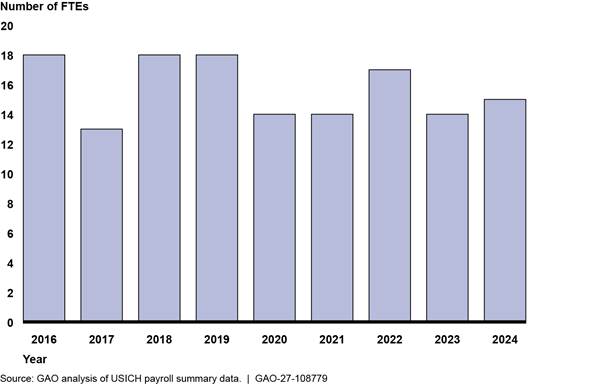
From 2016 through 2024, USICH staffing levels ranged from 13 to 18 full-time equivalent employees (see fig. 1).[18] During this period, USICH staff worked across six subcomponents: Office of the Executive Director, Policy Initiatives, National Initiatives, Communications, Finance and Administration, and Legislative Affairs.[19]
Figure 1: U.S. Interagency Council on Homelessness (USICH) Full-Time Equivalent Employees (FTE), 2016–2024
· Office of the Executive Director. This office led USICH’s operations, including overseeing implementation of the national strategic plan, coordinating across member agencies, and managing the budget, according to USICH documentation we reviewed and our previous reporting on USICH’s structure and operations.[20] As we reported in 2020, executive directors directed staff, developed strategic and performance goals for the Council’s consideration, prepared budget requests in coordination with OMB, and advanced interagency efforts.[21] Executive directors generally had experience addressing housing or homelessness issues across federal, state, and local governments and the nonprofit sector.[22] The office also employed a deputy director in 2016–2019, a chief of staff in 2016–2021, and a special assistant to the executive director in 2023–2024, according to USICH documentation.[23]
· Policy Initiatives. This office was responsible for developing and implementing USICH’s national strategic plan and preparing statutorily required annual reports and updates to Congress. It employed an external affairs manager in 2016–2017, between zero and two analysts and one and two policy directors in 2016–2024, and a policy initiatives director in 2022–2024, according to USICH documentation.[24]
· National Initiatives. This office provided technical assistance to states, local and tribal governments, and nonprofit entities through its regional coordinators. USICH defined these coordinators’ regions based on HUD’s and HHS’s regional areas since at least 2012, according to USICH staff.[25] It employed between three and six regional coordinators in 2016–2024, including its director, according to USICH documentation.[26]
· Communications. This office produced and distributed USICH’s newsletter and developed and disseminated information and tools to the homelessness sector and the public. It employed one manager and one specialist in 2016–2019 and 2021–2024.[27]
· Finance and Administration. This office was responsible for USICH’s operational functions, including payroll, budget execution, procurement, and facilities. Its staff were responsible for outsourcing support, such as managing interagency agreements with GSA. It had one director and one administrative specialist in 2016–2024, according to USICH documentation.[28]
·
Legislative Affairs. USICH added a sixth subcomponent,
Legislative Affairs, around 2022–2023, according to USICH documentation.
Legislative Affairs staff were responsible for coordinating and submitting
congressionally mandated briefings and reports and serving as a resource to
Congress on issues related to homelessness. USICH employed a director of
legislative affairs in 2024, according to USICH officials.
USICH made several other organizational changes during this period to address Council priorities, according to USICH officials. For example, it eliminated several management positions, including Deputy Director (2020), Chief of Staff and Legislative Liaison (2022), and Chief Operating Officer (2022). USICH used other types of positions to address Council priorities, such as program specialists, program assistants, and interns.
Use of Interagency and External Support
USICH also used support from Council member agencies to carry out its mission. For example, the Department of Veterans Affairs provided an interim executive director in 2021, and detailees from HHS and HUD supported USICH’s work, according to USICH reports and staff we interviewed. According to USICH staff, a detailee from HUD worked with Policy Initiatives to support USICH’s “All INside” initiative, which was implemented in seven localities in 2023 and 2024.[29] USDA and GSA provided support services through shared service agreements, including accounting, payroll, and other financial services; systems and reporting support; legal counsel; and Equal Employment Opportunity processing, according to USICH reports.[30]
USICH also engaged private contractors and obtained assistance from private entities to carry out certain functions, according to USICH documentation and staff we interviewed. For example, USICH engaged contractors to develop standardized tools to help member agencies provide information for annual reporting.[31] In 2023 and 2024, public health fellows affiliated with two nonprofit entities assisted with public health aspects of implementing USICH’s national strategic plan. The fellows worked with localities to reduce regulatory barriers to housing, health care, and other support for people experiencing homelessness and developed guidance on how health systems and hospitals can help address homelessness, according to USICH documentation.
Budget and Funding
USICH’s congressional appropriation gradually increased during fiscal years 2016–2024, from $3.5 million to $4.3 million.[32] Personnel costs comprised the majority of USICH’s spending during this period, ranging from 58 to 64 percent, according to USICH congressional budget justifications. The remaining funds supported operational expenses, such as travel, office space, and equipment. USICH’s annual rent costs were approximately $259,000 in 2018–2022, and $166,000 in 2023–2025, according to USICH officials. From 2017 through 2022, USICH leased a 4,766-square-foot office space in a GSA building in Southwest Washington, D.C. In late 2022, it moved to a smaller office space, also in Southwest Washington, D.C.
Over the past 10 years, USICH’s budget requests have included proposals related to staffing and organizational changes that Congress did not enact. For example, USICH proposed winding down its operations in fiscal years 2018, 2019, and 2020, and requested funding for a total of two full-time equivalent employees to carry out orderly shutdown activities. However, Congress enacted appropriations at or above existing levels for each of those years. In contrast, for fiscal years 2023 and 2024, USICH requested funding for additional staff (three to four full-time equivalent employees) to support financial analysis, national strategic plan implementation, and administrative functions. However, Congress enacted appropriations below USICH’s requested levels in each of those years.
USICH has also requested changes to its statutory termination date as part of the budget process. In 2017, Congress extended USICH’s termination date to October 1, 2018. In 2018, Congress extended the termination date to October 1, 2020. Finally, in 2019, Congress extended USICH’s termination date to October 1, 2028. In its fiscal year 2025 budget request, USICH proposed eliminating the statutory termination date, which Congress did not enact.
USICH Staffing and Operations from 2025 through Mid-2026
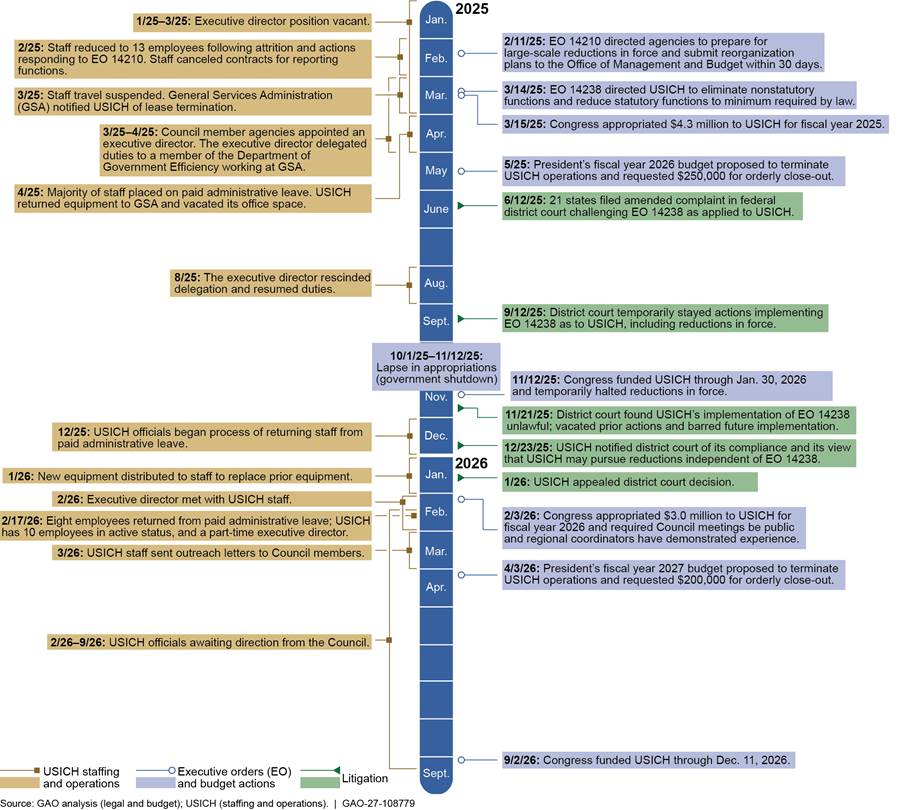
USICH began making changes to its staffing and operations in early 2025 in response to executive orders (see fig. 2).
Figure 2: U.S. Interagency Council on Homelessness (USICH) Staffing and Operational Developments, January 2025–September 2026
Notes: Exec. Order No. 14210, 90 Fed. Reg. 9669 (Feb. 14, 2025); Exec. Order No. 14238, 90 Fed. Reg. 13,043 (Mar. 20, 2025); Pub. L. No. 119-4, 139 Stat. 9, 10-12, 38-40 (2025); Pub. L. No. 119-37, div. A, § 101, 139 Stat. 495-6 (2025); Pub. L. No. 119-75, 140 Stat. 173, 425 (2026); Pub. L. No. 119-103, 140 Stat. 987 (2026); Rhode Island v. Trump, 810 F. Supp. 3d 283 (D.R.I. 2025), No. 1:25-cv-00128.
Staffing, Funding, and Operations in 2025
In early 2025, USICH staff managed operations without an executive director, according to staff we interviewed.[33] During this period, they developed and submitted an agency reduction-in-force and reorganization plan to OMB in response to a February 2025 executive order, according to USICH staff.[34] The plan, dated March 13, 2025, identified 13 full-time equivalent positions (excluding the executive director) as essential to carrying out USICH’s statutory functions, recommended consolidating Communications functions with other departments, and recommended eliminating four vacant positions. USICH’s staff also canceled contracts related to USICH’s reporting functions and suspended staff travel, according to the plan. As previously discussed, Executive Order 14238, issued March 14, 2025, directed USICH to eliminate its nonstatutory functions and reduce statutory functions to the minimum required by law.[35]
USICH staffing and operations continued to undergo changes in the spring of 2025, including leadership changes and the implementation of Executive Order 14238. Council members appointed an executive director, according to documentation we reviewed.[36] In April 2025, the executive director delegated executive director duties to another individual (delegate).[37] The delegate described themself as a member of the Department of Government Efficiency team working at GSA, according to USICH staff. USICH staff told us the delegate placed all but two of USICH’s 13 employees on paid administrative leave in April 2025 in response to Executive Order 14238.[38] The two employees who remained in active status—USICH’s Director of Finance and Administration and an assistant—performed payroll and other administrative functions, according to USICH staff. GSA also terminated USICH’s office lease, citing Executive Order 14238.[39] USICH vacated the space in April 2025 and returned equipment to GSA, according to USICH officials.
In June 2025, a coalition of 21 states filed an amended complaint in the U.S. District Court for the District of Rhode Island challenging USICH’s implementation of Executive Order 14238.[40] In November 2025, the court found that USICH’s implementation of the order was unlawful.[41] The court noted that reducing USICH personnel to two employees was contrary to law because the reduction made it impossible for the agency to continue to perform its statutory duties. The court also noted that USICH had not provided a reasoned explanation for why it was terminating its existing programs and failed to account for the interests of the constituents it served, among other things. The court vacated USICH’s prior actions to implement the order and permanently barred future actions to do so.
Following the November 2025 court decision, USICH began the process of returning staff from paid administrative leave in December 2025, including purchasing new equipment to replace equipment returned to GSA. USICH also filed a notice of compliance with the court’s decision.[42] Among other things, the notice stated USICH’s view that the court’s decision did not forbid future actions to improve USICH’s efficiency or reduce its size or scope if those actions were independent of Executive Order 14238. USICH subsequently appealed the court’s decision.[43]
USICH spent its appropriations for fiscal year 2025 primarily on employee pay and benefits, according to USICH officials. Congress appropriated $4.3 million to USICH for fiscal year 2025. USICH spent approximately $3.7 million (about 87 percent of the appropriated amount), mainly on employee pay and benefits—including for employees placed on administrative leave for approximately 6 months of the fiscal year—and on its office lease, which GSA terminated in April 2025, according to USICH officials.[44]
Staffing, Funding, and Operations in 2026
In January 2026, USICH officials told us that the Council had not met since December 2024.[45] They could not confirm the current chair or vice-chair. They also told us that USICH did not respond to certain OMB and Office of Personnel Management reporting requirements in 2025 relating to agency staffing.[46] According to USICH officials, this was due to uncertainty regarding USICH’s future status, including whether it would receive a fiscal year 2026 appropriation.
USICH delivered new equipment to staff in mid-January 2026 and returned eight staff to active status in mid-February 2026.[47] USICH officials told us all employees were teleworking as of February 17, 2026. As of May 2026, USICH had a part-time executive director and 10 full-time equivalent employees across four subcomponents: five in National Initiatives (all regional coordinators), two in Policy Initiatives, two in Finance and Administration, and one in Legislative Affairs.[48]
In March 2026, USICH began contacting member agencies to identify Council points of contact. According to USICH officials, one of 19 member agencies—GSA—had provided contact information as of May 2026.[49] Four other agencies—HHS, OMB, and the Departments of Energy and Transportation—confirmed receipt of USICH’s email but had not provided contact information. The other 14 agencies did not respond. As of September 2026, USICH staff had not confirmed a date for a Council meeting.
Congress appropriated $3 million to USICH for fiscal year 2026, a reduction of approximately 30 percent from fiscal year 2025. Released in April 2026, the President’s budget for fiscal year 2027 proposed terminating USICH’s operations in that fiscal year and requested $200,000 for USICH’s orderly closeout.[50]
As of September 2026, USICH staff said they had not received direction from the Council or the executive director on federal homelessness policies or priorities to guide their work and help perform USICH’s statutory duties and functions, such as updating its national strategic plan to end homelessness. The executive director stated that the Council should provide guidance before USICH drafts a strategic plan or undertakes policy initiatives. The executive director also stated that the Council’s future approach to homelessness may differ significantly from past approaches.
USICH’s efforts to reengage with Council members could help revive activities that support USICH’s statutory responsibilities, including updating the national strategic plan and providing technical assistance to states, local governments, and nonprofit organizations. We will continue to monitor USICH’s activities and use of funds.
Agency Comments
We provided a draft of this report to USICH, HHS, HUD, and USDA for review and comment. HHS, HUD, and USDA had no comments on the draft report.
USICH provided comments in an email from its executive director. USICH noted that a lawsuit currently under appeal (Rhode Island v. Trump) will affect how USICH can structure itself going forward. USICH said it looks forward to resolution of the lawsuit and moving forward with the Council on its mission while preserving the right to make changes consistent with applicable law and Executive Order 14238.
Our report provides information on USICH’s mission, statutory responsibilities, structure, staffing and operational changes, and communications with the Council. It also describes the nature and status of the lawsuit.[51] We therefore made no changes to our report in response to USICH’s comments.
We are sending copies of this report to the appropriate congressional committees, the Executive Director of USICH, Secretary of Health and Human Services, Secretary of Housing and Urban Development, and Secretary of Agriculture. In addition, the report is available at no charge on the GAO website at https://www.gao.gov.
If you or your staff have any questions about this report, please contact me at cackleya@gao.gov. Contact points for our Offices of Congressional Relations and Media Relations may be found on the last page of this report. GAO staff who made key contributions to this report are listed in appendix I.

Alicia Puente Cackley
Director, Financial Markets and Community Investment
GAO Contact
Alicia Puente Cackley, CackleyA@gao.gov
Staff Acknowledgments
In addition to the contact named above, Karen Tremba (Assistant Director), Heather Chartier (Analyst in Charge), Garrett Hillyer, Mac Hoeve, Jeff Larson, and Marc Molino made key contributions to this report.
The Government Accountability Office, the audit, evaluation, and investigative arm of Congress, exists to support Congress in meeting its constitutional responsibilities and to help improve the performance and accountability of the federal government for the American people. GAO examines the use of public funds; evaluates federal programs and policies; and provides analyses, recommendations, and other assistance to help Congress make informed oversight, policy, and funding decisions. GAO’s commitment to good government is reflected in its core values of accountability, integrity, and reliability.
Obtaining Copies of GAO Reports and Testimony
The fastest and easiest way to obtain copies of GAO documents at no cost is through our website. Each weekday afternoon, GAO posts on its website newly released reports, testimony, and correspondence. You can also subscribe to GAO’s email updates to receive notification of newly posted products.
Order by Phone
The price of each GAO publication reflects GAO’s actual cost of production and distribution and depends on the number of pages in the publication and whether the publication is printed in color or black and white. Pricing and ordering information is posted on GAO’s website, https://www.gao.gov/ordering.htm.
Place orders by calling (202) 512-6000, toll free (866) 801-7077,
or
TDD (202) 512-2537.
Orders may be paid for using American Express, Discover Card, MasterCard, Visa, check, or money order. Call for additional information.
Connect with GAO
Connect with GAO on X,
LinkedIn, Instagram, and YouTube.
Subscribe to our Email Updates. Listen to our Podcasts.
Visit GAO on the web at https://www.gao.gov.
To Report Fraud, Waste, and Abuse in Federal Programs
Contact FraudNet:
Website: https://www.gao.gov/about/what-gao-does/fraudnet
Automated answering system: (800) 424-5454
Media Relations
Sarah Kaczmarek, Managing Director, Media@gao.gov
Congressional Relations
David A. Powner, Acting Managing Director, CongRel@gao.gov
General Inquiries
[1]Exec. Order No. 14238, Continuing the Reduction of the Federal Bureaucracy, 90 Fed. Reg. 13,043 (Mar. 20, 2025). The order directed the elimination of nonstatutory functions to the maximum extent consistent with applicable law.
[2]42 U.S.C. §§ 11311–11320.
[3]See, e.g., 42 U.S.C. § 11319.
[4]We did not evaluate USICH’s compliance with laws, regulations, executive orders, or other criteria in this review.
[5]We have previously reported on USICH’s structure, operations, and policies and procedures for performing its statutory duties and functions. See GAO, Interagency Council on Homelessness: Governance Responsibilities Need Further Clarification, GAO‑20‑602 (Washington, D.C.: Aug. 19, 2020); and Interagency Council on Homelessness: Written Policies for Implementing Statutory Requirements Are Needed, GAO‑22‑105110 (Washington, D.C.: June 23, 2022). These reports recommended that the Council clarify and document governance roles and responsibilities and that USICH establish written policies and procedures for meeting its statutory requirements. The Council and USICH concurred with the recommendations but, as of July 2026, had not provided evidence that they fully implemented the recommendations.
[6]USICH provided personnel data for 2016–2025. The format of USICH’s personnel data did not allow us to determine whether positions were filled or vacant for the entirety of each year. USICH compiled the data by year but not during the same month each year. To identify when a position was filled or vacant, we used the position status associated with the calendar year in which USICH compiled the data.
[7]The most recent available information on Council leadership was from 2024.
[8]42 U.S.C. § 11311. USICH’s mission also includes maximizing the effectiveness of the federal government in contributing to the end of homelessness. More than 771,000 people experienced homelessness in 2024, the highest count and an overall increase of 19 percent since HUD began reporting these estimates in 2007. See Department of Housing and Urban Development, The 2024 Annual Homelessness Assessment Report (AHAR) to Congress Part 1: Point-in-Time Estimates of Homelessness (Washington, D.C.: Dec. 2024). Several federal agencies have programs to address homelessness.
[9]For the purposes of this report, we use “the Council” to refer collectively to the heads of the 19 federal agencies or their designees and “USICH” to refer collectively to the Council and USICH’s executive director and staff.
[10]U.S. Interagency Council on Homelessness, “Council Members,” accessed May 19, 2026, https://usich.gov/about/council. The McKinney-Vento Act also designated USA FreedomCorps—a former White House office and interagency coordinating council—as a member agency, along with other federal agencies the Council considers appropriate. 42 U.S.C. § 11312(a).
[11]90 Fed. Reg. 13,043 (Mar. 20, 2025). The order contained similar requirements for six other governmental entities, but the discussion in this report focuses on USICH.
[12]42 U.S.C. §§ 11312, 11313(a)(5), 11314(a). The Consolidated Appropriations Act, 2026—enacted on February 3, 2026—included funding conditions related to USICH’s staffing and operations. Pub. L. No. 119-75, 140 Stat. 173, 425-426. For example, the act required that each Council meeting be open to the public and that the Council post a public notification of each meeting at least 30 days in advance on its website, including the agenda. The act also required that the Council’s regional coordinators have the proven expertise and demonstrated experience needed to carry out their duties as specified in the McKinney-Vento Act.
[13]42 U.S.C. § 11314(d).
[14]E.g., 42 U.S.C. §§ 11314, 11315.
[15]The act specifies that such details are to be on a reimbursable basis. The Office of Personnel Management defines a detail as a temporary assignment of an employee to a different position for a specified period, with the employee returning to his or her regular duties at the end of the detail. Office of Personnel Management, Guide to Processing Personnel Actions (Washington, D.C.: Apr. 2025), 35-4.
[16]In this report, we use the terms “homeless individuals,” “homeless populations,” and “the homeless” when summarizing statutory provisions that use those terms or similar terms.
[17]The plans articulated government-wide goals, priorities, and strategies related to housing support, homelessness response, and prevention.
[18]USICH payroll summary data indicated USICH employed 13–18 full-time equivalent employees in active status during 2016–2024. Its budget justification reports from the same period indicated 18–21 approved full-time equivalent employees.
[19]The format of USICH’s personnel data did not allow us to determine whether positions were filled or vacant for the entirety of each year. USICH compiled the data by year but not during the same month each year. To identify when a position was filled or vacant, we used the position status associated with the calendar year in which USICH compiled the data.
[20]GAO, Interagency Council on Homelessness: Governance Responsibilities Need Further Clarification, GAO‑20‑602 (Washington, D.C.: Aug. 19, 2020).
[21]GAO‑20‑602. USICH executive directors supported Council functions by advising the chair and member agencies, preparing materials for quarterly meetings, and reporting on progress toward strategic objectives.
[22]The last executive director during this period resigned from USICH in December 2024, prior to the change in administrations.
[23]The position of special assistant to the executive director became vacant in January 2025, according to USICH documentation.
[24]The external affairs manager position was eliminated after 2017, according to USICH documentation. USICH employed one policy director in 2016–2017; the other policy director position was established and filled in 2018–2022, then vacant in 2023–2024. USICH employed two analysts in 2016–2019, none in 2020–2021, one in 2022–2023, and none in 2024. The Director of Policy Initiatives position was introduced in 2020, remained vacant in 2020–2021, and was filled in 2022–2024.
[25]HHS and HUD each have 10 service regions. As of December 2024, USICH identified six regions, each served by one of its six National Initiatives employees. These regions largely aligned with HHS’s and HUD’s regions, except that USICH grouped Arizona and California differently from those agencies.
[26]USICH employed five regional coordinators in 2016–2019, four in 2020, and five in 2021. In 2022, it added a new regional coordinator position, bringing the total to six in 2022–2024, according to USICH documentation.
[27]These positions were vacant in 2020, according to USICH documentation.
[28]In January–March 2025, the office employed an additional administrative specialist, according to USICH documentation.
[29]The initiative aimed to strengthen and accelerate local homelessness efforts in Chicago, Dallas, Denver, Los Angeles, the Phoenix metropolitan area, Seattle, and California. USICH reported in January 2025 that the initiative was a focus of USICH’s coordination efforts, and that HUD, HHS, the Federal Emergency Management Agency, and the Department of Veterans Affairs provided team leaders embedded in communities during the 2023–2024 initiative. United States Interagency Council on Homelessness, ALL INside Initiative: Strategic Reflections, Progress & Opportunities (Jan. 2025).
[30]According to USICH performance and accountability reports, USICH remained responsible for directing the work and authorizing activities, while USDA and GSA executed transactions and performed support activities as directed.
[31]USICH also engaged contractors to develop its website and support its network infrastructure.
[32]Congress appropriated USICH $3.5 million in fiscal year 2016, $3.6 million annually in fiscal years 2017–2019, $3.8 million annually in fiscal years 2020–2022, $4.0 million in fiscal year 2023, and $4.3 million in fiscal year 2024.
[33]USICH officials noted that USICH does not have a formal policy designating who carries out the duties of the executive director when the position is vacant. USICH staff told us that the Council chair had appointed an interim executive director to fill a vacancy in 2021, as noted previously.
[34]Exec. Order No. 14210, Implementing the President’s “Department of Government Efficiency” Workforce Optimization Initiative, 90 Fed. Reg. 9669 (Feb. 14, 2025). The order required agency heads to prepare for large-scale reductions in force, consistent with applicable law, and submit agency reorganization plans to OMB within 30 days. OMB and the Office of Personnel Management issued related guidance that identified tools agencies should employ, such as eliminating non-statutorily mandated functions through reductions in force, removing underperforming employees, and reducing headcounts through attrition. Office of Management and Budget and Office of Personnel Management, Memorandum: Guidance on Agency RIF and Reorganization Plans Requested by Implementing the President’s “Department of Government Efficiency” Workforce Optimization Initiative (Feb. 26, 2025).
[35]Continuing the Reduction of the Federal Bureaucracy, 90 Fed. Reg. 13,043 (Mar. 20, 2025).
[36]We could not ascertain the appointee’s exact title or date of appointment. The appointee stated that they were appointed acting executive director on March 14, 2025, and began serving in April 2025. A Council resolution signed by 11 member agencies stated that the appointee was appointed executive director as of March 14, 2025. Two separate orders signed by the appointee stated that the Council appointed them executive director on April 7, 2025. The appointee told us they had held multiple concurrent positions within the federal government and described their work with USICH as part-time.
[37]An order signed by the executive director on April 8, 2025, authorized the delegate to carry out the duties of executive director as of April 7, 2025. A subsequent order signed by the executive director rescinded the authorization of the delegate and stated that executive director duties would revert to the executive director as of August 6, 2025. USICH officials also referred to the delegate as a detailee but did not provide an interagency agreement or other documentation of a detail arrangement with another federal agency.
[38]USICH officials said the affected employees were given a choice between a deferred resignation agreement—effective September 30, 2025—or a termination via reductions in force. Separately, the executive director told us in January 2026 that there were differing views on the minimum number of USICH employees needed to carry out its statutory functions, noting the potential for contractors or staff from member agencies to implement certain requirements.
[39]GSA, in its role as landlord, notified USICH on March 31, 2025, that it was terminating USICH’s occupancy in connection with Executive Order 14238 and reassigning the space to other uses.
[40]First Amended Complaint for Declaratory and Injunctive Relief, Rhode Island v. Trump, 810 F. Supp. 3d 283 (D.R.I. 2025), No. 1:25-cv-00128; ECF No. 68. The defendants named in the amended complaint included USICH, its acting executive director, the President, OMB, and the Director of OMB. The amended complaint also challenged the implementation of the order as to three other governmental entities. However, this report focuses on USICH.
[41]810 F. Supp. 3d 283. The court found that USICH violated the Administrative Procedure Act because its actions were arbitrary, capricious, and contrary to law. The court also found that actions pertaining to USICH violated the Constitution’s “take care” clause, which requires the President to “take Care that the Laws be faithfully executed.”
[42]Defendants’ Notice of Compliance with the Court’s Summary Judgment Order, 810 F. Supp. 3d 283 (No. 1:25-cv-00128), ECF No. 103.
[43]810 F. Supp. 3d 283, appeal docketed, No. 26-1070 (1st Cir. Jan. 21, 2026). The appeal was pending as of September 2026. In presenting the information in this report, we take no position on the matters that are before the court.
[44]According to USICH officials, USICH spent $3,749,079 in fiscal year 2025, and returned a surplus of $550,921, approximately 13 percent of its $4.3 million appropriation. In November 2025, the District Court of Rhode Island found that the federal government acted unlawfully when it failed to follow necessary procedures for rescinding or deferring funds appropriated to USICH. Rhode Island v. Trump, 810 F. Supp. 3d 283, 308 (D.R.I. 2025). The court’s decision was under appeal as of September 2026. USICH officials stated that as of March 2026, USICH had not incurred legal expenses related to the ongoing litigation.
[45]In a January 2026 written response to us, HHS officials indicated that HHS was not aware of any USICH activity in 2025 and did not participate in USICH in 2025 or plan to participate in 2026, per Executive Order 14238. USDA provided a written response stating it did not have any personnel dedicated to USICH as of March 2026 and therefore did not respond to our questions. HUD did not provide information in response to our information and interview requests regarding USICH staffing and operations during our review. HHS, USDA, and HUD were among the 11 member agencies that signed a Council resolution appointing a new executive director as of March 14, 2025, as discussed earlier in this report.
[46]OMB and the Office of Personnel Management required federal agencies to submit second-phase agency reduction-in-force and reorganization plans by April 14, 2025; monthly progress reports in May, June, and July 2025; and annual staffing plans for fiscal year 2026 by December 1, 2025. Office of Management and Budget and Office of Personnel Management memoranda, Guidance on Agency RIF and Reorganization Plans (Feb. 26, 2025), and Guidance on Executive Order 14356, Ensuring Continued Accountability in Federal Hiring (Nov. 5, 2025).
[47]Of the 11 employees placed on paid administrative leave, three left USICH prior to employees’ return to active status, according to USICH documentation.
[48]USICH’s Director of Legislative Affairs left USICH in August 2026.
[49]USICH staff emailed the 19 member agencies in March 2026 and sent follow-up emails in April 2026.
[50]Office of Management and Budget, Appendix, Budget of the United States Government, Fiscal Year 2027 (Washington, D.C.: Apr. 2026), 1271. Enacted on September 2, 2026, the Continuing Appropriations and Extensions Act, 2027, continued USICH’s appropriation at the fiscal year 2026 level through the earlier of December 11, 2026 or the enactment of another appropriation. Pub. L. No. 119-103, § 106 (2026).
[51]In discussing the lawsuit, we take no position on the matters that are before the court.