
Report to Congressional Committees
United States Government Accountability Office
A report to congressional committees
Contact: William W. Colvin at colvinw@gao.gov
What GAO Found
When homebuyers apply for a mortgage, lenders request their credit reports from credit reporting agencies. These agencies may then sell the homebuyers’ contact and credit information to other lenders and brokers, which use it to send competing loan offers. Before recent legislation, credit reporting agencies could, without the homebuyer’s consent, provide this information to those that did not have an existing relationship with the homebuyer (see figure). Thus, homebuyers could receive dozens of mortgage solicitations by phone or text in a short period.
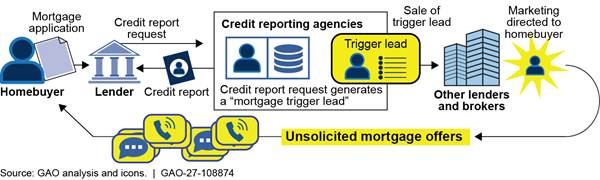
According to industry stakeholders, the primary benefit of trigger leads is that they can encourage homebuyers to comparison shop for loans and potentially save money. But this benefit may be limited: Recent federal survey results suggest that no more than 3.5 percent of homebuyers may have obtained a loan through competing offers based on trigger leads. One lender said homebuyers have ways to compare lenders before applying for a mortgage, so offers based on trigger leads generated later in the homebuying process may be less useful.
Trigger leads resulted in a high volume of unwanted marketing solicitations and posed other drawbacks for some homebuyers, according to consumer advocates and industry stakeholders:
· A high volume of solicitations can overwhelm and confuse homebuyers, and aggressive tactics can annoy them.
· Broad dissemination of homebuyers’ information could expose them to misleading or deceptive practices.
· Homebuyers may view the sale of their personal information and resulting marketing solicitations as an invasion of privacy.
In 2025, the Homebuyers Privacy Protection Act restricted credit reporting agencies’ ability to provide residential mortgage trigger leads to parties that have an existing relationship with or consent from the homebuyer. Because these restrictions took effect in March 2026, not enough time has passed to determine their effects on homebuyers. If effectively implemented, these restrictions could limit access to trigger leads and reduce the volume of solicitations homebuyers receive while preserving opportunities to comparison shop.
Why GAO Did This Study
Each year, millions of homebuyers apply for a mortgage, and some receive marketing calls and texts from other lenders and brokers with competing offers based on trigger leads. The volume of these mortgage solicitations prompted the enactment of the Homebuyers Privacy Protection Act in 2025.
The act includes a provision for GAO to assess the value of trigger leads for homebuyers. This report examines (1) the potential benefits of trigger leads, (2) drawbacks associated with them, and (3) how the act’s restrictions may affect those benefits and drawbacks.
GAO reviewed federal and state laws, searched for and reviewed relevant literature, and analyzed 2022–2024 responses to the National Survey of Mortgage Originations. In addition, GAO obtained information from or interviewed officials of credit reporting agencies, consumer groups, mortgage lenders (banks, credit unions, and nonbanks), industry associations, the association for state banking regulators, and a state regulatory agency. GAO also analyzed the Consumer Financial Protection Bureau’s (CFPB) consumer complaints database and used artificial intelligence to identify complaints related to mortgage solicitations, and interviewed officials from CFPB and the Federal Trade Commission.
|
Abbreviations |
|
|
|
|
|
CFPB |
Consumer Financial Protection Bureau |
|
FCRA |
Fair Credit Reporting Act |
|
FTC |
Federal Trade Commission |
|
HPPA |
Homebuyers Privacy Protection Act |
This is a work of the U.S. government and is not subject to copyright protection in the United States. The published product may be reproduced and distributed in its entirety without further permission from GAO. However, because this work may contain copyrighted images or other material, permission from the copyright holder may be necessary if you wish to reproduce this material separately.
October 6, 2026
The Honorable Tim Scott
Chairman
The Honorable Elizabeth Warren
Ranking Member
Committee on Banking, Housing, and Urban Affairs
United States Senate
The Honorable French Hill
Chairman
The Honorable Maxine Waters
Ranking Member
Committee on Financial Services
House of Representatives
Each year, millions of homebuyers apply for a mortgage loan, and some receive calls or texts from lenders and brokers offering competing loans soon after they apply. These solicitations can result from “mortgage trigger leads,” which credit reporting agencies generate when a lender requests a homebuyer’s credit report to evaluate the homebuyer’s ability to repay the loan.[1] In addition to supplying the requested report, the credit reporting agency can sell information about the homebuyer—including name, contact information, and credit score—to third parties, including lenders and mortgage brokers, provided they make the homebuyer a firm offer of credit.[2] Until recently, the Fair Credit Reporting Act (FCRA) permitted credit reporting agencies, without the homebuyer’s consent, to provide this information to lenders and brokers that did not have an existing relationship with the homebuyer.
Concerns about risks to homebuyers posed by mortgage trigger leads prompted the enactment of the Homebuyers Privacy Protection Act (HPPA) in 2025. HPPA amended FCRA to limit the sale of residential mortgage trigger leads to lenders and brokers that have an existing relationship with the homebuyer or have obtained the homebuyer’s consent to receive solicitations.[3]
HPPA includes a provision for us to report on the value of trigger leads received by text message. This report examines (1) the potential benefits of mortgage trigger leads for homebuyers, (2) drawbacks associated with mortgage trigger leads for homebuyers, and (3) how HPPA’s restrictions may affect the benefits and drawbacks of mortgage trigger leads.
To address these objectives, we reviewed relevant federal and state laws and regulations. We also analyzed 2022–2024 data from the National Survey of Mortgage Originations on homebuyers’ experiences and behaviors when applying for a mortgage loan.[4] We assessed the survey design and response rates and found them sufficiently reliable for our purposes.[5] We also searched for and reviewed industry, academic, and federal agency reports analyzing the effects of mortgage trigger leads on consumers’ mortgage-shopping behavior, including potential benefits and risks to consumers. In addition, we used artificial intelligence—specifically, a large language model—to search the Consumer Financial Protection Bureau’s (CFPB) consumer complaint data for complaints most relevant to mortgage trigger leads, based on known examples of such complaints.[6]
To obtain stakeholder perspectives on these issues, we interviewed officials from CFPB and the Federal Trade Commission (FTC). We also obtained information from two major credit reporting agencies, two consumer groups, and four associations representing mortgage lenders and brokers.[7] In addition, we obtained written responses from or interviewed a nongeneralizable sample of five bank, credit union, and nonbank mortgage lenders identified using Home Mortgage Disclosure Act data and selected to provide diversity in market share, location, and entity type. We identified 13 states with their own trigger lead restrictions and interviewed representatives of the Conference of State Bank Supervisors, which obtained input from 12 of those states. We also interviewed representatives of a state banking regulator and a provider of phone-number protection services, including spam filtering, and obtained examples of mortgage solicitations the provider had filtered from customers’ text messages.
We conducted this performance audit from January 2026 to October 2026 in accordance with generally accepted government auditing standards. Those standards require that we plan and perform the audit to obtain sufficient, appropriate evidence to provide a reasonable basis for our findings and conclusions based on our audit objectives. We believe that the evidence obtained provides a reasonable basis for our findings and conclusions based on our audit objectives.
Background
Mortgage Trigger Leads
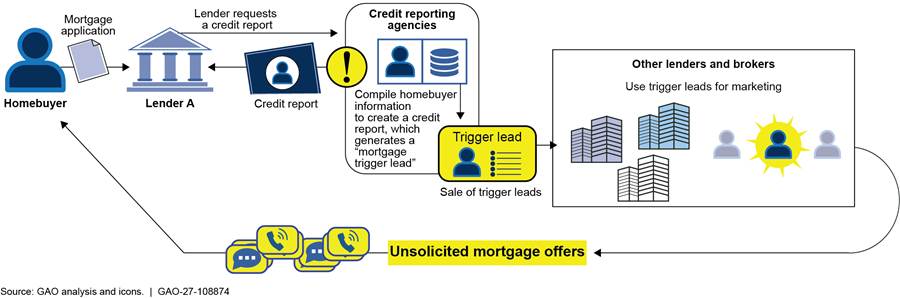
When a homebuyer applies for a mortgage loan, the lender obtains the homebuyer’s credit report from a credit reporting agency to evaluate the homebuyer’s ability to repay a loan and determine the interest rates and fees it will offer. Credit reporting agencies may then sell trigger leads—information from the credit report that may include the homebuyer’s name, contact information, and credit information—to other lenders and brokers. These lenders and brokers generally purchase trigger leads that meet certain credit scores and other criteria and use the leads to identify targets for mortgage solicitations (see fig. 1).
Federal Laws and Regulators
FCRA is the primary federal law governing the collection, assembly, purchase and sale, and use of credit reports. Under FCRA, credit reporting agencies may lawfully furnish homebuyers’ credit-report information to lenders and brokers, thereby creating trigger leads. Furnishing such information without the homebuyer’s consent is permitted only if certain criteria are met, including that lenders or brokers will make the homebuyer a firm offer of credit. Until recently, FCRA permitted credit reporting agencies, without the homebuyer’s consent, to provide this information to lenders and brokers that did not have an existing relationship with the homebuyer.
HPPA amended FCRA to limit the furnishing of residential mortgage trigger leads to (1) lenders or brokers that originated or are servicing the homebuyer’s current residential mortgage loan, (2) an insured depository institution or credit union at which the homebuyer has a current account, or (3) a party that has submitted documentation to the credit reporting agency certifying that the party has the authorization of the homebuyer.[8] CFPB and FTC share enforcement authority over credit reporting agencies.[9]
State Laws
A number of states have enacted legislation or issued regulations addressing mortgage trigger leads. For example, Arkansas enacted a law in 2025 requiring mortgage loan officers, in their initial communication with a consumer, to disclose how they obtained the consumer’s contact and loan application information.[10] Similarly, Georgia enacted a law in 2025 requiring those who purchase trigger leads to disclose in the initial solicitation that they are not affiliated with the mortgage lender or broker to whom the consumer submitted the mortgage loan application.[11]
Consumer Options for Limiting Mortgage Solicitations
Homebuyers have two primary options to opt out of unwanted contacts from lenders, including mortgage loan offers based on trigger leads:
OptOutPrescreen.com is a website sponsored by the consumer credit reporting industry that allows homebuyers to opt out of prescreened or prequalified offers based on their credit inquiries and information from their credit reports or credit scores. These offers include marketing based on mortgage trigger leads. Homebuyers may submit an online request to opt out for 5 years or mail in a request to opt out permanently. Registration requires consumers to provide personal information, including name, address, Social Security number, and date of birth. Requests are processed within 5 days, but it may take several weeks before lenders and others stop sending prescreened solicitations.
The National Do Not Call Registry is designed to stop unwanted sales calls and texts, including mortgage solicitations based on trigger leads. The registry tells registered telemarketers which numbers they may not call or text, but it does not block calls or texts. A phone number should show up on the registry the day after a consumer submits a request, but calls may not stop for up to 31 days. Registration does not expire. The registry does not prevent credit reporting agencies from selling consumers’ personal information for prescreened offers, such as mortgage solicitations based on trigger leads.
Potential Benefits of Trigger Leads in Comparison Shopping Appeared Limited
Stakeholders said the primary potential benefit of trigger leads was that they could make it easier for homebuyers to comparison shop for better rates or terms. For example, many industry stakeholders we spoke with, including a lender and credit reporting agencies, said marketing based on trigger leads may help promote competition among lenders by exposing homebuyers to additional mortgage loan offers.[12]
Research shows that comparison shopping for a mortgage loan can help homebuyers save money. For example, a CFPB analysis found that variation in mortgage prices can lead to significant differences in monthly costs, concluding that borrowers can save $100 or more per month in mortgage payments by comparison shopping.[13] Similarly, Freddie Mac analyzed two high-interest-rate months in 2022 and concluded that borrowers who received two rate quotes could have saved $600 annually, and those who received four could have saved more than $1,200 annually.[14] However, we estimate that 45.0 percent of homebuyers between 2022 and 2024 seriously considered only one lender or broker, based on data from the National Survey of Mortgage Originations.[15] Mortgage solicitations based on trigger leads could potentially address this gap by providing homebuyers with competing offers.
However, homebuyer behavior and industry stakeholder comments suggest that the benefits of trigger leads prior to HPPA may have been limited. National Survey of Mortgage Originations responses for 2022–2024 showed that few homebuyers applied for a mortgage loan with more than one lender and also obtained a loan from a lender that initiated contact—both of which would need to occur for a solicitation based on a trigger lead to be effective (see fig. 2).[16] We estimate that, at most, 3.5 percent of homebuyers may have obtained a loan through an offer based on a trigger lead.
Figure 2: National Survey Estimates on Homebuyers’ Interactions with Mortgage Lenders and Brokers, 2022–2024
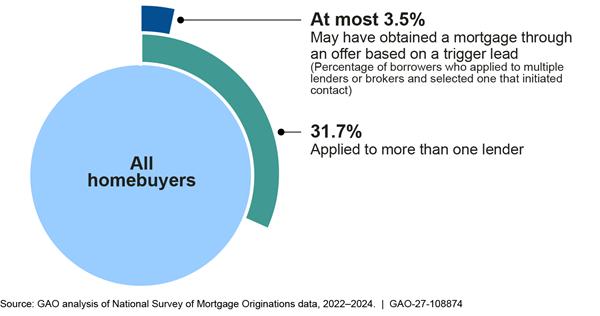
Note: Estimates presented in this figure are the upper bounds of 99 percent confidence intervals. The respective point estimates are 3.0 percent with margins of error of plus or minus 0.5 percent, and 30.3 percent with margins of error of plus or minus 1.4 percent.
Consumer advocates and mortgage industry stakeholders cited possible reasons for low homebuyer response to mortgage solicitations originating from trigger leads.
· One large lender we interviewed said these offers can come relatively late in the homebuying process, after a homebuyer has reached agreement on the sales price and closing date. The lender said switching lenders late in the process could delay mortgage closing dates and other time-sensitive events, such as moving from one home to another.
· Some lenders and consumer advocates we spoke with doubted whether trigger leads encouraged comparison shopping because homebuyers have other, potentially better alternatives for doing so prior to submitting a mortgage loan application, such as conducting their own online research.
Trigger Leads Previously Flooded Some Homebuyers with Mortgage Solicitations, Creating Confusion and Other Risks
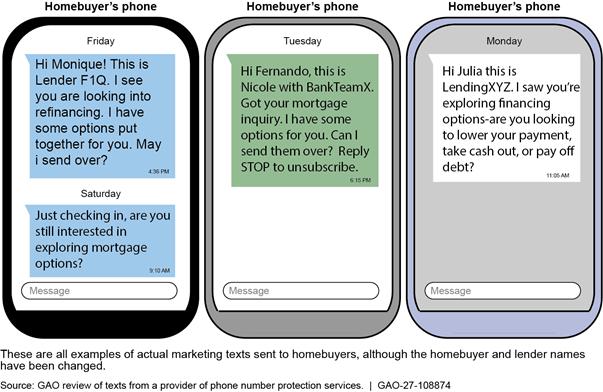
Prior to HPPA’s enactment, mortgage marketing based on trigger leads resulted in a high volume of unwanted communications that overwhelmed and annoyed some homebuyers, according to most of the industry, consumer-advocacy, and mortgage-lender stakeholders we spoke with. Many industry association representatives said homebuyers received marketing messages almost immediately after a lender requested a homebuyer’s credit report, with some saying a large number arrived within hours. Figure 3 provides examples of actual mortgage solicitation texts. Most industry, consumer advocacy, and state regulatory stakeholders we interviewed said they believed homebuyers find text marketing based on trigger leads to be at least as intrusive as phone calls or other marketing mediums, if not more, because texts are difficult to ignore.
|
Homebuyer Complaint About Mortgage Solicitations “I have received well over 100 calls and texts from mortgage companies after my credit was pulled by a mortgage lender and going forward, I will be reporting each one that violates my privacy through these texts.” Source: Consumer Financial Protection Bureau. | GAO‑27‑108874 |
The number of messages homebuyers received after applying for a mortgage loan could reach 30 or more, according to CFPB, and in some cases 100 or more, according to a mortgage lender. See sidebars for examples of complaints filed with CFPB (from Jan. 1, 2020, through March 5, 2026) that we identified using artificial intelligence—specifically, a large language model. In total, we identified more than 100 complaints that were likely to have been prompted by mortgage trigger leads.
All consumer advocacy groups and some industry associations we interviewed said homebuyers who receive a high volume of unwanted mortgage loan offers generally tune them all out. As a result, those unwanted offers generally do not help homebuyers comparison shop for mortgage loans.
|
Homebuyer Complaint About Mortgage Solicitations “I received a text message from a . . . [b]roker . . . about lowering my rates for [my] mortgage. . . . The message had a ‘STOP if you do not want any of these messages,’ . . . so I did that. After about 15 minutes I received another text followed by 54 calls . . . about . . . trying to lower my interest rates. . . . I have asked them to take me off their list to stop texting and they just keep coming.” Source: Consumer Financial Protection Bureau. | GAO‑27‑108874 |
In the CFPB complaints we reviewed, some homebuyers also expressed annoyance that mortgage marketers continued sending a high volume of solicitations even after being asked to stop.
Some industry, consumer advocacy, and federal regulator stakeholders also raised other concerns that mortgage solicitations based on trigger leads created for homebuyers:
|
Homebuyer Complaint About Mortgage Solicitations “I received an unsolicited text . . . claiming to offer a VA [mortgage product]. The message used high-pressure sales language . . . and . . . the sender did not identify themselves . . . or provide any verifiable contact information. As a . . . veteran and VA loan holder, [I am] concerned [about] this . . . predatory . . . attempt to solicit sensitive information under the guise of a federal benefit. I did not request . . . or authorize contact from this sender.” Source: Consumer Financial Protection Bureau. | GAO‑27‑108874 |
Misleading or deceptive messages. CFPB and many industry, consumer-advocacy, and mortgage-lender stakeholders we spoke to raised concerns that some trigger lead marketers misrepresented what they were offering. For example, CFPB officials said some loan officers may offer one mortgage loan rate in an initial message but not offer that rate once a homebuyer applies. Similarly, a lender said that some marketers advertised low mortgage rates for which a homebuyer may not actually qualify.
|
Homebuyer Complaint About Mortgage Solicitations “I . . . applied for a mortgage with a lender. . . . I began receiving text messages from [a different lender] . . . claiming I applied to them for a mortgage, and whether I would like to continue the process. I had no preexisting business with . . . and I had never applied to [a different lender]. The agent’s [claims] confused me and almost caused me to believe [the different lender] was the company affiliated with my lender.” Source: Consumer Financial Protection Bureau. | GAO‑27‑108874 |
Confusion about the source of messages. According to some industry associations and all lenders we spoke with, lenders or brokers using trigger leads at times misrepresented who they were to homebuyers. For example, they said some marketers impersonated the lender the homebuyer had originally used to apply for a loan.
|
Homebuyer Complaint About Mortgage Solicitations “Applying for a home loan. Once credit report was pulled, my personal contact information was sold to mortgage brokers. . . . I did not consent to having my information given away when doing a credit report.” Source: Consumer Financial Protection Bureau. | GAO‑27‑108874 |
Concerns about consumer and data privacy. The high volume of unsolicited marketing messages raised concerns among some homebuyers that their information had been sold without their consent, according to two industry associations and some homebuyers’ complaints filed with CFPB. In a 2025 letter in support of HPPA, the National Association of Attorneys General also stated that these unwanted solicitations infringed on consumer privacy. Homebuyers who received messages from lenders or brokers using mortgage trigger leads often did not know how marketers obtained their information, according to all industry associations and some lenders we interviewed. Some industry associations said that because the messages followed a lender’s credit check, homebuyers often assumed their lender had sold their data. Two lenders we spoke to said this harmed their reputation with homebuyers.
As previously mentioned, homebuyers can opt out of mortgage solicitations using OptOutPrescreen.com. However, many stakeholders said registration through this system can take several days to weeks to take effect, which could be too late to stop trigger lead solicitations that occur within hours to days after a lender requests a homebuyer’s credit report. To be effective, homebuyers would likely need to opt out in advance of applying for a mortgage loan.[17] Some stakeholders also said some homebuyers may be reluctant to use OptOutPrescreen.com because it requires entering personal information, such as a Social Security number.
HPPA May Reduce Drawbacks of Trigger Leads While Preserving Opportunities for Comparison Shopping
Because HPPA’s restrictions took effect in early March 2026—180 days after enactment—not enough time has passed to assess the effects of the act’s new restrictions. These restrictions limit the sale of residential mortgage trigger leads to lenders and brokers that have an existing relationship with the homebuyer or have obtained the homebuyer’s consent to receive solicitations. More time is needed before any changes would be reflected in complaint patterns or mortgage shopping data. However, early indications suggest that HPPA’s restrictions could reduce some of the drawbacks of trigger leads described above while preserving opportunities for homebuyers to comparison shop.
HPPA’s restrictions could reduce the volume of messages. HPPA’s limits on mortgage trigger leads could reduce the volume of mortgage solicitations and therefore address some associated homebuyer concerns. For example, some lenders that previously bought trigger leads to send unsolicited mortgage loan offers can no longer do so because they do not meet the new criteria for purchasing trigger leads. This could greatly reduce the volume of unsolicited loan offers, according to some industry stakeholders and a consumer advocacy group. However, some homebuyer concerns could persist. For example, lenders that have an existing relationship with a homebuyer can still receive trigger leads and send mortgage solicitations, which some consumers might still find annoying or confusing.
Trigger leads may preserve opportunities for comparison shopping. Because trigger leads may still be purchased under certain circumstances, they may continue to encourage homebuyers to consider more than one lender. For example, some industry stakeholders said homebuyers may be more receptive to marketing texts if they receive a much lower volume of solicitations. In addition, HPPA may preserve opportunities for comparison shopping because, as previously discussed, homebuyers have alternative ways to compare lenders and mortgage loans before applying. In addition, homebuyers have the option under FCRA to authorize a lender or broker to send solicitations based on mortgage trigger leads.
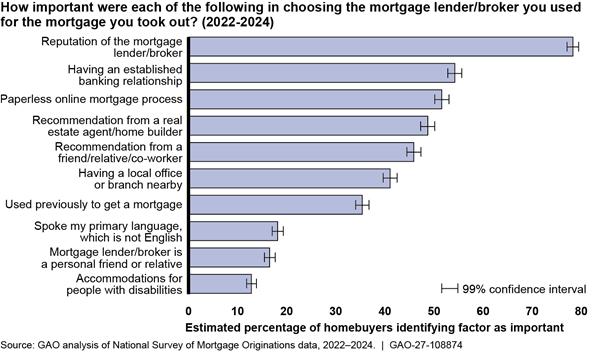
Homebuyers may now be more responsive to competing offers from known lenders. Some industry stakeholders noted that homebuyers may be more receptive to marketing texts from companies with which they have an existing relationship. Some industry participants told us that since HPPA’s enactment, some lenders have been using trigger leads as a tool for retaining existing customers. For example, some lenders or brokers now send lists of current customers to credit reporting agencies and pay the agencies to monitor and alert them when a customer applies for a new mortgage loan. National Survey of Mortgage Originations data for 2022–2024 show that homebuyers identified lender reputation and having an established banking relationship as important factors in selecting a lender (see fig. 4). These results suggest that homebuyers may be more responsive to competing offers from lenders they already know.
Figure 4: National Survey Estimates of Factors Homebuyers Identified as Important in Selecting a Mortgage Lender or Broker, 2022–2024
Agency Comments
We provided a draft of this report to CFPB and FTC for their review and comment. CFPB did not have any comments on the report. FTC provided technical comments, which we incorporated as appropriate.
We are sending copies of this report to the appropriate congressional committees, CFPB, and FTC. In addition, the report is available at no charge on the GAO website at http://www.gao.gov.
If you or your staff have any questions about this report, please contact me at ColvinW@gao.gov. Contact points for our Offices of Congressional Relations and Media Relations may be found on the last page of this report. GAO staff who made key contributions to this report are listed in appendix I.

William W. Colvin
Acting Director, Financial Markets and Community Investment
GAO Contact
William W. Colvin, ColvinW@gao.gov
Staff Acknowledgments
In addition to the contact named above, Patrick Ward (Assistant Director), Kun-Fang (K.F.) Lee (Analyst in Charge), Anna Blasco, Lauren Capitini, Jieun Chang, Daniel Kannell, Jill Lacey, Abinash Mohanty, Marc Molino, Yann Panassie, Samuel Portnow, and Jennifer Schwartz made key contributions to this report.
The Government Accountability Office, the audit, evaluation, and investigative arm of Congress, exists to support Congress in meeting its constitutional responsibilities and to help improve the performance and accountability of the federal government for the American people. GAO examines the use of public funds; evaluates federal programs and policies; and provides analyses, recommendations, and other assistance to help Congress make informed oversight, policy, and funding decisions. GAO’s commitment to good government is reflected in its core values of accountability, integrity, and reliability.
Obtaining Copies of GAO Reports and Testimony
The fastest and easiest way to obtain copies of GAO documents at no cost is through our website. Each weekday afternoon, GAO posts on its website newly released reports, testimony, and correspondence. You can also subscribe to GAO’s email updates to receive notification of newly posted products.
Order by Phone
The price of each GAO publication reflects GAO’s actual cost of production and distribution and depends on the number of pages in the publication and whether the publication is printed in color or black and white. Pricing and ordering information is posted on GAO’s website, https://www.gao.gov/ordering.htm.
Place orders by calling (202) 512-6000, toll free (866) 801-7077,
or
TDD (202) 512-2537.
Orders may be paid for using American Express, Discover Card, MasterCard, Visa, check, or money order. Call for additional information.
Connect with GAO
Connect with GAO on X,
LinkedIn, Instagram, and YouTube.
Subscribe to our Email Updates. Listen to our Podcasts.
Visit GAO on the web at https://www.gao.gov.
To Report Fraud, Waste, and Abuse in Federal Programs
Contact FraudNet:
Website: https://www.gao.gov/about/what-gao-does/fraudnet
Automated answering system: (800) 424-5454
Media Relations
Sarah Kaczmarek, Managing Director, Media@gao.gov
Congressional Relations
David A. Powner, Acting Managing Director, CongRel@gao.gov
General Inquiries
[1]In this report, we use the term “homebuyers” to include first-time and repeat homebuyers as well as borrowers applying to refinance an existing mortgage. We also use the term “credit reporting agency” to refer to “consumer reporting agencies” as defined under the Fair Credit Reporting Act, 15 U.S.C. § 1681a(f).
[2]In addition, other criteria need to be met before a consumer reporting agency can furnish such information. 15 U.S.C. § 1681b(c). A firm offer of credit is a loan offer that a creditor must honor if the consumer meets the criteria used by the creditor to select the consumer for the offer. 15 U.S.C. § 1681a(l). Although the Fair Credit Reporting Act, 15 U.S.C. § 1681b(c), permits a consumer reporting agency to furnish a homebuyer’s credit information to any “person” if the delineated criteria are met, for purposes of this report, we use the terms “lenders and brokers” instead of “person” given the scope of this report.
[3]Pub. L. No. 119-36, 139 Stat. 493 (2025) (to be codified at 15 U.S.C. §§ 1681b(c).
[4]The National Survey of Mortgage Originations is jointly funded and managed by the Federal Housing Finance Agency and the Consumer Financial Protection Bureau.
[5]In its May 2026 technical report, the National Survey of Mortgage Originations reported an overall response rate of 23.33 percent, with the most recent publicly available response rates (from survey waves 43–46) declining to 17.3 percent (see technical report, tables 4 and 6 on usable survey responses). While the survey applies nonresponse weighting to align respondent characteristics with the general population, we cannot definitively assess the effectiveness of this adjustment or the extent to which it accounts for all population differences without a nonresponse bias analysis. Also, we applied the weights provided with the survey data. We then verified our estimation procedures by recreating estimates provided by the Federal Housing Finance Agency. We calculated margins of error and 99 percent confidence intervals using Stata’s default logit transformation estimation method for proportions. Lastly, we present the margins of error as the maximum of two-sided margins of error.
[6]We used the date range of January 1, 2020, through March 5, 2026 (when we conducted our search). We also reviewed outputs to confirm that (1) complaints were indicative of stemming from a mortgage trigger lead, and (2) all identified complaints came directly from CFPB’s database.
[7]The consumer groups were the National Consumer Law Center and the Consumer Federation of America. The associations representing mortgage lenders and brokers were America’s Credit Unions, Independent Community Bankers of America, Mortgage Bankers Association, and National Association of Mortgage Brokers.
[8]Pub. L. No. 119-36, 139 Stat. 493 (2025) (codified at 15 U.S.C. § 1681b(c)).
[9]Pursuant to FCRA, CFPB has primary rulemaking authority over the consumer reporting agencies; however, FTC maintains some rulemaking authority over the consumer reporting agencies, including but not limited to the Disposal Rule under 15 U.S.C. § 1681w.
[10]2025 Ark. Acts 263, codified at Ark. Code Ann. § 23-39-513(18) (2026). Several other states have enacted similar laws or regulations, including Connecticut, Idaho, Iowa, Kansas, Kentucky, Maine, Rhode Island, Texas, Utah, Vermont, and Wisconsin. These laws do not ban the use of mortgage trigger leads but rather require that certain information be provided to consumers when a solicitation based on a mortgage trigger lead occurs. In contrast, Minnesota and New Jersey enacted legislation that attempted to ban the practice of making mortgage trigger leads available to lenders. However, in both cases, federal courts prevented the state laws from taking effect because such laws were preempted by FCRA, which permits mortgage trigger leads. 15 U.S.C. § 1681b(c)(1)(B), 15 U.S.C. 1681t(b)(1)(A). Consumer Data Industry Association v. Swanson, 2007 U.S. Dist. LEXIS 55571 (D. Minn. 2007)(enjoining Minn. Stat. § 13C.01, subdivision 3, which forbids the sale of mortgage trigger lead lists, from taking effect), Consumer Data Industry Association v. Milgram, No. 09-CV-01270 (MLC) (enjoining N.J. Stat Ann. § 46:10B-52, which prohibits credit reporting agencies from furnishing mortgage trigger leads to users of consumer reports, from taking effect).
[11]2025 Ga. Laws 240, codified at Ga. Code Ann. § 10-1-393.20(b) (2026).
[12]We characterize the information obtained through interviews and written responses from industry, consumer advocacy, and agency stakeholders with the following quantifiers: “some” refers to 1–3 stakeholders, “many” refers to 4–5 stakeholders, and “most” refers to 6 or more stakeholders.
[13]Alexei Alexandrov and Elizabeth Saunders, “Mortgage Data Shows That Borrowers Could Save $100 a Month (or More) by Choosing Cheaper Lenders,” Consumer Financial Protection Bureau, May 24, 2023, https://www.consumerfinance.gov/archive/blog/mortgage-data-shows-borrowers-could-save-100-month-choosing-cheaper-lenders/.
[14]“When Rates Are Higher, Borrowers Who Shop Around Save More,” Freddie Mac, February 16, 2023, https://www.freddiemac.com/research/insight/20230216-when-rates-are-higher-borrowers-who-shop-around-save.
[15]The 45.0 percent estimate has margins of error of plus or minus 1.4 percent at the 99 percent confidence level.
[16]Specifically, we estimate that at most, 31.7 percent of homebuyers applied to more than one lender, and that at most 3.5 percent additionally selected a lender that had initiated the first contact. These estimates reflect the upper bounds of 99 percent confidence intervals.
[17]Similarly, the National Do Not Call Registry depends on marketers actively checking for names in the registry, which some lenders or brokers may not do.