
Report to Congressional Committees
United States Government Accountability Office
A report to congressional committees
Contact: Jill Naamane at NaamaneJ@gao.gov
What GAO Found
The Department of Veterans Affairs’ (VA) Partial Claim Program is intended to help borrowers with VA-guaranteed loans avoid foreclosure. Under this new program, VA reimburses the loan servicer for a borrower’s missed payments and certain fees, allowing the borrower to become current on the loan. The borrower repays that amount—the partial claim—without interest when they sell or refinance the home, when they pay off the loan, or when the loan reaches maturity. The servicer collects the payment and sends it to VA.
How the VA Partial Claim Program Works
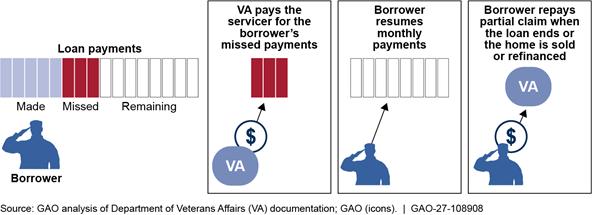
VA previously offered a temporary partial claim program to help borrowers affected by the COVID-19 pandemic and drew on that experience in implementing the new program. According to VA, under that program VA and servicers encountered documentation problems and difficulty tracking partial claim amounts. To address these issues, VA changed the program model and revised its application and payment processes. VA expects these changes to reduce administrative costs.
VA has taken steps to implement the Partial Claim Program. These include developing policies and processes, soliciting stakeholder feedback, hosting training, developing oversight policies, and modifying its data system. The program became effective on June 15, 2026, although servicers have until November 28, 2026, to finish implementing the program. VA officials said they intend to begin analyzing program trends and outcomes in December 2027.
VA has planned a high-level approach to assessing program effectiveness but has not developed a comprehensive plan to do so. For example, VA’s planned approach does not isolate the program’s effects on borrowers or consider program design questions. Without a comprehensive plan, VA and Congress will not have timely and credible evaluation results needed to make decisions about the program and identify changes that could improve outcomes for veteran borrowers, help prevent foreclosure, and reduce costs to taxpayers. Early planning is critical because the program is authorized for 5 years, ending July 30, 2030, and requires congressional reauthorization to continue. Early planning is also important to ensure VA collects the data needed for any evaluations.
Why GAO Did This Study
VA guarantees millions of home loans and bears financial risk when borrowers default and homes are foreclosed upon. In July 2025, the VA Home Loan Program Reform Act authorized VA to plan and administer the VA Partial Claim Program for 5 years.
The Continuing Appropriations Agriculture, Legislative Branch, Military Construction, and Veterans Affairs, and Extensions Act, 2026, requires GAO to report on the VA Partial Claim Program annually. This first report examines (1) how VA used lessons learned from previous loss mitigation programs to develop the Partial Claim Program and the steps VA has taken to implement it and (2) the extent to which VA followed key program evaluation practices.
GAO reviewed VA policies, processes, and plans related to the VA Partial Claim Program and assessed VA’s efforts against Office of Management and Budget program evaluation standards. GAO interviewed VA officials and representatives of 10 organizations, including lenders and servicers, trade associations, consumer advocacy organizations, and veteran advocacy organizations, selected because of their high loan volume or subject-matter expertise. GAO also analyzed VA data from January 2022 through June 2026 and Home Mortgage Disclosure Act data from 2022 through 2025 (the latest data available).
What GAO Recommends
GAO recommends that VA expeditiously develop a comprehensive plan for evaluating the effectiveness of the Partial Claim Program. VA did not provide comments on this report.
Abbreviations
COVID-VAPCP COVID-19 Veterans Assistance Partial Claim Payment program
VA Department of Veterans Affairs
VALERI VA Loan Electronic Reporting Interface
This is a work of the U.S. government and is not subject to copyright protection in the United States. The published product may be reproduced and distributed in its entirety without further permission from GAO. However, because this work may contain copyrighted images or other material, permission from the copyright holder may be necessary if you wish to reproduce this material separately.
November 10, 2026
The Honorable Jerry Moran
Chairman
The Honorable Richard Blumenthal
Ranking Member
Committee on Veterans’ Affairs
United States Senate
The Honorable Mike Bost
Chairman
The Honorable Mark Takano
Ranking Member
Committee on Veterans’ Affairs
House of Representatives
According to Department of Veterans Affairs (VA) data, over 9,000 homes with a VA-guaranteed loan were foreclosed upon in 2025.[1] VA offers several loss mitigation options—such as repayment plans, forbearances, and loan modifications—to help borrowers struggling to make payments keep their homes and avoid foreclosure. These options can also reduce the federal government’s costs associated with foreclosure.
In July 2025, the VA Home Loan Program Reform Act authorized VA to implement the VA Partial Claim Program for 5 years.[2] A partial claim is a loss mitigation option that allows borrowers who have missed mortgage payments to resume making payments without immediately paying the past-due amount. Instead, VA reimburses the servicer for that amount, and the borrower, through the servicer, repays VA when they sell or refinance the home, when they pay off the loan, or when the loan reaches maturity. Because a partial claim allows borrowers to keep their current interest rate, it can be particularly helpful during high-interest rate periods when other loss mitigation options may increase a borrower’s interest rate. The Congressional Budget Office estimated that the program would reduce foreclosures, lower VA’s default-related costs by $294 million, and result in a net decrease in direct spending of $170 million over the period 2025–2035.[3]
The Continuing Appropriations Act, 2026, includes a provision for us to annually report key data elements on the performance of the VA Partial Claim Program. It also includes a provision for us to assess and report on the program’s benefits and challenges no later than 1 year before it terminates.[4] This first annual report examines (1) how VA has used lessons learned from previous loss mitigation programs to develop the Partial Claim Program and the steps VA has taken to implement it, and (2) the extent to which VA followed key program evaluation practices in developing and implementing the program. Appendix I provides data on VA’s home loan programs and loss mitigation options.
To address our first objective, we reviewed VA’s policies, processes, and plans for the VA Partial Claim Program. We also interviewed VA officials about how lessons learned informed program design and implementation decisions.
To address our second objective, we reviewed VA documentation and interviewed VA officials about agency plans for evaluating the Partial Claim Program, and we assessed those plans against the Office of Management and Budget’s program evaluation standards and practices.[5]
To provide key data elements on the Partial Claim Program and VA’s home loan programs, we analyzed VA data from January 2022 through June 2026 on (1) the number of home loans VA made, guaranteed, and refinanced; (2) the number of loans with payments that were more than 60 or 90 days late; and (3) borrowers’ use of loss mitigation options. We also analyzed Home Mortgage Disclosure Act data from 2022 through 2025 (the latest data available) on the number of VA-guaranteed loan application denials. To assess the reliability of both data sources, we interviewed officials knowledgeable about the data, reviewed relevant documentation about how the data were collected and used, and conducted manual and electronic data testing. We determined the data were sufficiently reliable for use in the analyses described above.
For both objectives, we interviewed representatives from a nongeneralizable sample of 10 organizations to obtain their perspectives on VA’s implementation of the Partial Claim Program and its policies. These organizations included four lenders and servicers, two trade associations, two consumer advocacy organizations, and two veteran advocacy organizations. We selected the lenders and servicers from among the top 10 by VA loan volume. We judgmentally selected the other organizations because of their expertise in VA loans, partial claims, or loss mitigation. See appendix II for additional information about our scope and methodology.
We conducted this performance audit from January 2026 to November 2026 in accordance with generally accepted government auditing standards. Those standards require that we plan and perform the audit to obtain sufficient, appropriate evidence to provide a reasonable basis for our findings and conclusions based on our audit objectives. We believe that the evidence obtained provides a reasonable basis for our findings and conclusions based on our audit objectives.
Background
The VA Home Loan Guaranty program helps veterans and other eligible borrowers purchase, construct, or refinance a home.[6] The program typically guarantees at least 25 percent of a mortgage made by a private lender.[7] The guarantee reduces the lender’s risk by allowing it to recover a portion of its losses if the borrower defaults and the mortgage is foreclosed upon. This reduced risk can enable lenders to offer more favorable loan terms. Additionally, the program does not require borrowers to make a down payment or pay private mortgage insurance. In fiscal year 2025, VA’s portfolio of over 528,000 guaranteed loans had a total value of approximately $206 billion.
After a mortgage is originated, it must be serviced until the loan is paid off or the mortgage is foreclosed upon. Mortgage servicers manage the routine tasks associated with a mortgage, including sending monthly account statements, processing loan payments, responding to borrower inquiries, and forwarding loan payments to the loan holder.[8] The loan holder can be the lender that originated the mortgage or an institution that later purchased it. Servicers of VA-guaranteed loans must follow VA standards, including offering home-retention options and alternatives to foreclosure if a borrower experiences temporary financial hardship.
VA Loss Mitigation Options
VA offers various loss mitigation options for borrowers with VA-guaranteed loans that are in default or at risk of foreclosure. These fall into two categories: home retention and alternatives to foreclosure. If a borrower wants to keep the home, the servicer must first evaluate the borrower’s eligibility for home-retention options.[9] If these options are not successful or the borrower does not wish to keep the home, the servicer considers whether the borrower is eligible for alternatives to foreclosure.[10] Foreclosure is a last-resort option through which the loan servicer acquires the home and sells it to VA to recover amounts owed on the loan. VA must then pay the lender for the guaranteed portion of the loss.
By no later than November 28, 2026, servicers are required to fully implement VA’s loss mitigation options in the sequence shown in table 1.[11] Each option has its own eligibility criteria, and the sequence generally reflects how long borrowers have been behind on their payments.
|
Loss mitigation option |
Description |
Assistance type |
|
Special forbearance |
Borrower makes no payments or makes reduced payments for at least 1 month on a loan that is 61 or more calendar days delinquent. The borrower repays the sum of missed payments in a lump sum within a period agreed upon with the servicer. |
Home retention |
|
Repayment plan |
Borrower of a loan that is 61 or more calendar days delinquent makes the monthly mortgage payment plus additional amounts until the loan is current over a fixed period of at least 3 months. |
Home retention |
|
Traditional VA modificationa |
Borrower of a loan that is 61 or more calendar days delinquent receives a loan modification that re-amortizes the loan over its remaining term and keeps the monthly principal and interest payment the same or lower.b If the modification would result in an increase to the borrower’s monthly principal and interest payment, the servicer will evaluate the borrower for the 30-year modification. |
Home retention |
|
30-year modificationa |
Borrower of a loan that is 61 or more calendar days delinquent receives a loan modification that re-amortizes the loan over 360 months and keeps the monthly principal and interest payment the same or lower.b |
Home retention |
|
VA partial claima |
Borrower’s sum of missed payments (with at least 3 months delinquency) is moved to the end of the loan as a balloon payment, with no change to the monthly principal and interest payment.c |
Home retention |
|
40-year modificationa |
Borrower of a loan that is 3 months delinquent receives a loan modification that re-amortizes the loan over 480 months.b |
Home retention |
|
Short sale |
Borrower sells the home to a third party for an amount less than the borrower’s total eligible indebtedness on the loan. |
Alternative to foreclosure |
|
Deed-in-lieu |
Borrower voluntarily transfers the property to the servicer in exchange for a release from all obligations under the mortgage. |
Alternative to foreclosure |
Source: Department of Veterans Affairs (VA). | GAO‑27‑108908
aThis loss mitigation option requires successful completion of a 3-month Trial Payment Plan.
bUnder the traditional, 30-year, and 40-year modification options, a borrower’s interest rate can change. However, the new rate may not be more than 0.5 percentage points higher than the rates specified in the Freddie Mac Primary Mortgage Market Survey Rate for 30-year fixed rate conforming mortgages.
cA borrower’s interest rate does not change under the VA Partial Claim Program.
VA Partial Claim Programs
Under the Partial Claim Program, VA reimburses the servicer for a borrower’s missed payments and certain fees—which together constitute the partial claim—to help prevent or resolve default (see fig. 1).[12] Servicers are required to record the partial claim balance in a non-interest-bearing account attached to the VA-guaranteed loan. The borrower repays the partial claim without interest when they sell or refinance the home, when they pay off the loan, or when the loan reaches maturity. Borrowers can also make partial or full payments on a partial claim at any time without penalty. The servicer then remits the repayment to VA. Borrowers are generally not eligible if they have previously received a partial claim for their loan.[13]
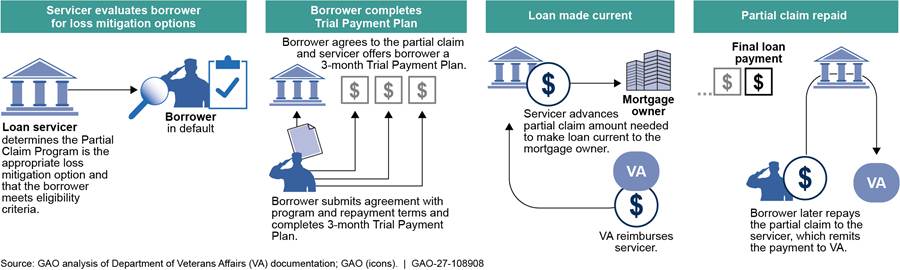
VA previously administered a temporary partial claim program during the COVID-19 pandemic. From July 2021 to October 2022, VA offered the COVID-19 Veterans Assistance Partial Claim Payment program (COVID-VAPCP) to help borrowers affected by the pandemic.[14] COVID-VAPCP functioned similarly to the Partial Claim Program in that VA purchased the amount of a borrower’s missed payments from the servicer to help resolve or prevent default.
Although COVID-VAPCP provided the same type of assistance as the Partial Claim Program, the programs differed in key ways. For example, VA did not require borrowers to complete a 3-month Trial Payment Plan. Instead, borrowers had to indicate they could resume making scheduled monthly payments on time and in full.
Borrowers also had to submit a signed collateral document that included the amount the borrower owed VA and the partial claim repayment terms. According to VA officials, VA hired a contractor to set up and service the loan, and the contractor needed this document before it could begin that process.
VA Used Lessons Learned from Prior Programs to Develop the Partial Claim Program and Is Implementing It in Phases
VA Drew on Its Experience with COVID-VAPCP in Implementing the Partial Claim Program
In implementing the Partial Claim Program, VA chose a different administrative model from the one used for COVID-VAPCP.[15] Under the new model, servicers are responsible for key aspects of the process, including managing program documentation, advancing the partial claim amount, and collecting payments from borrowers. VA chose this model to address three challenges experienced under COVID-VAPCP:
· Documentation issues. According to VA officials, under COVID-VAPCP, the partial claim agreement was between VA and the borrower, so VA had to collect collateral documents from the servicers and transfer them to its contractor. Officials said that 70 percent of these documents contained errors, requiring borrowers to correct and re-sign them. For example, some were addressed to the Secretary of Housing and Urban Development rather than the Secretary of Veterans Affairs, while others contained incorrect partial claim balances or VA loan identification numbers. In addition, VA tried to automate the document transfer process, which required servicers to use a specific document and label. However, servicers often used incorrect documents and labels, which required the servicer to make corrections.
Under the Partial Claim Program, servicers manage the documentation process, including collecting and submitting the documents VA needs to approve the partial claims.
· Tracking partial claim balances. According to VA officials, servicers did not record COVID-VAPCP partial claim balances in a timely manner. This led to issues tracking and collecting COVID-VAPCP partial claim payments. For example, if a borrower sold their home before the servicer recorded the partial claim balance, the balance would not have been included in the loan payoff amount.
Under the Partial Claim Program, servicers are required to create an account for the partial claim balance and link it to the borrower’s loan. This helps servicers easily track the balance. They are also required to include the outstanding partial claim balance on the borrower’s monthly mortgage and payoff statements.
· Contractor costs. Under COVID-VAPCP, VA hired a contractor to set up and service the loans. Under the Partial Claim Program, VA will no longer collect collateral documents for contractors to create a record of the partial claim for servicing. Instead, servicers can track the partial claims and will be responsible for servicing the loans, so VA no longer needs to hire a contractor for these functions. According to VA estimates, VA incurred approximately $139 million in contracting costs under COVID-VAPCP.[16]
VA also applied lessons from COVID-VAPCP and another previous loss mitigation program to three Partial Claim Program policies and processes:
· Automating borrower eligibility reviews. For the VA Partial Claim Program, VA updated its systems to automatically determine borrower eligibility and provide servicers with reasons for application denials. VA officials said they expected that the new system updates would reduce problems during the eligibility review process.
According to VA officials, VA loan technicians manually reviewed applications under COVID-VAPCP and frequently found that borrowers were not eligible. The technicians were responsible for communicating eligibility decisions to servicers. Representatives of one trade association we interviewed said the manual reviews led to delays. Additionally, representatives of the other trade association we interviewed said VA technicians provided servicers with reasons for denying applications that seemed arbitrary.
· Limiting initial application submissions. VA officials said they will review a sample of 10 Partial Claim Program applications from each servicer to identify common mistakes and share the results with the servicer. Officials said VA loan technicians found recurring issues while reviewing COVID-VAPCP applications and documentation. VA learned that reviewing an initial sample of applications from each servicer helps servicers avoid common mistakes on later submissions and increases the likelihood that submissions will be ready for processing. VA followed this process for the Veterans Affairs Servicing Purchase program, which had a lower application defect rate.[17] VA officials said they expect this policy will reduce application- and documentation-related problems.
· Revising the servicer reimbursement process. According to VA officials, VA applied changes it made during the Veterans Affairs Servicing Purchase program to the Partial Claim Program payment process. VA initially made these modifications because aspects of the COVID-VAPCP payment process frequently resulted in delays and denials. For example, VA manually verified servicers’ reimbursement requests but often needed additional information and documentation to confirm the requested amounts, delaying payment processing.
VA learned through the Veterans Affairs Servicing Purchase program that requiring servicers to submit supporting documentation with their reimbursement requests eliminated the need for manual verification and reduced payment delays. VA officials said they expect this process to reduce payment delays under the Partial Claim Program as well.
VA Is Implementing the Partial Claim Program in Phases
VA officials are implementing the Partial Claim Program in phases (see fig. 2). Officials said this approach allows VA to offer the program to borrowers sooner than if it waited to complete all implementation steps before launch.
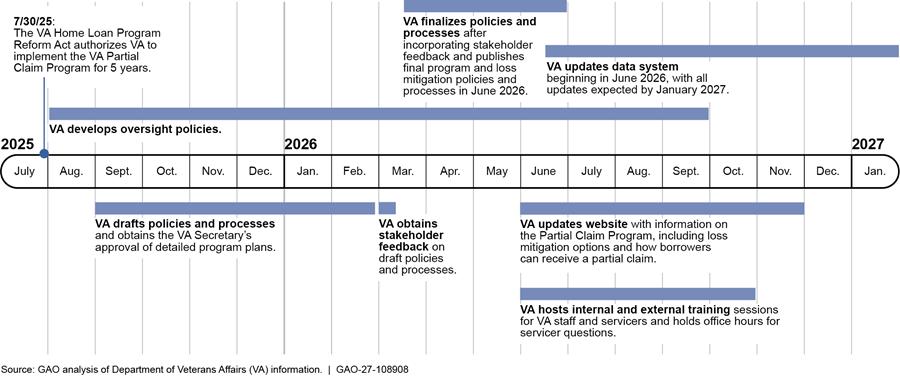
As of August 2026, VA had completed or initiated the following implementation steps:
· Obtaining stakeholder feedback. In early March 2026, VA obtained stakeholder feedback on its draft policies and processes through a VA web page and received over 850 comments from 37 organizations. This was VA’s first time using this process. Representatives of two trade associations, four lenders and servicers, two consumer advocacy groups, and one veteran advocacy organization we interviewed said they submitted comments and generally described the experience positively. However, among those organizations, about half noted that the abbreviated comment period made it challenging to provide feedback.
Most of the feedback received concerned documentation. For example, stakeholders expressed concerns that language in VA’s draft policies and processes regarding the attestation document could have made the servicer responsible for enforcing the borrower’s legal and financial responsibilities to VA. In response, VA updated its final policies and processes and modified the attestation document language to specify the law governing those obligations.
VA also plans to hold informal discussions with VA loan stakeholders throughout the implementation of the Partial Claim Program.
· Publishing final policies and processes. VA published final policies and processes on June 1, 2026, and the program became effective on June 15, 2026. However, servicers have until November 28, 2026, to start offering partial claims to give them time to become familiar with VA’s new processes and work with vendors to update their systems as needed.
· Developing oversight policies. According to VA officials, VA established an oversight team in August 2025 following the enactment of the VA Home Loan Program Reform Act and planned to complete its oversight policies and processes for the Partial Claim Program in September 2026.[18] For example, VA will select a sample of partial claims for post-audit review 90 days after certifying payment. Officials also said they plan to review program data and conduct internal control assessments to identify potential issues.
· Hosting internal and external training sessions. VA started hosting Partial Claim Program training sessions for VA staff and servicers in June 2026. These sessions included an overview of the program, key implementation dates, information on how the new program model functions, and servicers’ reporting requirements. VA also held office hours where servicers could ask questions. VA officials said they will offer training sessions on the payment and post-audit processes at a later date.
According to representatives of one trade association and two servicers we interviewed, under COVID-VAPCP, VA loan technicians often provided inconsistent program guidance to servicers and borrowers. Representatives of one servicer said the inconsistent guidance required servicers to escalate their issues with different VA staff and created inequitable borrower experiences. VA officials said they will provide loan technicians with a script and a frequently-asked-questions document to promote consistent responses under the new program.
· Updating the website. VA updated its website in June 2026 to include information on the Partial Claim Program. For example, VA added information explaining what a partial claim is and how borrowers may qualify for one. VA officials also said they plan to update a video explaining what borrowers should do if they have difficulty making their monthly payments to include information on the Partial Claim Program. They expect to make this update once all servicers are required to finish implementing the Partial Claim Program on November 28, 2026.
· Updating the data system. Full implementation of the Partial Claim Program depends on completing the remaining data-system updates. VA completed the first set of updates in June 2026 and expects to make the remaining updates by January 2027. According to VA officials, the updates allowed servicers to submit Trial Payment Plan information. The remaining updates will enable VA to process servicer reimbursements and conduct post-audit reviews. Officials said launching the program before all data-system updates were complete allowed VA to make it available several months earlier.
VA’s Planned Approach to Assessing Program Effectiveness Is Not Comprehensive
VA documented high-level plans to evaluate the Partial Claim Program, but its planned approach will likely not position the agency to fully assess its effectiveness. VA’s approach relies on individual measures that do not provide the context needed to isolate the program’s effects from other factors that could affect borrower outcomes, and it does not address questions about program design that should be considered to comprehensively evaluate the program’s effectiveness.
Specifically, VA officials have identified several metrics they intend to use to analyze the Partial Claim Program. Officials told us they plan to analyze
· the number of partial claims approved and denied,
· the number of borrowers who successfully complete a Trial Payment Plan,[19]
· the 6-, 12-, 18-, and 24-month redefault rates for borrowers who receive a partial claim,
· the number of successful partial claim repayments compared with COVID-VAPCP repayments, and
· the extent to which partial claims affect borrowers’ ability to refinance their loans at a later date.
Officials also plan to assess the collective effectiveness of VA’s loss mitigation options using its default resolution rate, which measures the percentage of loans that are at least 61 days delinquent that later become current.[20]
These metrics may provide useful information, but they have limitations. For example, redefault rates may need to be interpreted in light of differences among the borrower populations served by the various loss mitigation options. Similarly, VA’s default resolution rate measures the collective performance of all loss mitigation options and without isolating the effectiveness of the Partial Claim Program. The default resolution rate also may overstate the performance of VA’s loss mitigation options because it includes loans for which delinquencies resolve on their own, without loss mitigation intervention.
In addition, VA plans to gather feedback from external stakeholders on the program’s implementation, but not on important questions about whether changes to the program’s design would increase its effectiveness. For example, the statute authorizing the program generally limits borrowers to one partial claim per loan. However, other federal home loan programs permit borrowers to receive multiple partial claims, subject to a maximum allowable amount. Representatives of eight of the 10 organizations we interviewed said this difference may put VA borrowers at a disadvantage compared with borrowers in other federal home loan programs.[21] For example, representatives of one consumer advocacy group we interviewed said allowing multiple partial claims can reduce foreclosure rates. Additionally, representatives of one servicer we interviewed said borrowers may not need the full claim amount up to the maximum percentage cap, so allowing multiple partial claims can be helpful when a borrower faces hardships in the future. The remaining amount could be used in a future partial claim, which could help the borrower avoid foreclosure.
Another design difference between the Partial Claim Program and other federal programs is that VA does not offer borrowers an option to combine a loan modification with a partial claim to reduce their monthly payment. Representatives of six of the 10 stakeholders we interviewed said this option would be helpful to VA borrowers.[22] For example, according to a servicer we interviewed, loan modifications alone may not lower a borrower’s payment when interest rates are high and may instead lead to a payment increase because the borrower’s rate is likely lower than current market rates. According to VA officials, the VA Home Loan Program Reform Act does not provide VA with the authority to generally offer multiple partial claims or a combination of a partial claim and a loan modification. However, this would not preclude VA from gathering feedback on the program design and evaluating whether changes could be beneficial to borrowers and communicating those findings to Congress for consideration.
Office of Management and Budget guidance defines program evaluation as the systematic collection and analysis of information to assess program effectiveness and efficiency.[23] The guidance notes that agencies should develop a detailed plan describing an evaluation’s proposed design, methods, and reporting.[24]
The metrics and high-level approach VA has identified to evaluate the Partial Claim Program are not sufficient on their own to evaluate effectiveness and do not constitute a comprehensive plan. A comprehensive evaluation plan would identify how VA will use these metrics and what methods VA will use to assess program effectiveness. For example, a comprehensive evaluation plan would identify the methodologies VA could use to isolate the Partial Claim Program from other factors that could affect borrower and program outcomes, which would help VA better understand the effects of the program.
In addition, in planning a comprehensive evaluation, VA may determine that it does not have all the information it needs to fully evaluate the program. VA’s current plan includes analyzing data maintained by the Loan Guaranty Service. However, the Loan Guaranty Service does not maintain historical data on borrower characteristics that could help VA better understand who is benefiting from the program. A comprehensive plan could also identify how VA could use other agency resources for its analysis. For example, VA’s Office of Performance Analysis and Integrity maintains data on borrower characteristics and could be consulted about using these data. Identifying data gaps early would allow VA to plan for collecting the necessary data, helping to ensure that it can conduct complete and timely analysis.
In June 2026, VA officials said they planned to begin analyzing trends and outcomes of the Partial Claim Program in December 2027. They explained that VA had not prioritized developing an evaluation plan because servicers may not yet have begun offering borrowers partial claims, and because VA did not yet have sufficient program data to assess results.[25] They also noted that they prioritized rolling out the VA Partial Claim Program in phases so borrowers could access it sooner. However, the absence of sufficient data to conduct an evaluation does not prevent VA from planning one in advance.
The development of a comprehensive evaluation plan would help VA ensure that its approach to evaluating the effectiveness of the Partial Claim Program will provide the agency and Congress all the information needed to determine if the Partial Claim Program is achieving its goals or if changes are warranted. Without such a plan, VA and Congress will not have timely and credible evaluation results needed to decide if improvements to the program would better assist veteran borrowers, reduce foreclosures, and reduce costs to taxpayers. Early planning is particularly important because the program is authorized for a 5-year period ending July 30, 2030, and requires congressional reauthorization to continue.
Conclusions
VA’s loss mitigation options play an important role in helping borrowers remain in their homes and avoid foreclosure. The VA Partial Claim Program provides veterans and other eligible borrowers experiencing financial hardship with an additional option. However, VA’s planned approach to evaluating the program relies on individual measures that do not provide sufficient context to help VA fully understand how effective the program is or consider program design questions. Developing a comprehensive evaluation plan at this stage in the program’s implementation is critical, as more than 1 year has already passed since the 5-year program was enacted. A comprehensive evaluation plan would better position VA to produce timely and credible evaluation results to inform decisions about the program and identify changes to better assist veteran borrowers, prevent foreclosures, and reduce taxpayers’ costs.
Recommendation for Executive Action
The Secretary of Veterans Affairs should expeditiously develop a comprehensive plan for evaluating the effectiveness of the Partial Claim Program. The plan should identify the methods VA will use to isolate the Partial Claim Program from other factors that could affect borrower and program outcomes, key data it will collect, and how it will use information to determine whether changes to the program would increase its effectiveness. (Recommendation 1)
Agency Comments
We provided a draft of this report to VA for review and comment. VA did not provide comments on the report.
We are sending copies to the appropriate congressional committees, the Secretary of Veterans Affairs, and other interested parties. In addition, the report will be available at no charge on the GAO website at http://www.gao.gov.
If you or your staff have any questions about this report, please contact me at NaamaneJ@gao.gov. Contact points for our Offices of Congressional Relations and Media Relations may be found on the last page of this report. GAO staff who made key contributions to this report are listed in appendix III.

Jill Naamane
Director, Financial Markets and Community Investment
Appendix I: Borrower Participation in VA’s Guaranteed and Direct Loan Programs and Use of Loss Mitigation
This appendix presents summary data on the Department of Veterans Affairs’ (VA) guaranteed and direct loan programs. VA-guaranteed loans include purchase loans, Interest Rate Reduction Refinance Loans, and cash-out refinance loans.[26] VA’s direct loan programs include the Native American Direct Loan and Vendee Loan programs.[27] Specifically, we present
· the number of loans originated and active,
· the number of loan applications that lenders have denied,
· the number of loans that were 2 or more months delinquent,
· the number of loss mitigation options used by borrowers, and
· the number of completed foreclosures.
VA-Guaranteed Loans
Tables 2 through 6 provide information on VA-guaranteed loans.
|
|
Purchase loans originated |
Interest Rate Reduction Refinance Loans originated |
Cash-out refinance loans originated |
Total loans originated |
Total active loans |
|
CY 2022 |
|
|
|
|
|
|
Q1 |
92,631 |
40,006 |
64,793 |
197,430 |
3,620,998 |
|
Q2 |
103,882 |
4,581 |
47,915 |
156,378 |
3,637,799 |
|
Q3 |
102,968 |
285 |
32,470 |
135,723 |
3,660,557 |
|
Q4 |
81,194 |
323 |
23,210 |
104,727 |
3,787,579 |
|
CY 2023 |
|
|
|
|
|
|
Q1 |
70,063 |
806 |
17,060 |
87,929 |
3,716,231 |
|
Q2 |
82,603 |
1,848 |
17,263 |
101,714 |
3,735,318 |
|
Q3 |
86,411 |
2,023 |
17,887 |
106,321 |
3,762,711 |
|
Q4 |
68,390 |
1,033 |
15,477 |
84,900 |
3,883,801 |
|
CY 2024 |
|
|
|
|
|
|
Q1 |
63,874 |
14,009 |
15,329 |
93,212 |
3,808,677 |
|
Q2 |
81,873 |
9,463 |
17,909 |
109,245 |
3,834,976 |
|
Q3 |
84,191 |
26,320 |
18,506 |
129,017 |
3,854,626 |
|
Q4 |
74,095 |
49,133 |
21,589 |
144,817 |
3,980,204 |
|
CY 2025 |
|
|
|
|
|
|
Q1 |
70,829 |
22,836 |
20,923 |
114,588 |
3,905,702 |
|
Q2 |
85,669 |
29,179 |
20,381 |
135,229 |
3,928,364 |
|
Q3 |
93,239 |
18,307 |
22,158 |
133,704 |
3,952,325 |
|
Q4 |
80,195 |
66,569 |
24,137 |
170,901 |
3,994,215 |
|
CY 2026 |
|
|
|
|
|
|
Q1 |
70,381 |
63,644 |
23,074 |
157,099 |
4,008,339 |
|
Q2 |
93,234 |
56,386 |
24,891 |
174,511 |
4,051,533 |
CY = calendar year Q = quarter
Source: Department of Veterans Affairs (VA) Loan Electronic Reporting Interface data. | GAO‑27‑108908
|
|
Purchase loan denials |
Interest Rate Reduction Refinance Loan denials |
Cash-out refinance loan denials |
Total denials |
|
CY 2022 |
38,538 |
13,529 |
77,839 |
129,906 |
|
CY 2023 |
32,170 |
3,975 |
41,419 |
77,564 |
|
CY 2024 |
29,377 |
15,562 |
48,393 |
93,332 |
|
CY 2025 |
30,421 |
26,322 |
57,036 |
113,779 |
CY = calendar year VA = Department of Veterans Affairs
Source: Consumer Financial Protection Bureau, Home Mortgage Disclosure Act data. | GAO‑27‑108908
Note: Denial data may include multiple application denials and resubmissions from the same applicant. Applications may be denied for reasons including debt-to-income ratio, employment history, credit history, or an incomplete application.
|
|
2 months delinquenta |
3 or more months delinquent |
Total delinquent loans |
|
CY 2022 |
|
|
|
|
Q1 |
6,006 |
119,977 |
125,983 |
|
Q2 |
6,881 |
101,226 |
108,107 |
|
Q3 |
8,154 |
91,218 |
99,372 |
|
Q4 |
7,451 |
91,863 |
99,314 |
|
CY 2023 |
|
|
|
|
Q1 |
8,832 |
86,323 |
95,155 |
|
Q2 |
7,552 |
78,649 |
86,201 |
|
Q3 |
9,864 |
75,430 |
85,294 |
|
Q4 |
8,591 |
75,194 |
83,785 |
|
CY 2024 |
|
|
|
|
Q1 |
10,654 |
76,091 |
86,745 |
|
Q2 |
8,658 |
79,524 |
88,182 |
|
Q3 |
11,196 |
89,637 |
100,833 |
|
Q4 |
8,258 |
98,947 |
107,205 |
|
CY 2025 |
|
|
|
|
Q1 |
9,625 |
92,133 |
101,758 |
|
Q2 |
7,920 |
88,045 |
95,965 |
|
Q3 |
10,735 |
84,236 |
94,971 |
|
Q4 |
8,096 |
90,753 |
98,849 |
|
CY 2026 |
|
|
|
|
Q1 |
10,238 |
88,972 |
99,210 |
|
Q2 |
7,857 |
87,425 |
95,282 |
CY = calendar year Q = quarter
Source: Department of Veterans Affairs (VA) Loan Electronic Reporting Interface (VALERI) data. | GAO‑27‑108908
Note: Loans in foreclosure are included in the delinquent-loan counts.
aServicers report defaults to VA using VALERI’s Electronic Default Notification once a loan is 61 days delinquent. For the purposes of this report, 61 days delinquent is equivalent to 2 months of missed payments.
Table 5: Loss Mitigation Options Used by Borrowers for VA-Guaranteed Loans, Q1 CY 2022 Through Q2 CY 2026
|
|
Special forbearance |
Repayment plan |
Loan modificationa |
Total |
|
CY 2022 |
|
|
|
|
|
Q1 |
13,963 |
436 |
7,685 |
22,084 |
|
Q2 |
8,113 |
478 |
5,801 |
14,392 |
|
Q3 |
10,054 |
783 |
2,247 |
13,084 |
|
Q4 |
10,185 |
2,149 |
3,207 |
15,541 |
|
CY 2023 |
|
|
|
|
|
Q1 |
8,739 |
1,859 |
1,907 |
12,505 |
|
Q2 |
5,732 |
2,308 |
2,521 |
10,561 |
|
Q3 |
5,653 |
3,017 |
2,163 |
10,833 |
|
Q4 |
1,911 |
2,582 |
1,539 |
6,032 |
|
CY 2024 |
|
|
|
|
|
Q1 |
2,401 |
3,172 |
1,543 |
7,116 |
|
Q2 |
2,282 |
2,929 |
1,182 |
6,393 |
|
Q3 |
5,565 |
3,869 |
953 |
10,387 |
|
Q4 |
5,350 |
3,516 |
962 |
9,828 |
|
CY 2025 |
|
|
|
|
|
Q1 |
3,923 |
3,585 |
1,188 |
8,696 |
|
Q2 |
4,040 |
2,799 |
2,023 |
8,862 |
|
Q3 |
4,043 |
3,578 |
2,467 |
10,088 |
|
Q4 |
5,598 |
3,106 |
2,759 |
11,463 |
|
CY 2026 |
|
|
|
|
|
Q1 |
4,354 |
2,942 |
2,934 |
10,230 |
|
Q2 |
4,516 |
2,390 |
3,522 |
10,428 |
CY = calendar year Q = quarter
Source: Department of Veterans Affairs (VA) Loan Electronic Reporting Interface (VALERI) data. | GAO‑27‑108908
aAccording to VA officials, VALERI cannot provide summary loan modification data by modification type, including traditional, 30-year, 40-year modifications.
|
|
Foreclosures completed |
|
CY 2022 |
|
|
Q1 |
1,502 |
|
Q2 |
1,790 |
|
Q3 |
2,132 |
|
Q4 |
2,248 |
|
CY 2023 |
|
|
Q1 |
2,476 |
|
Q2 |
2,373 |
|
Q3 |
2,383 |
|
Q4 |
1,705 |
|
CY 2024 |
|
|
Q1 |
750 |
|
Q2 |
732 |
|
Q3 |
741 |
|
Q4 |
732 |
|
CY 2025 |
|
|
Q1 |
1,420 |
|
Q2 |
3,390 |
|
Q3 |
3,673 |
|
Q4 |
3,654 |
|
CY 2026 |
|
|
Q1 |
3,633 |
|
Q2 |
3,575 |
CY = calendar year Q = quarter
Source: Department of Veterans Affairs (VA) Loan Electronic Reporting Interface data. | GAO‑27‑108908
VA Direct Loans
Tables 7 through 11 provide information on VA direct loans.
|
|
Native American Direct Loans |
Vendee Loansa |
|||
|
|
Originated |
Refinanced |
Activeb |
Originated |
Active |
|
CY 2022 |
|
|
|
|
|
|
Q1 |
4 |
n/a |
521 |
3 |
1,273 |
|
Q2 |
3 |
n/a |
530 |
5 |
1,218 |
|
Q3 |
5 |
n/a |
523 |
8 |
1,178 |
|
Q4 |
6 |
n/a |
520 |
4 |
1,154 |
|
CY 2023 |
|
|
|
|
|
|
Q1 |
5 |
n/a |
523 |
7 |
1,152 |
|
Q2 |
9 |
n/a |
523 |
9 |
1,143 |
|
Q3 |
10 |
14 |
524 |
9 |
1,138 |
|
Q4 |
19 |
12 |
527 |
20 |
1,147 |
|
CY 2024 |
|
|
|
|
|
|
Q1 |
14 |
2 |
528 |
17 |
1,150 |
|
Q2 |
6 |
1 |
528 |
15 |
1,149 |
|
Q3 |
9 |
0 |
530 |
3 |
1,137 |
|
Q4 |
13 |
0 |
534 |
8 |
1,121 |
|
CY 2025 |
|
|
|
|
|
|
Q1 |
6 |
0 |
539 |
5 |
1,106 |
|
Q2 |
10 |
2 |
540 |
8 |
1,098 |
|
Q3 |
9 |
1 |
548 |
7 |
1,093 |
|
Q4 |
12 |
0 |
553 |
8 |
1,082 |
|
CY 2026 |
|
|
|
|
|
|
Q1 |
2 |
0 |
551 |
11 |
1,069 |
|
Q2 |
3 |
0 |
553 |
14 |
1,071 |
CY = calendar year Q = quarter n/a = data not available due to VA data system transition
Source: Department of Veterans Affairs (VA) ServiceNow and VA contractor data. | GAO‑27‑108908
aVA does not refinance Vendee Loans.
bNative American Direct Loan active loan counts do not include refinanced loans.
|
|
Native American Direct Loan denials |
Vendee Loan denials |
|
CY 2022 |
|
|
|
Q1 |
n/a |
10 |
|
Q2 |
n/a |
3 |
|
Q3 |
n/a |
16 |
|
Q4 |
n/a |
13 |
|
CY 2023 |
|
|
|
Q1 |
n/a |
20 |
|
Q2 |
n/a |
21 |
|
Q3 |
1 |
13 |
|
Q4 |
1 |
43 |
|
CY 2024 |
|
|
|
Q1 |
6 |
39 |
|
Q2 |
7 |
9 |
|
Q3 |
5 |
11 |
|
Q4 |
5 |
13 |
|
CY 2025 |
|
|
|
Q1 |
16 |
5 |
|
Q2 |
9 |
11 |
|
Q3 |
3 |
12 |
|
Q4 |
1 |
1 |
|
CY 2026 |
|
|
|
Q1 |
0 |
5 |
|
Q2 |
1 |
13 |
CY = calendar year Q = quarter n/a = data not available due to VA data system transition
Source: Department of Veterans Affairs (VA) ServiceNow and VA contractor data. | GAO‑27‑108908
|
|
Native American Direct Loans |
Vendee Loans |
||||
|
|
2 months delinquent |
3 or more months delinquent |
Total delinquent |
2 months delinquent |
3 or more months delinquent |
Total delinquent |
|
CY 2022 |
|
|
|
|
|
|
|
Q1 |
5 |
99 |
104 |
8 |
49 |
57 |
|
Q2 |
11 |
95 |
106 |
8 |
36 |
44 |
|
Q3 |
7 |
90 |
97 |
2 |
31 |
33 |
|
Q4 |
9 |
88 |
97 |
7 |
20 |
27 |
|
CY 2023 |
|
|
|
|
|
|
|
Q1 |
8 |
96 |
104 |
18 |
19 |
37 |
|
Q2 |
7 |
90 |
97 |
3 |
23 |
26 |
|
Q3 |
8 |
92 |
100 |
6 |
21 |
27 |
|
Q4 |
10 |
98 |
108 |
4 |
15 |
19 |
|
CY 2024 |
|
|
|
|
|
|
|
Q1 |
6 |
98 |
104 |
6 |
11 |
17 |
|
Q2 |
6 |
99 |
105 |
7 |
13 |
20 |
|
Q3 |
9 |
105 |
104 |
5 |
16 |
21 |
|
Q4 |
11 |
108 |
119 |
7 |
16 |
23 |
|
CY 2025 |
|
|
|
|
|
|
|
Q1 |
10 |
115 |
125 |
11 |
22 |
33 |
|
Q2 |
7 |
110 |
117 |
5 |
22 |
27 |
|
Q3 |
4 |
113 |
117 |
4 |
19 |
23 |
|
Q4 |
11 |
116 |
127 |
6 |
15 |
21 |
|
CY 2026 |
|
|
|
|
|
|
|
Q1 |
7 |
118 |
125 |
8 |
12 |
20 |
|
Q2 |
6 |
121 |
127 |
5 |
17 |
22 |
CY = calendar year Q = quarter
Source: Department of Veterans Affairs (VA) ServiceNow and VA contractor data. | GAO‑27‑108908
|
|
Native American Direct Loans |
Vendee Loans |
|||||
|
|
Traditional modification |
30-year modification |
Special forbearance |
Repayment plan |
Traditional modification |
30-year modification |
40-year modification |
|
CY 2022 |
|
|
|
|
|
|
|
|
Q1 |
0 |
3 |
0 |
0 |
1 |
0 |
0 |
|
Q2 |
0 |
5 |
0 |
0 |
1 |
1 |
0 |
|
Q3 |
0 |
3 |
0 |
0 |
0 |
0 |
0 |
|
Q4 |
0 |
0 |
0 |
0 |
1 |
2 |
0 |
|
CY 2023 |
|
|
|
|
|
|
|
|
Q1 |
0 |
0 |
0 |
0 |
0 |
0 |
1 |
|
Q2 |
0 |
1 |
0 |
0 |
0 |
0 |
0 |
|
Q3 |
0 |
0 |
0 |
0 |
0 |
0 |
1 |
|
Q4 |
0 |
0 |
0 |
0 |
0 |
0 |
1 |
|
CY 2024 |
|
|
|
|
|
|
|
|
Q1 |
0 |
2 |
0 |
0 |
0 |
0 |
0 |
|
Q2 |
0 |
2 |
0 |
0 |
0 |
0 |
0 |
|
Q3 |
0 |
1 |
0 |
0 |
0 |
0 |
0 |
|
Q4 |
0 |
0 |
0 |
0 |
0 |
0 |
0 |
|
CY 2025 |
|
|
|
|
|
|
|
|
Q1 |
0 |
0 |
0 |
0 |
0 |
0 |
0 |
|
Q2 |
0 |
1 |
0 |
0 |
0 |
0 |
0 |
|
Q3 |
0 |
0 |
0 |
0 |
2 |
0 |
0 |
|
Q4 |
0 |
0 |
0 |
0 |
1 |
0 |
0 |
|
CY 2026 |
|
|
|
|
|
|
|
|
Q1 |
0 |
3 |
0 |
0 |
0 |
0 |
0 |
|
Q2 |
0 |
0 |
0 |
0 |
0 |
0 |
0 |
CY = calendar year Q = quarter
Source: Department of Veterans Affairs (VA) ServiceNow and VA Contractor data. | GAO‑27‑108908
Note: According to VA officials, Native American Direct Loans are not eligible for special forbearance, repayment plans, or 40-year modifications.
|
|
Native American Direct Loan foreclosures completed |
Vendee Loans foreclosures completed |
|
CY 2022 |
|
|
|
Q1 |
0 |
0 |
|
Q2 |
0 |
0 |
|
Q3 |
0 |
1 |
|
Q4 |
0 |
0 |
|
CY 2023 |
|
|
|
Q1 |
0 |
0 |
|
Q2 |
0 |
0 |
|
Q3 |
0 |
1 |
|
Q4 |
0 |
0 |
|
CY 2024 |
|
|
|
Q1 |
0 |
0 |
|
Q2 |
0 |
0 |
|
Q3 |
0 |
1 |
|
Q4 |
0 |
0 |
|
CY 2025 |
|
|
|
Q1 |
0 |
0 |
|
Q2 |
0 |
0 |
|
Q3 |
0 |
1 |
|
Q4 |
0 |
0 |
|
CY 2026 |
|
|
|
Q1 |
0 |
1 |
|
Q2 |
0 |
0 |
CY = calendar year Q = quarter
Source: Department of Veterans Affairs (VA) ServiceNow and VA contractor data. | GAO‑27‑108908
This report examines (1) how the Department of Veterans Affairs (VA) has used lessons learned from previous loss mitigation programs to develop the Partial Claim Program and the steps VA has taken to implement it, and (2) the extent to which VA followed key program evaluation practices in developing and implementing the program.
For the first objective, we reviewed VA documentation on the Partial Claim Program, including chapters 5 and 22 of the VA Servicer Handbook, training slides, and the program implementation timeline. We also reviewed documentation on the COVID-19 Veterans Assistance Partial Claim Payment program (COVID-VAPCP), including VA circulars and relevant provisions of the Code of Federal Regulations. We assessed VA’s efforts to identify and apply lessons learned against key practices from our prior work for identifying and applying lessons learned.[28]
For the second objective, we reviewed VA’s plans for evaluating the Partial Claim Program and assessed them against the Office of Management and Budget’s program evaluation standards and practices, which are intended to guide agencies in developing and implementing evaluation activities and policies.[29]
For both objectives, we interviewed VA officials about the Partial Claim Program, differences between it and COVID-VAPCP, and VA’s rationale for incorporating lessons learned from previous loss mitigation programs. We also discussed VA’s implementation plans, including the development of policy guidance, internal and external training, oversight policies, stakeholder communication, and data-system modifications, as well as its plans for evaluating the program.
We also interviewed representatives from a nongeneralizable sample of 10 organizations: four lenders and servicers; two trade associations (the Housing Policy Council and Mortgage Bankers Association); two consumer advocacy organizations (Self-Help and the National Consumer Law Center); and two veterans advocacy organizations (American Legion and Paralyzed Veterans of America).[30] We selected the lenders and servicers from among the 10 largest by VA loan volume.[31] We judgmentally selected the remaining organizations based on their subject-matter expertise in VA loans, partial claims, or loss mitigation.
In these interviews, we discussed the organizations’ perspectives on Partial Claim Program policies; VA’s stakeholder engagement, communication, and training during implementation; and their experiences with COVID-VAPCP. We summarized themes from the interviews, including common challenges organizations experienced with COVID-VAPCP, their communication with VA about both programs, and their views on the Partial Claim Program.
To provide data on VA’s home loan programs in appendix I, we analyzed quarterly and monthly summary data aggregated from the VA Loan Electronic Reporting Interface (VALERI), ServiceNow, and VA contractor data from January 2022 through June 2026. We analyzed data on (1) the number of home loans VA made, guaranteed, and refinanced through the VA Home Loan Guaranty, Native American Direct Loan, and Vendee Loan programs; (2) the number of loans with payments more than 60 or 90 days late or in foreclosure; and (3) borrowers’ use of loss mitigation options.[32]
To assess the reliability of VALERI, ServiceNow, and VA contractor data, we interviewed VA officials knowledgeable about the data, conducted manual and electronic data testing for missing values and obvious errors, and reviewed documentation on how the data were collected and used. Additionally, we compared the VALERI and ServiceNow data with other publicly available sources and reviewed screenshots of business intelligence dashboards used to generate summary data. Based on this assessment, we determined that the summary data were sufficiently reliable for describing borrower participation in VA’s home loan programs, loan delinquency, and use of loss mitigation options.
We also analyzed annual Home Mortgage Disclosure Act data from 2022 through 2025 (the latest data available) on lender denials of applications for VA-guaranteed loans. We obtained the publicly available data from the Federal Financial Institutions Examination Council’s website on June 29, 2026. We used the more up-to-date static files for each year, which include 3-year data for 2022, 1-year data for 2023 and 2024, and snapshot data for 2025. These data can include multiple denials and resubmissions from the same applicant. Therefore, the number of applications denied is likely higher than the number of borrowers whose applications were denied.
To assess the reliability of the data, we reviewed relevant documentation about how the data are collected and used, and we performed electronic data testing for missing values and obvious errors. We also corresponded with agency officials about interpreting Home Mortgage Disclosure Act data, data fields, and our approach to analysis. Based on this assessment, we determined the data were sufficiently reliable for describing the number of lender denials of applications for VA-guaranteed loans.
We conducted this performance audit from January 2026 to November 2026 in accordance with generally accepted government auditing standards. Those standards require that we plan and perform the audit to obtain sufficient, appropriate evidence to provide a reasonable basis for our findings and conclusions based on our audit objectives. We believe that the evidence obtained provides a reasonable basis for our findings and conclusions based on our audit objectives.
GAO Contact
Jill Naamane, NaamaneJ@gao.gov
Staff Acknowledgments
In addition to the contact named above, Christine McGinty (Assistant Director), Anna Brunner (Analyst in Charge), Fritz Manzano, Karen Jarzynka-Hernandez, Yiwen (Eva) Cheng, Kathleen M. Drennan, Jill Lacey, Marc Molino, Jessica Sandler, and Jennifer Schwartz made key contributions to this report.
The Government Accountability Office, the audit, evaluation, and investigative arm of Congress, exists to support Congress in meeting its constitutional responsibilities and to help improve the performance and accountability of the federal government for the American people. GAO examines the use of public funds; evaluates federal programs and policies; and provides analyses, recommendations, and other assistance to help Congress make informed oversight, policy, and funding decisions. GAO’s commitment to good government is reflected in its core values of accountability, integrity, and reliability.
Obtaining Copies of GAO Reports and Testimony
The fastest and easiest way to obtain copies of GAO documents at no cost is through our website. Each weekday, GAO posts on its website newly released reports, testimonies, and correspondence. You can also subscribe to GAO’s email updates to receive notification of newly posted products.
Connect with GAO
Connect with GAO on X, LinkedIn,
Instagram,
and YouTube.
Subscribe to our Email Updates. Listen to our Podcasts.
Visit GAO on the web at https://www.gao.gov.
To Report Fraud, Waste, and Abuse in Federal Programs
Contact FraudNet:
Website: https://www.gao.gov/about/what-gao-does/fraudnet
Automated answering system: (800) 424-5454
Media Relations
Sarah Kaczmarek, Managing Director, Media@gao.gov
Congressional Relations
David A. Powner, Acting Managing Director, CongRel@gao.gov
General Inquiries
[1]VA’s Home Loan Guaranty program is a housing assistance program through which eligible veterans and others enter into mortgages with private lenders. VA agrees to reimburse lenders for a portion of losses due to foreclosure.
[2]VA Home Loan Program Reform Act, Pub. L. No. 119-31, 139 Stat. 475 (2025).
[3]Congressional Budget Office, Cost Estimate on H.R. 1815, VA Home Loan Program Reform Act (Washington, D.C.: May 16, 2025).
[4]Continuing Appropriations, Agriculture, Legislative Branch, Military Construction and Veterans Affairs, and Extensions Act, 2026, Pub. L. No. 119-37, § 7308, 139 Stat. 495, 652. Additionally, the law also holds a borrower who defaults on a partial claim liable to VA for any loss suffered by VA from the default. Further, use of nonjudicial foreclosures was authorized to discharge properties from a VA partial claim interest as long as certain legal funds distribution requirements are followed. Pub. L. No. 119-37, § 7307, 139 Stat. 495, 651-2.
[5]Office of Management and Budget, Phase 4 Implementation of the Foundations for Evidence-Based Policymaking Act of 2018: Program Evaluation Standards and Practices, M-20-12 (Washington, D.C.: Mar. 20, 2020).
[6]Eligible borrowers for the VA Home Loan Guaranty program include veterans, active-duty service members, National Guard and Reserve members, and eligible surviving spouses.
[7]The loan guarantee amount may be less than or greater than 25 percent, depending on the loan amount and other factors.
[8]Some lenders service the VA-guaranteed loans they originate, while others contract out to third-party mortgage servicers.
[9]Servicers can evaluate borrowers with a loan that is less than 3 months past due only for the special forbearance, repayment plan, traditional VA modification or 30-year loan modification loss mitigation options. VA allows servicers to evaluate borrowers with loans that are at least 3 months past due for all the home-retention loss mitigation options.
[10]While alternatives to foreclosure require a borrower to give up ownership of their home, they minimize the negative effect on the borrower’s credit score in comparison with the effect of foreclosure.
[11]The sequencing of the loss mitigation options is called the Loss Mitigation Waterfall. VA Home Loan Program Reform Act, Pub. L. No. 119-31, § 2, 139 Stat. 475(2025) (codified at 38 U.S.C. § 3732(d)).
[12]The amount VA purchases from the servicer to resolve or prevent a borrower from defaulting on their loan may include (1) past due amounts for principal, interest, taxes, and insurance; (2) any past due amounts that are part of the monthly payment; (3) the monthly payment due for the month following the month the final Trial Payment Plan payment was due; (4) property inspections; and (5) outstanding foreclosure fees. The partial claim cannot exceed 25 or 30 percent of the loan’s unpaid principal balance, depending on when the borrower missed their payments.
[13]Borrowers are not eligible to receive a partial claim if they have previously received one for their loan under the Partial Claim Program, COVID-19 Veterans Assistance Partial Claim Payment program, or the COVID-19 Refund Modification. See generally 38 U.S.C. § 3737(c)(2). Borrowers are also not eligible if they received a loan modification in the past 24 months of the date the servicer reviews the borrower for a partial claim.
[14]VA also provided borrowers with a loss mitigation option combining a partial claim and loan modification through the COVID-19 Refund Modification program.
[15]According to VA officials, the Partial Claim Program is modeled after the U.S. Department of Agriculture’s partial claim program. The two programs are administered differently, including with respect to borrower eligibility requirements and limits on the partial claim amount.
[16]According to VA officials, a contractor set up and serviced approximately 52,000 loans under the COVID-VAPCP program.
[17]VA offered the Veterans Affairs Servicing Purchase program as a loss mitigation option of last resort from May 31, 2024, to May 1, 2025. Through this program, VA purchased defaulted VA-guaranteed loans from servicers, modified them to a fixed 2.5 percent interest rate, and placed them in the VA-owned portfolio as direct loans.
[18]VA’s oversight plan was contingent on final Partial Claim Program policies and processes being developed and implemented.
[19]VA officials told us they may consider changes to the program based on the percentage of borrowers who successfully complete a Trial Payment Plan.
[20]VA calculates the default resolution rate by dividing the number of loans made current after default by the number of loans made current plus the number of foreclosures completed.
[21]Other federal agencies, such as the U.S. Department of Agriculture and the Department of Housing and Urban Development, offer partial claims as a loss mitigation option. Borrowers are not eligible for VA’s Partial Claim Program if they received a partial claim under COVID-VAPCP or if they received a COVID-19 Refund Modification.
[22]We previously found that greater reductions in monthly mortgage payments reduced 6-month redefault rates when controlling for observable borrower and loan characteristics. GAO, Foreclosure Mitigation: Agencies Could Improve Effectiveness of Federal Efforts with Additional Data Collection and Analysis, GAO‑12‑296 (Washington, D.C.: June 28, 2012).
[23]Office of Management and Budget, Phase 4 Implementation. The guidance provides program evaluation standards to guide agencies in developing and implementing evaluation activities and policies, among other things.
[24]In a 2023 report, we identified evaluating the extent to which a program achieves its intended outcomes as a practice that can help ensure the resulting evidence meets relevant quality standards. GAO, Evidence-Based Policymaking: Practices to Help Manage and Assess the Results of Federal Efforts, GAO‑23‑105460 (Washington, D.C.: July 12, 2023).
[25]VA began accepting Trial Payment Plan submissions for the VA Partial Claim Program on June 15, 2026. However, servicers have until November 28, 2026, to implement the VA Loss Mitigation Waterfall and offer the VA Partial Claim Program to borrowers. Borrowers are required to complete a 3-month Trial Payment Plan before servicers can approve them for a partial claim.
[26]Purchase loans are used to help borrowers buy, build, or improve a home. Interest Rate Reduction Refinance loans are typically used to lower the borrower’s interest rate. Cash-out refinance loans are typically used to obtain cash or finance property improvements.
[27]Under the Native American Direct Loan Program, VA provides loans to help eligible Native American veterans and other eligible borrowers purchase, construct, or improve homes on federal trust land. The Vendee Loan program is a VA-backed financing option that allows veterans, nonveterans, and investors to purchase homes that VA has acquired through foreclosure.
[28]GAO, Veterans Employment: Identifying Lessons Learned from Rapid Retraining Program Could Benefit Future Efforts, GAO‑23‑106191 (Washington, D.C.: Sept. 28, 2023).
[29]Office of Management and Budget, Phase 4 Implementation of the Foundations for Evidence-Based Policymaking Act of 2018: Program Evaluation Standards and Practices, M-20-12 (Washington, D.C.: Mar. 10, 2020).
[30]Self-Help is the parent organization of the Center for Responsible Lending.
[31]We initially selected two lenders and two servicers to interview. However, in some instances, the servicer or lender we selected was both a lender and a servicer. We also contacted three additional lenders that declined to participate or did not respond.
[32]Servicers report defaults to VA using VALERI’s Electronic Default Notification once a loan is 61 days delinquent. For the purposes of this report, 61 days delinquent is equivalent to 2 months of missed payments. Loans in foreclosure are included in the delinquent loan counts.