
October 2026
GAO-27-900655
United States Government Accountability Office
GAO exists to support Congress in meeting its constitutional responsibilities and to help improve the performance and ensure the accountability of the federal government for the benefit of the American people.
GAO’s Core Values encompass mission values (Accountability, Integrity, Reliability) and people values (Valued, Respected, Treated Fairly).
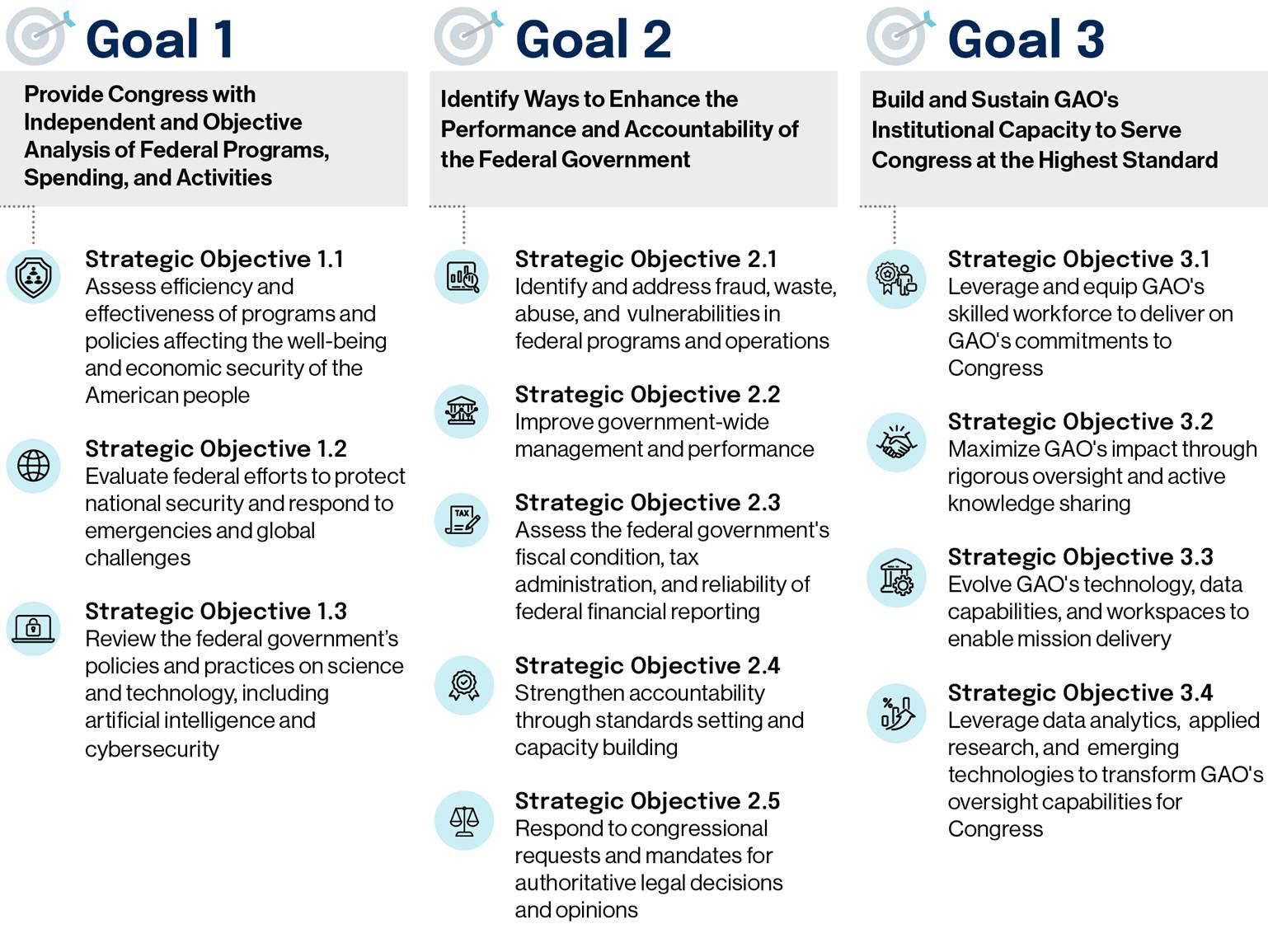
The Government Performance and Results Act of 1993 (GPRA), as amended, requires most federal agencies to develop strategic plans. GAO, as a legislative branch agency, is exempt from many federal management laws, including GPRA. However, we generally hold ourselves to the spirit of these laws. As such, we consider this strategic plan to include information comparable to what is required by GPRA.
This plan organizes our work under three Strategic Goals, each supported by Strategic Objectives and corresponding Performance Goals. We track progress in meeting these goals annually in GAO’s Performance and Accountability Report. This framework connects our day-to-day work to long-term outcomes in a way that is visible to Congress and the public.
To ensure this plan reflects congressional needs, we worked closely with our congressional clients throughout the planning process. We requested comments from our oversight committees and other congressional committees, the Comptroller General’s Advisory Board and other advisory bodies, the federal inspector general community, state and local audit organizations, and independent subject-matter experts. We also requested comments from the Congressional Budget Office and Congressional Research Service. Comments were reviewed and incorporated as appropriate.
October 2026
I am pleased to present GAO's Strategic Plan for Serving Congress and the Nation for fiscal years 2027 to 2032. We begin this planning period amid rapid changes in government and society: advances in emerging technology, including artificial intelligence, mounting financial pressures, a shifting national and global security environment, and intensifying cybersecurity threats. Against this backdrop, Congress needs GAO’s objective, fact-based, nonpartisan analysis to make policy decisions, oversee federal programs and operations, and address challenges and opportunities.
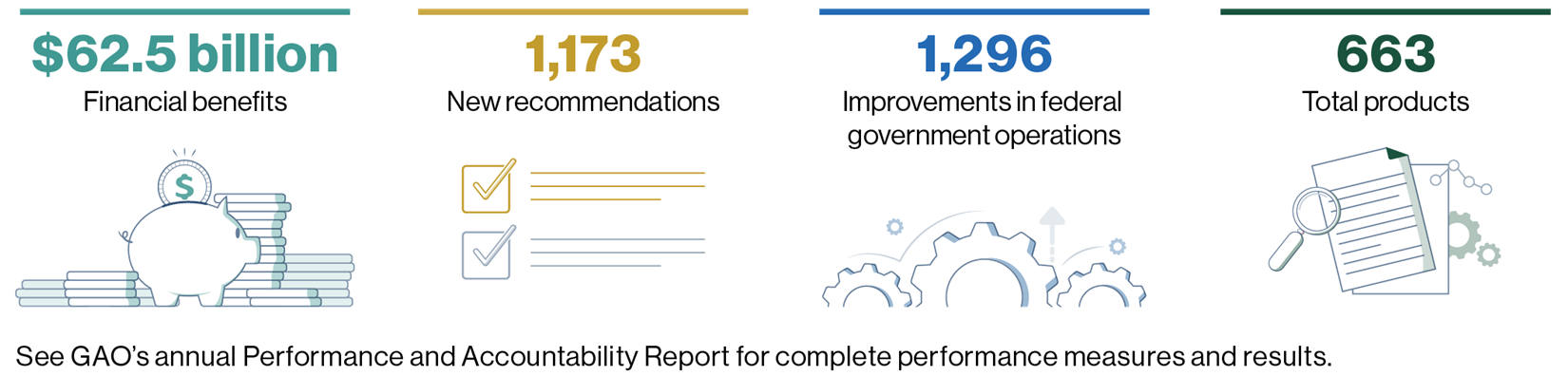
Our track record demonstrates our value and how we support Congress. In fiscal year 2026 alone, our work resulted in $62.5 billion in financial benefits. Our work has also helped Congress enact new laws, improve public safety, and strengthen government.
This plan articulates how we will continue to help Congress identify cost savings; address fraud, waste, and abuse; make government more accountable, efficient, and effective; and ultimately improve the safety, security, and well-being of the American people.
In the next 5 years, GAO’s work will help Congress:
· Address the growing national debt
· Prevent and combat fraud, waste, and abuse
· Monitor federal efforts to ensure the nation’s security from cyberattacks and other threats
· Draw attention to solutions for rising health care costs
· Evaluate national security activities
· Anticipate emerging science and technology trends, opportunities, and risks, including artificial intelligence
Our prior plan organized this work under four goals. This time, we have established three goals, better aligning with our cross-cutting approach. The first two goals focus on our oversight and foresight mission, covering the entire range of issues for our congressional clients. Our third goal focuses on how we will continue to improve our internal operations and increase efficiency by describing the skills, technology, human capital, and resources needed to achieve these goals.
We will continue to perform the in-depth audits, program evaluations, and policy analyses we are known for. We are also evolving and modernizing our products, services, and processes to ensure we provide Congress with timely and actionable analyses, advice, and recommendations on the most pressing issues facing the nation. We must be agile as congressional needs and priorities rapidly change and federal agencies reimagine how they carry out their missions using emerging technology.
This Strategic Plan reflects what we will do and how we will do it.
If you have any questions about this plan, please contact Stephen Sanford, Managing Director, Strategic Planning and External Liaison, who may be reached at SanfordS@gao.gov.
Sincerely,
Orice Williams Brown
Acting Comptroller General of the United States
The world in which Congress makes policy and conducts oversight is changing rapidly. Technological advances, economic and geopolitical shifts, and emerging risks are reshaping government and the challenges facing the nation. Congress needs timely, reliable, and fact-based information to understand what is happening today and what lies ahead.
Changes in geopolitics, emerging national security threats, and persistent cybersecurity risks will create new challenges for the nation and its government. Digital systems both generate and consume vast amounts of data, raising policy questions about responsible use, privacy, and security. Innovations in technology and science, increasingly driven by artificial intelligence, will continue to affect every policy area. Key sectors, such as energy and water systems, will face mounting challenges from evolving cybersecurity risks, aging infrastructure, and growing demands.
Disasters are testing the nation’s capacity to prepare for and respond to increasingly costly emergencies. Demographic shifts will create new pressures and demands on federal programs. Emerging technology will reshape jobs and employment. The nation’s economic security and well-being will depend on both safe, reliable, and resilient critical infrastructure and the stability of interconnected financial markets.
Coordination across federal, state and local governments will be increasingly important as responsibilities for service delivery and oversight shift among these levels of government. Alongside these trends, the federal government’s unsustainable fiscal outlook poses serious economic, national security, and societal challenges.
Our work will help Congress anticipate challenges and make informed decisions in a complex and dynamic time. In doing so, we will help Congress and the American people better understand and respond to the opportunities and challenges that shape our future.
GAO is an independent, nonpartisan professional services agency in the legislative branch. Often called the “congressional watchdog,” we advise lawmakers and agency leaders on how to make government work better. GAO was established under the Budget and Accounting Act of 1921 to investigate how public funds are spent. The act also requires us to report on our findings and recommend ways to increase efficiency in government spending.
By the Numbers: GAO’s Fiscal Year 2026 Key Accomplishments
We are comprised of about 3,200 employees with expertise and academic degrees in fields, including:
|
§ Accounting |
§ Law |
|
§ Budget policy |
§ National security |
|
§ Contracting and acquisition |
§ Physical science |
|
§ Economics |
§ Public health |
|
§ Engineering |
§ Public policy |
|
§ Finance |
§ Social science |
|
§ Human capital |
|
|
§ Information technology and cybersecurity |
|
Our workforce is geographically dispersed across headquarters in Washington, DC, and 11 field offices:
|
§ Atlanta |
§ Huntsville |
|
§ Boston |
§ Los Angeles |
|
§ Chicago |
§ Norfolk |
|
§ Dallas |
§ Oakland |
|
§ Dayton |
§ Seattle |
|
§ Denver |
|
Our nationally distributed workforce ensures that GAO provides oversight of federal programs and spending across the entire country.
Goal 1: Provide Congress with Independent and Objective Analysis of Federal Programs, Spending, and Activities
Goal 1 focuses on whether federal programs and policies are achieving their intended purposes. This work includes analyzing programs that affect citizens’ health and safety and federal policies related to science and technology, artificial intelligence, and cybersecurity.
As the nation confronts increasing health care costs, evolving labor markets, supply chain vulnerabilities, mounting fiscal pressure, an aging population, and threats from state and non-state actors, legislators face complex decisions. We will give Congress the crucial information it needs to assess what is working, what improvements need to be made, and what new realities will shape America’s future.
Strategic Objective 1.1: Assess Efficiency and Effectiveness of Programs and Policies Affecting the Well-Being and Economic Security of the American People
Performance Goals
§ 1.1.1: Assess federal programs and financing serving the health needs of Americans, including insurance markets, Medicare, Medicaid, Department of Veterans Affairs and Department of Defense health care, and public health preparedness.
§ 1.1.2: Assess federal efforts to improve kindergarten through 12th grade education, higher education programs, and workforce development programs for workers, youth, and veterans.
§ 1.1.3: Assess federal programs providing social services, economic assistance, and protections for workers, families, children, and individuals with disabilities, including veterans.
§ 1.1.4: Assess federal programs supporting the financial security of older adults, including Social Security, retirement income, and employer-sponsored retirement plans.
§ 1.1.5: Assess federal efforts to ensure a fair and effective justice system, including criminal prosecution, civil rights protections, corrections, and support for tribal, state, and local law enforcement.
§ 1.1.6: Assess federal programs for housing finance, affordable rental housing, homelessness assistance, community development, and small business support.
§ 1.1.7: Assess federal efforts to maintain an effective financial system and enforce consumer protections for financial products, services, and manufactured goods.
§ 1.1.8: Assess the federal role in natural resources management, environmental protection and cleanup, food safety, agriculture, and energy.
§ 1.1.9: Assess federal investments and policies supporting transportation, telecommunications, postal services, and federal property management.
§ 1.1.10: Assess the federal government’s efforts to fulfill its responsibilities to Tribes and Native Americans.
Strategic Objective 1.2: Evaluate Federal Efforts to Protect National Security and Respond to Emergencies and Global Challenges
Performance Goals
§ 1.2.1: Assess federal efforts to protect the homeland, including border security, terrorism prevention, transportation security, critical infrastructure protection, emergency preparedness, resiliency efforts, and disaster assistance.
§ 1.2.2: Assess military readiness, capabilities, and resource and business management to meet national security goals, including workforce; weapons systems acquisitions; logistics and sustainment; defense industrial base; nuclear forces and modernization; countering weapons of mass destruction; and preparedness for emerging threats and domains, including space and cyber operations.
§ 1.2.3: Assess federal efforts to address the national security implications of artificial intelligence, including risks posed by adversarial use, autonomous systems, and the integrity of artificial intelligence-enabled decision-making.
§ 1.2.4: Assess federal efforts to advance U.S. foreign policy and international economic interests, including counterterrorism and arms nonproliferation, foreign assistance, trade, diplomacy, export controls, and foreign investment.
§ 1.2.5: Assess the Intelligence Community’s management, workforce, and support for military, diplomatic, and national security operations.
Strategic Objective 1.3: Review the Federal Government’s Policies and Practices on Science and Technology, including Artificial Intelligence and Cybersecurity
Performance Goals
§ 1.3.1: Assess federal cybersecurity efforts, including establishing a national strategy, securing federal systems, protecting critical infrastructure, and ensuring the privacy of sensitive data.
§ 1.3.2: Identify and assess emerging science and technology issues through technology assessments and other products to enhance congressional knowledge and understanding, including policy implications.
§ 1.3.3: Assess the use and oversight of artificial intelligence, including evaluating associated risks, international competitiveness, and the effectiveness of artificial intelligence policy and regulatory frameworks governing its deployment.
§ 1.3.4: Assess federal information technology acquisition, management, and strategic planning, including portfolio oversight, implementation of leading development practices, emerging technology adoption, and technical workforce capacity.
§ 1.3.5: Assess the management and results of federal investment in science and technology, including those related to the workforce, intellectual property, global competitiveness, and innovation.
§ 1.3.6: Identify ways to improve management and execution of civilian space programs.
Effective government requires strong oversight and good management. Goal 2 focuses on protecting taxpayer dollars and helping government work better for the American people. We will help Congress address fraud, waste, and abuse at a time when oversight is especially important given our nation’s fiscal health. Outdated management structures, fragmentation, skills gaps, and uneven use of technology can make government less efficient. Persistent improper payments, vulnerabilities in high-risk programs, and gaps in internal controls cost taxpayers tens of billions of dollars each year and erode public trust in government.
Goal 2 charts a path toward more transparent, well-managed federal resources. Through this work, we help Congress ensure that government meets the needs of a changing nation.
Strategic Objective 2.1: Identify and Address Fraud, Waste, Abuse, and Vulnerabilities in Federal Programs and Operations
Performance Goals
§ 2.1.1: Identify ways to strengthen program integrity to reduce fraud, waste, and abuse in federal programs and operations.
§ 2.1.2: Perform audits to identify and address fraud, waste, and abuse throughout federal programs and operations.
§ 2.1.3: Conduct controls testing, vulnerability assessments, and investigations to identify weaknesses in federal programs and operations.
§ 2.1.4: Refer information that may indicate misconduct or wrongdoing to appropriate authorities and transmit information about internal control vulnerabilities to agency officials for action.
§ 2.1.5: Receive and process fraud, waste, and abuse allegations involving federal programs and operations submitted by the public, as well as government employees and contractors, through FraudNet.
§ 2.1.6: Identify threats facing the American public from scams and assess how federal actions could help counter that threat.
Performance Goals
§ 2.2.1: Assess efforts to improve the efficiency and effectiveness of federal results-oriented management and government-wide management reforms.
§ 2.2.2: Assess efforts to build an agile, skilled, and multidisciplinary federal workforce.
§ 2.2.3: Identify ways to improve federal acquisition of goods and services.
§ 2.2.4: Identify ways to improve distribution, administration, and management of federal funding, grants, and other assistance across all levels of government, including to Tribes, states, localities, and territories.
§ 2.2.5: Identify federal programs that are at high risk of fraud, waste, and abuse or need major transformation.
§ 2.2.6: Identify opportunities to reduce fragmentation, overlap, and duplication among federal programs and enhance cost savings or federal revenue.
§ 2.2.7: Identify ways to improve the quality, transparency, and usefulness of federal information and data to promote effectiveness, accountability, and efficiency of government operations.
§ 2.2.8: Identify and support utilization of best practices and frameworks to improve government-wide management and performance.
Strategic Objective 2.3: Assess the Federal Government’s Fiscal Condition, Tax Administration, and Reliability of Federal Financial Reporting
Performance Goals
§ 2.3.1: Assess the federal fiscal outlook, including budget factors, debt management, and agency budget decisions and operations.
§ 2.3.2: Assess the reliability of federal financial reporting, internal controls over financial reporting, and compliance with applicable laws, regulations, contracts, and grant agreements.
§ 2.3.3: Assess federal tax administration to inform congressional deliberations on tax policy and fiscal decisions.
§ 2.3.4: Assess efforts to reduce the tax gap and protect federal revenue.
§ 2.3.5: Identify opportunities to improve federal financial management and operations.
Performance Goals
§ 2.4.1: Update and disseminate Yellow Book standards used for government audits across all levels of government.
§ 2.4.2: Update and disseminate Green Book standards for internal controls required across the federal government.
§ 2.4.3: Collaborate and build capacity with government accountability organizations, including federal Inspectors General, state and local auditors, and audit institutions worldwide to strengthen oversight of federal spending across all levels of government and abroad.
§ 2.4.4: Develop, update, and disseminate guidance, frameworks, and standards addressing emerging and cross-cutting government-wide risk areas to strengthen accountability and oversight capacity.
Strategic Objective 2.5: Respond to Congressional Requests and Mandates for Authoritative Legal Decisions and Opinions
Performance Goals
§ 2.5.1: Adjudicate federal bid protests and issue decisions that protect the integrity of the federal acquisition process.
§ 2.5.2: Issue legal decisions on appropriations matters relating to the use of federal funds and compliance with statutory requirements.
§ 2.5.3: Issue legal decisions requested by Congress and required by law.
Goal 3: Build and Sustain GAO’s Institutional Capacity to Serve Congress at the Highest Standard
To meet Congress’s changing needs, GAO must continually transform.
Goal 3 focuses on ensuring GAO has the capacity to be an agile, innovative, and effective agency. We will strengthen our workforce, modernize our operations, and use emerging technologies to make our work more responsive to Congress. These areas also help us to address any internal challenges that the agency identifies and to prepare for the future.
We will also share our expertise with the broader government accountability community. Working with these entities allows us to both extend the impact of our oversight and learn new approaches. Together, these investments help us deliver the quality and timely work that our congressional clients and the American people rely on.
Strategic Objective 3.1: Leverage and Equip GAO’s Skilled Workforce to Deliver on GAO’s Commitments to Congress
Performance Goals
§ 3.1.1: Attract and retain a multidisciplinary workforce with the skills necessary to achieve operational excellence.
§ 3.1.2: Streamline hiring, particularly for technical and specialty areas such as data science, artificial intelligence, cybersecurity, and emerging technologies.
§ 3.1.3: Provide enterprise-wide learning and developmental opportunities that enhance analytical, cybersecurity, and artificial intelligence skills to improve technology readiness.
§ 3.1.4: Cultivate a workplace where all employees are valued, respected, and treated fairly.
Strategic Objective 3.2: Maximize GAO’s Impact Through Rigorous Oversight and Active Knowledge Sharing
Performance Goals
§ 3.2.1: Increase awareness and understanding of auditing standards and appropriations law principles throughout government, auditing organizations, the accountability and policy community, and the public.
§ 3.2.2: Support Congress’s constitutional responsibilities and Legislative Branch operations through active knowledge sharing with congressional agencies, committees, and administrative units.
§ 3.2.3: Maximize GAO’s impact and strengthen understanding of its nonpartisan, fact-based work through strategic external engagement and effective public communication.
§ 3.2.4: Continuously optimize resources and assets through strategic planning, foresight, change management, process improvement, and organizational agility to meet the evolving needs of Congress.
§ 3.2.5: Adopt data science and emerging technology solutions to enhance GAO’s products, processes, and programs to serve Congress and to support knowledge sharing.
Strategic Objective 3.3: Evolve GAO’s Technology, Data Capabilities, and Workspaces to Enable Mission Delivery
Performance Goals
§ 3.3.1: Champion a cybersecurity culture to safeguard data and systems, and to mitigate risk.
§ 3.3.2: Deliver reliable, customer-focused workspace and facilities solutions for staff and tenants.
§ 3.3.3: Utilize cloud and other technologies to provide resilient, scalable, and flexible environments that keep pace with mission needs.
§ 3.3.4: Continually improve our fiscal effectiveness through internal controls and financial management.
§ 3.3.5: Modernize and streamline purchasing mechanisms to enhance agility and achieve agency mission and operational requirements.
Strategic Objective 3.4: Leverage Data Analytics, Applied Research, and Emerging Technologies to Transform GAO’s Oversight Capabilities for Congress
Performance Goals
§ 3.4.1: Use the Innovation Lab to securely develop and test innovative ways to improve our audit and business processes to enhance our support of Congress.
§ 3.4.2: Develop and deploy innovative tools that enhance our responsiveness to Congress.
§ 3.4.3: Drive enterprise-wide adoption of innovative technology and enterprise analytics, including artificial intelligence, to enable GAO to more robustly support Congress.
§ 3.4.4: Expand enterprise data management and analytics to improve timeliness for Congress.
For more information on our organization and teams, see Our Teams.
Additional Information
This section contains credit and copyright information for images and graphics in this product, as appropriate, when that information was not listed adjacent to the image or graphic.
· GAO (bullseye); iconpower/stock.adobe.com (icons) [Goals and Strategic Objectives]
· GAO [By the Numbers]
GAO’s complete set of strategic planning and performance and accountability reports is available at https://www.gao.gov/about/what-gao-does/performance.
The fastest and easiest way to obtain copies of GAO documents at no cost is through our website: https://www.gao.gov. Each business day, GAO posts on its website newly released reports, testimony, correspondence, and other publications.
Contact Stephen Sanford, Managing Director, Strategic Planning and External Liaison, SanfordS@gao.gov.
Connect with GAO
Connect with GAO on Facebook, X, LinkedIn, BlueSky, Threads, Instagram, YouTube, and Flickr.
Subscribe to our Email Updates. Listen to our Podcasts.
Visit GAO on the web at https://www.gao.gov.
Contact FraudNet.
Website: https://www.gao.gov/about/what-gao-does/fraudnet
Automated answering system: (800) 424-5454
Sarah Kaczmarek, Managing Director, Media@gao.gov
David Powner, Acting Managing Director, CongRel@gao.gov
Website: https://www.gao.gov/about/contact-us